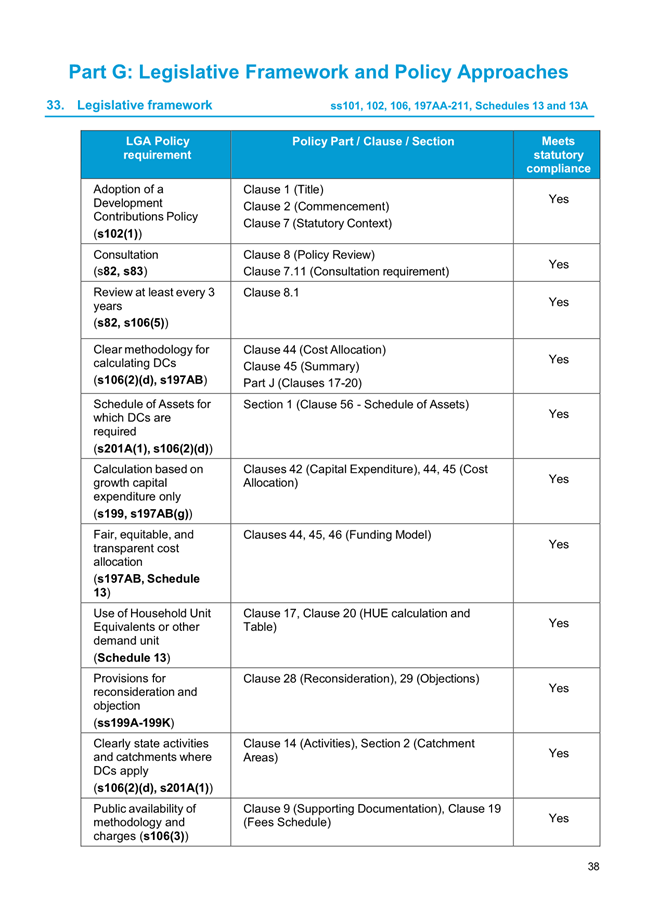
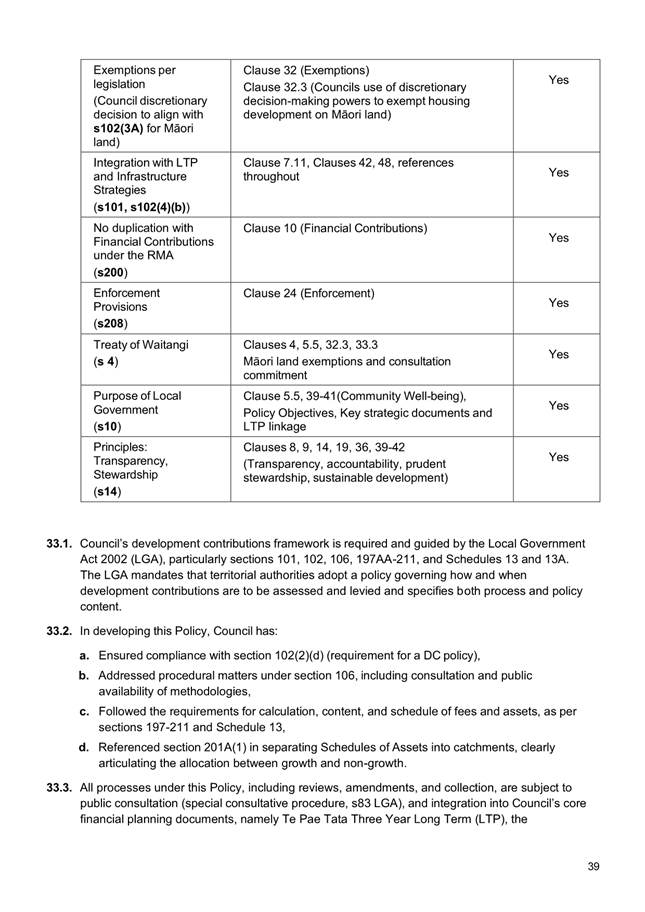
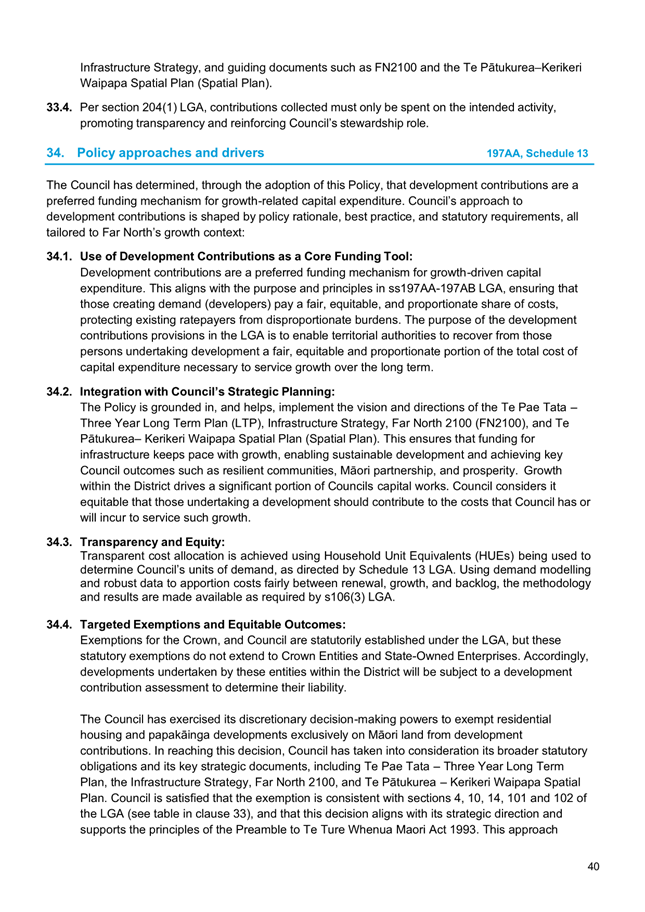
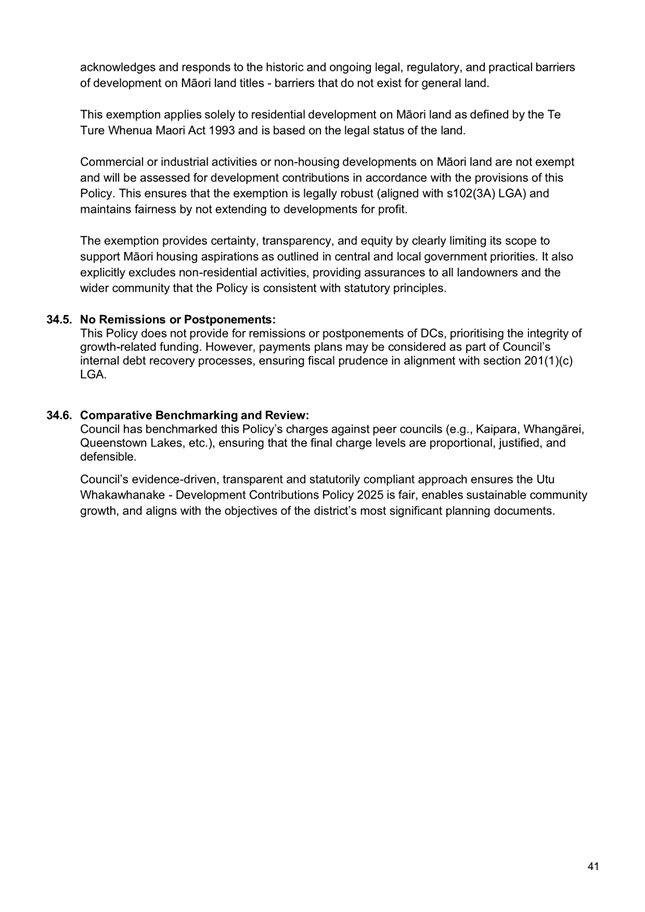
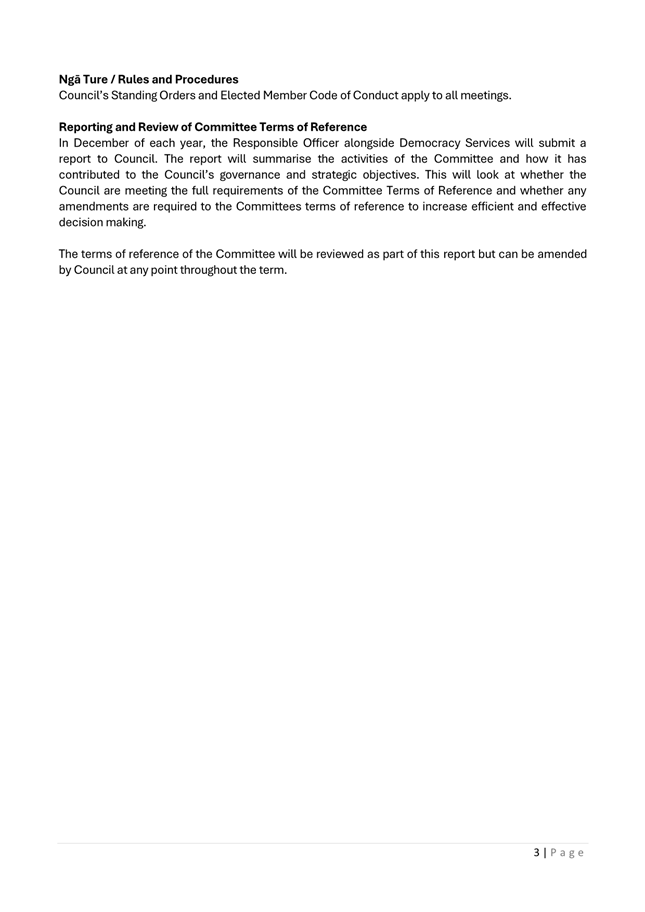
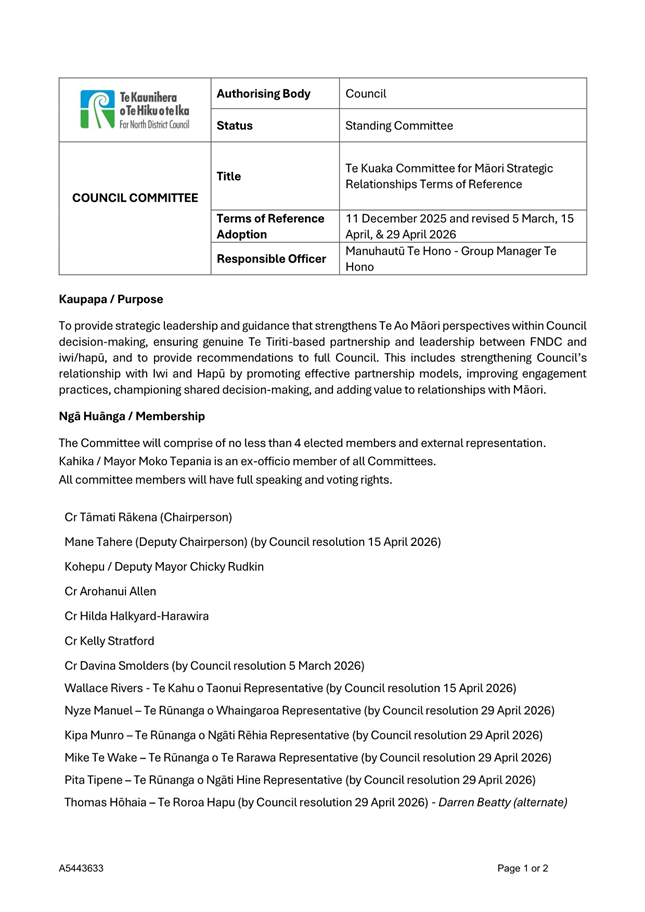
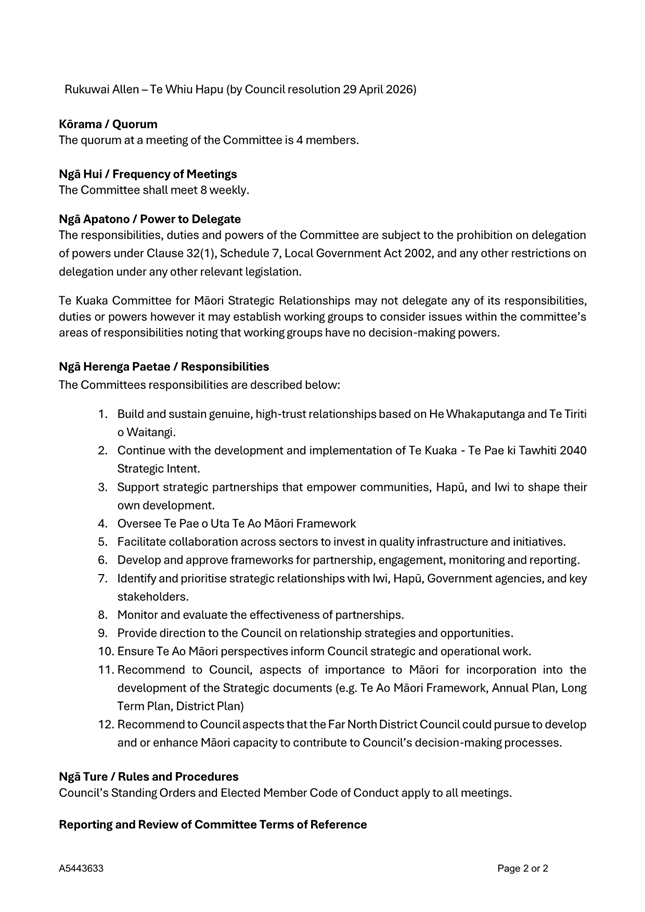
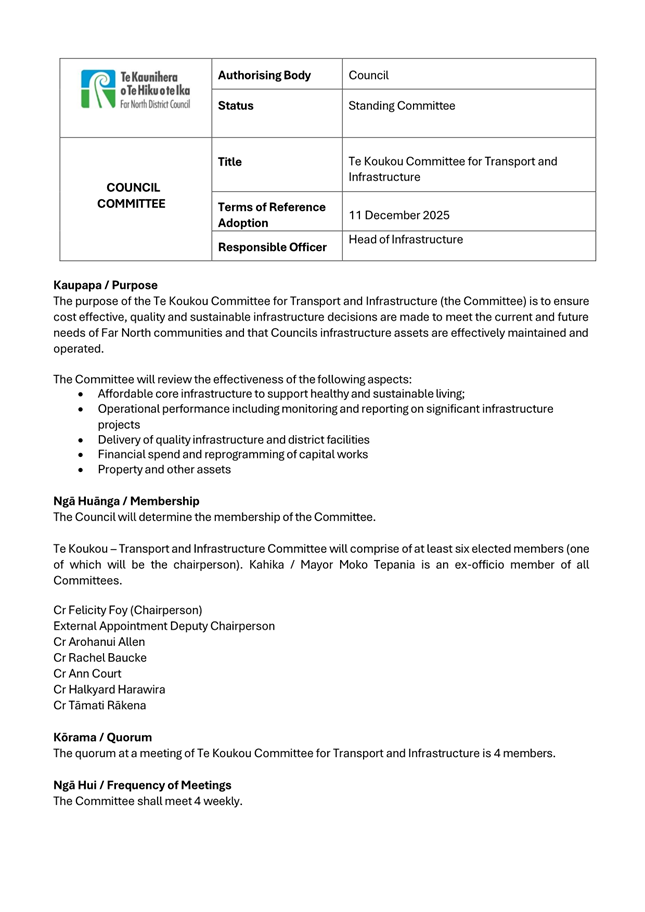
|
AGENDA
|
|
|
|
Ordinary Council Meeting
|

|
Membership:
Kahika
- Mayor Moko Tepania - Chairperson
Kohepu
- Deputy Mayor Chicky Rudkin
Cr
Arohanui Allen
Cr
Rachel Baucke
Cr Ann
Court
Cr
Felicity Foy
Cr
Hilda Halkyard-Harawira
Cr
Tāmati Rākena
Cr
Davina Smolders
Cr
Kelly Stratford
Cr
John Vujcich
|
|
Wednesday, 22 July 2026
|
|
Time: 10:00 AM
|
|
Council Chamber
Memorial Ave
Kaikohe
|
Far
North District Council Values
The Code of Conduct is designed to give effect to the
following values:
1.
Public interest: members will serve the best interests of the
people within their community, district or region and discharge their duties
conscientiously, to the best of their ability.
2.
Public trust: members, in order to foster community
confidence and trust in their Council, will work together constructively and
uphold the values of honesty, integrity, accountability and transparency;
3.
Ethical behaviour: members will not place themselves in
situations where their honesty and integrity may be questioned, will not behave
improperly and will avoid the appearance of any such behaviour;
4.
Objectivity: members will make decisions on merit; including
appointments, awarding contracts, and recommending individuals for rewards or
benefits.
5.
Respect for others: will treat people, including other
members, with respect and courtesy, regardless of their race, age, religion,
gender, sexual orientation, or disability. Members will respect the
impartiality and integrity of officials;
6.
Duty to uphold the law: members will comply with all
legislative requirements concerning their role, abide by this Code of Conduct,
and act in accordance with the trust placed in them by the public;
7.
Equitable contribution: members will take all reasonable
steps to ensure they fulfil the duties and responsibilities of office,
including attendance at meetings and workshops, background reading, attendance
at civic events, and participation in relevant training seminars organised by
the Council.
8. Leadership:
members will actively promote and support these principles and ensure they are
reflected in the way in which the Council operates including regular review and
assessment.
These values complement, and work in conjunction with, the
principles of s.14 of the LGA 2002 and the governance principles of s.39 of the
LGA 2002.
1 Karakia
Tīmatanga / Opening Prayer
Ka tuku mātou kia kaha mai ngā māngai kua
whiriwhirihia mō Te Kaunihera o Te Hiku o te Ika ki te mahi me te
ngākau auaha me te whakamahi i ngā pūkenga me te mātauranga
i roto i ngā wānanga me ngā whakataunga kia whakatūria ai
tētahi Hapori e matatika ana, e tū kotahi ana ka mutu ka whakapiki anō
i te oranga o tō tātou rohe, ka whakatau anō i ngā take o
te rohe i runga i te tika me te pono.
We ask that through Council discussions and decisions the
representatives we have elected may govern the Far North District with
imagination, skill and wisdom to achieve a fairer and more united Community
that enhances the wellbeing of our district and solves the District’s
problems efficiently and effectively.
2 Ngā
Whakapāha Me Ngā Pānga Mema / Apologies and Declarations of
Interest
Members need to
stand aside from decision-making when a conflict arises between their role as a
Member of the Council and any private or other external interest they might
have. This note is provided as a reminder to Members to review the matters on
the agenda and assess and identify where they may have a pecuniary or other
conflict of interest, or where there may be a perception of a conflict of
interest.
If a Member
feels they do have a conflict of interest, they should publicly declare that at
the start of the meeting or of the relevant item of business and refrain from
participating in the discussion or voting on that item. If a Member thinks they
may have a conflict of interest, they can seek advice from the Chief Executive
Officer or the Manager - Democracy Services (preferably before the meeting).
It is noted that while members can seek advice the final
decision as to whether a conflict exists rests with the member.
Elected
Member - Register of Interests
3 Ngā
Tono Kōrero / Deputations
No requests for deputations were received at the time of the
Agenda going to print.
4 Ngā
Kōrero A Te Kahika / Mayoral Announcements
5 He
Pānui Whakamōtini / Notice of Motion
5.1 Notice
of Motion - Cr Smolders - Mana Whakahono ā Rohe Agreement
File
Number: A5867767
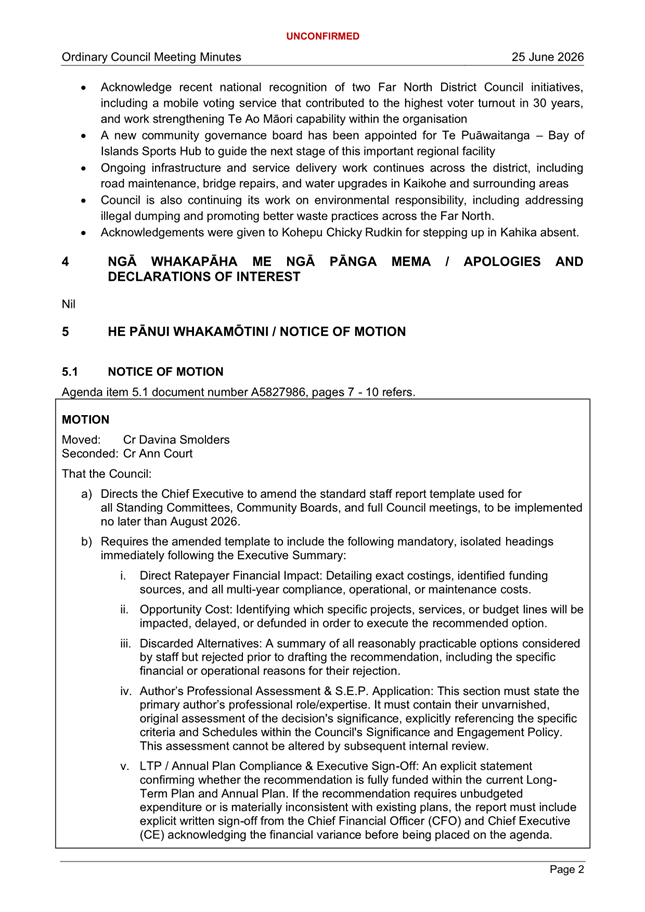
I, Councillor Davina Smolders, give notice that at the next
Ordinary Meeting of Council to be held on 22 July 2026, I intend to move the
following motion:
|
MŌtini / Motion
That
Council resolves to:
a) Confirm that no proposed Mana Whakahono ā
Rohe Agreement shall be executed until the Far North District Council has
complied with the decision-making requirements of the Local Government
Act 2002 and the Far North District Council Significance and
Engagement Policy.
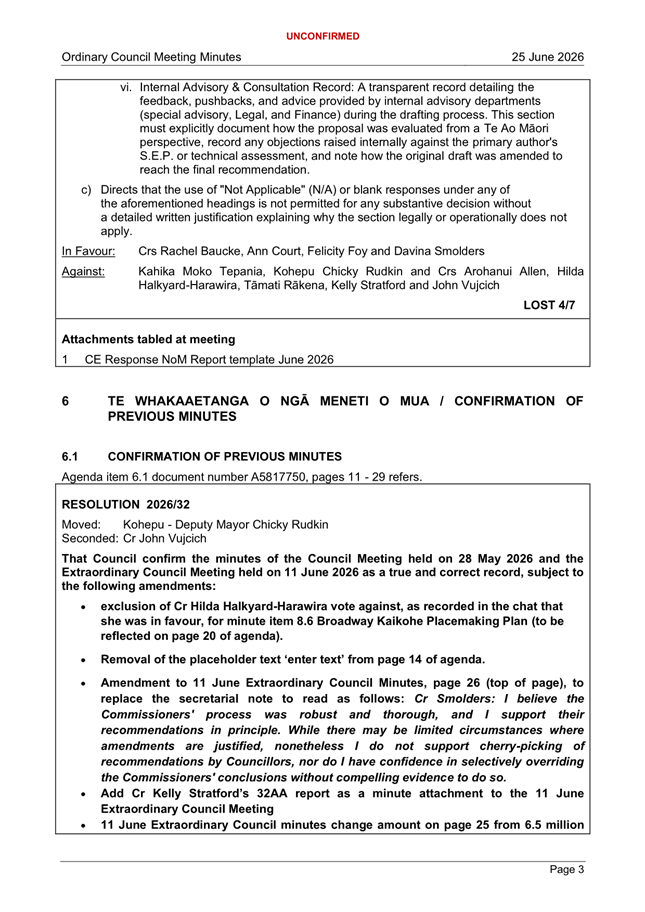
b) Direct
the Chief Executive to undertake and publicly release a formal Significance
Assessment for each proposed Mana Whakahono ā Rohe Agreement before
Council considers whether to execute those agreements, consistent with the
Significance and Engagement Policy, which requires significance to be
determined before decision-making occurs.
c) Direct
the Chief Executive to publicly release each draft Mana Whakahono ā Rohe
Agreement, before Council considers whether to execute any agreement.
d) Direct
the Chief Executive to report to Council, following completion of the
Significance Assessment, identifying:
· the
significance rating assigned to each proposed agreement;
· the
reasons supporting that assessment;
· the
provisions of the Significance and Engagement Policy relied upon;
· whether
the proposal is considered to be of Low, Medium or High Significance;
· the
recommended level of public engagement; and
· whether
a Special Consultative Procedure has been considered and, if not
recommended, the reasons for that recommendation.
e) If
Council determines, having considered the Significance Assessment, that any
proposed Mana Whakahono ā Rohe Agreement is of Medium or High
Significance, direct the Chief Executive to undertake the level of public
engagement required under the Far North District Council Significance and
Engagement Policy before Council makes any decision on whether to execute
that agreement.
f) If
Council determines that any proposed Mana Whakahono ā Rohe Agreement is
of High Significance, resolve that it is prudent to undertake a Special
Consultative Procedure before deciding whether to execute that agreement.
g) Direct
the Chief Executive to provide a governance report to Council, prior to
execution of any Mana Whakahono ā Rohe Agreement, confirming:
· compliance
with the Resource Management Act 1991;
· compliance
with the Local Government Act 2002;
· compliance
with the Far North District Council Significance and Engagement Policy;
· the
estimated financial implications of each agreement;
· any
ongoing governance, operational or financial obligations created by each
agreement;
· any
identified legal, reputational or operational risks associated with entering
into the agreement; and
· any
implications for future councils arising from the agreement.
h) Confirm
that this Notice of Motion does not seek to prevent or delay the statutory
negotiation of Mana Whakahono ā Rohe Agreements under the Resource
Management Act 1991, but seeks to ensure that any decision to execute those
agreements is made transparently, lawfully, and in accordance with the Far
North District Council's adopted governance framework.
i) Receive a legal
opinion from independent external counsel (not previously involved in the
negotiation of the agreements) confirming that the proposed decision-making
process complies with the Local Government Act 2002, the Resource Management
Act 1991 and the Far North District Council Significance and Engagement
Policy before any Mana Whakahono ā Rohe Agreement is executed.
|
Context and Discussion | Horopaki ngā kōrerorero
Executive
Summary
This
Notice of Motion is not intended to oppose Mana Whakahono ā Rohe (MWaR)
Agreements, nor does it question the Far North District Council's statutory
obligation under the Resource Management Act 1991 to negotiate such agreements
with Iwi authorities.
Rather,
this Notice of Motion seeks to ensure that, before Council decides whether to
execute six proposed Mana Whakahono ā Rohe Agreements, it has complied
with the statutory decision-making framework established by the Local
Government Act 2002 and the Far North District Council's adopted Significance
and Engagement Policy.
The
execution of six enduring statutory relationship agreements has the potential
to create governance, operational and financial obligations extending beyond
the current electoral term. Whether those implications are ultimately assessed
as being of Low, Medium or High Significance is a matter that should be
determined through Council's adopted Significance and Engagement Policy before
any decision to execute the agreements is made.
This
Notice of Motion does not seek to predetermine the outcome of that assessment.
Instead, it seeks to ensure that Council follows the governance framework it
has adopted for itself and that elected members are provided with sufficient
information to make an informed decision.
Transparent
decision-making benefits everyone. It benefits Iwi and hapū by
strengthening the legitimacy and durability of the agreements.
It
benefits Council by demonstrating compliance with its statutory obligations.
It
benefits the wider community by providing confidence that significant
governance decisions have been made openly, consistently and in accordance with
Council's adopted policies.
Purpose of this Notice of Motion
The
purpose of this Notice of Motion is to ensure that the Far North District
Council demonstrates compliance with its statutory governance obligations
before deciding whether to execute the proposed Mana Whakahono ā Rohe
Agreements.
Specifically,
this Notice of Motion seeks to ensure that:
· Council has complied with the Local Government Act 2002
decision-making framework;
· Council has properly applied its adopted Significance and
Engagement Policy;
· Elected members receive sufficient information to
understand the governance, financial and operational implications of the
proposed agreements;
· The significance of each proposed agreement is assessed
before any decision is made;
· The level of community engagement is determined in
accordance with Council's adopted Significance and Engagement Policy; and
· Any decision to execute the agreements is supported by a
transparent and demonstrably robust governance process.
Importantly,
this Notice of Motion is directed at the process by which Council reaches its
decision, rather than the merits of any individual Mana Whakahono ā Rohe
Agreement. Nothing in this Notice of Motion seeks to prevent Council from
fulfilling its statutory obligations under the Resource Management Act 1991.
Rather,
it recognises that compliance with the Resource Management Act and compliance
with the Local Government Act 2002 are complementary obligations that should
operate together.
Background
The Far
North District Council is presently negotiating six proposed Mana Whakahono
ā Rohe Agreements, comprising five agreements with iwi and one agreement
with a hapū.
Mana
Whakahono ā Rohe Agreements are statutory relationship agreements provided
for under the Resource Management Act 1991. They establish how local
authorities and iwi authorities will work together on matters arising under
that Act.
The
Resource Management Act requires local authorities to enter into negotiations
where an Iwi authority requests such an agreement.
This
statutory obligation is recognised and accepted.
However,
while the Resource Management Act establishes the obligation to negotiate, it
does not remove Council's separate obligations under the Local Government Act
2002 to make informed governance decisions, nor does it displace Council's
obligation to apply its adopted Significance and Engagement Policy when
determining how significant proposals should be assessed before decisions are
made.
Accordingly,
the issue before Council is not whether negotiations should occur.
The
issue is whether Council has demonstrated that it has complied with its own
governance framework before deciding whether to execute agreements that may
create enduring obligations extending beyond the current Council.
Current Position
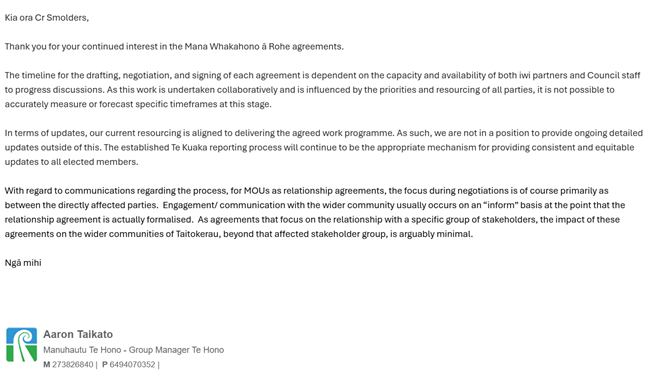
Through
correspondence with elected members, the Group Manager – Te Hono, Mr
Aaron Taikato, advised that:
"Engagement/communication
with the wider community usually occurs on an 'inform' basis at the point that
the relationship agreement is actually formalised."
Mr
Taikato further advised that:
"As
agreements that focus on the relationship with a specific group of
stakeholders, the impact of these agreements on the wider communities of
Taitokerau, beyond that affected stakeholder group, is arguably minimal."
Those
comments are important because they explain the current operational approach
proposed by Council staff.
This
Notice of Motion does not question the professionalism of that advice, nor does
it suggest that staff have acted other than in accordance with their
understanding of the relevant statutory framework.
However,
the conclusions expressed in that correspondence raise governance questions
that properly fall within the responsibilities of elected members rather than
staff alone.
In
particular, the conclusion that the agreements have only "arguably
minimal" impacts on the wider community has not, to date, been supported
by a Significance Assessment undertaken in accordance with Council's adopted
Significance and Engagement Policy.
Similarly,
the proposed approach of informing the wider community only after the
agreements have been formalised differs from the sequence contemplated by the
Significance and Engagement Policy, which requires significance to be assessed
before decisions are made and provides for public engagement, where
appropriate, before Council reaches its decision.
The
purpose of this Notice of Motion is therefore not to reject the operational
advice provided by staff.
Rather,
it is to ensure that Council, as the governing body, satisfies itself that the
statutory decision-making framework established by Parliament and reinforced
through Council's own policies has been properly applied before deciding
whether to execute the proposed agreements.
Why This Matters
The
proposed Mana Whakahono ā Rohe Agreements are not ordinary operational
documents.
They are
intended to establish enduring statutory relationships between the Far North
District Council and Iwi or hapū that will continue beyond the term of the
present Council.
The
existing Ngāpuhi Mana Whakahono ā Rohe Agreement illustrates that
such agreements may include ongoing governance arrangements, operational
commitments, agreed engagement processes, dispute resolution mechanisms and
future implementation obligations.
Whether
the proposed agreements ultimately create obligations of sufficient
significance to require public engagement is a matter that should be determined
through Council's adopted Significance and Engagement Policy.
That
determination should occur before Council decides whether to execute the
agreements.
The
purpose of this Notice of Motion is to ensure that the governing body has
confidence that this process has been followed and that the reasons supporting
Council's decision are transparent, well documented and capable of public
scrutiny.
Statutory Decision-Making Framework
The
Relationship Between the Resource Management Act 1991 and the Local Government
Act 2002
The
proposed Mana Whakahono ā Rohe Agreements arise under the Resource
Management Act 1991 (RMA), while the decision to execute those agreements is
made by the Far North District Council under the governance framework
established by the Local Government Act 2002 (LGA).
These
statutes perform different, but complementary, functions.
The
Resource Management Act establishes the legal mechanism through which Mana
Whakahono ā Rohe Agreements may be negotiated and provides that where an
iwi authority requests such an agreement, the local authority must enter into
negotiations.
Local
Government Act establishes how the governing body of a local authority is to
make decisions on behalf of its community. Accordingly, the statutory
obligation to negotiate under the Resource Management Act does not replace,
limit or remove Council's obligations under the Local Government Act when
deciding whether to execute the negotiated agreements.
Council
must comply with both statutory frameworks.
This
Notice of Motion therefore does not question Council's obligation to negotiate.
Rather,
it seeks assurance that Council has complied with its separate governance
obligations before deciding whether to execute the proposed agreements.
Purpose of Local Government
Section
10 of the Local Government Act provides that one of the purposes of local
government is to enable democratic local decision-making and action by, and on
behalf of, communities. That purpose provides the foundation for every decision
made by Council.
The
execution of six statutory agreements intended to establish enduring
relationships between Council and Iwi or hapū is not merely an operational
matter.
It is a
governance decision made on behalf of the people of the Far North District.
Consequently,
the process by which that decision is reached should reflect the democratic
decision-making framework established by Parliament.
Role of the Governing Body
Section
11 of the Local Government Act provides that the role of a local authority is
to give effect to the purpose of local government. That role requires elected
members to govern on behalf of both present and future communities.
Unlike
routine operational matters, the proposed Mana Whakahono ā Rohe Agreements
are intended to continue beyond the current electoral term.
Future
councils may inherit the governance arrangements, operational expectations and
relationship commitments established through these agreements.
For that
reason, elected members should be satisfied that the statutory governance
process has been fully completed before deciding whether the agreements should
be executed.
Principles of Local Government
Section
14 of the Local Government Act establishes the principles under which local
authorities are expected to conduct their business. Among those principles are
that local authorities should conduct their business in an open, transparent
and democratically accountable manner.
Those
principles are directly relevant to the subject of this Notice of Motion.
The
purpose of this Notice of Motion is not to revisit Parliament's decision to
provide for Mana Whakahono ā Rohe Agreements. Nor is it to question the
importance of constructive relationships between Council and Iwi or hapū.
Instead, it seeks to ensure that the decision to execute those agreements is
reached through a process that reflects the statutory principles of openness,
transparency and democratic accountability.
For the
avoidance of doubt, Council’s decision-making obligations arise under the
Local Government Act 2002, including:
· section 76,
which requires every Council decision to be made in accordance with the
applicable decision-making provisions;
· section 76AA,
which requires Council to have a Significance and Engagement Policy and to
identify when and how communities can expect to be engaged;
· section 77,
which requires Council to identify reasonably practicable options and assess
their advantages and disadvantages;
· section 78,
which requires Council to consider the views and preferences of persons likely
to be affected by, or interested in, the matter;
· section 79,
which requires the extent of analysis, information, and engagement to be
proportionate to the significance of the matter;
· section 80,
which requires Council to clearly identify and explain any decision that is
significantly inconsistent with Council policy;
· section 82,
which sets out the principles of consultation;
· section 83,
which sets out the special consultative procedure where required or where
Council considers it prudent.
Decision-Making Responsibilities
The
Local Government Act establishes a structured decision-making framework
intended to ensure that elected members make informed governance decisions.
That
framework requires Council to:
· obtain sufficient information appropriate to the
significance of the proposal;
· identify the reasonably practicable options;
· consider the advantages and disadvantages of those options;
· understand the consequences of the proposed decision; and
· adopt a decision-making process that is proportionate to
the significance of the matter under consideration.
These
obligations exist to assist elected members in exercising independent
governance judgement.
The
proposed Mana Whakahono ā Rohe Agreements establish enduring statutory
relationships capable of influencing future governance arrangements and
operational practices.
Accordingly,
this Notice of Motion seeks confirmation that the decision-making process
adopted by Council is proportionate to the significance of the proposed
agreements.
Council's Significance and Engagement Policy
The
Local Government Act requires every local authority to adopt a Significance and
Engagement Policy.
The Far
North District Council has fulfilled that statutory obligation through its
adopted Significance and Engagement Policy.
Importantly,
the Policy is not simply an internal administrative guideline. It is a
governance instrument adopted pursuant to statutory requirements. Its purpose
is to provide elected members and the community with a transparent framework
for determining:
· the significance of proposals;
· the level of community engagement appropriate to those
proposals; and
· the process by which significant governance decisions
should be made.
The
Policy expressly provides that significance should be assessed before
decision-making occurs.
It
further provides that proposals assessed as Medium or High Significance should
be subject to an appropriate level of community engagement before Council
reaches its decision. These provisions establish the governance sequence that
Council has adopted for itself.
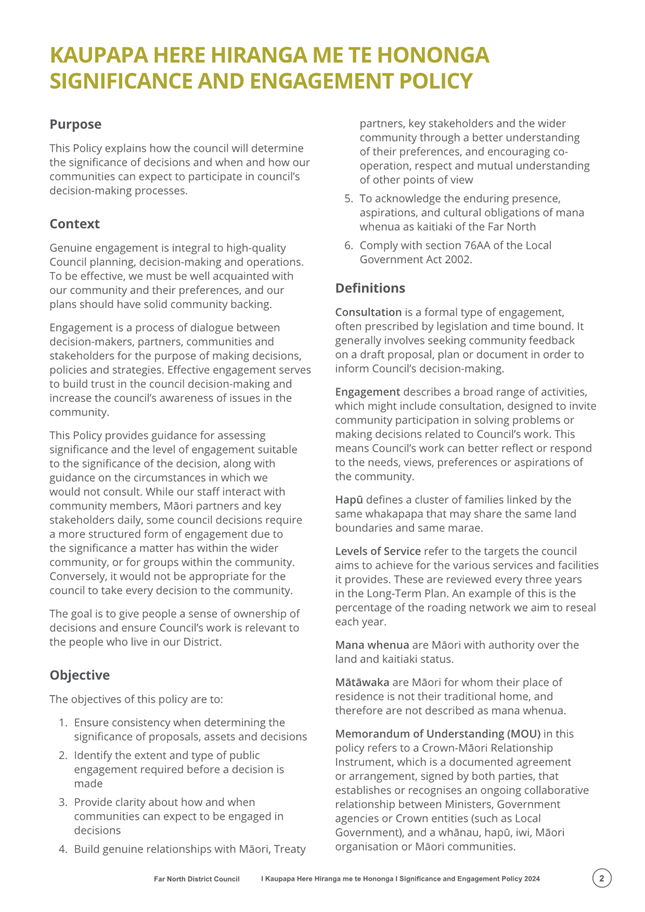
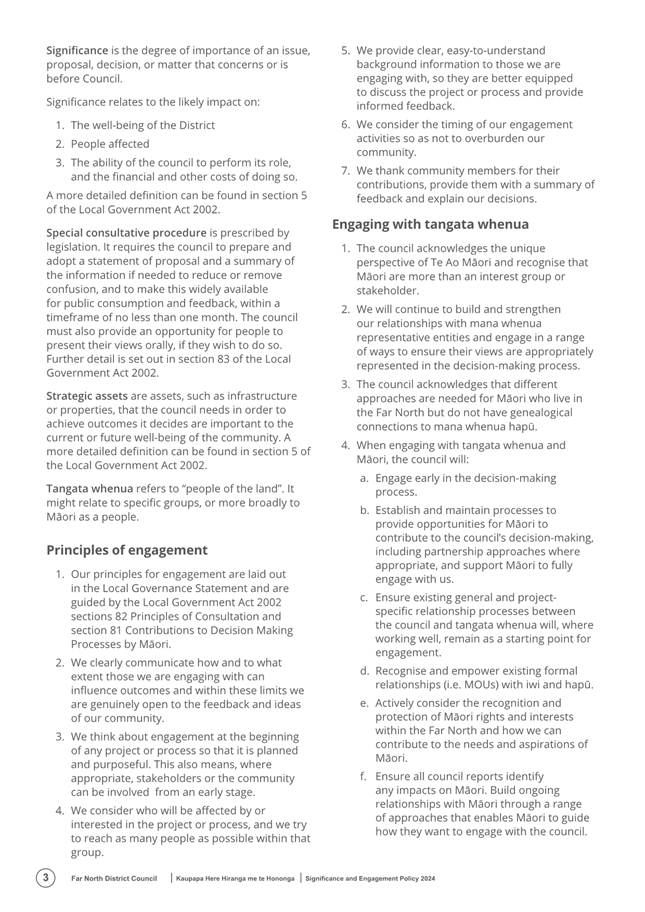
Significance & Engagement with the Ngāpuhi MWaR
That
Council notes that the Ngāpuhi Mana Whakahono ā Rohe agreement was
previously assessed as having medium significance. Under
Council’s Significance and Engagement Policy, a proposal assessed as
medium or high significance requires some form of community engagement before
the decision is made.
Council
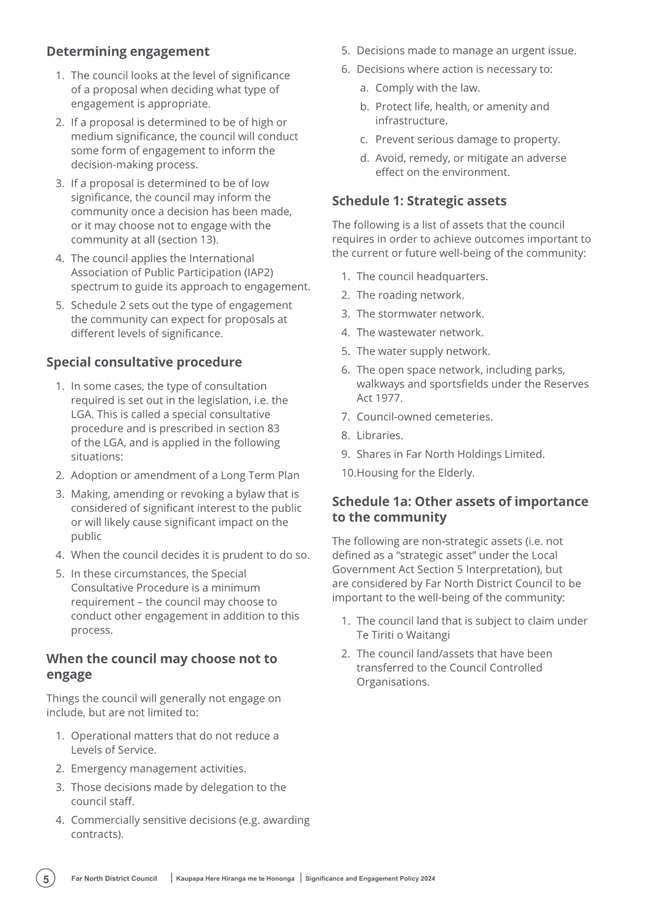
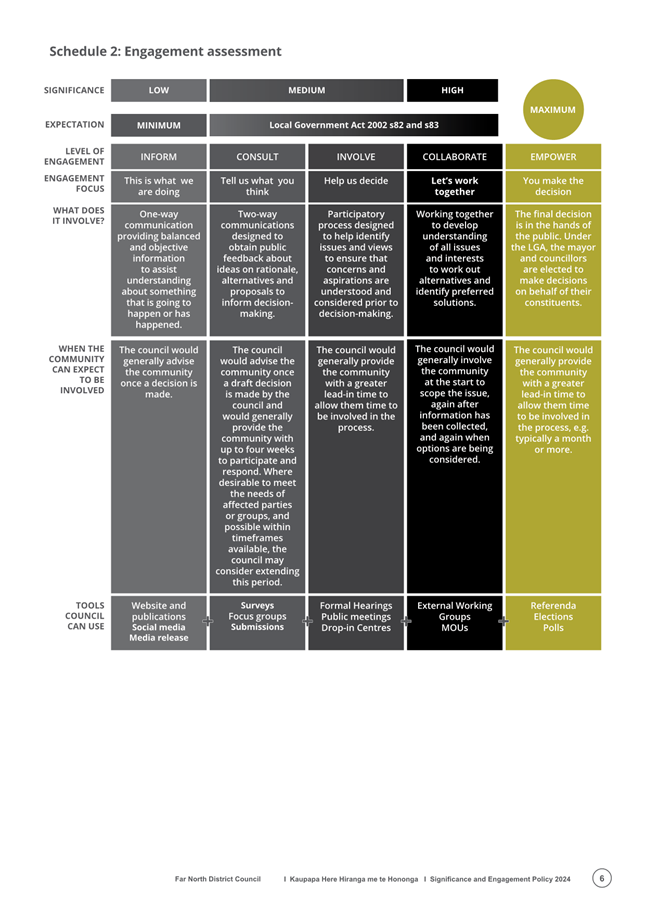
further notes that Schedule 2 of the Significance and Engagement Policy
provides that medium significance involves advising the community once a draft
decision is made and generally providing up to four weeks for the community to
participate and respond.
Council
therefore considers that any future Mana Whakahono ā Rohe agreement,
memorandum of understanding, mana-enhancing agreement, relationship agreement,
or similar arrangement with iwi or hapū must NOT be
assessed at a lower level of significance than the Ngāpuhi agreement
unless clear written reasons are provided to elected members and the public.
Given
that Council's previous approval of the Te Rūnanga ā Iwi o
Ngāpuhi Mana Whakahono ā Rohe Agreement was assessed as having medium
significance, we also note that despite that assessment:
· no
public consultation was undertaken prior to the agreement being approved;
· no
Special Consultative Procedure was initiated;
· no
publicly available Chief Financial Officer assessment of the long-term
financial implications has been identified; and
· the
agreement was approved without the community having an opportunity to consider
or comment on its ongoing governance, financial and operational implications.
The
experience of the Ngāpuhi agreement highlights the need for a clear and
consistent process before any further Mana Whakahono ā Rohe agreements are
executed.
Where
proposed agreements create enduring obligations, influence Council
decision-making, establish ongoing work programmes, commit Council resources,
or have potential financial implications for future ratepayers, elected members
should receive a documented significance assessment, a financial assessment of
the long-term costs and liabilities, and advice confirming whether community
engagement is required under the Council's Significance and Engagement Policy
and the Local Government Act 2002.
Ratepayer Neutrality
Council
also needs to note its obligation to maintain ratepayer neutrality.
This means that where an agreement creates obligations, funding expectations,
service commitments, staff resourcing requirements, dispute resolution costs,
consultation costs, land or asset implications, or preferential access to
Council processes, those costs and advantages must be clearly identified and
assessed before the agreement is signed.
Ratepayer
neutrality requires that one group’s agreement with Council must not
impose hidden, unquantified, or unfair costs on general ratepayers without
transparent assessment, public visibility, and elected-member approval.
Why the Policy Matters
The
significance of the proposed Mana Whakahono ā Rohe Agreements is presently
a matter of differing opinion.
Council
staff have expressed the view that the wider community impacts are arguably
minimal.
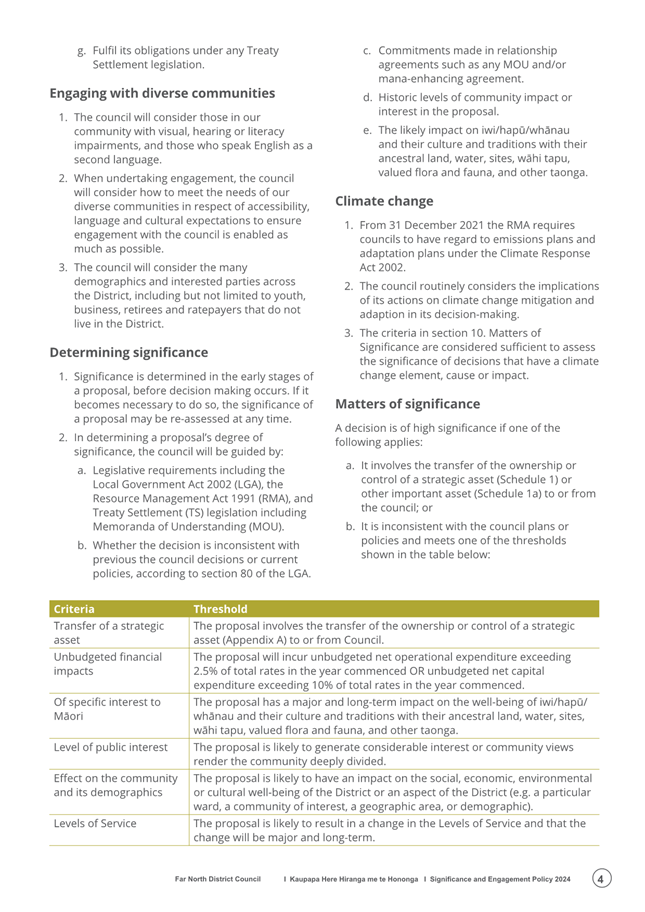
Members of the community have
expressed the contrary view and in determining significance, the policy
expressly states that the Council will be guided by:
d.
Historic levels of community impact or interest in the proposal.
This
Notice of Motion deliberately does not seek to determine which view is correct.
Instead,
it submits that the purpose of Council's Significance and Engagement Policy is
to provide an objective process through which that question can be answered.
The
Policy exists precisely because significant proposals should not rely solely
upon subjective judgement.
Rather,
proposals should be assessed against objective criteria adopted by Council
itself. That process promotes consistency, transparency and public confidence
in Council's governance.
Existing Māori Representation and the Importance of Public
Confidence
The Far
North District Council has deliberately established governance arrangements
that ensure significant Māori participation in local government.
These
arrangements include Māori ward representation, Te Kuaka –
Māori Strategy Committee, dedicated organisational capability through Te
Hono, and ongoing statutory engagement with iwi and hapū.
In
addition, a number of elected members bring valuable lived experience,
whakapapa connections and longstanding relationships with Iwi and hapū
within the district. Those perspectives are an important and legitimate part of
representative local government and contribute to informed decision-making.
However,
the existence of strong Māori representation within Council's governance
structures does not reduce the importance of broader public confidence in the
decision-making process.
On the
contrary, where Council is considering enduring statutory agreements with
organisations that are already closely engaged in Council's governance, it
becomes even more important that the governing body can demonstrate that it has
followed its adopted Significance and Engagement Policy in a transparent and
consistent manner.
The
purpose of public engagement is not to diminish Māori participation or
question the legitimacy of those relationships.
Rather,
it is to ensure that all communities can have confidence that significant
governance decisions have been reached through the process that Council has
adopted for itself.
Accordingly,
this Notice of Motion seeks to ensure that the significance of the proposed
Mana Whakahono ā Rohe Agreements is formally assessed and that the
appropriate level of community engagement is determined before Council decides
whether to execute those agreements.
The Governance Decision Before Council
The
central question before Council is not whether the Resource Management Act
requires negotiations to occur. It clearly does.
The
governance question is different.
Before
deciding whether to execute six enduring statutory agreements, Council should
be satisfied that:
· the significance of each proposed agreement has been
formally assessed;
· the statutory decision-making obligations under the Local
Government Act have been met;
· the Significance and Engagement Policy has been properly
applied;
· elected members have sufficient information to understand
the governance, financial and operational implications of the proposed
agreements; and
· the appropriate level of public engagement has been
determined before any decision is made.
Only
once those matters have been addressed can Council confidently determine
whether the proposed agreements should be executed.
Conclusion
This
Notice of Motion does not seek to prevent the negotiation of Mana Whakahono
ā Rohe Agreements. Nor does it seek to determine whether the proposed
agreements should ultimately be executed. Rather, it asks Council to
demonstrate that it has first complied with its own adopted Significance and
Engagement Policy before making that decision.
The Far
North District Council adopted the Significance and Engagement Policy to
provide a transparent and consistent framework for determining the significance
of proposals and the level of community engagement required before significant
decisions are made.
That
Policy requires significance to be assessed before Council reaches its
decision. It also establishes that proposals assessed as Medium or High
Significance require an appropriate level of public engagement before a
decision is made.
The
proposed Mana Whakahono ā Rohe Agreements are capable of creating enduring
governance relationships, ongoing operational commitments and future financial
implications extending beyond the life of the present Council. Significance
under the Policy specifically relates to the likely impact on “the
ability of the council to perform its role, and the financial and other costs
of doing so”.
Further, the Policy
provides that a matter is of high significance if it is “likely to
generate considerable interest or community views render the community deeply
divided”, where a proposal has a major and long-term impact on the
well-being of iwi/hapu or whanau and their culture and traditions with
their ancestral land, water, sites, wahi tapu, valued flora and fauna, and
other taonga.
The proposed
Agreements have generated considerable public interest and
they concern matters of importance to Iwi and hapū.
The agreements
also concern the future governance of the Far North District Council.
The effect on any changes to levels of service should be assessed, as
major and long-term changes mean the matter is of high significance.
The characteristics of the agreements therefore
raise matters the Significance and Engagement Policy requires Council to
assess.
The purpose
of this Notice of Motion is straightforward.
Before
deciding whether to execute six proposed Mana Whakahono ā Rohe Agreements,
Council should first demonstrate that:
· each proposed agreement has been formally assessed under
the Significance and Engagement Policy;
· the significance criteria contained within the Policy have
been objectively applied;
· elected members have been provided with sufficient
information to understand the governance, financial and operational
implications of the agreements;
· the level of community engagement required under the Policy
has been determined before Council reaches its decision; and
· where any agreement is assessed as being of High
Significance, Council has expressly considered whether a Special Consultative
Procedure is the appropriate mechanism to ensure meaningful public
participation before execution.
I
remind you of the current position:
Mr
Taikato advises that community engagement generally occurs once the agreement
has been formalised. Respectfully, this appears inconsistent with the sequence
established by the Far North District Council's Significance and Engagement
Policy, which requires significance to be assessed before decisions are made
and, where proposals are assessed as Medium or High Significance, for
engagement to occur before Council reaches its decision.
This
Notice of Motion therefore seeks clarification that the adopted Policy has been
applied before any agreement is executed.
This
Notice of Motion asks Council NOT to predetermine the outcome of the
Significance Assessment.
If the
agreements are assessed as being of Low Significance, that conclusion should be
demonstrated through the assessment required by Council's own Policy.
If the
agreements are assessed as being of Medium or High Significance, then the
corresponding engagement requirements within the Policy should be followed
before Council reaches its decision.
Either
outcome strengthens public confidence in Council's governance.
Policy and Planning Implications | Ngā pānga ki ngā
kaupapa here me te whakamahere
This
Notice of Motion is consistent with the Far North District Council's statutory
obligations and adopted governance framework.
The
motion does not seek to alter the purpose or operation of Mana Whakahono ā
Rohe Agreements under the Resource Management Act 1991, nor does it seek to
prevent Council from negotiating or entering into such agreements.
Rather,
it seeks to ensure that Council applies its adopted Significance and Engagement
Policy before deciding whether to execute six proposed Mana Whakahono ā
Rohe Agreements.
The
motion supports the purpose of the Significance and Engagement Policy by
requesting that:
· a formal Significance Assessment is completed before
execution of the proposed agreements;
· Council determines the significance of each agreement using
the adopted Policy;
· the level of community engagement is determined in
accordance with the Policy; and
· where appropriate, Council considers whether a Special
Consultative Procedure should be undertaken before making its decision.
The
motion is also consistent with the principles of the Local Government Act 2002
relating to transparent, accountable and informed decision-making, and supports
the governance objectives of Far North 2100 by promoting public confidence in
Council's decision-making processes.
Ultimately,
this Notice of Motion simply asks Council to apply the governance framework it
has already adopted. If the proposed agreements are assessed as being of Low
Significance, that assessment will provide assurance to the governing body and
the community. If they are assessed as being of Medium or High Significance,
the Policy provides the pathway for the appropriate level of community
engagement before any decision is made.
Financial Implications | Ngā pānga ā pūtea
This
Notice of Motion does not commit Council to any new operational programme or
capital expenditure.
The
principal financial implications relate to the preparation of a formal
Significance Assessment (if one has not already been completed), the release of
the proposed agreements, and any community engagement that Council determines
is appropriate following application of the Significance and Engagement Policy.
These
activities are consistent with Council's existing governance responsibilities
and should, where practicable, be met from existing governance, policy and
legal budgets.
Should
Council determine that one or more of the proposed Mana Whakahono ā Rohe
Agreements are of High Significance, additional costs may arise if a Special
Consultative Procedure is undertaken. However, those costs represent an
investment in robust governance and democratic accountability for agreements
intended to create enduring statutory relationships and obligations.
Conversely,
proceeding to execute the agreements without first demonstrating compliance
with the Significance and Engagement Policy may expose Council to greater
financial risks, including:
· additional legal costs arising from procedural challenge;
· increased costs associated with responding to complaints,
information requests and governance reviews;
· reputational impacts affecting public confidence in
Council's decision-making; and
· the potential need to revisit or amend agreements if
deficiencies in the decision-making process are subsequently identified.
The
financial implications associated with applying the Council's adopted
governance framework are therefore considered proportionate to the significance
of the proposed agreements and represent prudent risk management.
Undertaking
the correct governance process before entering into enduring statutory
agreements is likely to be considerably less costly than defending the
consequences of an inadequate process after those agreements have been
executed.
Risks and Legal Mitigations | Ngā tūraru me ngā
whakamaurutanga ā ture
This
Notice of Motion is intended to reduce governance and legal risk by ensuring
that Council's decision-making process is demonstrably consistent with its
statutory obligations and adopted Significance and Engagement Policy before
executing six proposed Mana Whakahono ā Rohe Agreements.
The
principal risks and proposed mitigations are set out below.
|
Potential
Risk
|
Mitigation
|
|
Additional
time may be required to complete a formal Significance Assessment and
determine the appropriate level of community engagement.
|
Ensures
Council follows its adopted Significance and Engagement Policy before deciding
on enduring agreements.
|
|
If a
proposal is assessed as being of High Significance, a Special Consultative
Procedure may extend the timeframe before agreements are executed.
|
The
additional time provides greater public confidence and ensures Council has
considered the level of engagement required by its own Policy before making
its decision.
|
|
Additional
staff resources may be required to prepare assessments, reports and community
engagement material.
|
These
activities are consistent with Council's governance responsibilities and may
reduce the likelihood of future governance disputes or procedural challenges.
|
|
If
Council proceeds without demonstrating compliance with its Significance and
Engagement Policy, questions may arise regarding whether the adopted
governance framework has been appropriately applied, leading any decisions to be susceptible to a judicial
review challenge.
|
Completing
and documenting the Significance Assessment before execution provides
transparency and a clear governance record supporting Council's decision.
|
|
Limited
public understanding of the agreements before execution may reduce confidence
in the decision-making process.
|
Releasing
the proposed agreements and determining the appropriate level of engagement
before execution promotes openness, transparency and informed public
participation.
|
|
Future
councils may inherit governance and operational obligations established
through the agreements without a clearly documented governance process
supporting their execution.
|
A
comprehensive governance process provides an enduring record demonstrating
that Council considered the long-term implications before entering into the
agreements.
|
Legal Considerations
This
Notice of Motion acknowledges that the Resource Management Act 1991 provides
the statutory framework for negotiating Mana Whakahono ā Rohe Agreements.
However,
the decision to execute those agreements remains a governance decision of the
Far North District Council and should be made in accordance with the Local
Government Act 2002 and the Council's adopted Significance and Engagement
Policy.
The
motion therefore seeks to ensure that Council can demonstrate that it has:
· applied the Significance and Engagement Policy before
making its decision;
· completed a formal Significance Assessment for each
proposed agreement;
· determined the appropriate level of community engagement
based on that assessment;
· considered whether a Special Consultative Procedure is
appropriate if any agreement is assessed as being of High Significance; and
· maintained a transparent governance process consistent with
the principles of the Local Government Act 2002.
By
following this process, Council reduces the risk of future procedural criticism
and strengthens public confidence in both the decision-making process and the
agreements ultimately entered into.
Impacts on Māori | Ngā pānga ki te Māori
This
Notice of Motion is not intended to diminish the role of Māori in local
government, nor does it seek to prevent or delay the negotiation of Mana
Whakahono ā Rohe Agreements as provided for under the Resource Management
Act 1991.
Rather,
it seeks to strengthen the legitimacy and durability of those agreements by
ensuring that the Far North District Council follows its own adopted
Significance and Engagement Policy before deciding whether to execute them.
Mana
Whakahono ā Rohe Agreements are, by their nature, of direct significance
to the Iwi and hapū that are party to them. The proposed agreements are
intended to strengthen the relationship between Council and those Iwi and
hapū and provide greater certainty regarding how the parties will work
together in the future.
This
Notice of Motion fully acknowledges and supports the importance of those
relationships.
The Far
North District Council has also deliberately established governance
arrangements that provide for significant Māori participation in local
government through Māori ward representation, Te Kuaka – Māori
Strategy Committee, Te Hono, and other statutory engagement mechanisms. These
governance arrangements ensure Māori perspectives are represented
throughout Council's decision-making processes.
However,
because the proposed Mana Whakahono ā Rohe Agreements establish enduring
statutory relationships between Council and Iwi or hapū, they are also
capable of affecting the governance of the wider district.
For that
reason, this Notice of Motion submits that the Significance and Engagement
Policy should be applied before the agreements are executed to determine the
appropriate level of community engagement.
Applying
the Policy does not diminish Māori participation. Rather, it complements
existing Māori participation by ensuring that all communities can have
confidence that Council has followed a transparent, consistent and
well-documented decision-making process before entering into enduring
agreements. Transparent governance benefits everyone.
It
benefits Iwi and hapū by strengthening the legitimacy and durability of
the agreements. It benefits Council by demonstrating compliance with its
adopted governance framework. It benefits the wider community by providing
confidence that decisions have been made openly, consistently and in accordance
with Council policy.
Accordingly,
the anticipated impact of this Notice of Motion on Māori is considered to
be positive, as it promotes transparent governance and supports the long-term
credibility and public confidence of the relationships established through Mana
Whakahono ā Rohe Agreements.
External Community Engagement | Whakawhiti kōrero ki te
hapori o waho
The proposed Mana Whakahono ā
Rohe Agreements are matters of significant public interest and are likely to
attract substantial community interest and participation, given the differing
and strongly divided views held across the district.
As an
elected member, I have received numerous enquiries from ratepayers, community
organisations and members of the public seeking information about the proposed
agreements, including questions regarding:
· the purpose and legal effect of the agreements;
· whether the agreements create ongoing governance or
financial obligations;
· whether the agreements will be publicly released before
execution;
· whether the agreements have been assessed under the Far
North District Council's Significance and Engagement Policy; and
· whether the wider community will have an opportunity to
provide feedback before Council makes its decision.
Community
engagement has occurred through a range of channels, including emails,
telephone conversations, public meetings, social media engagement and
discussions with residents throughout the district.
A
consistent theme arising from those discussions has been a desire for greater
transparency regarding the content of the proposed agreements and the process
by which Council intends to approve them.
Many
members of the public have expressed the view that they wish to understand the
agreements before they are executed so they can better appreciate their
purpose, implications and any ongoing commitments that may arise.
This
feedback does not represent a unanimous view rather, it demonstrates a high
level of public interest in ensuring that the decision-making process is
transparent and consistent with the Far North District Council's adopted
Significance and Engagement Policy.
The
purpose of this Notice of Motion is to respond to those governance concerns by
requesting that Council first applies its adopted Significance and Engagement
Policy to determine the significance of the proposed agreements and, based on
that assessment, determine the appropriate level of community engagement before
making its decision.
Take / Rationale
I commend this Notice of Motion to
Council.
Āpitihanga / Attachments
1. Significance
and Engagement Policy 2024 - A5873273 ⇩ 
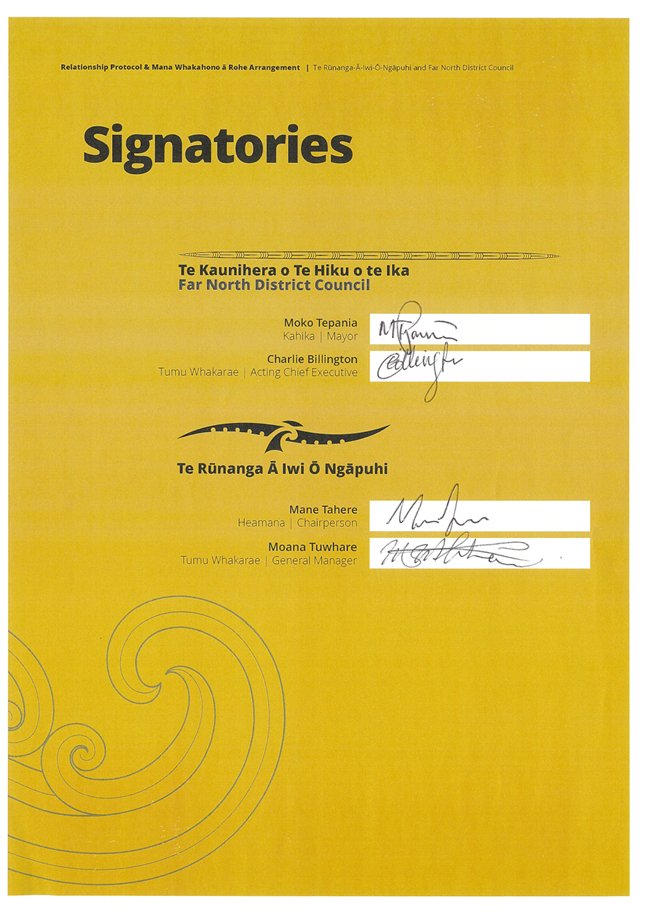
2. Mana
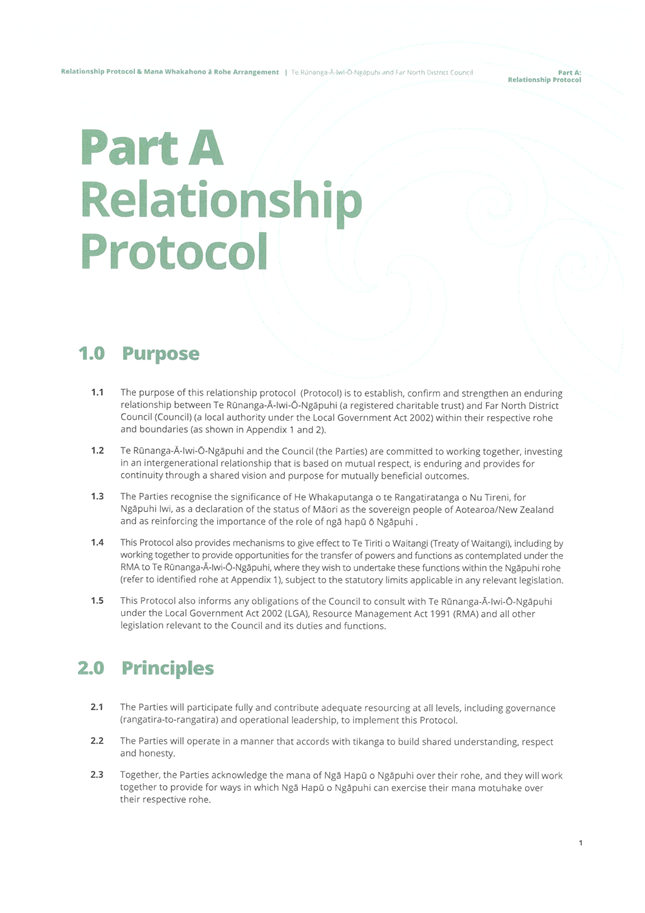
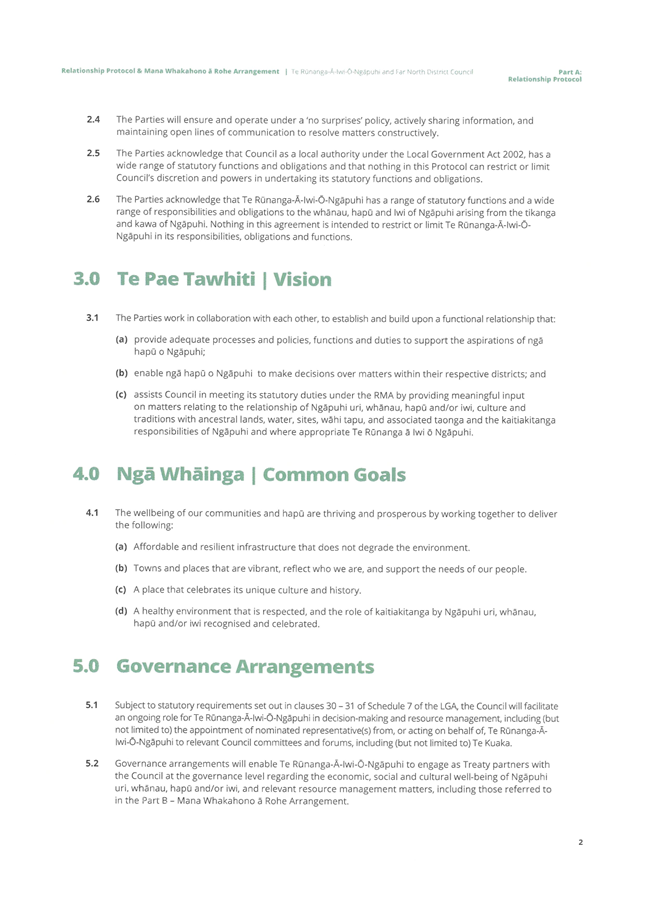
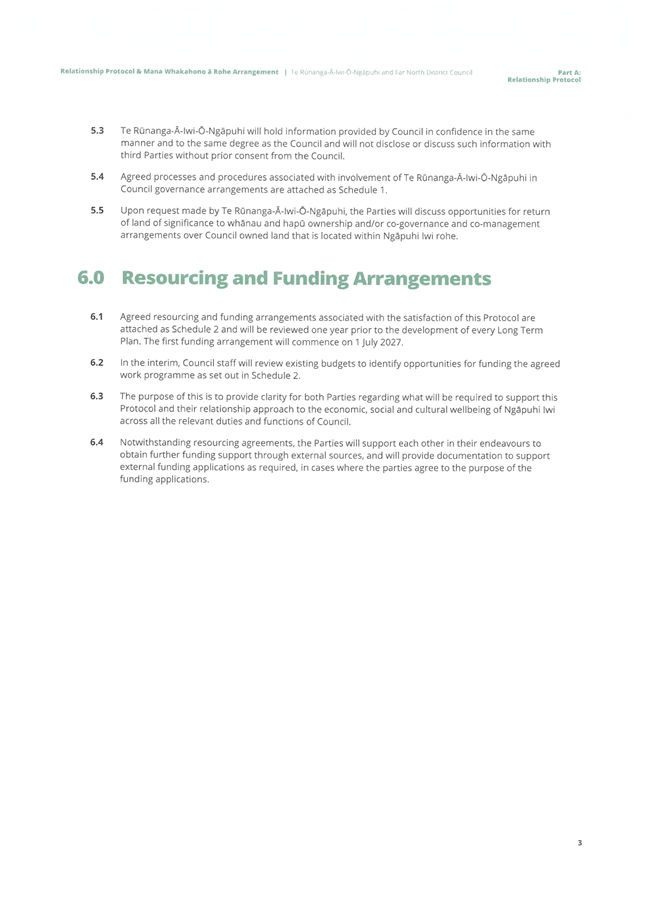
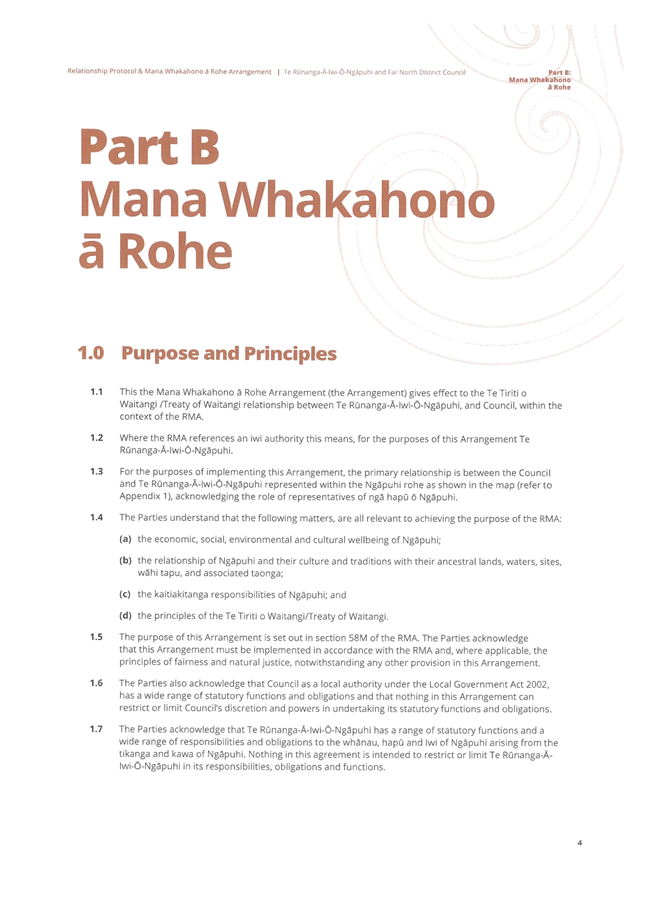
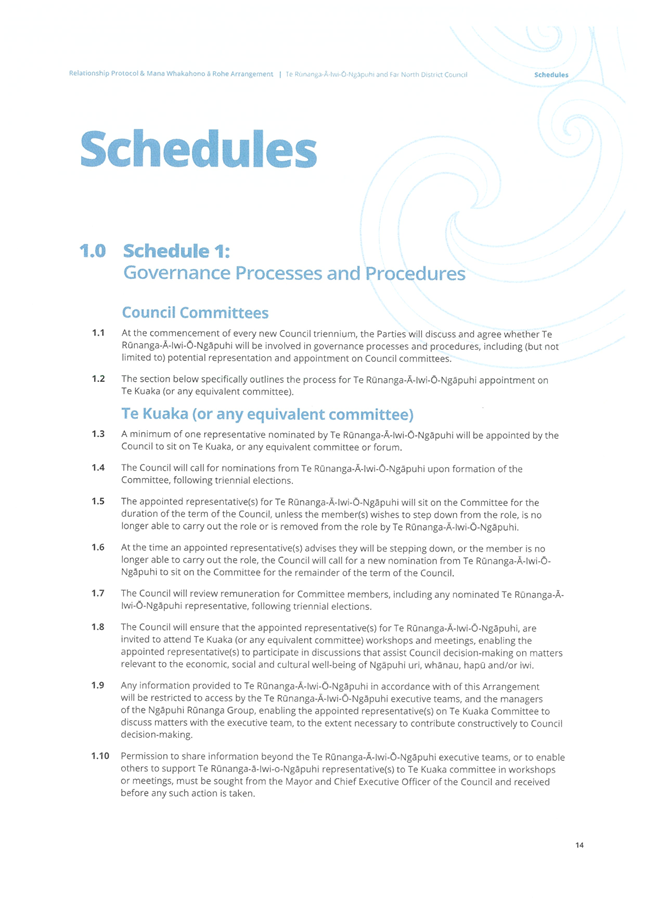
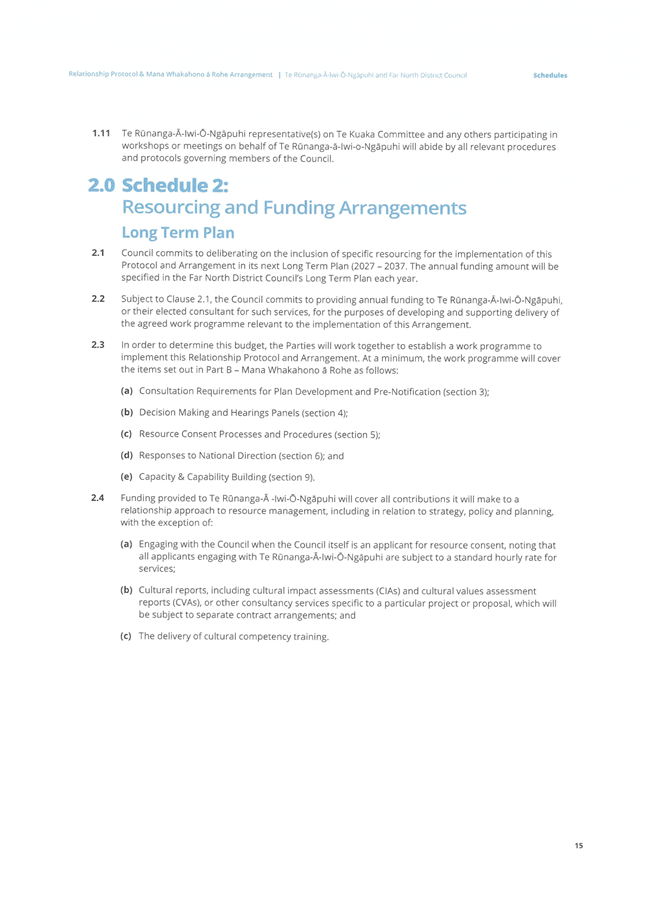
Whakahono a Rohe with Te Runanga a Iwi o Ngapuhi 2025 - A5873279 ⇩ 
3. Email
from Te Hono - A5873280 ⇩
6 Te
Whakaaetanga o Ngā Meneti o Mua / Confirmation of Previous Minutes
6.1 Confirmation
of Previous Minutes
File
Number: A5855001
Author: Natasha
Rmandic, Democracy Advisor
Authoriser: Aisha
Huriwai, Manager - Democracy Services
Take Pūrongo / Purpose of the Report
The minutes are attached to allow
Council to confirm that the minutes are a true and correct record of previous
meetings.
|
tŪtohunga
/ Recommendation
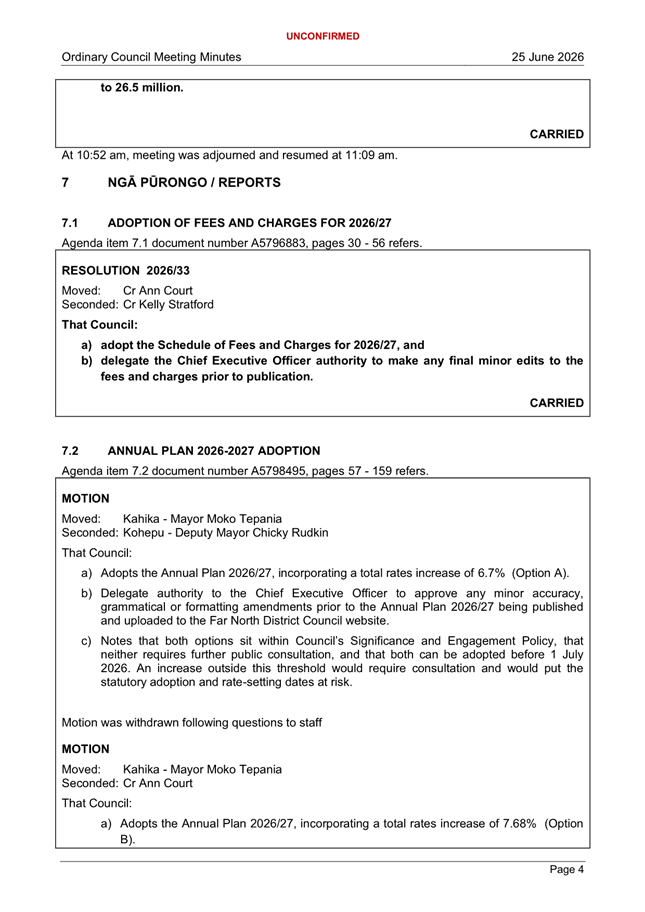
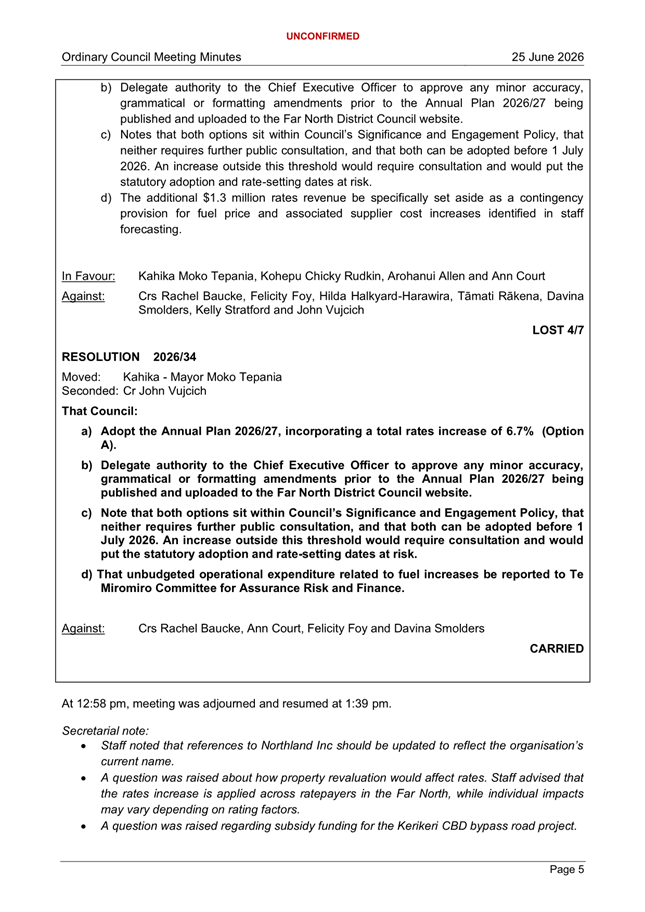
That Council confirm the minutes of the Ordinary
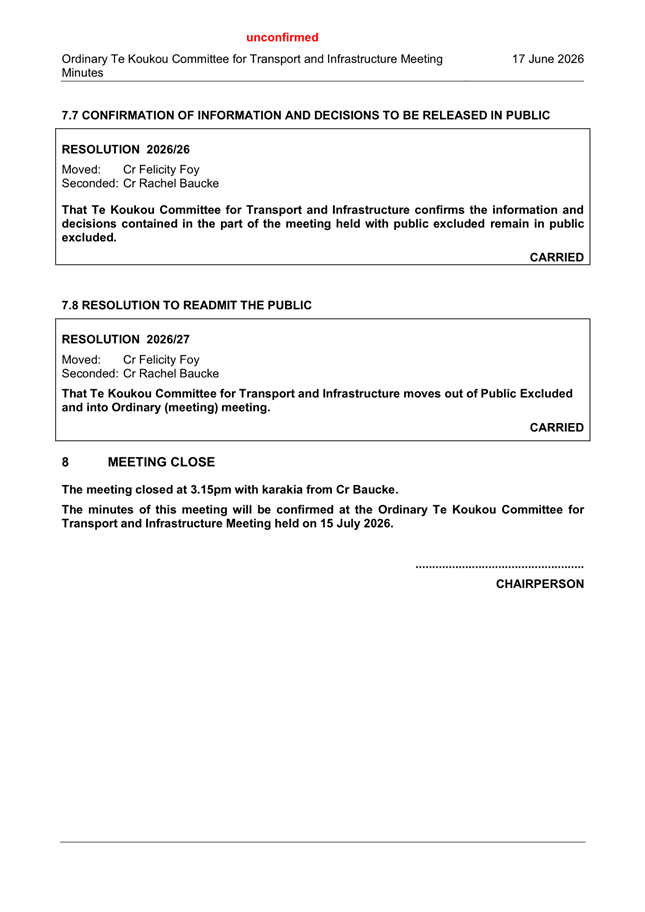
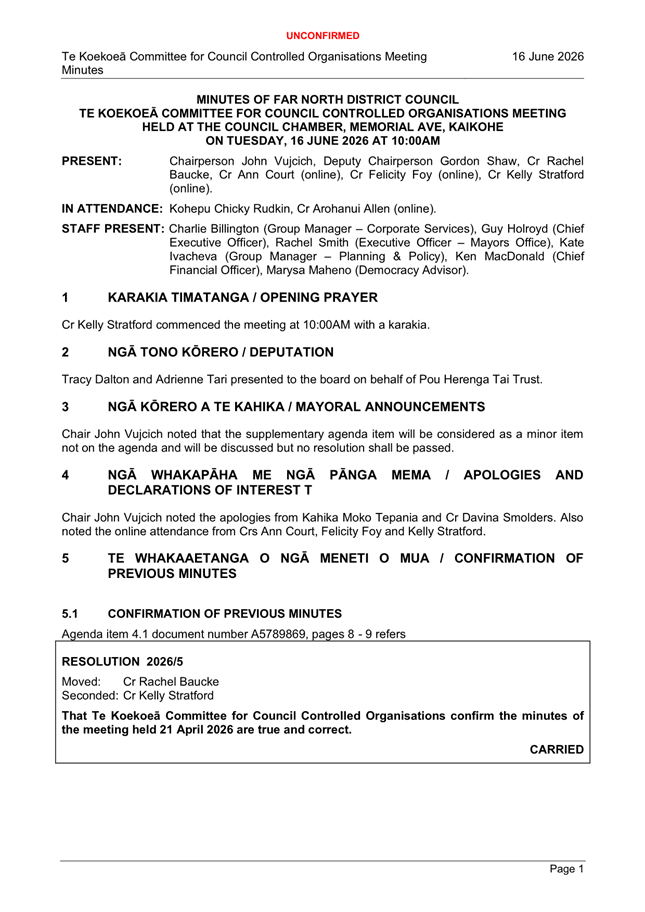
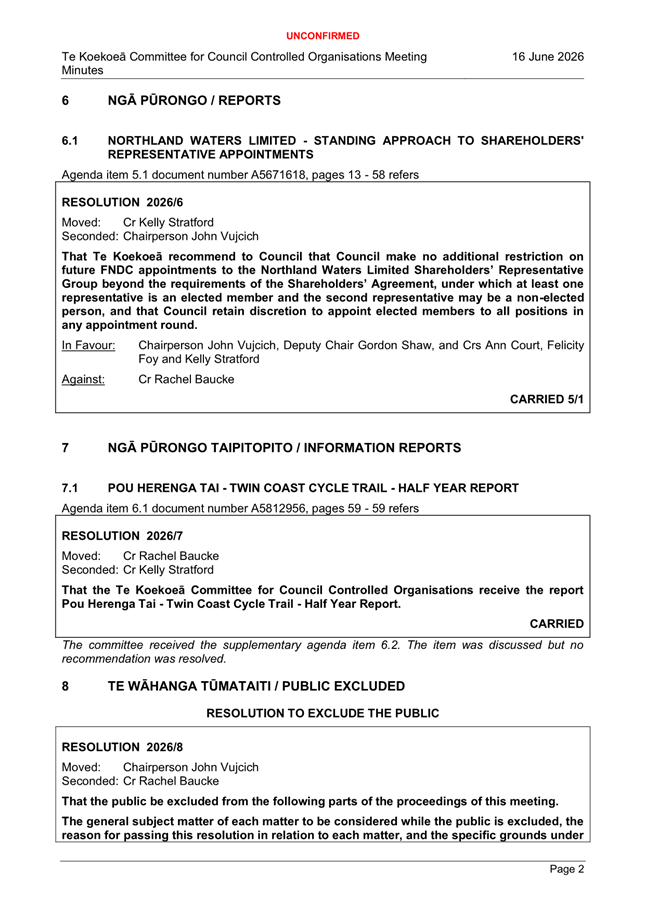
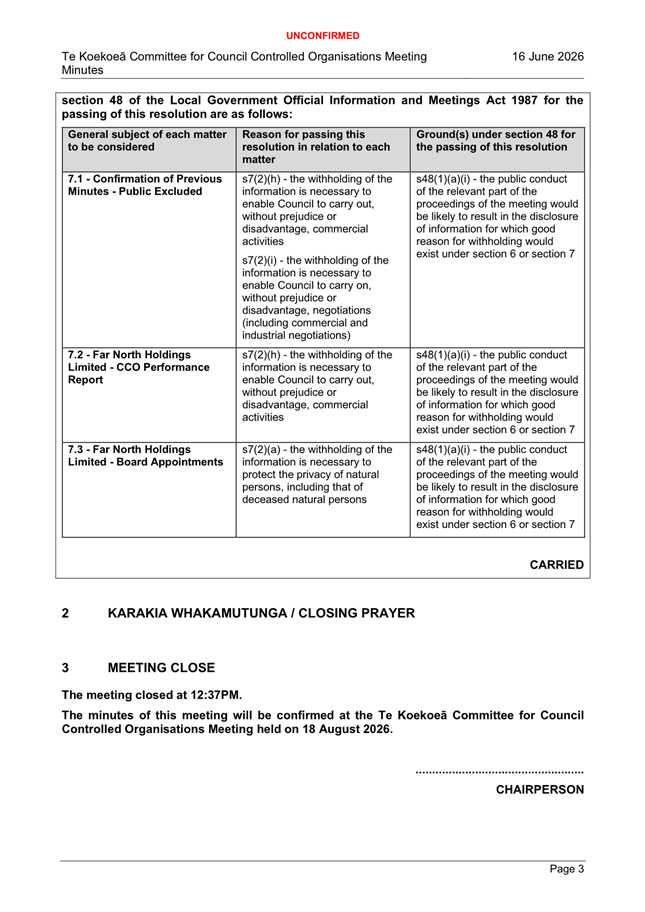
Council meeting held 25 June 2026 as a true and correct record.
|
1) TĀhuhu kŌrero / Background
Local Government
Act 2002 Schedule 7 Section 28 states that a local authority must keep minutes
of its
proceedings. The minutes of these proceedings duly entered and authenticated as
prescribed
by a local
authority are prima facie evidence of those meetings.
Secretarial notes
are included in the minutes to capture the essence of the debate during each
item. Secretarial notes do not reiterate the whole conversation.
2) matapaki me NgĀ KŌwhiringa /
Discussion and Options
The minutes of the Council meeting
held 25 June 2026 are attached:
Far North District Council Standing
Orders Section 27.3 states that no discussion shall arise on the substance of
the minutes in any succeeding meeting, except as to their correctness.
TAKE
TŪTOHUNGA / REASON FOR THE RECOMMENDATION
The reason for the recommendation
is to confirm the minutes are a true and correct record of the
previous meetings.
3) PĀnga PŪtea me ngĀ
wĀhanga tahua / Financial Implications and Budgetary Provision
There are no financial implications or the need for
budgetary provision as a result of this report.
Āpitihanga
/ Attachments
1. 2026-06-25
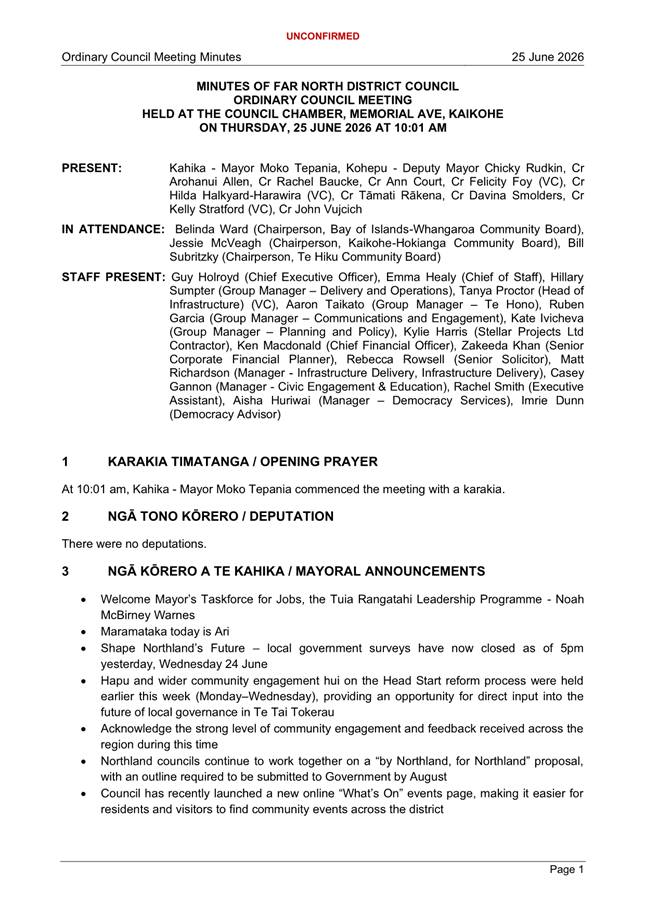
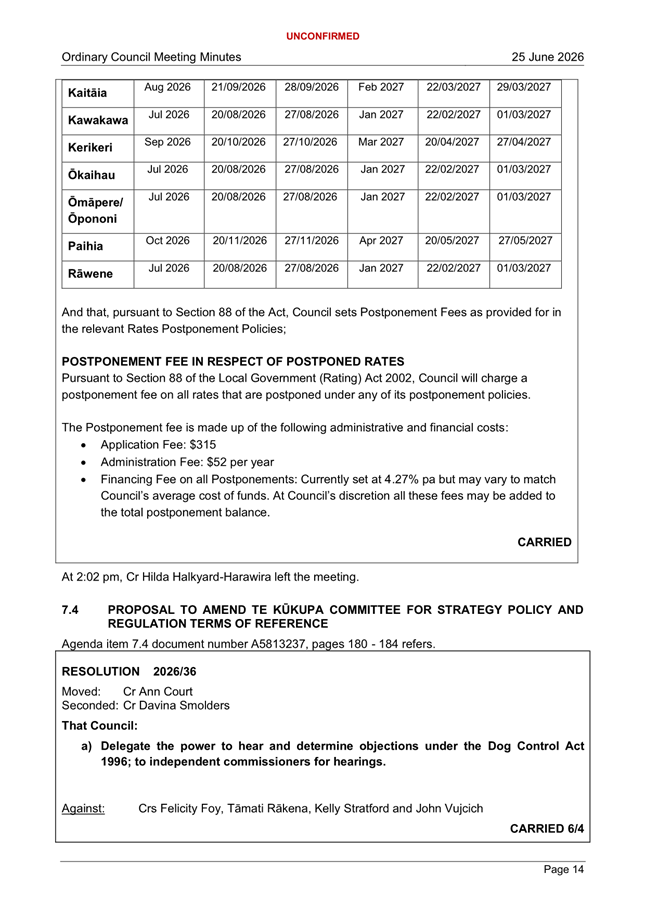
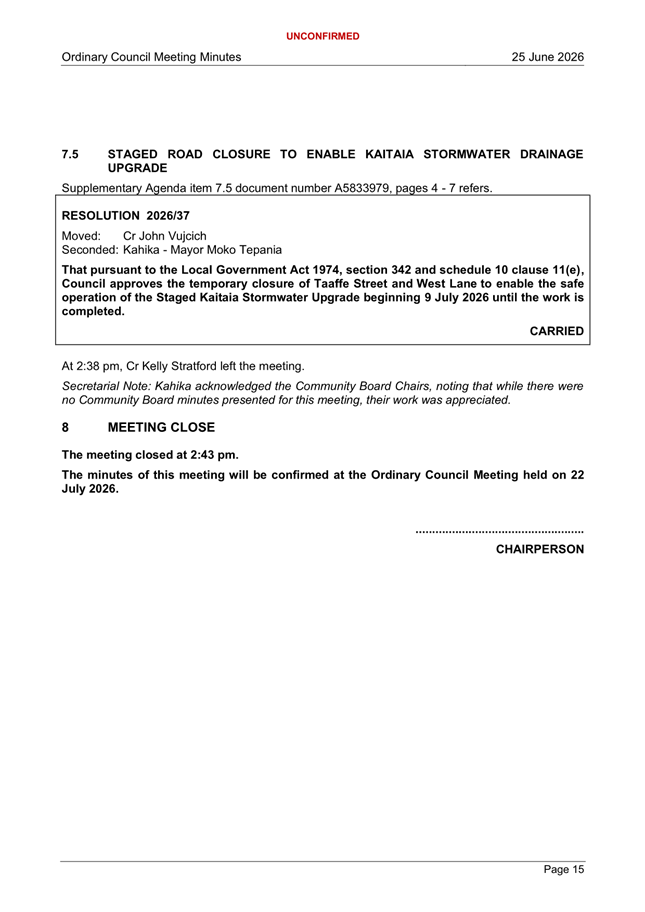
Council Minutes - A5836415 ⇩ 
Hōtaka Take Ōkawa / Compliance Schedule:
Full consideration has been given to the provisions of the
Local Government Act 2002 S77 in relation to decision making, in particular:
1. A
Local authority must, in the course of the decision-making process,
a) Seek
to identify all reasonably practicable options for the achievement of the
objective of a decision; and
b) Assess
the options in terms of their advantages and disadvantages; and
c) If
any of the options identified under paragraph (a) involves a significant
decision in relation to land or a body of water, take into account the
relationship of Māori and their culture and traditions with their
ancestral land, water sites, waahi tapu, valued flora and fauna and other
taonga.
2. This
section is subject to Section 79 - Compliance with procedures in relation to
decisions.
|
He Take Ōkawa /
Compliance Requirement
|
Aromatawai Kaimahi /
Staff Assessment
|
|
State the level of significance (high or low) of the
issue or proposal as determined by the Council’s
Significance and Engagement Policy
|
This is a matter of low significance.
|
|
State the relevant Council policies (external or
internal), legislation, and/or community outcomes (as stated in the LTP) that
relate to this decision.
|
This report complies with the
Local Government Act
2002 Schedule 7 Section 28.
|
|
State whether this issue or proposal has a District wide
relevance and, if not, the ways in which the appropriate Community
Board’s views have been sought.
|
It is the responsibility of each meeting to confirm
their minutes therefore the views of another meeting are not relevant.
|
|
State the
possible implications for Māori and how Māori have been provided
with an opportunity to contribute to decision making if this decision is
significant and relates to land and/or any body of water.
State the
possible implications and how this report aligns with Te Tiriti o Waitangi /
The Treaty of Waitangi.
|
There are no implications for Māori in confirming
minutes from previous meeting. Any implications on Māori arising from
matters included in meeting minutes should be considered as part of the
relevant report.
|
|
Identify persons likely to be affected by or have an
interest in the matter, and how you have given consideration to their views
or preferences (for example – youth, the aged and those with
disabilities).
|
This report is asking for minutes to be confirmed as
true and correct record, any interests that affect other people should be
considered as part of the individual reports
|
|
State the financial implications and where budgetary
provisions have been made to support this decision.
|
There are no financial implications or the need for
budgetary provision arising from this report
|
|
Chief Financial Officer review.
|
The CFO has not reviewed this report.
|
7 Ngā
Pūrongo / Reports
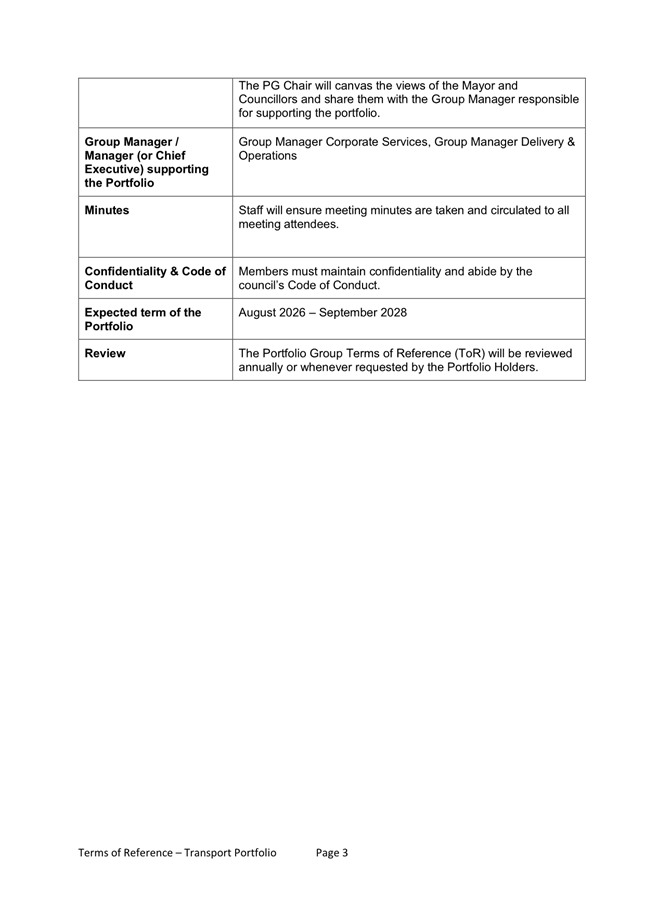
7.1 Transport
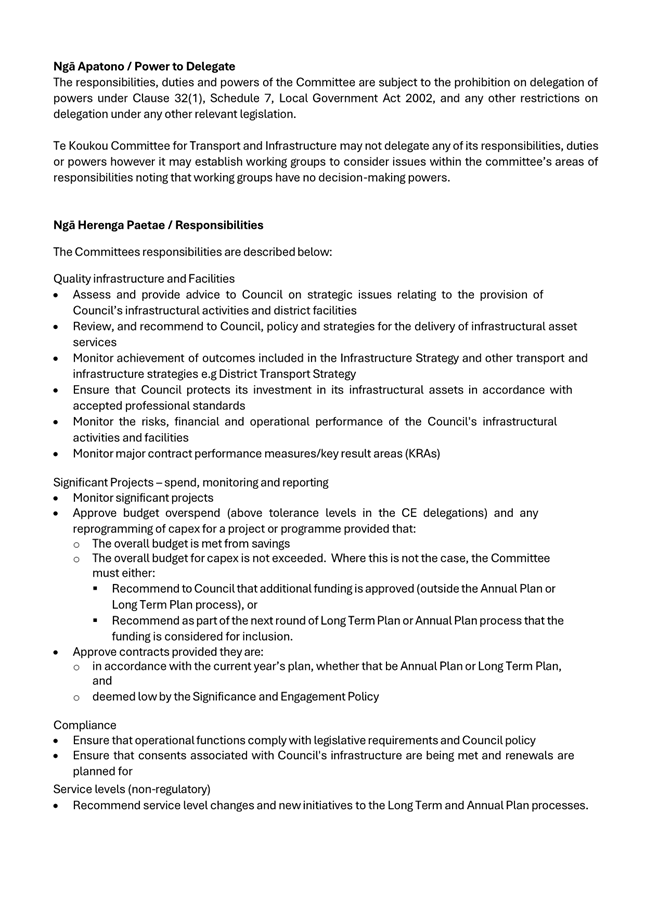
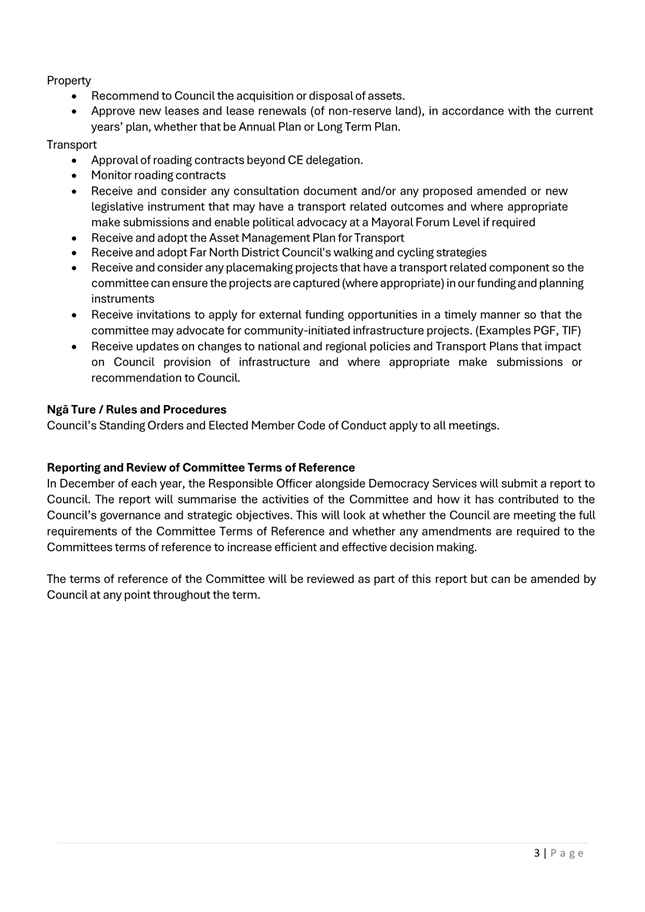
Portfolio Holder Terms of Reference
File
Number: A5840207
Author: Margriet
Veenstra, Manager - Property Information & Business Compliance
Authoriser: Charlie
Billington, Group Manager - Corporate Services
Take Pūrongo / Purpose of the Report
This report
seeks Council approval to adopt the Transport Portfolio Terms of Reference and
confirm the Transport Portfolio membership, following the earlier establishment
of the Portfolio.
WhakarĀpopoto matua / Executive Summary
· Portfolios
provide a non-decision-making governance mechanism to support elected members
to develop deeper subject matter understanding and provide oversight of key
areas of Council activity.
· The
Transport Portfolio supports Council’s significant responsibilities in
roading, transport planning, and regional transport partnerships.
· This report seeks adoption of the Transport Portfolio Terms of
Reference and confirmation of its membership, following the Portfolio’s
earlier establishment.
|
tŪtohunga
/ Recommendation
That Council:
a) Adopt
the attached Transport Portfolio Terms of Reference including the following
membership;
Cr
Ann Court – Northland Regional Transport Committee Appointment and Road
Controlling Authority Forum appointment
Cr
Rachel Baucke – Northland Regional Transport Committee Alternate
Cr
Tāmati Rākena – Chairperson, North Hokianga Roading Working
Group
Cr
Felicity Foy – Chairperson, Te Koukou Committee for Transport and
Infrastructure
|
1) Tāhuhu Kōrero / Background
The Far North District Council has established portfolios in
previous terms as a governance tool to support elected members to specialise in
key areas and strengthen oversight of Council activities.
Portfolios are strictly non-decision-making roles that allow
councillors to deepen their understanding of council operations, champion
issues, engage with communities, and shape policy. They provide oversight
alongside senior management and staff, ensuring balanced presentation,
strategic focus and stronger links between council priorities and community
needs.
A Transport Portfolio was established by Council in December
2025, alongside other portfolios adopted at the same meeting (Resolution
2025/138). However, unlike the other portfolios, its Terms of Reference and
membership were not confirmed at that time.
Transport is a core Council function, with significant
operational, financial, and reputational implications, including:
· Maintenance and
operation of the local roading network
· Delivery of
capital works programmes
· Engagement with
NZTA/Waka Kotahi and regional transport partners
· Responding to
community expectations and requests for service
Given the scale and complexity of Council’s transport
responsibilities, establishing a Transport Portfolio will:
· Provide consistent
elected member oversight
· Strengthen
strategic engagement with key partners
· Support better
visibility of risks, priorities, and delivery performance
2) matapaki me NgĀ KŌwhiringa /
Discussion and Options
Role of the Portfolio
The Transport Portfolio is intended to operate as a
non-decision-making forum, consistent with Council’s existing portfolio
structure.
Its purpose is to:
· Provide high-level
information and briefing to the Portfolio Holder
· Support
understanding of key transport issues, risks, and opportunities
· Enable the
Portfolio Holder to represent Council effectively in regional and sector forums
The Portfolio Holder:
· Does not direct
staff
· Does not make
operational or policy decisions
· May only represent
Council externally with formal authorisation
This approach ensures clear separation between:
· Governance
(Council and elected members)
· Management (Chief
Executive and staff)
Options
Option 1: Adopt the Terms of Reference as attached
and confirm the membership (recommended)
Option 2: Agree amendments - Adopt the Terms of
Reference and membership with amendments.
Option 3: Defer decision - Leave the report to lie on
the table, deferring adoption of the Terms of Reference and confirmation of the
membership pending further refinement.
TAKE
TŪTOHUNGA / REASON FOR THE RECOMMENDATION
To confirm the membership and Terms of Reference of the
Transport Portfolio and ensure clarity of roles and responsibilities and
consistent transparent governance.
3) PĀnga PŪtea me ngĀ
wĀhanga tahua / Financial Implications and Budgetary Provision
Supporting the portfolio will have an impact on staff
resourcing and time, these costs are expected to be managed within existing
budgets. As with other portfolios, the benefits include improved
decision-making, better alignment between governance and delivery and reduced
duplication of effort across the organisation.
Āpitihanga
/ Attachments
1. Transportation
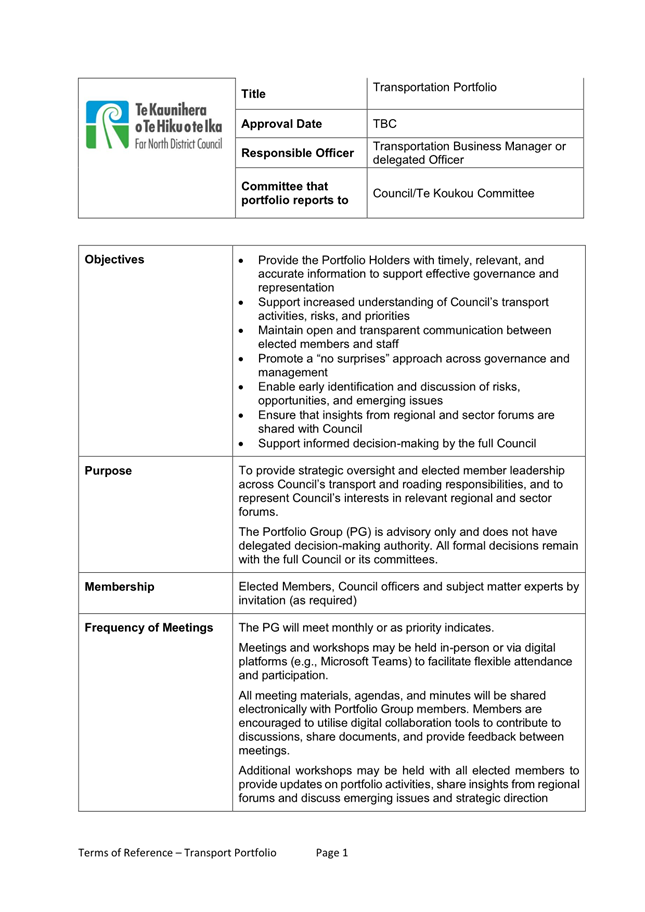
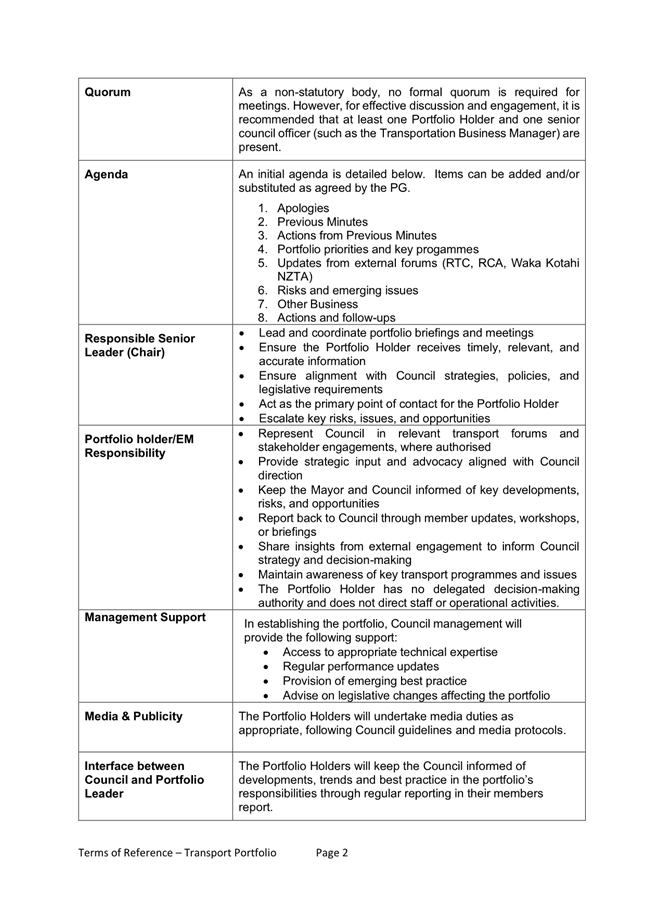
Portfolio ToR - A5857005 ⇩ 
Hōtaka Take Ōkawa / Compliance Schedule:
Full consideration has been given to the provisions of the
Local Government Act 2002 S77 in relation to decision making, in particular:
1. A
Local authority must, in the course of the decision-making process,
a) Seek
to identify all reasonably practicable options for the achievement of the
objective of a decision; and
b) Assess
the options in terms of their advantages and disadvantages; and
c) If
any of the options identified under paragraph (a) involves a significant
decision in relation to land or a body of water, take into account the
relationship of Māori and their culture and traditions with their
ancestral land, water sites, waahi tapu, valued flora and fauna and other
taonga.
2. This
section is subject to Section 79 - Compliance with procedures in relation to
decisions.
|
He Take Ōkawa /
Compliance Requirement
|
Aromatawai Kaimahi /
Staff Assessment
|
|
State the level of significance (high or low) of the
issue or proposal as determined by the Council’s
Significance and Engagement Policy
|
This matter is of low significance.
|
|
State the relevant Council policies (external or
internal), legislation, and/or community outcomes (as stated in the LTP) that
relate to this decision.
|
The Local Government Act 2002, including requirements
for transparency, accountability, and effective governance. Council’s
governance framework, including the Code of Conduct and Standing Orders.
Relevant transport legislation, regulations, and NZTA/Waka Kotahi
requirements. Council’s adopted policies, strategies, and bylaws
relating to transport and infrastructure. Health and Safety at Work Act 2015,
where applicable to governance oversight responsibilities.
|
|
State whether this issue or proposal has a District wide
relevance and, if not, the ways in which the appropriate Community
Board’s views have been sought.
|
This is a district wide matter for the governing body to
decide.
|
|
State the
possible implications for Māori and how Māori have been provided
with an opportunity to contribute to decision making if this decision is
significant and relates to land and/or any body of water.
State the
possible implications and how this report aligns with Te Tiriti o Waitangi /
The Treaty of Waitangi.
|
The views from Māori have not been sought
specifically to inform this work.
|
|
Identify persons likely to be affected by or have an
interest in the matter, and how you have given consideration to their views
or preferences (for example – youth, the aged and those with
disabilities).
|
This does not impact any identified persons in
legislation.
|
|
State the financial implications and where budgetary
provisions have been made to support this decision.
|
Any costs are expected to be managed within existing
budgets.
|
|
Chief Financial Officer review.
|
The CFO has not reviewed this report.
|
7.2 Future
Economic Development Investment and Resourcing for the Far North District
– Long Term Plan 2027–2037
File
Number: A5830580
Author: Roger
Ackers, Head of Strategic Reform Initiatives
Authoriser: Guy
Holroyd, Chief Executive Officer
Take Pūrongo / Purpose of the Report
To seek Council direction on the future provision and
funding of economic development activities within the Far North District and to
confirm that any future investment decisions are considered through the Long
Term Plan (LTP) 2027–2037 process
WhakarĀpopoto matua / Executive Summary
· Economic development is a key contributor to community wellbeing,
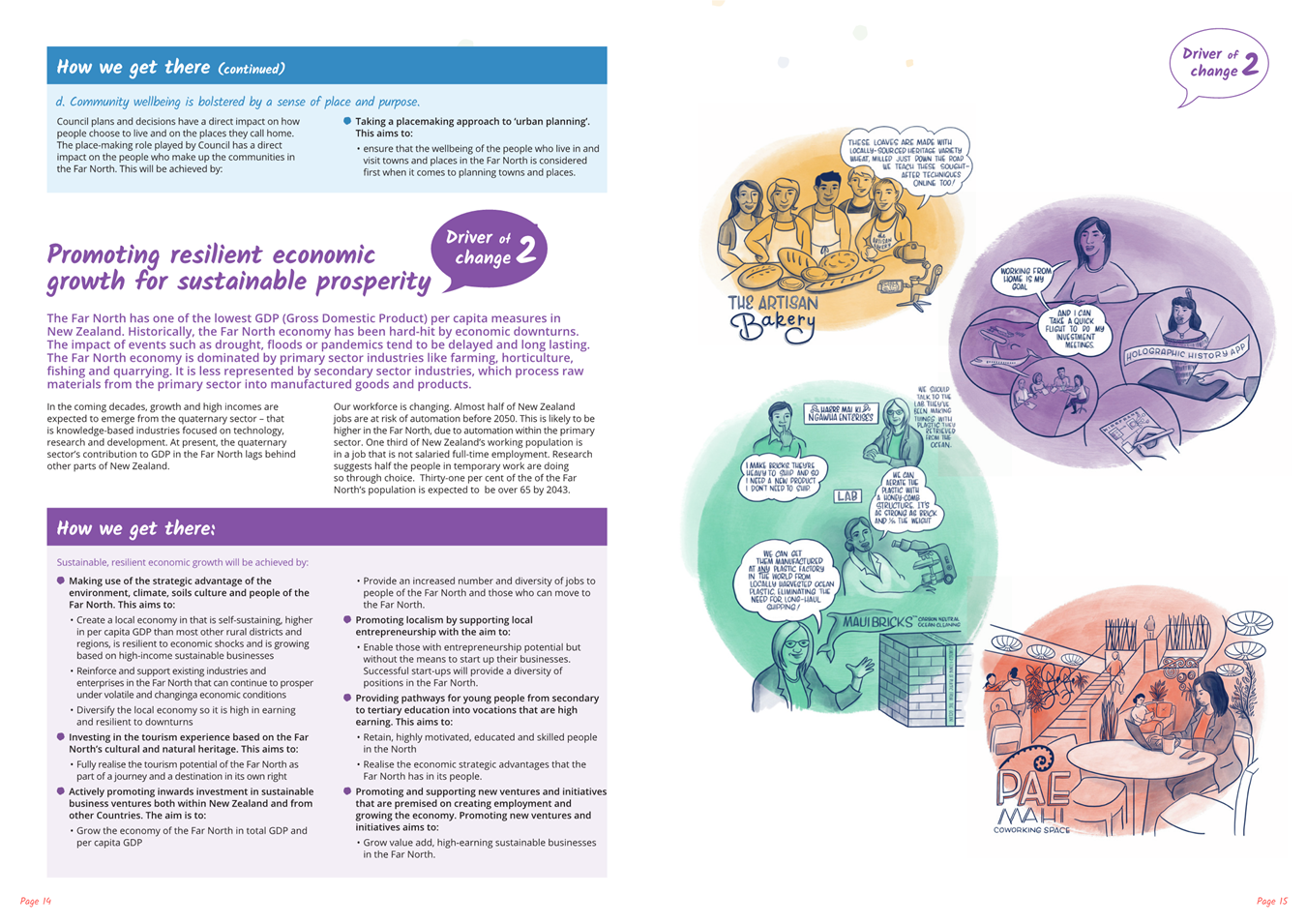
productivity, business growth, employment and long-term prosperity. Far North
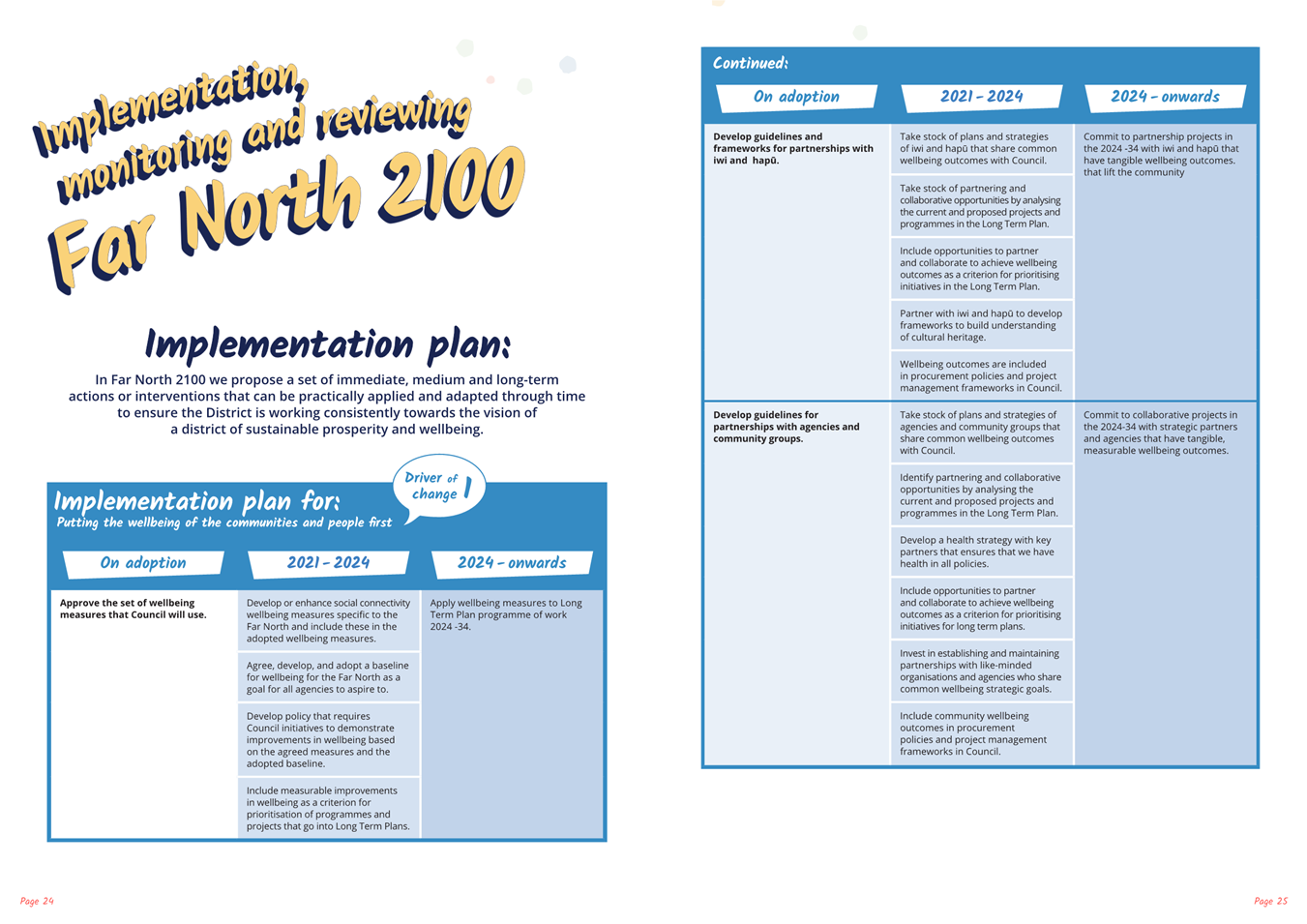
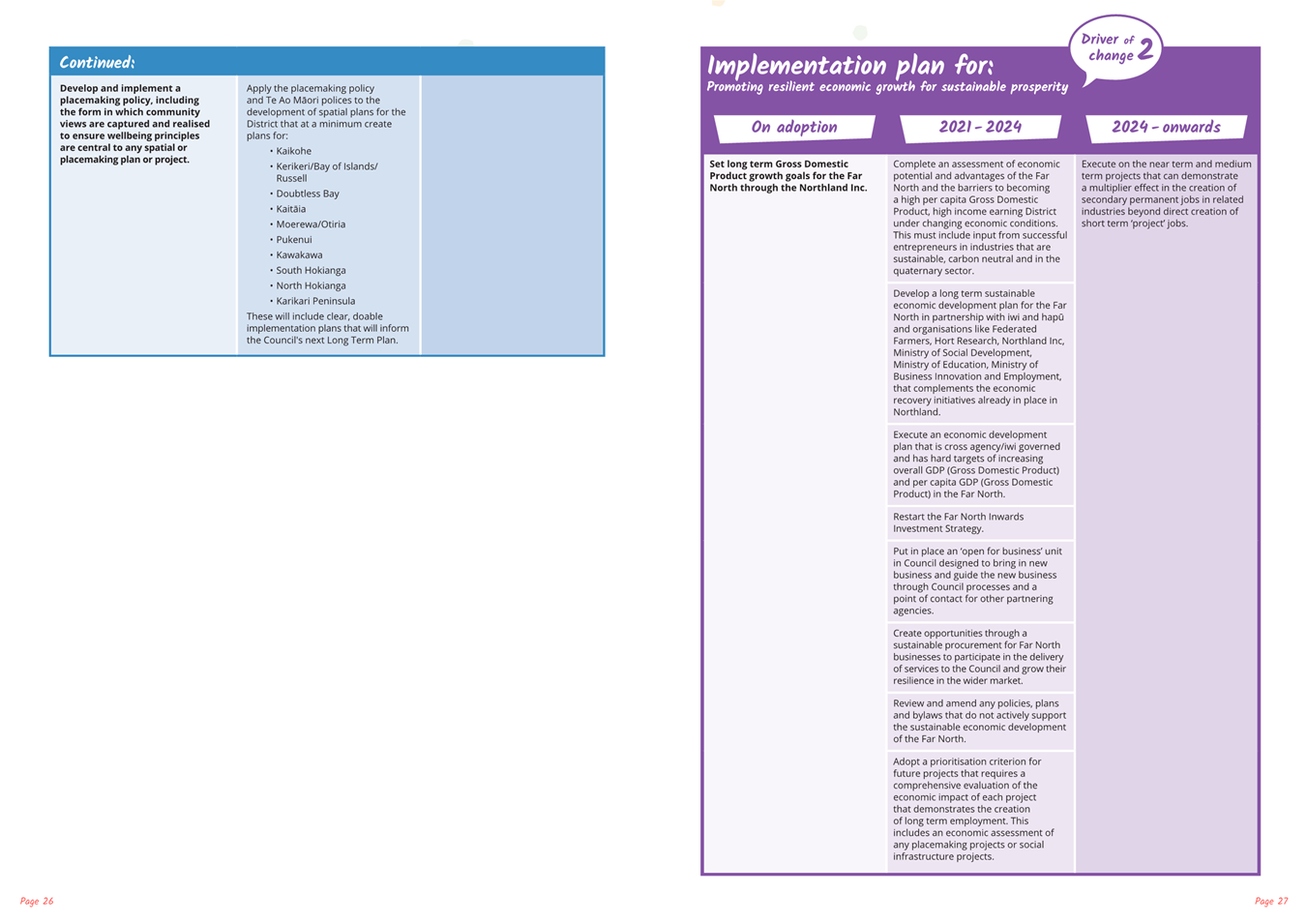
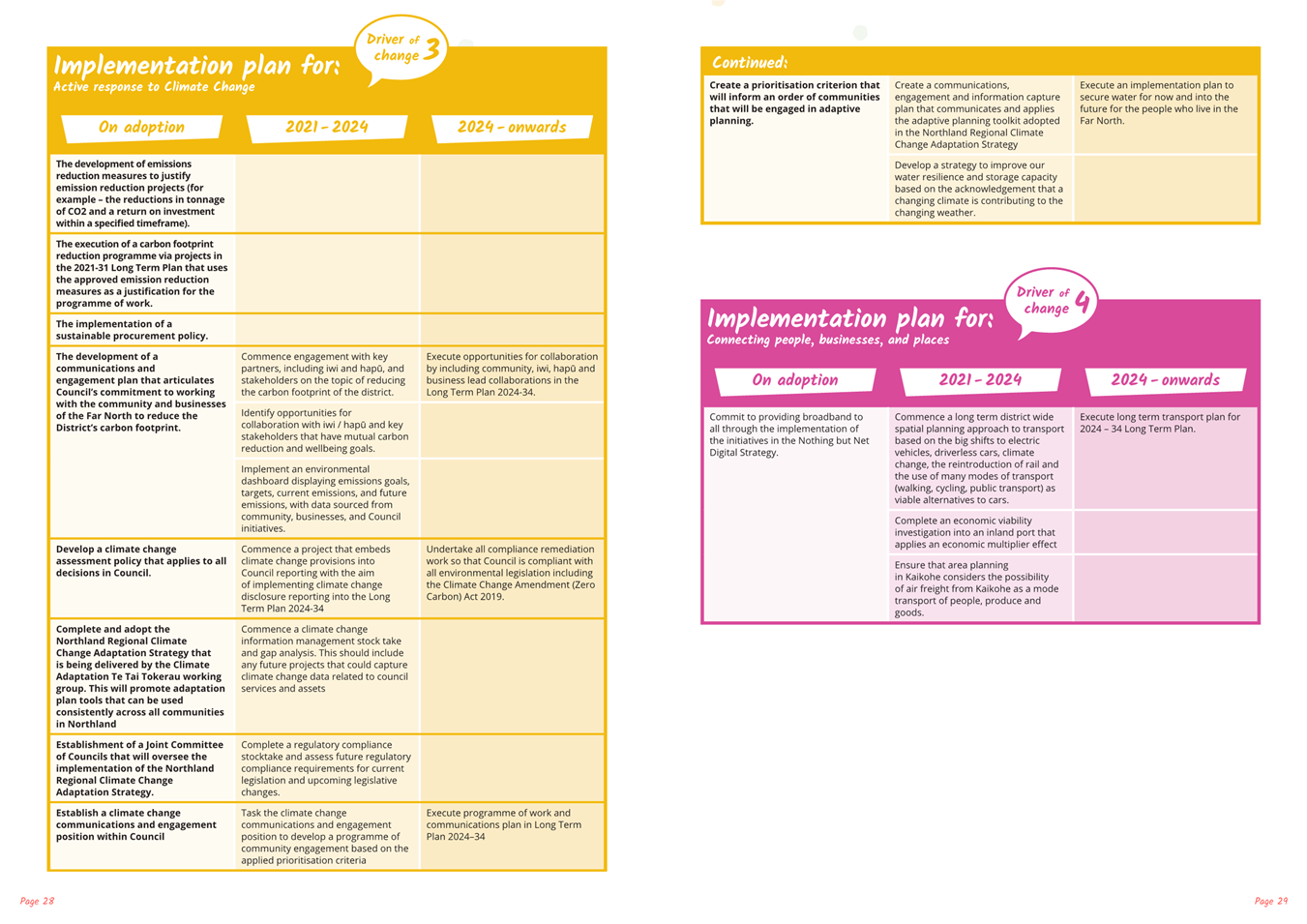
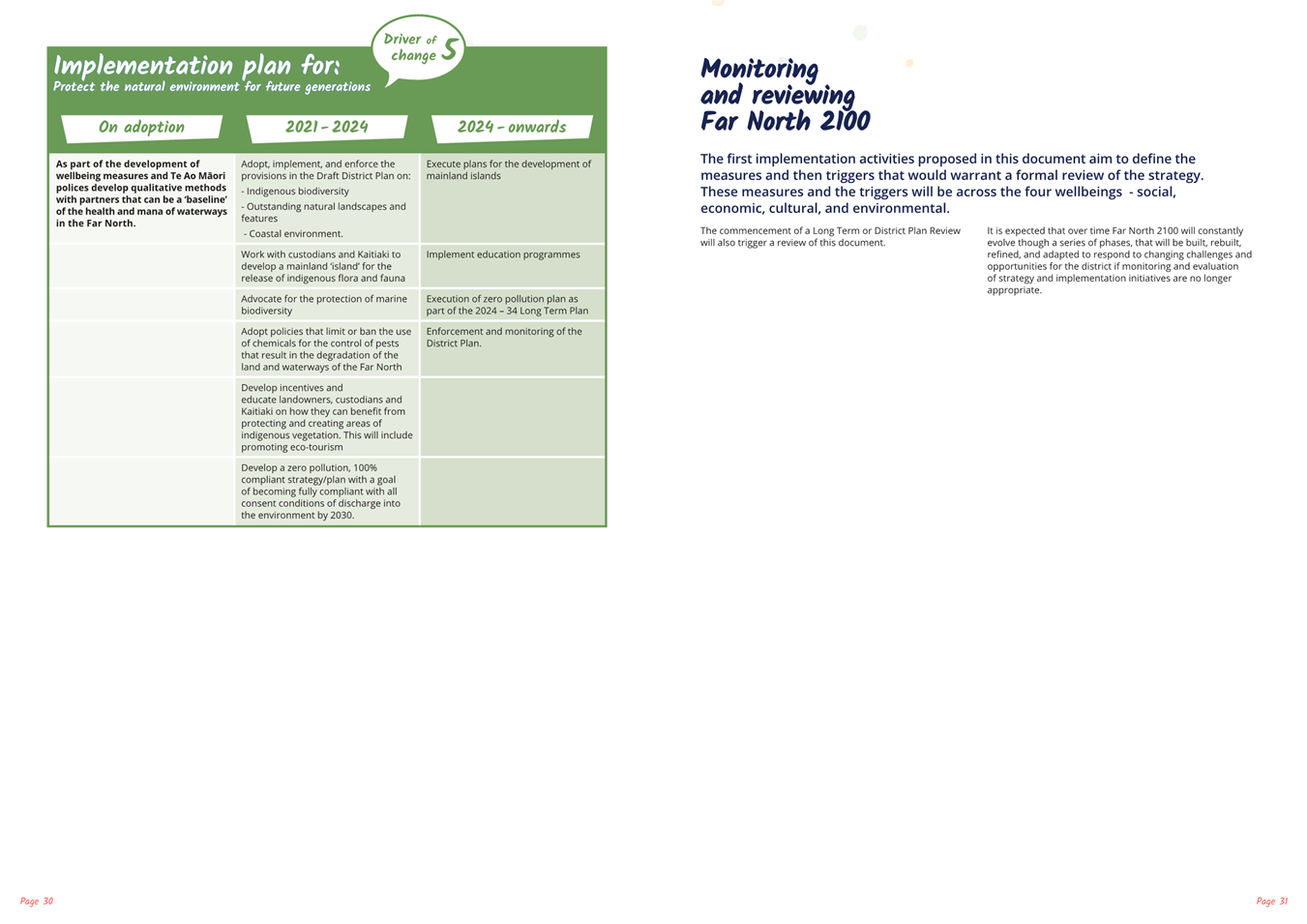
2100 identifies resilient economic growth and sustainable prosperity as a
strategic priority for the district and calls for a greater focus on
investment, entrepreneurship, business development, tourism, innovation and
economic diversification.
· The current regional economic development model is delivered
primarily through Northland NZ, supported by district-level initiatives, iwi
and Māori development activity, central government programmes and a range
of public and private sector partnerships. Northland NZ is jointly owned by the
four Northland councils and provides regional economic development and tourism
functions on behalf of its shareholders.
· Council is now entering the development phase of the Long Term Plan
2027–2037. This creates an opportunity to consider a broader strategic
question: What economic outcomes does the Far North want to achieve, and
what delivery model and investment framework are best placed to achieve them?
· Recent work undertaken through the Northland Regional Deal and the
GDP Targeting and Augmentation Model (GTAM) provides a stronger evidence base
for economic development decision-making. The focus shifts from funding
activities or organisations to identifying and investing in initiatives that
can improve productivity, attract investment, grow quality employment, increase
incomes and strengthen long-term economic resilience.
· This report does not seek a decision on a preferred funding option
or delivery model. Rather, it seeks Council's endorsement to develop economic
development investment and service delivery options for consideration through
the Long Term Plan 2027–2037 process.
· The review will consider the future role of Council, the level of
investment required, the relationship with Northland NZ and other partners, and
the most effective mechanisms for delivering measurable economic outcomes for
the Far North District.
|
tŪtohunga
/ Recommendation
That Council:
a) Agrees
that the future scale, scope, priorities and delivery model for economic
development activities within the Far North District should be reviewed as
part of development of the Long Term Plan 2027–2037
b) Agrees
that future economic development investment should be assessed against the
economic outcomes sought by Council, including productivity growth, business
development, quality employment, investment attraction, Māori economic
development and regional prosperity
c) Agrees
that options for future economic development investment, including investment
in Northland NZ and alternative service delivery arrangements, be developed
and reported back to Council; and
d) Requests
the preparation of a detailed options assessment, implementation pathway and
funding plan for consideration through the Long Term Plan 2027–2037
process.
|
1) Tāhuhu Kōrero / Background
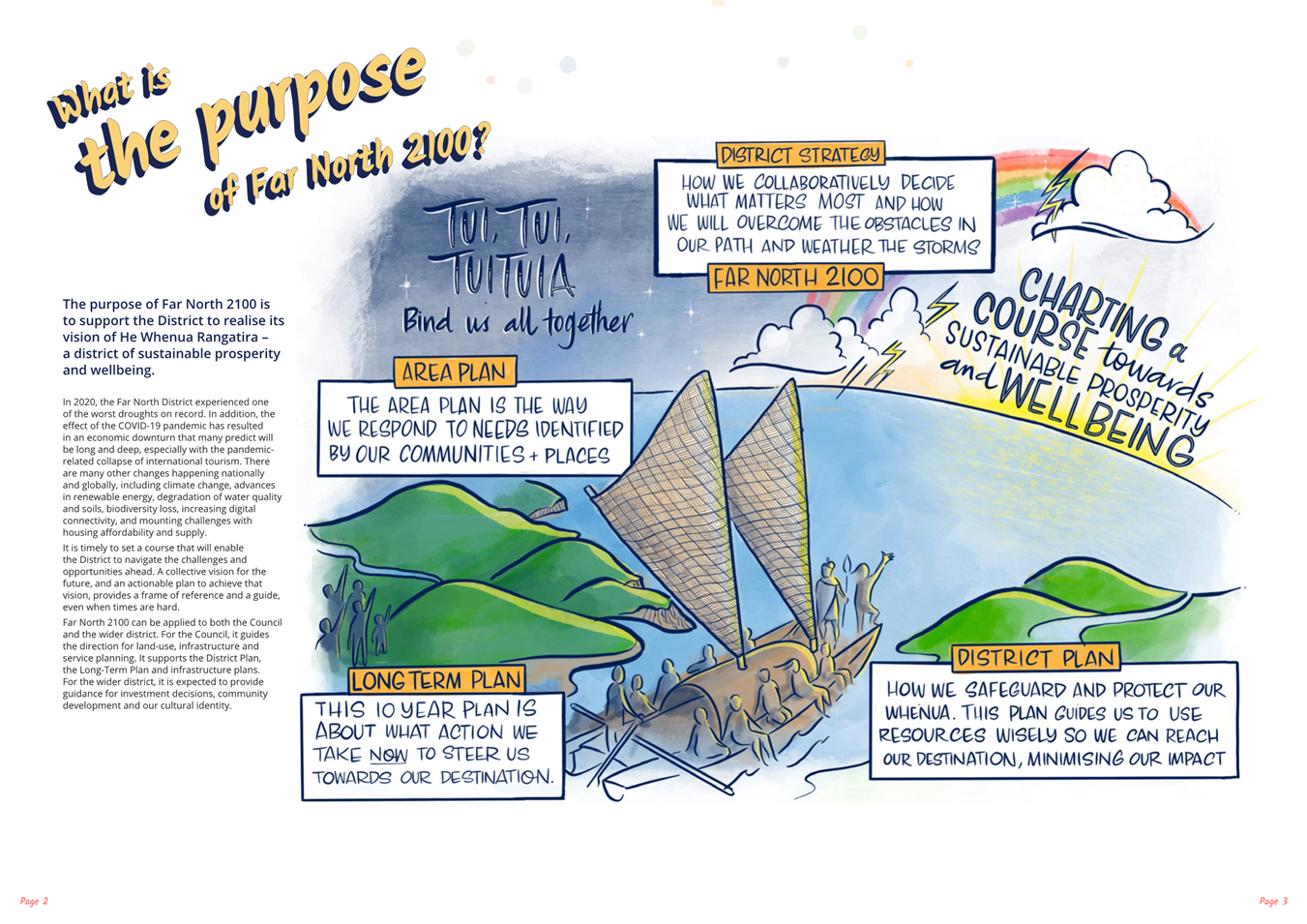
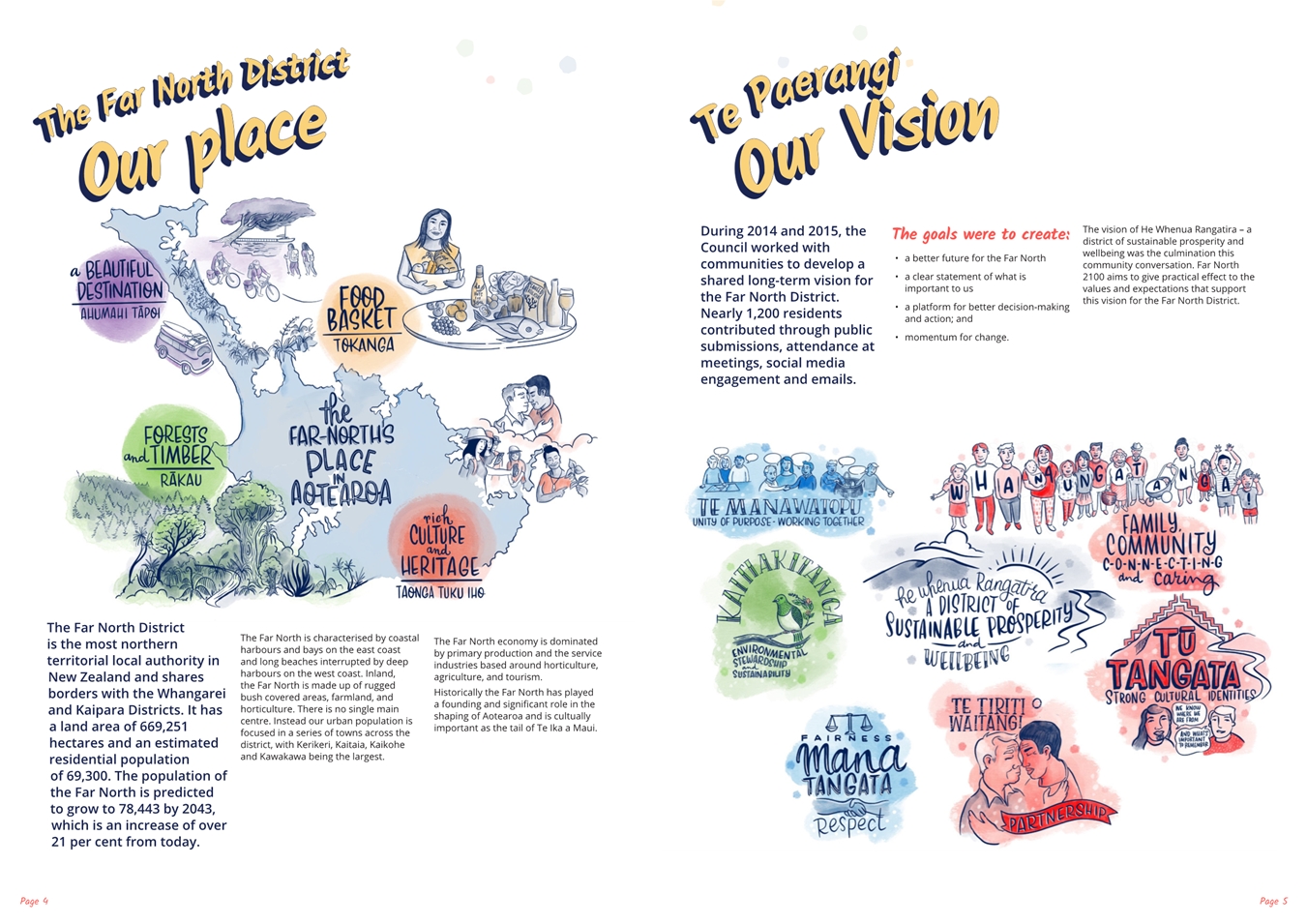
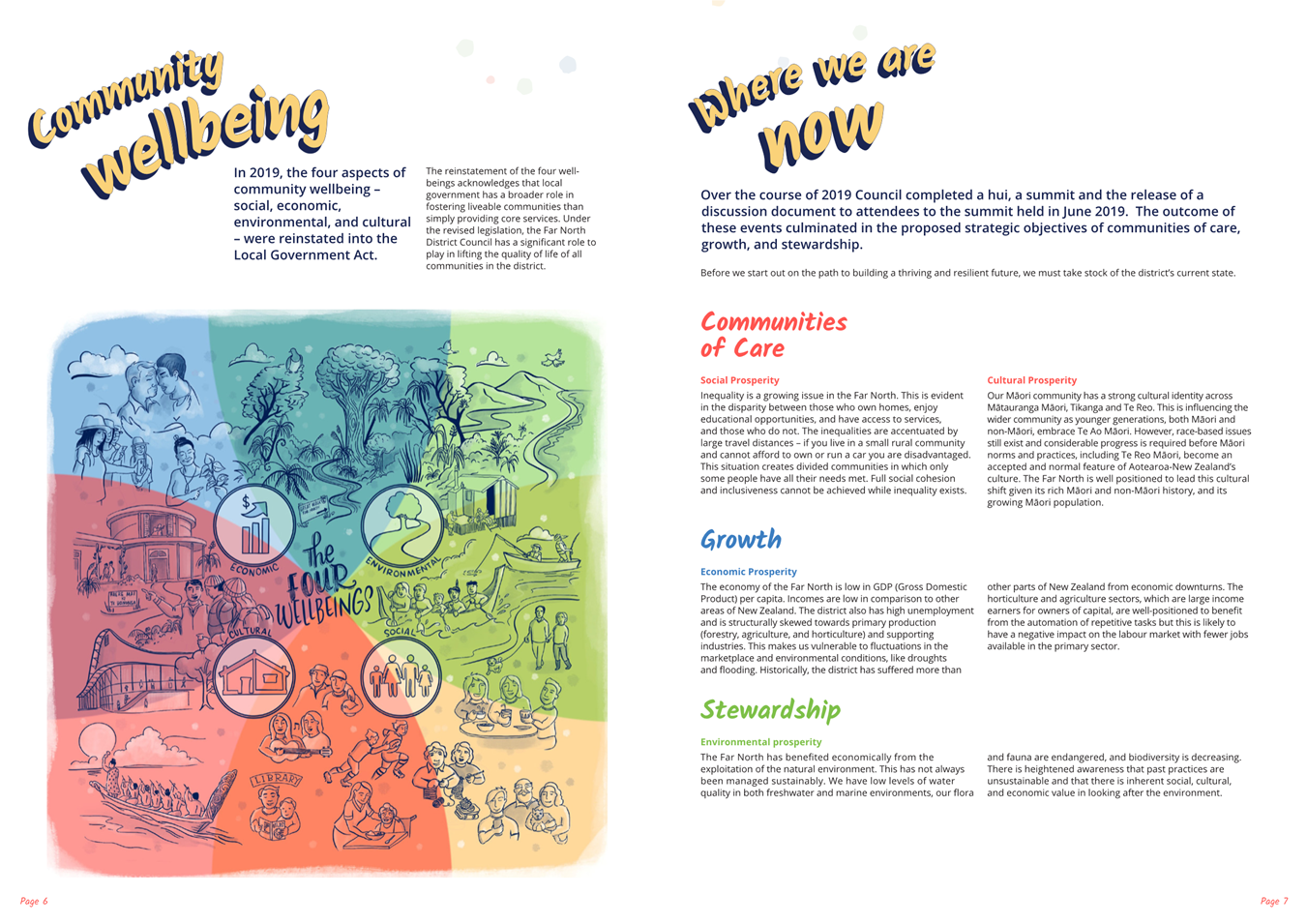
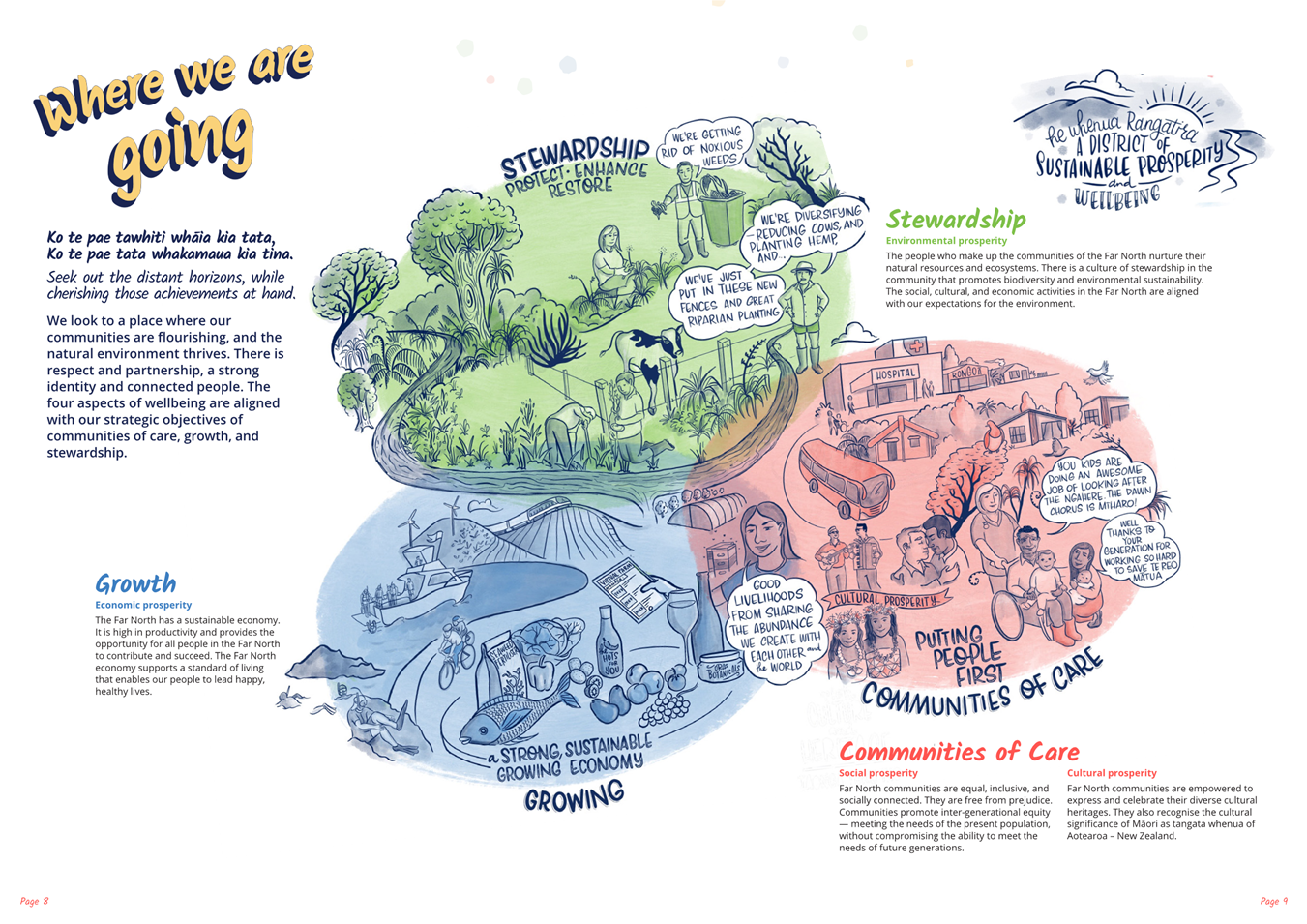
Far North 2100
Far North 2100, adopted by Far North District Council at its
November 2021 Council meeting following a recommendation from the Strategy and
Policy Committee on 12 October 2021, is grounded in the vision of He Whenua
Rangatira – a district of sustainable prosperity and wellbeing.
Economic prosperity is identified as a key component of
community wellbeing.
Far North 2100 identifies:
· Low GDP per capita
relative to many parts of New Zealand.
· Structural
reliance on primary industries.
· Vulnerability to
economic shocks.
· The importance of
tourism, innovation, investment attraction and economic diversification.
· The need to
promote resilient economic growth and sustainable prosperity.
The strategy specifically identifies actions including:
· Developing a
long-term economic development plan.
· Supporting inward
investment.
· Supporting
entrepreneurship and innovation.
· Growing
value-added industries.
· Improving
productivity and workforce capability.
· Strengthening
regional approaches to economic development.
Martin Jenkins Review
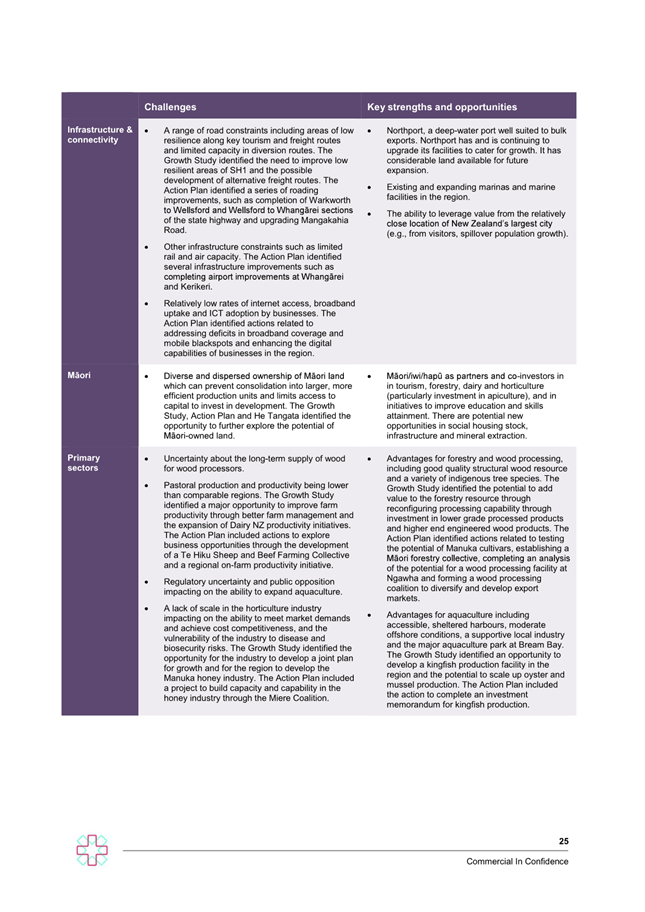
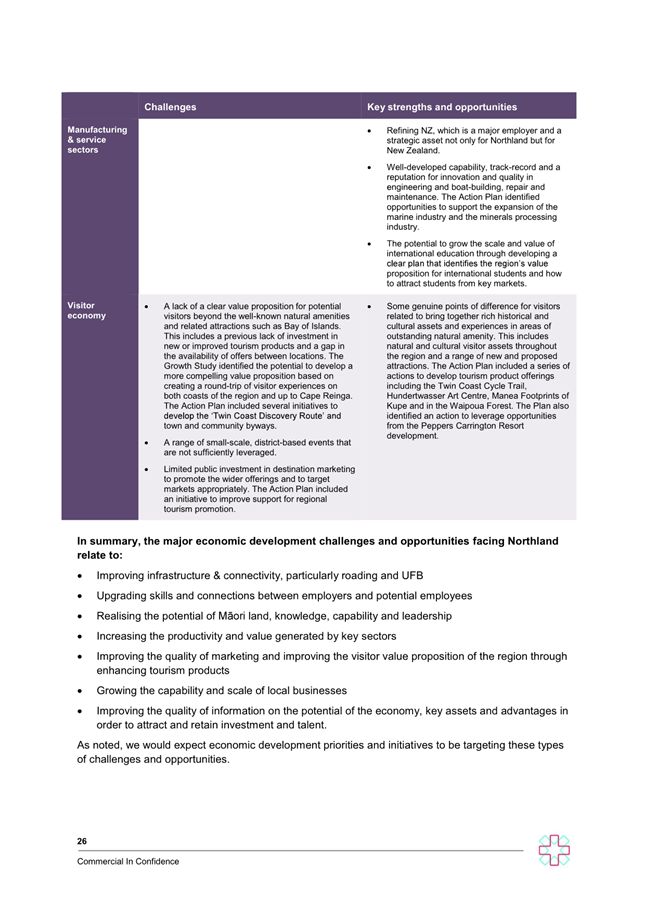
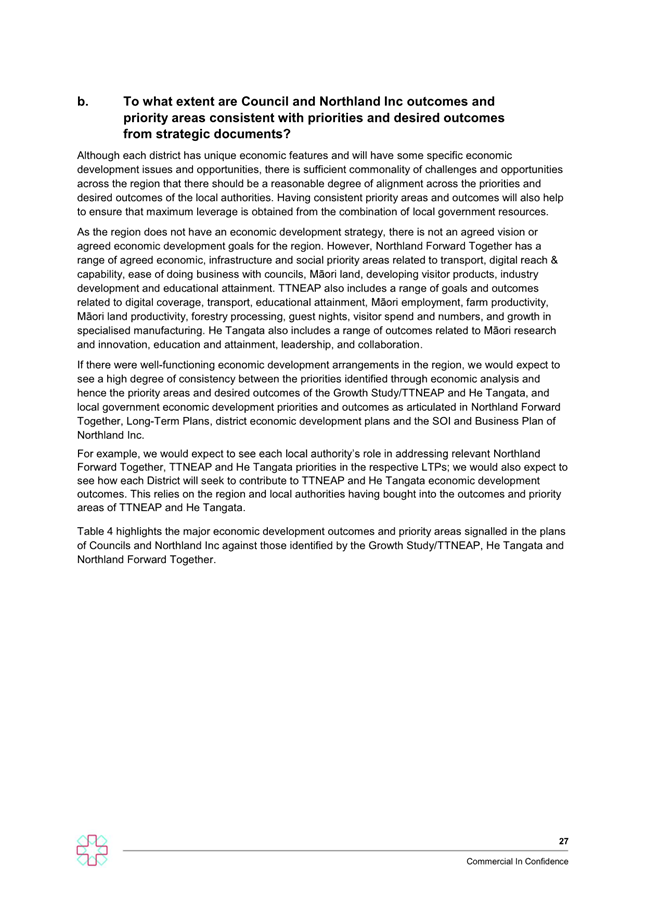
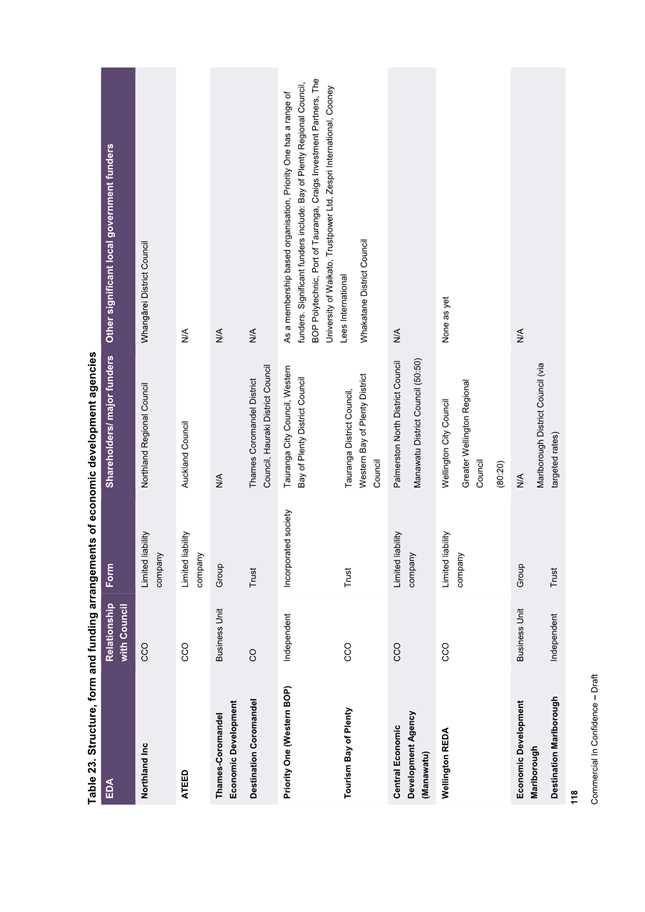
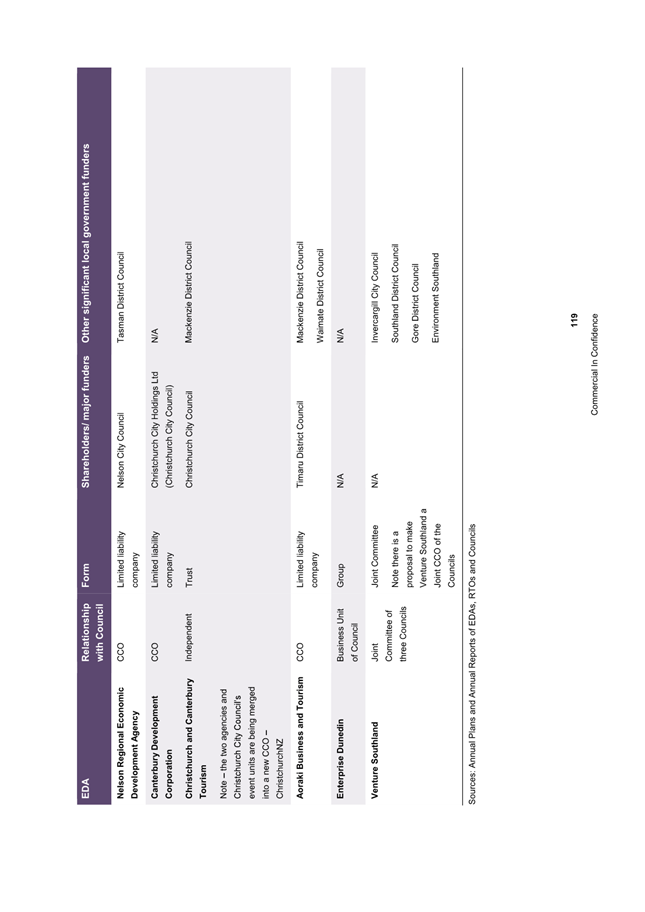
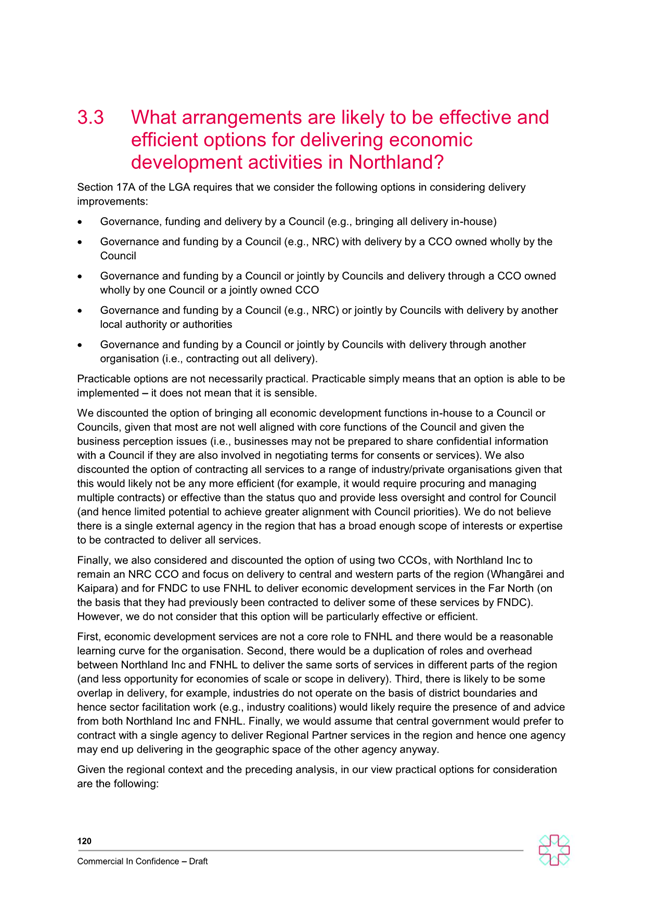
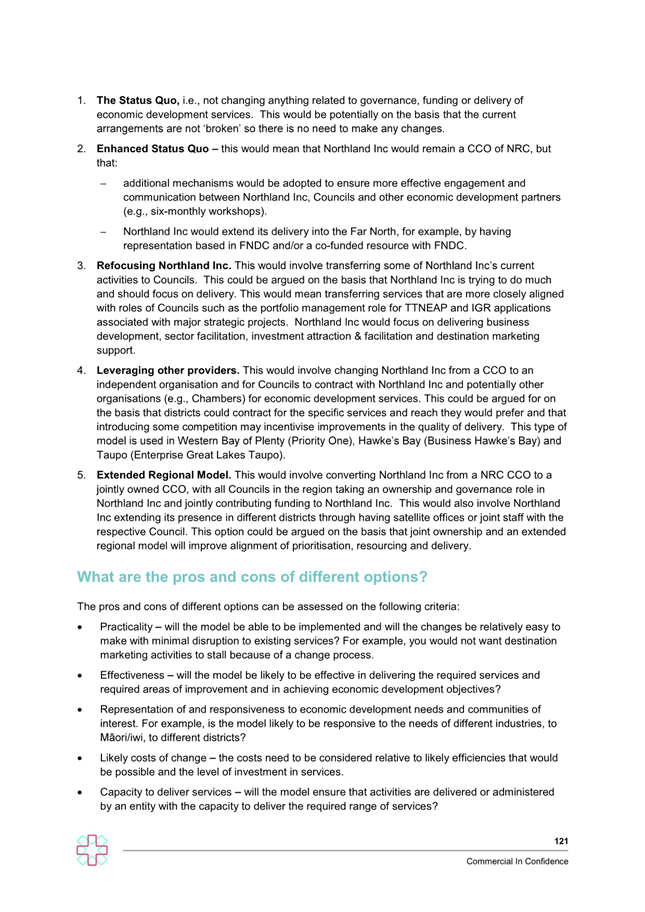
The Martin Jenkins Review of Economic Development
Arrangements in Northland completed in July 2017, concluded that:
· There were no
major gaps in the economic development services being delivered across
Northland.
· There was limited
duplication across agencies.
· Greater regional
coordination would improve effectiveness.
· A shared regional
economic development strategy was needed. Northland NZ has delivered Te
Rerenga in this space.
· Māori
economic development and regional destination management required greater
emphasis.
· Northland Inc (now
Northland NZ) should evolve into a jointly governed regional entity with
enhanced district involvement.
The review concluded that economic development services
generally generated benefits that outweighed costs and recommended
strengthening regional coordination, governance and investment arrangements.
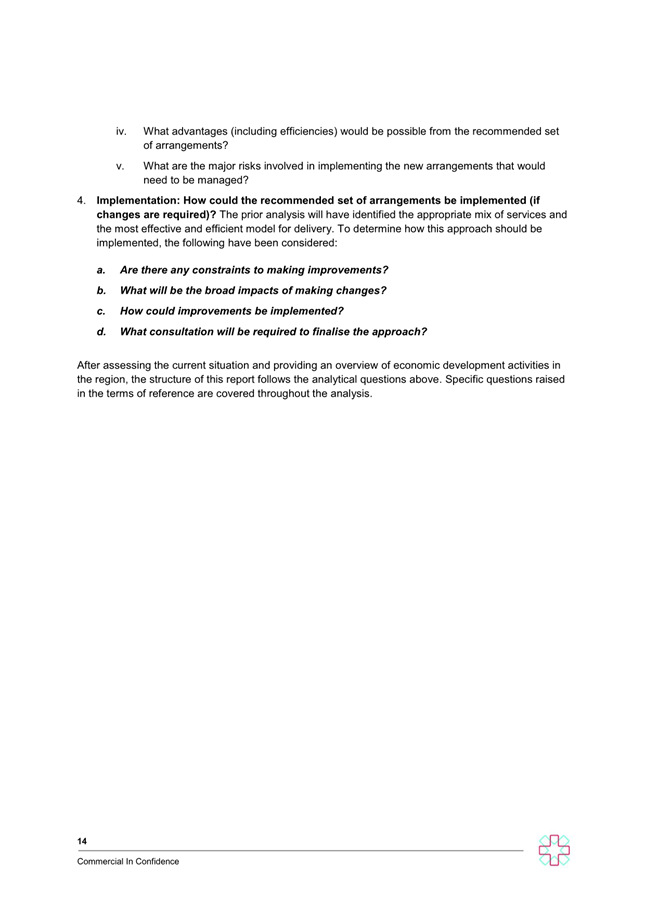
Following the July 2017 Martin Jenkins review, a further
service delivery review was completed in 2019. That review assessed alternative
governance and delivery models and concluded that a strengthened regional
economic development organisation remained the preferred approach due to the
benefits of regional scale, capability, coordination and governance.
Subsequent Service Delivery Review 2019
A subsequent review of service delivery options concluded
that a regional council-controlled organisation remained the preferred delivery
model and would provide:
· Regional scale.
· Greater
capability.
· Access to
specialist expertise.
· Better investment
attraction capability.
· Stronger
government relationships.
· Improved
coordination of priorities across councils.
Northland NZ Today
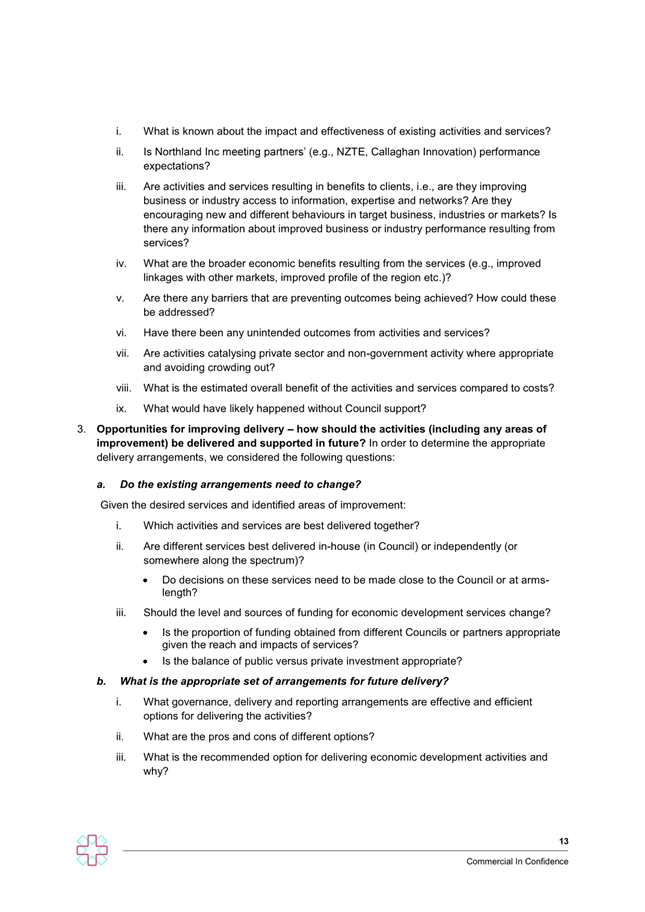
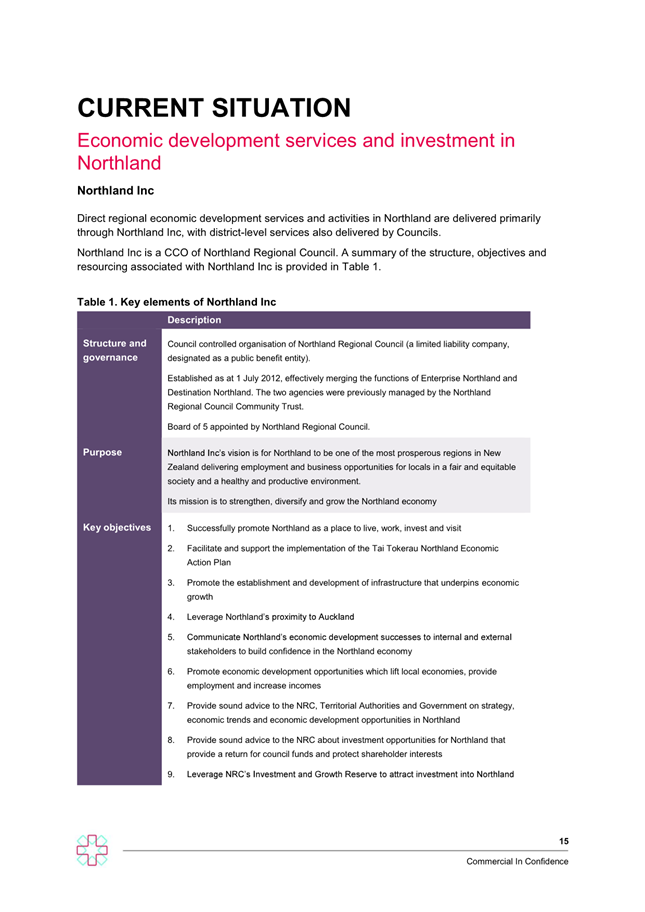
Northland NZ is the region's economic development agency
(EDA) and regional tourism organisation (RTO). It evolved from Northland Inc
and operates as a council-controlled organisation jointly owned by Northland
Regional Council, Far North District Council, Whangārei District Council
and Kaipara District Council. The organisation was established to provide a
coordinated regional approach to economic development, tourism, investment
attraction and strategic economic leadership across Te Tai Tokerau.
It works alongside local government, iwi, central government
agencies, industry and community partners to support economic growth, improve
productivity, attract investment, grow business capability and strengthen
regional prosperity.
The organisation is governed by an independent Board and is
accountable to its shareholder councils through an annual Statement of Intent
(SOI), quarterly reporting requirements and oversight from the Joint Regional
Economic Development Committee (JREDC). The JREDC was established under the
Local Government Act 2002 and acts as the shared governance forum for regional
economic development matters, including shareholder oversight of Northland NZ.
Northland NZ currently delivers activities across four
strategic priority areas: Investment and Infrastructure, Primary Sector
Development, Tourism and Destination Management, and Innovation and Enterprise.
These activities are supported by Māori Economic Development, Advocacy and
Brand, Environmental Sustainability, Partnerships, and Organisational
Capability functions.
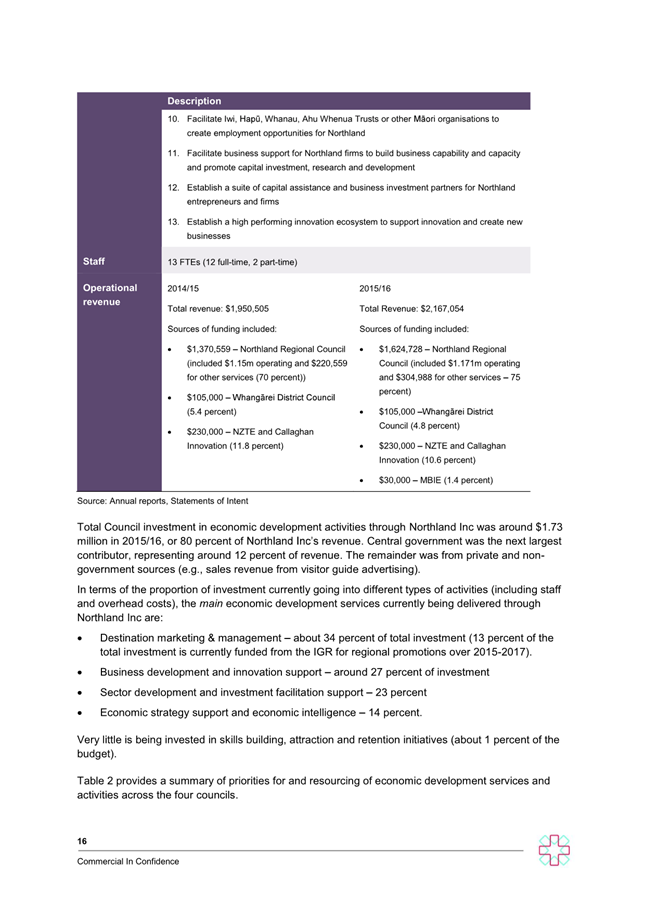
Northland NZ receives operational funding primarily through
the Investment and Growth Reserve (IGR), a regionally administered fund
supported by contributions from the four Northland councils. Additional funding
is secured through central government programmes, project-specific contracts,
commercial partnerships and externally funded initiatives. The Investment and
Growth Reserve also provides funding for project development and enabling
investment activities across the region.
Under the current shareholder arrangements, Far North
District Council contributes funding annually to the Investment and Growth
Reserve (IGR), which funds the activities of Northland NZ and approved regional
economic development initiatives. Council's current projected contribution is
$413,000 in 2025/26, increasing to $500,000 in 2026/27 and $513,000 in 2027/28
under the current funding model.
Northland NZ has also played a central role in the
development of the Northland Regional Deal proposal. The proposal identifies
four priority growth sectors—future energy, marine manufacturing, primary
industry and the visitor economy—which together have the potential to
generate an estimated $977 million of additional regional GDP, over 6,000 jobs
and approximately $877 million in additional exports if supported by
appropriate infrastructure investment and enabling policy settings.
Economic Development Context for the Far North
Recent regional analysis undertaken through the Northland
Regional Deal work highlights that economic development remains a significant
strategic priority for the Far North District.
While Northland's economy has grown over the past decade,
structural challenges remain including lower productivity, lower household
incomes, infrastructure constraints and comparatively high levels of
deprivation.
At the same time, the Far North has demonstrated strong
growth in economic activity, employment and exports, particularly in sectors
such as tourism, primary industry and emerging renewable energy opportunities.
The Regional Deal work identifies significant opportunities
associated with future energy, marine manufacturing, value-added primary
production and tourism, all of which have direct relevance to the Far North
District and support the strategic outcomes sought through Far North 2100.
From Activities to Outcomes
Recent work undertaken through the Northland Regional Deal
and the GDP Targeting and Augmentation Model (GTAM) signals a shift in thinking
about economic development.
Historically, economic development investment has often
focused on funding organisations, programmes and activities. GTAM instead
focuses on identifying the initiatives, investments and interventions most
likely to improve productivity, increase household incomes, stimulate business
growth, attract investment and create quality employment opportunities.
Under this approach, the primary question becomes:
What economic outcomes does the
Far North wish to achieve, and what investment framework, partnerships and
delivery model are best placed to achieve them?
This provides a stronger basis for assessing future
investment decisions through the Long Term Plan 2027–2037 process and
aligns investment decisions with measurable economic outcomes rather than
organisational structures alone.
Timing and Long Term Plan Alignment
The review of economic development investment is being
undertaken alongside development of the Long Term Plan 2027–2037 and the
Northland NZ Statement of Intent (SOI) process for 2027/28. This provides
Council with an opportunity to consider future economic development outcomes,
delivery models and funding arrangements alongside other LTP priorities.
|
Timing
|
Activity
|
|
July–August 2026
|
Council confirms scope of economic development review and
desired outcomes.
|
|
July–September 2026
|
LTP strategic direction and service review discussions with
elected members.
|
|
August–October 2026
|
Development of economic development options, delivery
models and funding scenarios.
|
|
September 2026
|
JREDC considers shareholder expectations for the Northland
NZ 2027/28 SOI.
|
|
October–December 2026
|
Assessment of options, costs, benefits and alignment with
desired economic outcomes.
|
|
December 2026
|
Shareholder Letter of Expectations issued to Northland NZ.
|
|
Late 2026
|
Council workshop on economic development outcomes and
future delivery options.
|
|
January 2027
|
Draft Northland NZ SOI received.
|
|
February–March 2027
|
Council and JREDC consider draft SOI and provide feedback.
|
|
Early 2027
|
Preferred approach included within Draft LTP material.
|
|
March–April 2027
|
Draft LTP consultation.
|
|
April 2027
|
Shareholder comments provided to Northland NZ.
|
|
May 2027
|
Final Northland NZ SOI received.
|
|
May–June 2027
|
LTP deliberations and adoption.
|
|
July 2027 onwards
|
Implementation of Council's adopted economic development
investment and delivery approach.
|
The review proposed in this paper provides Council with an
opportunity to determine:
• the
economic outcomes it wishes to prioritise;
• which
activities are best delivered regionally;
• where
stronger district-level capability may be required;
• whether
there are gaps in the current delivery model; and
• which
initiatives are likely to generate the greatest economic return for the Far
North.
The review should therefore consider not only institutional
arrangements, but also how future investment can be directed toward high-impact
initiatives that support productivity growth, business development, workforce
capability, infrastructure-enabled growth and Māori economic development.
2) matapaki me NgĀ KŌwhiringa /
Discussion and Options
Why Review Economic Development Now?
The LTP 2027–2037 process provides the appropriate
mechanism to consider:
· Future levels of
investment.
· Desired outcomes.
· Service delivery
models.
· Relationship with
Northland NZ.
· Internal
resourcing requirements.
· Alignment with
emerging regional and local government reform.
Economic development funding currently sits alongside
numerous competing priorities including infrastructure, climate adaptation,
growth management and community services.
Council must determine the value it wishes to place on:
· Business growth.
· Employment
outcomes.
· Inward investment.
· Tourism
development.
· Workforce
development.
· Māori
economic development.
· Regional influence
and advocacy.
Strategic Alignment
Future economic development investment aligns with:
· Far North 2100.
· Community
wellbeing outcomes.
· Emerging LTP
2027–2037 outcomes.
· Te Rerenga.
· Regional Deal
opportunities.
· Economic
resilience and productivity goals.
Investment Considerations
Regardless of the delivery model ultimately adopted, future
economic development investment will need to consider:
· priority
initiatives capable of improving productivity and economic output;
· opportunities
identified through the Regional Deal programme;
· enabling
infrastructure requirements;
· workforce and
skills development initiatives;
· Māori
economic development opportunities;
· tourism and
visitor economy growth opportunities; and
· investment
attraction and business growth initiatives.
The Long Term Plan process provides an opportunity to
determine the level of investment Council wishes to make toward these outcomes
and the delivery model best placed to support them.
The following list of options are proposed for consideration
through the LTP process as the basis of future economic delivery models.
Option 1 – Status Quo
Continue participation in the current regional model and
maintain investment in Northland NZ through existing shareholder arrangements,
the Investment and Growth Reserve (IGR), and the annual Statement of Intent
process.
Advantages
· Lowest
implementation cost.
· Maintains
established regional partnerships.
· Retains regional
capability and economies of scale.
· Avoids disruption
to existing programmes.
· Continues access
to specialist expertise and investment attraction capability.
· Supports
continuation of Regional Deal and regional advocacy initiatives.
Disadvantages
· Limited ability to
address district-specific priorities.
· Dependence on
regional prioritisation processes.
· Limited local
economic development capacity.
· May not fully
address emerging Far North opportunities.
Option 2 – Regional Model Plus Enhanced Local
Capability
Retain participation in Northland NZ while investing in
additional district-level economic development capability to address local
priorities and project development opportunities.
Advantages
· Retains regional
benefits and economies of scale.
· Improves Council's
ability to pursue local priorities.
· Supports project
development and investment attraction.
· Better alignment
between regional and local initiatives.
· Greater
responsiveness to local opportunities.
· Enables targeted
investment into initiatives identified through GTAM and Regional Deal analysis.
· Retains access to
regional capability while strengthening local project development and delivery
capacity.
· Supports a dual
focus on regional collaboration and place-based economic development outcomes.
Disadvantages
· Requires
additional operational funding.
· Potential overlap
between regional and district activities.
· Requires clear
role definition and governance arrangements.
· More complex
operating model.
Option 3 – Full Internal Delivery
Bring all economic development activities currently
delivered through Northland NZ into Council and cease reliance on the regional
model.
Advantages
· Complete local
control.
· Full alignment
with Council priorities.
· Direct
accountability to Council.
· Greater
flexibility in resource allocation.
Disadvantages
· Significant
establishment costs.
· Loss of regional
scale and capability.
· Reduced access to
regional networks.
· Potential
duplication with neighbouring councils.
· Reduced influence
in regional initiatives.
· Increased
organisational risk.
Option 4 – Full Internal Delivery Plus Enhanced
Capability
Bring all current Northland NZ functions into Council and
invest further in economic development capability to support economic growth,
project development, investment attraction and strategic partnerships.
Advantages
· Maximum local
control and influence.
· Strong alignment
with district priorities.
· Opportunity to
create a dedicated Far North economic development function.
· Potential for
stronger local project pipeline development.
· Enables direct
prioritisation and funding of local economic growth initiatives identified
through GTAM and future economic development planning.
Disadvantages
· Highest cost
option.
· Significant
staffing and resource requirements.
· Loss of regional
efficiencies.
· Increased
organisational and financial risk.
· May duplicate
capabilities already available elsewhere.
· Greater risk that
regional collaboration opportunities, economies of scale and regional
investment attraction capability could be diminished.
Option 5 – Reduced Investment Model
Bring economic development functions in-house but reduce
overall investment in economic development to minimise cost pressures and
support ratepayer affordability.
Advantages
· Lower overall
expenditure.
· Potentially
supports rate affordability objectives.
· Retains local
control over investment priorities.
Disadvantages
· Reduced economic
development capability.
· Reduced ability to
attract external investment.
· Lower project
development and advocacy capacity.
· Greater reliance
on opportunistic rather than strategic activity.
· Potential loss of
long-term economic opportunities.
Option 6 – Exit Economic Development Investment
Discontinue investment in economic development activities
and exit funding arrangements associated with Northland NZ and the Investment
and Growth Reserve.
Advantages
· Lowest direct
financial cost.
· Reduces Council
expenditure commitments.
Disadvantages
· Loss of regional
economic development capability.
· Reduced influence
over regional economic priorities.
· Reduced access to
investment attraction, business support and project development activities.
· Potential loss of
Regional Deal and strategic partnership opportunities.
· Reduced ability to
proactively influence economic outcomes.
· Inconsistent with
Far North 2100 objectives and Council's broader wellbeing responsibilities.
· Economic
development activity would still occur but with limited Council influence over
priorities or outcomes.
Economic Development Review and LTP Alignment
The review of economic development investment is being
undertaken alongside development of the Long Term Plan 2027–2037 and the
Northland NZ Statement of Intent (SOI) process. This enables Council to
consider future economic development outcomes, delivery models and funding
arrangements alongside other LTP priorities.
TAKE
TŪTOHUNGA / REASON FOR THE RECOMMENDATION
The Long Term Plan 2027–2037 provides the appropriate
mechanism for Council to consider the future role, investment and delivery of
economic development activities. The recommendation does not predetermine a
preferred option. Rather, it enables Council to undertake a structured
assessment of future economic development outcomes, investment priorities,
service delivery models and funding requirements before making decisions
through the LTP process. The approach aligns with Far North 2100, the Northland
Regional Deal programme and emerging GTAM work which emphasises investment in
initiatives capable of improving productivity, economic resilience and
long-term prosperity.
3) PĀnga PŪtea me ngĀ
wĀhanga tahua / Financial Implications and Budgetary Provision
No additional funding is sought through this report.
However, Council currently has projected contributions to
the Investment and Growth Reserve of:
· $413,000 in
2025/26;
· $500,000 in
2026/27; and
· $513,000 in
2027/28.
These contributions support Northland NZ and other approved
regional economic development activities under the current shareholder
arrangements. Future funding requirements will depend on Council's preferred
economic development outcomes, investment priorities and delivery model, and
will be considered through the Long Term Plan 2027–2037 process.
Āpitihanga
/ Attachments
1. Far
North 2100 - A5859301 ⇩ 
2. Martin
Jenkins - Review of Economic Development 2017 - A5859303 ⇩
Hōtaka Take Ōkawa / Compliance Schedule:
Full consideration has been given to the provisions of the
Local Government Act 2002 S77 in relation to decision making, in particular:
1. A
Local authority must, in the course of the decision-making process,
a) Seek
to identify all reasonably practicable options for the achievement of the
objective of a decision; and
b) Assess
the options in terms of their advantages and disadvantages; and
c) If
any of the options identified under paragraph (a) involves a significant
decision in relation to land or a body of water, take into account the
relationship of Māori and their culture and traditions with their
ancestral land, water sites, waahi tapu, valued flora and fauna and other
taonga.
2. This
section is subject to Section 79 - Compliance with procedures in relation to
decisions.
|
He Take Ōkawa /
Compliance Requirement
|
Aromatawai Kaimahi /
Staff Assessment
|
|
State the level of significance (high or low) of the
issue or proposal as determined by the Council’s
Significance and Engagement Policy
|
Low
This report does not seek a decision on a preferred
economic development investment model, funding level or service delivery
arrangement. Rather, it seeks Council direction that future economic
development investment and resourcing options be developed for consideration
through the Long Term Plan 2027–2037 process. Any future funding and
service level decisions would be subject to further Council consideration and
community consultation through the Long Term Plan process.
|
|
State the relevant Council policies (external or
internal), legislation, and/or community outcomes (as stated in the LTP) that
relate to this decision.
|
This report aligns with:
· Far
North 2100 and its vision of He Whenua Rangatira – a district of
sustainable prosperity and wellbeing.
· The
economic prosperity and wellbeing outcomes identified within Far North 2100.
· The
Local Government Act 2002, including Council's purpose to promote the social,
economic, environmental and cultural wellbeing of communities in the present
and for the future.
· Te
Rerenga – Northland Economic Development Strategy.
· The
development of the Long Term Plan 2027–2037 and associated strategic
planning processes.
· The
Northland Regional Deal proposal and associated economic growth opportunities
identified for Te Tai Tokerau
|
|
State whether this issue or proposal has a District wide
relevance and, if not, the ways in which the appropriate Community
Board’s views have been sought.
|
The matter has district-wide relevance as it relates to
potential future economic development investment, service delivery and
economic outcomes across the Far North District. No Community Board
consultation has been undertaken at this stage as the report does not seek a
substantive decision on future service delivery arrangements or funding
levels. Any future proposals requiring community input would be considered
through the Long Term Plan 2027–2037 consultation process.
|
|
State the
possible implications for Māori and how Māori have been provided
with an opportunity to contribute to decision making if this decision is
significant and relates to land and/or any body of water.
State the
possible implications and how this report aligns with Te Tiriti o Waitangi /
The Treaty of Waitangi.
|
· The
report does not relate to land, water or statutory decision-making affecting
Māori interests. However, economic development outcomes are of
significance to Māori as partners in economic development, major
landowners, investors, employers and contributors to regional prosperity.
· The
report recognises the importance of Māori economic development and notes
that this is currently a component of the Northland NZ activity framework.
Any future assessment of economic development investment and service delivery
options will consider opportunities to support Māori economic
aspirations and will be informed by engagement with iwi, hapū,
Māori organisations and Post Settlement Governance Entities where
appropriate.
· The
report is consistent with Council's commitment to Te Tiriti o Waitangi
through supporting inclusive economic development and recognising the
contribution of Māori to the economic, social, cultural and
environmental wellbeing of the district.
|
|
Identify persons likely to be affected by or have an
interest in the matter, and how you have given consideration to their views
or preferences (for example – youth, the aged and those with
disabilities).
|
Parties with an interest in this matter include:
· Residents
and ratepayers of the Far North District.
· Businesses
and industry groups.
· Iwi,
hapū and Māori organisations.
· Northland
NZ.
· Northland
Regional Council, Whangārei District Council and Kaipara District
Council.
· Central
government agencies and economic development partners.
· Community
organisations and social sector partners.
|
|
State the financial implications and where budgetary
provisions have been made to support this decision.
|
No additional funding is sought through this report.
Council currently contributes to the Investment and
Growth Reserve (IGR), which supports Northland NZ and approved regional
economic development initiatives. Current projected contributions are:
· $413,000
in 2025/26;
· $500,000
in 2026/27; and
· $513,000
in 2027/28.
Future investment requirements will depend on Council's
preferred economic development outcomes, investment priorities and service
delivery model and will be considered through the Long Term Plan
2027–2037 process.
|
|
Chief Financial Officer review.
|
Chief Financial Officer has reviewed this report.
|
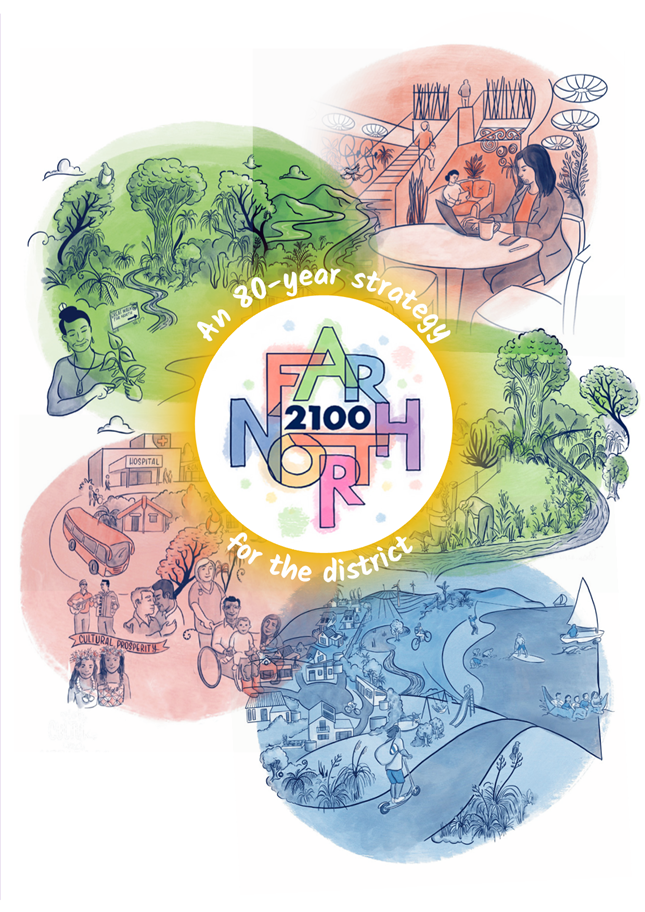

7.3 Unbudgeted
Capital Funding - Audio System Upgrades
File
Number: A5837747
Author: Ruben
Garcia, Group Manager - Community and Engagement
Authoriser: Ken
Macdonald, Chief Financial Officer
Take Pūrongo / Purpose of the Report
To obtain Council approval for unbudgeted capital
expenditure to resolve audio amplification and livestream audio quality issues
in Council Chambers and remote meeting locations, including at Te Ahu and the
Turner Centre, to support effective public meeting participation and
transparency.
WhakarĀpopoto matua / Executive Summary
· This report seeks Council approval for unbudgeted capital
expenditure of up to $200,000, not to exceed $200,000, in 2026/27 to address
ongoing audio issues affecting public meetings.
· Regular concerns and complaints have been received regarding poor
audio quality, including in-room amplification and the quality of audio
captured for livestreams and meeting recordings.
· The current ceiling-mounted microphone panel system in Council
Chambers is no longer fit for purpose. It does not directly capture individual
speakers and is affected by distance, room acoustics, background noise, and
amplification feedback.
· Recent changes to the Council Chambers meeting layout have further
reduced the effectiveness of the existing microphone panels, which are hard
fixed and were designed for a previous room configuration.
· Remote meeting locations, including at Te Ahu and the Turner Centre,
also experience audio quality limitations, primarily due to reliance on
webcam-based audio pickup that is not suitable for larger formal public meeting
environments.
· The recommended solution is a standardised microphone base unit and
long gooseneck microphone system, consistent with established practice in
mature councils in New Zealand and internationally.
· The proposed system will improve direct voice pickup, in-room
amplification, livestream and recording quality, remote participation, public
accessibility, and overall meeting facilitation.
· The solution also provides additional functionality, including
request-to-speak and speaker queuing features, and is scalable for future
enhancements such as electronic voting and translation.
· The recommended investment will provide a durable, fit-for-purpose,
and future-ready solution that supports transparent, accessible, and effective
Council decision-making.
|
tŪtohunga
/ Recommendation
That Council approve unbudgeted capital
expenditure for 2026/27 of up to $200,000, not to exceed $200,000, to address
audio amplification and livestream audio quality issues in Council Chambers
and remote meeting locations, including at Te Ahu and the Turner Centre.
|
1) Tāhuhu Kōrero / Background
Council has received regular and ongoing complaints
regarding audio quality during public meetings. These concerns relate to both
in-room audio amplification and the quality of audio captured for livestreams
and meeting recordings.
The current ceiling-mounted microphone panel system in
Council Chambers is no longer considered fit for purpose. The system relies on
microphones fixed overhead, at a distance from elected members, staff, and
public speakers. This creates technical challenges with voice pickup,
particularly where speakers are not directly beneath the panels or where room
acoustics affect sound clarity.
The ceiling panels do not directly isolate individual
voices. Instead, they capture a broad range of room sound, including background
noise, movement, paper shuffling, side conversations, and general room
reverberation. This creates an imbalanced signal-to-noise ratio, which reduces
speech clarity and directly affects both in-room amplification and the quality
of livestreamed and recorded meetings.
The effectiveness of the system has been further reduced by
recent changes to the room layout for public meetings. The ceiling-mounted
microphone panels are hard fixed and were designed around a previous room
configuration. As a result, they are no longer positioned to maximise audio
pickup from the current seating and speaking locations.
Audio quality issues also exist at remote meeting locations,
including at Te Ahu and the Turner Centre, although the cause is more limited
than in Council Chambers. At these locations, audio capture is currently
reliant on webcam-based microphone pickup, which is not designed for formal
public meetings involving multiple speakers across a larger room. This limits
the ability to clearly capture voices, particularly where speakers are
positioned away from the webcam, and can result in poor audio quality for remote
participants, livestreams, and meeting recordings.
This report is required now to seek approval for unbudgeted
capital expenditure to address the identified audio issues and improve the
quality, accessibility, and transparency of Council’s public meetings,
whether attended in person, viewed by livestream, or accessed through meeting
recordings.
2) matapaki me NgĀ KŌwhiringa /
Discussion and Options
The recommended course of action is to replace the current
audio capture arrangements with a standardised microphone and base unit system
suitable for formal public meetings.
This type of system is a well-established solution used by
mature councils in New Zealand and internationally (see attached list of
Councils using this type of solution). It involves individual microphone base
units at each seated position, with long gooseneck microphones positioned close
to each speaker. This allows the system to directly capture the voice of the
intended speaker, rather than relying on distant overhead microphones or
webcam-based audio pickup.
A base and microphone system would improve both in-room
amplification and the quality of audio provided to livestreams and meeting
recordings. It would also support clearer participation by elected members,
staff, submitters, remote participants, media, and members of the public.
The proposed solution is consistent with the type of meeting
audio system used by councils of a similar size and scale, including
Whangārei District Council. It reflects a standard approach for formal
decision-making environments where clear speech capture, reliable
amplification, and high-quality public meeting records are required.
Option 1: Status quo
Council could choose to retain the current audio
arrangements, including the ceiling-mounted microphone panels in Council
Chambers and webcam-based audio pickup at remote meeting locations.
This option is not recommended. It would not address the
ongoing complaints about poor audio quality and would continue to affect
in-room participants, livestream viewers, and those accessing meeting
recordings. It also risks further reputational damage, particularly where
members of the public are unable to clearly hear or understand Council debate
and decision-making.
There is no immediate capital cost associated with this
option; however, the underlying issues would remain unresolved.
Option 2: Minor adjustments to the current system
Council could make minor adjustments to the existing
equipment, such as retuning the current audio system, repositioning available
equipment where possible, or continuing to rely on existing webcam-based audio
at remote locations.
This option is also not recommended. While minor
improvements may be possible, they would not address the root cause of the
issue. The current ceiling-mounted panels are hard fixed, positioned for a
previous room layout, and do not provide direct voice pickup from individual
speakers. Similarly, webcam microphones are not suitable for larger public
meeting spaces with multiple speakers.
This option may involve lower immediate cost but would
provide limited benefit and would not represent good long-term value.
Option 3: Preferred option - standardised microphone and
base unit system
The preferred option is to implement a standardised
microphone and base unit solution for Council Chambers and appropriate audio
capture improvements for remote meeting locations, including Te Ahu and the
Turner Centre.
This would include tabletop microphone base units and long
gooseneck microphones at key speaking positions to ensure direct voice pickup.
The system would be integrated with existing audio-visual, livestreaming, and
recording systems to improve sound quality across all public meeting outputs.
In addition to improved audio quality, the proposed system
provides a request-to-speak function. This allows elected members and other
meeting participants to indicate when they wish to speak, supporting clearer
speaker queuing and improved meeting facilitation by the Chair. The base unit
touchscreen can also display relevant speaker order information, helping manage
debate and discussion more effectively during formal meetings.
The proposed solution is also scalable. While the immediate
need is to resolve audio quality issues, the system can be expanded or upgraded
in future to support additional functionality, such as electronic voting and
translation features. This means the investment is not limited to meeting
today’s operational needs but also provides a platform that can support
future improvements to Council meeting management, accessibility, and
participation.
The benefits of this option include:
· clearer voice
pickup from individual speakers;
· improved in-room
audio amplification;
· improved
livestream and recording quality;
· reduced background
noise and room echo;
· better support for
remote participation;
· improved
accessibility for the public;
· request-to-speak
functionality to support speaker queuing and meeting facilitation;
· touchscreen
display of relevant speaker order information;
· a scalable
platform that can support future upgrades, including voting and translation
functionality;
· a more
professional and reliable meeting environment;
· reduced reliance
on unsuitable overhead or webcam-based microphones; and
· a standardised
solution consistent with other council chambers and formal public meeting
environments.
This option is recommended because it directly addresses the
cause of the current audio issues and provides a durable, fit-for-purpose, and
future-ready solution for Council’s public meetings.
The solution currently being considered is the DICENTIS
Wireless Conference System. This system provides wireless microphone base
units, long gooseneck microphones, request-to-speak functionality, speaker
order display, and integration capability with existing audio-visual,
livestreaming, and recording systems.
Further information is provided in Attachment 1, DICENTIS
Wireless Conference System Product Brochure. Attachment 2, DICENTIS Wireless
Conference System Installations in New Zealand, provides examples of councils
and public sector meeting environments in New Zealand that have installed this
same solution as their audio microphone system.
Risk and mitigations
The key risk of not proceeding is that poor audio quality
will continue to affect public meetings, livestreams, and recordings. This may
reduce public confidence, create frustration for elected members and staff, and
limit the ability of the public to follow Council decision-making.
There is also a risk that minor or temporary fixes will not
resolve the issue and may result in further cost without delivering a durable
solution.
These risks are mitigated by approving a fit-for-purpose,
standardised audio solution that is designed for formal meeting environments
and integrated with Council’s existing livestreaming and recording
systems.
Costs of each option
Option 1, the status quo, has no immediate capital cost but
does not resolve the issue.
Option 2, minor adjustments to the current system, may
involve some operational or minor capital cost but is unlikely to provide a
reliable or long-term solution.
Option 3, the preferred option, requires unbudgeted capital
expenditure of up to $200,000, not to exceed $200,000. Final costs will be
confirmed through procurement, detailed design, and implementation planning.
TAKE
TŪTOHUNGA / REASON FOR THE RECOMMENDATION
The recommended option provides the most effective and
enduring response to the audio issues currently affecting Council meetings. It
addresses the core problem by replacing unsuitable audio pickup arrangements
with a fit-for-purpose system designed for formal meeting environments. This
will improve sound amplification in the room, enhance the quality of
livestreams and recordings, support better meeting facilitation, and provide a
scalable platform for future meeting technology needs.
3) PĀnga PŪtea me ngĀ
wĀhanga tahua / Financial Implications and Budgetary Provision
This report seeks approval for unbudgeted capital
expenditure in 2026/27 of up to $200,000, not to exceed $200,000, to address
audio amplification and livestream audio quality issues in Council Chambers and
remote meeting locations.
As this is an unbudgeted capital funding request exceeding
$100,000, Council approval is required before the expenditure can proceed.
Indicative pricing estimates the proposed solution will cost
between $175,000 and $200,000, GST inclusive. This estimate includes equipment,
installation, and integration with Council’s existing audio-visual,
livestreaming, and recording systems.
No further ongoing operational costs are anticipated as part
of the proposed solution, aside from normal asset maintenance and support that
would be managed within existing operational arrangements.
Funding source and general rates impact
The Finance Team has reviewed this proposal and has
confirmed that, if approved, the unbudgeted capital expenditure will be loan
funded.
Finance has calculated the indicative first-year rates
impact based on the maximum capital expenditure request of $200,000.
The calculation assumes annual depreciation over a
seven-year asset life of $28,571.43 and interest at 4.27% of $8,540. This
results in an estimated total first-year cost of $37,111.43, or $42,678.14 GST
inclusive.
Based on the rates impact calculation provided by Finance,
the estimated first-year general rates impact is $0.24 per $100,000 of land
value for ratepayers in the general differential. The estimated impact is $0.66
per $100,000 of land value for the commercial/industrial differential, and
$0.12 per $100,000 of land value for the 50% land differential.
Āpitihanga
/ Attachments
1. Attachment
A - Commercial Brochure Dicentis Wireless Solution - A5841153 ⇩ 
2. Attachment
B - DICENTIS Wireless Conference System Installations - A5841154 ⇩
Hōtaka Take Ōkawa / Compliance Schedule:
Full consideration has been given to the provisions of the
Local Government Act 2002 S77 in relation to decision making, in particular:
1. A
Local authority must, in the course of the decision-making process,
a) Seek
to identify all reasonably practicable options for the achievement of the
objective of a decision; and
b) Assess
the options in terms of their advantages and disadvantages; and
c) If
any of the options identified under paragraph (a) involves a significant
decision in relation to land or a body of water, take into account the
relationship of Māori and their culture and traditions with their
ancestral land, water sites, waahi tapu, valued flora and fauna and other
taonga.
2. This
section is subject to Section 79 - Compliance with procedures in relation to
decisions.
|
He Take Ōkawa /
Compliance Requirement
|
Aromatawai Kaimahi /
Staff Assessment
|
|
State the level of significance (high or low) of the
issue or proposal as determined by the Council’s
Significance and Engagement Policy
|
Low. The decision is not considered significant under
Council’s Significance and Engagement Policy. The proposal does not
alter Council’s strategic direction, change levels of service in a
material way, or involve the transfer of ownership or control of a strategic
asset.
Formal public consultation is not considered necessary.
The proposal responds to known and recurring complaints regarding audio
quality and is intended to improve public access to Council meetings.
|
|
State the relevant Council policies (external or
internal), legislation, and/or community outcomes (as stated in the LTP) that
relate to this decision.
|
Council decision-making is required to be undertaken in a
manner that supports transparency, good information, and effective public
participation. Public meetings are a core part of Council’s democratic
decision-making process, and the ability for people to hear and understand
proceedings is fundamental to that process.
Improving audio quality supports the intent of open and
transparent local government by ensuring meetings can be followed by people
attending in person, participating remotely, watching livestreams, or
accessing recordings after the meeting.
The recommended option supports Council’s
commitment to transparency, accessibility, and effective governance. Reliable
audio is an essential operational requirement for public meetings,
particularly where meetings are livestreamed and recorded for public access.
The proposed investment also supports a more consistent
and professional meeting experience across Council Chambers and remote
meeting locations.
|
|
State whether this issue or proposal has a District wide
relevance and, if not, the ways in which the appropriate Community
Board’s views have been sought.
|
Audio feedback concerns and complaints from the public
are regularly received in relation to both Council meetings and Community
Board meetings hosted at remote locations. The issue therefore has
district-wide relevance.
|
|
State the
possible implications for Māori and how Māori have been provided
with an opportunity to contribute to decision making if this decision is
significant and relates to land and/or any body of water.
State the
possible implications and how this report aligns with Te Tiriti o Waitangi /
The Treaty of Waitangi.
|
There are no specific implications for Māori in
relation to land, water, sites, wāhi tapu, valued flora and fauna, or
other taonga.
However, improving the quality of public meeting audio
will support better access to Council decision-making for all communities,
including iwi, hapū, Māori communities, and Māori
representatives participating in or observing Council meetings.
|
|
Identify persons likely to be affected by or have an
interest in the matter, and how you have given consideration to their views
or preferences (for example – youth, the aged and those with
disabilities).
|
Persons likely to be affected by or have an interest in
this matter include all participants and audiences of public meetings,
including elected members, staff, presenters, submitters, media, members of
the public attending in person, and online audiences viewing livestreams or
recordings. Consideration has been given to the need for all audiences,
including youth, older people, and people with disabilities, to clearly hear
and follow public meeting proceedings.
|
|
State the financial implications and where budgetary
provisions have been made to support this decision.
|
Details included in Section 3 of the report.
|
|
Chief Financial Officer review.
|
Chief Financial Officer has reviewed this report.
|
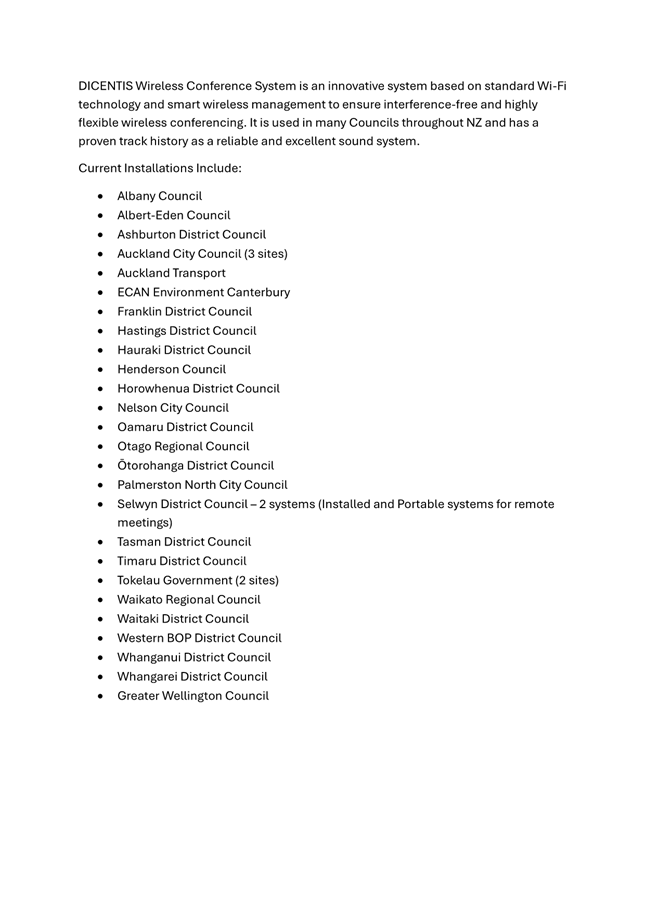
7.4 Decision
on the Installation of a Memorial Seat for Stanley Julian at Taipa Beachfront
File
Number: A5667986
Author: Mark
Inglis, Facilties Lead - Technical Operations
Authoriser: Hilary
Sumpter, Group Manager - Delivery and Operations
Take Pūrongo / Purpose of the Report
To seek a decision on the installation of a memorial seat
for Stanley Julian at Taipa beachfront.
WhakarĀpopoto matua / Executive Summary
· This report considers the implications of approving a memorial seat
requested for Stanely Julian on the Taipa beachfront.
· The report addresses the issues of compliance with Far North
District Council policy, affected parties, risks and mitigations, implications
for Māori and estimated costs to Council.
· The proposal was considered by the Te Hiku Community Board at its
meeting on 16 December 2025. The Board supported the application subject to
hapū consultation.
· The results of hapū consultation were communicated to Council
on 23 March 2026. Matakairiri te Hapū declined the proposal.
· The proposal is considered under the 2017 Arts and Memorials in
Public Places policy.
· Since the purchase and installation of the memorial seat would be
borne by the applicant, and ongoing maintenance costs of low value, the
financial implications of this proposal are minor.
· The report recommends that the application be DECLINED.
|
tŪtohunga
/ Recommendation
That Council decline the proposal from the
Julian family for the installation of a memorial seat for Stanley Julian, on
the Taipa beachfront (Parcel ID LINZ/FNDC: 5231365) at the position indicated
in Attachment B of this agenda report.
|
1) TĀhuhu kŌrero / Background
The family of Stanley Julian has applied to the Board to
install a memorial seat on the beachfront at Taipa Beach. Stanley was a
respected member of the Taipa community who had lived in Taipa for over 50
years. He passed away earlier this year. The seat is a gift he would have
wished to donate and share with fellow beach users. The application is included
as Attachment A to this agenda report.
The family requests that the seat be located on the
foreshore of the Taipa beachfront in the position indicated the map detailed in
Attachment B of this agenda report.
The proposed seat would be shaded by a pohutukawa tree but
would not be close enough to interfere with its roots. There are no underground
cables in the vicinity. The Roading Team has checked the proposal and notes the
placement of the seat will not interfere with any road users or pedestrians.
The seat would be a simple bench design with no back, 1500mm
long x 300mm wide x 100mm thick of macrocarpa, or similar, with rounded corners
for safety, fixed onto two legs and concreted into the ground. There will be a
small plaque attached of durable metal. The family will be donating and
installing the bench-seat, to FNDC specifications.
2) matapaki me NgĀ KŌwhiringa /
Discussion and Options
In considering this request, the following issues need to be
addressed
· Far North
District Council Policy – Council has current policy entitled -
“Art and Memorials in Public Places 2017”, which is included in
this agenda report as Attachment B. The relevant elements of the policy are
considered below:
o Contribution to community
wellbeing - one of the objectives of the policy is to recognise members of
the community who have contributed to the wellbeing of the people within their
area or the district. The proposal meets this objective.
o Community involvement
– the policy states that there should be community involvement in
decision-making about any proposed memorial. Given that the scale of this
proposal is minor, it would be unnecessary to undertake a community
consultation on the matter.
o Contribution to the
identity of the area – the design of the proposed seat is consistent
with the beachfront character of the area.
o Durable, easy to maintain
and of good quality materials – the proposed seat is of similar
durability and materials as the existing seats in the area.
o Comply with standards
relating to design and colour – any approval would be subject to
providing a compatible seat, consistent with those already in place.
o Enhance the public space
– the additional seat and style of the unit would enhance the park by
providing improved public amenity.
o Become Council property
– the seat would become a Council asset.
· Community Board
Recommendation – the board considered the proposal at its meeting on
16 December 2026 and approved the request, subject to approval by hapū/iwi
on the design and location of the seat as per the resolution below:
Resolution 2025/1
That the Te Hiku
Community Board approve the installation of a memorial seat for Stanley Julian
on the Tāipa beachfront.
carried
Note: That Te Hiku
Community Board approves the installation of a memorial seat for Stanley Julian
on the Tāipa beachfront subject to written confirmation being received
that local hapū/iwi approved the design and location of seat.
· Implications
for Māori – the local hapū, Matakairiri te Hapū, was
consulted and has declined the proposal using two main criteria when
considering such requests:
o Where is the individual from?
o What did they contribute to
the community?
Hapū stated that “Any foreshore
development must have a close relationship with Ngati Kahū and the
haukainga hapū of Maheatai – Matakairiri.”
In this instance Hapū decided that there was not
sufficient closeness in the relationship with Ngati Kahu and Matakairiri.
· Affected and
Interested Parties:
o Matakariki is mana whenua of
this land and the key interested party. The hapū states that
Meahetai/Taipā is culturally significant to Ngati Kahu, as it is the
cradle of the Uri (descendants) of Ngati Kahu. It is critical that Council
considers carefully the views of the hapū on this matter.
o In terms of other affected
parties, it is unlikely that the loss of a small vacant section of the reserve
would impact on members of the community.
· Risks and
Mitigations – there is a risk of damage to the seat through graffiti
or physical force. This would create addition work and cost for the FNDC
District Facilities Team. Any damage would be funded through existing
operational expenditure for Parks and Recreation. At the end of the life cycle
of the asset, Council will also need to consider replacement or removal of the
asset, which would become an additional cost. The current replacement cost is
approximately $1,000.00 (excl. gst) including installation.
TAKE
TŪTOHUNGA / REASON FOR THE RECOMMENDATION
Since the proposal was declined by Matakairiri te Hapū,
it is recommended that the proposal be declined.
3) PĀnga PŪtea me ngĀ
wĀhanga tahua / Financial Implications and Budgetary Provision
The cost of the seat, and its installation, will be borne by
the applicant, so there is no initial cost to Council for the asset.
Operational expenditure for repairs and maintenance is estimated at no more
than $200/annum over the 20-year lifecycle of the seat.
Āpitihanga
/ Attachments
1. Attachment
A - Application for memorial seat for Stanley Julian - A5504241 ⇩ 
2. Attachment
B - Proposed location memorial seat Stanley Julian on Foreshore Road Taipa -
A5668354 ⇩
3. Attachment
C - Art-and-Memorials-in-Public-Places-2017. - A5668385 ⇩
Hōtaka Take Ōkawa / Compliance Schedule:
Full consideration has been given to the provisions of the
Local Government Act 2002 S77 in relation to decision making, in particular:
1. A
Local authority must, in the course of the decision-making process,
a) Seek
to identify all reasonably practicable options for the achievement of the
objective of a decision; and
b) Assess
the options in terms of their advantages and disadvantages; and
c) If
any of the options identified under paragraph (a) involves a significant
decision in relation to land or a body of water, take into account the
relationship of Māori and their culture and traditions with their
ancestral land, water sites, waahi tapu, valued flora and fauna and other
taonga.
2. This
section is subject to Section 79 - Compliance with procedures in relation to
decisions.
|
He Take Ōkawa /
Compliance Requirement
|
Aromatawai Kaimahi /
Staff Assessment
|
|
State the level of significance (high or low) of the
issue or proposal as determined by the Council’s
Significance and Engagement Policy
|
The establishment of a memorial seat for a notable member
of the community is of significance, however since the value of the seat is
modest, and proposed location uncontentious, the relative level of
significance is low.
|
|
State the relevant Council policies (external or
internal), legislation, and/or community outcomes (as stated in the LTP) that
relate to this decision.
|
This proposal is consistent with the principles and
objectives of the following policy:
https://www.fndc.govt.nz/__data/assets/pdf_file/0022/18094/Art-and-Memorials-in-Public-Places-2017..pdf
|
|
State whether this issue or proposal has a District wide
relevance and, if not, the ways in which the appropriate Community
Board’s views have been sought.
|
Community Boards are delegated to recommend to Council,
the installation of works of art and memorials within their ward or
subdivision. The board considered the proposal at its meeting on 16 December
2025 and approved the application subject to iwi/hapu approval of seat design
and location.
|
|
State the
possible implications for Māori and how Māori have been provided
with an opportunity to contribute to decision making if this decision is
significant and relates to land and/or any body of water.
State the
possible implications and how this report aligns with Te Tiriti o Waitangi /
The Treaty of Waitangi.
|
Matakairiri. - haukainga hapū of Maheatai, was
consulted on this matter. The hapū representative was Trudy Allen in her
role as Taipā Marae Enviro Kaitiaki. She is well versed in the issues
facing this area, as she is the hapū representative working on the FNDC
foreshore redevelopment project in Taipa. FNDC will continue to consult with
Matakairiri on matters concerning this area.
|
|
Identify persons likely to be affected by or have an
interest in the matter, and how you have given consideration to their views
or preferences (for example – youth, the aged and those with
disabilities).
|
Matakariri is the key affected party which does not
approve this proposal to proceed on their whenua, therefore a decline is
recommended.
For other parties who use the reserve, impacts would not
be material.
|
|
State the financial implications and where budgetary
provisions have been made to support this decision.
|
Since the purchase and installation of the memorial seat
is borne by the applicant and ongoing maintenance costs are likely to be low,
the financial implications of this proposal are minor.
|
|
Chief Financial Officer review.
|
Chief Financial Officer has reviewed this report.
|
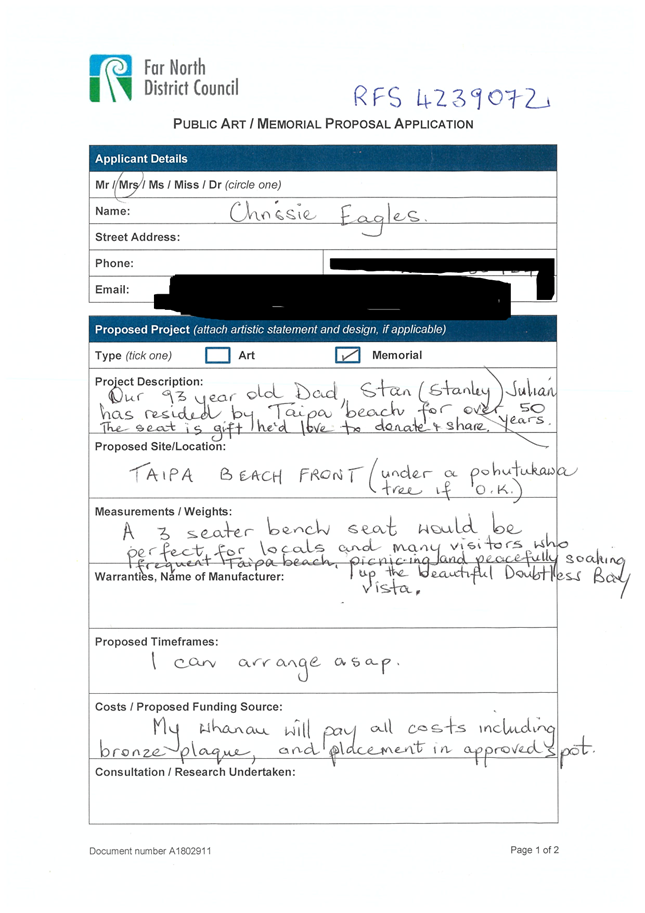
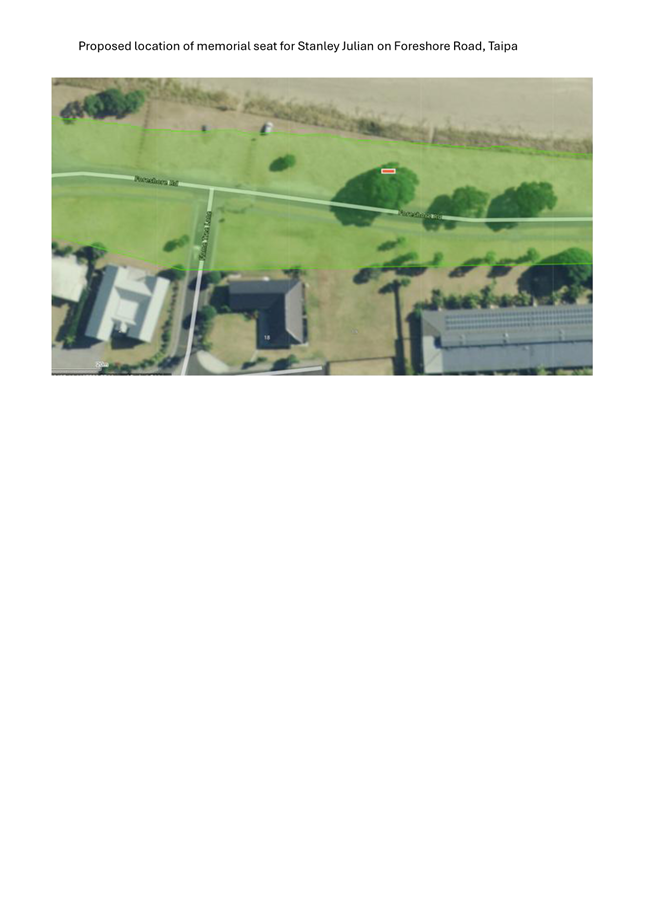
7.5 2026
Local Government New Zealand Annual General Meeting Remits
File
Number: A5860891
Author: Marysa
Maheno, Democracy Advisor
Authoriser: Aisha
Huriwai, Manager - Democracy Services
Take Pūrongo / Purpose of the Report
To confirm Council’s position on proposed remits for
the 2026 Local Government New Zealand (LGNZ) Annual General Meeting (AGM).
WhakarĀpopoto matua / Executive Summary
· 9 remits/papers are listed on the 2026 Local Government New Zealand
AGM agenda. (Attachment 1)
· This report includes advice from staff who have subject matter
expertise.
· Kahika-Mayor Moko Tepania will be attending the 2026 LGNZ AGM with
voting rights on behalf of Far North District Council.
· At the AGM attendees will be asked which remits they support, and
that remits be prioritised.
· Adopted remits will then be discussed at National Council to
determine further resourcing.
|
tŪtohunga
/ Recommendation
That Council agree their position for the
following remits:
|
Remit
|
Vote
|
Priority #
|
|
Priorities for Dog
Control Act Reform
|
Support
|
1
|
|
Improved
Regulation of Vape Retailers
|
Support
|
5
|
|
Financial Support
for Government Reform Implementation Costs
|
Support
|
4
|
|
Removal of
Representation Review Requirements During Simplifying Local Government
Reform
|
Abstain
|
7
|
|
Devolution of
Place-Naming Authority to Territorial Authorities
|
Support
|
6
|
|
Enhanced Role for
Government in Supporting Subnational Diplomacy
|
Abstain
|
9
|
|
Bulk Funding of
Transport Activities
|
Support
|
2
|
|
Improving LTP
Audit Requirements
|
Abstain
|
8
|
|
A Fairer Approach
to Uneconomic Transport Infrastructure Funding
|
Support
|
3
|
|
1) Tāhuhu Kōrero / Background
Local Government New Zealand is the local government
association founded in 1988. They represent the interests of regional city and
district councils who pay to be members.
The association holds an annual process called Remits as
part of their work. There are four criteria for remits:
1. The
remit is relevant to local government as a whole, not just a single zone,
sector or council.
2. The
remit relates to significant matters, including constitutional and substantive
policy, rather than matters that can be dealt with administratively.
3. The
remit concerns matters that can’t be addressed through channels other
than the AGM.
4. The
remit does not deal with issues already being actioned by LGNZ work programmes
or Strategy.
Remits can be submitted by zones or individual Councils -
with endorsement from other councils.
Remits then go to a Remit Screening Committee. Once approved
by the Screening Committee remits form part of the LGNZ AGM agenda. Voting at
the AGM determines which remits will continue and the order of priority.
Following the AGM all adopted remits will go to National Council to assign
resourcing as part of the LGNZ work programme.
The Far North District Council is a member of the
association and Kahika-Mayor Tepania will attend the 31 July 2026 AGM.
2) matapaki me NgĀ KŌwhiringa /
Discussion and Options
The intent of this report
is to present the confirmed remits, with advice from technical staff and/or
subject matter experts to Council to determine FNDC’s position which will
inform the vote of the Mayor at the LGNZ AGM.
|
Remit Title
|
Asking:
|
Staff Advice:
|
Recommended
Priority:
|
|
a) Priorities for Dog Control Act Reform
|
That LGNZ advocate
to government for the reform of the Dog Control Act 1996 to provide councils
with more effective powers and tools to undertake their dog control
responsibilities including:
· greater
scope for earlier intervention
· stronger
consequences for non-compliance
· better
ability for councils to set minimum requirements for dog owners - including
for desexing and containment
|
Support
FNDC support review of the Dog Control Act to provide
stronger and clearer rules and regulations, including stronger and wider
enforcement options.
|
1
|
|
b) Improved Regulation of Vape Retailers
|
That LGNZ advocate
to central government for legislative change to provide territorial
authorities with greater regulatory and enforcement powers over vape
retailers, including the ability to control the location, density, operation,
advertising, product visibility and compliance standards of vape stores
within their districts.
|
Support
During the development
of the Council's Smokefree/Vapefree Policy, significant concern was
identified within Far North communities regarding the increasing number of
vape retailers and the impact of vaping on tamariki.
Under the current
legislative framework, councils do not have regulatory powers in relation to
the location, density, or operation of vape retailers.
Supporting this remit
would advocate for legislative change to enable local councils to regulate
the location, density, and operation of vape retailers within their districts
in response to local community concerns.
|
5
|
|
c) Financial Support for Government
Reform Implementation Costs
|
That LGNZ advocate
to central government to provide specific targeted financial support to
councils to implement the operational and governance changes that are
proposed through the legislative reform programme, for example Simplifying
Local Government and RMA reforms.
|
Support
This remit was proposed
by Whangarei District Council and supported by Council at meeting held 20 May
2026.
|
4
|
|
d) Removal of Representation Review
Requirements During Simplifying Local Government Reform
|
That LGNZ advocate
to the Government, on behalf of its members, for compliance relief from the
upcoming representation review requirements in light of the significant
reforms proposed through the Simplifying Local Government programme and the
recent Head Start pathway, which may render any review undertaken before the
2028 elections redundant.
|
Abstain
Regarding
representation reviews:
· Councils
required to undertake a representation review must continue to comply with
their obligations under the Local Electoral Act 2001 as the law currently
stands.
· This
does not currently apply to FNDC, as it completed its representation review
for the 2025 elections and is not due to undertake another review at this
stage.
· Where
councils are amalgamated or replaced by a new entity, representation
arrangements will need to be determined before the first election. The
process is not yet known and may be addressed through the design and
implementation of the new structure rather than a traditional representation
review.
· Any
change to existing statutory obligations would require legislative provision.
Until then, councils should continue planning under the current legislation.
The concern raised by
the remit is understandable, as some councils are currently required to
undertake a representation review while their structure is also being
changed.
|
7
|
|
e) Devolution of Place-Naming Authority
to Territorial Authorities
|
That LGNZ advocate
for legislative changes to devolve authority for officiating geographic place
names from the Minister for Land Information to local authorities.
|
Support
This remit was proposed
by FNDC elected members and supported by Council resolution on 20 May 2026.
|
6
|
|
f) Enhanced Role for Government in
Supporting Subnational Diplomacy
|
That LGNZ advocate
to government and the Ministry of Foreign Affairs and Trade to formalise and
increase its role in supporting subnational diplomacy including developing
clear policy and capability to support and grow local government's
contribution
|
Abstain
FNDC does not recommend
the remit be supported in its current form. Since the remit was developed,
there have been significant changes. A review and redrafting would ensure the
remit reflects current Government priorities, clearly defines its intent, and
provides greater certainty regarding its implementation.
|
9
|
|
g) Bulk Funding of Transport Activities
|
That LGNZ calls on
government, opposition parties and NZTA to support a move to bulk funding for
basic and repeatable transport activities, thereby acknowledging the
efficiency and financial gains, and reduction in funding risk, this change
would provide to local government, and supports a trial of this proposed
bulk-funding approach for the 2027 2030 funding round amongst a group of
councils which have demonstrated strong performance in delivering public
transport services and/or maintaining transport infrastructure.
|
Support
FNDC supports
approaches that provide greater funding certainty, improved long-term
planning capability, and increased flexibility to manage transport investment
across the network. For districts such as the Far North, where there are
significant network management, resilience and maintenance challenges across
a large geographic area, a bulk funding approach may enable more efficient
allocation of resources and better alignment of investment with local
priorities.
FNDC considers that any
funding model should continue to maintain appropriate accountability,
transparency, and performance monitoring requirements while reducing
unnecessary administrative burden.
|
2
|
|
h) Improving LTP Audit Requirements
|
That LGNZ advocate
to government for improvements to the efficiency, proportionality, and
cost-effectiveness of audit requirements for Long Term Plans and Consultation
Documents, including:
1. Greater proportionality in audit
requirements, ensuring that audit effort is aligned with council size,
complexity, risk, and materiality; and
2. Reducing duplication across audit
stages, particularly where similar information and assumptions are subject to
repeated review; and
3. Improving standardisation,
transparency, and cost control in audit delivery, to reduce rework and
improve consistency across the sector, and to constrain excessive or
escalating audit fees through greater transparency of audit pricing and
benchmarking of costs across the sector.
|
Abstain
FNDC staff recommend
that this remit not be supported.
|
8
|
|
i) A Fairer Approach to Uneconomic
Transport Infrastructure Funding
|
That LGNZ advocate
for a fairer approach towards uneconomic transport infrastructure, where
either NZTA commits to co-funding this infrastructure if councils remain
legally obligated to own and maintain it, and/or the Government provides
clearer guidance and support for councils downgrading or ceasing service to
low traffic volume areas
|
Support
FNDC supports a funding
framework that more appropriately recognises the challenges faced by
districts with extensive transport networks, dispersed populations, low
rating bases, and significant resilience requirements. Uneconomic but
essential transport infrastructure often provides critical access for
residents, businesses, emergency services, and freight movements.
A funding model that
better reflects the strategic and social importance of these networks would
assist rural and regional councils to maintain safe and resilient transport
connections while improving equity across New Zealand's transport funding
system.
|
3
|
TAKE TŪTOHUNGA / REASON FOR THE
RECOMMENDATION
The reasons for each recommendation are included in the
table above.
3) PĀnga PŪtea me ngĀ
wĀhanga tahua / Financial Implications and Budgetary Provision
There are no financial implications or need for budgetary
provision in supporting, or otherwise any of the proposed remits.
Should the remits continue to be pursued by LGNZ it could
save Council funding in the long term by pursuing policies nationally rather
than by region or district.
Āpitihanga
/ Attachments
1. 2026
LGNZ AGM Remits - A5860887 ⇩ 
Hōtaka Take Ōkawa / Compliance Schedule:
Full consideration has been given to the provisions of the
Local Government Act 2002 S77 in relation to decision making, in particular:
1. A
Local authority must, in the course of the decision-making process,
a) Seek
to identify all reasonably practicable options for the achievement of the
objective of a decision; and
b) Assess
the options in terms of their advantages and disadvantages; and
c) If
any of the options identified under paragraph (a) involves a significant
decision in relation to land or a body of water, take into account the
relationship of Māori and their culture and traditions with their
ancestral land, water sites, waahi tapu, valued flora and fauna and other
taonga.
2. This
section is subject to Section 79 - Compliance with procedures in relation to
decisions.
|
He Take Ōkawa /
Compliance Requirement
|
Aromatawai Kaimahi /
Staff Assessment
|
|
State the level of significance (high or low) of the
issue or proposal as determined by the Council’s
Significance and Engagement Policy
|
This is considered to be a matter of low significance.
While some of the proposed remits touch on matters that could be of high
significance this paper looks at whether further conversations should be had
nationally rather than specific outcomes for our specific communities. There
is also insufficient time to consult locally.
|
|
State the relevant Council policies (external or
internal), legislation, and/or community outcomes (as stated in the LTP) that
relate to this decision.
|
The report seeks the views of Council to feed into a
national process.
|
|
State whether this issue or proposal has a District wide
relevance and, if not, the ways in which the appropriate Community
Board’s views have been sought.
|
The view of the Community Boards have not been sought
due to time constraints.
|
|
State the
possible implications for Māori and how Māori have been provided
with an opportunity to contribute to decision making if this decision is
significant and relates to land and/or any body of water.
State the
possible implications and how this report aligns with Te Tiriti o Waitangi /
The Treaty of Waitangi.
|
While some of the proposed remits touch on matters that
could of high significance to Māori this paper looks at whether further
conversations should be had nationally rather than specific outcomes for our
specific communities.
|
|
Identify persons likely to be affected by or have an
interest in the matter, and how you have given consideration to their views
or preferences (for example – youth, the aged and those with
disabilities).
|
While some of the proposed remits touch on matters that
could be of high significance to Māori this paper looks at whether
further conversations should be had nationally rather than specific outcomes
for our specific communities.
|
|
State the financial implications and where budgetary
provisions have been made to support this decision.
|
There are no financial implications or need for
budgetary provision.
|
|
Chief Financial Officer review.
|
The Chief Financial Officer has not reviewed this
report.
|
7.6 Utu Whakawhanake Development Contributions Policy 2025
Amendments - Submission Analysis and Adoption report
File
Number: A5864316
Author: Virginia
Smith, Policy Advisor
Authoriser: Kate
Ivicheva, Group Manager - Planning & Policy
Take Pūrongo / Purpose of the Report
To seek recommendation to
Council for adoption of amendments to the Utu Whakawhanake Development
Contributions Policy 2025.
WhakarĀpopoto matua / Executive Summary
· Operational testing of the implementation of the Utu
Whakawhanake Development Contributions Policy (Policy)
identified that amendments were required to address three matters:
o The reconsideration process
o Credit and terminology issues in clauses 17.8, 18.1 and 18.8; and
o Minor technical corrections
· On 13 May 2026, Te Kūkupa Committee for Strategy, Policy and
Regulation approved proposed amendments for consultation (resolution 2026/22,
refers).[1]
· The amendments do not change the underlying charging methodology,
schedule of fees, or core policy settings previously consulted on and adopted
· Consultation on the proposed amendments to the Policy (attachment 02) took
place from 18 May 2026 to 8 June 2026
· 25 submissions were received. 4 were out of scope. Of the 21
in-scope submissions, the majority supported the proposed amendments
· Staff analysis concludes that no further drafting changes are
required to the proposed amendments
· The recommendation is to adopt the proposed amending Policy in
attachment 03 and delegate reconsideration panel membership selection to the
Chief Executive.
· On 8 July 2026 Te Kūkupa Committee for Strategy, Policy and
Regulation meeting recommended that council adopt the proposed amendments.
|
tŪtohunga
/ Recommendation
That Council:
a) Receive
the Utu Whakawhanake Development Contributions Policy 2025 Amendments –
Submissions Analysis Report in Attachment 1.
b) Adopt
the proposed amendments to the Utu Whakawhanake Development Contributions
Policy 2025 in Attachment 2
c) Resolves
to commence the amended Utu Whakawhanake Development Contributions Policy
2025 on 27 July 2026.
d) Delegates
to the Chief Executive the selection of the membership of the reconsideration
panel, from suitably delegated officers, for the purposes of clause 28 of the
amended Utu Whakawhanake Development Contributions Policy 2025.
e) Authorise
the Chief Executive to make any necessary minor drafting or presentations to
the Utu Whakawhanake Development Contributions Policy 2025 to correct any
errors or omissions, or to reflect the decisions made by Council.
|
1) TĀhuhu kŌrero / Background
Council adopted the Utu
Whakawhanake Development Contributions Policy 2025 (Policy) on 7 October 2025,
with the commencement date originally delayed to May 2026 (2025/136,
refers). Council later resolved to move the commencement date to 1 July 2026 at
its Council meeting held on 1 April 2026.
Implementation work began
in November 2025. Through internal feedback, public enquiries, and operational
testing, staff identified non-material changes that would make the Policy
operate more efficiently and effectively. These changes were scheduled to occur
at the next Policy review date.
Due to a legal compliance
risk identified during the operational testing phase regarding the statutory
decision timeframe for reconsideration applications, this amendment process was
triggered, and all non-material changes were incorporated.
Council have completed
consultation and met its legal obligations under the Local Government Act 2002
(LGA). The submission analysis supports adoption of the amendments as consulted
on, without further change. It is now enabled to determine whether to adopt the
proposed amendments.
|
Date
|
Event
|
|
7 October 2025
|
Council adopted the Utu Whakawhanake Development
Contributions Policy 2025 and delayed commencement to May 2026 (resolution
ref 2025/136).
|
|
24 November 2025
|
Operational implementation planning began, covering
process design, governance, communications, and systems.
|
|
1 April 2026
|
Council considered the operational implementation status
update report and moved the commencement date to 1 July 2026.
Policy amendment process activated.
|
|
13 May 2026
|
Te Kūkupa Committee for Strategy, Policy and
Regulation approved the proposed amendments for consultation.
|
|
18 May 2026 – 8 June 2026
|
Public consultation was
undertaken under section 82 of the Local Government Act 2002
25 submissions received
No verbal submissions
requested
4 submissions out of
scope.
|
|
June 2026
|
Staff completed the
submission analysis report and provided the amended Policy for decision.
|
|
8 July 2026
|
Te Kūkupa
Committee for Strategy, Policy and Regulation Meeting – Submissions
Analysis Report and amended Policy endorsed the report and attachments for to
progress to Council for consideration and adoption decision.
|
|
22 July 2026
|
Submissions Analysis Report, amended Policy report and
attachments for Council consideration and adoption decision.
|
At the 8 July 2026 Te
Kūkupa Committee for Strategy, Policy and Regulation Meeting[2] Committee members
raised questions about the membership of the Reconsideration Panel (Panel).
Staff advised that the Panel would comprise of subject matter experts from the
Infrastructure, Building Consents, Resource Consents, Finance and Policy teams.
In response to this
matter, and to other feedback received at the meeting, staff will be presenting
a briefing report to a future Te Kūkupa Committee for Strategy, Policy and
Regulation meeting. The briefing report will address the Panel’s membership
selection process, terms of reference, and reporting arrangements to support
governance oversight.
2) matapaki me NgĀ KŌwhiringa /
Discussion and Options
Submission
Findings
Twenty-Five submissions
were received on the proposed amendments (Attachment 2). 4 submissions
were assessed as out of scope because they addressed wider issues about
development contributions rather than specific amendments consulted on.
Of the twenty-one in
scope submissions,
· 15 supported the proposed amendments,
· 3 did not support one or more amendments and/or proposed changes,
while
· 3 opposed the proposal to amend the policy altogether.
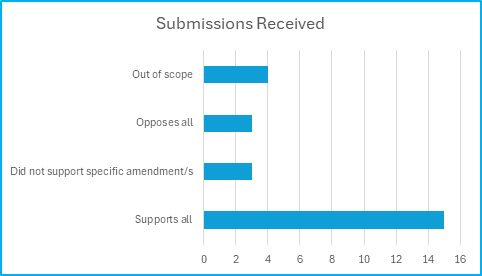
The majority of
submissions support proceeding with the proposed amendments, with the strongest
feedback focussing on how the delegated reconsideration panel should operate in
practice; however, no submission identified any alternative process that will resolve
the statutory time frame issue.
The submission analysis
concludes that the balance of feedback supports proceeding with the amendment
as consulted on.
Reconsideration process
The key legal and
operational issues are that the current clause 28.3 requires reconsiderations[3] to go to a public
Council meeting, yet the LGA requires that reconsideration decisions be
notified within 15 working days. The Supporting Report presented to the 13 May
2026 Te Kūkupa Committee for Strategy, Policy and Regulation Meeting[4] identifies that
ordinary Council meeting cycles, agenda lead-in times, and public notice
requirements would often exceed that period.
Attachment 3
replaces that pathway with a panel of three suitably delegated officers, with
discretion to refer significant matters to a commissioner, and a requirement to
provide written advice on objection rights. This change preserves the right to
seek reconsideration and objection, while making the process sustainable and
workable in practice.
The submission analysis (Attachment
1) recommends retaining this amendment unchanged. It also notes that
submitter concerns about safeguards are best addressed through implementation
tools such as delegations, procedures, guidance, conflict management, and
reporting, rather than further policy drafting.
Delegating membership to
the Chief Executive is consistent with that approach. It allows the panel to be
formed from suitably delegated officers with the right skills and availability
to meet statutory timeframes, while keeping the policy wording unchanged.
Referring
reconsiderations to a panel of delegated officers is consistent with the
approach taken by other councils, including Whangārei, Kaipara, and
Auckland Councils.
Credit provisions
The
proposed amendments to clauses 17.8.a.iv, 18.1.b, 18.8.a and 18.8.b improve
clarity and fairness in how credits are recognised. They separate HUE
calculation from credit allocation, align terminology, strengthen
cross-references, and recognise section 224(c) certificates issued before 1
July 2026 where title registration is delayed by Land Information New Zealand.
The
Supporting Report[5]
explains that these changes are intended to avoid inequity where developers
have completed the Council approval process, but title registration is delayed
for reasons outside their control. The amended policy text in Attachment 3
reflects that approach by extending historical credit recognition to allotments
with either a registered title or a section 224(c) certificate issued before 1
July 2026.
Submission
feedback supported retaining these amendments as drafted. The analysis found no
drafting defect or new issue that would justify changing the proposed wording
after consultation.
Technical corrections
The proposed technical
amendments correct grammar, spelling, duplicated wording, headings, and cross
references. The Submission Analysis (Attachment 1) reiterates the
Supporting Report conclusion that these amendments are low-risk and high-value
because they improve clarity, consistency, transparency, and legal
defensibility without changing the underlying charging intent.
Attachment 3
incorporates these amendments into the full amended Policy text. Adopting the
amendments without further change will ensure that the operative clauses,
schedules, methodology, and explanatory material read as one coherent
framework.
Legislative Compliance to support Policy amendment
The Policy is adopted and
amended under the LGA. Sections 102(4)(b) of the LGA allows Council to amend
the Policy at any time, provided it has first consulted on the proposed
amendments in a manner that gives effect to the requirements of section 82 LGA.
|
LGA Section
|
Policy Requirement
|
Amendment Compliance
|
|
s102(4)(b)
|
Amending funding and
financial policies
|
Enables Council to
amend its financial policies adopted under section 101(2) LGA
|
|
S82 as directed by
s102(4)(b)
|
Compliance with the
principles of consultation and information requirements for public
consultation when amending funding and financial policies
|
Enables Council’s
discretion to ensure efficient use of Council resources. Considerations when
using discretion:
• known community
views,
• ability for
public to provide their views
• prudent use of
Council resources
• significance of
decision in alignment with its significance and engagement policy
• engagement
material is clear about the scope of the consultation and feedback sought
|
|
s197AB(c)
|
Transparency
|
Enhanced cross-referencing and clear exceptions
|
|
s197AB(d)
|
Fairness and equity
|
Parallel treatment of
residential and non-residential
|
|
s106(2)
|
Methodology clarity
|
Separation of HUE
calculation from credit assessment
|
|
s199A
|
Reconsideration grounds
|
Reduced ambiguity
minimises incorrect assessments
|
|
Schedule 13, Clause 2
|
Units of demand
|
Clear linkage between
credits and demand factors
|
Risks
and mitigations
The primary risk of not adopting the amendments is that
clause 28.3 of the Policy will remain operationally unworkable, exposing
Council to avoidable legal and service risks. This includes the risk that
reconsideration decisions are not made within statutory timeframes, or that
Council must rely on unsustainable Extraordinary Council Meetings to maintain
legal compliance.
A smaller reputational risk remains that some
stakeholders may perceive the amendments as a policy shift, even though the
reports describe them as non-material changes that provide operational
improvements and better usability. This risk is best managed through clear
communication, transparent implementation, and written reasons for
reconsideration decisions.
Options
|
Option
|
Advantages
|
Disadvantages
|
|
1. Adopt the proposed amendments
without further changes and delegate panel membership selection to the Chief
Executive
|
· Consistent with previous Council decisions
· Consistent with submission analysis
· Resolves statutory workability issue
· Improves fairness and clarity
· Avoids reopening consultation
· Supports timely and efficient implementation
· Most cost-effective option
· Strongest alignment with LTP outcomes
· Council staff are currently developing Panel safeguards. processes
and supporting material to address the concerns raised through the
submissions.
|
· None identified
|
|
2. Do not adopt the amendments and retain the
current version of the adopted Utu Whakawhanake Development Contributions
Policy 2025 as adopted on 7 October 2025.
|
· No immediate change to the Policy text
|
· Council accepts identified legal compliance risk of not meeting
the statutory timeframe
· Leaves the reconsideration process unworkable long term
· Policy retains drafting and cross-referencing issues
· Weakens fairness where section 224(c) Resource Management Act 1991
timing issues arise
· Weakest alignment with LTP because it undermines efficient
administration and creates avoidable legal and operational risk
· Is the least cost-efficient option as it will require the most
resourcing to achieve compliance
|
Option 1 is the recommended option, as it best
reflects consultation feedback and Council’s prior decisions. It is also
the most cost-effective and operationally efficient option, with the strongest
alignment to LTP outcomes.
TAKE
TŪTOHUNGA / REASON FOR THE RECOMMENDATION
Staff recommend Option 1,
as it addresses the identified legal and operational risks, enhances fairness
and clarity, and remains within the scope of the amendments consulted on. It
also reflects the predominant theme arising from submissions, namely, to
proceed with the amendments as drafted, while managing panel safeguards through
implementation rather than further policy amendment.
Delegating responsibility
for selecting reconsideration panel members to the Chief Executive is an
appropriate and proportionate administrative measure. This approach supports
timely decision-making, enables the formation of panels based on relevant skills
and expertise, and provides necessary operational flexibility, while remaining
consistent with amended clause 28.3 as set out in Attachment 2.
3) PĀnga PŪtea me ngĀ
wĀhanga tahua / Financial Implications and Budgetary Provision
There are no financial
implications from the proposed amendments. The proposed amendments do not
change the Policy’s fee schedule or funding settings.
Any additional
initiatives, implementation, or enforcement costs that cannot be managed within
existing budgets will need to be identified by the teams responsible for
implementation and considered through the appropriate budgeting and planning
processes.
Āpitihanga
/ Attachments
1. Utu
Whakawhanake Development Contributions Policy 2025 Submission Analysis Report
June 2026 - A5818145 ⇩ 
2. Proposed-AMENDMENTS
in Tracked Changes-Utu-Whakawhanake-Development-Contributions-Policy-2025 -
A5819960 ⇩
3. Utu
Whakawhanake Development Contributions Policy 2025 Amended June 2026 -
A5818143 ⇩
Hōtaka Take Ōkawa / Compliance Schedule:
Full consideration has been given to the provisions of the
Local Government Act 2002 S77 in relation to decision making, in particular:
1. A
Local authority must, in the course of the decision-making process,
a) Seek
to identify all reasonably practicable options for the achievement of the
objective of a decision; and
b) Assess
the options in terms of their advantages and disadvantages; and
c) If
any of the options identified under paragraph (a) involves a significant
decision in relation to land or a body of water, take into account the
relationship of Māori and their culture and traditions with their
ancestral land, water sites, waahi tapu, valued flora and fauna and other
taonga.
2. This
section is subject to Section 79 - Compliance with procedures in relation to
decisions.
|
He Take Ōkawa /
Compliance Requirement
|
Aromatawai Kaimahi /
Staff Assessment
|
|
State the level of significance (high or low) of the
issue or proposal as determined by the Council’s
Significance and Engagement Policy
|
As per the Significance
and Engagement Policy, the level of significance is low, as impacts are
predominately administrative rather than financial or strategic, and
community views are known through the Submissions Analysis Report.
|
|
State the relevant Council policies (external or
internal), legislation, and/or community outcomes (as stated in the LTP) that
relate to this decision.
|
Te Pae Tata –
Three-Year Long-Term Plan,
Infrastructure Strategy,
Far North 2100,
Te Pūtōrino /
Kerikeri-Waipapa Spatial Plan
Te Pae o Uta
Revenue and Financing
Policy
Rating Policy
Proposed District Plan
The proposed amendments
align with those strategic documents because they do not change the Policy
direction or funding model. Instead, they improve transparency, fairness, and
operational workability within the existing strategic framework.
|
|
State whether this issue or proposal has a District wide
relevance and, if not, the ways in which the appropriate Community
Board’s views have been sought.
|
This has a District Wide
relevance, therefore Community Boards views were not sought.
|
|
State the
possible implications for Māori and how Māori have been provided
with an opportunity to contribute to decision making if this decision is
significant and relates to land and/or any body of water.
State the
possible implications and how this report aligns with Te Tiriti o Waitangi /
The Treaty of Waitangi.
|
No consultation was sought
with Iwi or Hapū, due to the nature of the amendments proposed.
|
|
Identify persons likely to be affected by or have an
interest in the matter, and how you have given consideration to their views
or preferences (for example – youth, the aged and those with
disabilities).
|
Developers
|
|
State the financial implications and where budgetary
provisions have been made to support this decision.
|
The proposed amendments do
not change the Policy’s fee schedule, or funding settings.
Any additional initiatives, implementation, or enforcement costs that cannot
be managed within existing budgets will need to be identified by the teams
responsible for enforcement and considered through the appropriate budgeting
and planning processes.
|
|
Chief Financial Officer review.
|
The CFO has reviewed this report
|
7.7 Mana
Whakahono ā Rohe - Approval to Initiate Engagement with Hapū.
File
Number: A5864966
Author: Llani
Harding, Pouhautū - Manager - Te Hono
Authoriser: Aaron
Taikato, Manuhautū Te Hono – Group Manager Te Hono
Take Pūrongo / Purpose of the Report
The purpose of this report is to present the
formal invitation from Ngā Hapū o Te Uri O Hua, Takotoke, Ngāti
Kura requesting that Far North District Council enter into a Mana Whakahono
ā Rohe (MWhāR), and to recommend that Council formally initiate
engagement with the Hapū under section 58P(4) of the Resource Management
Act (RMA) 1991.
WhakarĀpopoto matua / Executive Summary
· On 2 June 2026, Ngā Hapū o Te Uri O Hua, Takotoke,
Ngāti Kura wrote to Far North District Council requesting that Council
enter into a MWhāR with the Hapū.
· The Resource Management Act 1991 (RMA) provides different initiation
pathways for MWhāR. An Iwi authority may initiate a MWhāR under
section 58O, while a local authority may initiate a MWhāR with an Iwi
authority or Hapū under section 58P(4) RMA.
· The request received from Ngā Hapū o Te Uri O Hua,
Takotoke, Ngāti Kura is appropriately treated as a formal request for
Council to consider initiating a MWhāR under section 58P(4) RMA.
· Council has previously considered its general approach to MWhāR
and resolved that Council may consider initiating a MWhāR with a Hapū
or collective of Hapū where an established relationship exists.
· Council has an established and ongoing relationship with Ngā
Hapū o Te Uri O Hua, Takotoke and Ngāti Kura through a range of
governance, infrastructure, environmental and resource management programmes.
· Council is only being asked to initiate engagement, not
approve a MWhāR.
· Initiating engagement is consistent with Council's obligations under
the Resource Management Act 1991 and Local Government Act 2002, including
supporting Māori participation in decision-making, recognising the role of
kaitiaki, fostering constructive relationships with tangata whenua, and giving
practical effect to the principles of Te Tiriti o Waitangi.
· Initiating engagement does not predetermine the content of any
future agreement, commit Council to any specific obligations, funding
arrangements, governance arrangements, implementation programme or timeframes,
nor remove Council's statutory decision-making responsibilities.
· The current resource management system is subject to legislative
reform, with the Resource Management Act 1991 expected to be replaced by new
legislation. The timing and content of replacement legislation remain uncertain
and, the final legislative treatment of MWhāR agreements and their ongoing
legal effect remains uncertain.
· On 14 July 2026 Te Kuaka Committee for Māori Strategic
Relationships considered this report and resolved to commend parts a) and b) of
the recommendation below to Council.
|
tŪtohunga
/ Recommendation
That Council
a) receive the report Mana Whakahono
ā Rohe – Approval to Initiate Engagement with Hapū; and
b) agree
to:
i. formally
initiate engagement with Ngā Hapū o Te Uri O Hua, Takotoke,
Ngāti Kura under section 58P(4) of the Resource Management Act 1991 for
the purpose of negotiating a Mana Whakahono ā Rohe agreement;
ii. note that the process to be
adopted, timeframes for negotiation, implementation arrangements, governance
arrangements, review mechanisms, dispute resolution processes, resourcing
requirements and any future commitments will be subject to negotiation between
the parties and will not be agreed or implemented without being considered
through the appropriate Council governance and statutory decision-making
processes;
iii. note that initiation of engagement under section 58P(4)
does not commit Council to any specific terms, obligations, funding
arrangements, implementation programme or delegated authority:
iv. note
that any proposed Mana Whakahono ā Rohe agreement would be reported back
to Council for consideration before being finalised.
OR
That the Far North District Council does not formally
initiate engagement with Ngā Hapū o Te Uri O Hua, Takotoke,
Ngāti Kura under section 58P(4) of the Resource Management Act 1991 for
the purpose of negotiating a Mana Whakahono ā Rohe agreement at this
time.
|
1) Tāhuhu Kōrero / Background
Subpart 2 of Part 5 of the Resource Management Act (RMA)
1991 provides for MWhāR: Iwi participation arrangements. MWhāR are
intended to assist tangata whenua and local authorities to discuss, agree and
record how they will work together under the RMA, including how tangata whenua
will participate in resource management processes.
The statutory purpose and intent of MWhāR includes:
· improving
working relationships between tangata whenua and local authorities;
· enhancing
Māori participation in resource management and decision-making processes;
· supporting
effective and efficient resource management outcomes; and
· creating
locally appropriate arrangements that reflect the relevant relationships, rohe
and responsibilities of the parties.
In addition to the MWhāR provisions, Council exercises
powers and functions under a range of legislation that recognises the interests
of Māori in resource management and local government decision-making.
These include:
· section
6(e) of the Resource Management Act 1991, requiring recognition and provision
for the relationship of Māori and their culture and traditions with
ancestral lands, water, sites, wāhi tapu and other taonga;
· section
7(a), requiring particular regard to kaitiakitanga;
· section
8, requiring decision-makers to take account of the principles of Te Tiriti o
Waitangi;
· sections
4, 14 and 81 of the Local Government Act 2002, which require local authorities
to provide opportunities for Māori participation in decision-making and
maintain processes that support Māori contribution to local government
decision-making.
MWhāR provides a recognised statutory mechanism through
which councils and tangata whenua can build on existing relationships and agree
how they will work together in relation to resource management matters.
Council has previously considered its general approach to
MWhāR in the 2018 – 2022 triennium.
On 26 July 2018 the Governance and Strategic Relationships
Committee recommended that Council may initiate a MWhāR with a Hapū
or collective of Hapū once a relationship has been established.
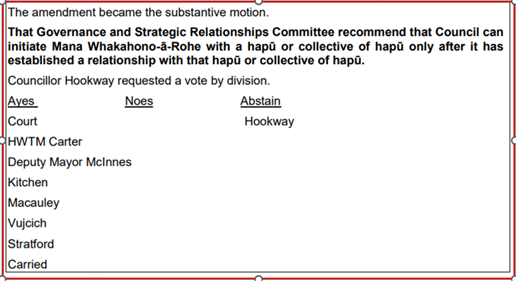
On 25 October 2018 Council adopted Resolution 2018/29:
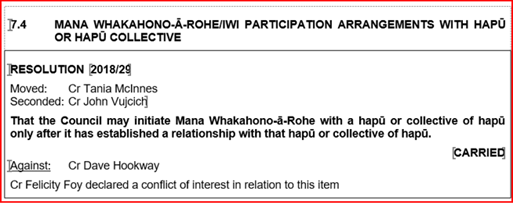
Council also subsequently considered specific MWhāR
arrangements with Te Rūnanga ā-Iwi o Ngāpuhi via the Strategy
and Policy Committee in May 2022 Resolution 2022/30, when that Iwi authority
formally invited Council to enter negotiations:
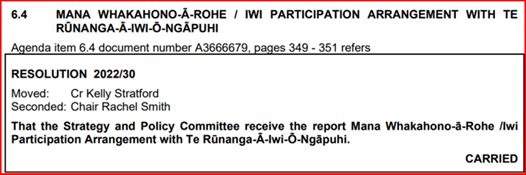
and ultimately entered into a MWhāR with Te
Rūnanga ā-Iwi o Ngāpuhi in August 2025.
Most recently, Te Kuaka Committee for Māori Strategic
Relationships adopted Resolution 2026/22 regarding this matter:
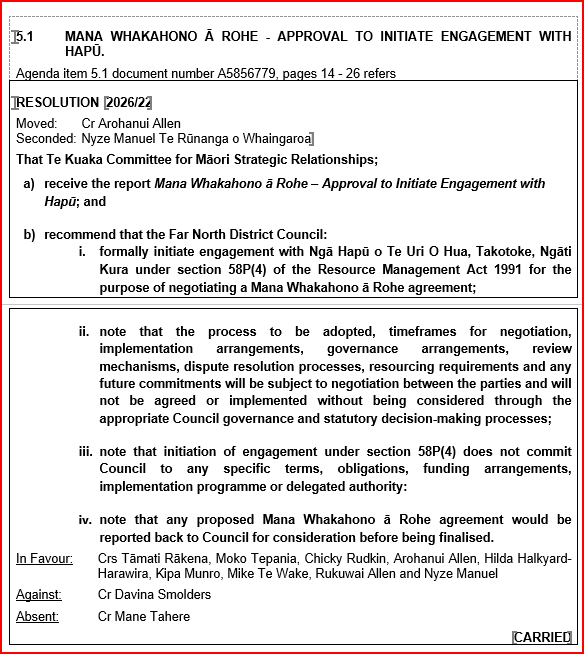
Council also has an established working relationship with
Ngā Hapū o Te Uri O Hua, Takotoke, Ngāti Kura through a range of
programmes and initiatives, including:
· Kaikohe
Wastewater Treatment Plant Working Group;
· Kaikohe
Library and Civic Hub Steering Group;
· Kaikohe
Placemaking Plan Working Group;
· Memorial
Park Reserve Management Plan development;
· Rawiri
Taiwhanga Memorial Park programme of works;
· Lake
Ōmāpere related matters;
· Kaikohe
Wastewater Treatment Plant consent processes;
· Wairoro
Stream water take consent matters; and
· other
resource management and community development initiatives.
Staff consider that the duration, breadth and continuity of
these engagements demonstrate an established working relationship consistent
with the approach contemplated by Council Resolution 2018/29.
2) matapaki me NgĀ KŌwhiringa /
Discussion and Options
Statutory Authority
MWhāR are provided for under Subpart 2 of Part 5 of the
Resource Management Act 1991 (sections 58L–58U). The purpose of
MWhāR is to provide a framework through which tangata whenua and local
authorities can discuss, agree and record how they will work together in
relation to resource management matters, including participation in
decision-making processes and engagement on matters affecting their rohe.
A MWhāR agreement does not transfer Council’s
statutory decision-making responsibilities or predetermine planning outcomes.
Rather, it provides a statutory framework through which participation
arrangements, engagement expectations, and process matters may be discussed and
agreed.
Section 58P(4) of the Resource Management Act 1991 provides
that a local authority may initiate a MWhāR with an Iwi authority or with
Hapū. Accordingly, Far North District Council has the statutory authority
to initiate engagement with Ngā Hapū o Te Uri O Hua, Takotoke and
Ngāti Kura for the purpose of negotiating a MWhāR.
The request received from the Hapū is appropriately
treated as a request for Council to consider exercising its discretion under
section 58P(4). Unlike an initiation by an Iwi authority under section 58O, a
request from Hapū does not create a statutory obligation requiring Council
to enter into a MWhāR.
Te Tiriti o Waitangi and Māori Participation
In exercising its functions under the Resource Management
Act 1991 Council must have regard to a number of statutory provisions relevant
to Māori participation in resource management, including:
· section
6(e), requiring recognition and provision for the relationship of Māori
and their culture and traditions with ancestral lands, water, sites, wāhi
tapu and other taonga;
· section
7(a), requiring particular regard to be given to kaitiakitanga;
· section
8, requiring decision-makers to take account of the principles of Te Tiriti o
Waitangi.
Council also has obligations under the Local Government Act
2002 to provide opportunities for Māori to contribute to local authority
decision-making processes and to establish and maintain processes that
facilitate such participation.
Initiating engagement regarding a MWhāR is consistent
with these statutory obligations and is based on a recognised legislative
mechanism through which Council and Hapū can strengthen participation,
engagement and relationship arrangements.
No Commitment to Future Arrangements
Council is only being asked to initiate engagement, not
approve a MWhāR.
The recommendation contained in this report is limited to
initiating engagement under section 58P(4).
Should Council resolve to
initiate engagement, the Resource Management Act requires the parties to
subsequently agree:
· the process
to be adopted;
· the period
within which negotiations are to be concluded; and
· how
the MWhāR is to be implemented following conclusion of negotiations.
No such arrangements are proposed for approval through this
report.
Initiation of engagement does
not commit Council to:
· any
particular terms of a MWhāR;
· any agreed
timeframe;
· any
governance arrangements;
· any
implementation programme;
· any financial
commitment;
· any staffing
commitment beyond business as usual; or
· any
delegation of statutory powers.
Any future arrangements arising from negotiations would
remain subject to consideration and approval through Council's normal
governance, financial and statutory decision-making processes before taking
effect.
This would involve presenting the amicable draft to Council,
ascertaining whether or not the content initiates the Councils Significance and
Engagement policy as per the relevant provisions in the Local Government Act
2002
Reform Environment and Legislative Uncertainty
The current resource management system is subject to
legislative reform, with the Resource Management Act 1991 expected to be
replaced by new legislation. While the timing and content of replacement
legislation remain uncertain, the current MWhāR provisions remain
available.
This creates a limited window for Council to consider
whether it wishes to utilise the existing statutory pathway before reforms
occur. Current proposals indicate that MWhāR processes initiated under the
RMA may have standing within the replacement system, although the final
legislative position remains subject to Parliamentary approval.
Current reform material also indicates support for retaining
participation mechanisms for Māori, but the final form of any replacement
provisions is not yet known. While initiated MWhāR processes may be
recognised within the replacement system, the final legislative treatment of
MWhāR agreements and their ongoing legal effect remains uncertain.
While the timing and final content of the replacement
legislation remain uncertain, there is currently no assurance that new
MWhāR processes will be able to be initiated under the future legislative
framework. Arrangements initiated under the current framework may be more
likely to be recognised through transitional provisions. Accordingly, the
opportunity to initiate a MWhāR process under the current legislative
framework may not remain available indefinitely.
If Council decides not to initiate a MWhāR process at
this time, existing engagement approaches would remain available. While these
alternatives can support ongoing relationship-based engagement, they would not
carry the same statutory weight as a MWhāR or provide the same level of
certainty, consistency, and durability for participation arrangements. This may
result in less clarity for hapū, Council staff, applicants and developers
regarding engagement expectations, participation processes, and who should be
involved in resource management matters.
Option 1 (recommended)
Recommend that Council formally initiate engagement with
Ngā Hapū o Te Uri O Hua, Takotoke, Ngāti Kura under section
58P(4).
Benefits
· Utilises the
statutory pathway available to Council under the Resource Management Act.
· Is consistent
with Council Resolution 2018/29.
· Recognises
the existing relationship between Council and the hapū.
· Supports
meaningful Māori participation in resource management decision-making.
· Recognises
the role of hapū as kaitiaki within their rohe.
· Supports
Council's obligations under the Resource Management Act 1991 and Local
Government Act 2002.
· Provides
a structured framework within which expectations, roles and responsibilities
can be discussed and clarified.
Implications
· Initiating
engagement does not establish the content of any future agreement.
· Scope,
process, timeframe, implementation arrangements, governance structures,
monitoring requirements and dispute resolution processes would need to be
negotiated.
· Any financial
implications, resource commitments or implementation requirements would remain
subject to future Council consideration and approval.
· Any
final MWhāR arrangement would be brought back through the appropriate
Council governance processes before being finalised.
Option 2: (not recommended)
That Council
not initiate engagement at this time
· Benefits: This option recognises that Council is not automatically
compelled to enter into a hapū MWhāR and may choose to defer a
decision given that the future status of MWhāR provisions under proposed
RMA reforms is uncertain.
· Risks: Deferring or declining initiation may be perceived as
inconsistent with Council’s established relationship with the hapū
and may miss an opportunity to clarify engagement expectations through a
structured process.
· Implications: Council would need to clearly communicate its reasons
for not initiating at this time and identify whether further engagement scoping
or resourcing analysis is required before the matter returns for consideration.
3)
TŪRARU ME TE WHAKAMAHINGA TŪRARU / RISK MANAGEMENT
The primary risks associated
with the recommendation are:
· differing
expectations between Council and the Hapū regarding the purpose, scope or
outcomes of a MWhāR;
· expectations
that initiation of engagement guarantees the completion of a MWhāR;
· future
resourcing, implementation or funding requirements identified during
negotiations;
· the
possibility that negotiations do not result in a final agreement.
These risks can be managed through
clear communication, agreed negotiation protocols, transparent governance
processes and ensuring that any future commitments are separately considered
through Council's normal decision-making and budgeting processes.
|
Risk
|
Potential Impact
|
Likelihood
|
Consequence
|
Mitigation
|
|
Reform uncertainty
– status of MWhāR under replacement legislation
|
The RMA is expected to
continue operating through a transitional period while the replacement
resource management system is implemented. However, there is uncertainty
about whether MWhāR processes that have not been initiated before Royal
Assent will have standing in the future system. Current indications suggest
that arrangements commenced under the RMA may be more likely to be recognised
through transitional provisions.
|
Medium
|
Medium
|
If Council resolves to
initiate, issue written invitations within 30 days of the resolution and
before Royal Assent of the replacement legislation, where practicable. Seek
further advice on transition provisions as the legislation progresses and
report back to Council on any implications for the process.
|
|
Different expectations
between Council and the Hapū regarding the purpose, scope or outcomes of
a MWhāR.
|
Delays in negotiations
or inability to reach agreement.
|
Medium
|
Medium
|
Establish clear
expectations at the outset of negotiations and agree a negotiation framework
before substantive discussions commence.
|
|
Perception that
initiation of engagement commits Council to a final MWhāR agreement.
|
Public misunderstanding
or concern regarding Council's intentions.
|
Medium
|
Medium
|
Clearly communicate
that initiation under section 58P(4) only commences engagement and that any
future agreement will require separate Council consideration and approval.
|
|
Future negotiation
identifies resource, staffing or funding requirements.
|
Additional operational
or financial pressures on Council.
|
Medium
|
Medium
|
Any proposed
commitments will be assessed and reported separately through Council's normal
budgeting and decision-making processes before approval.
|
|
Negotiations do not
result in an agreement.
|
Time and resources
expended without a final outcome.
|
Low
|
Medium
|
Establish realistic
objectives, maintain good-faith engagement and utilise agreed dispute
resolution processes where appropriate.
|
|
Concerns are raised by
other Iwi or Hapū regarding the proposal.
|
Reputational impacts or
requests for similar arrangements.
|
Low
|
Medium
|
Continue to assess any
requests on their individual merits and in accordance with statutory
requirements and previous Council direction.
|
|
Negotiated provisions
are perceived as affecting Council decision-making authority.
|
Governance concerns
raised by elected members or the community.
|
Medium
|
High
|
Ensure any draft
agreement explicitly recognises Council's statutory responsibilities and
decision-making powers and returns to Council for approval before any
commitment is made.
|
|
Failure to progress the
Hapū request.
|
Potential reputational
impacts and deterioration of existing relationships.
|
Medium
|
Medium
|
Maintain open
communication and utilise an agreed engagement process that reflects
partnership and good-faith principles.
|
|
The proposal is
perceived as creating precedent for future MWhāR requests.
|
Increased demand for
similar arrangements and expectations from other groups.
|
Medium
|
Low
|
Note that each request
must be considered on its own merits, statutory context, relationship history
and Council circumstances at the time.
|
|
The proposal is
misunderstood as approval of a MWhāR rather than approval to commence
discussions.
|
Public concern,
reputational impacts, or misunderstanding of Council's intentions.
|
Medium
|
Medium
|
Clearly communicate
that Council is only being asked to initiate engagement, not approve a
MWhāR. Any future agreement would require separate Council consideration
and approval.
|
4) TAKE TŪTOHUNGA /
REASON FOR THE RECOMMENDATION
Option 1 is recommended because it utilises the
structured statutory framework available to Council under the Resource
Management Act, recognises the existing relationship between Council and the
hapū and is therefore consistent with Council Resolution 2018/29, and
supports meaningful Māori participation in resource management
decision-making recognising Council's obligations under the Resource Management
Act 1991 and Local Government Act 2002.
5) PĀnga PŪtea me ngĀ
wĀhanga tahua / Financial Implications and Budgetary Provision
There are no immediate budgetary implications in Council
endorsing this recommendation. If Council resolves to initiate engagement, any
costs associated with negotiation, technical support, legal review,
implementation planning or future work programmes will be identified through
the agreed process. Any commitments requiring new or additional funding will
need to be assessed through Council’s usual budgeting, annual plan or
long-term plan processes before they are confirmed
Āpitihanga
/ Attachments
1. Letter
from Ngā Hapū o Te Uri O Hua, Takotoke, Ngāti Kura to Far North
District
Council - 2 June 2026 - A5835604 ⇩ 
Hōtaka Take Ōkawa / Compliance Schedule:
Full consideration has been given to the provisions of the
Local Government Act 2002 S77 in relation to decision making, in particular:
1. A
Local authority must, in the course of the decision-making process,
a) Seek
to identify all reasonably practicable options for the achievement of the
objective of a decision; and
b) Assess
the options in terms of their advantages and disadvantages; and
c) If
any of the options identified under paragraph (a) involves a significant
decision in relation to land or a body of water, take into account the
relationship of Māori and their culture and traditions with their
ancestral land, water sites, waahi tapu, valued flora and fauna and other
taonga.
2. This
section is subject to Section 79 - Compliance with procedures in relation to
decisions.
|
He Take Ōkawa /
Compliance Requirement
|
Aromatawai Kaimahi /
Staff Assessment
|
|
State the level of significance
(high or low) of the issue or proposal as determined by the Council’s
Significance and Engagement Policy
|
Low. The current recommendation is limited to initiating
engagement under section 58P(4) of the Resource Management Act 1991 and does
not preclude consideration of wider community engagement in relation to
future decisions which may arise as a result of the proposed engagement with
hapu.
The proposal does not involve
approving a MWhāR agreement, or commit Council to any timeframe,
implementation arrangement, funding commitment, governance change or level of
service change. Any potential future agreement and associated implications would
be subject to separate Council consideration and decision-making processes.
Accordingly, staff consider that the proposal does not trigger significance
under Council's Significance and Engagement Policy at this time.
|
|
State the relevant Council
policies (external or internal), legislation, and/or community outcomes (as
stated in the LTP) that relate to this decision.
|
Resource Management Act 1991,
Local Government Act 2002, Te Pae Tata, Te Pae o Uta, Te Kiri Waiwai o
Papatuanuku, FN2100
|
|
State whether this issue or
proposal has a District wide relevance and, if not, the ways in which the
appropriate Community Board’s views have been sought.
|
This has relevance to the
Kaikohe-Hokianga ward specifically as Hapū are mostly located within
these boundaries. Board views have not been sought for this committee meeting
however Board Chairs will have opportunity to speak to this matter at Council.
|
|
State the possible implications for Māori
and how Māori have been provided with an opportunity to contribute to
decision making if this decision is significant and relates to land and/or
any body of water.
State the possible implications and how this
report aligns with Te Tiriti o Waitangi / The Treaty of Waitangi.
|
The proposal aligns with Council's obligations under
sections 6(e), 7(a) and 8 of the Resource Management Act 1991 and sections 4,
14 and 81 of the Local Government Act 2002.
MWhāR provides a recognised statutory mechanism
through which tangata whenua and local authorities can agree how they will
work together in resource management matters.
Initiating engagement supports Te Tiriti o Waitangi
principles including partnership, good faith engagement, active protection,
informed decision-making and meaningful Māori participation in matters
affecting ancestral lands, waters, wāhi tapu and other taonga.
The proposal recognises the role of Ngā Hapū o
Te Uri O Hua, Takotoke and Ngāti Kura as kaitiaki within their rohe and
builds upon an established working relationship between Council and the
Hapū.
The recommendation is limited to initiating engagement
only. No process, timeframe, implementation arrangement, governance
structure, funding commitment or other obligation will be agreed without
further negotiation and consideration through Council's normal governance,
financial and statutory decision-making processes.
Council is only being asked to
initiate engagement, not approve a MWhāR. Any future agreement,
implementation arrangements, funding commitments or governance matters would
be separately considered by Council before any commitment is made.
|
|
Identify persons likely to be
affected by or have an interest in the matter, and how you have given
consideration to their views or preferences (for example – youth, the
aged and those with disabilities).
|
Ngā Hapū o Te Uri O
Hua, Takotoke, Ngāti Kura, their members, relevant Iwi and Hapū,
affected communities, elected members, Council staff and stakeholders
involved in relevant RMA processes may have an interest in this matter. The
Hapū have initiated the request for Council to consider a MWhāR,
and further views would be considered through the agreed engagement and
negotiation process if Council resolves to initiate.
|
|
State the financial implications
and where budgetary provisions have been made to support this decision.
|
There are no immediate budgetary
implications from endorsing this paper. Any future financial implications
arising from negotiation or implementation of a MWhāR would need to be
identified, assessed and approved through Council’s ordinary financial
planning and decision-making processes.
|
|
Chief Financial Officer review.
|
This report has been reviewed by
the CFO
|
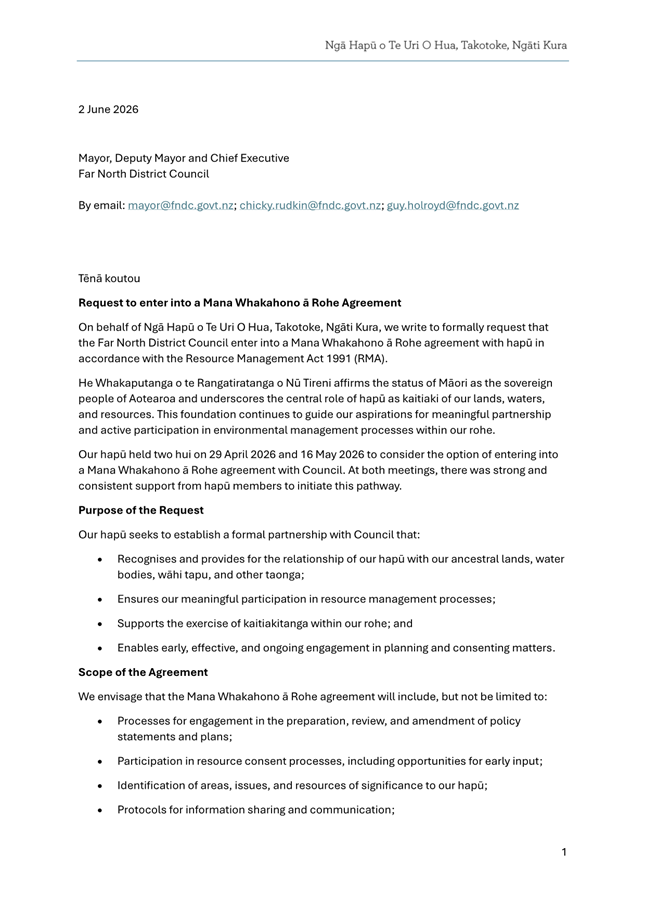
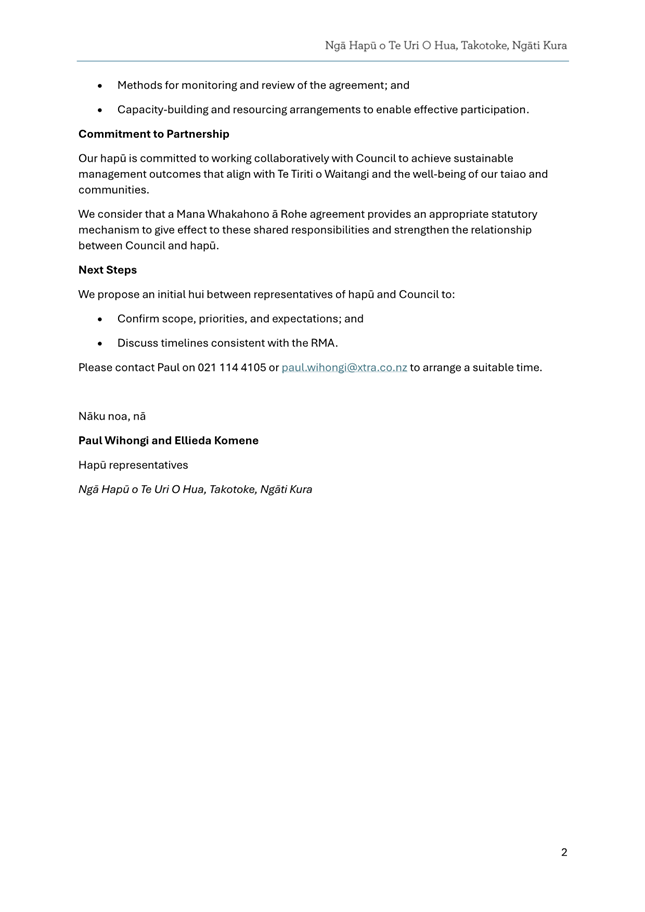
7.8 Scoping
Report and Community Panels' Terms of Reference - Stage One Community
Adaptation Planning
File
Number: A5873826
Author: Katy
Simon, Adaptation Programme Lead Climate Action and Resilience
Authoriser: Kate
Ivicheva, Group Manager - Planning & Policy
Take Pūrongo / Purpose of the Report
To seek Council’s adoption of the scope proposed for
Stage One Community Adaptation Planning, as set out in the final draft scoping
report.
To seek Council’s adoption of the draft Terms of
Reference for the Community Panels in Stage One Community Adaptation Planning.
WhakarĀpopoto matua / Executive Summary
· Far North District Council (Council) has legislative
responsibilities to appropriately plan for and manage short-, medium- and
long-term risks from natural hazards.
· Council’s community adaptation planning is the primary
planning process to address the projected significant increases in natural
hazards risks to existing Council services and assets.
· Stage One Community Adaptation Planning is Council’s first
adaptation planning project under Pou 1 of Te Hōtaka Urutau Hapori |
Community Adaptation Programme.
· A scoping report is the main deliverable of phase one of the
project. The scoping report sets the natural hazards addressed, planning
outcomes and levels of detail, and main engagement approaches.
· The draft Terms of Reference sets working agreements for the
upcoming Community Panels, community advisory bodies for the Stage One project.
|
tŪtohunga
/ Recommendation
That Council:
a) Adopt
the scoping report for Stage One Community Adaptation Planning.
b) Adopt
the Terms of Reference for Community Panels for Stage One Community
Adaptation Planning.
|
1) Tāhuhu Kōrero / Background
Council established
community adaptation planning in the Community
Adaptation Programme | Te Hōtaka Urutau Hapori (Programme), approved
and accelerated in August 2025. The Community Adaptation Programme supports Te
Hiku o Te Ika – The Far North District to prepare for and respond to the
impacts of climate change.
Stage One Community
Adaptation Planning is Council’s first community adaptation planning
project under Pou 1 of the Programme. The Stage One project is set up in five
phases to match an adaptation planning cycle and will deliver Community
Adaptation Plans by December 2027.

·
Figure 1 Stage One
project phases
A draft scoping report
for the Stage One project is now complete. This scoping report progresses the
project from phase one into phase two.
The scoping proposals
presented in the draft report were shaped by:
- The policy and planning context;
- A stocktake of natural hazards
and risk information, existing projects and initiatives; and
- Early engagement with community
and haukāinga | local people in the project area.
A Technical Advisory Group and Project Steering Group were
established during Phase One. These groups include staff and subject matter
experts across Far North District Council, Northland Regional Council, Far
North Holdings Inc. and more. Both groups gave input on and reviewed the
initial scoping proposals.
Staff also presented reports on the Stage One scoping
proposals to relevant committees and Community Boards:
· 17
June 2026: Te Koukou Committee for Transportation and Infrastructure endorsed
the scoping proposals to include Council infrastructure elements and the
approach to prioritise planning for settlements (RESOLUTION
2026/17).
· 29
June and 1 July 2026: Staff sought endorsement of sub-areas, community-centred
approach and Member participation in Community Panels from Te
Hiku and Kaikohe
Hokianga Community Boards.
· 8
July 2026: Staff presented a complete draft scoping report to Te Kūkupa
Committee for Strategy, Policy and Regulation for consideration and
endorsement.
At the time of writing, Community Boards and Te Kūkupa
meetings had yet to be held. Staff can speak to these outcomes when presenting
this report.
2) matapaki me NgĀ KŌwhiringa /
Discussion and Options
Staff are seeking
Council’s adoption of the scoping decisions presented in the main body of
the final draft scoping report - Attachment A.
The final draft report
contains scoping decisions on:
· Natural
hazards and planning timeframes
· Scale
and level of detail of a planning output:
o Areas
(the broader landscape or catchment context within which settlements and
individual elements sit)
o Settlements
(towns, villages, marae-based communities, and other concentrated places where
people, services, and assets are located together)
o Standalone
elements (specific assets, places, or features of value that may be exposed to
climate risk)
· Scale
of engagement
· Roles
and responsibilities
Scoping decisions are
based on:
- Legislation
and policy context (existing and anticipated)
- Known
needs and issues of local communities
- Known
interests, needs and issues for hapū and marae in the Stage One area
- Known
overlapping resilience/adaptation projects and initiatives
- Available
natural hazards modelling and information
- Available
budget and resourcing
- Timeframes
set by Te Hōtaka Urutau Hapori | Community Adaptation Programme
Appendices A and B in the
draft Scoping Report summarise the background analysis and initial engagement
that formed the scoping report. See Appendix A, Table A1.1:
National Legislation & Direction, for a list of relevant
legislation, policy and strategies.
This table summarises the
main scoping decisions for Council’s consideration
|
Stage One Scoping Decisions
|
Report page
|
|
Stage One project will
develop up to five Community Adaptation Plans.
|
12 - 13
|
|
Community Adaptation
Plans will address coastal flooding, tidal inundation, coastal erosion and
river (pluvial and fluvial) flooding across the short term (present), medium
term (2060 – 2070), and long term (2090-2130.
|
7
|
|
Community Adaptation
Plans will produce adaptation decisions across three scales: settlements,
areas and standalone elements.
|
7-8
|
|
Settlements will have
the most detail with adaptive pathways plans.
Settlement adaptive
pathways plans will focus on Councils’ and Council Controlled
Organsations’ (CCO) services and assets, but may also include other
public and private elements of value to communities.
Council / CCO
administered services and assets could include:
roading, bridges and
cycleways (prioritised for settlements)
potable water and
wastewater assets and services
stormwater and drainage
assets
waste transfer stations
and sites
wharves, jetties and
maritime assets related to ferry transportation services
parks and reserves
cemeteries
Council property,
including community centres, halls, libraries, and public toilets
|
10-11
|
|
High level
recommendations (less detailed than adaptive pathways plans) will be created
for area-wide issues and select standalone elements, including parts of the
roading network. These recommendations are expected to be addressed through
other planning and statutory processes.
|
10-11
|
|
Tangata whenua elements
outside of priority settlements fall under Pou 2, Tuia ngā tai o te ao |
Tangata Whenua led adaptation.
|
8
|
|
Five Community Panels
will be created.
Community Panels will
advise on adaptation planning and make recommendations to Council.
|
12
|
|
The wider public will
be informed of the process and will have the opportunity to provide feedback
on the draft adaptation plans.
|
15
|
|
Council is the final
decision-maker, as the primary entity responsible for delivering Community
Adaptation Plans.
|
15
|
|
Council will
collaborate with Northland Regional Council as a key partner for
implementation.
|
16
|
|
The project team will
seek to collaborate with existing and anticipated CCOs and other regional
service providers, such as Waka Kotahi, Department of Conversation, Te Whatu
Ora and Ministry of Education.
|
16
|
Further Stage One
project scoping
The scoping decisions
presented in the final draft scoping report are intentionally broad. Further
engagement, assessments, and technical review in project phases two and three
will refine the scope.
Engagement with Community
Panels, including hapū and marae representatives, and with the Technical
Advisory Group will confirm:
Details on which priority
settlements will be prioritised for detailed planning
Which parts of the
roading network and standalone elements to plan for within each sub-area
Specific area-wide issues
within and across the sub-areas
A more detailed risk and
vulnerability assessment will be used to develop community risk profiles. These
risk profiles will further refine priority elements by helping to prioritise
critical elements and set the community’s acceptable levels of risk and
tolerance of impacts on levels of service.
Decision options for
the final draft scoping report
|
Recommendation (a) - Adopt the draft scoping report for
Stage One Community Adaptation Planning.
|
|
Decision option
|
Pros
|
Cons
|
|
Option 1 - Adopt the
final draft scoping report, as attached
|
- Delivers on the Community
Adaptation Programme. The Stage One project can proceed.
- Enables adaptation planning
for a significant amount of Council services and assets.
- Community Adaptation Plans
will address risks and opportunities across the whole Stage One area.
- Accommodates broader issues
with more detailed planning, where prioritised.
|
- The draft Scoping Report only
proposes detailed plans for settlements.
- Time and resource constraints
mean the Stage One project cannot develop detailed plans for all elements
across the whole project area.
|
|
Option 2 – Adopt
the final draft scoping report, pending changes as noted by Council
|
- The project team may be able
to make minor to medium changes to the scope and still meet project
timeframes.
|
- A large change to the scope
may delay project timeframes and/or increase budget requirements.
|
|
Option 3 – Do not
adopt
|
- Allows more time for Council
to seek additional information or deliberation.
- Staff can present future
reports addressing the Council’s concerns.
|
- Contrary to Te Koukou
Committee endorsement.
- Triggers one-to-two-month
delays with multiple flow-on effects.
- Could increase project costs
over time.
|
Draft Terms of Reference for Community Panels
Staff are also seeking Council’s decision on the draft
Terms of Reference for the Community Panels - Attachment B.
Council has committed to establishing a community advisory
body in every adaptation planning project under Pou 1, Community Adaptation
Programme. For the Stage One project, this will be achieved by creating five
Community Panels.
The Community Panels will be established by August 2026. The
first sessions will take place by September 2026.
The draft Terms of Reference sets down responsibilities and
working agreements amongst the Community Panel members and between each
Community Panel and Council.
The working agreements laid out in the draft Terms of
Reference are based on other local government examples and have been reviewed
by the project team.
As set by the draft Terms of Reference, the Community Panels
will:
· Provide
community-endorsed recommendations for how their communities can prepare for,
and adapt to coastal hazards, flood hazards and sea level rise.
· Co-develop
Community Adaptation Plans for the project area and make recommendations to
Council.
· Agree to act
cooperatively and in good faith, for the benefit of their wider communities and
future generations.
· Consists of full
members, observers and support staff, with full members able to participate in
session activities and recommendations.
o Relevant Community Board
members will be full members.
o All other Elected Members will
be observers.
· Reach decisions by
consensus.
Receive an honorarium
payment in recognition of their contribution (noting that hapū
representatives will have separate compensation agreements).
|
Recommendation (b) - Adopt the draft Terms of Reference for Community Panels
for Stage One Community Adaptation Planning.
|
|
Decision Options
|
Pros
|
Cons
|
|
Option 1 - Adopt the
draft Terms of Reference for Community Panels, as attached
|
- Delivers community-centred
commitment under the Community Adaptation Programme; Adaptation
recommendations will come directly from the Community Panels.
- Sets up feasible engagement
within the project’s resourcing.
- The Stage One project can
proceed within the set timeframes.
|
- Poses a minor risk that the
Community Panels will make recommendations to Council that Council does not
approve or adopt.
- This is mitigated through
technical and feasibility assessments and regular governance briefings.
|
|
Option 2 – Adopt
the draft Terms of Reference for Community Panels, pending changes as noted
by Council
|
- The project team may be able
to make minor to medium changes to the draft Terms of Reference still meet
project timeframes and/or maintain a community centred approach.
|
- A large change to the draft
Terms of Reference may delay project timeframes or may undermine the
community-centred approach.
|
|
Option 3 – Do not
adopt
|
- Allows more time for Council
to seek additional information or deliberation.
- Staff can present future
reports addressing the Council’s concerns.
|
- Triggers one-to-two-month
delays with multiple flow-on effects.
- Could increase project costs
over time.
|
TAKE
TŪTOHUNGA / REASON FOR THE RECOMMENDATION
The first recommendation supports the scoping proposals
presented in the final draft scoping report, which has been developed through
community and haukāinga engagement and a rigorous technical and
feasibility review process.
The second recommendation, to adopt the draft Terms of
Reference for Community Panels, supports sound working agreements based on
other council examples and on the project team’s experience and
expertise.
3) PĀnga PŪtea me ngĀ
wĀhanga tahua / Financial Implications and Budgetary Provision
There are
no additional financial implications for either the adoption of the final draft
scoping report or the adoption of the draft Terms of Reference for Community
Panels. Both deliverables are a planned part of the Stage One project.
The Stage One project is currently funded under the Long
Term Plan 2024-2027, with an estimated total budget of $650,000.00 across the
2025-2026 and 2026-2027 financial years. Northland Regional Council provides
$100,000.00 in funding (included in the $650,000.00 total).
Āpitihanga
/ Attachments
1. Attachment
A - Final Draft Scoping Report - Stage One Community Adaptation Planning -
A5840647 ⇩ 
2. Attachment
B - Draft Terms of Reference for Community Panels - A5840648 ⇩
Hōtaka Take Ōkawa / Compliance Schedule:
Full consideration has been given to the provisions of the
Local Government Act 2002 S77 in relation to decision making, in particular:
1. A
Local authority must, in the course of the decision-making process,
a) Seek
to identify all reasonably practicable options for the achievement of the
objective of a decision; and
b) Assess
the options in terms of their advantages and disadvantages; and
c) If
any of the options identified under paragraph (a) involves a significant
decision in relation to land or a body of water, take into account the
relationship of Māori and their culture and traditions with their
ancestral land, water sites, waahi tapu, valued flora and fauna and other
taonga.
2. This
section is subject to Section 79 - Compliance with procedures in relation to
decisions.
|
He Take Ōkawa /
Compliance Requirement
|
Aromatawai Kaimahi /
Staff Assessment
|
|
State the level of significance (high or low) of the
issue or proposal as determined by the Council’s
Significance and Engagement Policy
|
Low (noting that the overall adaptation decisions are of
high significance). Initial engagement has been carried out to inform these
scoping proposals. The Community Panels will meet SEP requirements for
finalising the scope.
|
|
State the relevant Council policies (external or
internal), legislation, and/or community outcomes (as stated in the LTP) that
relate to this decision.
|
Primary relevant legislation:
- Resource
Management Act 1991
- Local
Government Act 2002
- Civil
Management Emergency Management Act 2002
Relevant Council policies and
strategies:
- Te
Taitokerau Climate Adaptation Strategy
- Climate
Action Policy
- FN2100
- Te
Pae o Uta
See Appendix A, Table A1.1:
National Legislation & Direction, in Attachment A for a
complete list of relevant legislation, policy and strategies.
|
|
State whether this issue or proposal has a District wide
relevance and, if not, the ways in which the appropriate Community
Board’s views have been sought.
|
Staff have presented a report to the Kaikohe Hokianga
and Te Hiku Community Boards at their 29 June and 1 July meetings. These
reports sought their endorsement of community scoping elements under their
delegation.
|
|
State the
possible implications for Māori and how Māori have been provided
with an opportunity to contribute to decision making if this decision is
significant and relates to land and/or any body of water.
State the
possible implications and how this report aligns with Te Tiriti o Waitangi /
The Treaty of Waitangi.
|
The project seeks to fulfil the commitments set out
under Te Hōtaka Urutau Hapori | Community Adaptation Programme, which
states that the programme will always support Council in giving effect to Te
Tiriti o Waitangi.
Since 2024, this project has focused on
relationship-building through early engagement with haukāinga,
whānau, marae, and hapū representatives across the Ngāpuhi, Te
Rarawa, and Te Roroa rohe. This early engagement and a haerenga trip in
February 2026 informed the scoping proposals.
Hapū and marae representatives will be asked to
join the Community Panels. Haukāinga kaitiaki roles will also guide the
project at an operational level.
|
|
Identify persons likely to be affected by or have an
interest in the matter, and how you have given consideration to their views
or preferences (for example – youth, the aged and those with
disabilities).
|
Adaptation planning will affect Hokianga communities,
across all ages, abilities and backgrounds. For this reason, the adaptation
planning is a community-centred process. The scoping proposals affirm this
engagement approach.
|
|
State the financial implications and where budgetary
provisions have been made to support this decision.
|
Adaptation planning will affect Hokianga communities,
across all ages, abilities and backgrounds. For this reason, the adaptation
planning is a community-centred process. The scoping proposals affirm this
engagement approach.
|
|
Chief Financial Officer review.
|
Type here
|

7.9 Membership
Update for Committees of Council
File
Number: A5875246
Author: Natasha
Rmandic, Democracy Advisor
Authoriser: Aisha
Huriwai, Manager - Democracy Services
Take Pūrongo / Purpose of the Report
To seek Council approval in membership changes on various
Committees of Council and Youth Engagement and Leadership Portfolio.
WhakarĀpopoto matua / Executive Summary
· Since confirming the Committee and Portfolio Terms of Reference in
December, a number of changes have been requested:
o Removal of Councillor Ann Court from Te Kūkupa Committee for
Strategy, Policy and Regulation as per her request;
o Replace external appointment Pita Tipene with Hohipere Williams as
the appointed representative for Te Rūnanga o Ngāti Hine to Te Kuaka
Committee for Māori Strategic Relationships;
o Appoint Councillor John Vujcich as a member to Te Koukou Committee
for Transport and Infrastructure;
o Removal of Councillor Rachel Baucke from Youth Engagement and
Leadership Portfolio as per her request.
|
tŪtohunga
/ Recommendation
That Council:
a) remove
Councillor Ann Court from the Te Kūkupa Committee for Strategy, Policy
and Regulation, effective immediately;
b) note
that Councillor Ann Court’s removal from the Committee creates a
vacancy in the role of Deputy Chairperson, which the Committee will
determine;
c) replace
Pita Tipene with Hohipere Williams as appointed member, as the representative
for Te Rūnanga o Ngāti Hine on Te Kuaka Committee for Māori
Strategic Relationships;
d) appoint
Councillor John Vujcich as a member of Te Koukou Committee for Transport and
Infrastructure;
e) approve
removal of Councillor Rachel Baucke from the Youth Engagement and Leadership
Portfolio effective immediately;
f) note
that Councillor Rachel Baucke’s removal from the Programme creates a
vacancy;
g) And
that the Chief Executive Officer (or delegate) update the relevant Terms of
Reference to reflect the changes.
|
1) Tāhuhu Kōrero / Background
I. Councillor
Ann Court is currently a member and Deputy Chairperson of Te Kūkupa
Committee for Strategy, Policy and Regulation. Councillor Court has requested
to be removed from the Committee to enable her to focus on her portfolio
responsibilities. Because Committee membership is determined by Council, a
Council resolution is required to give effect to this request.
II. At
its Extraordinary Meeting on 15 April 2026, Council adopted a revised framework
for external Māori representation on the Te Kuaka Committee for Māori
Strategic Relationships and confirmed appointments received from participating
iwi and hapū entities.
a. Under
that framework, iwi and hapū entities that hold a signed Memorandum of
Understanding with Council may nominate one representative to Te Kuaka, subject
to formal appointment by Council.
b. Pita
Tipene was appointed as the representative for Te Rūnanga o Ngāti
Hine pursuant to Council Resolution 2026/18.
c. At
the Te Kuaka Committee meeting held on 19 May 2026, Rowena Tana, Chair of Te
Rūnanga o Ngāti Hine, advised the Committee that TRONH had resolved
to appoint Hohipere Williams as its representative on Te Kuaka in place of Pita
Tipene.
d. A
letter confirming this change of appointment was subsequently received by
Democracy Services on 19 May 2026.
e. As
membership of Council committees must be formally determined by Council
resolution, the change in representation now requires Council confirmation.
III. Councillor
John Vujcich has expressed interest in being appointed to Te Koukou Committee
for Transport and Infrastructure as a member. Because Committee membership is
determined by Council, a Council resolution is required to give effect to this
request.
IV. Councillor
Rachel Baucke is currently a member of Youth Engagement and Leadership
Portfolio. Councillor Baucke requested to be removed from the Programme to
enable her to focus on other responsibilities. Council resolution is required
to give effect to this request.
2) matapaki me NgĀ KŌwhiringa /
Discussion and Options
The proposed membership changes are administrative
governance matters that give effect to requests received from elected members
and Te Rūnanga o Ngāti Hine. Council is asked to approve these
changes.
Options
Option 1: Approve the proposed membership changes.
This option would give effect to the requests received, confirm the nominated
representative for Te Rūnanga o Ngāti Hine, and ensure membership
records are current. It would support effective governance by clarifying who is
appointed to each Committee or Portfolio and by enabling the relevant Terms of
Reference to be updated.
Option 2: Decline one or more of the proposed membership
changes. Council could choose not to approve some or all of the proposed
changes.
Option 3: Defer the decision. Council could defer
consideration of the membership changes to a future meeting.
TAKE
TŪTOHUNGA / REASON FOR THE RECOMMENDATION
Option 1 is recommended because it gives effect to the
requests and nominations received, maintains accurate Committee and Portfolio
membership records, and supports clear and current governance arrangements. The
decision is administrative in nature, has a low level of significance, and can
be implemented within existing resources.
3) PĀnga PŪtea me ngĀ
wĀhanga tahua / Financial Implications and Budgetary Provision
There are no financial implications or budgetary provisions
required as a result of the recommendations in this report. The matter relates
to governance membership and appointment arrangements and can be managed within
existing governance and democracy services budgets.
Āpitihanga
/ Attachments
1. 2025-12-11
Te Kūkupa Committee Terms of Reference - A5443635 ⇩
2. 2026-04-29
Te Kuaka Committee Terms of Reference - A5443633 ⇩
3. 2026-05-19
Letter from Te Runanga o Ngāti Hine - Hohipere Williams - A5849769 ⇩
4. 2025-12-11
Te Koukou Committee Terms of Reference - A5865453 ⇩
5. Youth
Education and Leadership Pathway Portfolio Terms of Reference - A5875925 ⇩
Hōtaka Take Ōkawa / Compliance Schedule:
Full consideration has been given to the provisions of the
Local Government Act 2002 S77 in relation to decision making, in particular:
1. A
Local authority must, in the course of the decision-making process,
a) Seek
to identify all reasonably practicable options for the achievement of the
objective of a decision; and
b) Assess
the options in terms of their advantages and disadvantages; and
c) If
any of the options identified under paragraph (a) involves a significant
decision in relation to land or a body of water, take into account the
relationship of Māori and their culture and traditions with their
ancestral land, water sites, waahi tapu, valued flora and fauna and other
taonga.
2. This
section is subject to Section 79 - Compliance with procedures in relation to
decisions.
|
He Take Ōkawa /
Compliance Requirement
|
Aromatawai Kaimahi /
Staff Assessment
|
|
State the level of significance (high or low) of the
issue or proposal as determined by the Council’s
Significance and Engagement Policy
|
The proposed decision is assessed as having a low level of
significance. It relates to internal governance membership arrangements and
does not change levels of service, funding, strategic direction, or the
delivery of Council activities. Wider community engagement is not considered
necessary for this decision.
|
|
State the relevant Council policies (external or
internal), legislation, and/or community outcomes (as stated in the LTP) that
relate to this decision.
|
Under the Local Government Act 2002, Council is required
to identify reasonably practicable options and assess the advantages and
disadvantages of those options as part of its decision-making process.
Committee membership is a matter for Council to determine by resolution. The
proposed changes are consistent with Council’s governance arrangements
and the relevant Committee Terms of Reference, subject to those Terms of
Reference being updated following Council’s decision.
|
|
State whether this issue or proposal has a District wide
relevance and, if not, the ways in which the appropriate Community
Board’s views have been sought.
|
The primary risk is that Committee and Portfolio
membership information may not accurately reflect current appointments if
Council does not confirm the changes. This risk is mitigated by seeking a
formal Council resolution and updating the relevant Terms of Reference and
governance records following the decision.
|
|
State the
possible implications for Māori and how Māori have been provided
with an opportunity to contribute to decision making if this decision is
significant and relates to land and/or any body of water.
State the
possible implications and how this report aligns with Te Tiriti o Waitangi /
The Treaty of Waitangi.
|
The proposed appointment of Hohipere Williams as the
representative for Te Rūnanga o Ngāti Hine supports the framework
for external Māori representation on Te Kuaka Committee for Māori
Strategic Relationships and gives effect to the nomination advised by Te
Rūnanga o Ngāti Hine. The decision does not relate to land or a
body of water and is not considered to have direct implications for the
relationship of Māori and their culture and traditions with ancestral
land, water, sites, wāhi tapu, valued flora and fauna, or other taonga.
|
|
Identify persons likely to be affected by or have an
interest in the matter, and how you have given consideration to their views
or preferences (for example – youth, the aged and those with
disabilities).
|
N/A
|
|
State the financial implications and where budgetary
provisions have been made to support this decision.
|
There are no additional costs associated with the
recommended option. Any administrative work required to update membership
records, Terms of Reference, and meeting information can be managed within
existing governance and democracy services budgets.
|
|
Chief Financial Officer review.
|
Chief Financial Officer has not reviewed this report.
|
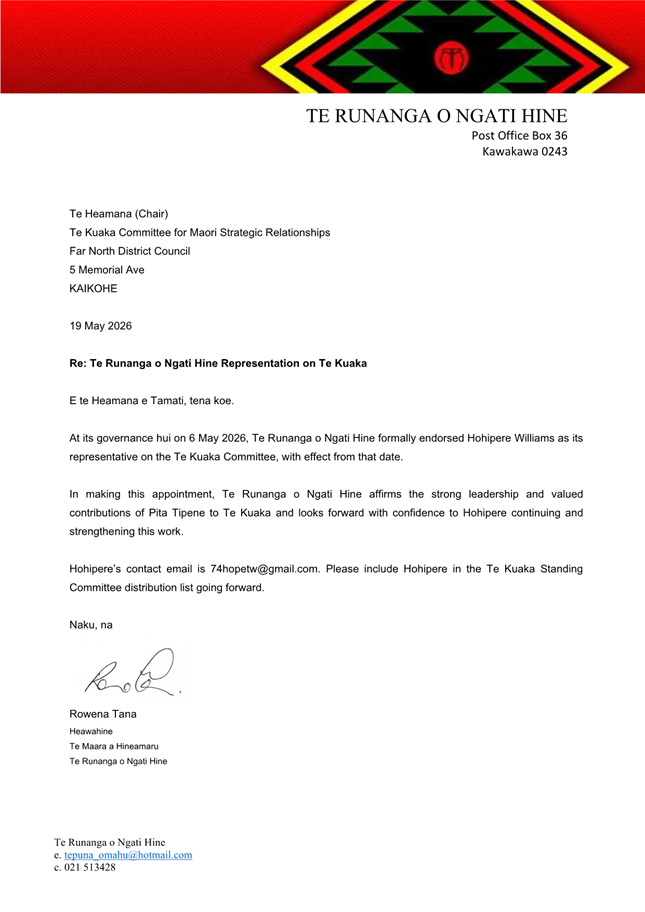
7.10 Request
to undertake public consultation on the disposal of a portion of park land at
1936 State Highway 10, Waipapa - home of Te Pūawaitanga
File
Number: A5761517
Author: Michelle
Rockell, Executive Projects Advisor
Authoriser: Hilary
Sumpter, Group Manager - Delivery and Operations
Take Pūrongo / Purpose of the Report
To seek a
decision from Council on initiating public consultation for the proposed
disposal of approximately 10 hectares of park land at 1936 State Highway 10,
Waipapa to support the delivery of Te Puāwaitanga.
WhakarĀpopoto matua / Executive Summary
· Te Puāwaitanga (Bay of Islands Sports Hub) is a council‑owned,
multi‑sports facility located at 1936 State Highway 10, Waipapa, which
opened for public use in April 2025.
· The land occupies approximately 46 hectares, with around 12 hectares
developed to date and stage 2 development consented but unfunded.
· Council considered the concept of balance land (land not required
for sports and active recreation purposes and available for infrastructure
requirements and/or supporting funding opportunities for future development of
the sports hub) in 2021 but deferred decision making. Increasing pressure
around capital funding, operational costs and scope of future facilities has
highlighted the need to revisit this issue.
· An updated 2026 needs assessment for Kerikeri and Waipapa identified
approximately 20.8 hectares for sports and recreation, with an internal staff
review indicating up to 30 hectares are required to support additional
community uses.
· Without further governance direction on this landholding, the
Waipapa Structure Plan process will rely on public input or technical
assessments identifying the need to consider alternative land uses. This
could result in limiting future flexibility and funding options for the
development of the site.
· Masterplans from Far North Holdings Limited (FNHL), Stellar Projects
and Woods all indicate an area of land located at the northern end of the site
as most viable for retail and commercial activity. Investigating disposal of
this area does not pose a risk to any land requirements for sports and active
recreation.
· Section 138 of the Local Government Act 2002 requires that public
consultation be completed before disposal of part of park land.
· Public consultation is the first step to investigating additional
funding to develop Te Puāwaitanga. This report does not make any decisions
on the disposal of the park land.
· Staff sought views of the Bay of Islands -
Whangaroa Community Board and a recommendation from Te Koukou Committee for
Transport and Infrastructure which are included within the report.
|
tŪtohunga
/ Recommendation
That Council approves public consultation in
accordance with section 138 of the Local Government Act 2002 on the proposed
disposal of approximately 10 hectares of park land located at 1936 State
Highway 10, Waipapa (Lot 18 Deposited Plan 316057) as marked in Attachment F.
|
1) TĀhuhu kŌrero / Background
A 2012 needs assessment of Kerikeri football sports fields
identified a requirement for approximately 10 hectares of land to meet current
and future demand. In 2019, the community identified a need for a consolidated
sports hub, prompting the council to investigate suitable land options.
Following an investigation of three sites, Council resolved
to purchase 1936 State Highway 10, Waipapa in 2020 for the development of the
BOI Sports Hub Development (resolution 2020/9). The land is held as
‘park’ under the Local Government Act 2002.
Te Puāwaitanga - Bay of Islands Sports Hub opened at
the site in April 2025. It is intended to be a multi sports hub,
currently consisting of five fields and used primarily for football, league and
cricket. The facility has cost over $10M to date and is unfinished,
occupying approximately 12 hectares within a total landholding of around 46
hectares.
A 2020 Council report noted that while the total land area
exceeded immediate sports hub requirements, this would allow for future
expansion or alternative uses. Council subsequently confirmed the location of
stage 1 in February 2021 (resolution 2021/1), deferring a decision on future
use of balance of land. Balance land is defined as:
“land not
required for sports and active recreation purposes and available for
infrastructure requirements and/or supporting funding opportunities for future
build/development of the sports hub”.
Resource consent for the sports hub was granted in two
stages:
· Stage 1, including
current fields and supporting infrastructure, has been completed.
· Stage 2 allows for
additional fields, buildings and parking but does not have approval to proceed,
remaining subject to further funding and consent conditions.
More detailed background information can be found in Attachment
A.
Current sports hub operational costs and revenue
streams
Costs to operate and maintain the current facility for the
year 2026/2027 are:
|
General custodian and sports
field services
|
~$290,000
|
|
Insurance
|
~$3,200
|
|
Depreciation[6]
|
~$377,200
|
|
Rates[7]
|
$25,235.31
|
|
Total
|
~$695,635.31
|
Costs are ward rated, with rating implications of $38.15 per
ratepayer in the eastern ward.
The sports fields do not currently generate an income as
hire fees are not charged. Holding events on site is complicated as large
marquees or temporary structures erected on the fields may damage the
irrigation infrastructure.
Potential sports and recreation
requirements
Council completed an updated 2026 needs assessment in
response to adopting Te Pātukurea – Kerikeri Waipapa Spatial Plan,
which had revised growth protections and looked at alternative land use for
parts of the council managed reserve at Harmony Lane, Waipapa (home of
Baysport). A copy can be found in Attachment B.
In summary, the needs assessment identified
a total of 20.8 hectares to accommodate sports demands to 2053, being:
· 14 football and rugby fields (allowing to relocate codes from
Baysport)
· 1 grass cricket block and 4 artificial wickets (with potential to
expand in the future)
· 2 softball diamonds
· 1 hockey turf
· Multi-sport club room, including 2 indoor courts, indoor gymnastic
facility, changing rooms and toilets
· Walking track, informal areas and play area
· Carpark
· Future proofing area (carpark extension, tennis, croquet, dog
walking)
An internal staff review identified an
extra approximate 9 hectares for additional potential sports, recreation and
community uses, bringing the total land requirement to approximately 30
hectares.
2) matapaki me NgĀ KŌwhiringa /
Discussion and Options
The Bay of Islands - Whangaroa Community
Board were asked to present their views on the proposed public consultation at
the 4 June 2026 meeting, for inclusion in this report to further a
recommendation to Council.
The Community Board supported commencing public consultation
but emphasised the need for a clear consultation question to avoid any
confusion about how disposal proceeds would be used. Staff will work with the
Communications team to ensure the wording is in plain English and develop a
dedicated FAQ section to address potential questions, assuring the public that
the land will only be disposed of only if acceptable commercial returns are
possible.
The Community Board also requested that the Te
Puāwaitanga Governance Group be engaged before consultation begins. Staff
provided the Governance Group an update on the project and requested their
feedback on the proposed public consultation.
The general sentiment from the Governance Group was
positive, with members stating their support to see surplus land disposed to
support future Te Puāwaitanga development, noting that in the past this
was not supported as there was no guarantee the funds would go towards the
sports hub. One member noted that the proposed area for disposal imposes over
part of stage 2 of the resource consent; they were assured that restrictions
and measures would be put in place to ensure that no parts of stage 2 would be
lost to commercial development. The proposed plan is very high level that is
likely to change as more detailed designs surface, supported by technical staff
input.
The Community Board also sought clarification on what
depreciation covers. This is now included as a footnote in the report, under Current
sports hub operational costs and revenue streams.
On 17 June 2026, Te Koukou Committee for
Infrastructure and Transport passed the following recommendation:
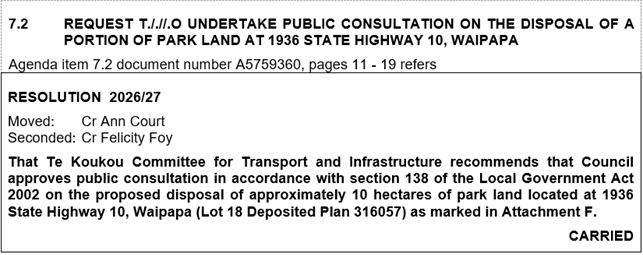
Strategic considerations for future use of 1936 State
Highway 10, Waipapa
The following matters provide important context for
determining the future use of 1936 State Highway 10, Waipapa and highlight the
strategic, financial and operational considerations Council must consider.
· Waipapa
Structure Plan
·
The Waipapa Structure Plan provides a long‑term framework
to guide land use, infrastructure and growth decisions for Waipapa. Without new
governance direction on 1936 State Highway 10, Waipapa, the Waipapa Structure
Plan process would rely on public input or technical assessments identifying
the need to consider alternative land uses. Current government direction is
that land allocation for Lot 18 shall be in its entirety as sports and active
recreation, and Lot 17 shall continue as rural production.
·
·
Seeking additional governance direction will set a clear signal
into the Waipapa Structure Plan of Councils desire, or not, to achieve
diversification of the site. A structure plan can and will recommend change of
zoning, where evidence suggests a better arrangement of an area.
·
·
The Waipapa Structure Plan is expected to be adopted by Council
between August – December 2027. While not a statutory document, any plan
change or resource consent must consider any Council adopted structure plan.
·
· Funding
considerations for current and future sports hub
·
There is strong community and sports sector interest in further
development of Te Puāwaitanga. While some user groups may fundraise for
specific facilities, there is an expectation that the council would support
future stages through Long‑Term Plan funding or the provision of key
infrastructure. Without clarity on the council’s financial contribution,
community‑led fundraising efforts may be delayed or undermined.
·
·
No single funding source is likely to cover all future
development costs. External funding is inherently uncertain due to strong
competition from other sporting, community and arts organisations, creating
risks around both timing and scale. Council will need to carefully balance
funding day‑to‑day services and future growth, while keeping costs
affordable for ratepayers.
·
·
Any development will require a diversified funding mix, including
partnerships, private and community grants, central government initiatives,
targeted rates, user charges, asset recycling and development contributions.
·
·
Development costs have been considered for 3 scenarios:
|
Scenario
|
Cost
|
|
Completion of stage 2 of resource consent
|
~$14,500,000
|
|
2026 needs assessment
|
~$4,000,000 (excluding stage 2 of resource consent)
|
|
Additional aspirational activities
|
~$30,200,000
|
|
Total
|
~$48,700,000
|
Additional flood mitigation may be
required, with an estimated cost of roughly $300,000. Costs are estimates at
this stage.
· Relocation of
Baysport football fields sports and subsequent development
·
Baysport is home to a number of football field sports that wish
to relocate to Te Puāwaitanga. However, the current resource consent does
not provide sufficient capacity to relocate, and until lighting, upgraded
changing facilities and clubroom facilities are provided at Te
Puāwaitanga, football activities will continue to be accommodated at
Baysport.
·
·
The Kerikeri-Waipapa spatial plan identifies land at Baysport as
future residential zoned activity, which while highly viable, cannot occur
until further sports fields are developed at Te Puāwaitanga to support
transition from Baysport to Te Puāwaitanga (with the exception of tennis
and skating). The Kerikeri-Waipapa spatial plan talks about this transition
being guided by future the Waipapa Structure Plan and master planning
development in collaboration with subject matter experts and the community.
·
· Limitations on
use arising from on-site infrastructure
·
Current infrastructure installed on site is sufficient only to
service the existing established activities. Cumulative effects of additional
uses could place further pressure on infrastructure, create conflicts between
users and increase parking demand.
·
·
The on-site wastewater facility was designed to service the
consented development, with any additional buildings requiring careful
assessment to confirm capacity. The site has no connection to town water
supply, with limitations on bore water take. Although treatment and filtration
measures are in place, potable water availability requires further
investigation to ensure compliance with all applicable water safety standards
for a private supply.
·
·
Water supply is also critical for field irrigation, as turf
fields are sensitive to inadequate maintenance and represent a significant
investment in the sports hub.
·
These considerations raise the question of whether the
property should be held in its entirety for sport and active recreation, or
whether some of it should also be held as balance land.
Answering this question provides:
· clear
understanding of land allocation for current and future sport and active
recreation uses, and what balance land is available for future infrastructure
servicing or other funding opportunities,
· enable next steps
to progress the relocation and development of Baysports playing fields to Te
Puāwaitanga, while also unlocking opportunities for future development of
this site,
· support to plan
for future on-site water and wastewater treatment requirements, which are
currently unknown,
· guidance to staff
on next steps required to progress the sports hub and actions relating to the
land, and
· clarity to the
governance group, who will play a key role in operating and developing land
associated with the sports hub, within the determined land parameters set by
Council.
·
Possible development opportunities
In February 2026, FNHL presented Council with a draft
masterplan for the site (attachment C). While there are inconsistencies,
with sports codes not fully aligning with the needs assessment or resource
consent, the plan proposes a retail development area at the northern end of the
site. This is consistent with the masterplans prepared by Stellar Projects and
Woods (attachments D and E).
Across all three plans, this is the only area identified as
suitable for retail development. The Stellar Projects plans include a range of
layouts that incorporate aspirational requirements (referred to as
“balance land”), demonstrating that even with these requirements
occupying approximately 30 hectares, there remains sufficient land to
accommodate retail and commercial development.
The Woods report further supports this position, noting that
the northern portion of the site benefits from frontage to State Highway 10,
strong visibility and access and a strategic location within the Waipapa growth
area. These factors contribute to its suitability for business park development
and are expected to enhance land value.
In line with earlier governance direction to consider next
steps for this site, staff have engaged with FNHL who have identified viable
retail opportunities requiring approximately 10 hectares, of which
approximately 3 hectares would be required for flood mitigation. Attachment
F shows in red the total land area, and in blue the total area with retail
and stormwater management.
Concerns were raised by elected members at the Te Koukou
Committee for Infrastructure and Transport about water and wastewater
requirements. Attachment C provides a high-level concept of potential
commercial development; however, as the land is not currently available for
disposal, staff cannot obtain detailed designs or confirm specific
infrastructure needs.
Further planning will need input from technical staff to
identify water, wastewater and other infrastructure needs, ensuring the
requirements of Te Puāwaitanga are fully considered.
There is currently no budget allocated for future sports
development at Te Puāwaitanga, including for the consented stage 2 works.
The disposal of land not identified for sports and active recreation across any
of the plans can provide a funding opportunity to support the delivery of the
sports hub and associated infrastructure.
Notwithstanding land tenure changes, developers will need to
request plan changes and/or resource consents as zoning provisions remain in
place.
Restrictions on disposal of parks
Section 138 Local Government Act 2002 defines park as
“land acquired or used principally for community, recreational,
environmental, cultural, or spiritual purposes.” As such, 1936 State
Highway 10, Waipapa is held as park under the Local Government Act 2002.
Section 138 also states that a proposal to sell or otherwise
dispose of a park or part of a park must be consulted on before it is sold or
disposed of.
Disposal of park land includes:
· sale of park
· lease or licence
to occupy of more than six months that excludes public access to the park
Council must comply with this section.
Parks and Reserves Policy 2022
Schedule 2 – Criteria for acquisition, disposal and
land exchange decisions for parks and reserves of the Parks and Reserves Policy
2022 states that a decision to sell a park will only occur after the below has
been addressed:
· There are no other
public works use for the land.
· Council has
carried out a land status investigation and determined its obligations under
the Public Works Act 1981.
· The local
community board has been consulted.
· Council has
considered its obligations under section 1 of the policy, being Te Tiriti o
Waitangi / Treaty of Waitangi.
· Council will
engage, discuss and listen to local iwi on proposals to dispose of park land,
and offer the land to iwi, as first right of refusal to purchase when the
council is not legally required to offer the land to a former owner under the
Public Works Act 1981.
Section 11 – Application of Revenue, states:
· All monetary
proceeds from land sale will be deposited into a suitable council bank account.
· Council will apply
the monetary proceeds to purchasing, taking on a lease, managing,
administering, maintain, protecting, improving or developing parks and reserves
in the same council ward to generally benefit the community from which the net
monetary proceeds were derived.
Next steps
Council may now make a decision on the following options:
Option 1 (recommended option):
That Council approve public consultation in accordance
with section 138 of the Local Government Act 2002 on the proposed disposal of
approximately 10 hectares of park land located at 1936 State Highway 10,
Waipapa (Lot 18 Deposited Plan 316057) as marked in Attachment F.
Public consultation is a requirement under section 138 of
the Local Government Act 2002 to dispose of part of a park.
Option 2: Do nothing (status quo)
Option 2 means no decision is made on the land use at this
time. Staff will continue to develop the Waipapa Structure Plan, relying on
technical and public input to determine whether any balance land exists on the
site, which could result in a conservative outcome where the Waipapa Structure
Plan recommends the entire site remains for sport and active recreation.
This option may lead to loss of retail development
opportunities as Council adoption of the Waipapa Structure Plan is not expected
until end 2027.
TAKE
TŪTOHUNGA / REASON FOR THE RECOMMENDATION
Section 183 of the Local
Government Act 2002 requires Council to consult on the proposal to dispose of a
park or a portion of a park.
Public consultation is the
first step in determining whether disposing of any part of the land is a viable
option that has community endorsement and could help fund future sporting
development and associated infrastructure on the site.
The consultation process will
seek community feedback to determine the level of public support for disposing
of land for commercial purposes. Completing public consultation does not equate
to a decision on disposal.
Following public
consultation, staff will present analysis and decision reports to the Bay of
Islands - Whangaroa Community Board, Te Koukou Committee for Transport and
Infrastructure and Council for a decision in quarter four 2026.
If Council
decides to dispose of the park land, it can establish a dedicated reserve
account for Te Puāwaitanga. Any proceeds from the disposal would be
allocated to this account to support future
development. This will require a formal Council resolution.
3) PĀnga PŪtea me ngĀ
wĀhanga tahua / Financial Implications and Budgetary Provision
The operational cost of
consultation is expected to be minimal, involving primarily staff time and
resources, and will be met from within existing budgets.
Āpitihanga
/ Attachments
1. Attachment
A - background - A5830964 ⇩
2. Attachment
B - 2026 needs asessment - A5830969 ⇩ 
3. Attachment
C - FNHL masterplan - A5830976 ⇩ 
4. Attachment
D - Stellar Projects plan - A5830966 ⇩ 
5. Attachment
E - Woods plan - A5830968 ⇩
6. Attachment
F - proposed area for disposal - A5830980 ⇩ 
7. Attachment
G - 50 year flood zone area - A5831219 ⇩
8. Attachment
X - A5875797 ⇩
Hōtaka Take Ōkawa / Compliance Schedule:
Full consideration has been given to the provisions of the
Local Government Act 2002 S77 in relation to decision making, in particular:
1. A
Local authority must, in the course of the decision-making process,
a) Seek
to identify all reasonably practicable options for the achievement of the
objective of a decision; and
b) Assess
the options in terms of their advantages and disadvantages; and
c) If
any of the options identified under paragraph (a) involves a significant
decision in relation to land or a body of water, take into account the
relationship of Māori and their culture and traditions with their
ancestral land, water sites, waahi tapu, valued flora and fauna and other
taonga.
2. This
section is subject to Section 79 - Compliance with procedures in relation to
decisions.
|
He Take Ōkawa /
Compliance Requirement
|
Aromatawai Kaimahi /
Staff Assessment
|
|
State the level of significance (high or low) of the
issue or proposal as determined by the Council’s
Significance and Engagement Policy
|
Medium significance for the community and ratepayers as
per the Significance and Engagement Policy 2021. This means a need to ensure
decisions reflect community needs and preferences, and public consultation
should be conducted to gather feedback.
|
|
State the relevant Council policies (external or
internal), legislation, and/or community outcomes (as stated in the LTP) that
relate to this decision.
|
Section 138 of the Local Government Act 2002 states the
definition of park as “land acquired or used principally for community,
recreational, environmental, cultural, or spiritual purposes.”
Section 138 also states that a proposal to sell or
otherwise dispose of a park or part of a park must be consulted on before it
is sold or disposed of.
|
|
State whether this issue or proposal has a District wide
relevance and, if not, the ways in which the appropriate Community
Board’s views have been sought.
|
The proposal is relevant to the Bay of Islands –
Whangaroa ward, however the land may also be used by users from the District.
As per the Bay of Islands – Whangaroa Community Board protocols, the
Community Board may provide their views to Council in relation to community
development plans and structure plans. The Bay of Islands – Whangaroa
Community Boards views were sought at the 4 June 2026 meeting and included
within the report.
|
|
State the
possible implications for Māori and how Māori have been provided
with an opportunity to contribute to decision making if this decision is
significant and relates to land and/or any body of water.
State the
possible implications and how this report aligns with Te Tiriti o Waitangi /
The Treaty of Waitangi.
|
Ngāti Rēhia is a member of the governance
group, has provided input into previous decision making and currently
provides ground maintenance services to Te Puāwaitanga. The name Te
Puāwaitanga was gifted by Ngāti Rēhia and was instrumental in
defining the values for Te Puāwaitanga.
Ngāti Rēhia have been advised of the proposed
public consultation, with the Chairperson advising that “the commercial
value of the property to help fund the next stage of Te Puāwaitanga
would be a good option to consider”.
|
|
Identify persons likely to be affected by or have an
interest in the matter, and how you have given consideration to their views
or preferences (for example – youth, the aged and those with
disabilities).
|
Sporting codes that currently use Te Puāwaitanga,
being football, rugby league and cricket, and other groups who may wish to
use the area, including members of the public. The Te Puāwaitanga
Governance Group has been advised of the proposed public consultation and
have given support to continue investigations. Everyone will be able to
provide input into public consultation, with feedback analysed and submitted
to the Bay of Islands – Whangaroa Community Board, Te Koukou Committee
for Transport and Infrastructure and Council.
|
|
State the financial implications and where budgetary
provisions have been made to support this decision.
|
There are no financial implications to commence public
consultation.
|
|
Chief Financial Officer review.
|
The Chief Financial Officer has reviewed this report
|
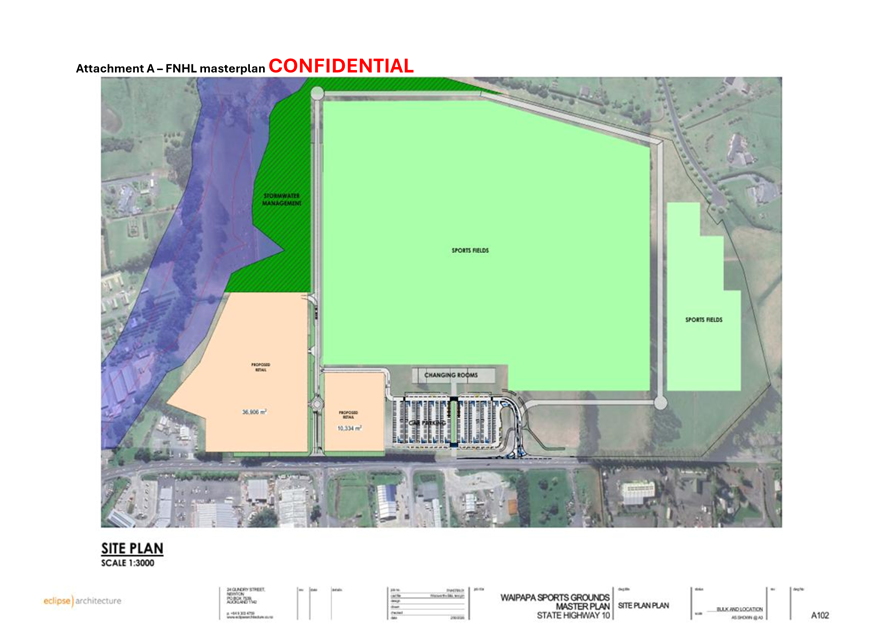
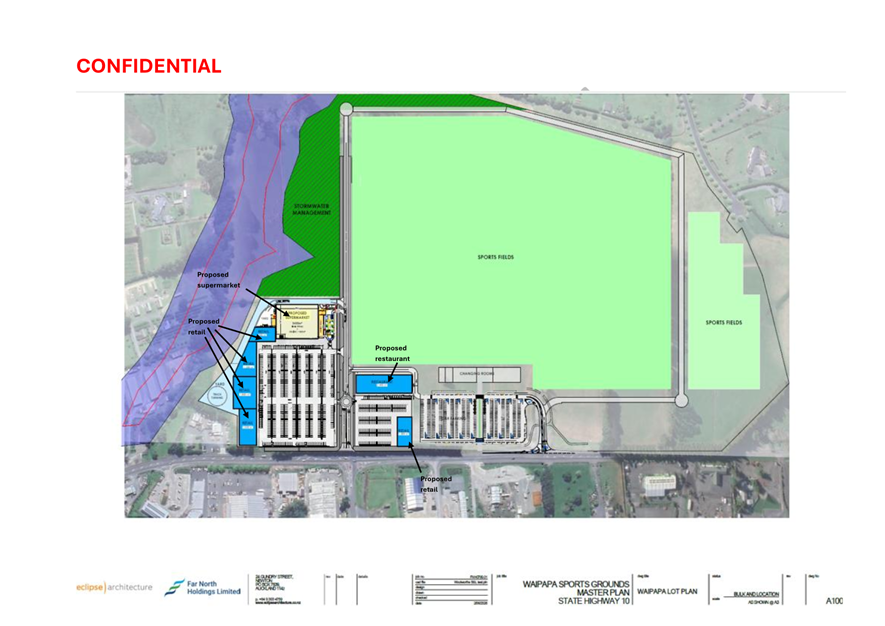
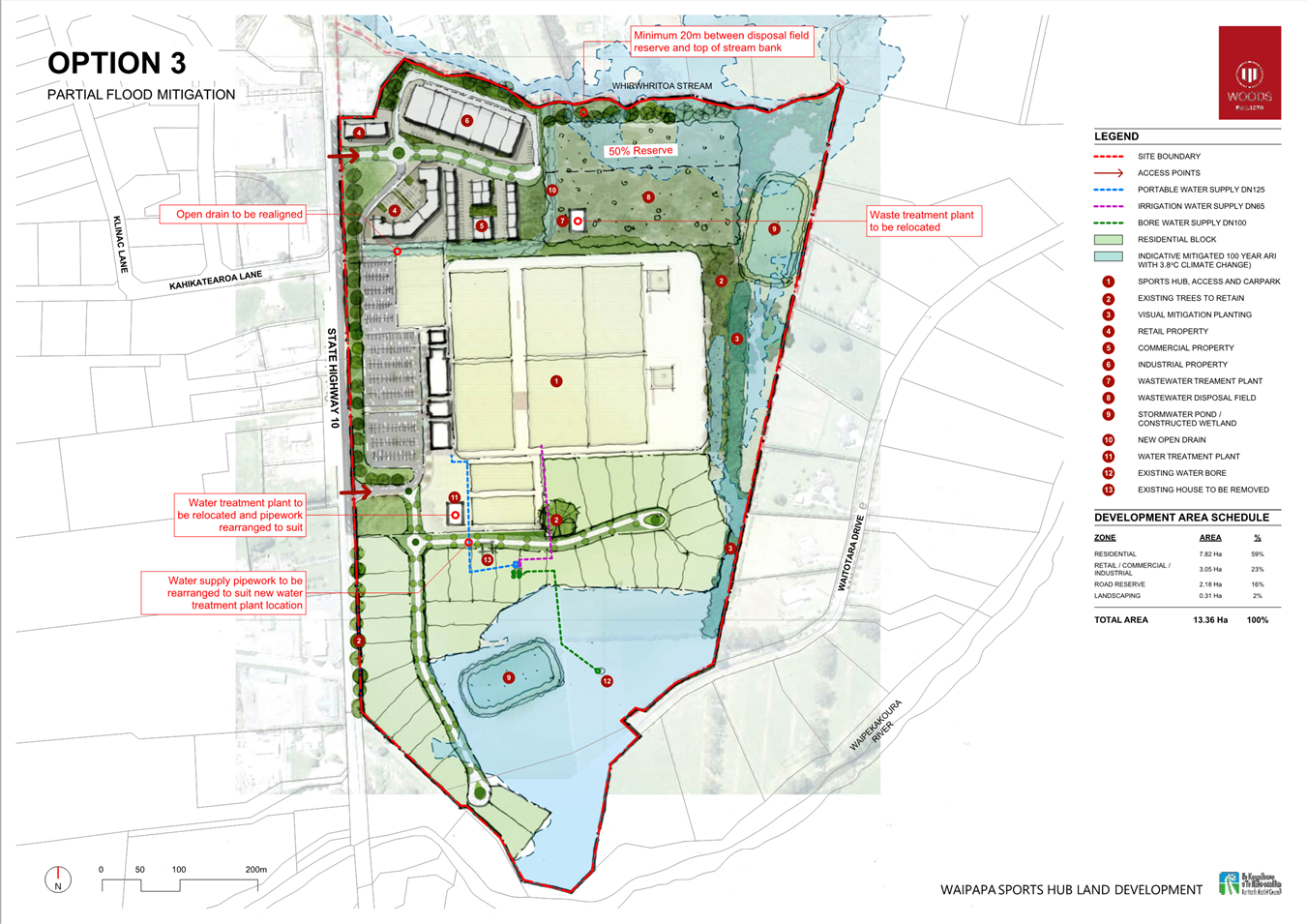

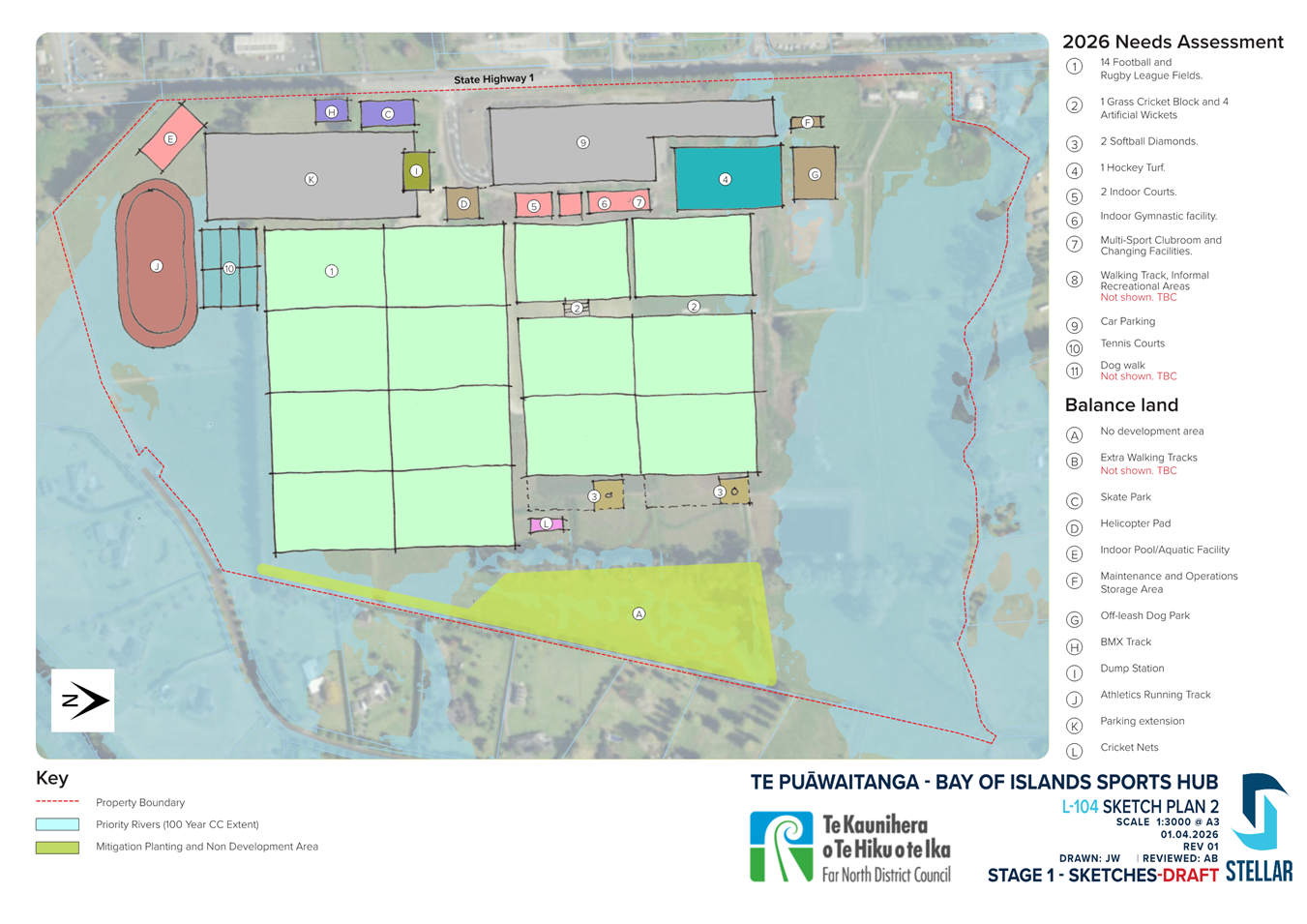
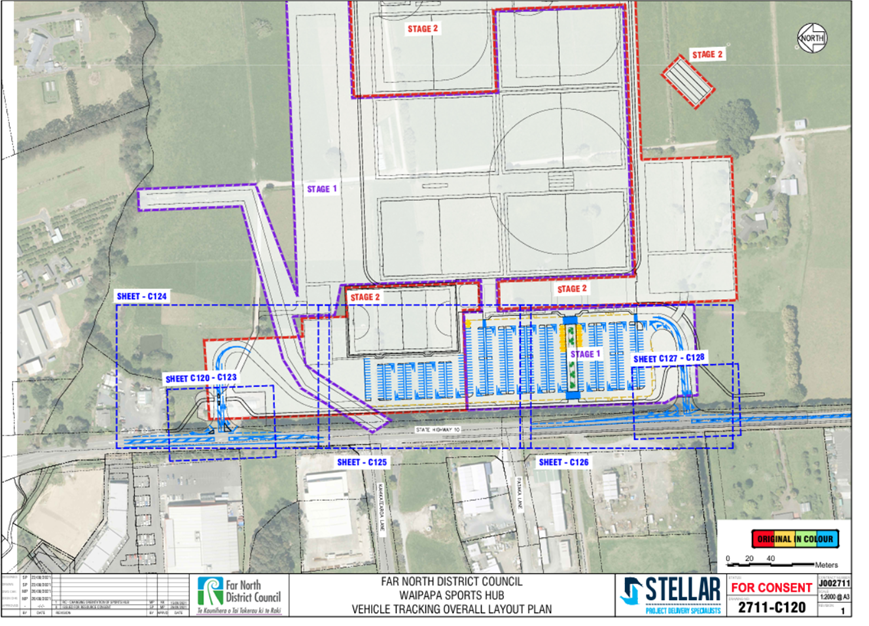
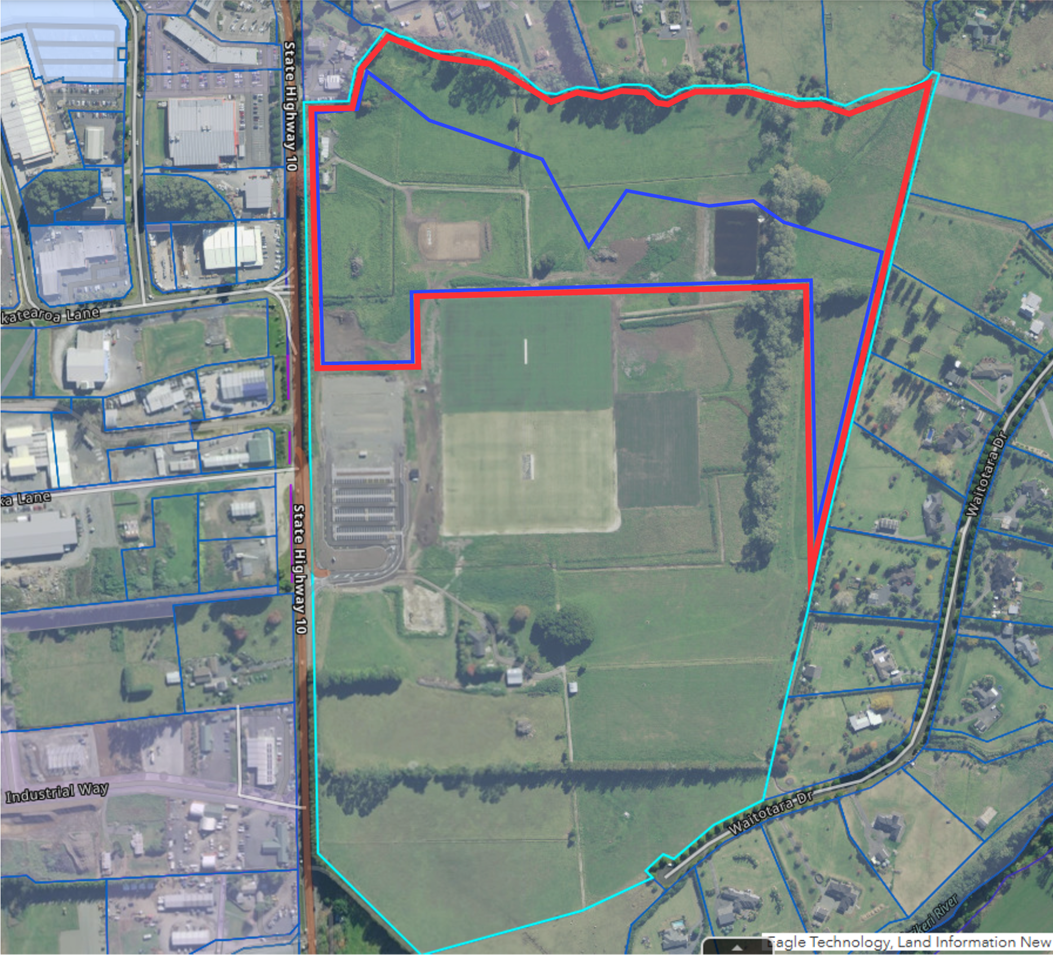
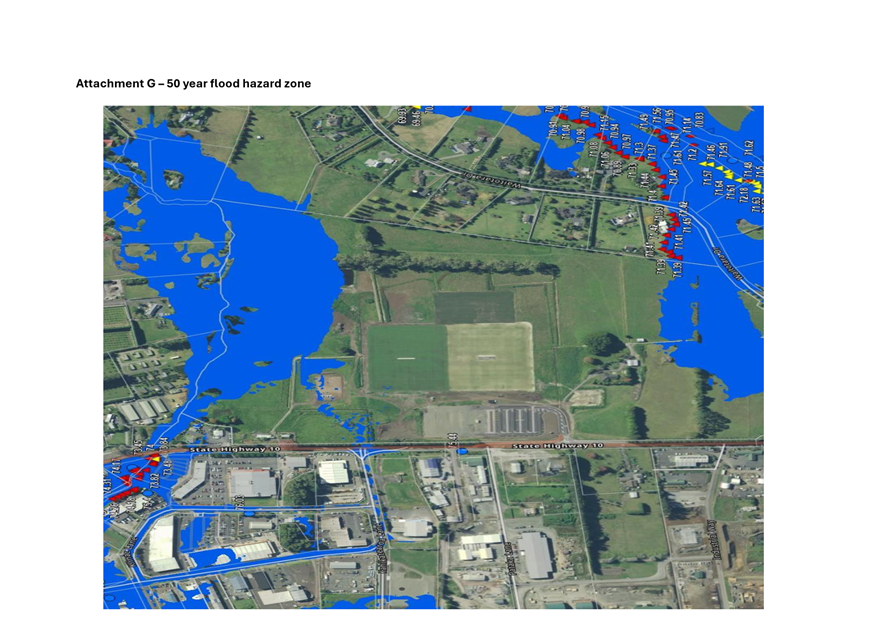
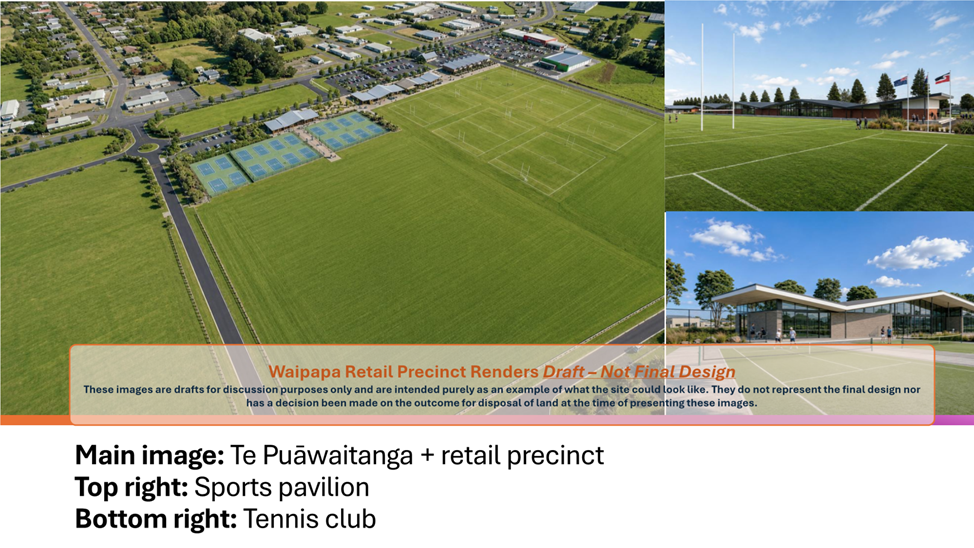
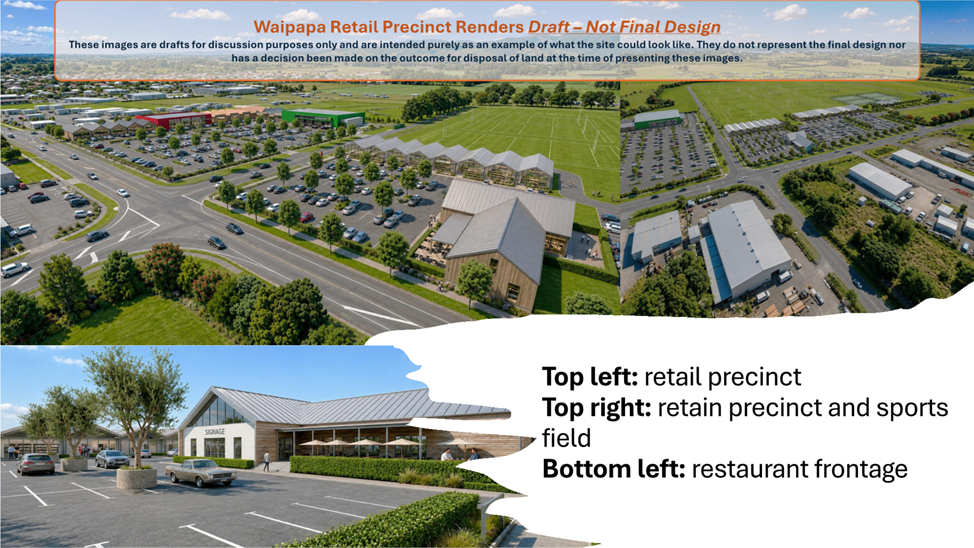
8 Ngā
Pūrongo Taipitopito / Information Reports
8.1 Community
Board Minutes
File
Number: A5864845
Author: Natasha
Rmandic, Democracy Advisor
Authoriser: Aisha
Huriwai, Manager - Democracy Services
Take Pūrongo / Purpose of the Report
To provide an overview of
resolutions made by Community Boards with an opportunity for Chairpersons to
speak with Council about pertinent discussions held at Community Board.
WhakarĀpopoto matua / Executive Summary
Minutes from Te Hiku, Kaikohe-Hokianga
Community and Bay of Islands-Whangaroa Board meetings are attached for Council
information.
|
tŪtohunga
/ Recommendation
That Council
note the minutes from the following Community Board meetings:
a) Te
Hiku Community Board Meeting held 29 June 2026;
b) Kaikohe-Hokianga
Community Board Meeting held 1 July 2026;
c) Bay
of Islands-Whangaroa Community Board Meeting held 2 July 2026.
|
1) TĀhuhu kŌrero / Background
This report is to provide Council with an overview of
resolutions made at Community Board meetings and for Community Board
Chairpersons to raise any Community Board issues with Council.
2) matapaki me NgĀ KŌwhiringa /
Discussion and Options
From time-to-time Community Boards may make recommendations
to Council. This report is not considered to be the appropriate mechanism for
Council to make a decision from a Community Board recommendation. Council could
however move a motion to formally request a report on a particular matter for
formal consideration at a subsequent meeting. The report would then ensure that
Council have sufficient information to satisfy the decision-making requirements
under the Local Government Act 2002 (sections 77-79).
3) PĀnga PŪtea me ngĀ
wĀhanga tahua / Financial Implications and Budgetary Provision
There are no financial implications or need for budget
provision in considering this report.
Āpitihanga
/ Attachments
1. 2026-06-29
Te Hiku Community Board Minutes - A5838580 ⇩ 
2. 2026-07-02
Bay of Islands-Whangaroa Community Board Minutes - A5850293 ⇩ 
3. 2026-07-01
Kaikohe-Hokianga Community Board Minutes - A5842300 ⇩
8.2 Confirmation
of Committee and Joint Committee Minutes - June 2026
File
Number: A5864858
Author: Natasha
Rmandic, Democracy Advisor
Authoriser: Aisha
Huriwai, Manager - Democracy Services
TAKE PŪRONGO / Purpose of the Report
This report highlights recent Council and Joint Committee
meetings and the availability of minutes for reference.
WHAKARĀPOPOTO MATUA / Executive SummarY
Recent meetings are listed below, with links to minutes
included where available at the time of publication.
Far North District Council Committee Meetings:
· Te
Koukou Committee for Transport and Infrastructure
Minutes
of Te Koukou Committee for Transport and Infrastructure Meeting - Wednesday, 17
June 2026
· Te
Koekoeā Committee for Council Controlled Organisations
Minutes
of Te Koekoeā Committee for Council Controlled Organisations Meeting -
Tuesday, 16 June 2026
Note: Minutes not
available at the time this agenda was prepared will be included in a future
report once published.
Note: Any
recommendations from Committee meetings will be presented separately on the
Council agenda for consideration.
|
TŪTOHUNGA
/ Recommendation
That Council
receive the report Committee Minutes June 2026.
|
tĀHUHU KŌRERO / Background
Council
operates several Committees that meet regularly but on different cycles:
· Te
Huia Committee for Chief Executive Performance
· Te
Kuaka Committee for Māori Strategic Relationships
· Te
Koekoeā Committee for Council Controlled Organisations
· Te
Koukou Committee for Transport and Infrastructure
· Te
Kūkupa Committee for Strategy, Policy and Regulation
· Te
Miromiro Committee for Assurance, Risk and Finance
· Te
Pīpīwharauroa Committee for External Appointments.
Agendas and
minutes for these meetings are publicly available at https://infocouncil.fndc.govt.nz/
Council
also has appointed representatives to joint and external committees in
partnership with Northland Regional Council (NRC):
· Te Oneroa-a-Tōhe Beach Board
· Joint Regional Economic Development Committee
· Joint Climate Change Adaptation Committee
· Civil Defence Emergency Management Committee
· Regional Transport Committee
Further
details, including Terms of Reference, can be found on the NRC Website.
Agendas and minutes are updated on the NRC Agendas
and Minutes page.
MATAPAKI ME NGĀ KŌWHIRINGA /
Discussion and Next Steps
This report provides a summary of
recent meeting activity and identifies where agendas and minutes are available.
Any recommendations arising from these meetings will be
reported separately to Council for formal consideration.
Te Koekoeā Committee for Council Controlled
Organisations made a recommendation to Council in relation to Northland Waters
Shareholdings. Members will note that a separate report is not on the agenda to
seek a final decision from Council. Staff have requested that it be sought from
Council at a later stage.
PĀNGA PŪTEA ME NGĀ WĀHANGA
TAHUA / Financial Implications and Budgetary Provision
This
report has no financial implications.
Āpitihanga
/ Attachments
1. 2026-06-17
Te Koukou Committee for Transport and Infrastructure Minutes - A5828193 ⇩
2. 2026-06-16
Te Koekoeā Committee for Council Controlled Organisations Minutes -
A5821672 ⇩
9 Te
Wāhanga Tūmataiti / Public Excluded
RESOLUTION TO
EXCLUDE THE PUBLIC
|
Recommendation
That the public be excluded from the following parts of
the proceedings of this meeting.
The general subject matter of each matter to be considered
while the public is excluded, the reason for passing this resolution in
relation to each matter, and the specific grounds under section 48 of the
Local Government Official Information and Meetings Act 1987 for the passing
of this resolution are as follows:
|
General subject of each matter to be
considered
|
Reason for passing this resolution in
relation to each matter
|
Ground(s) under section 48 for the
passing of this resolution
|
|
9.1 - Confirmation of Previous Minutes
- Public Excluded
|
s7(2)(a) - the withholding of the information is
necessary to protect the privacy of natural persons, including that of
deceased natural persons
s7(2)(h) - the withholding of the information is
necessary to enable Council to carry out, without prejudice or
disadvantage, commercial activities
s7(2)(i) - the withholding of the information is
necessary to enable Council to carry on, without prejudice or disadvantage,
negotiations (including commercial and industrial negotiations)
|
s48(1)(a)(i) - the public conduct of the relevant
part of the proceedings of the meeting would be likely to result in the
disclosure of information for which good reason for withholding would exist
under section 6 or section 7
|
|
9.2 - Confirmation of Committee and
Joint Committee Minutes - June 2026 - Public Excluded
|
s7(2)(a) - the withholding of the information is
necessary to protect the privacy of natural persons, including that of
deceased natural persons
s7(2)(h) - the withholding of the information is
necessary to enable Council to carry out, without prejudice or
disadvantage, commercial activities
s7(2)(i) - the withholding of the information is
necessary to enable Council to carry on, without prejudice or disadvantage,
negotiations (including commercial and industrial negotiations)
|
s48(1)(a)(i) - the public conduct of the relevant
part of the proceedings of the meeting would be likely to result in the
disclosure of information for which good reason for withholding would exist
under section 6 or section 7
|
|
9.3 - Appointment of Adjudication
Panel
|
s7(2)(a) - the withholding of the information is
necessary to protect the privacy of natural persons, including that of
deceased natural persons
s7(2)(g) - the withholding of the information is
necessary to maintain legal professional privilege
|
s48(1)(a)(i) - the public conduct of the relevant
part of the proceedings of the meeting would be likely to result in the
disclosure of information for which good reason for withholding would exist
under section 6 or section 7
|
|