AGENDA
Ordinary Te Kuaka Committee for Māori
Strategic Relationships Meeting
Tuesday, 15 September 2026
|
Time:
|
10:00 AM
|
|
Location:
|
Council Chamber
Memorial Ave
Kaikohe
|
Membership:
Heamana Tāmati Rākena
Heamana Tuarua Mane Tahere
Kahika - Mayor Moko Tepania
Kohepu - Deputy Mayor Chicky Rudkin
Cr Arohanui Allen
Cr Hilda Halkyard-Harawira
Cr Kelly Stratford
Hohipere Williams - Te Rūnanga o Ngāti Hine
Kipa Munro - Te Rūnanga o Ngāti Rēhia
Mike Te Wake - Te Rūnanga o Te Rarawa
Nyze Manuel - Te Rūnanga o Whaingaroa Rukuwai Tipene-Allen - Te
Whiu Hapū
Thomas Hohaia - Te Roroa Hapū
Wallace Rivers - Te Kahu o Taonui
|
|
Authorising Body
|
Council
|
|
Status
|
Standing Committee
|
|
COUNCIL
COMMITTEE
|
Title
|
Te Kuaka Committee for Māori
Strategic Relationships Terms of Reference
|
|
Terms of Reference Adoption
|
11 December 2025 and revised 5 March 2026 , 15 April & 29
April 2026
|
|
Responsible Officer
|
Manuhautū Te Hono - Group Manager Te Hono
|
Kaupapa / Purpose
To provide
strategic leadership and guidance that strengthens Te Ao Māori
perspectives within Council decision‑making, ensuring genuine Te Tiriti‑based
partnership and leadership between FNDC and iwi/hapū, and to
provide recommendations to full Council. This includes strengthening Council’s relationship
with Iwi and Hapū by promoting
effective partnership models, improving engagement practices, championing
shared decision‑making, and
adding value to relationships with Māori.
Ngā
Huānga / Membership
The Committee
will comprise of no less than 4 elected members and external representation.
Kahika
/ Mayor Moko Tepania is an ex-officio member of all Committees.
All
committee members will have full speaking and voting rights.
|
Cr
Tāmati Rākena (Chairperson)
|
|
Mane
Tahere (Deputy Chairperson) (by Council resolution 15 April 2026)
|
|
Kohepu
/ Deputy Mayor Chicky Rudkin
|
|
Cr
Arohanui Allen
|
|
Cr
Hilda Halkyard-Harawira
|
|
Cr
Kelly Stratford
|
|
Wallace Rivers - Te Kahu o Taonui
Representative (by Council resolution 15 April 2026)
|
|
Nyze
Manuel – Te Rūnanga o Whaingaroa
Representative (by Council resolution 29 April 2026)
|
|
Kipa Munro – Te Rūnanga o
Ngāti Rēhia Representative (by Council
resolution 29 April 2026)
|
|
Mike Te Wake – Te Rūnanga
o Te Rarawa Representative (by Council resolution 29 April 2026)
|
|
Hohipere Williams – Te
Rūnanga o Ngāti Hine Representative (by Council
resolution 22 July 2026)
|
|
Thomas Hōhaia – Te Roroa
Hapu (by
Council resolution 29 April 2026) - Darren Beatty (alternate)
|
|
Rukuwai Allen – Te Whiu Hapu (by
Council resolution 29 April 2026)
|
Kōrama
/ Quorum
The
quorum at a meeting of the Committee is 4 members.
Ngā
Hui / Frequency of Meetings
The
Committee shall meet 8 weekly.
Ngā
Apatono / Power to Delegate
The
responsibilities, duties and powers of the Committee are subject to the
prohibition on delegation of powers under Clause 32(1), Schedule 7, Local
Government Act 2002, and any other restrictions on delegation under any other
relevant legislation.
Te Kuaka
Committee for Māori Strategic Relationships may not delegate any of its responsibilities,
duties or powers however it may establish working groups to consider issues
within the committee’s areas of responsibilities noting that working
groups have no decision-making powers.
Ngā Herenga
Paetae / Responsibilities
The
Committees responsibilities are described below:
1. Build
and sustain genuine, high-trust relationships based on He Whakaputanga and Te
Tiriti o Waitangi.
2. Continue
with the development and implementation of Te Kuaka - Te Pae ki Tawhiti 2040
Strategic Intent.
3. Support
strategic partnerships that empower communities, Hapū, and Iwi to shape
their own development.
4. Oversee
Te Pae o Uta Te Ao Māori Framework
5. Facilitate
collaboration across sectors to invest in quality infrastructure and
initiatives.
6. Develop
and approve frameworks for partnership, engagement, monitoring and reporting.
7. Identify
and prioritise strategic relationships with Iwi, Hapū, Government
agencies, and key stakeholders.
8. Monitor
and evaluate the effectiveness of partnerships.
9. Provide
direction to the Council on relationship strategies and opportunities.
10. Ensure
Te Ao Māori perspectives inform Council strategic and operational work.
11. Recommend
to Council, aspects of importance to Māori for incorporation into the
development of the Strategic documents (e.g. Te Ao Māori Framework, Annual
Plan, Long Term Plan, District Plan)
12. Recommend
to Council aspects that the Far North District Council could pursue to develop
and or enhance Māori capacity to contribute to Council’s
decision-making processes.
Ngā
Ture / Rules and Procedures
Council’s
Standing Orders and Elected Member Code of Conduct apply to all meetings.
Reporting and
Review of Committee Terms of Reference
In
December of each year, the Responsible Officer alongside Democracy Services
will submit a report to Council. The report will summarise the activities of
the Committee and how it has contributed to the Council’s governance and
strategic objectives. This will look at whether the Council are meeting the
full requirements of the Committee Terms of Reference and whether any
amendments are required to the Committees terms of reference to increase
efficient and effective decision making.
The Terms of
Reference of the Committee will be reviewed as part of this report but can be
amended by Council at any point throughout the term.
Far North District Council
Ordinary Te Kuaka Committee for Māori Strategic
Relationships Meeting
will be held in the Council Chamber, Memorial Ave,
Kaikohe on:
Tuesday 15 September 2026 at 10:00
AM
Te Paeroa Mahi / Order
of Business
1 Karakia
Tīmatanga / Opening Prayer. 7
2 Ngā
Whakapāha Me Ngā Pānga Mema / Apologies and Declarations of
Interest 7
3 Ngā
Tono Kōrero / Deputation. 7
4 Te
Whakaaetanga o Ngā Meneti o Mua / Confirmation of Previous Minutes. 8
4.1 Confirmation
of Previous Minutes. 8
5 Ngā
Pūrongo Taipitopito / Information Reports. 15
5.1 Whenua
Māori - Freehold Land Rating Debt Update. 15
5.2 Development
of a Local Alcohol Policy. 20
5.3 District
Wide Spatial Strategy Update: Vision, Principles and Objectives and Kaupapa
Steering Rōpū. 43
5.4 Ngā
Kaupapa Māori Report 140
5.5 Te
Pae o Uta Te Ao Māori Framework Update. 149
5.6 Current
and Previous Open Resolutions - Actions Sept 2026. 163
6 Karakia
Whakamutunga / Closing Prayer. 170
7 Te
Kapinga Hui / Meeting Close. 170
|
Ordinary
Te Kuaka Committee for Māori Strategic Relationships Meeting
Agenda
|
15
September 2026
|
1 Karakia
Tīmatanga / Opening Prayer
2 Ngā Whakapāha Me Ngā Pānga Mema / Apologies
and Declarations of Interest
Members need to
stand aside from decision-making when a conflict arises between their role as a
Member of the Committee and any private or other external interest they might
have. This note is provided as a reminder to Members to review the matters on
the agenda and assess and identify where they may have a pecuniary or other
conflict of interest, or where there may be a perception of a conflict of
interest.
If a Member
feels they do have a conflict of interest, they should publicly declare that at
the start of the meeting or of the relevant item of business and refrain from
participating in the discussion or voting on that item. If a Member thinks they
may have a conflict of interest, they can seek advice from the Chief Executive
Officer or the Manager - Democracy Services (preferably before the meeting).
It is noted
that while members can seek advice the final decision as to whether a conflict
exists rests with the member.
3 Ngā
Tono Kōrero / Deputation
No requests for deputations were received at the time of the
Agenda going to print.
|
Ordinary
Te Kuaka Committee for Māori Strategic Relationships Meeting
Agenda
|
15
September 2026
|
4 Te
Whakaaetanga o Ngā Meneti o Mua / Confirmation of Previous Minutes
4.1 Confirmation
of Previous Minutes
File
Number: A5871313
Author: Marlema
Baker, Democracy Advisor
Authoriser: Aisha
Huriwai, Manager - Democracy Services
Purpose of the Report
The minutes are attached to allow
the Committee to confirm that the minutes are a true and correct record of the
previous meeting.
|
Recommendation
That Te Kuaka Committee for Māori Strategic
Relationships confirm the minutes of the extraordinary meeting held 14 July
2026 as a true and correct.
|
1) Background
Local Government Act 2002 clause 7 Section 28 states that a
local authority must keep minutes of its proceedings. The minutes of
these proceedings duly entered and authenticated as prescribed by a local
authority are prima facie evidence of those meetings.
2) Discussion and Options
The minutes of the
meeting are attached.
Far North District
Council Standing Orders Section 27.3 states that “no discussion shall
arise on the substance of the minutes in any succeeding meeting, except as to
their correctness”.
Reason
for the recommendation
The reason for the recommendation
is to confirm the minutes are a true and correct record of the previous
meeting.
3) Financial Implications and Budgetary
Provision
There are no financial implications or the need for
budgetary provision.
Attachments
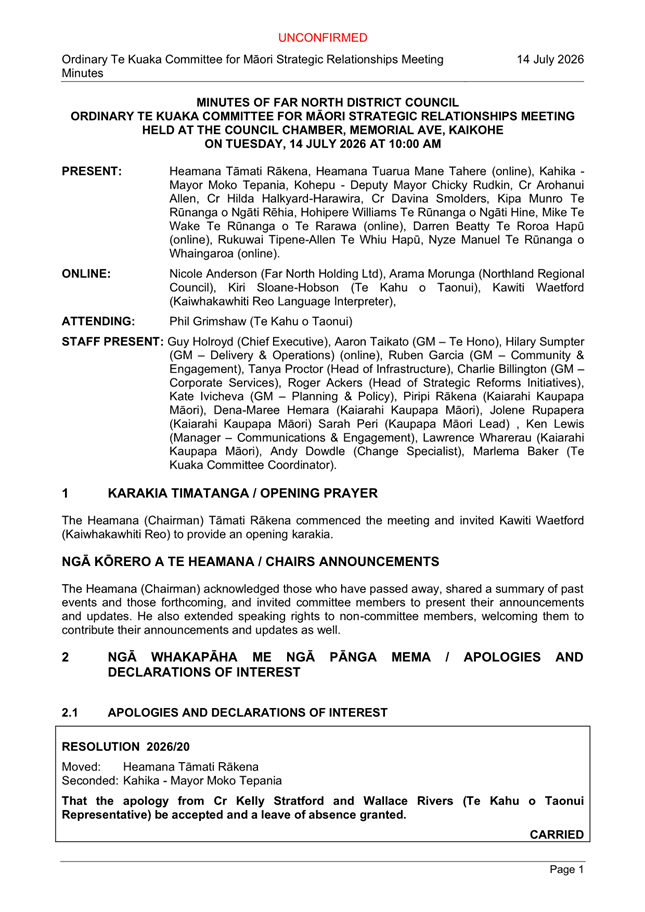
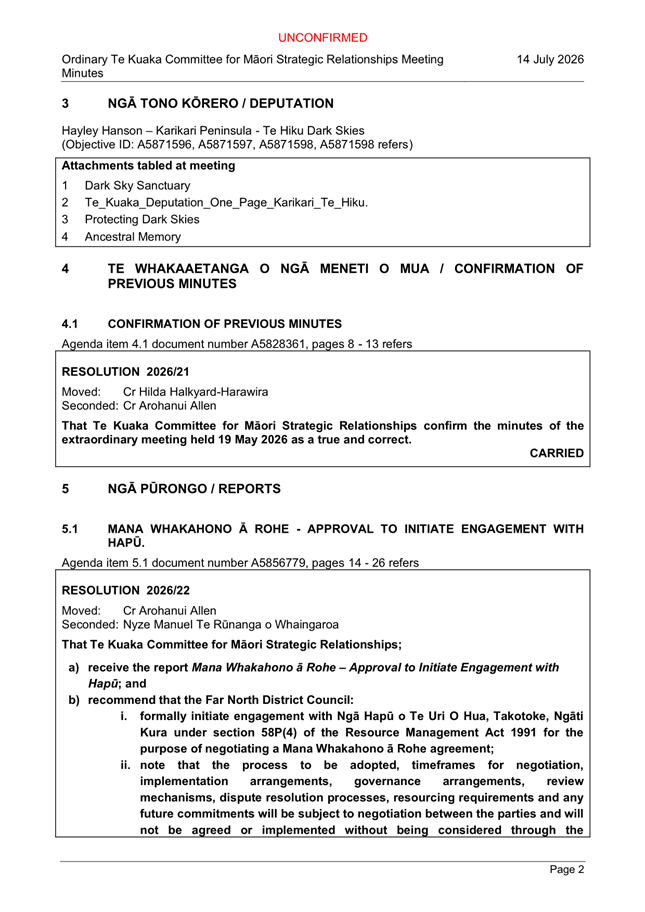
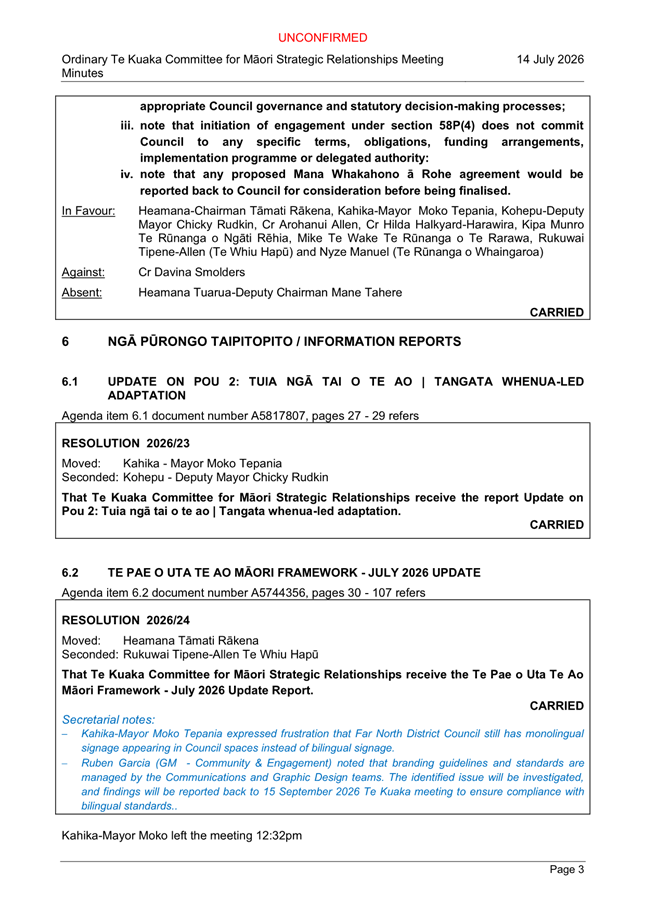
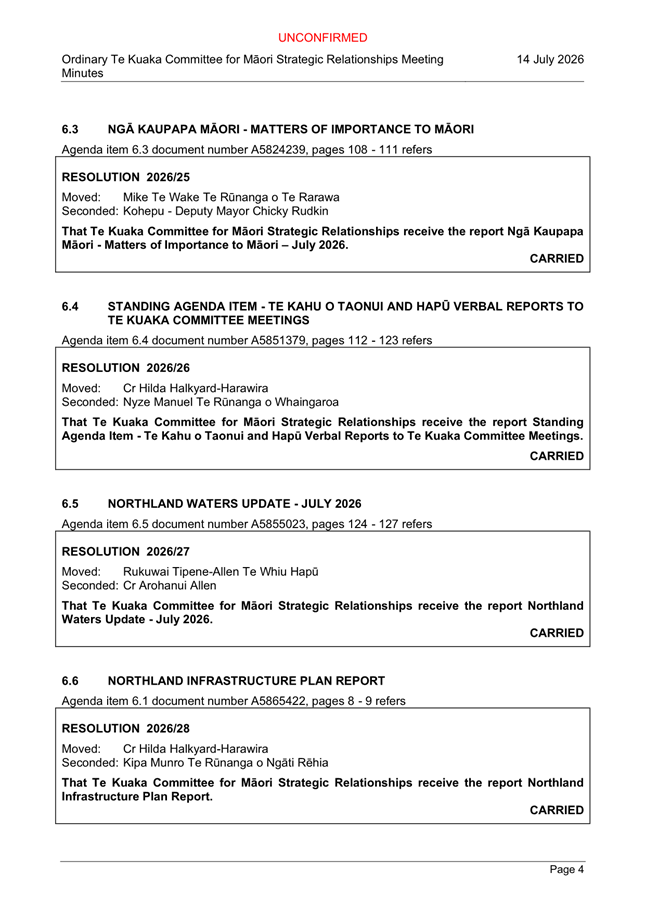
1. 2026-07-14
Te Kuaka Committee for Māori Strategic Relationships Minutes - A5868567 ⇩ 
Compliance schedule:
Full consideration has been given to the provisions of the
Local Government Act 2002 S77 in relation to decision making, in particular:
1. A
Local authority must, in the course of the decision-making process,
a) Seek
to identify all reasonably practicable options for the achievement of the
objective of a decision; and
b) Assess
the options in terms of their advantages and disadvantages; and
c) If
any of the options identified under paragraph (a) involves a significant
decision in relation to land or a body of water, take into account the
relationship of Māori and their culture and traditions with their
ancestral land, water sites, wāhi tapu, valued flora and fauna and other
taonga.
2. This
section is subject to Section 79 - Compliance with procedures in relation to
decisions.
|
Compliance
requirement
|
Staff
assessment
|
|
State the level of significance
(high or low) of the issue or proposal as determined by the Council’s
Significance and Engagement Policy
|
This is a matter of low
significance.
|
|
State the relevant Council
policies (external or internal), legislation, and/or community outcomes (as
stated in the LTP) that relate to this decision.
|
This report complies with the
Local Government Act 2002 Schedule 7 Section 278.
|
|
State whether this issue or
proposal has a District wide relevance and, if not, the ways in which the
appropriate Community Board’s views have been sought.
|
It is the responsibility of each
meeting to confirm their minutes therefore the views of another meeting are
not relevant.
|
|
State the possible implications for Māori
and how Māori have been provided with an opportunity to contribute to
decision making if this decision is significant and relates to land and/or
any body of water.
|
There are no implications on
Māori in confirming minutes from a previous meeting. Any implications on
Māori arising from matters included in meeting minutes should be
considered as part of the relevant report.
|
|
Identify persons likely to be
affected by or have an interest in the matter, and how you have given
consideration to their views or preferences.
|
This report is asking for the
minutes to be confirmed as true and correct record, any interest that affect
other people should be considered as part of the individual reports.
|
|
State the financial implications
and where budgetary provisions have been made to support this decision.
|
There are no financial
implications or the need for budgetary provision arising from this report.
|
|
Chief Financial Officer review.
|
The Chief Financial Officer has
not reviewed this report.
|
|
Ordinary Te Kuaka
Committee for Māori Strategic Relationships Meeting Agenda
|
15 September 2026
|
|
Ordinary
Te Kuaka Committee for Māori Strategic Relationships Meeting
Agenda
|
15
September 2026
|
5 Ngā
Pūrongo Taipitopito / Information Reports
5.1 Whenua
Māori - Freehold Land Rating Debt Update
File
Number: A5950110
Author: Ken
Macdonald, Chief Financial Officer
Authoriser: Charlie
Billington, Group Manager - Corporate Services
TAKE PŪRONGO / Purpose of the Report
The purpose of this report is to
provide Te Kuaka Committee for Māori Strategic Relationships with an
update on Whenua Māori freehold land rating relief activity for the
2025/26 financial year.
WHAKARĀPOPOTO MATUA / Executive Summary
· This information
is an extract from recent reporting through Te
Miromiro Committee for Assurance Risk and finance (Te Miromiro), with
focus on Māori Freehold Land (MFL) rates and water debt, remissions,
property reviews and write-offs.
· The Revenue
Recovery team continues to manage these matters through targeted remission
activity, property reviews and appropriate write-off processes.
· A further verbal
update may be provided at the meeting.
|
TŪTOHUNGA
/ Recommendation
That Te Kuaka Committee for
Māori Strategic Relationships receive the report Whenua Māori -
Freehold Land Rating Debt Update.
|
TĀHUHU KŌRERO / Background
Council regularly monitors rates,
water and sundry debt arrears through Te Miromiro Committee to provide
financial oversight, assurance and visibility of collection activity.
That broader reporting includes
General Title rates, Māori Freehold Land rates and water debt, and sundry
debtor balances, and is available via Council’s website.
Agenda
of Te Miromiro Committee for Assurance, Risk and Finance Meeting - Tuesday, 11
August 2026
This report has been prepared for
Te Kuaka Committee for Māori Strategic Relationships (Te Kuaka) as an
extract from that broader arrears reporting, with the content narrowed to
matters relating to Whenua Māori freehold land. This recognises Te
Kuaka’s strategic relationship role and its interest in rating relief,
remissions, and actions affecting Māori Freehold Land. The report forms
the basis for a discussion on MFL debt for alignment with the Te Hono work plan
for MFL.
The update covers the 2025/26
financial year and includes current MFL rates and water debt balances, payments
received, remission activity, property reviews, and write-offs processed from 1
July 2025 to 30 June 2026.
MATAPAKI ME NGĀ KŌWHIRINGA /
Discussion and Next Steps
Māori
Freehold Land rates and water debt
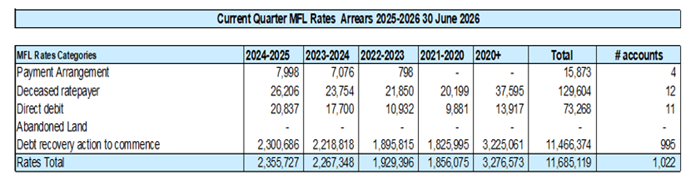
Rates debt has increased since the start of the 2025/26
rating year.
The current balance owing for MFL rates for the 2025/26 rating year is
$2,840,199.77,
and the current balance owing for MFL water rates for the 2025/26 rating year is $86,825.36.
Payments of $2,507,482.99 have
been received towards MFL rates for all rating years in 2025/26.
General Title rates
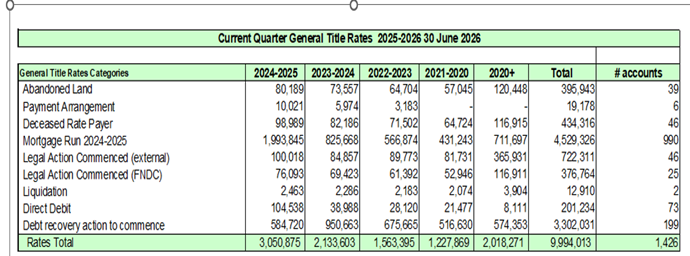
arrears and MFL rates arrears for the year ended 30 June 2026
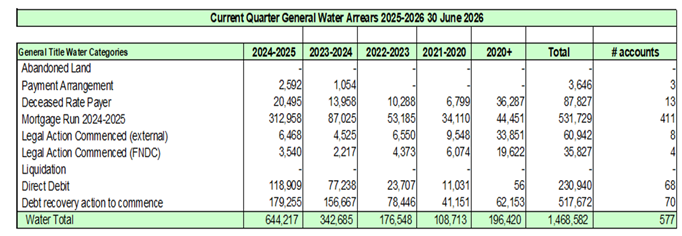
General
Title water rates arrears and MFL water rates arrears for the year ended 30
June 2026
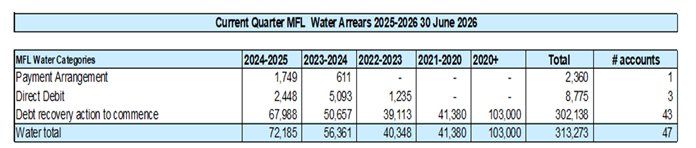
MFL rates arrears for the year ended 30 June 2026 compared
with the year ended 30 June 2025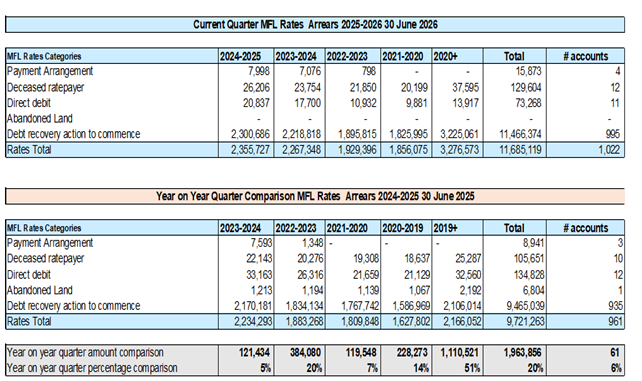
MFL
water rates arrears for the year ended 30 June 2026 compared with the year ended
30 June 2025
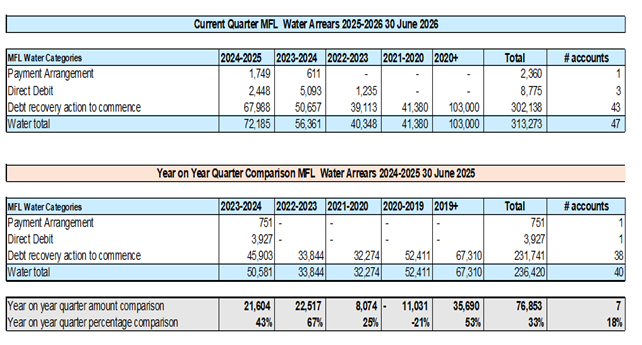
Māori
Freehold Land property reviews
Remissions:
· Remissions are applied in accordance with Far North
District Council (FNDC) policy.
· Signed-off
MFL remissions made up 9% ($677,324.75), consisting of 17 accounts for the 2025/26 rating year of rating relief remissions.
· Investigations are required to
ascertain (1) how much additional MFL land is being utilised, (2) the quantum
of landowners’ remissions that have expired, and (3) the quantum of MFL
landowners who have not renewed their remissions.
Chief Executive (CE) write-offs:
· Chief Executive
(CE) write-offs are made under section 90A and 90B of the Local Government
(Rating) Act 2002, as amended by the Local Government (Rating of Whenua
Māori) Amendment Act 2021.
· Amount processed
was $106,376.33, consisting of 10 accounts.
MFL
write-offs for non-rateable land:
· These write-offs
apply where a Māori Freehold Land (MFL) rate account becomes non-rateable
because the unused land criteria have been met under the Local Government
(Rating) Act 2002, as amended by the Local Government (Rating of Whenua
Māori) Amendment Act 2021.
· A total arrears balance of $21,939.41 has been written off
under this section, consisting of 5 accounts.
MFL rates processing update:
For July and August, 34 accounts are currently being
processed for MFL remissions, CE write-offs, and non-rateable land write-offs.
PĀNGA PŪTEA ME NGĀ WĀHANGA
TAHUA / Financial Implications and Budgetary Provision
Provision is made annually for doubtful debts in relation
to arrears owed to Council. A higher provision is
made for MFL rates and water rates compared with
General Title rates and water rates, due to the difference in collection options available to
Council.
Definitions of categories for rates and water
Abandoned Land
Abandoned land means a rating unit for which rates have not
been paid to the local authority for 3 years or more, and the ratepayer is
either unknown, unlocatable, deceased with no representative, or has notified
the local authority of their intent to abandon the land.
Payment Arrangement
This is a separate payment arrangement for a set period to
halt penalties accumulating on the rate account.
Deceased ratepayer
The probate process has not been completed.
Mortgage run 2024/25
These are properties where the mortgage demand process has
commenced.
Legal Action Commenced (external)
These are properties where legal action has commenced with
an external legal representative.
Legal action commenced (FNDC)
These are properties where legal action has commenced with
FNDC’s legal services team.
Liquidation
The ratepayer is a company that has gone into liquidation,
and Council is awaiting completion of the liquidation process.
Direct Debit
Properties that are paying by direct debit.
Debt recovery action to commence
These are properties with arrears, no mortgage, and no
payment arrangement or direct debit set up on the account. The next stage would
likely be legal action.
Arrangement or direct debit set up on the account; next
stage would likely be legal action.
Āpitihanga
/ Attachments
Nil
|
Ordinary Te Kuaka
Committee for Māori Strategic Relationships Meeting Agenda
|
15 September 2026
|
5.2 Development
of a Local Alcohol Policy
File
Number: A5941430
Author: Donald
Sheppard, Policy Advisor
Authoriser: Kate
Ivicheva, Group Manager - Planning & Policy
TAKE PŪRONGO / Purpose of the Report
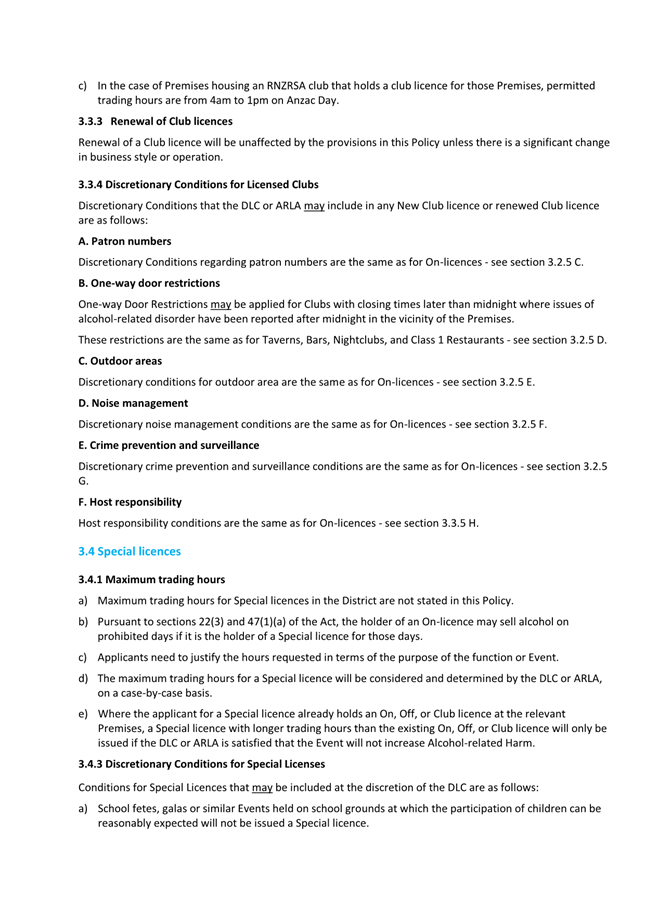
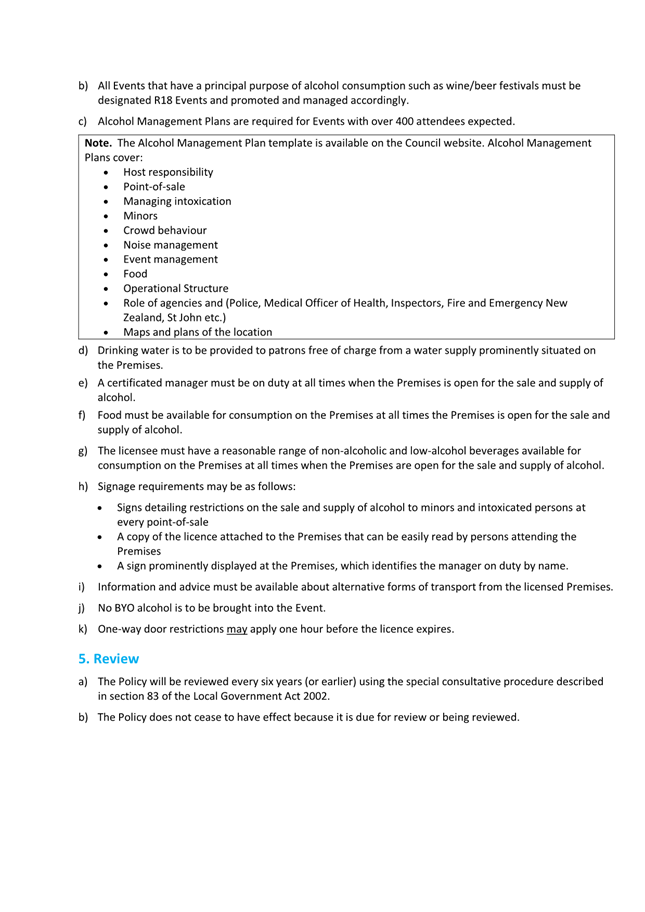
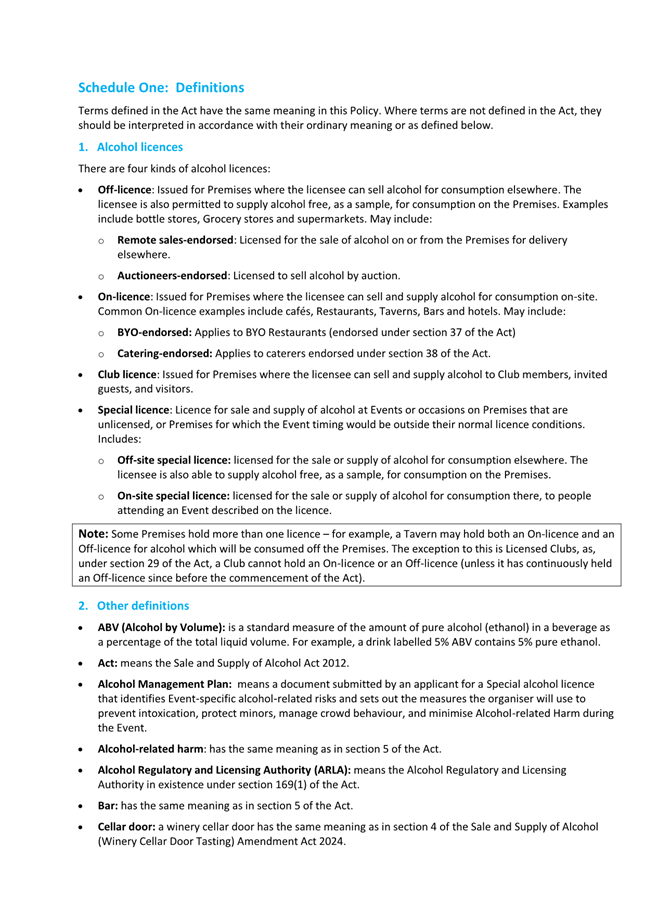
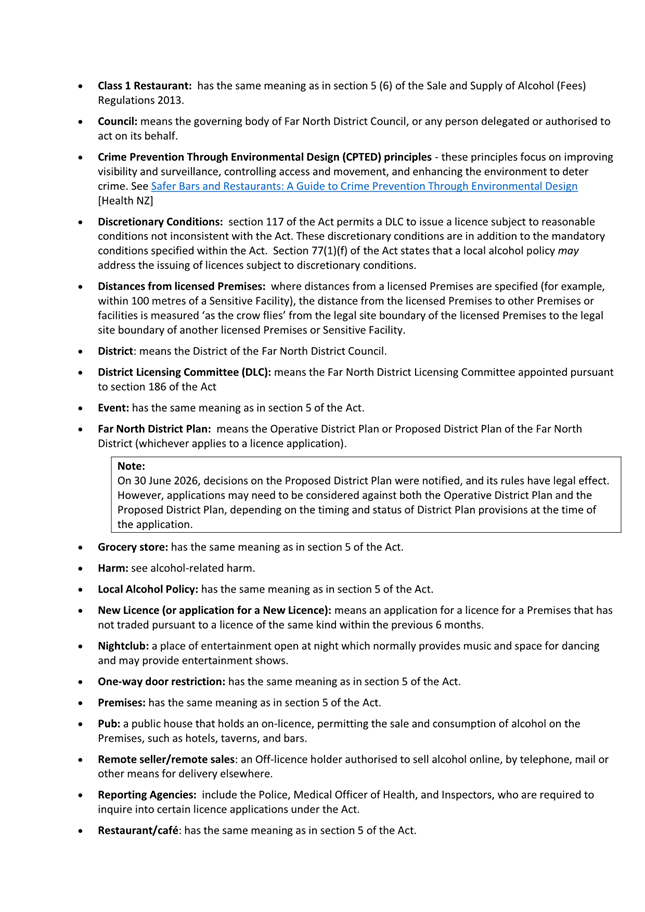
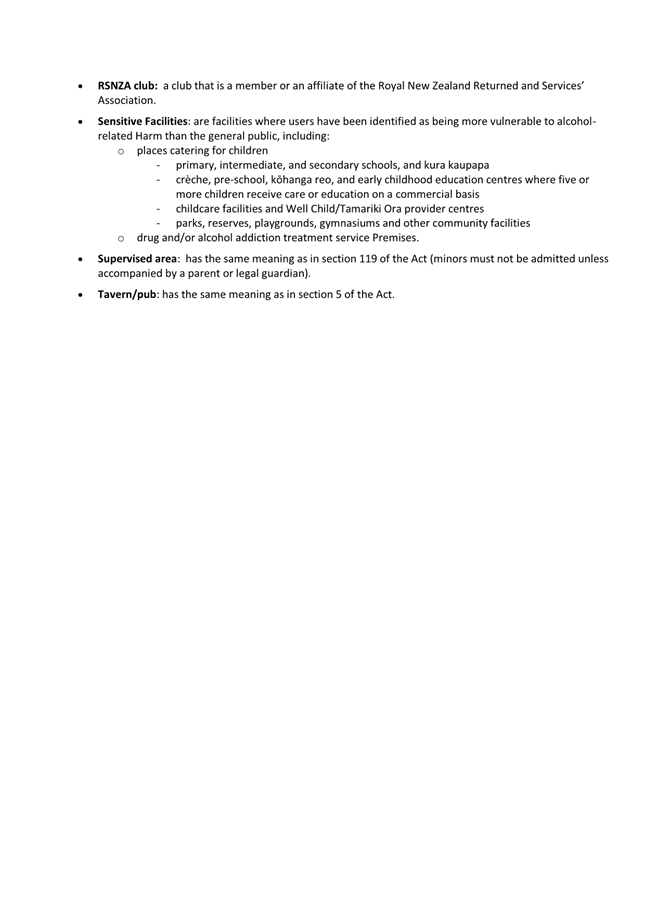
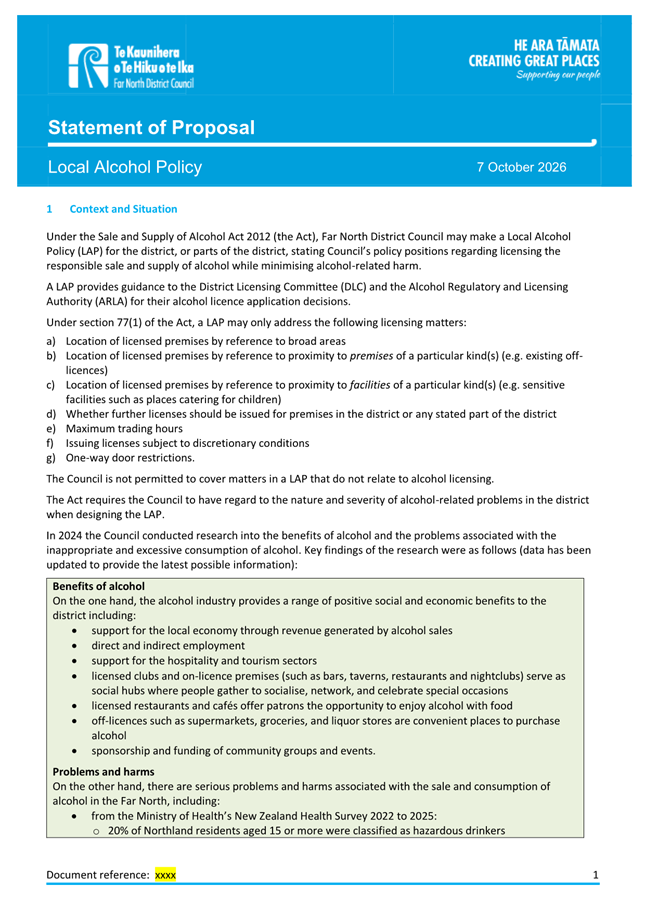
To inform Te Kuaka that a Local Alcohol Policy (LAP) for the
district is being developed. A draft LAP will be subject to public consultation
in October/November 2026 (subject to approval from Te Kūkupa on 09
September 2026).
WHAKARĀPOPOTO MATUA / Executive SummarY
· Under the Sale and Supply of Alcohol Act 2012, the Council may adopt
a LAP to guide alcohol
licensing and support the safe and responsible sale, supply, and consumption of
alcohol while minimising alcohol-related harm.
· On 12 December 2024 (Resolution 2024/174
refers), Council approved the development of a LAP for
the district.
· In May/June 2025, a comprehensive community survey was undertaken to
understand community views on potential LAP provisions.
· On 14 May, a stakeholder hui was held with 22 organisations in
attendance, with representatives from various Iwi, Hapū,
hauora, and support organisations.
· The
draft Policy was developed by a working group that includes the Police, Medical
Officer of Health, and Alcohol Licensing Inspectorate.
· On
09 September 2026 staff sought approval from Te Kūkupa to
consult with the public on 1) the Draft LAP (Attachment One) and 2) the
Statement of Proposal for Consultation (Attachment Two).
|
TŪTOHUNGA
/ Recommendation
That Te Kuaka Committee for
Māori Strategic Relationships receive the report Development of a Local
Alcohol Policy.
|
tĀHUHU KŌRERO / Background
What is a Local Alcohol Policy (LAP)?
A LAP is a council policy, developed with the community
under the Sale and Supply of Alcohol Act 2012 (the Act) to support the safe and
responsible sale, supply, and consumption of alcohol and minimise
alcohol-related harm in the district.
A LAP applies to licensing decisions and may address matters
such as trading hours, the location and density of licensed premises, and
discretionary licence conditions. Under sections 105 and 131 of the Act, the
DLC and ARLA must have regard to a LAP when considering licence applications
and renewals.
LAP development
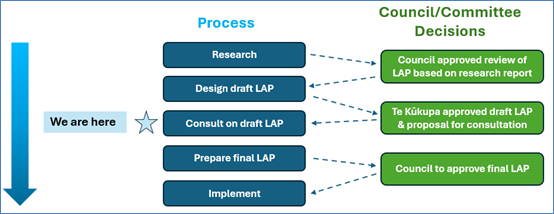
On 16 November 2023, the Council authorised staff to conduct
research into making a LAP (Resolution 2023/146
refers). The findings of this research are summarised in the Statement
of Proposal (Attachment Two). For more in-depth information, refer to the full
research report attached to the Council meeting on 12 December 2024[1].
Key research findings relating to Māori included:
Northland results 2023–2025[2] (updated from the original
report):
· Māori adults
aged 15 or more are more likely than the overall Northland adult population to
be frequent binge drinkers[3],
with 26% binge drinking at least monthly compared with 19% of all Northland
adults.
· Māori adults
are also more likely to be hazardous drinkers, with 31% classified as hazardous
drinkers compared with 23% of all Northland adults.
New Zealand-wide evidence:
· As
reported in a 2023 article[4],
Māori have a 35% greater probability than non-Māori of experiencing
violence due to someone else’s drinking; Māori are over-represented
in serious traffic crashes involving alcohol; and Māori children are more
likely than non-Māori children to be killed or seriously injured in
alcohol crashes.
· In
2022, the Health Promotion Agency[5]
noted that across New Zealand Māori are more likely to be exposed to risk
factors that increase alcohol use and harm such as:
o living
in deprived areas with a high density of alcohol outlets
o having
an increased risk of hazardous drinking when living near these outlets
o greater
exposure to cheap alcohol and advertising, especially among tamariki.
On 12 December 2024, based on the
research findings, the Council approved the development of a LAP for the
District (Resolution 2024/174 refers).
The Draft LAP was developed by a Working Group including the
Police, the Medical Officer of Health, and the Alcohol Licensing Inspectorate.
Engagement with Māori to help inform the Draft LAP
In May/June 2025, a comprehensive survey of Far North
residents was undertaken to understand community views on potential LAP
provisions. Of 422 respondents who indicated their ethnicity, 151 (36%)
identified as Māori. The following table shows a high level of concern by
Māori respondents regarding alcohol-related issues and problems:
Table One - Level of concern by Māori
respondents for alcohol-related problems and issues:
|
Problems
and issues associated with alcohol
|
% concerned
|
|
Domestic
violence
|
97%
|
|
Impact
on mental health
|
89%
|
|
Police
time and resources
|
88%
|
|
Disorderly
behaviour
|
87%
|
|
Impact
on physical health
|
81%
|
From mid-2025 to August 2026, staff
engaged with community groups to understand their views. A hui was held in May
2026 where 66 people attended, representing 22 different organisations,
including Iwi, Hapū, Hauora, and social agencies. At this hui, in response
to participants’ requests, council’s Alcohol Licensing Inspectors
agreed to develop an online platform for interested parties to share and
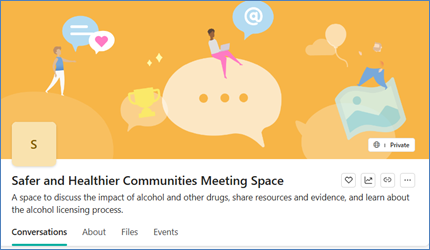
discuss information on alcohol-related matters. This platform was launched in
August 2026.
MATAPAKI ME NGĀ KŌWHIRINGA /
Discussion and Next Steps
Relevant legislation
The Act enables Council to make a LAP for alcohol licensing
matters in the district to ensure alcohol is sold, supplied, and consumed
safely and responsibly, and that alcohol-related harm is minimised.
Section 77 of the Act provides for a LAP to include policies
on the following licensing matters:
a) location of licensed
premises by reference to broad areas
b) location of licensed
premises by proximity to premises of a particular kind or kinds - for example,
how close bottle stores can be to each other
c) location of licensed
premises by proximity to facilities of a particular kind or kinds - these
facilities include ‘sensitive facilities’ such as places catering
for children and alcohol addiction treatment centres
d) whether further
licences should be issued - the Council may impose a cap or ‘sinking
lid’ on issuing further licences where the current number of licences is
considered excessive
e) maximum trading hours -
default trading hours are stated in the Act. Council may reduce or increase
these hours to reflect community preferences
f) issuing licences
subject to discretionary conditions - these are conditions that the DLC may or
may not apply to specific licences and may cover areas such as noise control,
outdoor advertising of alcohol, and safety and security provisions etc.
g) one-way door
restrictions - these restrictions allow patrons to leave premises such as bars,
taverns, pubs, and nightclubs but not to re-enter these premises after a
certain time.
Under sections 105 and 131 of the Act, the DLC and ARLA must
have regard to the LAP when considering licence applications and renewals in
the district.
Content of the Draft LAP
The Draft LAP is informed by research, community survey
results, engagement with licensees, meetings with community and hauora
organisations, and input from Police, Licensing Inspectors, and the Medical
Officer of Health.
Staff have aimed to produce a Draft LAP that reasonably
reflects community views, the data and research, while providing a balanced and
proportionate response to alcohol-related harm in the community.
The content of the Draft LAP (Attachment 1) complies with
section 77 of the Act (Content of policies).
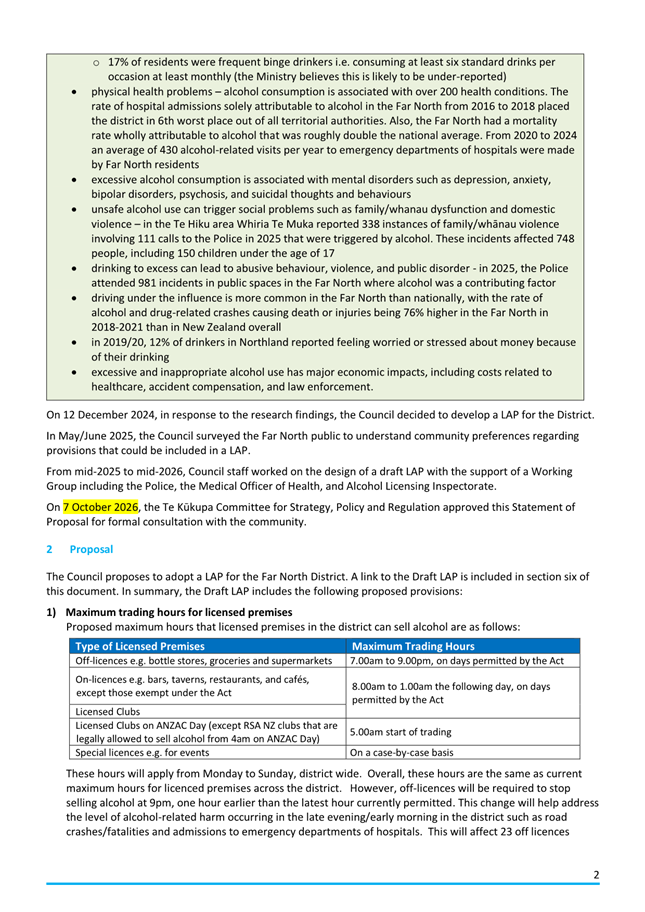
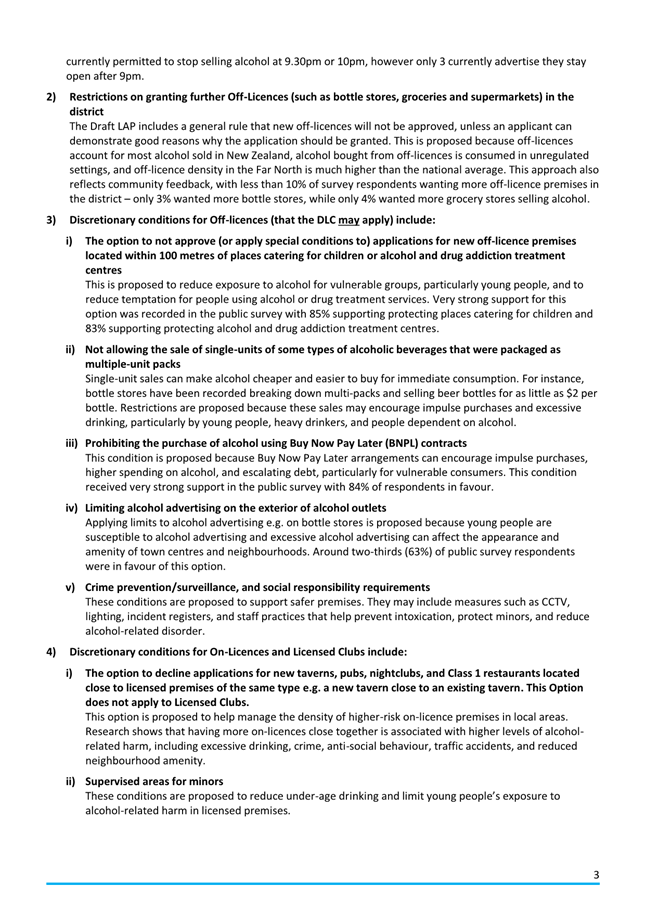
Key elements of the draft LAP include:
· setting maximum
trading hours for licensed premises
· restrictions on
granting further Off-Licences for bottle stores, groceries and supermarkets in
the district
· discretionary
conditions for Off-licences that the DLC may apply regarding:
o limiting new taverns, pubs,
nightclubs, and Class 1 restaurants located close to licensed premises of the
same type
o protecting vulnerable users of
places catering for children and alcohol and drug addiction treatment centres
o not allowing the sale of
single units of some types of alcoholic beverages that were packaged as
multiple-unit packs
o prohibiting the purchase of
alcohol using Buy Now Pay Later contracts
o limiting alcohol advertising
on the exterior of alcohol outlets
o crime prevention,
surveillance, and social responsibility practices.
· discretionary
conditions for On-Licences and Licensed Clubs regarding:
o supervised areas for minors
o protecting vulnerable users of
places catering for children and alcohol and drug addiction treatment centres
o setting maximum patron numbers
o applying one-way door
restrictions where alcohol-related disorder has been reported late at night
near a premises
o noise control and the
management of outdoor areas
o crime prevention,
surveillance, and host responsibility practices.
· discretionary
conditions for Special Licences regarding the management of events.
Consultation
As required by section 78 of the Act, Council staff have
consulted with the Police, Licensing Inspectors, and the Medical Officer of
Health on the design of the draft LAP.
Section 79 requires Council to
consult on the Draft LAP using the Special Consultative Procedure (SCP)
described in section 83 of the Local Government Act 2002. An SCP requires at
least one month for consultation.
Section 83 requires Council to
prepare a Statement of Proposal explaining what is proposed and how the public
can provide their feedback (Attachment Two). This document explains how people
can express their views.
NEXT
STEPS
Consultation must run for at least one month, and written
submissions will be accepted from 12 October to 15 November (five weeks), with
oral submissions in early December, depending on Te Kūkupa availability.
Staff will then aim to report submissions analysis and the
proposed final LAP to Te Kūkupa in the first quarter of 2027 for a
recommendation to Council to adopt the LAP.
3) PĀnga PŪtea me ngĀ
wĀhanga tahua / Financial Implications and Budgetary Provision
LAP development costs, including staff time, engagement, and
external legal advice, have been met from existing budgets. No new
implementation costs are expected, apart from public notification costs
required by the Act.
Any additional initiatives, implementation, or enforcement
costs that cannot be managed within existing budgets will need to be identified
by the teams responsible and considered through the appropriate budgeting and
planning processes.
Having a LAP in place may reduce the number of costly
hearings regarding objections to the DLC’s decisions, as a LAP will give
the DLC and licensed premises clearer direction regarding Council’s
intentions for alcohol licensing.
Āpitihanga
/ Attachments
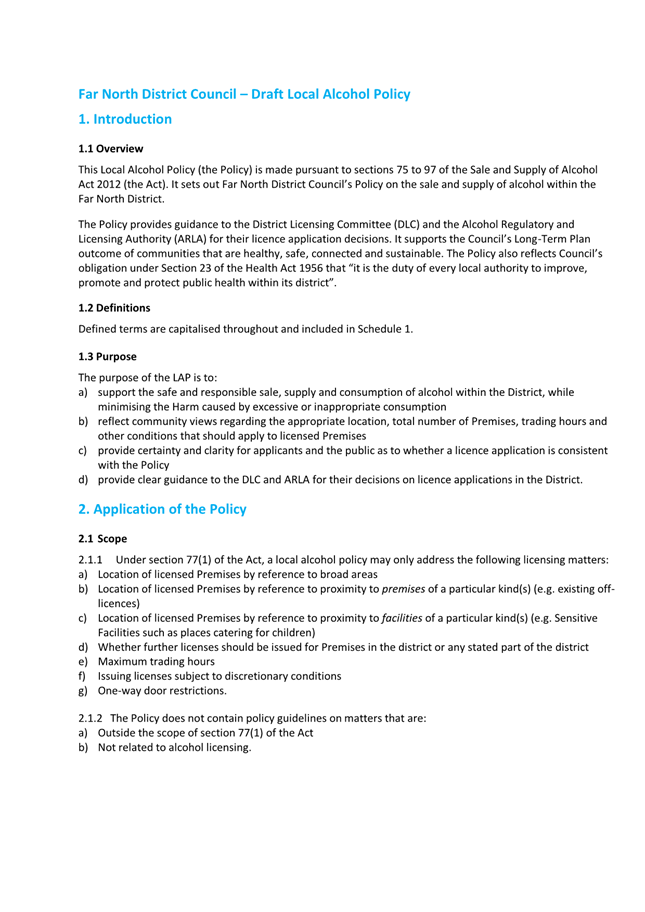
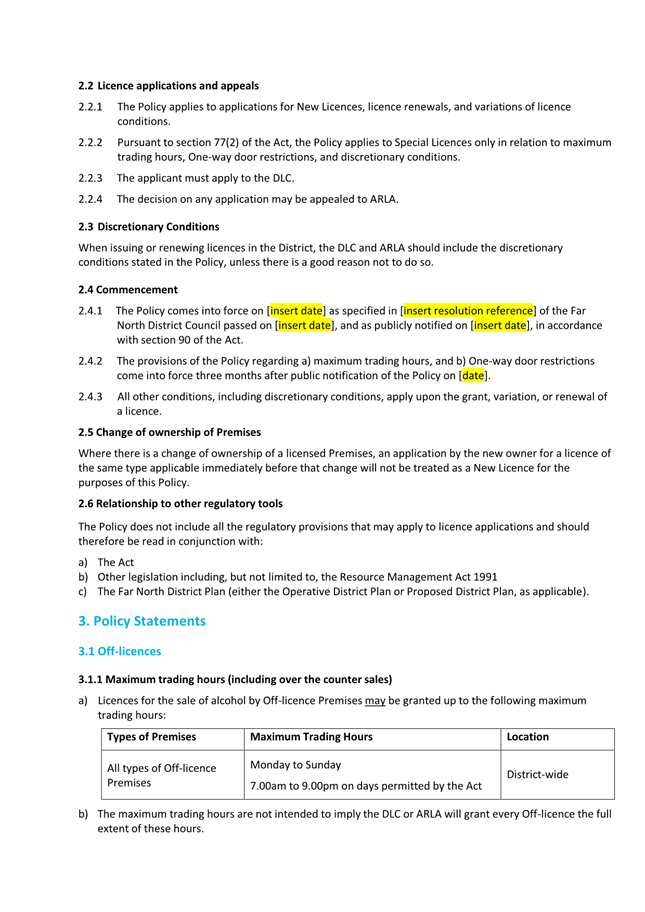
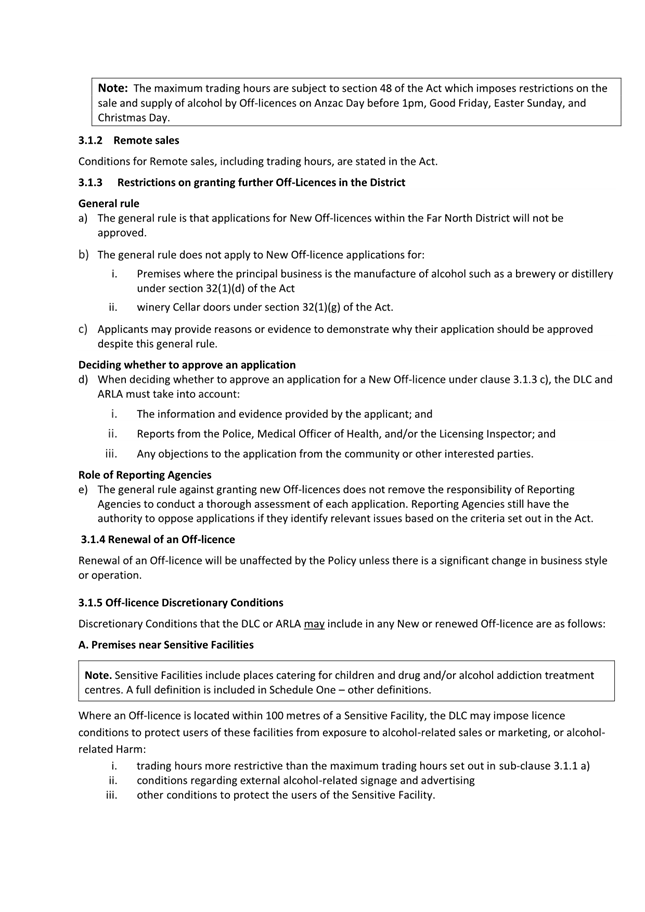
1. Draft
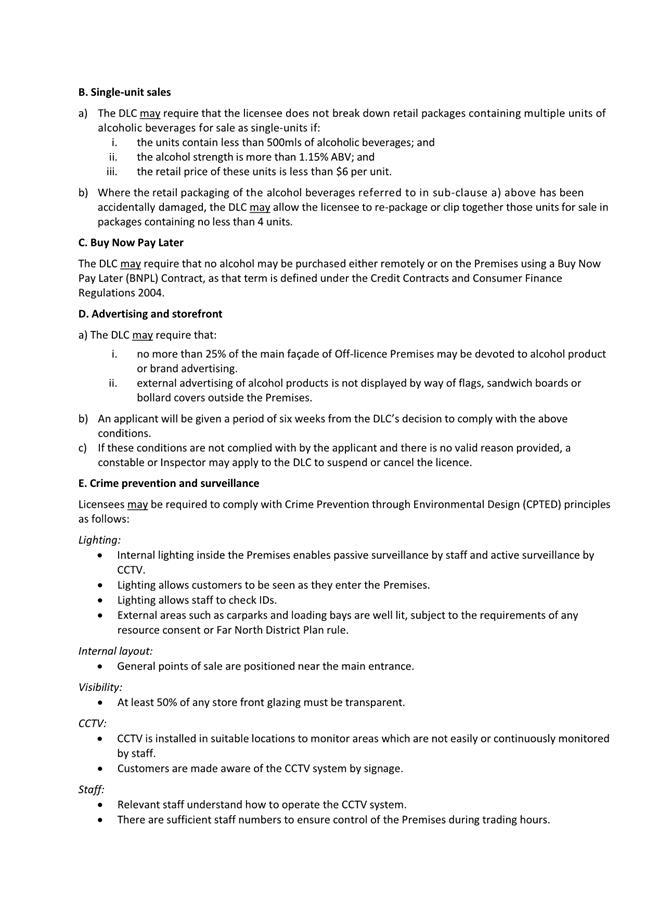
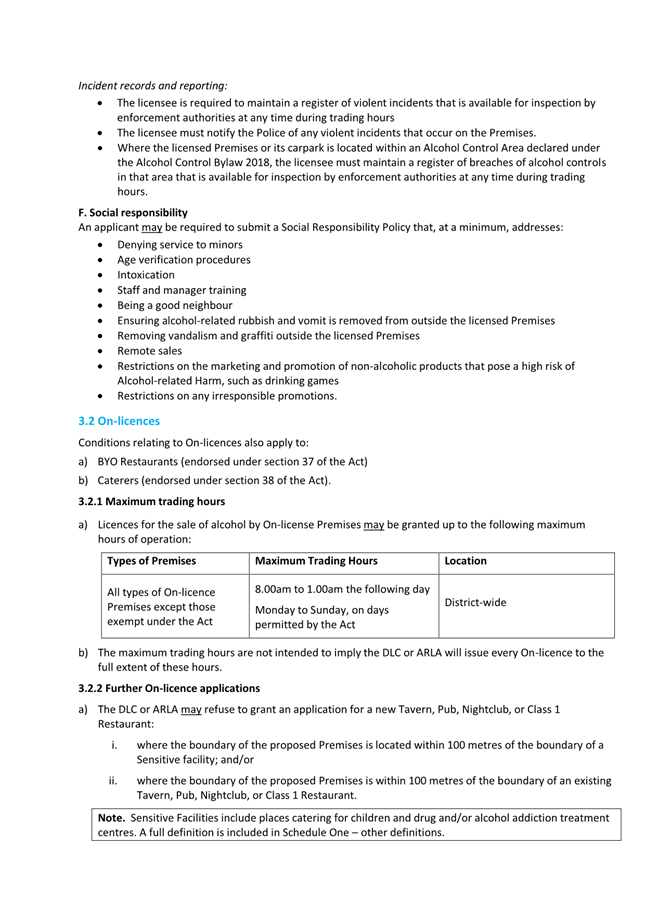
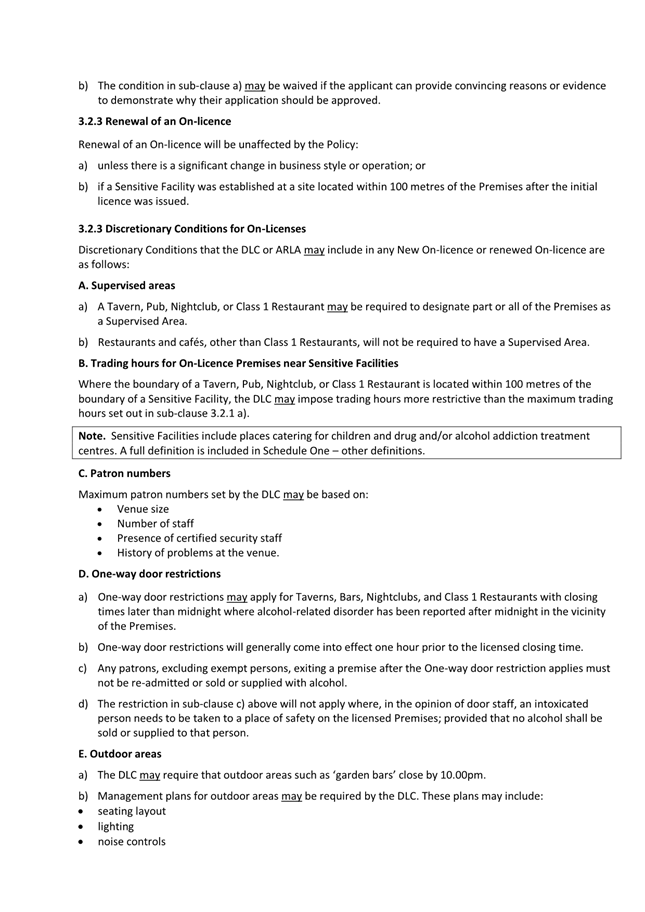
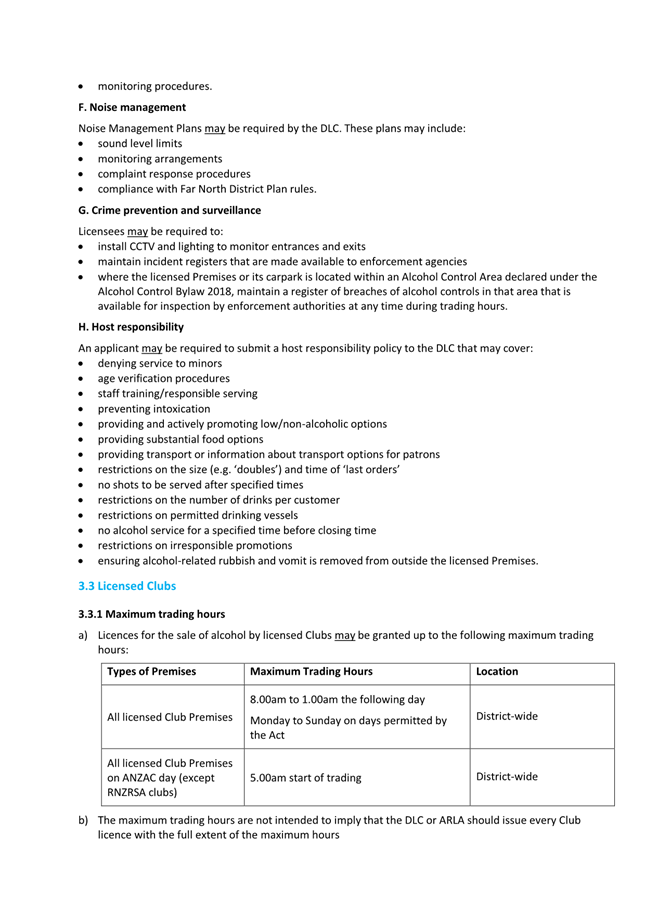
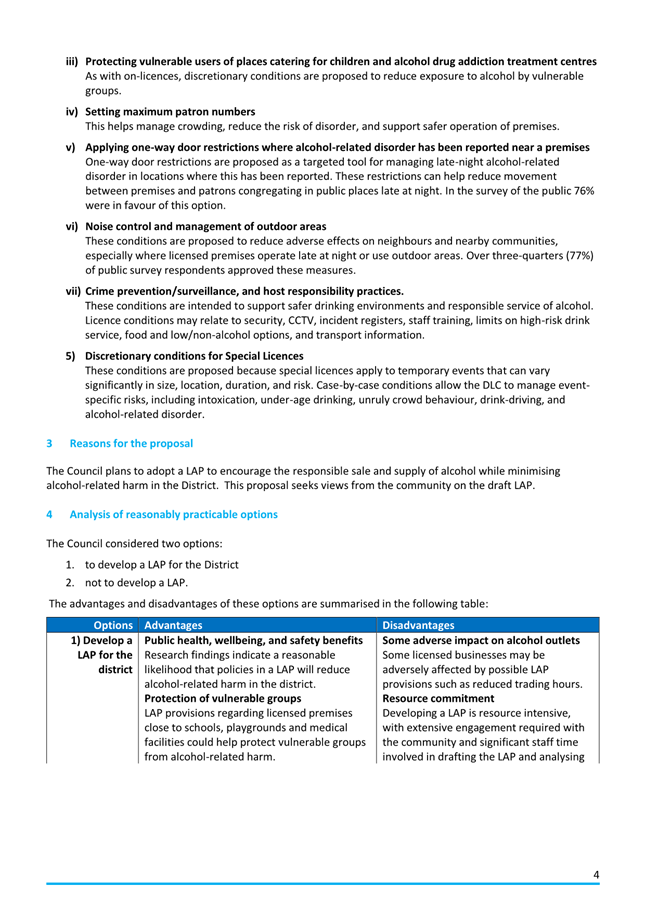
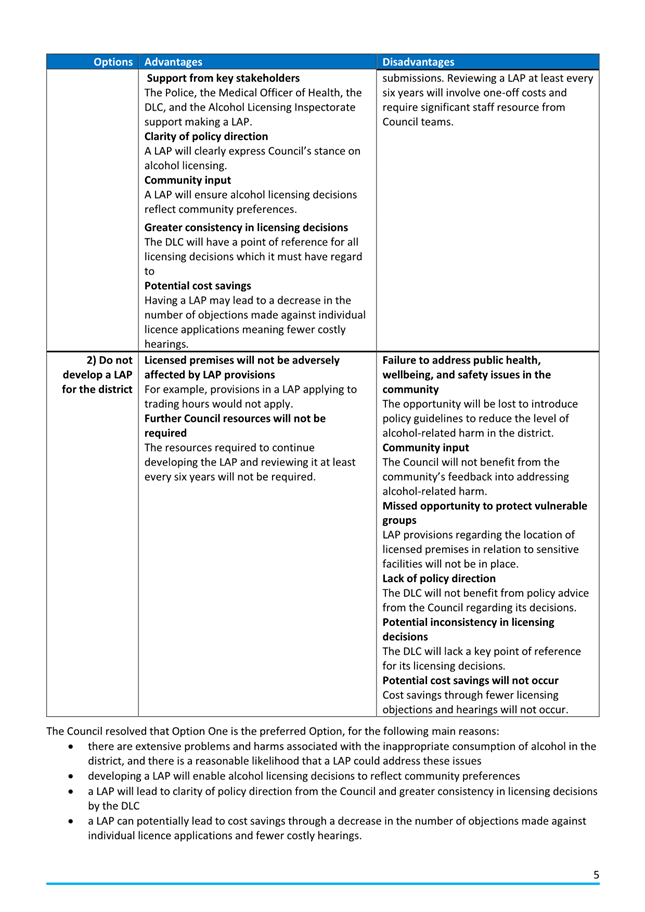
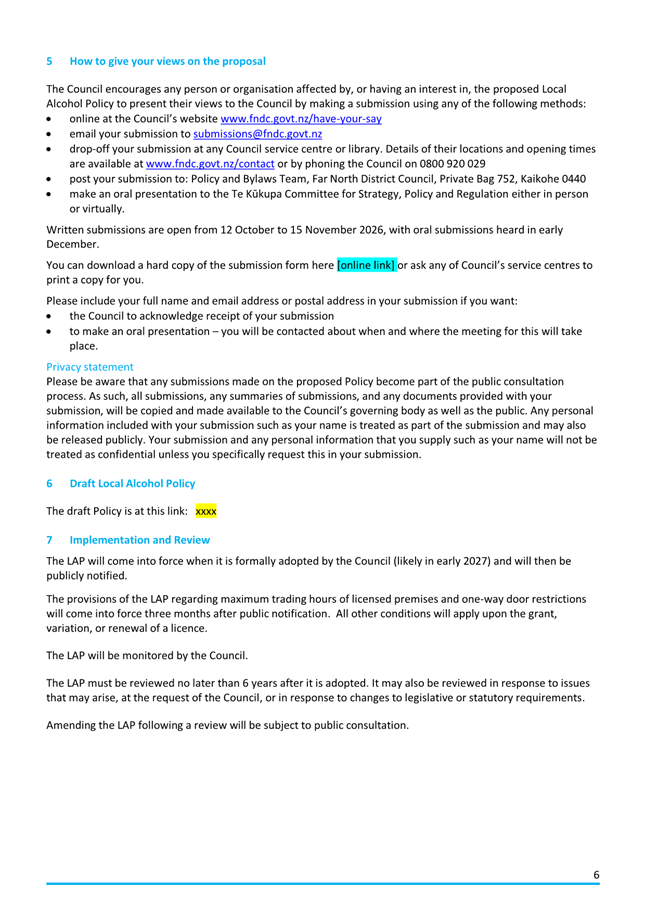
LAP - A5933144 ⇩ 
2. Statement
of Proposal - A5933160 ⇩ 
|
Ordinary Te Kuaka
Committee for Māori Strategic Relationships Meeting Agenda
|
15 September 2026
|
|
Ordinary Te Kuaka
Committee for Māori Strategic Relationships Meeting Agenda
|
15 September 2026
|
|
Ordinary Te Kuaka
Committee for Māori Strategic Relationships Meeting Agenda
|
15 September 2026
|
5.3 District
Wide Spatial Strategy Update: Vision, Principles and Objectives and Kaupapa
Steering Rōpū
File
Number: A5952270
Author: Stephen
FitzHerbert, Senior Strategic Planner Growth Planning and
Placemaking
Authoriser: Kate
Ivicheva, Group Manager - Planning & Policy
TAKE PŪRONGO / Purpose of the Report
The purpose of the report is to inform Te Kuaka Committee
for Strategic Māori Relationships (Te Kuaka) with an update on two
milestones within the District Wide Spatial Strategy (DWSS) work programme:
1. The
DWSS’s Vision, Principles and Objectives (VPO). This section outlines the
process undertaken to establish a draft VPO and a refined VPO.
2. The
Kaupapa Steering Rōpū (KSR). This section is produced by FNDC
kaimahi, on behalf of the KSR, to share progress on work activities and methods
for better supporting the rōpū.
WHAKARĀPOPOTO MATUA / Executive SummarY
· The
District Wide Spatial Strategy (DWSS) has progressed two key milestones:
completion of a near-final Vision, Principles and Objectives (VPO) (Milestone
4) and the reconvening of the Kaupapa Steering Rōpū (KSR) (Milestone
2).
· The
DWSS has been developed through an evidence-based process incorporating
technical analysis, strategic planning work, stakeholder engagement, and Iwi
and Hapū input to create a strong foundation for long-term district and
regional spatial planning.
· Two
workshops and a follow-up hui with Te Kūkupa, Community Board Chairs and
KSR members were undertaken to test and refine the draft VPO.
· The
emerging vision is for "a Far North where people and whānau can build
thriving futures, connected to place and each other", supported by
objectives focused on economic prosperity, strong communities, equitable access
to services and housing, infrastructure-led growth, and environmental and
cultural stewardship.
· Feedback
from elected members, Community Board Chairs and KSR members strengthened the
VPO through greater recognition of He Whakaputanga and Te Tiriti o Waitangi,
stronger emphasis on infrastructure and affordability, enhanced recognition of
rural communities and productive land, and a stronger focus on climate
resilience and long-term decision-making.
· The
KSR has been reconvened under updated Terms of Reference that broaden
representation, include rangatahi voices, strengthen cultural expertise, and
reinforce its strategic advisory role.
· KSR
members have made a significant contribution to refining the draft VPO and
ensuring that Te Ao Māori values, aspirations and intergenerational
perspectives are embedded throughout the strategy.
· The
KSR has identified opportunities to better support the rōpū and
increase co-design of future DWSS work, strengthen Te Ao Māori and
mātauranga Māori expression, support wider mana whenua engagement,
develop Māori success measures, enhance rangatahi participation, and
contribute to future implementation and regional spatial planning processes.
· Key
risks relate to member availability, compressed project timeframes, role
clarity, understanding of spatial planning processes, and representation
concerns; however, these risks are considered manageable through improved
communication, capability-building, clearer expectations and enhanced support
for KSR members.
|
TŪTOHUNGA
/ Recommendation
That the Te Kuaka Committee
for Māori Strategic Relationships receive the report District Wide
Spatial Strategy Update: Vision, Principles and Objectives and Kaupapa
Steering Rōpū.
|
tĀHUHU KŌRERO / Background
The District Wide Spatial Strategy (DWSS) project commenced
in late 2025 and has been developed through an evidence-based process informed
by elected members, mana whenua, stakeholders and the wider community. Rather
than starting with predetermined growth areas or fixed outcomes, the project
has focused on developing a robust understanding of the Far North's current
conditions, future challenges, opportunities, and aspirations. This has
involved integrating technical investigations, strategic and policy reviews,
community and stakeholder feedback, Iwi and Hapū perspectives, and spatial
analysis to build a shared evidence base. Together, these inputs have helped
identify the key factors that will shape the district's future and provide a
strong foundation for informed decision-making and long-term planning.
The DWSS is being progressed in advance of forthcoming
reforms to New Zealand’s resource management system and the eventual
development of a regional spatial plan. By preparing a district-wide strategy
now, FNDC can establish a strong local evidence base that reflects community
aspirations, Hapū and Iwi priorities, growth trends, infrastructure
requirements, and environmental priorities. This proactive approach ensures the
district is well positioned to influence and contribute to future regional
planning processes. In the meantime, the strategy provides a clear strategic
framework to support Council decision-making, helping to guide investment,
planning, and development choices until a regional spatial plan is prepared,
formally adopted, and becomes the primary mechanism for spatial planning.
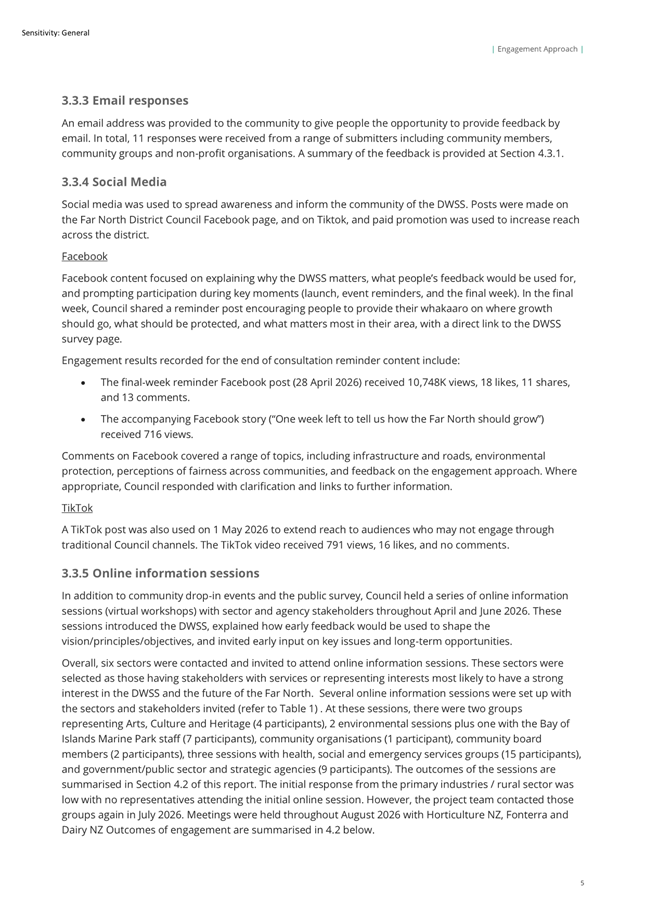
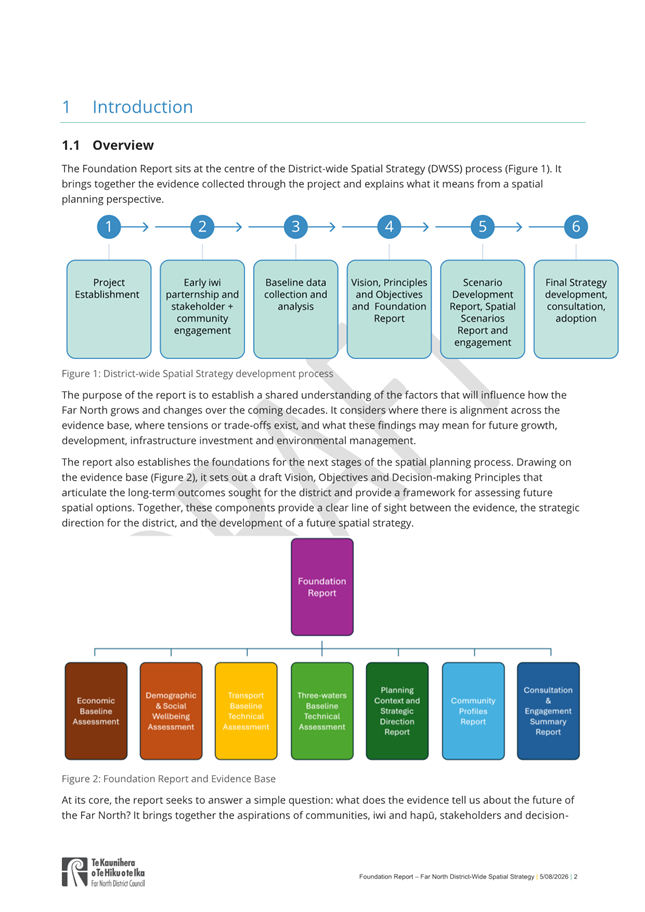
The DWSS work programme has six
milestones:
1. Project
establishment
2. Early
Hapū and Iwi partnership and stakeholder and community engagement
3. Baseline
data collection and analysis
4. Vision,
principles and objectives and Foundation report
5. Scenario
development report, spatial scenarios report and engagement
6. Final
DWSS development, consultation and adoption
The current project stage is completing Milestone 4 and
reconvening the Kaupapa Steering Rōpū (KSR) as per Milestone 2. The
development of the vision, principles and objectives (VPO) has been informed by
the earlier stages of evidence and engagement (Milestones 1-3) and recent
workshops with elected members and the KSR. The KSR has been reconvened as per
Milestone 2, see below for an overview of the rōpū’s
evolution. Completion of the VPO is scheduled for the beginning of
October, when it will be recommended to Te Kūkupa for endorsement.
Te Kuaka Committee for Strategic Māori Relationships
(Te Kuaka) endorsed the establishment of a KSR in 2024 (Resolution 2024/25) and
its reconvening in 2026 (Resolution 2026/4) as the preferred forum to provide
kaupapa‑specific
strategic Māori guidance for district‑wide
initiatives (i.e., the DWSS), consistent with the District Wide Kaupapa Framework. The
KSR is an integral contributor to all stages of DWSS development, serving as an
advisory forum to embed partnership, participation and protection and situate
Te Ao Māori values, priorities and aspirations within the creation of the
DWSS. KSR’s intended contribution to the DWSS includes:
- informing
and influencing the vision for the district;
- influencing
growth and development priorities;
- situating
Te Ao Māori values and mātauranga Māori within the DWSS;
- responding
to environmental and community issues; and
- aligning
with Iwi and hapu aspirations.
The KSR acts as an advisory rōpū comprised of
people with the necessary Te Ao Māori values, expertise and lived
experience, and the ability to represent diverse Hapū, Iwi, hapori and
district perspectives, to contribute to informed, effective and future-focused
district-wide spatial planning. As such, the KSR provides a dedicated,
fit-for-purpose mechanism to apply a strong Te Ao Māori lens to the DWSS,
while maintaining Te Kuaka’s governance-level oversight role and
clarifying the overall project governance and reporting lines. The KSR is not
a delegated decision-making authority, nor does it replace wider public
consultation, Community Board engagement, Hapū and Iwi engagement, or
legislative consultation requirements.
Alongside Te Kuaka’s decision to reconvene the KSR, a
refined ToR was endorsed (see Attachment 1). Changes to the draft ToR were
completed by the initial KSR in 2025, whose membership included: Hapū/Iwi
representatives Pita Tipene, Kipa Munro and Rereata Makiha, Councillors Babe
Kapa and Hilda Halkyard-Harawira, as well as FNDC kaimahi from Te Hono and
Integrated Planning. The refined ToR reflected a shift from a relatively small
initial advisory rōpū toward a more representative and enduring rōpū
with broader participation and a clearer strategic purpose. The changes
included:
- The inclusion
of a vision, mission and values to provide a stronger strategic and cultural
foundation for the KSR (see Item 1.1).
- Extending the
recognition of ‘Councillors’ to include ‘Elected
members’ and clarification of how council representation is determined
(i.e., two elected members will be selected at the beginning of each triennium)
and the formal appointment process for elected member participation.
- Explicit
recognition of rangatahi representation to introduce a youth voice to the KSR
and broaden representation beyond Iwi, Hapū, elected members and subject
matter experts (SME).
- Greater
definition of SMEs to mandate technical cultural expertise.
- Introduction
of a formal succession process in the instance an appointed member can no
longer serve on the rōpū.
- Expansion of
membership from six to ten appointed people to enhance representation and
better encompass and reflect the breadth and diversity of Māori interests
across the district.
- Explicit
linkage to Council’s Appointed Members Allowance Policy to provide clear
guidance regarding payment arrangements and allowances.
- The
removal of the Open Spaces Strategy project.
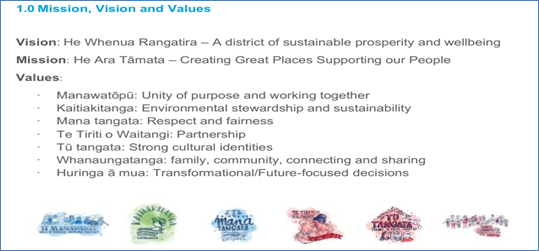
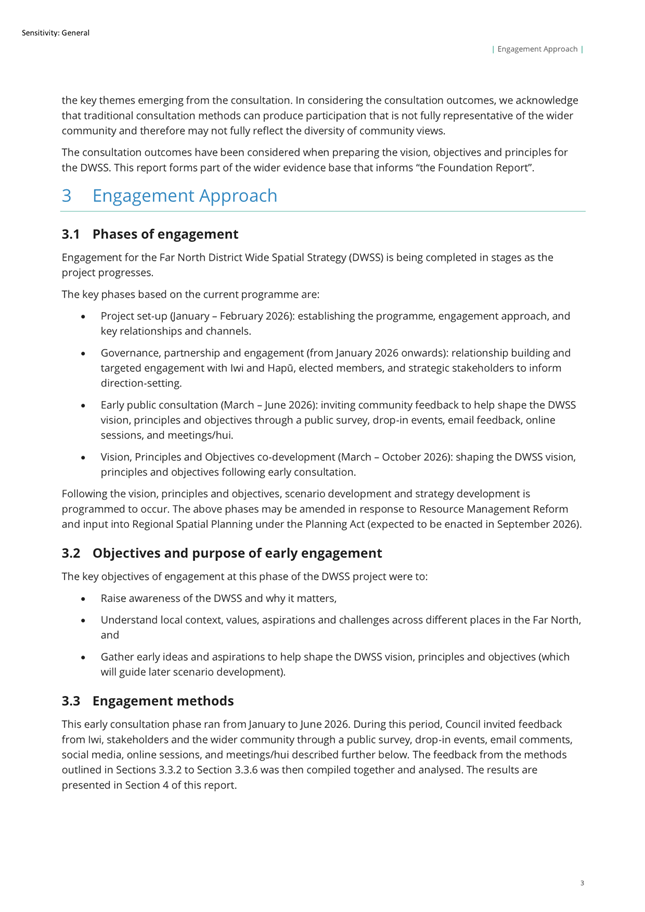
Item 1.1 The KSR’s vision, mission and values
The following section details the process undertaken to
develop the DWSS’s VPO and current KSR activity.
MATAPAKI ME NGĀ KŌWHIRINGA /
Discussion and Next Steps
This section is presented in two parts. The first section
outlines the process undertaken to develop the DWSS’s VPO. The second
provides a KSR progress update.
Part 1: District-Wide Spatial Strategy and
establishing the Vision, Principles and Objectives
Work progressed during July and August to complete Milestone
4. This activity has involved two workshops with elected members and the KSR,
as well as engagement with stakeholder groups.
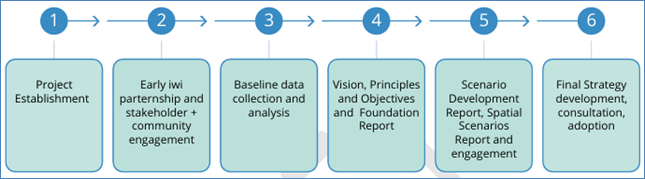
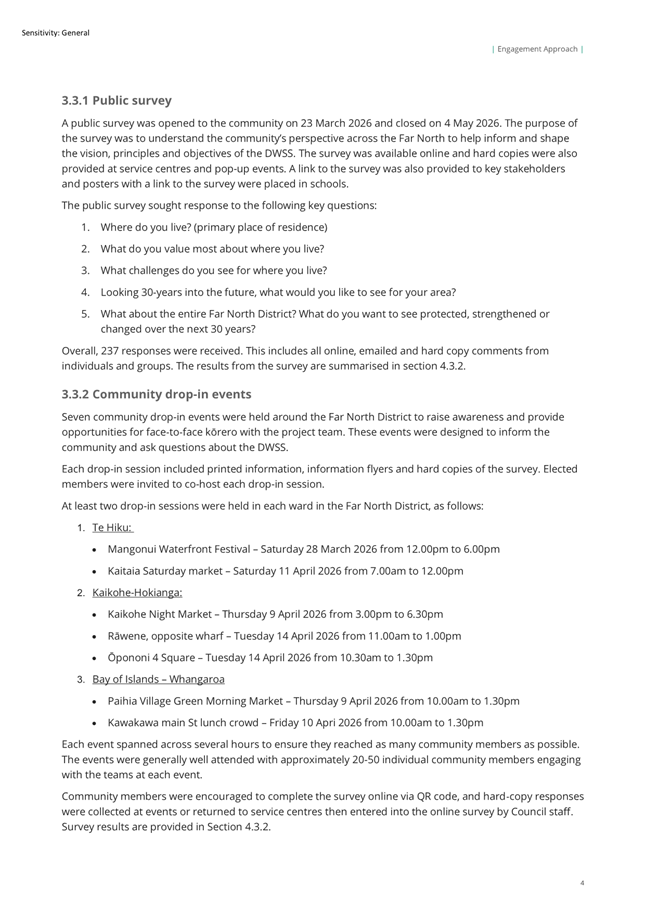
Item 2.1. District-wide
Spatial Strategy development process
Establishing the VPO
The VPO sets the long-term direction for the district,
shaping decision-making and defining the outcomes the strategy aims to achieve.
They provide the framework for evaluating spatial options, prioritising
investment, and coordinating future decisions relating to land use,
infrastructure, environmental management, community development, and the
incorporation of Te Ao Māori priorities and values. In essence, every
decision made through the spatial strategy will be directly guided by and
aligned with these foundations.
The vision sets out the district’s long-term
direction and describes the future it is working towards. It reflects the
aspirations of the community, Iwi and Hapū, stakeholders, and
decision-makers, and establishes a common purpose for the strategy. The vision
provides a framework for balancing immediate needs with longer-term goals,
ensuring decisions remain aligned with the desired future. In simple terms, the
vision answers the question of what we want the district to be in the years
ahead.
The principles guide how decisions are made in
pursuit of the vision. They establish a common set of criteria that can be
applied across a wide range of planning and investment decisions, helping to
ensure consistency over time. Where competing priorities or trade-offs exist,
the principles provide a basis for evaluating options and determining the most
appropriate course of action. In simple terms, they answer the question: How
will we make decisions as we work towards our desired future?
The objectives identify the changes and outcomes
required to achieve the vision. They turn broad aspirations into clear
priorities that can guide planning, policy development, and investment
decisions. Objectives also provide a framework for monitoring progress and assessing
whether the strategy is delivering the intended results. In simple terms, they
answer the question: What do we need to achieve to deliver the vision?
The DWSS project team undertook Iwi, stakeholder and public
engagement and reviewed relevant plans, strategies, technical information and
evidence to identify the district's key aspirations, growth and development
priorities, desired environmental, cultural, social and economic outcomes, and
areas where competing interests need to be reconciled. The evidence base
articulated a strong collective aspiration for the Far North to become a more
connected, resilient, culturally grounded and inclusive district, where growth,
infrastructure, environmental stewardship, economic prosperity and community
wellbeing are planned and delivered in an integrated way. The key themes
consistently emerging across the evidence included:
- a
network of thriving centres and rural communities,
- meaningful
partnerships with tangata whenua and the expression of kaitiakitanga,
- environmental
enhancement within natural limits,
- infrastructure-enabled
and place-based growth,
- equitable
access to opportunities and services,
- a
more diverse and resilient economy,
- and
long-term adaptability to future challenges.
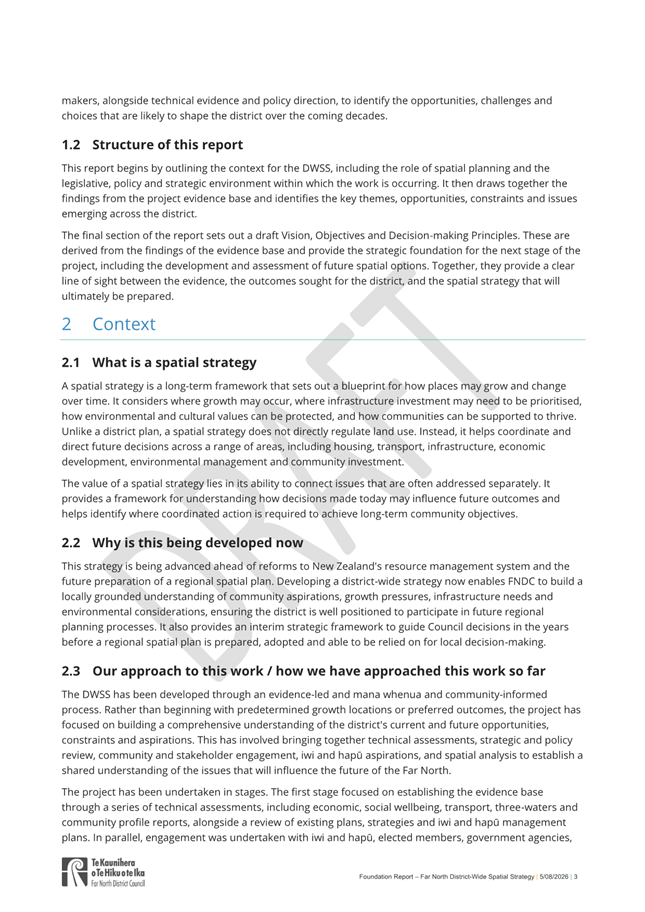
The initial baseline evidence findings were workshopped with
elected members (Te Kūkupa and Community Board Chairs) and the KSR on 8
July 2026. The evidence base comprised economic, social and wellbeing,
transport, planning context as well as strategic direction, community profiles
and an engagement summary report (see Attachments 2 and 3). The workshop
findings were assessed alongside the evidence base, which informed the initial
working draft VPO.
Refining the VPO
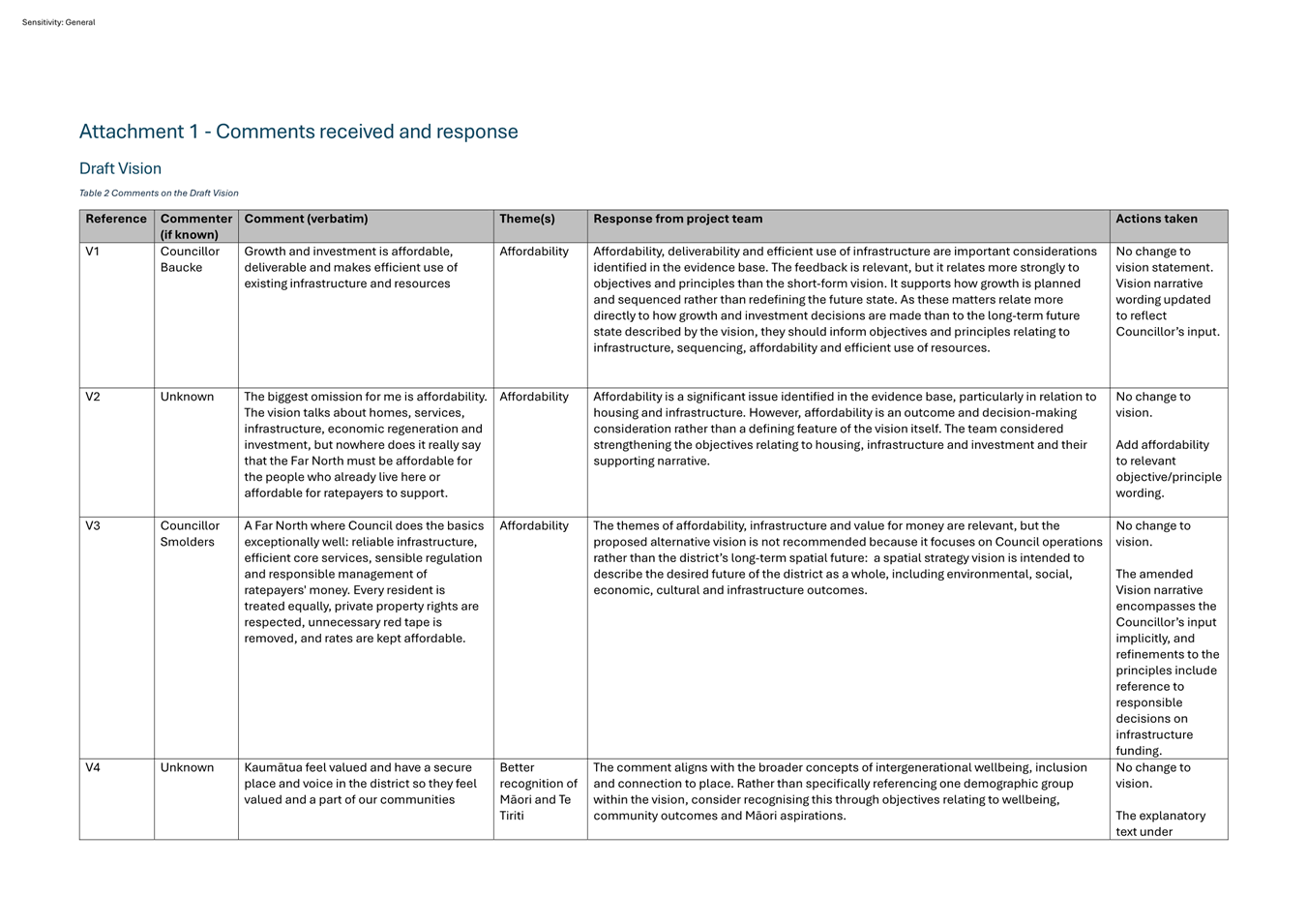
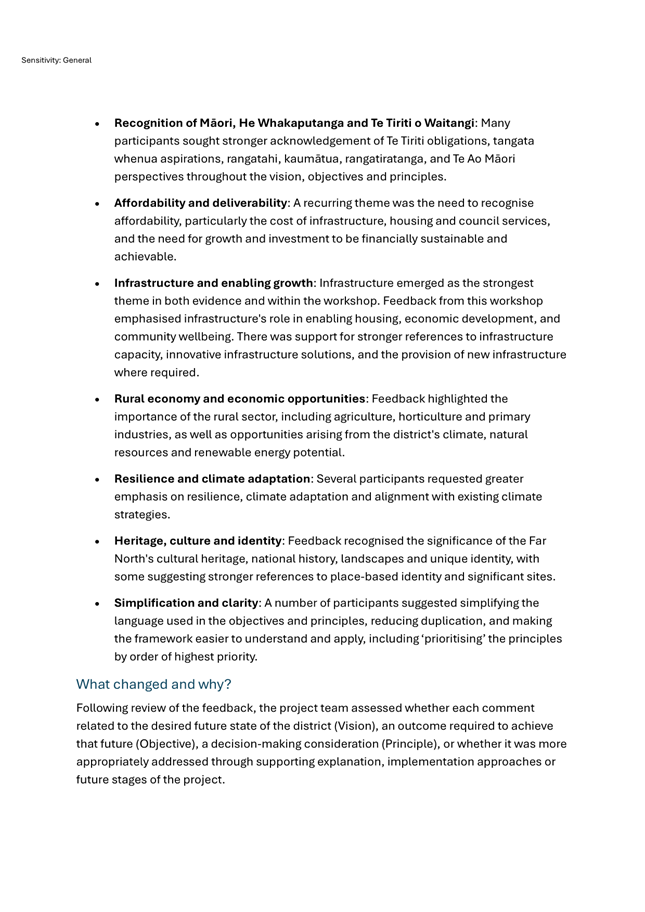
Two engagement activities were undertaken to refine the
working draft VPO. Firstly, a workshop was held with Te Kūkupa, the KSR
and Community Board Chairs on 12 August 2026. At that workshop Te Kūkupa, the
KSR and Community Board Chairs shared their perspectives on the working draft
VPO and proposed changes. A virtual whiteboard space was kept open until 16
August for workshop invitees to make further comments on the working draft VPO.
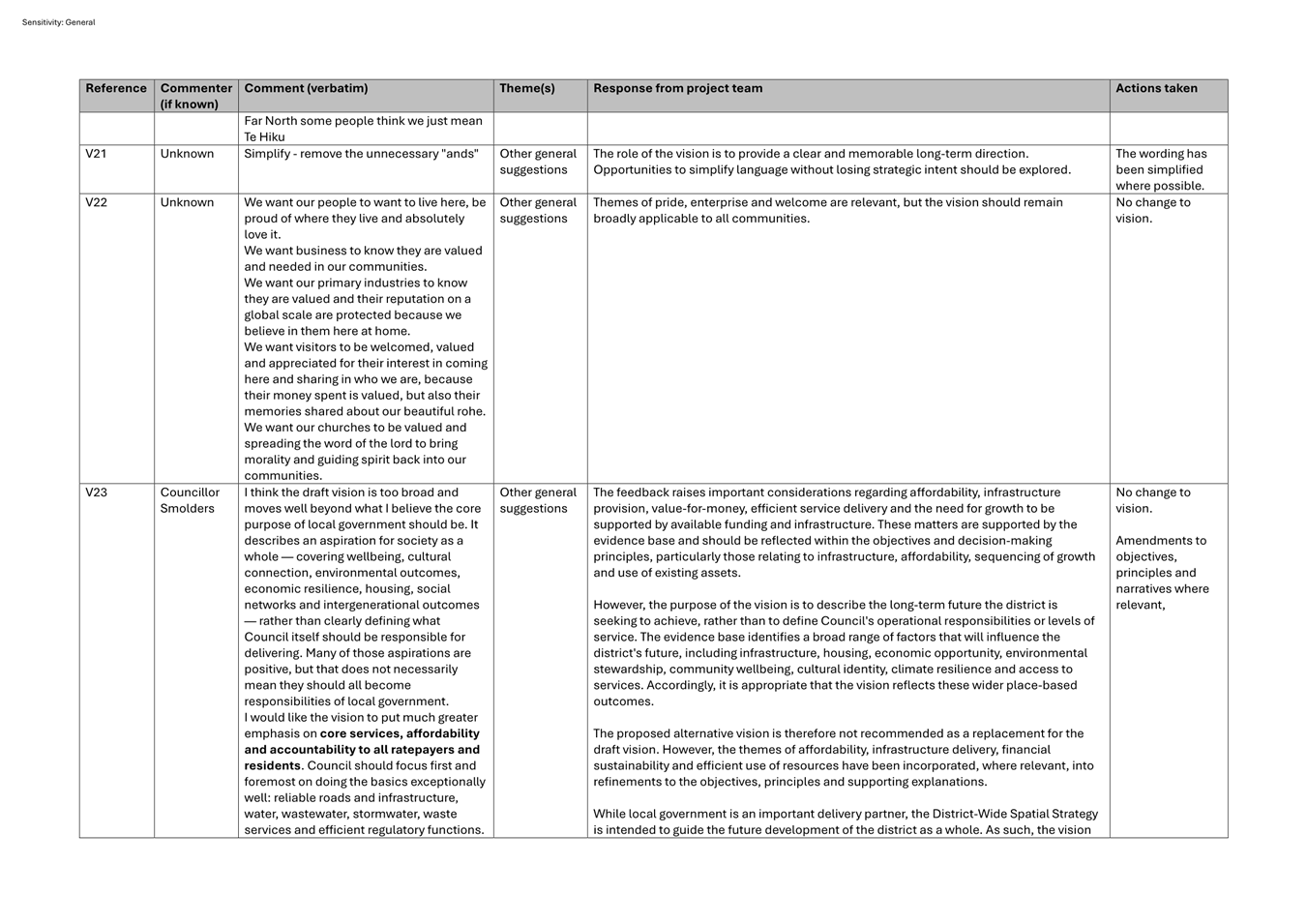
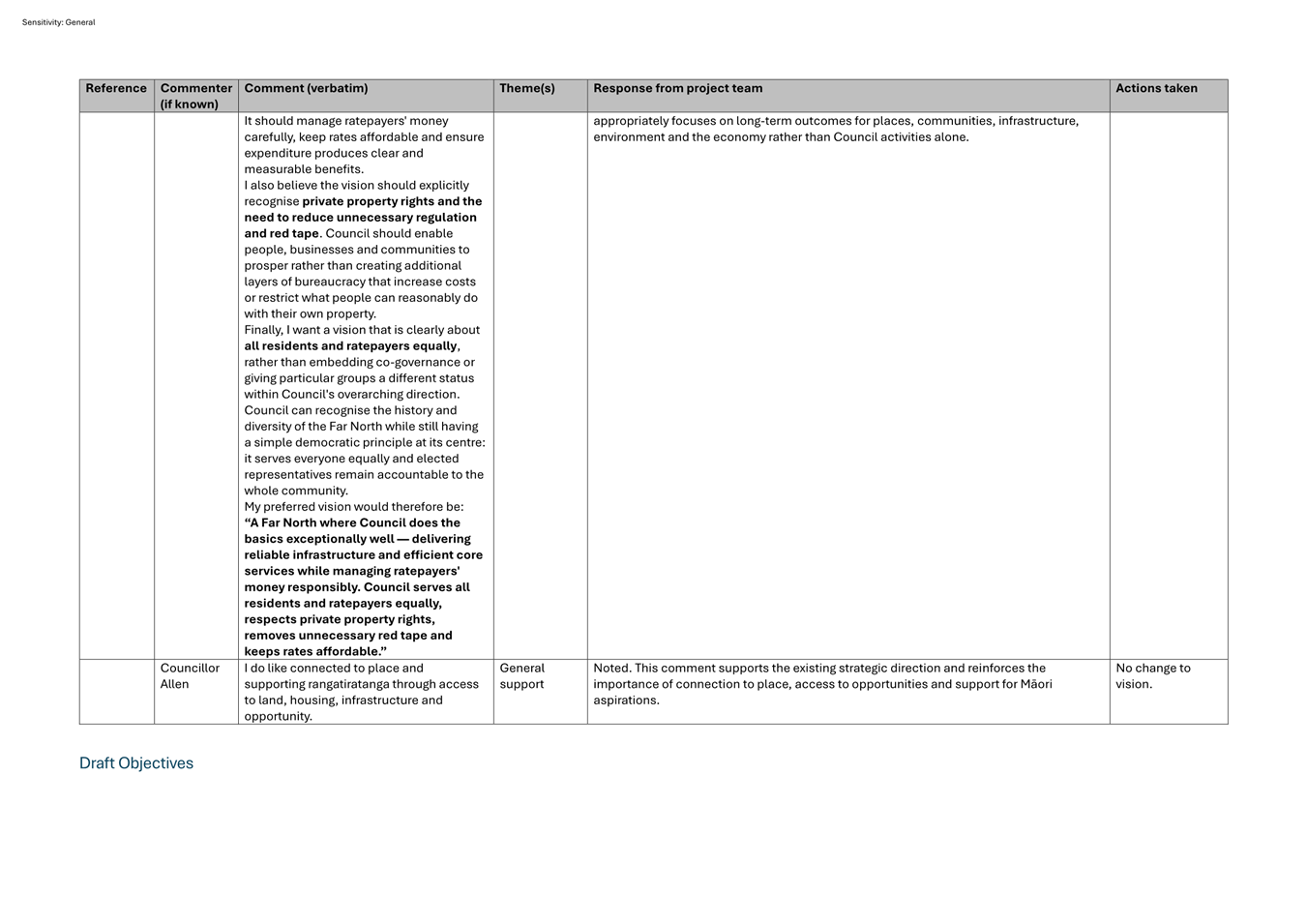
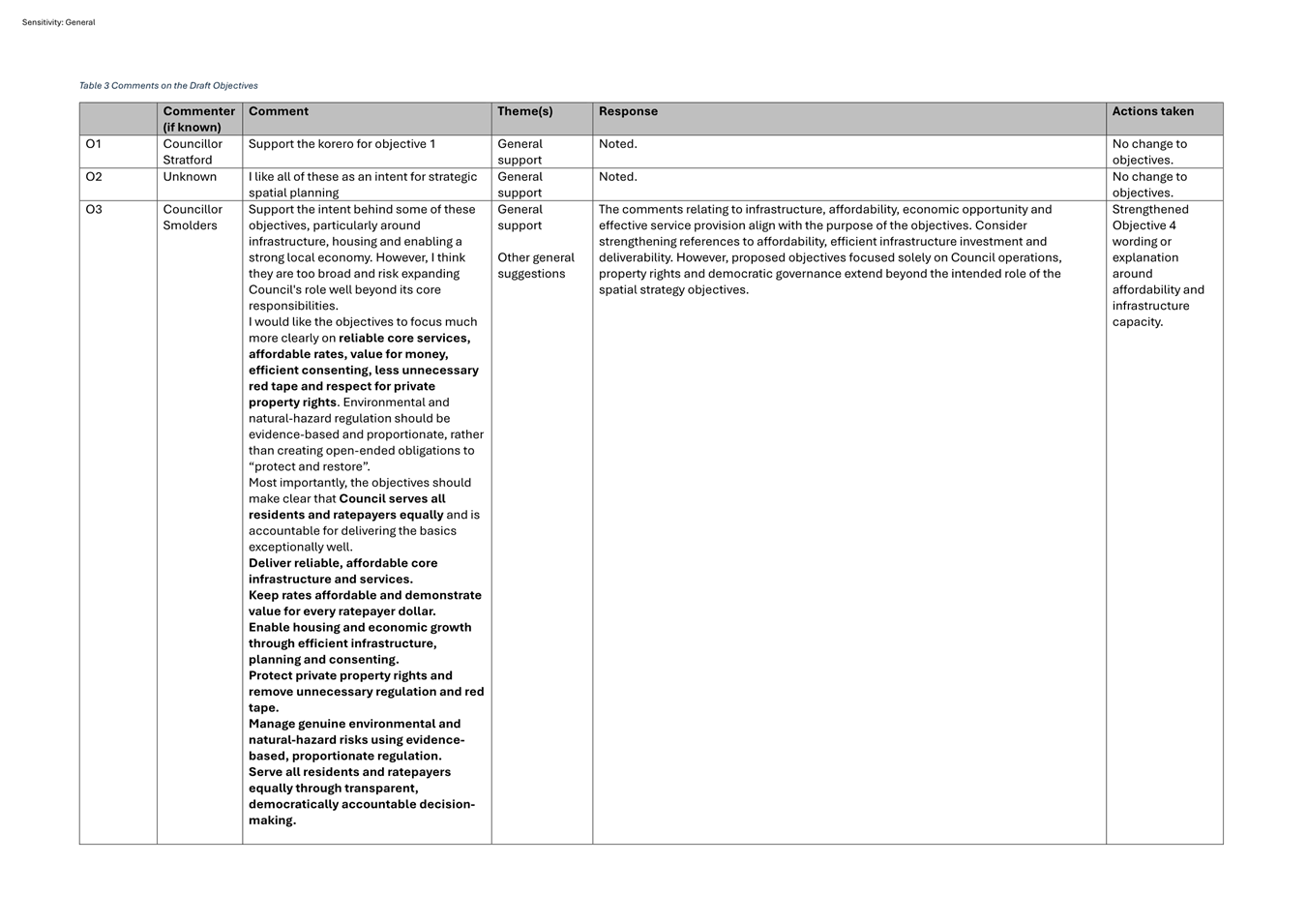
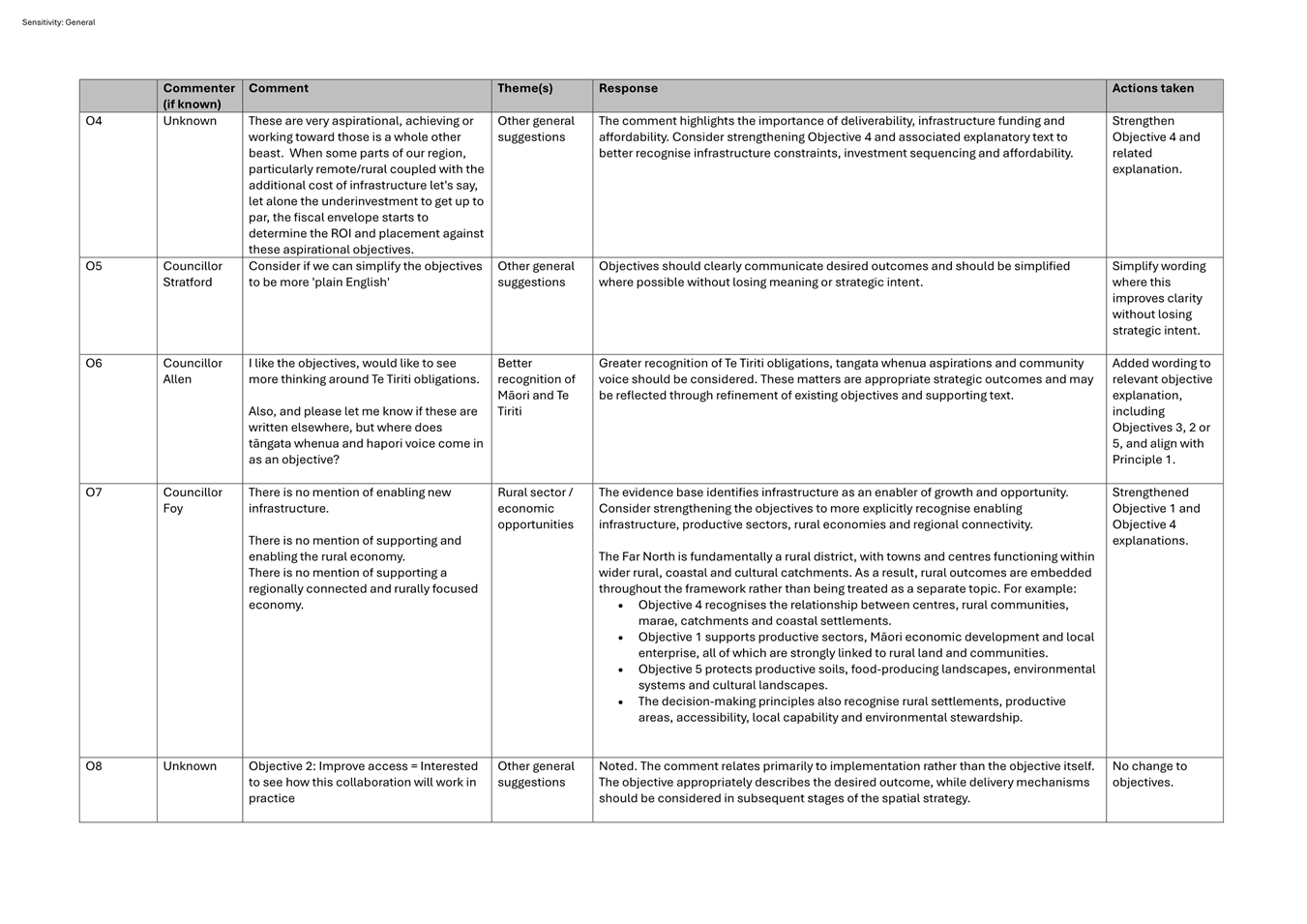
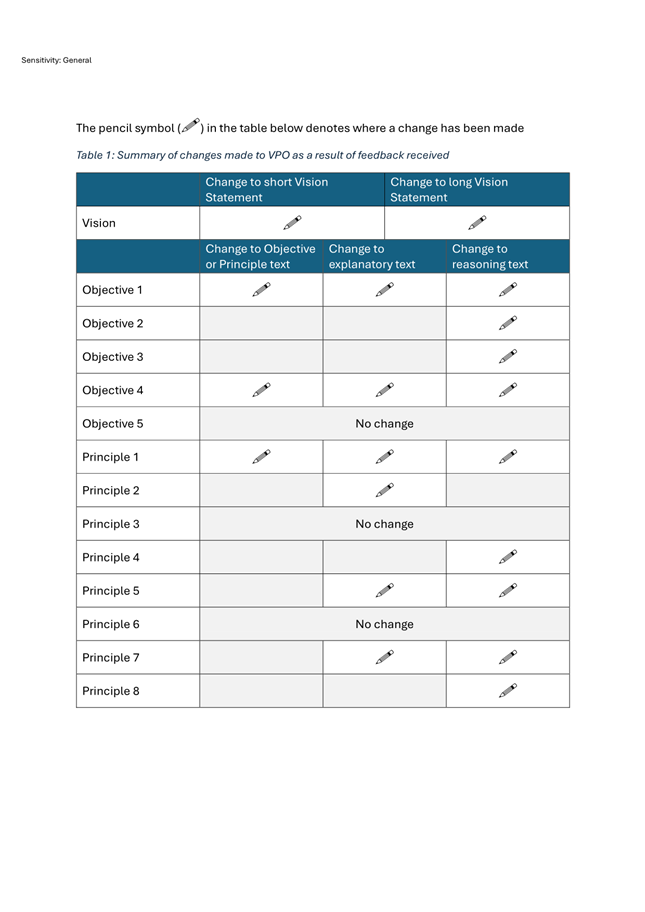
The refinements represented amendments to five areas of the initial draft VPO.
Amendments demonstrated:
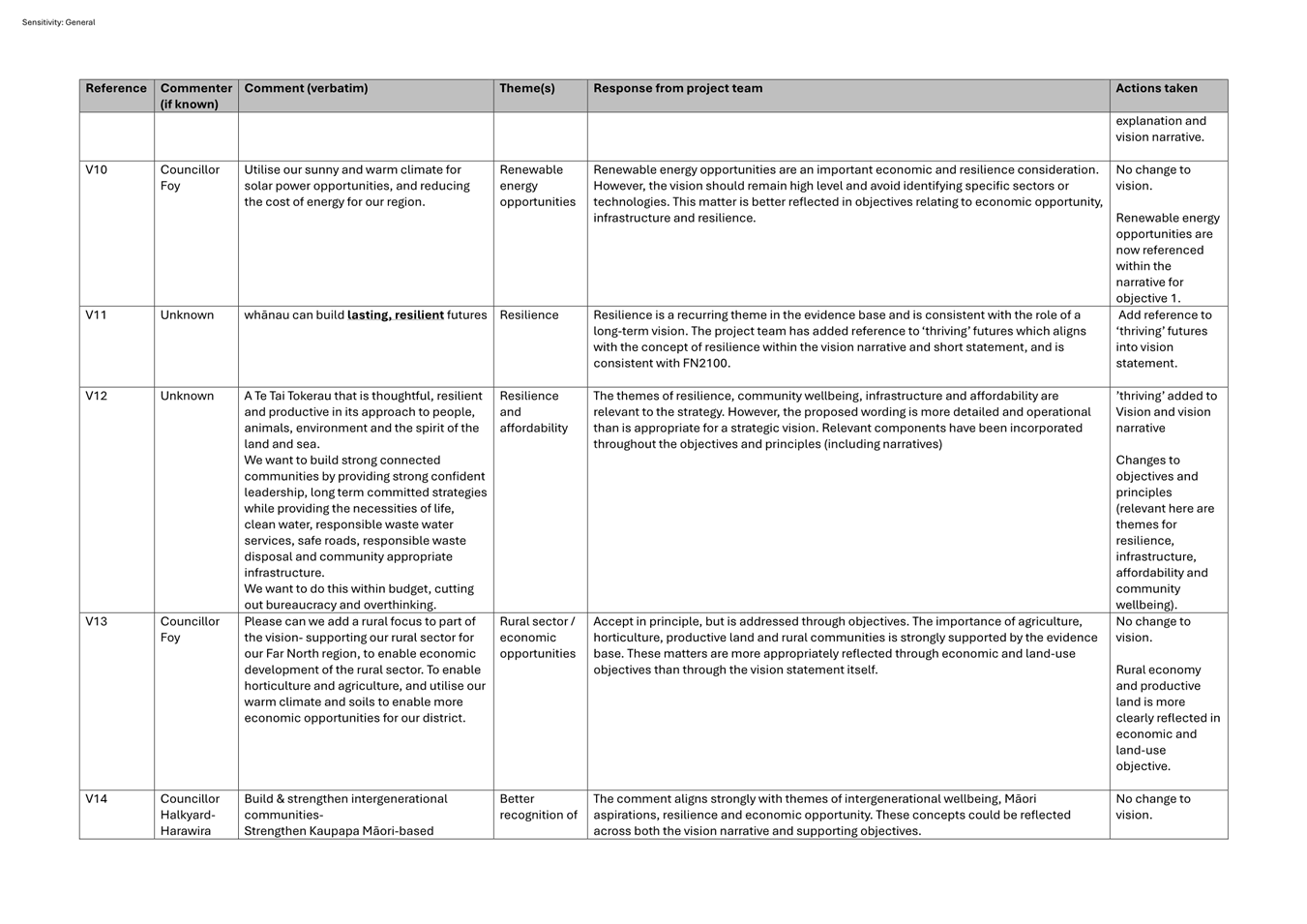
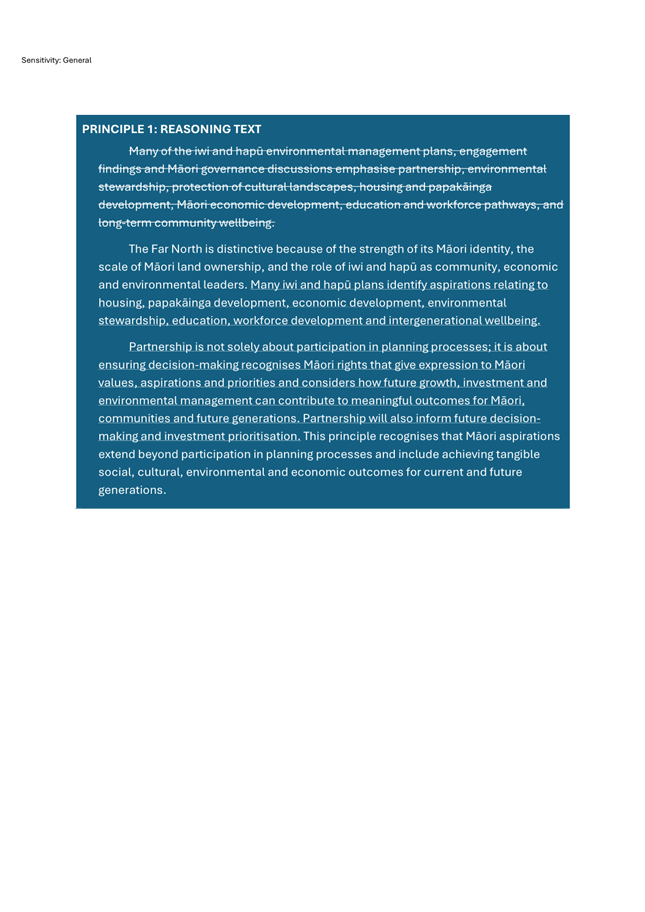
· Stronger
recognition of He Whakaputanga, Te Tiriti o Waitangi, tangata whenua
aspirations and Māori partnerships;
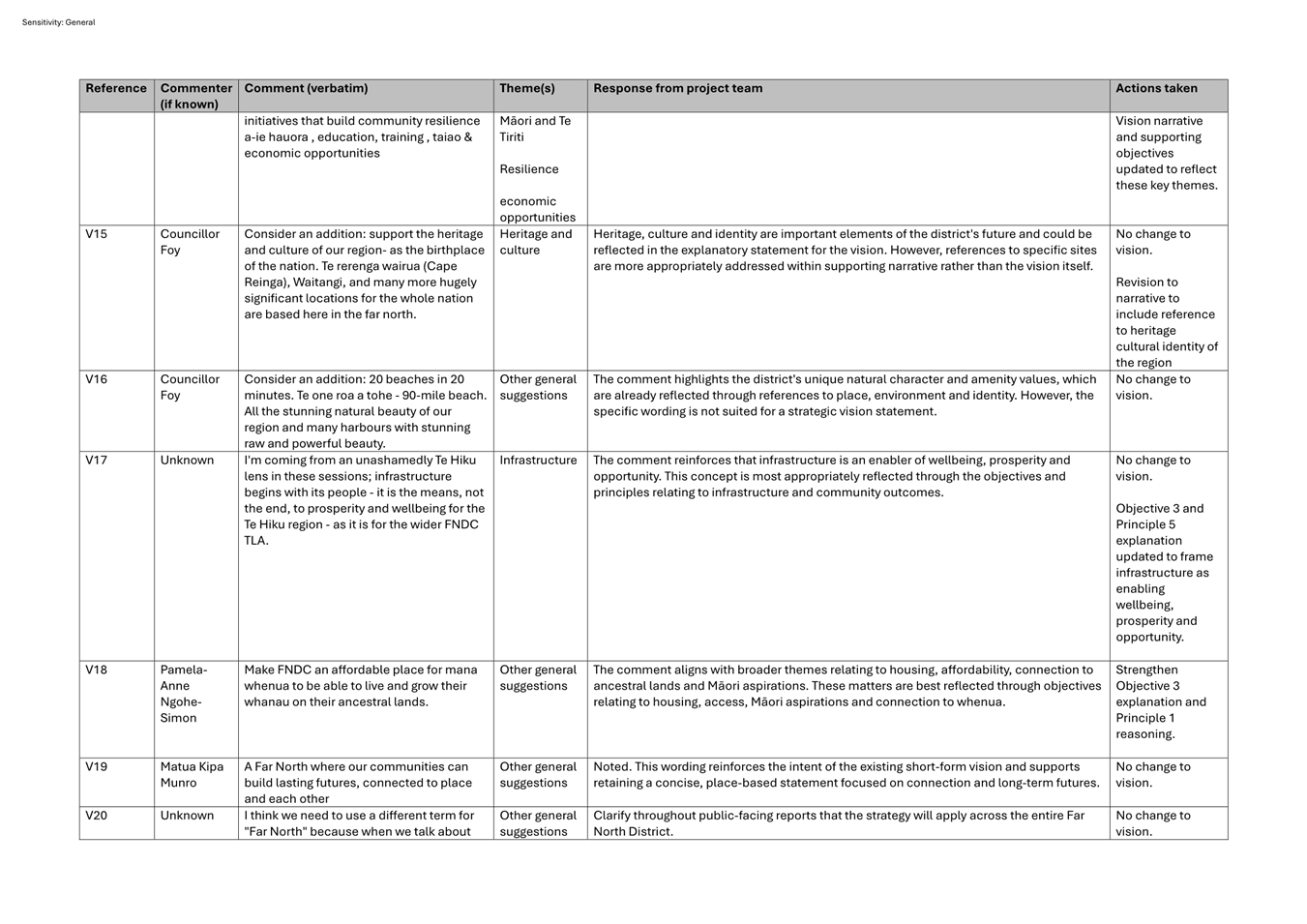
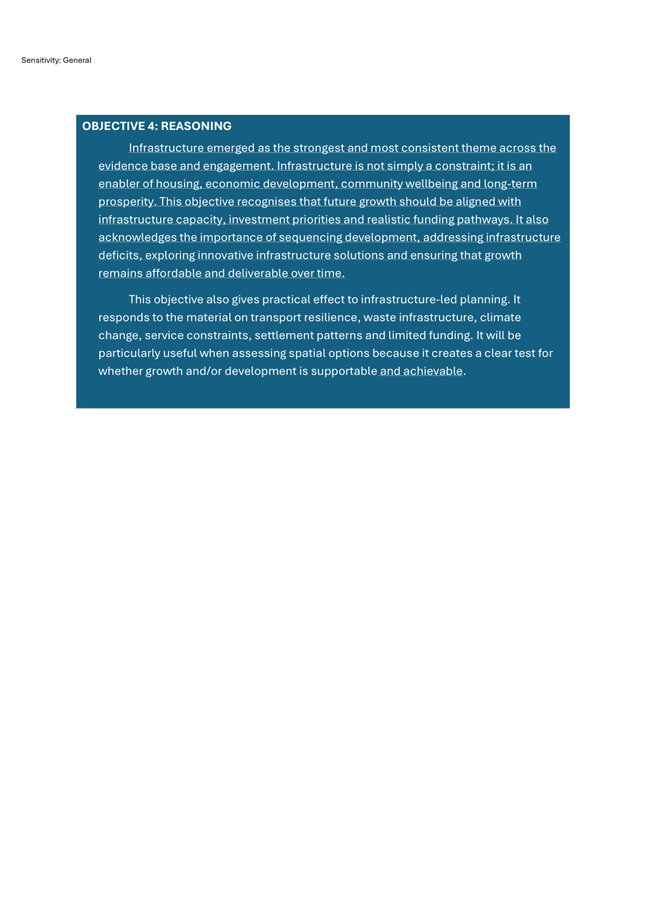
· Greater emphasis
on infrastructure as an enabler of housing, economic development, community
wellbeing and resilience;
· Stronger
recognition of affordability, financial sustainability and infrastructure
deliverability;
· Improved
recognition of rural communities, productive land, primary industries and
renewable energy opportunities; and
· Enhanced
references to climate adaptation, resilience and long-term decision-making
under uncertainty.
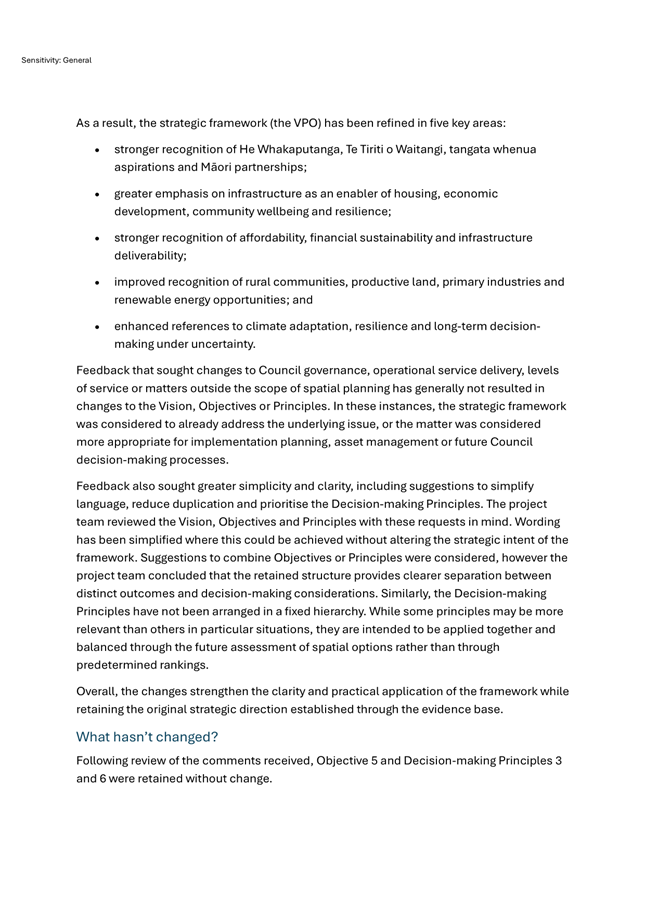
The DWSS project team then reviewed all suggestions and
amended the VPO to reflect workshop input. The revised draft VPO was presented
at a virtual hui on 28 August 2026. Participation at this hui was limited due
to competing priorities, however, a virtual whiteboard space was kept open to
receive workshop invitee comments until 31 August. The participants who
attended supported the updated VPO, with no objectives raised. For the
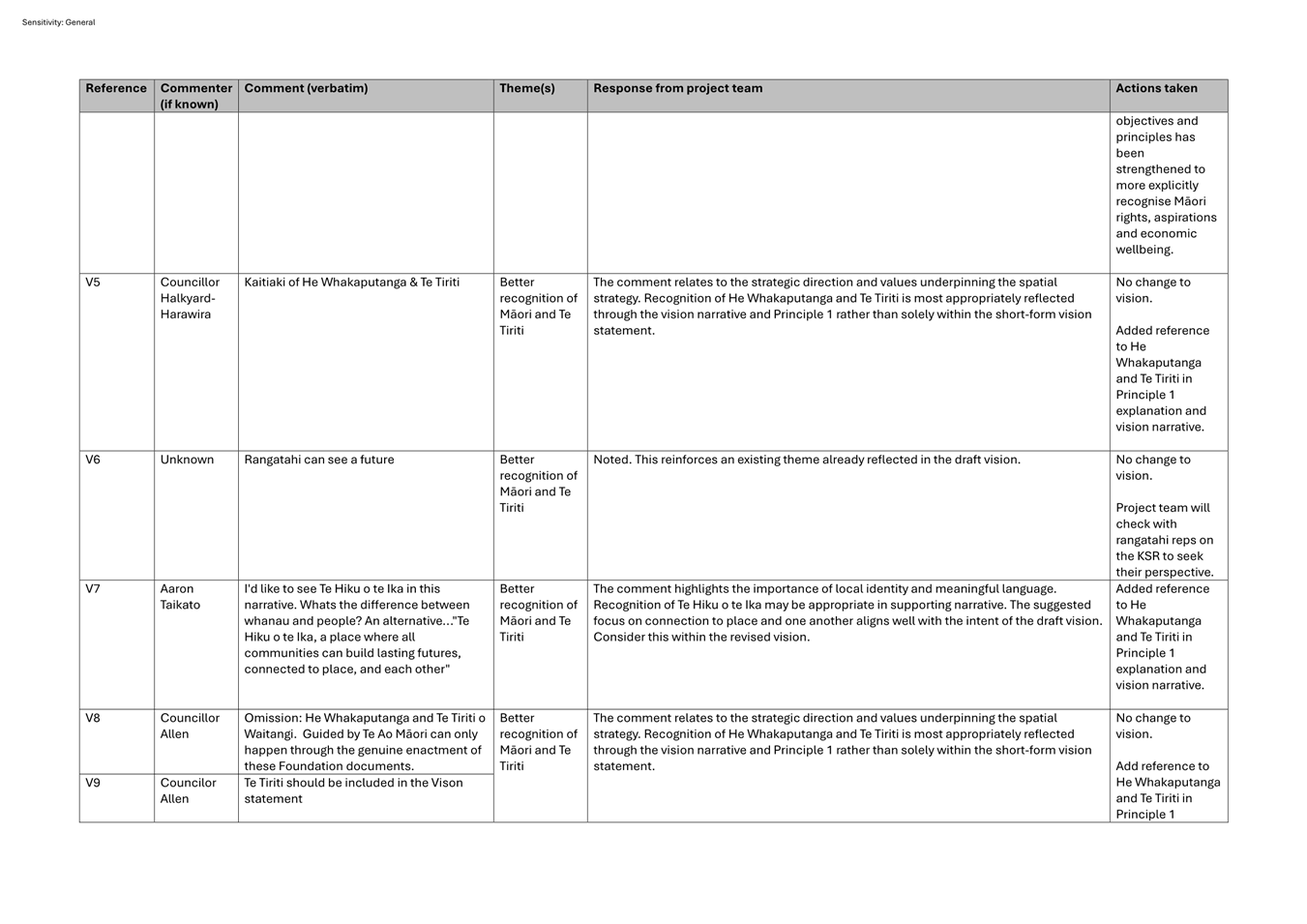
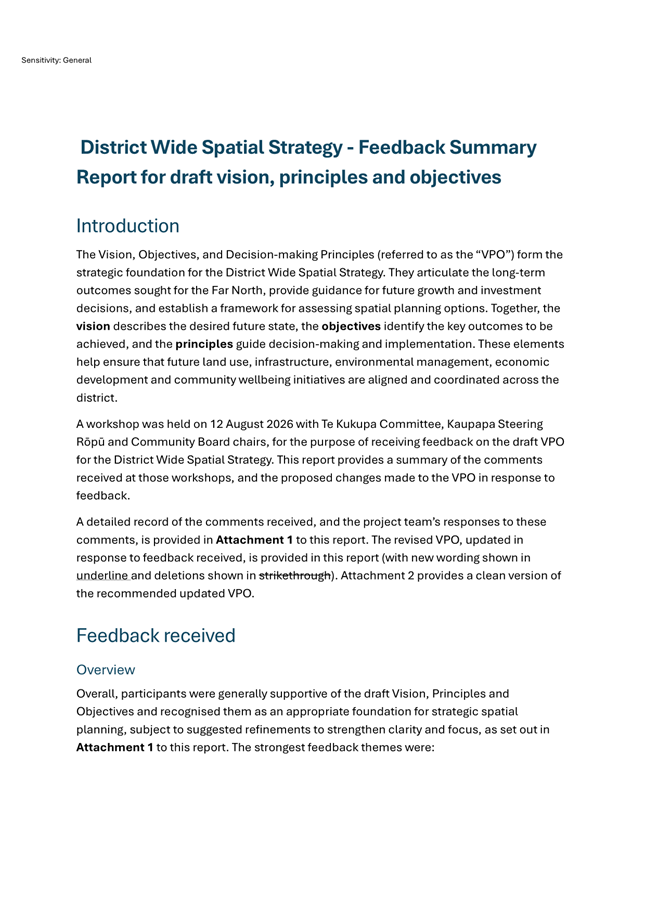
evolution of the draft VPO, see Attachment 4 for the DWSS – Feedback
Summary report for draft vision, principles and objectives, and the reasoning
for each of the objectives and principles. And secondly, stakeholders were
contacted and invited to express their views on the revised draft VPO.
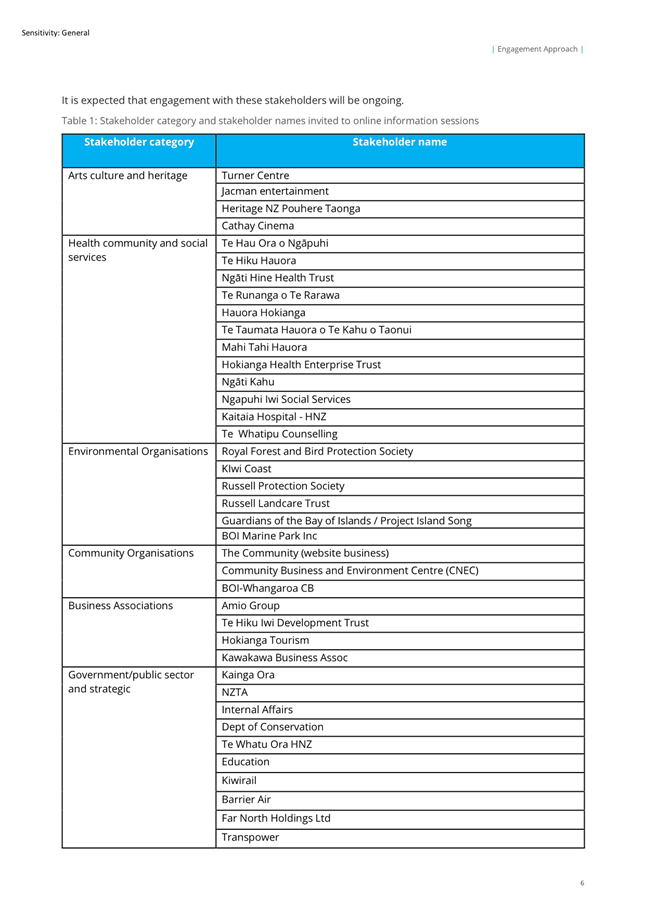
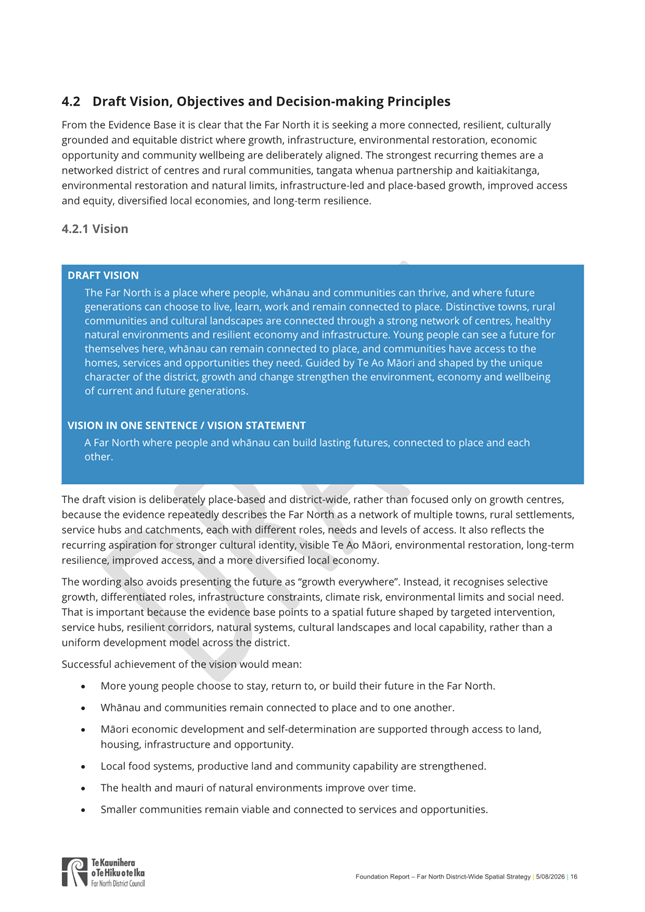
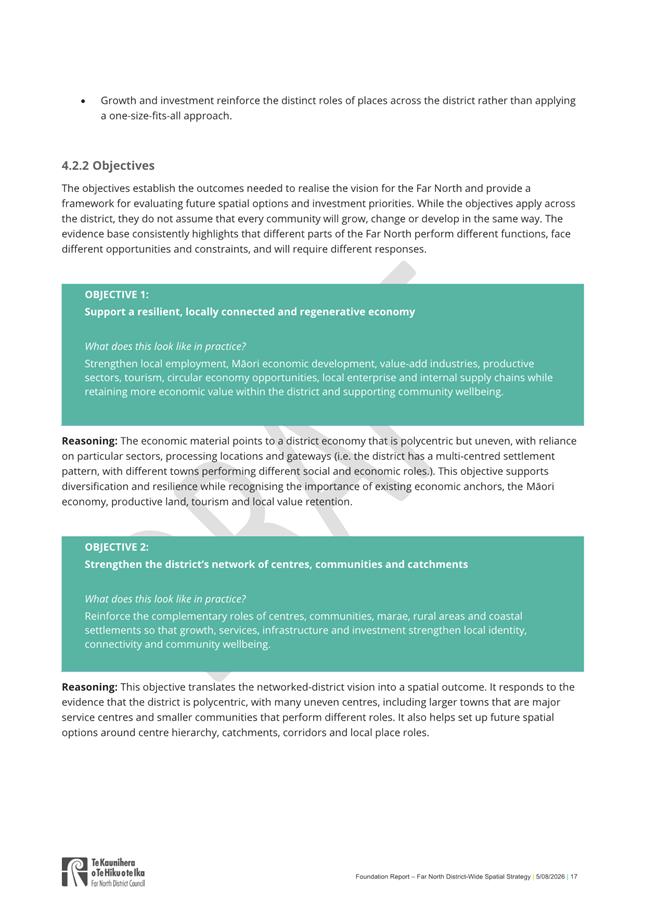
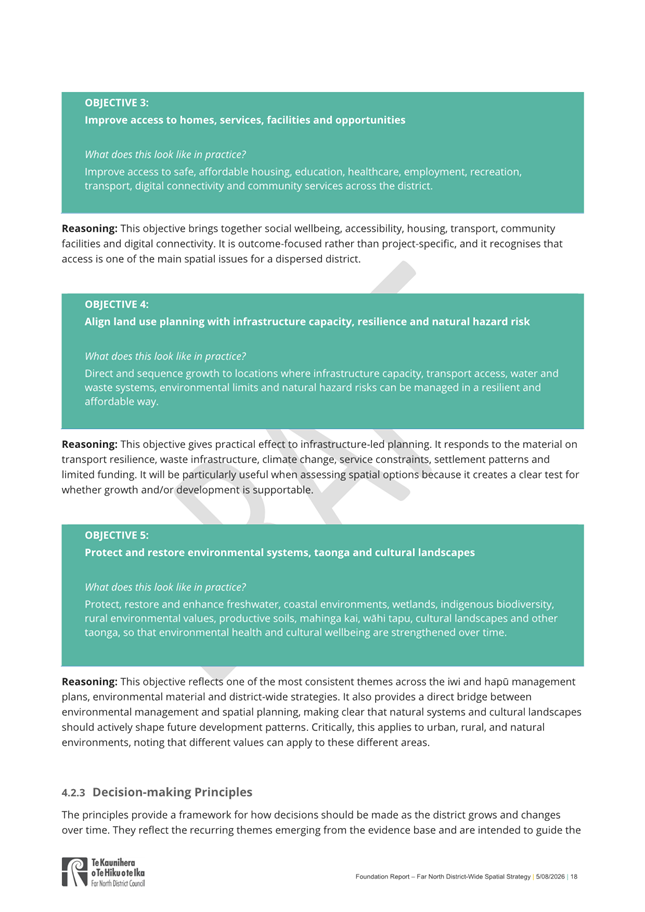
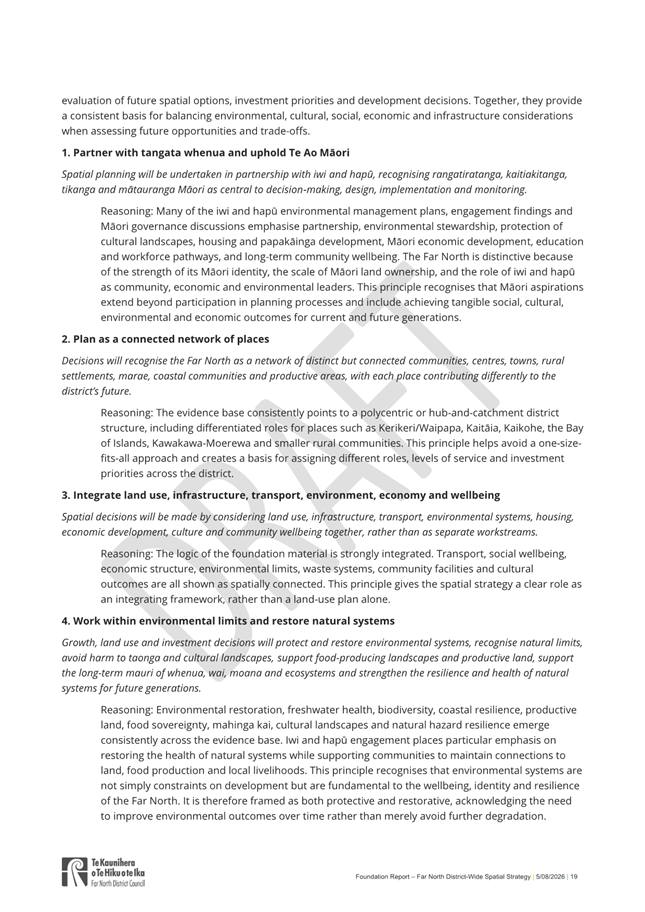
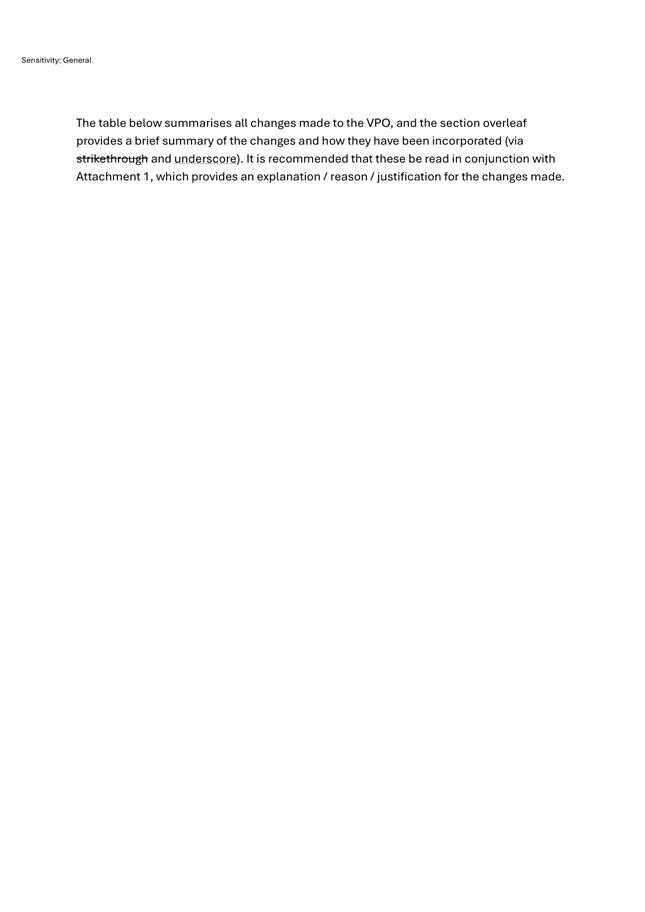
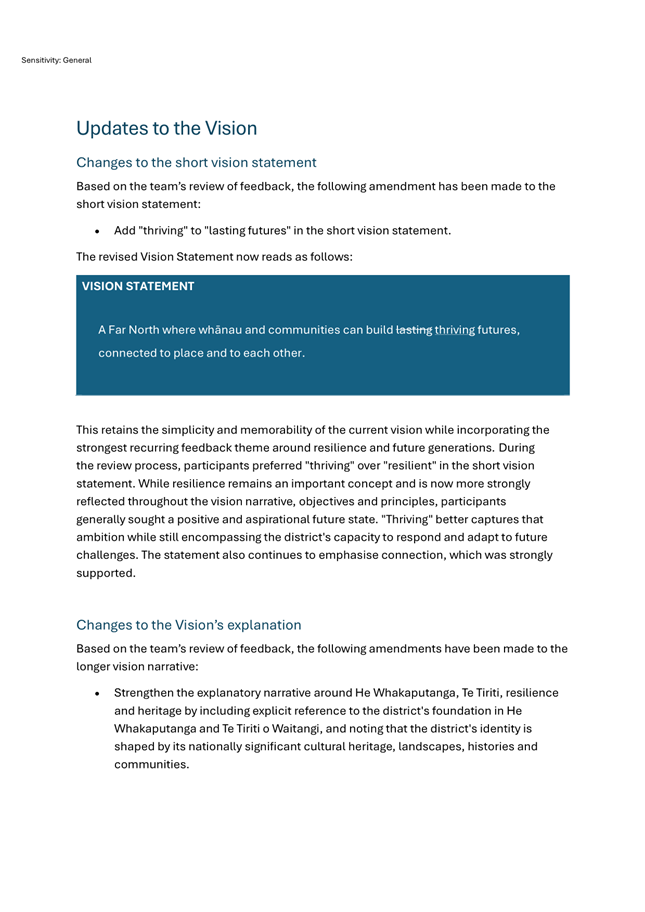
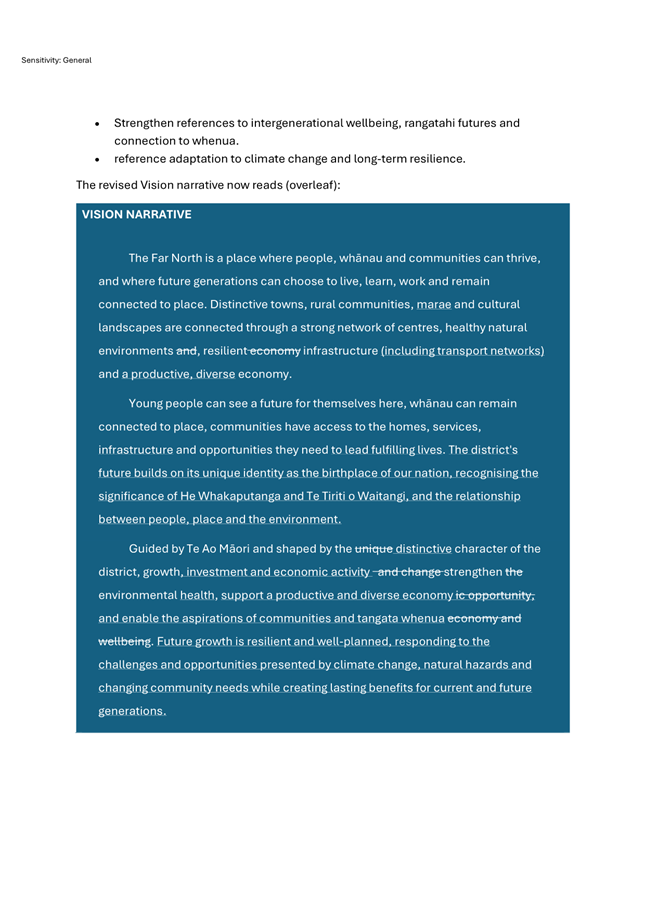
The final draft of the VPO:
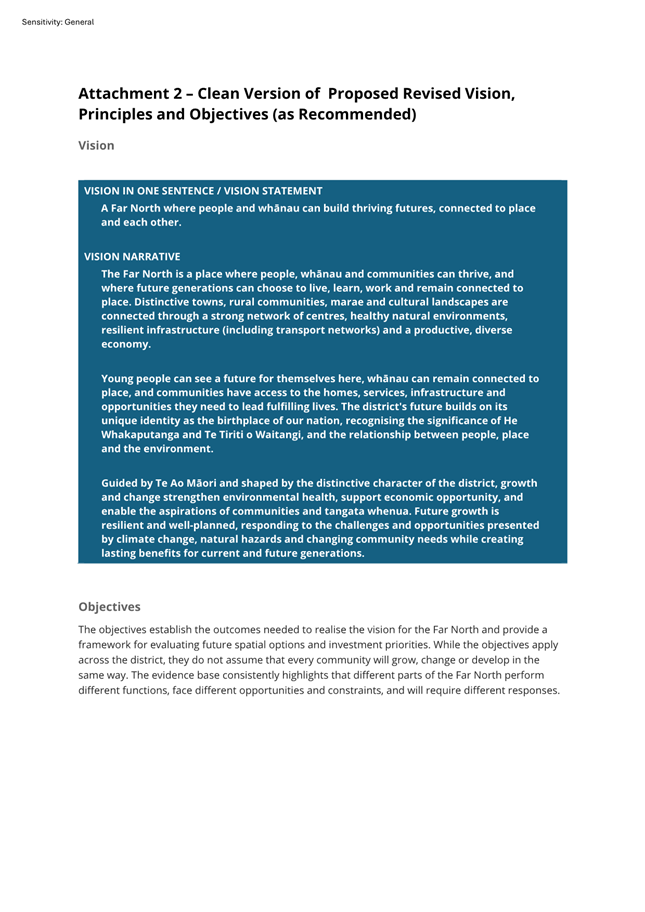
Vision statement: A Far
North where people and whānau can build thriving futures, connected to
place and each other.
Vision narrative: The Far
North is a place where people, whānau and communities can thrive, and
where future generations can choose to live, learn, work and remain connected
to place. Distinctive towns, rural communities, marae and cultural landscapes
are connected through a strong network of centres, healthy natural
environments, resilient infrastructure (including transport networks) and a
productive, diverse economy. Young people can see a future for themselves here,
whānau can remain connected to place, and communities have access to the
homes, services, infrastructure and opportunities they need to lead fulfilling
lives. The district's future builds on its unique identity as the birthplace of
our nation, recognising the significance of He Whakaputanga and Te Tiriti o
Waitangi, and the relationship between people, place and the environment.
Guided by Te Ao Māori and shaped by the distinctive character of the
district, growth and change strengthen environmental health, support economic
opportunity, and enable the aspirations of communities and tangata whenua.
Future growth is resilient and well-planned, responding to the challenges and
opportunities presented by climate change, natural hazards and changing
community needs while creating lasting benefits for current and future
generations.
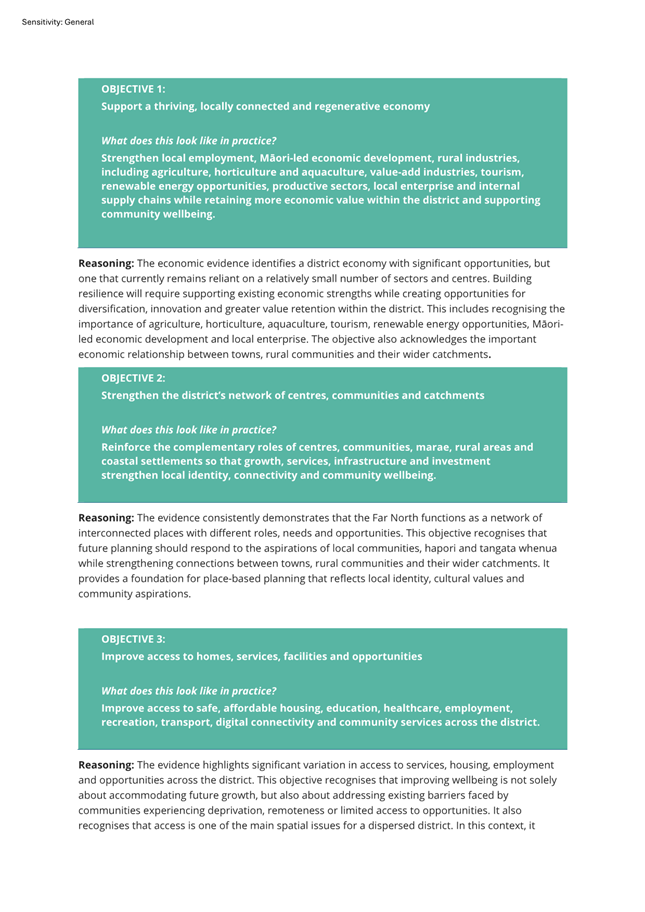
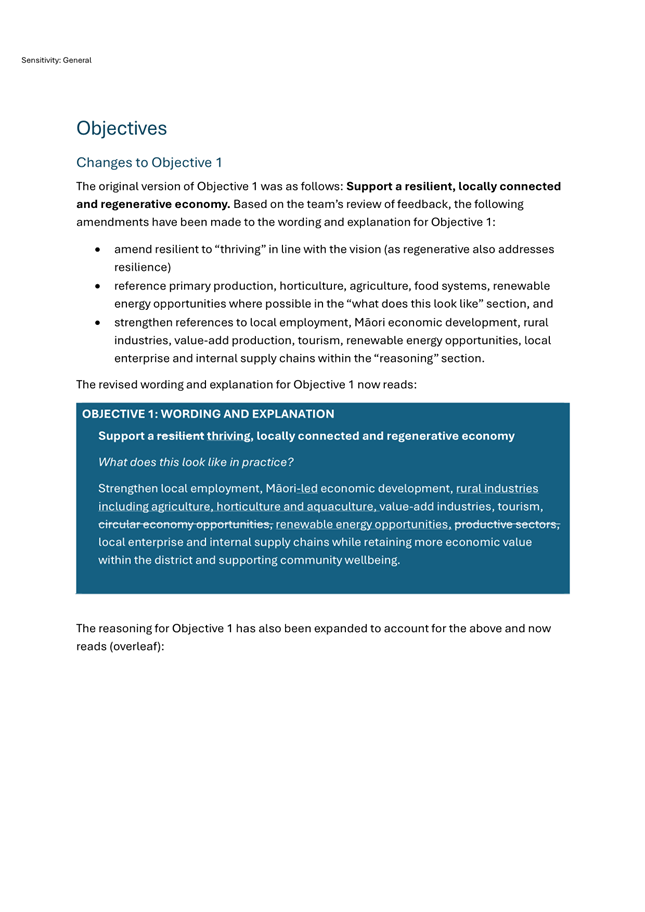
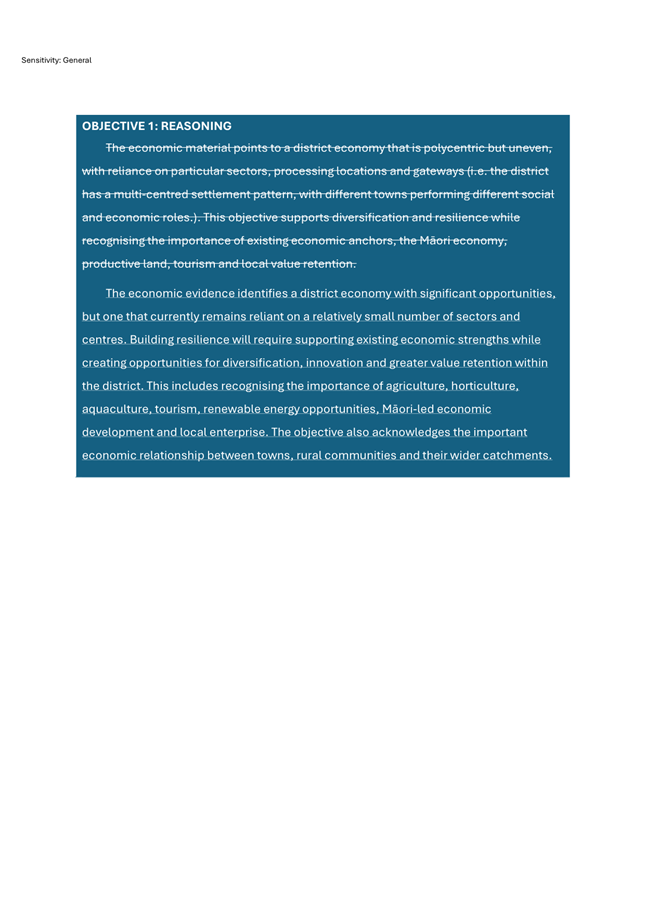
Objective
1: Support a thriving, locally connected and regenerative economy
What does this look like in
practice? Strengthen local employment, Māori-led economic development,
rural industries, including agriculture, horticulture and aquaculture,
value-add industries, tourism, renewable energy opportunities, productive
sectors, local enterprise and internal supply chains while retaining more
economic value within the district and supporting community wellbeing.
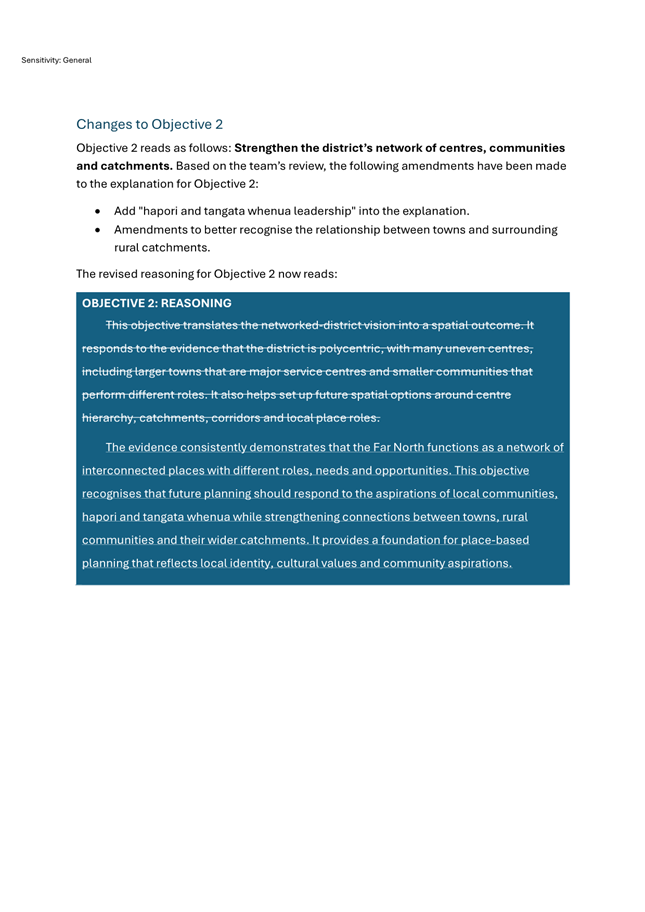
Objective 2: Strengthen the district’s
network of centres, communities and catchments
What does this look like in
practice? Reinforce the complementary roles of centres, communities, marae,
rural areas and coastal settlements so that growth, services, infrastructure
and investment strengthen local identity, connectivity and community wellbeing.
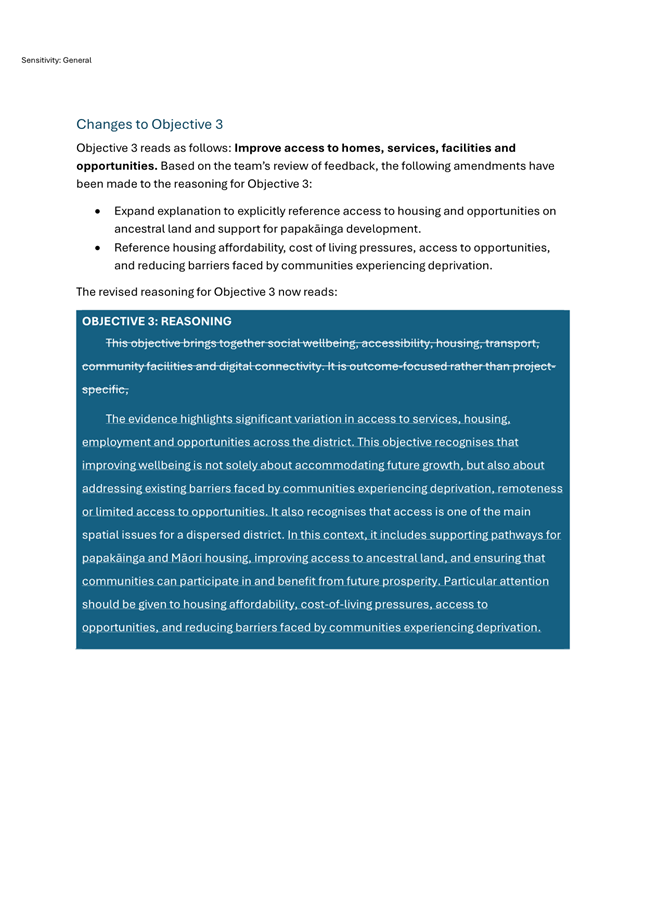
Objective 3: Improve access to homes, services,
facilities and opportunities
What does this look like in
practice? Improve access to safe, affordable housing, education,
healthcare, employment, recreation, transport, digital connectivity and
community services across the district.
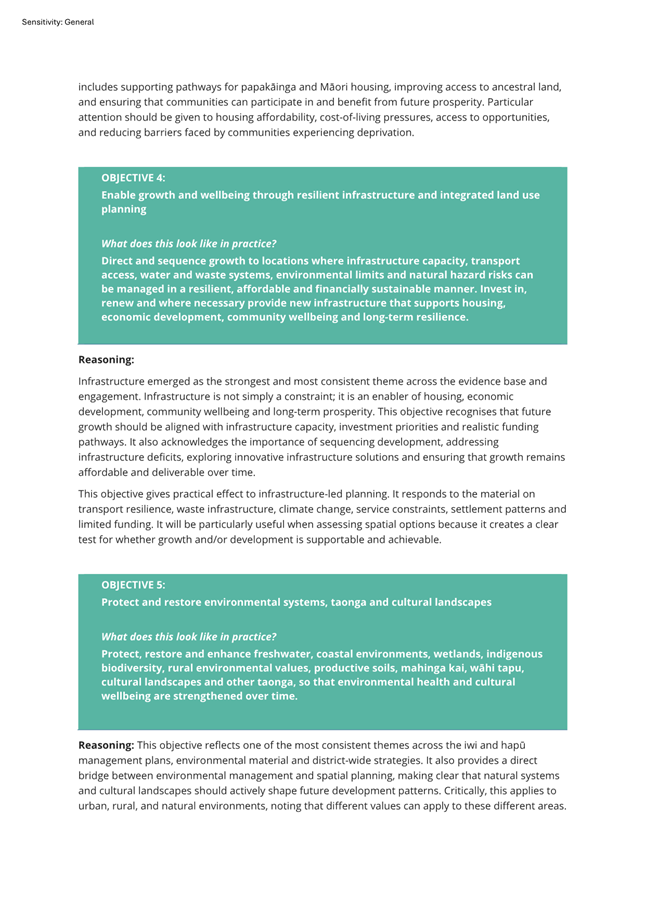
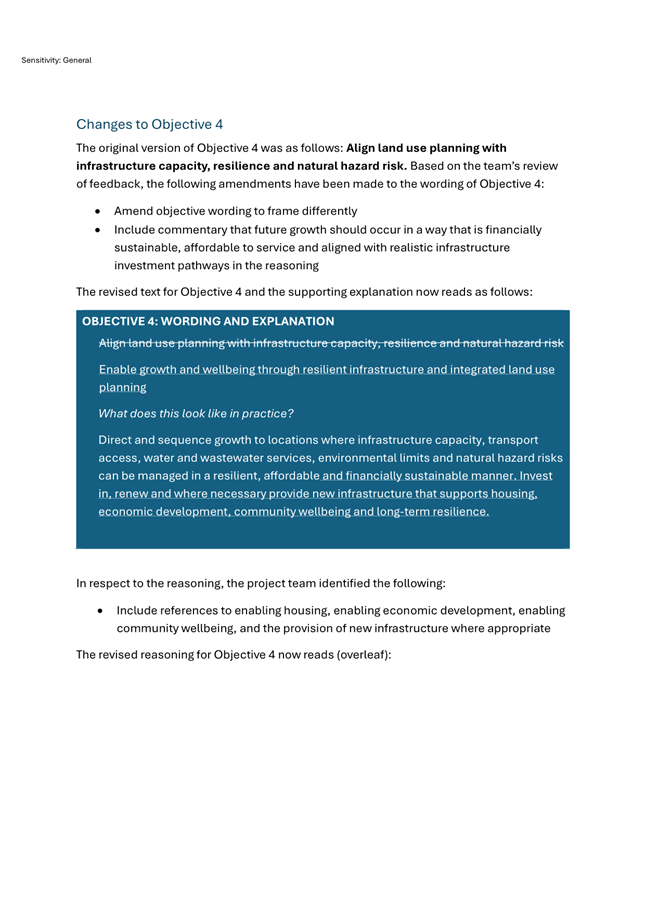
Objective 4: Enable growth and wellbeing
through resilient infrastructure and integrated land use planning
What does this look like in
practice? Direct and sequence growth to locations where infrastructure
capacity, transport access, water and waste systems, environmental limits and
natural hazard risks can be managed in a resilient, affordable and financially
sustainable manner. Invest in, renew and where necessary provide new
infrastructure that supports housing, economic development, community wellbeing
and long-term resilience.
Objective 5: Protect and restore environmental
systems, taonga and cultural landscapes
What does this look like in
practice? Protect, restore and enhance freshwater, coastal environments,
wetlands, indigenous biodiversity, rural environmental values, productive
soils, mahinga kai, wāhi tapu, cultural landscapes and other taonga, so
that environmental health and cultural wellbeing are strengthened over time.
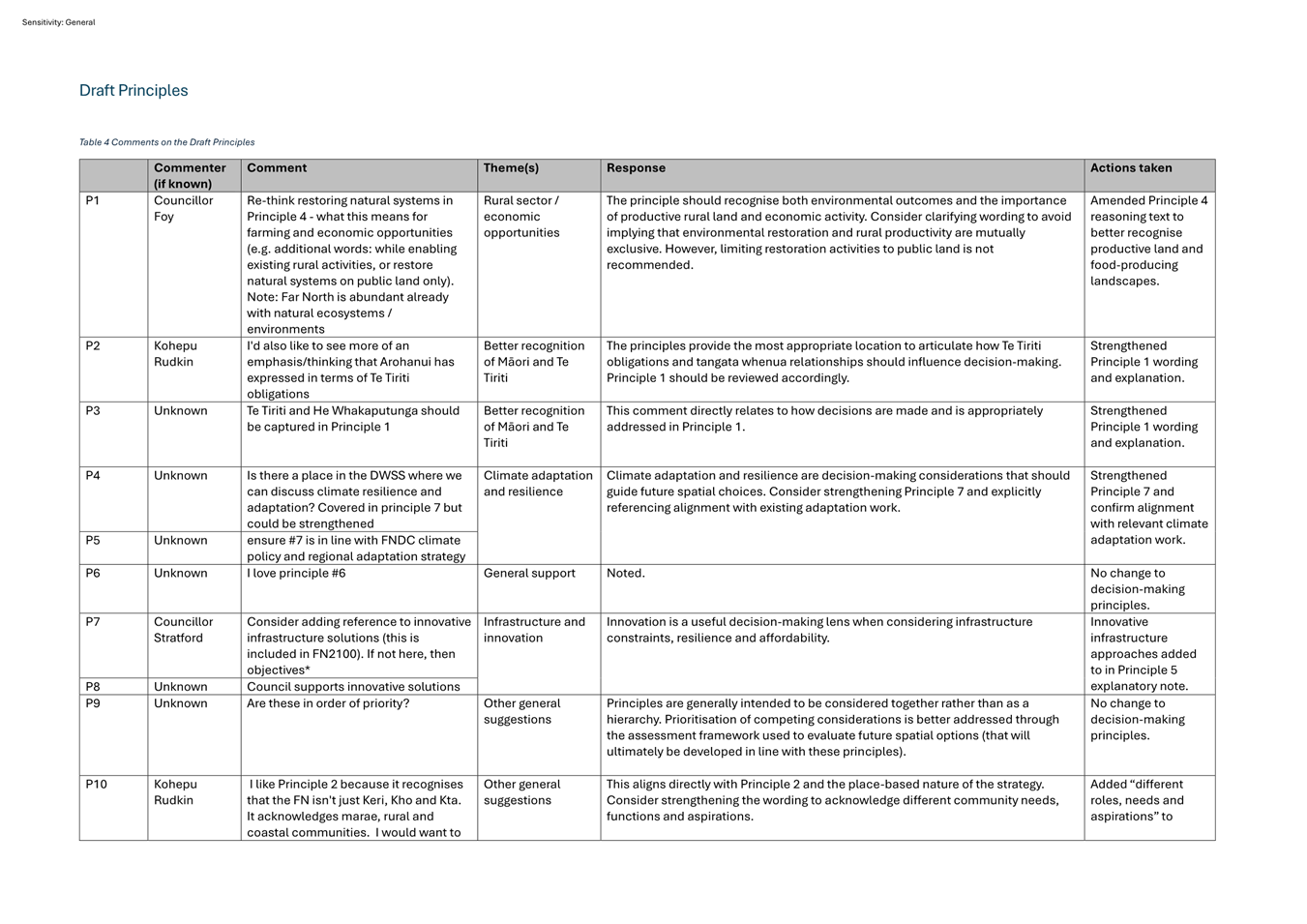
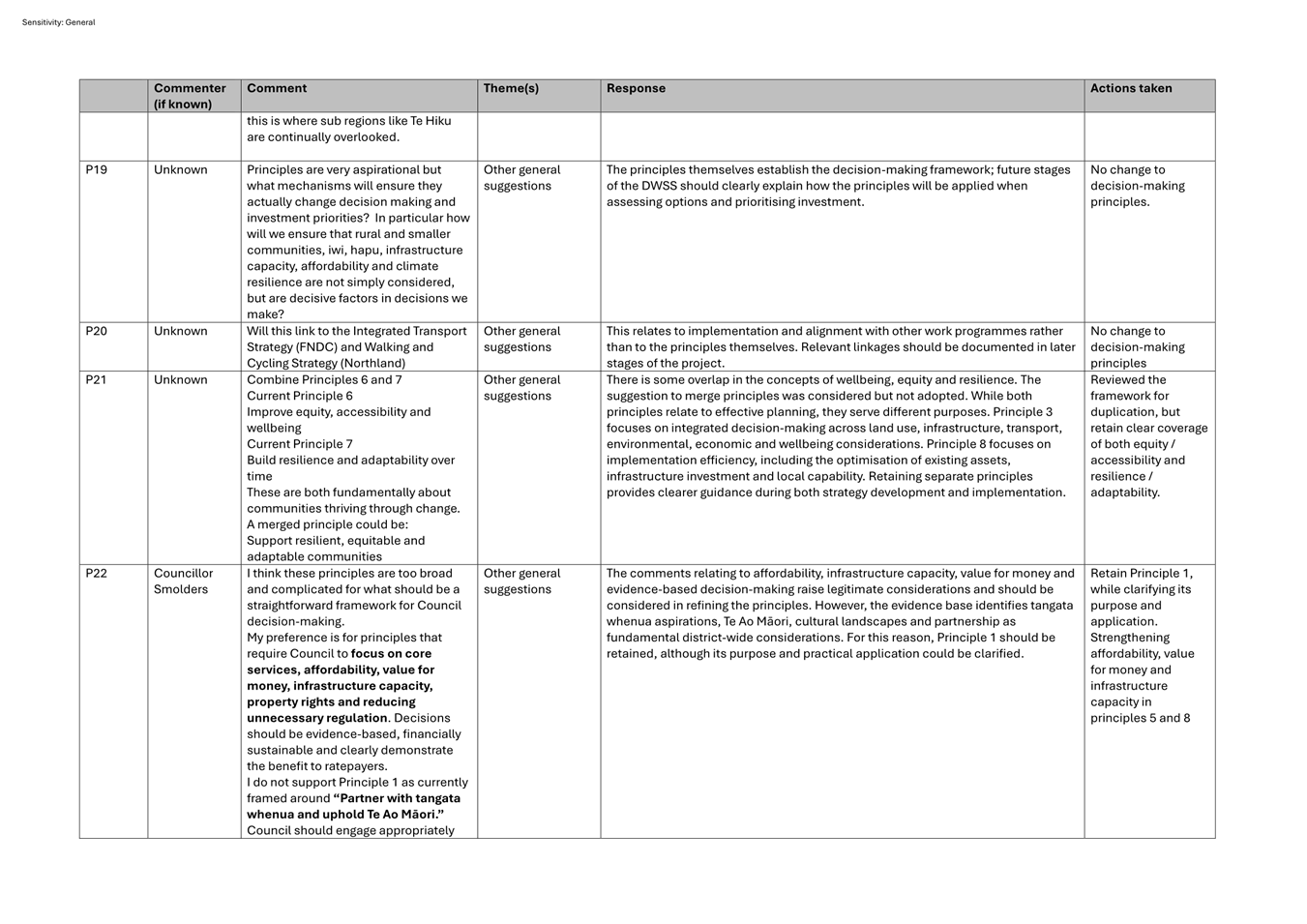
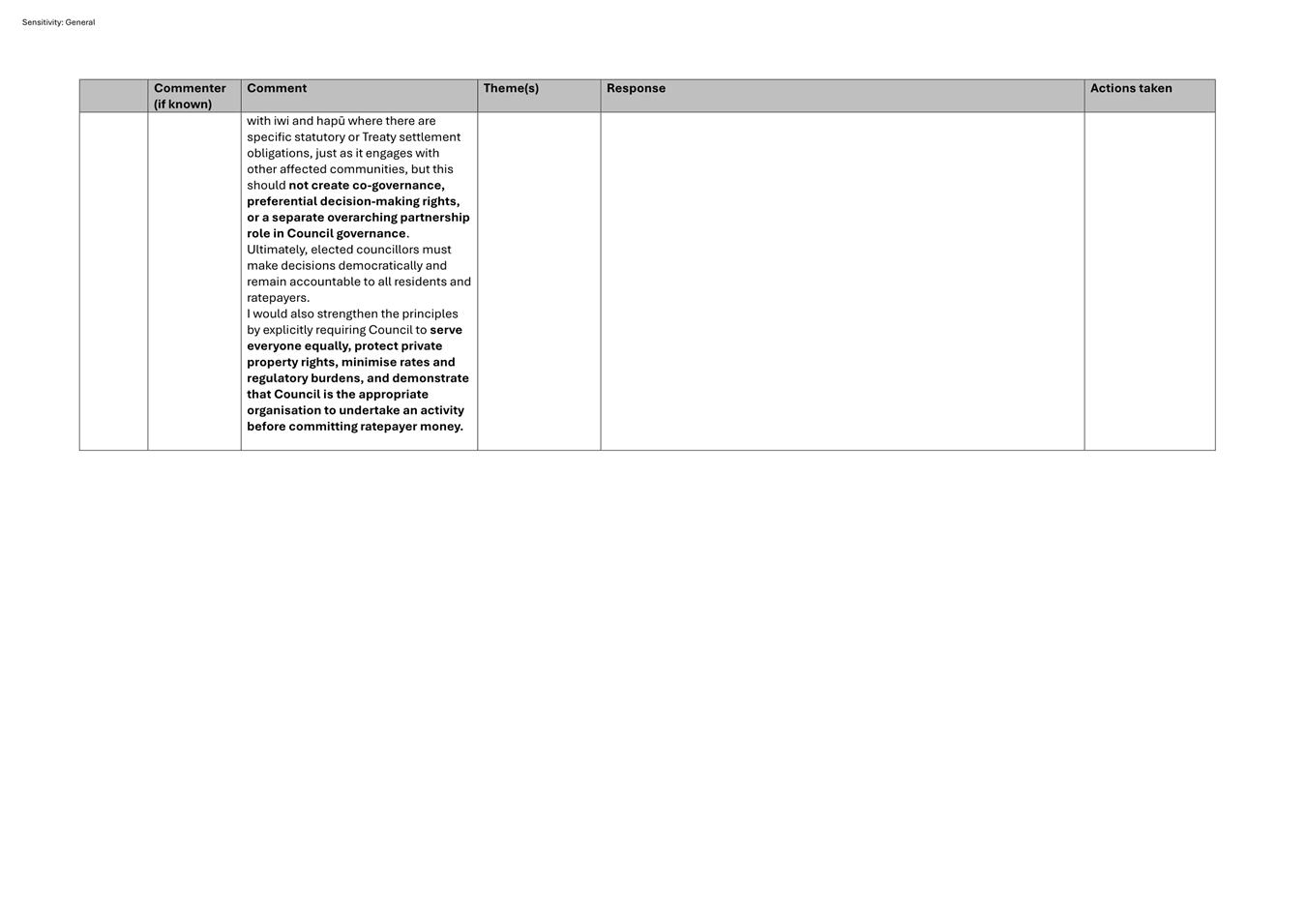
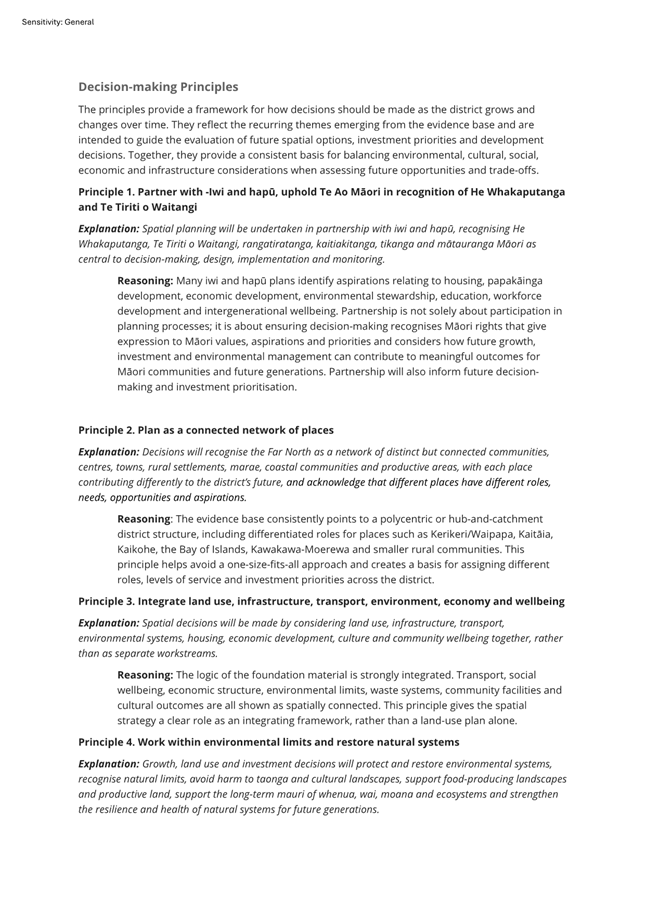
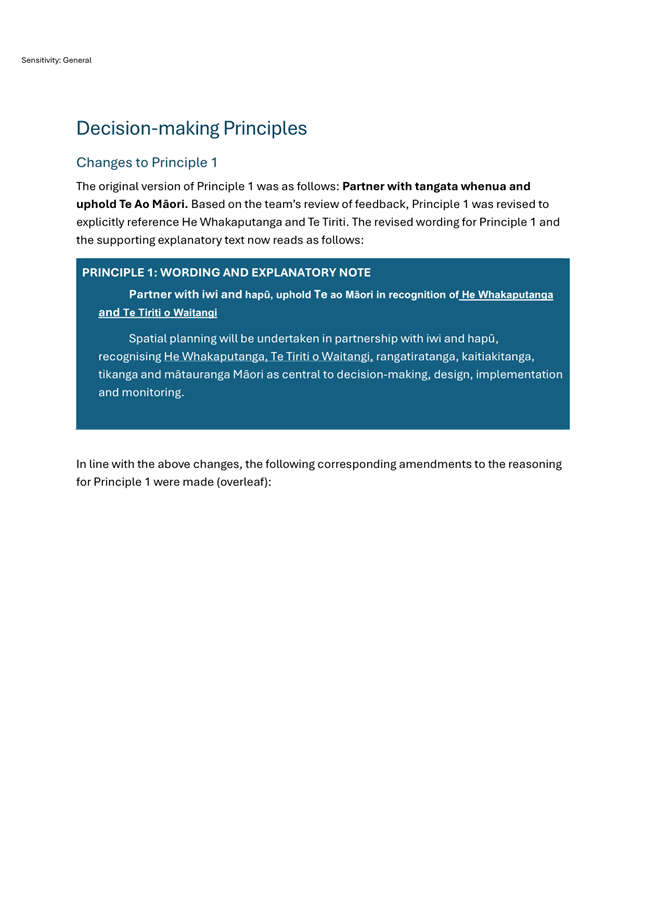
Principle 1: Partner with -Iwi and Hapū,
uphold Te Ao Māori in recognition of He Whakaputanga and Te Tiriti o
Waitangi
Explanation: Spatial
planning will be undertaken in partnership with Iwi and Hapū, recognising
He Whakaputanga, Te Tiriti o Waitangi, rangatiratanga, kaitiakitanga, tikanga
and mātauranga Māori as central to decision-making, design,
implementation and monitoring.
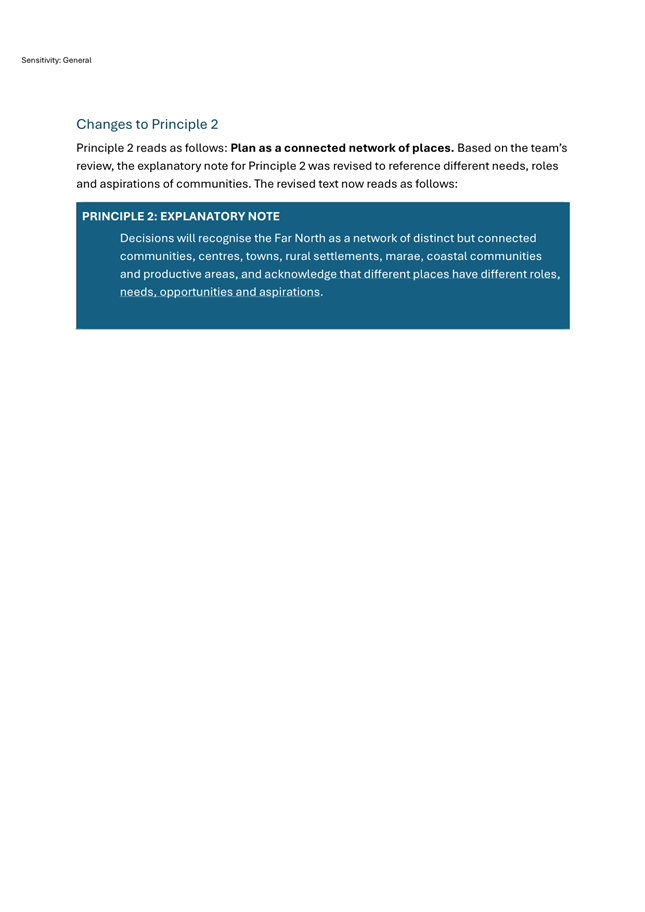
Principle 2: Plan as a connected network of
places
Explanation: Decisions will
recognise the Far North as a network of distinct but connected communities,
centres, towns, rural settlements, marae, coastal communities and productive
areas, with each place contributing differently to the district’s future,
and acknowledge that different places have different roles, needs,
opportunities and aspirations.
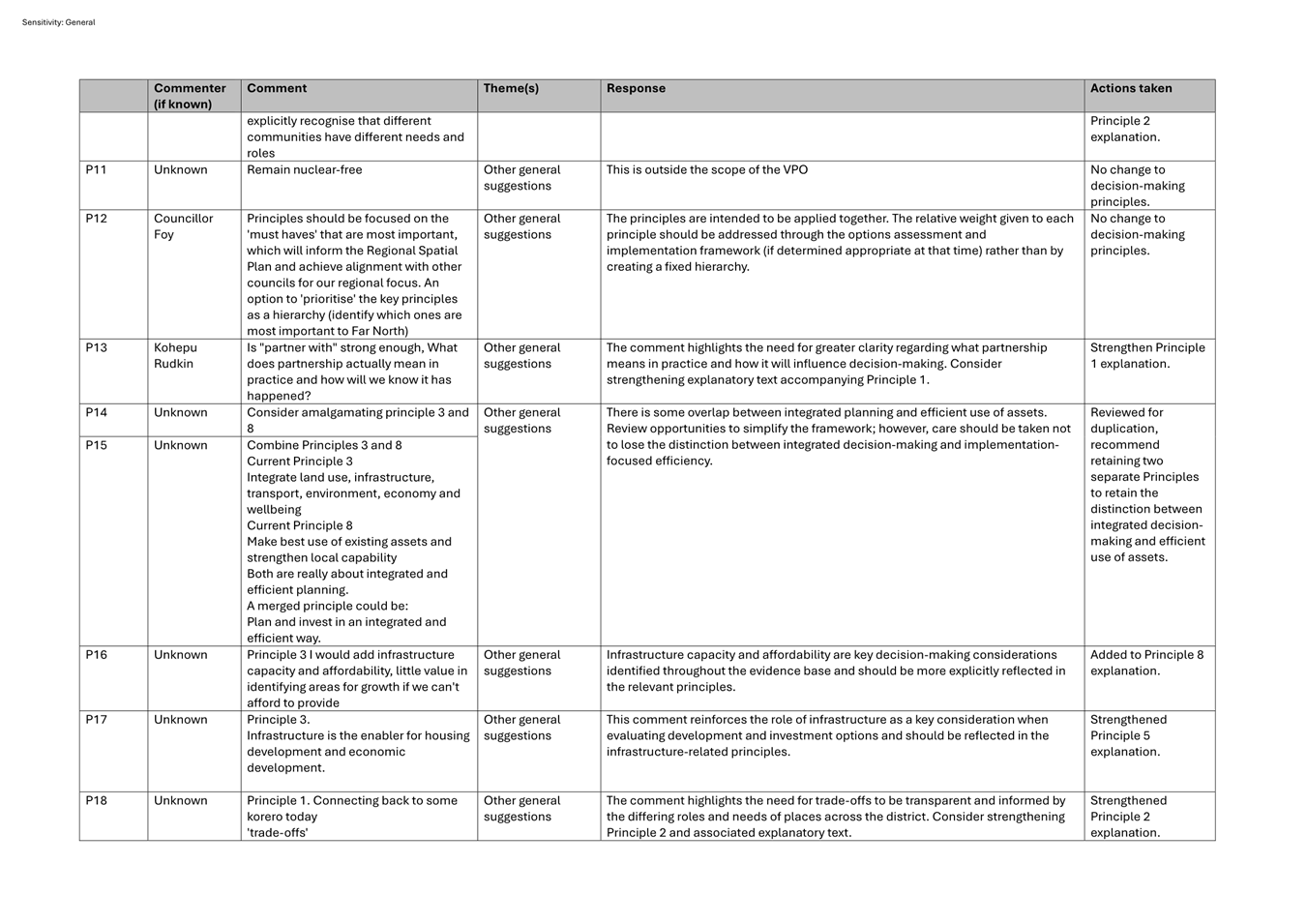
Principle 3: Integrate land use,
infrastructure, transport, environment, economy and wellbeing
Explanation: Spatial
decisions will be made by considering land use, infrastructure, transport,
environmental systems, housing, economic development, culture and community
wellbeing together, rather than as separate workstreams.
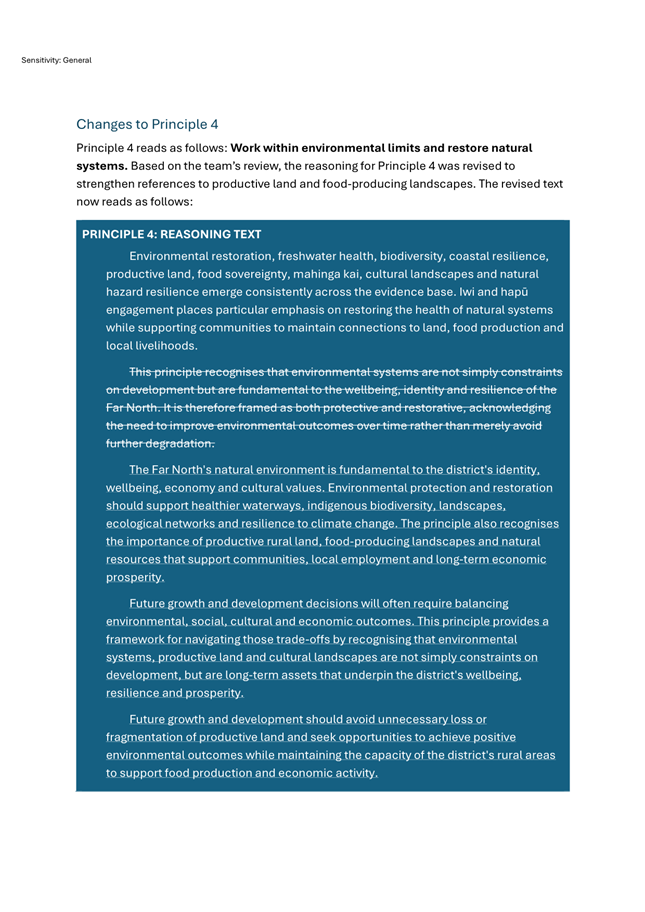
Principle 4: Work within environmental limits
and restore natural systems
Explanation: Growth, land
use and investment decisions will protect and restore environmental systems,
recognise natural limits, avoid harm to taonga and cultural landscapes, support
food-producing landscapes and productive land, support the long-term mauri of
whenua, wai, moana and ecosystems and strengthen the resilience and health of
natural systems for future generations.
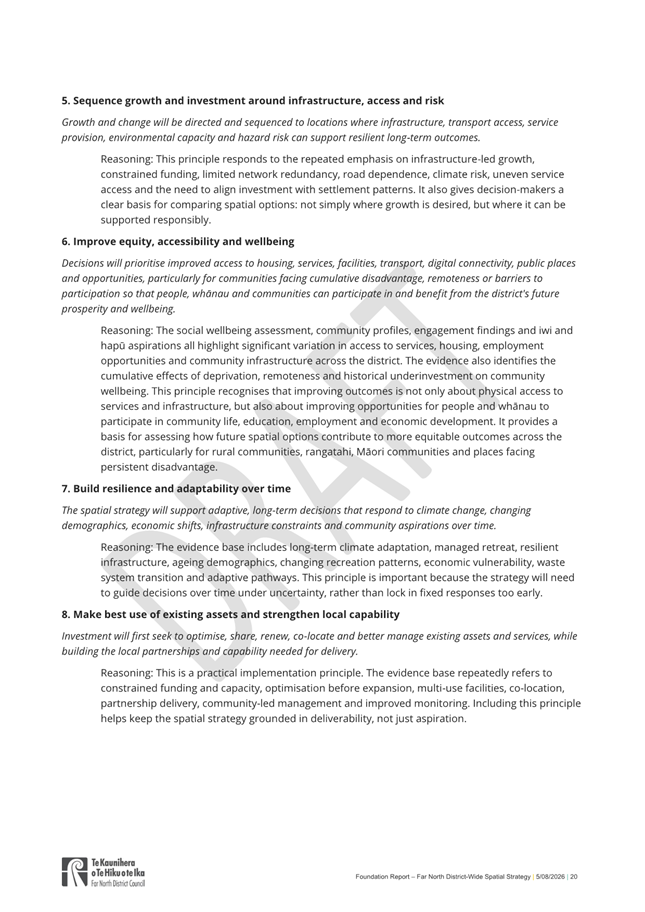
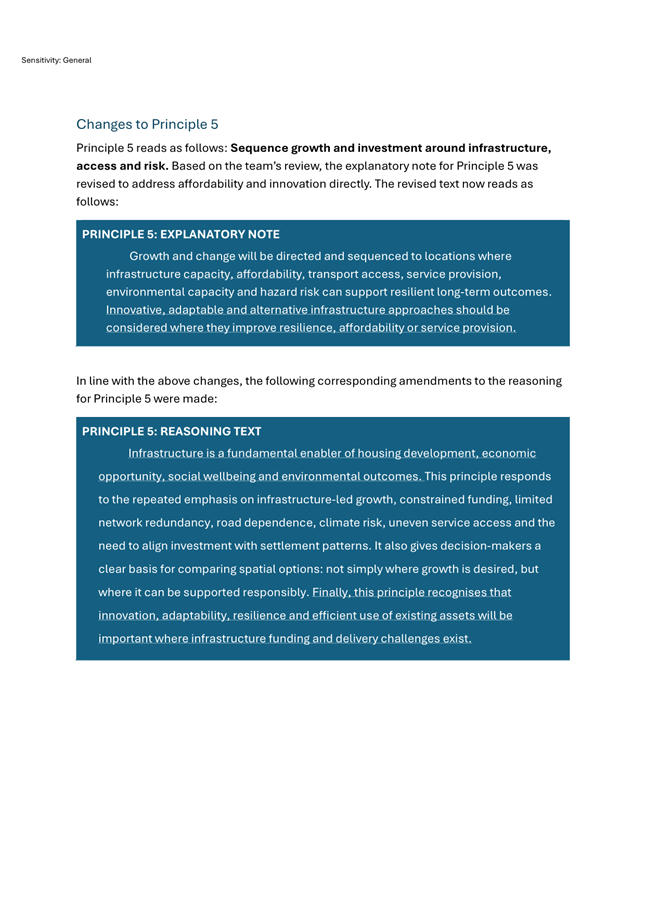
Principle 5: Sequence growth and investment
around infrastructure, access and risk
Explanation: Growth and
change will be directed and sequenced to locations where infrastructure
capacity, affordability, transport access, service provision, environmental
capacity and hazard risk can support resilient long-term outcomes. Innovative,
adaptable and alternative infrastructure approaches should be considered where
they improve resilience, affordability or service provision.
Principle 6: Improve equity, accessibility and
wellbeing
Explanation: Decisions will
prioritise improved access to housing, services, facilities, transport, digital
connectivity, public places and opportunities, particularly for communities
facing cumulative disadvantage, remoteness or barriers to participation so that
people, whānau and communities can participate in and benefit from the
district's future prosperity and wellbeing.
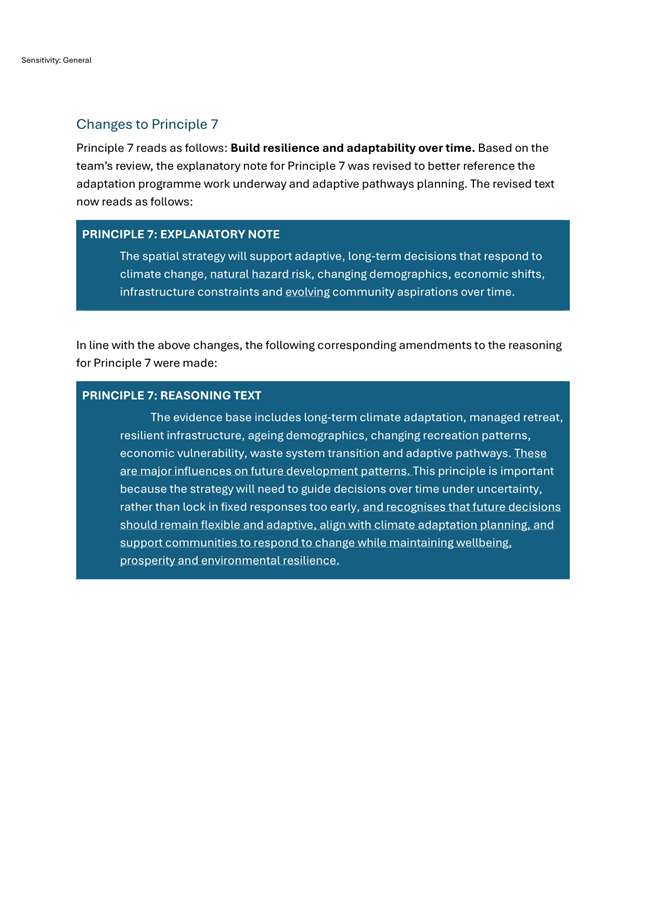
Principle 7: Build resilience and adaptability
over time
Explanation: The spatial
strategy will support adaptive, long-term decisions that respond to climate
change, natural hazard risk, changing demographics, economic shifts,
infrastructure constraints and evolving community aspirations over time.
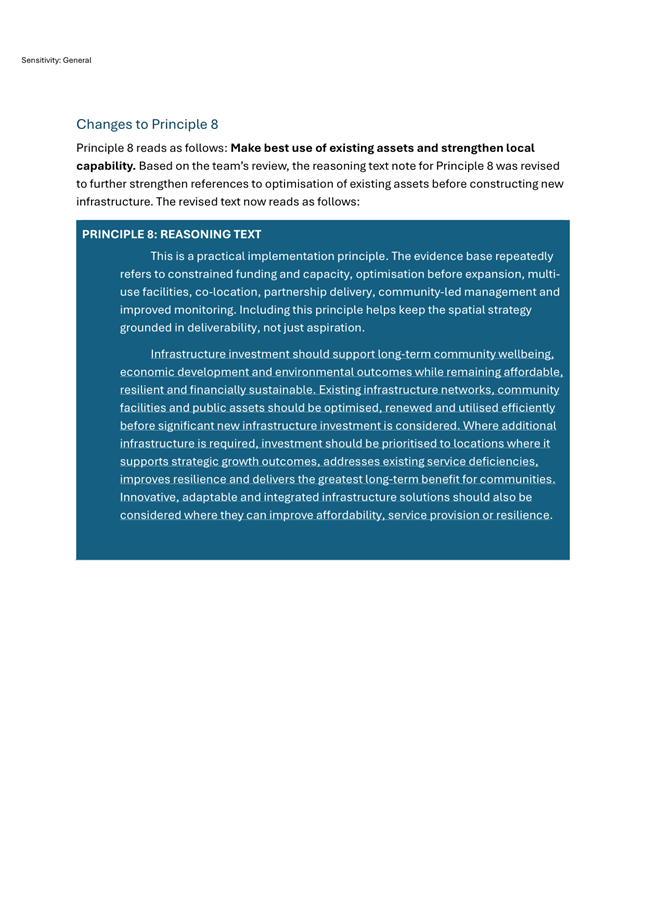
Principle 8: Investment will first seek to
optimise, share, renew, co-locate and better manage existing assets and
services, while building the local partnerships and capability needed for
delivery.
Explanation: Investment
will first seek to optimise, share, renew, co-locate and better manage existing
assets and services, while building the local partnerships and capability
needed for delivery.
Next steps
The VPO will be presented to Te Kūkupa (7 October 2026)
for endorsement. This report will consider any perspectives raised at the
Te Kuaka committee meeting. Once the VPO is finalised the DWSS project
team is to develop spatial options that will be refined through workshops with
the KSR, Elected members, Iwi and stakeholders. The proposed approach is a
focus on ‘no regrets’ actions to inform regional spatial
planning.
Part two: Kaupapa Steering Rōpū (KSR) Update
This update, produced by FNDC kaimahi on behalf of the KSR,
provides Te Kuaka with an update on the progress of the reconvened KSR. The
content includes an update on work completed and current risks, challenges and
opportunities. This first update presents a partial view of KSR perspectives,
and it is envisaged that KSR members will share comment orally during the Te
Kuaka hui. Additionally, FNDC kaimahi will continue to attempt to connect with
members kanohi ki te kanohi to hear all perspectives on the current situation
and recommendations for kaimahi to better tautoko the rōpū.
a) Work
completed
· Reconvening the
KSR
Upon Te Kuaka’s decision, Te Hono and Integrated
Planning kaimahi have initiated the appointment of members for the KSR and a
review of the updated ToR to confirm finalisation. Meetings between the KSR and
FNDC kaimahi occurred between June and August.
The current members include:
- Kipa
Munro
- Pamela-Anne
Ngohe-Simon (resignation received on 8 September – has recommended an
alternative Hapū member. Replacement to be confirmed).
- Tui
Te Paa
- Dallas
King
- Tuhoronuku
Smith (Rangatahi representative)
- Hineteaio
Chapman (Rangatahi representative).
Additional appointments to the rōpū will be
considered in conversation with existing members, and upon Te Kuaka’s
direction, to identify any opportunities for enhanced representation.
· Appointment of
Chair
Expressions of interest for the role of Chair were called
for in August. As of 8 September 2026, the KSR Chair has not been confirmed,
however, interest has been expressed by a member.
· Refining the
DWSS VPO
KSR members who were available participated in combined
workshops (08 July, 12 August and 28 August 2026) with Te Kūkupa members
and Community Board Chairs. Key KSR contributions at the workshop included
recommendations that the DWSS project team:
- elaborate
on the position of He Whakaputanga and Te Tiriti within the overarching vision
and narrative as well as the respective principles and objectives;
- employ
the notion of thriving and expressing the importance of healthy and mutually
beneficial relationships between people, place, taonga, water, infrastructure
and service delivery.
- emphasise
the importance of affordability in supporting mana whenua to be able to live
and grow with whanau on ancestral lands;
- expand
the temporality of the vision to align with intergenerational perspectives and
aspirations;
- acknowledge
the function of infrastructure as an enabler for supporting prosperity,
opportunity and wellbeing for whanau; and,
- provide
a te reo Māori version of the VPO to better encourage mana whenua
engagement with the DWSS programme.
The DWSS project team refined the VPO as per the
contributions of KSR members (as well as Te Kūkupa and Community Board
Chairs). The revised VPO was presented for discussion at a virtual hui (28
August 2026). The sentiment shared by participating KSR members was positive.
· Reviving the
KSR
The pace of the DWSS work programme is acknowledged for
creating challenges in terms of both bringing together the rōpū,
assignment of roles and participation in activities. Essentially, the foundational
building work to tautoko the new KSR has (to date) been constrained in
comparison to the initial KSR. The suggested way forward, as per
recommendations from KSR members, includes (and is not limited too):
- Hosting
an independent KSR hui to support whanaungatanga, project understanding,
setting expectations and confirming that the updated ToR is fit for purpose.
- Providing
the KSR with a clear statement of the ‘how’, ‘what’ and
‘why’ for their role in the DWSS to help mitigate perceptions of
the authority- and function- (or not) of the rōpū.
- Supporting
rangatahi participation and alteration of activities and/or means of
contribution when required due to clashes with obligations (i.e., education).
- Re-establishing
regular monthly check-ins with FNDC kaimahi.
- Dedicated
individual and rōpū capability-building for shared understanding of
DWSS spatial planning objectives and technicalities by way of target Q&A
hui with DWSS kaimahi.
- Establishing
alternative contribution pathways for members who may have limited availability
for certain activities.
- Providing
updated workplan timelines and key KSR activities.
- Creating
KSR-specific activities with the DWSS project team.
These are proposed activities and not limited to the above.
Activities will be confirmed upon hui with KSR members.
b) Current
risks, challenges and opportunities
This section shares some KSR members’ perceptions on
current risks, challenges and opportunities (RCO). FNDC kaimahi recommend that
KSR members be invited to share orally at the Te Kuaka hui. KSR members who
were available to share perspectives on the current RCO, identified the
following:
Key risks and challenges:
- Limited
member participation due to either short notice and or competing obligations. Proposed
mitigation is as per above in the steps for reviving the KSR.
- Unclear
objectives and key KSR activities. Proposed mitigation is as per above in
the steps for reviving the KSR.
- Understanding
of unfamiliar spatial planning processes and or technical language. Proposed
mitigation is as per above in the steps for reviving the KSR.
- Members
being challenged by mana whenua as to the perception of representation and
authority. Proposed mitigation is as per above in the steps for reviving the
KSR.
- VPO
language and connection with mana whenua. Partial mitigation is the
commissioning a te reo Māori expression of the VPO (in progress).
- The
compressed project timeframe is a challenge. Proposed mitigation includes a
high-level evaluation of the process and lessons learnt that can inform
opportunities for engagement in future projects.
These risks are acknowledged and
respected by FNDC kaimahi and considered manageable through targeted
capability-building, clearer communication, improved planning and engagement
processes, and strengthened support for KSR members.
Opportunities identified by KSR members include increasing
co-design opportunities throughout the development of spatial scenarios,
strengthening Te Ao Māori and mātauranga Māori expression within
DWSS documents, supporting wider mana whenua engagement, developing Māori
success measures and monitoring frameworks, enhancing rangatahi participation,
and informing future implementation and regional spatial planning processes.
These opportunities would further strengthen the partnership approach
underpinning the DWSS and support the achievement of intergenerational outcomes
for tangata whenua, whānau and the wider Far North community.
c) A
proposed path forward
A number of KSR members have shared their perspectives with
FNDC kaimahi on how they have experienced the DWSS programme from the decision
to reconvene the KSR in April, recruitment and the scheduled activities during
June to August. Several matters were advised by the members, and FNDC will
engage with all KSR members to identify any additional matters. FNDC kaimahi
are committed to strengthening the effectiveness, capability, and influence of
KSR by providing clear work programmes, meaningful engagement opportunities,
capacity-building support, and collaborative processes that ensure Te Ao
Māori values, mana whenua aspirations, and mātauranga Māori are
embedded throughout the development and implementation of the District Wide
Spatial Strategy (DWSS). The following steps are proposed to (re)set-up the
KSR for success:
· Convene
a dedicated KSR hui before the commencement of spatial scenario development to
support whanaungatanga, establish shared expectations, and confirm priority
areas of focus for the rōpū.
· Finalise
and implement a KSR work programme that clearly identifies upcoming DWSS
milestones, decision points, engagement opportunities, expected contributions,
and time commitments.
· Provide
members with a concise induction package outlining the purpose, scope,
authority, reporting lines, and expectations of the KSR, including its
relationship with Te Kuaka, Te Kūkupa and the DWSS project team.
· Establish
regular engagement mechanisms, including monthly check-ins and targeted
workshops, to maintain momentum and provide timely opportunities for KSR input.
· Continue
capability-building initiatives to strengthen member understanding of spatial
planning concepts, scenario development methodologies, infrastructure planning,
and statutory planning processes.
· Complete
and circulate a Te Reo Māori expression of the Vision, Principles and
Objectives to support wider mana whenua engagement and strengthen the cultural
accessibility of DWSS materials.
· Involve
the KSR in the co-design and assessment of spatial scenarios to ensure Te Ao
Māori values, mātauranga Māori, tangata whenua aspirations, and
intergenerational outcomes are considered throughout the next stage of the
project.
· Work
with the KSR to identify Māori-focused outcomes, measures of success, and
monitoring indicators that can be incorporated into the final DWSS and future
implementation frameworks.
· Explore
opportunities for broader mana whenua, Hapū and rangatahi engagement,
including the development of targeted engagement approaches and culturally
appropriate communication materials.
· Undertake
a review of lessons learned from the establishment and early operation of the
reconvened KSR to identify improvements that can enhance future district-wide
projects and strengthen Māori participation in strategic planning.
· Provide
Te Kuaka with a further KSR progress update following completion of the spatial
scenario development phase, including progress against agreed actions, emerging
opportunities, and any recommendations from the rōpū.
Part three: Summary
The DWSS programme has made substantial progress by
establishing a near-final Vision, Principles and Objectives framework and
reconvening the Kaupapa Steering Rōpū (KSR). The DWSS team
acknowledge there are actions to implement to provide better support to the
KSR. The emerging strategy places strong emphasis on partnership with
Māori, infrastructure-led growth, environmental restoration, community
wellbeing, equitable access, and long-term resilience. The KSR has played an
important role in strengthening the strategy's Te Ao Māori foundations,
and refining the draft VPO and will continue to contribute as the project moves
into spatial scenario development.
PĀNGA PŪTEA ME NGĀ WĀHANGA
TAHUA / Financial Implications and Budgetary Provision
No additional financial implications are associated with
this update. All costs associated with the KSR are aligned with the Appointed
Members Allowance Policy and were budgeted for and are covered within the
project budget for the current financial year.
Sufficient funds to facilitate the KSR in relation to the
DWSS across the next financial year have been forecast into the upcoming annual
plan process.
Āpitihanga
/ Attachments
1. 2026
KSR Terms of Reference - A5952637 ⇩ 
2. DWSS
Engagement Summary Report Updated_20260828 - A5952631 ⇩
3. DWSS_Foundation_Report_Draft_August
- A5952665 ⇩ 
4. DWSS
- Feedback summary report for draft vision, principles and objectives -
A5952575 ⇩
|
Ordinary Te Kuaka
Committee for Māori Strategic Relationships Meeting Agenda
|
15 September 2026
|
|
Ordinary Te Kuaka
Committee for Māori Strategic Relationships Meeting Agenda
|
15 September 2026
|
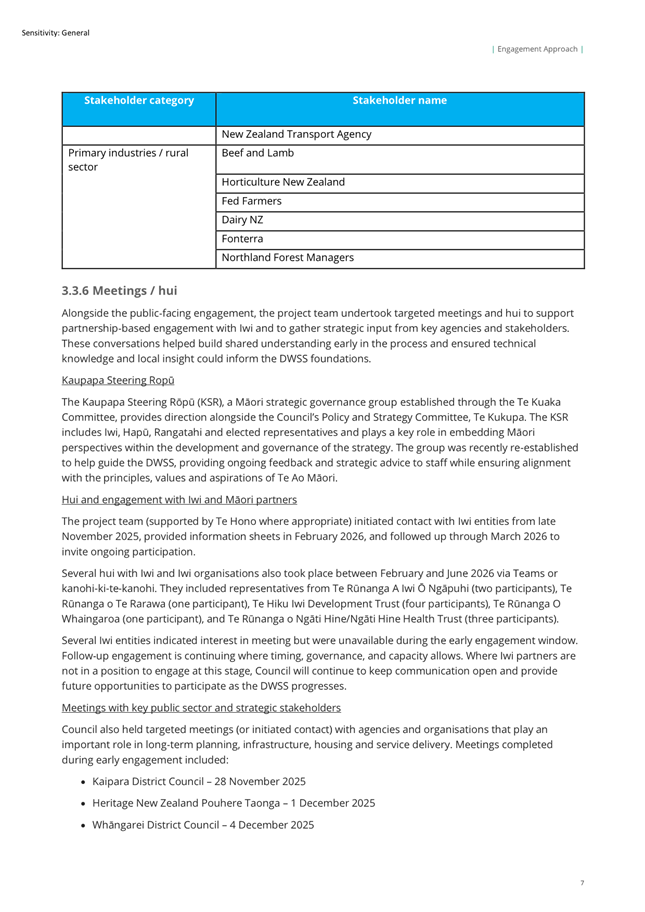
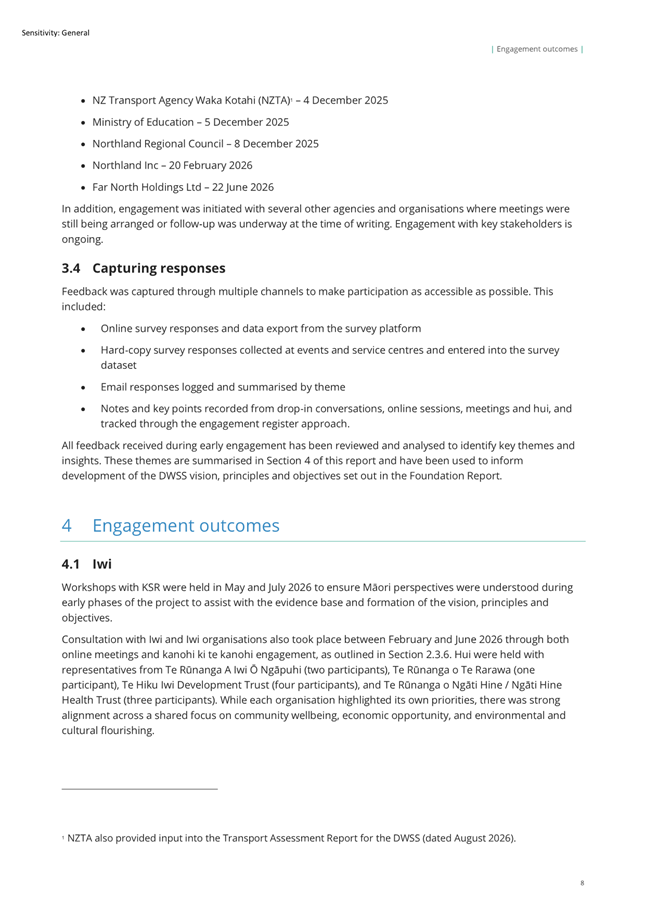
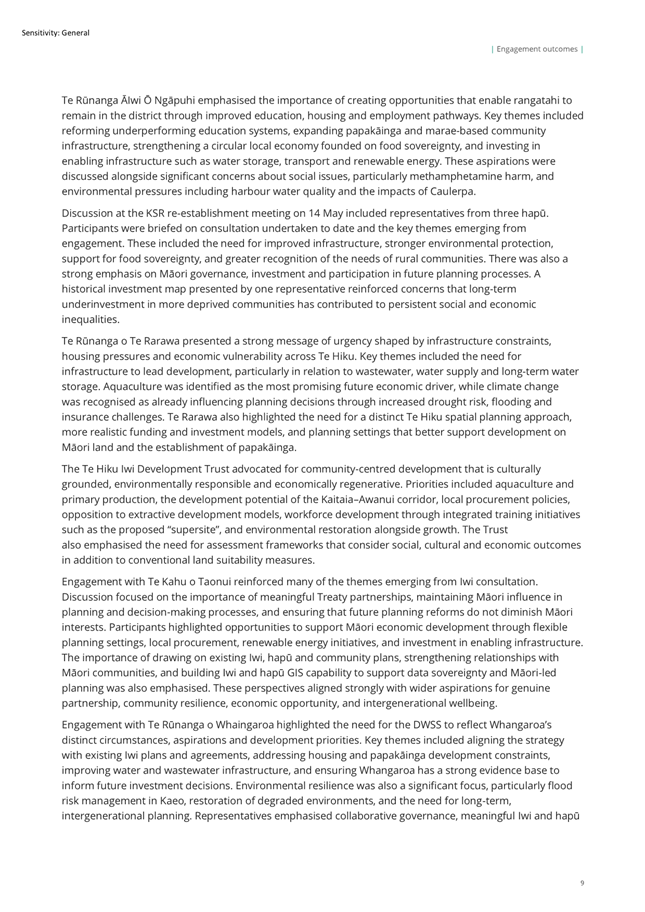
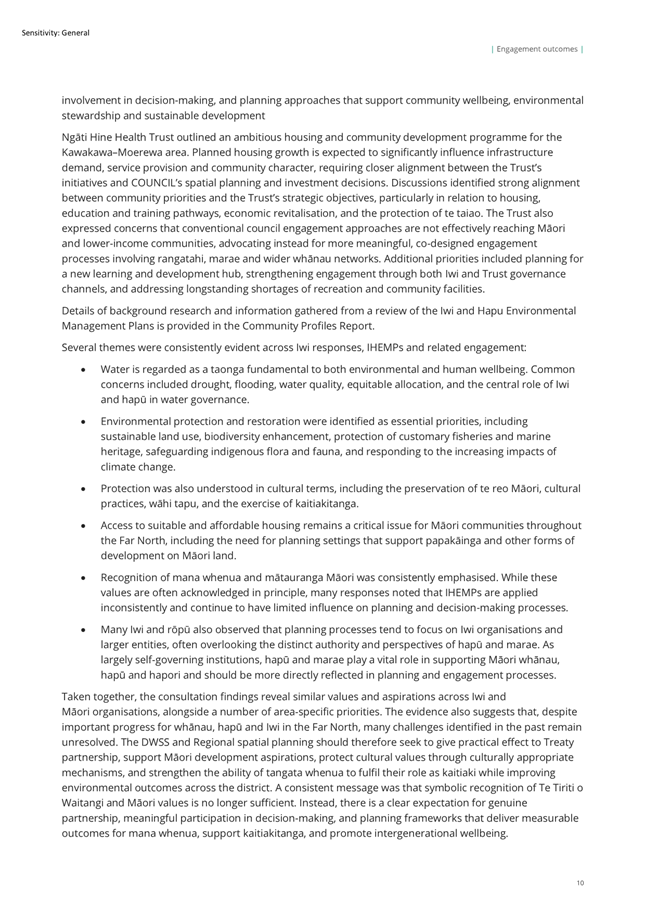
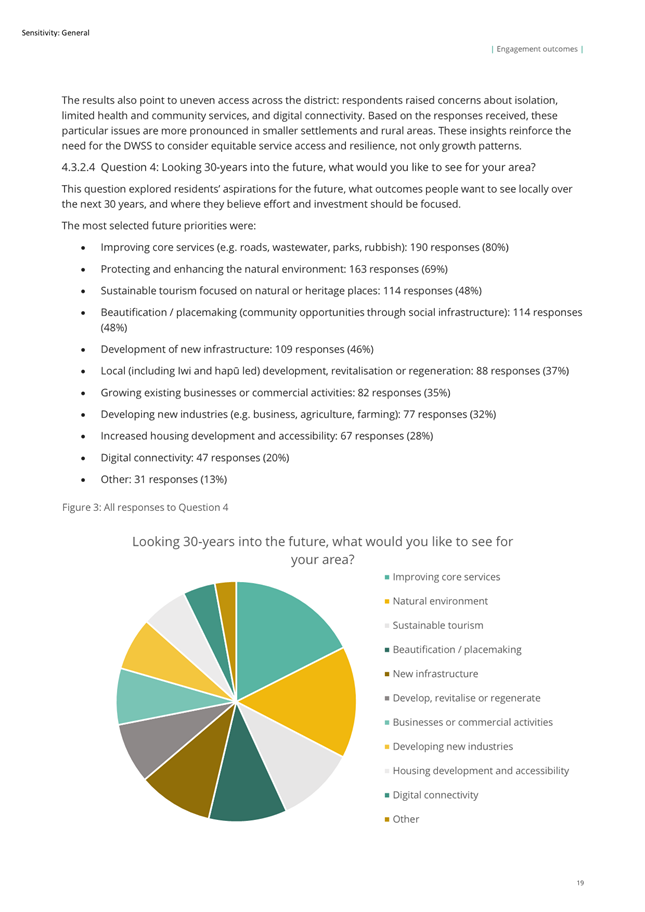
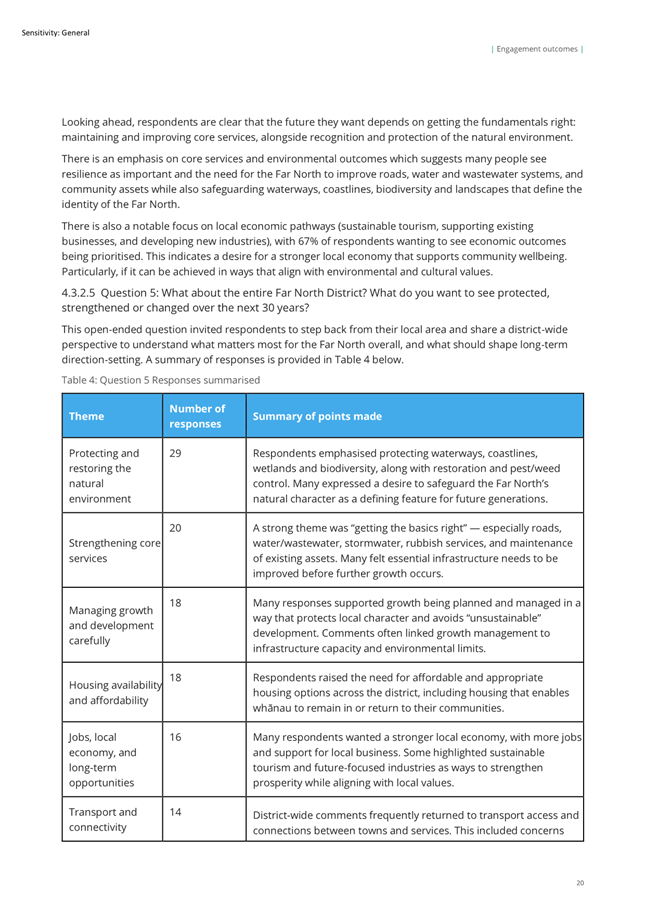
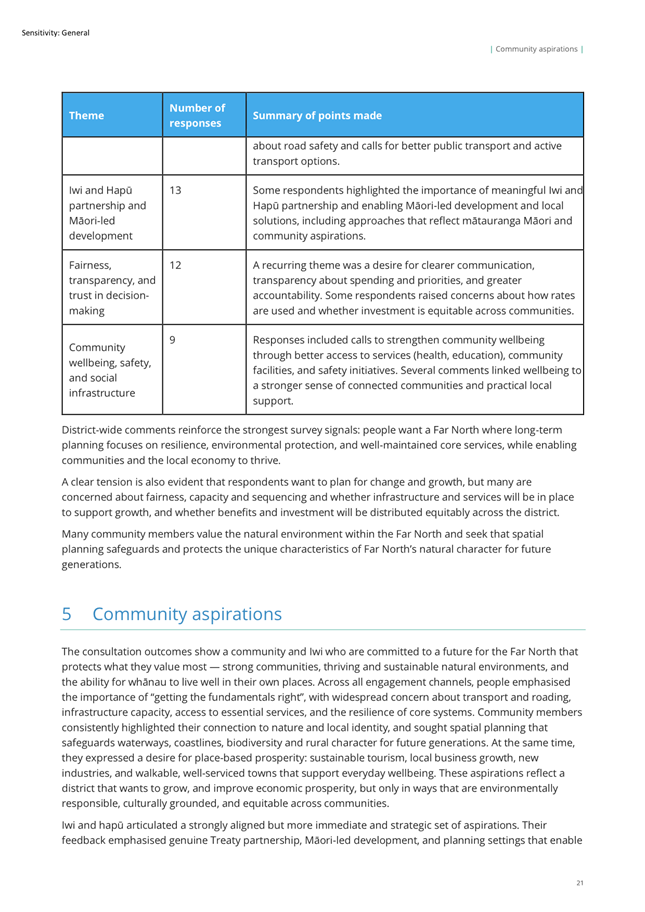
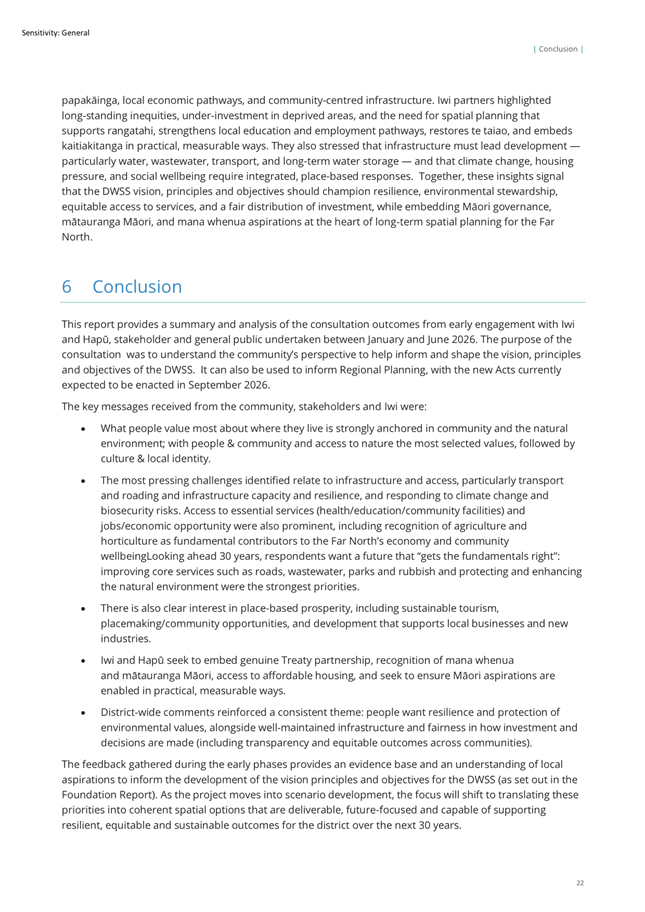
|
Ordinary Te Kuaka
Committee for Māori Strategic Relationships Meeting Agenda
|
15 September 2026
|
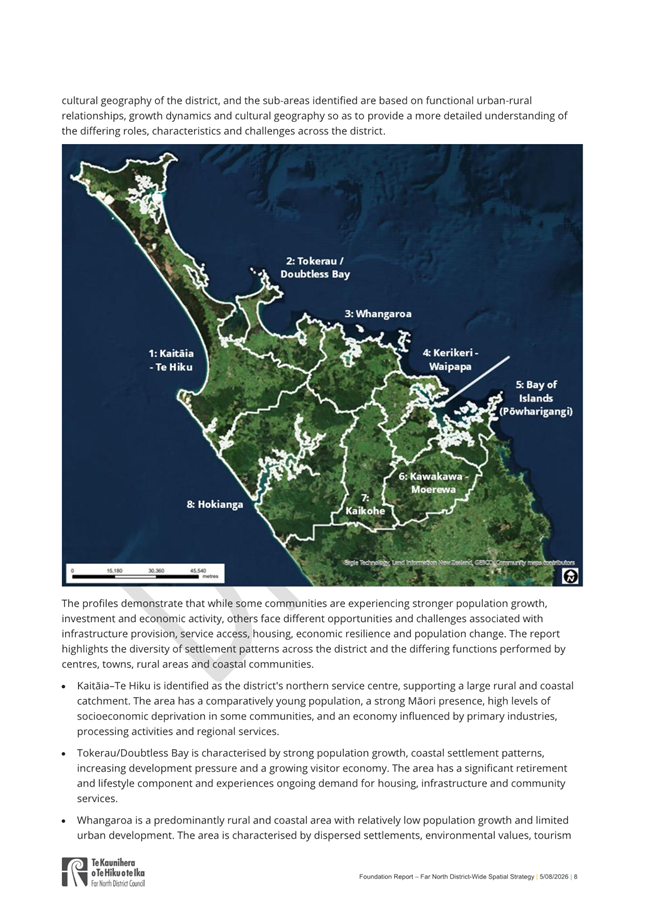
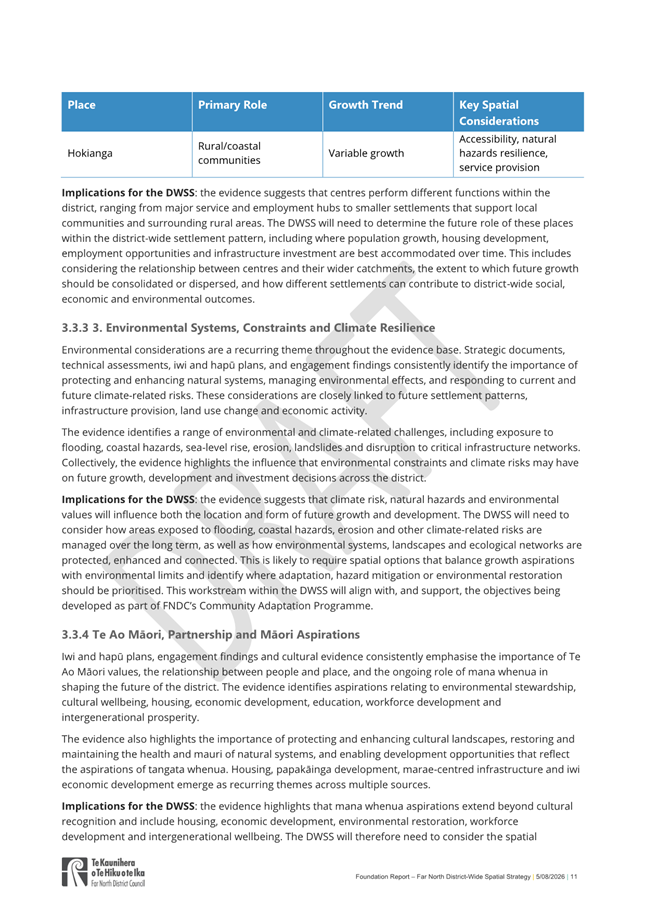
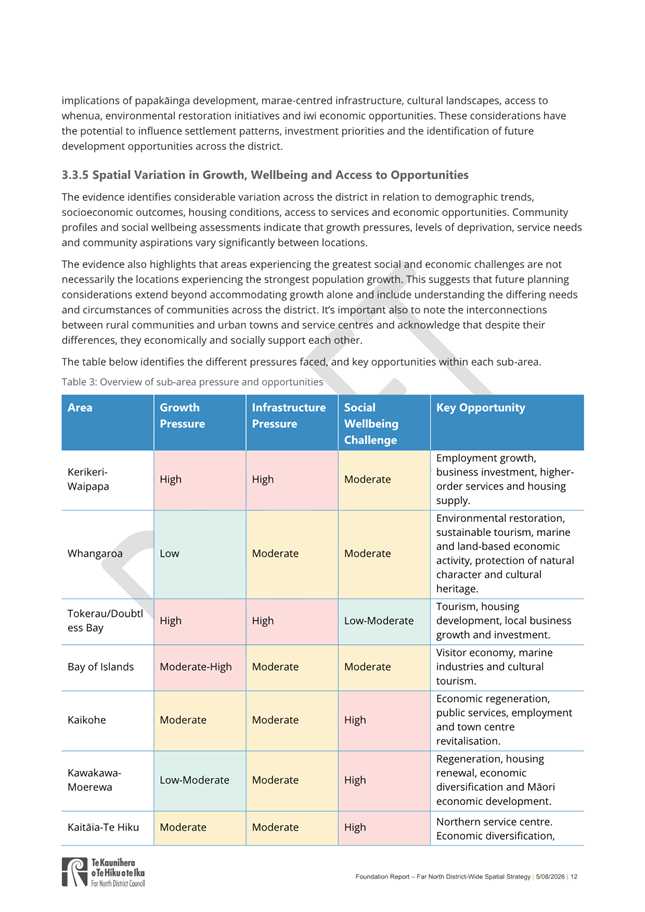
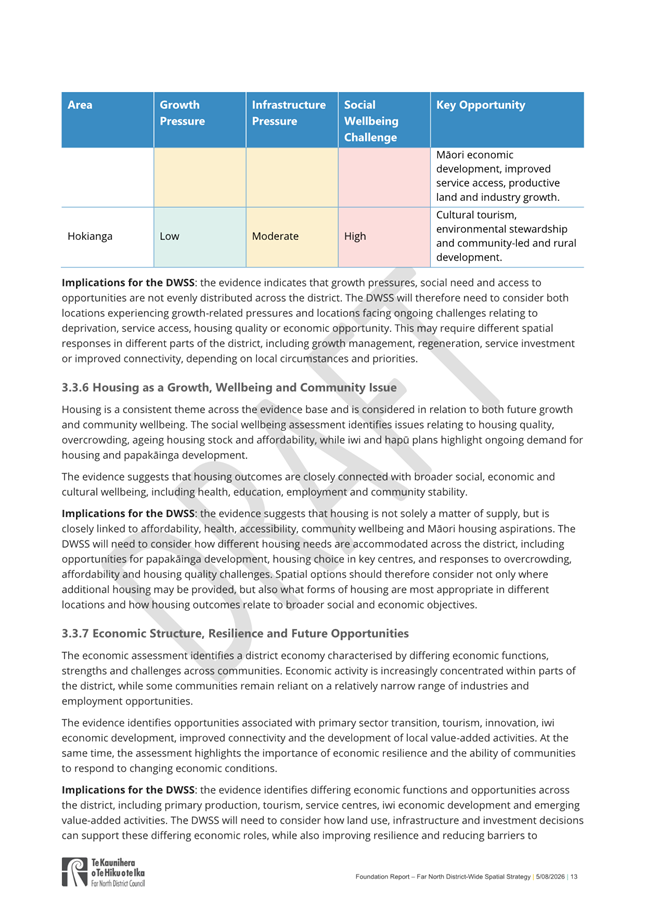
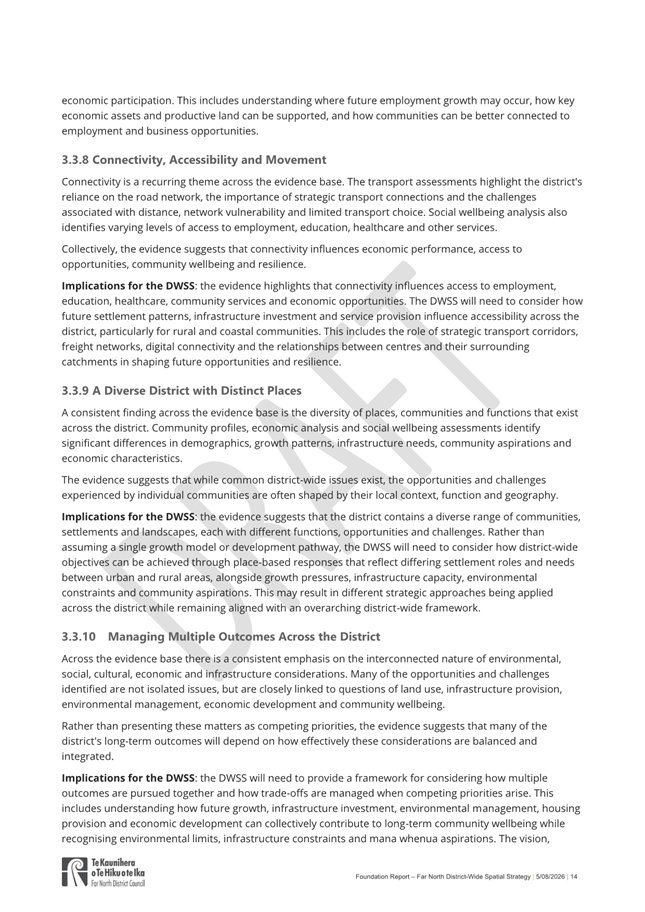
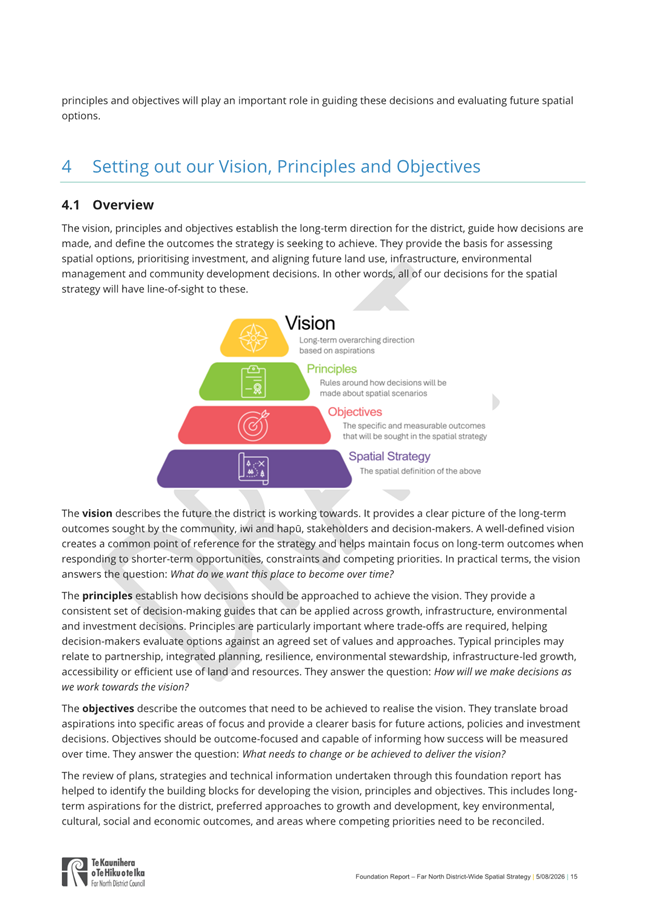
|
Ordinary Te Kuaka
Committee for Māori Strategic Relationships Meeting Agenda
|
15 September 2026
|
|
Ordinary Te Kuaka
Committee for Māori Strategic Relationships Meeting Agenda
|
15 September 2026
|
5.4 Ngā
Kaupapa Māori Report
File
Number: A5938156
Author: Llani
Harding, Pouhautū - Manager - Te Hono
Authoriser: Aaron
Taikato, Manuhautū Te Hono – Group Manager Te Hono
TAKE
PŪRONGO / Purpose of the Report
To provide Te Kuaka Committee for Strategic Māori
Relationships (Te Kuaka) with an update on Ngā Kaupapa Māori -
Matters of Importance to Māori since the last report tabled on 14th
July 2026.
WHAKARĀPOPOTO
MATUA / Executive Summary
· Te Kuaka is
committed to ensuring that the work of the Committee is carried out in a way
that enhances the social, economic, cultural, and environmental wellbeing of
the Far North District and assists Council, as appropriate, in conducting and
maintaining effective, good-faith working relationships with Māori
communities.
· Ngā Kaupapa
Māori - Matters of Importance to Māori are raised at Council meetings
and/or by the Kahika-Mayor and Councillors, Te Kahu o Taonui Iwi
representatives, or members of the public. This report serves as a mechanism to
provide Te Kuaka Committee with an update on these matters.
|
TŪTOHUNGA
/ Recommendation
That Te Kuaka Committee for
Māori Strategic Relationships receive the report Ngā Kaupapa
Māori Report – Matters of Importance to Māori – July to
August 2026.
|
NGĀ KAUPAPA JULY –
AUGUST 2026 TE HIKU WĀRI.
26 July 2026 – Te Hono Engagement Hui – Te
Manawa O Ngāti Tara Marae - Parapara
This hui strengthened communication and relationships with
Te Manawa o Ngāti Tara Marae, including updates to Hapū contact
information and engagement records. Hapū shared progress on key
environmental and cultural initiatives, including dune restoration, GIS
mapping, and the identification of culturally significant sites. The discussion
provided Council with greater insight into Hapū priorities, aspirations
for protecting taonga and wāhi tapu, and preferred communication pathways.
Opportunities for Council support were identified, including connecting
Hapū with relevant staff, providing guidance on Council processes and
funding opportunities, and supporting ongoing engagement and
collaboration.
The hui contributed to Te Pae o Uta by strengthening
relationships with Hapū, supporting effective engagement, and enabling
Māori participation in Council processes while identifying opportunities
for future collaboration and shared outcomes.
NEXT STEPS
· Update Council
records with the revised Hapū contact information.
· Maintain regular
engagement through Te Hono.
· Explore
opportunities to support the development and implementation of the Taiao
Hapū Development Plan.
· Maintain
engagement with Te Manawa o Ngāti Tara and monitor progress on
environmental and cultural mapping initiatives.
· Facilitate
connections with relevant Council teams to support identified environmental and
cultural priorities.
· Provide
information on available funding opportunities and Council processes that may
assist Hapū-led projects.
· Identify potential
partnership and funding opportunities.
· Provide ongoing
Council information, advice and support relevant to Hapū priorities.
3rd August - Lake Ngātu Karakia – New
Alcohol Ban Signs
Karakia was held to acknowledge and provide cultural support
for the introduction of the new alcohol ban at Lake Ngātu. The blessing
was an important step in recognising the significance of the lake to local Iwi
and the wider community, and to support the protection of the area as a safe
and welcoming place for recreation, cultural activities and whānau. The
Policy and Planning team led the review of alcohol ban areas and supported the
evidence-based policy process that resulted in Lake Ngātu being designated
an alcohol ban area. They provided the research and implementation information
that underpinned the communications and community celebration activities.
The alcohol ban responds to requests from local Iwi
Ngāi Takoto and community members seeking to protect the wellbeing of
people using the lake and the health of the natural environment. The karakia
provided an opportunity to formally acknowledge the kaupapa, bring together
those involved, and reaffirm our shared responsibility as kaitiaki to protect
Lake Ngātu for present and future generations of Te Hiku o Te Ika.
The ceremony was led and blessed by Rev Tuterangi Rameka,
with attendance from Cr Hilda Hayward-Harawira, Council staff and Ngāi
Takoto Iwi representatives.
As with all Te Hono engagements with Iwi, Hapū and
Marae, this kaupapa strengthened relationships with our tangata whenua partners
and supported meaningful partnership through culturally appropriate
engagement.
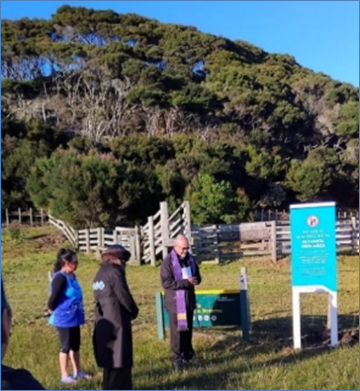
Image credit: Te Hono
10 August 2026- Te Hono Engagement Hui-
Haititaimarangai Marae 339 Trust
Kaiārahi Kaupapa Māori facilitated a hui with the
Haititaimarangai Marae 339 Trust to introduce Te Hono, provide an overview of
Council's structure and current initiatives, and discuss the support available
to iwi, hapū and marae across Te Hiku o Te Ika.
The hui provided an opportunity for the Trust to share its
aspirations, priorities and key kaupapa, helping to inform future engagement
and identify opportunities for Council support. The engagement strengthened the
relationship between Council and the Trust and established a foundation for
ongoing collaboration.
Several key issues and matters of importance to the Trust
were raised and recorded during the hui to inform Council's ongoing work and
engagement activities. These matters will be considered through the appropriate
Council channels, with follow-up discussions and outcomes to be communicated as
they progress.
Outcomes
· Strengthened the
relationship between Council and Haititaimarangai Marae 339 Trust.
· Increased
awareness of Te Hono's role and the support available through Council.
· Captured and
recorded the Trust's aspirations, priorities and key issues to inform future
engagement and decision-making.
· Established a
pathway for ongoing communication, collaboration and information sharing.
· Identified
opportunities for continued engagement between Council and the Trust on matters
of mutual interest.
This engagement supports Te Hono's iwi, hapū and marae
engagement commitments and contributes to Te Pae o Uta by strengthening
relationships and supporting meaningful Māori participation in Council
processes and decision-making.
14th August 2026 - Blessing of Te Ahu Workspace and
Acknowledgement of Joe Tua
The Te Ahu office and the desk of long-serving Council staff
member Joe Tua were blessed by local Te Rarawa kaumatua John Paitai on Friday
14 August, as colleagues gathered to remember Joe and his legacy.
Matua John led a form of taki (ceremonial first entry into
the building), followed by those in attendance, and a karakia whakawātea
(clearing prayer). Staff also shared words about Joe, who gave more than 21
years of dedicated service to Far North District Council.
Joe joined Council in May 2005 as a Monitoring Officer and
later became a Monitoring Compliance Officer. He was passionate about bringing
the Te Ahu whānau closer together, often using food to connect people,
share time together and strengthen relationships.
The blessing concluded with a small hākari attended by
staff who had worked alongside Joe, providing another opportunity to
acknowledge a respected colleague and kaumatua who made a lasting contribution
to Council and his community. This gives effect to Te Pae o Uta by
including staff in cultural safety practices such as whakawatea and karakia to
uphold tikanga and spiritual understanding.
This opportunity also provided our kaimahi at Te Ahu to
experience and take part in the formalities around tikanga building their
cultural capabilities and confidence align to our internal tikanga
policy.
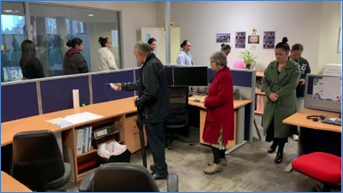
Image credit: Te Hono
24 August 2026 – Te Hono Engagement Hui - Te
Rarawa Marae
Te Rarawa Iwi/Hapū engagement hui was hosted at Te
Rarawa Marae, Pukepoto, Monday 24th August 2026. Representatives acknowledged
the ongoing engagement and appreciated Council efforts to reach out directly to
our communities, share information and improve awareness of our services.
Te Rarawa representatives noted they have attended several
engagement hui and advised they will now invite Council to future hui to
continue the kōrero and provide opportunities for further
presentations.
The outcome provided positive engagement with strong support
for a continued relationship-building and regular information sharing
opportunities between Council and Te Rarawa Marae.
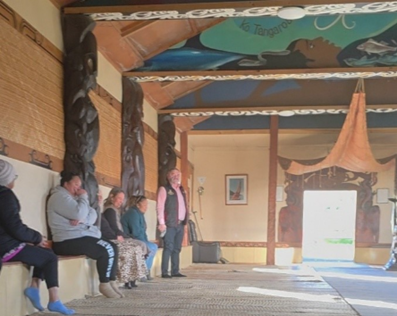
Image credit: Te Hono
Te Rarawa Papakāinga – Housing Blessing and
Opening
The Te Rarawa Papakāinga housing blessing and opening,
acknowledging this significant milestone for whānau and Te Rarawa.
The engagement supported the ongoing relationship between
Council and Te Rarawa and aligned with the commitments and intent of the Te
Rarawa Memorandum of Understanding (MOU), particularly through maintaining
meaningful engagement, strengthening partnership, and supporting iwi
aspirations.
The occasion provided an
opportunity for Council to be present alongside Te Rarawa and whānau,
reinforcing positive relationships and demonstrating Council’s commitment
to ongoing partnership and engagement with Te Rarawa.
NGĀ KAUPAPA JULY – AUGUST 2026
PĒOWHAIRANGI - WHANGAROA WĀRI.
9 July 2026 - Māori Business Engagement –
ĀTEA Ltd
Te Hono supported Council’s Procurement Specialist and
Business Compliance team to engage with ĀTEA Ltd, a Māori-owned and
operated business, to discuss their interest in working with Council and to
explore potential opportunities for future services.
The engagement focused on providing general guidance to help
ĀTEA Ltd understand Council’s procurement processes and identify
appropriate pathways for future opportunities. As ĀTEA Ltd did not have a
formal proposal to table at the time, the discussion was exploratory and
focused on connecting the business with the relevant Council teams.
ĀTEA Ltd was encouraged to maintain engagement with the
Business Compliance team and explore potential opportunities with
Council’s Transportation Network team.
This engagement supports Te Pae o Uta by strengthening
pathways for Māori businesses to understand and participate in Council
processes, while supporting relationship-building and opportunities for
Māori-led businesses to contribute to Council outcomes.
22 July
2026 - Matauri X Incorporation Customer Hui.
Kaiārahi Kaupapa Māori and Whenua Māori
Engagement Officer met with the chairperson for Matauri X Incorporation (MXI)
to discuss the progression of a Memorandum of Understanding (MoU) and Whenua
Māori rates relief opportunities for MXI. Discussion also touched on the
maintenance and servicing of the public toilets in the carpark just back from
the beach front.
Council provided advice for MXI to complete the update of
titles for Matauri X block. Once Council receive the updated information, rates
relief provisions can then be investigated further. This has been an ongoing
historical relationship issue dating back to before the existence of Te Hono
within Council.
Our Whenua Māori Engagement Officer has provided all
the rating information and options available to MXI for them to follow up on
and we can look to support resolve their concerns. MXI have been asked to
supply the updated information on prior occasions.
To date, Council have been maintaining and servicing the
toilets mentioned above as well as surrounds and berms.
The following steps would be to look at creating an MoU with
Council which would include discussion around the rating schedule and servicing
of the public toilets.
A Te Pae o Uta outcome for Council would be building
enduring relationships, supporting Māori land aspirations, and creating a
practical agreement pathway between Council and MXI.
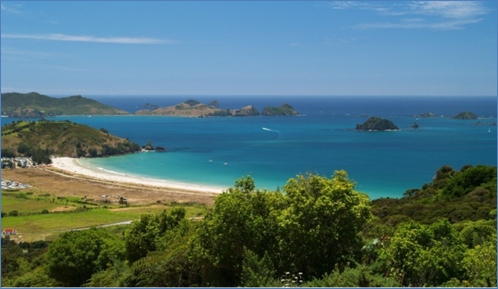
Matauri Bay and
offshore Cavalli Islands: Image credit Tripbucket.com
4 August 2026. Review Mana Ōrite Relationship
Agreement with Te Rūnanga o Whaingaroa
Council representatives, met with Te Rūnanga o
Whaingaroa Strategic Leadership Team (TROW) at their Kerikeri facility, Te
Pūtahitanga.
The hui gave an opportunity for both TROW and Te Hono to
reflect on progress, discuss the draft work plan, and identify practical ways
to implement the relationship agreement.
The Mana Ōrite Relationship Agreement (MORA) was
developed to refresh the previous relationship arrangements between Te
Rūnanga o Whaingaroa and Council. Initial discussions were held in
Whangaroa in February 2024, and the agreement was formalised in September 2025
at Te Pokapū Community Hub in Kāeo.
The hui confirmed a willingness for TROW to work openly with
Council through formal and relationship-based approaches.
Key discussion points:
· Confirming the
role of Te Hono team as a relationship monitor within Council.
· The need for TROW
to finalise the draft work plan and share it with relevant Council
departments.
· The importance of
aligning agreed priorities with Long-Term Plan processes.
· Opportunities to
explore procurement, system sharing, and use of the Te Kahu o Taonui consenting
portal.
Next Steps.
· TROW to continue
confirming priority work streams and finalise the draft work plan.
· Te Hono to
socialise the confirmed work plan with relevant Council departments and general
managers.
· Once Council
receives the draft work plan, we will be able to consider the agreed priorities
and how these may be reflected through the Long-Term Plan (LTP)
processes.
· Both parties to
continue regular engagement and identify practical opportunities to support
implementation of the agreement.
Council and Te Pae o Uta outcomes strengthens our MORA with
TROW through agreed work plans, shared priorities, regular engagement and
implementation that will support a long-term relationship with TROW.
NGĀ KAUPAPA JULY –
AUGUST 2026 KAIKOHE KI HOKIANGA WĀRI.
20 August 2026- Hapū Marae Engagement Hui
(Kokohuia Marae)
Te Hono held a hui at Kokohuia Marae with hapū of
Ngāti Korokoro, Ngāti Whararā me Te Pouka, alongside
representatives from Te Whakamaharatanga, Te Kai Waha, and Pākanae Marae.
The purpose of the engagement was for Te Hono to provide a clear overview of
Council’s structure, roles, and services, supporting stronger
understanding of how Council operates and how Hapū and Marae can connect
with the right teams. This included outlining key functions, points of contact,
and the pathways available for Māori communities to access information,
raise issues, and participate in Council processes. The hui emphasised
transparency, partnership, and ensuring our communities remain informed and
connected to ongoing mahi.
The hui also created a space for meaningful kōrero on
kaupapa important to Hapū and Marae wellbeing. Participants shared
priorities Wastewater Treatment Plant that require better communication and
better representation from hapū, to provide workshop on Papakāinga
tips and advice, raised questions, and discussed areas where improved would
benefit whānau and the wider South Hokianga community by having more
council staff utilise Te Hono when engaging with Marae, Hapū, Hapori,
better notification on projects to allow good timing and if necessary, a
responses. Hapū and marae priorities relating to wellbeing, cultural
resilience, and local development were heard and recorded. It gives increased
confidence for Hapū and Marae to connect with Council teams and seek
support when needed and a reinforced commitment to partnership, transparency,
and ongoing collaboration with Council, Iwi, Hapū and Marae across the
district.
This increased understanding of Council roles,
services, and key points of contact for future engagement. It was to provide a
clearer communication pathway and updates on projects, funding opportunities,
and Council processes that require Te Hono to assist in helping to provide that
information, putting them in touch with the right person.
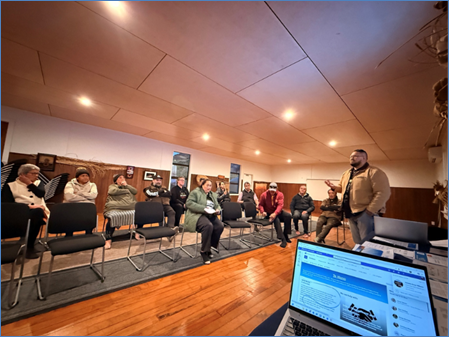
Image credit: Te Hono
6th August
2026 - E Tū Rangatahi (Ngawha Innovation Park)
E Tū Rangatahi – Stand Up Young Leaders brought
together Taitamariki aged 15–24 from across Te Tai Tokerau to explore
issues affecting their communities and to develop youth led ideas for positive
change. Led by Civic Engagement, and supported by Te Hono, Digital Information,
Communications & Engagement, and Events Coordination, the kaupapa provided
a well-structured and welcoming environment for Rangatahi to participate
confidently and meaningfully.
In the lead up to the event, Rangatahi formed their own
teams, selected kaupapa that mattered to them, and worked collectively to shape
solutions grounded in their lived experiences. This preparation phase
strengthened leadership, critical thinking, and teamwork, giving young people
the space to reflect on what is happening in the Far North and how they want to
influence the future of their rohe.
On the day, teams gathered at the Mahinga Innovation Centre
to present their ideas and take part in a programme centred on collaboration,
wānanga, and youth voice. The environment supported open discussion and
creativity, allowing Rangatahi to express their perspectives freely and learn
from one another. The emphasis remained on participation rather than
perfection, valuing their thinking, their voice, and their willingness to step
forward as emerging leaders. Its core focus is Empowering Rangatahi as decision
makers to be culturally grounded and included in community developments, but
also to build resilience on future focused communities as drivers that align
with the Rangatahi Strategy. Concluding the event teams were announced on
placings of their pitch and the winner will have some time to present to the
Mayor's Office.
1st - Te Kura Takiwā o Taipa - Taipa Area School -
Strengthening Rangatahi Voice in Local Decision-Making. This pitch explored how
young people could have a stronger voice in local decision-making by promoting
meaningful engagement with rangatahi. Guided by the principle "Nothing
about us, without us," the group emphasised the importance of listening,
involving, empowering, supporting, and following through—ensuring
rangatahi are genuine partners in shaping the decisions that affect their
communities.
2nd Kaitaia College - Te Hiku Hauora Interns Pure
Shift – Helping Rangatahi Make the Shift Away from Vaping. This pitch
explored the impact of vaping on rangatahi through the lens of Te Whare Tapa
Whā. The group examined why young people vape, including peer pressure,
stress relief, flavours, and social influences, before introducing Pure
Shift—an interactive app that supports rangatahi to quit through
educational resources, habit tracking, quizzes, access to support services, and
a rewards system that incentivises healthier choices.
3rd Te Kura Kaupapa Māori o Kaikohe -The rangatahi
pitch centred on the importance of young people showing up and voting and
enrolling in elections. They highlighted that every vote is an opportunity to
have a voice, influence the decisions that shape our communities, and create
meaningful change. With the Far North having some of the highest rates of
unenrolled eligible voters, they emphasised that if more rangatahi enrolled and
voted, they could become one of the most influential groups in determining the
future of our district. Their message was clear: our voices matter, and by
participating in local democracy, rangatahi have the power to shape the
communities they want to live in.
Some of the outcomes from this Kaupapa were:
· Rangatahi voice
strengthened – young people confidently shared their experiences,
concerns and ideas directly with Council.
· Youth
participation increased – Rangatahi gained greater awareness of how they
can engage with and influence Council decision-making and community
outcomes.
· Youth Council
development supported – the kaupapa contributed to conversations around
establishing a Far North Youth Council and creating stronger pathways for
ongoing rangatahi representation.
· Leadership
capability developed – Rangatahi demonstrated teamwork, critical
thinking, communication and problem-solving skills.
· Council insight
improved – honest kōrero provided Council with a clearer
understanding of the priorities and challenges facing young people in the
district.
· Cross-Council
connections strengthened – the kaupapa connected rangatahi with existing
youth-focused initiatives across Council, including Community Development and
Te Hono.
· Māori youth
voice elevated – Te Hono supported meaningful opportunities for
Taitamariki Māori to contribute their perspectives and aspirations.
· Future engagement
pathways identified – the kaupapa created a stronger foundation for
ongoing engagement between Council and rangatahi.
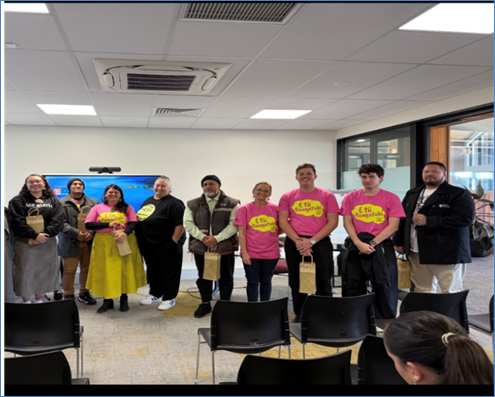
Image credit: Te Hono
PĀNGA PŪTEA ME NGĀ WĀHANGA
TAHUA / Financial Implications and Budgetary Provision
There are no financial
implications involved in receiving this report.
Āpitihanga
/ Attachments
Nil
|
Ordinary Te Kuaka
Committee for Māori Strategic Relationships Meeting Agenda
|
15 September 2026
|
5.5 Te Pae o
Uta Te Ao Māori Framework Update
File
Number: A5940408
Author: Kieran
Morrison, Principal Advisor - Te Hono
Authoriser: Aaron
Taikato, Manuhautū Te Hono – Group Manager Te Hono
TAKE PŪRONGO / Purpose of the Report
To provide Te Kuaka Committee for Māori Strategic
Relationships with an update on Te Pae o Uta – Te Ao Māori Framework
following the Te Kuaka Committee workshop presentation delivered on Friday 21
August 2026.
WHAKARĀPOPOTO MATUA / Executive SummarY
The Far North District Council (FNDC) adopted Te Pae o Uta
Te Ao Māori Framework at its Council meeting on 7 September 2023
(resolution 2023/8). The framework provides the primary organisational approach
for embedding Te Ao Māori across governance, strategy, operations,
partnerships and service delivery. Since adoption, the programme has grown to
284 goals across 48 teams, with 99.3% of goals either completed, nearing
completion, or actively in progress as at the end of July 2026.
The programme is now entering a maturation phase. It is
proposed that no new team goals be added in FY27, allowing teams to focus on
closing out current goals, completing a programme-wide health check, and
preparing an evidence-based refresh for implementation from July 2027. Te Kuaka
Committee is asked to receive this update and note the proposed direction for
the next phase of Te Pae o Uta.
The overall principles for Council in respect of Te Pae o
Uta are to:
· Recognise He
Whakaputanga o te Rangatiratanga o Nu Tireni (Declaration of Independence) and
Te Tiriti o Waitangi (Treaty of Waitangi) as the founding covenants of Te Tai
Tokerau and Aotearoa New Zealand respectively.
· Acknowledge the
importance of relationships, both tangible and intangible, including Ngā
Atua, whenua, Mauri o te Wai and taiao.
· Focus on the
pursuit of excellence in Te Ao Māori.
· Enable staff to
understand key Te Ao Māori concepts and practices.
· Acknowledge
kōrero tuku iho at Council by recognising Iwi, and Hapū kōrero
|
TŪTOHUNGA
/ Recommendation
That the Te Kuaka Committee
for Māori Strategic Relationships receive the report Te Pae o Uta Te Ao
Māori Framework Update.
|
tĀHUHU KŌRERO / Background
Adopted by Council in September 2023, Te Pae o Uta has
become the primary framework guiding the integration of Te Ao Māori across
the organisation.
Key achievements to
date
· Te
Pae o Uta – Te Ao Māori Framework adopted by Council and embedded as
the organisation's strategic framework for advancing Te Ao Māori.
· Established and expanded the organisation-wide Te Pae o Uta work
programme, growing from 161 goals in 2024 to 284 goals in 2026.
· Developed
and implemented Te Pae o Waho, a structured cultural competency programme
supporting organisational capability and Te Ao Māori understanding.
· Delivered
the Te Pae Waiata cultural capability programme and established the Council
kapa haka rōpū.
· Developed
and endorsed Ka Irihia - Te Reo Māori Action Plan, providing a strategic
pathway for increasing the use and visibility of te reo Māori.
· Developed
and adopted Te Ao Mārama - Reorua Strategy, strengthening Council's
commitment to bilingual communication.
· Developed
and adopted Te Kiri Waiwai o Papatūānuku - Whenua Māori
Strategy, establishing a coordinated approach to supporting Whenua Māori
aspirations.
· Established
Te Rōpū Tupu Wanawana to provide governance oversight, strategic
guidance and monitoring of Te Pae o Uta implementation.
· Implemented formal six-weekly and quarterly reporting processes to
strengthen accountability and performance monitoring of Te Pae o Uta outcomes.
· Strengthened
strategic partnerships with Iwi and Hapū through formal agreements.
· Expanded
the reach of Te Pae o Uta into Far North Holdings Limited and Pou Herenga Tai
Trust.
· Developed
and commenced implementation of the Hapū Engagement Programme.
· Achieved
national recognition as a finalist in the Human Resources New Zealand Awards,
recognising Te Pae o Uta as an innovative organisational initiative.
Since Te Pae o Uta was established, it has evolved from a
Māori responsiveness framework into an organisation-wide change programme
that is actively influencing governance, organisational capability, service
delivery, community engagement and strategic planning.
Te Pae o Uta has achieved
three significant outcomes:
Established
a Council-wide Māori outcomes framework
A major achievement has been the
creation of a common organisational language and framework that applies across
governance, strategy, operations, partnerships and service delivery.
Increased
organisational participation and accountability
Te Pae o Uta goals are now
embedded within Council work programmes and monitored through a structured
reporting process. This shows a growing organisational uptake and indicates Te
Pae o Uta is increasingly becoming business-as-usual activity across Council.
It
has strengthened Māori participation in governance and decision-making
These outcomes are reflected in
strategic alignment with Te Pae ki Tawhiti and in practical mechanisms that
support participation, leadership and local aspirations.
Strategic alignment to
Te Pae ki Tawhiti
Te Kuaka’s Strategic Vision: "Our Far North
communities are thriving, self-reliant, inter-dependent, engaged, proud and
determined."
Te Pae o Uta strongly contributes to this vision by:
· Building mechanisms for Māori participation.
· Supporting community-led decision making.
· Strengthening local leadership.
· Recognising Iwi, Hapū and Marae aspirations in planning and
service delivery.
Te Pae o Uta
can be viewed as one of the key delivery mechanisms helping transform the Te
Kuaka vision into operational practice.
Work programme current state
As at the end of
July 2026, the Te Pae o Uta (TPoU) work programme shows 99.3% of goals either
completed, nearing completion, or actively in progress. Significant progress
has been achieved in te reo Māori implementation, Iwi, Hapū and Marae
engagement, cultural capability development, and embedding Te Ao Māori
practices across the organisation. While some strategic initiatives require
targeted acceleration, the overall programme reflects sustained progress
towards Council's Te Pae o Uta outcomes and strategic priorities.
A total of 284 goals have been established across
Council teams.
· Tū
Kotahi: 169 goals (59.5%).
· Whanake
Tahi: 79 goals (27.8%).
· Kōkiri
Tahi: 36 goals (12.7%).
There are 48 teams represented within the Te Pae o Uta
work programme.
· 13.6% of goals are completed or near completion.
· 85.7% of goals are actively in progress.
· 0.7% of goals have not started or are incomplete.
Key updates
· A new Principal
Advisor – Te Hono has been onboarded as the custodian of Te Pae o Uta and
to manage the organisation's TPoU framework and work programme.
· A programme-wide
health check has been initiated to validate the current state and ensure
reports, tools and resources are fit for purpose.
· It is proposed
that no new team goals be added to the TPoU work programme in FY27 due to the
number of goals still in progress.
· This financial
year will focus on closing out current team goals and preparing for the
framework refresh for the next triennium.
Te Pae o Waho capability programme
Te Pae o Waho supports the Te Pae o Uta strategy and aligns
with the Whanake Tahi goal of building staff capability and confidence to
respond effectively to Māori. Training continues to be delivered across
multiple sites and online.
· Five
classes were delivered in the final intake of FY26, concluding on 2 July 2026.
· Intake
one for FY27 commenced on 21 July 2026, with 10 classes scheduled to finish on
24 September 2026.
· An
additional class has been set up for the Mayor’s Office and is due to
finish on 7 October 2026.
MATAPAKI ME NGĀ KŌWHIRINGA /
Discussion and Next Steps
To enable teams to focus on
closing out open goals and strengthening internal capability, it is proposed
that no new team goals be added in this financial year.
Te Hono is meeting with managers
and teams to review progress, identify support needs, and agree practical plans
to close out open team goals.
The framework is now entering a
maturation phase. While significant progress has been made, the refresh will
focus on capability measurement, strategic alignment, policy implementation and
measurable community outcomes, rather than organisational activity alone.
The refresh will use a
collaborative and evidence-based approach, considering where improvements can
be made without changing the whakapapa or mauri of the framework. Once a design
concept is approved, a detailed implementation plan will be developed.
High-level refresh pathway
The proposed pathway is to
complete the health check, confirm priority improvement areas, develop the
refresh design concept, and return to Te Kuaka with key milestones before
implementation from July 2027.
Implementation of the refresh is
scheduled for July 2027, aligning with the new financial year and the start of
the second triennium for Te Pae o Uta. Te Kuaka will be kept informed of key
milestones and progress as these mahi advances.
PĀNGA PŪTEA ME NGĀ WĀHANGA
TAHUA / Financial Implications and Budgetary Provision
There are no financial
implications in the receiving of this report.
Āpitihanga
/ Attachments
1. Te
Kuaka Workshop te Pae o Uta Presentation 21082026 - A5940332 ⇩ 
|
Ordinary Te Kuaka
Committee for Māori Strategic Relationships Meeting Agenda
|
15 September 2026
|
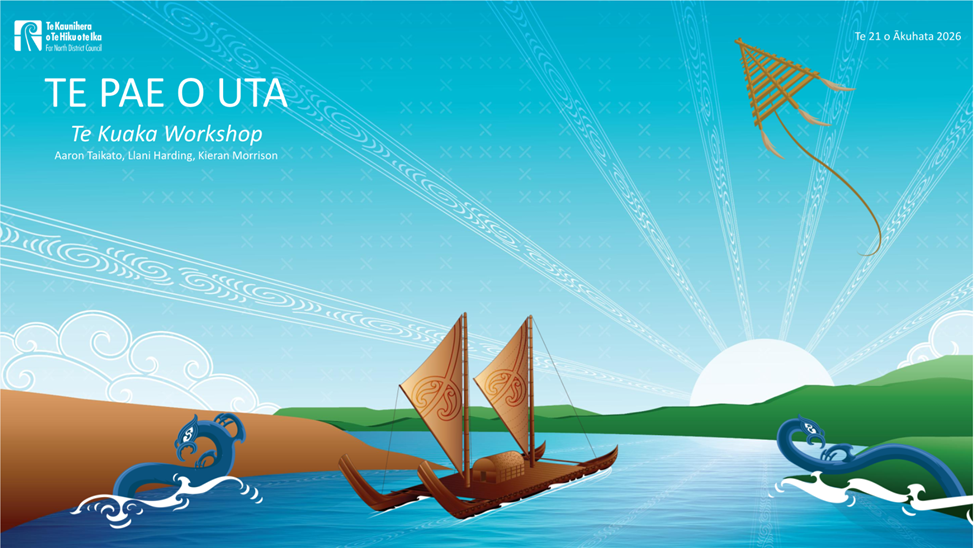
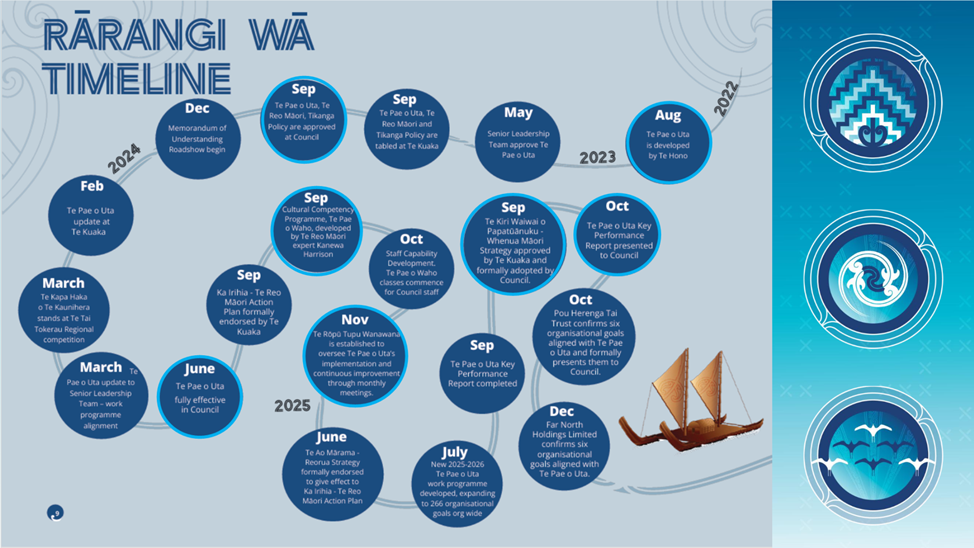
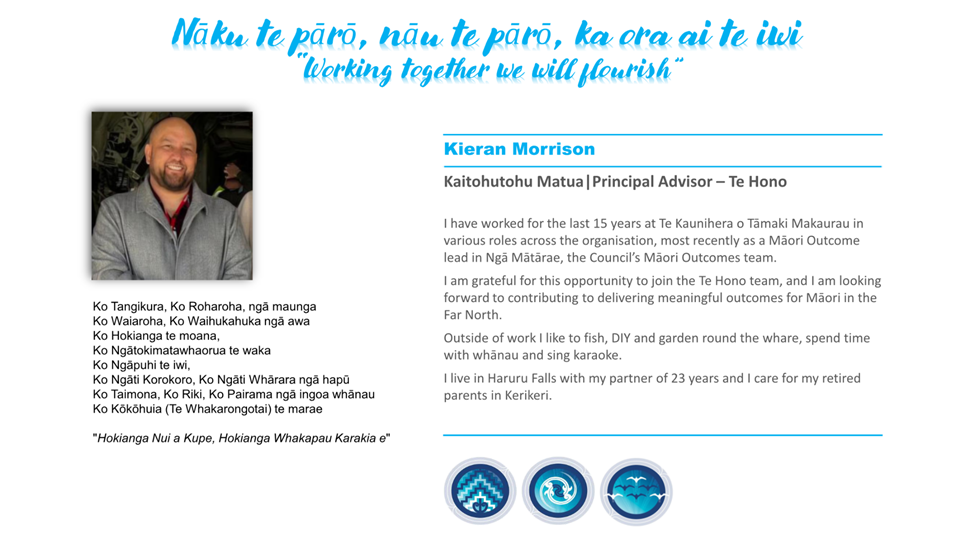
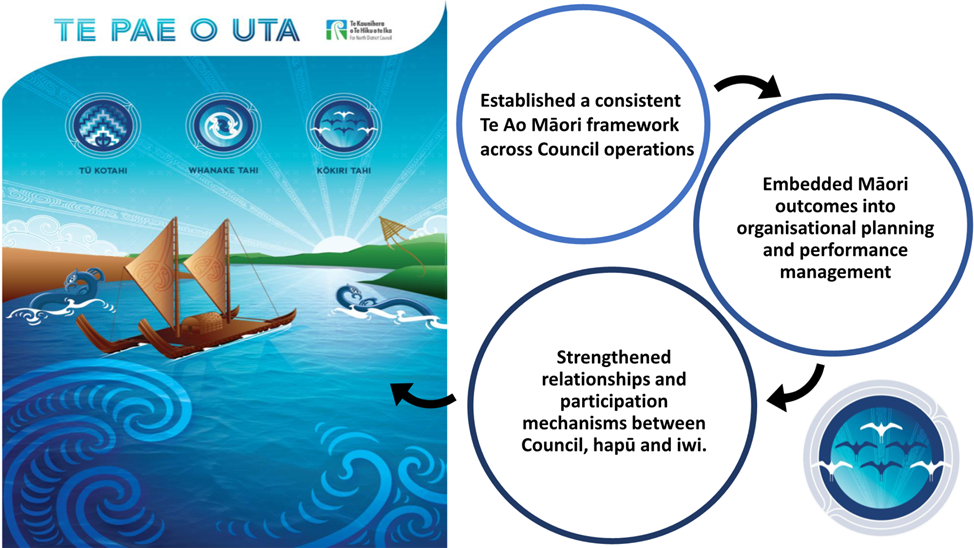
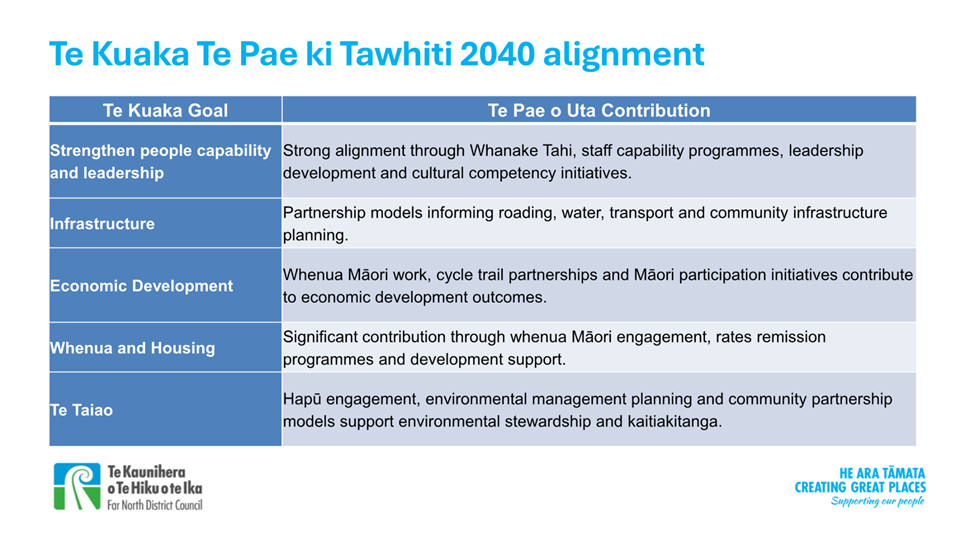
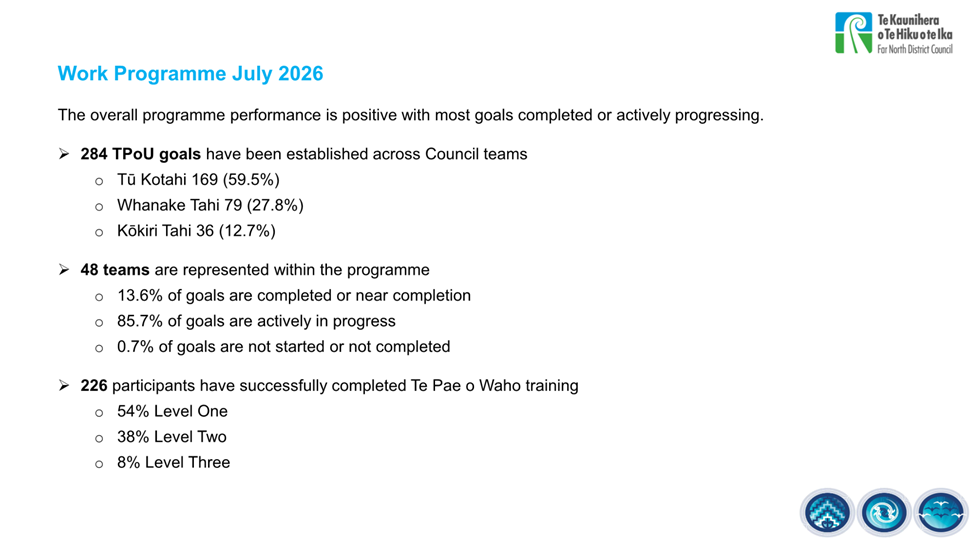
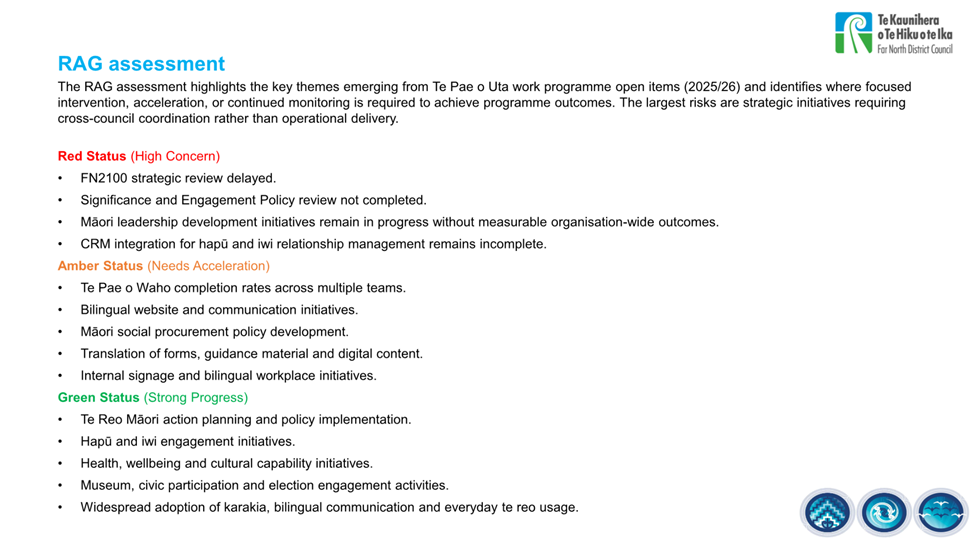
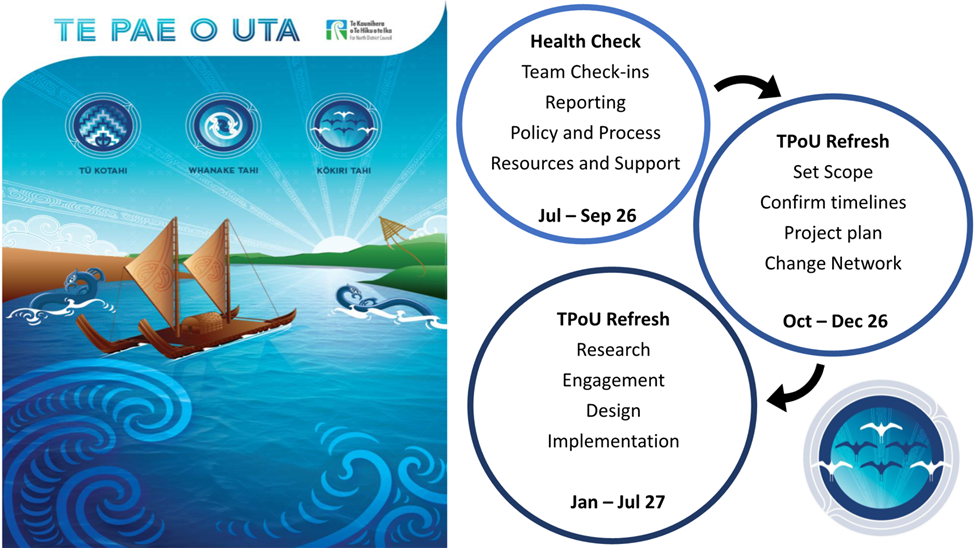
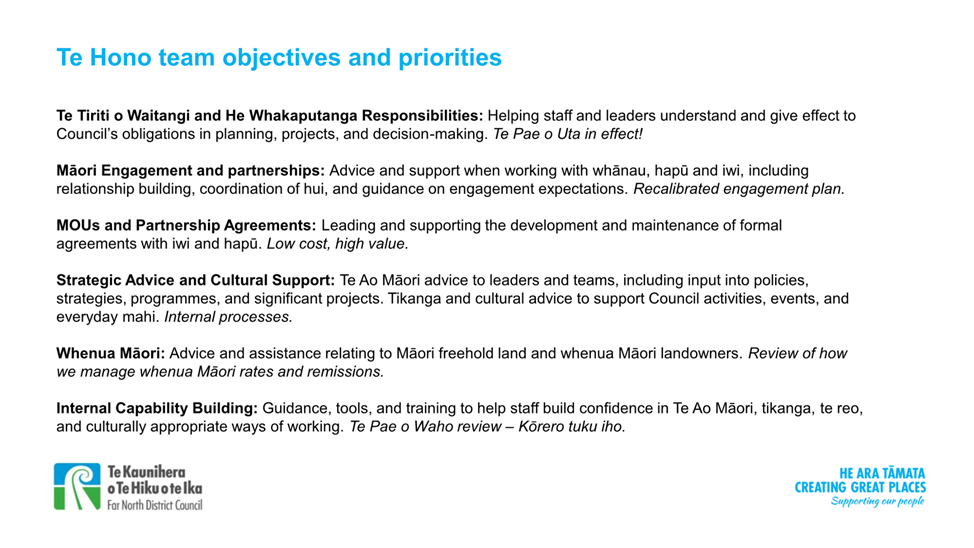

|
Ordinary Te Kuaka
Committee for Māori Strategic Relationships Meeting Agenda
|
15 September 2026
|
5.6 Current and
Previous Open Resolutions - Actions Sept 2026
File
Number: A5925059
Author: Marlema
Baker, Te Kuaka Committee Coordinator
Authoriser: Aisha
Huriwai, Manager - Democracy Services
TAKE PŪRONGO / Purpose of the Report
The purpose of this report is to provide Te Kuaka Committee
for Māori Strategic Relationships (Te Kuaka) with an update on outstanding
resolutions and action items arising from previous Committee meetings.
WHAKARĀPOPOTO MATUA / Executive SummarY
· This
report provides an update on all current open resolutions and action items
arising from previous Te Kuaka Committee meetings.
· Open
resolutions are formal Committee decisions that remain active until they have
been implemented or formally closed.
· Action
items are requests, follow-up matters, or information updates arising from
Committee discussions that require a response or further work by staff.
· The
attached schedule identifies each open item, the originating meeting,
responsible service area, current status, and the latest progress update.
· Democracy
Services coordinates the compilation of the report, while responsibility for
progressing and updating items remains with the relevant Group Manager and
service area.
· Items
remain on the report until the resolution or action has been completed, or the
Committee determines that no further reporting is required.
· Regular reporting
of open resolutions and actions supports transparency, accountability, and
provides assurance that matters raised by the Committee continue to be
progressed between meetings.
|
TŪTOHUNGA
/ Recommendation
That Te Kuaka Committee
for Māori Strategic Relationships receive the report Current and
Previous Open Resolutions - Actions Sept 2026.
|
tĀHUHU KŌRERO / Background
Open resolutions are an established reporting mechanism used
across Council, Committees, and Community Boards to monitor progress against
formal decisions made by elected members. The process provides a structured and
transparent way of ensuring agreed actions are progressed and regularly
reported back until completed.
Responsibility for delivering and updating open resolutions
sits with the relevant Group Manager and service area. Democracy Services
coordinates the compilation of the report and includes updates within meeting
agendas to provide members with ongoing visibility of progress.
Historically, reporting focused on formal resolutions only.
However, Committee members regularly request additional information,
investigations, updates, and follow-up actions during meeting discussions that
do not form part of a formal resolution. Members have expressed the importance
of ensuring these matters are also visible and monitored through a reporting
process.
To address this, action items have been incorporated into
the report alongside formal resolutions. This enables both types of matters to
be tracked, assigned to the appropriate staff member or service area,
monitored, and reported back to the Committee until completed or otherwise
closed.
MATAPAKI ME NGĀ KŌWHIRINGA /
Discussion and Next Steps
The inclusion of both open resolutions and action items
within a single report provides the Committee with a comprehensive overview of
matters that remain active following previous meetings.
The attached schedule includes the originating meeting date,
resolution or action reference, responsible officer or service area, current
status, and the latest progress update. This information enables members to
clearly identify outstanding matters and monitor progress over time.
Maintaining a consolidated record of both resolutions and
actions assists in strengthening accountability, promoting transparency, and
reducing the risk of matters being overlooked before completion. It also
provides members with greater visibility of work being undertaken in response
to Committee decisions and requests.
Staff will continue to obtain updates from responsible
service areas and report progress through future agendas. Items will remain on
the schedule until the underlying resolution has been implemented, the
requested action has been completed, or the Committee determines that no
further reporting is required.
This process supports effective governance oversight and
helps ensure matters of importance to the Committee continue to progress
between meetings.
PĀNGA PŪTEA ME NGĀ WĀHANGA
TAHUA / Financial Implications and Budgetary Provision
There are no direct
financial implications arising from this report.
Any financial implications associated with individual
resolutions or actions will be considered and reported through the relevant
project, programme, or decision-making process as required.
Āpitihanga
/ Attachments
1. Te
Kuaka Committee - Current and Previous Open Resolutions - Actions Sept 2026 -
A5947431 ⇩
|
Ordinary Te Kuaka
Committee for Māori Strategic Relationships Meeting Agenda
|
15 September 2026
|
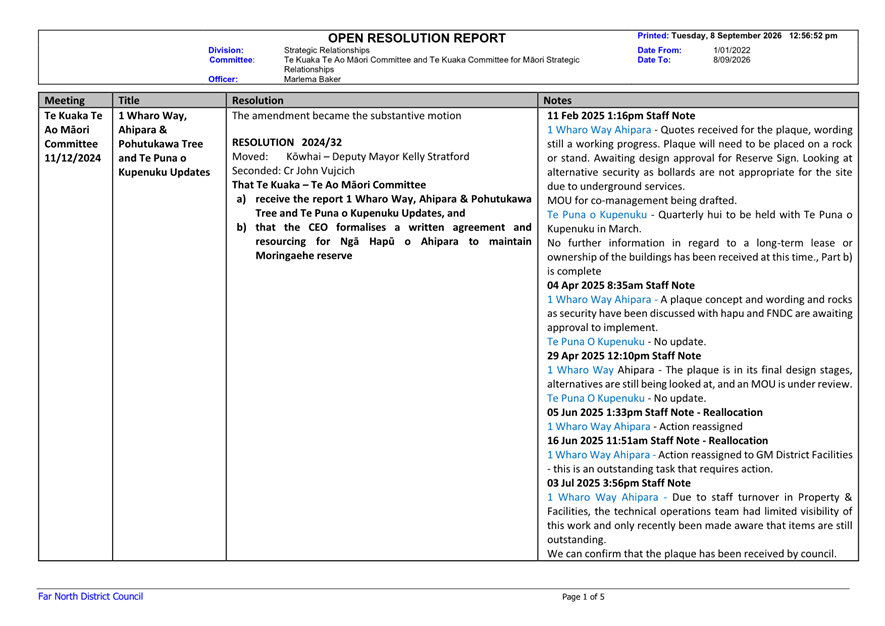
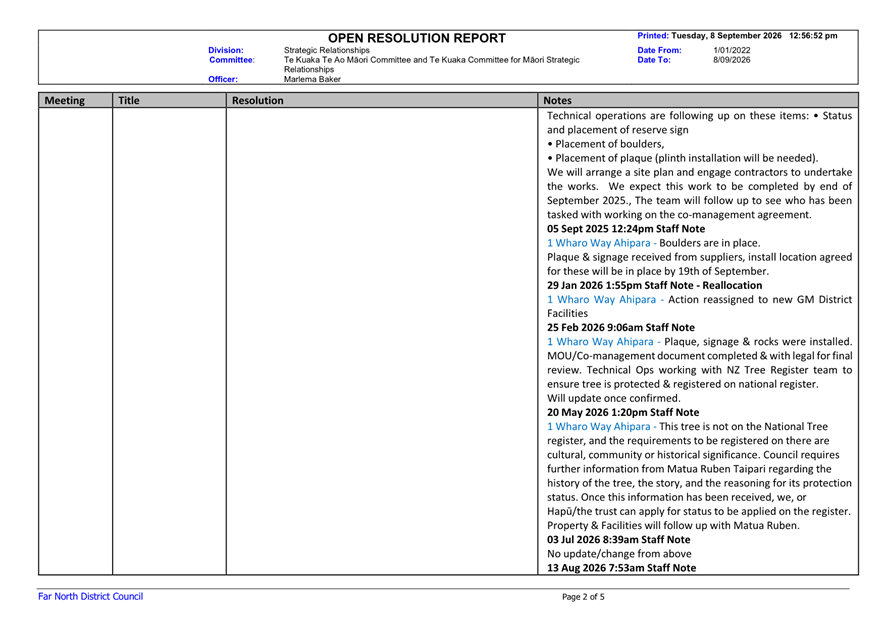
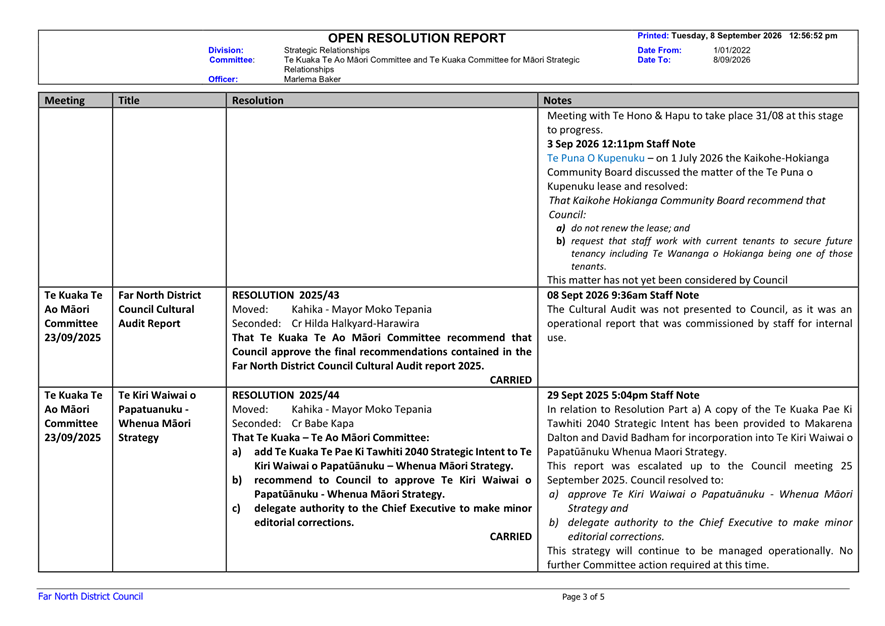
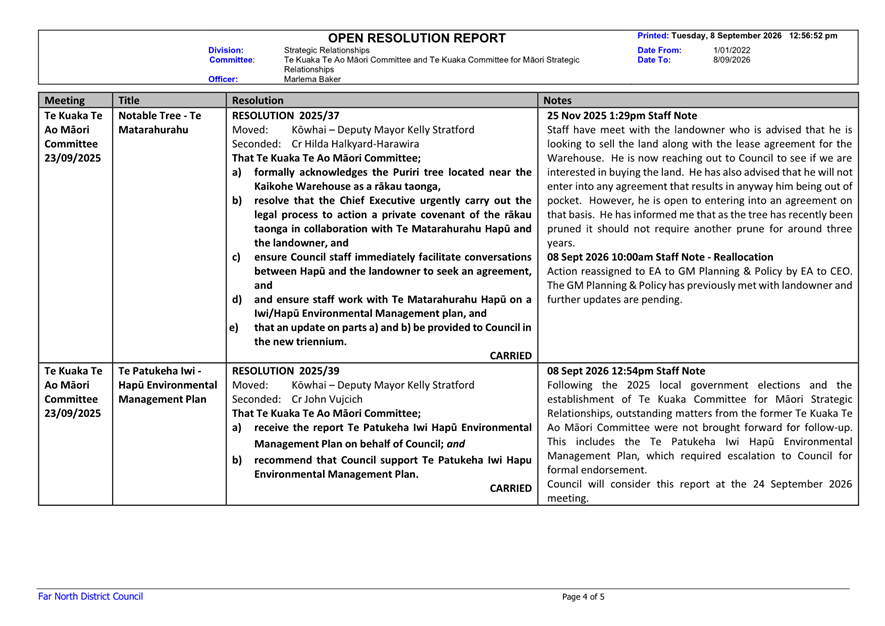
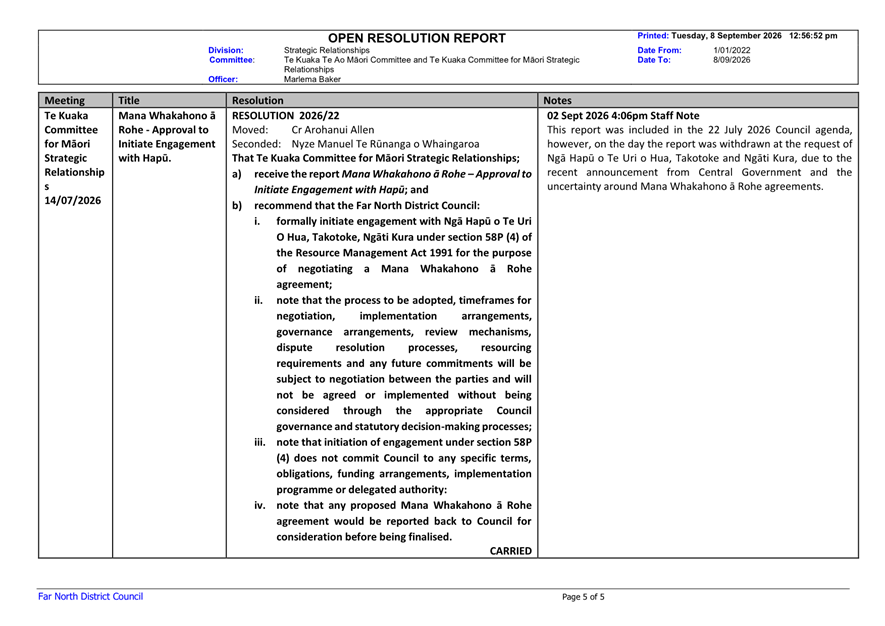
|
Ordinary
Te Kuaka Committee for Māori Strategic Relationships Meeting
Agenda
|
15
September 2026
|
6 Karakia
Whakamutunga / Closing Prayer
7 Te Kapinga Hui / Meeting
Close