5.2 District
Wide Spatial Strategy: Foundation Report
File
Number: A5969471
Author: Stephen
FitzHerbert, Senior Strategic Planner Growth Planning and
Placemaking
Authoriser: Kate
Ivicheva, Group Manager - Planning & Policy
Take
Pūrongo / Purpose of the Report
To seek Te Kūkupa’s endorsement of the District
Wide Spatial Strategy Foundation Report (Milestone 4) and, in doing so, confirm
the Vision, Principles and Objectives that will guide the next stage of the District
Wide Spatial Strategy programme, including the development and evaluation of
future spatial growth scenarios.
WhakarĀpopoto
matua / Executive Summary
· Milestone 4 (the Foundation Report) is a key governance decision
point in the District Wide Spatial Strategy (DWSS) programme. Te
Kūkupa’s consideration and endorsement of the Foundation Report is
consistent with its Terms of Reference, adopted by Council on 11 December 2025,
which delegate responsibility to the Committee for overseeing and providing
leadership on the development and review of Council strategies.
· By endorsing the DWSS Foundation Report, Te Kūkupa confirms the
Vision, Principles and Objectives that will guide the next stages of the DWSS,
including the development of future spatial growth scenarios, their evaluation,
while also providing a governance endorsed foundation to inform the Regional
Spatial Plan work programme.
· The Vision, Principles, and Objectives provide a clear framework to
guide the development and evaluation of future spatial growth scenarios and
ensure economic development and community wellbeing outcomes are embedded in
subsequent planning and decision-making.
· The Foundation Report has been developed through an evidence-based
process incorporating technical analysis, strategic planning work, stakeholder
engagement, and Iwi and Hapū input to create a strong foundation for
long-term district and regional spatial planning.
· The Vision, Principles and Objectives were workshopped twice with Te
Kūkupa, Community Board Chairs and Kaupapa Steering Rōpū members.
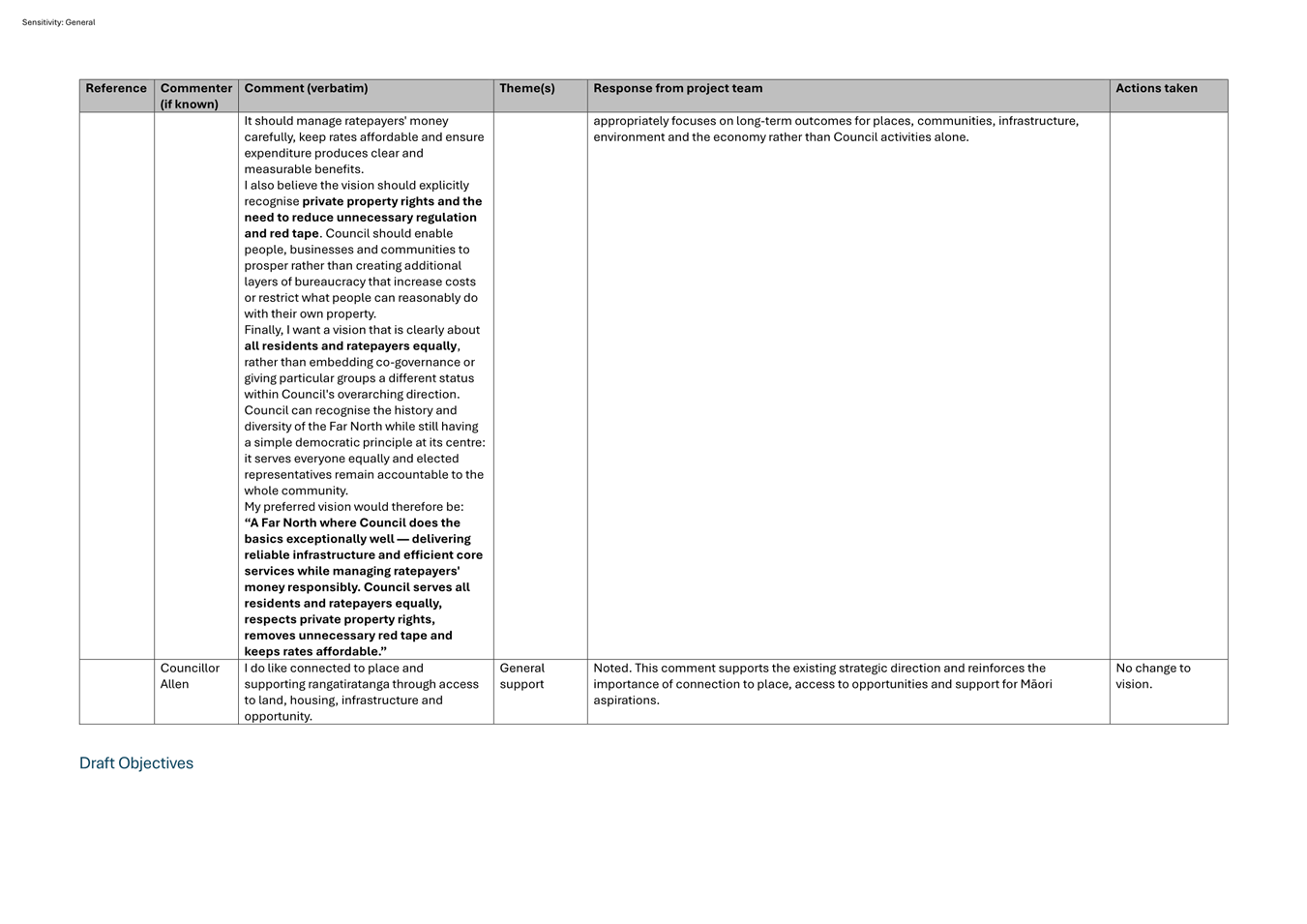
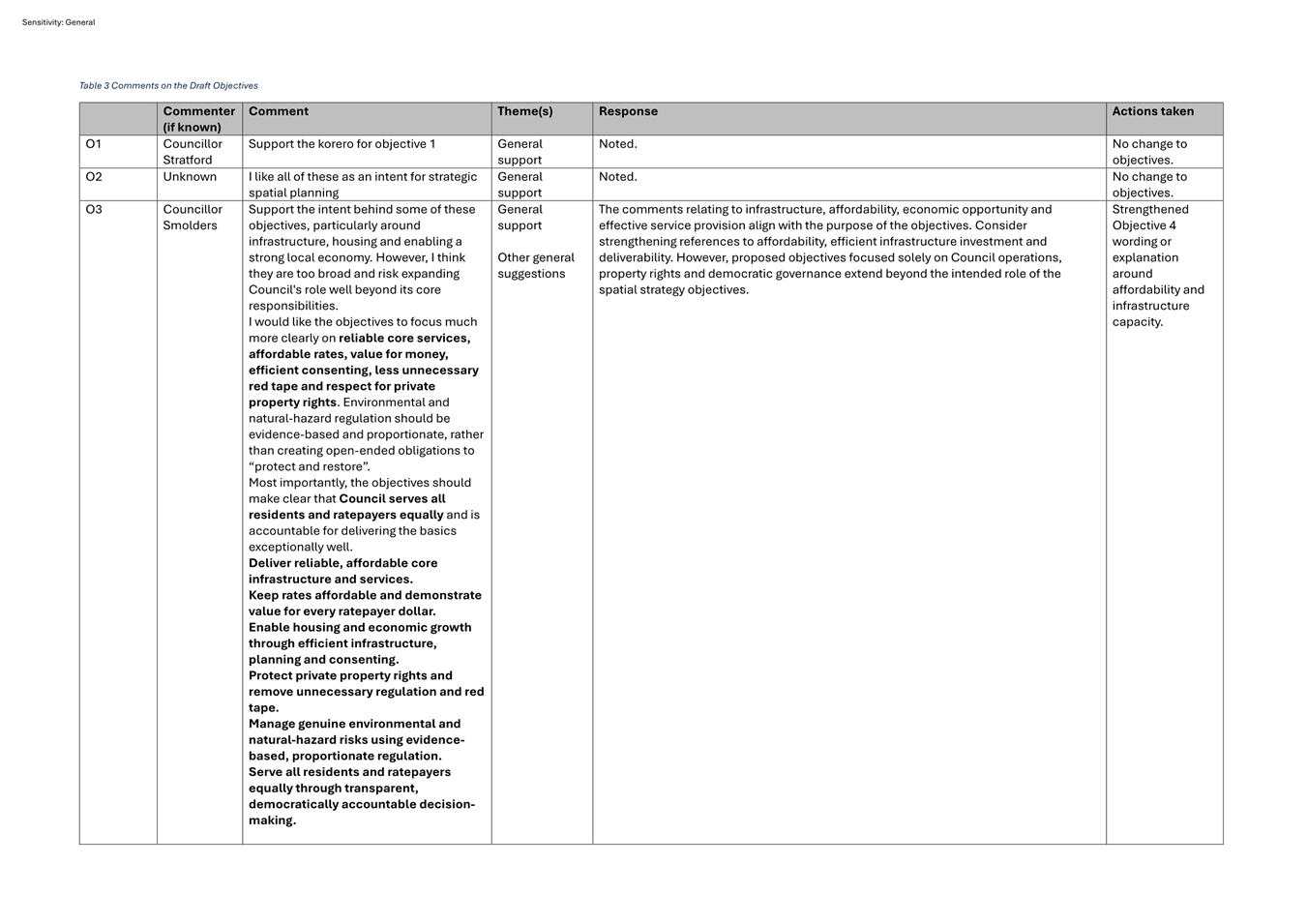
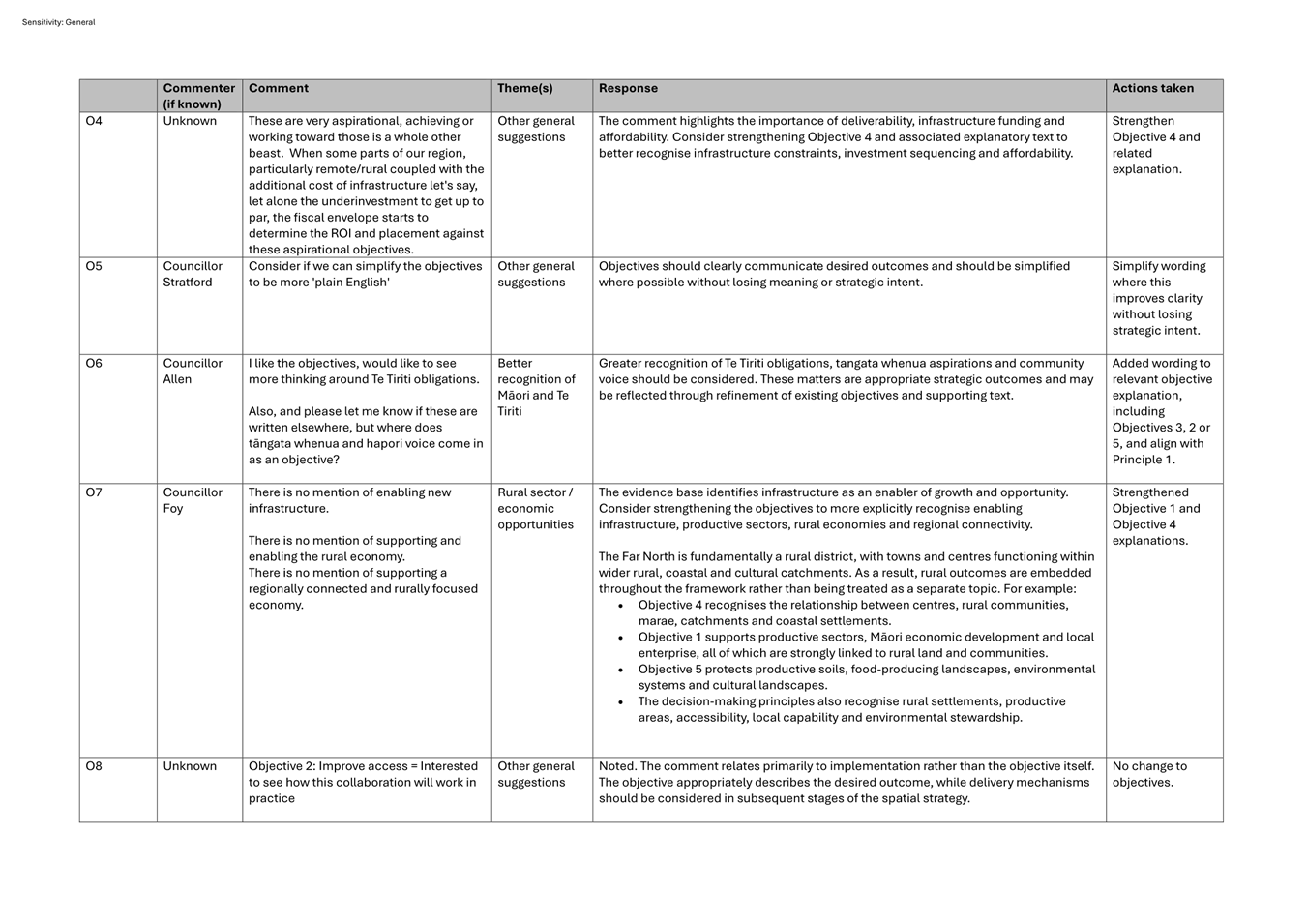
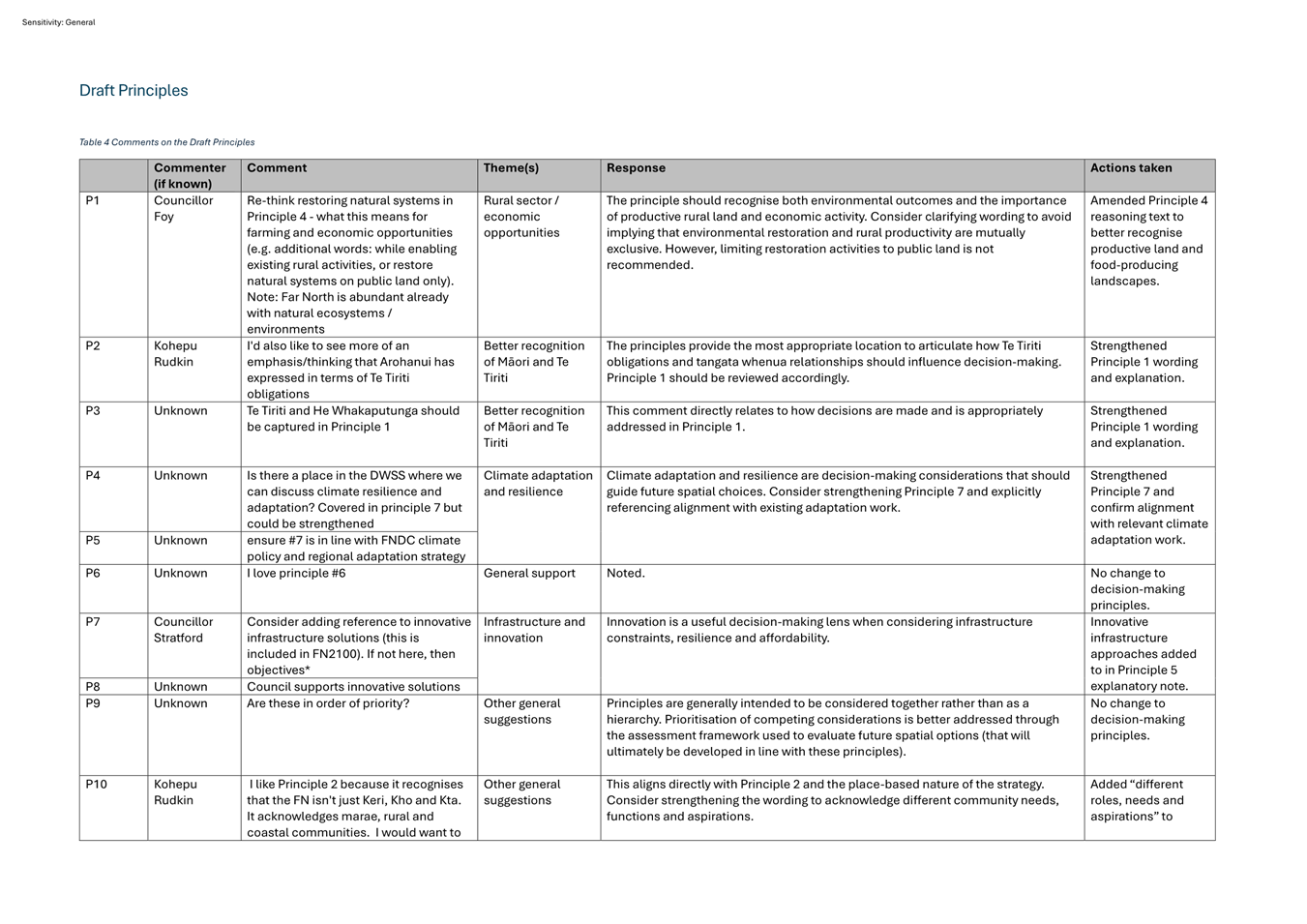
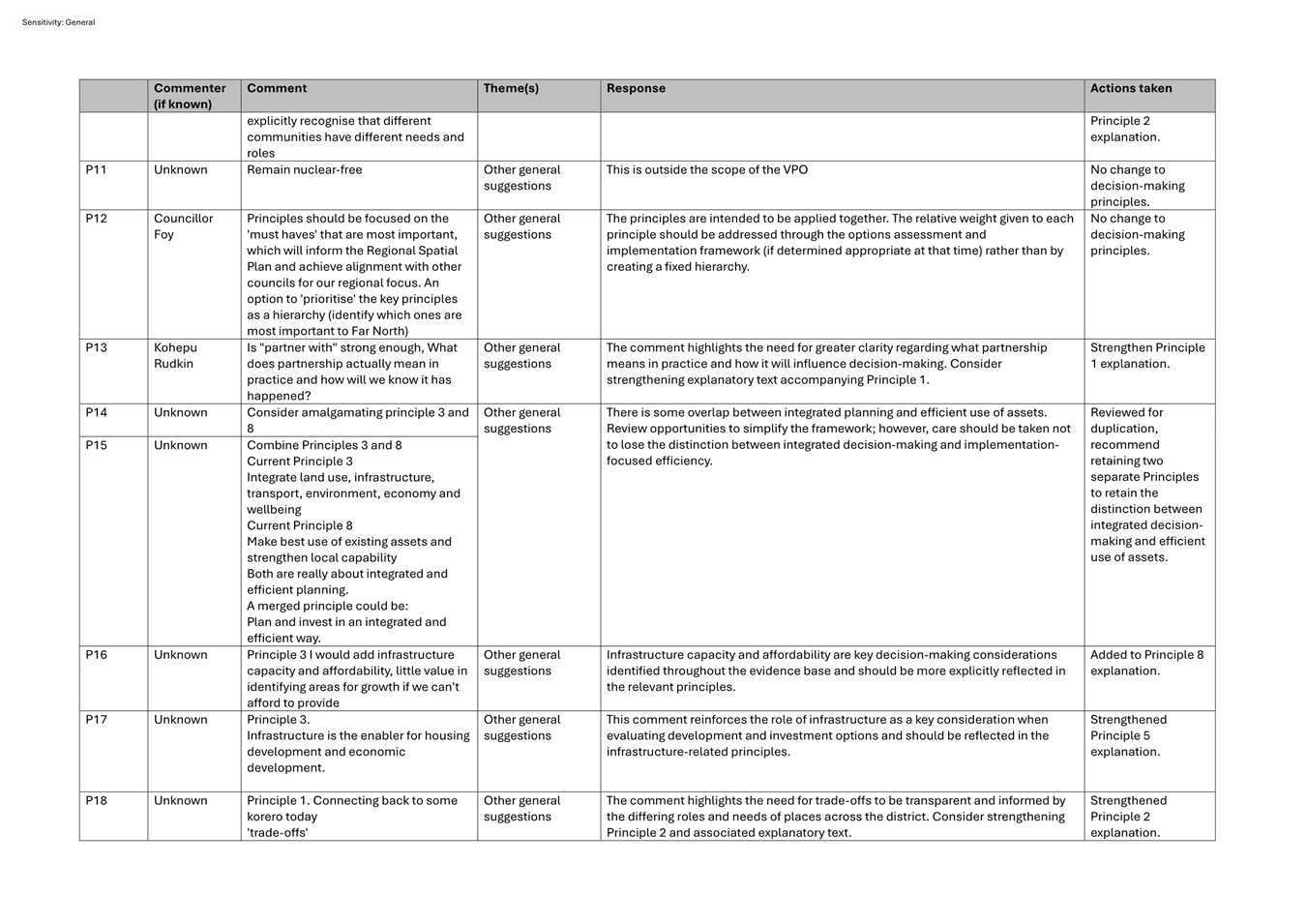
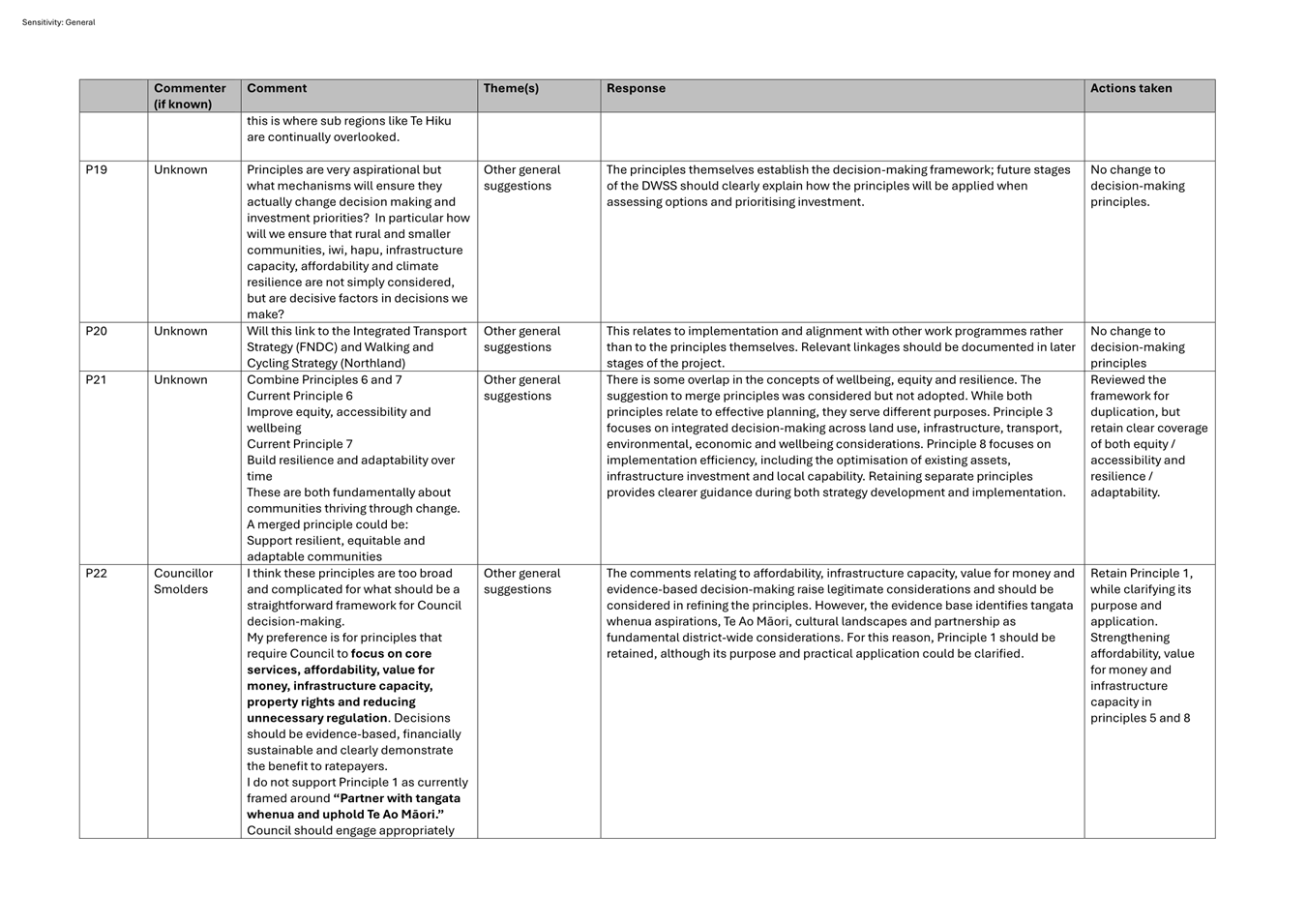
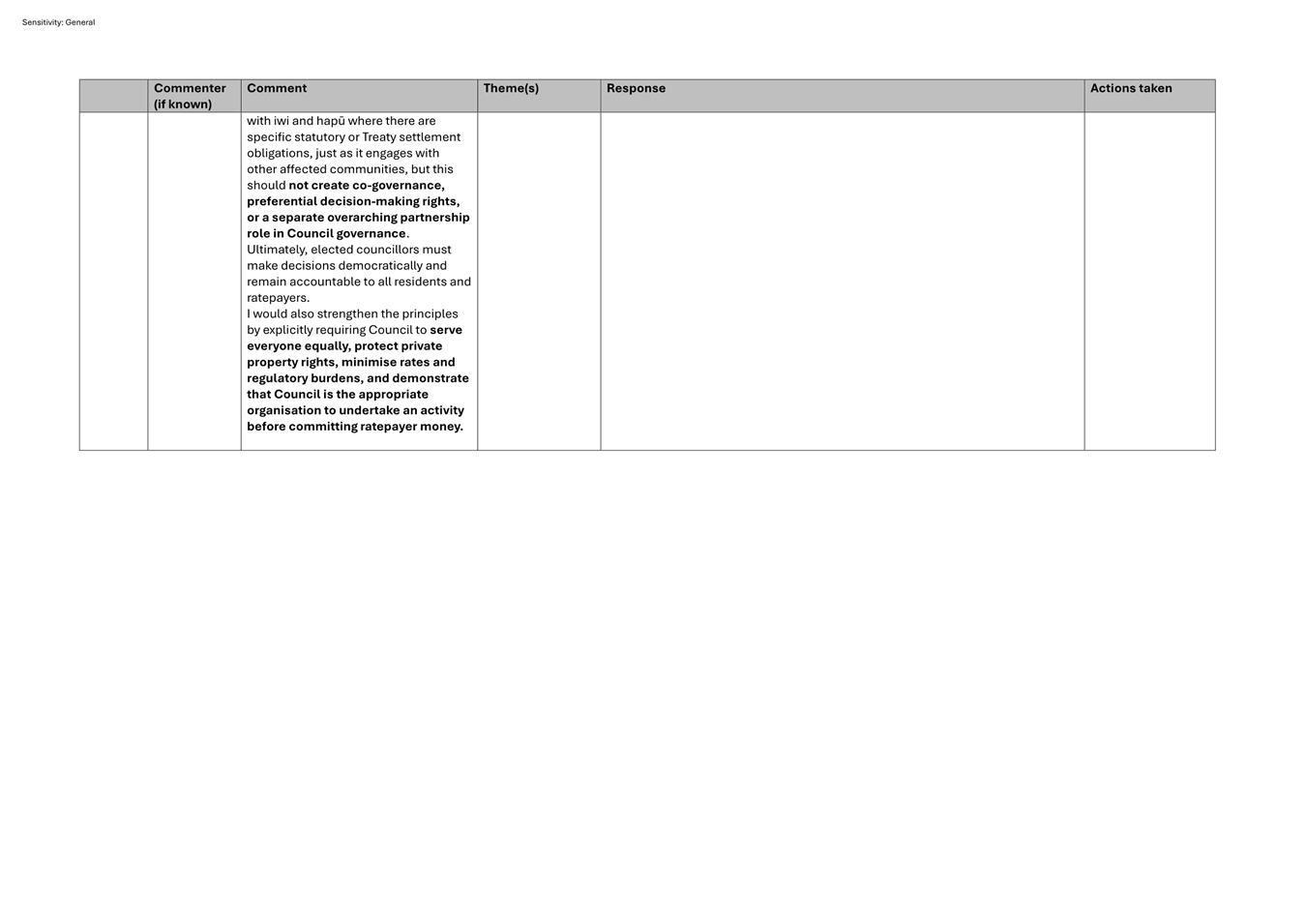
· Feedback from elected members, Community Board Chairs and Kaupapa
Steering Rōpū members strengthened the Vision,
Principles and Objectives through greater recognition of He Whakaputanga and Te
Tiriti o Waitangi, stronger emphasis on infrastructure and affordability,
enhanced recognition of rural communities and productive land, and a stronger
focus on climate resilience and long-term decision-making.
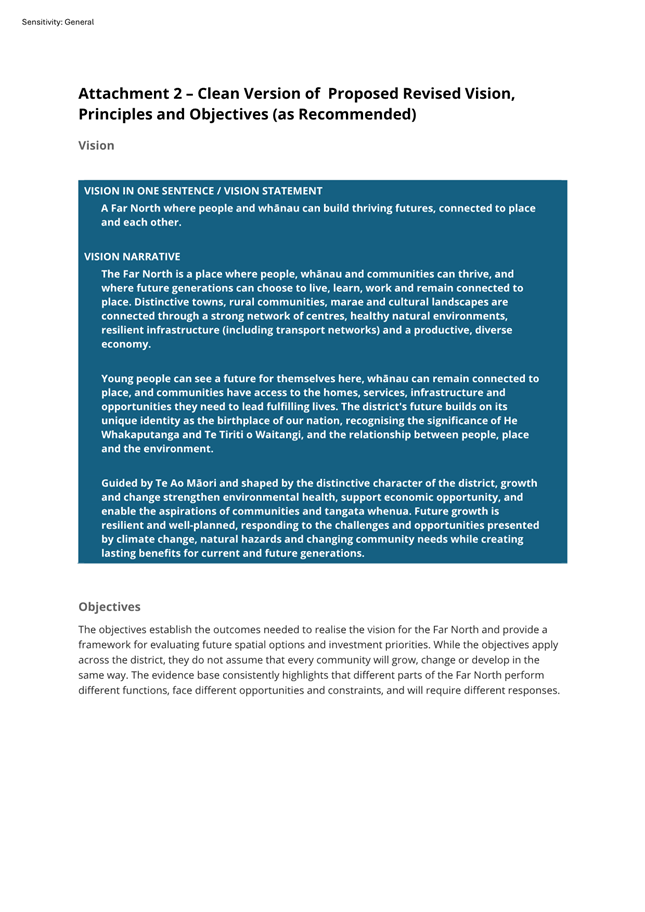
· The vision is for "a Far North where people and whānau can
build thriving futures, connected to place and each other", supported by
objectives focused on economic prosperity, strong communities, equitable access
to services and housing, infrastructure-led growth, and environmental and
cultural stewardship.
· The refined Vision, Principles and Objectives and an update from the
Kaupapa Steering Rōpū were presented to and received by Te
Kuaka Committee for Māori
Strategic Relationships on 15 September 2026, who supported their advancement
to Te Kūkupa.
|
tŪtohunga
/ Recommendation
That Te Kūkupa Committee for
Strategy, Policy and Regulation:
a) endorse
the District Wide Spatial Strategy Foundation Report, which includes the
Vision, Principles and Objectives of the Strategy.
|
1)
Tāhuhu Kōrero / Background
The District Wide Spatial Strategy (DWSS) project commenced
in late 2025 and has been developed through an evidence-based process informed
by elected members, mana whenua, stakeholders and the wider community. Rather
than starting with predetermined growth areas or fixed outcomes, the project
has focused on developing a robust understanding of the Far North's current
conditions, future challenges, opportunities, and aspirations. This has
involved integrating technical investigations, strategic and policy reviews,
community and stakeholder feedback, Iwi and Hapū perspectives, and spatial
analysis to build a shared evidence base. Together, these inputs have helped
identify the key factors that will shape the district's future and provide a
strong foundation for informed decision-making and long-term planning.
The DWSS is being progressed in advance of forthcoming
reforms to New Zealand’s resource management system and the eventual
development of a regional spatial plan. By preparing a district wide strategy
now, FNDC can establish a strong local evidence base that reflects community
aspirations, Hapū and Iwi priorities, growth trends, infrastructure
requirements, and environmental priorities. This proactive approach ensures the
district is well positioned to influence and contribute to future regional
planning processes. In the meantime, the strategy provides a clear long-term strategic
framework to support Council decision-making, helping to guide investment,
planning, and development choices until a regional spatial plan is prepared,
formally adopted, and becomes the primary mechanism for spatial planning.
A spatial strategy is a strategic guide rather than a rigid
legal definition or binding regulatory rule. A key intent of the DWSS Vision,
Principles and Objectives is that people can recognise themselves, their
communities, their values and their aspirations within the strategy, ensuring
it functions as an enabling framework that implicitly supports a wide range of
activities and opportunities aligned with the district's long-term outcomes,
rather than defining them narrowly or excluding them.
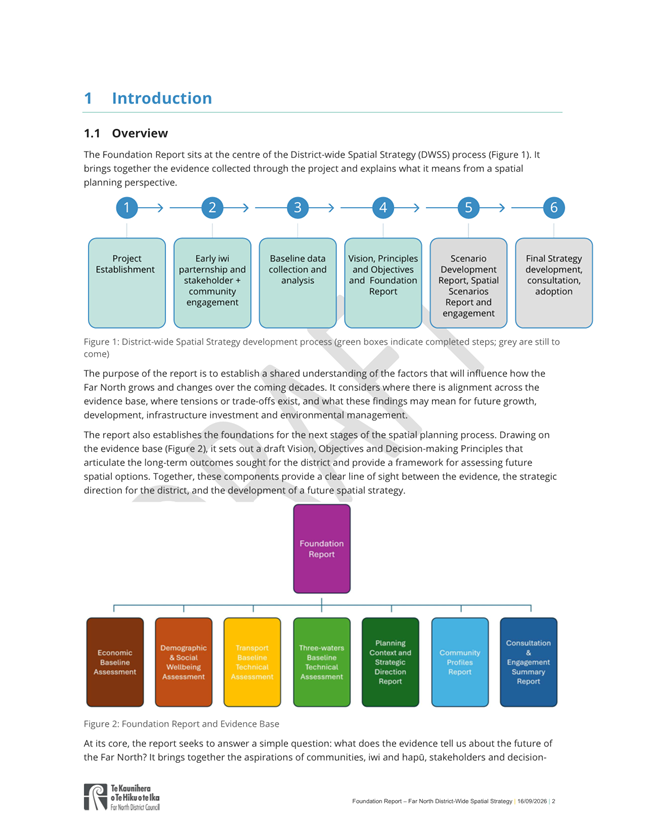
The DWSS work programme has six milestones:
1. Project
establishment
2. Early
Hapū and Iwi partnership and stakeholder and community engagement
3. Baseline
data collection and analysis
4. Vision,
principles and objectives and Foundation report (current stage)
5. Scenario
development report, spatial scenarios report and engagement
6. Final
DWSS development, consultation and adoption
The development of the Vision, Principles and Objectives has
been informed by the earlier stages of evidence and engagement (Milestones 1-3)
and recent workshops with elected members and the Kaupapa Steering
Rōpū. Te Kuaka received the refined Vision, Principles and Objectives
on 15 September 2026, and supported their advancement to Te Kūkupa.
2) matapaki me
NgĀ KŌwhiringa / Discussion and Options
A key focus of Milestone 4 has been the creation of the District
Wide Spatial Strategy (DWSS) Foundation Report and the associated Vision,
Principles and Objectives. Together these components establish the strategic
foundation for future spatial planning in the Far North. Work to complete
Milestone 4 progressed during July and August. Key activities involved two
workshops with elected members and the Kaupapa Steering Rōpū, as well
as engagement with stakeholder groups. Through a combination of evidence
analysis, engagement with Iwi and Hapū, stakeholders, elected members, and
the Kaupapa Steering Rōpū, the Vision, Principles and Objectives have
been shaped to reflect community aspirations, district-wide opportunities and
challenges, and the long-term outcomes sought for the Far North. This section
outlines the content of the Foundation Report and the process undertaken to draft
and refine the Vision, Principles and Objectives.
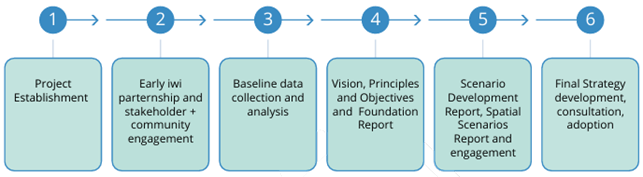
Item 2.1. District Wide Spatial Strategy development process
Foundation Report
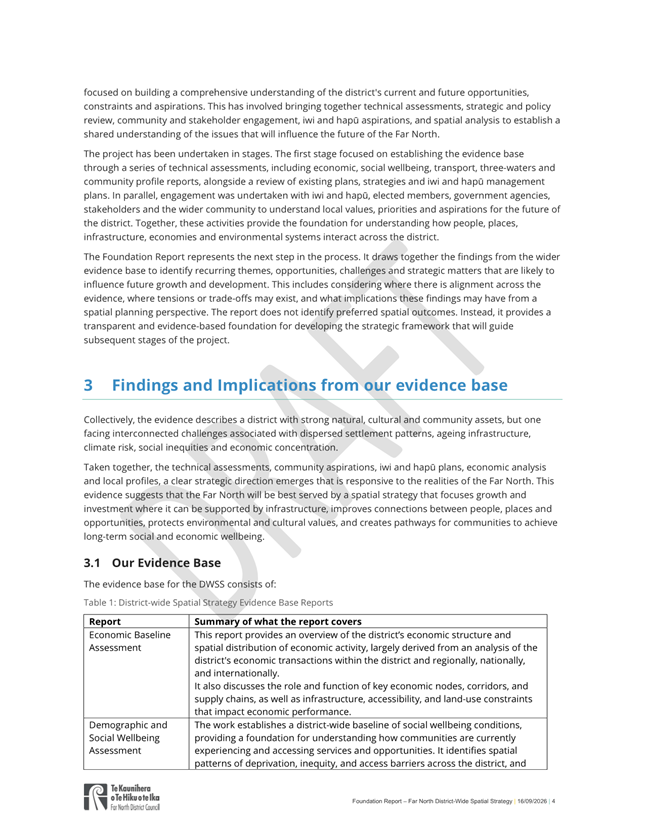
The DWSS Foundation Report (see Attachment 1) is the key
strategic foundation document for the Far North District-Wide Spatial Strategy
(DWSS). Its primary purpose is to bring together the extensive evidence
gathered through technical assessments, community engagement, iwi and hapū
aspirations, and strategic planning reviews to establish a shared understanding
of the opportunities, challenges and choices that will influence how the Far
North grows and changes over the coming decades. The report does not determine
where future growth should occur; instead, it provides the evidence-based
framework that will guide the development and assessment of future spatial
options.
The report begins by setting out the context for spatial
planning in the Far North, explaining what a spatial strategy is, why it is
being developed ahead of resource management reforms, and how the project has
been undertaken to date. It emphasises an evidence-led, community-informed and
mana whenua-informed approach that seeks to understand the district's
aspirations, opportunities and constraints before considering future
development scenarios. This section establishes the role of the DWSS as a long-term
framework for coordinating decisions relating to land use, infrastructure,
transport, economic development, environmental management and community
wellbeing.
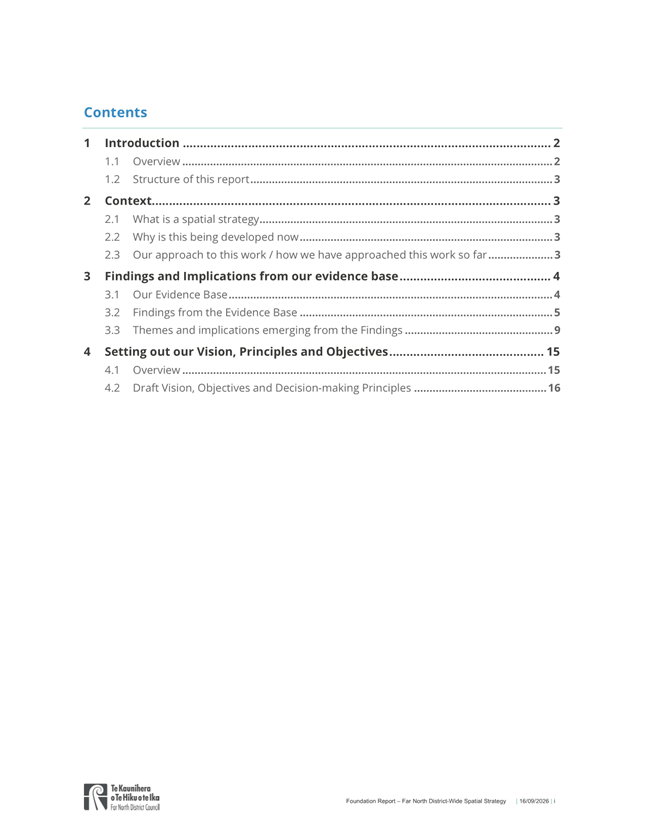
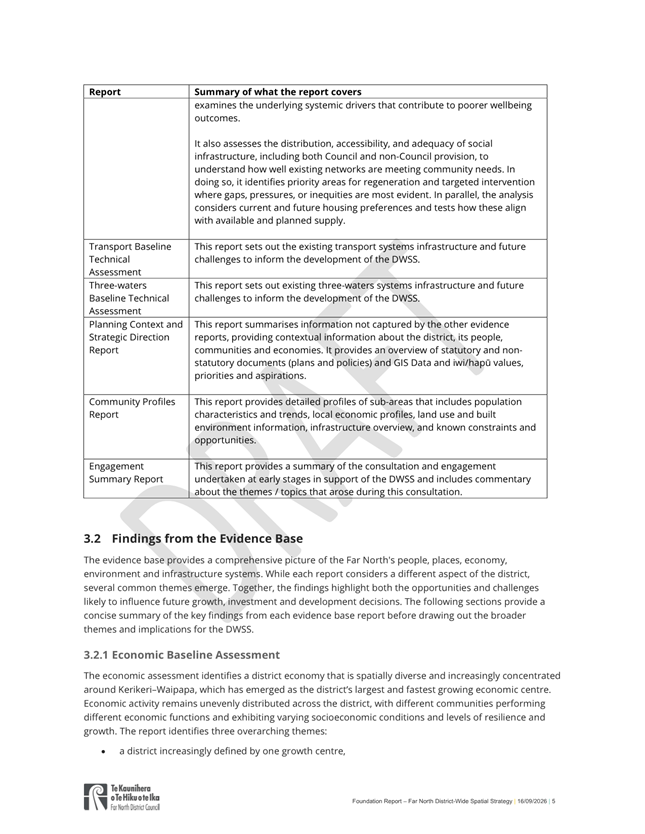
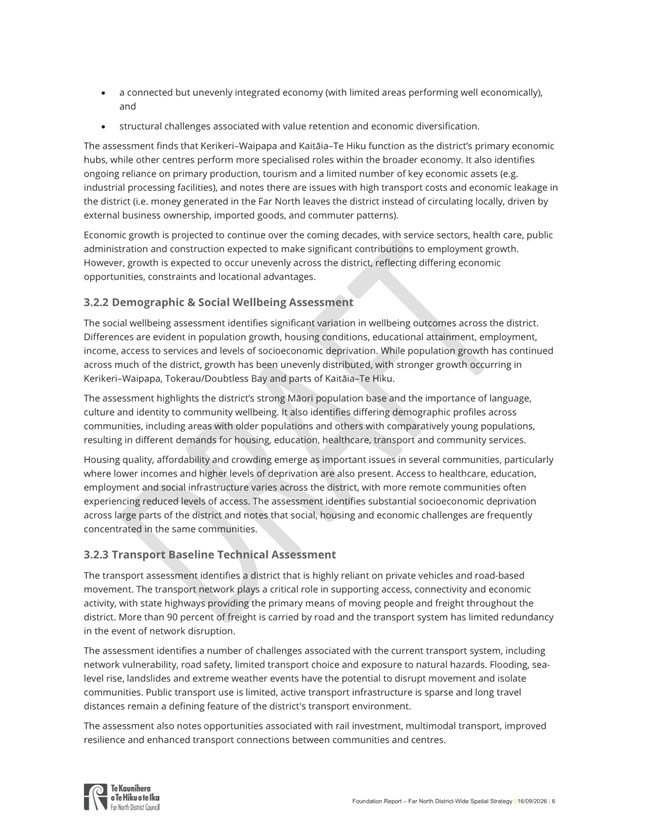
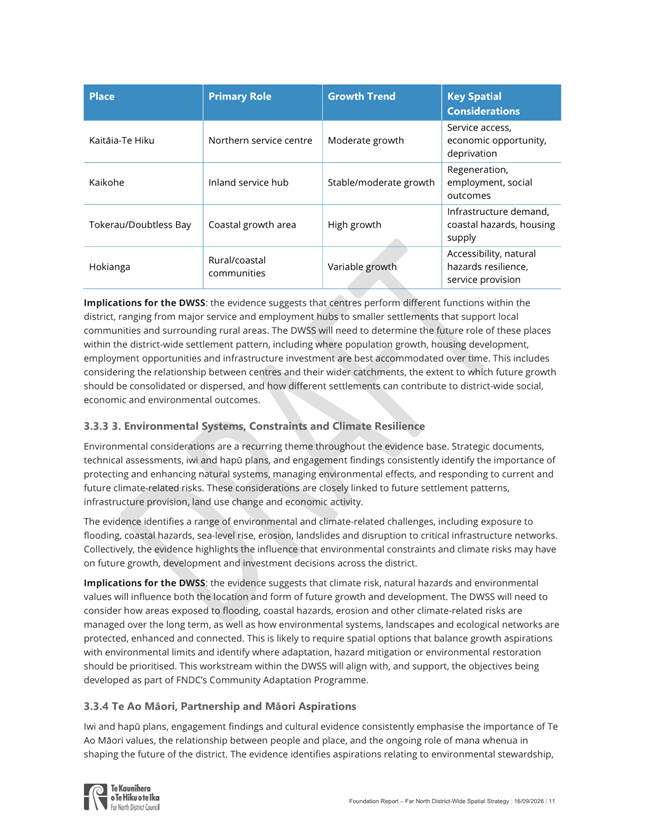
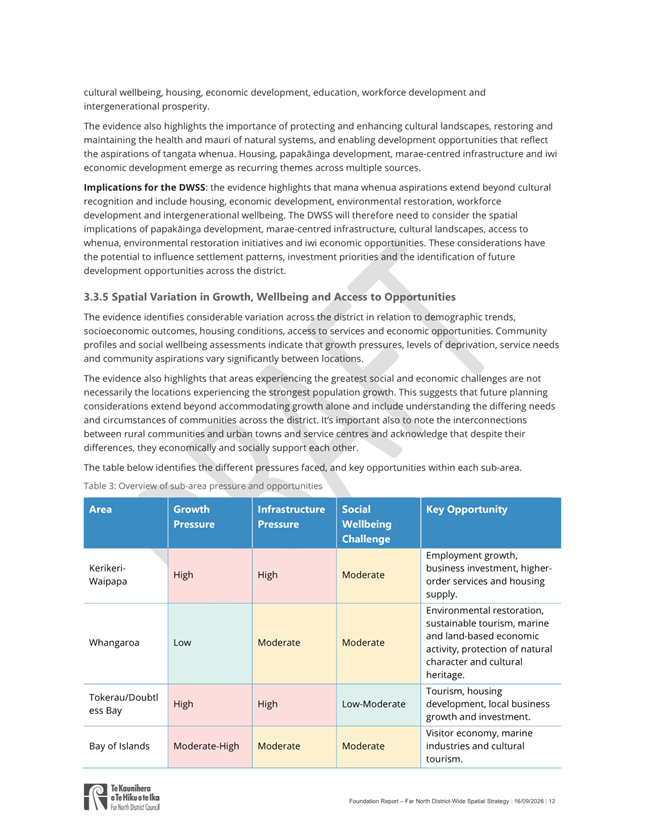
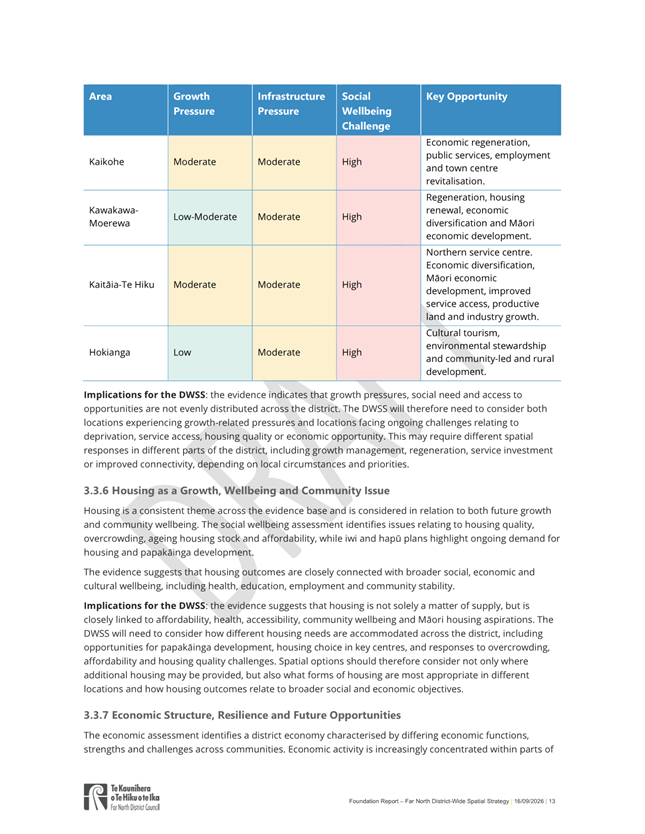
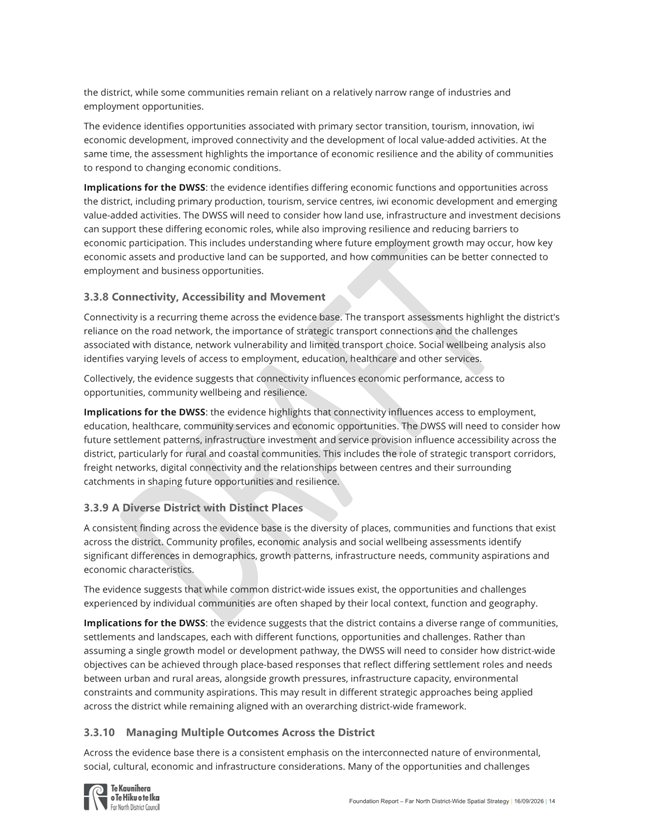
A substantial component of the Foundation Report synthesises
findings from the project's evidence base, including the Economic Baseline
Assessment, Demographic and Social Wellbeing Assessment, Transport Assessment,
Three Waters Assessment, Planning Context and Strategic Direction Report,
Community Profiles Report, and Engagement Summary Report. Together, these
studies describe a district with significant natural, cultural and economic
strengths, but one also facing infrastructure constraints, climate risks,
uneven growth patterns, housing challenges, service accessibility issues and
socioeconomic inequities. The report identifies common themes across the
evidence and explores their implications for future planning and investment
decisions.
The report then draws together these findings into a series
of district wide strategic themes that are intended to shape future spatial
planning. These include infrastructure as a critical enabler of growth and
wellbeing; the role of centres and settlement patterns; environmental
stewardship and climate resilience; Te Ao Māori and mana whenua
aspirations; housing, connectivity and economic opportunity; and the need for
place-based responses that recognise the differing roles and circumstances of
communities across the district. The report concludes that future growth and
investment will need to be more coordinated, infrastructure-led,
environmentally responsive and tailored to local circumstances rather than
applying a one-size-fits-all approach.
The final section of the Foundation Report establishes the
strategic framework for the next phase of the DWSS programme by presenting a refined
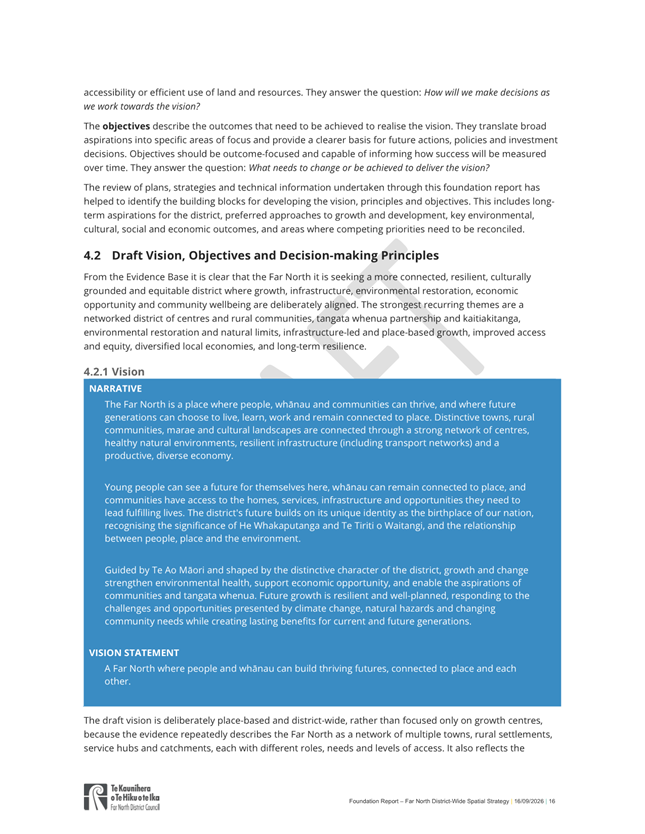
Vision, Objectives and Principles. The vision describes the desired future for
the Far North; the principles provide guidance on how decisions should be made
when evaluating spatial options and investment priorities; and the objectives
identify the key outcomes required to achieve that future. Together, these
elements create a clear line of sight between the evidence base and the future
spatial strategy, ensuring that subsequent scenario development and
decision-making are grounded in an agreed set of outcomes, values and
priorities for the district.
Drafting the Vision, Principles
and Objectives
The Vision, Principles and Objectives set the long-term
direction for the district, shaping decision-making and defining the outcomes
the strategy aims to achieve. They provide the framework for evaluating spatial
options, prioritising investment, and coordinating future decisions relating to
land use, infrastructure, environmental management, community development, and
the incorporation of Te Ao Māori priorities and values. In essence, every
decision made through the spatial strategy will be directly guided by and
aligned with these foundations.
The vision sets out the district’s long-term
direction and describes the future it is working towards. It reflects the
aspirations of the community, Iwi and Hapū, stakeholders, and
decision-makers, and establishes a common purpose for the strategy. The vision
provides a framework for balancing immediate needs with longer-term goals,
ensuring decisions remain aligned with the desired future. In simple terms, the
vision answers the question of what we want the district to be in the years
ahead.
The principles guide how decisions are made in
pursuit of the vision. They establish a common set of criteria that can be
applied across a wide range of planning and investment decisions, helping to
ensure consistency over time. Where competing priorities or trade-offs exist,
the principles provide a basis for evaluating options and determining the most
appropriate course of action. In simple terms, they answer the question: How
will we make decisions as we work towards our desired future?
The objectives identify the changes and outcomes
required to achieve the vision. They turn broad aspirations into clear
priorities that can guide planning, policy development, and investment
decisions. Objectives also provide a framework for monitoring progress and assessing
whether the strategy is delivering the intended results. In simple terms, they
answer the question: What do we need to achieve to deliver the vision?
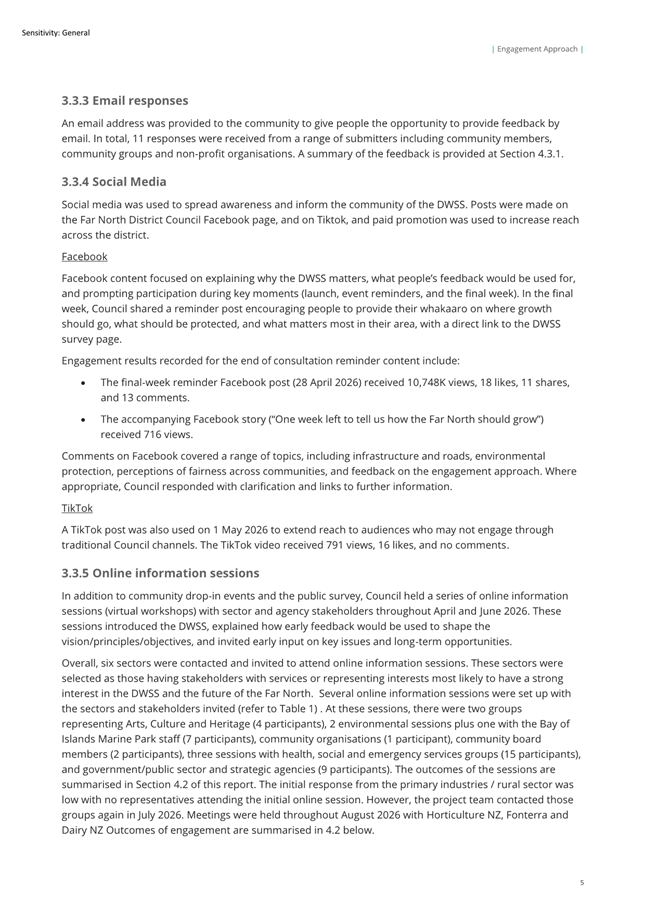
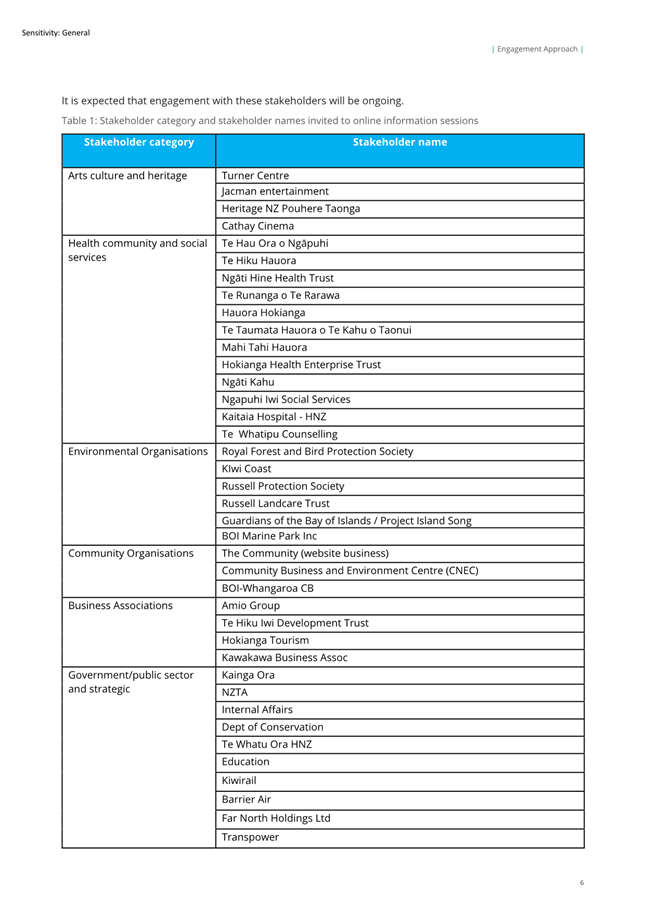
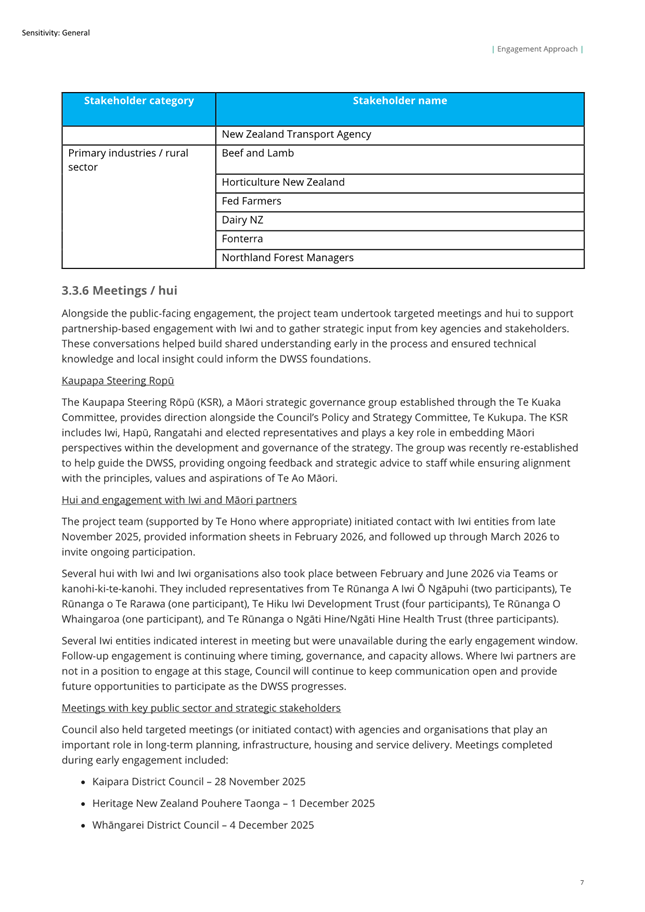
The DWSS project team undertook Iwi, stakeholder and public
engagement and reviewed relevant plans, strategies, technical information and
evidence to identify the district's key aspirations, growth and development
priorities, desired environmental, cultural, social and economic outcomes, and
areas where competing interests need to be reconciled. The evidence base
articulated a strong collective aspiration for the Far North to become a more
connected, resilient, culturally grounded and inclusive district, where growth,
infrastructure, environmental stewardship, economic prosperity and community
wellbeing are planned and delivered in an integrated way. The key themes
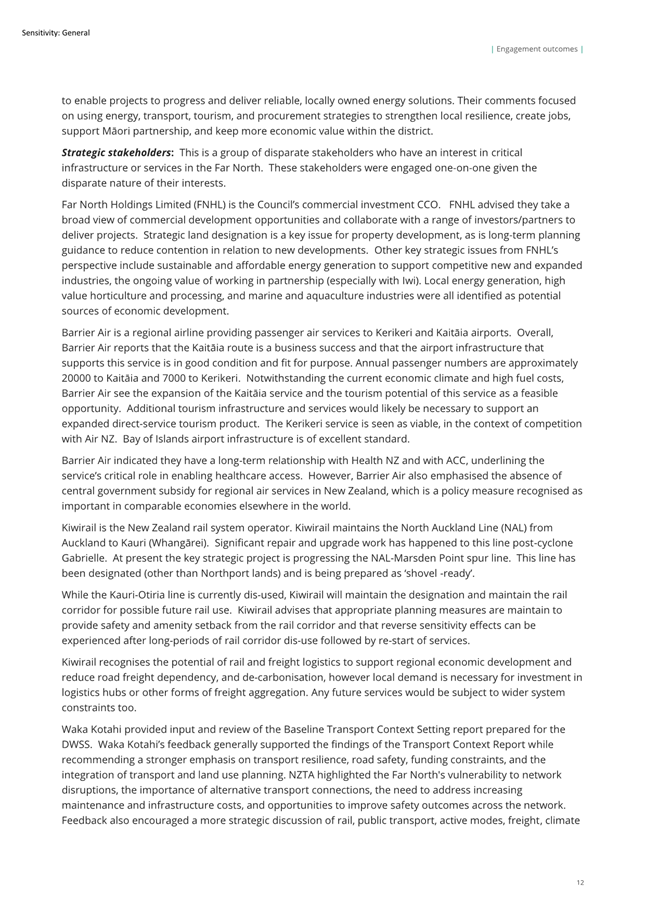
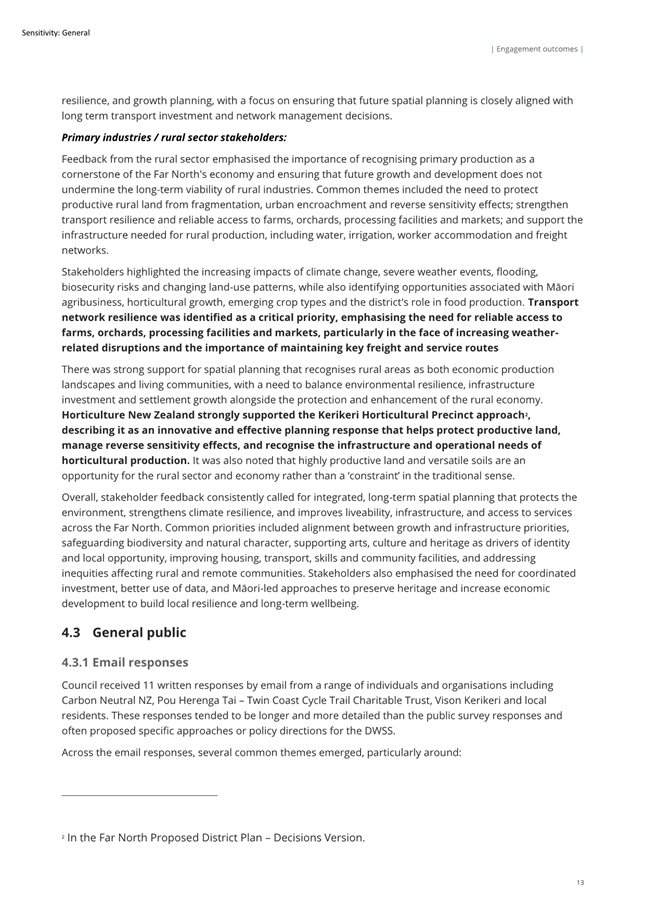
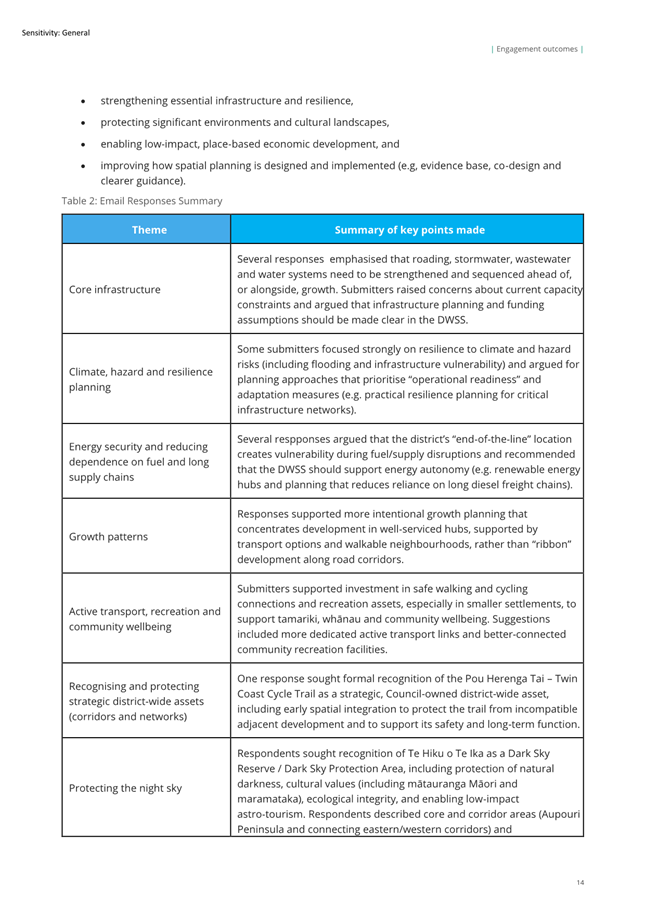
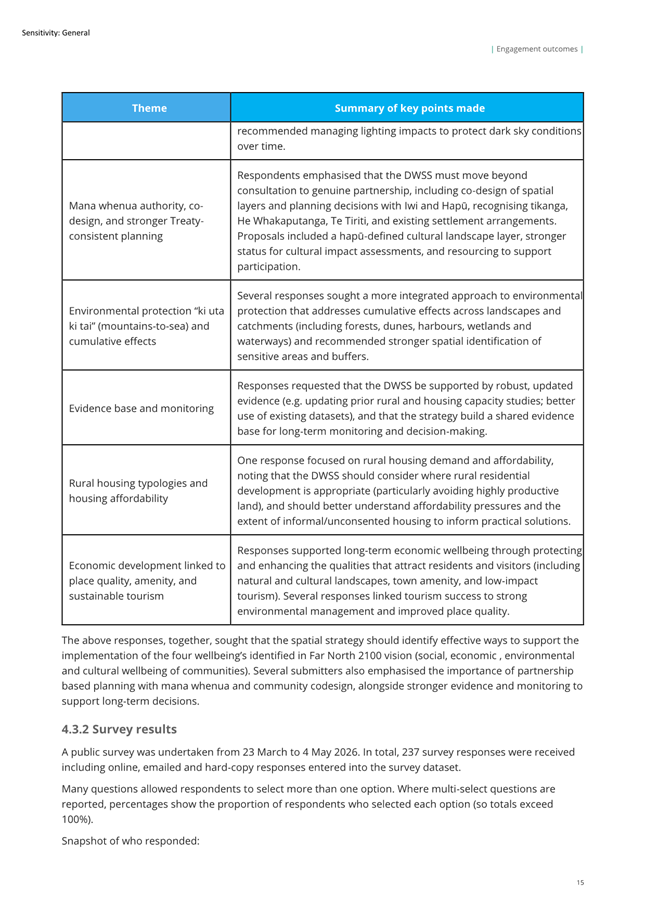
consistently emerging across the evidence included:
- a
network of thriving centres and rural communities,
- meaningful
partnerships with tangata whenua and the expression of kaitiakitanga,
- environmental
enhancement within natural limits,
- infrastructure-enabled
and place-based growth,
- equitable
access to opportunities and services,
- a
more diverse and resilient economy,
- and
long-term adaptability to future challenges.
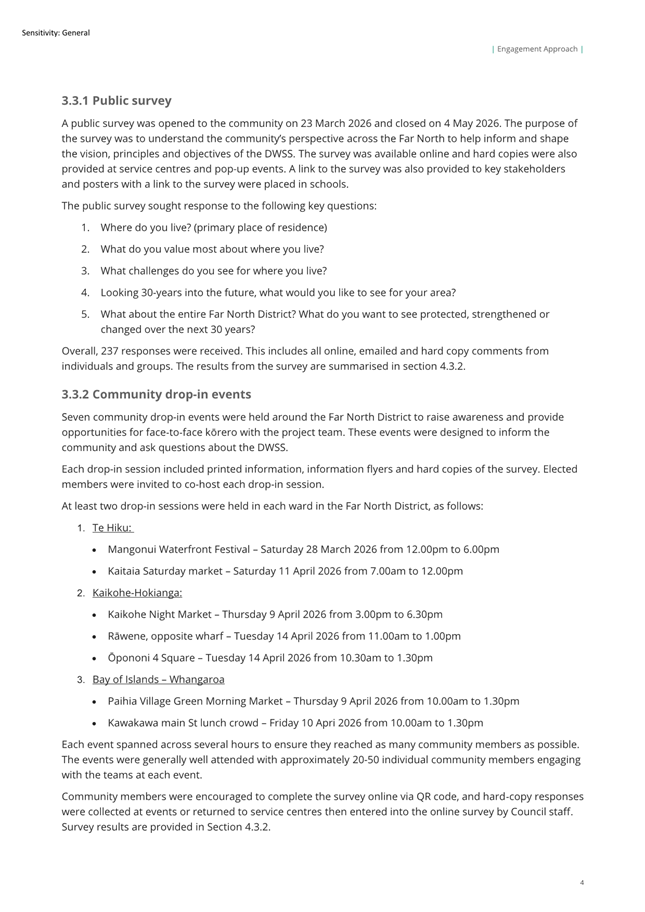
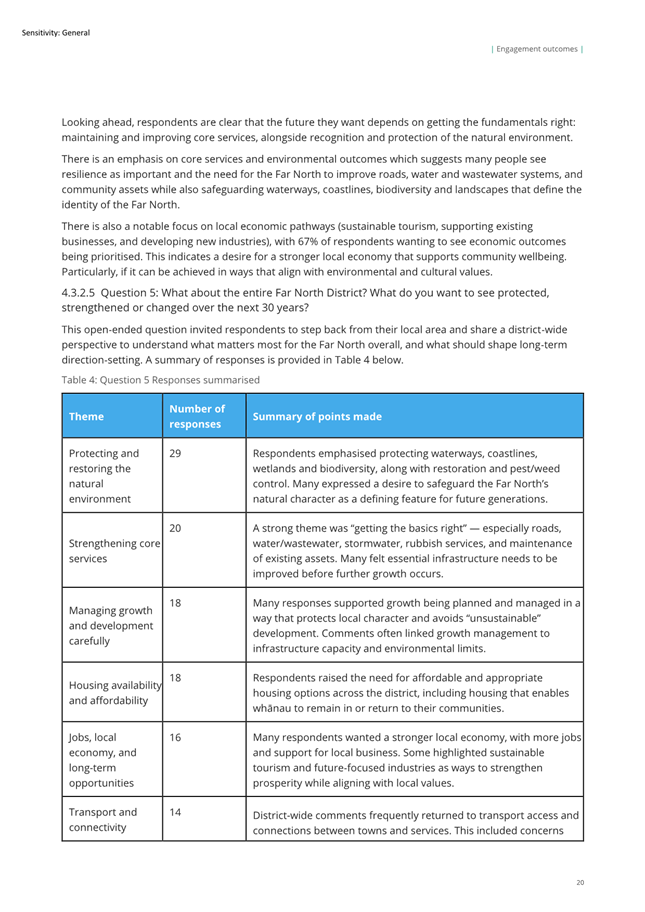
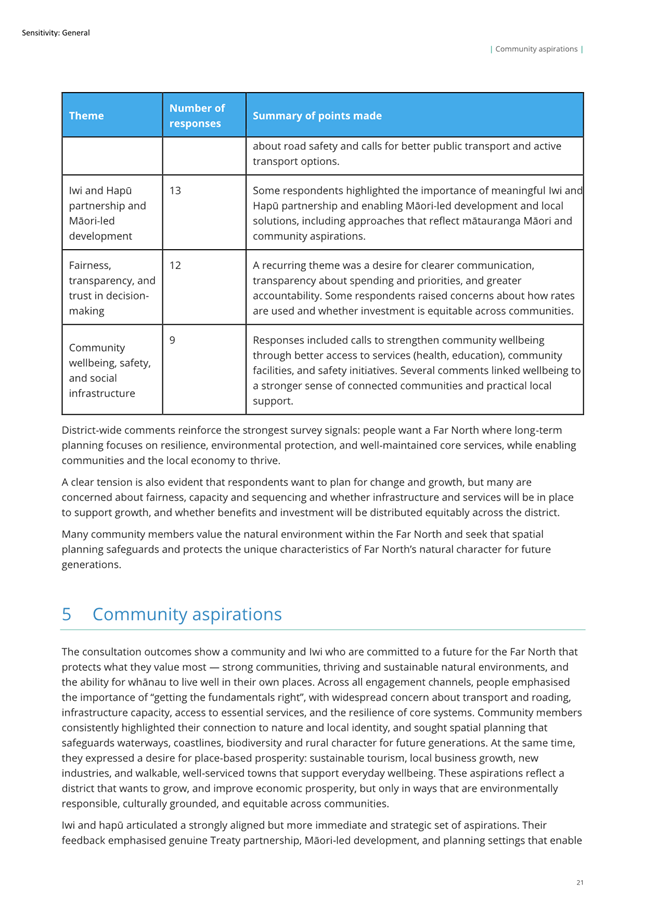
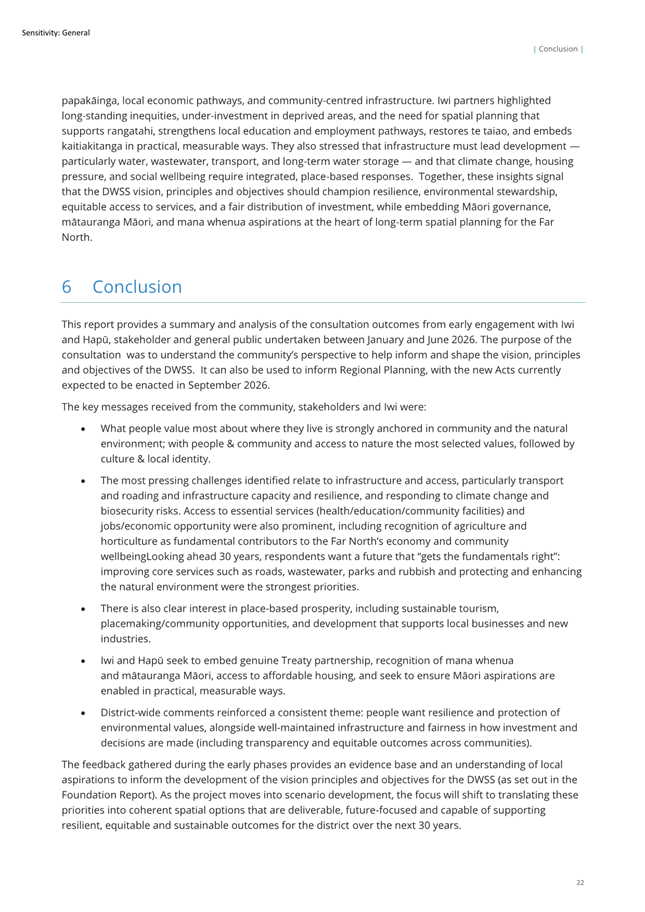
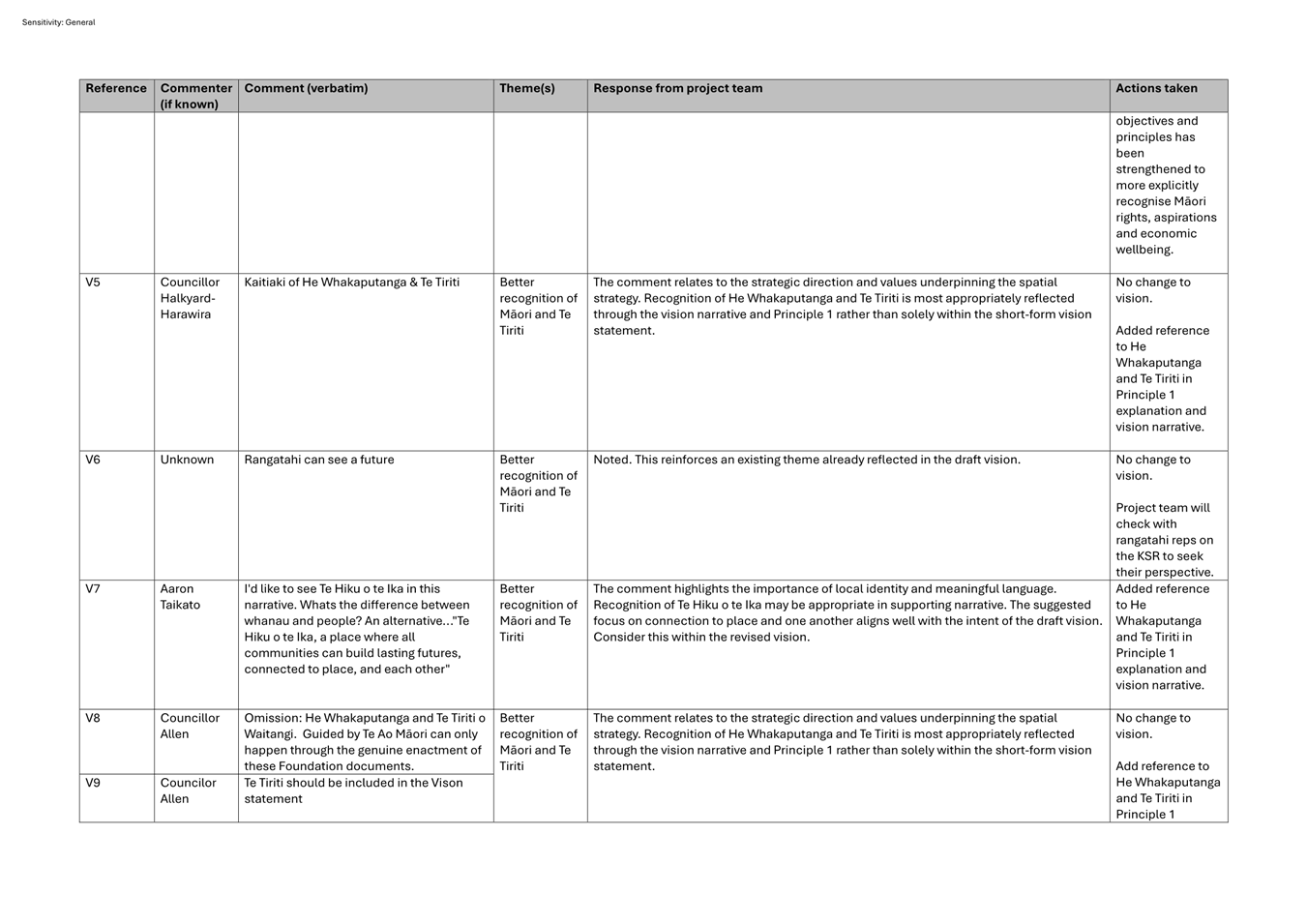
The initial baseline evidence findings were workshopped with
elected members (Te Kūkupa and Community Board Chairs) and the Kaupapa
Steering Rōpū on 8 July 2026. The evidence base comprised economic,
social and wellbeing, transport, planning context as well as strategic
direction, community profiles and an engagement summary report (see Attachment
2). The workshop findings were assessed alongside the evidence base, which
informed the establishment of the draft Vision, Principles and Objectives.
Refining the draft Vision,
Principles and Objectives
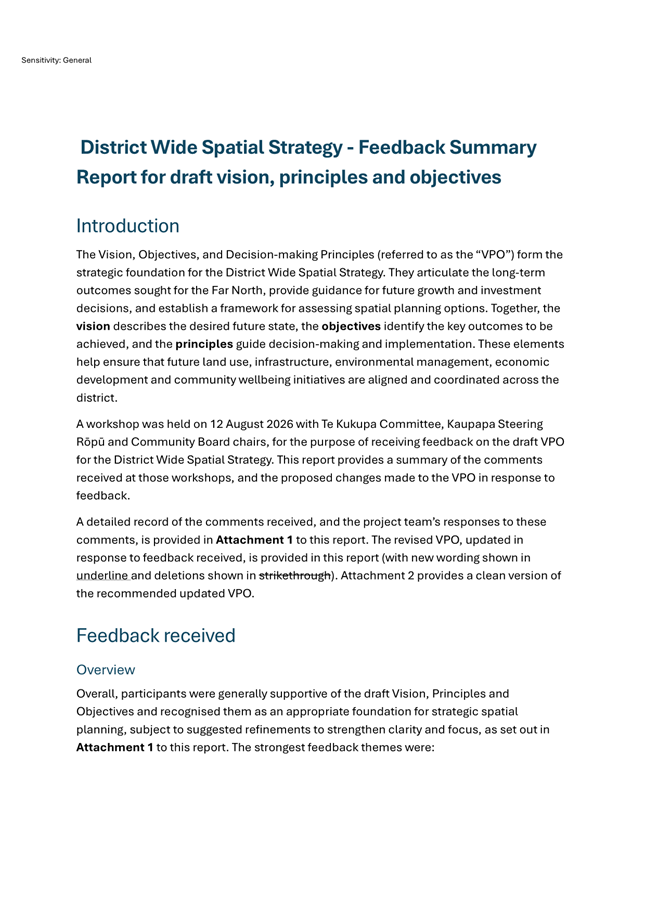
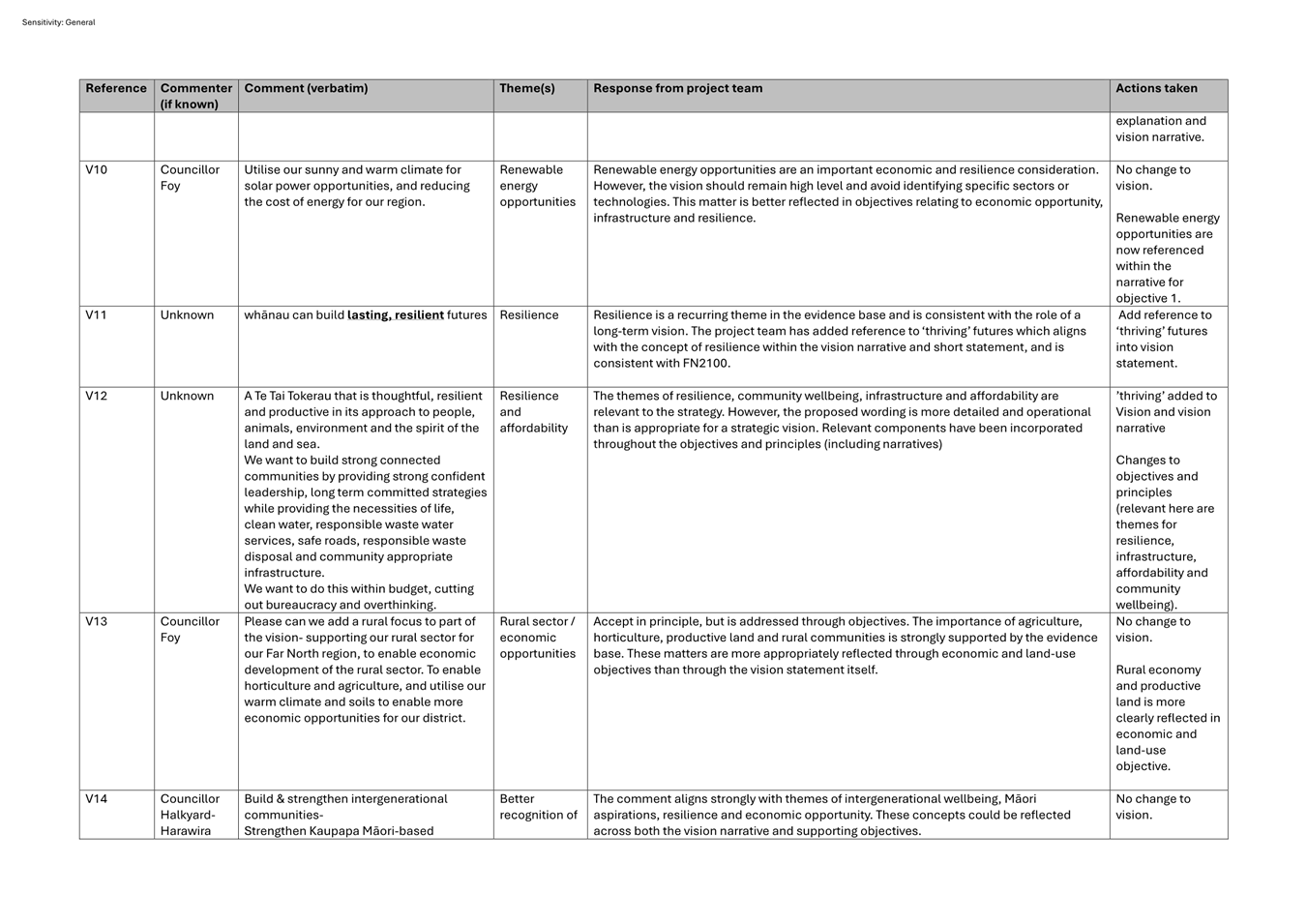
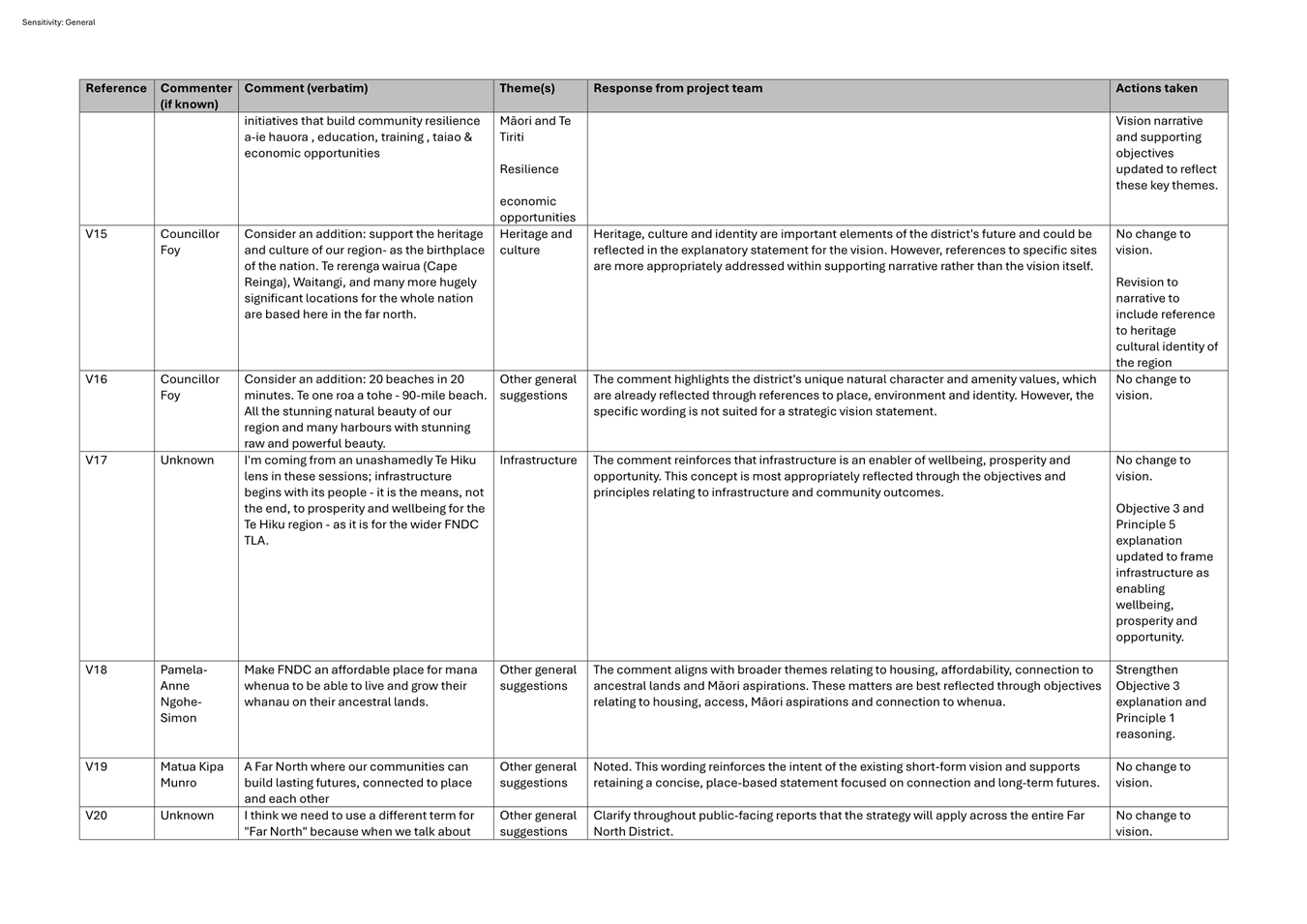
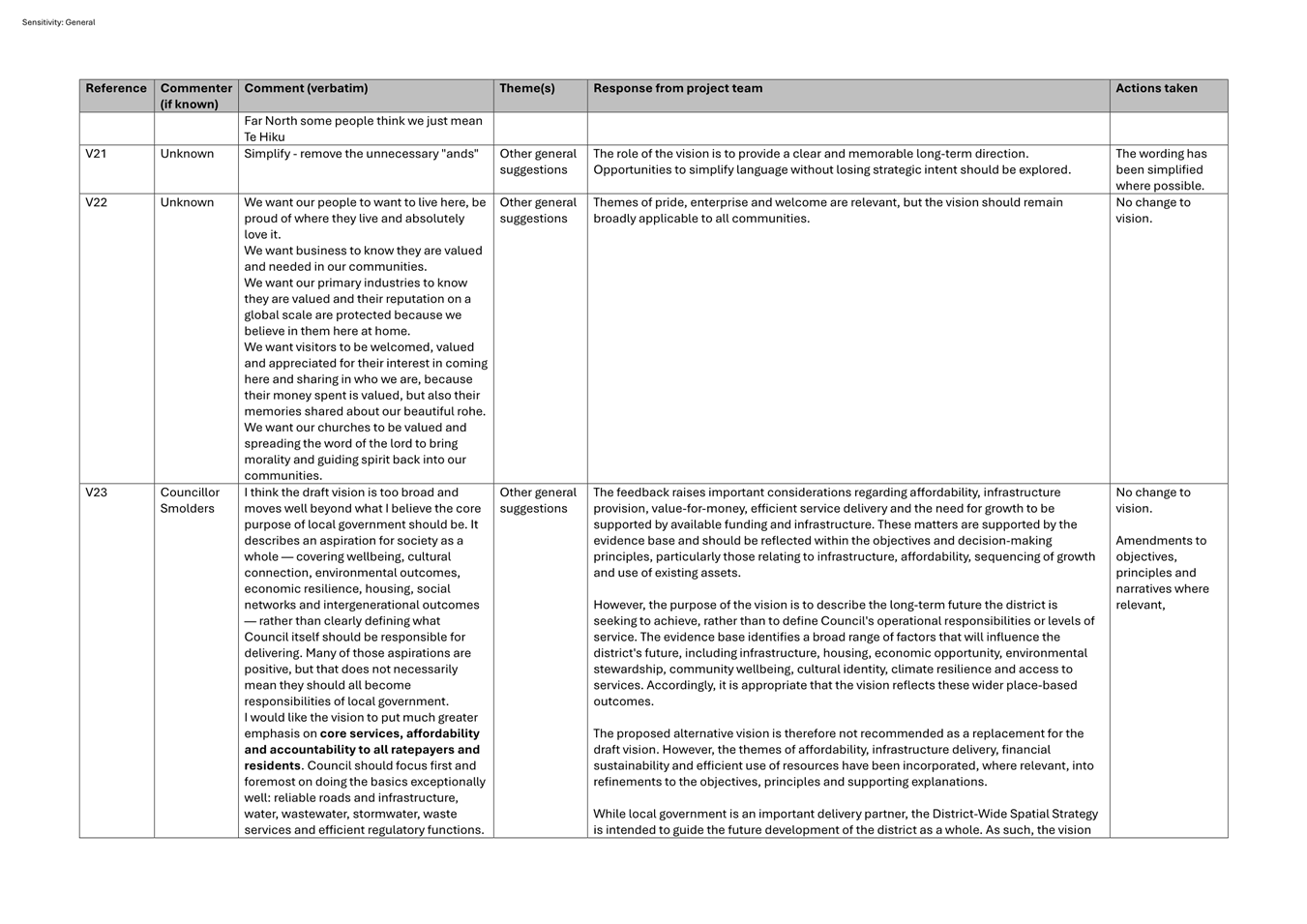
Two engagement activities were undertaken to refine the
draft Vision, Principles and Objectives. Firstly, a workshop was held with Te Kūkupa,
the Kaupapa Steering Rōpū and Community Board Chairs on 12 August
2026. At that workshop, Te Kūkupa, the Kaupapa Steering Rōpū and
Community Board Chairs shared their perspectives on the draft Vision,
Principles and Objectives and proposed changes. A virtual whiteboard space was
kept open until 16 August for workshop invitees to make further comments. The
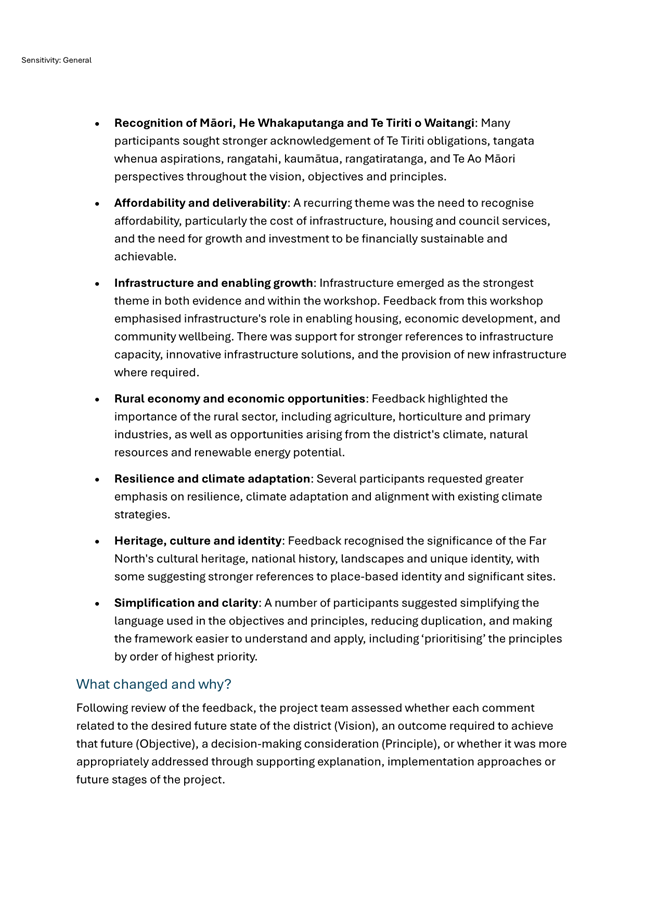
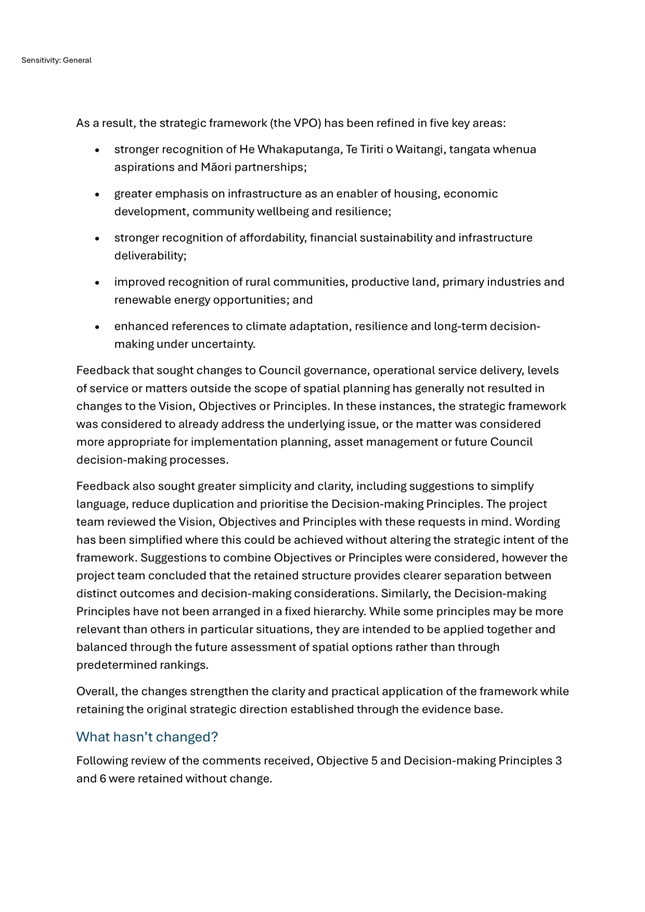
refinements represented amendments to five areas of the Vision, Principles and
Objectives. Amendments demonstrated:
· Stronger
recognition of He Whakaputanga, Te Tiriti o Waitangi, tangata whenua
aspirations and Māori partnerships;
· Greater emphasis
on infrastructure as an enabler of housing, economic development, community
wellbeing and resilience;
· Stronger
recognition of affordability, financial sustainability and infrastructure
deliverability;
· Improved
recognition of rural communities, productive land, primary industries and
renewable energy opportunities; and
· Enhanced
references to climate adaptation, resilience and long-term decision-making
under uncertainty.
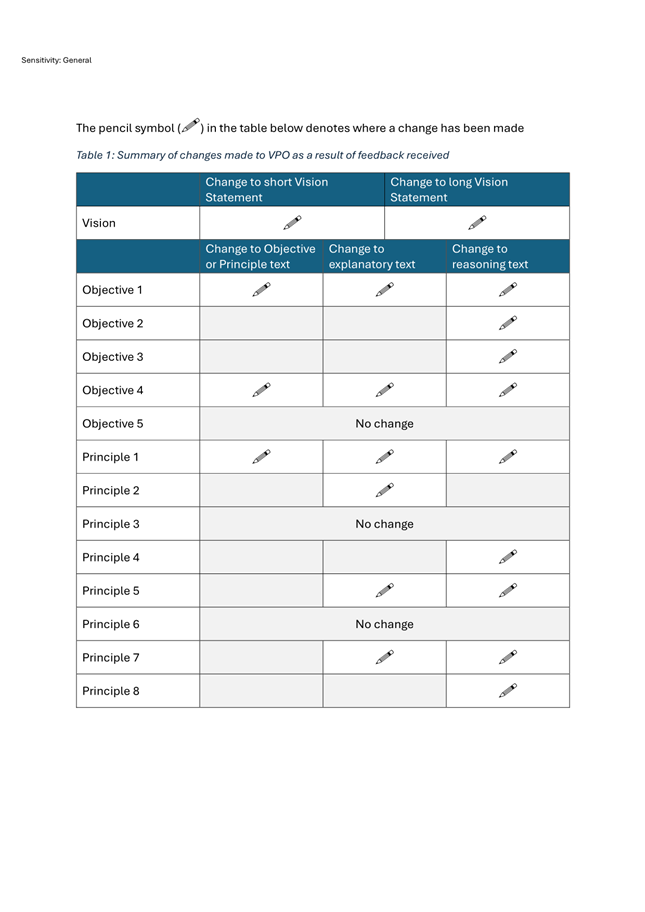
The DWSS project team reviewed all suggestions and amended
the Vision, Principles and Objectives to reflect workshop input. The refined
Vision, Principles and Objectives were presented at a virtual hui on 28 August
2026. Participation at this hui was limited due to competing priorities,
however, a virtual whiteboard space was kept open to receive workshop invitee
comments until 31 August. The participants who attended supported the refined
version, with no objections raised. For the evolution of the Vision, Principles
and Objectives, see Attachment 3. Additionally, stakeholders were contacted and
invited to express their views on the refined Vision, Principles and
Objectives.
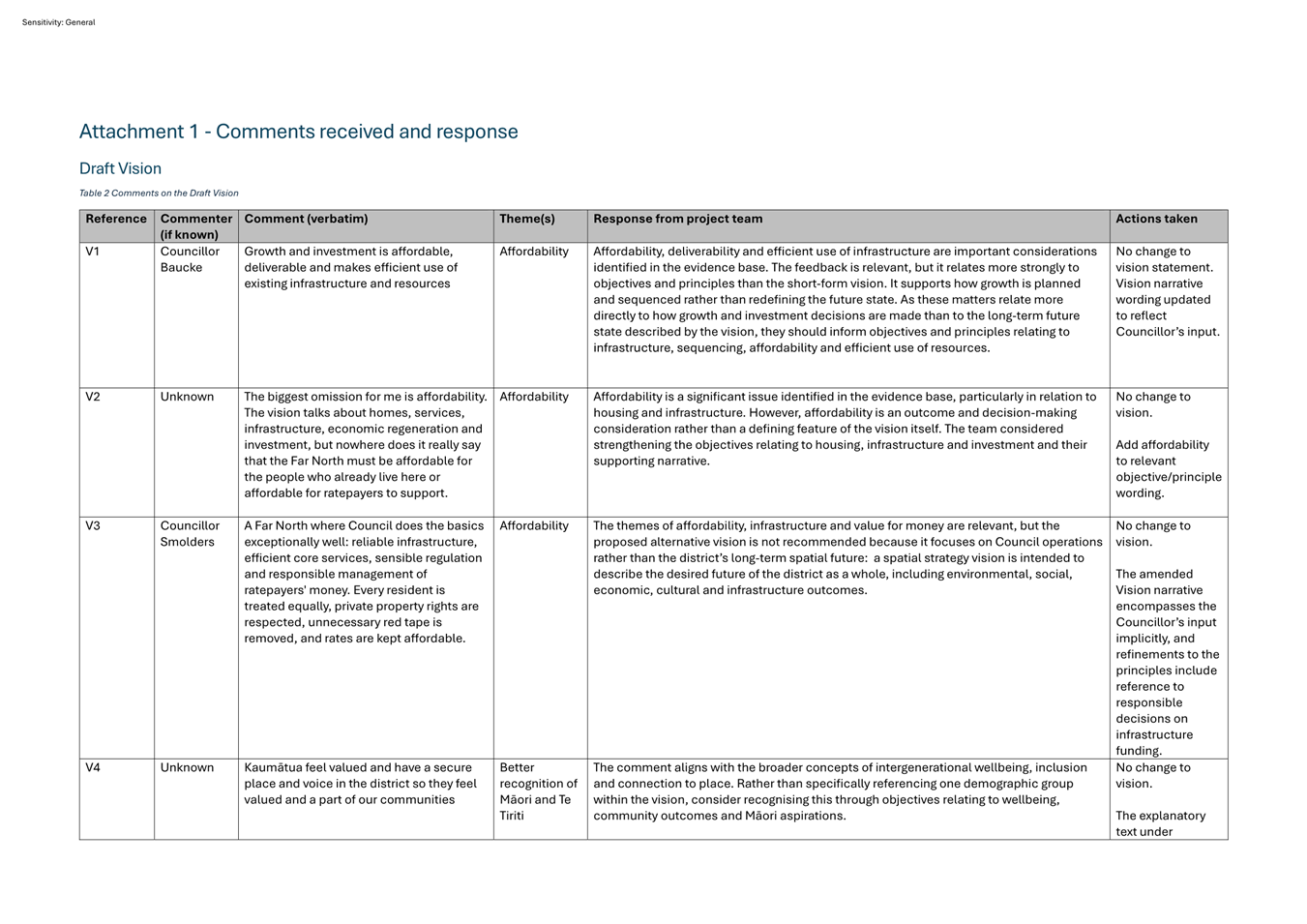
Refined Vision
The DWSS vision sets the
district’s long-term direction and desired future, reflecting the
aspirations of the community, Iwi and Hapū, stakeholders, and
decision-makers while providing a shared framework to guide decisions and
balance immediate needs with long-term goals.
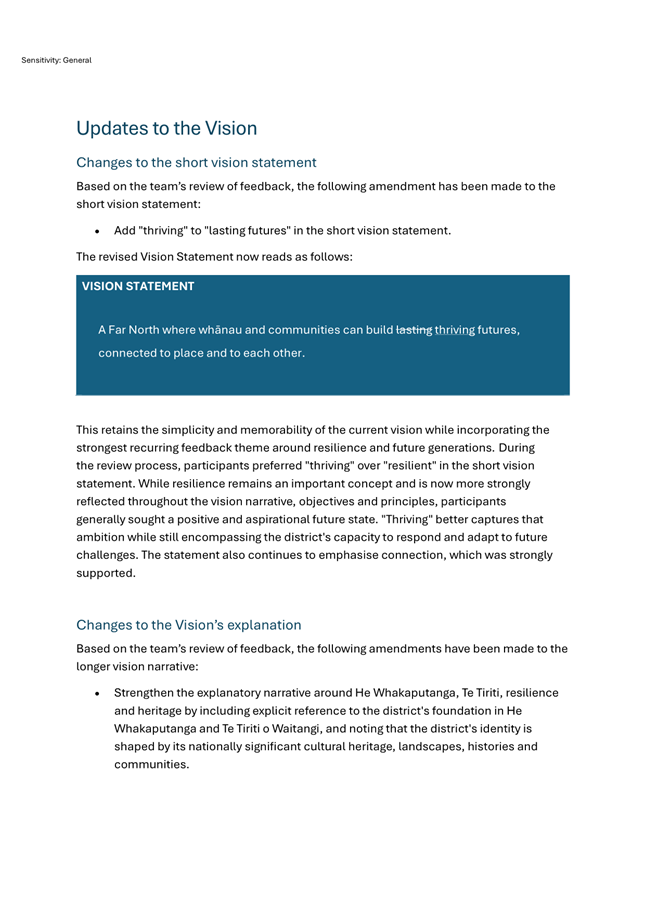
Vision statement: A Far
North where people and whānau can build thriving futures, connected to
place and each other.
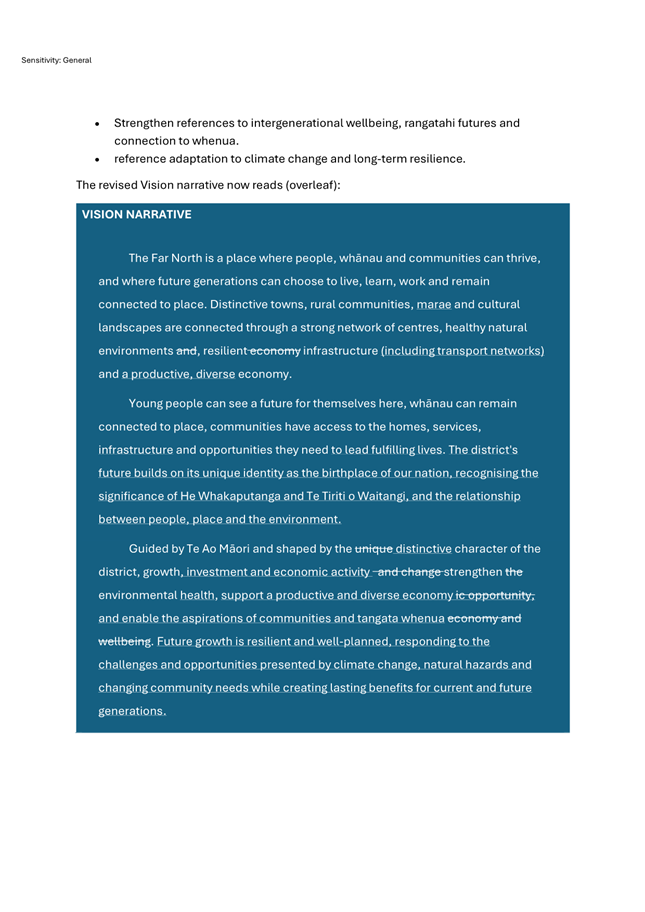
Vision narrative: The Far North is a place where
people, whānau and communities can thrive, and where future generations
can choose to live, learn, work and remain connected to place. Distinctive
towns, rural communities, marae and cultural landscapes are connected through a
strong network of centres, healthy natural environments, resilient
infrastructure (including transport networks) and a productive, diverse
economy. Young people can see a future for themselves here, whānau can
remain connected to place, and communities have access to the homes, services,
infrastructure and opportunities they need to lead fulfilling lives. The
district's future builds on its unique identity as the birthplace of our
nation, recognising the significance of He Whakaputanga and Te Tiriti o
Waitangi, and the relationship between people, place and the environment.
Guided by Te Ao Māori and shaped by the distinctive character of the
district, growth and change strengthen environmental health, support economic
opportunity, and enable the aspirations of communities and tangata whenua.
Future growth is resilient and well-planned, responding to the challenges and
opportunities presented by climate change, natural hazards and changing
community needs while creating lasting benefits for current and future
generations.
Refined Objectives
The DWSS objectives establish the
outcomes required to achieve the Far North’s vision, providing a
framework for assessing future spatial options and investment priorities while
recognising that different parts of the district have distinct roles,
opportunities, constraints, and development needs that require tailored
responses.
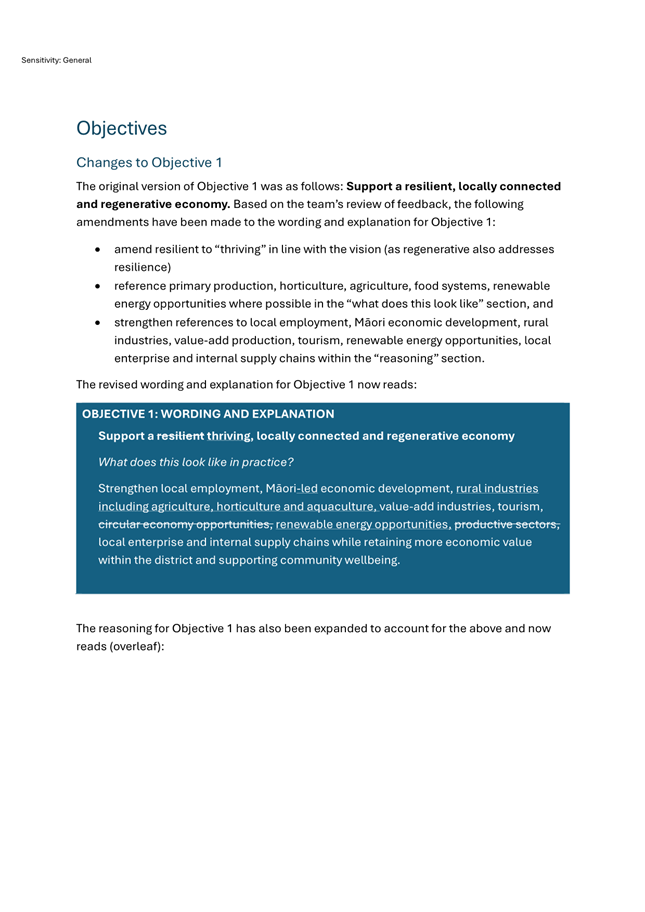
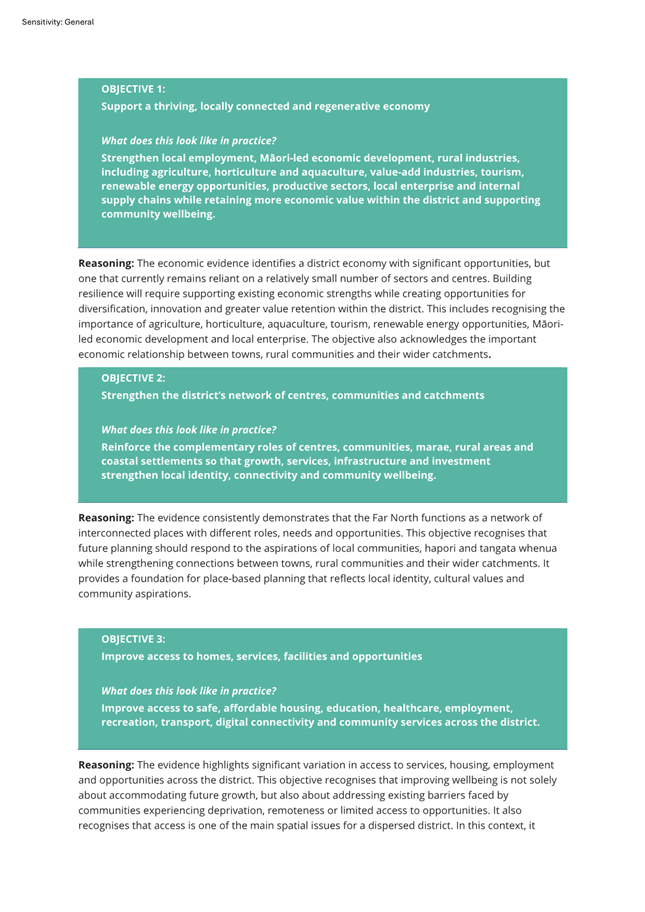
Objective 1: Support a
thriving, locally connected and regenerative economy
What does this look like in
practice? Strengthen local employment, Māori-led economic development,
rural industries, including agriculture, horticulture and aquaculture,
value-add industries, tourism, renewable energy opportunities, productive
sectors, local enterprise and internal supply chains while retaining more
economic value within the district and supporting community wellbeing.
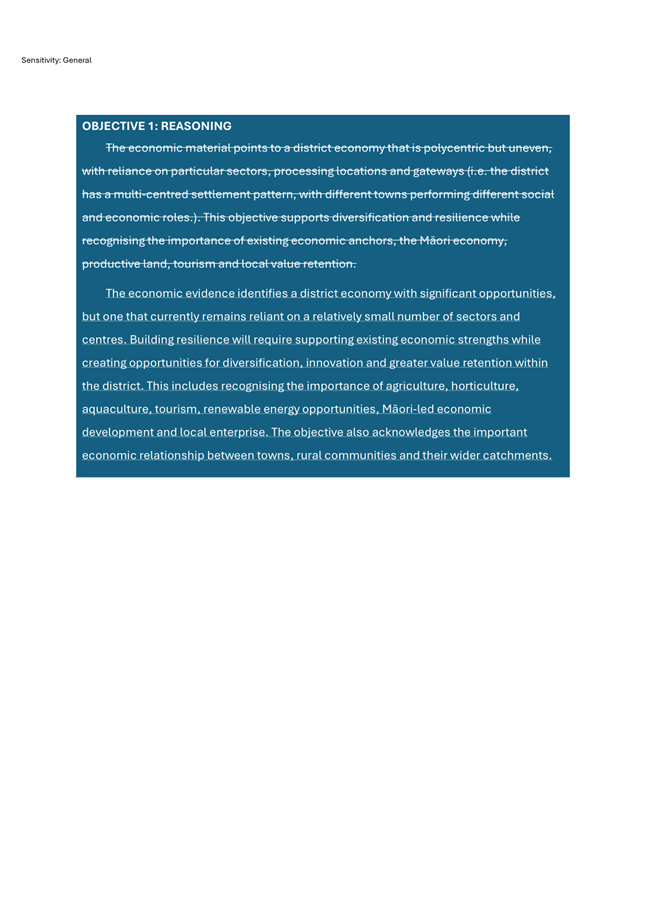
Reasoning: The economic
evidence identifies a district economy with significant opportunities, but one
that currently remains reliant on a relatively small number of sectors and
centres. Building resilience will require supporting existing economic
strengths while creating opportunities for diversification, innovation and
greater value retention within the district. This includes recognising the
importance of agriculture, horticulture, aquaculture, tourism, renewable energy
opportunities, Māori led economic development and local enterprise. The
objective also acknowledges the important economic relationship between towns,
rural communities and their wider catchments.
Objective 2: Strengthen the
district’s network of centres, communities and catchments
What does this look like in
practice? Reinforce the complementary roles of centres, communities, marae,
rural areas, and coastal settlements so that growth, services, infrastructure,
and investment strengthen local identity, connectivity, and community
wellbeing.
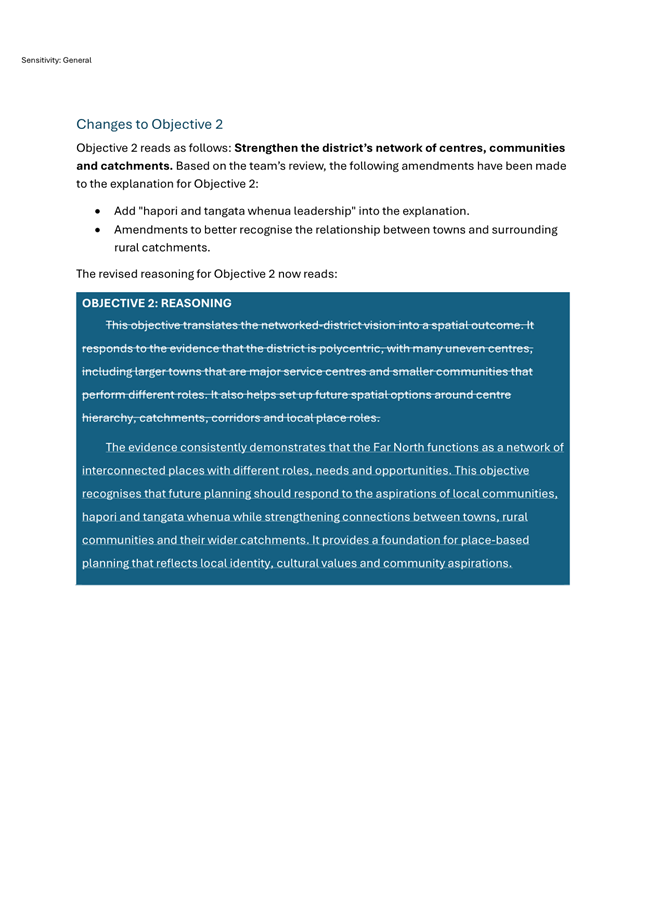
Reasoning: The evidence
consistently demonstrates that the Far North functions as a network of
interconnected places with different roles, needs and opportunities. This
objective recognises that future planning should respond to the aspirations of
local communities, hapori and tangata whenua while strengthening connections
between towns, rural communities and their wider catchments. It provides a
foundation for place-based planning that reflects local identity, cultural
values and community aspirations.
Objective 3: Improve access
to homes, services, facilities and opportunities
What does this look like in
practice? Improve access to safe, affordable housing, education,
healthcare, employment, recreation, transport, digital connectivity and
community services across the district.
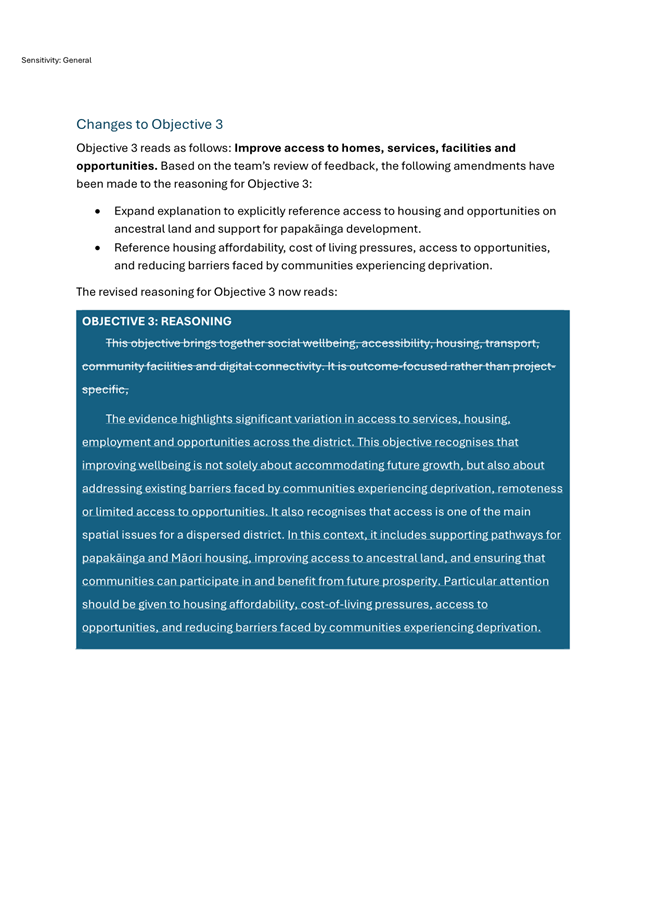
Reasoning: The evidence
highlights significant variation in access to services, housing, employment and
opportunities across the district. This objective recognises that improving
wellbeing is not solely about accommodating future growth, but also about
addressing existing barriers faced by communities experiencing deprivation,
remoteness or limited access to opportunities. It also recognises that access
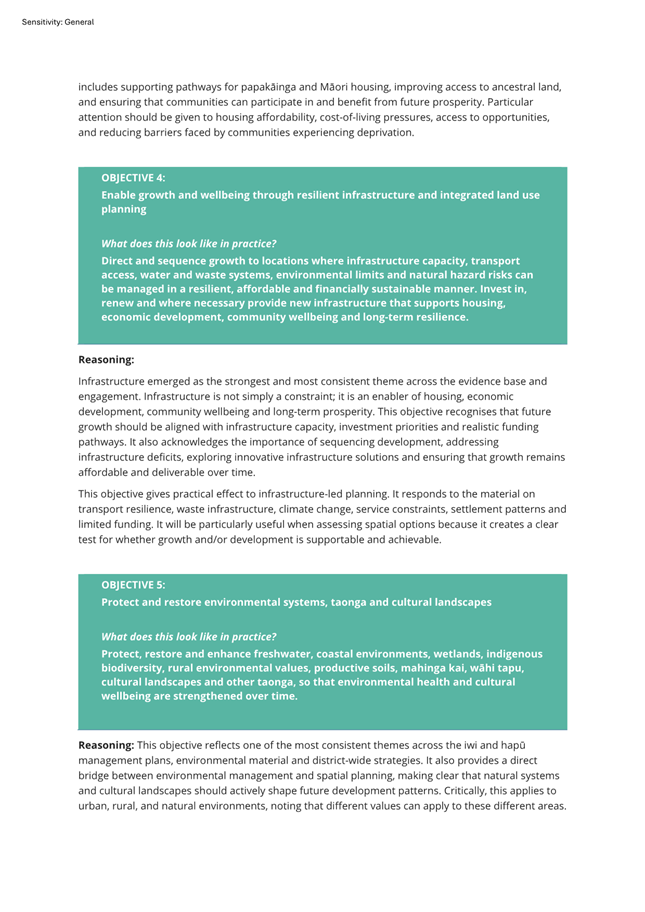
is one of the main spatial issues for a dispersed district. In this context, it
includes supporting pathways for papakāinga and Māori housing,
improving access to ancestral land, and ensuring that communities can
participate in and benefit from future prosperity. Particular attention should
be given to housing affordability, cost-of-living pressures, access to
opportunities, and reducing barriers faced by communities experiencing
deprivation.
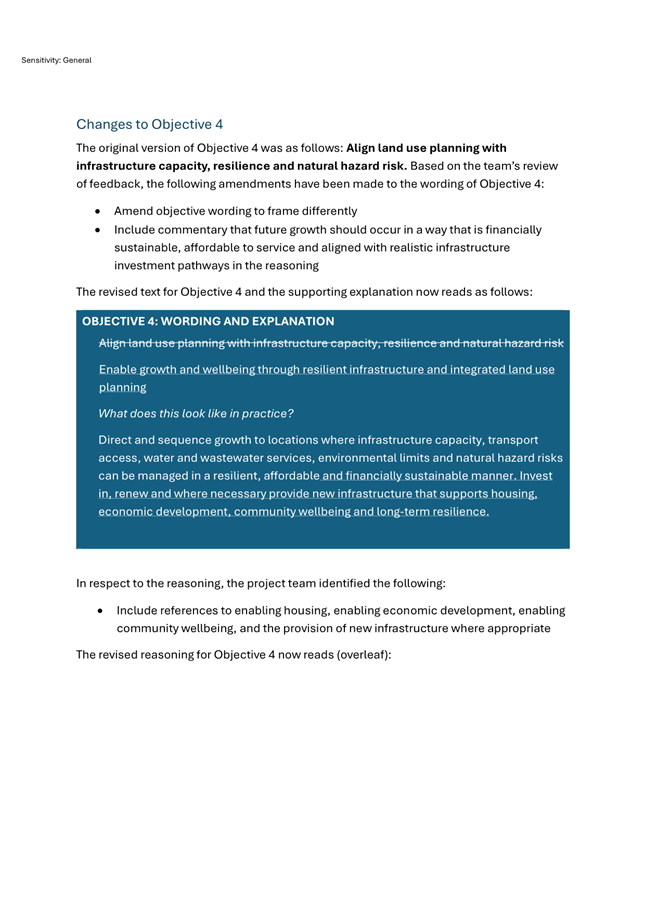
Objective 4: Enable growth
and wellbeing through resilient infrastructure and integrated land use planning
What does this look like in
practice? Direct and sequence growth to locations where infrastructure
capacity, transport access, water and waste systems, environmental limits and
natural hazard risks can be managed in a resilient, affordable and financially
sustainable manner. Invest in, renew and where necessary provide new
infrastructure that supports housing, economic development, community wellbeing
and long-term resilience.
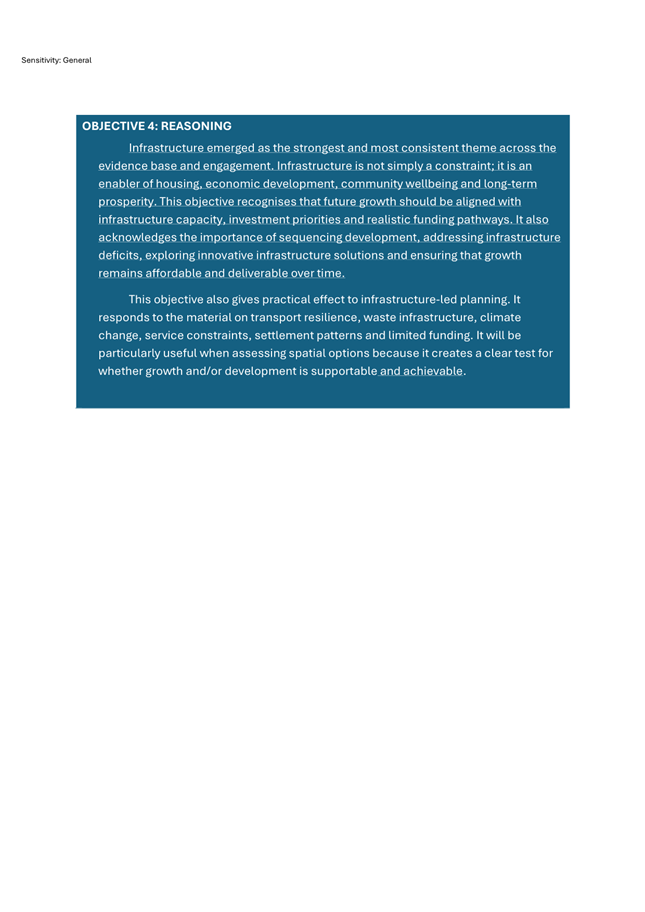
Reasoning: Infrastructure
emerged as the strongest and most consistent theme across the evidence base and
engagement. Infrastructure is not simply a constraint; it is an enabler of
housing, economic development, community wellbeing and long-term prosperity.
This objective recognises that future growth should be aligned with
infrastructure capacity, investment priorities and realistic funding pathways.
It also acknowledges the importance of sequencing development, addressing
infrastructure deficits, exploring innovative infrastructure solutions and
ensuring that growth remains affordable and deliverable over time. This
objective gives practical effect to infrastructure-led planning. It responds to
the material on transport resilience, waste infrastructure, climate change,
service constraints, settlement patterns and limited funding. It will be
particularly useful when assessing spatial options because it creates a clear
test for whether growth and/or development is supportable and achievable.
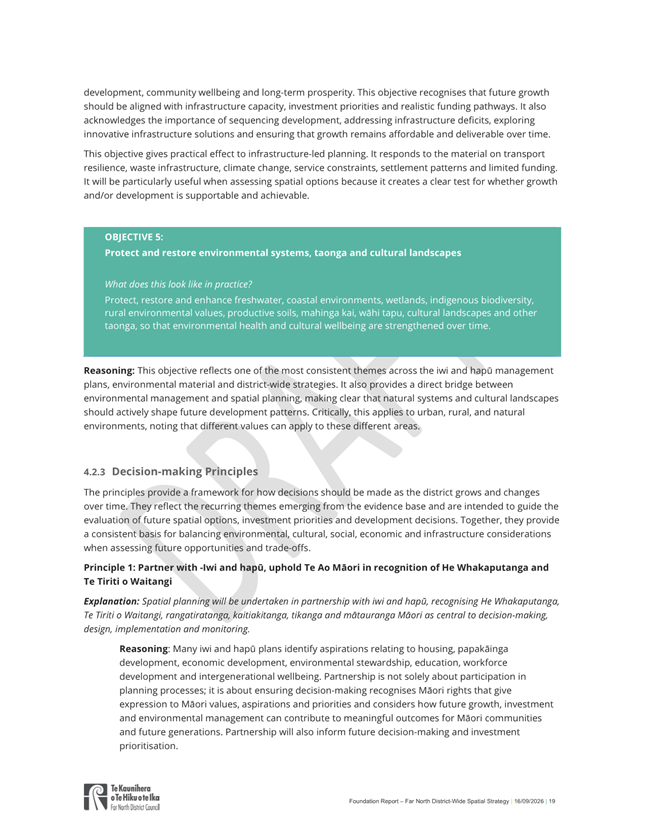
Objective 5: Protect and
restore environmental systems, taonga and cultural landscapes
What does this look like in
practice? Protect, restore and enhance freshwater, coastal environments,
wetlands, indigenous biodiversity, rural environmental values, productive
soils, mahinga kai, wāhi tapu, cultural landscapes and other taonga, so
that environmental health and cultural wellbeing are strengthened over time.
Reasoning: This objective
reflects one of the most consistent themes across the iwi and hapū
management plans, environmental material and district-wide strategies. It also
provides a direct bridge between environmental management and spatial planning,
making clear that natural systems and cultural landscapes should actively shape
future development patterns. Critically, this applies to urban, rural, and
natural environments, noting that different values can apply to these different
areas.
Refined Principles
The DWSS principles provide a consistent framework for
decision-making that guides progress toward the vision by helping evaluate
options, manage trade-offs, and determine the most appropriate course of action
across planning and investment decisions over time.
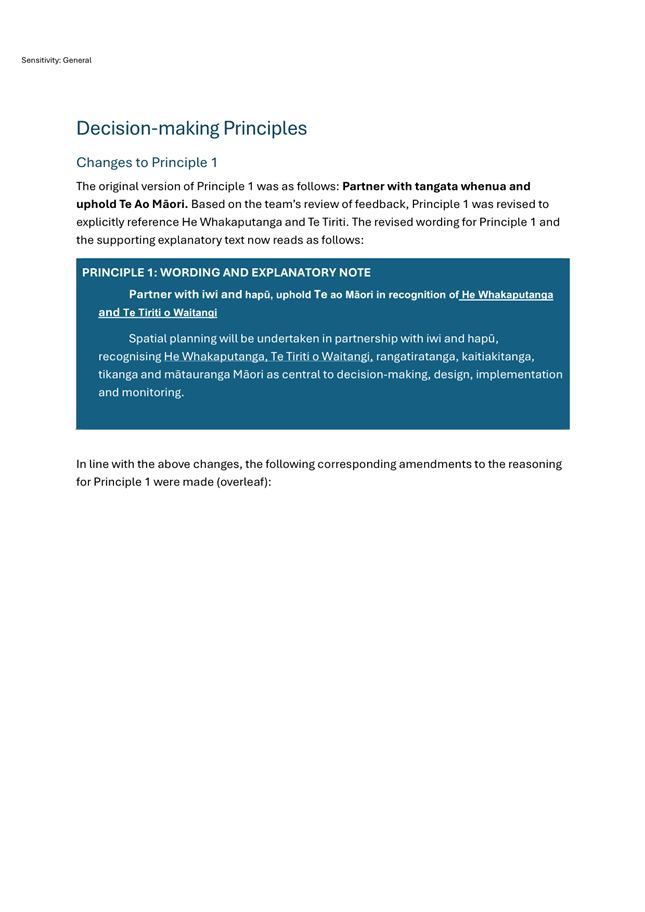
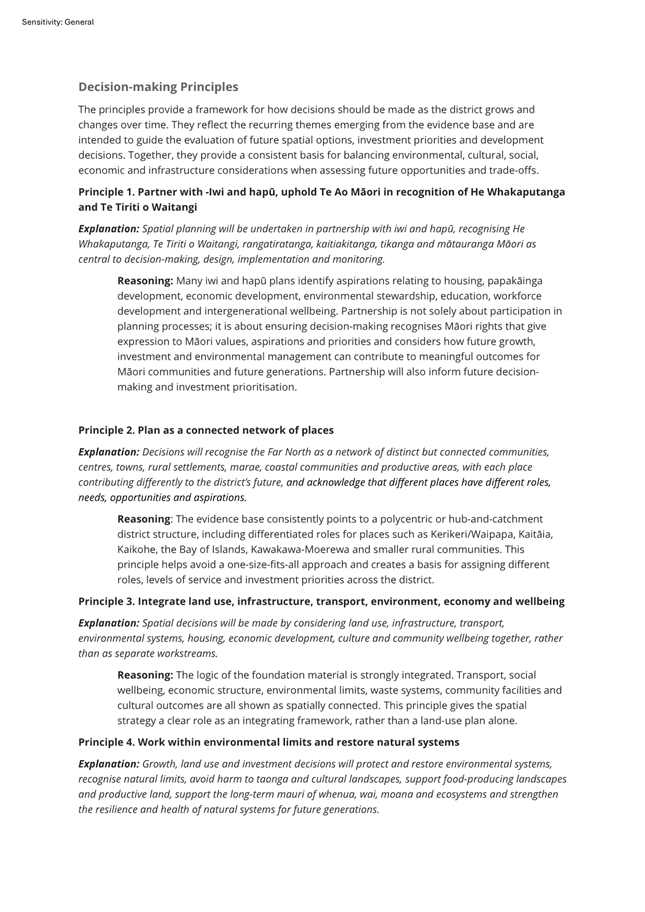
Principle 1: Partner with Iwi
and Hapū, uphold Te Ao Māori in recognition of He Whakaputanga and Te
Tiriti o Waitangi
Explanation: Spatial
planning will be undertaken in partnership with Iwi and Hapū, recognising
He Whakaputanga, Te Tiriti o Waitangi, rangatiratanga, kaitiakitanga, tikanga
and mātauranga Māori as central to decision-making, design,
implementation and monitoring.
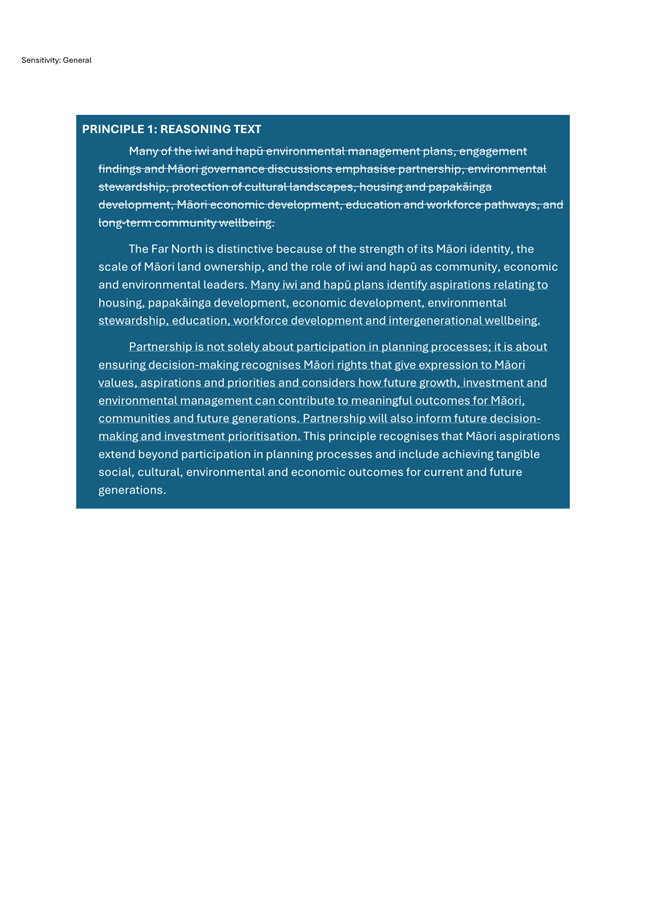
Reasoning: Many iwi and
hapū plans identify aspirations relating to housing, papakāinga
development, economic development, environmental stewardship, education,
workforce development and intergenerational wellbeing. Partnership is not
solely about participation in planning processes; it is about ensuring
decision-making recognises Māori rights that give expression to Māori
values, aspirations and priorities and considers how future growth, investment
and environmental management can contribute to meaningful outcomes for
Māori communities and future generations. Partnership will also inform
future decision making and investment prioritisation.
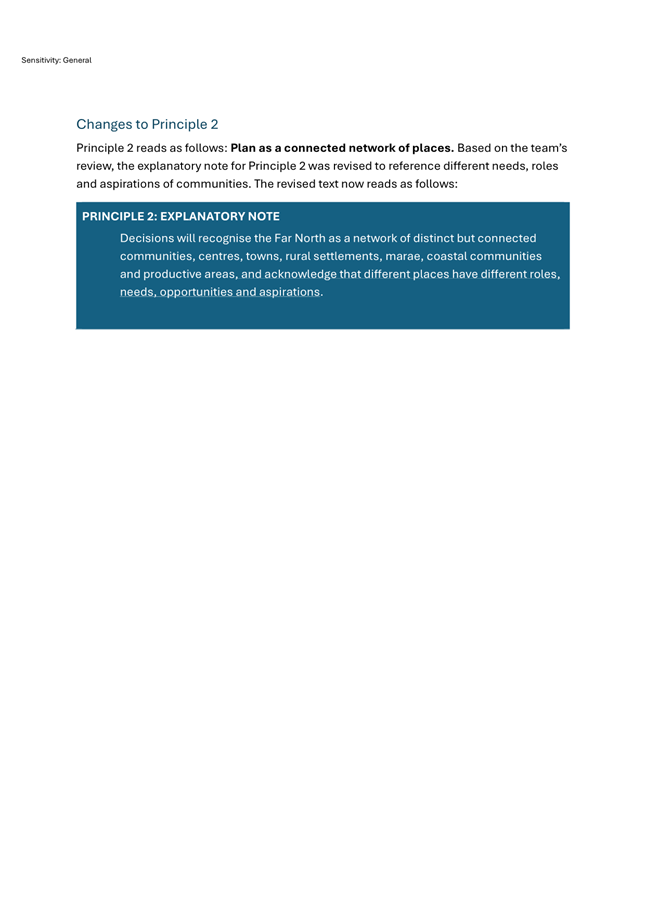
Principle 2: Plan as a
connected network of places
Explanation: Decisions
will recognise the Far North as a network of distinct but connected
communities, centres, towns, rural settlements, marae, coastal communities and
productive areas, with each place contributing differently to the
district’s future, and acknowledge that different places have different
roles, needs, opportunities and aspirations.
Reasoning: The evidence
base consistently points to a polycentric or hub-and-catchment district
structure, including differentiated roles for places such as Kerikeri/Waipapa,
Kaitāia, Kaikohe, the Bay of Islands, Kawakawa-Moerewa and smaller rural
communities. This principle helps avoid a one-size-fits-all approach and
creates a basis for assigning different roles, levels of service and investment
priorities across the district.
Principle 3: Integrate land
use, infrastructure, transport, environment, economy and wellbeing
Explanation: Spatial
decisions will be made by considering land use, infrastructure, transport,
environmental systems, housing, economic development, culture and community
wellbeing together, rather than as separate workstreams.
Reasoning: The logic of
the foundation material is strongly integrated. Transport, social wellbeing,
economic structure, environmental limits, waste systems, community facilities
and cultural outcomes are all shown as spatially connected. This principle
gives the spatial strategy a clear role as an integrating framework, rather
than a land-use plan alone.
Principle 4: Work within
environmental limits and restore natural systems
Explanation: Growth, land
use and investment decisions will protect and restore environmental systems,
recognise natural limits, avoid harm to taonga and cultural landscapes, support
food-producing landscapes and productive land, support the long-term mauri of
whenua, wai, moana and ecosystems and strengthen the resilience and health of
natural systems for future generations.
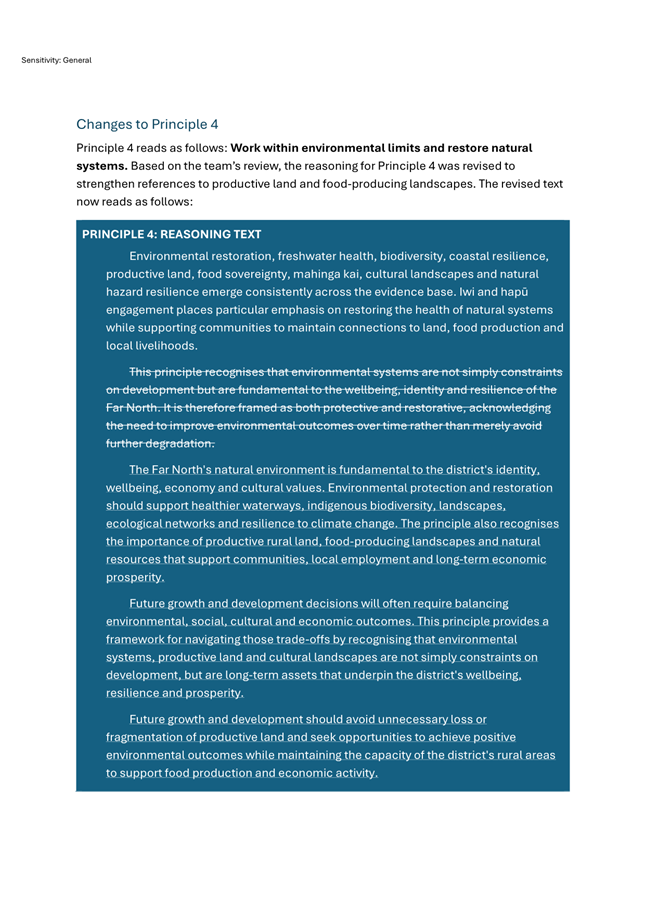
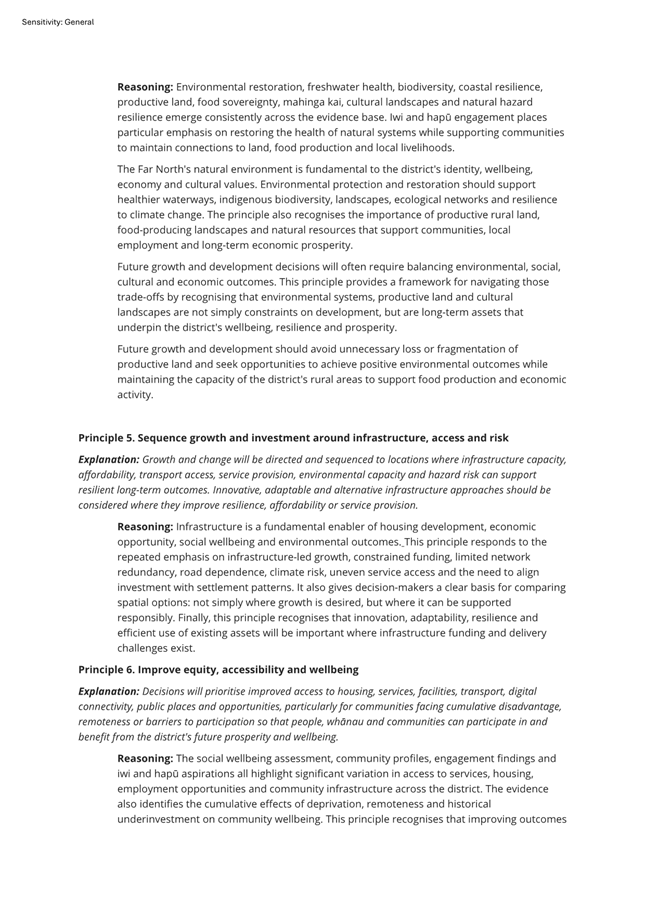
Reasoning: Environmental
restoration, freshwater health, biodiversity, coastal resilience, productive
land, food sovereignty, mahinga kai, cultural landscapes and natural hazard
resilience emerge consistently across the evidence base. Iwi and hapū
engagement places particular emphasis on restoring the health of natural
systems while supporting communities to maintain connections to land, food
production and local livelihoods.
The Far North's natural
environment is fundamental to the district's identity, wellbeing, economy and
cultural values. Environmental protection and restoration should support
healthier waterways, indigenous biodiversity, landscapes, ecological networks and
resilience to climate change. The principle also recognises the importance of
productive rural land, food-producing landscapes and natural resources that
support communities, local employment and long-term economic prosperity.
Future growth and development
decisions will often require balancing environmental, social, cultural and
economic outcomes. This principle provides a framework for navigating those
trade-offs by recognising that environmental systems, productive land and
cultural landscapes are not simply constraints on development, but are
long-term assets that underpin the district's wellbeing, resilience and
prosperity.
Future growth and development
should avoid unnecessary loss or fragmentation of productive land and seek
opportunities to achieve positive environmental outcomes while maintaining the
capacity of the district's rural areas to support food production and economic
activity.
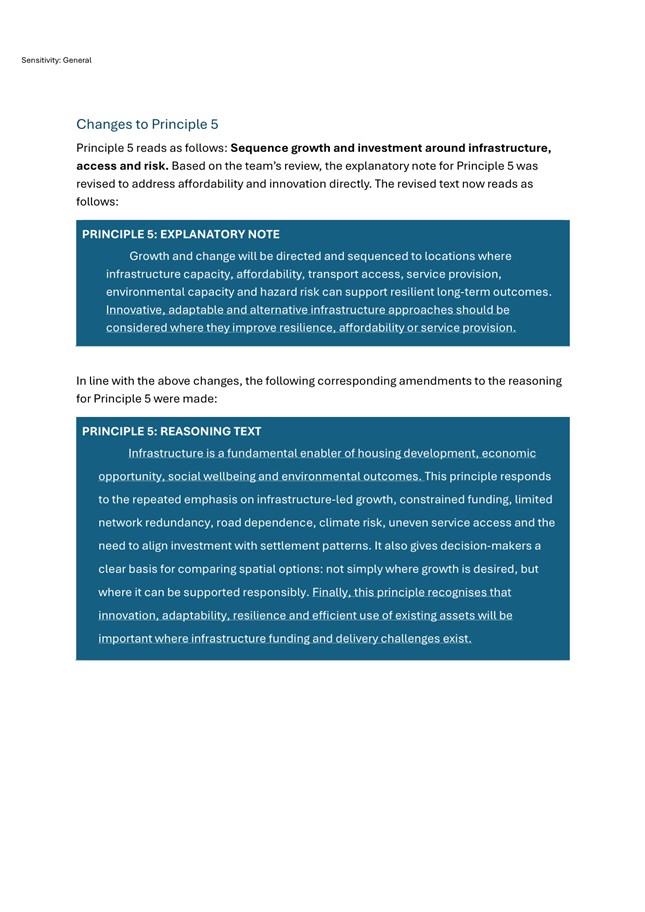
Principle 5: Sequence
growth and investment around infrastructure, access and risk
Explanation: Growth and
change will be directed and sequenced to locations where infrastructure
capacity, affordability, transport access, service provision, environmental
capacity and hazard risk can support resilient long-term outcomes. Innovative,
adaptable and alternative infrastructure approaches should be considered where
they improve resilience, affordability or service provision.
Reasoning: Infrastructure
is a fundamental enabler of housing development, economic opportunity, social
wellbeing and environmental outcomes. This principle responds to the repeated
emphasis on infrastructure-led growth, constrained funding, limited network
redundancy, road dependence, climate risk, uneven service access and the need
to align investment with settlement patterns. It also gives decision-makers a
clear basis for comparing spatial options: not simply where growth is desired,
but where it can be supported responsibly. Finally, this principle recognises
that innovation, adaptability, resilience and efficient use of existing assets
will be important where infrastructure funding and delivery challenges exist.
Principle 6: Improve
equity, accessibility and wellbeing
Explanation: Decisions
will prioritise improved access to housing, services, facilities, transport,
digital connectivity, public places and opportunities, particularly for
communities facing cumulative disadvantage, remoteness or barriers to
participation so that people, whānau and communities can participate in
and benefit from the district's future prosperity and wellbeing.
Reasoning: The social
wellbeing assessment, community profiles, engagement findings and iwi and
hapū aspirations all highlight significant variation in access to
services, housing, employment opportunities and community infrastructure across
the district. The evidence also identifies the cumulative effects of
deprivation, remoteness and historical underinvestment on community wellbeing.
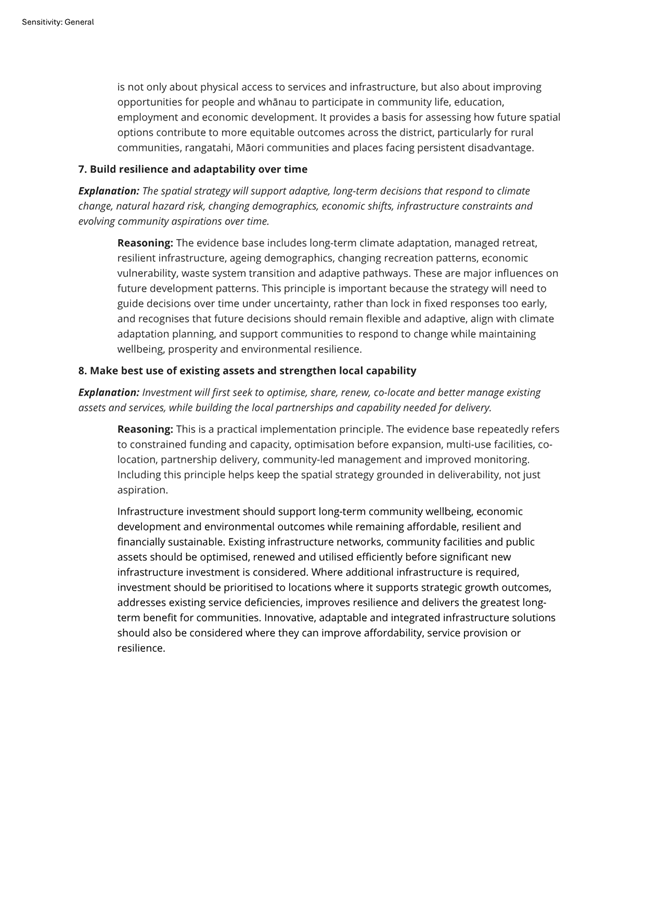
This principle recognises that improving outcomes is not only about physical
access to services and infrastructure, but also about improving opportunities
for people and whānau to participate in community life, education,
employment and economic development. It provides a basis for assessing how future
spatial options contribute to more equitable outcomes across the district,
particularly for rural communities, rangatahi, Māori communities and
places facing persistent disadvantage.
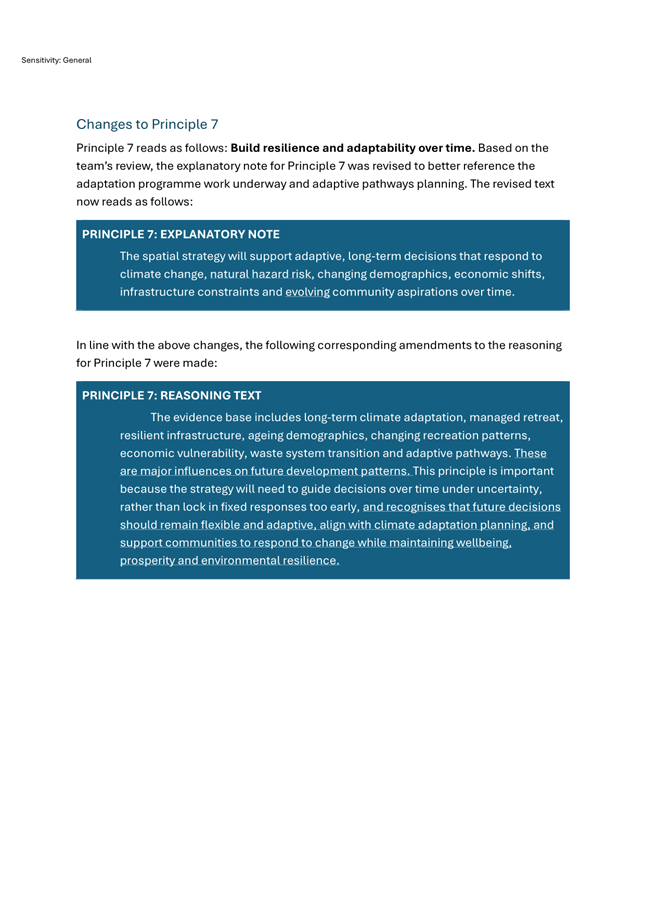
Principle 7: Build
resilience and adaptability over time
Explanation: The spatial
strategy will support adaptive, long-term decisions that respond to climate
change, natural hazard risk, changing demographics, economic shifts,
infrastructure constraints and evolving community aspirations over time.
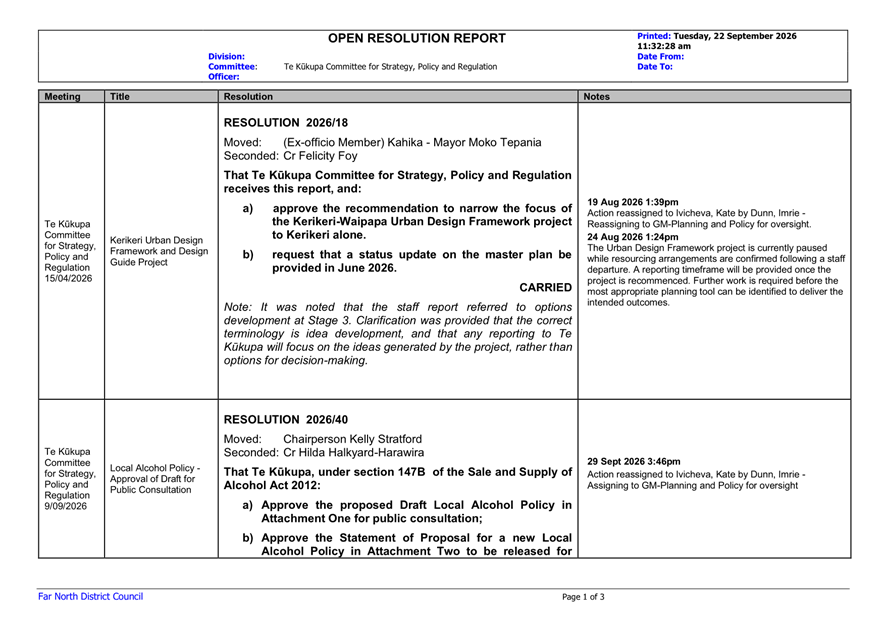
Reasoning: The evidence
base includes long-term climate adaptation, managed retreat, resilient
infrastructure, ageing demographics, changing recreation patterns, economic
vulnerability, waste system transition and adaptive pathways. These are major
influences on future development patterns. This principle is important because
the strategy will need to guide decisions over time under uncertainty, rather
than lock in fixed responses too early, and recognises that future decisions
should remain flexible and adaptive, align with climate adaptation planning,
and support communities to respond to change while maintaining wellbeing,
prosperity and environmental resilience.
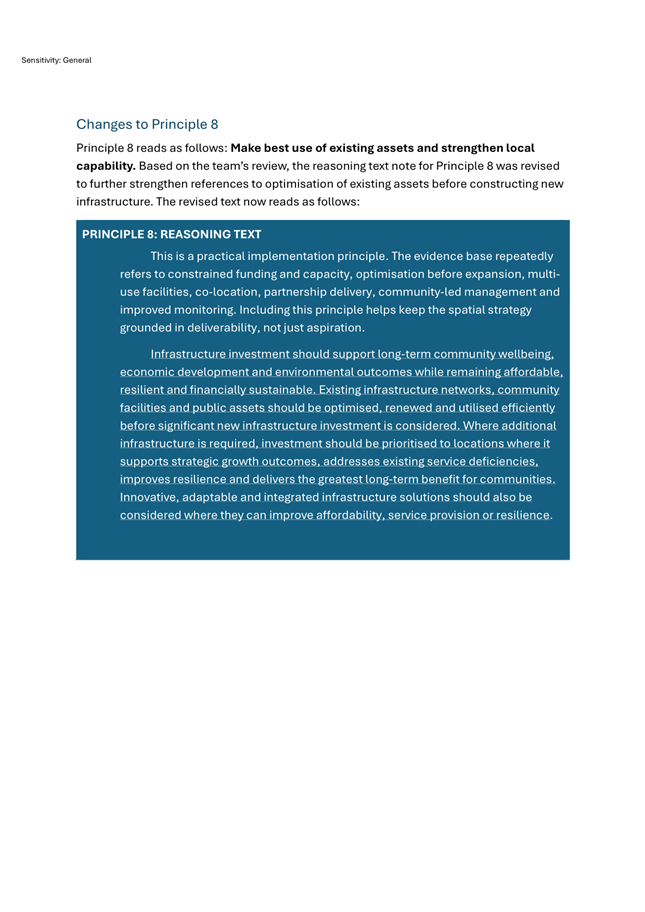
Principle 8: Investment
will first seek to optimise, share, renew, co-locate and better manage existing
assets and services, while building the local partnerships and capability
needed for delivery.
Explanation: Investment
will first seek to optimise, share, renew, co-locate and better manage existing
assets and services, while building the local partnerships and capability
needed for delivery.
Reasoning: This is a
practical implementation principle. The evidence base repeatedly refers to
constrained funding and capacity, optimisation before expansion, multi-use
facilities, co location, partnership delivery, community-led management and
improved monitoring. Including this principle helps keep the spatial strategy
grounded in deliverability, not just aspiration. Infrastructure investment
should support long-term community wellbeing, economic development and
environmental outcomes while remaining affordable, resilient and financially
sustainable. Existing infrastructure networks, community facilities and public
assets should be optimised, renewed and utilised efficiently before significant
new infrastructure investment is considered. Where additional infrastructure is
required, investment should be prioritised to locations where it supports
strategic growth outcomes, addresses existing service deficiencies, improves
resilience and delivers the greatest long-term benefit for communities.
Innovative, adaptable and integrated infrastructure solutions should also be
considered where they can improve affordability, service provision or
resilience.
Next steps
Upon Te Kūkupa endorsement of the Foundation Report,
the DWSS programme will commence Milestone 5. This step involves the
development and assessment of future spatial growth scenarios. The technical
outputs will include a Scenario Development Report, outlining the spatial
scenarios considered, supported by a range of Technical Memos that explore key
topics informing those scenarios. This will then inform the Spatial Scenarios
Report, which presents the shortlisted scenarios. Milestone 5 will provide FNDC
with a robust, evidence-based spatial scenario and a clear rationale for its
selection, enabling informed engagement in the new planning system and helping
to streamline decision-making on the preferred spatial option for the district
land use plan.
Options:
Option 1: Te Kūkupa
endorse the District Wide Spatial Strategy Foundation Report (recommended
option)
Approval of the Foundation Report will enable the District
Wide Spatial Strategy to progress to Milestone 5 of the programme and remain on
track for meeting programme deliverables and alignment with the commencement of
the Regional Spatial Strategy.
Advantages:
· Endorsement of the
Foundation Report by Te Kūkupa confirms a shared understanding of the
district's opportunities, challenges and long-term aspirations, provides
confidence in the evidence base and strategic framework (i.e., Vision,
Principles and Objectives) underpinning the District Wide Spatial Strategy, and
enables the programme to proceed to scenario development and public engagement
with a clear and agreed foundation for future decision-making.
· Council will have
an adopted Foundation report, which sets the Vision, Principles and Objectives
for the district, which will be part of the evidence base already being
collected to inform the development of any Regional Spatial Plan.
Disadvantages:
· No disadvantages
have been identified by staff.
Option 2: Te Kūkupa
endorse the District Wide Spatial Strategy Foundation Report subject to
recommended amendments to the Vision, Principles and Objectives
Te Kūkupa endorses the Foundation Report as an
appropriate summary of the evidence base, findings and strategic issues facing
the Far North, subject to agreed amendments to the Vision, Principles and
Objectives. This endorsement recognises the strong foundation provided by the
report while ensuring that the strategic framework guiding future scenario
development appropriately reflects the aspirations and priorities of Te
Kūkupa.
Advantages:
· Endorsing the
Foundation Report subject to agreed amendments to the Vision, Principles and
Objectives enables the District Wide Spatial Strategy programme to continue
progressing while ensuring the strategic framework is refined to better reflect
the aspirations and priorities of Te Kūkupa. This approach recognises the
strength of the evidence base and findings, supports timely progression to
scenario development, and provides an opportunity to strengthen the strategic
direction that will guide future decision-making.
· Council will have
an adopted Foundation report, which sets the Vision, Principles and Objectives
for the district, which will be part of the evidence base already being
collected to inform the development of any Regional Spatial Plan.
Disadvantages:
· While endorsing
the Foundation Report subject to amendments enables the project to progress, it
may create some uncertainty regarding the final strategic direction until the
requested changes to the Vision, Principles and Objectives are agreed and
incorporated. Clear documentation of the amendments, responsibilities for their
incorporation, and the process for confirming their resolution will be
important to minimise delays, maintain stakeholder confidence, and provide
certainty for the next stage of scenario development.
Option 3: Te Kūkupa
does not endorse the District Wide Spatial Strategy Foundation Report
A decision not to endorse the Foundation Report would
provide an opportunity to address any substantive concerns regarding the
report's strategic direction before progressing to the next phase of the
project. However, this approach is likely to result in greater programme
uncertainty, potential delays, and reduced certainty for scenario development
until the matters preventing endorsement are resolved. To minimise these risks,
Te Kūkupa should clearly articulate the specific issues requiring further
consideration and the process for addressing them, enabling a pathway toward
future endorsement and continued progression of the District Wide Spatial
Strategy programme.
Advantages:
· A decision not to
endorse the Foundation Report at this stage provides an opportunity to ensure
the report fully reflects the aspirations, priorities and expectations of Te
Kūkupa before it is used to guide future spatial planning decisions.
While recognising the significant work undertaken to develop the evidence base,
this approach enables any outstanding concerns to be addressed and may
ultimately result in a stronger strategic foundation and greater confidence in
the subsequent phases of the District Wide Spatial Strategy programme.
Disadvantages:
· While a decision
not to endorse the Foundation Report would enable Te Kūkupa's concerns to
be fully considered before the project progresses, it will introduce programme
delays, reduce certainty regarding the strategic direction of the District Wide
Spatial Strategy, and require additional work and financial cost to achieve
alignment. To minimise these impacts, clear guidance on the issues requiring
resolution and the pathway to future endorsement will be important to maintain
momentum and provide certainty for subsequent stages of the programme.
Staff do not recommend this option as the Foundation Report
represents a synthesis of the evidence base and is intended to provide the
agreed foundation for scenario development. A decision not to endorse the
report would risk delaying the programme, creating uncertainty for the next
phase of work, and undermining the significant technical, engagement and
partnership inputs that have informed the Foundation Report to date. It
also increases the risk of not integrating this work with the Regional Spatial
Plan work programme.
TAKE
TŪTOHUNGA / REASON FOR THE RECOMMENDATION
Staff recommend endorsement of the DWSS Foundation Report
because it represents the culmination of extensive technical analysis,
engagement and partnership input, and provides a sound basis for developing and
evaluating future spatial scenarios. Endorsement enables the programme to
progress with confidence and demonstrates collective support for the evidence
and strategic direction established to date.
Te Kūkupa’s endorsement of the DWSS Foundation
Report is consistent with its responsibilities under the Terms of Reference
adopted by Council on 11 December 2025, which give the Committee responsibility
for overseeing and leading the development and review of Council strategies.
3) PĀnga
PŪtea me ngĀ wĀhanga tahua / Financial Implications and
Budgetary Provision
No additional financial implications are associated with
this recommendation as it is budgeted for within the DWSS work programme
budget.
Āpitihanga / Attachments
1. DWSS
Foundation Report - A5968834 ⇩ 
2. DWSS
Engagement Summary Report - A5965898 ⇩ 
3. DWSS
Vision, Principles & Objectives Feedback Summary Report - A5952575 ⇩
Hōtaka Take Ōkawa / Compliance Schedule:
Full consideration has been given to the provisions of the
Local Government Act 2002 S77 in relation to decision making, in particular:
1. A Local authority
must, in the course of the decision-making process,
a) Seek to identify all
reasonably practicable options for the achievement of the objective of a
decision; and
b) Assess the options in
terms of their advantages and disadvantages; and
c) If any of the options
identified under paragraph (a) involves a significant decision in relation to
land or a body of water, take into account the relationship of Māori and
their culture and traditions with their ancestral land, water sites, waahi tapu,
valued flora and fauna and other taonga.
2. This section is
subject to Section 79 - Compliance with procedures in relation to decisions.
|
He Take Ōkawa / Compliance
Requirement
|
Aromatawai Kaimahi / Staff
Assessment
|
|
State the level of significance (high or low) of the
issue or proposal as determined by the Council’s
Significance and Engagement Policy
|
Low
The Foundation Report primarily consolidates the
evidence base, findings, and draft strategic framework that will inform
subsequent stages of the District Wide Spatial Strategy (DWSS), including the
development and assessment of spatial scenarios.
|
|
State the relevant Council policies (external or
internal), legislation, and/or community outcomes (as stated in the LTP) that
relate to this decision.
|
Alignment with:
- District
Wide Spatial Strategy Project Framework: the Foundation Report is a key
milestone within the DWSS programme and establishes the evidence base,
Vision, Objectives and Principles that will guide future scenario development
and spatial planning decisions.
- Significance
and Engagement Policy (2024): provides the framework for determining the
significance of decisions and the level of engagement required with
communities, iwi and stakeholders. The Foundation Report has been developed
through an evidence-led and engagement-informed process consistent with the
principles of the policy and, recognises obligations arising from Treaty
settlement legislation and relationship agreements with iwi and hapū.
The Foundation Report incorporates iwi and hapū aspirations and promotes
partnership-based planning.
- Te
Pātukurea (2025): the Foundation Report identifies that the findings of
this adopted spatial plan will be incorporated into the broader DWSS.
- Long-Term
Plan: Resilient and connected communities through improved access to housing,
services, infrastructure and opportunities; A strong and sustainable local
economy supported by employment growth, economic diversification, Māori
economic development and investment; Protection and enhancement of the
natural environment through environmental stewardship, climate resilience and
restoration of natural systems; Partnership with tangata whenua and
recognition of Te Ao Māori in planning and decision-making;
Infrastructure-led and sustainable growth that aligns future development with
infrastructure capacity, affordability and resilience.
- Local
Government Act (2002): Section 10 - Purpose of local government, including
promoting the social, economic, environmental and cultural wellbeing of
communities; Sections 76-82 - Decision-making requirements and
principles of consultation; and, Section 81: Contributions to decision-making
processes by Māori. The Foundation Report has been informed by iwi and
hapū engagement and seeks to establish a framework for ongoing
partnership with tangata whenua.
- Resource
Management Act (1991): Provides the statutory framework for managing the use,
development and protection of natural and physical resources. The Foundation
Report identifies environmental management, climate resilience,
infrastructure planning and land-use integration as key considerations
informing future spatial options.
|
|
State whether this issue or proposal has a District wide
relevance and, if not, the ways in which the appropriate Community
Board’s views have been sought.
|
District-wide relevance.
The Foundation Report forms part of the DWSS programme
and establishes the evidence base and strategic framework for considering
future growth, infrastructure, environmental, economic and community outcomes
across the Far North District. The report has been informed by district-wide
technical assessments and engagement with iwi and hapū, stakeholders,
elected members and the wider community. As the matter relates to the
district, specific Community Board views have not been sought as part of this
decision, although Community Board members have had opportunities to
participate in workshops and through the wider engagement and governance
processes associated with the DWSS programme.
|
|
State the
possible implications for Māori and how Māori have been provided
with an opportunity to contribute to decision making if this decision is
significant and relates to land and/or any body of water.
State the
possible implications and how this report aligns with Te Tiriti o Waitangi /
The Treaty of Waitangi.
|
The Foundation Report has important implications for
Māori as it will help shape the strategic framework that informs future
decisions regarding land use, growth, infrastructure investment,
environmental management, housing, economic development, and community
wellbeing across the Far North District. The report identifies Te Ao
Māori, tangata whenua partnership, environmental stewardship, housing
and papakāinga development, cultural landscapes, Māori economic
development, and intergenerational wellbeing as key considerations that
should influence future spatial planning and investment decisions.
Māori have been provided with multiple
opportunities to contribute to the development of the Foundation Report and
the wider DWSS via direct engagement and via the programme’s Kaupapa
Steering Rōpū. The Foundation Report has been developed through an
evidence-led and mana whenua-informed process, including engagement with iwi
and hapū, consideration of iwi and hapū management plans, review of
Māori aspirations, and incorporation of engagement findings throughout
the evidence base and strategic framework. The draft Vision, Objectives and
Principles also explicitly recognise the importance of partnership with
tangata whenua and the role of Te Ao Māori in shaping the future of the
district.
This report aligns with the principles and intent of Te
Tiriti o Waitangi / The Treaty of Waitangi by recognising the unique status
of tangata whenua and promoting meaningful participation by iwi and hapū
in the development of the DWSS. The draft Principles within the Foundation
report include a commitment to: Partner with tangata whenua and uphold Te Ao
Māori; Recognise iwi and hapū as partners in planning
and decision-making; Support Māori aspirations relating to housing,
papakāinga, environmental stewardship, cultural landscapes and economic
development; Protect and restore taonga, cultural landscapes, whenua,
wai and moana; and, Integrate mātauranga Māori and kaitiakitanga
into future spatial planning and investment decisions.
|
|
Identify persons likely to be affected by or have an
interest in the matter, and how you have given consideration to their views
or preferences (for example – youth, the aged and those with
disabilities).
|
The matter is of interest to all communities within the
Far North District, including mana whenua, iwi and hapū, residents,
ratepayers, youth, older persons, people with disabilities, businesses,
community organisations, infrastructure providers and government agencies.
The Foundation Report has been developed through an evidence-led and
engagement-informed process, incorporating feedback from iwi and hapū,
stakeholders, elected members and the wider community, alongside detailed
technical assessments and demographic analysis. Consideration has been given
to the diverse needs, aspirations and preferences of different groups through
the report's assessment of housing, accessibility, economic opportunity,
community wellbeing, infrastructure provision and environmental outcomes
across the district.
|
|
State the financial implications and where budgetary
provisions have been made to support this decision.
|
|
|
Chief Financial Officer review.
|
No
|