
AGENDA
Ordinary Te Kūkupa Committee for
Strategy, Policy and Regulation Meeting
Wednesday, 9 September 2026
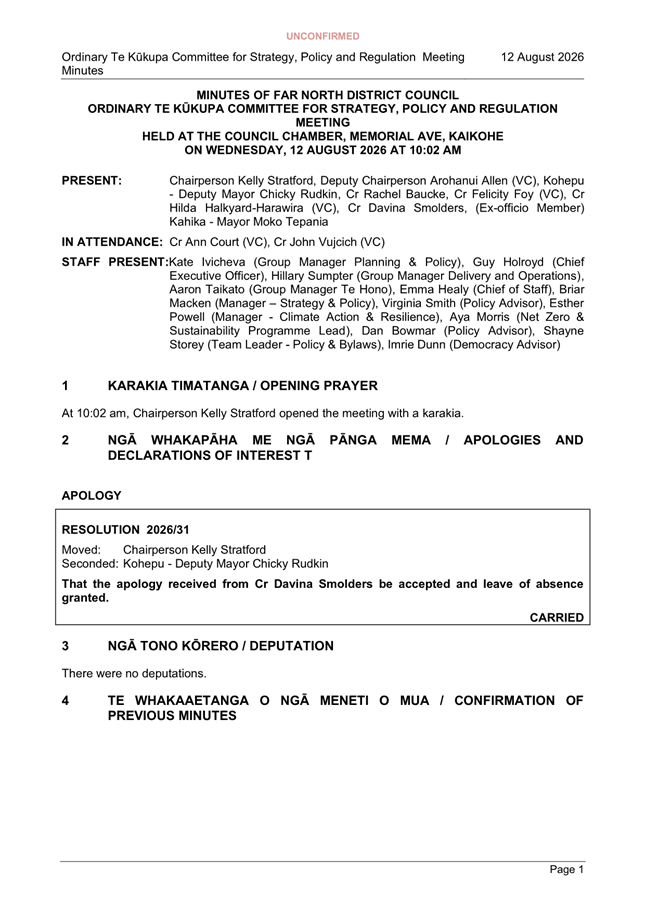
|
Time:
|
10:00 am
|
|
Location:
|
Council Chamber
Memorial Ave
Kaikohe
|
Membership:
Cr Kelly
Stratford - Chairperson
Cr Arohanui
Allen - Deputy Chairperson
Cr
Rachel Baucke
Cr
Felicity Foy
Cr Hilda
Halkyard-Harawira
Cr
Davina Smolders
Kohepū
- Deputy Mayor Chicky Rudkin
(Ex-officio
Member) Kahika - Mayor Moko Tepania
|
|
Authorising Body
|
Mayor/Council
|
|
Status
|
Standing Committee
|
|
COUNCIL COMMITTEE
|
Title
|
Te Kūkupa Committee for Strategy, Policy and
Regulation Terms of Reference
|
|
Terms of Reference Adoption
|
11 December 2025 and revised 5
March 2026 & 22 July 2026
|
|
Responsible Officer
|
Group Manager Planning and
Policy
|
Kaupapa / Purpose
Te Kūkupa Committee for
Strategy, Policy and Regulation is established to provide governance oversight,
leadership, and direction on the development, review, and monitoring of the Far
North District Council’s strategies, policies, bylaws, and regulatory
frameworks. The Committee ensures that Council’s strategic objectives are
advanced through robust policy development and effective regulatory practice.
Ngā Huānga / Membership
The Council will determine the
membership of the Committee.
Te Kūkupa Committee for
Strategy, Policy and Regulation will comprise of at least six elected members
(one of which will be the chairperson).
Kahika
/ Mayor Moko Tepania is an ex-officio member of all Committees.
Membership is as follows:
|
Cr Kelly Stratford - Chairperson
|
|
Cr Arohanui Allen -
Deputy Chairperson *
|
|
Kohepu – Deputy
Mayor Chicky Rudkin *
|
|
Cr Rachel Baucke
|
|
Cr Ann Court
|
|
Cr Felicity Foy
|
|
Cr Davina Smolders
|
*1 Committee
member by Council Resolution 5 March 2026, Deputy Chairperson by Committee
Resolution 12 August 2026.
*2 Committee member by Council Resolution 5 March 2026.
Kōrama
/ Quorum
The
quorum at a meeting of Te Kūkupa Committee for Strategy, Policy and
Regulation is 4 members.
Ngā Hui / Frequency of
Meetings
The
Committee shall meet 4 weekly.
Ngā Apatono / Power to
Delegate
The responsibilities, duties and
powers of the Committee are subject to the prohibition on delegation of powers
under Clause 32(1), Schedule 7, Local Government Act 2002, and any other
restrictions on delegation under any other relevant legislation.
Te Kūkupa
Committee for Strategy Policy and Regulation
may not delegate any of its responsibilities,
duties or powers however it may establish working
groups to consider issues within the committee’s areas of
responsibilities noting that working groups have no decision-making powers.
Ngā Herenga Paetae /
Responsibilities
The Committee’s responsibilities include, but are not
limited to:
·
Leading the development, review, and recommendation of Council
strategies, policies, and bylaws.
·
Overseeing the preparation and review of the Long Term Plan,
Annual Plan, and associated consultation processes.
·
Monitoring the implementation and effectiveness of adopted
strategies and policies.
·
Provide Governance level insight on Council’s approach to
regulatory matters - having regard to the separation of regulatory and
non-regulatory decision-making functions as between the Chief Executive and
Governance (section 42(3)(a) LGA02).
·
Have input into submissions on central government policy,
legislation, and regulatory proposals relevant to Council’s functions.
·
Considering and recommending to Council on matters relating to:
-
District Plan and Resource Management Act functions,
-
Environmental policy and planning,
-
Economic development strategies,
-
Social and community wellbeing policies,
-
Climate change adaptation and mitigation policy,
-
Regulatory fees and charges,
-
Other strategic or regulatory matters as delegated by Council.
The Committee has delegated authority to:
·
Approve for consultation draft strategies, policies, and bylaws.
·
Hear and consider submissions, including oral submissions on
strategies, policies, and bylaws, and recommend adoption to Council.
·
Have Governance level oversight of regulatory and policy matters
as specifically delegated by Council - subject to
Clause 32(1), Schedule 7, Local Government Act 2002 and section 43(3)(a) of the
LGA02.
·
Request reports and briefings from staff on matters within its
scope.
The Committee does NOT have the authority to:
·
Adopt final strategies, policies, or bylaws (unless specifically
delegated by Council).
·
Make decisions that are the responsibility of the full Council or
another committee.
Ngā
Ture / Rules and Procedures
Council’s Standing Orders and Elected Member Code of
Conduct apply to all meetings.
Reporting
and Review of Committee Terms of Reference
In December of each year, the Responsible Officer alongside
Democracy Services will submit a report to Council. The report will summarise
the activities of the Committee and how it has contributed to the
Council’s governance and strategic objectives. This will look at whether
the Council are meeting the full requirements of the Committee Terms of
Reference and whether any amendments are required to the Committees terms of
reference to increase efficient and effective decision making.
The
terms of reference of the Committee will be reviewed as part of this report but
can be amended by Council at any point throughout the term.
Integrated Work Programme
2026 - Committee Meetings
and Monthly Operational
Briefings (MOBs)
|
Date
|
Forum
|
Key Programme / Topic
|
Purpose
|
Details to be
reported on
|
Te Kūkupa Role / Outcome
|
|
18 March 2026
|
Committee
|
Work
Programme
|
Adoption of the Work Programme (this document)
|
Adoption of Te Kūkupa
work programme 2026
|
Approval
|
|
19 March 2026
|
MOB –
Full Council
|
Planning and Policy Group
– Monthly Operational
Briefing
|
Operational awareness and progress updates
|
Narrative update on
progress on planned works, highlights, what
is planned next.
Status of Submissions
Confirm metrics
|
Note and participate as part of full Council
|
|
15 April 2026
|
Committee
|
District Plan update
|
Governance direction on next statutory stage
|
Status of District Plan,
next phases, key dates and
upcoming decisions
|
Governance
assurance
|
|
15 April 2026
|
Committee –
Workshop
|
LGNZ Remit topics and planning
|
To workshop what FNDC wants to
submit on and plan any submissions or support of submissions
|
·
Remits identified and scheduled approval by
Council in alignment Zone
meetings.
|
Oversight and Approval
|
|
16 April 2026
|
MOB –
Full Council
|
Planning and Policy Group
– Monthly Operational
Briefing
|
Operational awareness and progress updates
|
Narrative update on
progress on planned works, highlights, what
is planned next.
Status of Submissions
Confirm metrics
|
Note and participate as part of full Council
|
|
Date
|
Forum
|
Key Programme / Topic
|
Purpose
|
Details to be
reported on
|
Te Kūkupa Role / Outcome
|
|
13 May 2026
|
Committee
|
Strategies and policies – Adoption and Implementation - Six
monthly update
|
Monitoring and reporting
on the implementation of adopted strategies and policies
|
·
Implementation
progress of adopted strategies and policies
·
Performance
against intended outcomes
·
Risks and issues
·
Delivery
constraints and issues
Dashboard style report,
narrative on what is off track and recommended
corrective actions
|
Governance
assurance
|
|
10 June 2026
|
Committee
|
Bylaw Review Programme – Annual Status
Report
|
Annual governance oversight of bylaw review programme
|
·
Statutory review schedule and timeframes
·
Expiry risks and
legislative triggers
·
Compliance and enforcement
trends by bylaw
·
Revenue versus cost (where applicable)
·
Recommended
review priorities
|
Confirm
priorities and sequencing
|
|
10 June 2026
|
Committee
|
Status update on the master plan for
Kerikeri-Waipapa
|
Resolution passed at the
15 April Te Kūkupa meeting
|
·
|
Governance
assurance
|
|
Date
|
Forum
|
Key Programme / Topic
|
Purpose
|
Details to be
reported on
|
Te Kūkupa Role / Outcome
|
|
08 July 2026
|
Committee
|
Regulatory
Performance Dashboard
|
Six monthly
governance oversight of regulatory system performance
|
·
Building Consent Authority performance and accreditation
·
Resource consent statutory compliance and trends
·
Compliance and enforcement
activity
·
Environmental
monitoring trends
·
Backlogs
·
Contractor
performance (where applicable)
·
Emerging risks and issues
Dashboard style report
– 3
to 5 pages
|
Governance
assurance and risk oversight
|
|
08 July 2026
|
Committee
|
District Plan status report
|
Status report
on District Plan post
Council decision to adopt
|
·
Summary of Decisions
·
What is implemented
·
Next Steps
|
Note
performance and provide
governance direction
|
|
12 August 2026
|
Committee
|
Climate
Adaptation Programme
– Strategy Implementation Report
|
Six‑monthly governance assurance on implementation
|
·
Progress against
agreed milestones and action plan
·
Budget tracking against allocated funding
·
Key performance indicators and outcome measures
·
Risks, constraints and interdependencies
·
Areas of slippage or reprioritisation
·
Forward look
to next period
|
Note
performance and provide
governance direction
|
|
Date
|
Forum
|
Key Programme / Topic
|
Purpose
|
Details to be
reported on
|
Te Kūkupa Role / Outcome
|
|
09 September
2028
|
Committee
|
Spatial Planning,
Reserves and Placemaking – development
and implementation
|
Six-monthly governance assurance of spatial plan development and implementation
|
·
Progress against
agreed milestones and action plan
·
Budget tracking against allocated funding
·
Key performance indicators and outcome measures
·
Risks,
constraints and interdependencies
·
Areas of slippage or reprioritisation
·
Forward look
to next period
|
Note
performance and provide
governance direction
|
|
07 October 2026
|
Committee
|
Governance
review of selected regulatory policies and bylaws
|
Review effectiveness of regulatory frameworks
|
·
Effectiveness of
current regulatory settings
·
Compliance and enforcement
trends
·
Revenue versus cost (where applicable)
·
Identified gaps
or issues
·
Potential review triggers
|
Direction on review priorities
|
|
03 December
2026
|
Committee
|
Strategies and policies – Adoption and Implementation - Six
monthly
|
Monitoring and reporting
on the implementation of adopted strategies and policies
|
·
Implementation
progress of adopted strategies and policies
·
Performance
against intended outcomes
·
Risks and issues
·
Delivery
constraints and issues
Dashboard style report,
narrative on what is off track and recommended
corrective actions
|
Governance
assurance
|
|
Date
|
Forum
|
Key Programme / Topic
|
Purpose
|
Details to be
reported on
|
Te Kūkupa Role / Outcome
|
|
03 December 2026
|
Committee
|
Regulatory
Performance Dashboard
|
Six monthly
governance oversight of regulatory system performance
|
·
Building Consent Authority performance and accreditation
·
Resource consent statutory compliance and trends
·
Compliance and enforcement
activity
·
Environmental
monitoring trends
·
Backlogs
·
Contractor
performance (where applicable)
·
Emerging risks and issues
Dashboard style report
–
3 to 5 pages
|
Governance
assurance and risk oversight
|
|
03 December 2026
|
Committee
|
Broadway Kaikohe Placemaking Plan –
six-monthly progress report
|
Six-monthly progress reporting on implementation of
the Broadway Kaikohe Placemaking Plan, including reporting back to the
Kaikohe-Hokianga Community Board and Te Kūkupa Committee
|
· Progress on priority projects identified
in the plan
· Funding and implementation opportunities
being pursued
· Six-monthly progress reported back to the
Kaikohe-Hokianga Community Board and Te Kūkupa Committee
|
Governance assurance
|
|
Date
|
Forum
|
Key Programme / Topic
|
Purpose
|
Details to be
reported on
|
Te Kūkupa Role / Outcome
|
|
Monthly (to be scheduled)
|
MOB – Full Council
|
Planning and Policy Group
– Monthly Operational
Briefing
|
Operational awareness and progress updates
|
Narrative update on
progress on planned works, highlights, what
is planned next.
Status of Submissions
·
Confirm metrics
|
For noting
only
|
1 Karakia
Tīmatanga / Opening Prayer
2 Ngā Whakapāha Me Ngā Pānga Mema / Apologies
and Declarations of Interest
Members need to
stand aside from decision-making when a conflict arises between their role as a
Member of the Committee and any private or other external interest they might
have. This note is provided as a reminder to Members to review the matters on
the agenda and assess and identify where they may have a pecuniary or other
conflict of interest, or where there may be a perception of a conflict of
interest.
If a Member
feels they do have a conflict of interest, they should publicly declare that at
the start of the meeting or of the relevant item of business and refrain from
participating in the discussion or voting on that item. If a Member thinks they
may have a conflict of interest, they can seek advice from the Chief Executive
Officer or the Manager - Democracy Services (preferably before the meeting).
It is noted
that while members can seek advice the final decision as to whether a conflict
exists rests with the member.
3 Ngā
Tono Kōrero / Deputation
No requests for deputations were received at the time of the
Agenda going to print.
4 Te
Whakaaetanga o Ngā Meneti o Mua / Confirmation of Previous Minutes
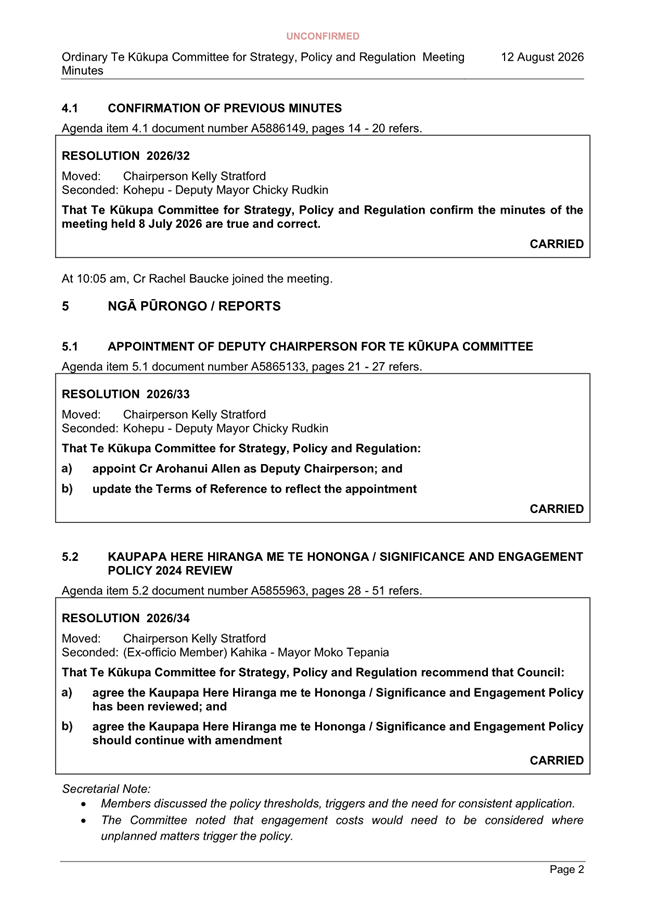
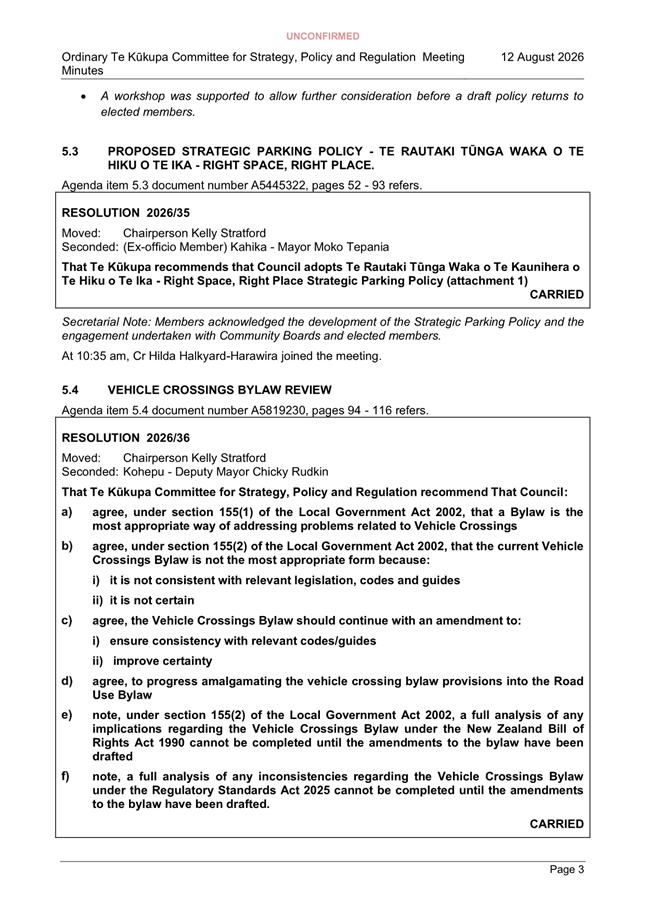
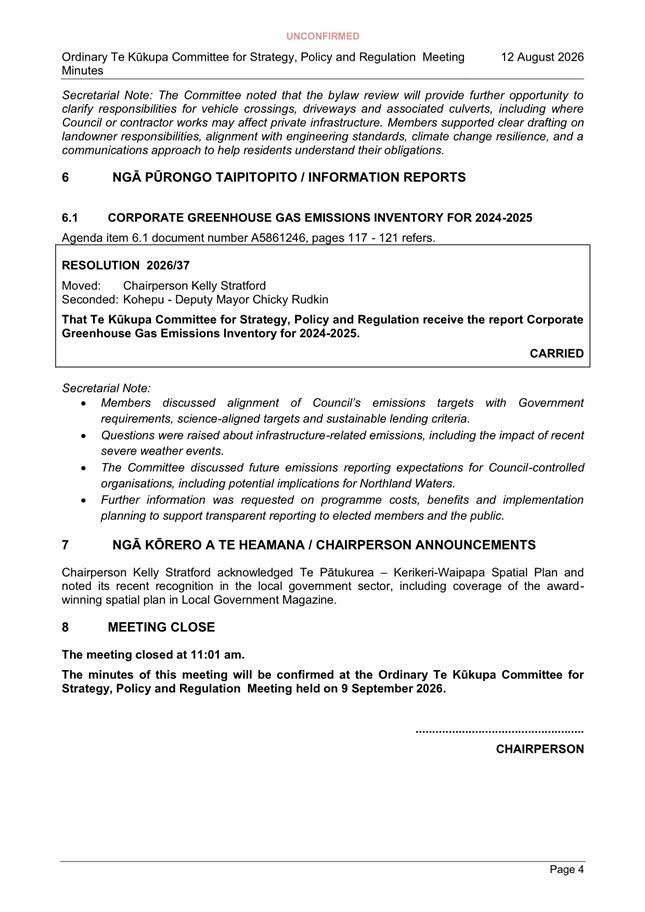
4.1 Confirmation
of Previous Minutes
File
Number: A5926392
Author: Imrie
Dunn, Democracy Advisor
Authoriser: Aisha
Huriwai, Manager - Democracy Services
Take Pūrongo / Purpose of the Report
The minutes are attached to allow the Committee to confirm
that the minutes are a true and correct record of previous meetings.
|
tŪtohunga / Recommendation
That Te Kūkupa Committee for Strategy, Policy and
Regulation confirm the minutes of the meeting held 12 August 2026 are true
and correct.
|
1) TĀhuhu kŌrero / Background
Local Government Act 2002 Schedule 7 Section 28 states that
a local authority must keep minutes of its proceedings. The minutes of these
proceedings duly entered and authenticated as prescribed by a local authority
are prima facie evidence of those meetings.
2) matapaki me NgĀ KŌwhiringa /
Discussion and Options
The minutes of the meetings are attached.
Far North District Council Standing Orders Section 27.3
states that no discussion shall arise on the substance of the minutes in any
succeeding meeting, except as to their correctness.
TAKE
TŪTOHUNGA / REASON FOR THE RECOMMENDATION
The reason for the recommendation is to confirm the minutes
are a true and correct record of the previous meetings.
3) PĀnga PŪtea me ngĀ
wĀhanga tahua / Financial Implications and Budgetary Provision
There are no financial implications or the need for
budgetary provision as a result of this report.
Attachments
1. 2026-08-12
Te Kūkupa Committee for Strategy, Policy and Regulation Minutes - A5910879
⇩ 
Hōtaka Take Ōkawa / Compliance schedule:
Full consideration has been given to the provisions of the
Local Government Act 2002 S77 in relation to decision making, in particular:
1. A
Local authority must, in the course of the decision-making process,
a) Seek
to identify all reasonably practicable options for the achievement of the
objective of a decision; and
b) Assess
the options in terms of their advantages and disadvantages; and
c) If
any of the options identified under paragraph (a) involves a significant
decision in relation to land or a body of water, take into account the
relationship of Māori and their culture and traditions with their
ancestral land, water sites, waahi tapu, valued flora and fauna and other
taonga.
2. This
section is subject to Section 79 - Compliance with procedures in relation to
decisions.
|
He
Take Ōkawa / Compliance Requirement
|
Aromatawai
Kaimahi / Staff Assessment
|
|
State the level of significance
(high or low) of the issue or proposal as determined by the Council’s
Significance and Engagement Policy
|
This is a matter of low
significance.
|
|
State the relevant Council
policies (external or internal), legislation, and/or community outcomes (as
stated in the LTP) that relate to this decision.
|
This report complies with the
Local Government Act 2002 Schedule 7 Section 28.
|
|
State whether this issue or
proposal has a District wide relevance and, if not, the ways in which the
appropriate Community Board’s views have been sought.
|
It is the responsibility of each
meeting to confirm their minutes therefore the views of another meeting are
not relevant.
|
|
State the possible implications for Māori
and how Māori have been provided with an opportunity to contribute to
decision making if this decision is significant and relates to land and/or
any body of water.
|
There are no implications for Māori in confirming minutes
from a previous meeting. Any implications on Māori arising from matters
included in meeting minutes should be considered as part of the relevant
report.
|
|
Identify persons likely to be
affected by or have an interest in the matter, and how you have given
consideration to their views or preferences (for example,
youth, the aged and those with disabilities).
|
This report is asking for minutes
to be confirmed as true and correct record, any interests that affect other
people should be considered as part of the individual reports.
|
|
State the financial implications
and where budgetary provisions have been made to support this decision.
|
There are no financial
implications or the need for budgetary provision arising from this report.
|
|
Chief Financial Officer review.
|
The Chief Financial Officer has
not reviewed this report.
|
5 Ngā
Pūrongo / Reports
5.1 Local
Alcohol Policy - Approval of Draft for Public Consultation
File
Number: A5869021
Author: Donald
Sheppard, Policy Advisor
Authoriser: Kate
Ivicheva, Group Manager - Planning & Policy
Take Pūrongo / Purpose of the Report
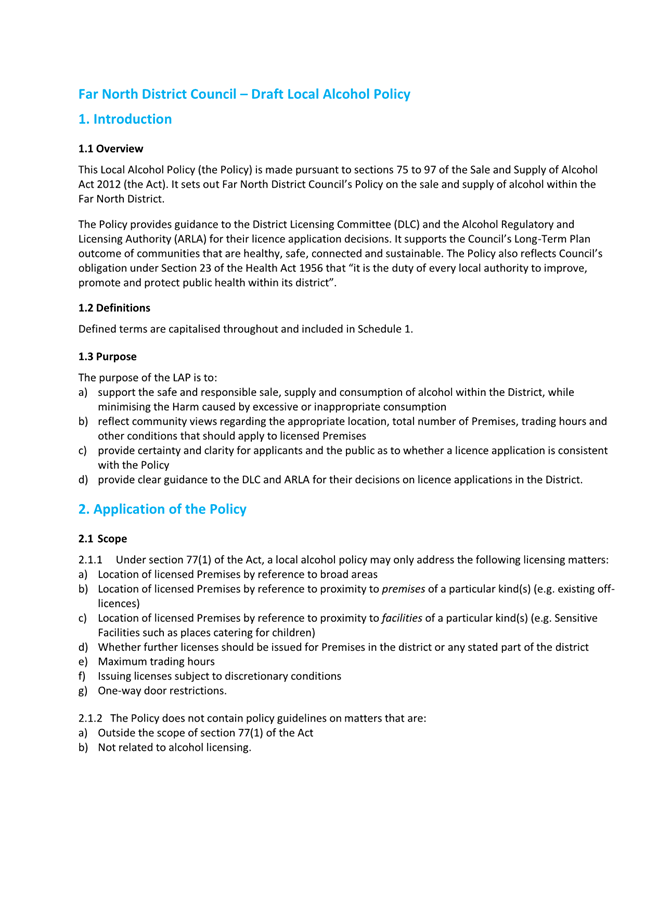
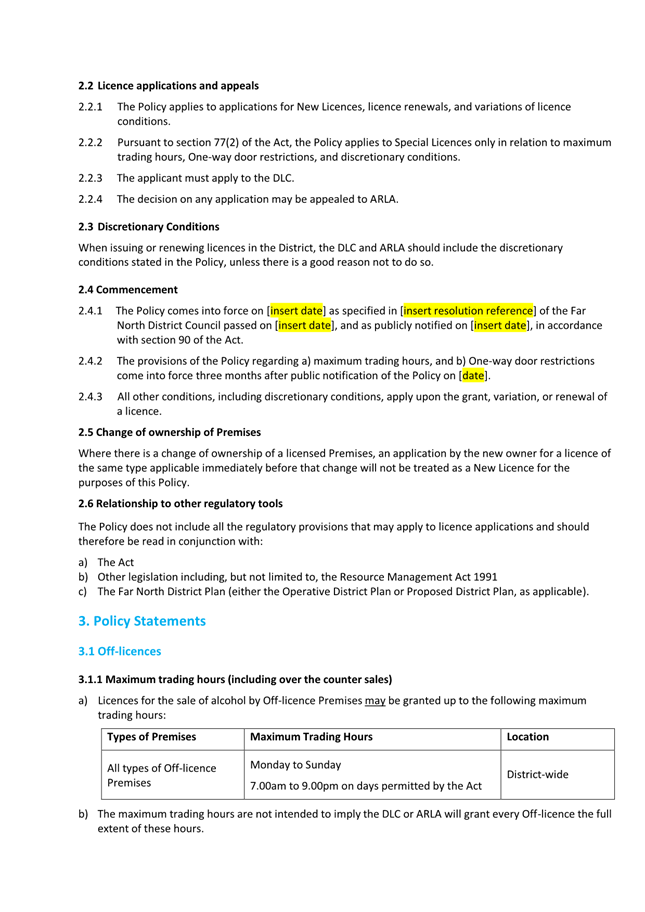
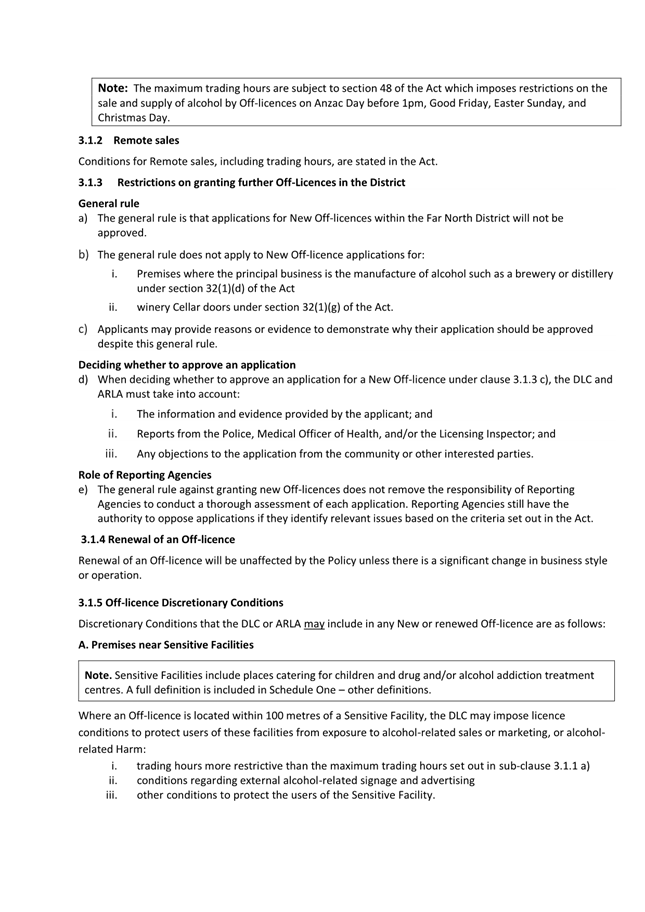
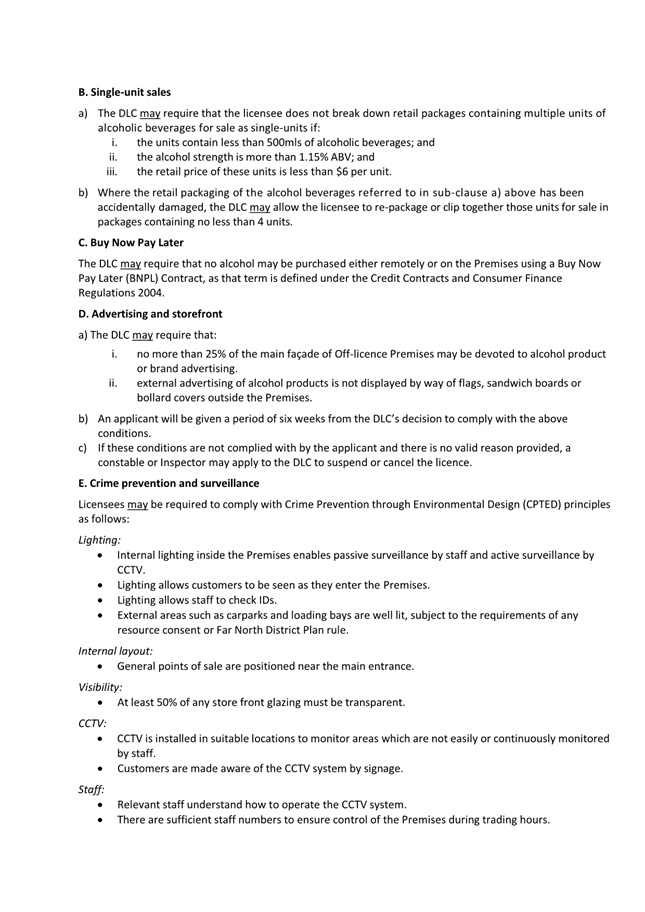
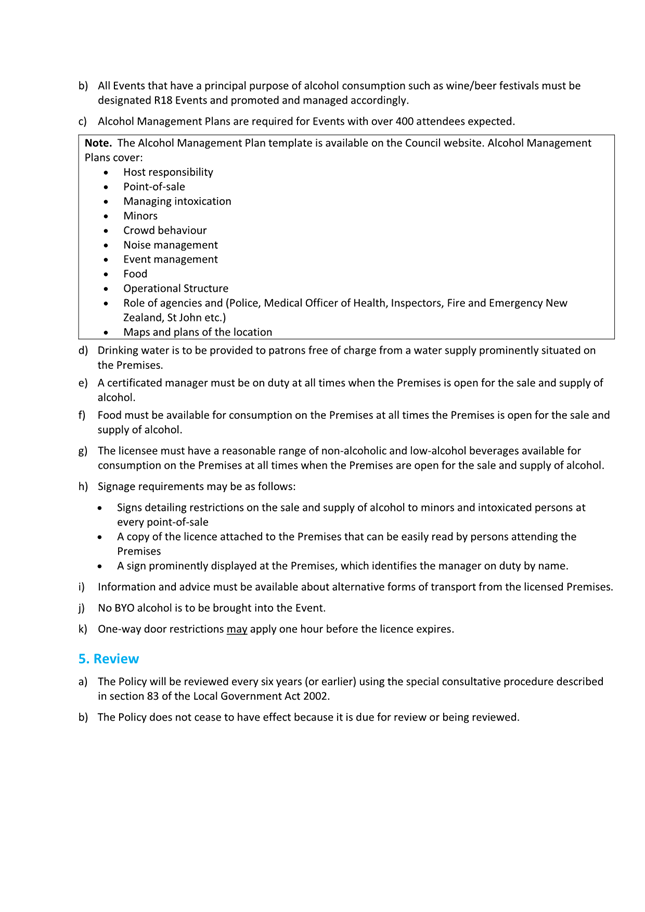
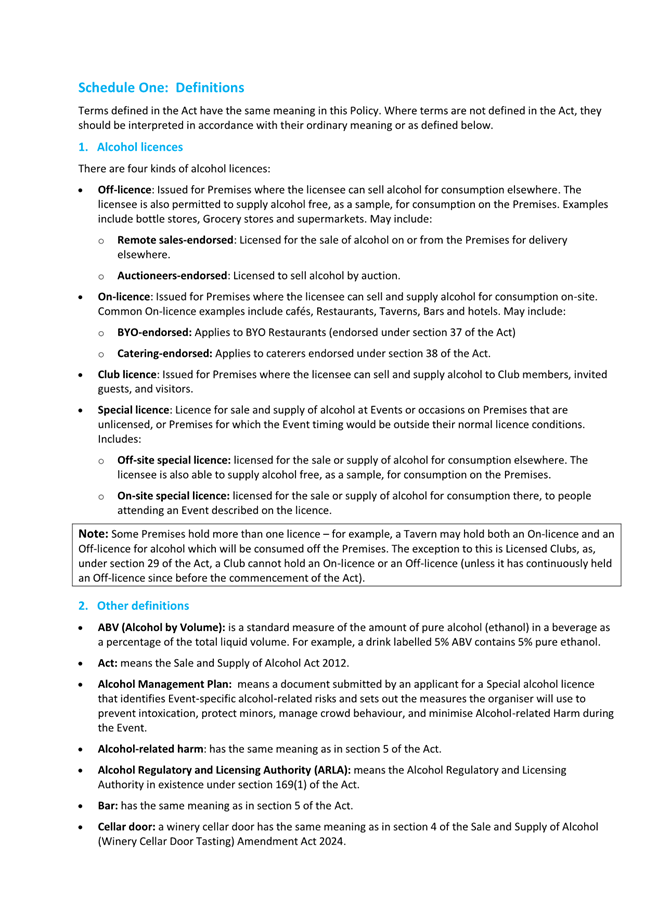
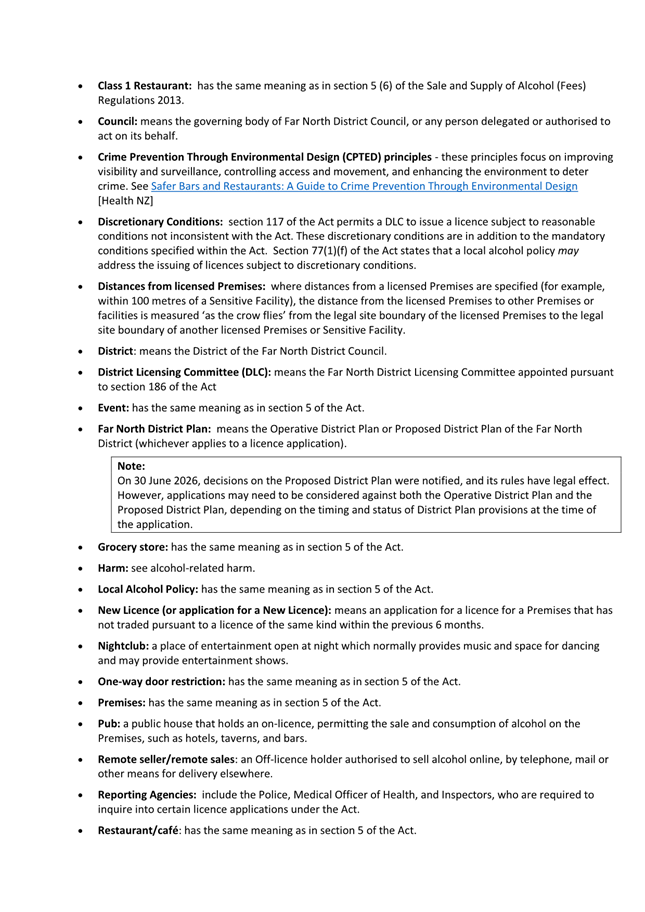
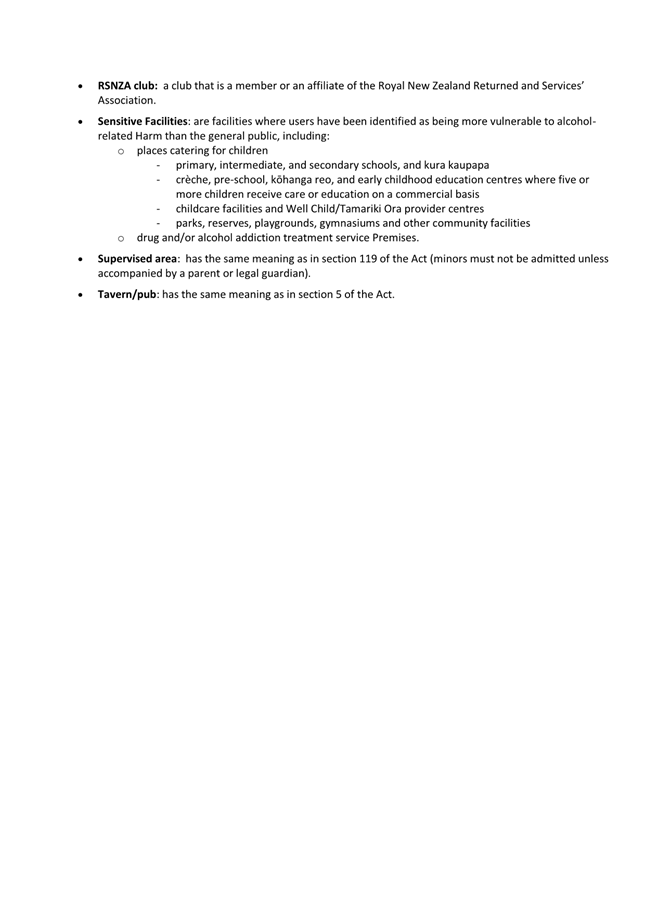
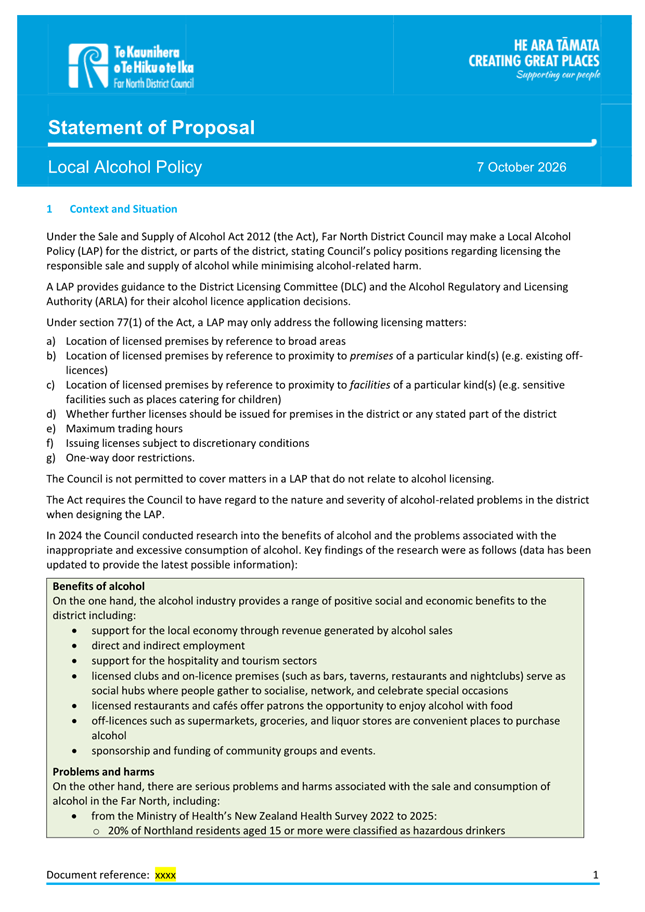
To seek approval to consult with the public on a Draft Local
Alcohol Policy (LAP) for the district.
WhakarĀpopoto matua / Executive Summary
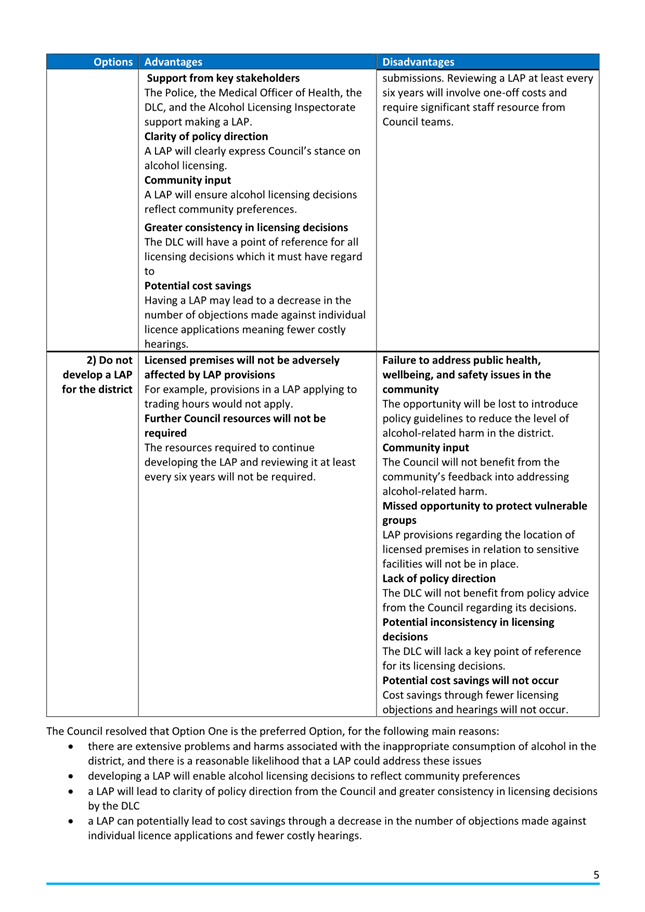
· Under the Sale and Supply of Alcohol Act 2012, the Council may adopt
a Local Alcohol Policy (LAP) to
guide alcohol licensing and support the safe and responsible sale, supply, and
consumption of alcohol while minimising alcohol-related harm.
· On 12 December 2024 (Resolution 2024/174
refers), Council approved the development of a LAP for
the district.
· In May/June 2025, a comprehensive community survey was undertaken to
understand community views on potential LAP provisions.
· On 14 May, a stakeholder workshop was held with 22 organisations in
attendance, with representatives from various Iwi, Hapū, hauora, and
support organisations.
· The draft
Policy has been developed by a working group that includes the Police, Medical
Officer of Health, and Alcohol Licensing Inspectorate.
· On 10 June 2026, a workshop was held with Te Kūkupa to obtain
guidance on a working draft of the LAP. If adopted, the LAP will guide District
Licensing Committee (DLC) and Alcohol Regulatory and Licensing Authority (ARLA)
decisions on alcohol licence applications.
· Staff seek approval from Te Kūkupa to consult with the public
on the Draft LAP (Attachment One) and Statement of Proposal for Consultation
(Attachment Two) using the Special Consultative Procedure described in section
83 of the Local Government Act 2002.
|
tŪtohunga
/ Recommendation
That Te Kūkupa, under section 147B of the
Sale and Supply of Alcohol Act 2012:
a) Approve the
proposed Draft Local Alcohol Policy in Attachment One for public consultation;
b) Approve the
Statement of Proposal for a new Local Alcohol Policy in Attachment Two to be
released for public consultation to meet the requirements of section 83 of
the Local Government Act 2002;
c) Approve a
minimum one-month period for making written submissions on the Statement of
Proposal;
d) Delegate
authority to the Chair of Te Kūkupa to decide on the date and
arrangements for any oral presentation/s of submissions;
e) Direct Council staff to make all necessary logistical arrangements
for submitters to be heard in person or online via Microsoft Teams;
f) Authorise
the Chief Executive to make any necessary minor drafting or presentation
amendments to the Draft Local Alcohol Policy and attached supporting
documents to correct errors or omissions prior to public release.
|
1) TĀhuhu kŌrero / Background
What is a Local Alcohol Policy (LAP)?
A LAP is a council policy, developed with the community
under the Sale and Supply of Alcohol Act 2012 (the Act) to support the safe and
responsible sale, supply, and consumption of alcohol and minimise
alcohol-related harm in the district.
A LAP applies to licensing
decisions and may address matters such as trading hours, the location and
density of licensed premises, and discretionary licence conditions. Under
sections 105 and 131 of the Act, the DLC and ARLA must have regard to a LAP when
considering licence applications and renewals.
LAP development
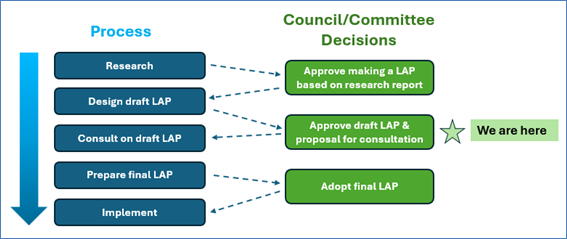
On 16 November 2023, the Council authorised staff to conduct
research into making a LAP (Resolution 2023/146
refers). The findings of this research are summarised in the Statement
of Proposal (Attachment Two).
On 12 December 2024, based on the research findings, the
Council approved the development of a LAP for the District (Resolution 2024/174
refers).
In May/June 2025, a comprehensive survey of Far North
residents was undertaken to understand community views on potential LAP
provisions.
From mid-2025 to August 2026, staff engaged with community
groups and licensees to understand their views. A workshop was held in May, 66
people attended representing 22 different organisations including Iwi, Hapū,
Hauora, and social agencies.
The draft LAP has been developed by a Working Group
including the Police, the Medical Officer of Health, and the Alcohol Licensing
Inspectorate.
On 10 June 2026, a workshop was held with Te Kūkupa to
obtain guidance on a working draft of the LAP. Further input was then sought
from Te Kūkupa on how to treat sensitive facilities such as schools in the
LAP.
Changes to the Draft LAP after the workshop with Te
Kūkupa on 10 June 2026
|
LAP clause/s
|
Changes made
|
Rationale
|
|
3.1.3
|
Simplified
the wording of “rebuttable presumption” clauses regarding
applications for new off-licences
|
To replace
legal jargon for ease of understanding
|
|
3.1.3 (b)
|
Added
exceptions to the general rule that new off-licences will not be approved,
i.e. for breweries, distilleries and winery cellar doors
|
Further
licences for breweries, distilleries and winery cellar doors will pose little
harm to the public
|
|
Definitions
|
Sensitive
facilities to include places catering for children and drug/alcohol addiction
centres but not marae or places of worship
|
Marae and
places of worship considered to have a lower need for protection from
proximity to licensed premises by both respondents to the public survey and
by Te Kūkupa members
|
|
3.1.5
3.2.2
3.2.3
|
Included
explanatory boxes for ‘sensitive facilities’ in appropriate
places in the Draft LAP
|
To provide
clarity
|
|
3.1.5
3.2.2
|
Buffer zone
for sensitive facilities changed from 200 metres to 100 metres
|
Investigation
showed that sensitive facilities located 100 to 200 metres away from licensed
premises are relatively less likely to be observed by users of these
facilities
|
|
Definitions
|
Revised
definition of the District Plan
|
More
accurate definition provided by the District Plan team
|
2) matapaki me NgĀ KŌwhiringa / Discussion and Options
Relevant legislation
The Act enables Council to make a LAP for alcohol licensing
matters in the district to ensure alcohol is sold, supplied, and consumed
safely and responsibly, and that alcohol-related harm is minimised.
Section 77 of the Act provides for a LAP to include policies
on the following licensing matters:
a) location of licensed
premises by reference to broad areas
b) location of licensed
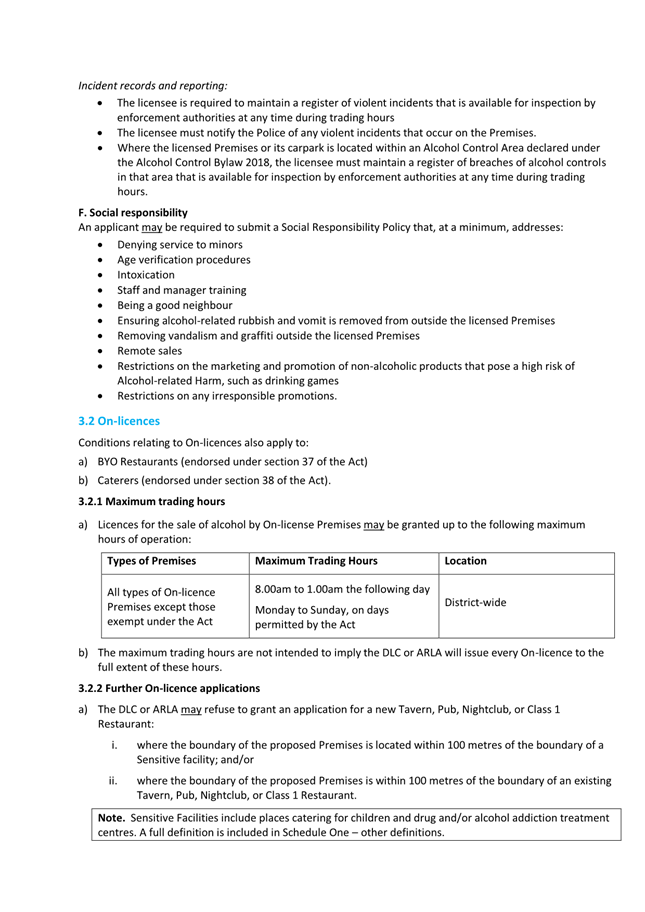
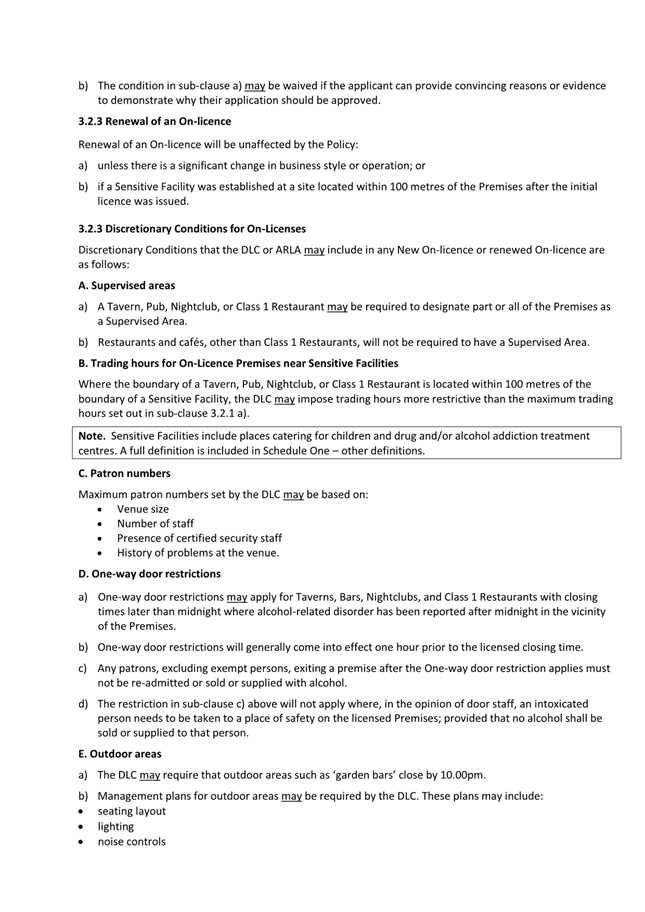
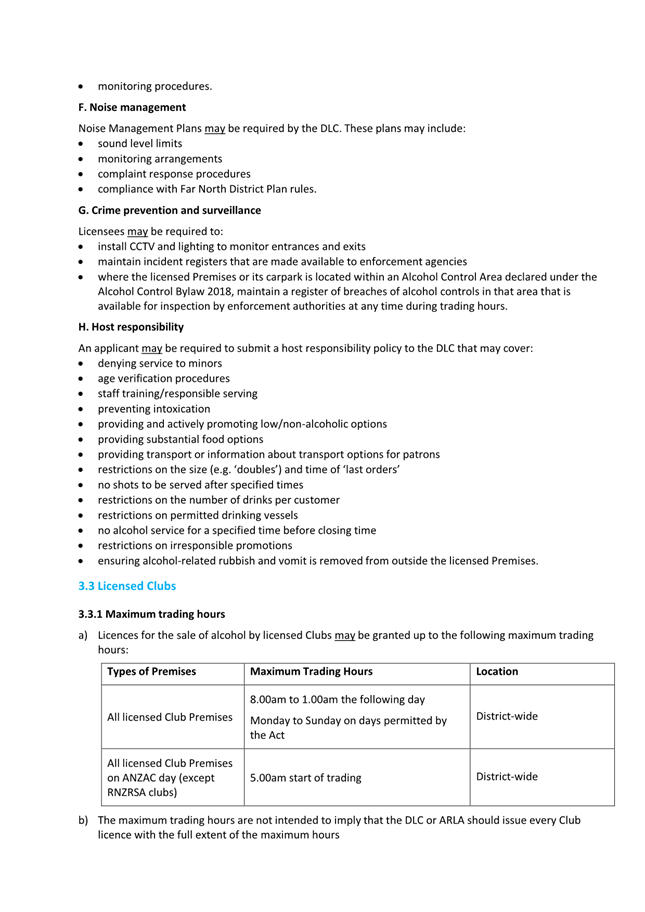
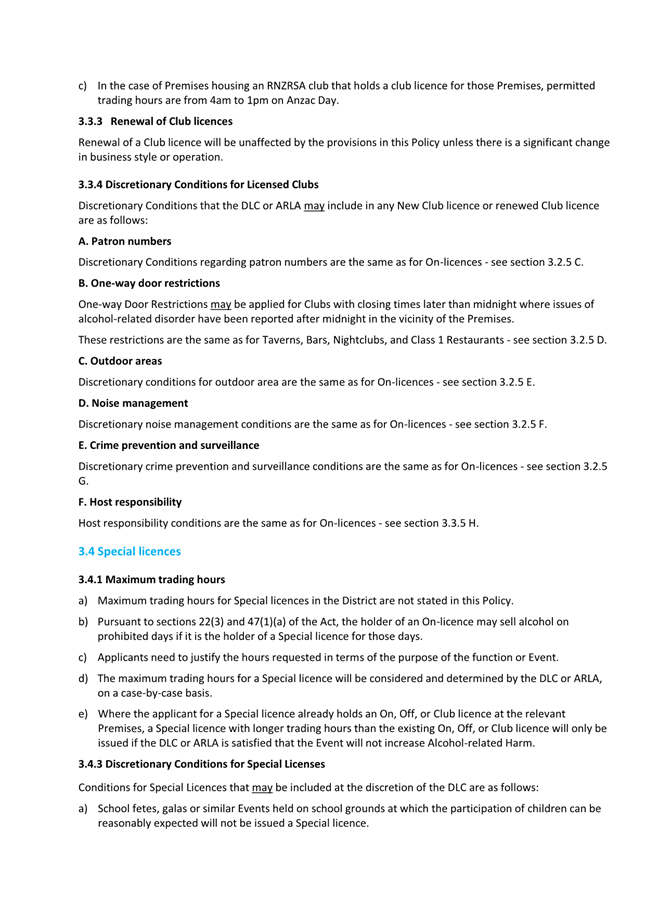
premises by proximity to premises of a particular kind or kinds - for example,
how close bottle stores can be to each other
c) location of licensed
premises by proximity to facilities of a particular kind or kinds - these
facilities include ‘sensitive facilities’ such as places catering
for children and alcohol addiction treatment centres
d) whether further
licences should be issued - the Council may impose a cap or ‘sinking
lid’ on issuing further licences where the current number of licences is
considered excessive
e) maximum trading hours -
default trading hours are stated in the Act. Council may reduce or increase
these hours to reflect community preferences
f) issuing licences
subject to discretionary conditions - these are conditions that the DLC may or
may not apply to specific licences and may cover areas such as noise control,
outdoor advertising of alcohol, and safety and security provisions etc.
g) one-way door
restrictions - these restrictions allow patrons to leave premises such as bars,
taverns, pubs, and nightclubs but not to re-enter these premises after a
certain time.
Under sections 105 and 131 of the Act, the DLC and ARLA must
have regard to the LAP when considering licence applications and renewals in
the district.
Summary of the research findings
The research findings are summarised in the Statement of
Proposal (Attachment Two). For more in-depth information, refer to the full
research report attached to the Council meeting on 12 December 2024[1].
Content of the Draft LAP
The Draft LAP is informed by research, community survey
results, engagement with licensees, meetings with community and hauora
organisations, and input from Police, Licensing Inspectors, and the Medical
Officer of Health.
Staff have aimed to produce a Draft LAP that reasonably
reflects community views, the data and research, while providing a balanced and
proportionate response to alcohol-related harm in the community.
The content of the Draft LAP (Attachment 1) complies with
section 77 of the Act (Content of policies).
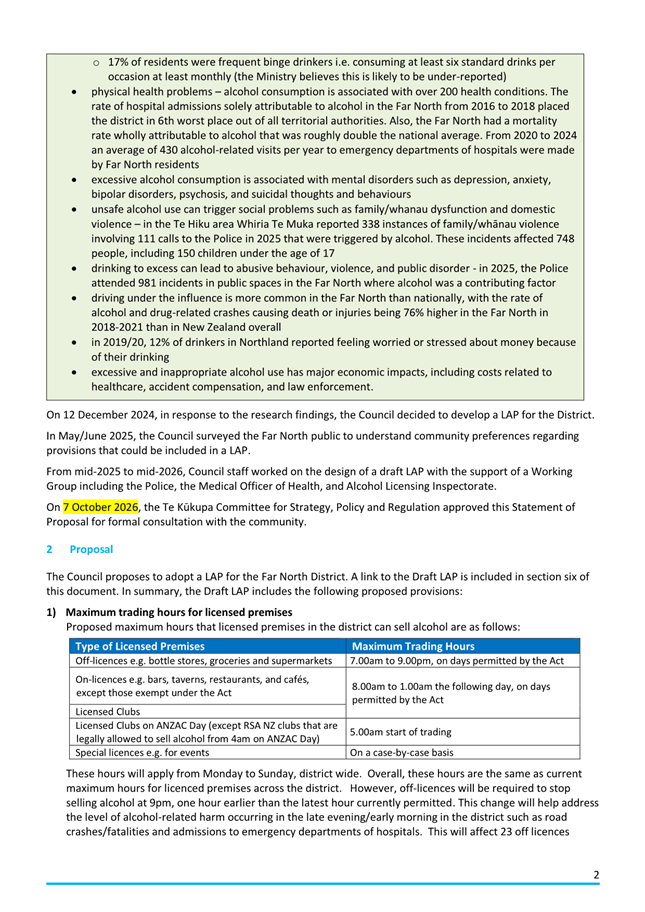
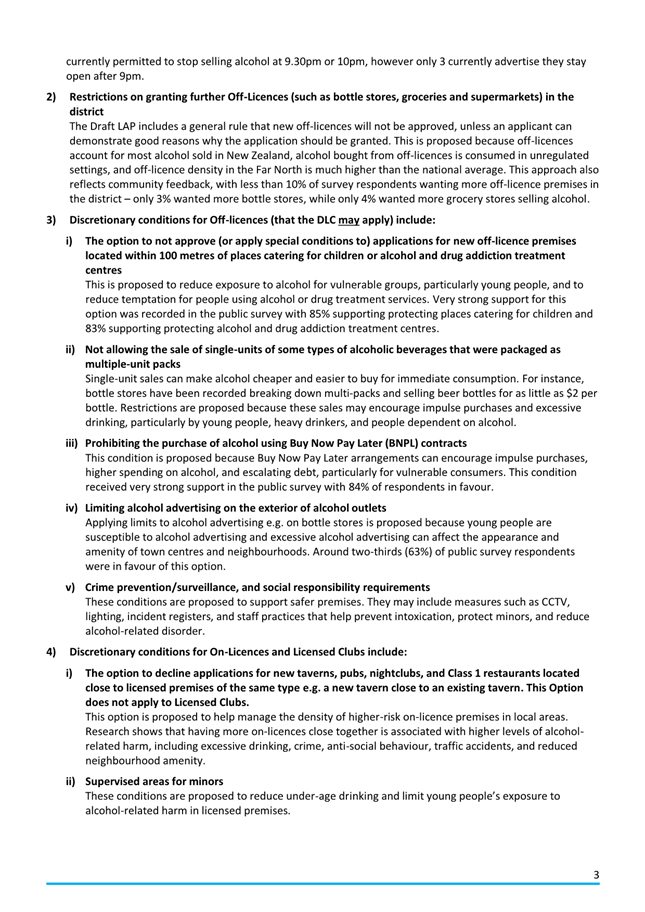
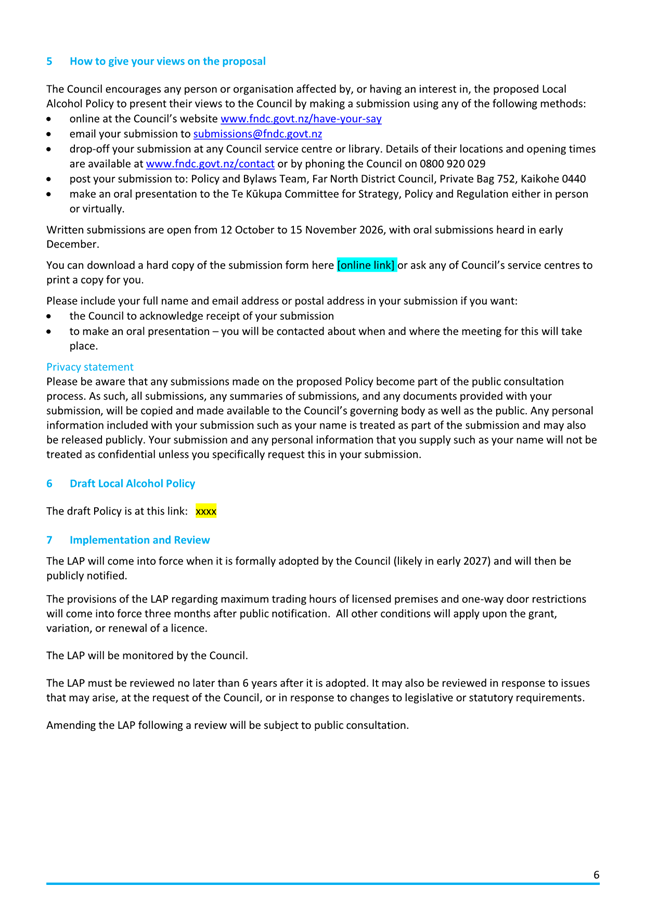
Key elements of the draft LAP include:
· setting maximum
trading hours for licensed premises
· restrictions on
granting further Off-Licences for bottle stores, groceries and supermarkets in
the district
· discretionary
conditions for Off-licences that the DLC may apply regarding:
o limiting new taverns, pubs,
nightclubs, and Class 1 restaurants located close to licensed premises of the
same type
o protecting vulnerable users of
places catering for children and alcohol and drug addiction treatment centres
o not allowing the sale of
single units of some types of alcoholic beverages that were packaged as
multiple-unit packs
o prohibiting the purchase of
alcohol using Buy Now Pay Later contracts
o limiting alcohol advertising
on the exterior of alcohol outlets
o crime prevention,
surveillance, and social responsibility practices.
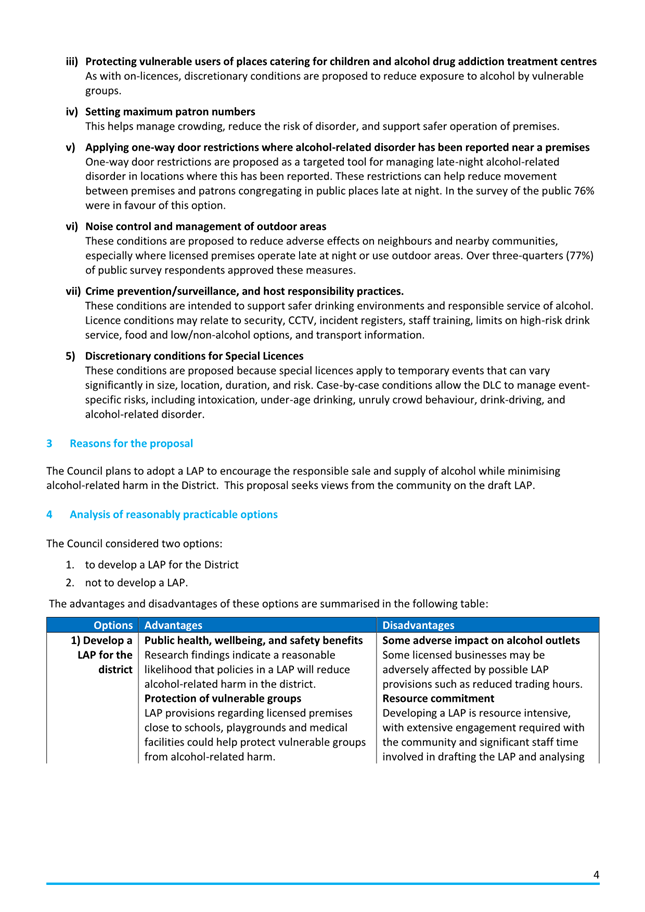
· discretionary
conditions for On-Licences and Licensed Clubs regarding:
o supervised areas for minors
o protecting vulnerable users of
places catering for children and alcohol and drug addiction treatment centres
o setting maximum patron numbers
o applying one-way door
restrictions where alcohol-related disorder has been reported late at night
near a premises
o noise control and the
management of outdoor areas
o crime prevention,
surveillance, and host responsibility practices.
· discretionary
conditions for Special Licences regarding the management of events.
Consultation
As required by section 78 of the Act, Council has consulted
with the Police, Licensing Inspectors, and the Medical Officer of Health on the
design of the draft LAP.
Section 79 requires Council to
consult on the Draft LAP using the Special Consultative Procedure (SCP)
described in section 83 of the Local Government Act 2002. An SCP requires at
least one month for consultation.
Section 83 requires Council to
prepare a Statement of Proposal explaining what is proposed and how the public
can provide their feedback (Attachment Two).
To ensure a range of options for
people to respond as they prefer to the Statement of Proposal, Council staff
will:
· encourage
people to present their views primarily online
· provide
a submission form for download on the website for people to print and make
written submissions either by post or delivery to Council offices
· inform
people that Council offices will print the Draft LAP, proposal document and
submission form if they are unable to print the documents themselves
· email
a link to the webpage for making submissions to the Council’s
“subscribers” database and share this link on the Council’s
social media pages.
Council staff expect there may be
requests to present submissions verbally to elected members. Staff therefore
recommend the Committee delegates to the Te Kūkupa Chair the power to
arrange and change the date of any verbal presentations of submissions.
OPTIONS
Option 1: Approve the proposed Draft LAP for public
consultation using the Special Consultative Procedure. This is the
recommended option.
Option 2: Do not approve the proposed Draft LAP for
public consultation
|
|
Advantages
|
Disadvantages
|
|
Option 1:
Approve the proposed Draft LAP for public consultation using the Special
Consultative Procedure
Recommended
|
Enables Council to meet
the statutory requirement to consult on the Draft LAP before a LAP can be
adopted
Supports transparent
and evidence-based decision-making by testing the Draft LAP with the wider
community before final decisions are made.
Provides interested
parties with a formal opportunity to comment on the proposed Draft LAP.
|
Consultation may raise
strong or conflicting views from community members, licensees, and
enforcement agencies.
|
|
Option 2: Do not approve the proposed Draft LAP for
public consultation
|
None identified
|
The development of a
LAP will stop.
Will be inconsistent
with Council’s previous decision to develop a LAP.
Will not support
testing the Draft LAP with the wider community before final decisions are
made.
Will not provide
interested parties with a formal opportunity to comment on the proposed Draft
LAP.
|
TAKE
TŪTOHUNGA / REASON FOR THE RECOMMENDATION
The Draft LAP has been developed through research,
stakeholder and community engagement, input from enforcement agencies, and
guidance from Te Kūkupa. Staff consider it is now appropriate to proceed
to formal public consultation.
NEXT
STEPS
Consultation must run for at least one month, and written
submissions will be accepted from 12 October to 15 November (five weeks), with
oral submissions in early December, depending on Te Kūkupa availability.
Staff will then aim to report submissions analysis and the
proposed final LAP to Te Kūkupa in the first quarter of 2027 for a
recommendation to Council to adopt the LAP.
IMPLICATIONS
UNDER THE HEAD START PROGRAMME
Potential amalgamation of local councils in Northland may
affect FNDC strategies, policies, and bylaws, including the LAP. Neither
Whangārei nor Kaipara District Councils currently have a LAP. However, the
Act allows a LAP to apply to only part of a district, so the proposed LAP could
continue to apply to the current Far North area if an enlarged district is
created.
IMPLICATIONS
UNDER THE REGULATORY STANDARDS ACT 2025 (RSA)
The Regulatory Standards Act 2025 (RSA 2025) applies to new
secondary legislation adopted by Council from 1 July 2026. LAP provisions on
maximum trading hours or one-way-door policies are secondary legislation and
will require a Consistency Accountability Statement when the LAP is adopted.
Consultation on the Draft LAP under sections 82 and 83 of
the Local Government Act 2002 will ensure compliance with the consultation
principle stated in section 9(i) of the RSA 2025.
3) PĀnga PŪtea me ngĀ
wĀhanga tahua / Financial Implications and Budgetary Provision
LAP development costs, including staff time, engagement, and
external legal advice, have been met from existing budgets. No new
implementation costs are expected, apart from public notification costs
required by the Act.
Any additional initiatives, implementation, or enforcement
costs that cannot be managed within existing budgets will need to be identified
by the teams responsible and considered through the appropriate budgeting and
planning processes.
Having a LAP in place may reduce the number of costly
hearings regarding objections to the DLC’s decisions, as a LAP will give
the DLC and licensed premises clearer direction regarding Council’s
intentions for alcohol licensing.
Āpitihanga
/ Attachments
1. Draft
LAP - A5933144 ⇩ 
2. Statement
of Proposal LAP - A5933160 ⇩
Hōtaka
Take Ōkawa / Compliance Schedule:
Full consideration has been given to the provisions of the
Local Government Act 2002 S77 in relation to decision-making, in particular:
1. A
Local authority must, in the course of the decision-making process,
a) Seek
to identify all reasonably practicable options for the achievement of the
objective of a decision; and
b) Assess
the options in terms of their advantages and disadvantages; and
c) If
any of the options identified under paragraph (a) involves a significant
decision in relation to land or a body of water, take into account the
relationship of Māori and their culture and traditions with their
ancestral land, water sites, waahi tapu, valued flora and fauna and other
taonga.
2. This
section is subject to Section 79 - Compliance with procedures in relation to
decisions.
|
He Take Ōkawa /
Compliance Requirement
|
Aromatawai Kaimahi /
Staff Assessment
|
|
State the level of significance (high or low) of the
issue or proposal as determined by the Council’s
Significance and Engagement Policy
|
Under the Significance and Engagement
Policy, developing a LAP is highly significant as:
· this area is not covered
by current plans or policies
· developing a LAP has a
high level of public interest
· a LAP is likely to be of
particular interest to Māori given the disproportionate level of
alcohol-related harms experienced by Māori.
|
|
State the relevant Council policies (external or
internal), legislation, and/or community outcomes (as stated in the LTP) that
relate to this decision.
|
Legislation:
· Sale and Supply of
Alcohol Act 2012
· Local Government Act
2002
· section 14(c) - Council’s decisions
should take into account: a) the diversity of the community, and the
community’s interests within its district; b) the interests of future
as well as current communities
· Health Act 1956
· section 23 provides that it is the duty
of every local authority to improve, promote and protect public health within
its district.
Council’s Long-Term Plan Community Outcomes:
· communities that are
healthy, safe and connected
District Plan Objectives and
Policies
· see section 4.5 of the
research report attached to the 12 December 2024 report to Council
Alcohol Control Bylaw 2018
· see section 4.4 of the
research report
|
|
State whether this issue or proposal has a District wide
relevance and, if not, the ways in which the appropriate Community
Board’s views have been sought.
|
The sale, supply, and consumption of alcohol has
district-wide relevance across the Far North District with 83% of adults aged
15 or more in Northland having consumed alcohol in the past year (2017-20
results).
For this reason, LAP
development has involved a district-wide approach, rather than working at the
local community level.
However, the Community Boards were briefed on the
project and identified local stakeholders for engagement.
|
|
State the
possible implications for Māori and how Māori have been provided
with an opportunity to contribute to decision making if this decision is
significant and relates to land and/or any body of water.
State the
possible implications and how this report aligns with Te Tiriti o Waitangi /
The Treaty of Waitangi.
|
A LAP has potential implications for Māori
communities, who are disproportionately affected by the harms and problems
associated with alcohol use. To understand impacts on Māori, Council
staff engaged with Iwi and Hapū representatives in a variety of ways:
· discussion
with Whiria Te Muka to obtain insights from Te Hiku Iwi regarding
alcohol-related domestic violence and the desire for Iwi and hapu to have
their say on a LAP
· meetings with
hauora organisations to understand alcohol-related public health issues
affecting Māori in the Far North
· a
hui in Ngāwhā attended by Iwi, Hapū, and hauora
representatives from across the district. Including Ngāpuhi, NgāiTakoto,
Ngāti Tautahi. Te Hiku Iwi, Whiria Te Muka, Te Rarawa, Ngāti Hine
Health, Hauora Hokianga, Te Taumata Hauora, Te Pūtahi-Nui-o-Rehua,
Whakawhitiora Pai, and Te Hau Ora o Ngāpuhi.
|
|
Identify persons likely to be affected by or have an
interest in the matter, and how you have given consideration to their views
or preferences (for example – youth, the aged and those with
disabilities).
|
Practically all members of the
community are affected by the sale, supply, and consumption of alcohol in the
district.
Existing licensees are very interested in the LAP and
their views were sought.
As discussed in section 9.2 of the research report
attached to the Council report on 12 December 2024, demographic groups that
are particularly vulnerable to alcohol-related harms include:
· children
· young adults and adults
aged 15 to 44
· those living in areas
with high social deprivation
· males
· Māori (particularly
Māori men).
|
|
State the financial implications and where budgetary
provisions have been made to support this decision.
|
LAP development costs, including staff time, engagement,
and external legal advice, have been met from existing budgets.
No new implementation costs are expected, apart from
public notification costs required by the Act, which will be met from
existing budgets.
Having a LAP in place may reduce the number of costly
hearings regarding objections to the DLC’s decisions.
|
|
Chief Financial Officer review.
|
Chief Financial Officer have not reviewed this report.
|
5.2 FNDC
Housing Strategy - Draft for Approval
File
Number: A5790006
Author: Steve
Rylands, Senior Policy Advisor
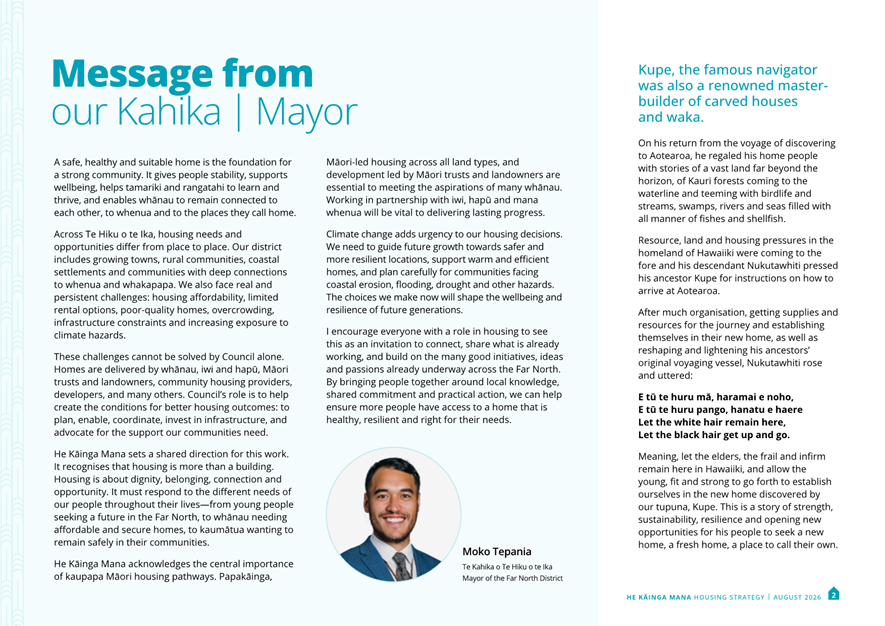
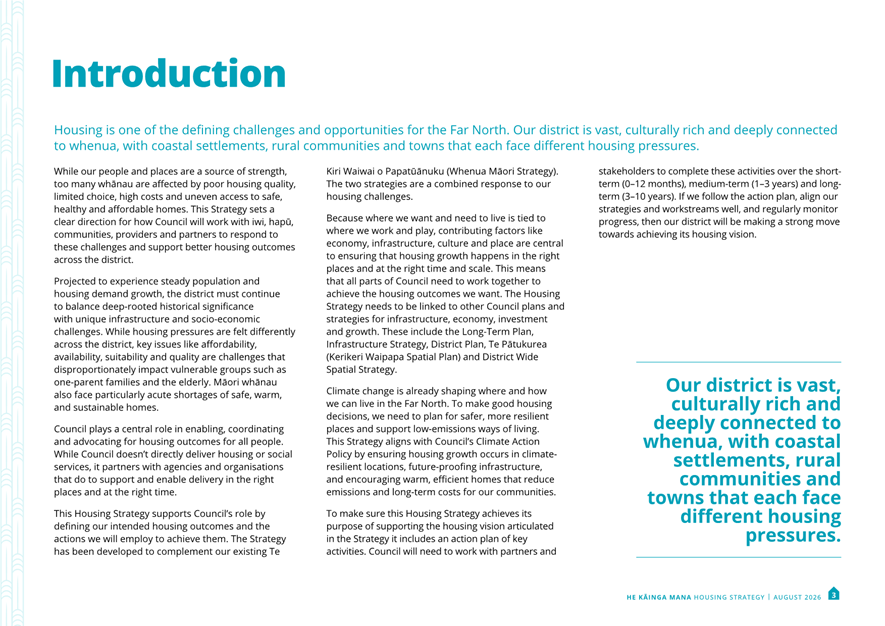
Authoriser: Kate
Ivicheva, Group Manager - Planning & Policy
Take Pūrongo / Purpose of the Report
To seek a recommendation from
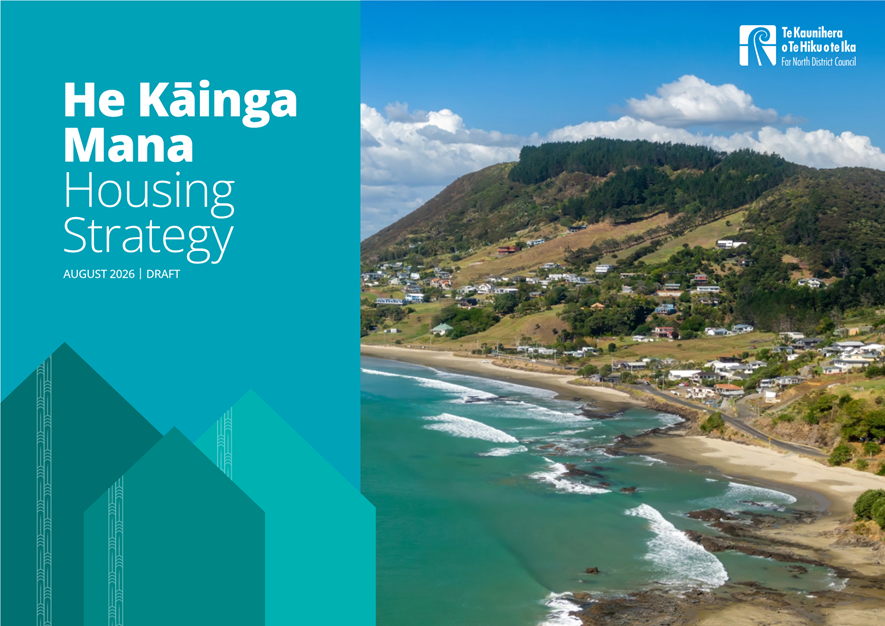
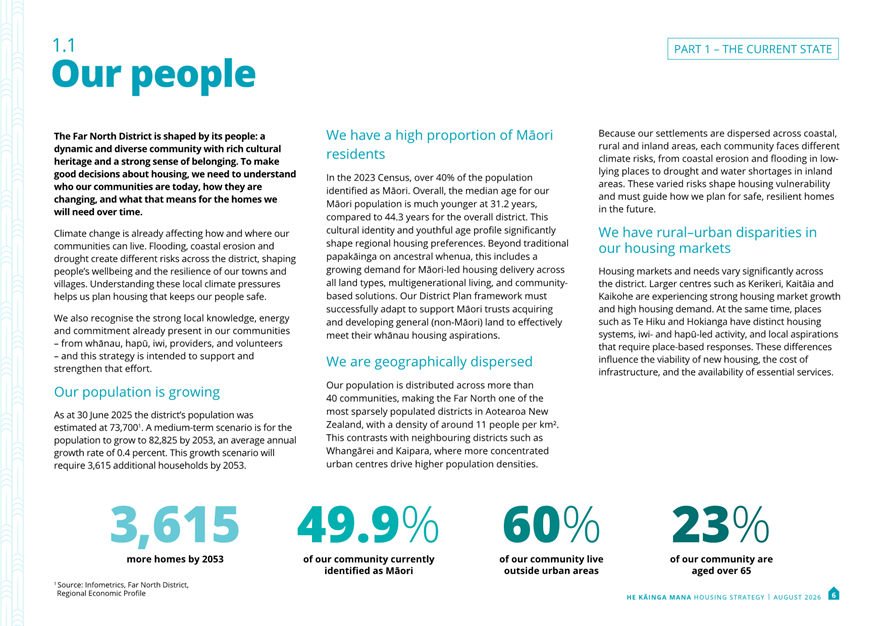
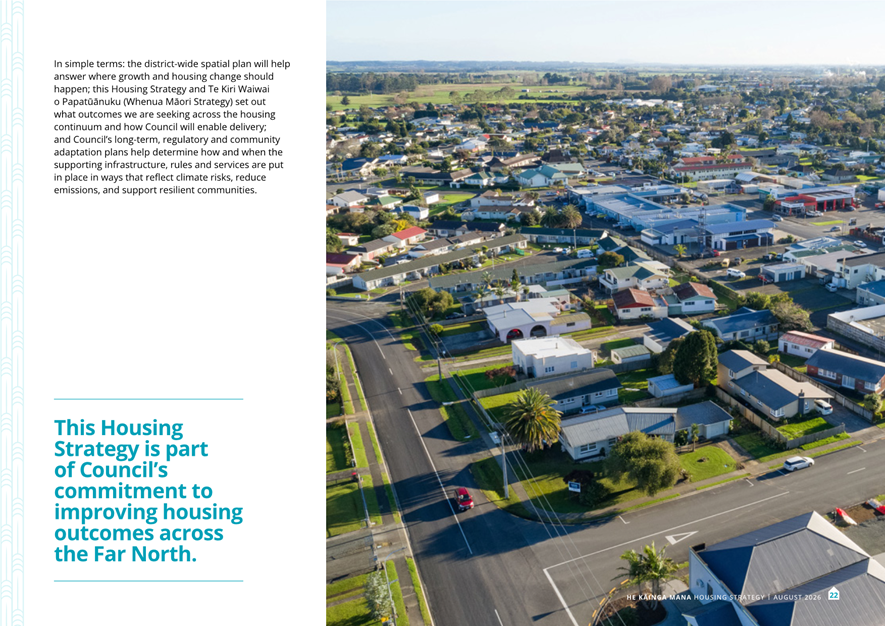
Te Kukupa that Council adopt the He Kāinga Mana Housing Strategy.
WhakarĀpopoto matua / Executive Summary
· On 11 December 2023, Council resolved (resolution 2023/159) to
approve development of a Housing Strategy for the Far North District and to
endorse an Interim Housing Action Plan.
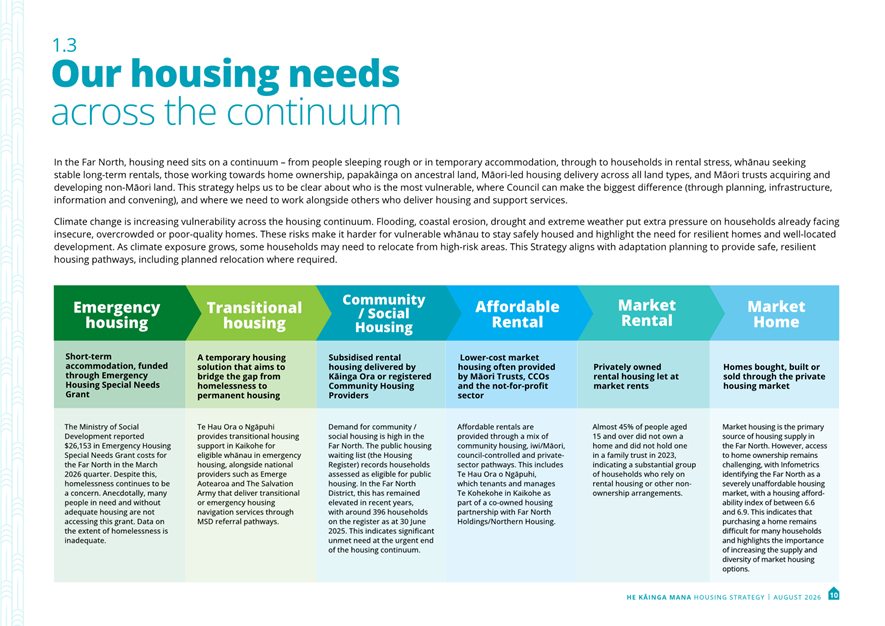
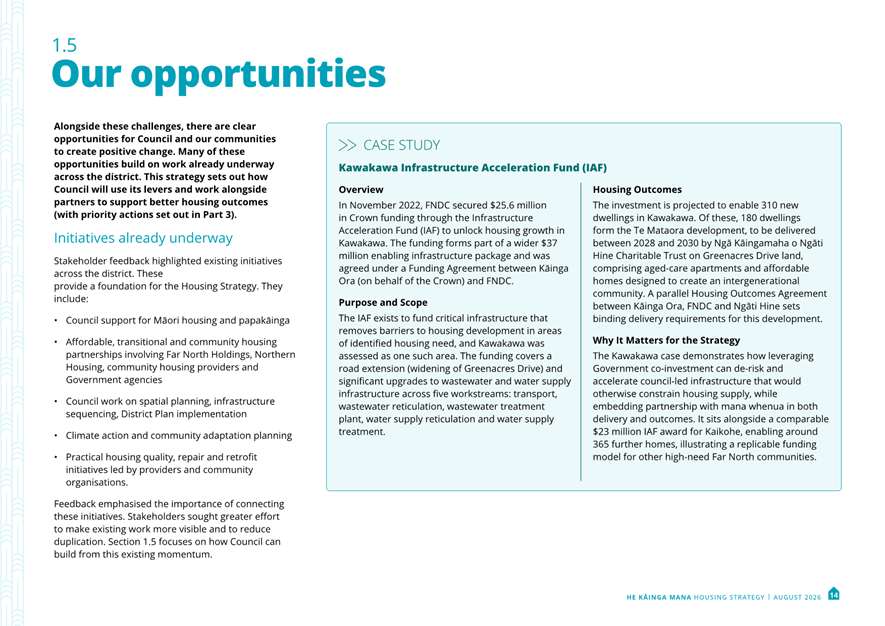
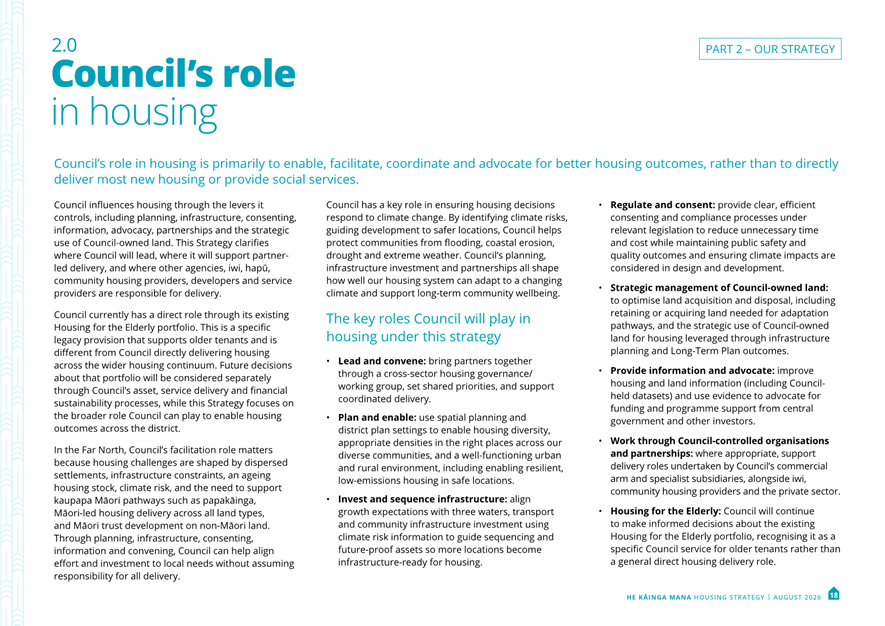
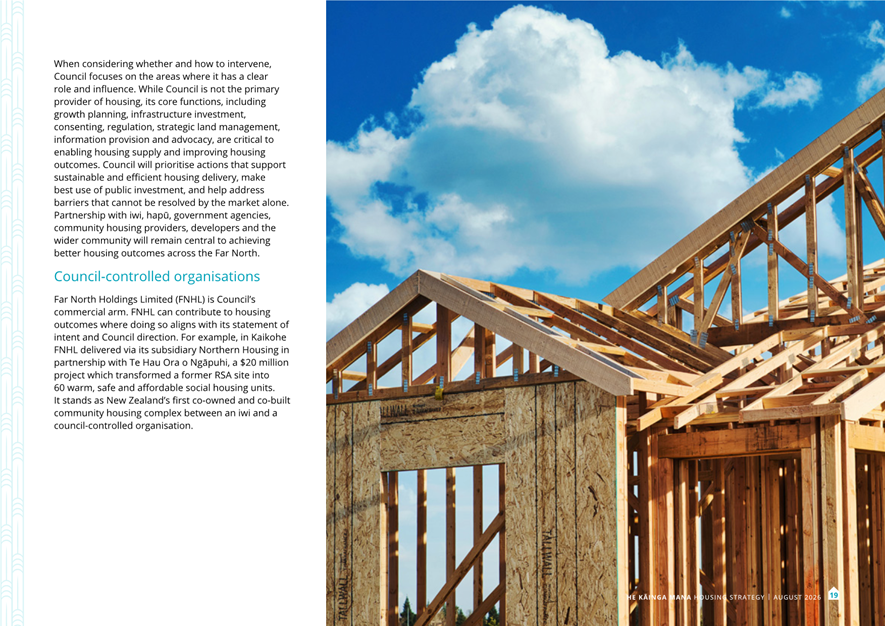
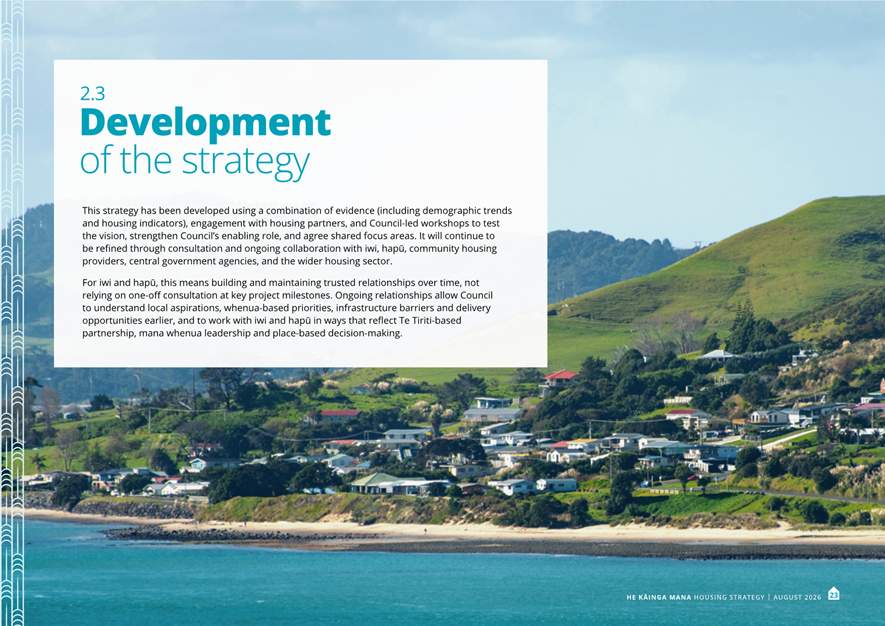
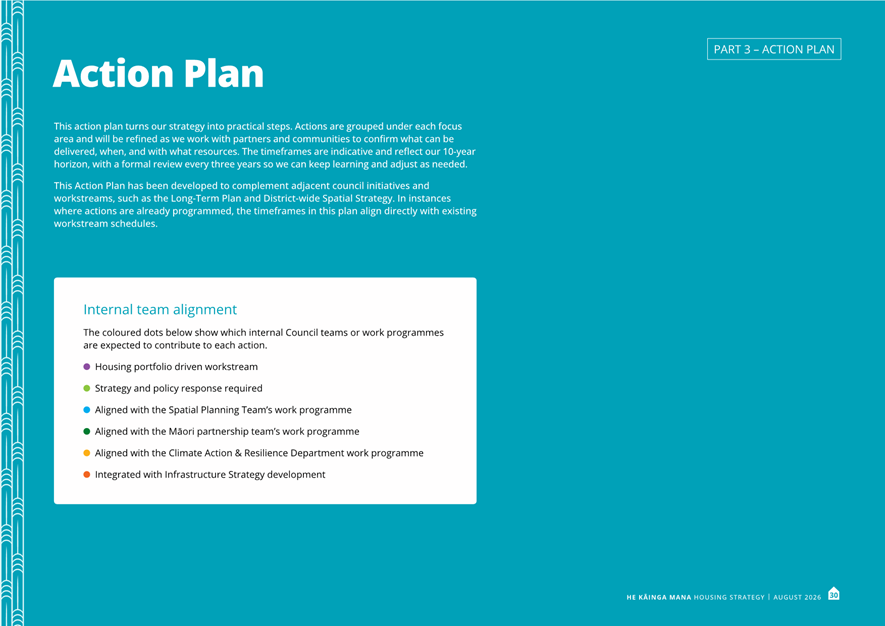
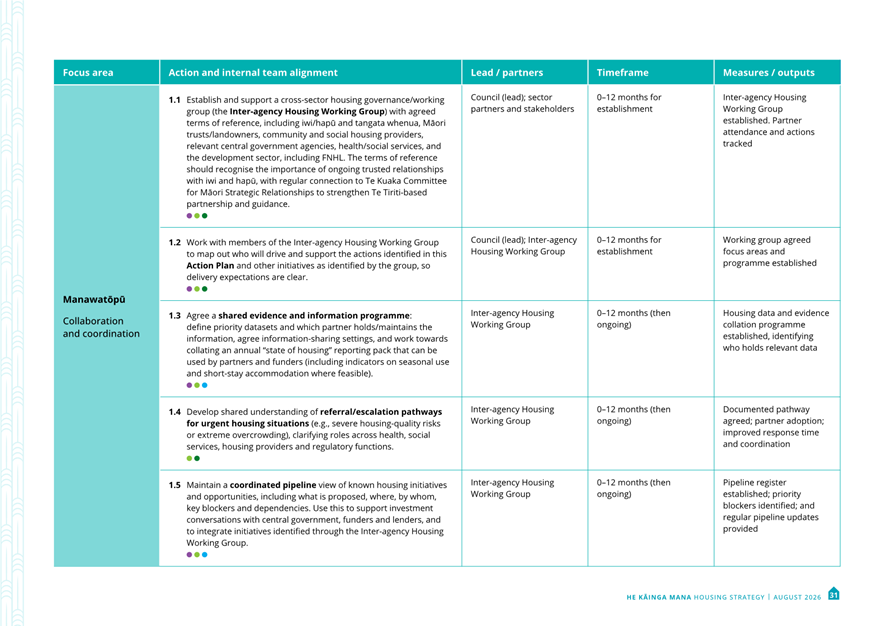
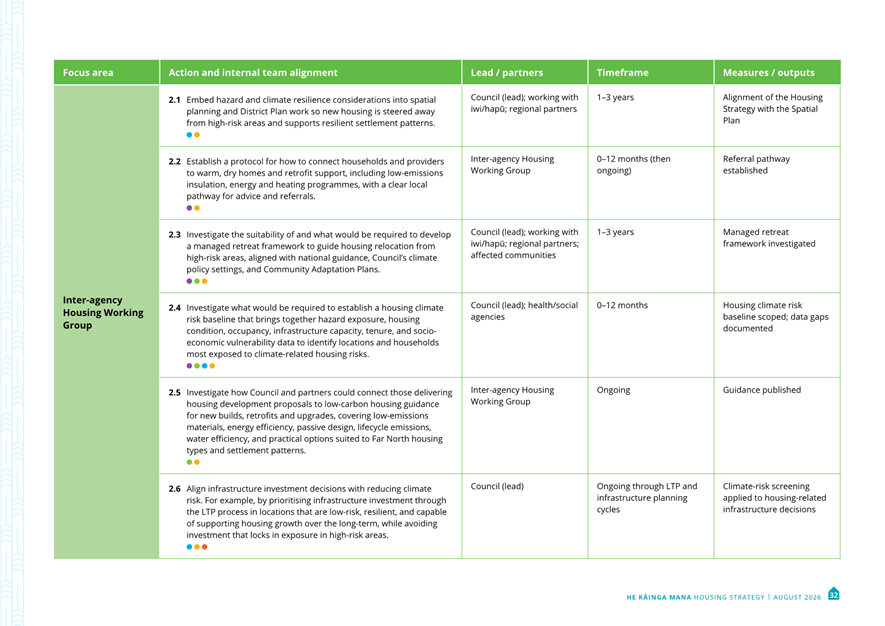
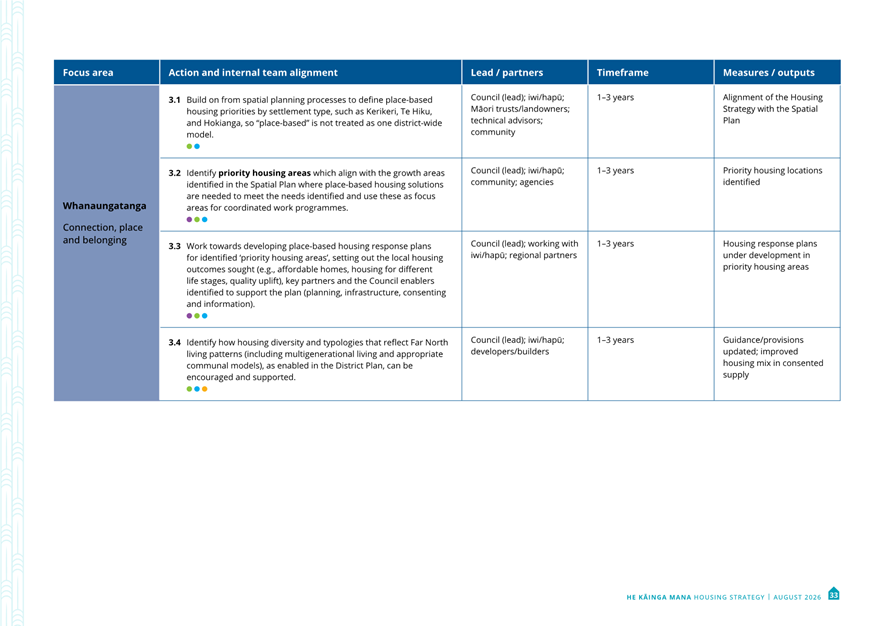
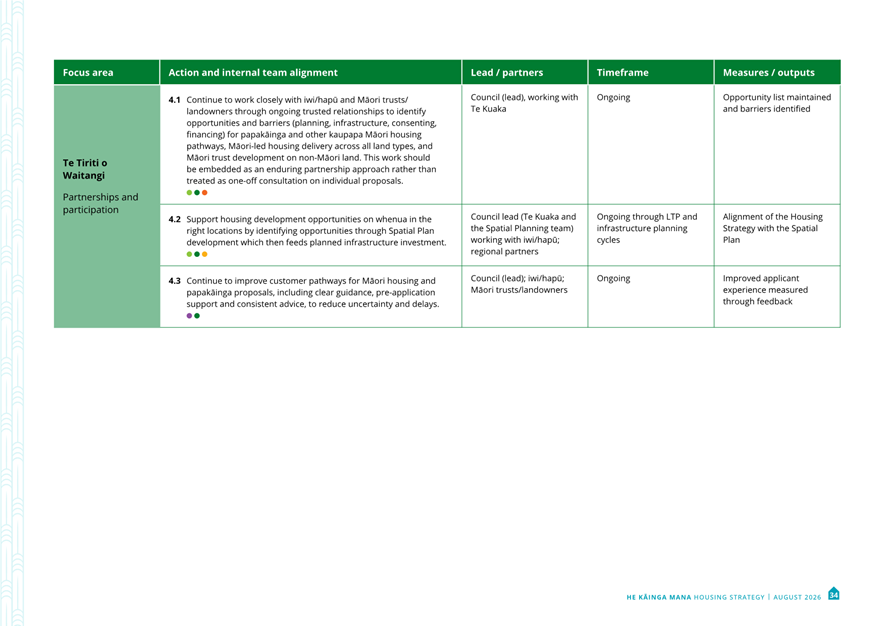
· The draft He Kāinga Mana Housing Strategy (Attachment 1)
has been developed in response to that decision, informed by data on housing
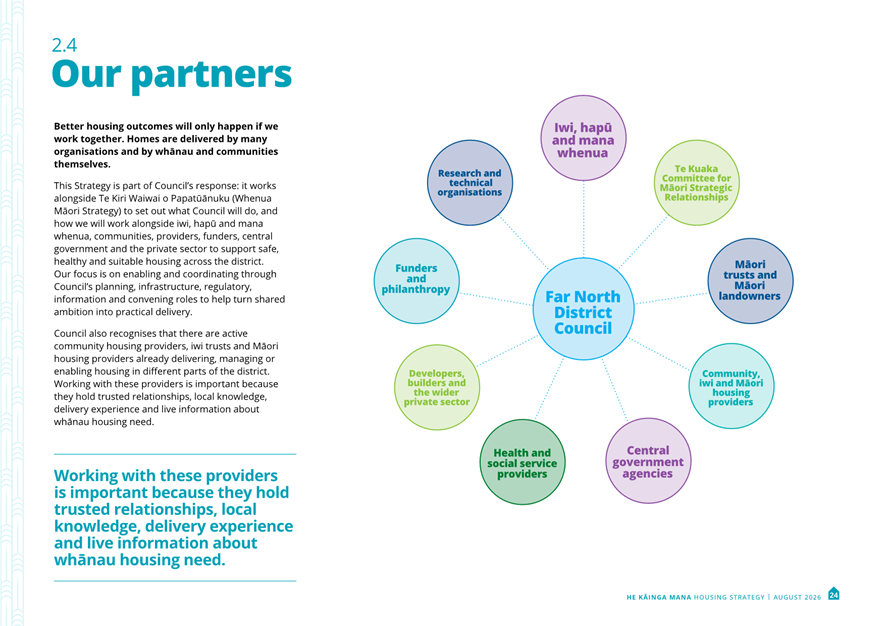
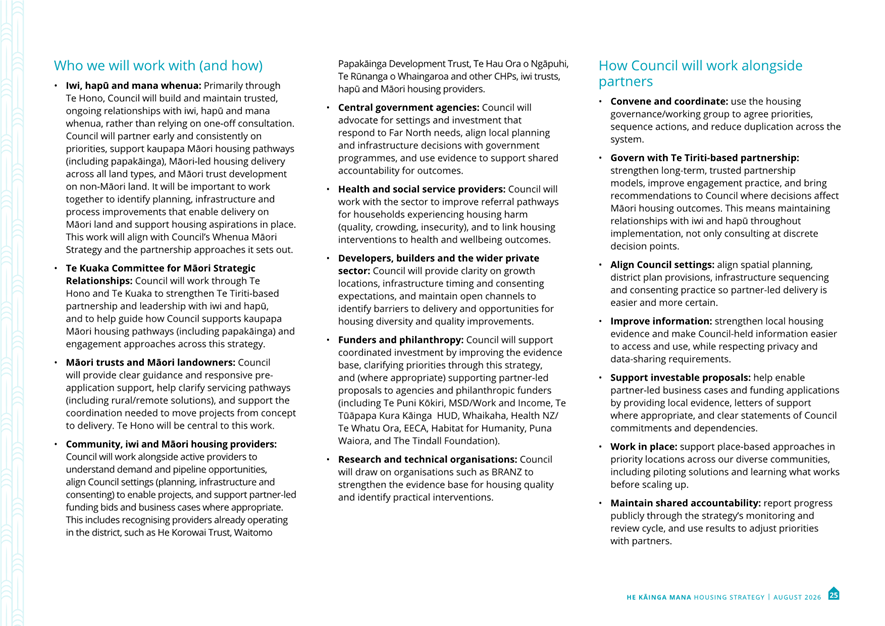
need and by targeted engagement with Iwi, Hapū, Māori housing
providers, Community Housing Providers, developers, and Government agencies.
· The Strategy will give Council a prominent role as an enabler,
coordinator and advocate for housing outcomes. It does not confer on Council a
role as a provider of housing. This reflects the reality that Council does not
build or fund housing at any scale.
· Feedback from stakeholders has been carefully considered and, where
it is within scope, has been incorporated into the draft Strategy.
· The Strategy can be implemented within existing resources.
Representatives from the teams responsible for the action plan participated in
the working group and confirmed that the proposed actions are achievable within
their current resourcing.
|
tŪtohunga
/ Recommendation
That Te Kūkupa recommend that
Council:
a) adopt
the He Kāinga Mana Housing Strategy at Attachment 1, and
b) authorise
the Chief Executive to make any necessary minor drafting amendments to the
strategy document to correct errors or omissions.
|
1) TĀhuhu kŌrero / Background
On 11 December 2023, Council
resolved (resolution 2023/159) to approve development of a Housing Strategy for
the Far North District and endorse an Interim Housing Action Plan. This
resolution recognised housing as one of the district's most significant social,
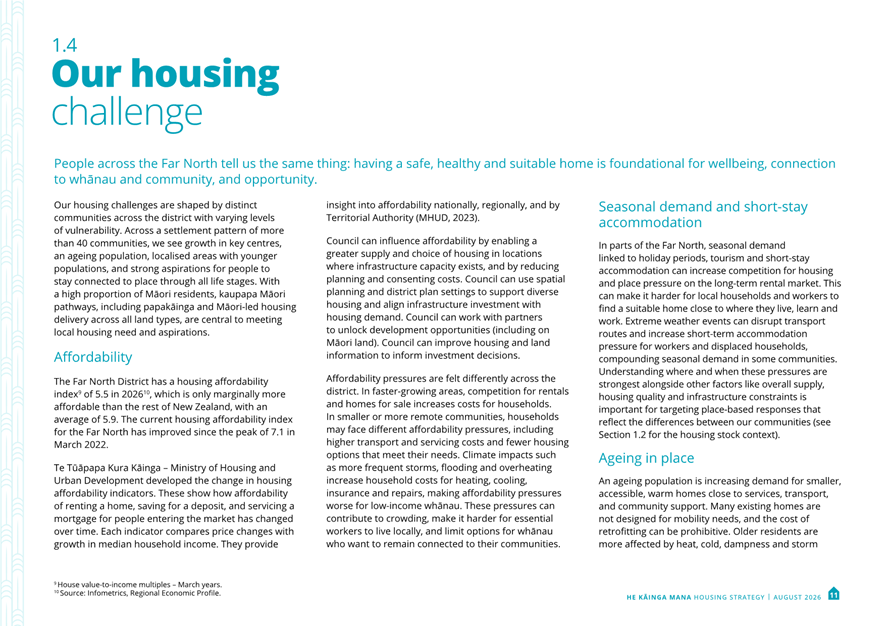
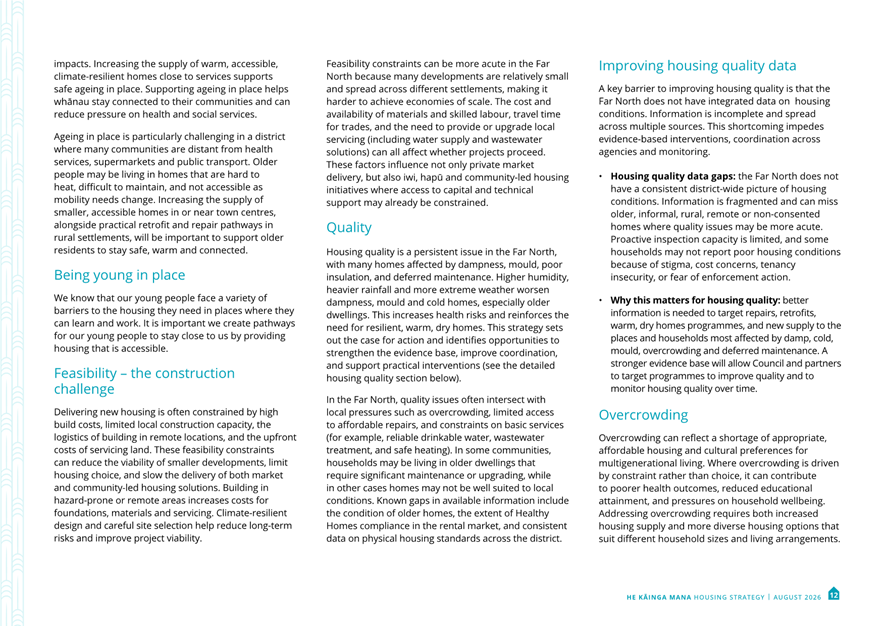
economic and wellbeing challenges. The report to Council reported a stark
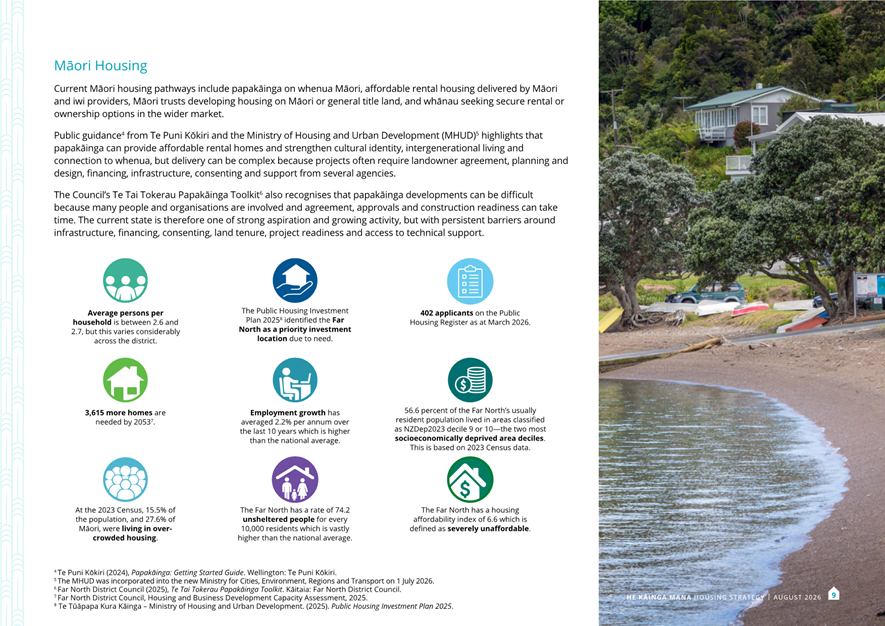
problem — a five-fold increase in Housing Register applicants since 2018,
27.6 percent of Māori living in overcrowded homes, an affordability index
of 6.6 (severely unaffordable), and Northland having the country's worst
housing quality.
Council agreed to establish
an Interim Housing Action Plan as a bridging solution. It guided
Council’s immediate housing work and decisions while the longer-term
Housing Strategy was developed, explicitly recognising that the need for action
was urgent.
An important element of the
Interim Housing Action Plan was the commissioning of a Housing and Business Development Capacity Assessment (HBA)
to provide evidence of how well placed the district is to meet future housing
needs. The assessment was that supply constraints are about affordability and
feasibility rather than a lack of zoned land. This finding reinforced the
rationale for the Housing Strategy – Council needed a collaborative,
multi-agency strategy addressing financial and structural barriers to
development.
Another important
achievement was the adoption in July 2025 of Te
Kiri Waiwai o Papatūānuku - Whenua Māori strategy. This is
Council’s strategy to support whānau, Hapū and Iwi to occupy,
develop and use whenua Māori.
Staff have prepared the draft
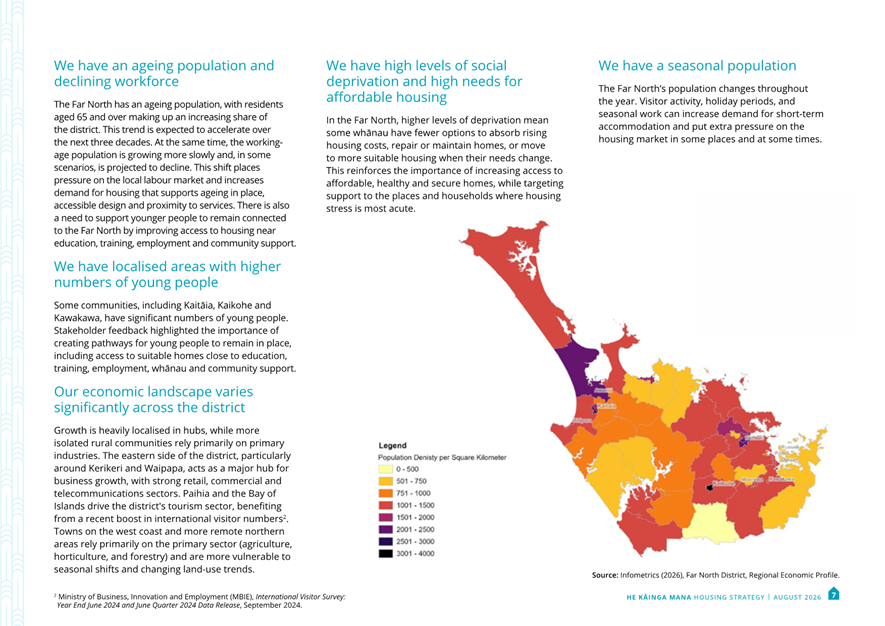
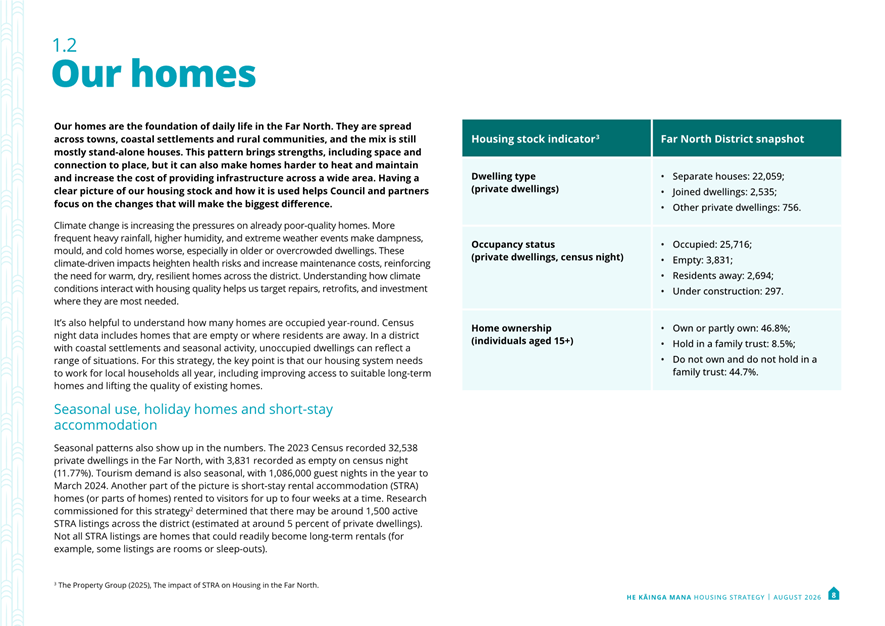
He Kāinga Mana Housing Strategy, informed by demographic and
housing-need data and by a period of targeted engagement with Iwi, Hapū,
Māori housing providers, Community Housing Providers and Government
agencies. He Kāinga Mana has been developed to work alongside Te
Kiri Waiwai o Papatūānuku, with both strategies intended to be
read as a connected response to housing in the district.
On 25 March 2025, early
development of the Housing Strategy was workshopped with elected members.
The Housing Portfolio has
supported and provided advice on the development of the Housing Strategy.
2) matapaki me NgĀ KŌwhiringa /
Discussion and Options
Nature of the Strategy:
Council as enabler, not deliverer
The Strategy's central design
feature is that it positions Council as an enabler, coordinator, and advocate
for housing outcomes, not a direct deliverer of housing. He Kāinga Mana
states that Council does not directly deliver housing or social services, but
that it partners with the agencies, Iwi, Hapū and organisations that do
so. Council's only current direct housing delivery role remains the Housing for
the Elderly portfolio.
This framing of the Strategy
reflects the practical levers available to Council: planning and consenting
processes, infrastructure sequencing, strategic use of Council land, provision
of housing information, and the strength of its partnerships.
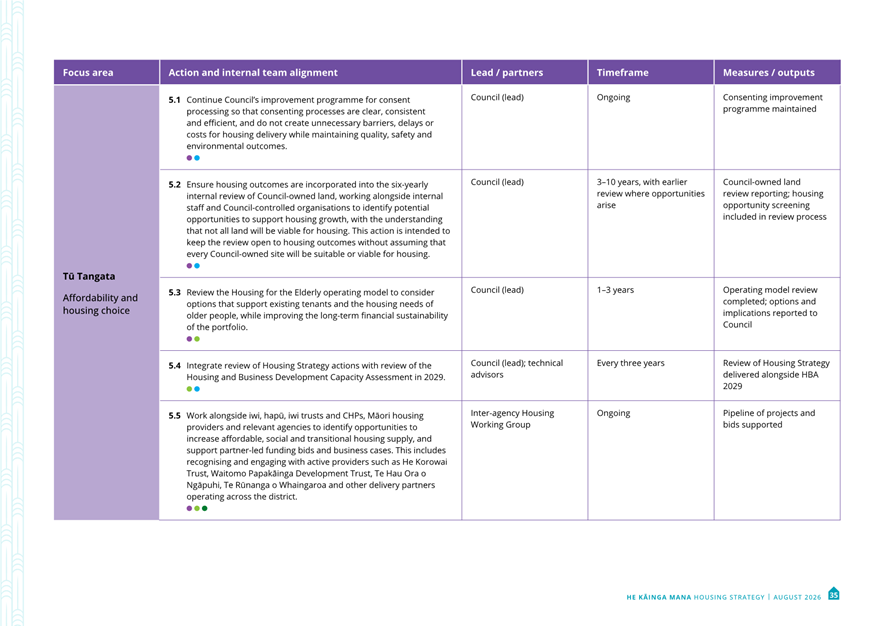
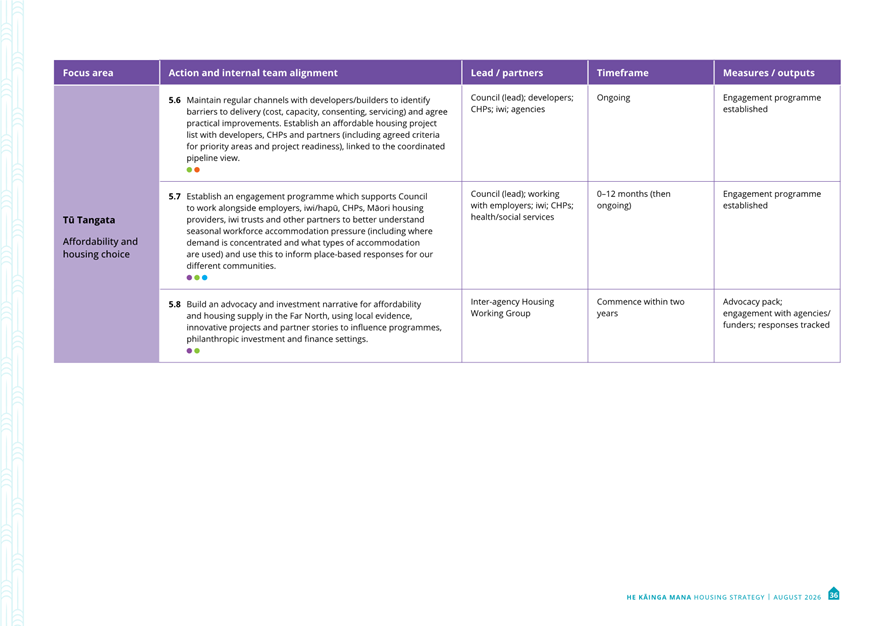
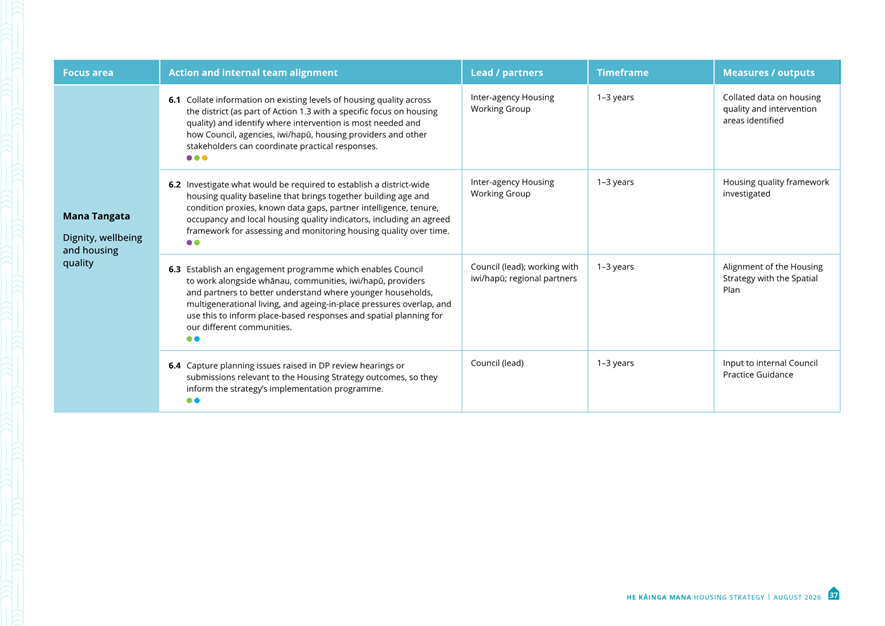
Focus Areas
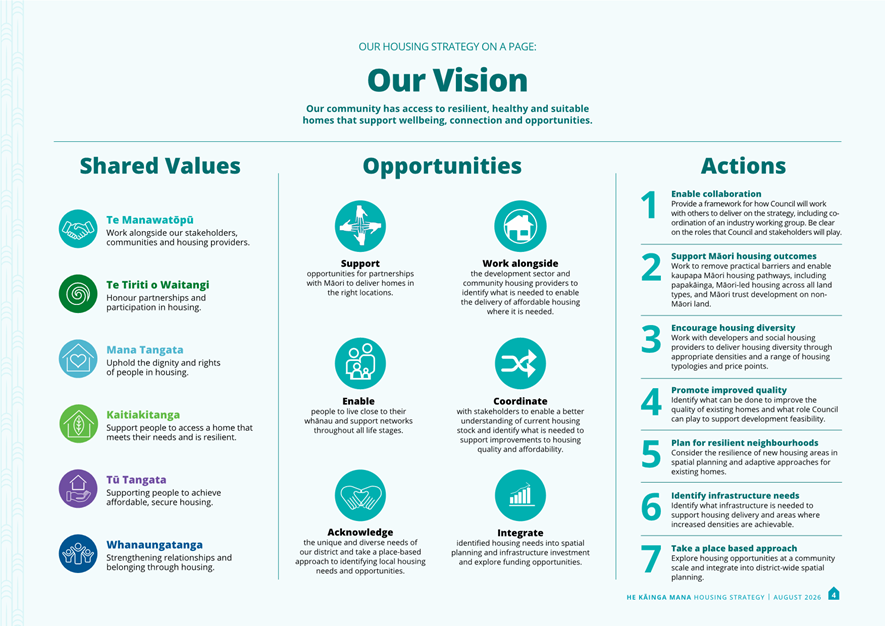
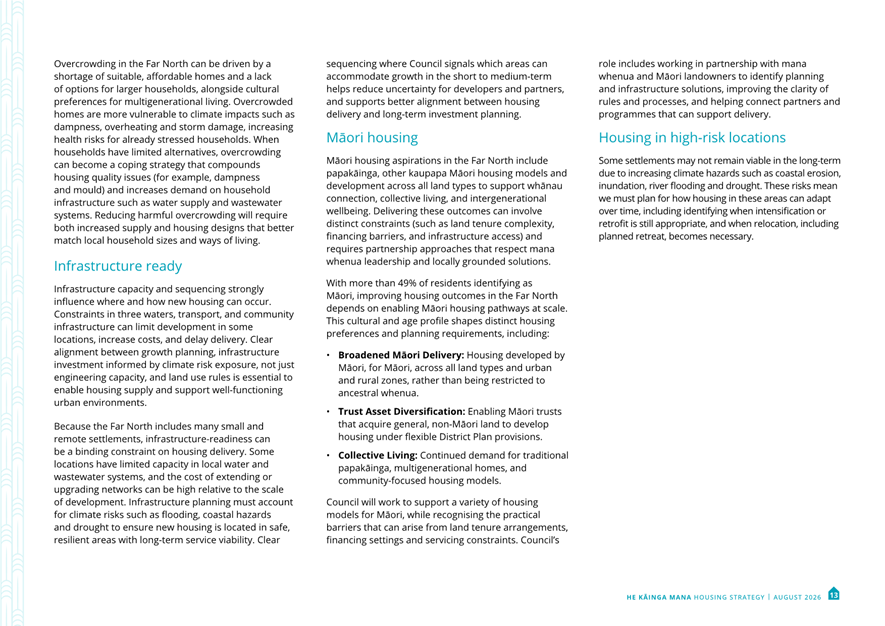
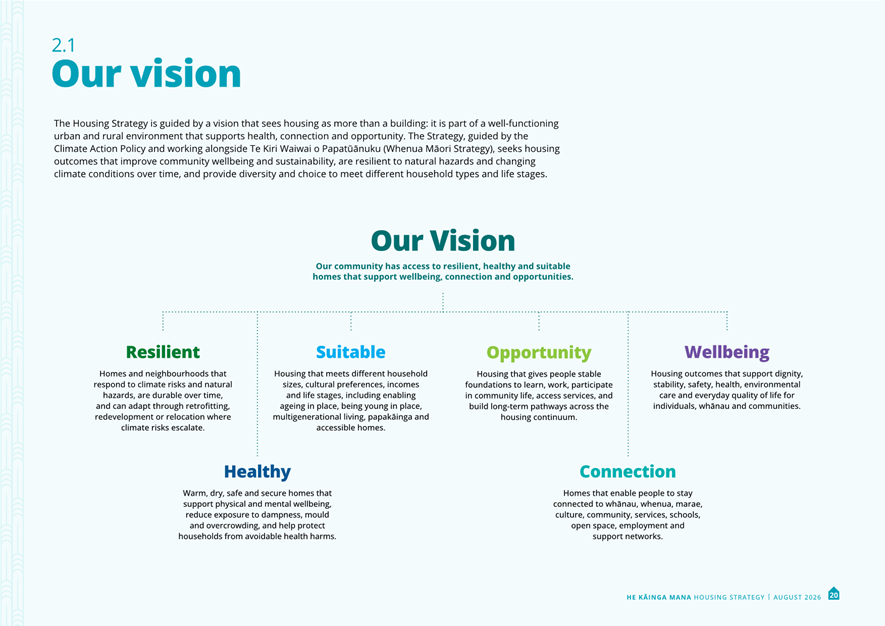
The Strategy is built around
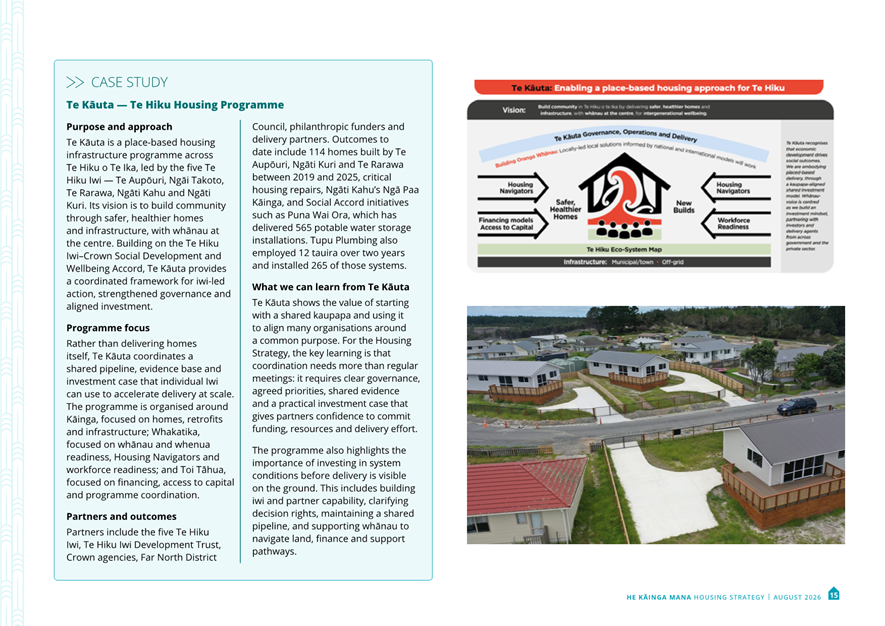
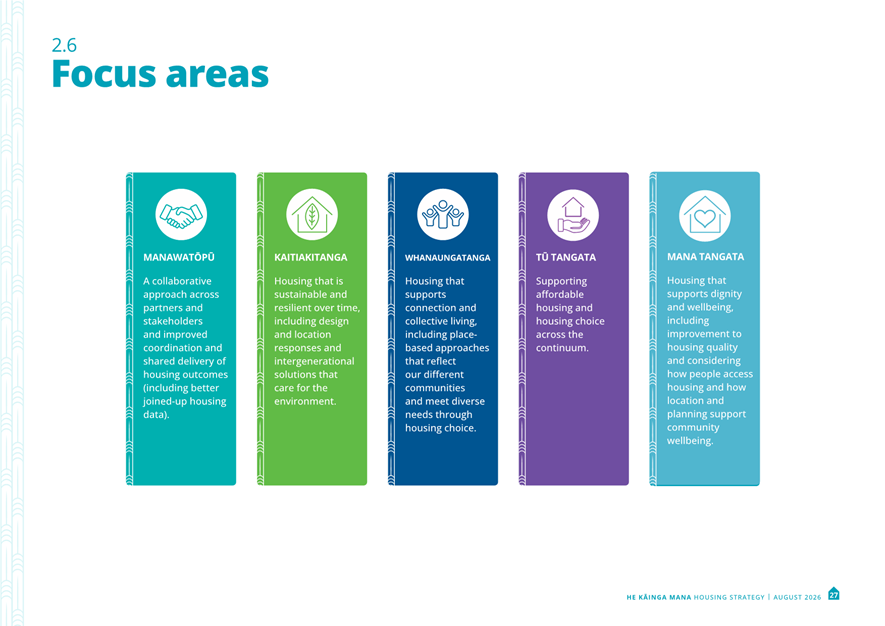
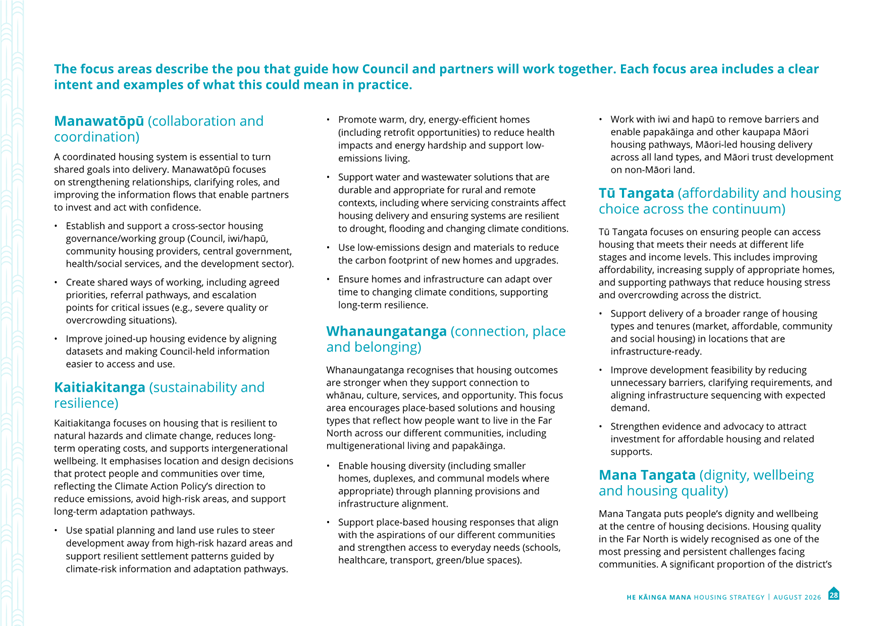
five focus areas that operationalise this enabling role:
· Te
Manawatōpū — collaboration and coordination - bring
Council, Iwi, Hapū, providers, developers, agencies and communities
together to share information, align effort and address barriers to housing
delivery
· Kaitiakitanga
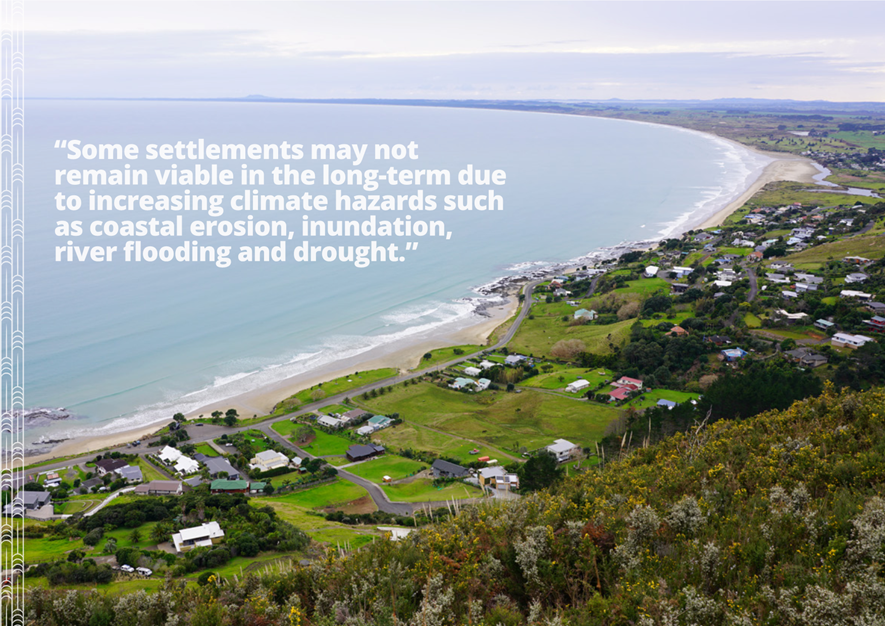
— sustainability and resilience - ensure that future housing and
supporting infrastructure are planned for safe, climate-resilient locations and
that they can respond to hazards such as flooding, erosion and drought
· Whanaungatanga
— connection, place and belonging - support Māori-led housing,
papakāinga and other collective housing pathways, while enabling people to
remain connected to whānau, whenua, marae and support networks
· Tū Tangata
— affordability and housing choice - encourage a greater diversity of
suitable, accessible and affordable homes, including housing that supports
people to age in place, young people to remain locally, and multigenerational
living
· Mana Tangata
— dignity, wellbeing and housing quality - improve understanding of
housing conditions and need, and work with partners to address poor-quality,
cold, damp, overcrowded or otherwise unsuitable homes.
Risk and mitigations
There is a risk that some
stakeholders may criticise the absence of hard housing delivery targets as a
weakness rather than the deliberate design choice it represents. This risk can
be mitigated by clearly explaining that the Strategy's role is to coordinate
and enable, not to deliver housing build programmes. A further risk is that the
cross-sector Interagency Housing Working Group and associated actions rely on
continued engagement from partners. This risk is mitigated through the
Strategy's three-yearly review cycle and ongoing implementation reporting.
Implications for
Māori
He Kāinga Mana has been shaped through targeted engagement with Iwi, Hapū
and Māori housing organisations, and will work alongside Te Kiri Waiwai
o Papatūānuku - Whenua Māori Strategy as a connected
response to housing challenges in the district. Feedback from Māori
organisations has directly informed strengthening the Strategy's treatment of
kaupapa Māori housing pathways and recognition of Māori-led housing
delivery across all land types. Council will continue to work with Iwi and Hapū
through Te Hono and other established relationships as the Strategy is
implemented.
Significance and
Engagement
The proposal has been
assessed using FNDC’s Significance and Engagement Assessment Matrix. In
line with the Significance and Engagement Policy, the recommendation to develop
a housing strategy will have little effect on financial thresholds, ratepayers,
specific demographics, or levels of service. The recommendation is consistent
with existing plans and policies. It is a non-statutory, enabling document
consistent with Council's existing plans and policies. It does not commit
Council to new expenditure or new functions. Therefore, the level of
significance is low.
Engagement took place with ~50
housing-related providers/agencies regarding housing issues. issues. For
example:
· Government
agencies e.g., MHUD and MSD
· Iwi / Hapū
organisations e.g., Ngāti Kahu, Ngati Rehia, Te Hau Ora O Ngāpuhi, Te
Hiku Iwi Development Trust, Te Rūnanga o Whaingaroa.
· Developers e.g., GJ Gardner’s
Engagement included numerous
workshops, meetings, and opportunities for review and feedback on the draft.
Over 25 organisations attended the initial workshop.
The following Council teams have
participated in the development of the Strategy:
· Strategy
and Policy
· Integrated
Planning
· Climate
Action and Resilience
· Resource
Consents
· Building
Consents
· Te
Hono
· Executive
Projects
· Communications
and Engagement
The recommended engagement
approach is to inform. This approach is considered proportionate because it
reflects the likely scale of impact, FNDC’s obligations under Part 6 of
the Local Government Act 2002, and the engagement already undertaken with
interested and affected parties.
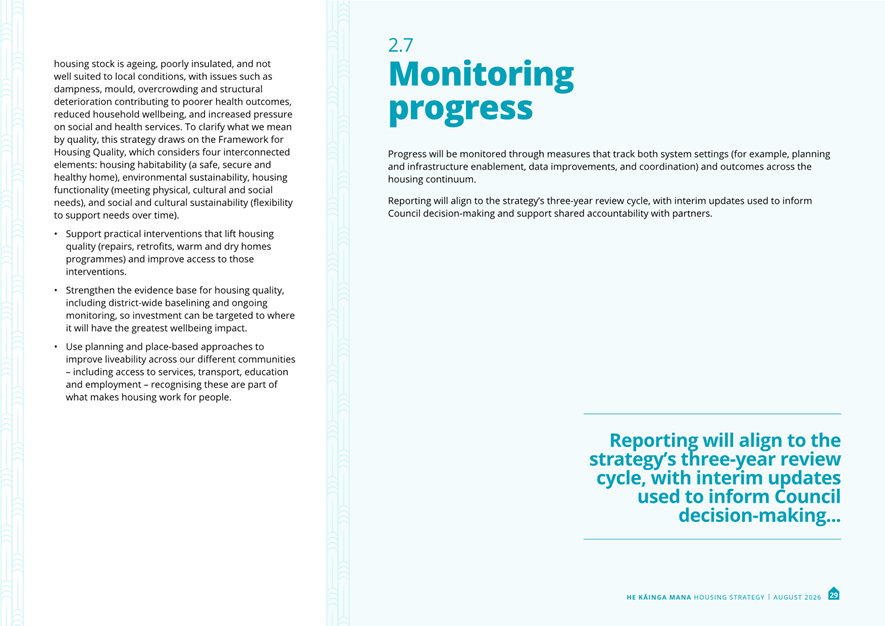
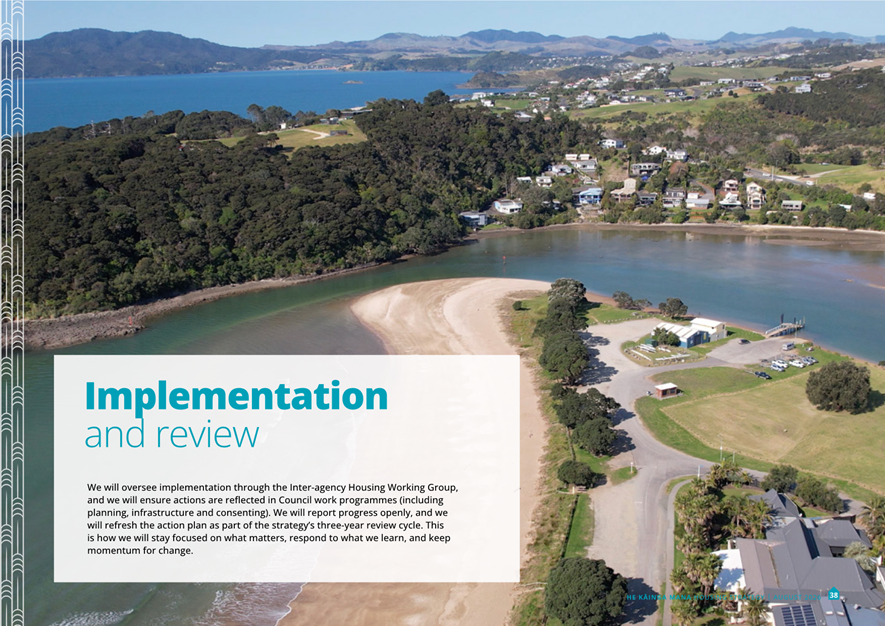
Implementation and Review
Implementation of He Kāinga Mana will be overseen
through the proposed Inter-agency Housing Working Group. Progress will be
reported through a formal three-yearly review cycle, using measures that track
both enabling actions — such as planning, infrastructure, data and coordination
— and housing outcomes across the continuum. The action plan will be
refreshed at each review to reflect delivery progress, new evidence and partner
feedback.
Options:
Option 1: He
Kāinga Mana – Housing Strategy is adopted by Council (recommended
option)
Approval of the strategy will
provide a guiding direction for FNDC on actions to improve housing outcomes in
the district, addressing the problems identified in 2023.
Advantages:
· Adopting
the strategy will:
o provide
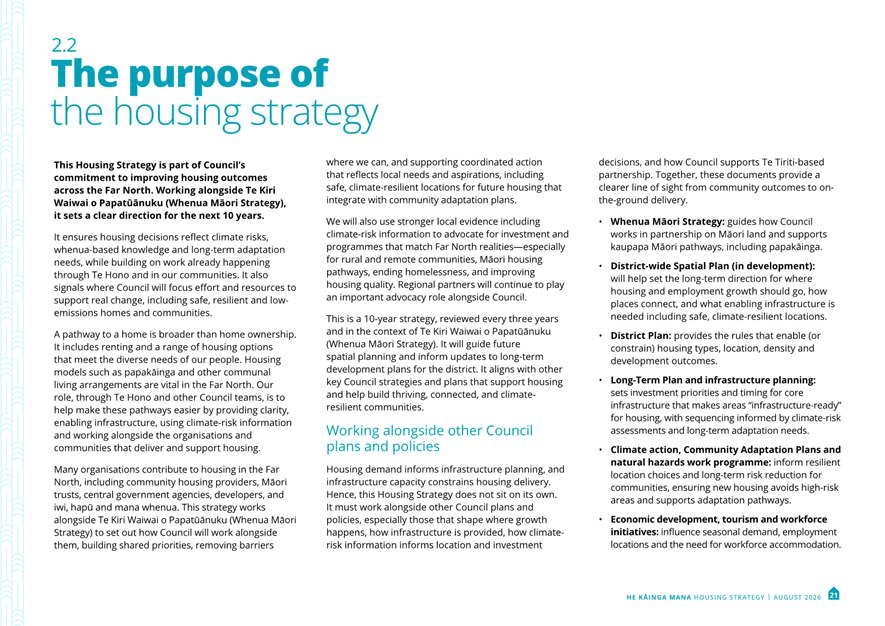
a clear, evidence-based 10-year direction for addressing the district's housing
affordability, supply and quality problems
o unlock
funding opportunities from government agencies and philanthropic funders, who
typically require a strategic framework and evidence base before committing
investment
o build
credibility on housing policy with Iwi, Hapū and Government
o create
a mechanism to coordinate the many organisations already active in housing
delivery
o align
and integrate housing decisions with other core strategies (District Plan,
Infrastructure Strategy, Long-Term Plan, Spatial Plan), so improving overall
planning coherence and efficiency
o support
economic and social benefits from enabling diverse, affordable housing supply,
including retention of younger residents and workers and improved outcomes for
an ageing population.
Disadvantages:
· No disadvantages
have been identified by staff.
Option
2: He Kāinga Mana – Housing Strategy is not adopted by Council
The status quo remains. Council’s role in
housing remains ambiguous and developed ad hoc.
Advantages:
· No
advantages have been identified by staff.
Disadvantages:
· Not
adopting the strategy will:
o forfeit
the scoping, engagement and evidence-gathering work
o leave
adverse housing indicators unaddressed
o risk
damaging trust and relationships with Iwi, Hapū, mana whenua, community
housing providers and government agencies who have invested significant time in
engagement
o continue
an ad-hoc approach to housing across Council teams
o fail
to respond to the Public Housing Investment Plan 2025, which identified the Far
North as a priority investment location due to need — a signal that could
result in Council losing influence over how external investment is directed in
the district
o provide
no mechanism to track or improve the currently poor and fragmented housing
quality data
o send
a signal of reduced Council commitment to housing wellbeing.
Option 3: He Kāinga Mana – Housing
Strategy is put out for Public Consultation prior to adoption
Public Consultation will provide the wider public the
opportunity to voice their thoughts on the Strategy. Public consultation would
run for four weeks (dates would need to be confirmed if this option is taken
up).
However, most of the actions identified in the Strategy
align with improving our internal processes and supporting Council’s role
as an enabler, coordinator and advocate of housing outcomes, not as a direct
deliverer of housing. There is a risk that the community may have an
expectation that a housing strategy would provide plans and actions regarding
the delivery of built houses.
Therefore, staff do not recommend this option.
TAKE TŪTOHUNGA /
REASON FOR THE RECOMMENDATION
He Kāinga Mana responds directly to Council's 2023 decision to develop a
Housing Strategy. The need for such a strategy remains as compelling today as
it was the case in 2023.
3) PĀnga PŪtea me ngĀ wĀhanga tahua / Financial
Implications and Budgetary Provision
Council teams involved in
developing He Kāinga Mana confirmed that the action plan, as currently
proposed, can be implemented within existing budgets. Any future initiatives or
material changes to the action plan that require additional funding would be
identified by the responsible teams and considered through the appropriate
planning and budgeting processes.
Āpitihanga
/ Attachments
1. He
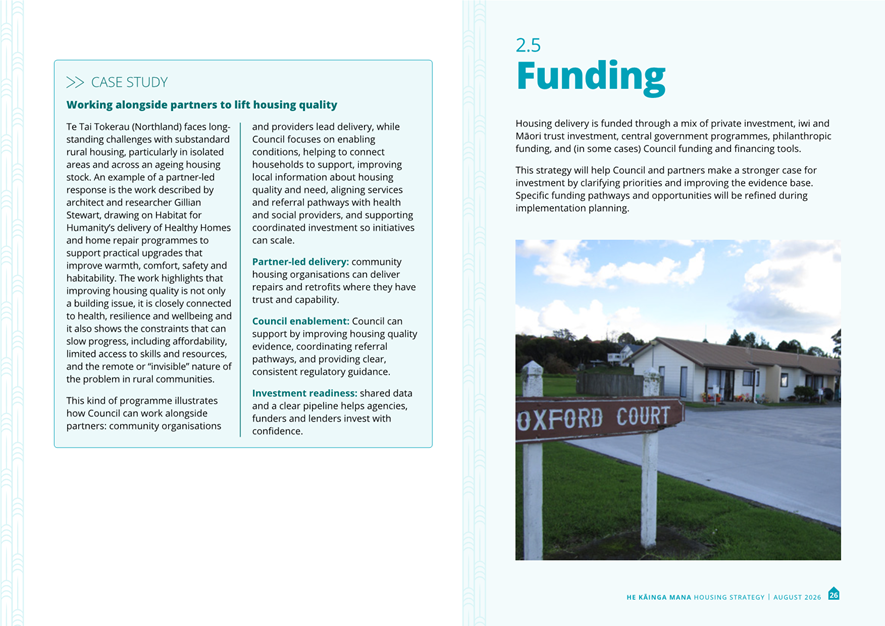
Kāinga Mana - Far North District Council Housing Strategy - A5920181 ⇩
Hōtaka Take Ōkawa / Compliance Schedule:
Full consideration has been given to the provisions of the
Local Government Act 2002 S77 in relation to decision making, in particular:
1. A
Local authority must, in the course of the decision-making process,
a) Seek
to identify all reasonably practicable options for the achievement of the
objective of a decision; and
b) Assess
the options in terms of their advantages and disadvantages; and
c) If
any of the options identified under paragraph (a) involves a significant
decision in relation to land or a body of water, take into account the
relationship of Māori and their culture and traditions with their
ancestral land, water sites, waahi tapu, valued flora and fauna and other
taonga.
2. This
section is subject to Section 79 - Compliance with procedures in relation to
decisions.
|
He Take Ōkawa /
Compliance Requirement
|
Aromatawai Kaimahi /
Staff Assessment
|
|
State the level of significance (high or low) of the
issue or proposal as determined by the Council’s
Significance and Engagement Policy
|
In line with the Significance and Engagement Policy, the
recommendation to develop a housing strategy will have little effect on
financial thresholds, ratepayers, specific demographics, or levels of
service. The recommendation is consistent with existing plans and policies.
Therefore, the level of significance is low.
|
|
State the relevant Council policies (external or
internal), legislation, and/or community outcomes (as stated in the LTP) that
relate to this decision.
|
· Local
Government Act 2002
· alignment
with the:
o Long-Term
Plan
o Infrastructure
Strategy,
o District
Plan,
o Climate
Action Policy,
o Te
Kiri Waiwai o Papatūānuku (Whenua Māori Strategy),
o Te
Pātukurea (Kerikeri-Waipapa Spatial Plan)
o District
Wide Spatial Strategy.
|
|
State whether this issue or proposal has a District wide
relevance and, if not, the ways in which the appropriate Community
Board’s views have been sought.
|
He Kāinga Mana has district-wide relevance,
while incorporating a place-based approach that recognises differences
between communities, including Te Hiku, Hokianga, Whangaroa and the
mid-north.
|
|
State the
possible implications for Māori and how Māori have been provided
with an opportunity to contribute to decision making if this decision is
significant and relates to land and/or any body of water.
State the
possible implications and how this report aligns with Te Tiriti o Waitangi /
The Treaty of Waitangi.
|
He Kāinga Mana has been informed by targeted
engagement with Iwi, Hapū and Māori housing organisations, and is
designed to work alongside Te Kiri Waiwai o Papatūānuku.
The following Iwi / Hapū / Māori housing
developers have been engaged in the development of the Strategy
· Kahukuraariki
Trust
· Ngāti
Kahu
· Ngati
Rehia
· Takou
Trust
· Te
Hau Ora O Ngāpuhi
· Te
Hiku Iwi Development Trust
· Te
Pouahi o Te Taitokerau
· Te
Putahi-Nui-o Rehua
· Te
Roroa Social Development
· Te
Rūnanga o Whaingaroa
· Te
Taumata Hauora o Te Kahu o Taonui
· Te
Tii (Waitangi) B3 Trust
· Waitomo
Papakainga Development Society
· Whare
Āwhina
|
|
Identify persons likely to be affected by or have an
interest in the matter, and how you have given consideration to their views
or preferences (for example – youth, the aged and those with
disabilities).
|
Iwi and Hapū; Māori housing trusts and
providers have been listed above. Other interested and affected parties that
have engaged on the Strategy, include:
· GJ
Gardner's Far North
· Claud
Switzer Memorial Trust
· Kāinga
Ora
· Ministry
of Housing and Urban Development
· Northland
NZ
· Public
Service Commission / MSD
· Whare
Timatatanga Hou Ora - Kaitaia Women’s Refuge
|
|
State the financial implications and where budgetary
provisions have been made to support this decision.
|
None
|
|
Chief Financial Officer review.
|
Chief Financial Officer have not reviewed this report
|
6 Ngā
Pūrongo Taipitopito / Information Reports
6.1 Sport
Northland Report 2025-2026
File
Number: A5928105
Author: Peggy
Veen, Principal Advisor
Authoriser: Jacine
Warmington, Group Manager - Strategic Relationships
TAKE PŪRONGO / Purpose of the Report
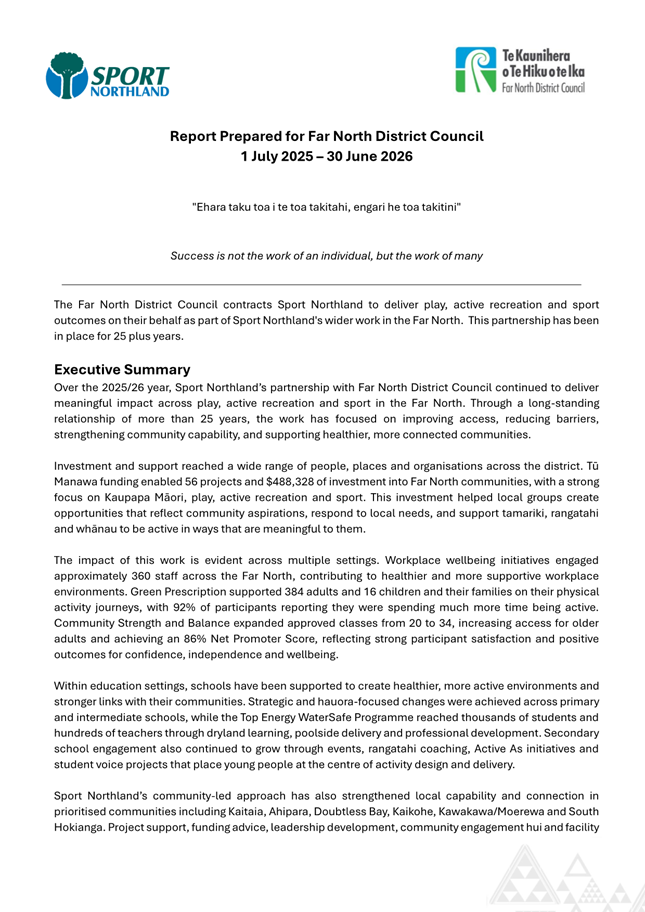
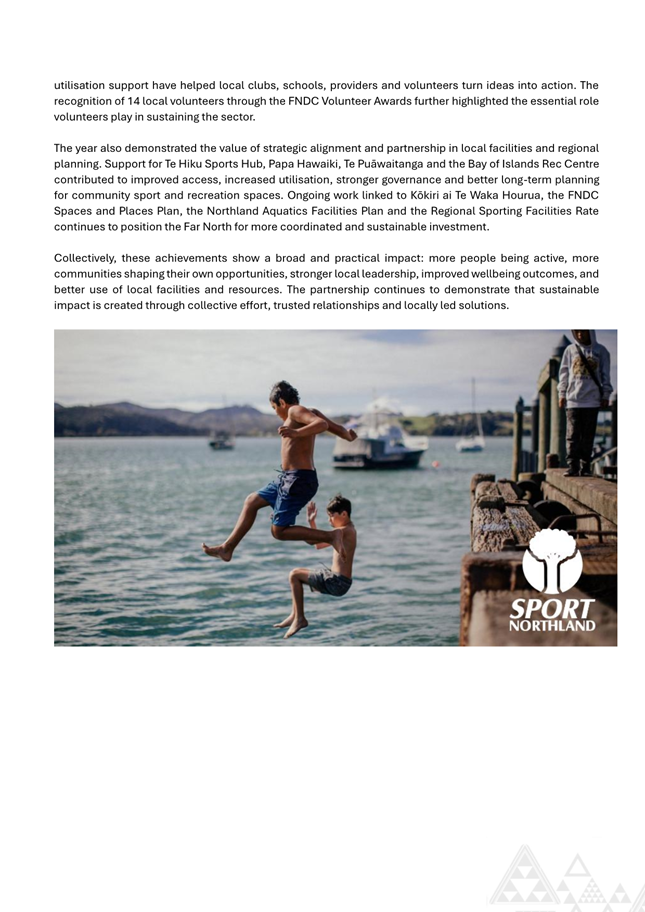
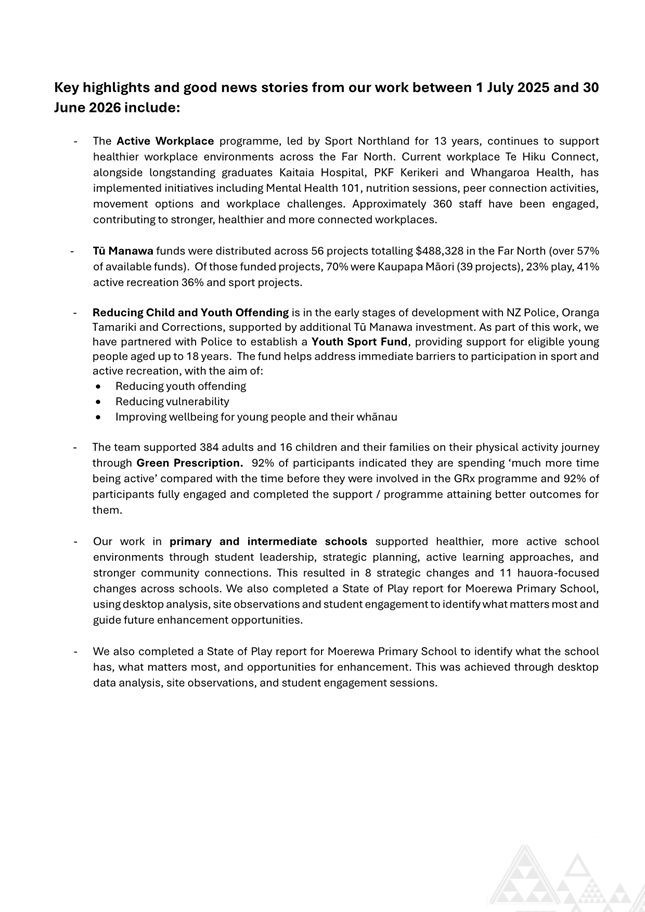
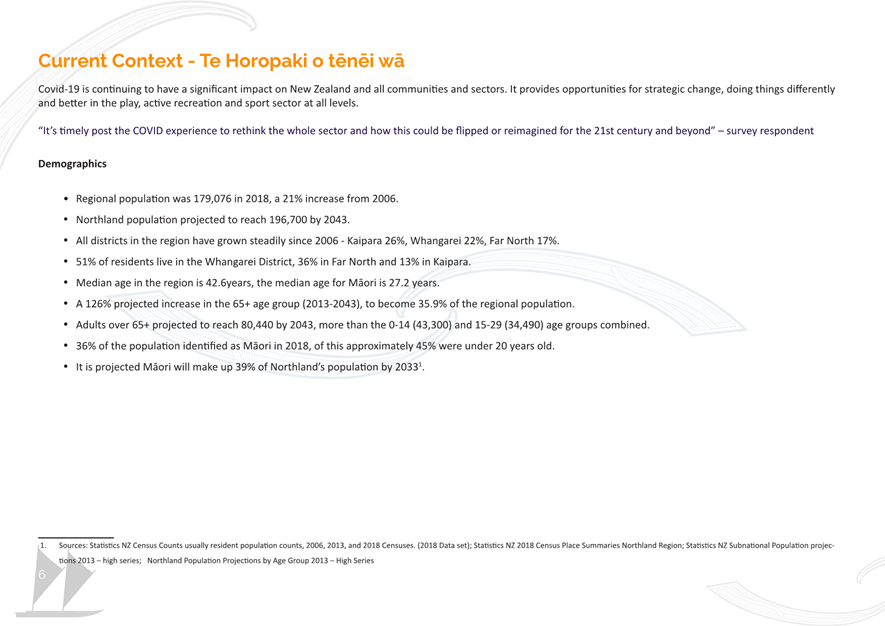
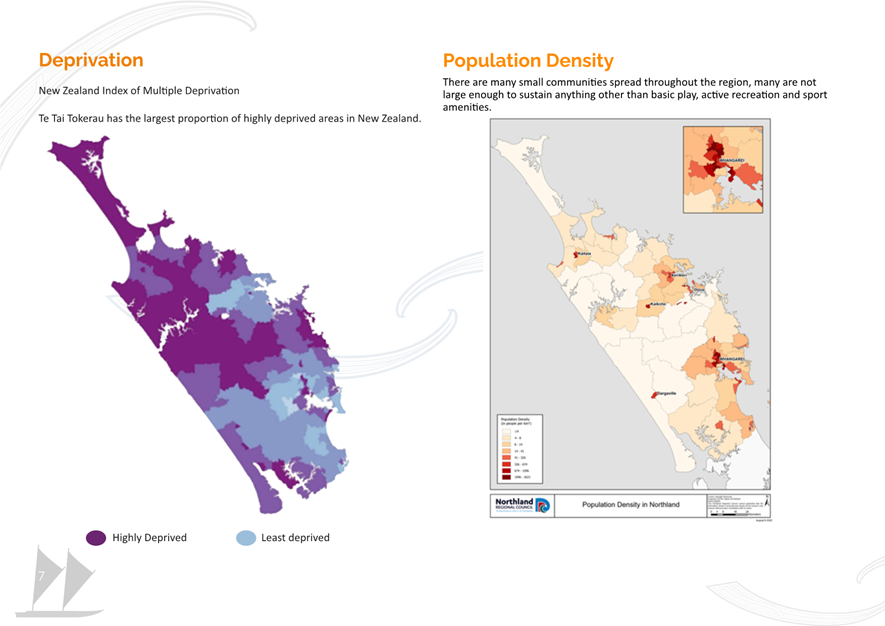
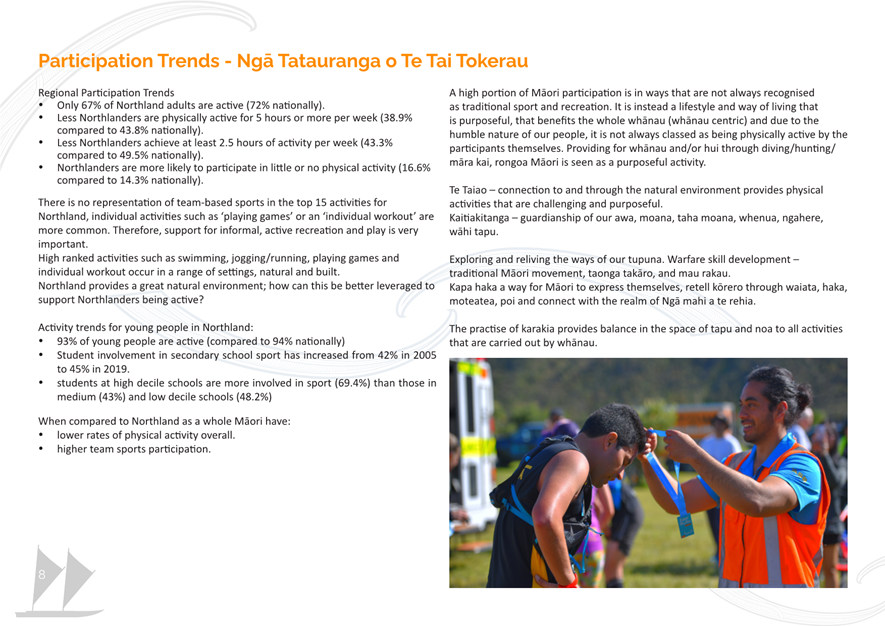
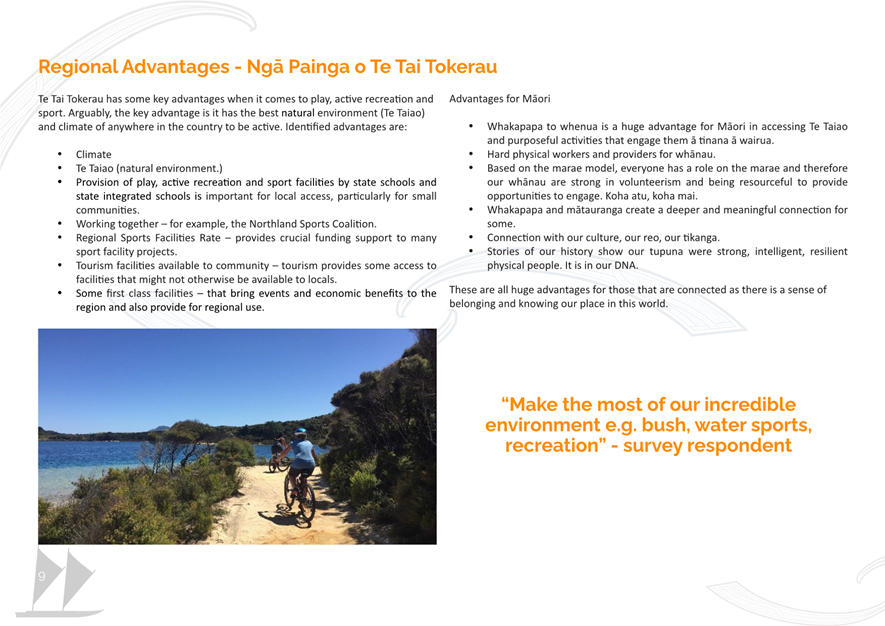
The purpose of this report is to provide Te Kūkupa
Committee for Strategy, Policy and Regulation with the annual report 2025-2026
from Sport Northland as an update on outcomes delivered through the partnership
between Far North District Council and Sport Northland, including the
activities supported by the annual funding agreement.
WHAKARĀPOPOTO MATUA / Executive SummarY
· This
report summarises the outcomes delivered through the longstanding partnership
between Far North District Council (FNDC) and Sport Northland. The partnership
contributes to Council’s strategic objectives by improving community
wellbeing and resilience, enabling equitable access to services and facilities,
and supporting community-led development across the Far North.
· A
funding agreement between FNDC and Sport Northland supports this work,
including partial funding for two Community Connector roles.
|
TŪTOHUNGA
/ Recommendation
That Te Kūkupa Committee for Strategy, Policy and
Regulation receive the Sport Northland Report 2025-2026.
|
tĀHUHU KŌRERO / Background
Far North District Council (FNDC) has maintained a funding
and service delivery partnership with Sport Northland for more than 25 years to
support play, active recreation and sport outcomes across the Far North
District. The agreement enables Sport Northland to deliver programmes,
community development initiatives, funding distribution, capability building,
and strategic planning support on behalf of Council.
The current funding agreement 2025 – 2027, supports
the employment of 2 community connectors that work primarily in targeted
communities. These communities are currently: Kaitaia, Ahipara, Taipa, Kaikohe,
South Hokianga and Kawakawa/Moerewa. These community connectors are employed by
Sport Northland.
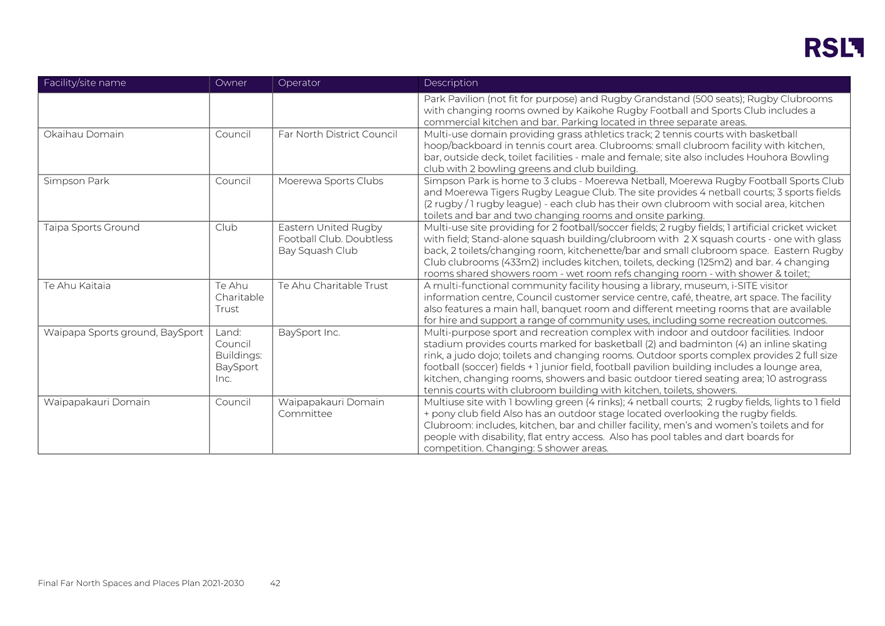
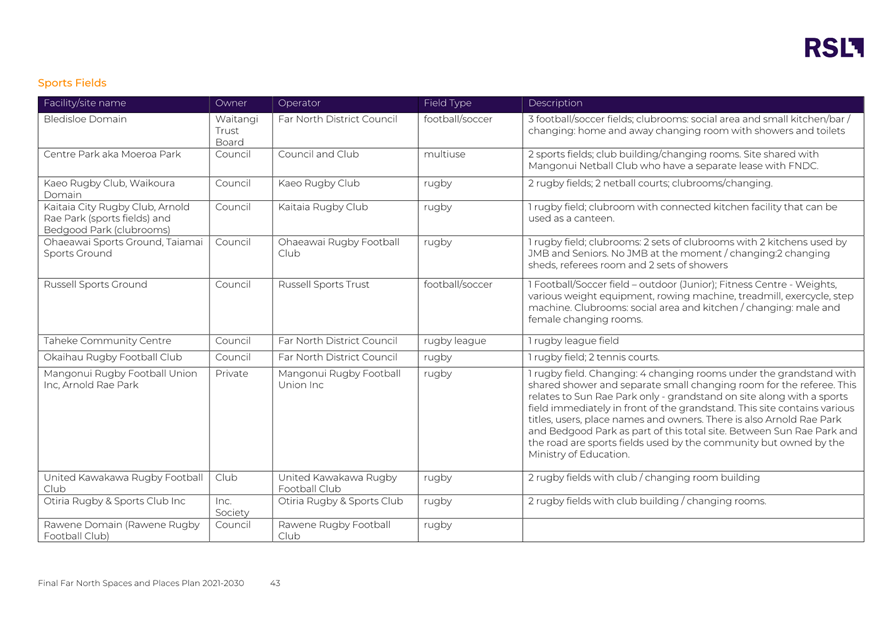
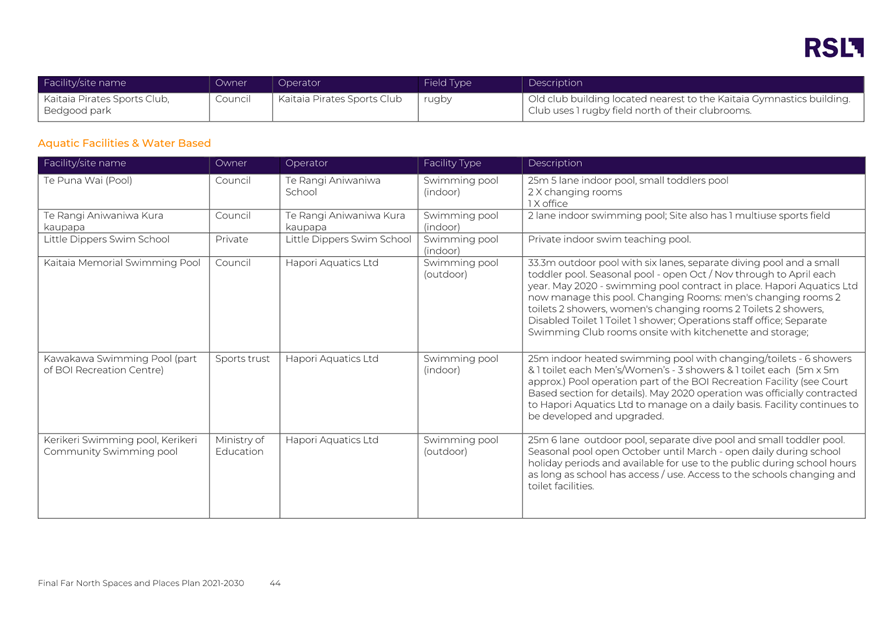
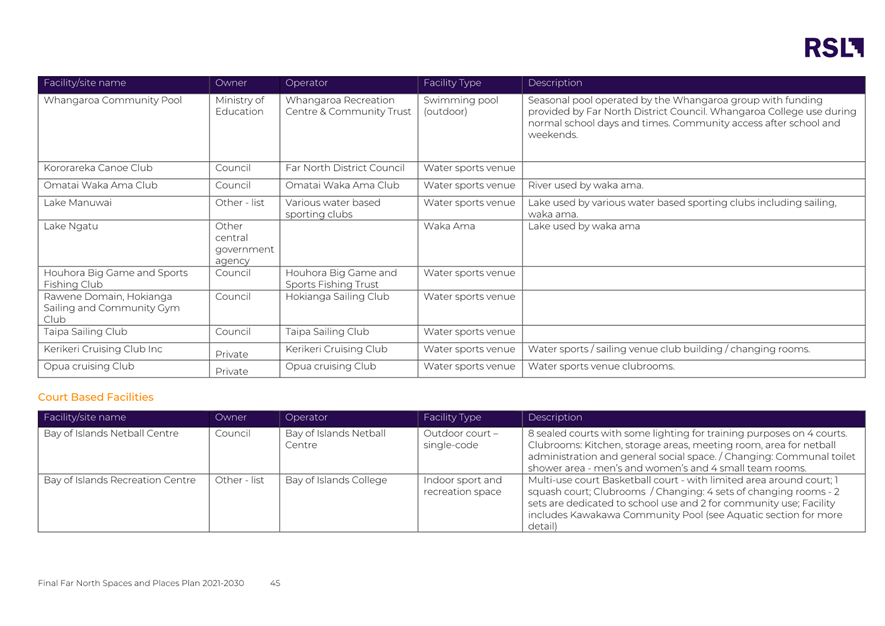
In addition, Sport Northland helps to facilitate the
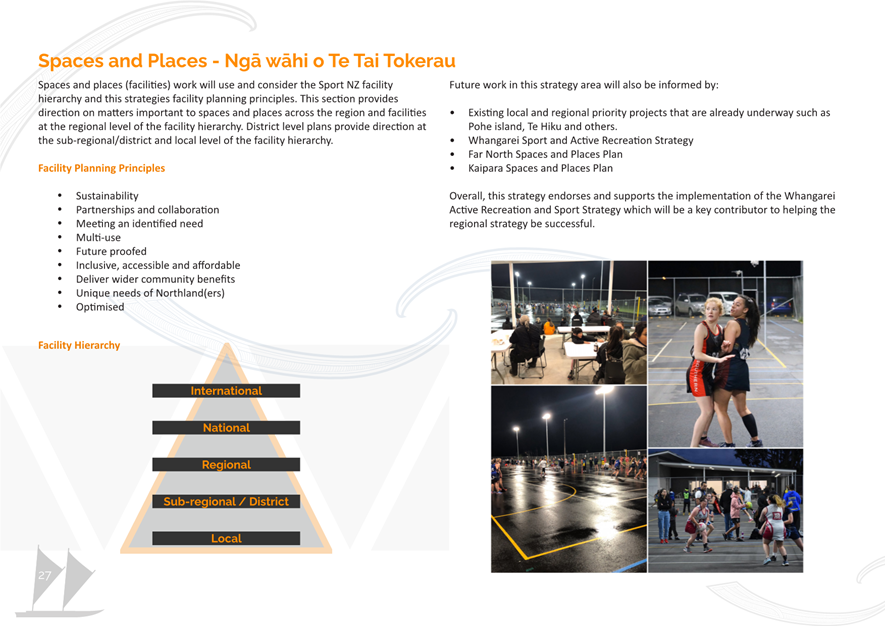
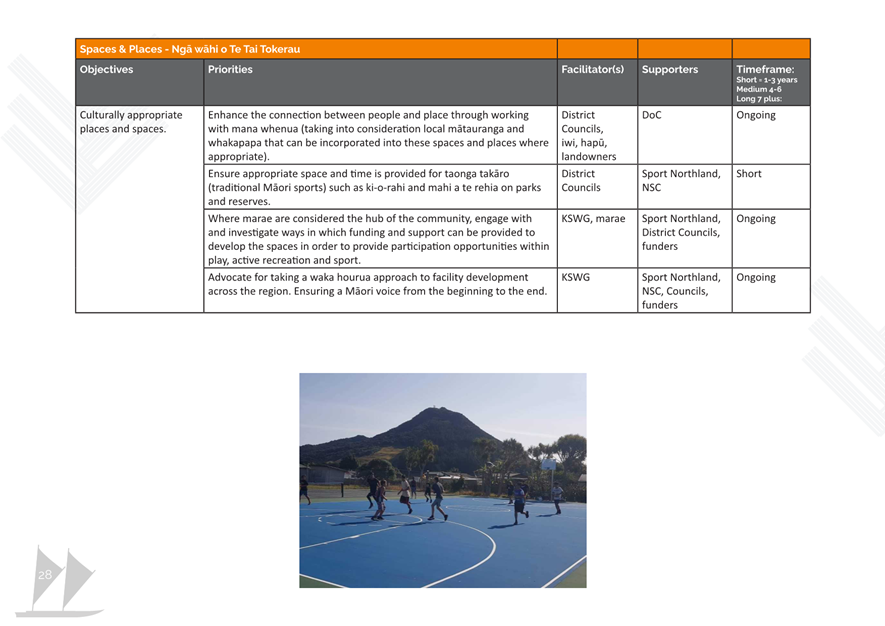
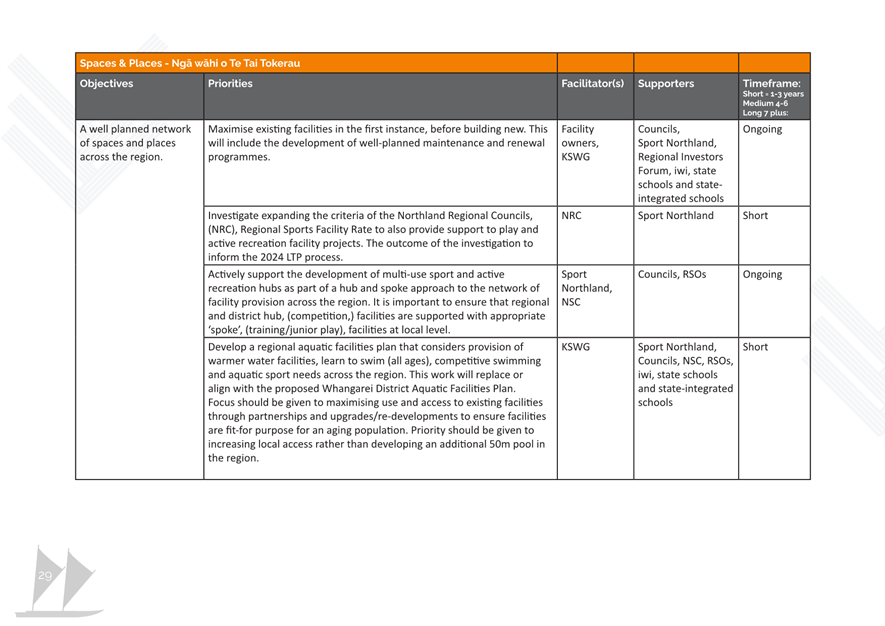
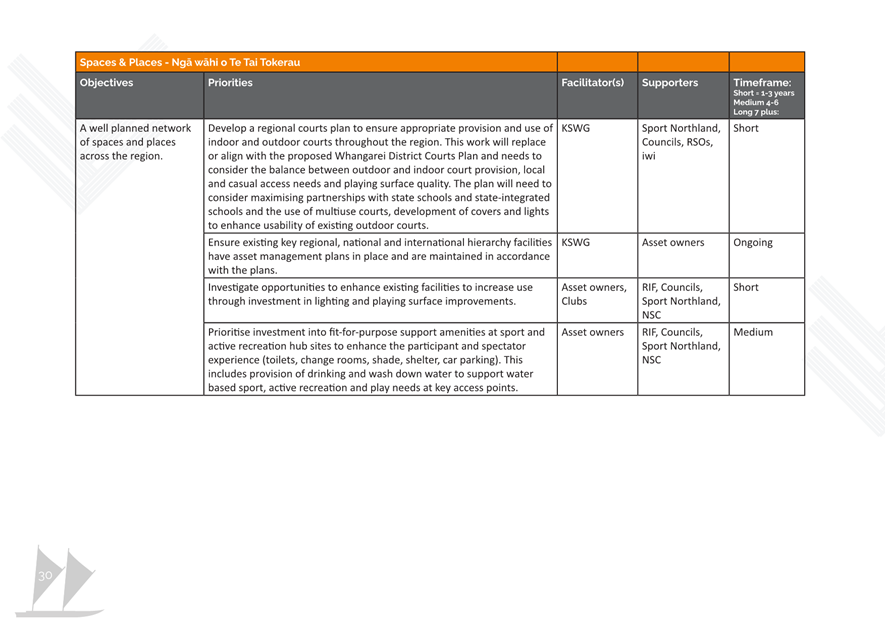
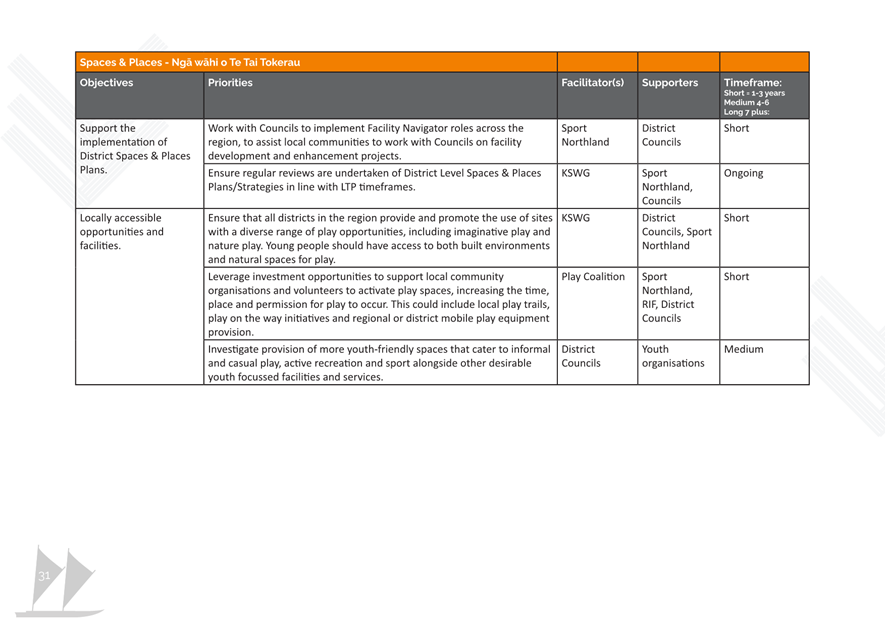
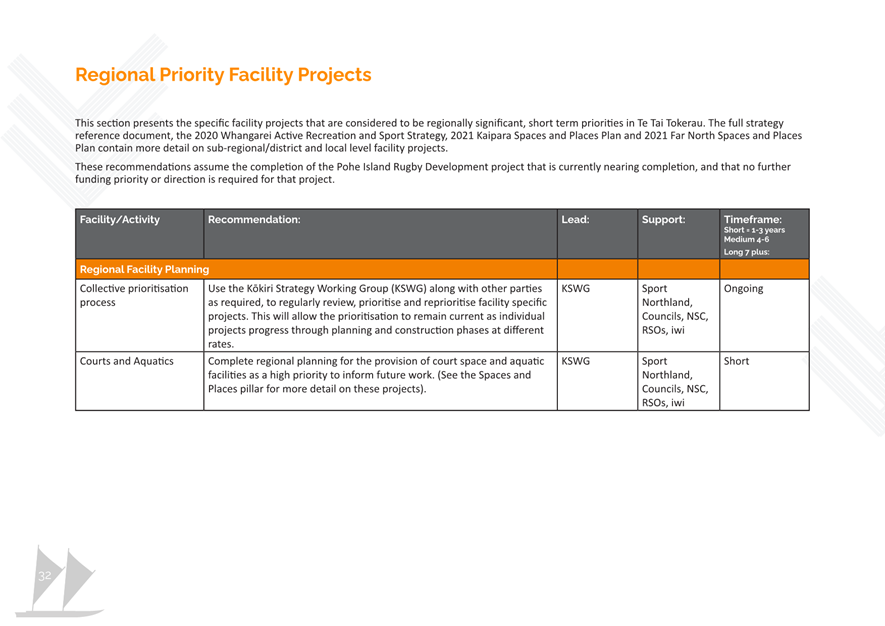
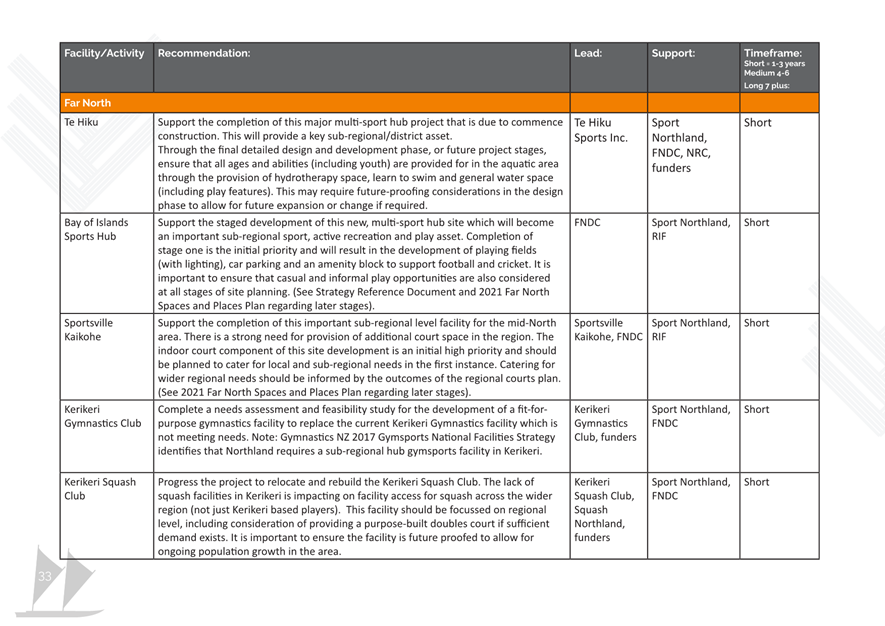
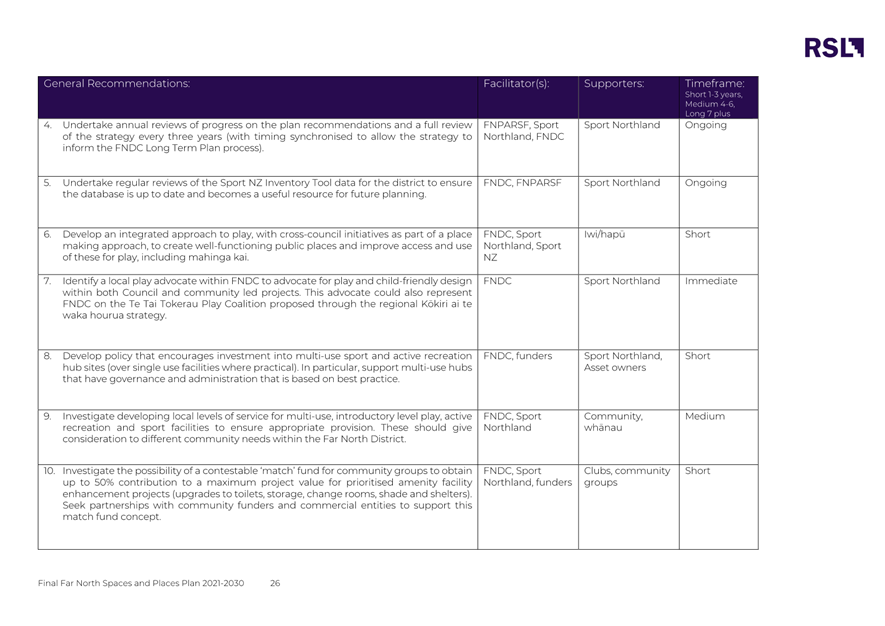
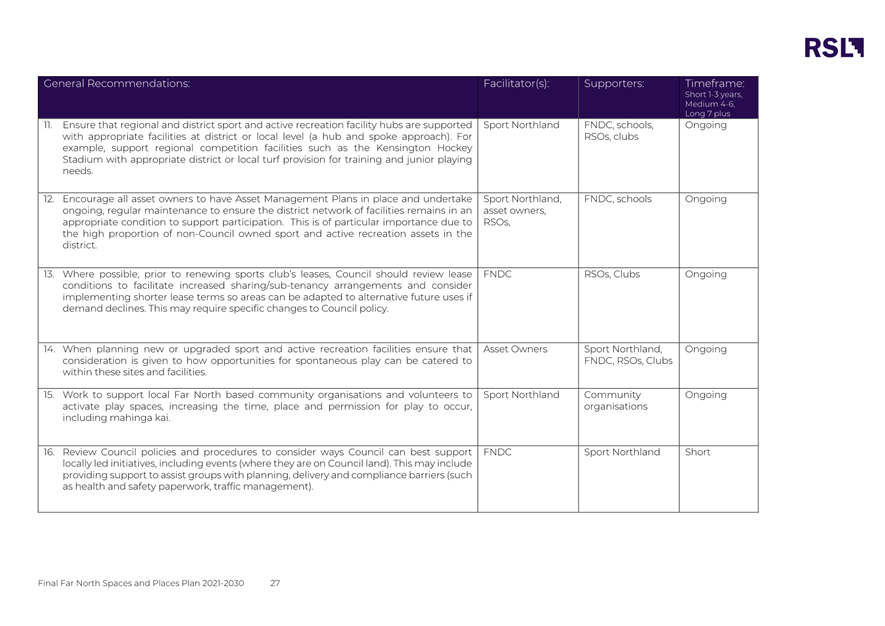
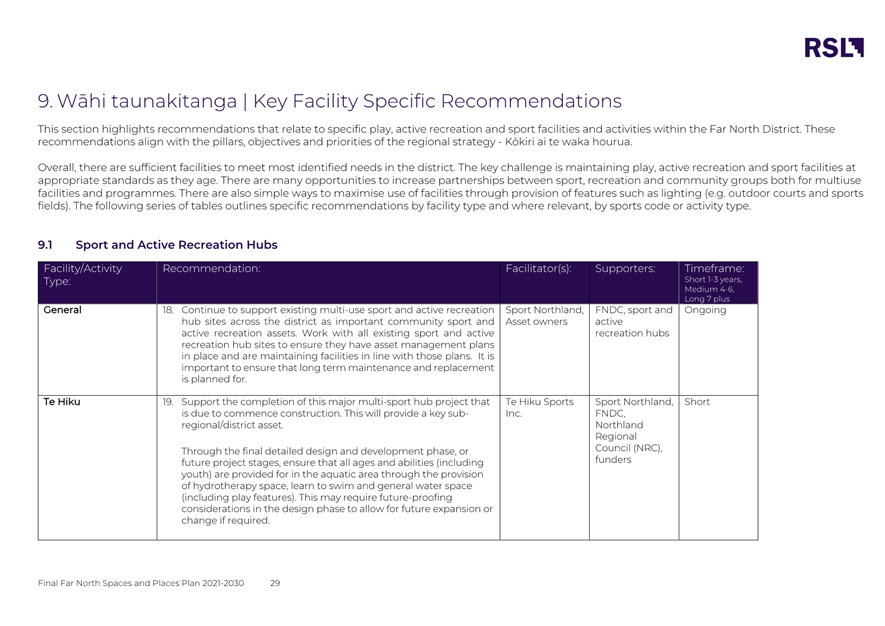
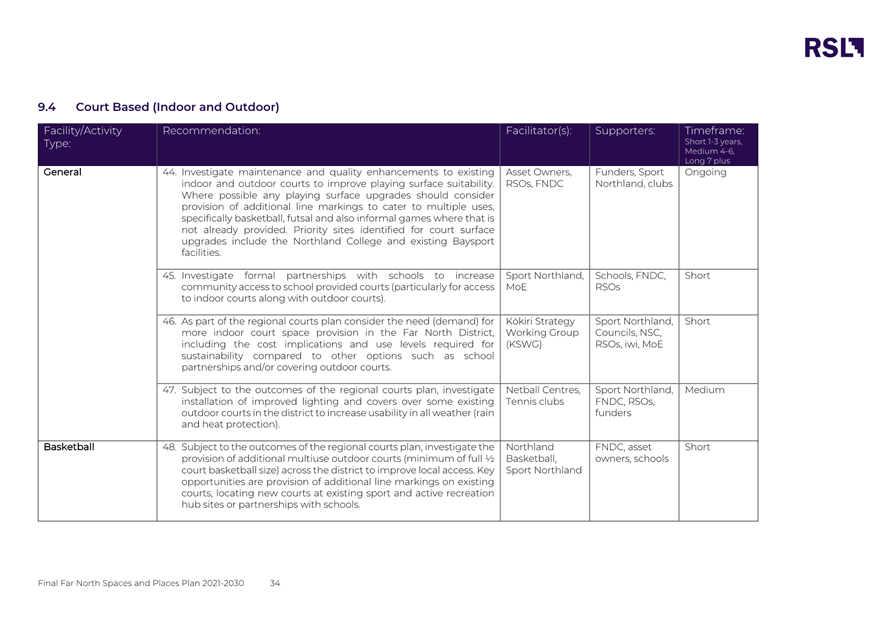
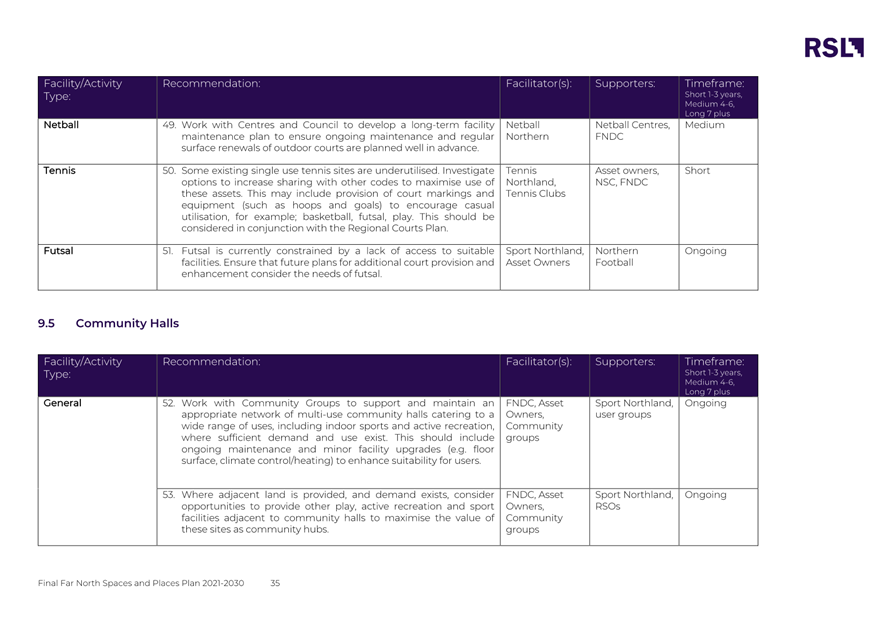
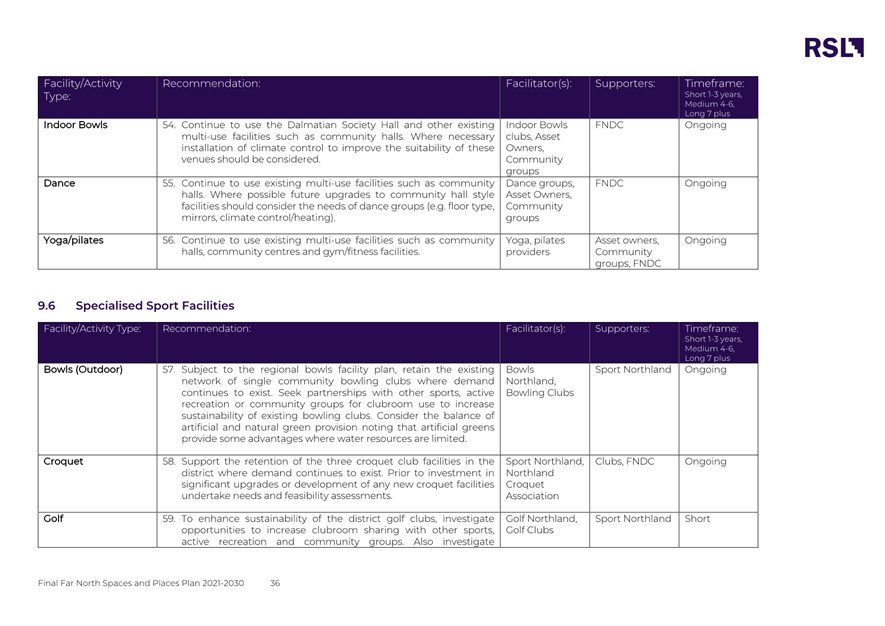
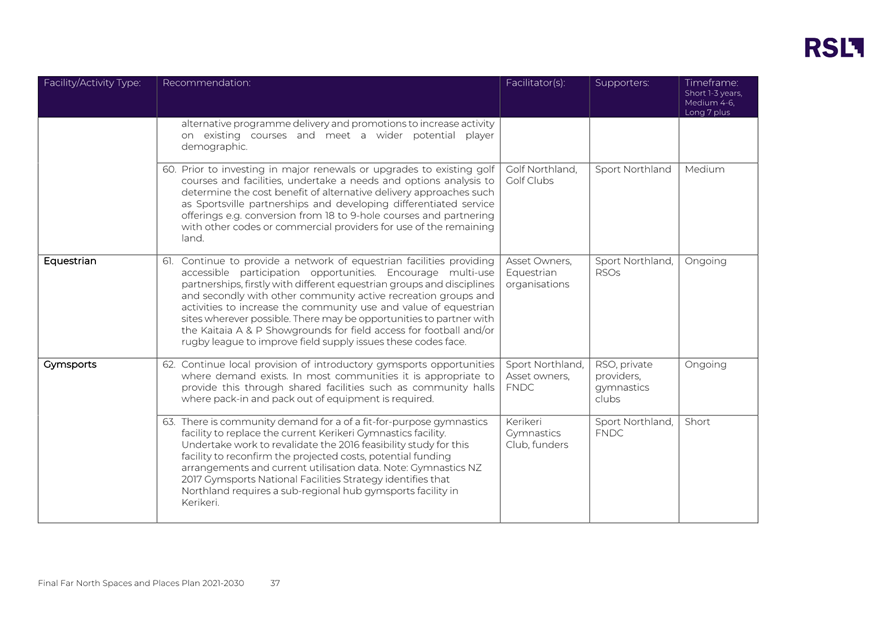
development of independently produced Spaces and Places plans to underpin the
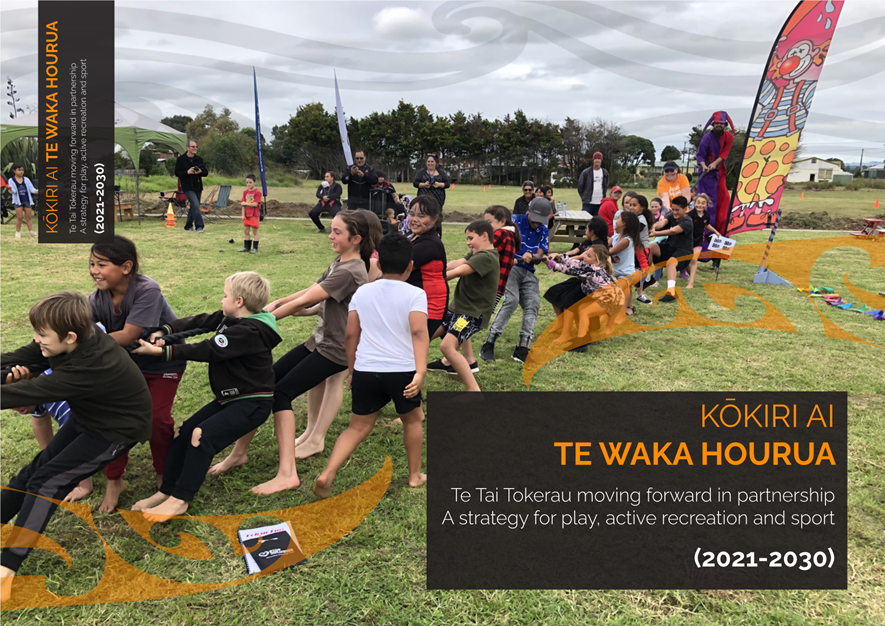
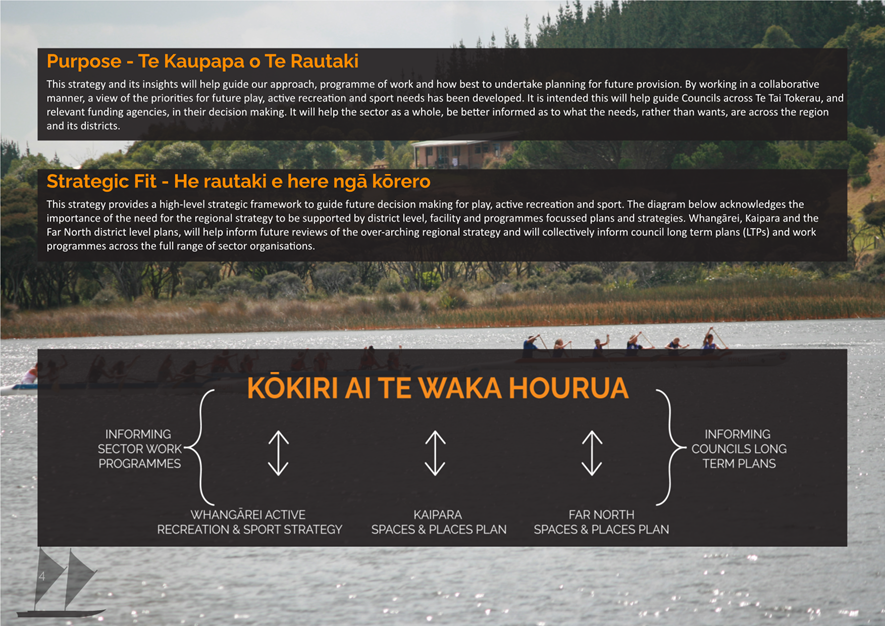
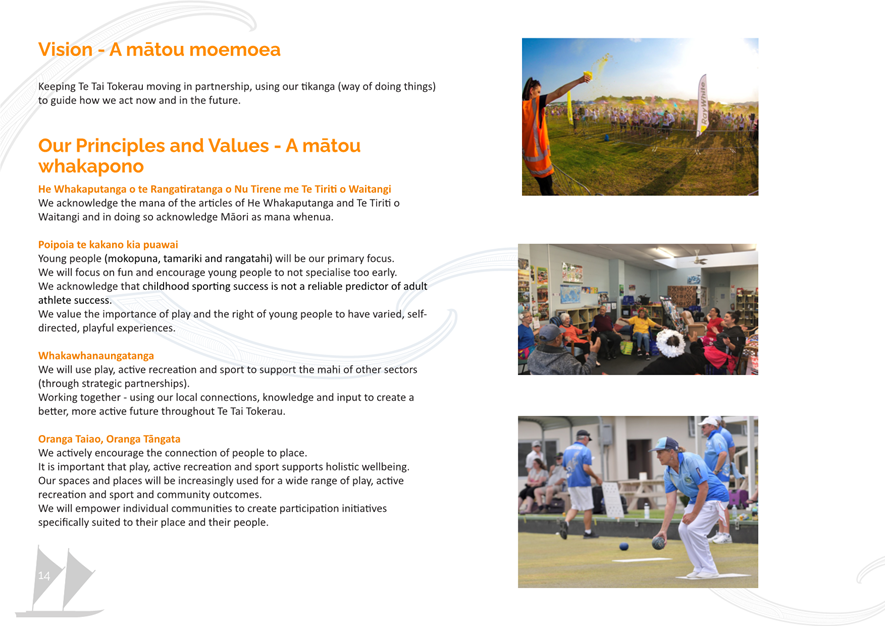
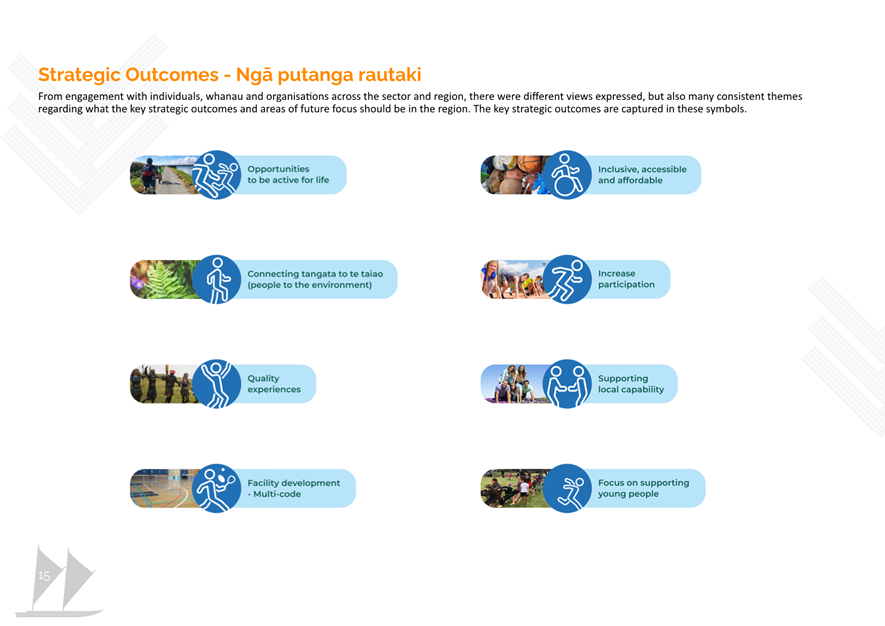
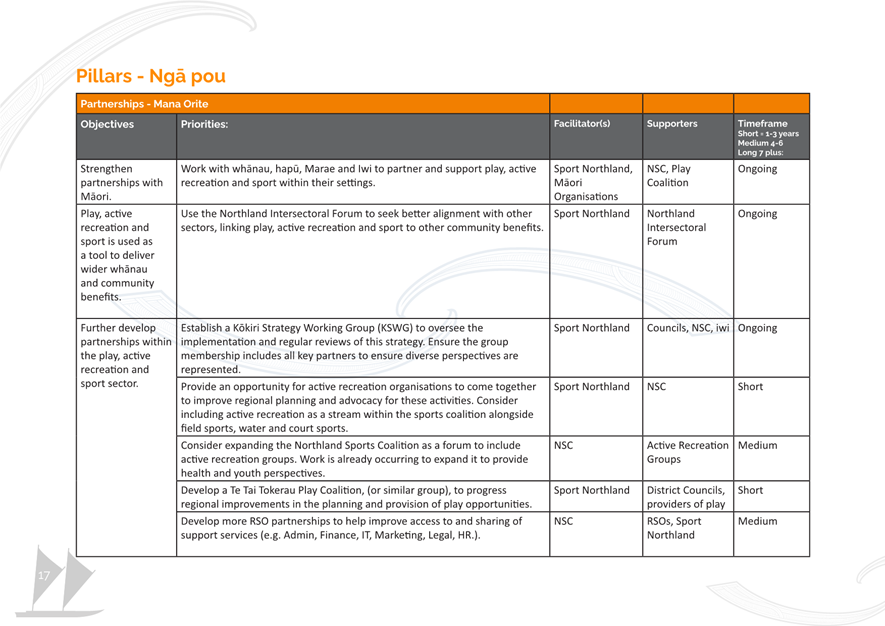
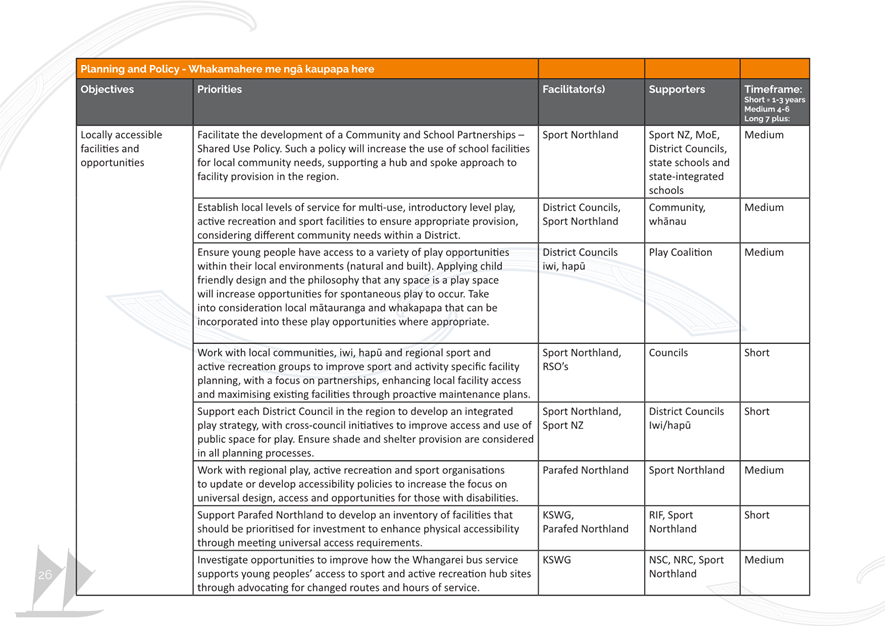
Northland Sports Facility Plan aligned with Kōkiri ai te Waka Hourua.
The agreement also supports Council’s broader goals by
contributing to the planning and development of community recreation
infrastructure and initiatives. They also support smaller projects that would
be considered local placemaking and support the Spaces and Places Strategy.
The summary of amounts funded are:
2025-2026 Funding Agreement: $162,868 + $5000 (recognition
awards)
2026-2027 Funding Agreement: $174,268 + $5000 (recognition
awards)
Sport Northland provide six monthly reporting, an annual
report (attached) on the whole of Sport Northland operations and deliver
Community Board presentations at least once a year to each Board area.
MATAPAKI ME NGĀ KŌWHIRINGA /
Discussion and Next Step
Sport Northland is a longstanding strategic partner that
supports Council to advance community wellbeing, resilience and equitable
access to play, active recreation and sport opportunities across the Far North.
The partnership has strengthened relationships across several areas of Council
and provides a practical link between strategic planning, community-led
development and local delivery.
The annual funding agreement enables Sport Northland to
maintain targeted support through two Community Connector roles. This
place-based approach helps identify local priorities, build community
capability and connect communities with programmes, funding and recreation
opportunities.
Sport Northland’s contribution to Spaces and Places
planning also supports evidence-based decisions about recreation infrastructure
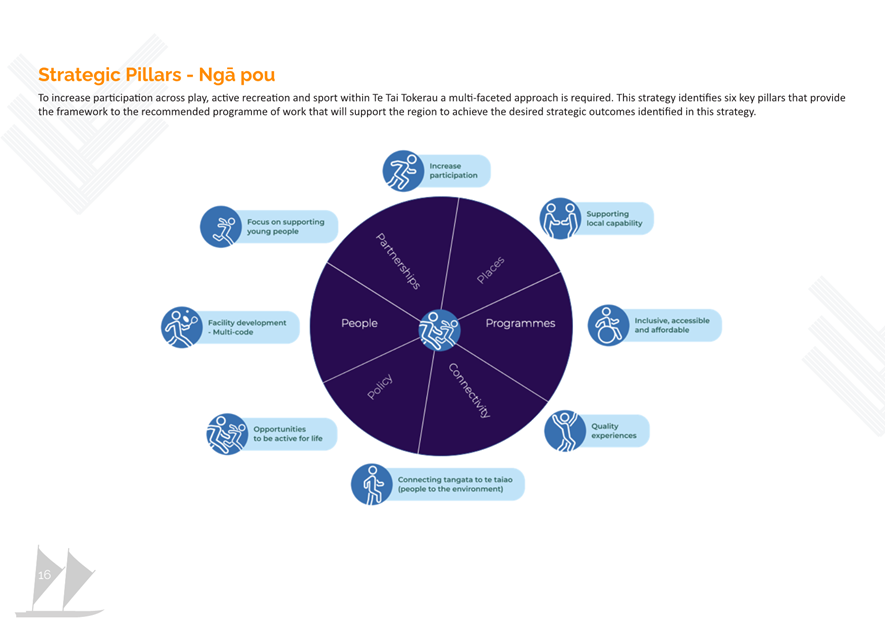
and alignment with the Northland Sports Facility Plan and Kōkiri ai te
Waka Hourua. Sport Northland, the three District Councils and Regional Council
are undertaking a comprehensive review and refresh of Kōkiri ai te Waka
Hourua, the strategy for play, active recreation and sport (PARS) for the
Northland Region. This will include a review and refresh for the District
Spaces Plans and Regional Sporting Facilities Plan which will all be included
within one integrated document.
The six-monthly reporting, annual operational report and
annual Community Board presentations provide ongoing visibility of delivery and
create opportunities for elected members and communities to review progress.
Future reporting should continue to clearly describe activities, geographic
reach, participation and community outcomes so Council can assess the value and
impact of its investment.
Next steps are to:
· receive
and review Sport Northland’s six-monthly and annual reporting against the
outcomes and activities in the funding agreement;
· continue
regular engagement between Council staff and Sport Northland to align work
programmes with Council priorities and community needs;
· support
Sport Northland to present progress and local outcomes to each Community Board
at least annually;
· use
reporting and engagement findings to inform future Spaces and Places planning
and related recreation investment decisions; and
· consider
the case for ongoing funding through the Long-Term Plan process, informed by
evidence of reach, outcomes and strategic alignment.
PĀNGA PŪTEA ME NGĀ WĀHANGA
TAHUA / Financial Implications and Budgetary Provision
The funding agreement is included in the current financial
year’s budget. Ongoing funding may need to be considered for inclusion in
the Long-Term Plan.
Āpitihanga
/ Attachments
1. FNDC
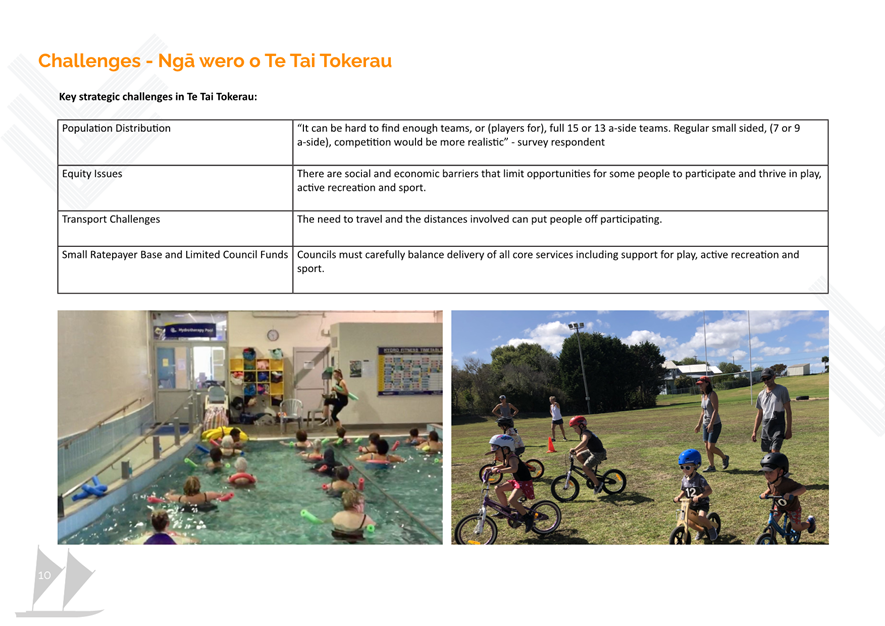
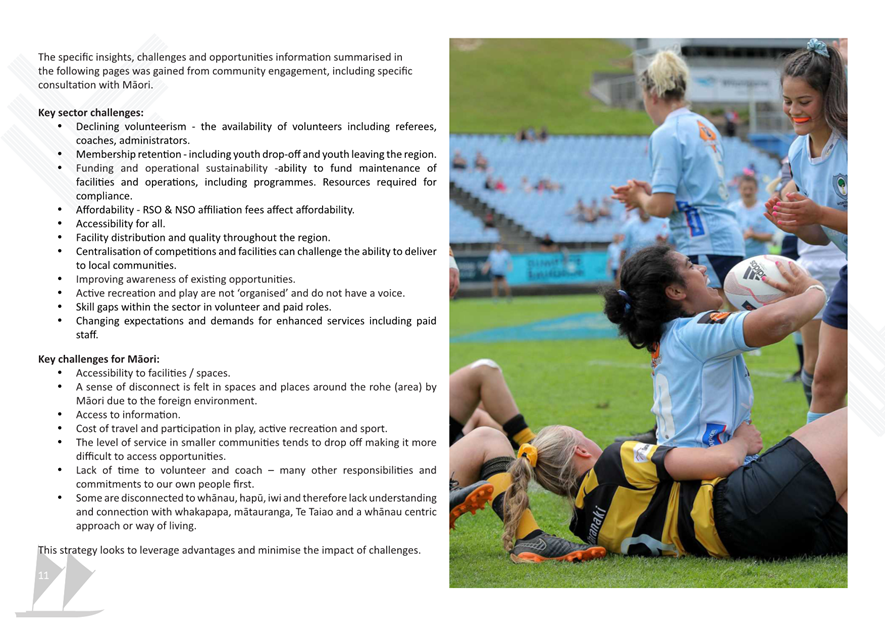
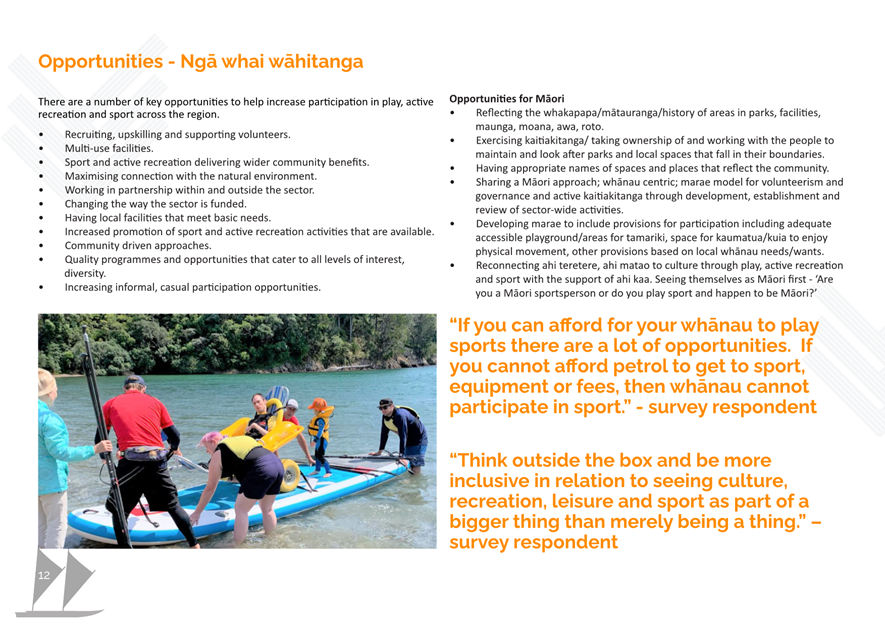
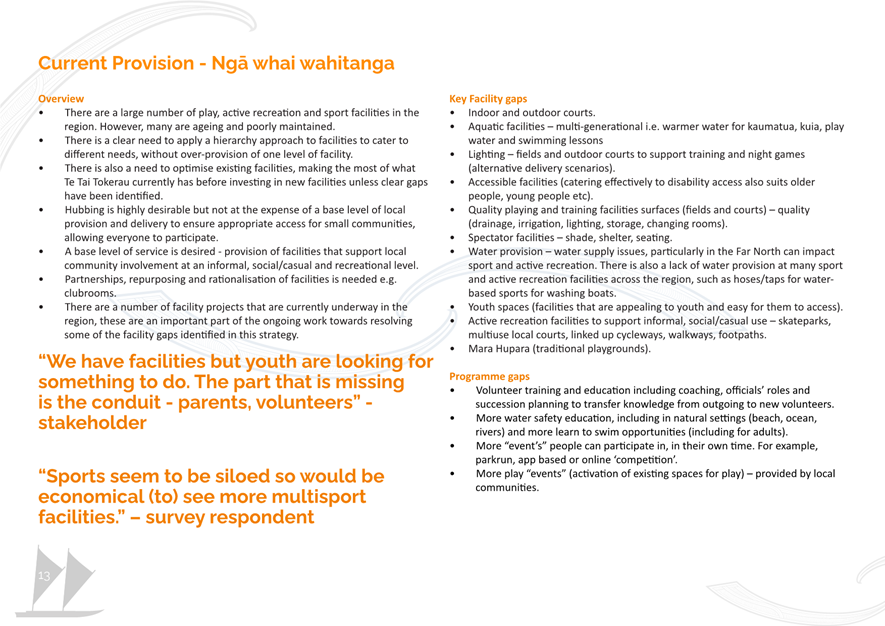
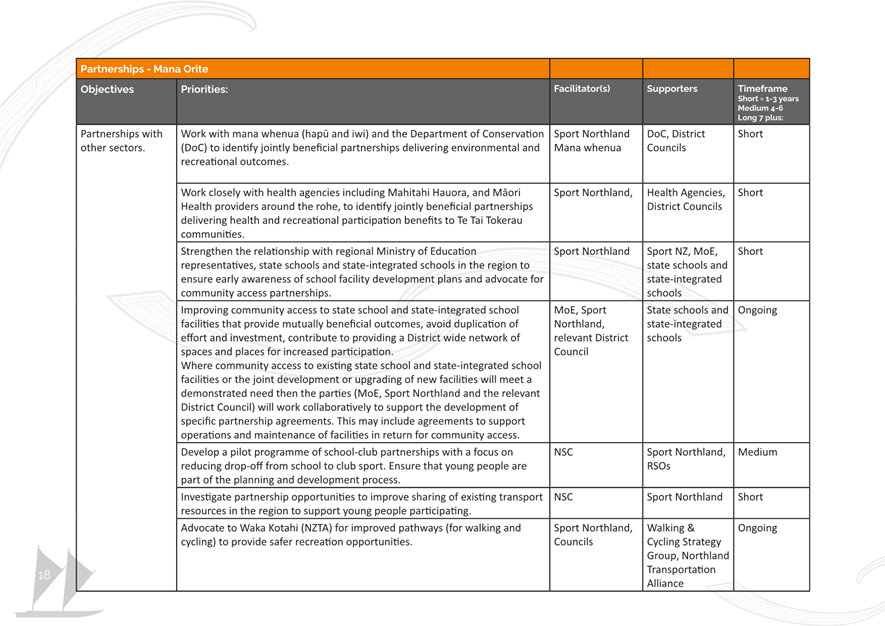
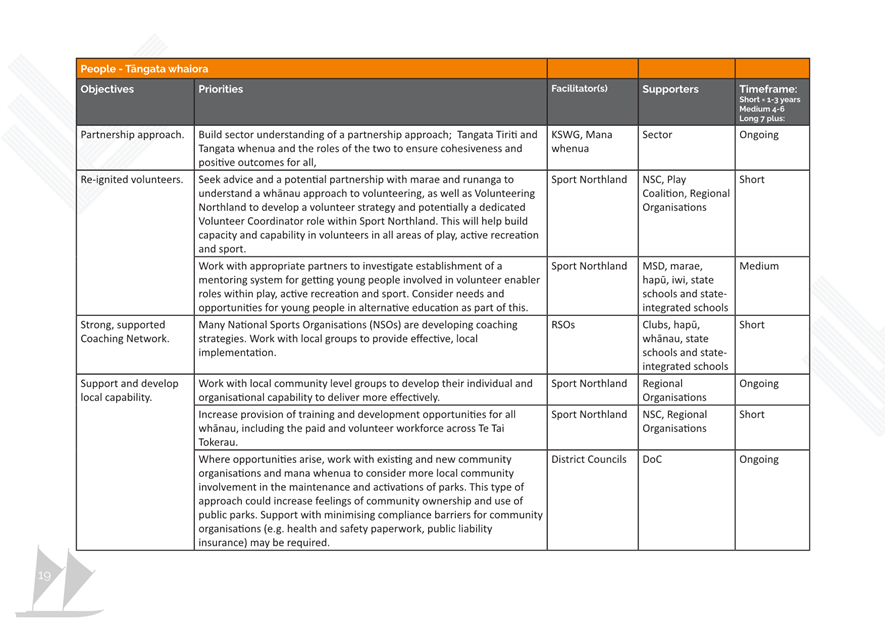
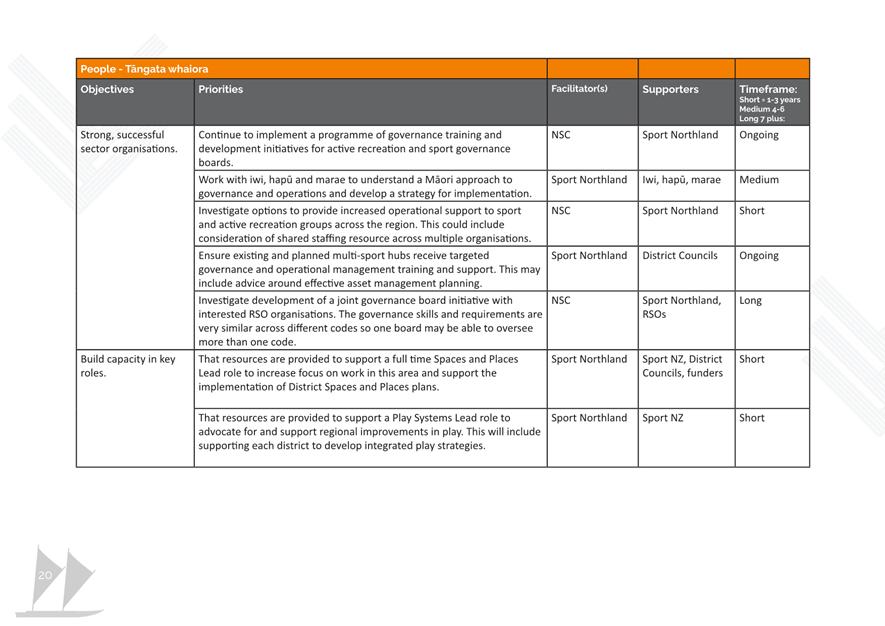
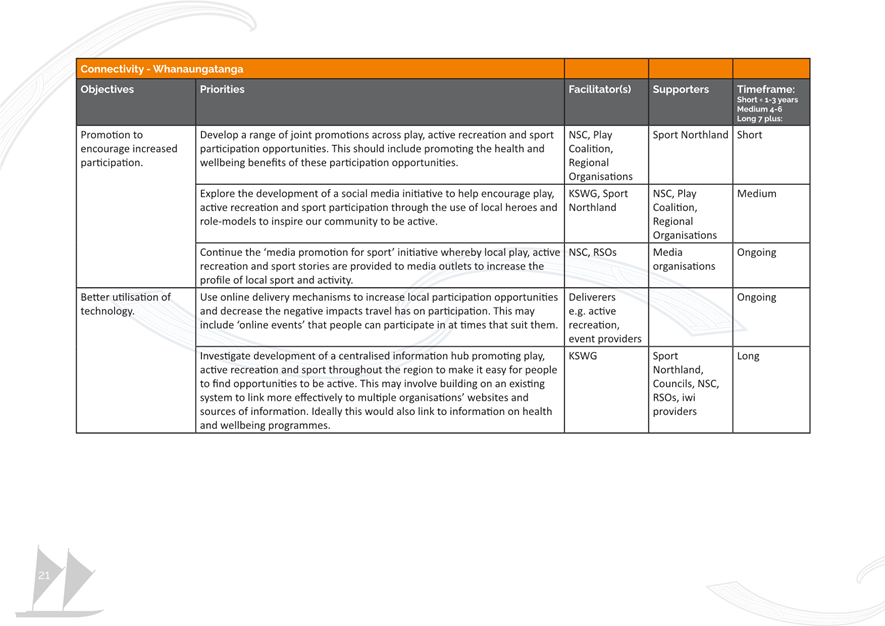
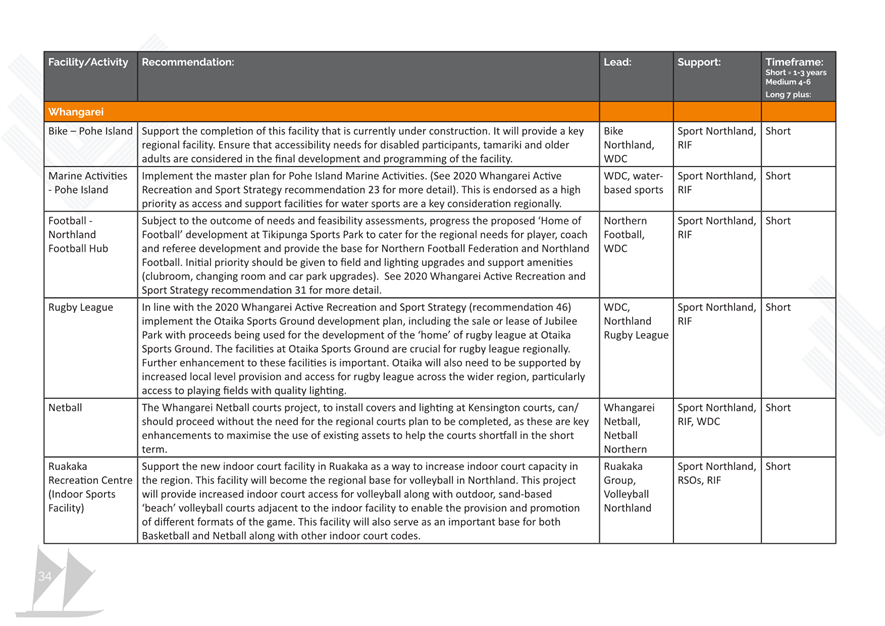
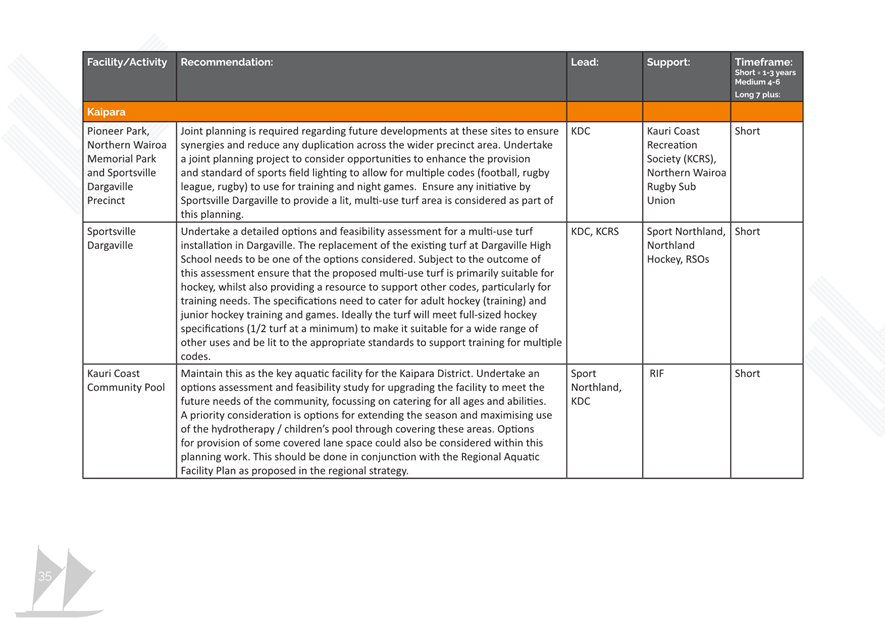
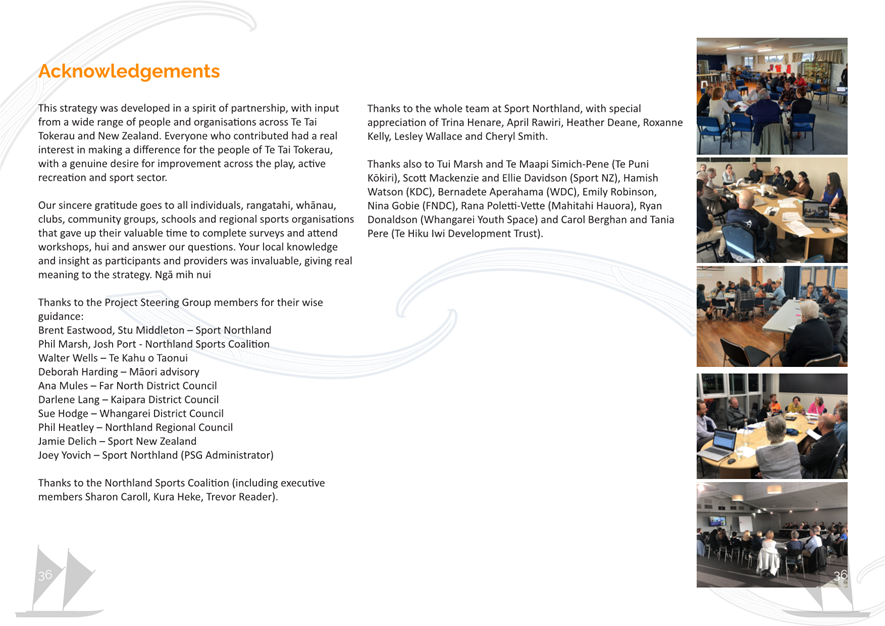
Report July 2026 - A5930897 ⇩ 
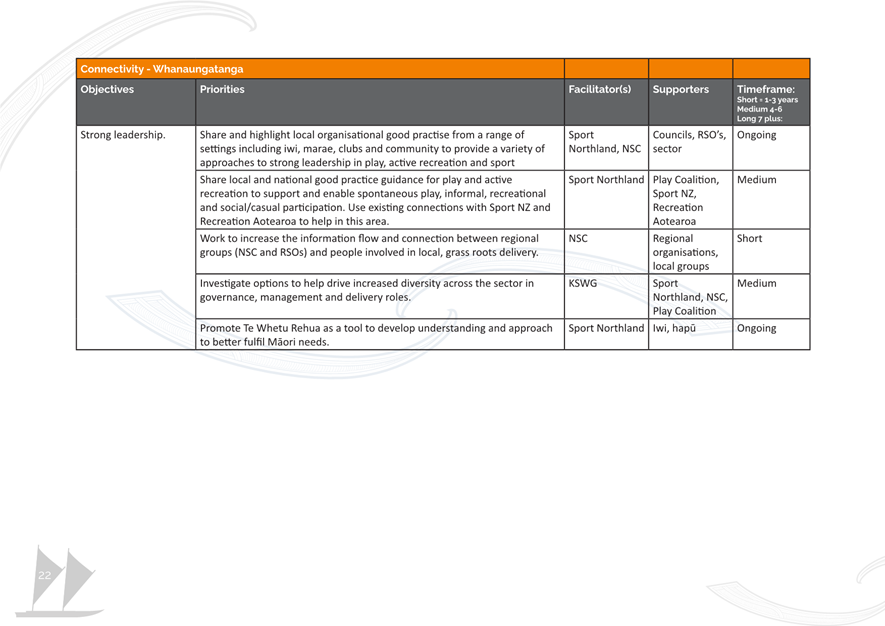
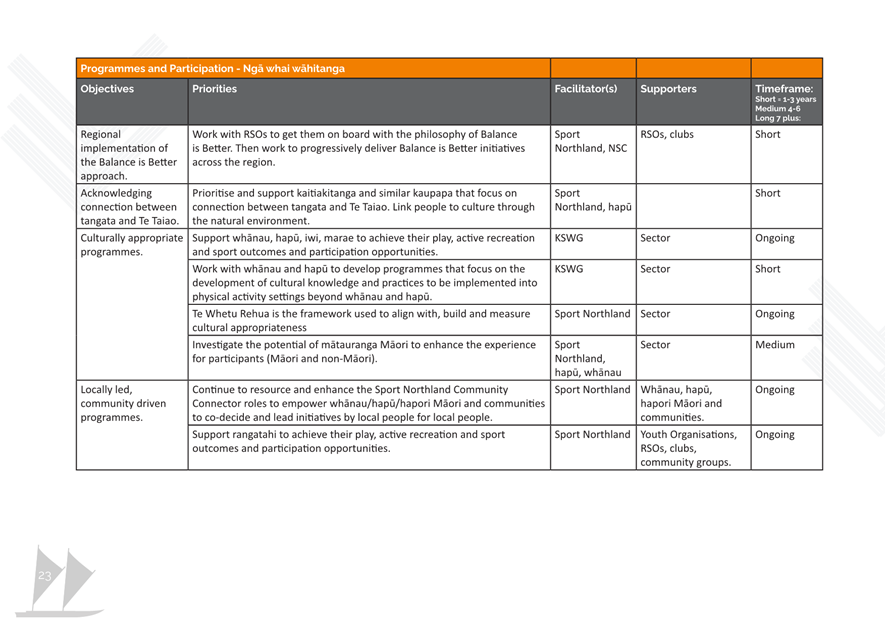
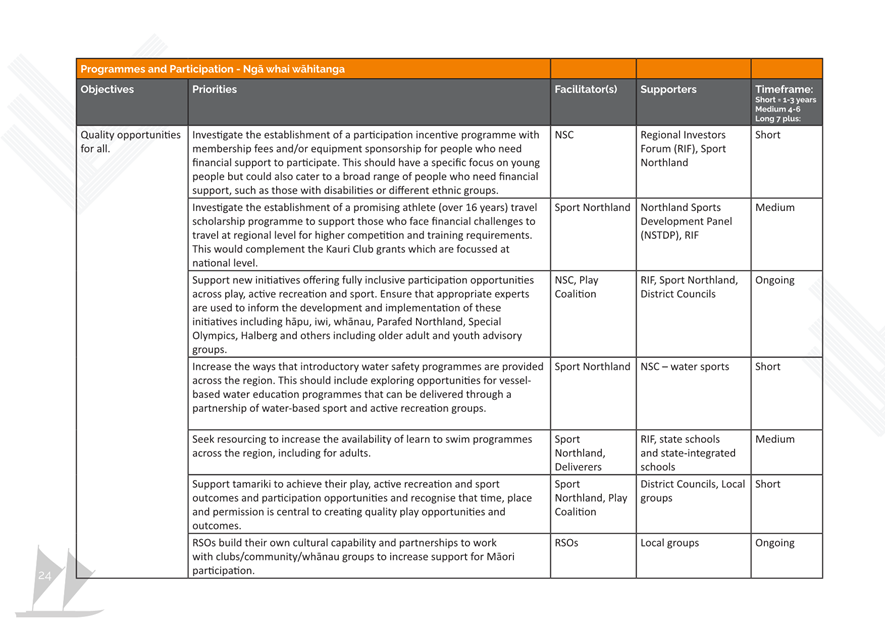
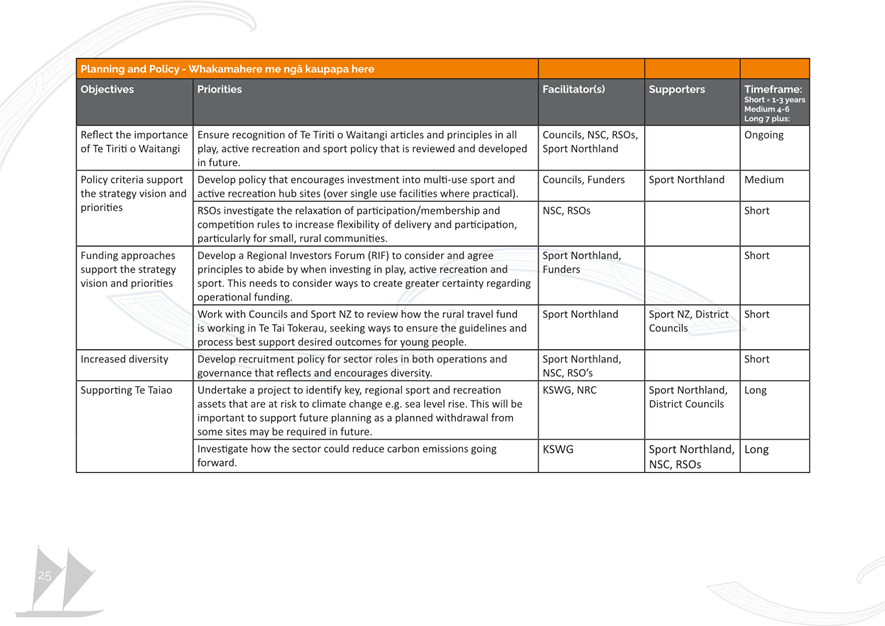
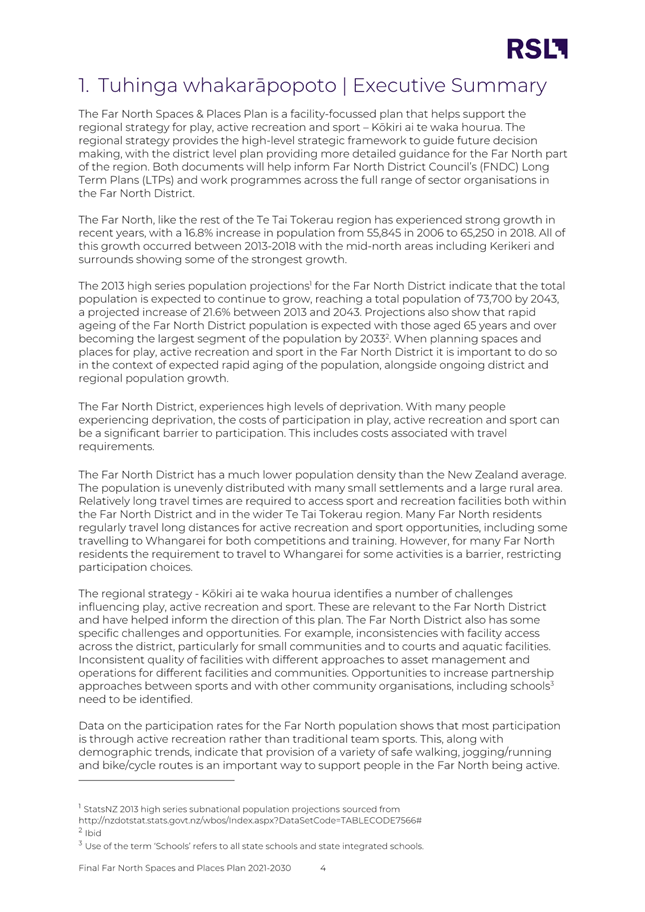
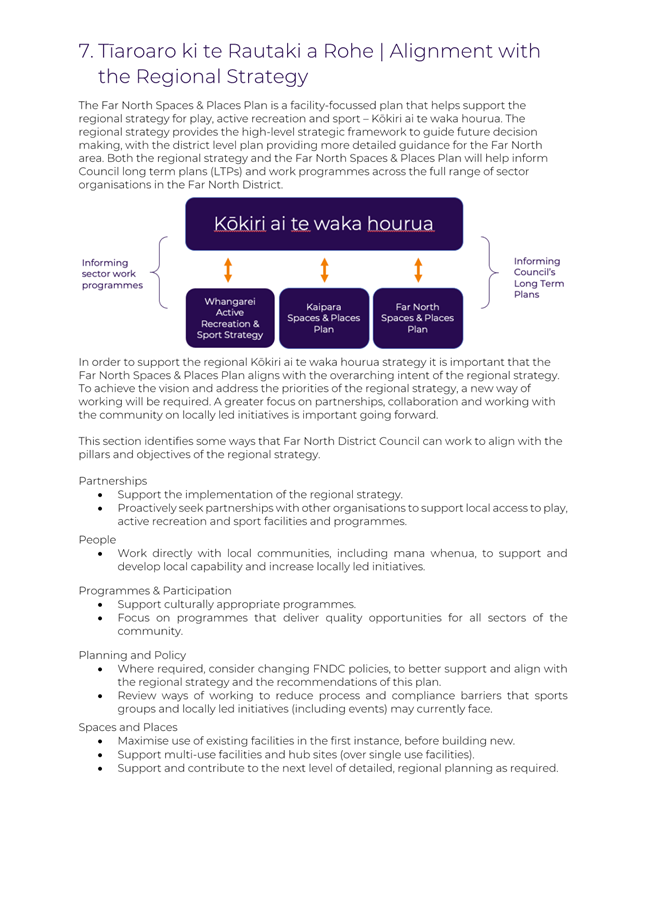
2. KŌKIRI
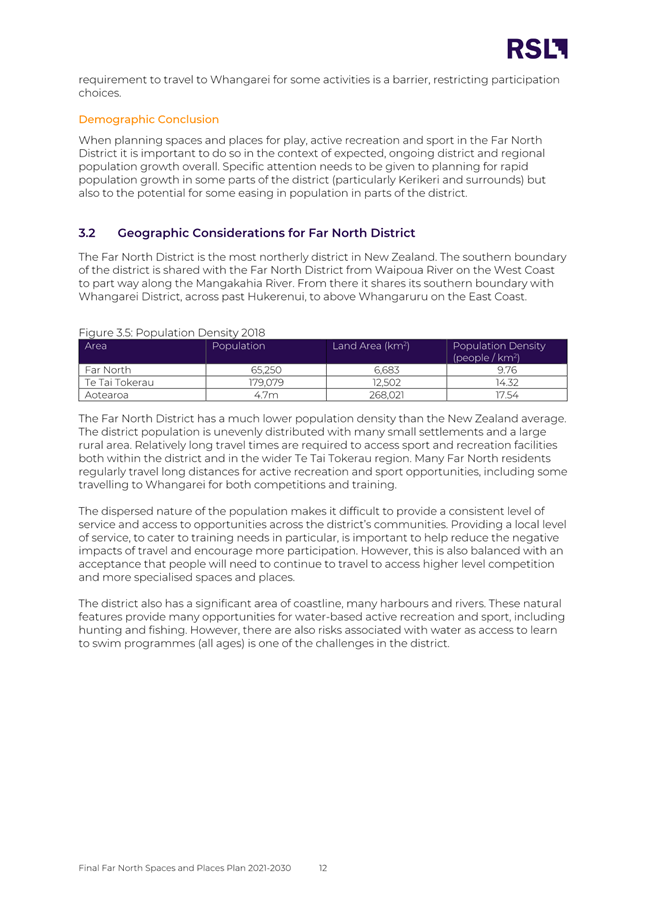
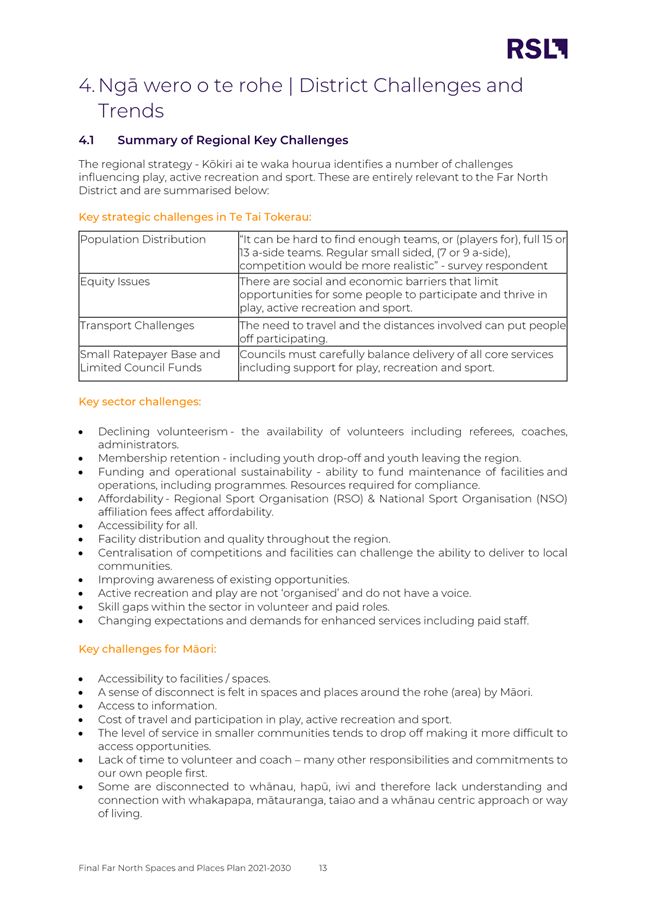
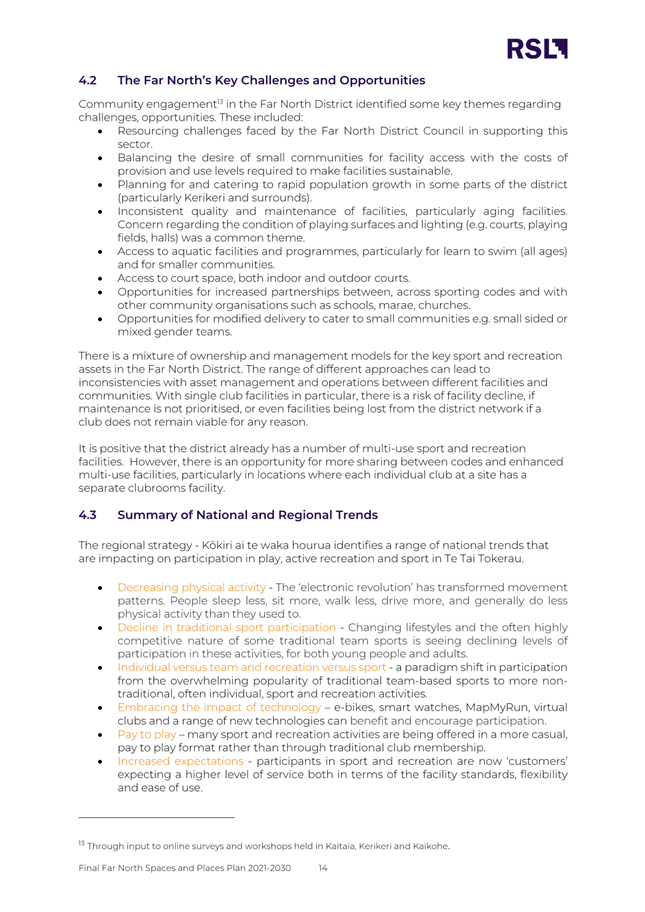
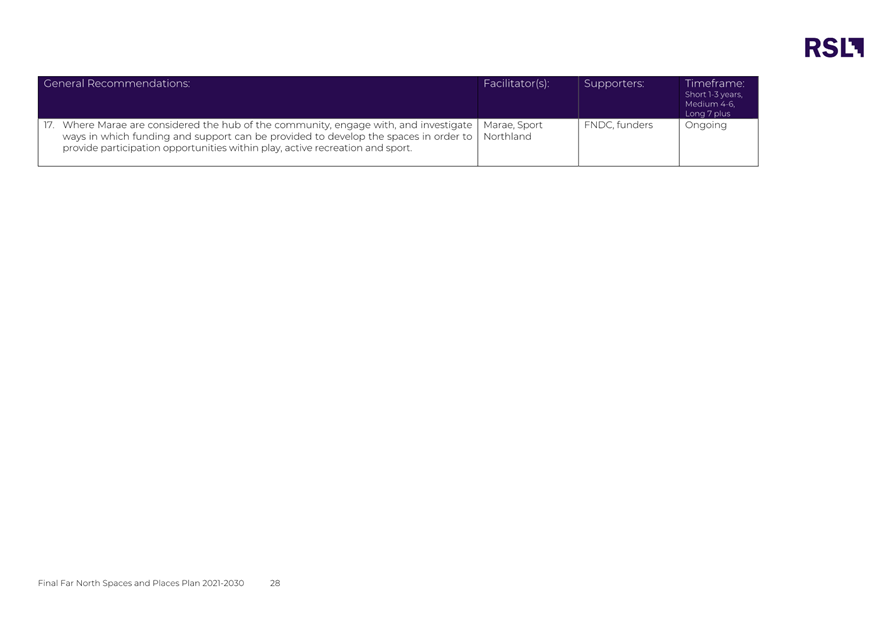
AI TE WAKA HOURUA - A3906668 ⇩ 
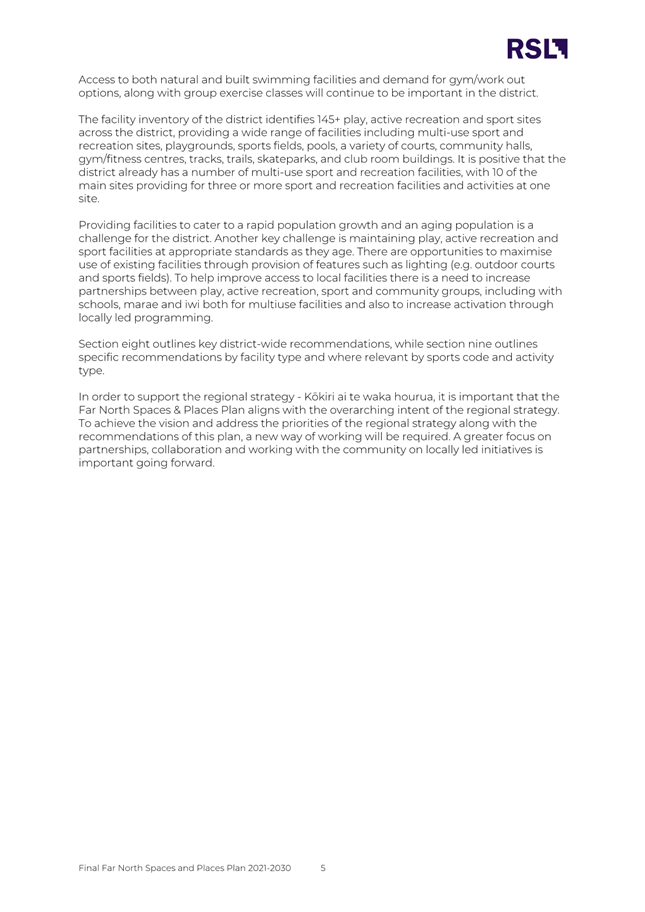
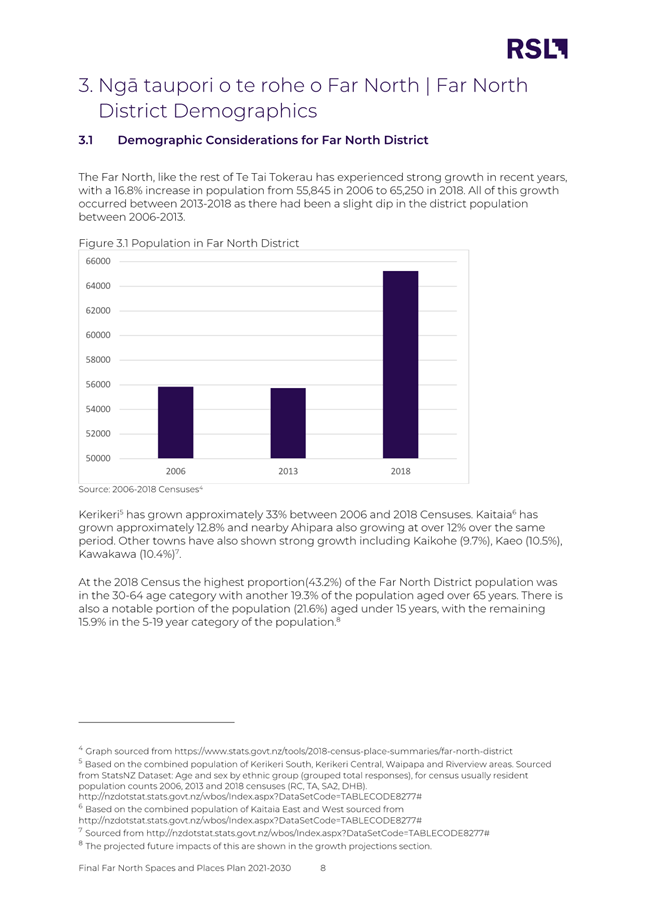
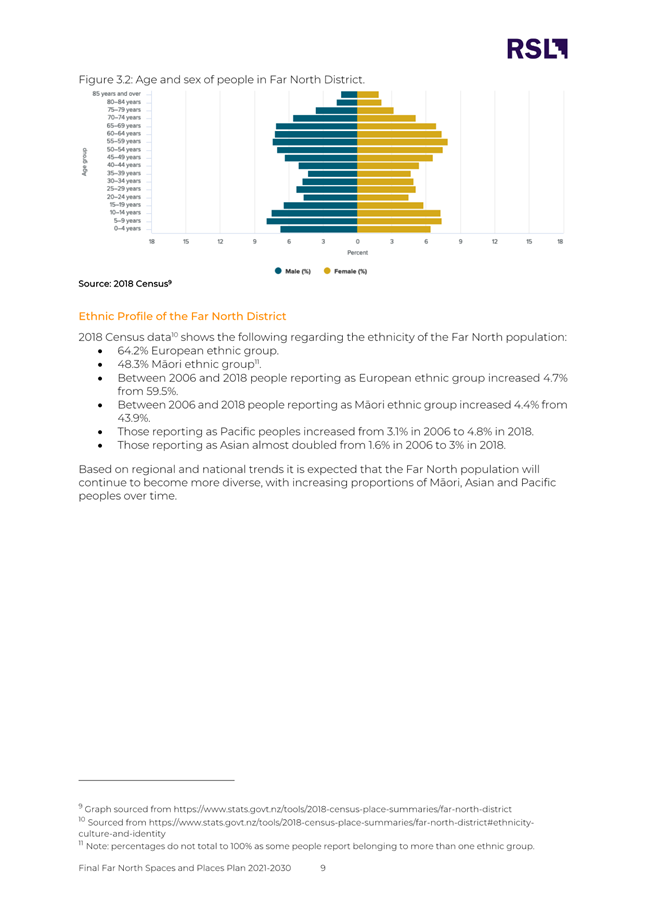
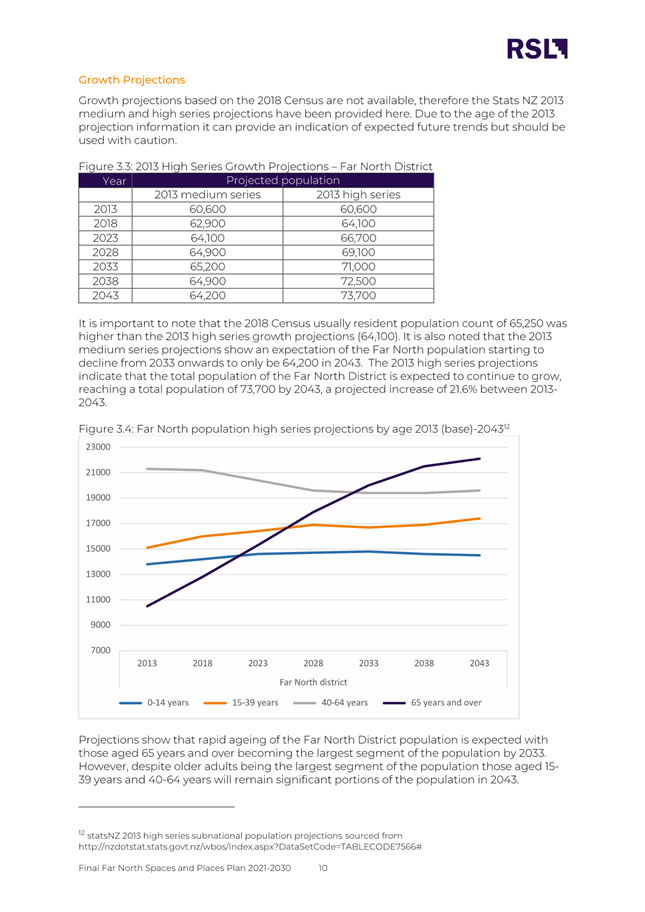
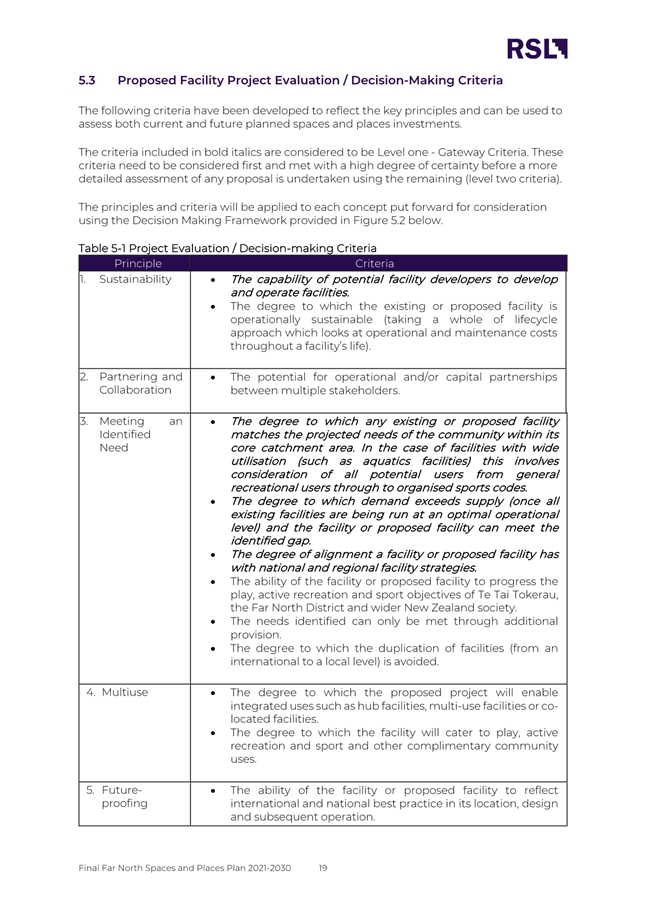
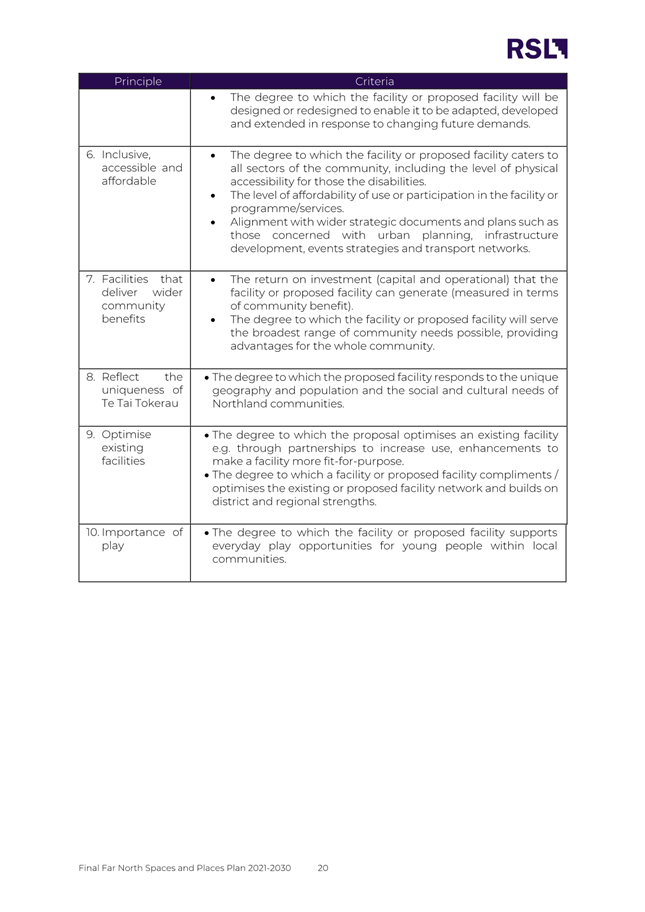
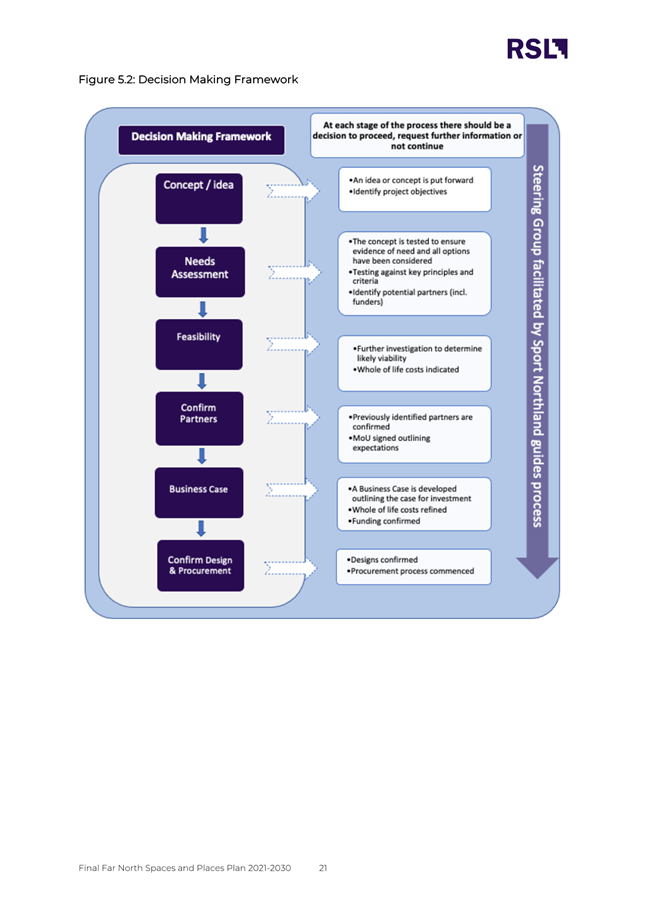
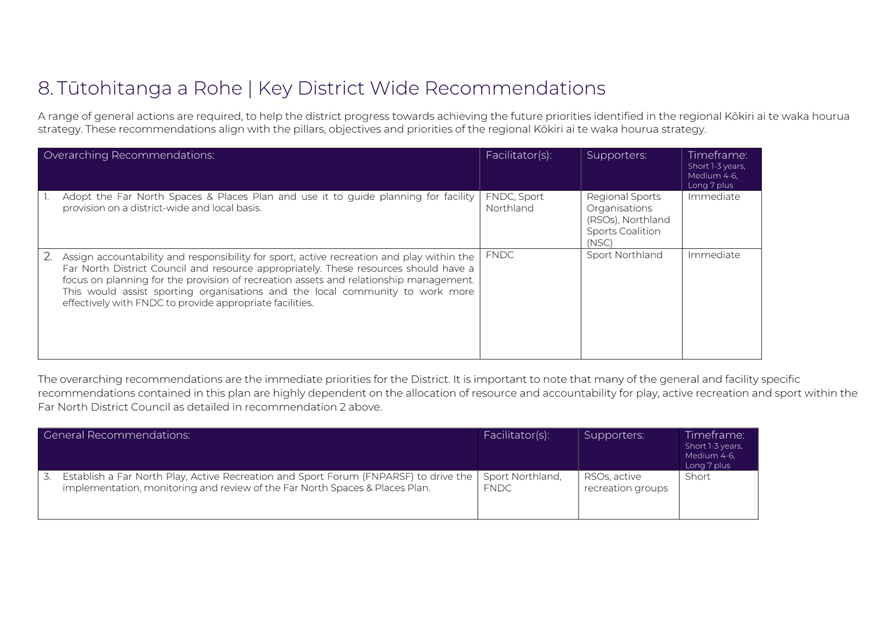
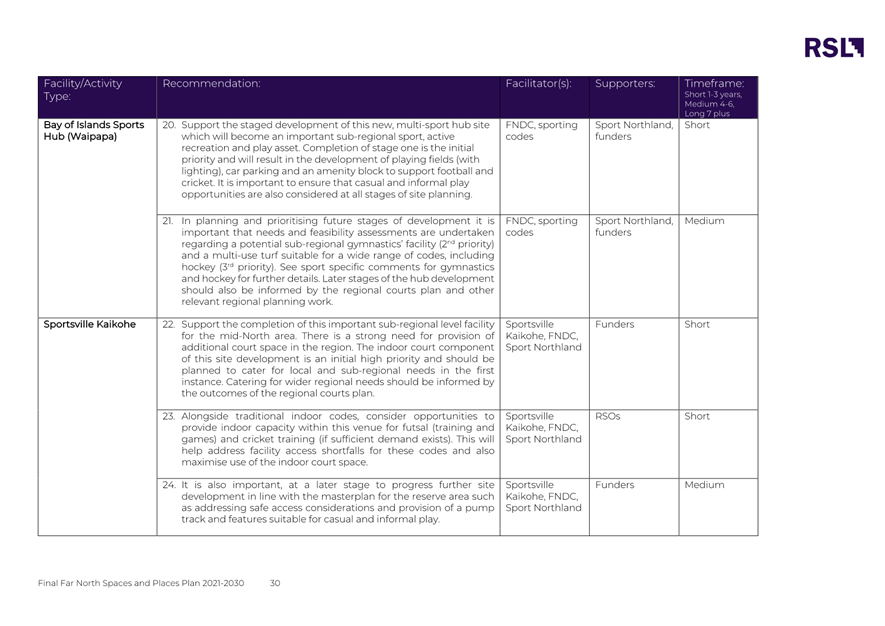
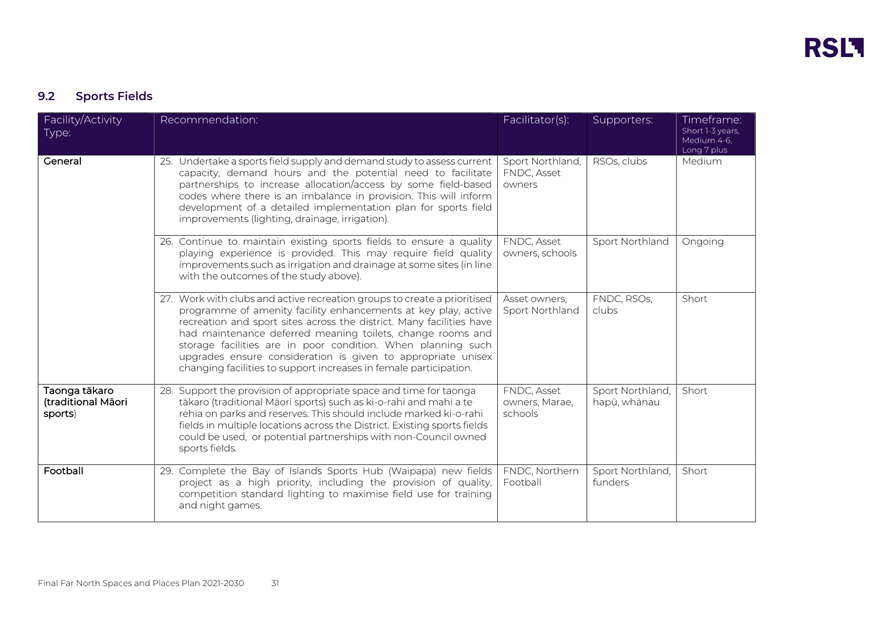
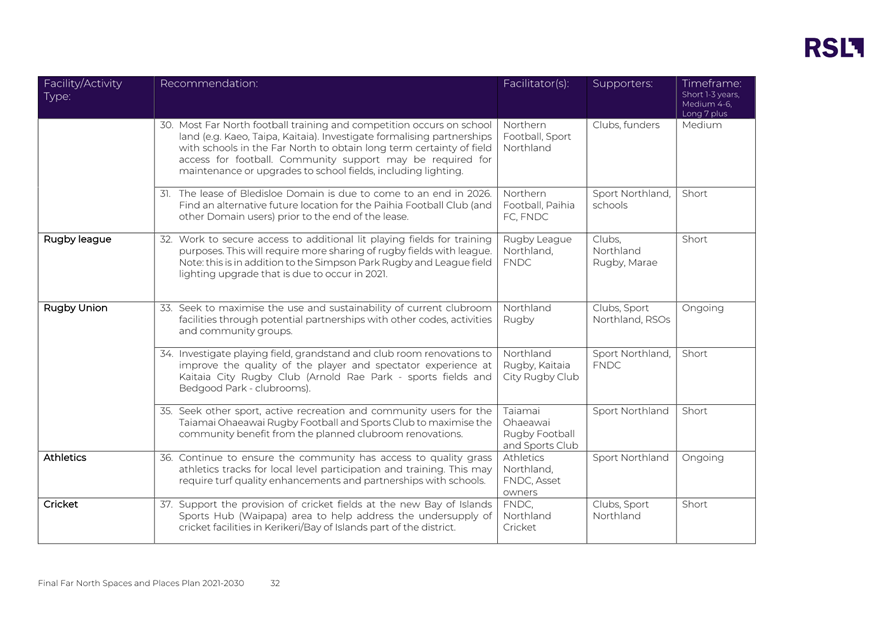
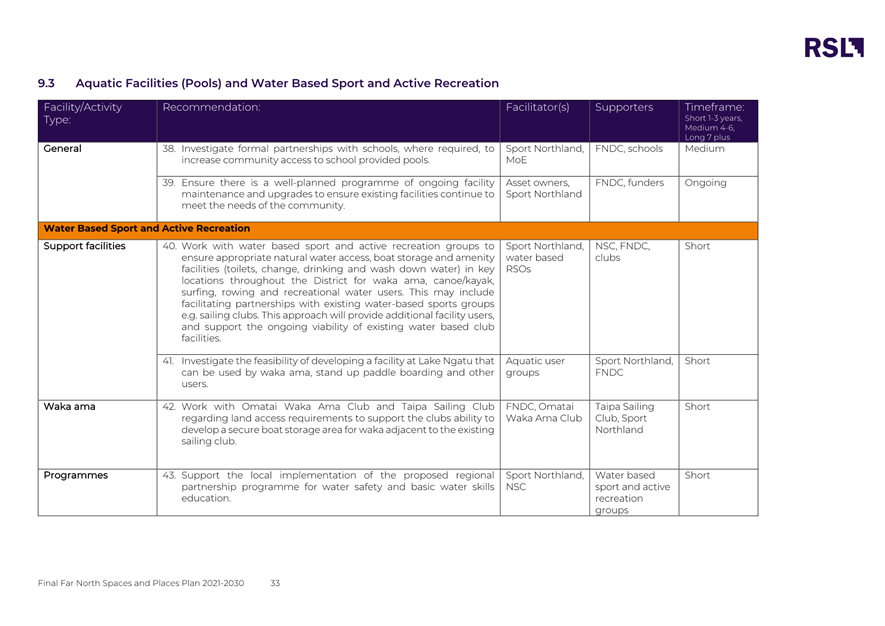
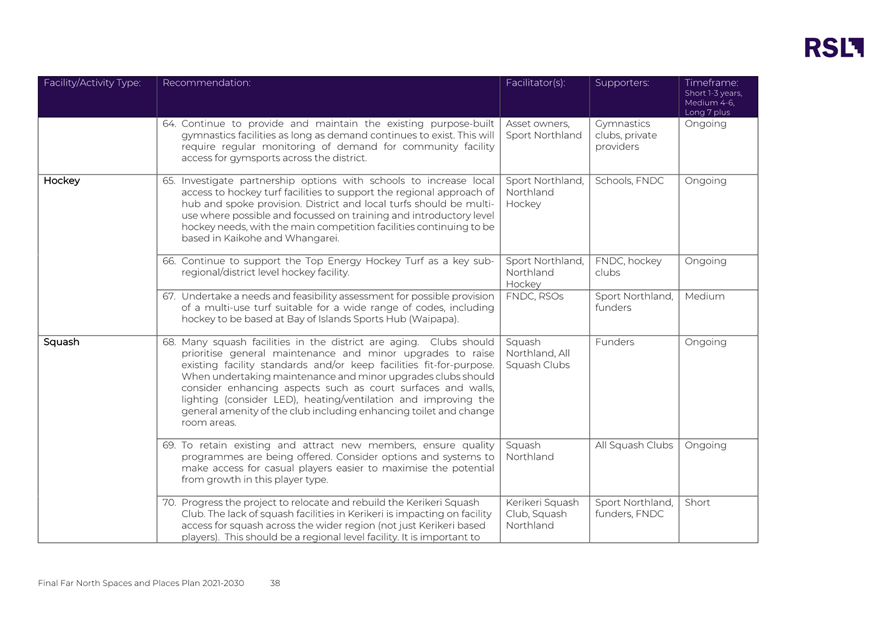
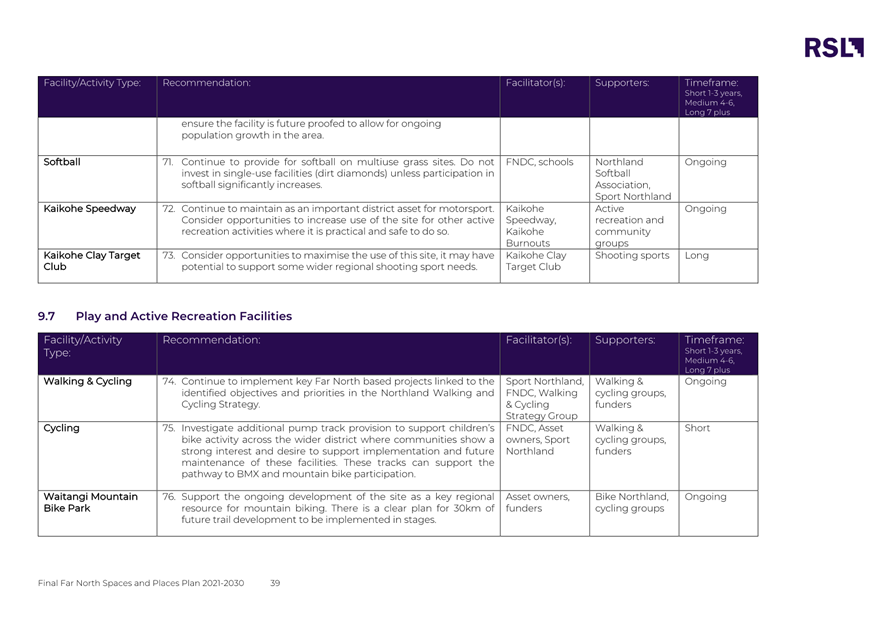
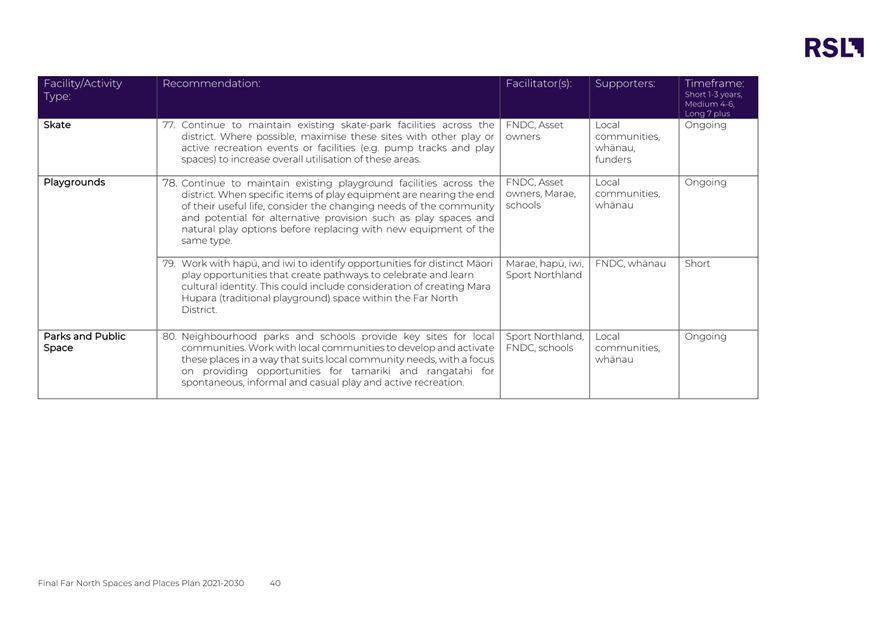
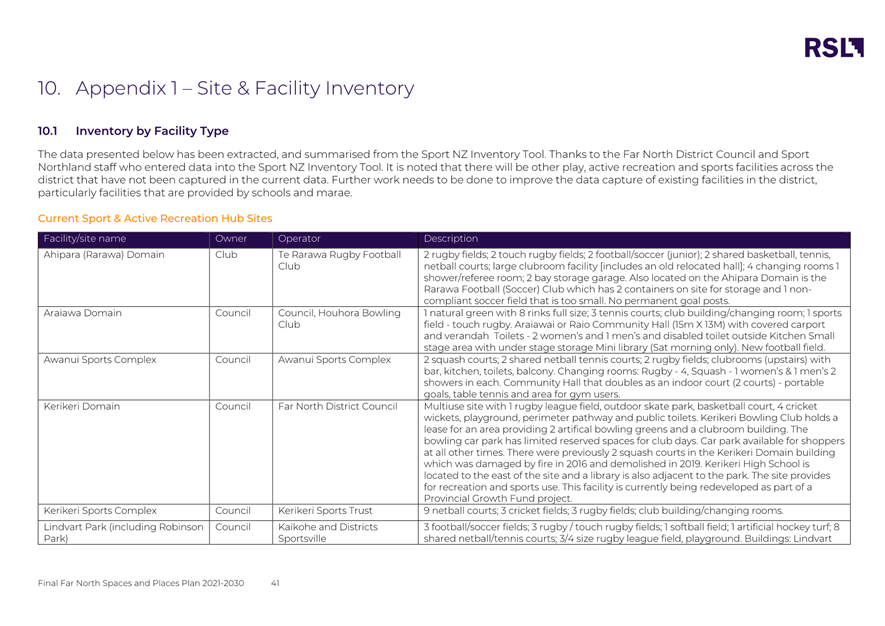
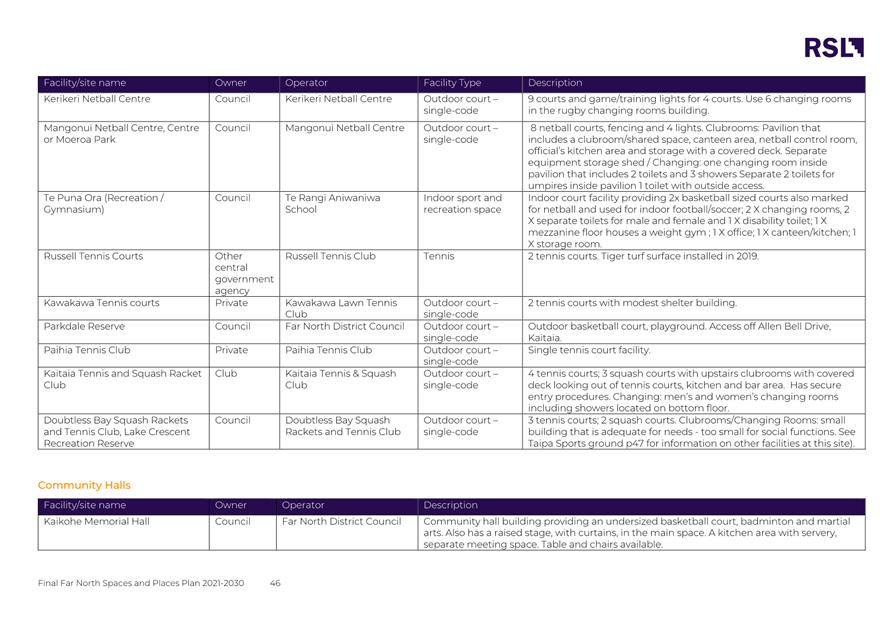
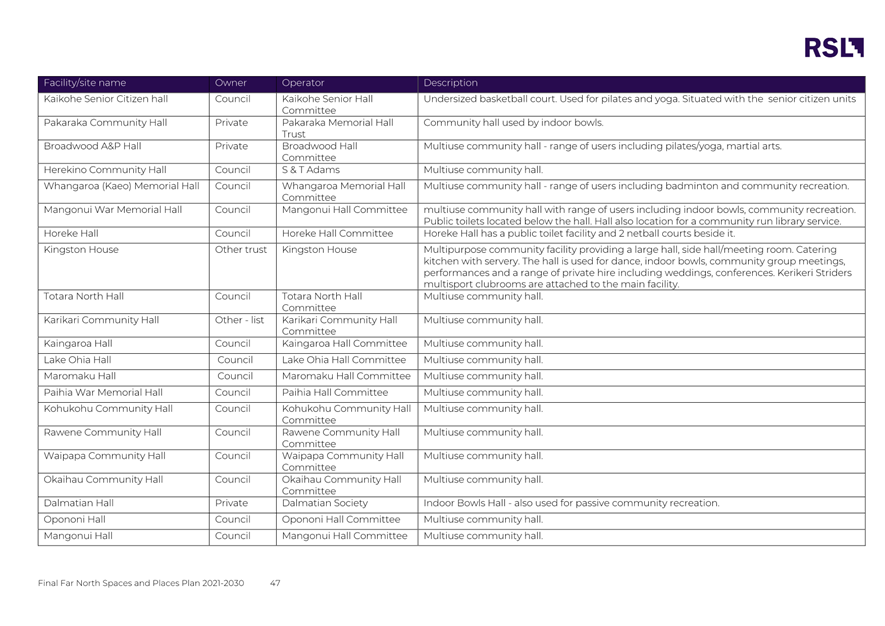
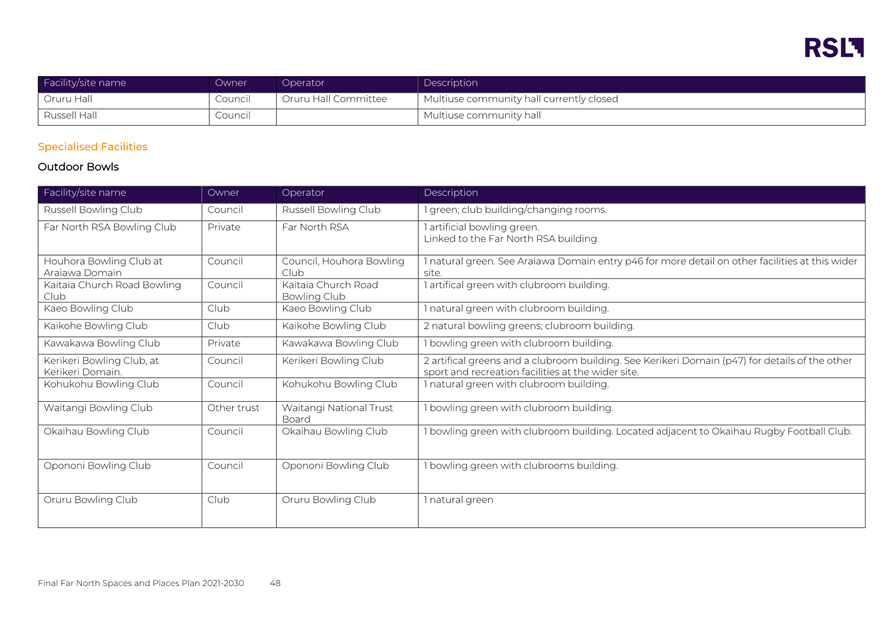
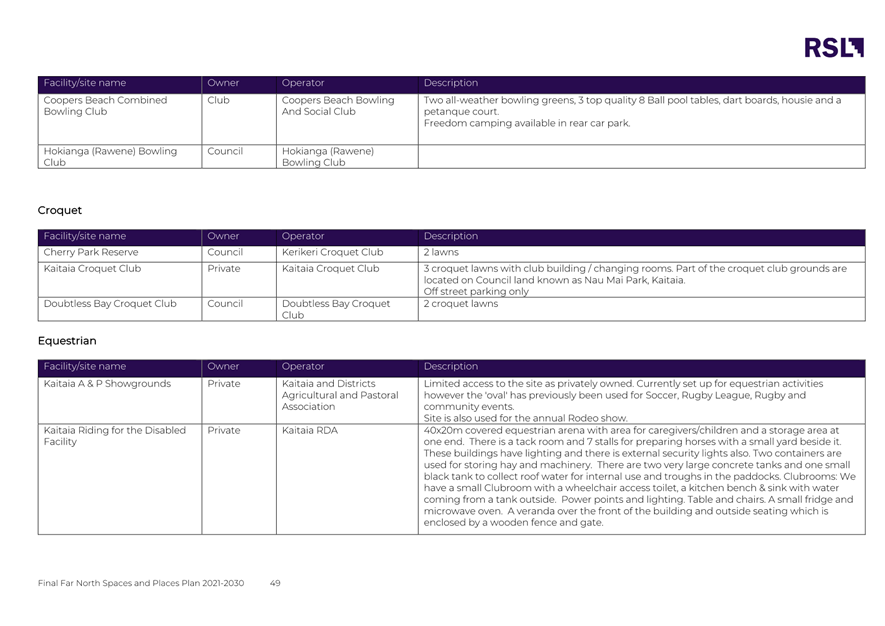
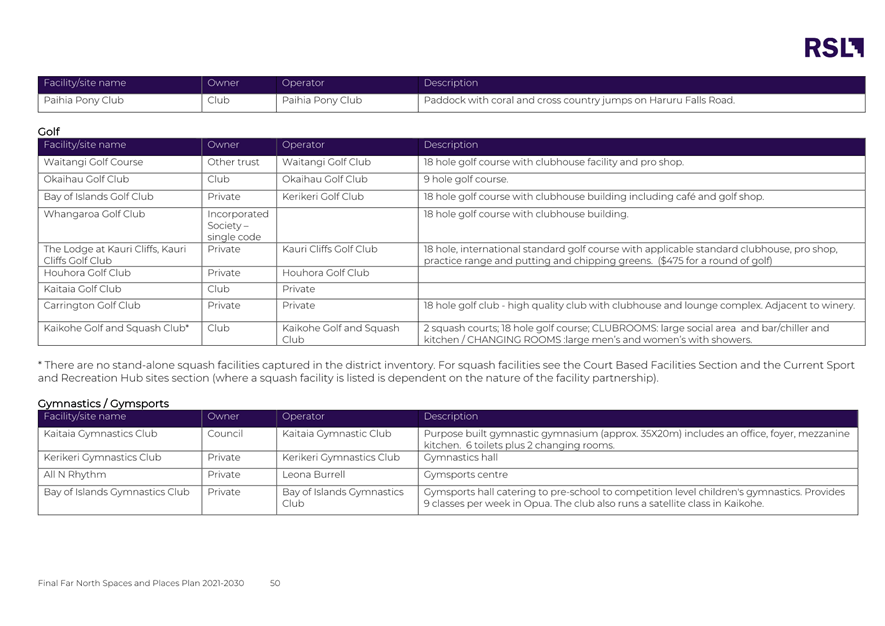
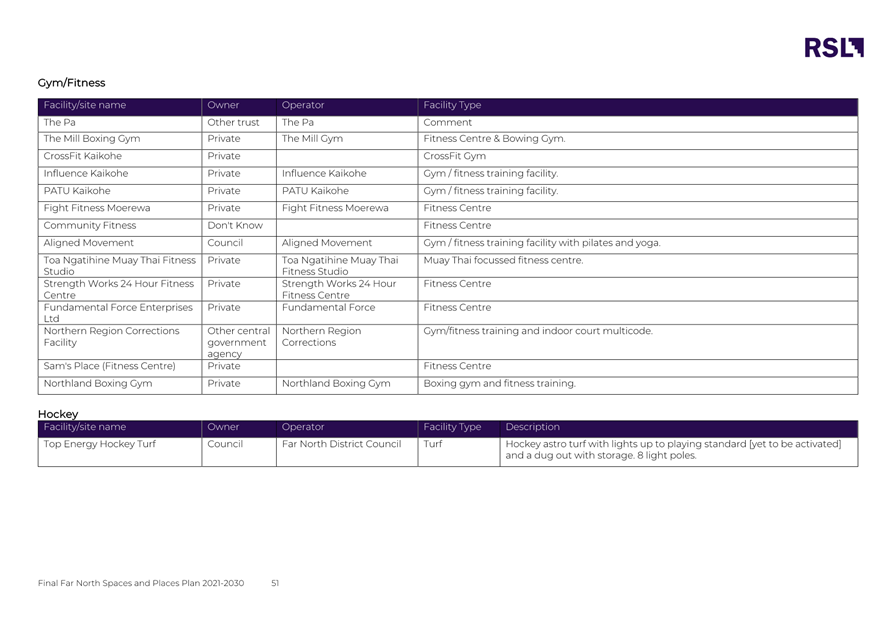
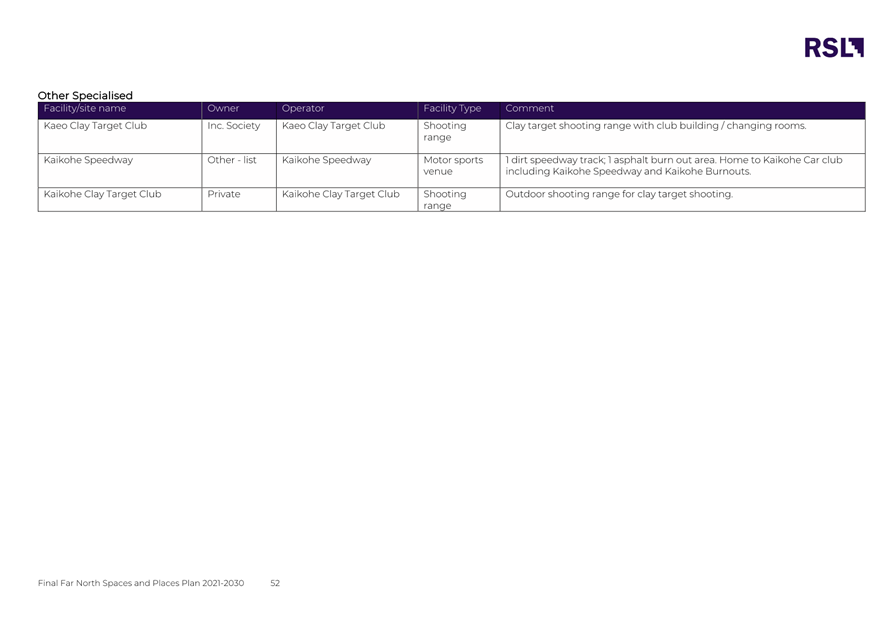
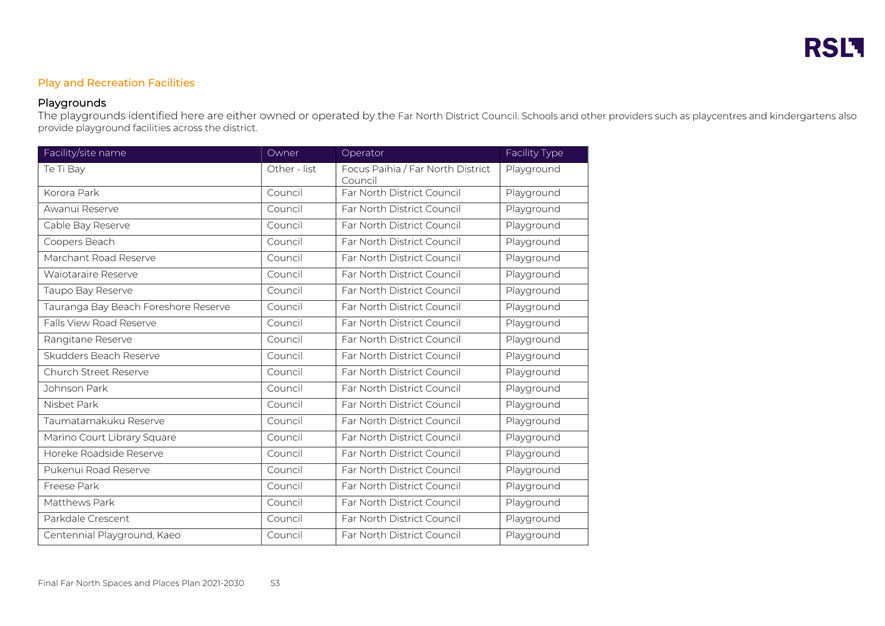
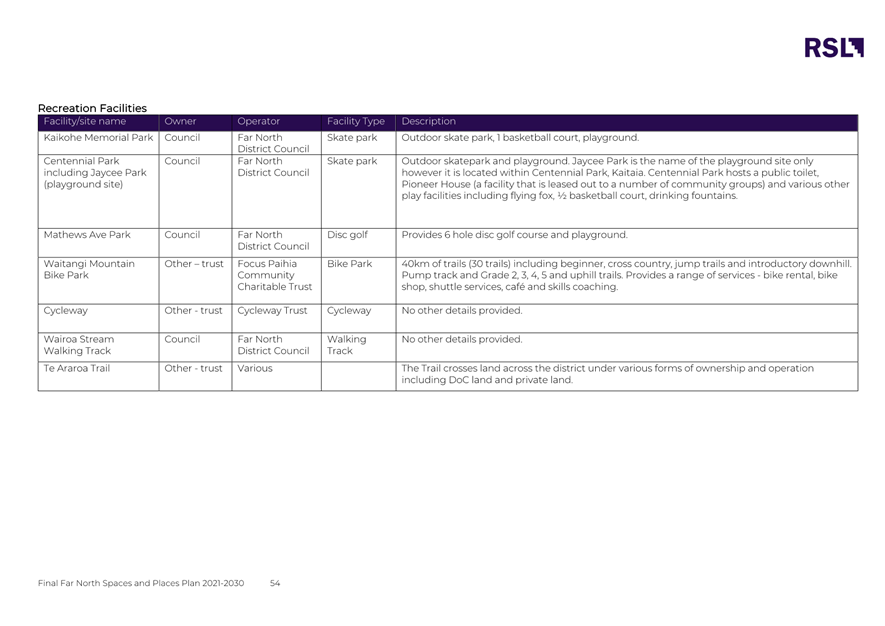
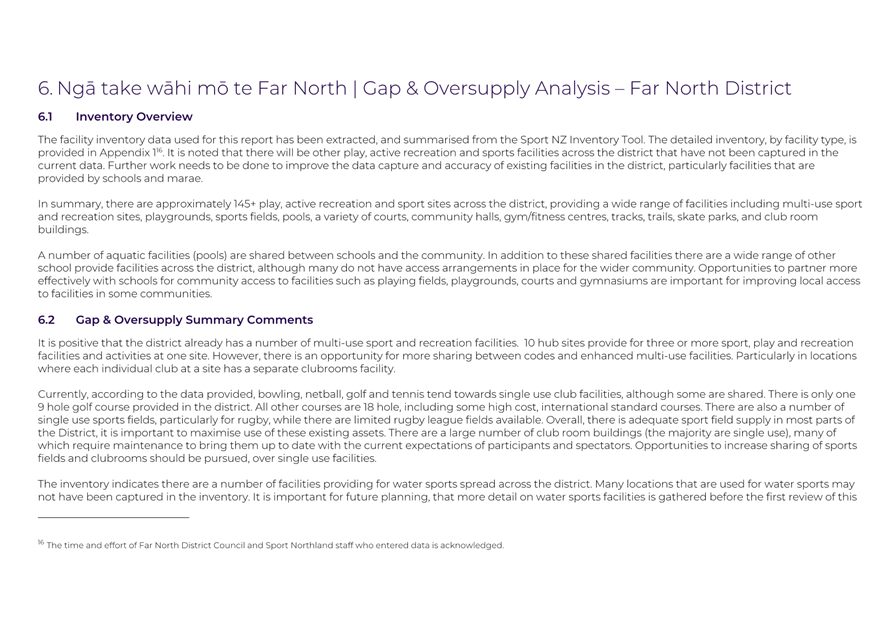
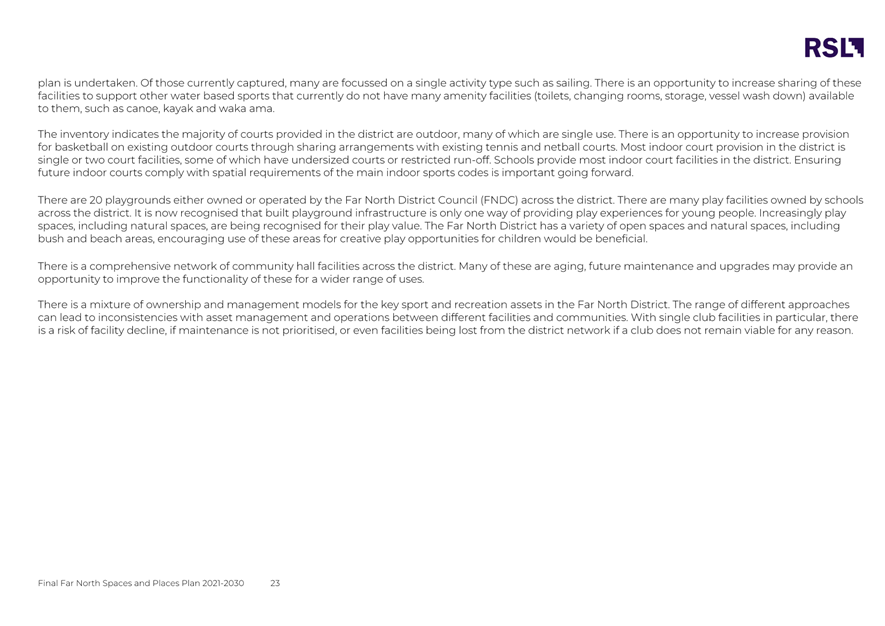
3. Far
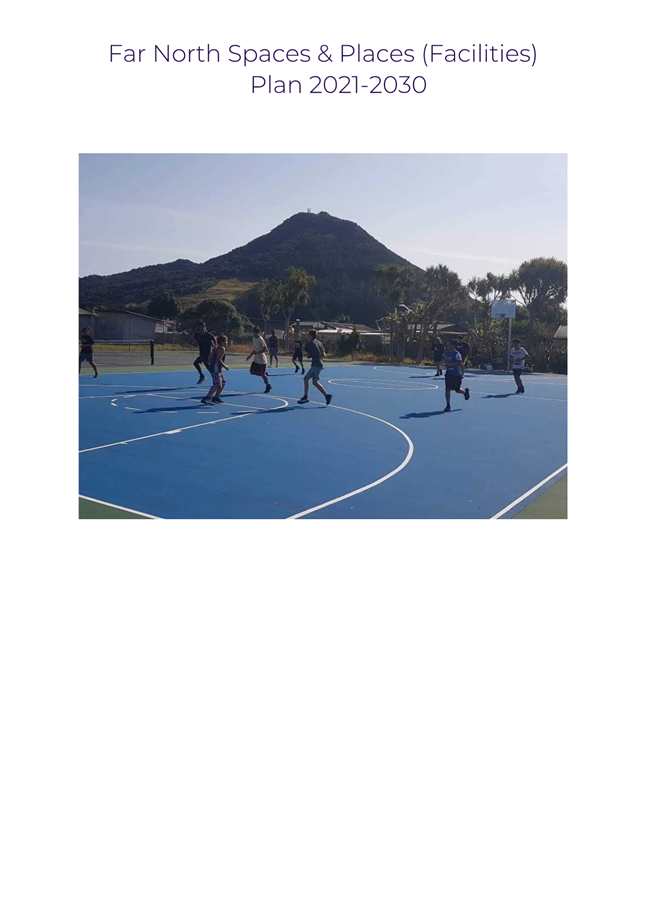
North Spaces & Places (Facilities) Plan 2021-2030 - A5360408 ⇩
6.2 Te
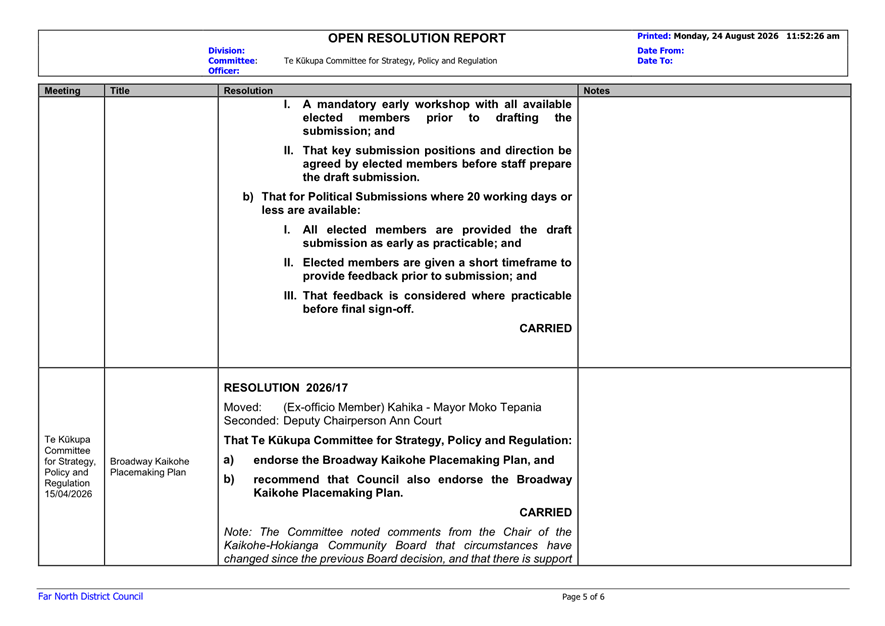
Kūkupa Committee for Strategy, Policy and Regulation - Open Resolution and
Actions Update Report
File
Number: A5924184
Author: Imrie
Dunn, Democracy Advisor
Authoriser: Aisha
Huriwai, Manager - Democracy Services
Take Pūrongo / Purpose of the Report
To
provide Te Kūkupa Committee for Strategy, Policy and Regulation with an overview of outstanding open
resolutions and action items arising from meetings.
WhakarĀpopoto matua / Executive Summary
· Open resolutions are a mechanism to communicate progress against
decisions/resolutions.
· Open resolutions are also in place for all formal elected member
meetings.
· This report introduces the inclusion of an ‘Action Points
Update’ going forward.
· Action points are a mechanism to capture actions that are not part
of a formal decision/resolution but require follow up or confirmation from
staff.
|
tŪtohunga
/ Recommendation
That Te Kūkupa Committee
for Strategy, Policy and Regulation receive the report Open
Resolutions and Actions Update.
|
1) TĀhuhu kŌrero / Background
Te Kūkupa decisions and
resolutions are documented in an open resolution status report, tracking
actions triggered by these decisions. Staff provide updates on incomplete
tasks, including outstanding actions from previous triennium committees.
As some reports are purely informational and do not generate
resolution items, a need has been identified to track certain action points
arising from information reports or meeting discussions.
This report introduces an ‘Actions Points
Update’ as a regular item at future Committee meetings. Going forward,
action points will be recorded, tracked internally by staff, and reported at
Committee meetings as
appropriate.
2) matapaki me NgĀ KŌwhiringa /
Discussion and Options
Managers will assist in recording
and following up outstanding open resolutions or actions points with staff
where appropriate, and occasionally, may be in a position to provide a further
verbal update at meetings following the printing of an agenda. Democracy
Services staff will support the process by generating reports.
The outstanding tasks are often multi-facet projects that
take longer to fully complete.
3) PĀnga PŪtea me ngĀ
wĀhanga tahua / Financial Implications and Budgetary Provision
There
are no financial implications or need for budgetary provision in receiving this
report.
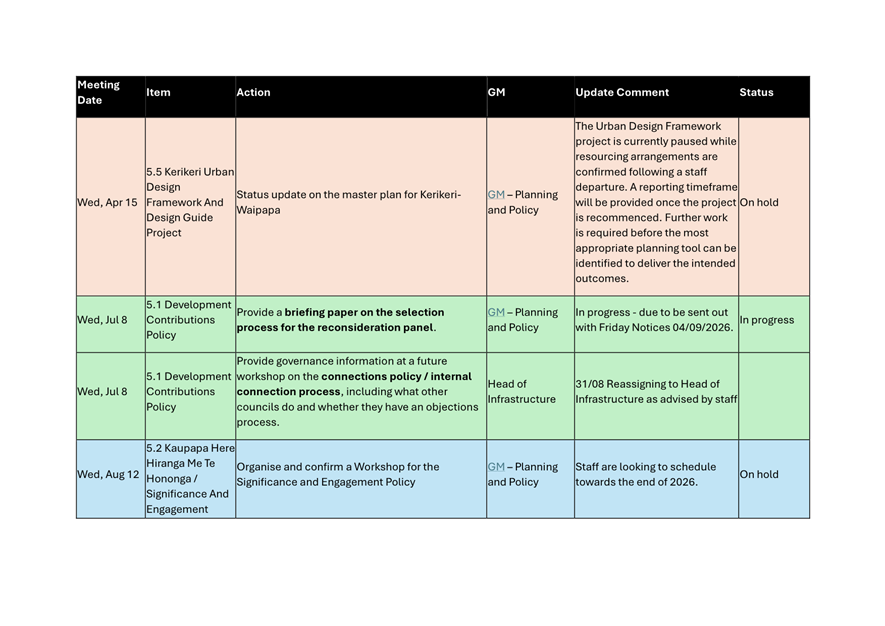
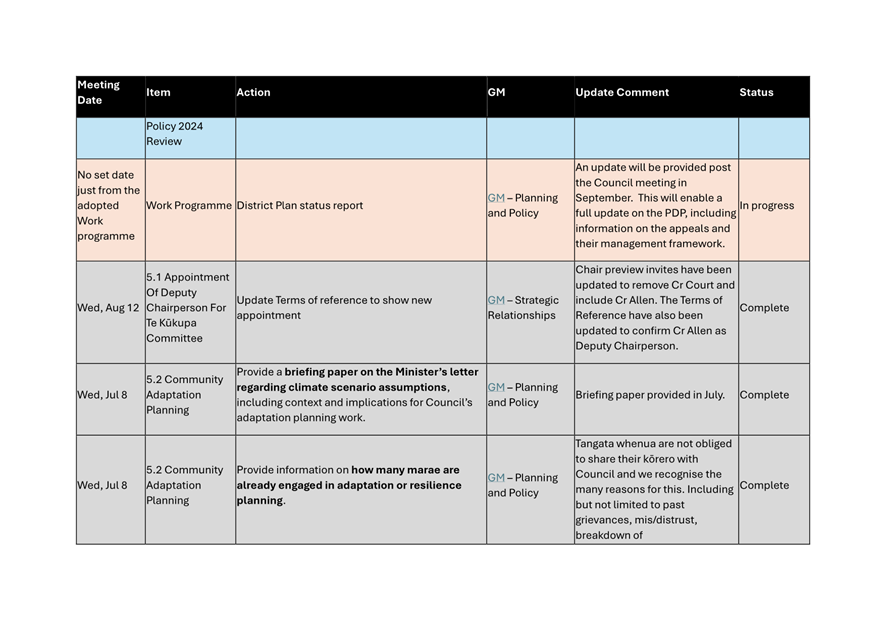
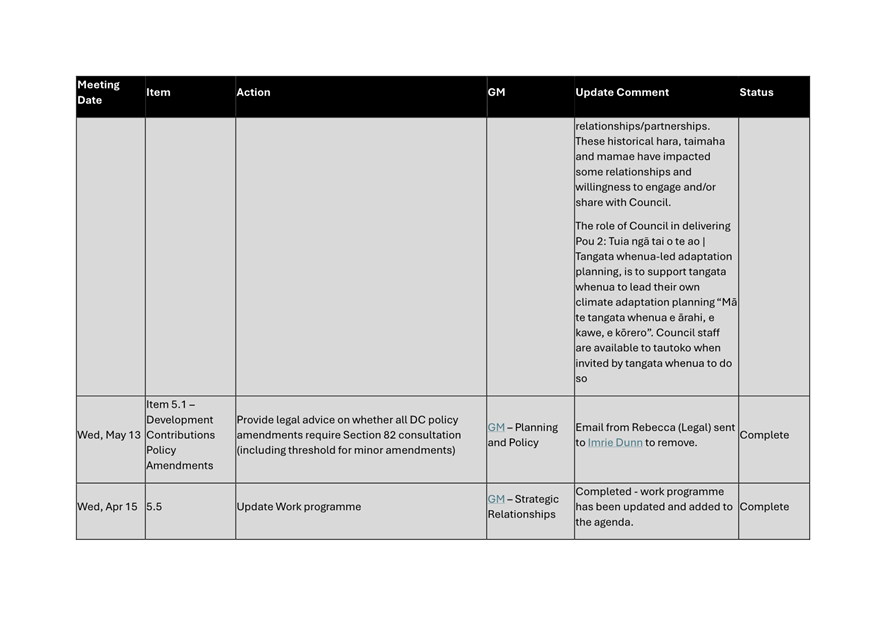
Āpitihanga
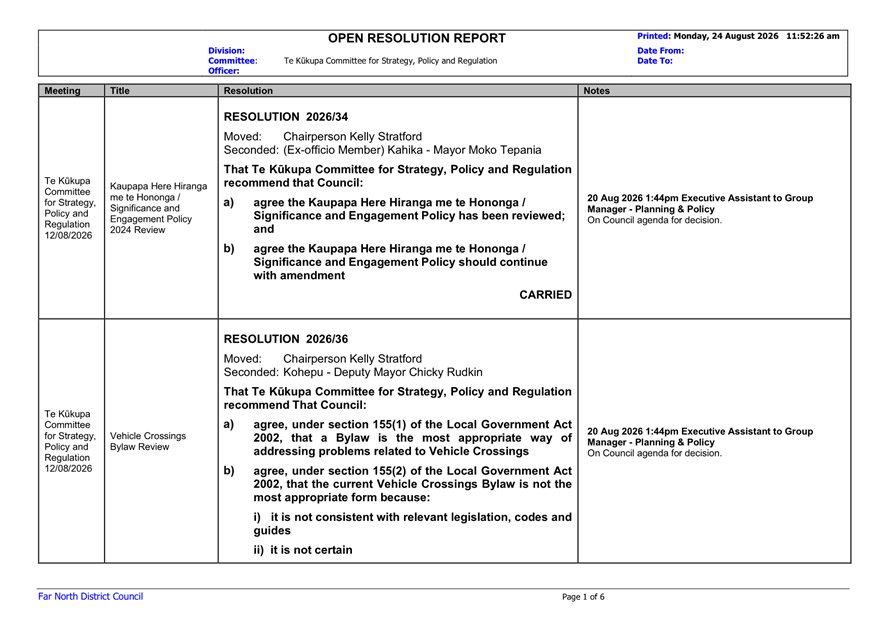
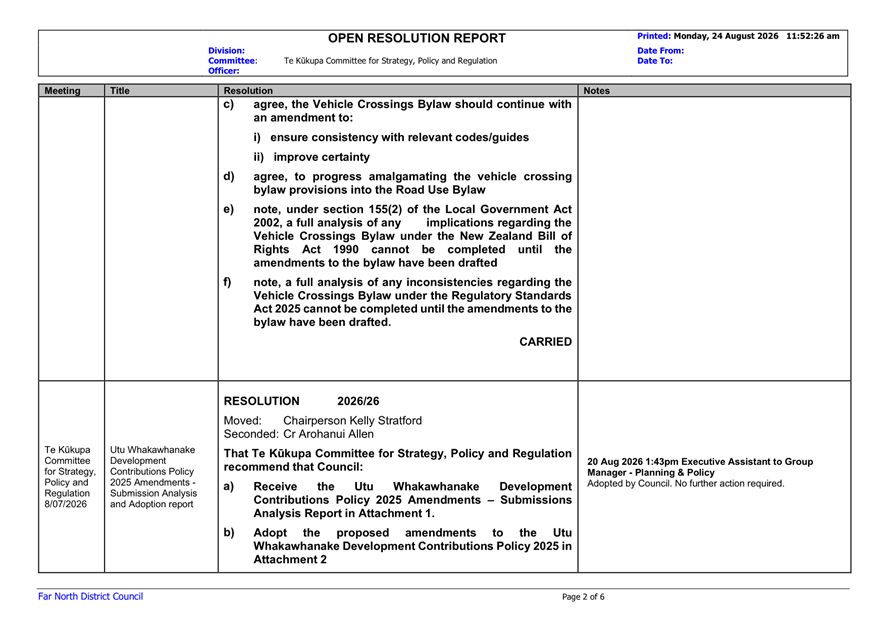
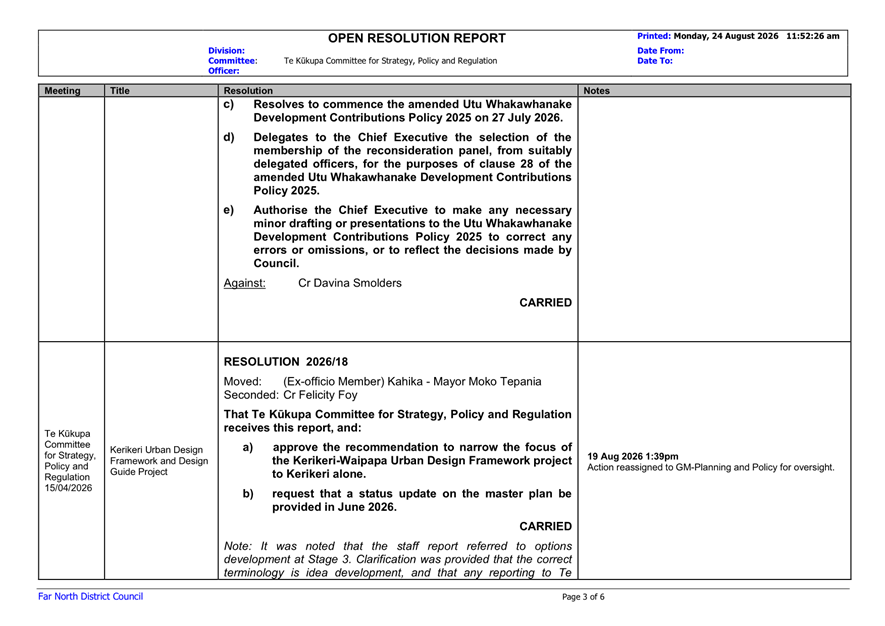
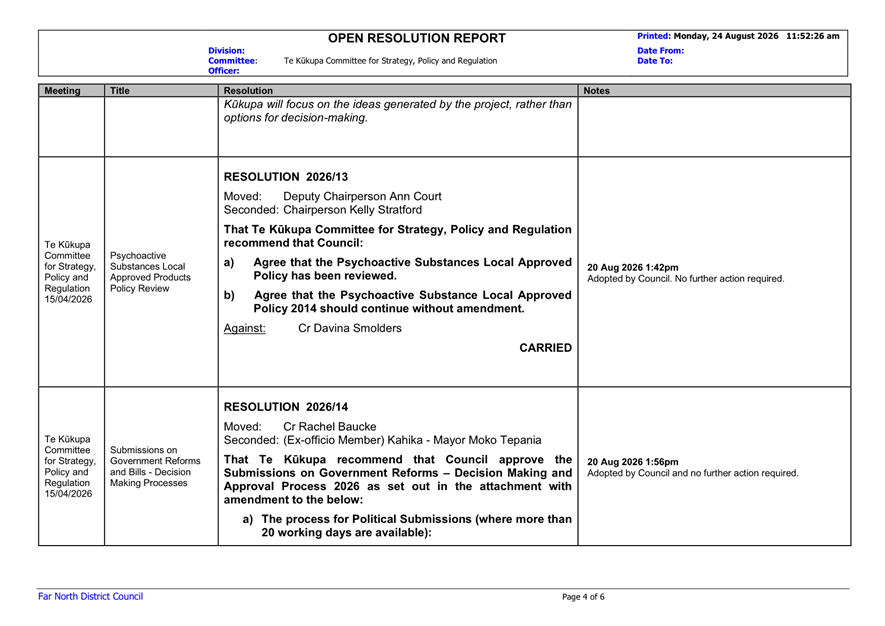
/ Attachments
1. Te
Kūkupa Action Items - A5930599 ⇩ 
2. Open
Resolution Report - A5930593 ⇩