|
Ordinary Te Koukou Committee for
Transport and Infrastructure Meeting Agenda
|
16 September 2026
|
5 Ngā
Pūrongo / Reports
5.5 Russell
Placemaking - Endorsement of Final Design for Cass Street and The Strand
File
Number: A5951491
Author: Jaye
Michalick, Team Leader – Growth Planning & Placemaking
Authoriser: Ken
Macdonald, Chief Financial Officer
Take Pūrongo / Purpose of the Report
To seek a recommendation to Council to approve for
implementation a final design plan for changes to The Strand and Cass Street in
Russell-Kororāreka. The following recommendations were endorsed by the Bay
of Islands-Whangaroa Community Board on 3 September 2026.
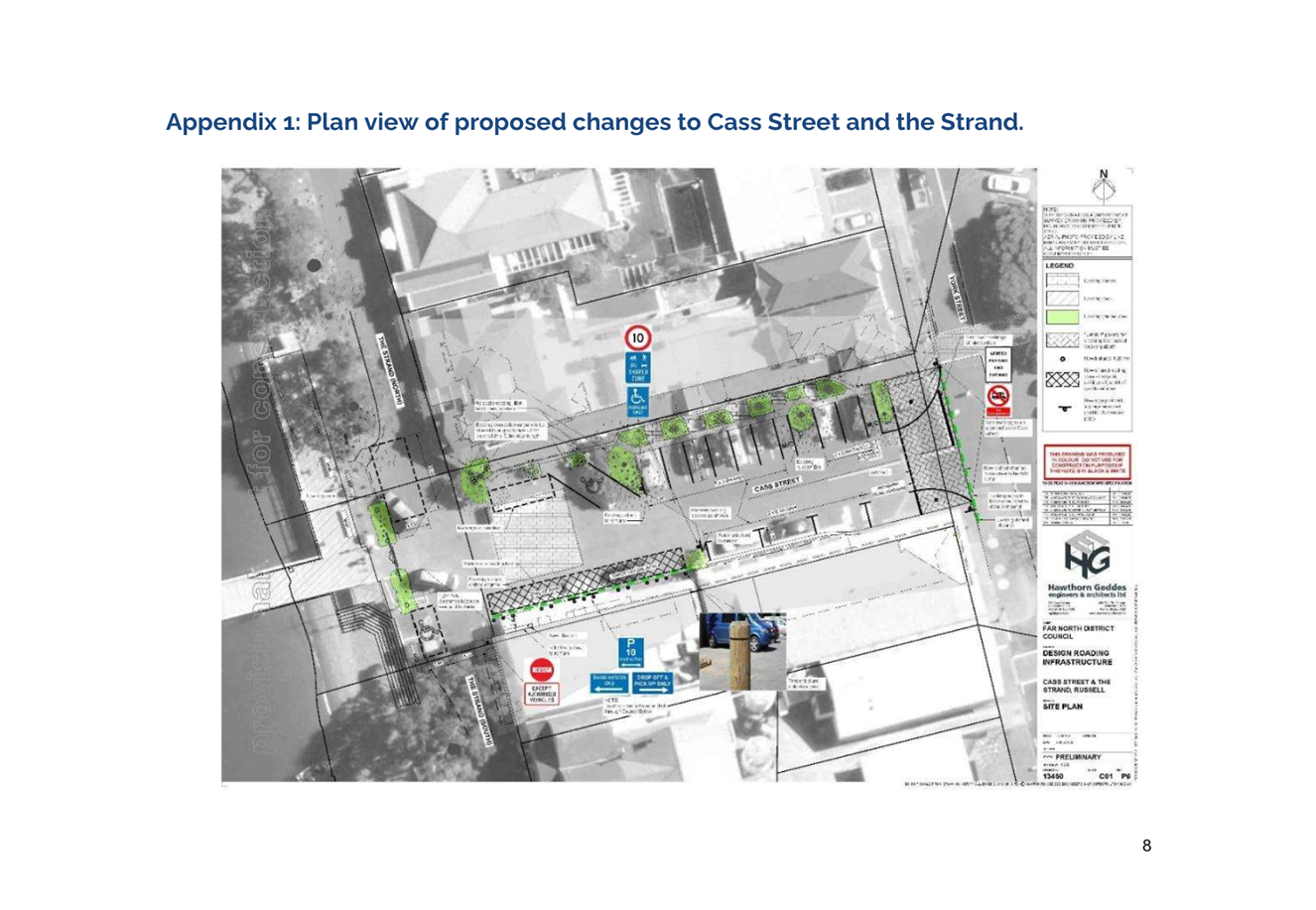
The design has been developed by a community working group
(the Russell Roading Working Group) and Council staff with support from a
transport engineer. This report discusses the proposed design, including
suggested changes to the design resulting from public engagement in June and
July 2026.
WhakarĀpopoto matua / Executive Summary
This request enables:
· Council to give effect to resolution
2025/80 that required a permanent design to be created for Cass Street and The
Strand in collaboration with a community working group, which required
community feedback prior to finalisation.
· Implementing the design enables Council to
give effect to resolution 2025/80, resulting in the change of use (to a Shared
Zone) along The Strand, from the boat ramp at the northern end to Pitt St to
the southern end, and along Cass Street from mid-block Cass St to its
intersection with The Strand. The design also introduces an Authorised Vehicles
only restriction along The Strand from Cass Street to Pitt Street.
· This report summarises the public feedback
obtained via community
engagement that took place between 18 June and 12 July 2026.
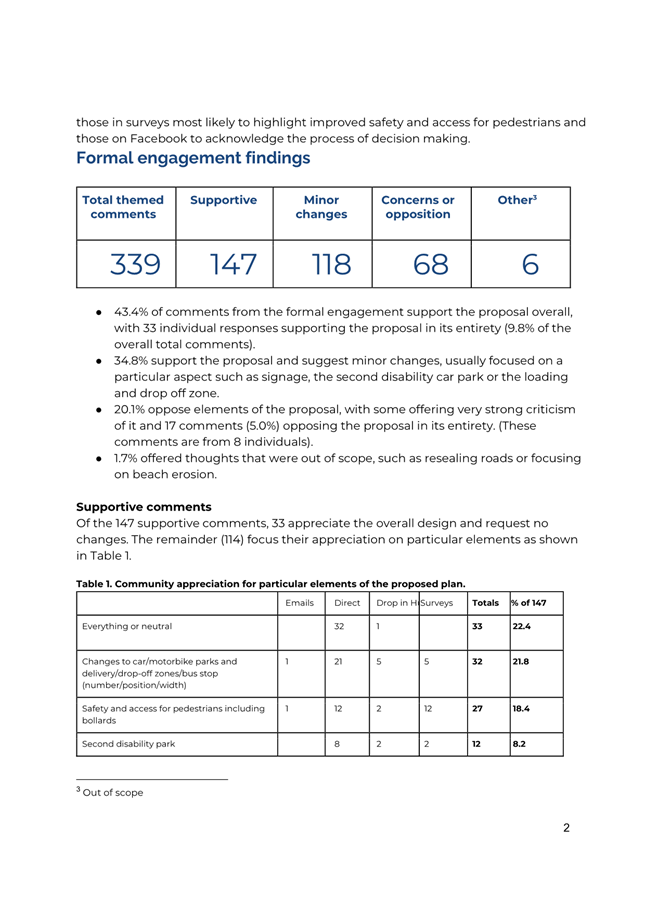
· A total of 339 comments from 110 individual
responses were received through active engagement and via a survey. A further 36 comments from the Russell Noticeboard
Facebook page were also analysed.
· After considering the feedback received on
the proposed design, staff recommend the following minor changes:
1. move the bollards along the south-eastern portion of Cass Street,
adjacent to the delivery and drop-off zone, to the carriageway side of the
drainage channel;
2. include the following additional signage at the final discretion of
the Transport Group):
§ a 10kph sign
near the refuelling loading zone on The Strand
§ add a No
Left Turn sign midway along Cass Street and adjacent to the Cass and York
Street intersection (to direct traffic turning onto or travelling east along
Cass Street)
§ sufficient
signage to inform how long vehicles can remain parked in the various carparks
along Cass Street
3. install
a cycle parking rack.
· This report also seeks endorsement to
change the construction material for the raised crossing at the entrance to Cass St, to a
lower-cost and higher-durability material.
· Funding up to a value of $113,807.08 to implement the final design plan has been
allocated via previous Bay of Islands-Whangaroa Community Board resolution
2026/35.
· An update on changes required to Far North
District Council Parking Bylaw and Road Use Bylaw, to facilitate permanent
changes to Cass St and The Strand is provided.
· The Bay of Islands-Whangaroa Community
Board have endorsed the final design as per the recommendation.
|
tŪtohunga
/ Recommendation
That the Te Koukou Committee for Transport and
Infrastructure recommend that Council approves the final design plan
for Cass Street and The Strand, per Attachment 1, with the following changes
(as detailed in Section 2 of this report):
a)
Shift proposed pedestrian
safety bollards, provide additional signage, and install a cycle parking
rack.
b)
Endorses grey-tinted
concrete as the proposed construction material for the raised crossing
entrance to Cass St (from York St).
|
1) Tāhuhu Kōrero / Background
In 2022, the Board allocated $100,000 for placemaking in
Kororāreka-Russell. In early 2024, staff began a placemaking project for
Kororāreka-Russell involving extensive community engagement. This led to
the Kororāreka-Russell Placemaking Plan, which identified 11 priority
placemaking outcomes.
One of the priority outcomes was to reduce vehicles on The
Strand. In December 2024, a temporary traffic trial was introduced on The
Strand and Cass Street. The trial tested new ways to manage vehicle access
along this busy and popular area, aiming to improve safety for pedestrians and
cyclists, reduce traffic congestion, and create a more welcoming space for
locals, visitors, and businesses.
In May 2025, a public consultation on the traffic trial
attracted 383 submissions, with 65.7 per cent of respondents supporting the
trial with pedestrian priority on some or all of The Strand.
In June 2025, the Bay of Islands-Whangaroa Community Board
endorsed the final Kororāreka - Russell Placemaking Plan 2025 via
resolution 2025/59.
In July 2025, the council decided to permanently reduce
vehicles on The Strand via resolution 2025/80, which included the requirement
to work with a community group to refine the design to permanently change The
Strand and Cass Street.
In October 2025, the Russell Roading Working Group (an
independent community group) was formed with support from council staff and
Community Board Member Hindle. This group has worked together with relevant
staff, including a transport engineer, to come up with the final design for
changes to Cass Street and The Strand that will achieve the outcomes decided by
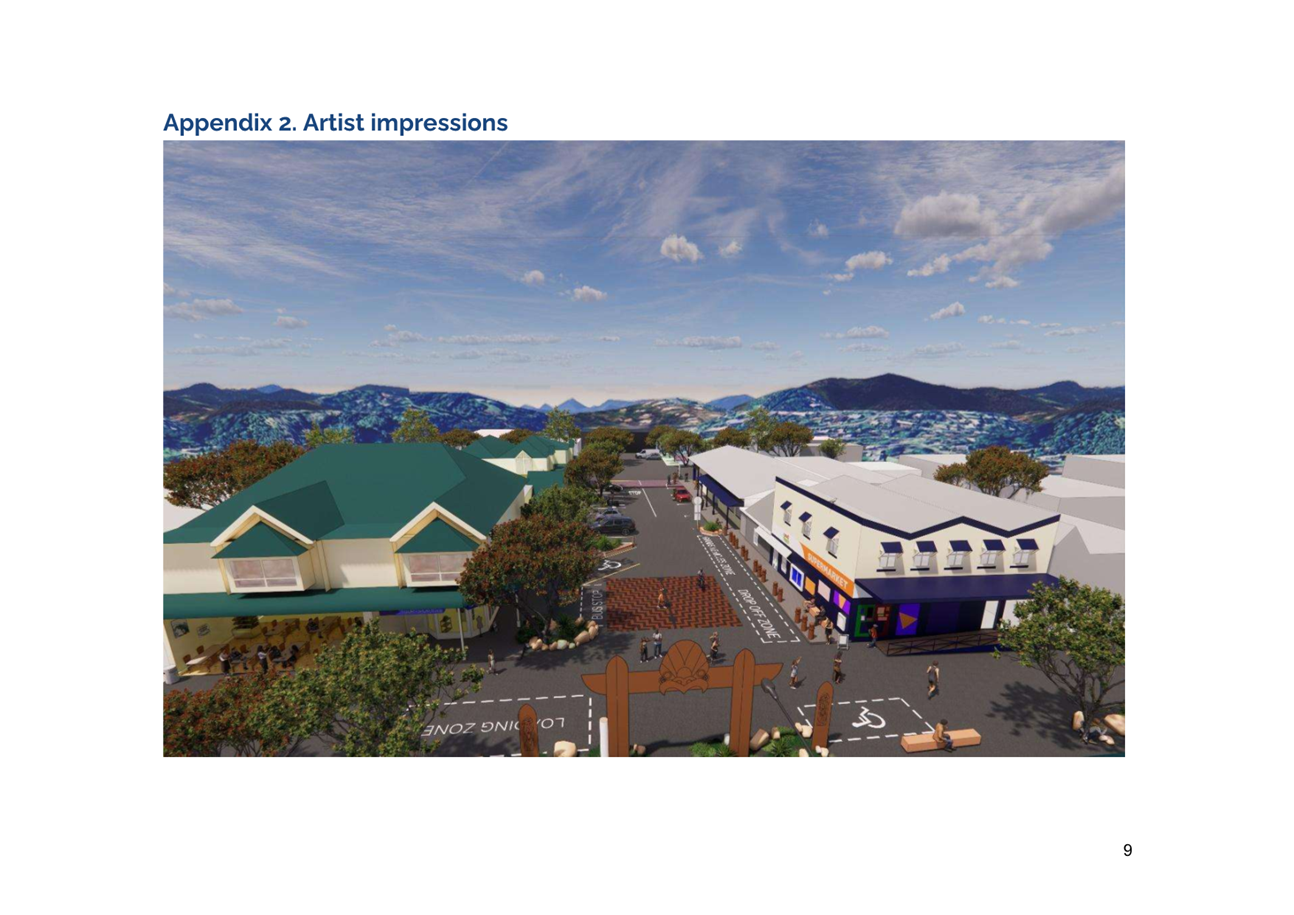
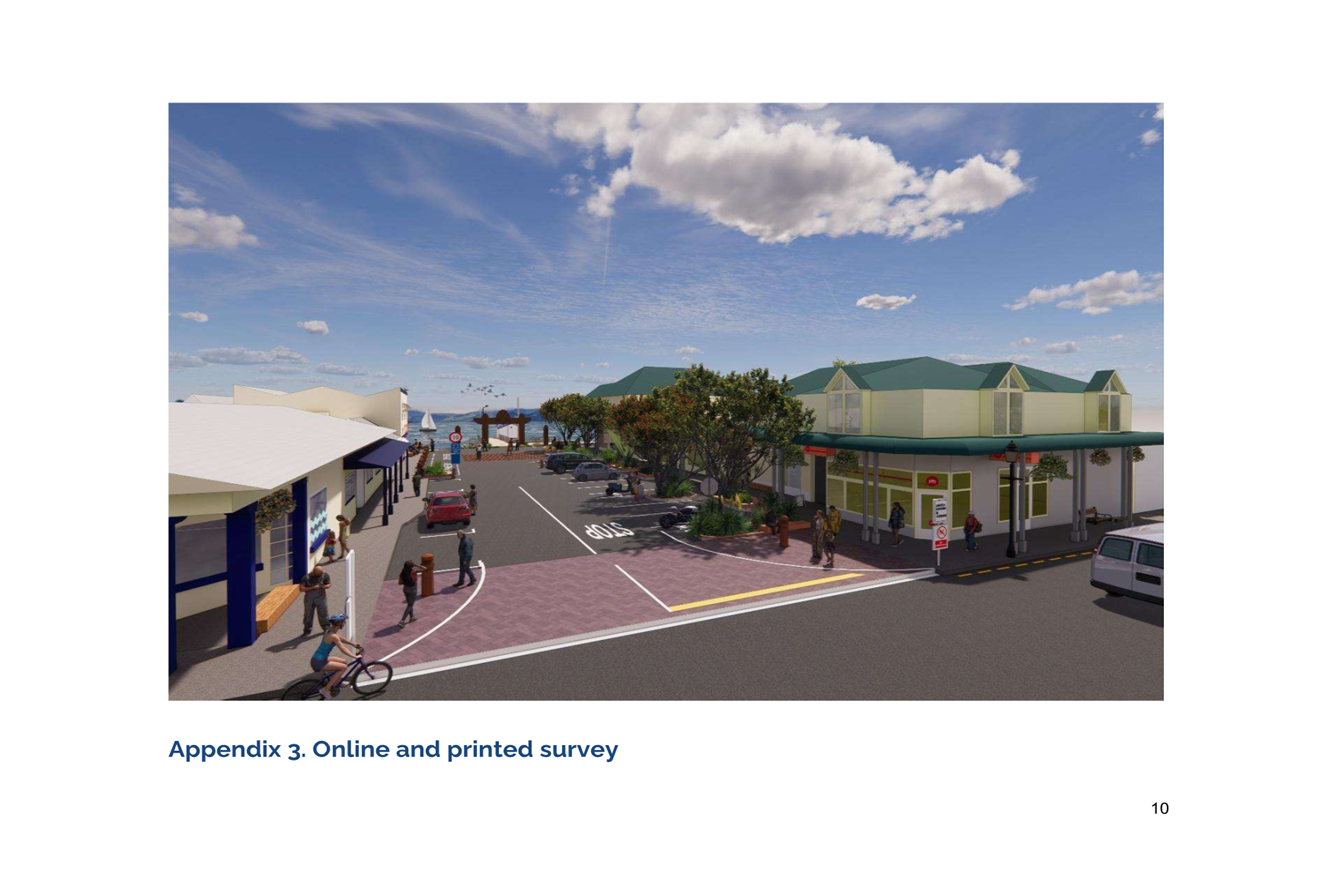
Council resolution 2025/80. Refer Pedestrianisation
of The Strand, Kororāreka-Russell for a record of membership and
meeting records. This decision has resulted in the final design plan in
Attachment 1.
In June 2026, the Bay of Islands-Whangaroa Community Board
endorsed a draft version of the design for changes to Cass Street and The
Strand to be engaged on for community feedback to inform the final version of
the design.
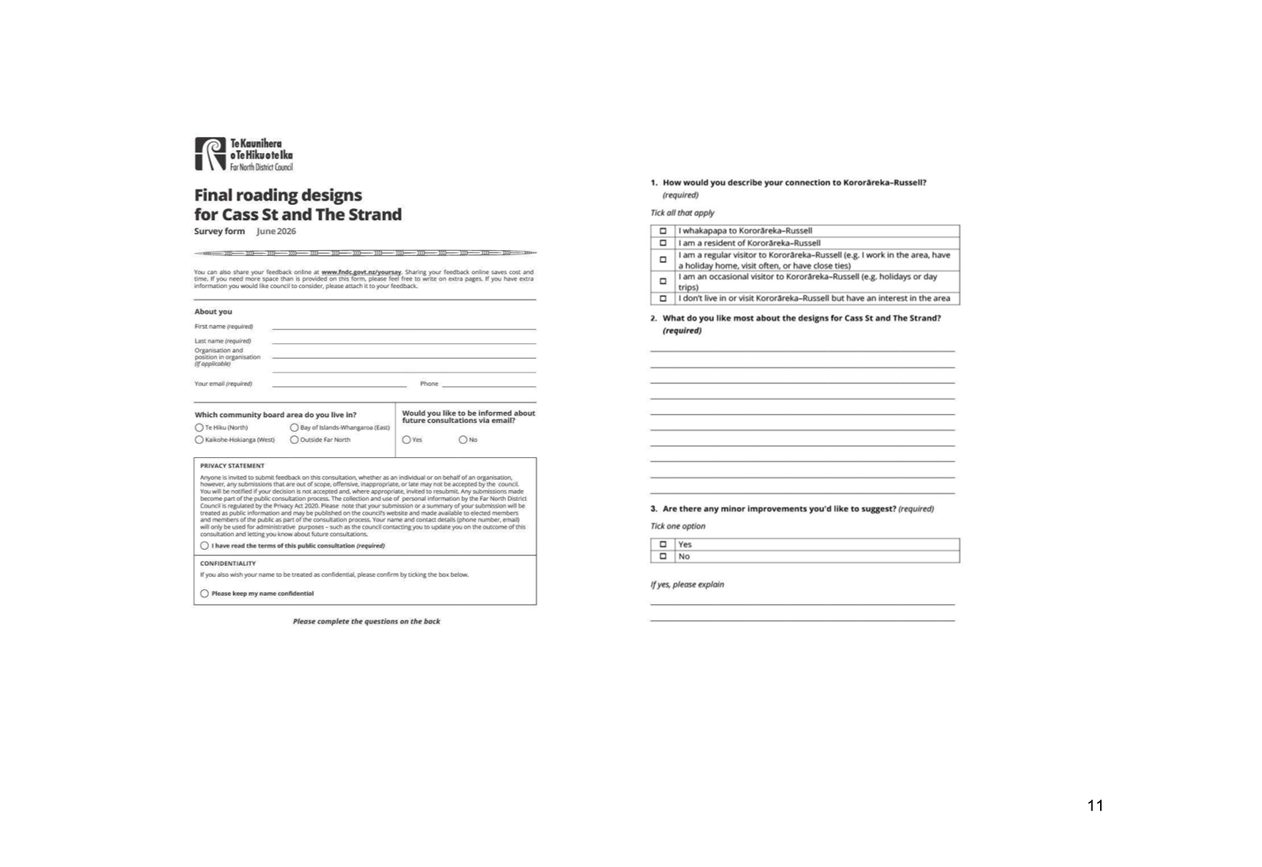
Between 18 June and 12 July 2026, engagement on the final
design for Cass Street and The Strand was undertaken. The public were invited
to view the final design plan and to provide their suggestions for minor
changes. A summary of feedback received during this engagement is discussed in
section 2, and a report on findings from this public consultation is provided
in Attachment 2.
On 3 September 2026, the Bay of Islands-Whangaroa Community
Board (the Board) endorsed the final design plan including the three changes
recommended by staff as a result of engagement across June/July 2026. The Board
also endorsed changing the construction material for the raised entrance from
York Street to a more durable and affordable material.
Pending approval of the final design plan by Te Koukou, then
Council, the physical changes to Cass Street and The Strand can be scheduled
and carried out by FNDC’s Transport Department. The Russell Roading
Working Group members have requested that the Transport Group liaise with them
while they undertake the physical works. The purpose of this would be to keep
the Russell Roading Working Group informed of progress and to seek views from
the Russell Roading Group, should that be necessary during this stage of works.
Funding to implement changes to Cass Street and The Strand
was previously allocated via Bay of Islands-Whangaroa Community Board
resolution 2026/35. It should be noted that the allocated funding is estimated
to cover costs associated with the physical changes to the road environment but
is not sufficient to cover costs associated with carving the new totara
bollards on Cass Street. Funding for the carving will need to be generated
either through community fundraising initiatives or future requests for funding
by the Board. The funding allocated comprises a total value of $113,807.08 as
follows:
· $14,150.08 remaining balance from the original 2022 Bay of
Islands-Whangaroa Community Board Russell placemaking fund of $100,000
(currently being held by Far North Holdings Ltd, this fund will be invoiced
back into FNDC for allocation to Transport Group for the purpose of
implementing the design plan)
· $42,157 remaining from the 2024/2025 Eastern Town Beautification
Fund (carried into this financial year), and
· $57,500 of the 2025/2026 Eastern Town Beautification Fund (carried
into this financial year).
2) matapaki me NgĀ KŌwhiringa /
Discussion and Options
Suggested Changes to the Design for Cass Street and The
Strand as a result of Community Feedback
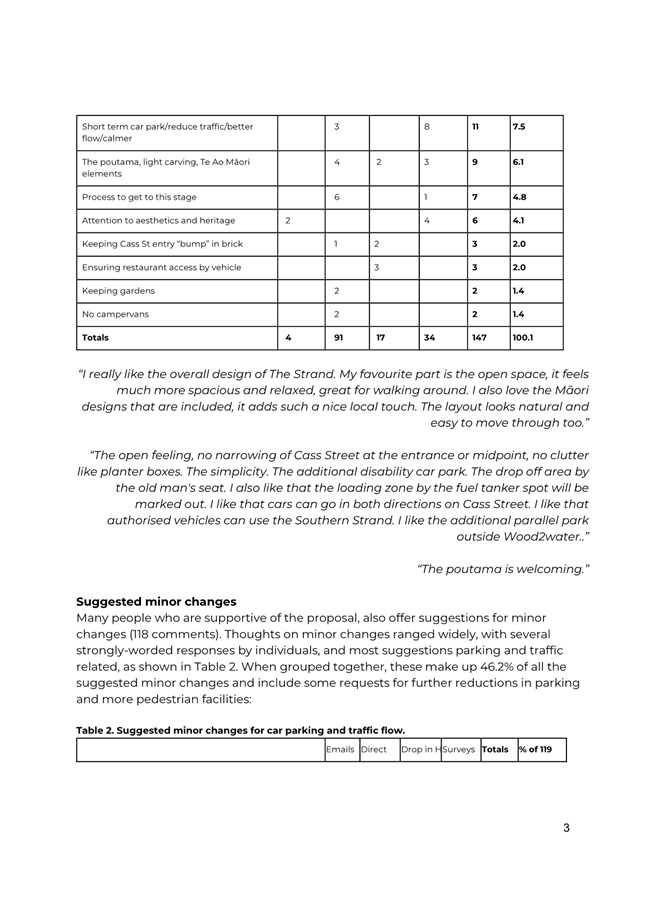
Community feedback responses ranged widely, with several
strongly worded individual responses often about elements that did not generate
strong responses from many others. 78.2% of feedback received is in either full
or partial support of the proposed changes. Some suggestions are out of scope,
such as opening The Strand to all traffic on a seasonal basis. Others
compromise safety, such as removing bollards or placing carparks too close to
intersections. Several suggestions were operational, such as developing
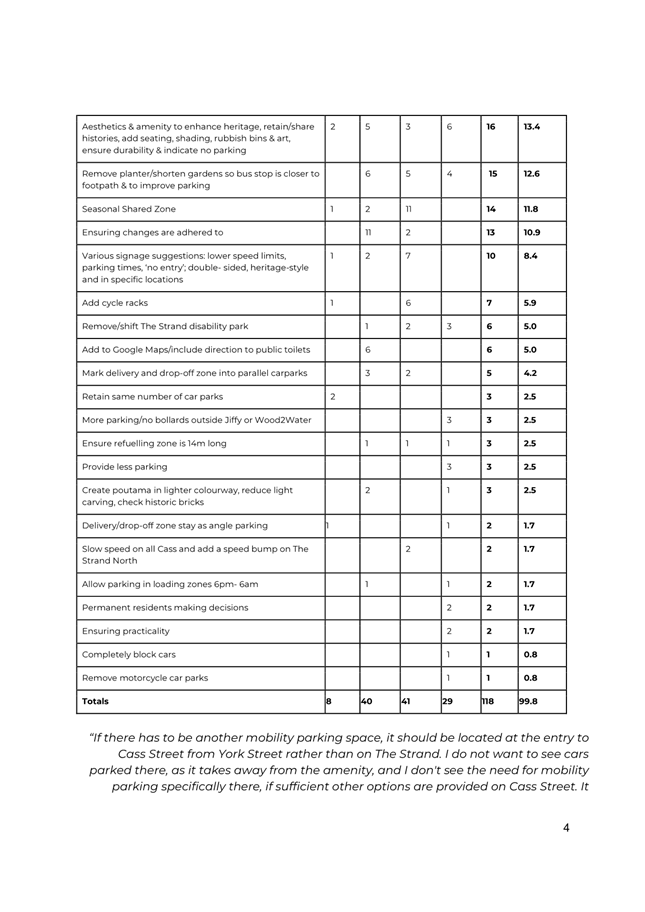
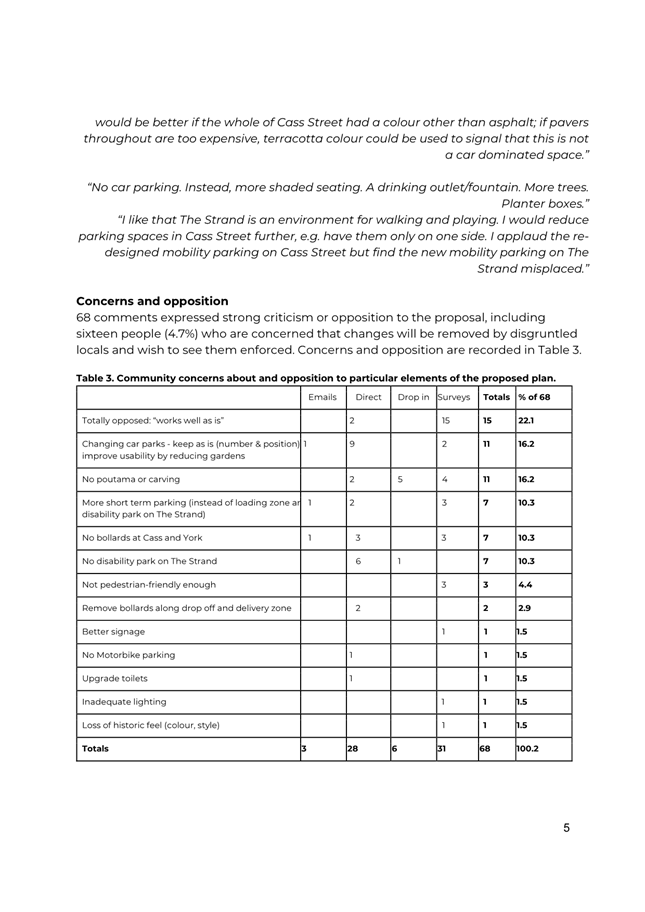
enforcement plans and adding the changes to Google Maps. Refer to Attachment 2
for details of the feedback obtained.
Staff, in consultation with the transport engineer,
considered the suggested changes received during the feedback and have
identified three proposed changes to the design that are expected to help
achieve the purpose of the design plan and remain within the budget allocated
(discussed below).
Shift Proposed Pedestrian Safety Bollards
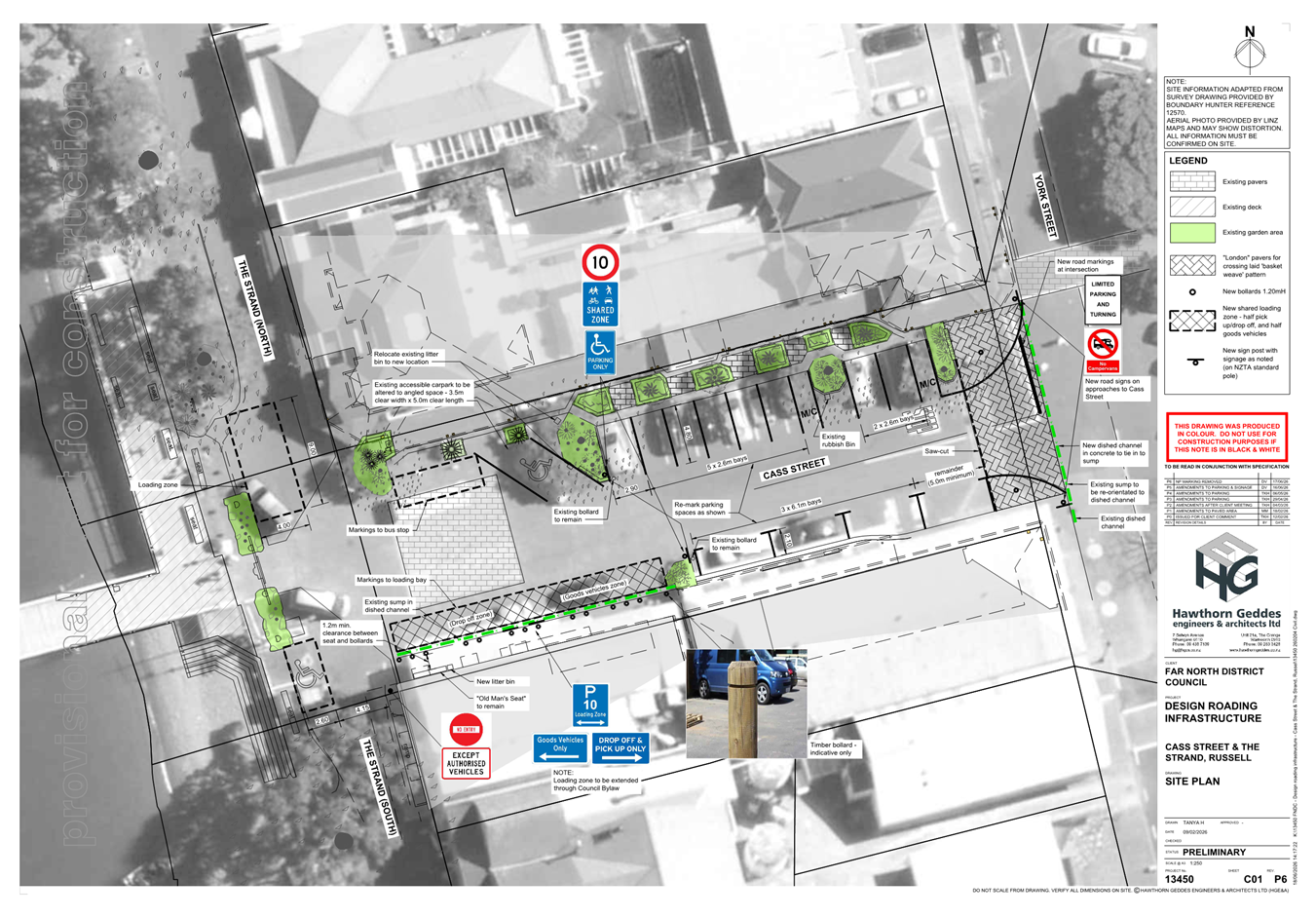
Retain but move all bollards along the south-western portion
of Cass Street, adjacent to the delivery and drop-off zone, to the carriageway
side of the drainage channel. The current design shows the bollards being
located on the footpath side of the drainage channel. This change would improve
pedestrian safety on the footpath in this area and would discourage angle
parking across the loading and drop-off zone.
Additional Signage
At the time of
detailed design, the Project Manager responsible for implementing the design
plan will include the following additional signage at the final discretion of
the Transport Group:
§ a 10kph sign near the
refuelling loading zone on The Strand
§ add a No Left Turn sign midway
along Cass Street and adjacent to Cass and York Street intersection (to direct
traffic turning onto or travelling east along Cass Street)
§ sufficient signage to inform
how long vehicles can remain parked in the various carparks along Cass Street
Including a Cycle Parking Rack
Cycle parking was not part of the original brief but was
suggested as part of the public engagement feedback. A cycle parking rack could
be added safely on The Strand, between trees, with a final location and method
of fixing to be determined by the Project Manager responsible for implementing
the design plan. With more cycle tracks being developed, these would be useful
and could be added at a later date if the current available funding will not
cover the purchasing and installation costs.
The following suggested changes were also considered,
however, staff in consultation with the transport engineer, recommend rejecting
the following suggested changes.
Considering if car park widths can be increased by
reducing the existing garden beds as per image below:
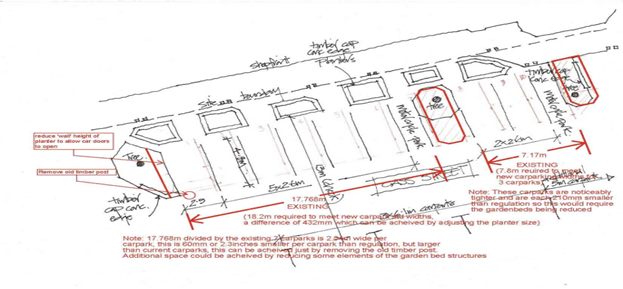
The reduction of the beds will require a full pavement
construction/extension, which will be both disruptive and relatively expensive.
The parking spaces drawn provide substantial additional width compared to a
standard space (2.4m). Additional width has been provided for the carpark
located nearest the high planter at the western end of the parking bay.
Provide angle parking where the proposed delivery and
drop-off zones are along the south-western side of Cass Street
This is not feasible or safe as angle parking will encroach
into the vehicle carriageway.
Making the shared zone seasonal
This has already been considered by council and rejected.
Removing the proposed bollard outside Wood2Water
(south-eastern end of Cass Street)
This suggestion was rejected as the proposed bollard helps
to reduce traffic speed coming into Cass Street and prevents vehicles colliding
with parked cars.
Removing the disability park on The Strand
This was rejected because no alternative option is available
and an ageing community needs another accessible car park.
Moving the bus stop closer to the footpath by removing
the garden box behind it, and shortening the garden bed on the corner of Cass
Street and The Strand
This is not needed for passenger or road user safety and
allows existing Russell 2000 planter boxes to remain.
Extending the refuelling zone to 14m
This was not required as the refuelling trucks are a maximum
of 8.5m and thus can fit into a 9m loading zone. This was confirmed in
conversation with Allied Petroleum.
Changes to the Poutama
Proposed changes to the Poutama were rejected because brick
stains are temporary and do not damage the brick surface. The stain will
require regular upkeep to sustain the colour, so should the staining prove
unpopular or too expensive to maintain, the original colour of the bricks will
slowly show through. This decision may antagonise the small group opposing the
Poutama due to the perceived historic value of the Square developed by the
Russell 2000 group, and of the bricks themselves which may have been hand-made
locally.
Suggested Changes to the Design for Cass Street and
The Strand - FNDC Transport Department recommendation
As reported to the Bay of Islands-Whangaroa Community Board
on 4 June 2026, FNDC’s Transport Department staff reviewed the draft
design plan. They are generally supportive of the plan; however, they recommend
an alternative option for the raised crossing at the entrance to Cass St (from
York St). The Russell Roading Working Group recommends construction via London
Pavers (as shown on the design plan in Attachment 1), while staff recommend
using tinted concrete, which is more durable, more stable, and lower-cost to
install and maintain. During engagement, three members of the public submitted
on this topic, and all three supported retaining the brick design. Altering the
design would reduce implementation costs by $9,600. Heritage New Zealand
Pouhere Taonga staff have also reviewed the plan and support it, as long as the
tint used for the concrete crossing is grey. This part of the town has
significant cultural and heritage values and is regulated to protect those
values.
Options
Te Koukou Committee has the option of:
· endorsing the design plan as shown in Attachment 1, without any of
the changes recommended above, or
· endorsing the design plan with all or some of the changes that are
either recommended for inclusion or rejection as set out above.
Following Te
Koukou’s recommendation to Council and Council making its decision, the
final approved design will be handed to FNDC’s Transport Department for
implementation.
Update on changes required to Far North
District Council Parking Bylaw and Road Use Bylaw, to facilitate permanent
changes to Cass St and The Strand.
Parking Bylaw
The Parking Bylaw Schedules and Maps will need to be amended
according to the changes in parking layout, time limits, and purpose, as
indicated in the final design plan for Cass Street and The Strand in
Russell-Kororāreka.
These changes to the Parking Bylaw schedules and maps
include:
· Changes to public
parking
· Changes to
mobility parking
· Changes to
delivery and drop-off zones
· Changes to the
refuelling zone
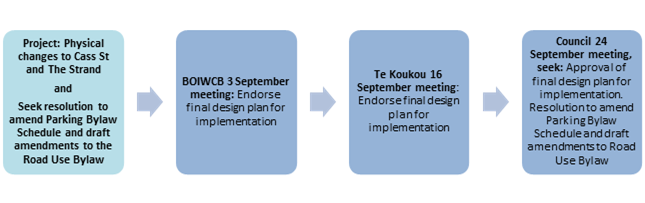
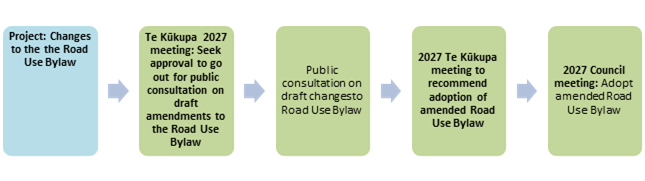
A resolution to make amendments to the Parking Bylaw
schedules and maps and to draft amendments to the Road Use Bylaw will be sought
at the 24 September Council meeting, see diagram below.
The GIS measurements of each park will be collated and
updated in the Parking Bylaw Schedules, and maps updated according to the
changes in parking, once work has been completed to ensure accuracy.
The car parks will be monitored and managed by Council
parking compliance following the Parking Bylaw Schedule and Map amendments.
Road Use Bylaw
The Road Use Bylaw will require amendment to incorporate the
changes according to the final design plan for Cass Street and The Strand in
Russell-Kororāreka.
These changes are:
· The Strand is to
be a shared access road with pedestrians
· The Strand will
have limited vehicle access
· The Strand will
have one-way-only access
· The schedules and
maps for the Road Use Bylaw will need to be amended
· The amendments to
the Bylaw and its schedules and maps will require a Public Consultation over a
four-week period.
Future resolutions to consult on draft amendments to, then
adopt amendments to the Road Use Bylaw will be sought from Te Kūkupa then
Council. This process will be led by the Policy and Bylaws Team, it will be
initiated once The Transport Department have completed the changes to Cass
Street and The Strand have been physically completed.
The below figure sets out future stages required to change
the Road Use Bylaw.
TAKE
TŪTOHUNGA / REASON FOR THE RECOMMENDATION
Adopting the recommended final design plan, including the
recommended changes discussed above, will ensure that when parts of Cass Street
and The Strand become a Shared Zone, pedestrian safety can be achieved, while
also incorporating design features and elements that have been identified as
important by the community of Russell-Kororāreka.
Endorsing a final design plan up to Council for
implementation will enable Council resolution 2025/80 to be achieved via the
introduction of a Shared Zone along The Strand, from the boat ramp at the
northern end to Pitt St to the southern end, and along Cass Street from
mid-block Cass St to its intersection with The Strand. The design also
introduces an Authorised Vehicles only restriction along The Strand from Cass
Street to Pitt Street.
3) PĀnga PŪtea me ngĀ
wĀhanga tahua / Financial Implications and Budgetary Provision
As discussed above, funding to implement the majority of the
recommended design, including suggested changes, has been secured via previous
Bay of Islands-Whangaroa Community Board resolution 2026/35.
Āpitihanga / Attachments
1. Design
Plan - A5932085 ⇩ 
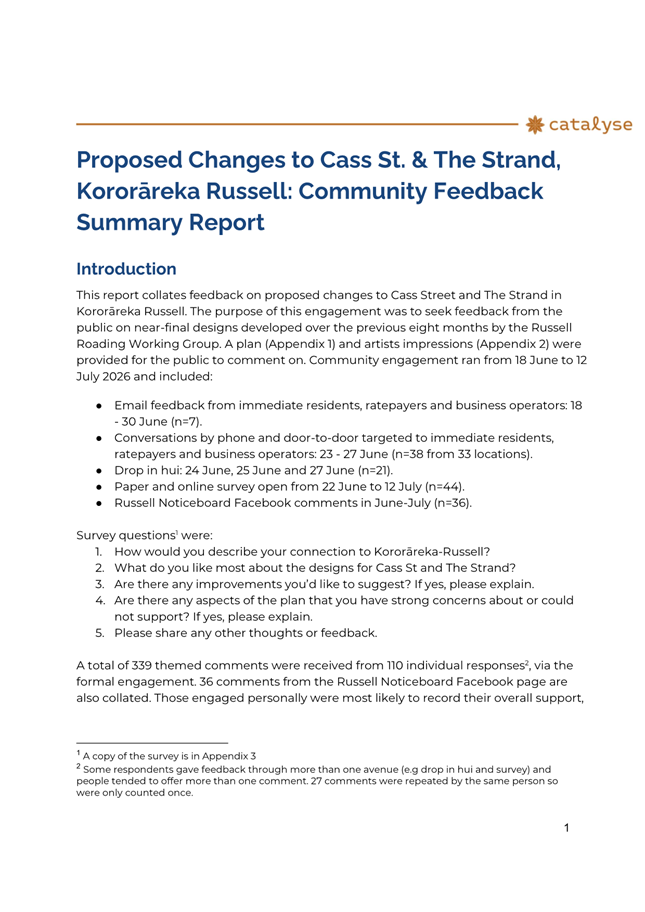
2. Engagement
Summary Report - A5932082 ⇩
Hōtaka Take Ōkawa / Compliance Schedule:
Full consideration has been given to the provisions of the
Local Government Act 2002 S77 in relation to decision making, in particular:
1. A
Local authority must, in the course of the decision-making process,
a) Seek
to identify all reasonably practicable options for the achievement of the
objective of a decision; and
b) Assess
the options in terms of their advantages and disadvantages; and
c) If
any of the options identified under paragraph (a) involves a significant
decision in relation to land or a body of water, take into account the
relationship of Māori and their culture and traditions with their
ancestral land, water sites, waahi tapu, valued flora and fauna and other
taonga.
2. This
section is subject to Section 79 - Compliance with procedures in relation to
decisions.
|
He Take Ōkawa /
Compliance Requirement
|
Aromatawai Kaimahi /
Staff Assessment
|
|
State the level of significance (high or low) of the
issue or proposal as determined by the Council’s
Significance and Engagement Policy
|
The design plan is not assessed as having a high level
of significance in accordance with Councils’ Significance and
Engagement Policy, however, significant iterative public engagement since
2024 has informed the development of this placemaking outcome.
|
|
State the relevant Council policies (external or
internal), legislation, and/or community outcomes (as stated in the LTP) that
relate to this decision.
|
Accessibility Policy (2022)
Art and Memorials in Public
Places Policy (2017)
Community Gardens Policy (2013)
Community Grant Policy (2024)
District Plan 2009
Footpath Policy (2016)
Heritage New Zealand Pouhere
Taonga Act 2014
Iwi/Hapu Environmental
Management Plans Policy (2016)
Local Government Act 2002
Long Term Plan (2024-2027)
Parks and Reserves Policy (2022)
Procurement Policy
Resource Management Act 1991
This outcome sees the implementation of an outcome
within the Russell Placemaking Plan, endorsed by Bay of Islands-Whangaroa
Community Board in June 2025
|
|
State whether this issue or proposal has a District wide
relevance and, if not, the ways in which the appropriate Community
Board’s views have been sought.
|
The Kororāreka-Russell Historic Township is of
district wide significance and the Community Board have been involved
throughout the process via the appointment of a Russell Roading Working Group
supported by a Community Board Member.
|
|
State the
possible implications for Māori and how Māori have been provided
with an opportunity to contribute to decision making if this decision is
significant and relates to land and/or any body of water.
State the
possible implications and how this report aligns with Te Tiriti o Waitangi /
The Treaty of Waitangi.
|
Hapū representation has been consistent throughout
this placemaking project, including hapū representation as a member of
the Russell Roading Working Group.
|
|
Identify persons likely to be affected by or have an
interest in the matter, and how you have given consideration to their views
or preferences (for example – youth, the aged and those with
disabilities).
|
This paper recommends a final design which has been the
subject of recent public engagement, to ensure that persons likely to be
affected by or have an interest in this matter, have been enabled to put
forward their views on this matter.
|
|
State the financial implications and where budgetary
provisions have been made to support this decision.
|
Funding has been previously allocated, as discussed in
this paper
Namely:
The funding allocated comprises a total value of
$113,807.08 from the following fund allocations:
• $14,150.08
remaining balance from the original 2022 Bay of Islands-Whangaroa Community
Board Russell placemaking fund (currently being held by Far North Holdings
Ltd, this fund will be invoiced back into FNDC for allocation to Transport
Group for the purpose of implementing the design plan)
• $42,157
remaining from the 2024/2025 Eastern Town Beautification Fund (carried into
this financial year), and
·
• $57,500 of the 2025/2026 Eastern Town
Beautification Fund (carried into this financial year).
|
|
Chief Financial Officer review.
|
This report has been reviewed by the CFO
|
|
Ordinary Te Koukou Committee for Transport and Infrastructure
Meeting Agenda
|
16 September 2026
|
5.6 Transportation
- Dust Mitigation Programme 2026/27
File
Number: A5960730
Author: Margriet
Veenstra, Manager - Property Information & Business Compliance
Authoriser: Charlie
Billington, Group Manager - Corporate Services
Take Pūrongo / Purpose of the Report
The purpose of this report is to seek a decision from Te
Koukou Committee for Transport and Infrastructure on the allocation and
prioritisation of Council's 2026/27 Dust Mitigation Budget of $500,000.
The report presents a refined Dust Matrix methodology,
lessons learned from previous programmes, community feedback received, and
alternative prioritisation approaches for consideration.
WhakarĀpopoto matua / Executive Summary
· Council has an approved
budget of $500,000 for dust mitigation during the 2026/27 financial year.
· Dust mitigation continues
to be one of the main transportation issues raised by residents living on
unsealed roads.
· Community feedback
consistently references concerns regarding dust entering homes, impacts on
water tanks, visibility, outdoor living areas, health and wellbeing, schools,
marae, and other community facilities.
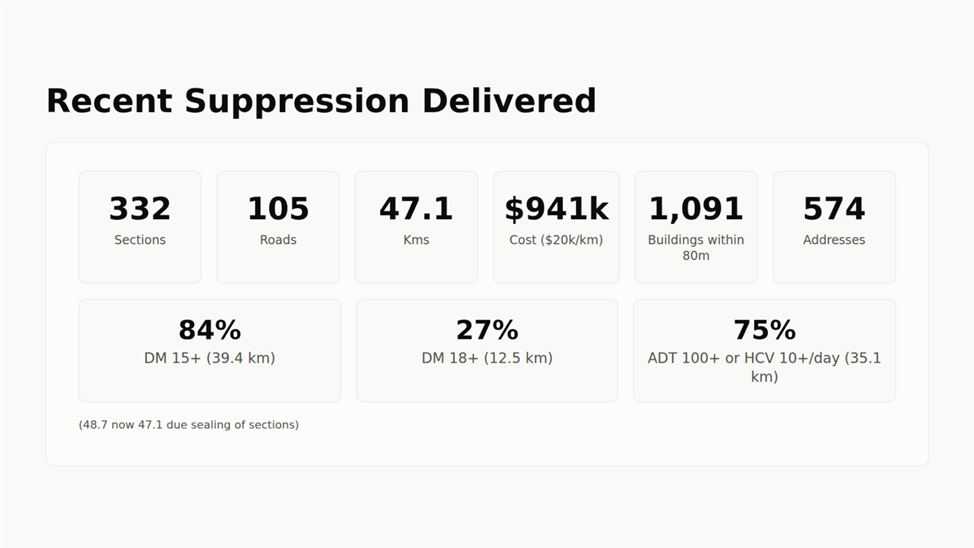
· During the previous
programme, treatment was focused on locations that met qualifying criteria and could be delivered
within the approved budget.
· As
a result, a number of locations
that had historically received treatment were not
included in the programme.
· This generated considerable feedback from residents and elected members.
· Council subsequently
reinstated many previously treated sites, ultimately resulting in significant
additional expenditure beyond the original programme budget.
· The lesson from this
experience is that dust mitigation is not simply an operational activity. It is
a highly visible and politically sensitive service where changes can generate
significant community response.
· The Dust Matrix has now
been developed to provide a more objective and transparent method of
prioritisation.
· However, workshop
discussions identified that members may wish to consider whether funding should
primarily maximise the number of people benefiting, or whether greater emphasis
should be placed on wider community outcomes.
· As a result, staff have developed two approaches for consideration.
|
tŪtohunga
/ Recommendation
That Te Koukou Committee for Transport and
Infrastructure receive the report titled "Dust Mitigation
Programme 2026/27" and
a)
Determine that the 2026/27 Dust Mitigation Programme be
prioritised using:
i. Option
1: Dust Matrix Prioritisation (Residency-focused)
ii. Option
2: Community Outcome Prioritisation (Community Facilities-focused)
b) Notes
that any prioritisation approach adopted may result in some locations
previously receiving treatment no longer qualifying.
c) Notes
that any expansion of the programme beyond the approved budget will require a
separate governance decision.
|
1) Tāhuhu Kōrero / Background
Dust mitigation has historically been delivered as an
unsubsidised activity funded entirely by ratepayers. Council currently spends
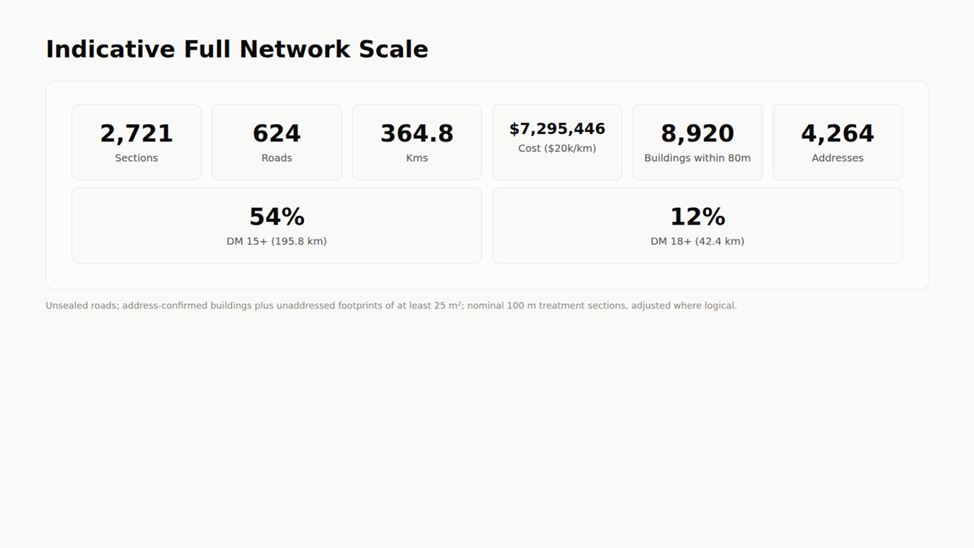
approximately $500,000 per annum on seasonal dust suppression. The treatment
generally lasts for approximately three months, depending on traffic volumes,
weather conditions and the condition of the road at the time of application.
Historically, many locations were included in the programme
based on previous decisions rather than a district-wide assessment methodology.
In 2024/25, an attempt was made to apply qualifying criteria more consistently
across the network. This resulted in a number of previously treated locations
no longer receiving treatment.
Council communications at the time acknowledged that the
revised approach unintentionally excluded locations that communities considered
important, including marae, schools and properties that had historically
received treatment. Council subsequently expanded the programme after receiving
considerable community and elected member feedback.
This history is relevant because a similar response can
reasonably be expected if significant numbers of previously treated locations
no longer receive treatment.
2) matapaki me NgĀ KŌwhiringa /
Discussion and Options
Dust Matrix methodology:
The Dust Matrix has been developed using NZTA guidance and
assesses:
Traffic:
· Average
Annual Daily Traffic (AADT)
· Heavy
Commercial Vehicle (HCV) volumes
· Vehicle
speeds
The traffic data used has
recently been updated by NZTA Waka Kotahi and represents current annual traffic
information. It should be noted that the information reflects annual averages
and does not capture seasonal tourism peaks.
Receptors:
The assessment considers
receptors located within 80 metres of an unsealed road.
This distance has been selected
because it is generally considered the area where dust impacts are most
significant. Advice obtained during development of the matrix indicated that
dust effects begin reducing beyond this distance.
Receptors considered include:
· Buildings
· Schools
· Kōhanga
Reo
· Marae
· Bus
Stops
· Places
of Worship
· Welfare
Facilities
· Ecological
Areas
· Horticultural
Areas
Site Characteristics:
The matrix also considers:
· Wind
exposure
· Rainfall
frequency
· Logging
route activity
As it is not feasible to physically inspect every road
throughout the district, a district-wide assumption of "some land features
that slow wind" has been applied consistently.
Similarly, rainfall has been based on a classification of
less than one rainfall event every two weeks during key dry periods.
Forestry information has been
sourced from available datasets. However, smaller forestry blocks may not be
captured and harvesting schedules can change due to market conditions.
Data Validation:
The methodology has been developed with future NZTA funding
applications in mind.
Where possible, data has been
validated through site visits and physical checks. However, given the scale of
the Far North network, it is not feasible to validate every data point
physically. The matrix therefore relies on a combination of datasets and targeted
field verification. Address information used in the latest analysis has been
validated using LINZ data.
Long-term value and investment
considerations:
One of the key questions raised during the development of
the Dust Matrix was whether annual dust suppression represents the most
effective long-term use of limited transport funding.
Dust suppression provides a temporary reduction in dust
impacts and generally requires reapplication each summer. While it can be
effective at addressing immediate concerns, it does not permanently remove the
underlying issue and does not create a long-term transport asset.
Through discussions with NZTA Waka Kotahi, it has been noted
that investment decisions should consider the least-cost whole-of-life solution
rather than focusing solely on the initial cost of treatment. This requires
Council to consider whether ongoing annual expenditure on dust suppression is
the most appropriate response, or whether some locations may be better suited
to longer-term interventions such as Otta Seal, traction seal or seal
extension. These options generally involve a higher initial investment but may
provide longer-lasting benefits and reduce the need for ongoing annual
treatment.
The Dust Matrix provides Council with an important evidence
base for this discussion. While dust suppression can provide immediate relief
to affected communities, it generally has a limited lifespan and requires
ongoing annual expenditure. Council therefore has an opportunity to use the
Dust Matrix to identify locations where a longer-term treatment may provide
better whole-of-life value than repeated annual applications.
Staff are not recommending that
the 2026/27 budget be redirected away from dust mitigation at this time.
However, staff recommend that the outcomes of the Dust Matrix be incorporated
into the development of the Unsealed Roads Strategy and Transport Asset
Management Plan to identify locations where a permanent solution may provide
better long-term value than ongoing annual treatment.
Funding Opportunities:
The Dust Matrix has been
developed in a manner that aligns with NZTA guidance and investment
discussions. The ability to demonstrate evidence-based prioritisation is
increasingly important if Council wishes to access future funding
opportunities.
The matrix provides:
· transparent
decision-making;
· repeatable
methodology;
· auditable
datasets;
· alignment
with receptor-based assessment; and
· a
framework capable of supporting future investment proposals.
The matrix also provides a
mechanism for identifying locations where dust suppression, Otta Seal, traction
seal or seal extension may represent the preferred treatment option based on
risk, exposure and long-term value.
The Dust Matrix has also been
developed to align with expectations expressed by NZTA Waka Kotahi regarding
evidence-based prioritisation of dust-related investments. Previous discussions
have indicated that future subsidy opportunities are more likely where Council
can demonstrate that proposed interventions are supported by robust data, align
with wider transport outcomes, represent the most appropriate response to the
identified problem, and provide value for money when assessed on a
whole-of-life basis.
The Dust Matrix is therefore not
simply a tool for deciding where annual dust suppression should occur. It is
also a strategic planning tool that can assist Council in:
· identifying
locations that may qualify for future NZTA Waka Kotahi funding consideration;
· demonstrating
need through an evidence-based process;
· comparing
dust suppression against longer-term solutions such as Otta Seal, traction seal
or seal extension;
· supporting
future business cases and investment proposals; and
· ensuring
Council is "investment ready" when funding opportunities become
available.
While no funding approvals have
been obtained, the development of the Dust Matrix and supporting database
places Council in a significantly stronger position to pursue future funding
opportunities with NZTA Waka Kotahi and other central government, regional,
environmental, resilience, community infrastructure or grant funding programmes
that may become available in the future.
NGĀ KŌWHIRINGA /
OPTIONS:
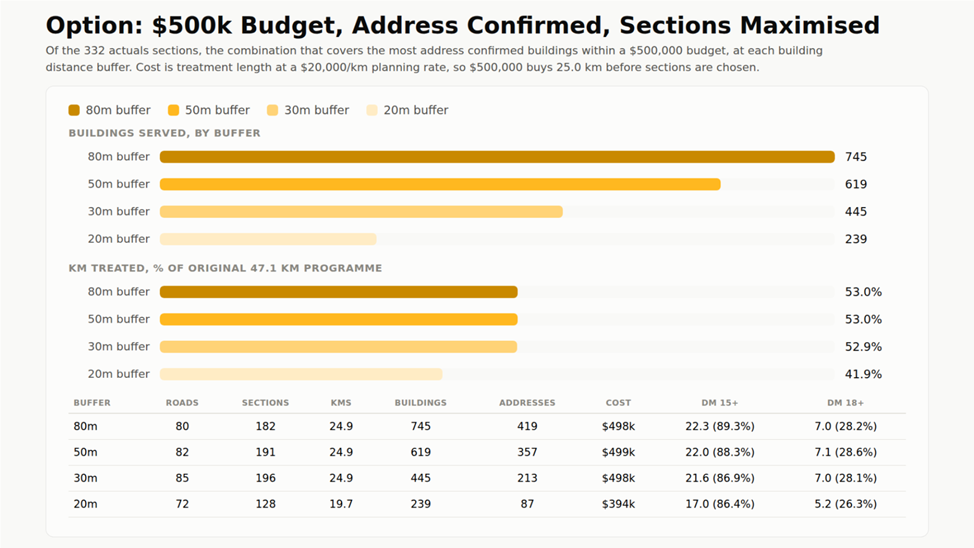
Option 1
– Dust Matrix prioritisation (Residency-focused)
Objective:
Maximise the number of
residences benefiting from the available budget.
Method:
Prioritise locations based on:
· Dust
Matrix score
· Verified
addresses
· Distance
from the road
· Traffic
volumes
· Heavy vehicle
movements
Advantages:
· Benefits
the greatest number of residences.
· Objective
and evidence based.
· Transparent
and repeatable.
· Supports future
NZTA Waka Kotahi funding applications.
Disadvantages:
· Community
facilities receive no additional weighting.
· Previously
treated locations may no longer qualify.
· May
be perceived as focusing on residences rather than wider community outcomes.
Option 2
– Community outcome prioritisation (Community Facilities-focused)
Objective:
Maximise community outcomes by
targeting facilities where people regularly gather while enabling the available
budget to be spread across the greatest number of qualifying locations.
Method:
Facilities would still be
required to meet the same spatial and eligibility criteria used elsewhere
within the Dust Matrix assessment, including proximity to an unsealed road.
Applying the same qualifying criteria but only assess:
· Schools
· Kōhanga
Reo
· Marae
· Community
Halls
· Places
of Worship
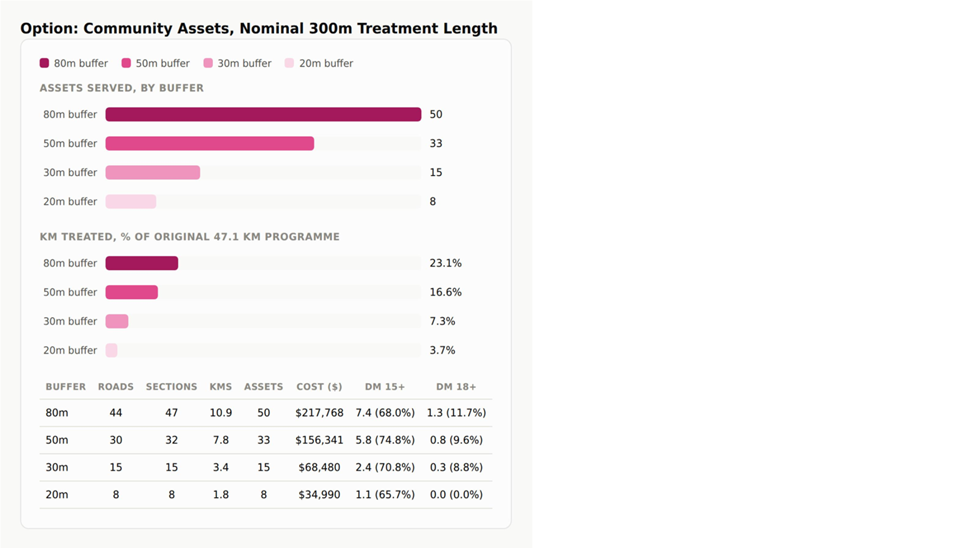
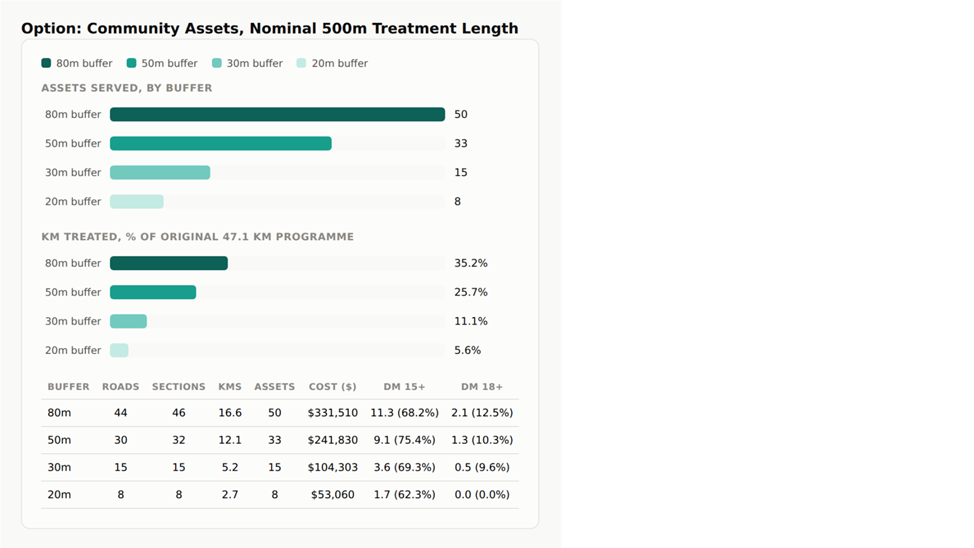
As part of the assessment, staff
modelled treatment lengths of both 300 metres and 500 metres around qualifying
facilities. The 300-metre treatment length is based on an indicative treatment
area of approximately 150 metres either side of a qualifying community
facility. However, staff found that a 300-metre treatment length may not
adequately capture larger sites where significant activity occurs beyond the
immediate road frontage. Examples include playgrounds, sports fields, gathering
spaces, parking areas, outdoor play areas and other community-use spaces
located elsewhere within the property boundary.
For this reason, staff recommend applying a 500-metre
treatment length where required. This provides flexibility to ensure dust
mitigation can be extended to cover the full functional area of a community
facility rather than being restricted to the immediate frontage.
The estimated programme cost of
$331,510 remains well below the approved budget of $500,000, leaving capacity
to accommodate:
· fluctuations
in the cost of dust suppressant products;
· increases
in diesel and transport costs;
· market
volatility affecting contractor pricing;
· changes
in treatment quantities; and
· site-specific
adjustments required to ensure facilities are appropriately protected from dust
impacts.
The available budget contingency
also reduces the risk of returning to Council for additional funding should
delivery costs increase prior to programme implementation.
Advantages:
· Focuses
on locations where larger numbers of people gather.
· Strong
alignment with community wellbeing outcomes.
· Supports
schools, Kōhanga Reo, marae and other important community facilities.
· Provides
flexibility to appropriately treat larger sites where key activity areas are
located away from the road frontage.
Disadvantages:
· Benefits
fewer individual residences.
· Some
high-scoring residential locations may receive no treatment.
· May
still generate community dissatisfaction from residents whose properties have
historically received treatment.
The Dust Matrix provides Council with a transparent and
evidence-based method for allocating a limited budget across a large, unsealed
network. However, elected members now have a broader governance choice
regarding the primary outcome they wish to achieve.
The decision is ultimately
whether the available budget should:
· maximise
the number of residences benefiting (Option 1) or,
· maximise
community outcomes (Option 2)
Regardless of the option selected, members should be aware
that some locations previously treated may not receive treatment and that
continued community interest and feedback should be expected based on previous
programme experience.
3) PĀnga PŪtea me ngĀ
wĀhanga tahua / Financial Implications and Budgetary Provision
The approved budget for the
2026/27 Dust Mitigation Programme is $500,000. The current programme is funded
entirely from local rates and does not presently receive NZTA Waka Kotahi
funding assistance.
Any expenditure beyond the
approved allocation would require a separate governance decision and an
identified funding source.
Option 2 is estimated at
$331,510, which would leave contingency within the approved budget for cost
escalation, site-specific adjustments, or further direction from Council.
The Dust Matrix may support
future funding applications by providing an evidence-based and auditable
prioritisation framework. However, no external funding has been approved for
the 2026/27 programme, and any future subsidy would be subject to NZTA Waka Kotahi
eligibility requirements and approval.
Āpitihanga
/ Attachments
1. Dust
Mitigation Programme 2026-27 - A5960888 ⇩ 
Hōtaka Take Ōkawa / Compliance Schedule:
Full consideration has been given to the provisions of the
Local Government Act 2002 S77 in relation to decision making, in particular:
1. A
Local authority must, in the course of the decision-making process,
a) Seek
to identify all reasonably practicable options for the achievement of the
objective of a decision; and
b) Assess
the options in terms of their advantages and disadvantages; and
c) If
any of the options identified under paragraph (a) involves a significant
decision in relation to land or a body of water, take into account the
relationship of Māori and their culture and traditions with their
ancestral land, water sites, waahi tapu, valued flora and fauna and other
taonga.
2. This
section is subject to Section 79 - Compliance with procedures in relation to
decisions.
|
He Take Ōkawa /
Compliance Requirement
|
Aromatawai Kaimahi /
Staff Assessment
|
|
State the level of significance (high or low) of the
issue or proposal as determined by the Council’s
Significance and Engagement Policy
|
Low significance under Council’s Significance and
Engagement Policy.
The decision concerns the allocation of an existing
approved budget of $500,000 and does not involve the transfer of a strategic
asset, a new activity, or additional rating requirements. However, dust
mitigation is of significant interest to affected communities, particularly
where locations that previously received treatment may no longer be included.
Previous programme changes generated considerable
concern from residents and elected members. The implementation and
reputational implications are therefore material, even though the decision is
assessed as having a low degree of significance under the policy.
|
|
State the relevant Council policies (external or
internal), legislation, and/or community outcomes (as stated in the LTP) that
relate to this decision.
|
Local Government Act 2002
|
|
State whether this issue or proposal has a District wide
relevance and, if not, the ways in which the appropriate Community
Board’s views have been sought.
|
This has district wide relevance.
|
|
State the
possible implications for Māori and how Māori have been provided
with an opportunity to contribute to decision making if this decision is
significant and relates to land and/or any body of water.
State the
possible implications and how this report aligns with Te Tiriti o Waitangi /
The Treaty of Waitangi.
|
Specific consultation with iwi and hapū has not
been undertaken for the 2026/27 programme. The report does not propose
treatment at predetermined individual marae or make a significant decision
relating to Māori land or a body of water. It establishes a
district-wide prioritisation approach using consistent qualifying parameters
|
|
Identify persons likely to be affected by or have an
interest in the matter, and how you have given consideration to their views
or preferences (for example – youth, the aged and those with
disabilities).
|
People and organisations likely
to be affected or have an interest include:
· residents
living close to unsealed roads;
· people who
have received dust suppression in previous years;
· children,
parents, staff and whānau using schools and Kōhanga reo;
· marae
trustees, whānau, hapū and visitors;
· users of
community halls, places of worship, welfare facilities and other community
buildings;
· people with
respiratory or other health conditions that may be affected by road dust;
· older
people and people with disabilities;
· road users,
including school transport and heavy-commercial-vehicle operators;
· elected
members and Community Boards; and
· ratepayers
who fund the unsubsidised programme.
Council has received substantial feedback through
requests for service, correspondence, previous communications and
elected-member representations. Concerns raised include dust entering homes,
effects on roof-collected water, visibility, outdoor living, health and
wellbeing, and the fairness of programme eligibility
|
|
State the financial implications and where budgetary
provisions have been made to support this decision.
|
Council has an approved budget of $500,000, excluding
GST, for dust mitigation in 2026/27.
|
|
Chief Financial Officer review.
|
The Chief Financial Officer has reviewed this report and
confirmed that the proposed expenditure is within the approved 2026/27 Dust
Mitigation Programme budget.
|