AGENDA

Monday, 29 June 2026
|
Time:
|
10:00 am
|
|
Location:
|
Conference Room - Te Ahu
Cnr State Highway 1 and Mathews Avenue
Kaitaia
|
Membership:
Chairperson William (Bill)
Subritzky
Deputy Chairperson Trevor Beatson
Member Adele Gardner
Member Mike Te Wake
Member Krystal-Rose Taaffe
Member Eddie Bellas
Member Hilda Halkyard-Harawira
Member Rachel Baucke
The Local Government Act 2002 states the role of a
Community Board is to:
A.
Represent, and act as an advocate for,
the interests of its community.
B.
Consider and report on all matters
referred to it by the territorial authority, or any matter of interest or
concern to the community board.
C.
Maintain an overview of services
provided by the territorial authority within the community.
D.
Prepare an annual submission to the
territorial authority for expenditure within the community.
E.
Communicate with community
organisations and special interest groups within the community.
F.
Undertake any other responsibilities
that are delegated to it by the territorial authority
Council Delegations to Community Boards - January 2013
The
"civic amenities" referred to in these delegations include the
following Council activities:
·
Amenity lighting
·
Cemeteries
·
Drainage (does not include reticulated
storm water systems)
·
Footpaths/cycle ways and walkways.
·
Public toilets
·
Reserves
·
Halls
·
Swimming pools
·
Town litter
·
Town beautification and maintenance
·
Street furniture including public
information signage.
·
Street/public Art.
·
Trees on Council land
·
Off road public car parks.
·
Lindvart Park – a
Kaikohe-Hokianga Community Board civic amenity.
Exclusions:
From time to time Council may
consider some activities and assets as having district wide significance and
these will remain the responsibility of Council. These currently include: The
roading network, Hundertwasser toilets, District Library Network, Baysport, the
Kerikeri, Kaikohe & Kaitaia Airports, Hokianga Vehicle Ferry, i-Site
network, Far North Community Centre, Kerikeri Domain, Kawakawa Heated Swimming
Pool, Kaikohe Cemetery, Kerikeri Sports Complex, The Centre at Kerikeri, the
Bay of Islands/Hokianga Cycle Trail.
Set
local priorities for minor capital works in accordance with existing
strategies,
1.
Recommend local service levels and
asset development priorities for civic amenities as part of the Annual Plan and
Long Term Plan processes.
2.
Reallocate capital budgets within the
Annual Plan of up to 5% for any specific civic amenity, provided that the
overall activity budgetary targets are met.
3.
Make grants from the allocated
Community Funds in accordance with policy 3209, and the SPARC/Sport Northland
Rural Travel fund in accordance with the criteria set by the respective body,
and, for the Bay of Islands-Whangaroa Community Board, the power to allocate
the Hundertwasser Donations Account.
4.
Provide comment to council staff on
resource consent applications having significance within the Community,
including the provision of land for reserves or other public purposes.
5.
To hold, or participate in hearings, as
the Council considers appropriate, in relation to submissions pertinent to
their community made to plans and strategies including the Long Term Plan and
Annual Plan, and if appropriate recommend decisions to the Council.
6.
To hold hearings of submissions
received as a result of Special Consultative Procedures carried out in respect
of any matter other than an Annual or Long Term Plan, and make recommendations
to the Council.
7.
Where recommended by staff to appoint
management committees for local reserves, cemeteries, halls, and community
centers.
8.
To allocate names for previously
unnamed local roads, reserves and other community facilities, and recommend to
Council name changes of previously named roads, reserves, and community
facilities subject to consultation with the community.
9.
To consider the provisions of new and
reviewed reserve management plans for recommendation to the Council in
accordance with the Reserves Act 1977, and hear or participate in the hearing
of submissions thereto, as considered appropriate by the Council.
10.
To provide recommendations to the
Council in respect of applications for the use and/or lease of reserves not
contemplated by an existing reserve management plan.
11.
Prohibit the use of skateboards in
specified locations within their communities, in accordance with
Council’s Skating Bylaw 1998.
12.
Recommend new bylaws or amendments to
existing bylaws.
13.
Prepare and review management plans for
local cemeteries within budget parameters and in a manner consistent with
Council Policy.
14.
Exercise the following powers in
respect of the Council bylaws within their community:
a)
Control of Use of Public Spaces –
Dispensations on signs
b)
Mobile Shops and Hawkers –
Recommend places where mobile shops and/or hawkers should not be permitted.
c)
Parking and Traffic Control –
Recommend parking restrictions, and areas where complying camping vehicles may
park, and consider and grant dispensations in accordance with clause 2007.2
d)
Public Places Liquor Control –
Recommend times and places where the possession or drinking of alcohol should
be prohibited.
e)
Speed Limits – Recommend places
and speed limits which should be imposed.
15.
To appoint Community Board members to
speak on behalf of their community in respect of submissions or petitions.
16.
Specific to the Bay of
Islands-Whangaroa Community Board – consider any recommendations of the
Paihia Heritage Working Group and make appropriate recommendations to Council
on the development of a draft Plan Change and a Section 32 analysis on heritage
provisions for Paihia.
17.
Specific to Te Hiku Community Board
– the Kaitaia Drainage Area Committee, Waiharara and Kaikino Drainage
Area Committee and Motutangi Drainage Area Committee.
18.
To set schedule of meeting dates, times
and venues, subject to the meetings not conflicting with meetings of the
Council and satisfying the provisions of the Local Government Official
information and Meetings Act 1987.
19.
To review all proposed public art
projects on a project-by project basis to ensure they comply with policy #5105
Art in Public Places, including approval of the aesthetic appearance,
maintenance programme, insurance and appropriate location, and to agree to
their installation.
20.
In respect of applications from food
establishments for permission to establish tables and chairs on a public place,
i.e. Alfresco dining in accordance with Policy 3116, to consider and decide on
any application which does not meet all criteria of the policy, and any
application which staff recommend to be declined.
21.
Subject to a report from the
appropriate managers and the appropriate budgetary provision, to make decisions
in respect of civic amenities including the levels of service, and the
provision or removal of an amenity not provided for elsewhere in these delegations.
Terms of Reference
In
fulfilling its role and giving effect to its delegations, Community Boards are
expected to:
1.
Comment on adverse performance to the
Chief Executive in respect of service delivery.
2.
Assist their communities in the
development of structure plans, emergency management community response plans,
and community development plans.
3.
Assist their communities to set
priorities for Pride of Place programmes.
4.
Have special regard for the views of Māori.
5.
Have special regard for the views of
special interest groups, e.g. disabled, youth, aged, etc.
6.
Actively participate in community
consultation and advocacy and keep Council informed on local issues.
7.
Seek and report to Council community
feedback on current issues by:
a)
Holding a Community forum prior to
Board meetings
b)
Varying the venues of Board meetings to
enable access by members of the community
8.
Monitor and make recommendations to
Council to improve effectiveness of policy.
9.
Appoint a member to receive Annual
Plan\Long Term Council Community Plan submissions pertinent to the Board area,
attend hearings within the Board area, and attend Council deliberations prior
to the Plan adoption.
Protocols
In
supporting Community Boards to fulfil their role, the Council will:
1.
Provide appropriate management support
for the Boards.
2.
Organise and host regular workshops
with the Community Boards l to assess the 'State of the Wards & District'
to establish spending priorities.
3.
Prior to decision-making, seek and
include 'Community Board views' in Council reports in relation to:
a)
the disposal and purchase of land
b)
proposals to acquire or dispose of
reserves
c)
representation reviews
d)
development of new maritime facilities
e)
community development plans and
structure plans
f)
removal and protection of trees
g)
local economic development initiatives
h)
changes to the Resource Management Plan
4.
Organise and host quarterly meetings
between Boards, the CEO and senior management staff.
5.
Prepare an induction/familiarisation
process targeting new members in particular early in the term.
6.
Support Board members to arrange
meetings with local agencies and service clubs to place more emphasis on
partnerships and raising profile of the Boards as community leaders.
7.
Permit Board chairperson (or nominated
member) speaking rights at Council meetings.
8.
Help Boards to implement local
community projects.
9.
Arrange for Infrastructure and Asset
Management Staff to meet with the Community Boards in September each year to
agree the capital works for the forthcoming year for input into the Annual or
Long Term Plan.
10.
Provide information.
Far North District Council
Te Hiku Community Board Meeting
will be held in the Conference Room - Te Ahu, Cnr
State Highway 1 and Mathews Avenue, Kaitaia on:
Monday 29 June 2026 at 10:00 am
Te Paeroa Mahi / Order
of Business
1 Karakia
Tīmatanga / Opening Prayer. 7
2 Ngā
Whakapāha Me Ngā Pānga Mema / Apologies and Conflicts of
Interest 7
3 Te
Wāhanga Tūmatanui / Public Forum.. 7
4 Ngā
Tono Kōrero / Deputation. 7
5 Ngā
Kaikōrero / Speakers. 7
6 Te
Whakaaetanga o Ngā Meneti o Mua / Confirmation of Previous Minutes. 8
6.1 Confirmation
of Previous Minutes. 8
7 Ngā
Pūrongo / Reports. 20
7.1 Scoping
Proposals for Stage One Community Adaptation Planning. 20
7.2 Electric
Vehicle Charging Infrastructure Proposal 68
7.3 Funding
Applications. 74
7.4 Project
Funding Reports. 94
8 Ngā
Pūrongo Taipitopito / Information Reports. 105
8.1 Chairperson
and Members Reports. 105
8.2 2025
- 26 End of Year Funding Report 114
8.3 THCB
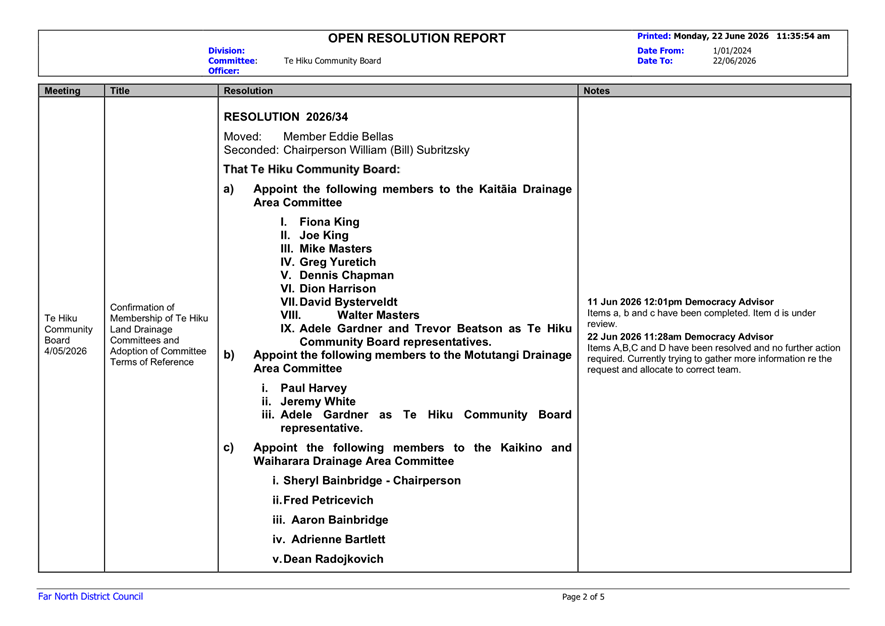
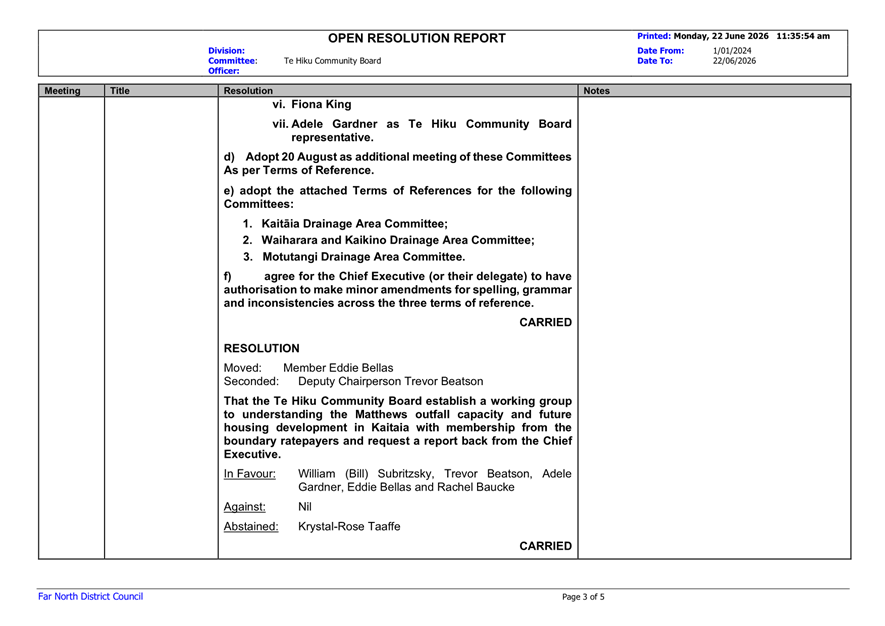
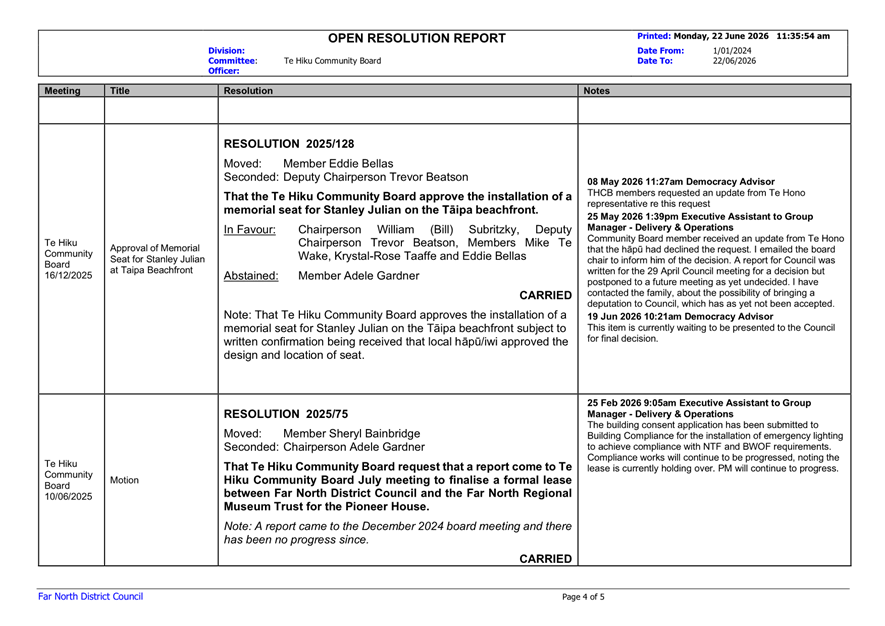
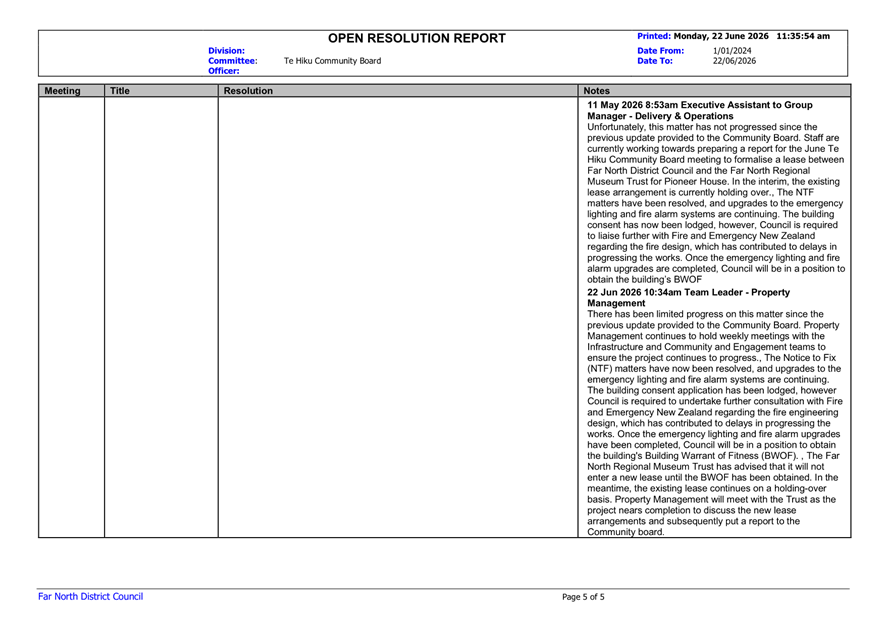
Open Resolutions Report 134
8.4 Te
Hono Group Annual Operational Report 140
9 Karakia
Whakamutunga / Closing Prayer. 144
10 Te Kapinga Hui /
Meeting Close. 144
1 Karakia
Tīmatanga / Opening Prayer
2 Ngā Whakapāha Me Ngā Pānga Mema / Apologies
and Conflicts of Interest
Members need to
stand aside from decision-making when a conflict arises between their role as a
Member of the Community Board and any private or other external interest they
might have. This note is provided as a reminder to Members to review the
matters on the agenda and assess and identify where they may have a pecuniary
or other conflict of interest, or where there may be a perception of a conflict
of interest.
If a Member
feels they do have a conflict of interest, they should publicly declare that at
the start of the meeting or of the relevant item of business and refrain from
participating in the discussion or voting on that item. If a Member thinks they
may have a conflict of interest, they can seek advice from the Chief Executive
Officer or the Manager - Democracy Services (preferably before the meeting).
It is noted
that while members can seek advice the final decision as to whether a conflict
exists rests with the member.
Elected
Member - Register of Interests
3 Te
Wāhanga Tūmatanui / Public Forum
- Vikram
Sampath Gorur – Top Energy
4 Ngā Tono Kōrero / Deputation
No requests for deputations were received at the time of the
Agenda going to print.
5 Ngā
Kaikōrero / Speakers
|
Coopers Beach Bowling Club Inc
|
Ken Smith
|
|
Far North Torpedo Competition
|
Chris Bellas
|
|
R. Tucker Thompson Sail Training
Trust
|
Catherine Langford
|
|
Te Tai Tokerau Tarai Waka Inc
|
Keringawai Evans
|
|
Te Uri O Hina Marae Trust
|
James Watkinson
|
|
Youthline Auckland Charitable
Trust
|
Lee Warbrick
|
|
Te Kura o Te Aniwaniwa
|
Karena Wells
|
6 Te
Whakaaetanga o Ngā Meneti o Mua / Confirmation of Previous Minutes
6.1 Confirmation
of Previous Minutes
File
Number: A5645311
Author: Natasha
Rmandic, Democracy Advisor
Authoriser: Aisha
Huriwai, Manager - Democracy Services
Take Pūrongo / Purpose of the Report
The minutes are attached to allow Te Hiku Community Board to
confirm that the minutes are a true and correct record of the previous
meetings.
|
tŪtohunga
/ Recommendation
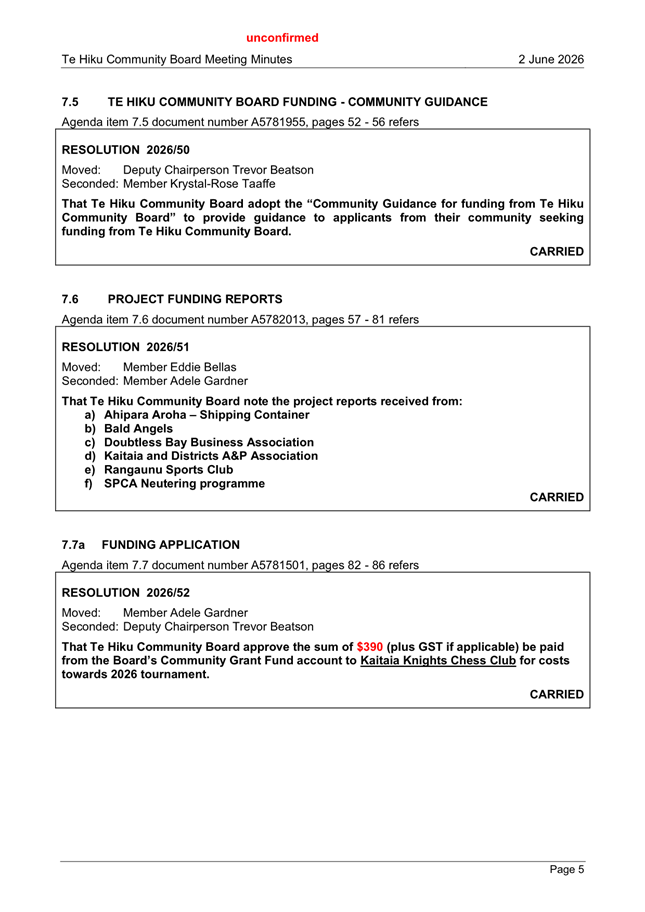
That Te Hiku Community Board confirm the minutes of the
meeting held 02 June 2026 to be a true and correct record.
|
1) TĀhuhu kŌrero / Background
Local Government Act 2002 Schedule 7 Section 28 states that
a local authority must keep minutes of its proceedings. The minutes of these
proceedings duly entered and authenticated as prescribed by a local authority
are prima facie evidence of those meetings.
2) matapaki me NgĀ KŌwhiringa /
Discussion and Options
The minutes of the meetings are
attached.
The Te Hiku Community Board
Standing Orders Section 27.3 states that no discussion may arise on the
substance of the minutes at any succeeding meeting, except as to their
correctness.
TAKE
TŪTOHUNGA / REASON FOR THE RECOMMENDATION
The reason for the recommendation is to confirm the minutes
as a true and correct record of the previous meetings.
3) PĀnga PŪtea me ngĀ
wĀhanga tahua / Financial Implications and Budgetary Provision
There are no financial implications or the need for
budgetary provision.
Āpitihanga / Attachments
1. 2026-06-02
Te Hiku Community Board Minutes - A5797931 ⇩ 
Hōtaka Take Ōkawa / Compliance Schedule:
Full consideration has been given to the provisions of the
Local Government Act 2002 S77 in relation to decision making, in particular:
1. A
Local authority must, in the course of the decision-making process,
a) Seek
to identify all reasonably practicable options for the achievement of the
objective of a decision; and
b) Assess
the options in terms of their advantages and disadvantages; and
c) If
any of the options identified under paragraph (a) involves a significant
decision in relation to land or a body of water, take into account the
relationship of Māori and their culture and traditions with their
ancestral land, water sites, waahi tapu, valued flora and fauna and other
taonga.
2. This
section is subject to Section 79 - Compliance with procedures in relation to
decisions.
|
He Take Ōkawa /
Compliance Requirement
|
Aromatawai Kaimahi /
Staff Assessment
|
|
State the level of significance (high or low) of the
issue or proposal as determined by the Council’s
Significance and Engagement Policy
|
This is a matter of low significance.
|
|
State the relevant Council policies (external or
internal), legislation, and/or community outcomes (as stated in the LTP) that
relate to this decision.
|
This report complies with the Local Government Act 2002
Schedule 7 Section 28.
|
|
State whether this issue or proposal has a District wide
relevance and, if not, the ways in which the appropriate Community
Board’s views have been sought.
|
It is the responsibility of each meeting to
confirm their minutes therefore the views of another meeting are not
relevant.
|
|
State the
possible implications for Māori and how Māori have been provided
with an opportunity to contribute to decision making if this decision is
significant and relates to land and/or any body of water.
State the
possible implications and how this report aligns with Te Tiriti o Waitangi /
The Treaty of Waitangi.
|
There are no implications on Māori in confirming
minutes from a previous meeting. Any implications on Māori arising from
matters included in meeting minutes should be considered as part of the
relevant report.
|
|
Identify persons likely to be affected by or have an
interest in the matter, and how you have given consideration to their views
or preferences (for example – youth, the aged and those with
disabilities).
|
This report is asking for the minutes to be confirmed as
true and correct record, any interests that affect other people should be
considered as part of the individual reports.
|
|
State the financial implications and where budgetary
provisions have been made to support this decision.
|
There are no financial implications or the need for
budgetary provision arising from this report.
|
|
Chief Financial Officer review.
|
The Chief Financial Officer has not reviewed this
report.
|
7 Ngā
Pūrongo / Reports
7.1 Scoping
Proposals for Stage One Community Adaptation Planning
File
Number: A5798145
Author: Katy
Simon, Adaptation Programme Lead Climate Action and Resilience
Authoriser: Kate
Ivicheva, Group Manager - Planning & Policy
Take Pūrongo / Purpose of the Report
To seek endorsement on Stage One
Community Adaptation Planning scoping proposals relevant to Te Hiku Community
Board.
WhakarĀpopoto matua / Executive Summary
· Te
Hiku Community Board has a governance role in Stage One Community Adaptation
Planning to meet its purpose to represent, and act as an advocate for, the
interests of its community.
· Stage
One Community Adaptation Planning proposes to set sub-areas and establish a
Community Panel for each sub-area. The Community Panels will recommend
adaptation decisions. This delivers community-centred planning, as set out by
Te Hōtaka Urutau Hapori | The Community Adaptation Programme.
· Ahead
of a Council decision, Staff are seeking the Community Board’s direction
on the proposed engagement approach and roles and responsibilities of the
Community Panels.
|
tŪtohunga
/ Recommendation
That Te Hiku Community Board:
a) Note the Stage One scope
to plan for a 100-year timeframe and high-end climate scenarios for coastal
flooding, coastal erosion and pluvial/fluvial (river) flooding, based on
available modelling.
b) Note the Stage One
scoping proposal to prioritise planning in select settlements for mixed
elements, supported by less-detailed planning for individual elements outside
of select settlements and large-scale issues.
c) Note that future
implementation actions in adopted Stage One Community Adaptation Plans are
timed, in most cases, for the Long Term Plan 2030-2040 and beyond.
d) Endorse the Stage One
scoping proposal to develop up to five Community Adaptation Plans at the
sub-area scale (as shown in Figure 3).
e) Endorse the Stage One
scoping proposal to establish five Community Panels, to represent each
sub-area and recommend adaptation decisions.
f) Endorse the Stage
One scoping proposal that Community Board Members representing a sub-area can
participate in their relevant Community Panels.
|
1) TĀhuhu kŌrero / Background
Council established
community adaptation planning in the Community
Adaptation Programme | Te Hōtaka Urutau Hapori (Programme),
approved August 2025. The Community Adaptation Programme supports Te Hiku o Te
Ika | The Far North District to prepare for and respond to the impacts of
climate change. This report covers Pou 1 of the Programme and relates to the
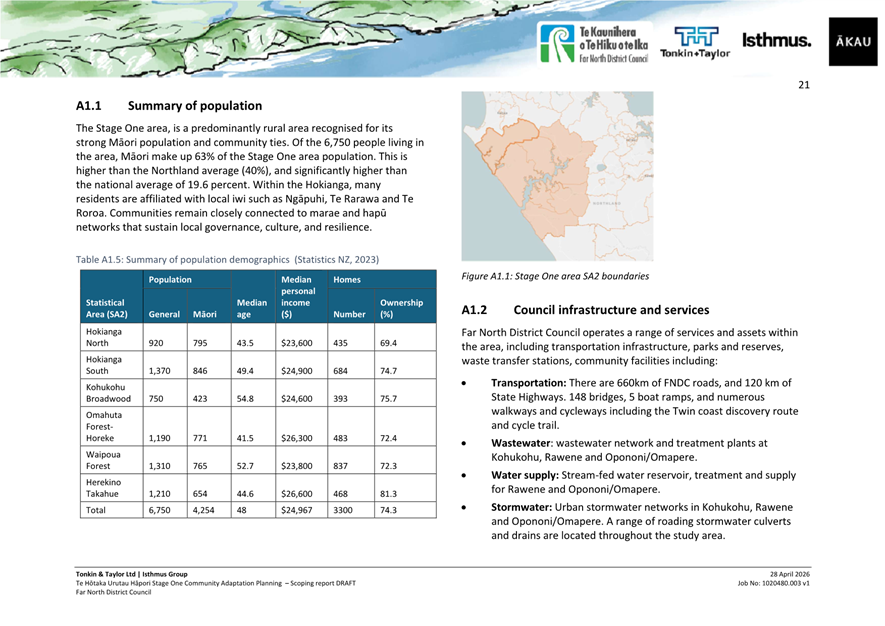
development of Community Adaptation Plans in the Stage 1 Project Area (see
Figure 1 below).
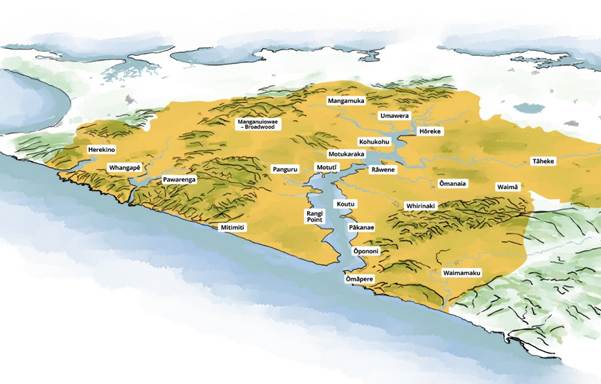
Figure 1 Stage One Project Area
Staff presented an
information report introducing Stage One at the March 2026 meeting. This was an
extraordinary agenda item. This report discussed the Community Board’s
governance responsibilities in adaptation planning. Attachment 1 –
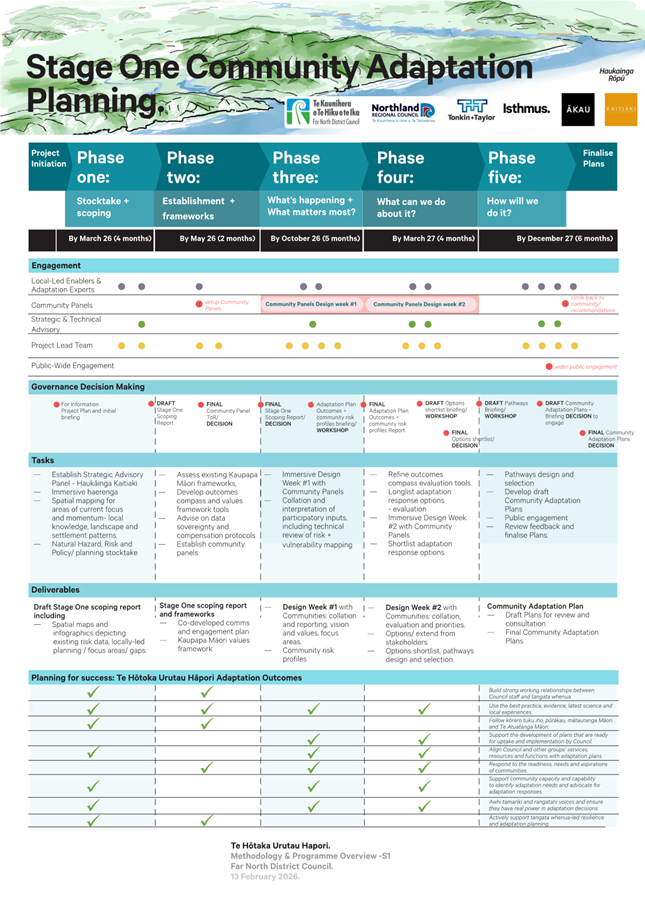
Stage One Project Summary shows key phases and deliverables, estimated
delivery timelines and high-level engagement and governance activities. This
summary was also attached in the March 2026 report.
The Stage One project is
now nearing the end of Phase 1, culminating in a scoping report to Council
(July 2026). The project must manage scope to effectively cover the overall
Stage One area and to adequately identify and respond to priority risks and community
resilience needs.
To achieve this, the
scoping report will recommend a range of climate-affected natural hazards and a
prioritised approach to the elements to be included.
The scoping report will
also recommend a sub-area approach to creating Community Adaptation Plans,
centred around Community Panels and supported by a Haukāinga Kaitiaki
Rōpū | local Tangata Whenua adaptation group.
The rest of this report
outlines Stage One scoping proposals for the Community Board’s
consideration and endorsement.
|
Stage One scoping proposal
|
Community Board action
|
|
a) Natural
hazards and planning timeframes
|
To note
|
|
b) Elements
addressed and level of detail
|
To note
|
|
c) Implementing
Community Adaptation Plans
|
To note
|
|
d) Sub-areas
for Community Adaptation Plans
|
Seeking endorsement
|
|
e) Community-centred
approach with Community Panels
|
Seeking endorsement
|
|
f) Community
Board member participation in the Community Panels
|
Seeking endorsement
|
2) matapaki me NgĀ KŌwhiringa /
Discussion and Options
The
Stage One scoping proposals were shaped by:
- The policy and planning context;
- A stocktake of natural hazards and
risk information, existing projects and initiatives; and
- Early engagement with community and
haukāinga | local people in the project area.
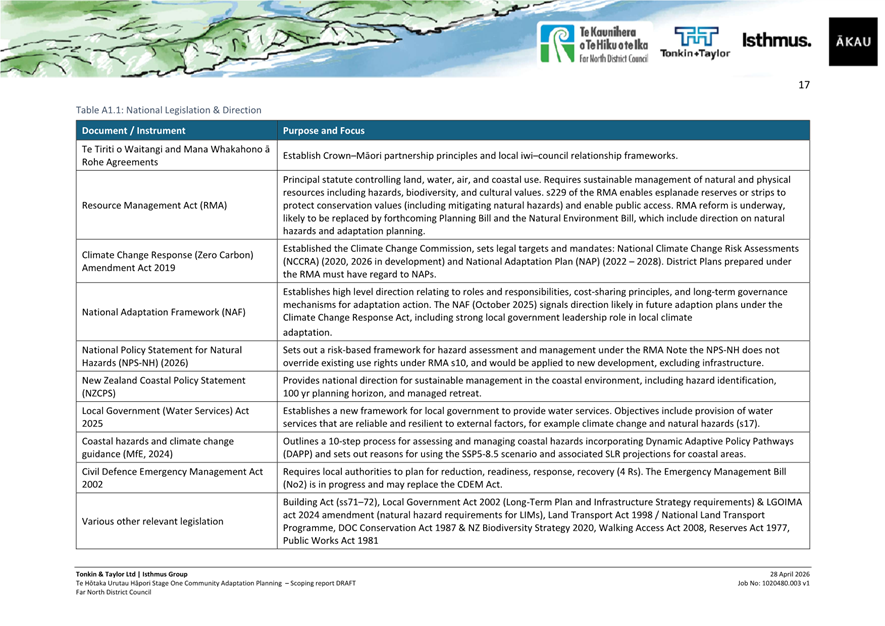
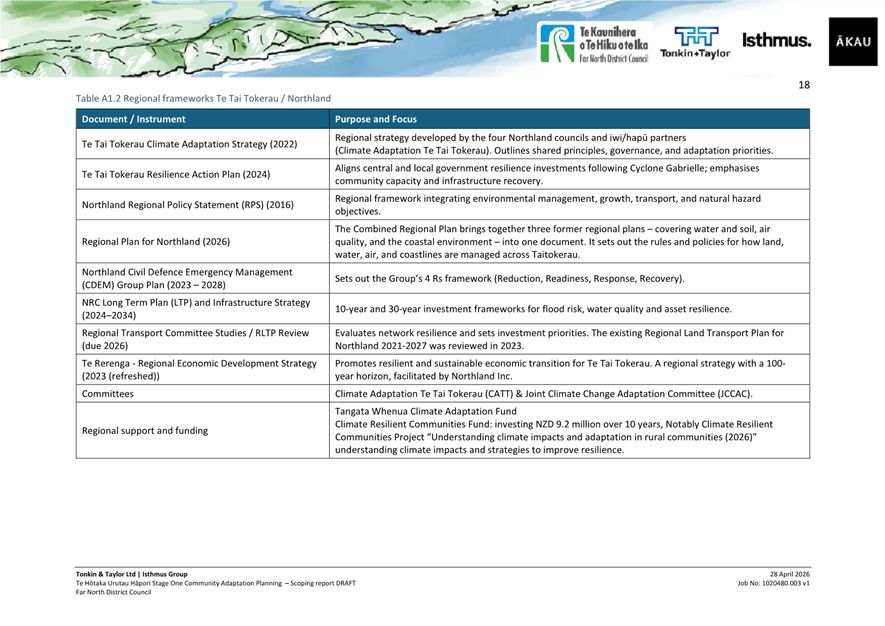
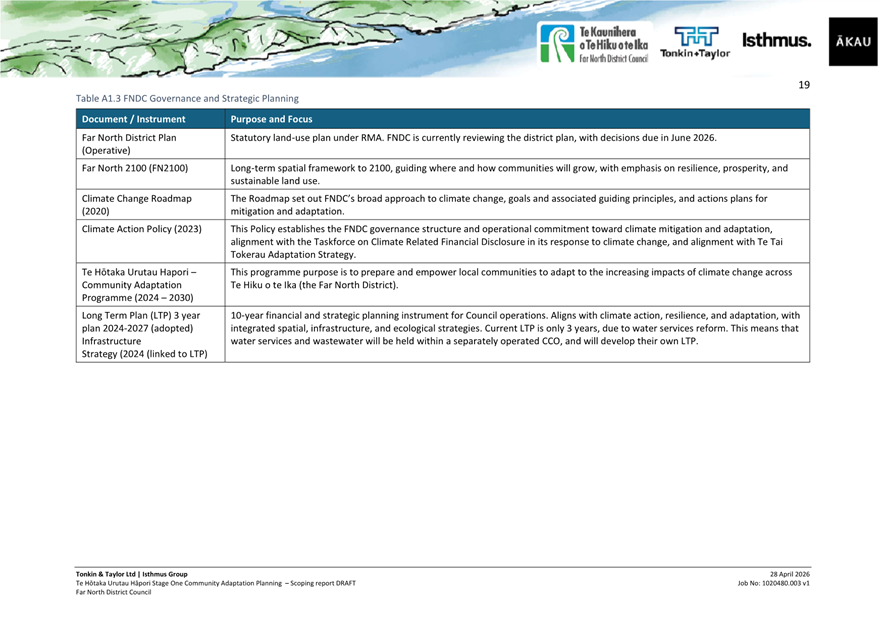
Attachment 2
– Supportive Materials for Scoping Proposals summarises this work
and provides supporting information.
To note - Natural hazards
and planning timeframes
Adopted
Community Adaptation Plans will set out adaptation decisions to manage risks
from increasing coastal flooding, coastal erosion, and fluvial and pluvial
(river) flooding. The CAPs will consider a 100-year timeframe under a high-end
climate scenario (SSP5-8.5), using the best available information to provide
projections at mid- and long-term intervals.
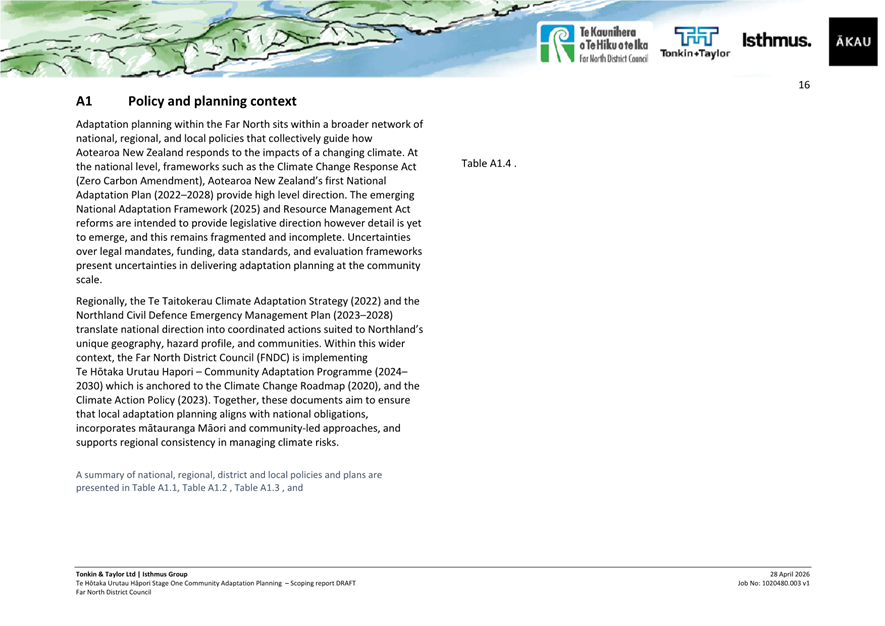
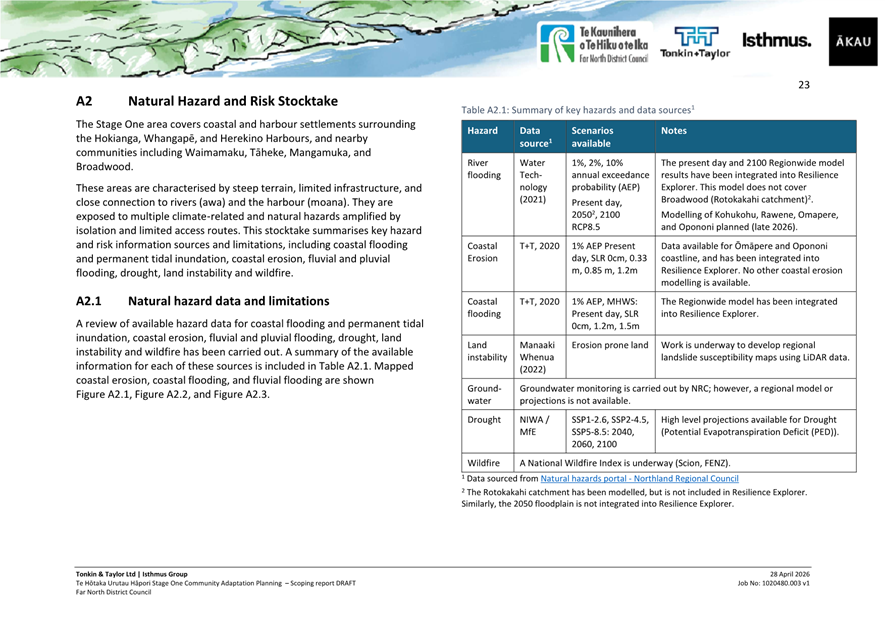
This table shows the
hazards, the year the modelling was completed, and the planning horizon for
each hazard.
Hazard
|
Short term
(2010-2025)
|
Medium term
(2060 – 2070)
|
Long term
(2100-2130)
|
|
Coastal
flooding (T+T, 2020)
|
Present
day
|
0.6 m
SLR
|
1.2m
SLR
|
|
Coastal
Erosion (T+T, 2020)
|
Present
day
|
0.85 m
SLR
|
1.2m
SLR
|
|
Fluvial
and pluvial flood (WaterTechnology, 2021)
|
Present
day
|
Data
TBC
|
2100
RCP8.5
|
The
SSP5-8.5 scenario will be considered for coastal hazards, in alignment with the
Ministry for the Environment’s Coastal Hazards and Climate Change
Guidance (2024) and the New Zealand Coastal Policy Statement (2010).
To note – Elements
addressed and level of detail
The
Community Adaptation Programme sets a baseline for elements that could be
addressed in adaptation planning, shown in Figure 2.
The Community Adaptation
Programme already commits Council to, at a minimum, deliver adaptation planning
for Council-administered infrastructure assets and services.
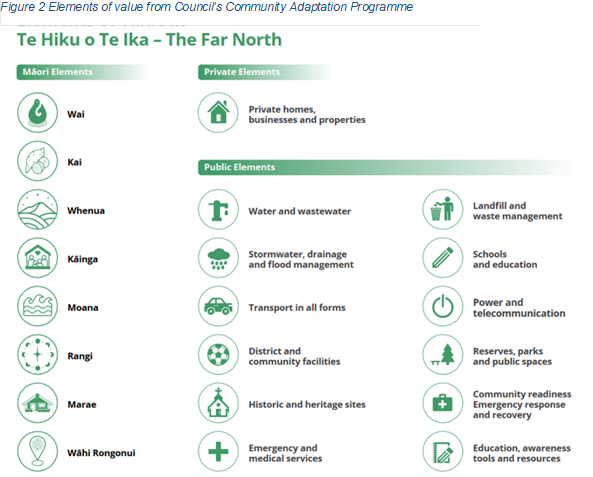
Time and resource
constraints mean the Stage One project cannot develop detailed plans for all
the elements listed in Figure 2.
Here is the proposed
approach to delivering meaningful adaptation decisions across the Stage One
area.
Mixed elements in
settlements - Stage One proposes planning for a mix of public and private
elements for select settlements. Settlements have not been identified at this
point in time. They will be where:
1. there are risks to clusters
of elements within a concentrated area; and
2. where adaptation planning has
the greatest benefits due to the potential for a single response to preserve
multiple elements.
Elements outside of settlements - Community
Adaptation Plans will separately plan for a limited number of priority elements
outside of the assets already covered in select settlements. These could
be standalone infrastructure assets or physical sites and could be public or
private. These will be based on what the Community Panels identify as critical
and of significant value.
Wider risks and opportunities - Community
Adaptation Plans will also document area-wide risks and opportunities.
Catchment-wide issues have been raised in early engagement. These are complex
and beyond Council in terms of governance, responsibility and ownership. They
will be documented but would need to be addressed through separate processes;
the solutions would likely come from a different planning process. Area-wide
issues and opportunities also factor into the evaluation of adaptation options
at other scales, where some options may achieve co-benefits that mitigate the
identified issues.
To
note – Implementing Community Adaptation Plans
Community
Adaptation Plans will set preferred short-, medium- and long-term adaptation
options. Adaptation options will become implementation actions through
Council's Long-Term Planning processes, strategies and planning mechanisms.
Most
implementation actions will not be agreed upon in time for the approaching Long
Term Plan 2027-2037, but will instead be provided for the Long Term Plan
2030-2040.
Where
possible, the project team will work with Council staff to identify more minor,
short-term actions that require minimal amendments to existing strategies,
asset management plans and other planned works.
Please
see Attachment 2 for a broader summary of related policy instruments and
their focus on natural hazards, timeframes, and climate scenarios.
Seeking endorsement - Stage
One sub-areas for Community Adaptation Plans
Stage One proposes to develop up
to five Community Adaptation Plans at the sub-area scale, as shown by the
colours in Figure 3.
The sub-areas are designed to accommodate waterways, access
(transport), and social networks. In early engagement, local community
members and haukāinga | home people talked about these networks and themes
as important aspects of community resilience. Council and Statistical Area 2
(SA2) boundaries also inform the sub-areas.
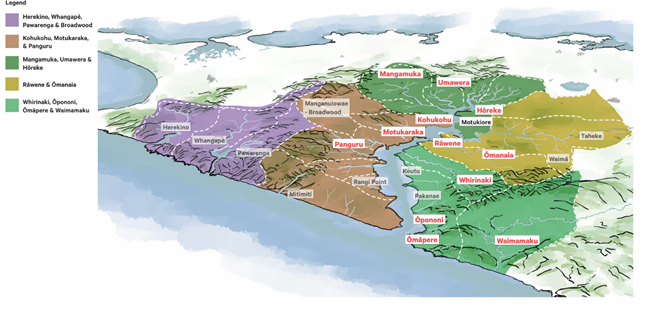
The intent is that sub-areas are the ‘right’ size to be flexible
and to meet the risk needs and resilience aspirations of communities and
Council; large enough to address wider issues and opportunities, but small
enough to focus on settlement-level, more detailed planning.
Figure 3 Sub-areas for Community Adaptation Plans and Community
Panels
The
sub-area names in the Figure 3 legend are draft-only and may change.
Decision options
|
Option 1 - Endorse the proposed scope for sub-areas
described above and show in Figure 3, as per recommendation (d).
|
|
Pros
|
Cons
|
|
Delivers on the
Community Adaptation Programme.
The Stage One project
can proceed within the set timeframes.
Community Adaptation
Plans will address risks and opportunities across the whole Stage One area.
Accommodates broader
issues with more detailed planning, where prioritised.
|
Not all parts of each
sub-area will receive detailed adaptive pathways plans; this is prioritised
for settlements.
|
|
Option 2 - Do not endorse.
|
|
Pros
|
Cons
|
|
Allows more time for
the Community Board to seek additional information or deliberation. Staff can
present future reports addressing the Community Board’s concerns.
|
Triggers
one-to-two-month delays with multiple flow-on effects that could increase
project costs down the line.
|
Seeking
endorsement – Community-centred approach with Community Panels
Council’s Community
Adaptation Programme commits Stage One to a community-centred approach to
adaptation planning and to creating a community advisory body.
Here are the scoping
proposals to meet these requirements:
- Each of the
five sub-areas will form a Community Panel (five Community Panels in total).
- The
Community Panels will represent their area and provide community input.
- They will
make recommendations to Council on adaptation decisions and on the final
Community Adaptation Plans. Council will make the final decisions.
This community-centred
approach is supported by a wider network of governance, technical
advisory, and stakeholder engagement groups. By the time an adaptation
recommendation reaches Council, it will have gone through a robust process of
tangata whenua and community input, technical assessment and stakeholder input.
- Kaimanaaki
hapori | community advisors and a haukāinga kaitiaki rōpū | local
Tangata Whenua adaptation group guide the project team. They will help create
each Community Panel and then support each Panel in providing input and
recommendations.
- The wider
public across the Stage One area will also have opportunities to have their say
on key draft deliverables.
- A Technical
Advisory Group and Project Steering Group provide Council subject matter
expertise and strategic oversight at a senior level. They help to ensure
adaptation recommendations can be implemented and delivered on - before they
become adaptation decisions.
This
structure and process ensures that local aspirations are continuously informed
by technical feasibility and guided by Council governance. It also aims to
put tangata whenua and communities at the heart of decision-making, supporting
ongoing stewardship of their places.
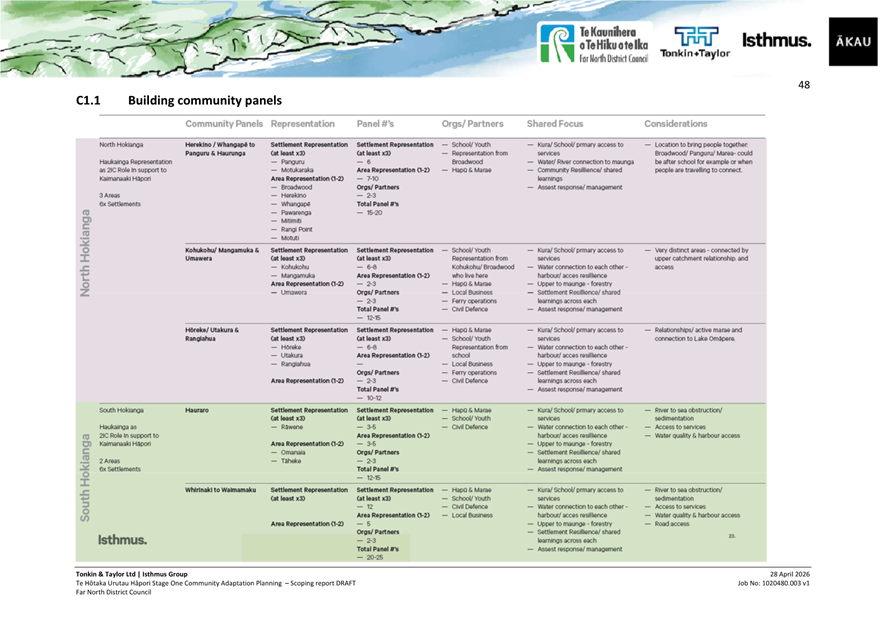
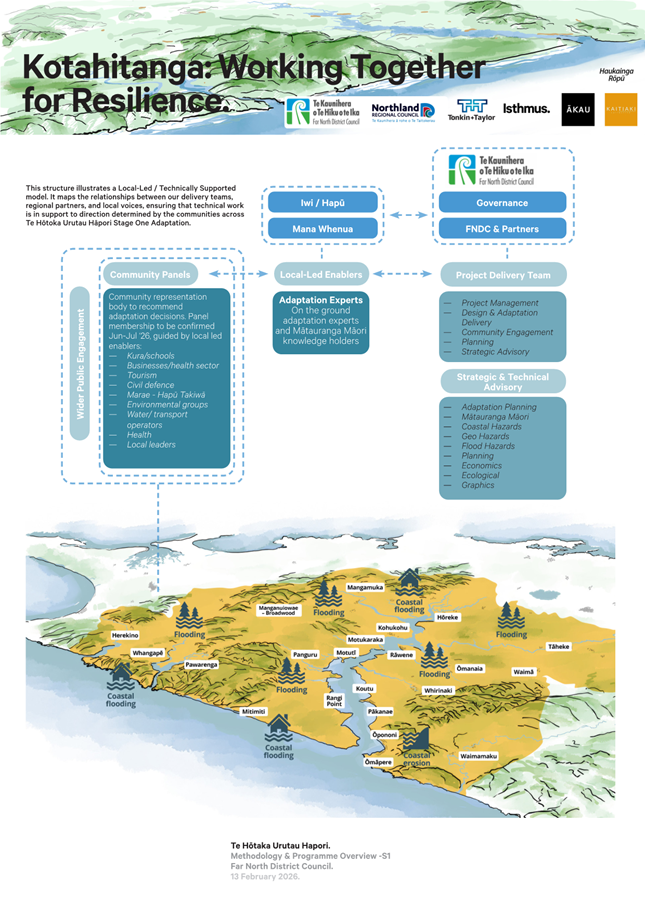
Figure
4 is the published Stage One project structure. This figure shows the key
groups and the Community Panels’ role. Attachment 2 includes the
project teams’ draft, initial thinking on Community Panels’ make-up
and membership.
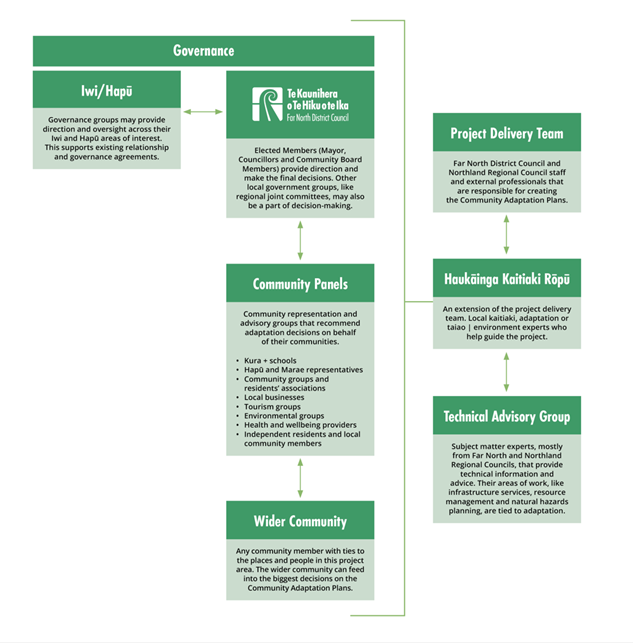
Figure 4 Stage One Project Structure
Decision options
|
Option 1 - Endorse the proposed scope for Community
Panels described above, as per recommendation (e).
|
|
Pros
|
Cons
|
|
Delivers
community-centred planning.
Sets up feasible
engagement within the project’s resourcing.
The Stage One project
can proceed within the set timeframes.
|
Poses minor risk that
the Community Panels will make recommendations to Council that Council does
not approve or adopt.
This is mitigated
through technical and feasibility assessments and regular governance
briefings.
|
|
Option 2 - Do not endorse.
|
|
Pros
|
Cons
|
|
Allows more time for
the Community Board to seek additional information or deliberation.
Staff can present
future reports addressing the Community Board’s concerns.
|
Triggers
one-to-two-month delays with multiple flow-on effects.
Could increase project
costs over time.
|
Please
note: The Community Board’s endorsement of the Community Panels and
their role and responsibilities is not a decision on each Panel’s
membership and make-up. This will be decided based on haukāinga kaitiaki
rōpū recommendations, hapū and marae delegations and through an
expression of interest process. Staff can speak to this in more detail when
presenting this report.
Seeking endorsement – Community
Board Members’ participation in Community Panels
The final scoping proposal is on the Community
Board’s role in the Community Panels.
The project team recommends that the Community
Board Members representing the sub-areas can fully participate in their
relevant Community Panels. This is for Community Board Members only and does
not apply to other Elected Members.
The specific Members will be determined via
email correspondence as the Community Panels are closer to being established,
with an estimated timeline of July to August 2026.
The Community Board’s endorsement
decision will guide a future Terms of Reference for all Community Panels. In
July or August 2026, Staff will present a report seeking Council’s
approval of these Terms of Reference.
Decision options
|
Option 1 - Endorse the proposed scope for the
Community Board Members’ participation described above, as per
recommendation (f).
|
|
Pros
|
Cons
|
|
Improves connection
between Community Panel and project governance.
Community Board Members
can provide insight from Council to strengthen the Community Panels’
recommendations.
|
Some people may
perceive Community Board member participation as too close to Council
influence.
Increased time and
travel for Community Board Members.
|
|
Option 2 - Do not endorse. Community Board Members
will not be invited to fully participate in their relevant Community Panels.
|
|
Pros
|
Cons
|
|
Sets a clear boundary
between recommendations from Community Panels and Council governance.
|
Weaker connection
between Community Panels and project governance, increasing reliance on staff
reporting.
|
TAKE
TŪTOHUNGA / REASON FOR THE RECOMMENDATION
3) PĀnga PŪtea me ngĀ
wĀhanga tahua / Financial Implications and Budgetary Provision
There are no additional
financial implications for a recommendation and endorsement on the scoping
proposals.
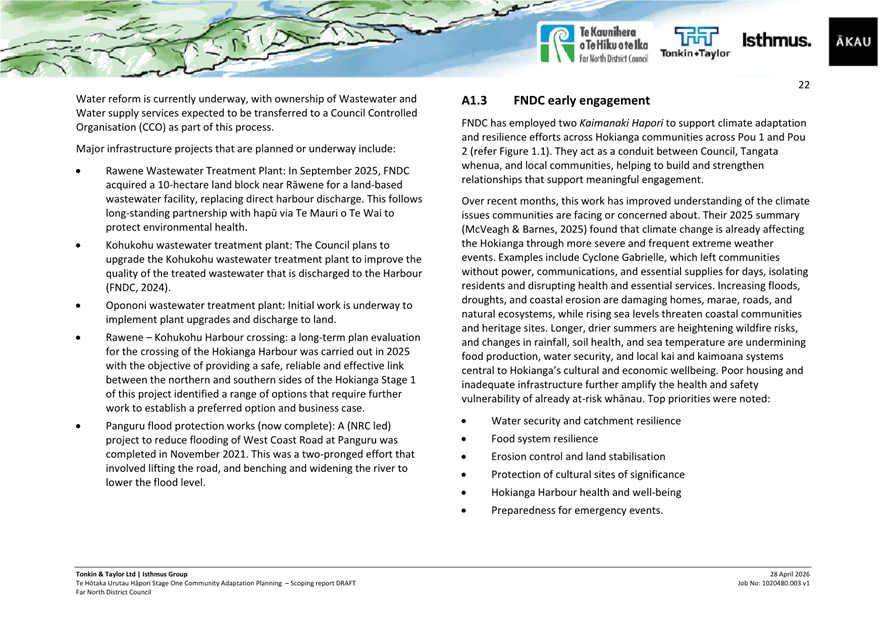
Stage One Community
Adaptation Planning is currently funded under the Long Term Plan 2024-2027,
with an estimated total budget of $650,000.00 across the 2025-2026 and
2026-2027 financial years. Northland Regional Council provides $100,000.00 in
funding (included in the $650,000.00 total).
Future budget requirements will be determined through the
2027-2037 Long Term Plan process.
Āpitihanga
/ Attachments
1. Attachment
1 - Stage One Community Adaptation Planning Project Summary - A5798518 ⇩ 
2. Attachment
2 - Supportive Materials for Scoping Proposals - A5798519 ⇩ 
Hōtaka
Take Ōkawa / Compliance Schedule:
Full consideration has been given to the provisions of the
Local Government Act 2002 S77 in relation to decision-making, in particular:
1. A
Local authority must, in the course of the decision-making process,
a) Seek
to identify all reasonably practicable options for the achievement of the
objective of a decision; and
b) Assess
the options in terms of their advantages and disadvantages; and
c) If
any of the options identified under paragraph (a) involves a significant
decision in relation to land or a body of water, take into account the
relationship of Māori and their culture and traditions with their
ancestral land, water sites, waahi tapu, valued flora and fauna and other
taonga.
2. This
section is subject to Section 79 - Compliance with procedures in relation to
decisions.
|
He Take Ōkawa /
Compliance Requirement
|
Aromatawai Kaimahi /
Staff Assessment
|
|
State the level of
significance (high or low) of the issue or proposal as determined by the Council’s
Significance and Engagement Policy
|
Low (noting that the
overall adaptation decisions are of high significance). Initial engagement
has been carried out to inform these scoping proposals. The Community Panels
will meet SEP requirements for finalising the scope.
|
|
State the relevant Council
policies (external or internal), legislation, and/or community outcomes (as
stated in the LTP) that relate to this decision.
|
Primary relevant
legislation:
- Resource
Management Act 1991
- Local
Government Act 2002
- Civil
Management Emergency Management Act 2002
Relevant Council policies
and strategies:
- Te
Taitokerau Climate Adaptation Strategy
- Climate
Action Policy
- FN2100
- Te Pae o Uta
See Attachment 2
for a complete list of relevant legislation, policy and strategies.
|
|
State whether this issue
or proposal has a District wide relevance and, if not, the ways in which the
appropriate Community Board’s views have been sought.
|
Staff presented reports to
the Kaikohe Hokianga and Te Hiku Community Boards at their March 2026
meetings. These reports will seek their views through their endorsement of
community scoping elements under their delegation.
|
|
State the possible implications for Māori
and how Māori have been provided with an opportunity to contribute to
decision making if this decision is significant and relates to land and/or
any body of water.
State the possible implications and how this
report aligns with Te Tiriti o Waitangi / The Treaty of Waitangi.
|
The project seeks to
fulfil the commitments set under Te Hōtaka Urutau Hapori | Community
Adaptation Programme, that the programme will always support Council to give
effect to Te Tiriti o Waitangi.
Since 2024, this project
has focused on relationship-building through early engagement with
haukāinga, whānau, marae, and hapū representatives across the
Ngāpuhi, Te Rarawa, and Te Roroa rohe. This early engagement and a
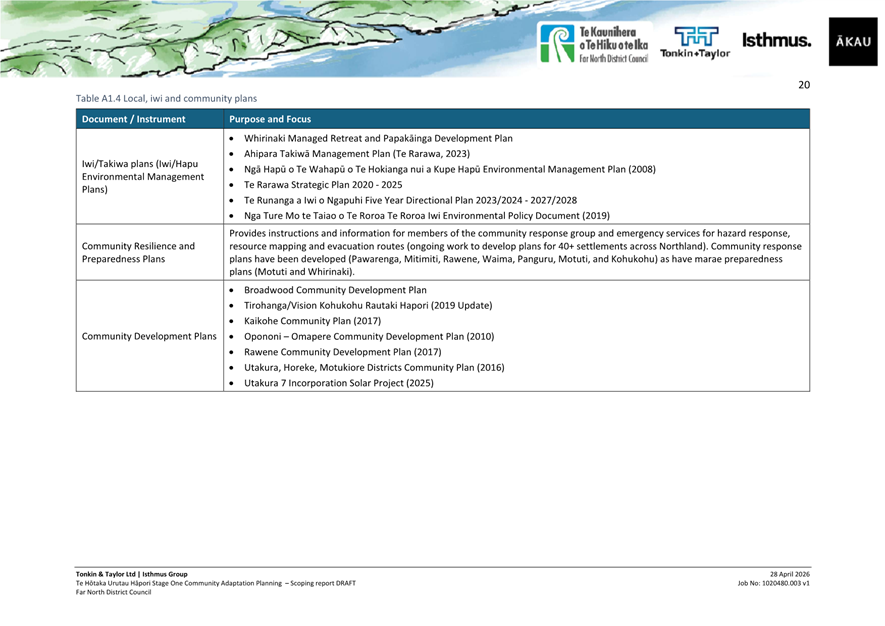
haerenga | trip in February 2026 informed the scoping proposals.
Hapū and marae
representatives will be asked to join the Community Panels. Haukāinga
kaitiaki roles will also guide the project at an operational level.
|
|
Identify persons likely to
be affected by or have an interest in the matter, and how you have given
consideration to their views or preferences (for example – youth, the
aged and those with disabilities).
|
Adaptation planning will
affect Hokianga communities, across all ages, abilities and backgrounds. For
this reason, the adaptation planning is a community-centred process. The
scoping proposals affirm this engagement approach.
|
|
State the financial
implications and where budgetary provisions have been made to support this
decision.
|
Adaptation planning will
affect Hokianga communities, across all ages, abilities and backgrounds. For
this reason, the adaptation planning is a community-centred process. The
scoping proposals affirm this engagement approach.
|
|
Chief Financial Officer
review.
|
Chief Financial Officer
has not reviewed this report.
|
7.2 Electric
Vehicle Charging Infrastructure Proposal
File
Number: A5799273
Author: Aya
Morris, Net Zero & Sustainability Programme Lead
Authoriser: Kate
Ivicheva, Group Manager - Planning & Policy
Take Pūrongo / Purpose of the Report
This report seeks endorsement for public electric vehicle
(EV) charging infrastructure to be installed in off-street public carparks and
in areas of parks and reserves already in use as public parking spaces within
the Te Hiku Ward.
WhakarĀpopoto matua / Executive Summary
· The Government’s Public EV Charging Infrastructure Loans
Programme offers opportunities to improve access to public EV charging
facilities in the Far North.
· The costs for installation and maintenance for this public
infrastructure will be covered by private companies as recipients of the loans,
with no cost to Far North District Council (FNDC).
· Many sites owned by FNDC have been identified as ideal locations for
public EV charging infrastructure, and private companies wish to seek leases.
· Granting leases for the installation of public EV charging
infrastructure on FNDC sites will support goals related to climate action and
sustainability in FNDC’s existing strategy and policy.
|
tŪtohunga
/ Recommendation
That Te Hiku Community Board endorses the
granting of leases for sites managed by the Far North District Council to
facilitate the installation of public EV charging infrastructure in
off-street public carparks and in areas of council parks and reserves that
are already in use as public parking spaces.
|
1) TĀhuhu kŌrero / Background
The Government has recently allocated loans to two private
companies to advance the extension of the nationwide EV charging network
through the Public EV Charging Infrastructure Loans Programme. These two
companies, ChargeNet and Meridian Energy, have each approached the FNDC to seek
a strategic partnership to strengthen the EV charging network within the
district.
There is presently limited access to public electric vehicle
chargers within the Far North District. The PlugShare site shows 54 EV chargers
in the Bay of Islands, with many of these located on the premises of private
accommodation providers, and 35 EV chargers in other areas of the Far North.[1] These figures
include chargers which are currently under repair.
Many areas across the Far North roading network lack public
EV charging infrastructure altogether. This lack of public EV charging
infrastructure acts as a disincentive for locals wishing to transition to EV
use, and for EV users considering visits to the Far North.
The FNDC has previously partnered with the Northland
Regional Council, Top Energy, ChargeNet, and Te Ahu Charitable Trust to advance
the growth of the regional EV charging network through the Crimson Coast EV
Highway project, funded through the Low Emission Vehicles Contestable Fund
administered by EECA.[2]
The transition to electrification within the transport
sector supports the existing FNDC climate action strategy and policy on
reducing greenhouse gas emissions by communities, businesses and visitors
within the Far North District.
2) matapaki me NgĀ KŌwhiringa /
Discussion and Options
The installation of public electric vehicle charging
infrastructure benefits Far North communities, businesses and visitors. The use
of electric vehicles and hybrids is becoming increasingly common within the Far
North District and within New Zealand more widely.
It is recommended that FNDC sites already in use for car
parking should be considered for leases to private companies seeking to install
public EV charging infrastructure for community use.
Benefits of EV charging infrastructure
The transition to electric vehicles supports nationwide
greenhouse gas emissions reduction targets set out in legislation and New
Zealand’s second national emissions reduction plan.[3] [4]
Emissions from transportation are the second-highest source
of greenhouse gas emissions in the Northland region, after agriculture,
contributing approximately 30% of regional emissions.[5]
Policy and strategy considerations
The reduction of community greenhouse gas emissions within
the Far North District supports the achievement of targets set out through Far
North District Council policy and strategy, including the Far North 2100
Strategy,[6]
the Climate Change Roadmap,[7]
and the Climate Action Policy.[8]
The Far North District Council Parking Bylaw already includes instruments which
relate to the management of parking spaces which feature EV charging
infrastructure.[9]
This bylaw would need to be amended to add additional areas if further chargers
are to be installed on FNDC sites.
Risks and mitigation
The allocation of leases within parking areas located on
FNDC sites may risk a reduction in the availability of parking for vehicles
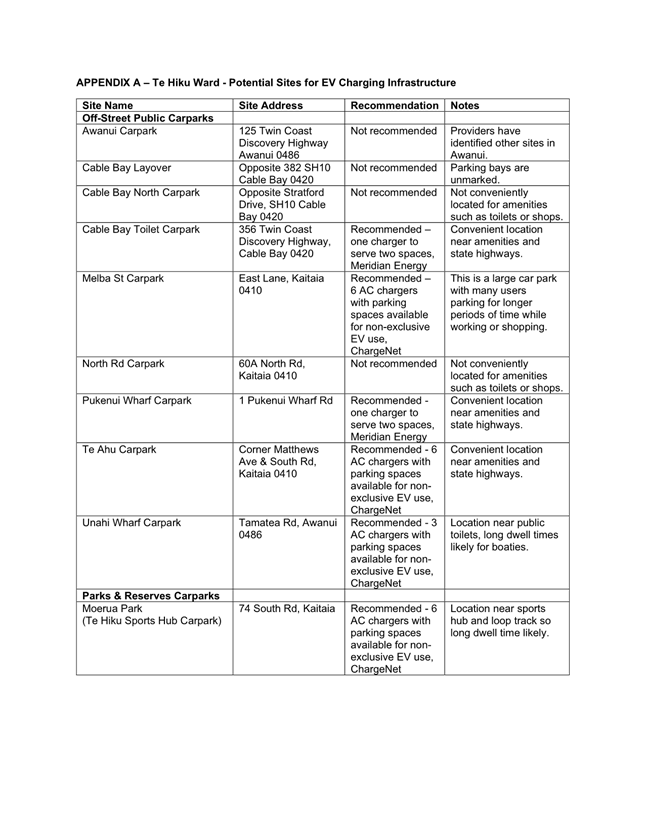
other than EVs. The sites recommended in Appendix A have been selected to
minimise this risk.
There is some risk that sites selected for public EV
charging may reduce the availability of accessible parking for people with
disabilities. The sites recommended in Appendix A have been selected to
minimise this risk. It is also proposed that terms should be included in lease
documentation to ensure that there is no reduction in accessible parking.
Significance and engagement
The proposal does not recommend installing EV infrastructure
at any sites that are not already used for car parking. It is unlikely that any
negative impacts other than those noted above will result from a change of use
from parking for traditional vehicles to parking for EVs.
Formal processes of public consultation and engagement have
not been conducted for earlier EV infrastructure installations at FNDC sites.
Costs of each option
Both ChargeNet and Meridian Energy propose to seek 15-year
leases or licences for FNDC sites, and to cover all costs toward the
installation and ongoing maintenance of public electric vehicle charging
infrastructure.
ChargeNet are seeking sites suitable for AC charging,
informally known as slow charging. This charging method typically requires
longer dwell times and produces limited revenue for providers as less
electricity is consumed. ChargeNet are seeking leases free of lease fees due to
this limited revenue opportunity and slower return on investment over time.
They are willing to consider sites in smaller towns throughout the Far North
District.
Meridian Energy are seeking sites suitable for DC charging,
informally known as fast charging. This charging method offers a faster
return on investment for providers. Meridian Energy are therefore seeking
busier sites, located close to the state highway network, and are offering
lease fees of approximately $2000 per site per year.
It is recommended that sites with central locations and
higher traffic volumes are considered for Meridian Energy leases and sites with
less central locations are considered for ChargeNet leases.
TAKE
TŪTOHUNGA / REASON FOR THE RECOMMENDATION
The installation of public EV charging infrastructure
benefits residents, businesses, and visitors to the Far North District by
increasing access to public EV chargers, reducing wait times, and reducing
travel distances between chargers. This increased access to EV charging
incentivises domestic tourists to visit the Far North and encourages Far North
residents and businesses to transition toward cleaner transportation options,
supporting the Far North District Council’s community greenhouse gas emissions
reduction goals.
3) PĀnga PŪtea me ngĀ
wĀhanga tahua / Financial Implications and Budgetary Provision
There is no requirement to allocate budget to this project,
as the costs will be covered by the proposed providers of public EV charging
infrastructure, ChargeNet and Meridian Energy.
There may be income opportunities available to the Far North
District Council through the terms of leases and licences to occupy the
selected sites.
Āpitihanga
/ Attachments
1. Appendix
A - EV Charging - A5807295 ⇩ 
Hōtaka Take Ōkawa / Compliance Schedule:
Full consideration has been given to the provisions of the
Local Government Act 2002 S77 in relation to decision making, in particular:
1. A
Local authority must, in the course of the decision-making process,
a) Seek
to identify all reasonably practicable options for the achievement of the
objective of a decision; and
b) Assess
the options in terms of their advantages and disadvantages; and
c) If
any of the options identified under paragraph (a) involves a significant
decision in relation to land or a body of water, take into account the
relationship of Māori and their culture and traditions with their
ancestral land, water sites, waahi tapu, valued flora and fauna and other
taonga.
2. This
section is subject to Section 79 - Compliance with procedures in relation to
decisions.
|
He Take Ōkawa /
Compliance Requirement
|
Aromatawai Kaimahi /
Staff Assessment
|
|
State the level of significance (high or low) of the
issue or proposal as determined by the Council’s
Significance and Engagement Policy
|
This report has a low degree of significance. The sites
proposed for the installation of public EV infrastructure are already used as
car parking spaces, so the installation of EV infrastructure is unlikely to
create additional adverse effects compared with the existing car parks.
|
|
State the relevant Council policies (external or
internal), legislation, and/or community outcomes (as stated in the LTP) that
relate to this decision.
|
Climate
Change Response (Zero Carbon) Amendment Act 2019 | New Zealand Legislation
Parking-Bylaw-Amended-February-2023.pdf
Climate
Change Road Map
Climate
Action Policy
Far
North 2100
|
|
State whether this issue or proposal has a District-wide
relevance and, if not, the ways in which the appropriate Community
Board’s views have been sought.
|
This issue has district-wide relevance and community
relevance. This is a community board report.
|
|
State the
possible implications for Māori and how Māori have been provided
with an opportunity to contribute to decision making if this decision is
significant and relates to land and/or any body of water.
State the
possible implications and how this report aligns with Te Tiriti o Waitangi /
The Treaty of Waitangi.
|
There are implications for Māori, as improved
environmental outcomes from reducing greenhouse gas emissions have the
potential to benefit lands and waterways.
The sites proposed for the installation of public EV
infrastructure are already in use as car parking spaces, so the installation
of EV infrastructure is unlikely to create additional adverse effects for
Māori in comparison to the existing car parks.
|
|
Identify persons likely to be affected by or have an
interest in the matter, and how you have given consideration to their views
or preferences (for example – youth, the aged and those with
disabilities).
|
People with disabilities or the aged community may be
impacted if there is any reduction in the availability of accessible car
parking. The project will ensure that no accessible car parks are removed and
will ensure that new accessible car parks are created as EV users also have
needs for accessible parking.
|
|
State the financial implications and where budgetary
provisions have been made to support this decision.
|
This has been covered in Section 3. There are no
requirements for budget allocation for this project as the installation of
public EV charging infrastructure will be covered by the proposed providers
of public EV charging infrastructure; ChargeNet and Meridian Energy.
There may be opportunities for income generation through
the terms of the leases and licences to occupy which will be granted.
|
|
Chief Financial Officer review.
|
Chief Financial Officer has not reviewed this report.
|
7.3 Funding
Applications
File
Number: A5821953
Author: Kathryn
Trewin, Funding Advisor
Authoriser: Aisha
Huriwai, Manager - Democracy Services
Take Pūrongo / Purpose of the Report
This report summarises applications for the Local Community
Grant funding to enable Te Hiku Community Board to determine which
application/s will receive funding at this meeting.
WhakarĀpopoto matua / Executive Summary
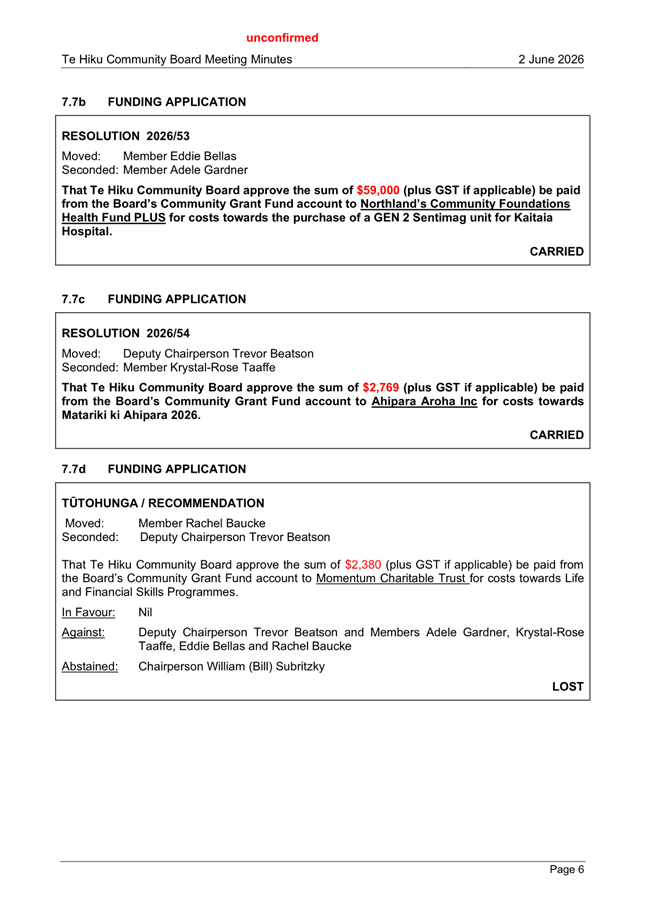
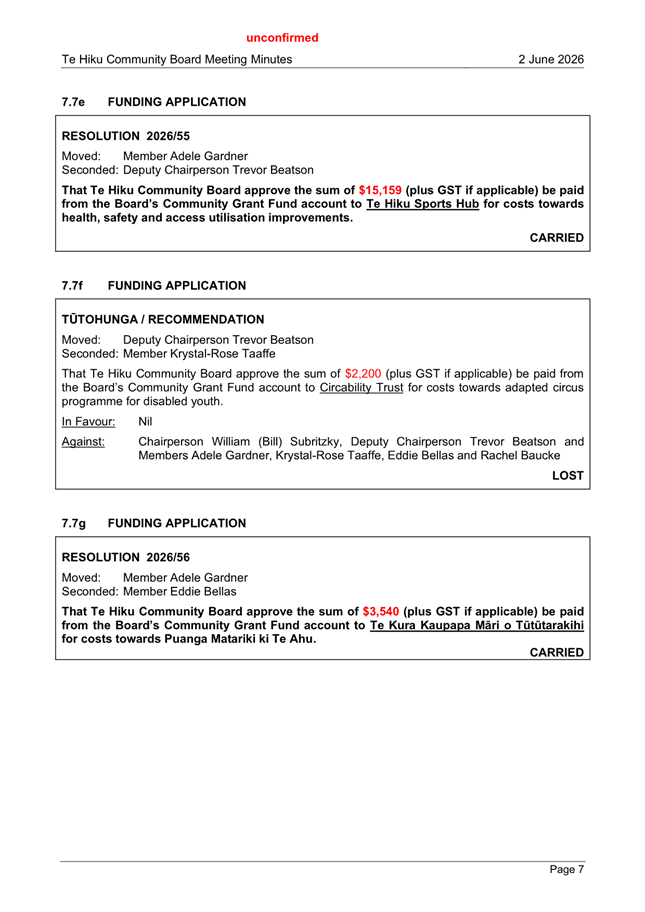
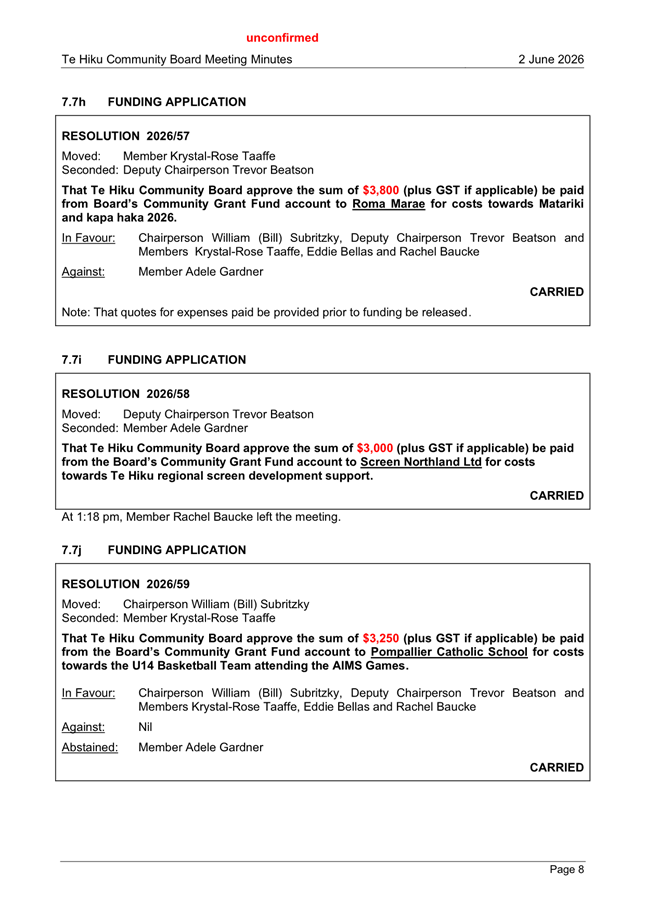
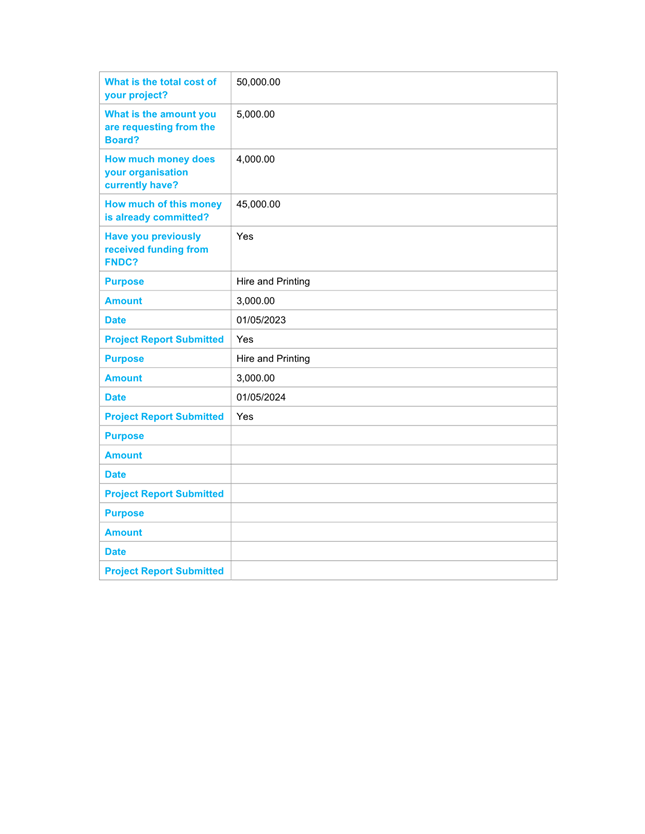
· Nine new applications have been received, requesting $87,068.
· The Community Board has an available total of $5,902.31
remaining from the 2025/26 financial year.
· At the time this report was written, the Annual Plan had not been
adopted, with funding for the Board for the 2026/27 financial year
unconfirmed. It is expected that they will be similar to the 2025/26
financial year.
· Funding in the 2025/26 financial year was $146,811 in
Community Grant Funding and $100,000 in Pride of Place Funding.
· The Annual Plan is due to be adopted on 25 June 2026, so it is
expected that actual available funding will be confirmed by the time this
meeting is held.
|
TŪTOHUNGA
/ RECOMMENDATION
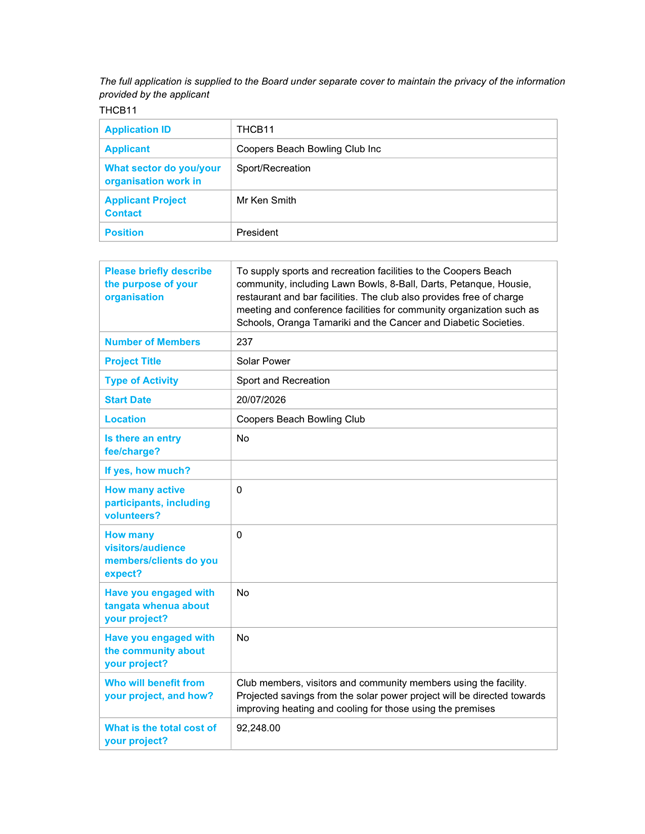
a) That Te Hiku
Community Board approve the sum of $10,000
(plus GST if applicable) be paid from the Board’s Pride of Place Grant
Fund account to Coopers Beach Combined Bowling Club for costs towards
installation of solar power.
|
|
TŪTOHUNGA / RECOMMENDATION
b) That Te Hiku
Community Board approve the sum of $5,000
(plus GST if applicable) be paid from the Board’s Community Grant Fund
account to Far North Torpedo Competition for costs towards equipment
hire and promotional material.
|
|
TŪTOHUNGA / RECOMMENDATION
c) That Te Hiku
Community Board approve the sum of $4,000
(plus GST if applicable) be paid from the Board’s Community Grant Fund
account to R Tucker Thompson Sail Training Trust for costs towards two
Te Hiku rangatahi participating in a youth development voyage.
|
|
TŪTOHUNGA / RECOMMENDATION
d) That Te Hiku
Community Board approve the sum of $3,100
(plus GST if applicable) be paid from the Board’s Community Grant Fund
account to Te Rangi Aniwaniwa Kura Kaupapa Māori for costs
towards cultural performance and wood carving resources.
|
|
tŪtohunga / Recommendation
e) That Te Hiku
Community Board approve the sum of $5,000
(plus GST if applicable) be paid from the Board’s Community Grant Fund
account to Te Tai Tokerau Tarai Waka Inc for costs towards Te
Hekengamai - Te Hau Komaru Festival 2026.
|
|
tŪtohunga / Recommendation
f) That
Te Hiku Community Board approve the sum of $17,250
(plus GST if applicable) be paid from the Board’s Pride of Place Grant
Fund account to Te Uri o Hina Marae Trust for costs towards Marae
Whakairo Restoration Project.
|
|
tŪtohunga / Recommendation
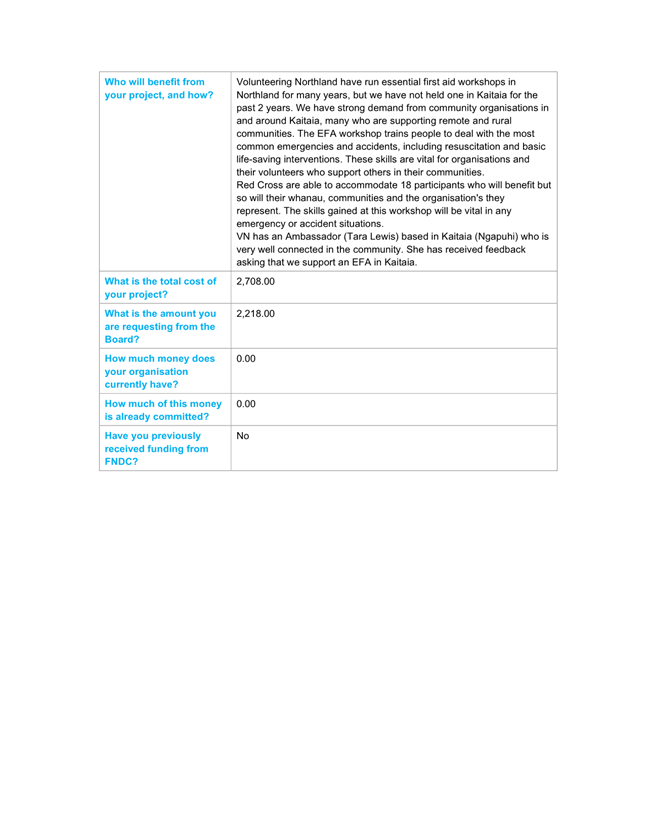
g) That Te Hiku
Community Board approve the sum of $2,218
(plus GST if applicable) be paid from the Board’s Community Grant Fund
account to Volunteering Northland for costs towards the costs of
running Red Cross Essential First Aid Workshop in Kaitaia.
|
|
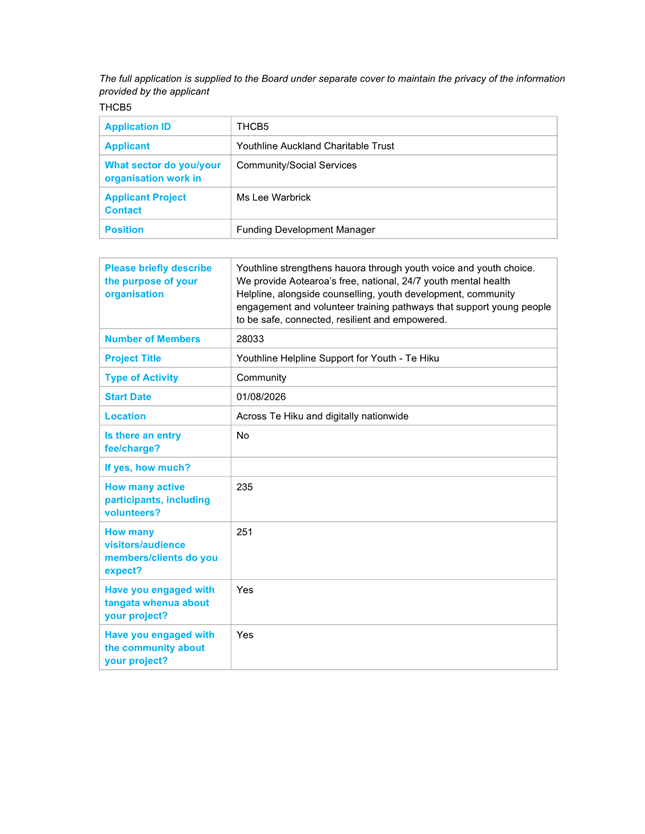
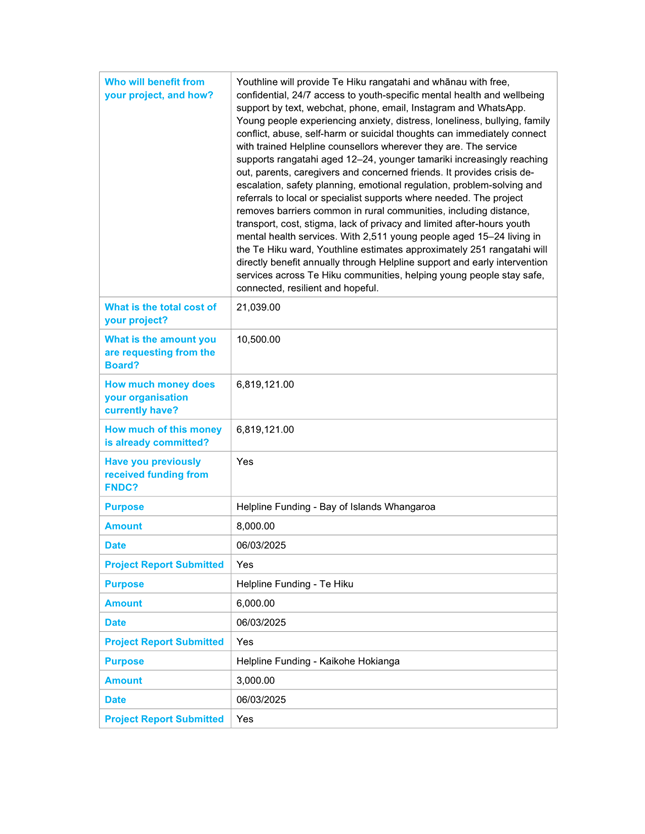
tŪtohunga / Recommendation
h) That Te Hiku
Community Board approve the sum of $5,000
(plus GST if applicable) be paid from the Board’s Community Grant Fund
account to Youthline Auckland Charitable Trust for costs towards the
costs of Youthline support for youth in Te Hiku.
|
1) TĀhuhu kŌrero / Background
The applications have been checked by staff for completeness
and comply with the conditions of the Community Grant Policy, Community
Outcomes as stated in the Long-Term Plan (LTP) and all provisions listed on the
application form.
2) matapaki me NgĀ KŌwhiringa /
Discussion and Options
|
Applicant and Project
|
Requested
|
Recommend
|
Comments
|
|
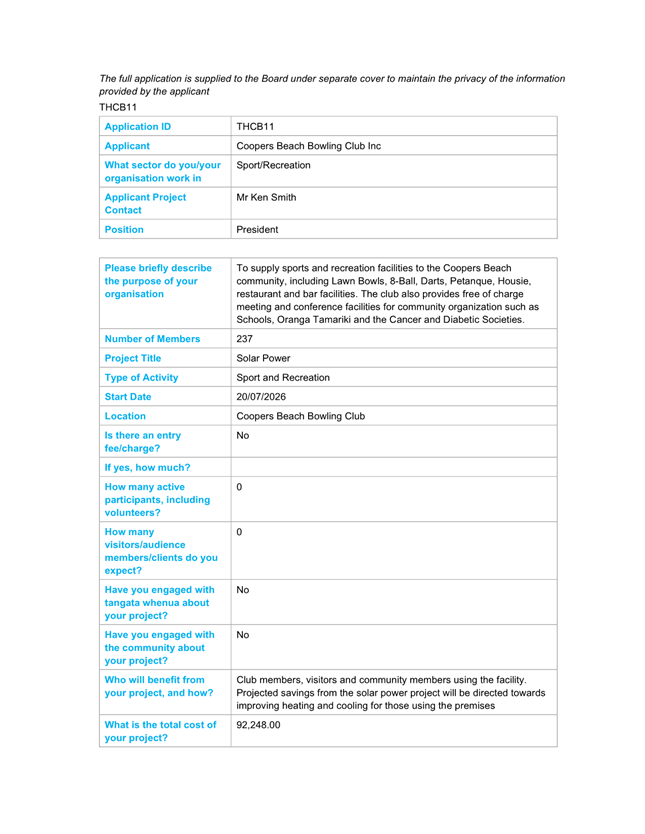
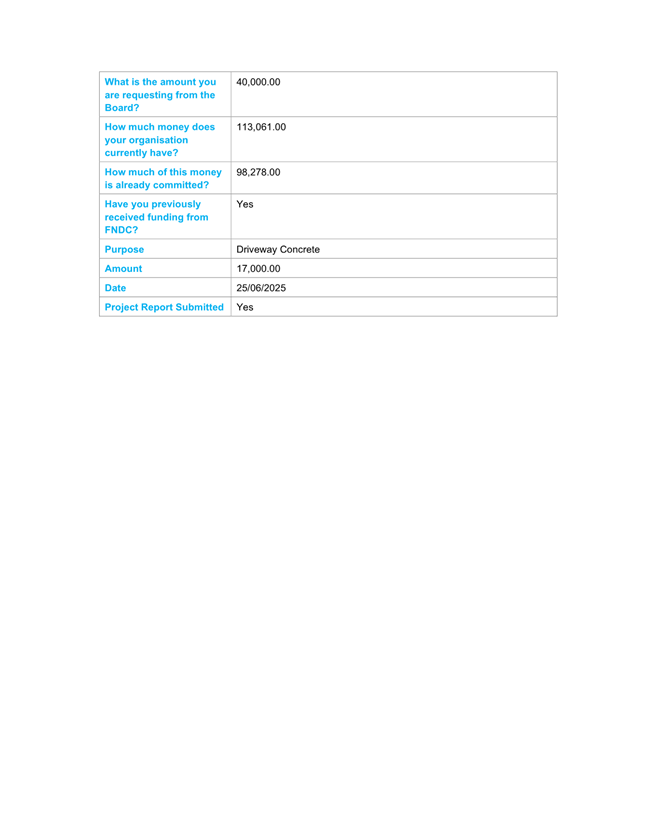
a) Coopers Beach
Bowling Club – Installation of solar power
|
$40,000
|
$10,000
|
The applicant has applied for
funding to install solar panels on the Coopers Beach Bowling Club.
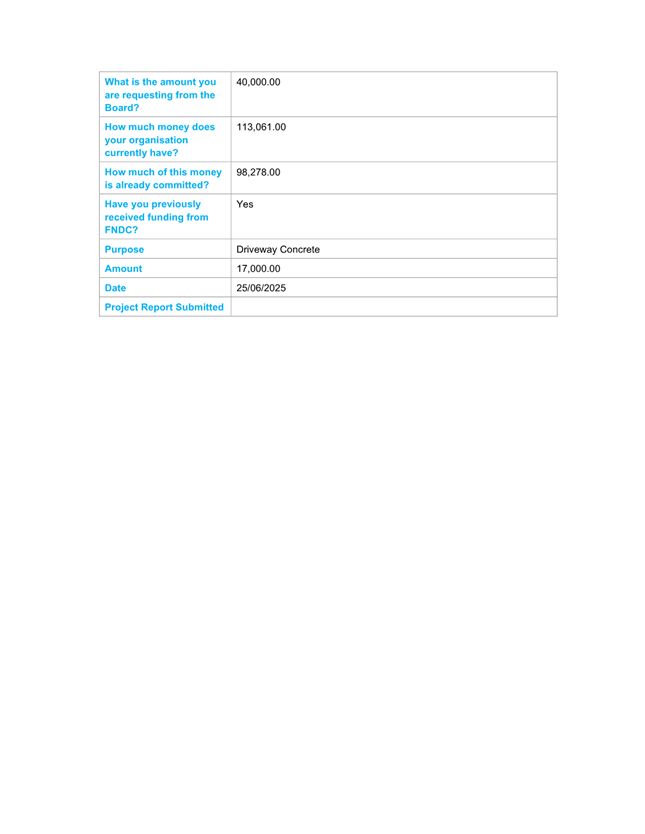
They have previously received
two grants towards concreting their carpark and the accessway to the State
Highway ($20,000 and $17,000). They are seeking funding from other
funding providers.
This meets community outcomes
3,5,6
|
|
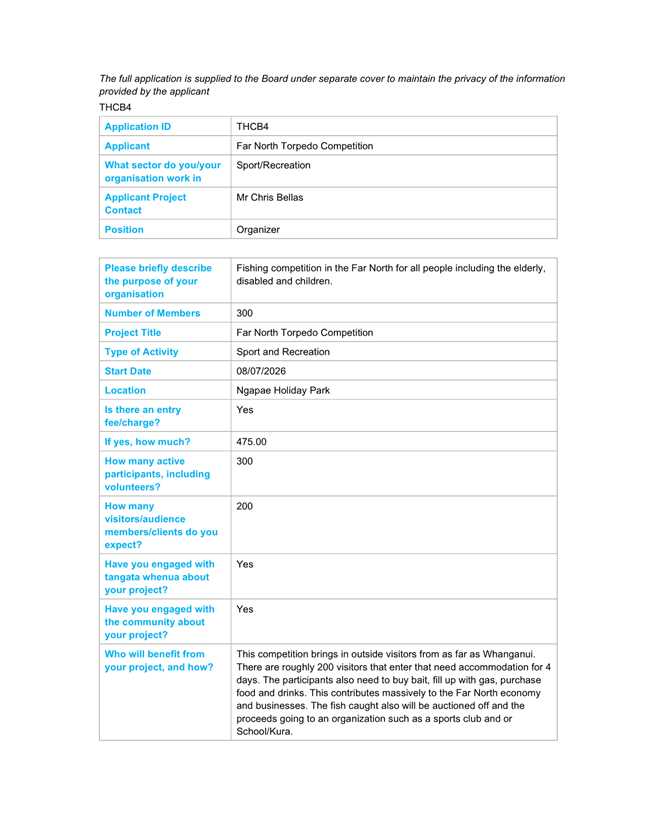
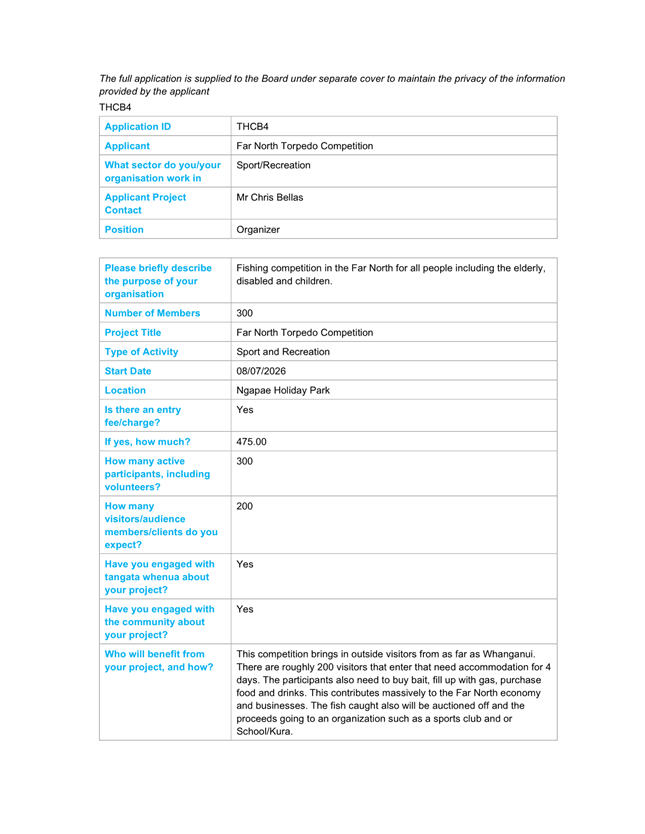
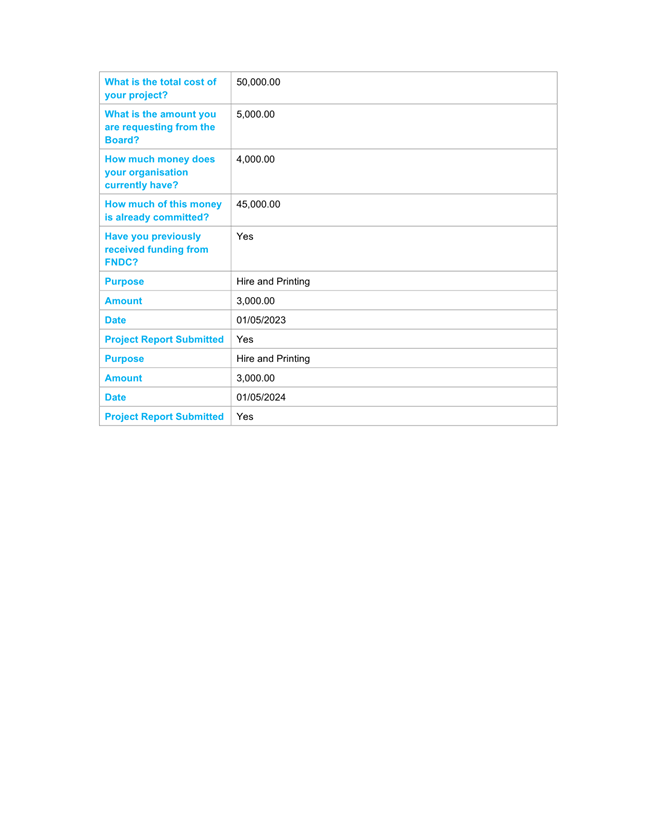
b) Far North
Torpedo Competition - Equipment hire and promotional material
|
$5,000
|
$5,000
|
The applicant is seeking funding
towards costs for running the annual Torpedo fishing competition. The
applicant previously received funds in June 2024 ($3,000).
This meets community outcomes
1,2,3,4,5
|
|
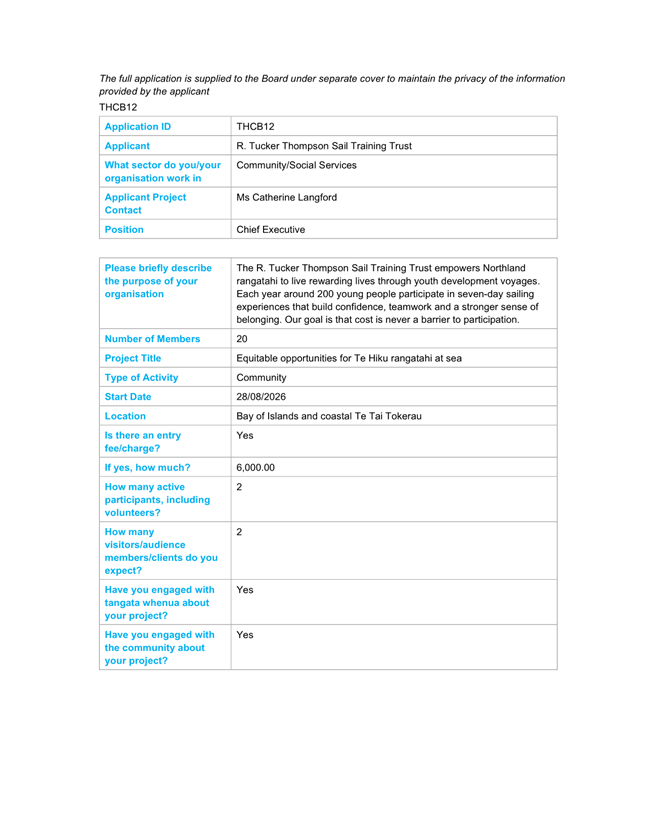
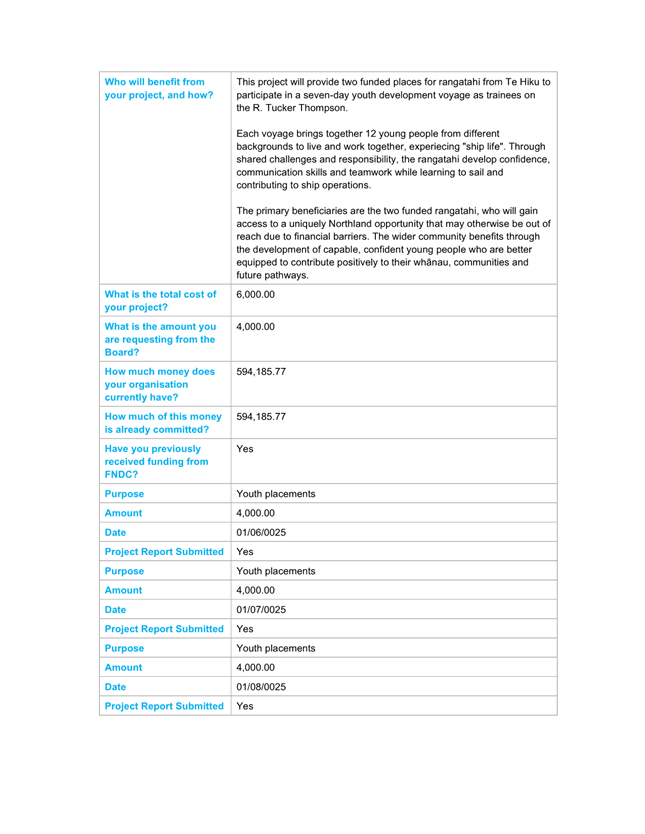
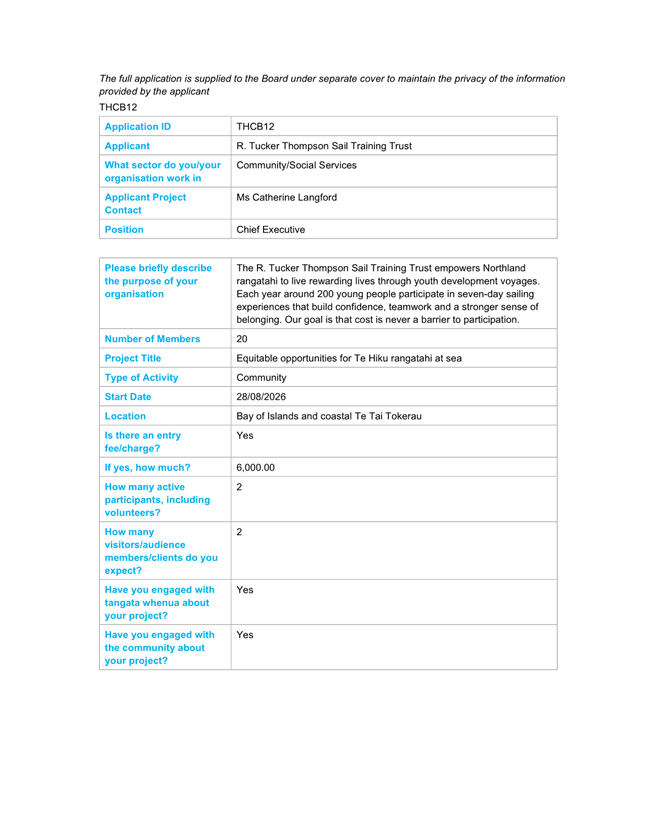
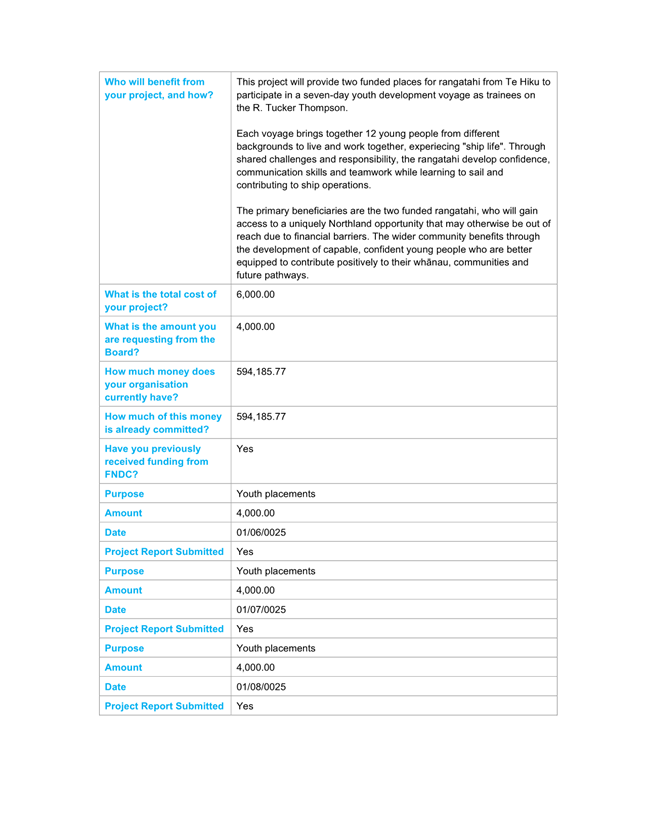
c) R Tucker
Thompson Sail Training Trust – Youth Development Voyage
|
$4,000
|
$4,000
|
The applicant has received
$4,000 per year for the past four years to enable two rangatahi from Te Hiku
ward to take part in a Youth Development voyage.
This meets community outcomes
2,3,5
|
|
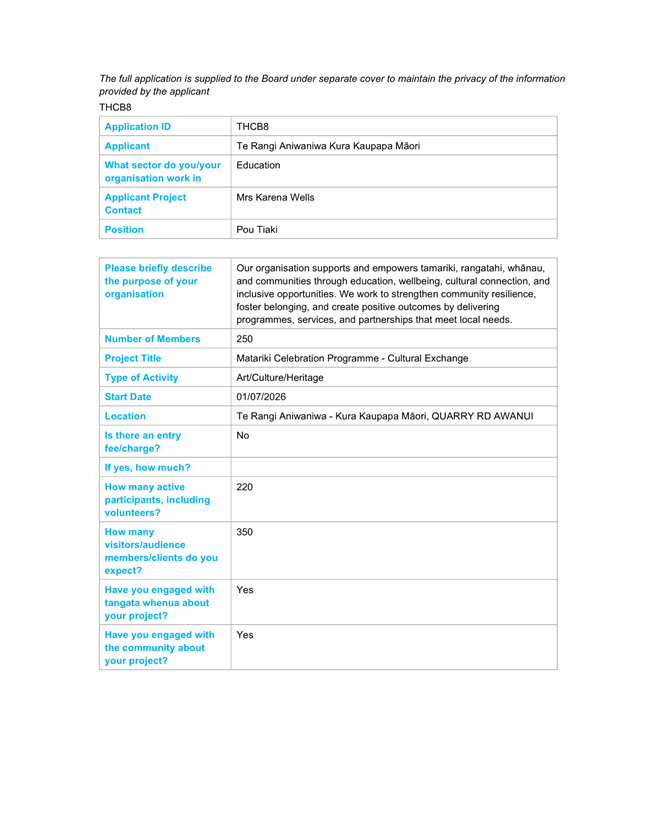
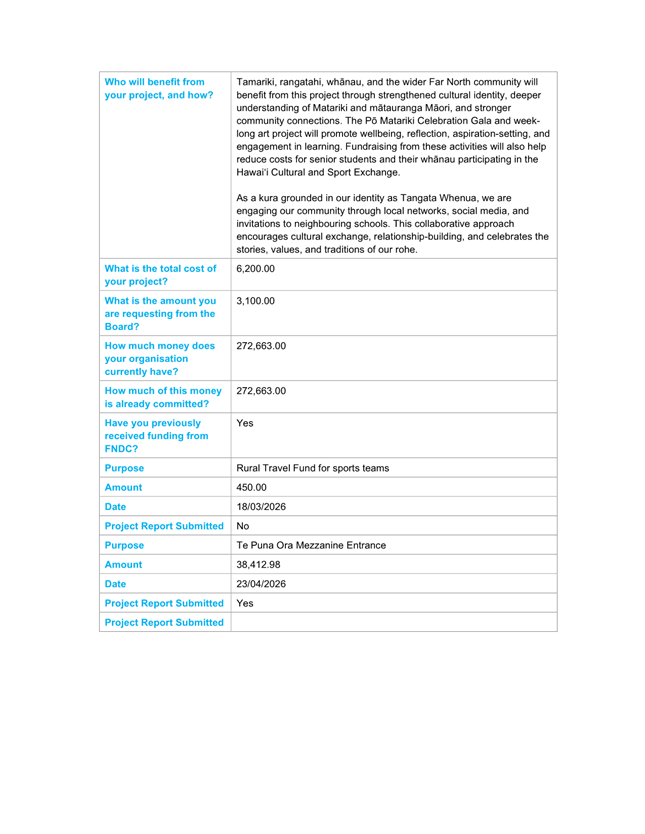
d) Te
Rangi Aniwaniwa Kura Kaupapa Māori – resources for cultural
performance and wood carving
|
$3,100
|
$3,100
|
The applicant is undertaking a
series of work for their Pō Matariki Celebration Gala. They are
creating resources to use to celebrate the festival, with the gala acting as
a fundraiser for senior students to travel to Hawai’I for a cultural
and sport exchange. While the kura does receive funding from the
Ministry of Education, this project is outside of the scope of what they will
fund.
This meets community outcomes 2,
3, 5
|
|
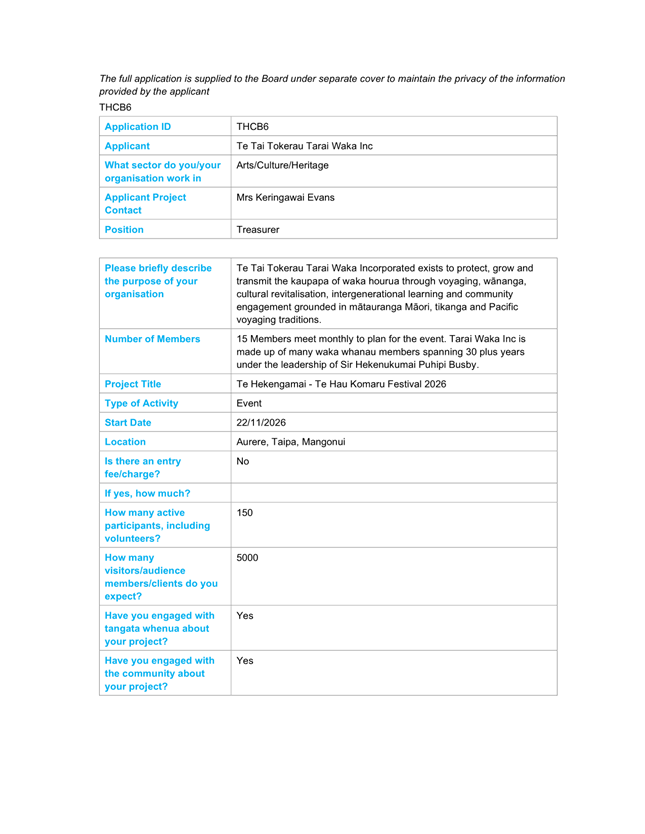
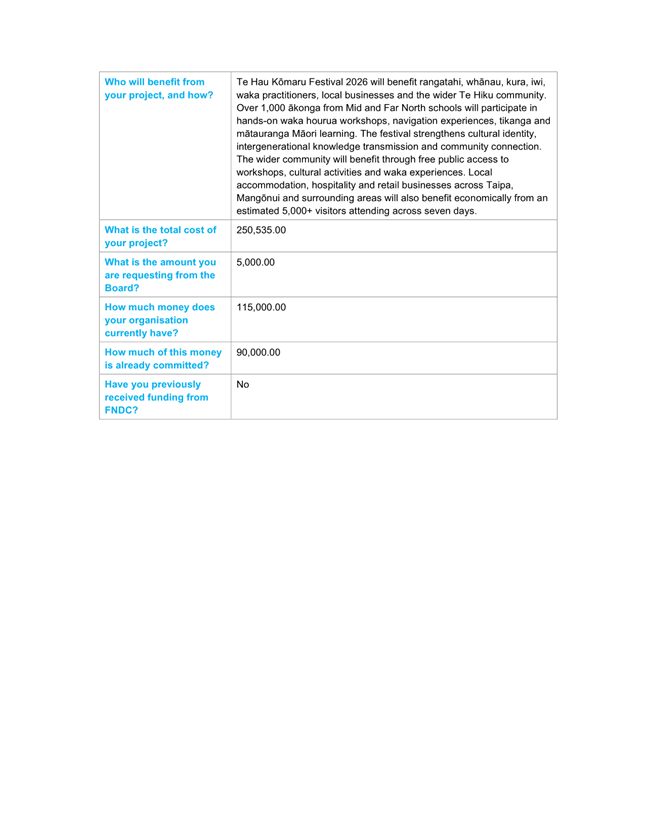
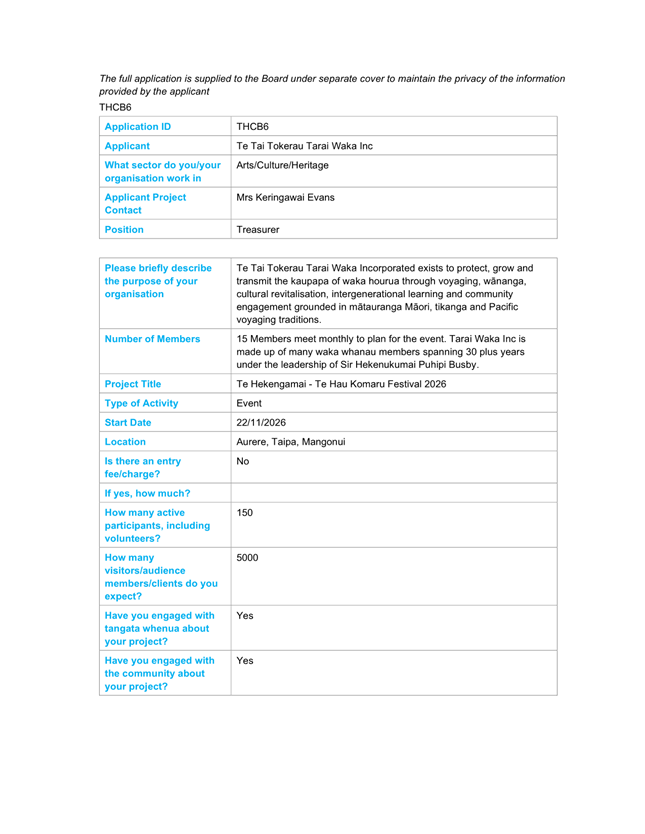
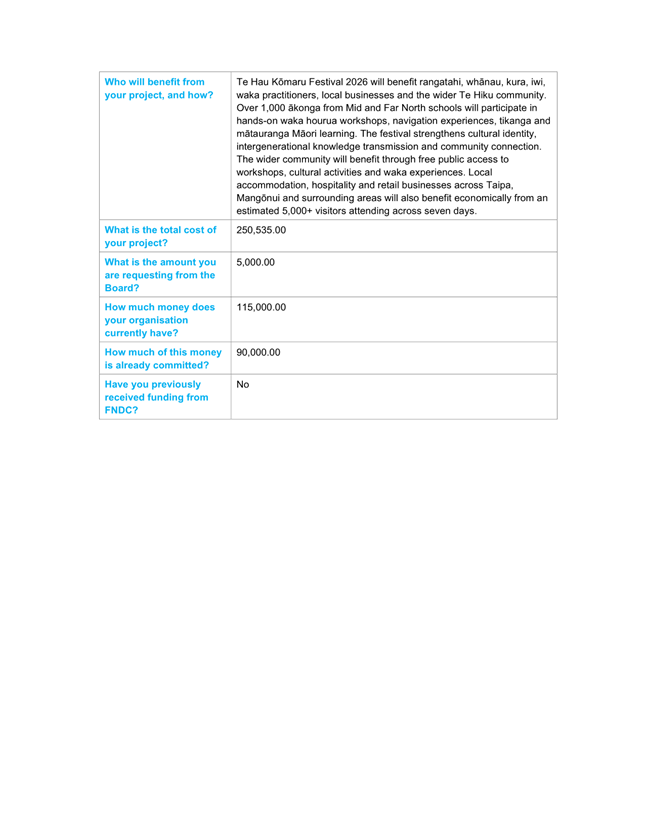
e) Te Tai Tokerau
Tarai Waka Inc - Te Hekengamai - Te Hau Komaru Festival 2026
|
$5,000
|
$5,000
|
The applicant is seeking funding
towards the costs of marae venue hire costs. They will be hosting over
1000 tamariki/rangatahi for the festival and have significant funding
applications under consideration by other organisations for the bulk of the
festival costs.
This meets community outcomes
1,2,3,4,5
|
|
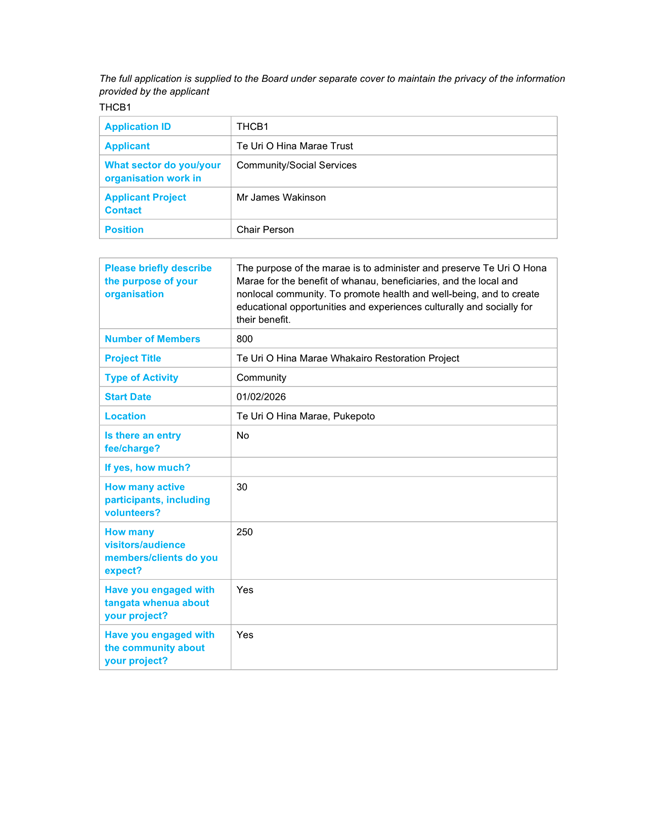
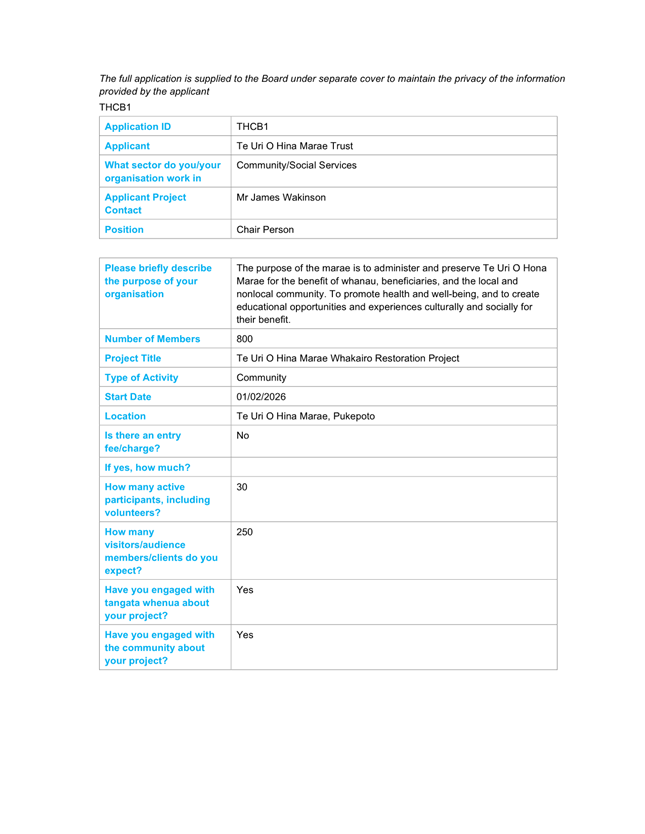
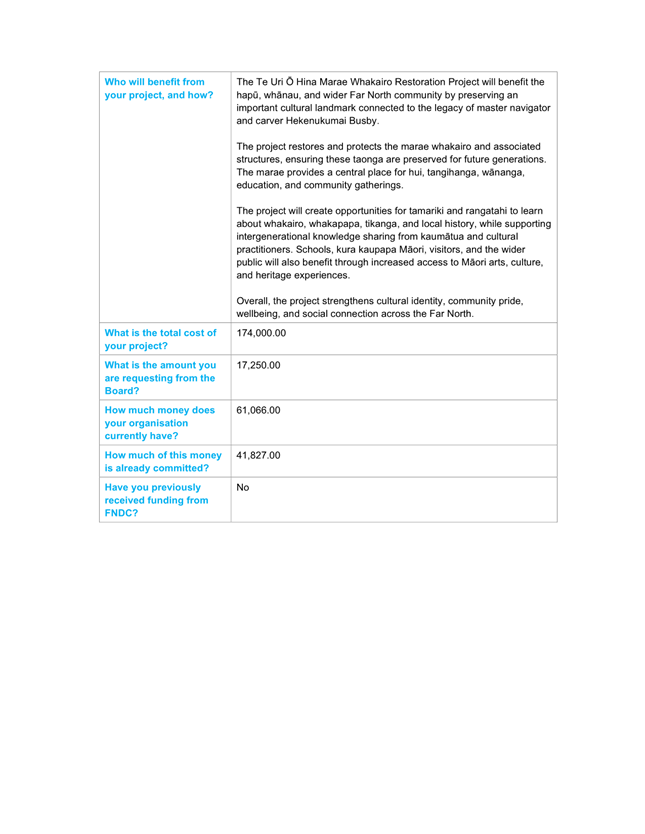
f) Te
Uri O Hina Marae Whakairo Restoration Project
|
$17,250
|
$17,250
|
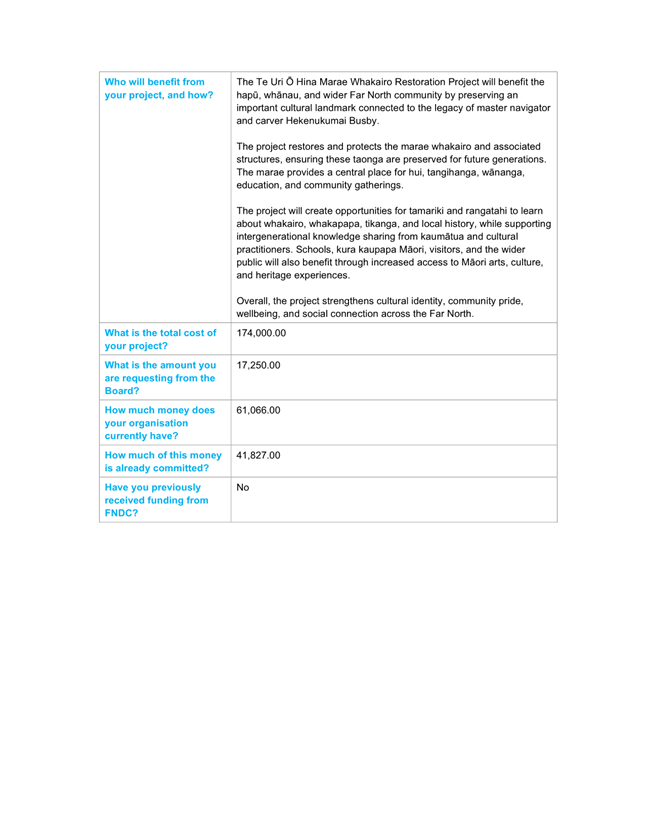
The applicant is a marae based
at Pukepoto and have secured the majority of the cost of this project through
funding applications to other organisations and general fundraising.
This amount is to help complete the restoration. They are using this as
an opportunity to use local tradespeople and to train the rangatahi of the
area.
This meets community outcomes
1,2,3,4,5,6
|
|
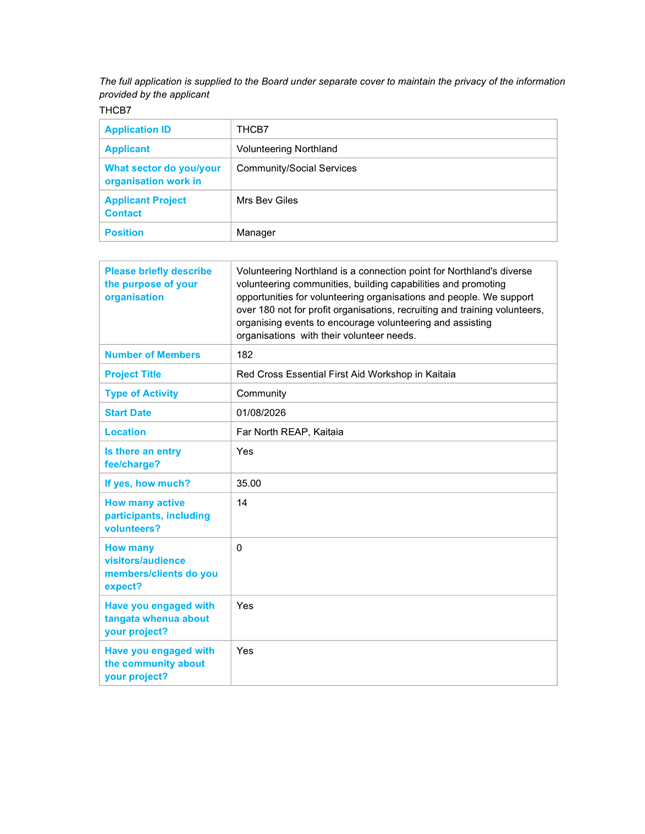
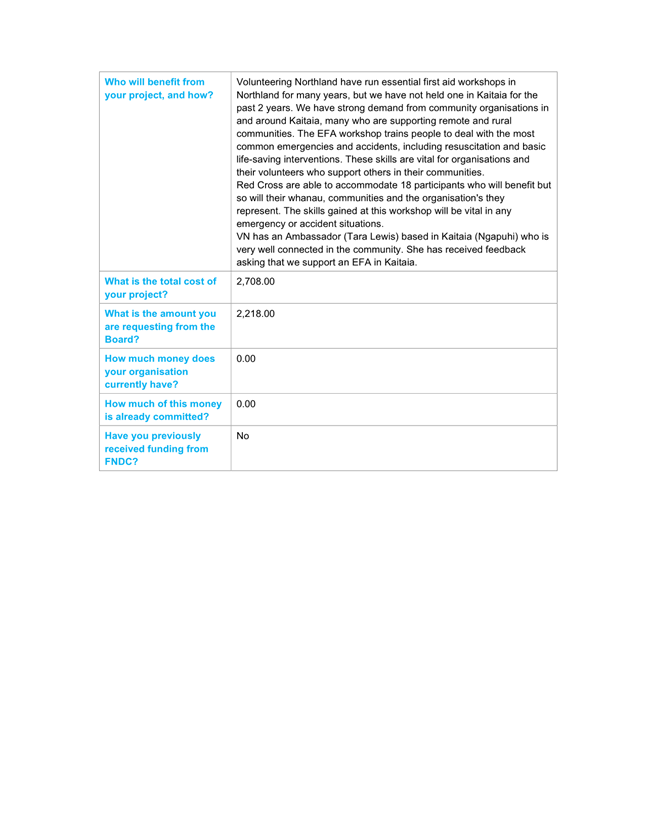
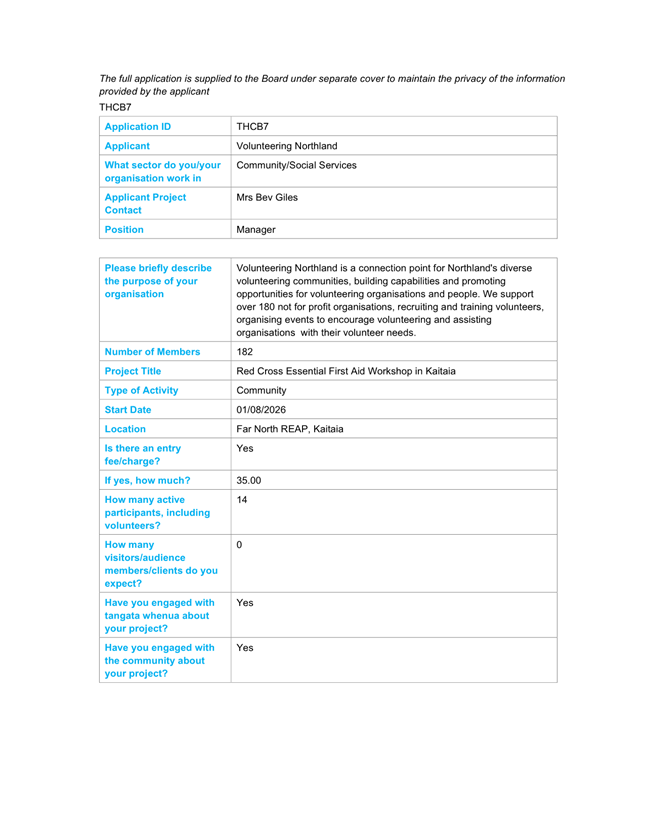
g) Volunteering
Northland – Community First Aid Classes
|
$2,218
|
$2,218
|
The applicant is seeking funding
to run a first aid course with Red Cross for volunteer organisation
members. There will be a nominal cost to attendees, and they are
seeking assistance for the balance of costs. This is more than 50% of
the total cost, so this would be an out of policy decision if the Board
agrees to grant the full requested amount.
This meets community outcomes
3,5,6
|
|
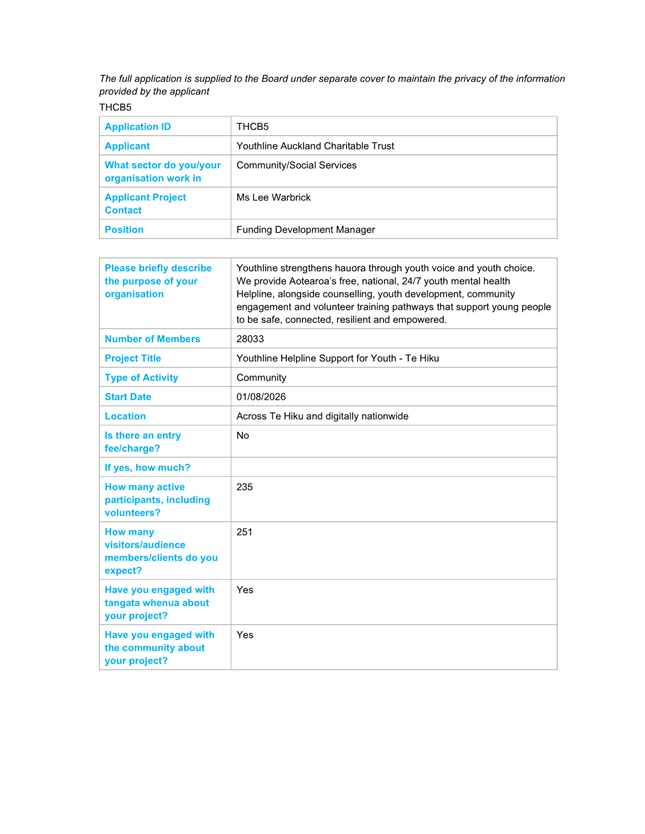
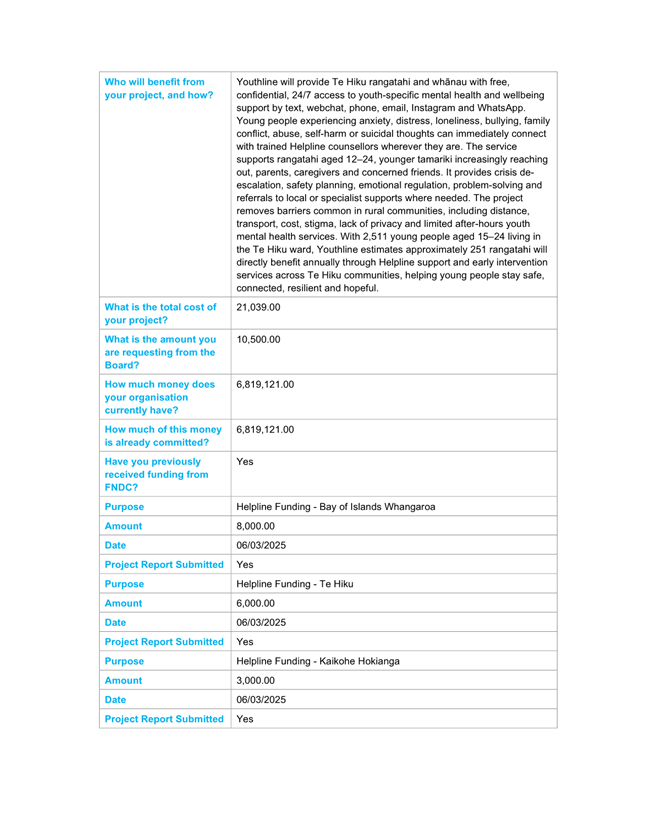
h) Youthline Auckland Charitable Trust -
Youthline Helpline Support for Youth - Te Hiku
|
$10,500
|
$5,000
|
The applicant is applying for
funding to help cover the costs of operating their Youthline services and
providing for the needs of youth in Te Hiku.
The board previously granted
them $3,000 in 2021 and $6,000 in 2025.
This meets community outcomes
1,2,3,5
|
TAKE
TŪTOHUNGA / REASON FOR THE RECOMMENDATION
The applicant is required to complete a standard application
form and provide supporting information.
For each application, the Board has three options.
Option 1 Authorise
funding for the full amount requested
Option 2 Authorise
partial funding
Option 3 Decline
funding
Each
application has been assessed and meets the criteria of the Community Grant
Policy, Community Outcomes as listed in the LTP, and the conditions listed on
the application form.
Each
application must meet at least one community outcome from the Council’s
Long Term Plan.
The six
community outcomes are as follows:
1. A
wisely managed and treasured environment that recognises the role of tangata
whenua as kaitiaki;
2. We
embrace and celebrate our unique culture and heritage and value it as a source
of enduring pride;
3. Proud,
vibrant communities;
4. Prosperous
Communities supported by a sustainable economy;
5. Communities
that are safe, connected and sustainable;
6. Communities
that are prepared for the unexpected.
3) PĀnga PŪtea me ngĀ
wĀhanga tahua / Financial Implications and Budgetary Provision
Budgetary provision has been made and the grant is allocated
in accordance with the Community Grant Policy.
Āpitihanga
/ Attachments
1. THCB
- Funding Application Summaries - July 2026 - A5821961 ⇩
Hōtaka Take Ōkawa / Compliance Schedule:
Full consideration has been given to the provisions of the
Local Government Act 2002 S77 in relation to decision making, in particular:
1. A
Local authority must, in the course of the decision-making process,
a) Seek
to identify all reasonably practicable options for the achievement of the
objective of a decision; and
b) Assess
the options in terms of their advantages and disadvantages; and
c) If
any of the options identified under paragraph (a) involves a significant
decision in relation to land or a body of water, take into account the
relationship of Māori and their culture and traditions with their
ancestral land, water sites, waahi tapu, valued flora and fauna and other
taonga.
2. This
section is subject to Section 79 - Compliance with procedures in relation to
decisions.
|
He Take Ōkawa /
Compliance Requirement
|
Aromatawai Kaimahi /
Staff Assessment
|
|
State the level of significance (high or low) of the
issue or proposal as determined by the Council’s
Significance and Engagement Policy
|
This is a matter of low significance.
|
|
State the relevant Council policies (external or
internal), legislation, and/or community outcomes (as stated in the LTP) that
relate to this decision.
|
Community Board Funding Policy and Te Pae o Uta.
|
|
State whether this issue or proposal has a District wide
relevance and, if not, the ways in which the appropriate Community
Board’s views have been sought.
|
This report does not have district-wide relevance.
|
|
State the
possible implications for Māori and how Māori have been provided
with an opportunity to contribute to decision making if this decision is
significant and relates to land and/or any body of water.
State the
possible implications and how this report aligns with Te Tiriti o Waitangi /
The Treaty of Waitangi.
|
No implications for Māori in relation to land
and/or water.
|
|
Identify persons likely to be affected by or have an
interest in the matter, and how you have given consideration to their views
or preferences (for example – youth, the aged and those with
disabilities).
|
Considered in the application.
|
|
State the financial implications and where budgetary
provisions have been made to support this decision.
|
Budgetary Provision has been made and the grant is
allocated in accordance with the Community Grant Policy.
|
|
Chief Financial Officer review.
|
The Chief Financial Officer has not reviewed this
report.
|
7.4 Project
Funding Reports
File
Number: A5822037
Author: Kathryn
Trewin, Funding Advisor
Authoriser: Aisha
Huriwai, Manager - Democracy Services
Take Pūrongo / Purpose of the Report
Recipients of funds from the
Community Board’s Local Grant Fund must complete and submit a project
report no later than two months after the completion of their project.
|
tŪtohunga
/ Recommendation
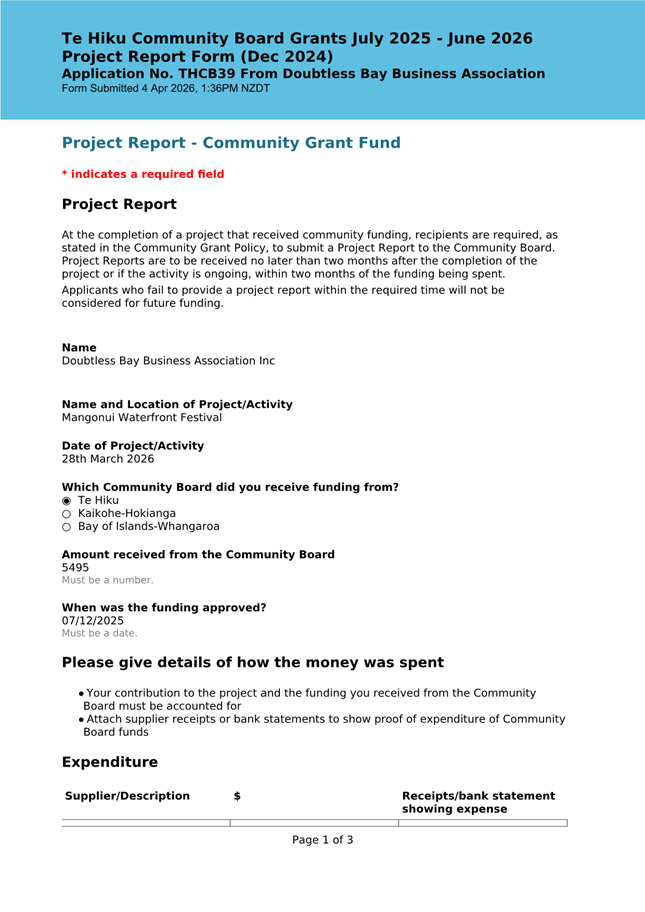
That Te Hiku Community Board note the project
reports received from:
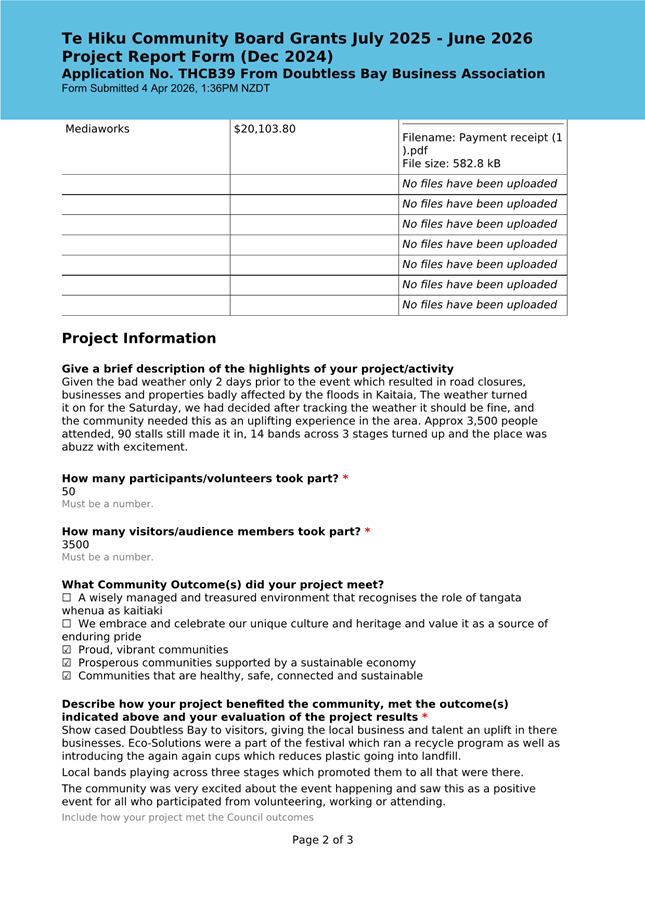
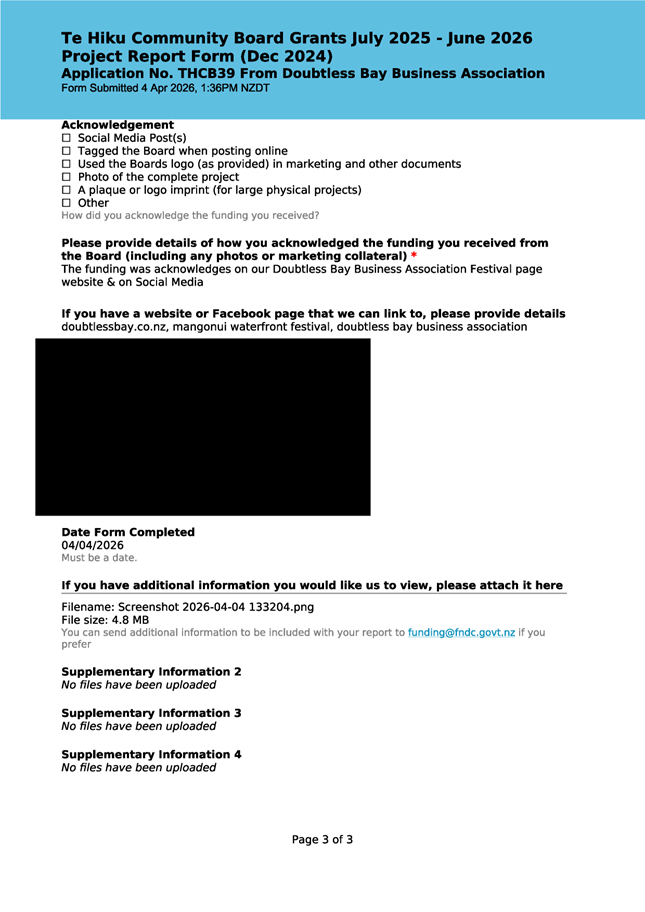
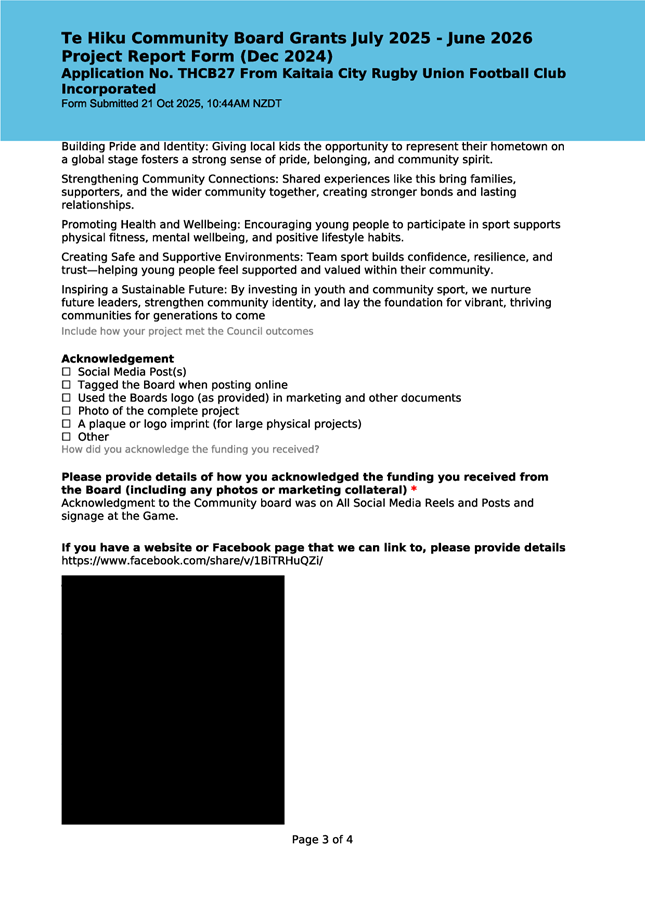
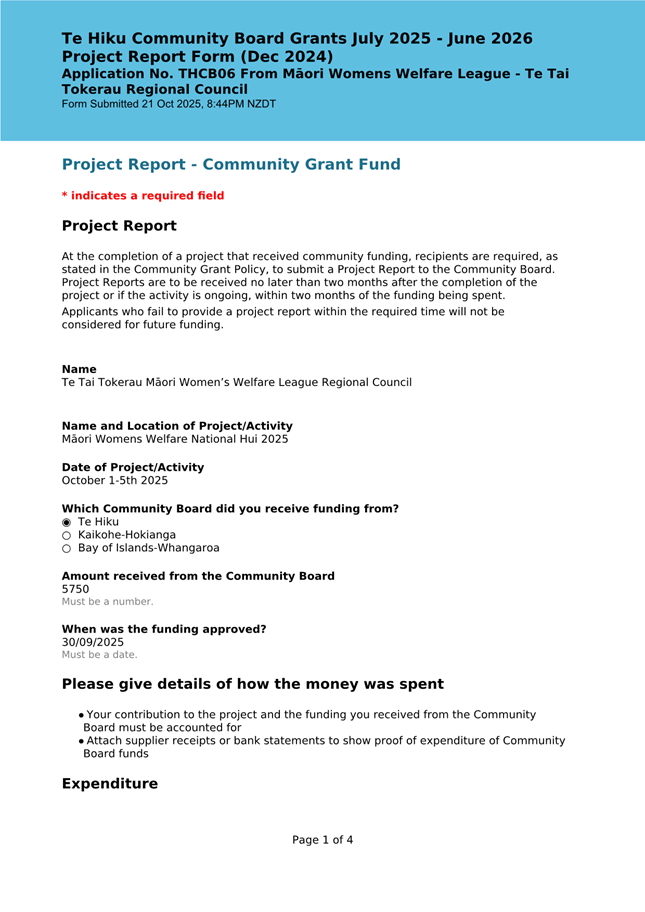
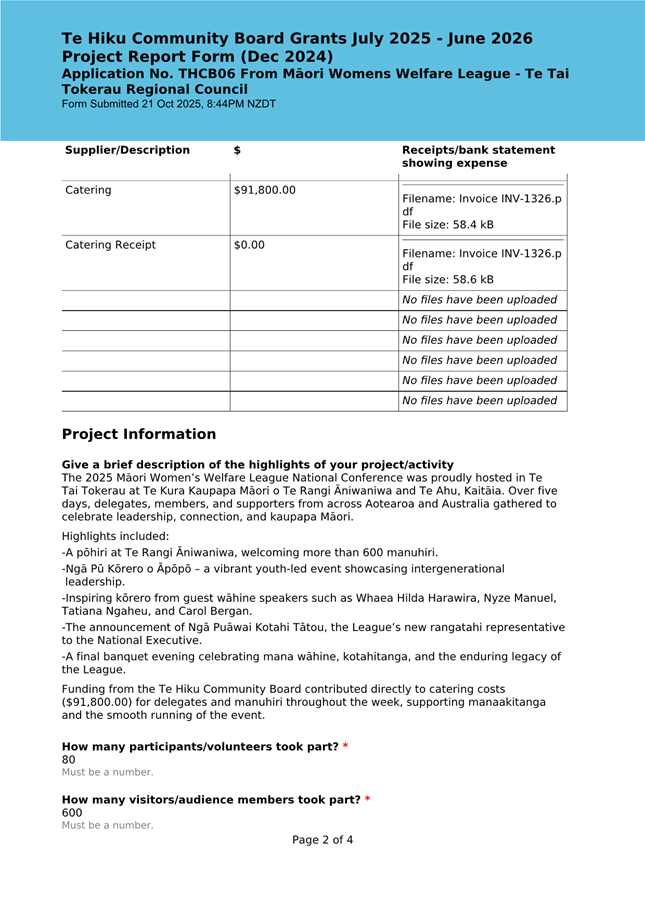
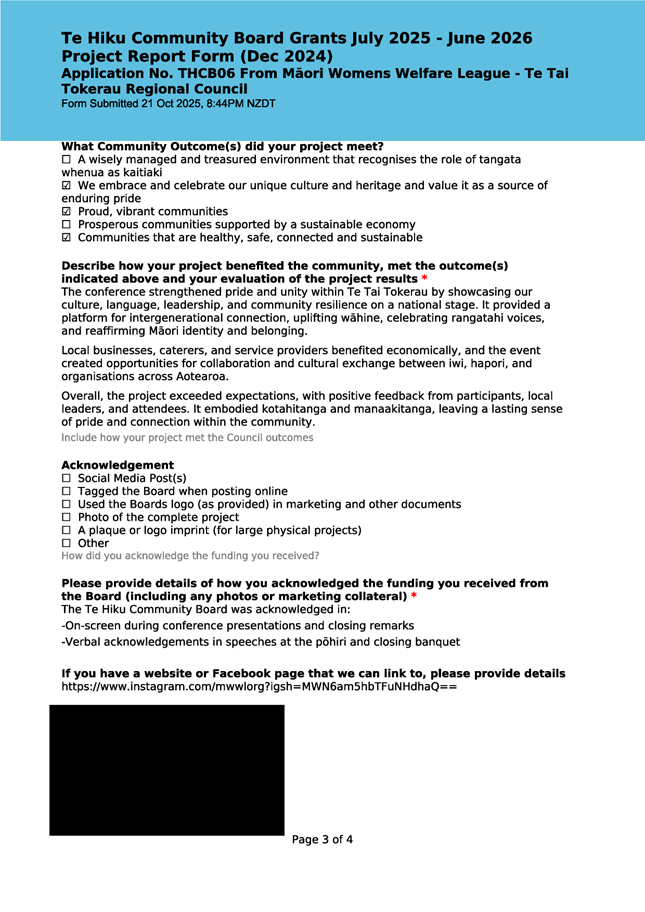
a) Doubtless
Bay Business Association
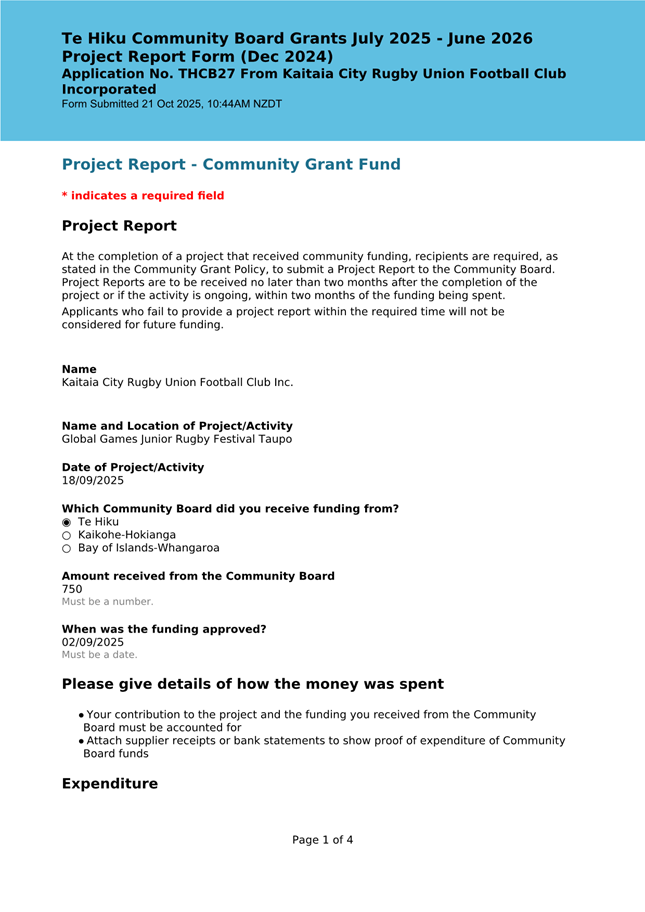
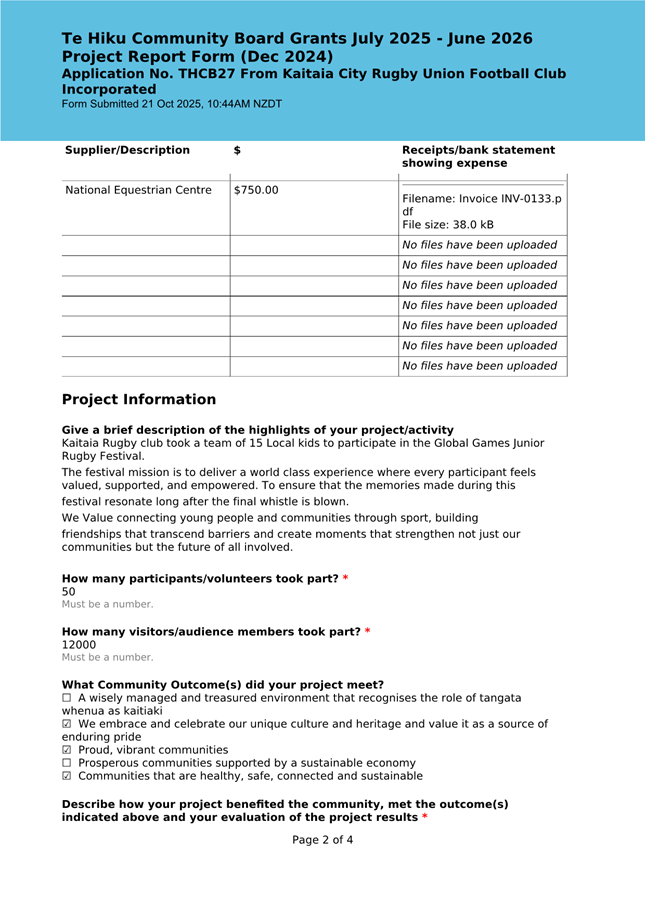
b) Kaitaia
City Rugby Union Football Club
c) Māori
Womens Welfare League
|
1) TĀhuhu kŌrero / Background
Clause 15 of the Community Grant Policy states that:
“At the completion of a project that received community funding,
recipients are required to complete a Project Report. These reports must be
received no later than two months after the completion of the project, or, if
the activity is ongoing, within two months of the funding being spent.
Recipients who do not complete this form are ineligible for Council funding for
a period of five years.”
2) matapaki me NgĀ KŌwhiringa /
Discussion and Options
Copies of the
project reports are attached for the Board’s information. Should Board
members have concerns or issues with these reports, these should be discussed
at this part of the meeting.
TAKE
TŪTOHUNGA / REASON FOR THE RECOMMENDATION
To receive the project reports from
funding applicants in accordance with the Community Grant Policy.
3) PĀnga PŪtea me ngĀ
wĀhanga tahua / Financial Implications and Budgetary Provision
There are no financial implications or budgetary
requirements.
Āpitihanga
/ Attachments
1. Doubtless
Bay Business Association - A5822031 ⇩ 
2. Kaitaia
City Rugby Union Football Club - A5822032 ⇩ 
3. Maori
Womens Welfare League - A5822033 ⇩
Hōtaka Take Ōkawa / Compliance Schedule:
Full consideration has been given to the provisions of the
Local Government Act 2002 S77 in relation to decision making, in particular:
1. A
Local authority must, in the course of the decision-making process,
a) Seek
to identify all reasonably practicable options for the achievement of the
objective of a decision; and
b) Assess
the options in terms of their advantages and disadvantages; and
c) If
any of the options identified under paragraph (a) involves a significant
decision in relation to land or a body of water, take into account the
relationship of Māori and their culture and traditions with their
ancestral land, water sites, waahi tapu, valued flora and fauna and other
taonga.
2. This
section is subject to Section 79 - Compliance with procedures in relation to
decisions.
|
He
Take Ōkawa / Compliance Requirement
|
Aromatawai
Kaimahi / Staff Assessment
|
|
State the level of significance
(high or low) of the issue or proposal as determined by the Council’s
Significance and Engagement Policy
|
This is a matter of low
significance.
|
|
State the relevant Council
policies (external or internal), legislation, and/or community outcomes (as
stated in the LTP) that relate to this decision.
|
Community Board Funding Policy,
Te Pae o Uta
|
|
State whether this issue or
proposal has a District wide relevance and, if not, the ways in which the
appropriate Community Board’s views have been sought.
|
It is the responsibility of each
Community Board to confirm the funding that they allocated has been spent
correctly.
|
|
State the possible implications for Māori
and how Māori have been provided with an opportunity to contribute to
decision making if this decision is significant and relates to land and/or
any body of water.
|
There are no implications on Māori in confirming the project
reports. Any implications on Māori arising from matters included in
project reports should be considered as part of the relevant report.
|
|
Identify persons likely to be
affected by or have an interest in the matter, and how you have given
consideration to their views or preferences (for example – youth, the
aged and those with disabilities).
|
This report is asking for the
project reports to be approved, any interests that affect other people should
be considered as part of the individual reports.
|
|
State the financial implications
and where budgetary provisions have been made to support this decision.
|
There are no financial
implications or the need for budgetary provision.
|
|
Chief Financial Officer review.
|
The Chief Financial Officer has
not reviewed this report.
|
8 Ngā
Pūrongo Taipitopito / Information Reports
8.1 Chairperson
and Members Reports
File
Number: A5816066
Author: Beverly
Mitchell, Community Board Coordinator
Authoriser: Aisha
Huriwai, Manager - Democracy Services
TE TAKE PŪRONGO / Purpose of the Report
The report provides feedback to the community on matters of
interest or concern to the Community Board.
|
NGĀ
TŪTOHUNGA / Recommendation
That Te Hiku
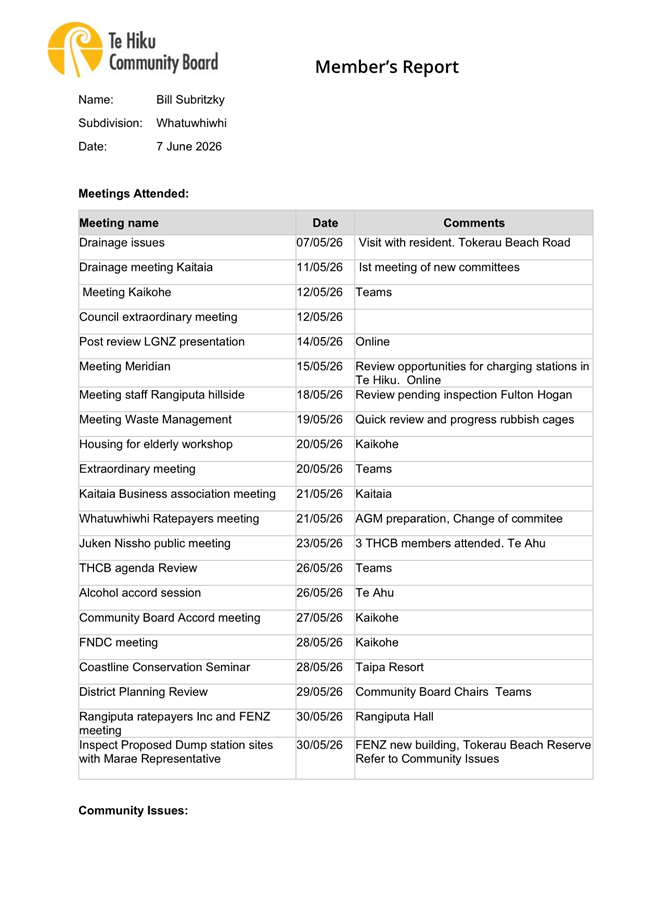
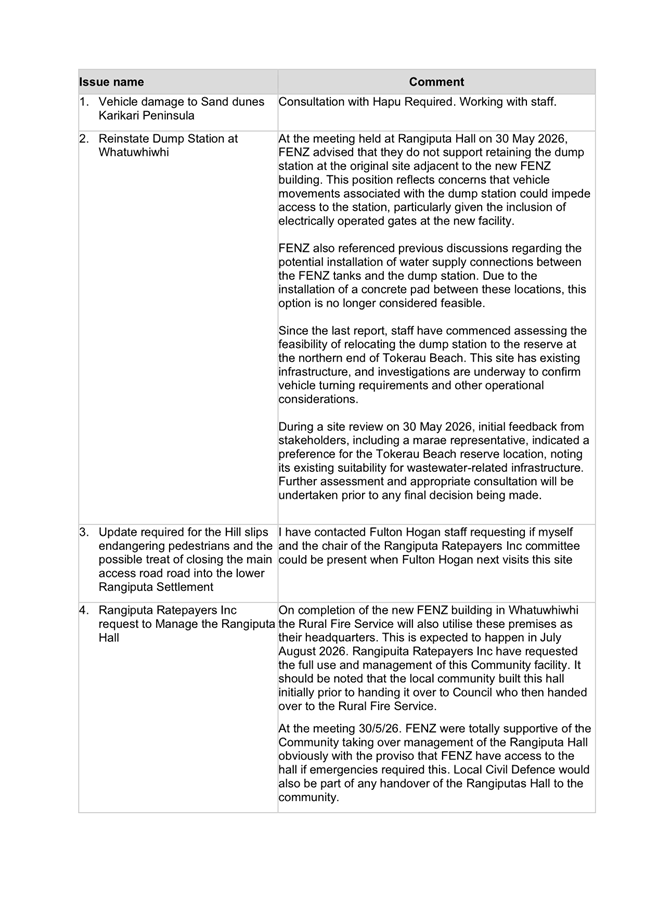
Community Board note the 29 June 2026 member reports from Chairperson Bill
Subritzky, Deputy Chairperson and members: Adele Gardner, Krystal-Rose Taaffe
and Eddie Bellas.
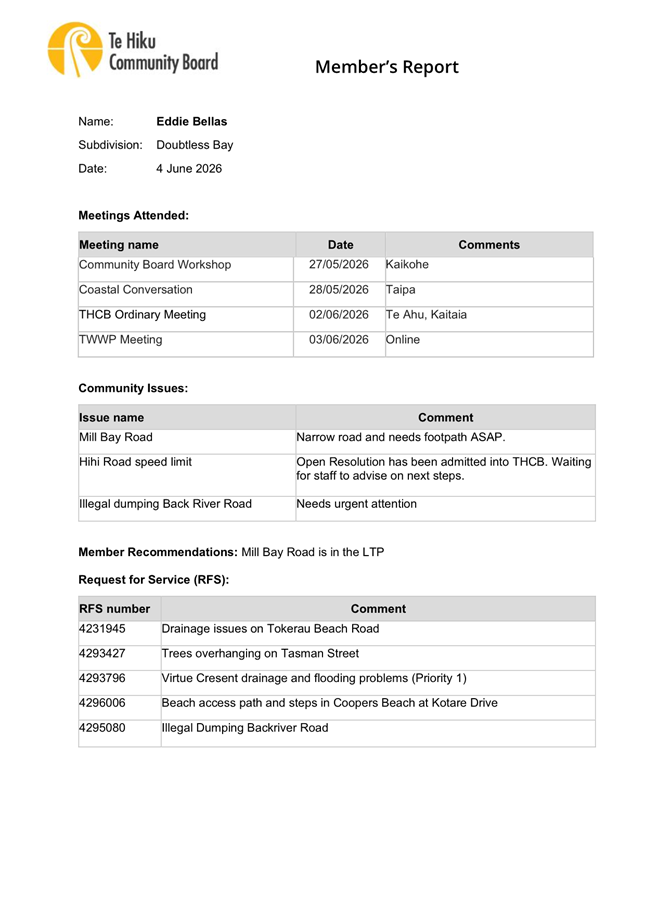
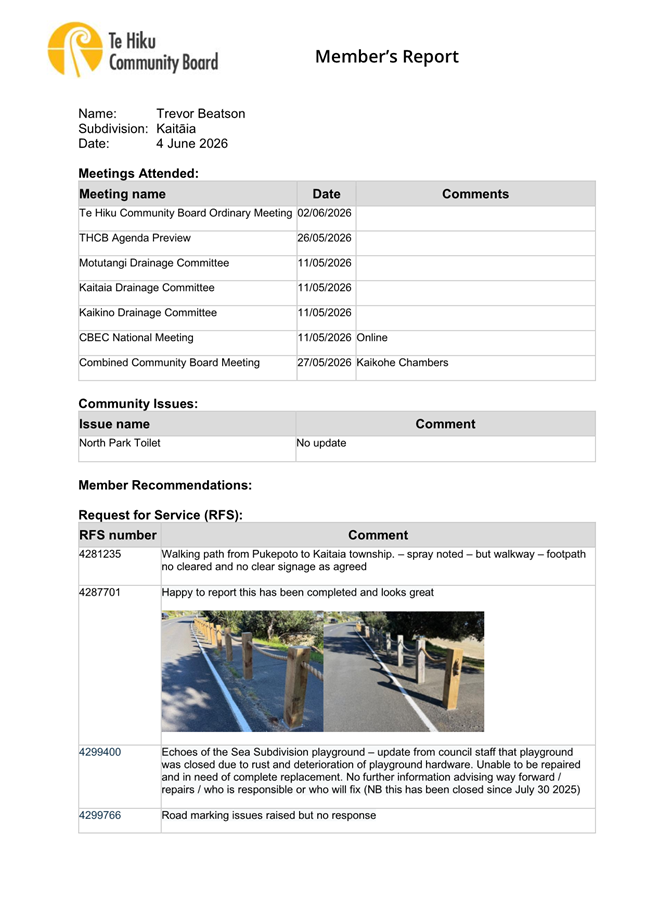
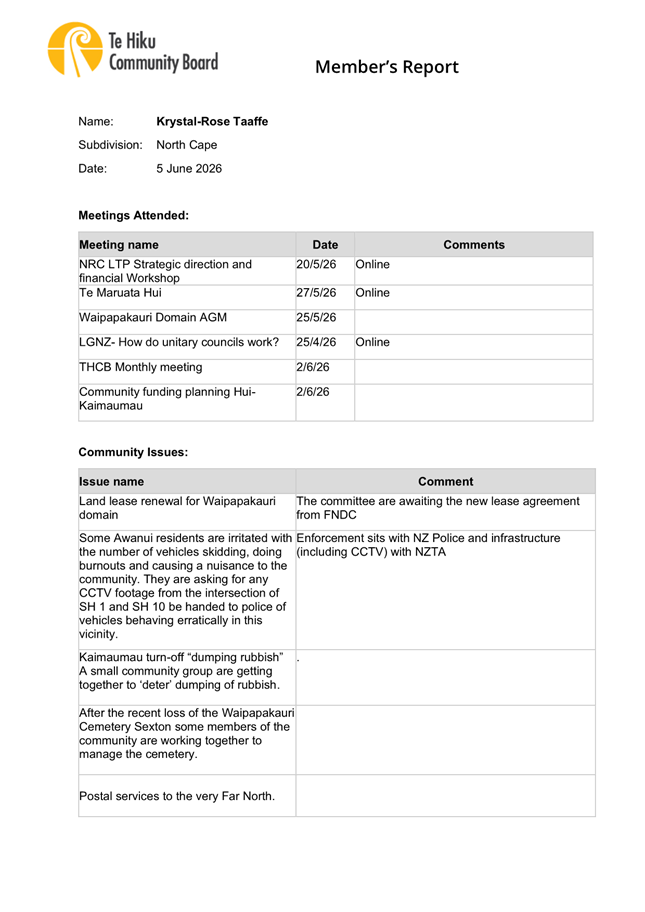
|
TE tĀHUHU KŌRERO / Background
The Local Government Act 2002 Part
4 Section 52 states that the role of a Community Board is to represent, and act
as an advocate for the interests of its community.
TE MATAPAKI ME NGĀ KŌWHIRINGA /
Discussion and Next Steps
Community Boards are required to
consider and report on any matters of concern or interest to the Community
Board, maintain an overview of services provided to the community and
communicate with community organisations and special interest groups within the
community.
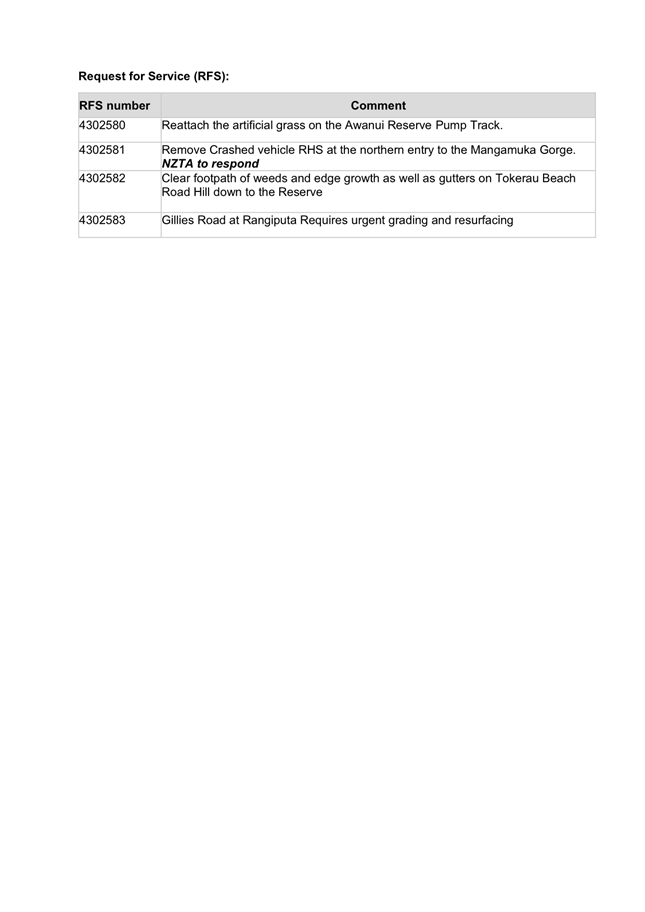
The reports from the Chairperson
and Members provide information to community on these requirements. They
also provide Request for Service (RFS) information on issues of interest or
concern to the Community Board, providing a reference for further enquiry on
the progress of the matters raised. The report from the Chairperson and members
are attached.
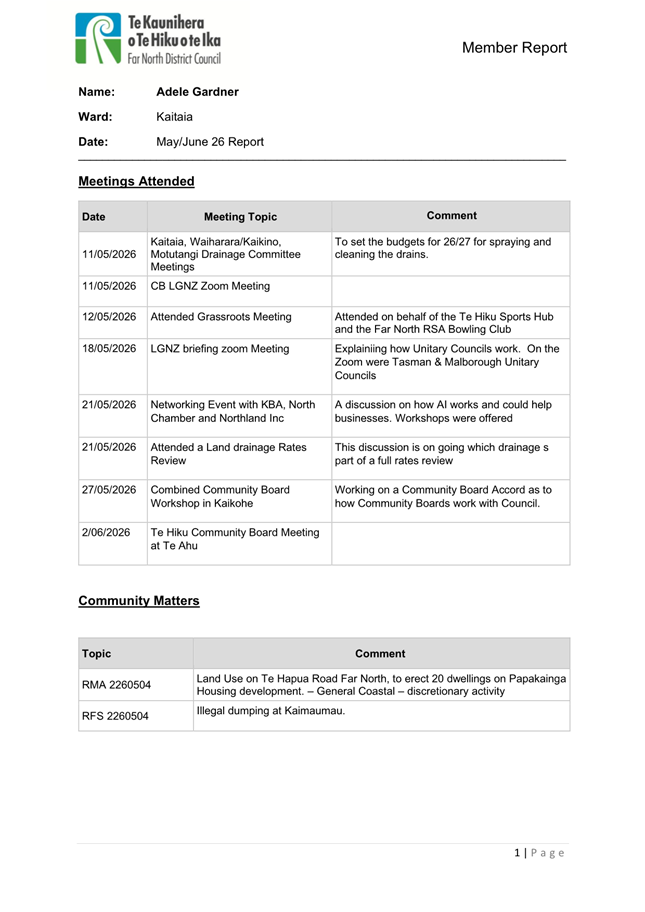
Resource Consents have been emailed
to community board members. Members have five days to send feedback in relation
to a resource consent. Members will be expected to include these details in
their member reports going forward.
REASON FOR THE RECOMMENDATION
The reason for the recommendation
is to provide information to the Community on the work that has been undertaken
by the Chairperson and Members on its behalf.
NGĀ PĀNGA PŪTEA ME NGĀ
WĀHANGA TAHUA / Financial Implications and Budgetary Provision
There are no financial implications
or the need for budgetary provision as a result of this report.
ngĀ
Āpitihanga / Attachments
1. 2026-06-29
Chair B Subritzky report - A5816767 ⇩
2. 2026-06-29
A Gardner member report - A5816502 ⇩
3. 2026-06-29
E Bellas member report - A5816819 ⇩
4. 2026-06-29
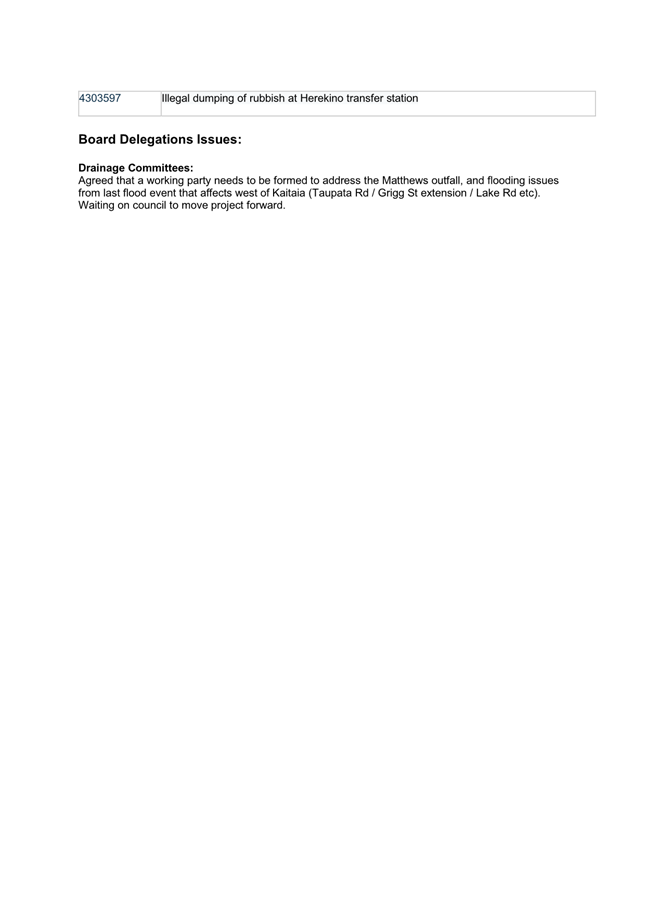
Dept Chair T Beatson report - A5823185 ⇩
5. 2026-06-29
K Taaffe member report - A5826210 ⇩
8.2 2025
- 26 End of Year Funding Report
File
Number: A5822634
Author: Kathryn
Trewin, Funding Advisor
Authoriser: Aisha
Huriwai, Manager - Democracy Services
TAKE PŪRONGO / Purpose of the Report
This report provides the
Board with an overview of the funding applications and decisions made in the
2025-26 financial year. It is noted that this does not include the
applications and decisions received and made at the meeting on 29 June 2026.
WHAKARĀPOPOTO MATUA / Executive SummarY
· The
Board considered 47 applications in the 2025-26 financial year (not including
the meeting of 29 June 2026).
· Applications
were broadly classified into six categories, with Events and Community projects
being most received.
· It
is noted there was a drop in applications in the lead up to (and after) the
local body elections in October 2025.
|
TŪTOHUNGA
/ Recommendation
That Te Hiku Community Board receive the report 2025 -
26 End of Year Funding Report.
|
tĀHUHU KŌRERO / Background
Each year, the Funding
Advisor receives and processes funding applications for the Board to help them
make decisions on what community applicants receive funding for their
projects. This report provides the Board with information about their
decisions in the 2025-26 financial year.
At the start of the
2025-26 financial year, the Board had $100,000 allocated for Pride of Place
funding and $146,811 for Community Grant funding.
The $146,811 is generated
from rates specifically collected within Te Hiku Ward.
MATAPAKI ME NGĀ KŌWHIRINGA /
Discussion and Next Steps
During the year, 47
applications for funding were received. It is noted that with the local
body elections taking place in late 2025, this affected the number of
applications received. No applications were considered in October (the month of
the elections) and January (when no meeting was held).
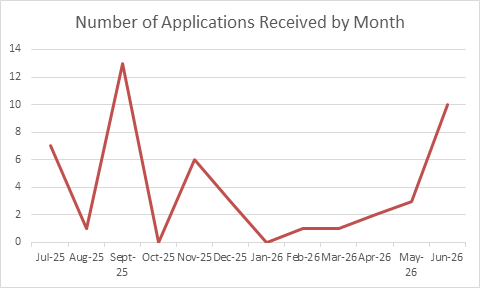
Applications received were considered in six
categories: Art/Culture/Heritage, Community, Environmental, Event,
Infrastructure and Sport/Recreation. As in previous years, the bulk of
applications are received for projects classified as Events (17) and Community
(11).
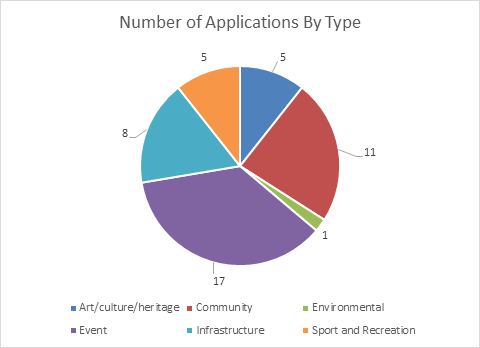
Each year, the amount of
funding requested is substantially more than the amount of funding the Board
has available to grant.
The Events and Community
sectors of funding applications are the largest requesters of funding, although
Infrastructure, which is typically larger projects involving construction, has
a high monetary value.
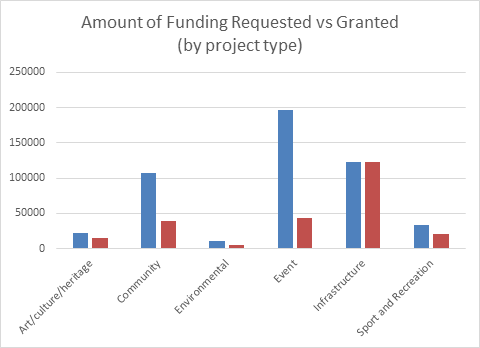
Being the main urban centre in Te Hiku Ward, Kaitaia is the
base of the bulk of applications, but they have been received from across the
rest of the ward, as well as applications that are for the benefit of the wider
ward, rather than just centralised in one community.
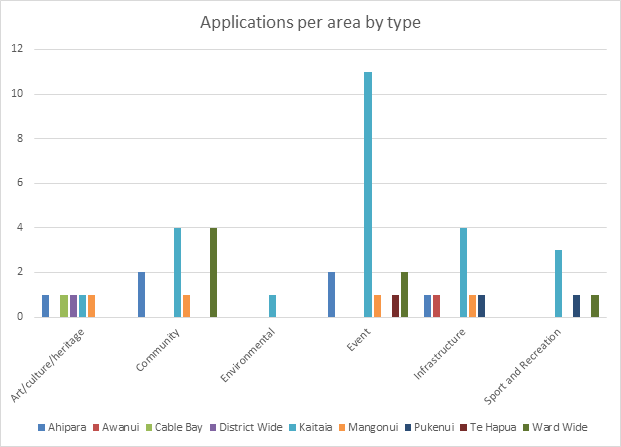
A list of all the
applications received by the Board is attached for information.
PĀNGA PŪTEA ME NGĀ WĀHANGA
TAHUA / Financial Implications and Budgetary Provision
This report has no financial implications or budgetary
provision from the Board.
Āpitihanga
/ Attachments
1. List
of Funding Applications received 2025-26 FY - A5822615 ⇩ 
8.3 THCB
Open Resolutions Report
File
Number: A5822923
Author: Natasha
Rmandic, Democracy Advisor
Authoriser: Aisha
Huriwai, Manager - Democracy Services
TAKE PŪRONGO / Purpose of the Report
To provide Te Hiku
Community Board with an overview of outstanding resolutions and actions for Te
Hiku Community Board.
WHAKARĀPOPOTO MATUA / Executive SummarY
· Open resolutions are a mechanism to communicate progress against
decisions/resolutions.
· Open resolutions are also in place for all formal elected member
meetings.
|
TŪTOHUNGA
/ Recommendation
That Te Hiku Community Board receive the report THCB
Open Resolutions Report for June 2026.
|
tĀHUHU KŌRERO / Background
Any resolution or decision from a meeting is compiled on an
open resolution status report to capture actions trigged by Board decisions.
Staff provide updates on progress against tasks that are not yet completed.
MATAPAKI ME NGĀ KŌWHIRINGA /
Discussion and Next Steps
Community Board coordinators assist in following up
outstanding resolutions with staff where appropriate, and occasionally, may be
in a position to provide a further verbal update at meetings following the
printing of an agenda.
The outstanding tasks are often multi-facet projects that
take longer to fully complete.
Where a decision differs to the recommendation of staff
there may be unintended consequences or challenges that take longer for staff
to work through.
PĀNGA PŪTEA ME NGĀ WĀHANGA
TAHUA / Financial Implications and Budgetary Provision
There are no financial
implications or need for budgetary provision in receiving this report.
Āpitihanga
/ Attachments
1. 2026-06-29
Open Resolutions - A5835413 ⇩ 
8.4 Te
Hono Group Annual Operational Report
File
Number: A5823424
Author: Llani
Harding, Pouhautū - Manager - Te Hono
Authoriser: Aaron
Taikato, Manuhautū Te Hono – Group Manager Te Hono
TAKE PŪRONGO / Purpose of the Report
The purpose of this
report is to provide Te Hiku Community Board with an annual operational group
report for Te Hono
WHAKARĀPOPOTO MATUA / Executive SummarY
Te Hono is the Māori
Engagement group for FNDC. The group is responsible for engaging with
whānau, hapū, iwi, marae, rōpū and hapori across the
district.
|
TŪTOHUNGA
/ Recommendation
That Te Hiku Community Board receives Te Hono Group
Annual Operational Report.
|
tĀHUHU KŌRERO / Background
Te Hono
also provide expert tikanga advice and support to elected members, staff,
contractors and internal groups of FNDC and our CCOs. Additionally, Te Hono
supports FNDC groups to implement Te Pae o Uta across the organisation, as well
as supporting Whenua Māori enquiries.
Te
Pae o Uta – Implementation and Monitoring:
Te Pae
o Uta was formally adopted by Council in September 2023 alongside the Reo and
Tikanga Policy.
A nine-month sprint was undertaken to ensure a
1 July, 2024 implementation phase of activation. Staff were supported through
this phase in understanding, developing and delivering 3 goals per team.
Throughout the design and implementation phase
of Year 1 goals, staff made recommendations to further enhance the learning and
understanding of Council through the development of targeted strategies and
actions plans.
Te Pae o Uta focuses on guiding and supporting
staff to respond to the needs of Māori.
The Far North District Māori population of
over 51% is the primary driver in ensuring that FNDC work is fit for purpose
for the district we serve.
Te Hono are the unit responsible for monitoring
and reporting on Te Pae o Uta progress, however, each group are responsible for
owning their goals and ensuring staff within the group are aware of their
commitments.
All
Council teams provide status updates to Te Hono on their Te Pae o Uta
goals. In addition, all group managers provide a Te Pae o Uta update in
their Operational report to Council. Te Hono provide a weekly drop-in service
for all Te Pae o Uta or Te Hono related queries.
Te
Pae o Waho monitoring and reporting:
Te Pae o Waho is the Reo
Māori and Tikanga course offered to staff. The aim is to build Te Reo
capability, competency and confidence when engaging with Māori.
The course has three
levels, and staff are required to work their way through the course during
their time at Council.
Te Pae o Waho is
delivered by Te Hono staff and is available year-round across all three major
FNDC work sites to staff and is offered to our CCO partners.
Te Pae o Waho Annual
Stats
|
|
Annual total
|
Intake 1
Aug-Oct 2025
|
Intake 2
Oct-Dec 2025
|
Intake 3
Feb-Apr 2026
|
Intake 4
Apr-Jun/July 2026
|
|
Classes
|
340
|
80
|
90
|
90
|
80
|
|
Enrolments
|
206
|
51
|
45
|
72
|
38
|
|
Completed
|
91
|
39
|
21
|
31
|
35 in progress
|
|
Did not complete
|
60
|
10
|
19
|
31
|
35 in progress
|
|
Withdrawn
|
20
|
2
|
5
|
10
|
3
|
Intake 4 – last
classes on 2nd July 2026
Te Pae Waiata:
Te Pae Waiata gives staff
of FNDC guidelines for improving waiata to tautoko speakers for the many
ceremonies hosted by Council. This empowers Te Ao Māori in all aspects of
work undertaken by the Far North District Council.
Participation
Statistics
|
Month
|
Participants
|
|
July 2025
|
15
|
|
August
|
15
|
|
September
|
9
|
|
October
|
50
|
|
November
|
9
|
|
December
|
25
|
|
January 2026
|
15
|
|
February
|
25
|
|
March
|
27
|
|
April
|
50
|
|
May
|
10
|
|
June 2026
|
|
Total Participants
Engaged (July 2025 - June 2026): 250
Hapū Engagement
Strategy:
Te Hono have developed an
internal strategy that guides our Hapu engagement for Council.
The purpose of this
strategy is to guide consistent, high-quality engagement between Council and
hapū and marae across the district, and to embed Te Ao Māori and
Te Tiriti partnership practice into council’s day to day work. It applies to
all staff and contractors involved in planning, projects,
policy, operations, and decision making that may affect
Māori communities, whenua, wai, taonga, or marae. This strategy sits
under the Long Term Plan, Te Pae o Uta (Te Ao Māori framework), and
Council’s Significance and Engagement Policy.
It is an internal
strategy for staff and elected members.
Engagement
Statistics
· Kaikohe
– Hokianga Ward
· Hapū
Engaged- 16
· Iwi
Engaged- 2
· Marae
Engagement Hui- 2 (Kokohuia Marae, Kohewhata Marae)
· Te
Hiku Ward
· Hapū
Engaged- 15
· Iwi
Engaged- 5
· Marae
Engagement Hui -2 (Waimanoni Marae, Roma Marae)
· Bay
of Islands - Whangaroa Ward
· Hapū
Engaged- 17
· Iwi
Engaged- 3
· Marae
Engagement Hui- 2 (Ōtiria Marae, Te Tii Waitangi Marae)
Whenua
Māori Programme Delivery:
The purpose of this work programme is to provide a
coordinated, specialist approach to managing whenua Māori-related matters
across council, in response to evidence that a majority of Māori-related
issues engaging council systems relate to Māori Freehold Land.
The programme guides how the Whenua Māori Specialist
supports whānau, hapū, iwi, and council staff to navigate council
processes, statutory requirements, rating matters, and development pathways
relating to whenua Māori.
This programme applies to all council activities where
whenua Māori, Māori Freehold Land, Treaty Settlement Land, or
associated interests are affected, including customer services, rates,
regulatory services, planning, infrastructure, policy development, and
governance reporting.
This is an internal programme for affected staff.
Whenua Māori Statistics
|
Māori Land Correspondence via RFS
|
441
|
|
Māori Freehold Land Online Registrations
|
18
|
|
Onsite Customer Hui
|
108
|
|
Offsite customer Hui
|
44
|
|
Inhouse Training held
|
10
|
|
Engagement Hui
|
3
|
|
Applications (01 Balance of land unused remission and 02
Papakāinga remissions)
|
11
|
Wider Council
Contribution and Support
Te Hono also contribute
to wider work programmes across Council including support for Civic Engagement
and supporting wider council teams to undertake their mahi.
Highlights:
· July- Signed Mana
Whakahono a Rohe with Te Rūnanga ā Iwi o Ngāpuhi;
· September –
Signed Mana Ōrite Relationship agreement with Te Rūnanga o Whaingaroa;
· Supporting
Waitangi, Māngūngū and Kaitāia Treaty Signing
Commemorations;
· Civic Education
and Electoral support;
· Elected Member
Pōwhiri;
· Quarterly New
Starters Pōwhiri/Long Service/Love Your Work Awards and Te Pae o Waho
Graduation Hui;
· Citizenship
Ceremonies;
· Cadetship Welcomes
and Graduation Ceremonies.
MATAPAKI ME NGĀ KŌWHIRINGA /
Discussion and Next Steps
That the Community board
receive this report.
PĀNGA PŪTEA ME NGĀ WĀHANGA
TAHUA / Financial Implications and Budgetary Provision
There are no financial
implications in this report.
Āpitihanga
/ Attachments
Nil