1 Karakia
Timatanga / Opening Prayer
Ka tuku mātou kia kaha mai ngā māngai kua
whiriwhirihia mō Te Kaunihera o Te Hiku o te Ika ki te mahi me te
ngākau auaha me te whakamahi i ngā pūkenga me te mātauranga
i roto i ngā wānanga me ngā whakataunga kia whakatūria ai
tētahi Hapori e matatika ana, e tū kotahi ana ka mutu ka whakapiki anō
i te oranga o tō tātou rohe, ka whakatau anō i ngā take o
te rohe i runga i te tika me te pono.
We ask that through Council discussions and decisions the
representatives we have elected may govern the Far North District with
imagination, skill and wisdom to achieve a fairer and more united Community
that enhances the wellbeing of our district and solves the District’s
problems efficiently and effectively.
2 Ngā
Whakapāha Me Ngā Pānga Mema / Apologies and Declarations of
Interest
Members need to
stand aside from decision-making when a conflict arises between their role as a
Member of the Council and any private or other external interest they might
have. This note is provided as a reminder to Members to review the matters on
the agenda and assess and identify where they may have a pecuniary or other
conflict of interest, or where there may be a perception of a conflict of
interest.
If a Member
feels they do have a conflict of interest, they should publicly declare that at
the start of the meeting or of the relevant item of business and refrain from
participating in the discussion or voting on that item. If a Member thinks they
may have a conflict of interest, they can seek advice from the Chief Executive
Officer or the Manager - Democracy Services (preferably before the meeting).
It is noted that while members can seek advice the final
decision as to whether a conflict exists rests with the member.
Elected
Member - Register of Interests
3 Ngā
Tono Kōrero / Deputations
No requests for deputations were received at the time of the
Agenda going to print.
4 Ngā
Kōrero A Te Kahika / Mayoral Announcements
|
Extraordinary Council Meeting Agenda
|
15 April 2026
|
5 Ngā
Pūrongo / Reports
5.1 External
Appointments to Te Kuaka Committee for Māori Strategic Relationships
File
Number: A5664706
Author: Marlema
Baker, Te Kuaka Committee Coordinator
Authoriser: Aaron
Taikato, Manuhautū Te Hono – Group Manager Te Hono
Take Pūrongo / Purpose of the Report
The purpose of this report is to amend the terms of
reference for Te Kuaka Committee for Māori Strategic Relationships
(“Te Kuaka”) to confirm representation from Te Kahu o Taonui and
Hapū with memorandum of understanding.
WhakarĀpopoto matua / Executive Summary
· Te Kuaka Committee for Māori Strategic Relationships was
established to provide Te Tiriti based leadership and partnership between Far
North District Council (Council) and Iwi/Hapū across Te Tai Tokerau. The
Committee’s effectiveness relies on the direct participation of Iwi and
Hapū leadership, appointed through their own democratic and tikanga based
processes.
· At its meeting of 1 April 2026, Council resolved to adopt amendments
to the Appointment of Non-Elected Members (Appointed Members) to Committees of
Council Policy. Those amendments expressly recognise the democratic mandate
conferred through Iwi and Hapū election and nomination processes and
confirm that Iwi/Hapū nominees to Te Kuaka Committee are not required to
participate in FNDC internal suitability or assessment processes, while still
requiring formal appointment by Council resolution to comply with clause 31,
Schedule 7, LGA 2002.
· This report gives effect to that amended policy position and to the
intent of Te Kuaka Committee’s Terms of Reference by making the following
recommendation to Council.
|
tŪtohunga
/ Recommendation
That Council
1.
confirms the following appointments to Te Kuaka
Committee for Māori Strategic Relationships:
i) Mane
Tahere, representing Te Kahu o Taonui,
ii) Wallace
Rivers, representing Te Kahu o Taonui
iii) one
(1) representative nominated by each of the following Hapū/Iwi entities
holding signed MOUs with Council, should they choose to appoint a
representative:
1. Te Rūnanga o
Whaingaroa
2. Te Rūnanga a
Iwi o Ngāpuhi
3. Te Rūnanga o
Te Rarawa
4. Te Rūnanga o
Ngāti Hine
5. Ngāti
Rēhia
6. Ngā Manga
Atawhai – Te Roroa
7. Whanaungatanga ki
Taurangi (representing: Ngāti Kuri, Te Aupōuri, Ngāi Takoto,
Te Rarawa, Ngāpuhi, Whaingaroa, Ngāti Whātua)
8. Te Whiu Hapū
2. confirm
that all appointed Hapū/Iwi members shall be appointed by formal Council
resolution in accordance with clause 31, Schedule 7, Local Government Act
2002, with full speaking and voting rights as provided for in the Te Kuaka
Committee Terms of Reference.
|
1) TĀhuhu kŌrero / Background
Council has
established Te Kuaka Committee as a standing committee of Council to provide
leadership, advice, and decision‑making grounded in Te Tiriti o Waitangi
partnership. The Committee’s Terms of Reference expressly contemplate the
appointment of non‑elected Iwi and Hapū representatives to ensure
authentic Māori participation in Council governance.
The Local
Government Act 2002 provides statutory authority for local authorities to
appoint non‑elected members to committees, including granting those
members full speaking and voting rights:
· Clause 30, Schedule 7, LGA 2002 – enables a local authority to appoint
committees.
· Clause 31, Schedule 7, LGA 2002 –
provides that a committee may include persons who are not members of the local
authority, provided they are appointed by resolution.
· Section 81, LGA 2002 – requires local
authorities to establish and maintain processes to provide opportunities for
Māori to contribute to decision‑making.
Council already
applies this legislative framework across a number of Standing and Joint
Committees that include non‑elected members appointed by Council
resolution, including (but not limited to):
· Joint
Committees with Iwi and other partners.
· Specialist
advisory committees where external expertise or representation is required.
At its meeting on 1 April 2026, Council resolved to adopt
amendments to the Appointment of Non‑Elected Members to Committees of
Council Policy. The amendments identified that the Policy required updating
to clearly recognise the democratic mandate conferred through Iwi and Hapū
election and nomination processes. The amended policy now explicitly excludes
Iwi/Hapū nominees to Te Kuaka Committee from the internal FNDC suitability
or assessment processes, while retaining the requirement for formal appointment
by Council resolution.
2) matapaki me NgĀ KŌwhiringa /
Discussion and Options
Option 1 – Approve the
appointment of non‑elected Hapū and Iwi members (Recommended)
Council approves the appointment of
TKOT nominees and hapū nominees with signed MOUs, subject to formal
Council resolution.
Advantages:
· Gives
effect to Te Tiriti o Waitangi partnership and section 81 LGA 2002 obligations.
· Aligns
with Te Kuaka Committee Terms of Reference and the amended Appointed Members
Policy.
· Recognises
and respects Iwi/Hapū democratic and tikanga‑based nomination
processes.
· Strengthens
Māori leadership, legitimacy, and decision‑making capability of Te
Kuaka Committee.
Disadvantages:
· Increases
committee membership, which may require careful meeting management.
Option 2
– Defer appointments until a later Council meeting
Council delays appointments pending
further information or confirmation of nominees.
Advantages:
· Allows
additional time for administrative confirmation.
Disadvantages:
· Undermines
timely Iwi/Hapū participation.
· Risks
damaging relationships with Iwi/Hapū partners.
· Delays
implementation of Council’s amended policy intent.
Option 3
– Decline to appoint non‑elected members
Council decides not to appoint non‑elected
members at this time.
Advantages:
· No
immediate administrative change.
Disadvantages:
· Inconsistent
with Te Kuaka Committee’s purpose and Terms of Reference.
· Inconsistent
with Council’s policy adopted on 1 April 2026.
· Fails
to meet Te Tiriti‑based partnership expectations and section 81 LGA 2002
obligations.
TAKE TŪTOHUNGA
/ REASON FOR THE RECOMMENDATION
Option 1
is recommended as it best maintains and gives effect to the intent of Te Kuaka
Committee for Māori Strategic Relationships, ensuring genuine Te Tiriti
based partnership, shared leadership, and meaningful Māori participation
in Council governance.
If Council
approves the recommendations in this report:
Hapū with
signed MOUs will be invited to confirm whether they wish to appoint a
representative and to provide nominee details.
A further
administrative update will be completed to record appointed members and update
the Te Kuaka Committee membership schedule.
3) PĀnga PŪtea me ngĀ
wĀhanga tahua / Financial Implications and Budgetary Provision
External members are entitled to meeting fees and
reimbursements in accordance with Council policy. These costs are provided for
within existing Democracy Services and governance budget
Āpitihanga / Attachments
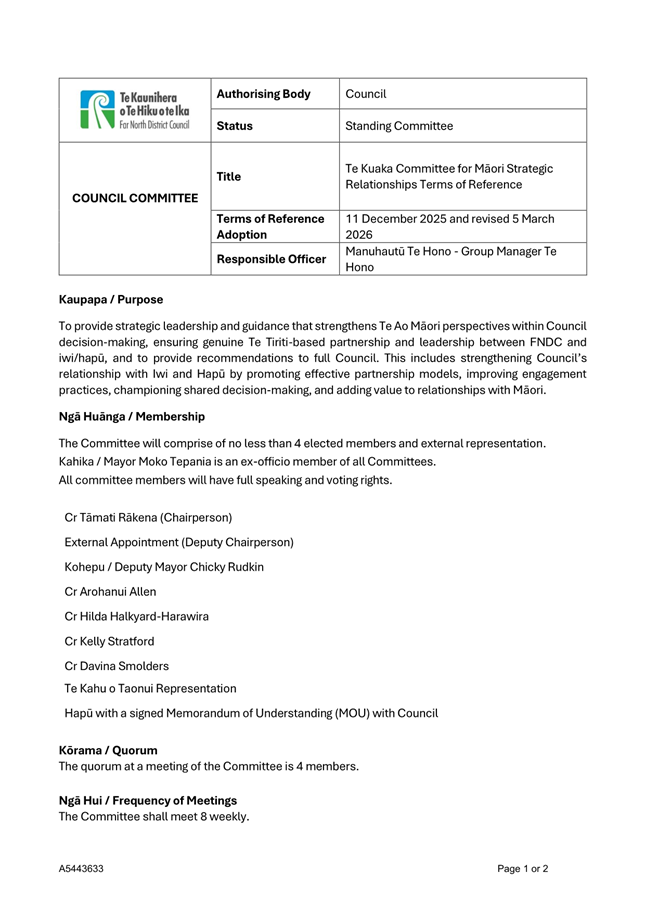
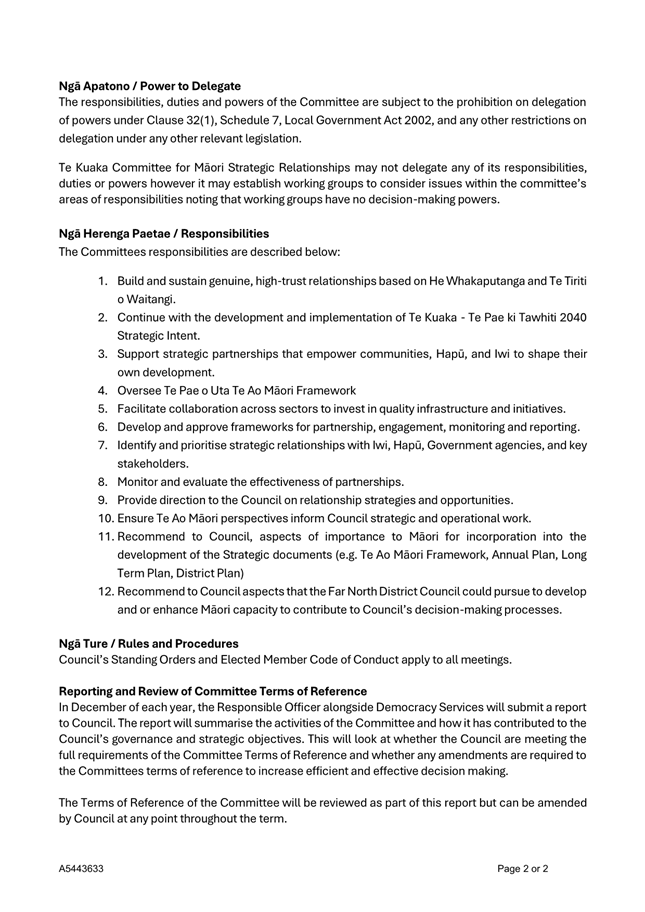
1. Terms
of Reference / Delegations - Te Kuaka Committee for Māori Strategic
Relationships - A5443633 ⇩ 
Hōtaka Take Ōkawa / Compliance Schedule:
Full consideration has been given to the provisions of the
Local Government Act 2002 S77 in relation to decision making, in particular:
1. A
Local authority must, in the course of the decision-making process,
a) Seek
to identify all reasonably practicable options for the achievement of the
objective of a decision; and
b) Assess
the options in terms of their advantages and disadvantages; and
c) If
any of the options identified under paragraph (a) involves a significant
decision in relation to land or a body of water, take into account the
relationship of Māori and their culture and traditions with their
ancestral land, water sites, waahi tapu, valued flora and fauna and other
taonga.
2. This
section is subject to Section 79 - Compliance with procedures in relation to
decisions.
|
He
Take Ōkawa / Compliance Requirement
|
Aromatawai
Kaimahi / Staff Assessment
|
|
State the level of significance
(high or low) of the issue or proposal as determined by the Council’s
Significance and Engagement Policy
|
Low – Governance
appointments are consistent with existing policy and practice
|
|
State the relevant Council
policies (external or internal), legislation, and/or community outcomes (as
stated in the LTP) that relate to this decision.
|
- Local
Government Act 2002 (Clause 30, Schedule 7, Clause 31, Schedule 7, Section
81).
- Te
Kuaka Committee Terms of Reference.
- Appointment
of Non-Elected Members Policy (amended 1April 2026)
|
|
State whether this issue or
proposal has a District wide relevance and, if not, the ways in which the
appropriate Community Board’s views have been sought.
|
The views of the Community
Boards have not been sought as this is a Council/Governance decision.
Yes, this has Districtwide
relevance in relation to Governance and Māori strategic relationships
across the District
|
|
State the possible implications for Māori
and how Māori have been provided with an opportunity to contribute to
decision making if this decision is significant and relates to land and/or
any body of water.
State the possible implications and how this
report aligns with Te Tiriti o Waitangi / The Treaty of Waitangi.
|
Directly supports Te
Tiriti-based partnership, Māori participation, and leadership in
decision-making.
|
|
Identify persons likely to be
affected by or have an interest in the matter, and how you have given
consideration to their views or preferences (for example – youth, the
aged and those with disabilities).
|
Iwi and Hapū partners
engaged through their own representative nominations processes
|
|
State the financial implications
and where budgetary provisions have been made to support this decision.
|
No additional cost beyond
existing budgets
|
|
Chief Financial Officer review.
|
This report has not been
reviewed by the Chief Financial Officer as costs are captured within existing
financial budgets.
|