|
AGENDA
|
|
|
|
Ordinary Council Meeting
|

|
Membership:
Kahika
- Mayor Moko Tepania - Chairperson
Kohepu
- Deputy Mayor Chicky Rudkin
Cr
Arohanui Allen
Cr
Rachel Baucke
Cr
Ann Court
Cr
Felicity Foy
Cr
Hilda Halkyard-Harawira
Cr
Tāmati Rākena
Cr
Davina Smolders
Cr
Kelly Stratford
Cr
John Vujcich
|
|
Wednesday, 1 April 2026
|
|
Time: 10:00 AM
|
|
Council Chamber
Memorial Ave
Kaikohe
|
|
Ordinary Council Meeting Agenda
|
1 April 2026
|
Far North District Council
Ordinary Council Meeting
will be held in the Council Chamber, Memorial Ave,
Kaikohe on:
Wednesday 1 April 2026 at 10:00
AM
Te Paeroa Mahi / Order of
Business
1 Karakia
Timatanga / Opening Prayer. 7
2 Ngā
Whakapāha Me Ngā Pānga Mema / Apologies and Declarations of
Interest 7
3 Ngā
Tono Kōrero / Deputations. 7
4 Ngā
Kōrero A Te Kahika / Mayoral Announcements. 7
5 Te
Whakaaetanga o Ngā Meneti o Mua / Confirmation of Previous Minutes. 8
5.1 Confirmation
of Previous Minutes. 8
6 Ngā
Pūrongo / Reports. 19
6.1 Adoption
of Statement of Proposal for Fees & Charges for 2026/27. 19
6.2 Local
Government Reform Programme. 32
6.3 Northland
Waters CCO - Foundational Legal Documents. 47
6.4 Reserves
adjoining Simson Park Domain - Reserves Act Classification. 118
6.5 Development
Contributions – Operational Implementation Status Update and Go‑Live Timing. 123
6.6 Review
of Appointment of Non-Elected Members (Appointed Members) to Committees
of Council 130
6.7 Approval
of Tourism Frame For Paihia. 144
Supplementary Reports - distributed under separate cover
6.8
Notice of Motion - Transparency, Accountability, and Governance Oversight of
Council Funding and Financial Commitments
6.9 Annual
Plan 2026/27
6.10
Te Koukou Committee for Transort and Infrastructure Terms of Reference
Membership Updates
7 Ngā
Pūrongo Taipitopito / Information Reports. 157
7.1 Response
to Council - Roaming and Aggressive dogs in Ahipara. 157
7.2 Community
Board Minutes. 165
7.3 Committee
and Joint Committee Minutes - March 2026. 184
8 Te Wāhanga
Tūmataiti / Public Excluded. 186
8.1 Notice
of Motion - Far North Holdings Ltd Statement of Expectation. 186
8.2 Confirmation
of Previous Minutes - Public Excluded. 186
8.3 Far
North Holdings Limited - Letter of Expectations 2026-29. 186
8.4 Confirmation
of March Community Boards Minutes - Public Excluded. 187
8.5 Confirmation
of Committee and Joint Committee March 2026 Minutes - Public Excluded 187
8.6 Stormwater
Unbudgeted Expenditure and Restricted Reserve Fund Allocation. 187
Supplementary Public Excluded
Reports - distributed under separate cover
8.7 Proposal:
Taipā Waste Water Treatment Plant Ponds Desludge
9 Karakia
Whakamutunga / Closing Prayer. 188
10 Te Kapinga Hui /
Meeting Close. 188
Far North
District Council Values
The Code of
Conduct is designed to give effect to the following values:
1.
Public interest: members will serve the best interests of the people within their
community, district or region and discharge their duties conscientiously, to
the best of their ability.
2.
Public trust:
members, in order to foster community confidence and trust in their Council,
will work together constructively and uphold the values of honesty, integrity,
accountability and transparency;
3.
Ethical behavior: members will not place themselves in situations where their
honesty and integrity may be questioned, will not behave improperly and will
avoid the appearance of any such behavior;
4.
Objectivity:
members will make decisions on merit; including appointments, awarding
contracts, and recommending individuals for rewards or benefits.
5.
Respect for others: will treat people, including other members, with respect and
courtesy, regardless of their race, age, religion, gender, sexual orientation,
or disability. Members will respect the impartiality and integrity of
officials;
6.
Duty to uphold the law: members will comply with all legislative requirements concerning
their role, abide by this Code of Conduct, and act in accordance with the trust
placed in them by the public;
7.
Equitable contribution: members will take all reasonable steps to ensure they fulfil the
duties and responsibilities of office, including attendance at meetings and
workshops, background reading, attendance at civic events, and participation in
relevant training seminars organised by the Council.
8.
Leadership:
– members will actively promote and support these principles and ensure
they are reflected in the way in which the Council operates including regular
review and assessment.
These values complement, and work in conjunction with, the
principles of s.14 of the LGA 2002 and the governance principles of s.39 of the
LGA 2002.
1 Karakia
Timatanga / Opening Prayer
Ka tuku mātou kia kaha mai ngā māngai kua
whiriwhirihia mō Te Kaunihera o Te Hiku o te Ika ki te mahi me te
ngākau auaha me te whakamahi i ngā pūkenga me te mātauranga
i roto i ngā wānanga me ngā whakataunga kia whakatūria ai
tētahi Hapori e matatika ana, e tū kotahi ana ka mutu ka whakapiki anō
i te oranga o tō tātou rohe, ka whakatau anō i ngā take o
te rohe i runga i te tika me te pono.
We ask that through Council discussions and decisions the
representatives we have elected may govern the Far North District with
imagination, skill and wisdom to achieve a fairer and more united Community
that enhances the wellbeing of our district and solves the District’s
problems efficiently and effectively.
2 Ngā
Whakapāha Me Ngā Pānga Mema / Apologies and Declarations of
Interest
Members need to
stand aside from decision-making when a conflict arises between their role as a
Member of the Council and any private or other external interest they might
have. This note is provided as a reminder to Members to review the matters on
the agenda and assess and identify where they may have a pecuniary or other
conflict of interest, or where there may be a perception of a conflict of
interest.
If a Member
feels they do have a conflict of interest, they should publicly declare that at
the start of the meeting or of the relevant item of business and refrain from
participating in the discussion or voting on that item. If a Member thinks they
may have a conflict of interest, they can seek advice from the Chief Executive
Officer or the Manager - Democracy Services (preferably before the meeting).
It is noted that while members can seek advice the final
decision as to whether a conflict exists rests with the member.
Elected
Member - Register of Interests
3 Ngā
Tono Kōrero / Deputations
No requests for deputations were received at the time of the
Agenda going to print.
4 Ngā
Kōrero A Te Kahika / Mayoral Announcements
|
Ordinary Council Meeting Agenda
|
1 April 2026
|
5 Te
Whakaaetanga o Ngā Meneti o Mua / Confirmation of Previous Minutes
5.1 Confirmation
of Previous Minutes
File
Number: A5633503
Author: Natasha
Rmandic, Democracy Advisor
Authoriser: Aisha
Huriwai, Manager - Democracy Services
Take Pūrongo / Purpose of the Report
The minutes are attached to allow Council to confirm that
the minutes are a true and correct record of previous meetings.
|
tŪtohunga
/ Recommendation
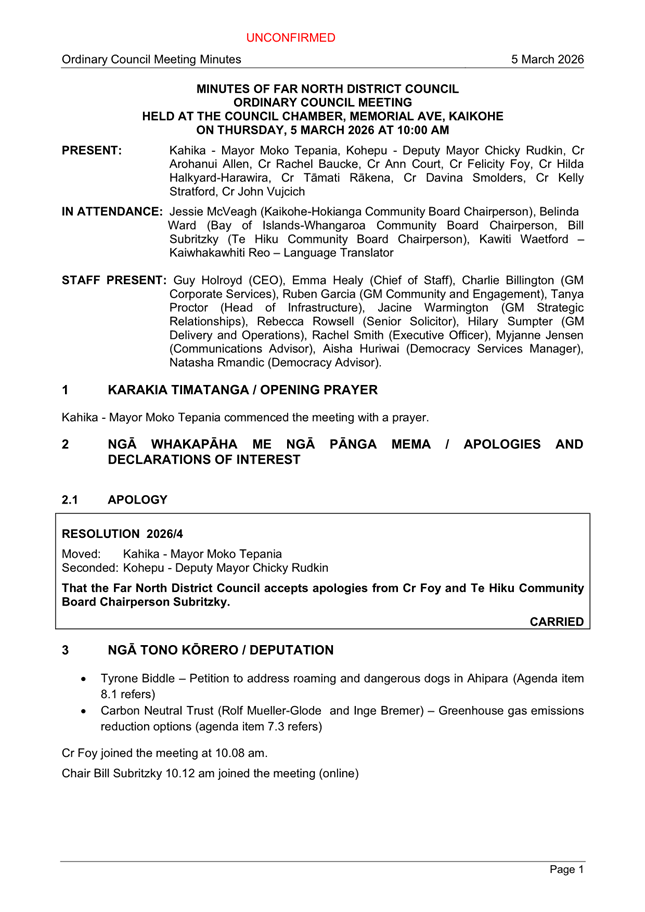
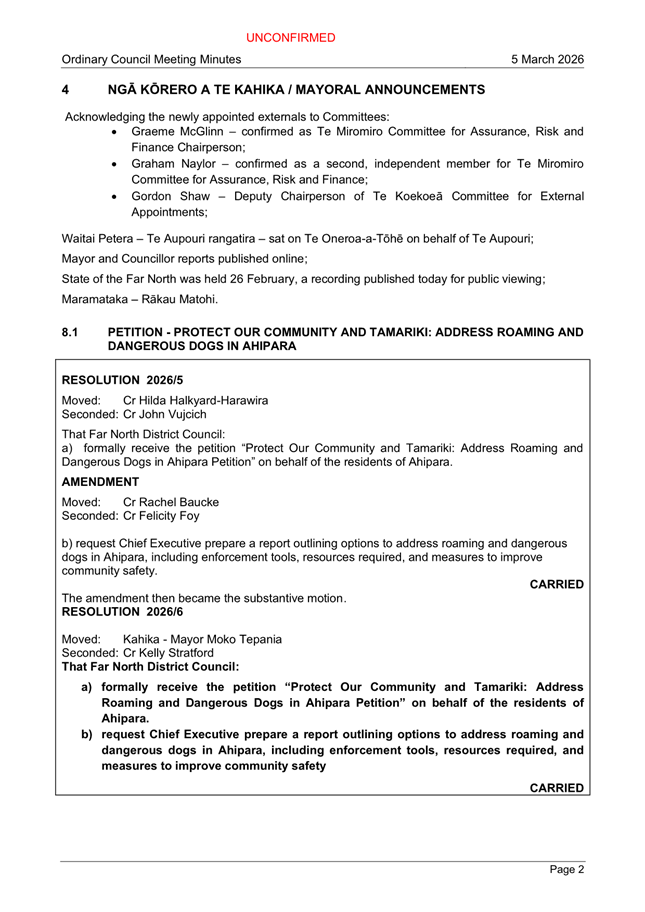
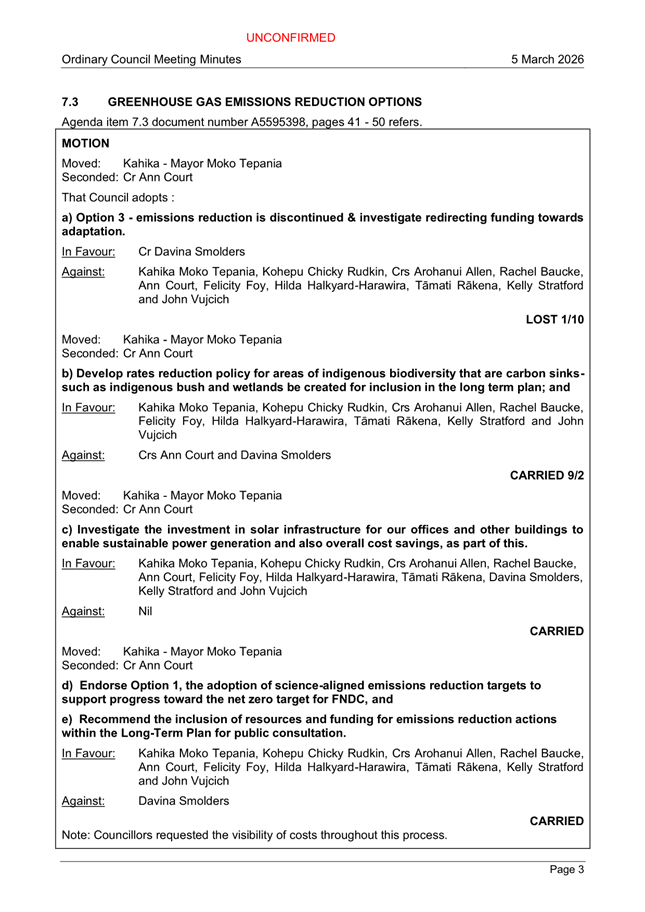
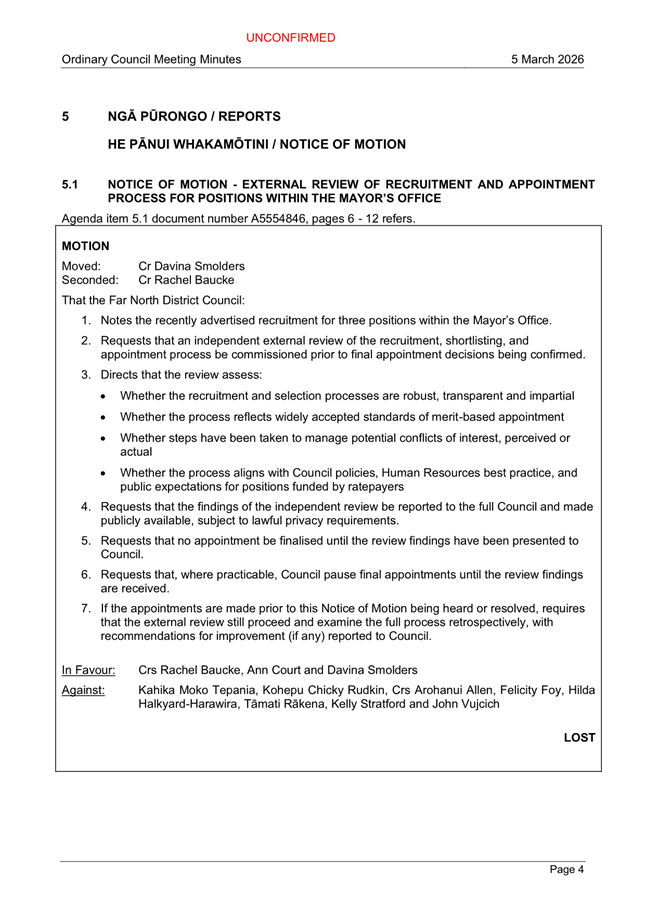
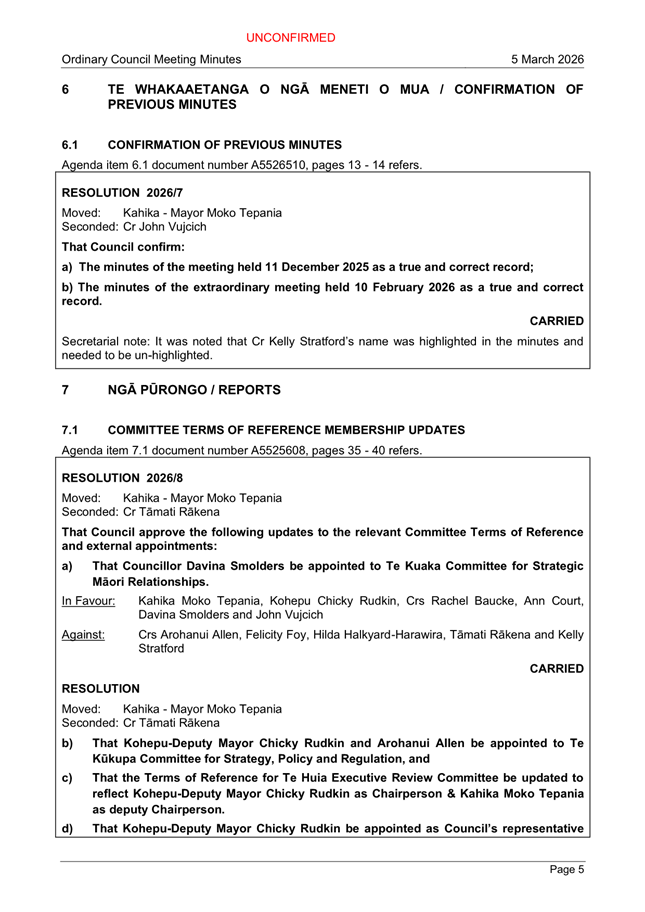
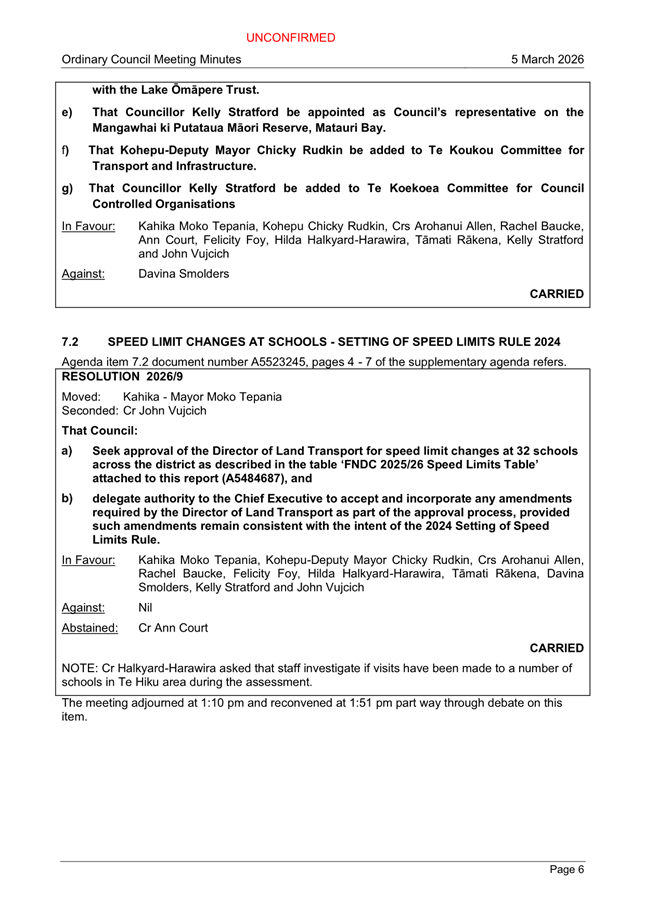
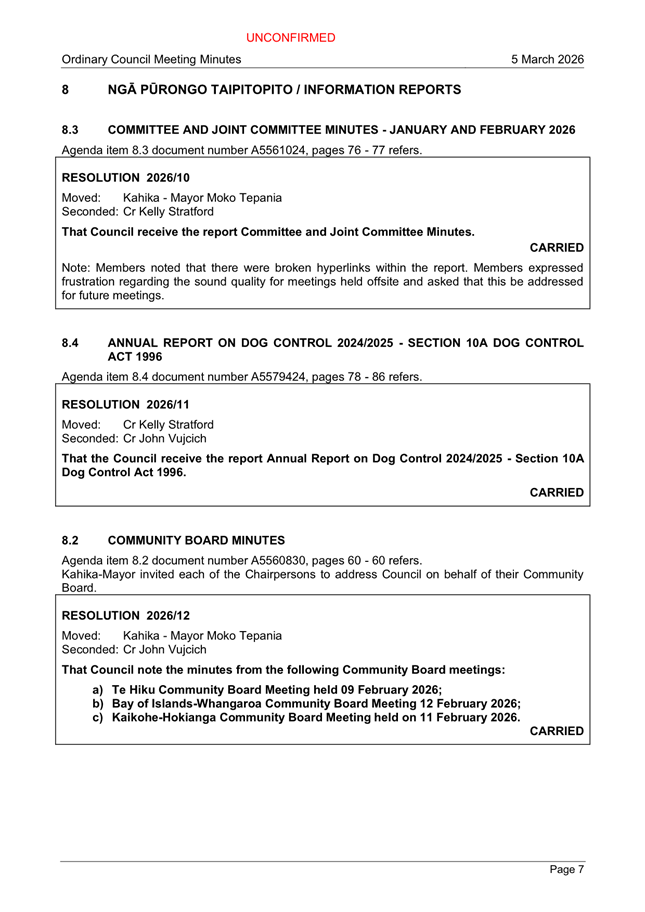
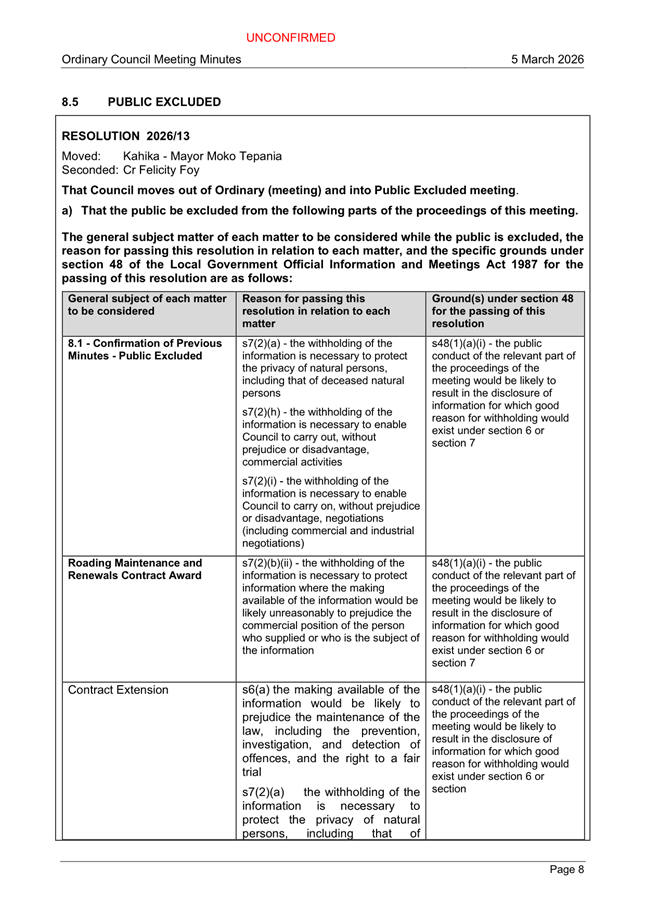
That Council confirm the minutes of the meeting
held 05 March 2026 as a true and correct record.
|
1) TĀhuhu kŌrero / Background
Local Government
Act 2002 Schedule 7 Section 28 states that a local authority must keep minutes
of its
proceedings. The minutes of these proceedings duly entered and authenticated as
prescribed
by a local
authority are prima facie evidence of those meetings.
2) matapaki me NgĀ KŌwhiringa /
Discussion and Options
The minutes of the Council meeting held 11 December 2025 are
attached:
Far North District Council Standing Orders Section 27.3
states that no discussion shall arise on the substance of the minutes in any
succeeding meeting, except as to their correctness.
TAKE TŪTOHUNGA
/ REASON FOR THE RECOMMENDATION
The reason for the recommendation
is to confirm the minutes are a true and correct record of the
previous
meetings.
3) PĀnga PŪtea me ngĀ
wĀhanga tahua / Financial Implications and Budgetary Provision
There are no financial implications or the need for
budgetary provision as a result of this report.
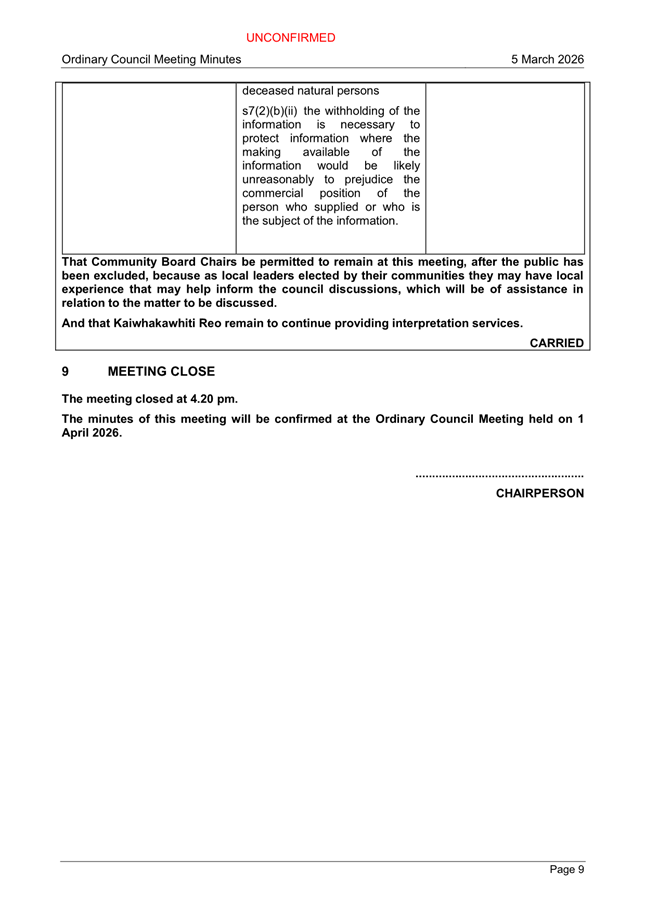
Āpitihanga / Attachments
1. Council
Minutes 05-03-2026 - A5611173 ⇩ 
Hōtaka Take Ōkawa / Compliance Schedule:
Full consideration has been given to the provisions of the
Local Government Act 2002 S77 in relation to decision making, in particular:
1. A
Local authority must, in the course of the decision-making process,
a) Seek
to identify all reasonably practicable options for the achievement of the
objective of a decision; and
b) Assess
the options in terms of their advantages and disadvantages; and
c) If
any of the options identified under paragraph (a) involves a significant
decision in relation to land or a body of water, take into account the
relationship of Māori and their culture and traditions with their
ancestral land, water sites, waahi tapu, valued flora and fauna and other
taonga.
2. This
section is subject to Section 79 - Compliance with procedures in relation to
decisions.
|
He Take Ōkawa /
Compliance Requirement
|
Aromatawai Kaimahi /
Staff Assessment
|
|
State the level of significance (high or low) of the
issue or proposal as determined by the Council’s
Significance and Engagement Policy
|
This is a matter of low significance.
|
|
State the relevant Council policies (external or
internal), legislation, and/or community outcomes (as stated in the LTP) that
relate to this decision.
|
This report complies with the
Local Government Act
2002 Schedule 7 Section 28.
|
|
State whether this issue or proposal has a District wide
relevance and, if not, the ways in which the appropriate Community
Board’s views have been sought.
|
It is the responsibility of each meeting to confirm
their minutes therefore the views of another meeting are not relevant.
|
|
State the
possible implications for Māori and how Māori have been provided
with an opportunity to contribute to decision making if this decision is
significant and relates to land and/or any body of water.
State the
possible implications and how this report aligns with Te Tiriti o Waitangi /
The Treaty of Waitangi.
|
There are no implications for Māori in confirming
minutes from previous meeting. Any implications on Māori arising from
matters included in meeting minutes should be considered as part of the
relevant report.
|
|
Identify persons likely to be affected by or have an
interest in the matter, and how you have given consideration to their views
or preferences (for example – youth, the aged and those with
disabilities).
|
This report is asking for minutes to be confirmed as
true and correct record, any interests that affect other people should be
considered as part of the individual reports
|
|
State the financial implications and where budgetary
provisions have been made to support this decision.
|
There are no financial implications or the need for
budgetary provision arising from this report
|
|
Chief Financial Officer review.
|
The CFO has not reviewed this report.
|
|
Ordinary Council Meeting Agenda
|
1 April 2026
|
|
Ordinary Council Meeting Agenda
|
1 April 2026
|
6 Ngā
Pūrongo / Reports
6.1 Adoption
of Statement of Proposal for Fees & Charges for 2026/27
File
Number: A5614417
Author: Angie
Thomas, Acting Chief Financial Officer
Authoriser: Ken
Macdonald, Chief Financial Officer
Take Pūrongo / Purpose of the Report
To adopt a schedule of fees and charges for the 2026/27
financial year.
WhakarĀpopoto matua / Executive Summary
· Under the
Local Government Act 2002 (the LGA), Council is required to review fees and
charges annually.
· The
adoption of fees and charges must occur prior to the start of the financial
year to which they apply.
· In
most cases, increases are limited to the Local Government Cost Index (LGCI)
inflation factor which is forecast at 2.4% for 2026/27. Exceptions are
discussed in this report.
|
tŪtohunga
/ Recommendation
That Council adopts the Statement of
Proposal to consult on the Schedule of Fees and Charges for 2026/27.
|
1) TĀhuhu kŌrero / Background
Council reviews and adjusts its fees and charges on an
annual basis.
Although many of our fees and charges may be set by Council
resolution under section 150 of the Local Government Act 2002, some must follow
a formal process with public consultation in accordance with section 83 (the
Special Consultative Procedure or SCP).
We therefore carry out the annual review of fees and charges
as follows:
1. A
review of fees and charges is conducted and an inflationary adjustment applied
to allow for any increases that may affect the goods or service. This review
also allows any other fees or charges to be altered, amended or renewed if
required. A Statement of Proposal (SOP) is prepared for consultation alongside
the proposed schedule of fees and charges. A consultation period of four weeks
for written submissions is followed by hearing of verbal submissions (if
required) and deliberations. The council will then consider any further changes
and adoption of the schedule in June with an enactment date of 1 July 2026.
All adjustments are consistent with
Council’s decision as part of the Annual Plan 2026/27 to adjust fees
annually in line with changing circumstances and specifically in line with
inflation. They ensure consistency with the Council’s Revenue and
Financing Policy.
2) matapaki me NgĀ KŌwhiringa /
Discussion and Options
In general, fees have been adjusted by inflation (LGCI)
which is forecast at 2.4% for the 2026/27 year).
Exceptions are:
· Some
fees and infringements are set by statute (e.g. Sale and Supply of Alcohol Act
2012) and are therefore not adjustable.
Inflationary adjustments are proposed for the following
(refer to the Schedule of Fees and Charges attachment):
· Dog registrations,
other fees, impounding fees
· Building consents
· Vehicle crossing
application and inspection fees
· Bylaw enforcement
· Cemeteries
· Environmental
health licences
· Fire prevention
· Food act
· Gambling venue
fees
· Mobile shop,
street stall and hawkers licences
· Alfresco dining
· Leases and
licenses of Reserves
· Legal services
· Libraries
(organisation borrower)
· Official
information – operative District Plan
· Property
information - staff time, physical map requests, postponement fees
· Resource consents
· Transport network
· Applications and
inspections relating to works on Council infrastructure (stormwater, wastewater
and water)
No changes are proposed for the
following:
· Hokianga Ferry
charges
· Official
information - LGOIMA requests, supply of publications, agendas, minutes,
photocopying and scanning charges)
· Property
information – digital data supply
· Rubbish disposal
at transfer stations
· Venues for hire
No change for legislated fees:
· Amusement devices
· Alcohol licencing
The fees and charges recommended for adjustments are
detailed below:
|
Application for resource consent, designation or heritage
orders
|
Current
|
Proposed
|
Reasoning
|
|
Simple s127 change (minor changes, no parties affected,
no engineering assessment)
|
$704.00
|
$1,000.00
|
Fee increase.
Aligns the deposit with the
average cost of processing these
applications over the last five years.
|
|
Variation/cancellation of
consent condition (s127) with engineering
|
$1,264.00
|
$2,800.00
|
Fee increase.
Word change from Change to variation.
Reflects the additional engineering time required for
these applications.
|
|
Simple Land Use. Single zone rule breach or no
Engineering assessment required
|
$1,575.00
|
$2,500.00
|
Fee increase.
Aligns the deposit with the average cost of processing
these applications over the last five years.
|
|
Complex Land Use. May include 3waters (water, stormwater, wastewater),
earthworks or traffic breaches. Development in Natural Hazard Zones or
Flooding and Coastal erosion.
|
$2,625.00
|
$3,500.00
|
Fee increase.
Aligns the fee with the actual average processing cost
and reflects additional specialist review (3 waters, earthworks, hazards
etc.) typically required.
|
|
Discharge to land (less
than 3m2)
|
$2,834.00
|
$1,200.00
|
Fee decrease.
Previous fee was significantly higher than actual
processing cost, so the fee is being reduced to better match real costs.
Additional wording to include (less than 3m2)
|
|
Combined Subdivision and Land Use
|
$5,143.00
|
$8,000.00
|
Fee increase.
Aligns with average cost of processing these applications
over the last five years and reflects the higher average processing time when
both consent types are assessed together.
|
|
Combined Land Use and Discharge
|
-
|
$3,700.00
|
New fee.
Introduced to cover a common application type previously
not specifically listed.
|
|
Subdivision 1–4 lots
|
$3,044.00
|
$5,000.00
|
Fee increase.
Based on working the average cost of a 1-4 lot
subdivision over the last five years.
|
|
Subdivision 5–8 lots
|
$5,038.00
|
$6,000.00
|
Fee increase.
Based on working the average cost of a 5-8 lot
subdivision over the last five years.
|
|
Subdivision 9+ lots
|
$6,823.00
|
$7,000.00
|
Fee increase.
Based on working the average cost of a 9+ lot
subdivision over the last five years.
|
|
|
|
|
|
Limited notification for resource consents, notices of
requirement and heritage orders
|
Current
|
Proposed
|
|
|
Land use and subdivision; combined land use and
subdivision; notices of requirement; heritage orders; discharge to land
|
$5,248.00
|
$6,000.00
|
Fee increase.
Aligns deposit with actual costs of preparing and
managing notification processes and reduces reliance on additional invoicing.
|
|
|
|
|
|
Hearings
|
Current
|
Proposed
|
Reasoning
|
|
Hearing for Limited or Public Notified application
|
$2,028.00
|
$10,000.00
|
New fee.
Hearings are significantly more expensive than the
current deposit, often involving commissioners, legal advice, and multiple
staff. The higher deposit better reflects real costs and reduces the risk of
unpaid invoices.
|
|
Hearing for Objections to Conditions
|
$2,028.00
|
$2,077.00
|
New fee.
Updated to reflect current processing costs.
|
|
|
|
|
|
Monitoring
|
Current
|
Proposed
|
Reasoning
|
|
Monitoring
of Resource Consent conditions. This may include site inspections and/or
desktop checks to deem compliance.
|
$403.00
|
Actual costs
|
Fee change to actual costs.
Monitoring work varies widely depending on the consent.
Charging actual costs ensures applicants only pay for the monitoring actually
required.
|
|
Monitoring
of Permitted Activities under s180 of the Planning Act 2026
|
|
Actual
costs
|
New fee.
Introduced to support new legislative requirements under
the Planning Act.
|
|
|
|
|
|
Approvals and certificates – instalment
|
Current
|
Proposed
|
Reasoning
|
|
Sec 221 (consent notice), Sec 222 (completion), Sec 223 (survey plan)
|
$274.00
|
$281.00
|
Removal of Sec 221 (consent notice) wording.
Fixes a technical error in the existing schedule.
|
|
224(c) Certificate – no engineering conditions (Includes s221 Consent Notice)
Note: Your certificate will not be issued until all previous invoices
relating to the underlying consent have been paid (SUB, COM, EPA etc.)
|
$642.00
|
$657.00
|
Fixes a technical error in the existing schedule.
Additional wording of (Includes s221 Consent
Notice). Note: Your certificate will not be issued until all
previous invoices relating to the underlying consent have been paid (SUB,
COM, EPA etc).
|
|
224(c) Certificate – with engineering conditions (Includes s221 Consent Notice)
Note: Your certificate will not be issued until all previous invoices
relating to the underlying consent have been paid (SUB, COM, EPA etc.)
|
$1,192.00
|
$1,221.00
|
Fixes a technical error in the existing schedule.
Additional wording of (Includes s221 Consent
Notice). Note: Your certificate will not be issued until all
previous invoices relating to the underlying consent have been paid (SUB,
COM, EPA etc).
|
|
Deemed permitted boundary activities and deemed permitted
marginal or temporary activities
|
$504.00
|
$600.00
|
Fee increase.
Based on the average cost of a Deemed permitted
boundary/marginal/temporary application over the last five years.
|
|
Creation of right-of-way under Sec 348 Local Government
Act
|
Actual costs
|
$500.00
|
Fee change from Actual costs to $500.
Provides an upfront deposit to reduce Council’s
exposure to unpaid processing costs.
|
|
Engineering Plan Approvals (RMAEPA)
|
$385.00
|
$500.00
|
Fee increase.
Reflects the actual cost of engineering review and
approval.
|
|
|
|
|
|
Approvals and certificates - instalment
|
Current
|
Proposed
|
Reasoning
|
|
Pre-lodgement, pre-application, concept development (first 30 min free)
|
$345.00
|
$353.00
|
Reflects the average staff time required to prepare and
attend these meetings.
Removal of, first 30 minutes no charge.
|
|
|
|
|
|
Other Approvals, Certificates & Fixed Fees
|
Current
|
Proposed
|
Reasoning
|
|
Section 139 Certificate of Compliance, Section 139(A)
Existing Use Certificate
|
$1,339.00
|
$1,500.00
|
Fee increase.
Reflects the average processing cost of these
applications (s139 and 139A) over the last five years.
|
|
Certificate of Permitted Activity Under s180 of the
Planning Act 2026. Actual processing costs will be calculated and invoiced
once the certificate has been issued.
|
|
$516.00
|
New fee.
Introduced to support the new planning legislation
replacing parts of the RMA.
|
|
|
|
|
|
|
Liquor Compliance Certificate
|
Current
|
Proposed
|
Reasoning
|
|
Certificate of Compliance Liquor application. Actual processing costs will be calculated and invoiced
once the certificate has been issued.
|
$490.00
|
$502.00
|
Additional wording to reflect actual process. Actual processing costs will be calculated and invoiced
once the certificate has been issued.
|
|
|
|
|
|
|
Hourly Processing Charges
|
Current
|
Proposed
|
Reasoning
|
|
Principal Planner, Team
Leader Resource Consents Engineering and
Manager Resource Consents
|
$221.00
|
$226.00
|
Provides clearer descriptions of staff roles associated
with each hourly rate. Team Leader Resource Consents Engineering role
added.
|
|
Team Leader Resource
Consents
|
$210.00
|
$215.00
|
Provides clearer descriptions of staff roles associated
with each hourly rate. Resource Consents title added to Team Leader.
|
|
Technology Fee (Per RMA Application)
|
|
$120.00
|
New fee.
Helps recover the cost of digital systems used to process
and manage consent applications. New fee.
|
|
|
|
|
|
|
Vehicle crossings
|
Current
|
Proposed
|
Reasoning
|
|
Vehicle crossing application and vehicle crossing
inspection fee (Includes first initial site
visit and application fee. A further two
inspections are required (pre-pour and final inspections $277 per inspection). Any
additional inspections will be charged separately ($277 per inspection)
|
$308.00
|
$450.00
|
Fee increase.
Aligns with the average cost of processing and inspecting
vehicle crossings.
Removal of wording, (Includes first initial site visit
and application fee.
Change from $205 to $277.
Moved from Building Consents to Resource Consents.
|
|
Vehicle crossing inspection fee
|
$205.00
(per inspection)
|
$277.00
|
Reflects actual inspection costs.
Moved from Building Consents to Resource Consents.
|
|
Re-application fee for expired approvals
|
$79.00
|
$81.00
|
No longer required administratively.
Moved from Building Consents to Resource Consents.
|
Other fees and charges 2026/27 amendments
The majority of fees and charges have been adjusted by a
2.4% inflationary increase, unless set by legislation etc:
Rubbish Disposal at Transfer Stations
|
Rubbish at transfer station
|
Current
|
Proposed
|
|
|
Per bag (standard 65L)
|
$3.00
|
$4.00
|
To align with Government imposed charges, operational
costs and compliance requirements.
|
|
Oversized bag (130L)
|
$6.00
|
$7.00
|
To align with Government imposed charges, operational
costs and compliance requirements.
|
|
Wheelie bin (240L)
|
$11.00
|
$12.50
|
To align with Government imposed charges, operational
costs and compliance requirements.
|
|
Loose material per m3
|
$46.00
|
$52.00
|
To align with Government imposed charges, operational
costs and compliance requirements.
|
|
Compacted material per m3
|
$74.50
|
$84.00
|
To align with Government imposed charges, operational
costs and compliance requirements.
|
Building Consents
This has been moved from Building Consents to Resource
Consents.
|
Vehicle crossings
|
Current
|
|
Vehicle crossing application and vehicle crossing
inspection fee (Includes first initial site visit and application fee). A
further two inspections are required (pre-pour and final inspections $205 per inspection). Any
additional inspections will be charged separately ($205 per inspection)
|
$308.00
|
|
Vehicle crossing inspection fee
|
$205.00
(per inspection)
|
|
Re-application fee for expired approvals.
|
$79.00
|
Libraries
|
Borrowing
|
Current
|
Proposed
|
|
|
Organisation borrower (limited users)
|
$33.00
|
$0.00
|
To be removed as this fee has not been used in 5 years
|
|
Replacement borrower card
|
$2.20
|
$2.00
|
Minor change
|
|
Inter-loan search
|
From $6
|
From $10.00
|
Due to increased postage charges
|
|
Book repairs
|
From $5.30
|
From $5.50
|
Minor change
|
Monitoring and Compliance
|
Monitoring and Compliance fees
|
Current
|
Proposed
|
|
|
Monitoring fee – monitoring of resource consents,
this may include site visit(s) and/or desktop assessment.
|
|
Actual Costs where site visits are required.
|
New fee.
This is now separated into actual costs, where a site
visit is required to monitor the conditions. Previously applicants were
paying a flat fee of $403 for up to 2 site visits. Several elements of the
Resource consent may only require the customer to send things to Council, or
can be confirmed via a desktop assessment.
|
|
The cost of staff time and expense associated with
investigation, remediation (if necessary), and complaints can be recovered
for significant non-compliance with the District Plan, Resource Consents or
other legislation, or for repeat offending where environmental impacts are
considered to be more than minor.
|
|
Actual and reasonable costs based on officers’ hourly
charge out rate.
|
New fee.
The actual and reasonable costs of significant or complex
investigations can be recovered as administrative costs under Section 36 of
the Resource Management Act where significant Council Officer time is
required to remedy breaches and ensure compliance with the RMA and/or
District Plan or other legislative requirements.
The purpose is to disincentivise people from committing
breaches of their Resource Consent or, when they do, quickly remedying them
and not requiring Council staff to spend significant amounts of time
investigating and ensuring compliance.
|
|
Compliance Manager - per hour
|
$236.00
|
$242.00
|
Moved from Building Consents hourly rates.
|
|
Monitoring and Compliance Officer - per hour
|
$163.00
|
$167.00
|
Moved from Resource Consents Planning Technician and
Monitoring Officer Hourly processing changes.
|
Certificates, license and permits
|
Environmental health licenses
|
Current
|
Proposed
|
|
|
Health (mortuaries and septic tank cleaners)
This fee covers the cost of processing the application. New applications are
reviewed by building, planning, and environmental health teams to ensure all
requirements are met. If requirements are not met, additional fees may apply
for planning and building teams additional processing time.
|
$366.00
|
$375.00
|
Removed wording Campgrounds
|
|
|
|
|
|
Food Act
|
Current
|
Proposed
|
|
|
Food Control Plan (FCP)
|
|
|
|
|
Template FCP registration
Application for new registration of
FCP (fee includes up to 2.75 hours of processing time, supply of thermometer
and printed food safety plan).
|
$325.00
|
$350.00
|
Change aligns with inflation and in line with other
Council’s (WDC and KDC) fees.
Additional wording to reflect actual process. Application for new registration of FCP (fee includes up to
2.75 hours of processing time, supply of thermometer and printed food safety
plan).
|
|
Thermometer
|
$32.00
|
$35.00
|
Aligns with other Council’s (WDC and KDC) fees.
|
|
Additional food control plan document and record blanks
|
$30.00
|
$45.00
|
Additional wording and
record blanks.
|
|
Additional processing time
Fee for additional time for processing the
application.
|
$163.00
|
$168.00
|
Description added.
Fee for additional time for processing the application.
|
|
FCP verification fixed fee
Verification including site visits and
compliance checks with FCP (includes up to 3.5hrs of processing and
travelling time).
|
$569.00
|
$595.00
|
Change aligns with inflation and in line with other
Council’s (WDC and KDC) fees.
Description added.
Verification including site visits and compliance checks with FCP (includes
up to 3.5hrs of processing and travelling time).
|
|
Failure to attend scheduled verification
|
$163.00
|
$249.50
|
Many operators do not show up onsite for their
verification which results in loss of time and impacts the officers work
plan. This fee would act as a deterrent for operators and prevent them from
doing this.
|
|
Proposed New Fees
|
Current
|
Proposed
|
|
|
Corrective action follow up
|
|
$249.50
|
To cover actual time to follow up on a CAR. Aligns with
other Council’s (WDC and KDC) fees.
Where the verification results in the issue of a Corrective Action Request
(CAR) that requires a return visit, this is follow-up visit to check remedial
actions and every additional visit is subject to additional compliance and
monitoring fees.
|
|
Cancellation of scheduled verification less than 24 hours
notice
|
|
$168.00
|
To cover actual time where a verification has been
cancelled at short notice. Many operators cancel the verification within 24
hours’ notice which impacts the officers work plan for the week, this
would act as a deterrent for operators and prevent them from doing this.
|
|
Replacement laminated certificate
|
|
$20.00
|
New fee – covers actual costs involved with
providing a replacement certificate. Many operators request another copy of
their registration certificate because they have misplaced their original one
or damaged it.
|
|
Complaint driven investigation resulting in enforcement
Justified complaint requiring investigation
by FSO.
|
|
$250.00
|
Aligns with other Council’s (WDC and KDC)
fees.
Additional description: Justified complaint requiring
investigation by FSO.
|
|
|
|
|
|
National Programme (NP)
|
Current
|
Proposed
|
|
|
NP registration
|
$263.00
|
$300.00
|
Aligns with other Council’s re: same processing
time. Actual costs.
|
|
NP renewal (renewal required every 2 years)
|
$150.00
|
$197.00
|
Aligns with other Council’s re: same processing
time. Actual costs.
|
|
Failure to attend scheduled verification
|
$163.00
|
$249.50
|
Many operators do not show up onsite for their
verification which results in loss of time and impacts the officers work
plan. This fee would act as a deterrent for operators and prevent them from
doing this.
|
|
Proposed new fees
|
Current
|
Proposed
|
|
|
NP verification fixed fee - NP1 (2.5 hours of processing
and travelling time)
|
|
$406.00
|
Change aligns with inflation and in line with other
Council’s (WDC and KDC) fees.
|
|
NP verification fixed fee - NP2 (3.5 hours of processing
and travelling time)
|
|
$525.00
|
Change aligns with inflation and in line with other
Council’s (WDC and KDC) fees. NP2 and 3 take longer processing time so
actual costs is more.
|
|
NP verification fixed fee - NP3 (3.5 hours of processing
and travelling time)
|
|
$525.00
|
Change aligns with inflation and in line with other
Council’s (WDC and KDC) fees. NP2 and 3 take longer processing time so
actual costs is more.
|
|
Cancellation of scheduled verification less than 24 hours
notice
|
|
$168.00
|
Many operators cancel the verification less than 24
hours’ notice which impacts the officers work plan for the week, this
would act as a deterrent for operators and prevent them from doing this.
|
|
Corrective action follow up
|
|
$249.50
|
Aligns with other Council’s (WDC and KDC) fees.
Where the verification results in the issue of a Corrective Action Request
(CAR) that requires a return visit, this is follow-up visit to check remedial
actions and every additional visit is subject to additional compliance and
monitoring fees.
|
|
Complaint driven investigation resulting in enforcement
Justified complaint requiring investigation
by FSO.
|
|
$250.00
|
Aligns with other Council’s (WDC and KDC) fees.
Additional description: Justified complaint requiring investigation by
FSO.
|
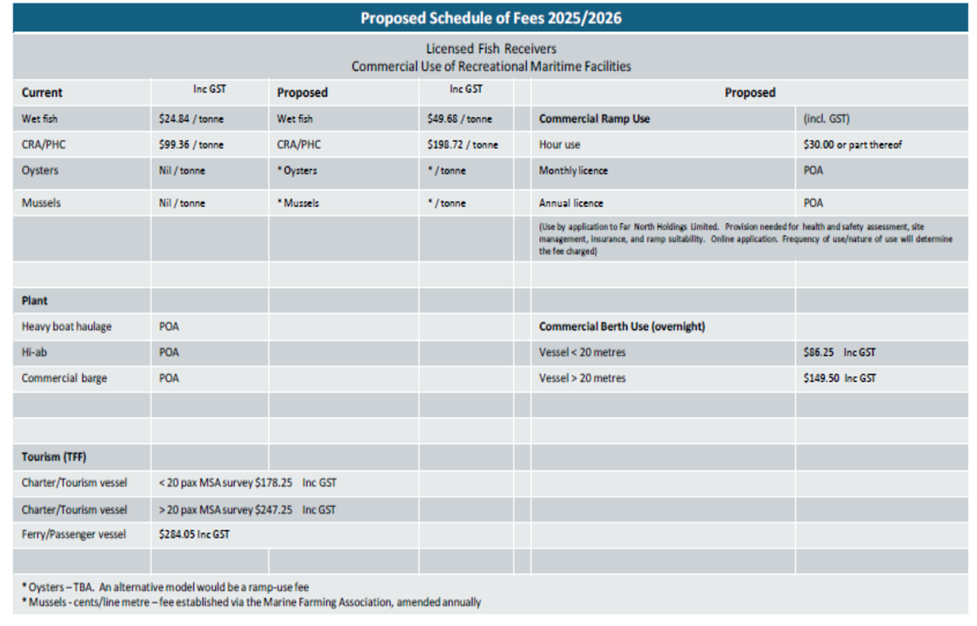
Licensed Fish Receivers
As per clause 8 of The Maritime Facilities Bylaw regarding
Commercial Operators:
Clause 8(2) All Commercial Operators must pay any applicable
Fees for the use of Maritime Facilities, including moorings, as set out in the
Council’s Fees and Charges Schedule. This may include fees for specific
types of activities or operations that may be carried out by Commercial
Operators.
Clause 8(3) No Commercial Operator may use any Maritime
Facilities unless they have paid the required Fees under clause 8(2) of this
Bylaw.
Clause 8(4) The above clauses shall have no effect if
the Council has not included Fees for the use of Maritime Facilities by
Commercial Operators within the Council’s Fees and Charges Schedule.
This bylaw came into force on 13 February 2025.
TAKE TŪTOHUNGA
/ REASON FOR THE RECOMMENDATION
The reason for the recommendation is to ensure an adopted
schedule of fees and charges is in place prior to the start of the 2026/27
financial year.
3) PĀnga PŪtea me ngĀ
wĀhanga tahua / Financial Implications and Budgetary Provision
Forecast revenue from the Schedule of Fees and Charges for
2026/27 is recognised in the budget adopted as part of the Annual Plan for
2026/27.
Āpitihanga
/ Attachments
1. Licensed
Fish Receivers - A5643724 ⇩ 
2. Fees
& Charges Schedule - (under separate cover)
Hōtaka Take Ōkawa / Compliance Schedule:
Full consideration has been given to the provisions of the
Local Government Act 2002 S77 in relation to decision making, in particular:
1. A
Local authority must, in the course of the decision-making process,
a) Seek
to identify all reasonably practicable options for the achievement of the
objective of a decision; and
b) Assess
the options in terms of their advantages and disadvantages; and
c) If
any of the options identified under paragraph (a) involves a significant
decision in relation to land or a body of water, take into account the
relationship of Māori and their culture and traditions with their
ancestral land, water sites, waahi tapu, valued flora and fauna and other
taonga.
2. This
section is subject to Section 79 - Compliance with procedures in relation to
decisions.
|
He Take Ōkawa /
Compliance Requirement
|
Aromatawai Kaimahi /
Staff Assessment
|
|
State the level of significance (high or low) of the
issue or proposal as determined by the Council’s
Significance and Engagement Policy
|
Low Significance
|
|
State the relevant Council policies (external or
internal), legislation, and/or community outcomes (as stated in the LTP) that
relate to this decision.
|
Local Government Act, Resource Management Act
|
|
State whether this issue or proposal has a District wide
relevance and, if not, the ways in which the appropriate Community
Board’s views have been sought.
|
District-wide relevance
|
|
State the
possible implications for Māori and how Māori have been provided
with an opportunity to contribute to decision making if this decision is
significant and relates to land and/or any body of water.
State the
possible implications and how this report aligns with Te Tiriti o Waitangi /
The Treaty of Waitangi.
|
No specific implications.
|
|
Identify persons likely to be affected by or have an
interest in the matter, and how you have given consideration to their views
or preferences (for example – youth, the aged and those with
disabilities).
|
No specific demographic identified.
|
|
State the financial implications and where budgetary
provisions have been made to support this decision.
|
The
proposals outlined are in intended to meet the funding arrangements specified
in the Revenue and Financing Policy. Adjustments as proposed support cost
recovery intentions for the relevant activities.
|
|
Chief Financial Officer review.
|
The Chief Financial Officer has reviewed this report.
|
|
Ordinary Council Meeting Agenda
|
1 April 2026
|
|
Ordinary Council Meeting Agenda
|
1 April 2026
|
6.2 Local
Government Reform Programme
File
Number: A5619316
Author: Roger
Ackers, Head of Strategic Reform Initiatives
Authoriser: Guy
Holroyd, Chief Executive Officer
Take Pūrongo / Purpose of the Report
To seek a decision from Council on whether to participate in
the proposed Northland Local Government Reform programme, including approval of
the staged approach, governance arrangements, indicative timeline, and
associated budget provisions, as considered by the Northland Mayoral Forum on
27 February 2026.
WhakarĀpopoto matua / Executive Summary
· In November 2025 the government released a discussion document
setting out draft proposals for reform of local government with the aim of
simplifying the system. The reform proposals provide for interim governance
arrangements and a process for each region to develop a Regional Reorganisation
Plan (RRP), which sets out bespoke local government arrangements in each
region.
· Following discussion at Northland Forward Together (December 2025),
the Chief Executives Forum and the Mayoral Forum, as well as engagement with
the Minister for Local Government, on 5 February 2026 Northland councils
publicly confirmed a shared position that local government reform should be
progressed through a “By Northland, For Northland” approach.
· Proceeding with this approach allows us to proactively advance the
future of regional governance in Northland, with the aim of delivering material
benefit to services and outcomes achieved through local government.
· This approach was further considered at the Mayoral Forum on 27
February 2026 where members agreed to take the proposal to establish a Local
Government Reform programme to their respective councils for consideration.
· This report recommends that council approve the following:
o Governance arrangements
and programme structure for a Local Government Reform Programme.
o Draft Terms of Reference
for the proposed Governance Steering Group and External Advisory Group to
oversee a Local Government Reform Programme.
o A placeholder budget for a
Local Government Reform Programme for the remainder of the 25/26 Financial Year
and the 26/27 Financial Year.
o An indicative timeline
that, subject to detailed planning, could allow for a new governance
structure(s) to be in place ahead of the October 2028 local government
elections.
|
tŪtohunga
/ Recommendation
That the Far North District Council:
a) Approves
the establishment of a staged programme for Local Government Reform as set
out in this report.
b) Approves
the governance structure set out in this report, including the establishment
of a Local Government Reform Steering Group and External Advisory Group.
c) Endorse
the Mayor of Whangārei District Council as Chair of the Local Government
Reform Steering Group.
d) Nominates
the Mayor and councillors _____ and ______ as members of the Local Government
Reform Steering Group.
e) Approve
the Draft Terms of Reference for the Local Government Reform Governance
Steering Group (Attachment 1).
f) Approve
the Draft Terms of Reference for the Local Government Reform External
Advisory Group (Attachment 2).
g) Approve
the indicative timeline set out in this report, which subject to detailed
planning once the programme is established, would enable a new governance
structure(s) to be in place for the October 2028 local government election.
h) Approve
the allocation of $31,250 to meet FNDC’s share of programme costs for
the remainder of the 2025/26 financial year.
i) Approve
the allocation of $250,000 to meet the placeholder budget of $1,000,000 in
its 2026/27 Annual Plan, noting that this amount is indicative only and
subject to further detailed planning and refinement.
j) Agree
to proceed with the proposed programme and to fund a third of the costs, as
outlined in this report, rather than a quarter if only three Northland
councils are participating.
k) Agree
that the programme approach needs to be reviewed if fewer than three
Northland Councils agree to proceed with the programme as proposed.
|
1) TĀhuhu kŌrero / Background
In November 2025 the government released a discussion
document setting out draft proposals for reform of local government. The
primary objective (as per the Regulatory Impact Statement) is to initiate a
locally led process to simplify and streamline local government structures and
service delivery, in a way that supports the implementation of resource
management reforms.
The draft proposal was to remove regional councillors and
establish a Combined Territories Board (CTB) of Mayors. There would potentially
also be a role for a Crown Commissioner on the CTB. The CTB would, among other
things, need to develop a Regional Reorganisation Plan (RRP) with a recommended
delivery model for council services across the region within two years of being
established.
Following discussion at Northland Forward Together (December
2025), the Chief Executives Forum and the Mayoral Forum, and engagement with
the Minister for Local Government, on 5 February 2026 Northland councils
publicly confirmed a shared position that local government reform should be
progressed through a “By Northland, For Northland” approach.
The matter was further considered at the Mayoral Forum on 27
February 2026 where the establishment of a local government reform programme,
including a recommended governance and programme structure, indicative project
timeline and budget was endorsed for consideration by each council.
2) matapaki me NgĀ KŌwhiringa /
Discussion and Options
If the programme moves forward as proposed in this report it
is critical that a clear perspective on what is important and what the
Northland Councils want to achieve from local government reform is developed at
a programme level across the councils.
A key framing of the proposed approach is that it is
‘By Northland, For Northland’ and proactively advancing the future
of regional governance in Northland.
Further to this, the opportunity to provide better outcomes
for Northland is the fundamental driver. Local government reform provides an
opportunity to review existing local government arrangements with the aim of
delivering better outcomes for Northland. Proposed objectives, which can be
refined over time, include to:
· provide
material benefit to services and outcomes delivered - including greater
affordability, effectiveness and operational efficiency;
· improve
local representation - fair and effective representation of communities of
interest across all of Northland;
· ensure
roles and delivery are at the right scale for efficient and effective system
performance and outcomes;
· enable
effective and visible regional leadership and governance for Northland; and
· provide
financially sustainable delivery of quality services into the future.
Staged Approach
It is recommended that the programme be staged based on key
decision points to ensure that checks and balances are in place before
progressing to next steps. Key decisions would be referred to each council for
consideration before progressing (e.g. approval to consult on a draft RRP and
recommendations to the Local Government Commission / Minister). Timeframes are
indicative, and subject to detailed programme planning in Stage 3.
Proposed stages and indicative timeframes are summarised
below:
· Stage
1 (completed) - Early engagement, regional alignment, and council submissions
on the draft reform proposals, including confirmation of a shared position that
reform should be progressed through a “By Northland, For Northland”
approach (December 2025 – February 2026).
· Stage
2 (in progress) - Establishing the governance and advisory arrangements,
programme structure, indicative timeline and provisional budget (February
– April 2026).
· Stage
3 – Implement and resource the programme structure, detailed project
planning and resourcing, including approaches to iwi, hapū and community
participation (April – June 2026).
· Stage
4 - Assessment of current state and options for future delivery models,
including stocktake of services, functions and structures and options analysis
(June – December 2026).
· Stage
5 - Preferred option and draft Regional Reorganisation Plan and supporting
evidence (including representation review and assessment against legislative
requirements) (December 2026 to February 2027).
· Stage
6 – Engagement and public consultation on draft RRP and representation
review (February to May 2027).
· Stage
7 – Consider feedback and finalise and submit Northland’s
recommended RRP (including supporting evidence) to Minister / Local Government
Commission (June to September 2027).
· Stage
8 – Local Government Commission / Ministerial decision and (subject to
approval) establish transition body (October 2027 – February 2028).
· Stage
9 - Establish governance and administrative arrangements to ensure a
functioning local government entity/entities capable of meeting statutory,
governance, and operational requirements is in place ahead of the election
(February to October 2028).
· Stage
10 - Local Body Elections in Northland (September to Saturday 14 October 2028).
· Stage
11 – Full execution of the Transition Plan and Implementation Scheme
(November 2028 onwards).
Recommended Governance structure and draft terms of
reference
At the meeting of 27 February 2026, the Mayoral Forum
considered and endorsed for consideration by each council the programme
structure outlined below, and Draft Terms of Reference for the Local Government
Reform Steering Group and Local Government Reform External Advisory Group.
The recommended programme governance and operational
structure are set out below.
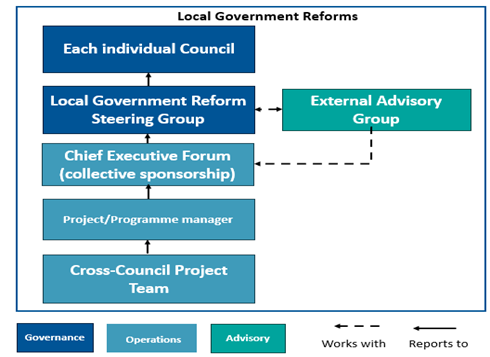
Local Government Reform Steering Group
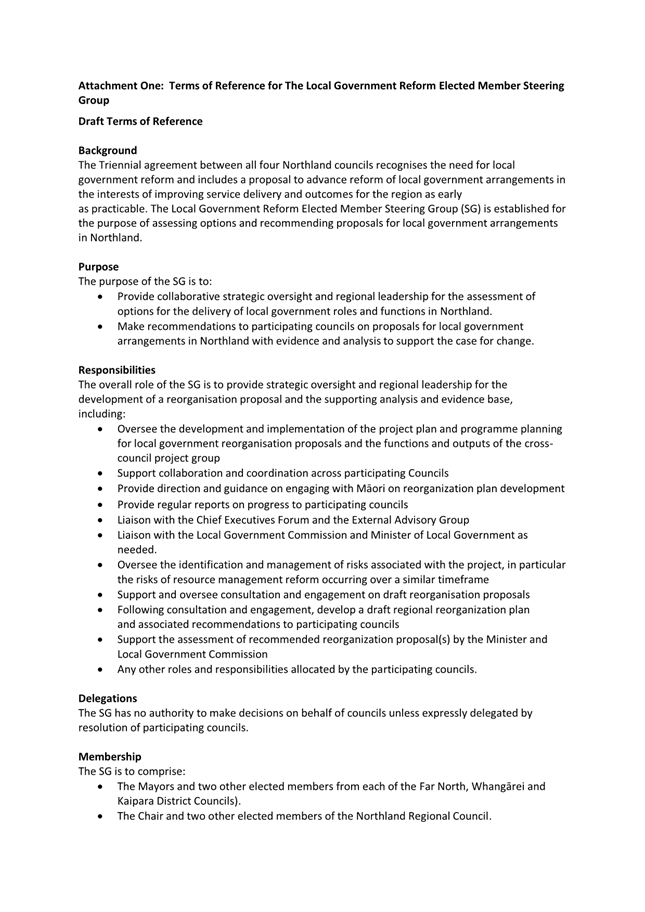
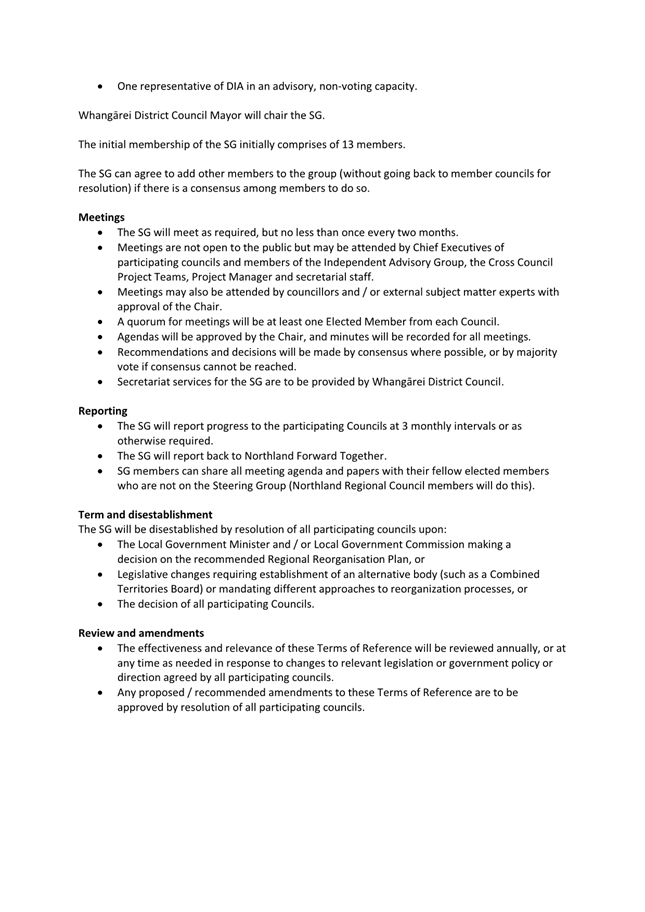
It is recommended that the programme be overseen by a Local
Government Reform Steering Group made up of the Mayors and NRC Chair plus two
elected members from each council, and one representative from the Department
of Internal Affairs (a total of 13 members).
The core role of this group is to provide collaborative,
strategic oversight and regional leadership. It is not proposed that this group
has delegated decision-making powers but would make recommendations as required
to participating councils on Regional Reorganisation Plans and next steps. It
is proposed that the Mayor of Whangārei District Council act as Chair of
the Local Government Reform Steering Group. Draft Terms of Reference for the
Local Government Reform Steering Group are set out in Attachment 1.
It is recommended that the Steering Group Terms of Reference
now be approved and that Council, via this report, nominate the two elected
members to accompany the Mayor on this Steering Group.
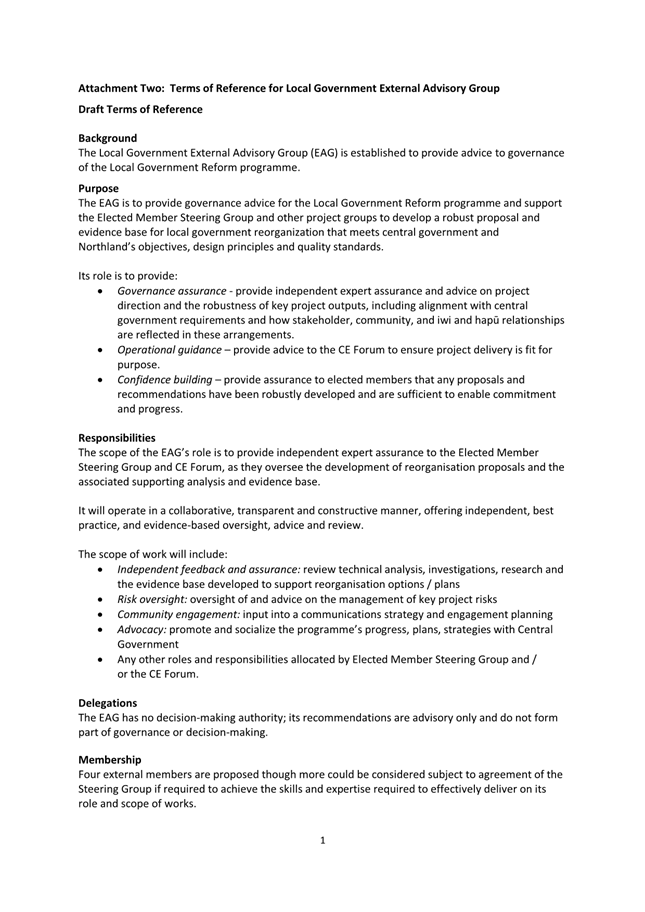
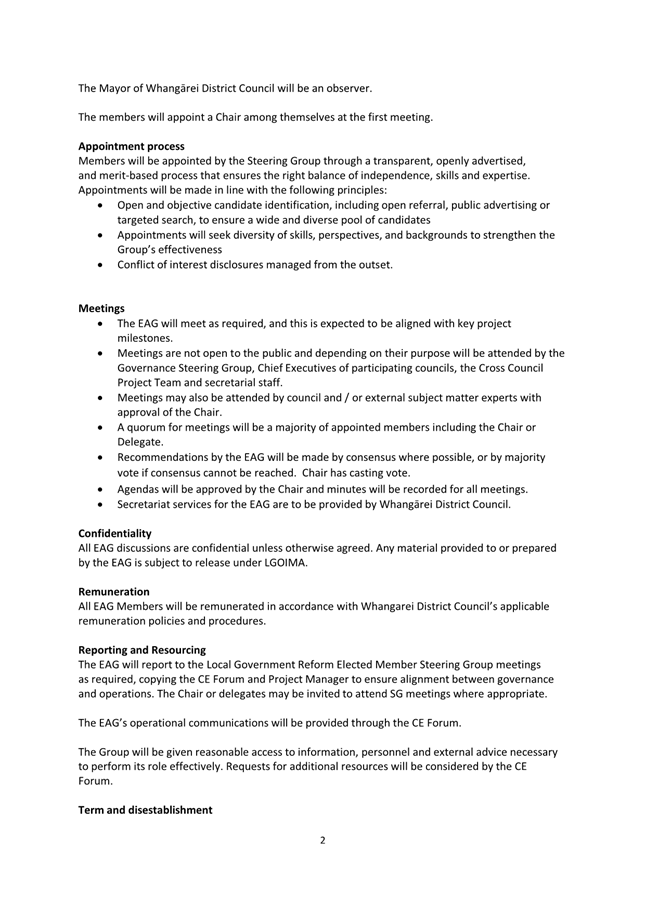
Local Government Reform External Advisory Group
It is recommended that the programme be supported by an
External Advisory Group (EAG) that would provide independent advice for the
programme and support the Local Government Reform Steering Group to develop a
robust proposal and evidence base for local government reorganization that
meets central government and Northland’s objectives and quality
standards.
It is proposed that four members be appointed through a
transparent, merit-based process that ensures the right balance of
independence, skills and expertise, and that the Mayor of Whangārei
District Council be appointed as an observer to the group. It is not proposed
that the EAG have delegated decision-making powers. Draft Terms of Reference
for the External Advisory Group are set out in Attachment 2.
It is recommended that the EAG Terms of Reference now be
approved.
Programme support
It is recommended that the programme be supported by a
dedicated programme manager and cross-council project team, reporting to the
Chief Executive’s Forum. The Chief Executive’s Forum will provide
operational oversight, resourcing, and the link between governance and
operations, and report to the Local Government Reform Steering Group. The
programme manager would be appointed by the Chief Executive’s Forum and
would provide project management and reporting functions. The cross-council
project team would be made up of staff from each council (membership to be
confirmed) and would implement the project plan and provide technical data and
analysis. The appropriate balance between internal and external capacity to
resource the programme will be determined during stage 3 (detailed programme
planning).
Iwi, hapū and community participation
Iwi, hapū and community participation is an important
consideration for the project and reflects the role of Māori as
tāngata whenua alongside the wider community. Engagement with relevant
iwi, hapū and community groups can support informed decision-making by
providing local context, perspectives, and insights that contribute to durable
and well-supported project outcomes.
As part of Stage Three project planning and resourcing,
approaches to iwi, hapū and community participation will be assessed as a
key element of the work programme. This assessment will propose, as an outcome
of Stage Three, any necessary refinements to governance, advisory, and
engagement arrangements in place or in development, to ensure iwi, hapū
and community perspectives are appropriately captured and inform the Local
Government Reform programme.
Option One: Council approves the Local Government reform
program
Council approves the Local Government reform programme and
associated recommendations (relating to the programme structure, indicative
timeline, provisional budget, terms of reference and nominates council steering
group members)
Advantages
· Council will have a proactive role in developing a Regional
Reorganisation Plan in collaboration with other participating councils.
· A
Far North District Council perspective will add knowledge and expertise to the
process.
Disadvantages
· Costs and
resourcing / staff and elected member time required.
Option Two: Council does not approve the Local Government
reform programme and associated recommendations
The Far North District Council elects not to participate in
the regional programme.
Advantages
No costs or demand on staff / councillor time or other
council resource.
Disadvantages
· The process will
lack a Far North District Council perspective, knowledge and expertise
· Signals that
Northland councils are not unified or aligned on reforms (contrary to previous
public statements)
· The perception
that council does not have an interest in improving local government system in
Northland.
Risk Management
A programme of this significance on the proposed timeframes
is a significant undertaking for Northland Councils and presents several risks
- as well as opportunities. The programme will establish robust risk management
processes. An initial assessment of risks is presented below.
|
Risk
Description
|
Likelihood
|
Impact
|
Potential
Mitigation/Control
|
|
Central
government decisions on LG reform (e.g. local government functions, and CTB
establishment) could impact the programme
|
High
|
High
|
- Regular
engagement with key officials and Ministers
- Initial
stages of project are preparatory and advisory (no regrets)
- Agile
programme approach enables adaptation if necessary as national settings
become clear.
|
|
Delays
establishing governance or work programme impact on timeline
|
High
|
High
|
- Early
testing and approval, clear milestones, regular reporting,
|
|
Inconsistent
council engagement or commitment
|
High
|
High
|
- Agreed
roles, responsibilities, and protocols endorsed by CE Forum, recognising
capacity constraints
|
|
Inadequate
engagement of iwi and hapū
|
High
|
High
|
- Stage
3 prioritises gaining agreement on approach to engagement
|
|
Misalignment
with new Resource Management (RM) system implementation (e.g. functions,
resourcing)
|
Medium
|
High
|
- Aligned
reporting through CE Forum
- Identify
and manage interdependencies
|
|
Process
does not meet legislative requirements and is not approved
|
Medium
|
High
|
- Align
with legislative requirements
- Ensure
process is sufficient
|
|
Rushed
process does not bring community along
|
High
|
High
|
- Early
engagement plan
- Thorough
consultation that meets legislative requirements
- Adequate
resourcing of comms and engagement
|
|
Capacity
constraints across councils (including RM Reform and the implementation of
LWDW) impact delivery
|
High
|
High
|
- Early
decision to set up project run with sufficient external capacity.
- CE
oversight of work programmes to manage dependencies and risks
|
|
Programme delays mean that new governance is not in place ahead of
the 2028 elections
|
High
|
High
|
- Resource
the project from the start
- Immediate
request to central government for funding support
- Work
closely with central government so approval process is resourced and not
delayed.
- Procure
external and professional services as soon as possible.
- Regular
governance meetings and report backs to councils.
- Consider
case to advocate for a four-year term.
|
|
Procedural
/ legal challenge risk increased due to pace of work
|
Medium
|
High
|
- Early
legal assurance and disciplined records management.
- Ensure
statutory processes are followed precisely.
- Avoid
substantive commitments ahead of triggers.
- Embed
quality assurance at each decision gate.
|
TAKE TŪTOHUNGA
/ REASON FOR THE RECOMMENDATION
Option One is recommended as it ensures that the Far North
District Council plays an active part in
· shaping the reform
discussions
· maintaining
regional alignment, and
· ensuring that
future decisions affecting the district are informed by robust analysis,
governance oversight, and local context, while preserving Council’s
authority over all subsequent decisions.
3) PĀnga PŪtea me ngĀ
wĀhanga tahua / Financial Implications and Budgetary Provision
A placeholder programme cost, and resourcing has been
estimated for the remainder of this financial year at a total of $125,000
($31,250 from each council). For the Far North District Council this
contribution is proposed to be funded from unspent professional services
budgets in the 2025/26 Financial Year. This will support the setup of the EAG,
and initial programme planning and analysis.
A placeholder budget of $1,000,000 has been estimated for
2026/27 Financial Year based on the stages of the project anticipated to fall
in that period. It is expected that this will be funded by $250,000 from
each council. The Far North District Council will consider this as part
of the annual plan process. These are placeholder budgets and should
council decide to proceed a more detailed programme budget will be prepared
during Stage 3.
Any further programme costs to enable the programme to gain
Government decision on the final form of local government arrangements will be
subject to LTP decisions. Beyond that, transition and implementation costs
depend on the final form of local government arrangements once approved by the
Government. The costs (and benefits) of shifting to different forms of local
government will be estimated as the options are assessed and the Regional
Reorganisation Plan is developed.
Āpitihanga
/ Attachments
1. Attachment
1 Terms of Reference Local Government Reform Steering Group - A5644625 ⇩ 
2. Attachment
2 Terms of Reference Local Government Reform External Advisory Group -
A5644626 ⇩
Hōtaka Take Ōkawa / Compliance Schedule:
Full consideration has been given to the provisions of the
Local Government Act 2002 S77 in relation to decision making, in particular:
1. A
Local authority must, in the course of the decision-making process,
a) Seek
to identify all reasonably practicable options for the achievement of the
objective of a decision; and
b) Assess
the options in terms of their advantages and disadvantages; and
c) If
any of the options identified under paragraph (a) involves a significant
decision in relation to land or a body of water, take into account the
relationship of Māori and their culture and traditions with their
ancestral land, water sites, waahi tapu, valued flora and fauna and other
taonga.
2. This
section is subject to Section 79 - Compliance with procedures in relation to
decisions.
|
He Take Ōkawa /
Compliance Requirement
|
Aromatawai Kaimahi /
Staff Assessment
|
|
State the level of significance (high or low) of the
issue or proposal as determined by the Council’s
Significance and Engagement Policy
|
Staff Assessment: Medium significance.
While this decision does not approve any specific reform
outcome or structural change, it is strategically significant. It commits
FNDC to participation in a staged Local Government Reform programme,
establishes governance arrangements, and makes indicative financial
provision. Any future decisions with high significance (including structural
change, reorganisation proposals, or statutory consultation) will be subject
to separate Council decisions and engagement processes.
|
|
State the relevant Council policies (external or
internal), legislation, and/or community outcomes (as stated in the LTP) that
relate to this decision.
|
Legislation
Local Government Act 2002 (sections 10, 14, Part 3,
sections 76-82)
Local Government Official Information and Meetings Act
1987
Relevant future legislation arising from the
Government’s Simplifying Local Government Reform programme
Council frameworks and policies
FNDC Significance and Engagement Policy
Long Term Plan 2024–2034 (governance, financial
sustainability, and service delivery outcomes)
Triennial Agreement between Northland councils
Te Kūkupa Committee Terms of Reference (strategic
oversight and reform alignment)
This decision aligns with Council’s role in
providing good‑quality
local infrastructure, public services, and democratic decision‑making, and in
proactively managing the implications of national reform on local outcomes.
|
|
State whether this issue or proposal has a District wide
relevance and, if not, the ways in which the appropriate Community
Board’s views have been sought.
|
District‑wide
relevance: Yes.
Local Government Reform has potential implications for
governance arrangements, representation, service delivery, financial
sustainability, and regulatory functions across the entire Far North
District.
At this stage, the decision relates to participation in
a regional programme and does not involve decisions that directly affect
service levels or local outcomes.
Community Board views will be sought at later stages if
and when proposals with direct local impacts are developed.
|
|
State the
possible implications for Māori and how Māori have been provided
with an opportunity to contribute to decision making if this decision is
significant and relates to land and/or any body of water.
State the
possible implications and how this report aligns with Te Tiriti o Waitangi /
The Treaty of Waitangi.
|
This decision recognises Māori as tāngata
whenua and acknowledges that Local Government Reform may have implications
for governance arrangements, representation, and the Crown–local
government–iwi relationship.
The proposed programme explicitly provides for:
· Consideration
of iwi and hapū participation as part of later programme stages;
· The
development of appropriate engagement and advisory arrangements before any
reform outcomes are determined; and
· Alignment
with Te Tiriti o Waitangi principles through informed, staged, and
transparent decision‑making
No decisions affecting land, water, or specific taonga
are made through this report. Any future decisions of that nature will be
subject to separate Council consideration and engagement.
|
|
Identify persons likely to be affected by or have an
interest in the matter, and how you have given consideration to their views
or preferences (for example – youth, the aged and those with
disabilities).
|
Parties with an interest include:
· Residents
and ratepayers of the Far North District;
· Iwi
and hapū across Te Tai Tokerau;
· FNDC
elected members and staff;
· Other
Northland councils and regional partners;
· Central
government agencies.
This decision is intentionally limited to programme
participation and governance set‑up.
Broader stakeholder and community views will be sought in later stages if
reform options are developed and before any statutory proposals are advanced.
|
|
State the financial implications and where budgetary
provisions have been made to support this decision.
|
The decision requires:
· Allocation
of $31,250 from existing budgets for the remainder of the 2025/26 financial
year; and
· An
indicative provision of $250,000 in the 2026/27 Annual Plan.
These provisions enable participation in programme
governance and planning only. Further financial commitments will be subject
to separate Council decisions, consistent with the staged approach.
|
|
Chief Financial Officer review.
|
This report has been reviewed by the CFO
|
|
Ordinary Council Meeting Agenda
|
1 April 2026
|
|
Ordinary Council Meeting Agenda
|
1 April 2026
|

|
Ordinary Council Meeting Agenda
|
1 April 2026
|
6.3 Northland
Waters CCO - Foundational Legal Documents
File
Number: A5571940
Author: Andy
Dowdle, Change Specialist - Organisational Development
Authoriser: Charlie
Billington, Group Manager - Corporate Services
Take Pūrongo / Purpose of the Report
The purpose of this paper is to support Council
consideration of Commitment Point 1 under the Northland Water Done Well
programme.
In particular, the paper provides
the information required for Council to consider whether to confirm its ongoing
commitment to the establishment of a joint, asset‑owning
Council‑Controlled
Organisation (CCO) for the delivery of drinking water and wastewater services
across Northland, and to endorse in principle the core foundation documents
required to progress to the next phase of the programme.
WhakarĀpopoto matua / Executive Summary
· Commitment Point 1 is a defined milestone within the Northland
Water Done Well programme, which has been structured to progress the
establishment of a joint, asset‑owning Council‑Controlled Organisation (CCO) for drinking water and wastewater
services through a series of staged decisions.
· The Elected Member Steering Group (EMSG) recommends the
establishment of an asset-owning joint CCO to provide drinking water and
wastewater services for Northland.
· The current phase has focused on developing the foundation documents
required to establish the CCO. These include the Shareholder Agreement and the
Constitution, supported by a Transitional Support Agreement. Together, these
documents establish the ownership, governance, accountability, and transition
framework for the proposed entity.
· The Shareholder Agreement sets out how Whangārei, Kaipara and
Far North District Councils will work together as owners of the CCO, including
the shareholding structure, ring‑fencing and financial
protections, reserved matters requiring shareholder approval, transfer
principles, and the mechanisms for collective shareholder engagement, including
the Shareholder Representative Group and Statements of Expectations.
· The Constitution sets out how the CCO operates, including the powers
and responsibilities of the board, directors’ duties and conduct,
decision‑making processes, reporting obligations and amendment provisions.
The Shareholder Agreement and Constitution are intended to operate together,
with the Shareholder Agreement prevailing in the event of any inconsistency.
· The next step is to issue the drafts of the foundation documents to
the three councils for approval in Principle after which the documents will be
finalised, reviewed through the EMSG and then issued to councils for adoption
(Commitment Point 2).
|
tŪtohunga
/ Recommendation
That the Far North District Council:
a. Notes
that the Elected Member Steering Group recommends the establishment of an
asset owning joint council-controlled organisation (CCO) to provide drinking
water and wastewater services for Northland.
b. Confirms
its commitment in principle to the formation of an asset-owning joint Council
Controlled Organisation (CCO) to provide drinking water and wastewater
services in Northland.
c. Endorses
in principle the Shareholders Agreement between Far North District Council,
Whangarei District Council and Kaipara District Council to establish the CCO.
d. Endorses
in principle the Constitution of the CCO as the foundation document for the
entity.
e. Endorses
that the Establishment Advisory Group will become the first Board of the CCO
when the company is incorporated.
|
1) TĀhuhu kŌrero / Background
In August 2025 each of Far North,
Whangarei, and Kaipara District Councils resolved to enter into a Commitment
Agreement (see attachment 1) for the councils to work together to establish a
multi-council council-controlled organisation (CCO) to deliver water services
for drinking water and wastewater across the Northland region and sets out how
we will work together. This CCO has a current working name of Northland
Water Done Well (NWDW).
As required by the water reform
legislation, a joint Water Services Delivery Plan (WSDP) was prepared
collaboratively by the three councils outlining how this CCO would operate. The
governance groups in the Commitment Agreement mirror those in the implementation
plan of the WSDP with the costs for this phase to be shared equally by the
participating councils.
Included in the implementation plan of the
WSDP were two points for recommitting to establishment of the CCO with the
first due in March 2026.
Please note the second recommitment point
in the WSDP was originally planned for 30 June 2026, however the Elected Member
Steering Group for NWDW agreed to move this date forward to 30 April 2026 to
allow more time for the establishment activities including the recruitment of a
Chief Executive for the CCO.
How we got
here
In the implementation plan included in the WSDP two phases
of activity were described to complete the readiness activities for day 1 of
CCO operations. We are currently in Phase 1 with activities focussed on
planning and workshopping decisions that that will be included in the
foundation documents – the shareholders agreement and constitution to
enable the CCO to be incorporated. In parallel the planning for the
establishment phase of the CCO once it is incorporated is underway to ensure
the CCO is ready for operations to commence on 01 July 2027.
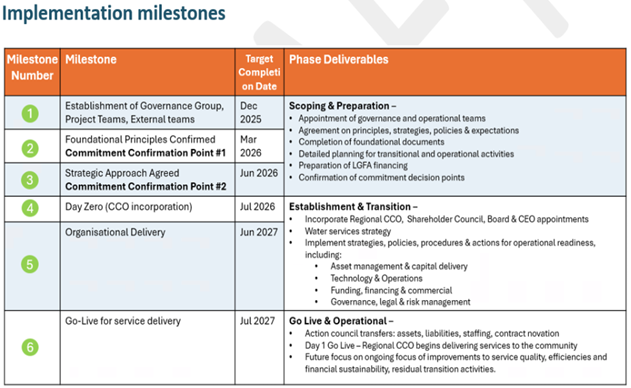
Milestones as set out in the
joint Water Service Delivery Plan. (Note
the programme has been accelerated to enable Commitment Point 2 to be brought
forward to April 2026).
These activities have been achieved by:
1. Elected
Member Steering Group made up of the mayor and two
councillors from each participating district and an external advisor (David
Hawkins). Eight meetings have been held since December considering topics
such as:
a. Content for the foundation documents (Shareholders
Agreement and Constitution) of the CCO
b. Content for other core documents such as Statement of
Expectations, Transfer Agreement
c. Review and
Establishment of the Establishment Advisory Group (EAG)/Interim Board members
d. Role and make-up of the Shareholder Representative Group
(SRG)
e. Financial discussions associated with water services across
the three councils
f. A prioritisation process for scheduling capital investment
g. What the water entity looks like and discussion on work
through the establishment phase
h. How to
balance funding, resource and facility needs while creating certainty for staff
and ensuring BAU activity is maintained
2. NWDW project team
a. A small project team led by the Implementation Programme
Director and supported by council staff from all three councils across
workstream topics – Finance, Asset Management, Operations, Legal, People,
Communications and Technology
b. Manage preparation
of the foundation documents
c. Manage
communications and engagement during the planning phase
d. Considering what needs to transfer from a council to the
CCO and the principles that will drive that for customers, staff, contracts,
property, regulatory obligations
e. Preparing
information for the EMSG to consider
f. Planning
for the establishment phase once foundation documents are agreed and CCO
incorporated
g. Establishing a
financial modelling tool and secure treasury advice
h. Work with the
Project Steering Group and report to the Chief Executive Group
i. Work
with and support the EAG
3. Establishment
Advisory Group/Interim Board (EAG)
a. Provides advisory
and assurance support to the EMSG and Programme Director and provides guidance
as an interim board on establishment activities until the CCO is
incorporated.
b. Attending
EMSG meetings, council briefings and other meetings by request
c. Guide
the water entities Chief Executive recruitment process
4. Council
workshops and briefings
a. Each council has
held workshops and briefing to ensure all elected members are across the
material supporting the decision points
2) matapaki me NgĀ KŌwhiringa /
Discussion and Options
Role of the foundation documents
- The Shareholder Agreement and Constitution are the two
core “foundation documents” required to establish the CCO
under the Local Government (Water Services) Act 2025 (LGWSA).
- These documents perform different but complementary roles
and together establish the governance, accountability and ownership
framework for the CCO.
In broad terms:
·
the Shareholder Agreement governs how the councils work together
as owners and how shareholder rights are exercised; and
·
the Constitution governs how the company itself operates as a
legal entity.
The documents are intended to
operate together and have been developed in parallel to ensure alignment. To
the extent permitted by law, the Constitution provides that the Shareholder
Agreement prevails where there is any inconsistency.
Under the Local Government (Water
Services) Act 2025 approval of these documents is a necessary step before the
programme can move from the current planning phase into establishment and
transition.
Simpson Grierson, acting on
behalf of all three councils, have drafted the foundation documents.
Shareholder Agreement
– purpose, scope and key provisions
The Shareholder Agreement (SHA)
records how Whangārei, Kaipara and Far North District Councils will
jointly own and oversee the CCO. It establishes the framework within which
councils exercise their ownership role while allowing the CCO to operate independently
on a day-to-day basis.
The SHA is not an operational
document. It does not direct service delivery or operational decisions.
Instead, it defines how councils, as shareholders, make decisions on matters
that have long term strategic, financial or ownership implications.
Key Terms of the SHA:
Ownership and shareholding
structure
The SHA provides for two classes of
shares:
1. Class
A shares: These shares carry voting rights but no dividend or distribution
rights. Each council is issued the same number of Class A shares, ensuring
equal voting influence regardless of differences in scale or asset value.
2. Class
B shares: These shares carry dividend or distribution rights but no voting
rights. They are intended to reflect the net value of assets transferred by
each council and are issued as part of the transfer process.
This structure separates
governance control from financial contribution. It ensures councils retain
equal decision-making influence while recognising differences in the value of
assets transferred.
Ring fencing and financial
protections
The SHA incorporates ring fencing
principles designed to protect each council’s financial position. In
practice, this means that revenues, costs, debt and investment remain
attributable to each council district and one council’s water services
activities do not subsidise another’s.
Ring fencing is a central
principle underpinning the ownership and funding model.
Transfer principles
The Shareholder Agreement includes
a schedule of Transfer Principles, which sit within the agreement as a
framework to guide the preparation of detailed Transfer Agreements between each
council and the CCO. The Transfer Principles do not themselves effect any
transfer. Instead, they set the agreed boundaries within which transfer
arrangements are developed.
The purpose of the Transfer
Principles is to ensure that transfer arrangements are approached consistently
across all three councils and that key policy settings are agreed once, rather
than revisited during negotiation of individual Transfer Agreements.
At a practical level, the Transfer Principles shape the
content of the Transfer Agreements, including how the following matters are
addressed:
· the
transfer of statutory drinking water and wastewater obligations and associated
operational responsibilities;
· the
identification and transfer of water related assets and associated liabilities;
· the
treatment of shared or non-owned assets, including access, lease or licence
arrangements;
· the
transfer or continuation of contracts, consents and enforcement
responsibilities;
· disclosure
of known asset condition, risks and liabilities;
· valuation
of transferring assets and liabilities; and
· financial
settlement through the issue of Class B shares.
The Transfer Principles establish
that transfers occur on an “as is, where is” basis, supported by
appropriate disclosure of known condition, liabilities and risks, to support
continuity of service as responsibility transfers to the CCO.
They also provide that assets must
relate primarily to water services, with shared land or infrastructure
interests to be managed through leases or access arrangements where full
transfer is not appropriate.
The principles confirm that
stormwater assets and responsibilities do not transfer to the CCO, although
councils may contract with the CCO for certain stormwater related services.
Reserved matters and
shareholder approval
The Shareholder Agreement includes a schedule of Reserved
Matters, being decisions that cannot be made by the board alone and instead
require shareholder approval. These matters are those that have fundamental
implications for ownership, financial risk, or the long-term nature of the
Council Controlled Organisation (CCO).
Reserved Matters are a primary
control point for councils as shareholders. They ensure that decisions which
materially affect the purpose, risk profile, financial position or ownership
structure of the CCO remain subject to direct shareholder oversight, rather
than being delegated to the board.
At a high level, Reserved Matters
include decisions relating to:
· changes
to the CCO’s purpose or scope of activities;
· significant
financial decisions, including changes to ring-fencing, hamonisation, major
borrowings or guarantees;
· material
asset transactions;
· amendments
to the Shareholder Agreement or Constitution;
· the
entry of a new shareholder or the exit of an existing shareholder; and
· other
decisions with long term implications for ownership, risk or financial
exposure.
Within the Reserved Matters
framework, the Shareholder Agreement differentiates between matters that
require majority shareholder approval and those that require unanimous
shareholder approval. Unanimity is used for decisions that go to the core
protections agreed by councils and where shared agreement is essential.
The following matters require
unanimous shareholder approval:
§ Ring
fencing and Harmonisation arrangements: Any decision that would alter the
principle that revenues, costs, debt and investment remain attributable to each
council district requires unanimous approval.
§ Changes
to core governance or ownership settings: Amendments to the Shareholder
Agreement or Constitution, changes to the Reserved Matters themselves, or
decisions affecting ownership structure require unanimous agreement, reflecting
their long-term significance.
§ Entry
or exit of shareholders: The admission of a new shareholder or the exit of an
existing shareholder requires unanimous approval, given the implications for
asset ownership, risk allocation and governance.
Routine operational and
management decisions remain delegated to the board.
Shareholder Representative
Group (SRG)
The Shareholder Agreement
establishes a Shareholder Representative Group (SRG) as the primary mechanism
through which the councils collectively exercise their shareholder role and
interact with the CCO on an ongoing basis.
The SRG is the primary interface
between shareholders and the CCO board. It provides a structured channel for
engagement that supports clear accountability and avoids inconsistent or
informal direction to the board.
In practice, the SRG is the point
at which councils:
· Set
the Statement of Expectations for the CCO;
· receive
and consider reporting from the board on performance, risks and emerging
issues;
· engage
with the board on matters of strategic importance within the parameters set by
the Shareholder Agreement;
· consider
matters delegated to it under the Shareholder Agreement; and
· support
consistent communication of shareholder expectations to the CCO.
The SRG does not manage the CCO
and does not direct operational decisions. Responsibility for operational
management sits with the board and executive leadership.
The SRG does not replace
individual councils’ statutory decision-making powers. Matters identified
as Reserved Matters requiring shareholder approval continue to be referred to
councils for formal consideration and resolution.
Through the SRG, shareholders may
engage with the board on strategic direction, alignment with shareholder
expectations (including Statements of Expectations), and emerging risks or
issues. The board remains accountable for managing the affairs of the CCO
within the framework established by the shareholders.
The Terms of Reference for the SRG
are set out in a schedule to the Shareholder Agreement. These provide details
on membership, scope of authority, meeting processes and reporting
arrangements.
Statements of Expectations and
accountability
The SHA provides for councils to
issue a Statement of Expectations (SoE) to the CCO, setting out shareholder
expectations relating to performance, service delivery, financial management
and reporting.
This is the central accountability
mechanism between the Council’s and the CCO, whereby the shareholders
communicate their collective expectations to the CCO board about how the
organisation is expected to perform its role.
The SoE does not direct day‑to‑day operations and does
not displace the board’s statutory responsibilities. Rather, it sets out
high‑level
expectations relating to performance, priorities, conduct and accountability,
within the governance framework established by the Shareholder Agreement and
Constitution. The SOE is a reserved matter and must be agreed unanimously by
the SRG.
Scope of shareholder
expectations
The SoE can outline the
shareholders’ expectations across a number of core areas, including:
o Strategic
intent and purpose: Expectations regarding the CCO’s role in delivering
safe, reliable and compliant drinking water and wastewater services, consistent
with statutory requirements and the purpose set out in the Constitution.
o Financial
stewardship and ring‑fencing:
Expectations that the CCO operates within the agreed ring‑fencing framework,
maintains transparency of financial performance by district, and manages
assets, debt and investment in a prudent and sustainable manner.
o Service
delivery and customer focus: Expectations relating to continuity of service,
customer experience, responsiveness to issues, and effective engagement with
communities, recognising that service levels, priorities and charging may
differ by district.
o Asset
management and investment planning: Expectations regarding the stewardship of
public water assets, evidence‑based
investment planning, prioritisation of critical infrastructure, and long‑term asset
sustainability.
o Regulatory
compliance and risk management: Expectations that the CCO meets all regulatory
obligations, maintains robust risk management systems, and proactively manages
health, safety and environmental risks.
o Workforce
capability and organisational culture: Expectations relating to leadership,
capability, organisational culture and fair treatment of staff, including
during establishment and transition.
o Information,
reporting and transparency: Expectations regarding the quality, frequency and
timeliness of reporting to shareholders to support effective oversight,
including financial, performance and risk reporting.
o Relationship
to governance and oversight arrangements: The SoE operates alongside, and is
supported by, the broader governance framework. It does not replace or override
the Reserved Matters regime, the role of the SRG, or the board’s
authority under the Constitution.
Performance against the SoE is
expected to be monitored through regular reporting, structured engagement
between the board and the SRG, and the annual planning and accountability
cycle.
Responsibility for developing and
refining the SoE sits with the shareholders, supported through the agreed
governance arrangements. The Shareholder Agreement anticipates that the SRG
will play a key role in progressing the SoE, with final approval resting with
the councils in accordance with shareholder decision‑making processes.
·
Constitution – purpose, scope and key provisions
The Constitution is the foundation
document for the CCO that sets out how it operates as a company. It sets out
the internal rules of the organisation, including how authority is exercised,
how decisions are made, and how the board and shareholders interact.
While the Shareholder Agreement
focuses on ownership, control and how councils exercise their shareholder
rights, the Constitution focuses on how the CCO itself functions on a
day-to-day basis within those parameters. It provides the legal framework within
which the board is empowered to manage the affairs of the company.
Role of the Constitution within
the governance framework
The Constitution performs a
different role to the Shareholder Agreement, but the two documents are designed
to operate together. The Shareholder Agreement sets the governance and
ownership settings from the perspective of the councils as shareholders, while
the Constitution gives effect to those settings within the internal governance
of the company.
To the extent permitted by law,
the Constitution provides that the Shareholder Agreement prevails in the event
of any inconsistency. This ensures that agreed shareholder protections and
controls are not undermined by the company’s internal rules.
Key matters addressed in the
Constitution
The Constitution addresses the core
operational and governance settings of the CCO, including:
o Purpose
and permitted activities: The Constitution defines the CCO’s purpose and
the scope of activities it is authorised to undertake. This provides clarity
around the functions of the company and ensures alignment with the water
services role approved by shareholders.
o Powers
and responsibilities of the board: The Constitution establishes the
board’s authority to manage the affairs of the company, subject to the
oversight and limitations imposed by shareholder Reserved Matters. This
includes responsibility for strategy, operational decision making and
compliance with statutory obligations.
o Directors’
duties and conduct: Provisions relating to directors’ statutory duties,
conflicts of interest, standards of behaviour, appointment and removal
processes, and circumstances in which a director may be disqualified or
required to step aside.
o Meetings
and decision-making processes: Rules governing board and shareholder meetings,
including notice requirements, quorum, voting thresholds and resolution
processes. These provisions provide certainty around how decisions are validly
made.
o Reporting
and information rights: Requirements for financial, performance and other
reporting to shareholders, supporting transparency and accountability and
complementing the reporting obligations set out in the Shareholder Agreement
and Statements of Expectations.
o Amendment
of the Constitution: The Constitution sets out how it may be amended and the
level of shareholder approval required. Amendments are treated as Reserved
Matters under the Shareholder Agreement, ensuring appropriate shareholder
oversight of any changes.
Next Steps: Commitment points in
the programme
The programme anticipates two key
commitment points:
1. First commitment point – establishment
readiness. Confirming that core establishment work,
including
foundation documents and governance arrangements, are in place.
2. Second commitment point
– transition readiness.
Execution of foundation documents
to enable incorporation of the Water Entity and move from planning into
establishment, including progressing transition and transfer agreements and
preparing for operational commencement on 1 July 2027.
Next steps following commitment
points
Subject to councils confirming
progress at the relevant commitment points, the programme would transition into
a detailed transition and implementation phase. This phase would include:
· Incorporation
of the company
· Development
of transition agreements to manage continuity of service and responsibilities
· Establishment
of funding arrangements
· Appointment
of the CE
· Preparation
of transfer agreements covering assets, liabilities and obligations;
· Organisational
readiness activities, including leadership and capability planning; and
· Continued
council oversight through the agreed governance framework
OPTIONS
Option1
Endorse the establishment of the CCO and the finalisation of
the foundation documents
This option follows previous guidance from Council and gives
effect to the stated model of water services delivery outlined in the Water
Services Delivery plan – Recommended
Option 2
Decline to endorse the establishment of the CCO and the
finalisation of the foundation documents.
Now that the Water Service
Delivery Plan has been approved by the Secretary for Local Government (DIA),
councils are legally required to give effect to it which includes establishment
of a joint CCO to provide drinking water and wastewater services.
If a council:
· Deviates
materially from its accepted WSDP
· Fails
to maintain financially sustainable water services
· Cannot
demonstrate long-term compliance capability
Then under the Local Government (Water Services) Act 2025,
DIA can:
· Require
reconsideration of delivery arrangements
· Trigger
ministerial attention
· Escalate
toward structural change expectations (e.g. CCO formation)
This is reinforced through
amendments to the Local Government Act and Commerce Act, linking economic
regulation consequences to governance performance. Note that there are no fines
or the like for non‑delivery
of a plan milestone, the DIA enforcement provisions are more administrative
rather than punitive.
TAKE TŪTOHUNGA
/ REASON FOR THE RECOMMENDATION
Option 1 is recommended as it takes into consideration the
endorsement of the Elected Member Steering Group. To take any other pathway
than Option 1 would result in council not meeting its commitments outlined in
the Water Services Delivery Plan, the likely appointment of a Crown appointed
commissioner and an uncertain future for the delivery of water services in the
Far North
3) PĀnga PŪtea me ngĀ
wĀhanga tahua / Financial Implications and Budgetary Provision
The endorsement in principle of the foundational documents
and the EAG appointment to the inaugural board of directors does not impact
existing operational budgets and no additional budget allocation is being
sought by the recommended option.
Āpitihanga
/ Attachments
1. Attachment
A - Northland Waters Constitution (Final Draft) - A5637161 ⇩ 
2. Attachment
B - NWDW - Shareholders Agreement (Final Draft) - A5637157 ⇩
Hōtaka Take Ōkawa / Compliance Schedule:
Full consideration has been given to the provisions of the
Local Government Act 2002 S77 in relation to decision making, in particular:
1. A
Local authority must, in the course of the decision-making process,
a) Seek
to identify all reasonably practicable options for the achievement of the
objective of a decision; and
b) Assess
the options in terms of their advantages and disadvantages; and
c) If
any of the options identified under paragraph (a) involves a significant
decision in relation to land or a body of water, take into account the
relationship of Māori and their culture and traditions with their
ancestral land, water sites, waahi tapu, valued flora and fauna and other
taonga.
2. This
section is subject to Section 79 - Compliance with procedures in relation to
decisions.
|
He Take Ōkawa /
Compliance Requirement
|
Aromatawai Kaimahi /
Staff Assessment
|
|
State the level of significance (high or low) of the
issue or proposal as determined by the Council’s
Significance and Engagement Policy
|
Low. The development of the WSDP was of high
significance as it proposed major changes to how council delivers water
services and consultation was conducted, at that time, in line with the
requirements of the Local Government Act 2002.The development of foundational
legal documents for the CCO is one of the required activities to give effect
to the WSDP.
|
|
State the relevant Council policies (external or
internal), legislation, and/or community outcomes (as stated in the LTP) that
relate to this decision.
|
Local Government (Water Services) Act 2025
Local Government Act 2002
Significance and Engagement Policy 2021
|
|
State whether this issue or proposal has a District wide
relevance and, if not, the ways in which the appropriate Community
Board’s views have been sought.
|
The formation of a Regional Water Services CCO has
district-wide relevance and falls outside Community Board delegations.
|
|
State the
possible implications for Māori and how Māori have been provided
with an opportunity to contribute to decision making if this decision is
significant and relates to land and/or any body of water.
State the
possible implications and how this report aligns with Te Tiriti o Waitangi /
The Treaty of Waitangi.
|
Water is considered taonga (a treasured resource) in te
ao Māori. Future management of water services is of high significance to
Tangata whenua in Te Tai Tokerau.
Engagement during this phase of the programme leverages
relationships with Te Kahu o Taonui and regular reporting to Te Kuaka.
|
|
Identify persons likely to be affected by or have an
interest in the matter, and how you have given consideration to their views
or preferences (for example – youth, the aged and those with
disabilities).
|
Although the development of foundational legal documents
has the potential to have a downstream effect on the delivery of water
services (and water services customers). The foundational documents at this
stage of the process do not have a material impact on service delivery and
will be of little interest to public/water services customers.
|
|
State the financial implications and where budgetary
provisions have been made to support this decision.
|
The programme remains within approved budget
allocations.
|
|
Chief Financial Officer review.
|
The CFO has not reviewed this report. The CFO is part of
the project team delivering the FNDC Local Water Done Well project and has
ongoing visibility of the CCO establishment activities.
|
|
Ordinary Council Meeting Agenda
|
1 April 2026
|
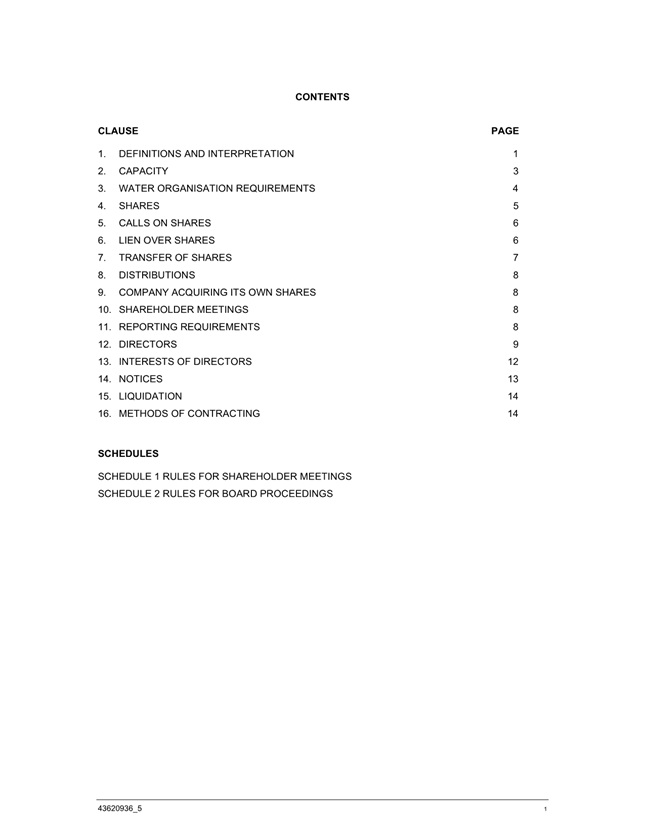
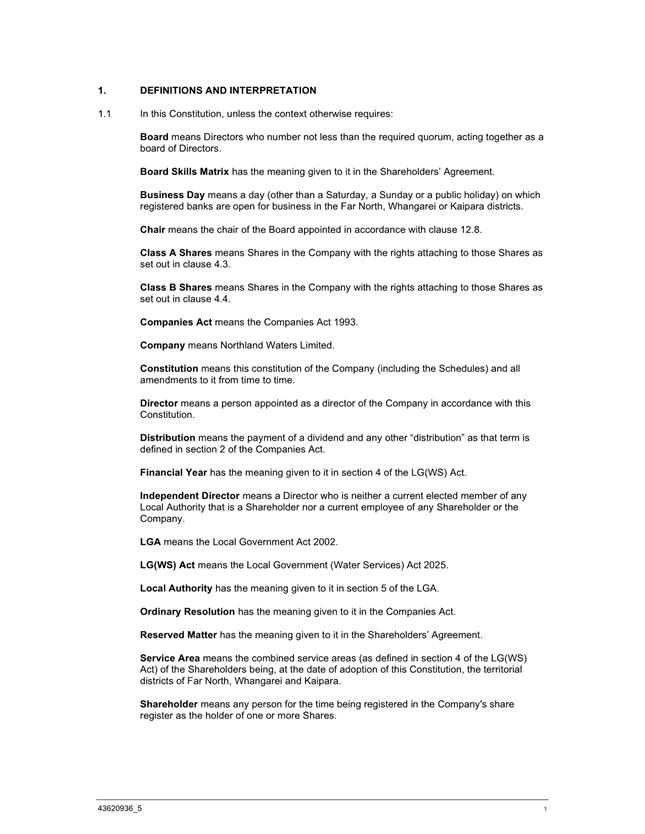
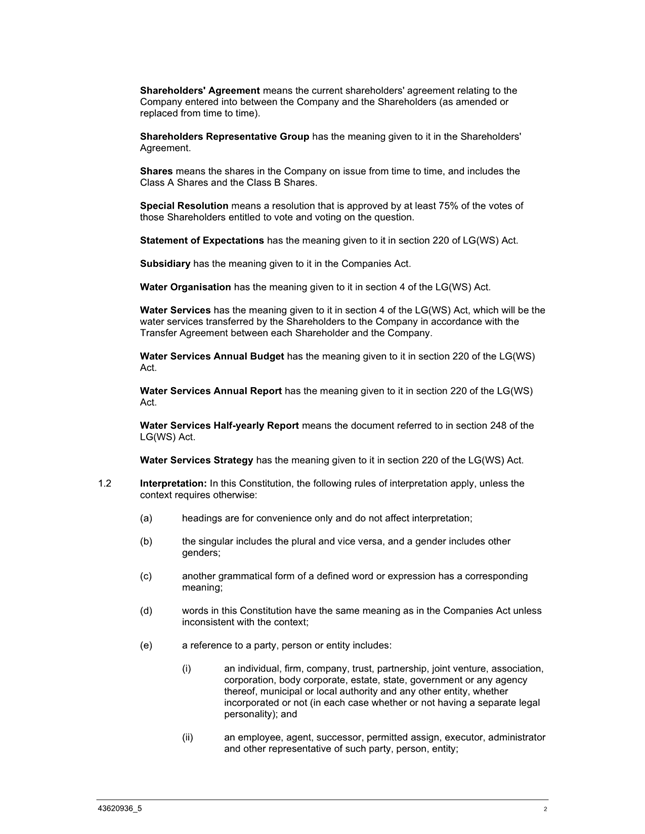
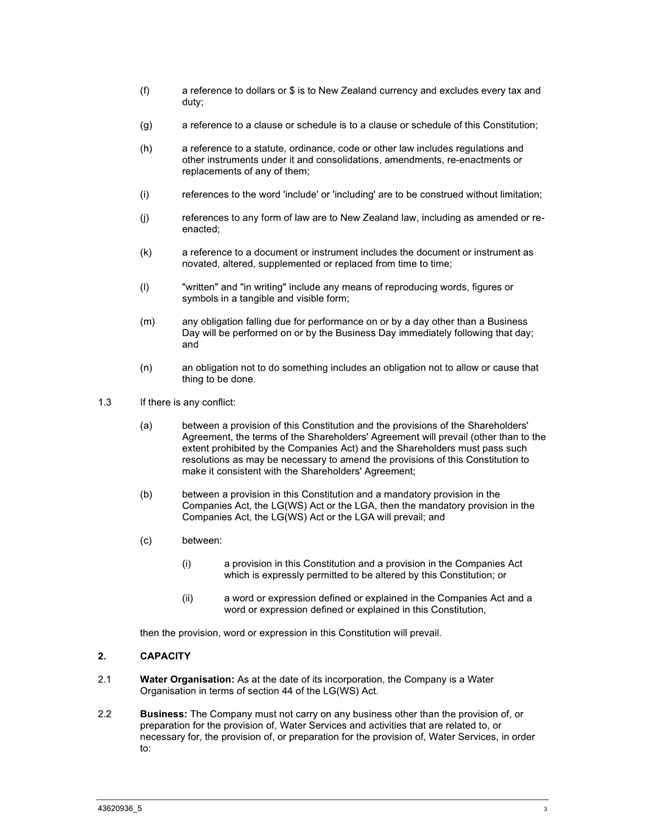
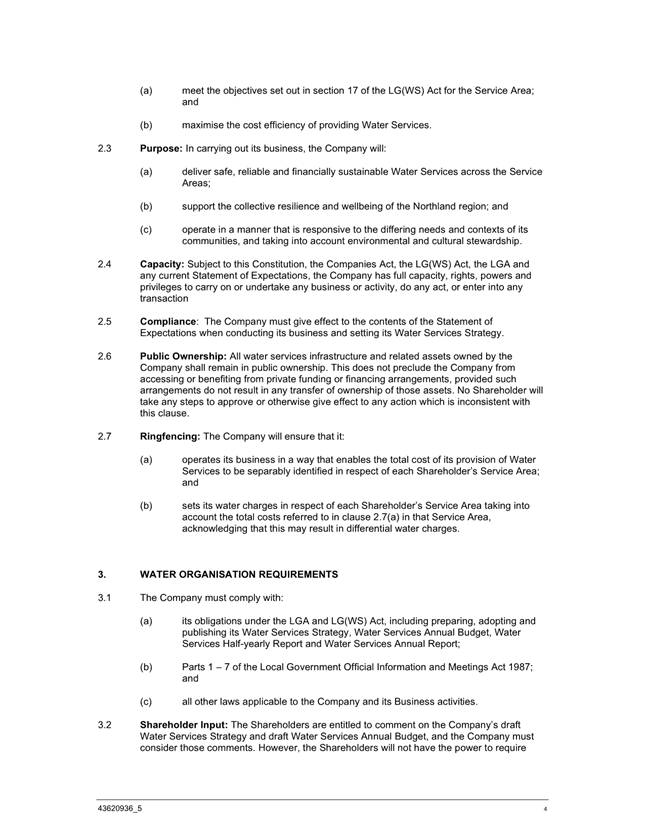
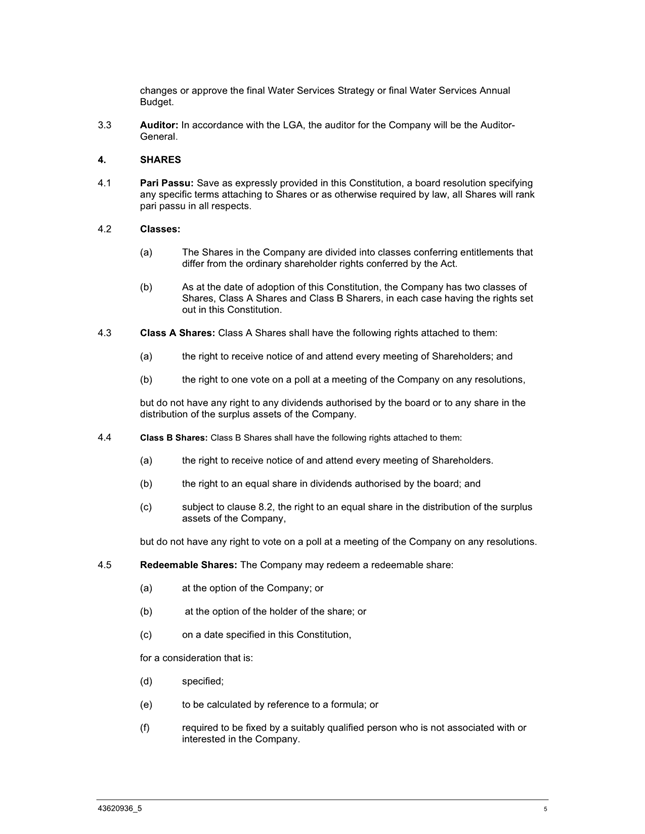
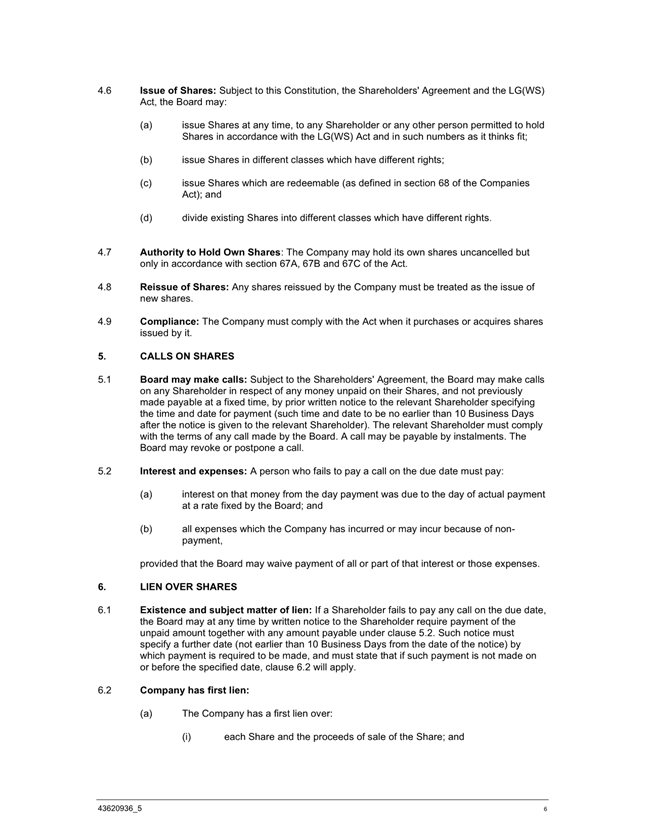
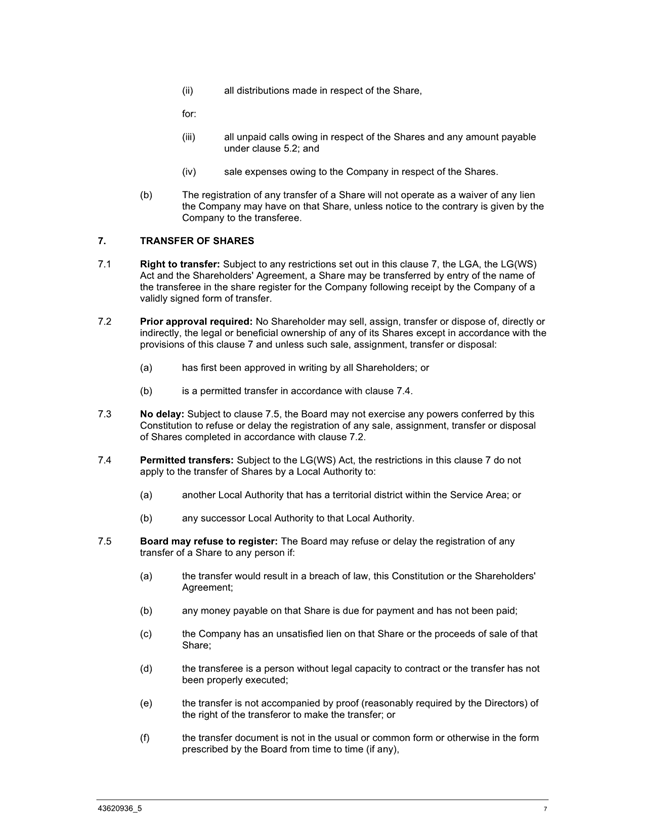
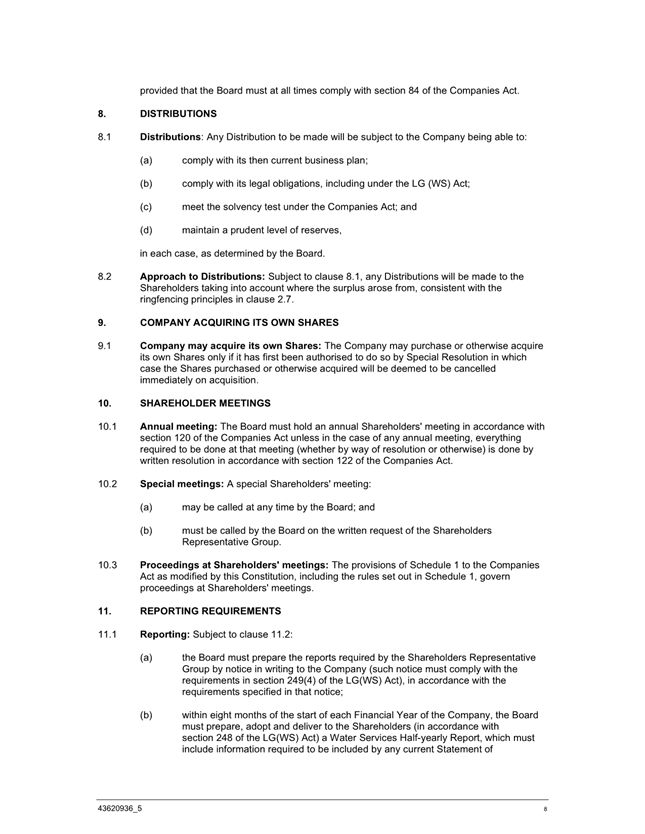
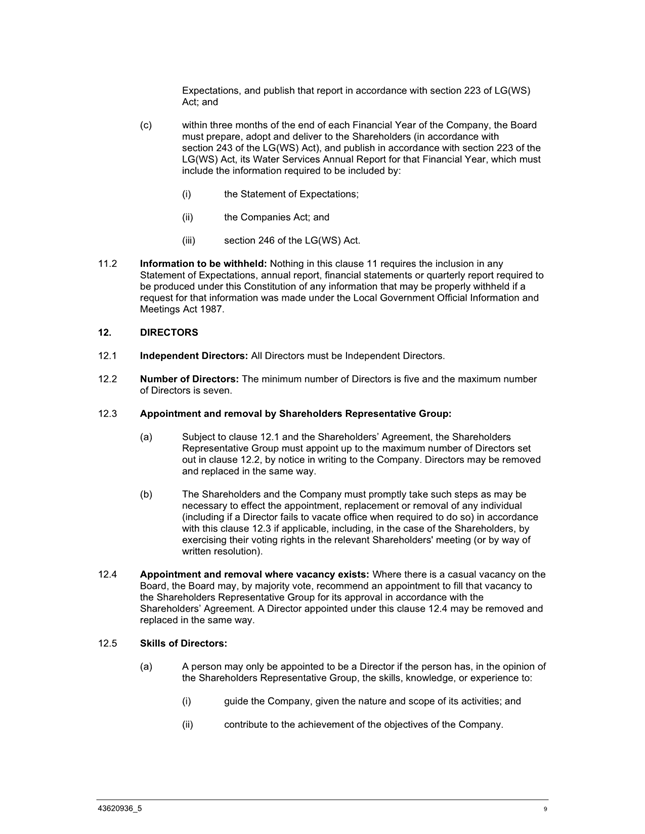
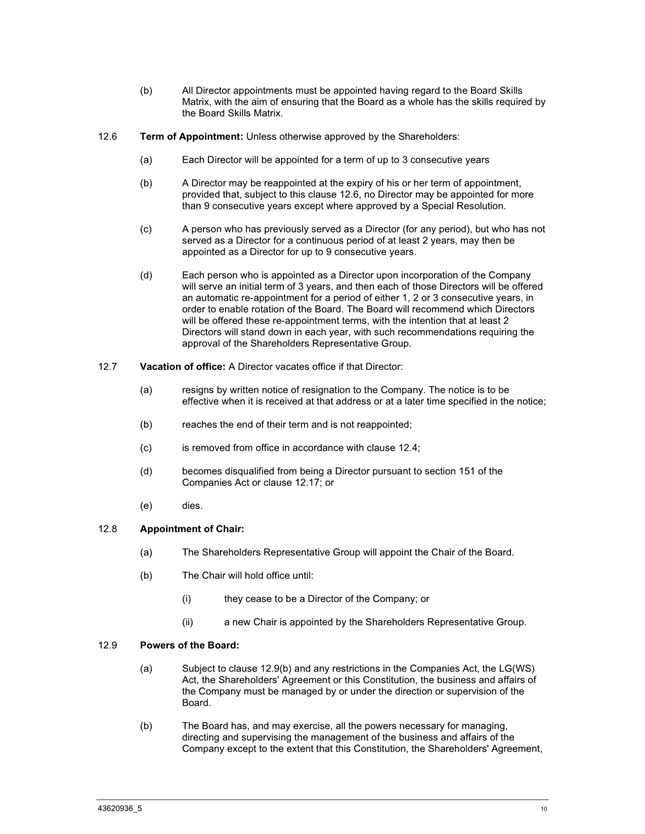
|
Ordinary Council Meeting Agenda
|
1 April 2026
|

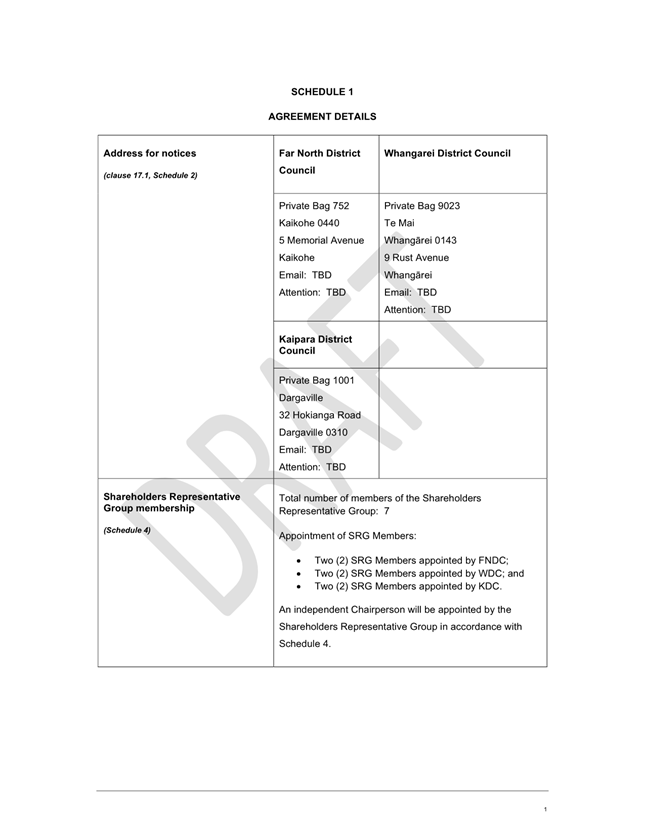
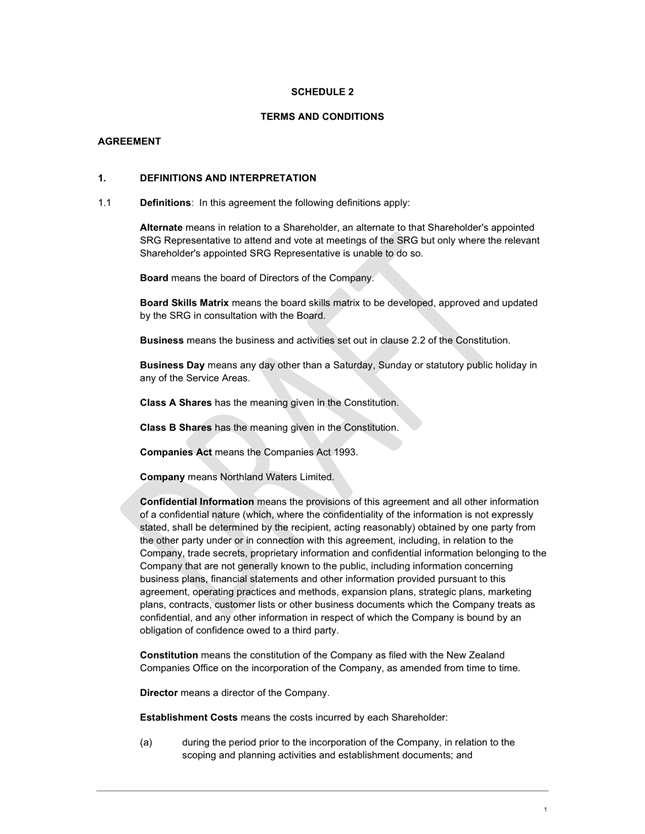
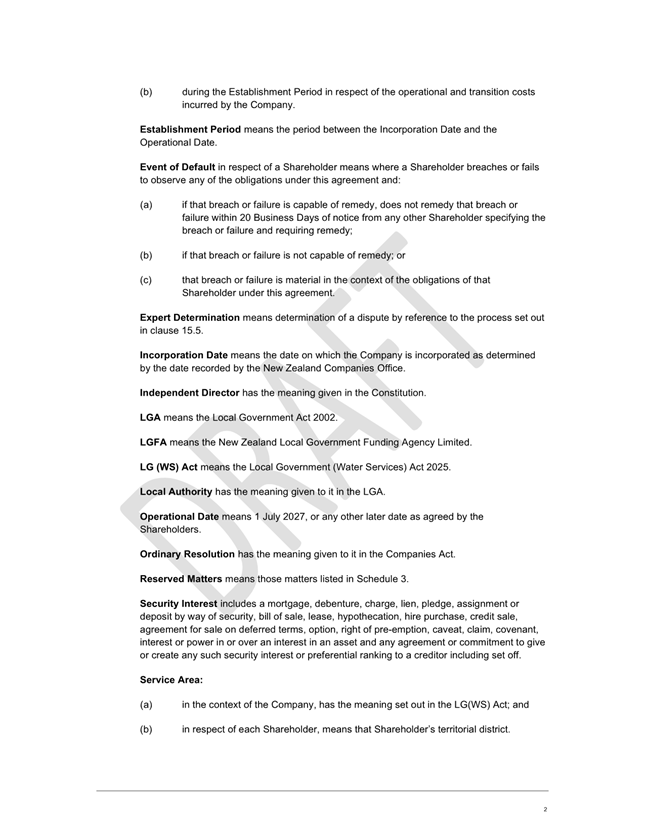
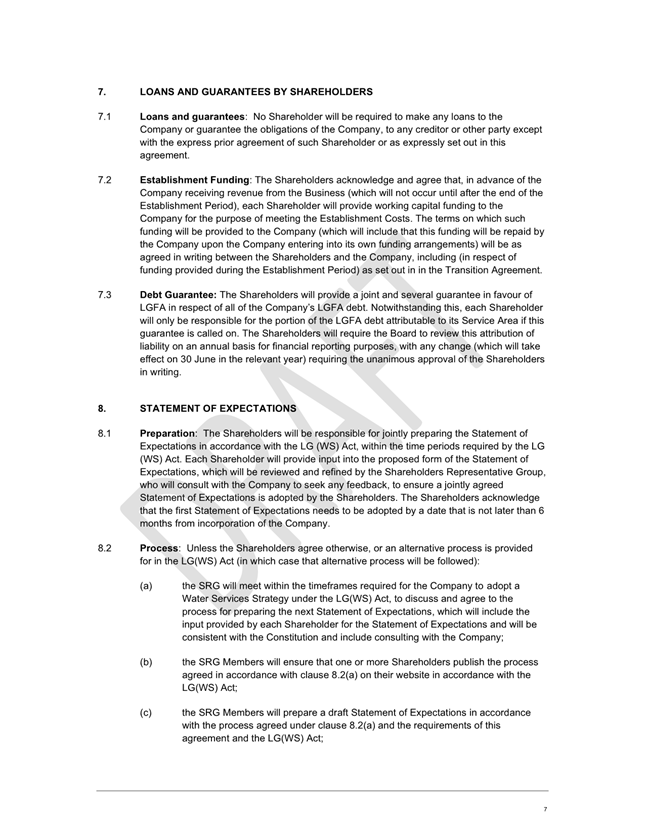
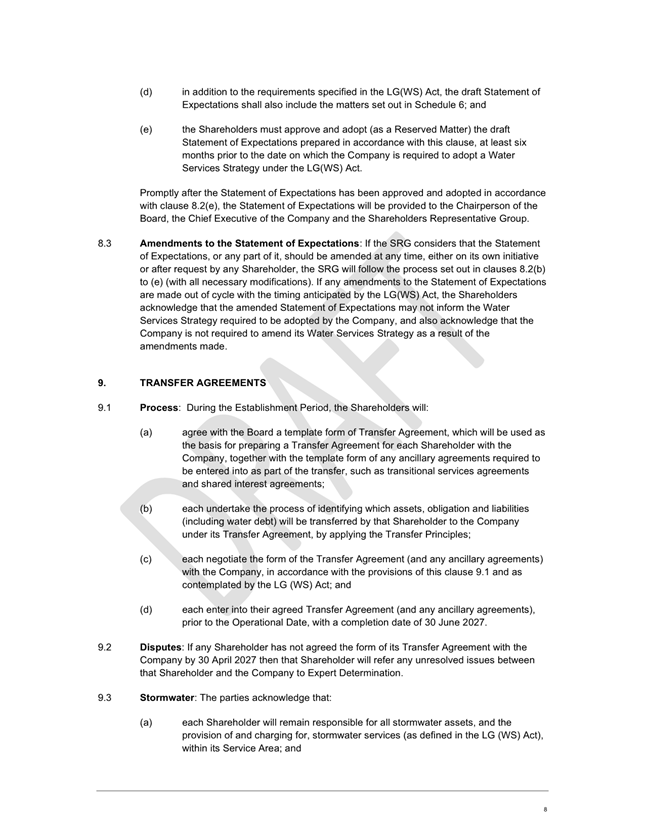
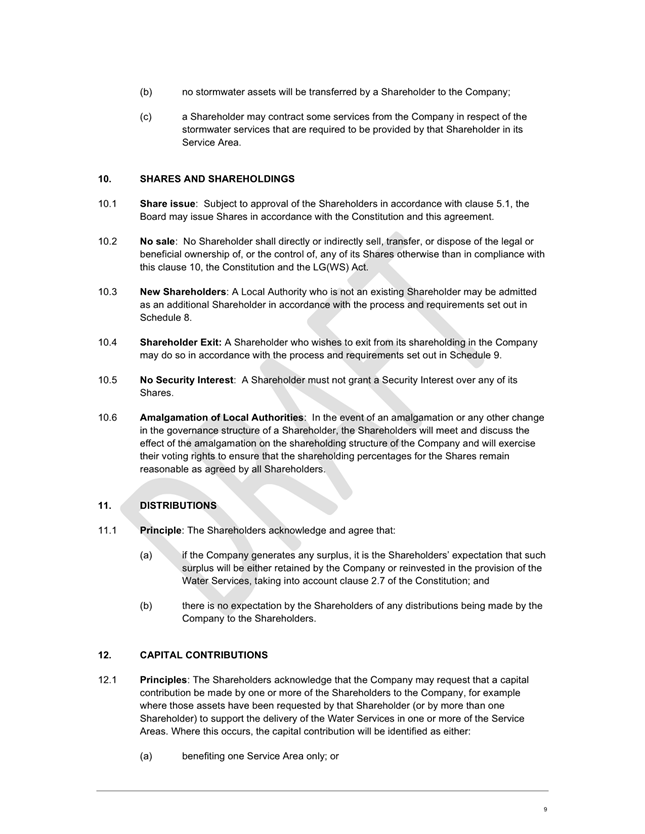
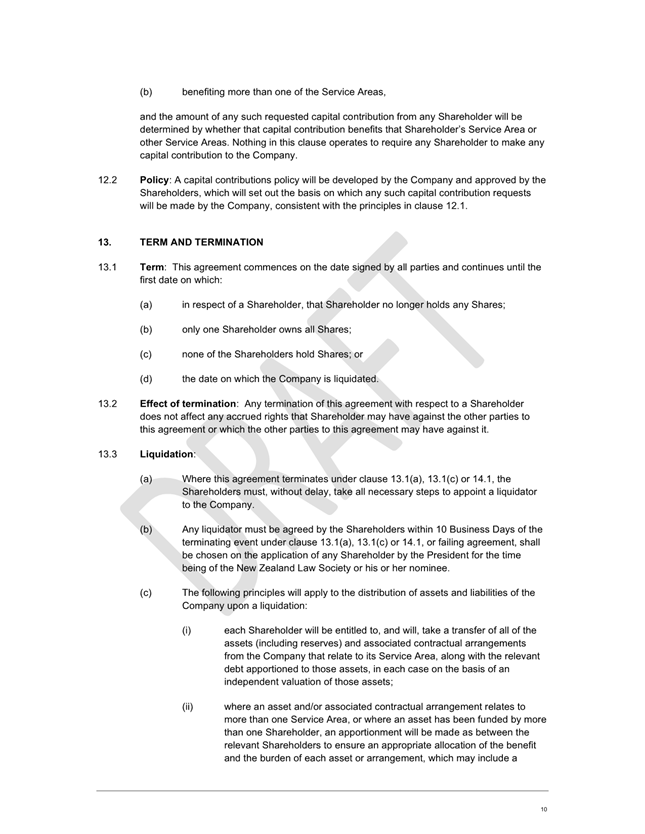
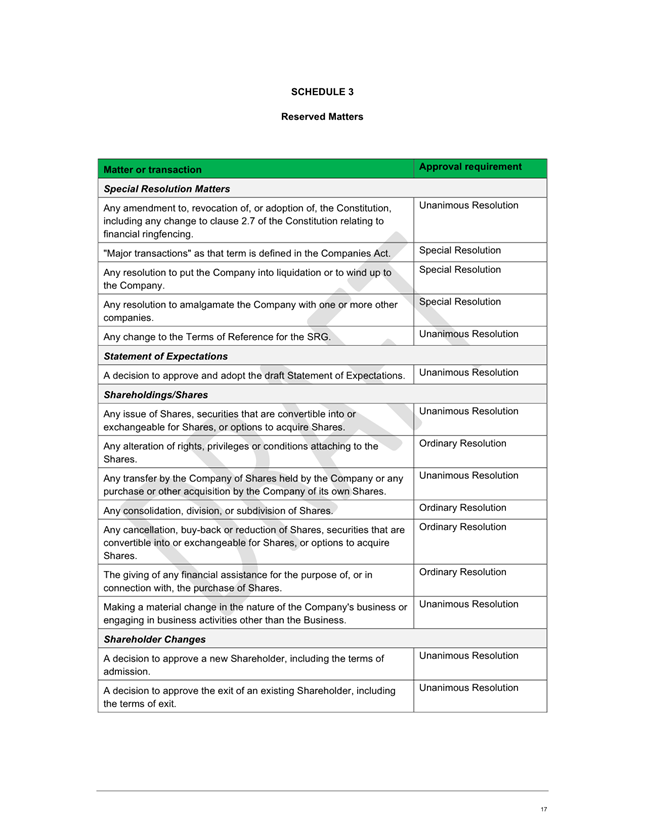

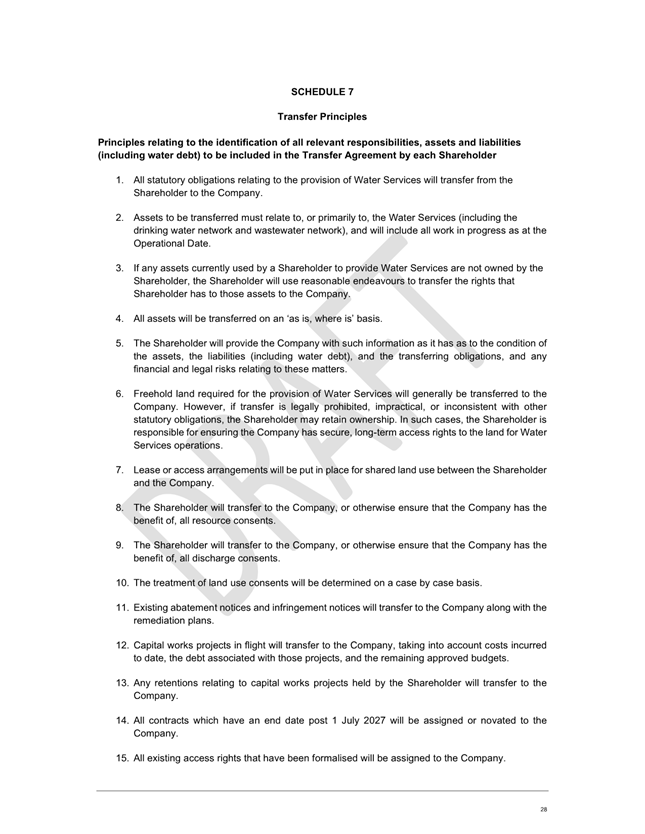
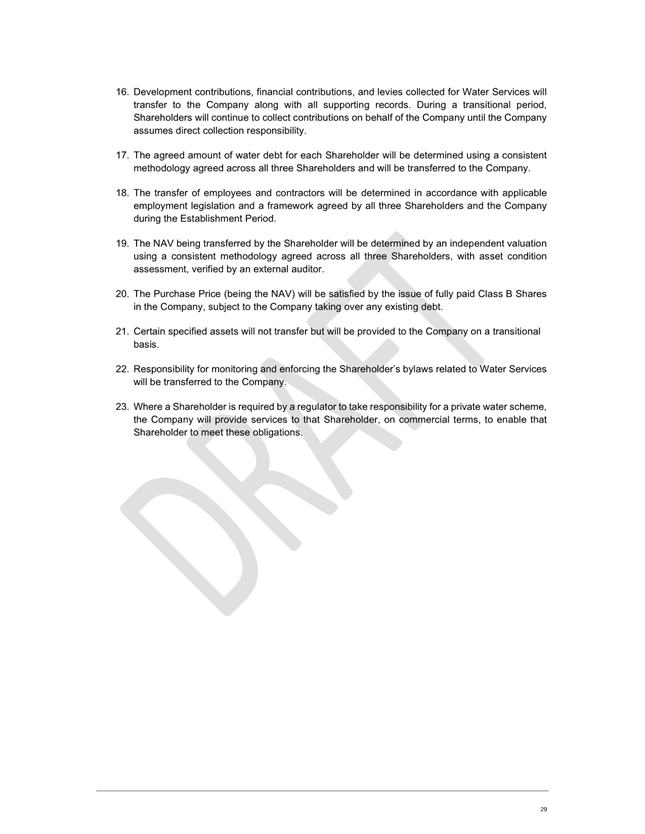
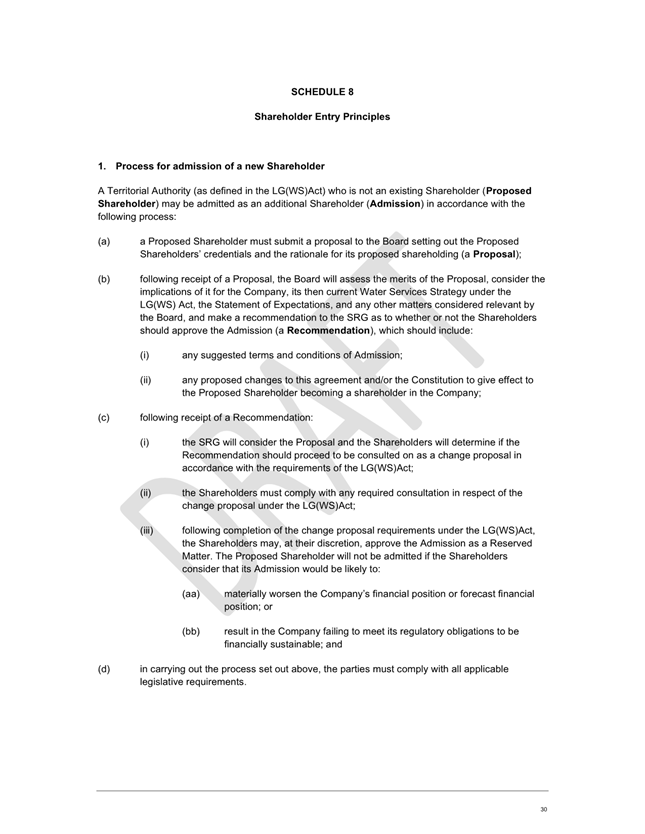
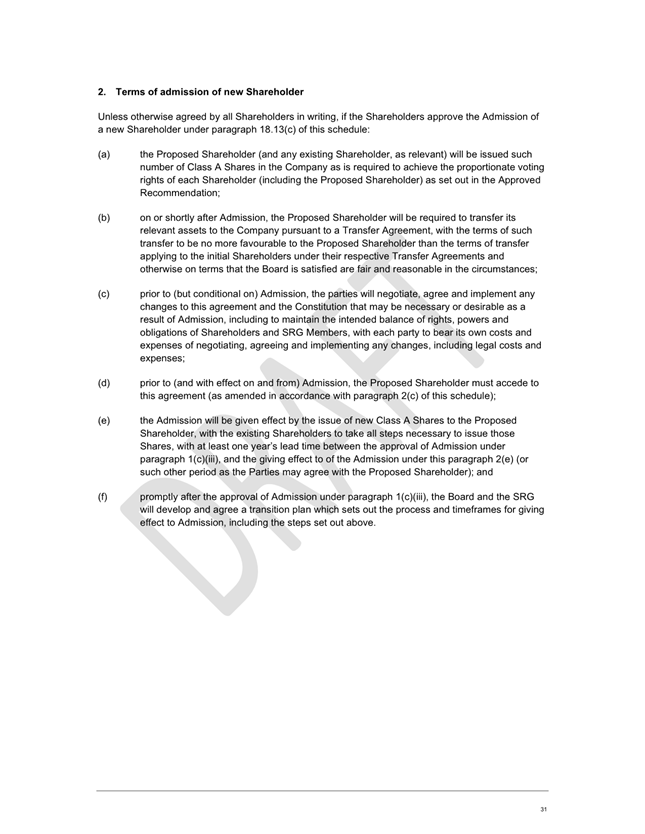
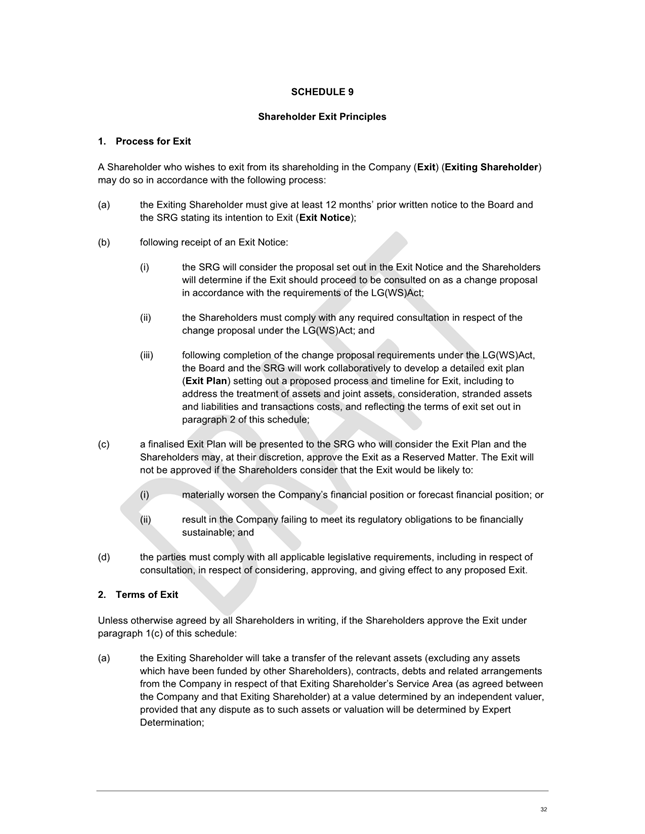
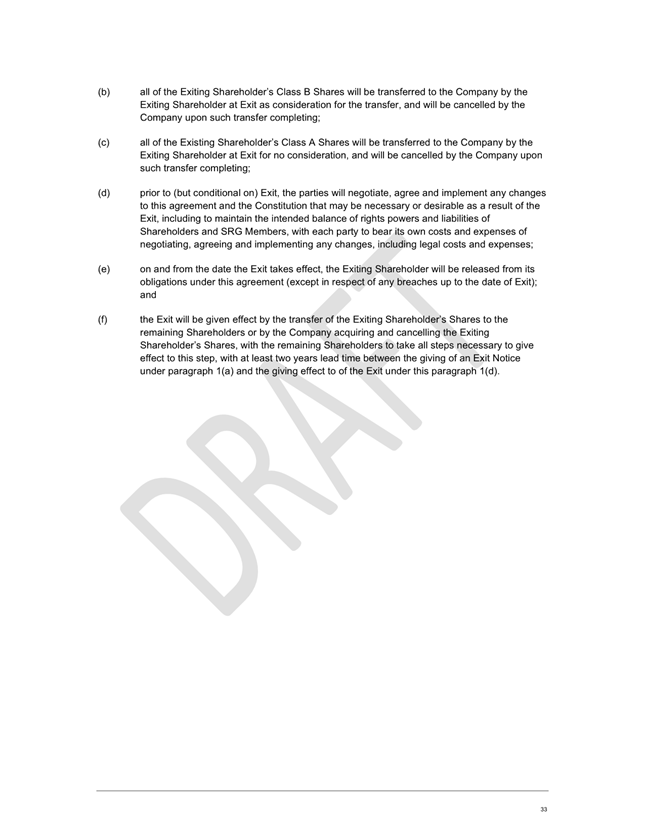
|
Ordinary Council Meeting Agenda
|
1 April 2026
|
6.4 Reserves
adjoining Simson Park Domain - Reserves Act Classification
File
Number: A5624582
Author: Robin
Rawson, Parks & Reserves Planner
Authoriser: Tammy
Wooster, Group Manager Planning and Policy
Take Pūrongo / Purpose of the Report
This report seeks approval from Council to either; approve
classification of Lot 35 DP 51470 and reclassification of Lots 25 and 26 DP
51470 as recreation reserves, or; to approve classification of Lot 35 as a
Local Purpose (Carpark) Reserve under the Reserves Act 1977. All three
reserves adjoin Simson Park Domain.
WhakarĀpopoto matua / Executive Summary
· In the last quarter of 2025, a two-month public consultation was
undertaken on (1) the draft Reserve Management Plan for Simson Park, Moerewa
and (2) the classification / reclassification of Council-owned reserves
adjoining Simson Park Domain.
· 59 submissions supported the classification of Lot 35 DP 51470 as a
recreation reserve and 4 submissions opposed this classification.
· The consultation documentation communicated that if Lot 35 DP 51470
was classified as a recreation reserve that Lots 25 and 26 DP 51470 would be
reclassified as recreation reserves, noting that reclassification of Local
Purpose reserves does not require public consultation.
· On 12 March 2026, the Bay of Islands-Whangaroa Community Board
recommended that Council reclassifies Lot 25 and Lot 26 DP 51470 as Recreation
Reserves, and that Council classifies Lot 35 DP 51470 as Recreation Reserve.
|
tŪtohunga
/ Recommendation
That the Far North District Council:
a) Approves
the reclassification of Lot 25 and Lot 26 DP 51470 as Recreation
Reserves under section 24 of the Reserves Act 1977 by delegation of the
Minister of Conservation; and
b) Approves
the classification of Lot 35 DP 51470 as a Recreation Reserve under Section
16 of the Reserves Act 1977 by delegation of the Minister of Conservation.
|
1) TĀhuhu kŌrero / Background
All of the land parcels forming Simson Park
Domain are classified as Recreation Reserve which is consistent with park
use.
Two of the adjoining three parcels fronting
Leaity Street were classified by Council in 1985 as Local Purpose (Carpark)
Reserves, (Lots 25 & 26 DP 51470). The status of the third land
parcel fronting Leaity Street is an unclassified reserve currently held as
Local Purpose (Road) under the Reserves Act, (Lot 35 DP 51470), (refer image
below). These reserve parcels are Council owned but are not part of
Simson Park Domain.
Early consultation on Simson Park
Domain's management plan, held in 2024, revealed increased recreational demand
and the need for a fourth playing field that was confirmed by a sporting needs
assessment commissioned for the Domain. The inclusion of a fourth field
in the final reserve management plan would reduce development space for other
park uses including possible future redevelopment of Simson Park Hall.

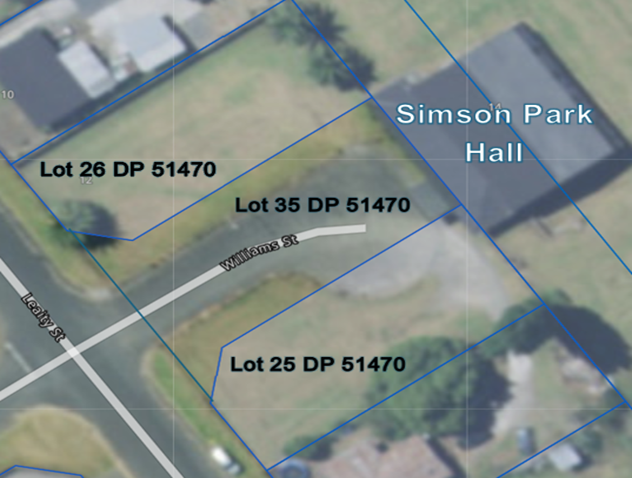
Site Plan of reserves
Council approved the initiation of
consultation on both classification and the draft management plan in September
2025, (Resolution 2025/117) and consultation on these matters concluded in
December 2025. Lot 35, the Local Purpose (Road) Reserve, cannot be
included in the approved reserve management plan unless it has been classified
as a reserve. The consultation asked for comment on the option of Lot 35
being classified as recreation reserve and communicated that if this parcel was
classified as recreation reserve that Lots 25 and 26 would also be classified
as recreation reserves, noting that Council is able to reclassify Local Purpose
Reserves without public consultation.
Summary of consultation:
· 59 submissions supported the classification of Lot 35 DP51470 as a
recreation reserve
· 4 responses were opposed to the classification of Lot 35 DP51470 as
a recreation reserve
· 2 respondents said they were not sure about the proposed
reclassification
· A further 5 respondents did not have a view on the proposed
classification.
Comments in
support of reclassification as recreation reserve were as follows:
|
Needs
to be utilised
|
|
One
hundred percent agree
|
|
Under-utilised
and would be great to see this used as an overflow for parking with some
proper access point into the field area for pedestrians.
|
Comments
in opposition were as follows:
|
In 2018 on the day of
the Council meeting which was to adopt the 2018 dog management bylaw and
policy, council managers submitted a last minute change to ban dogs from
being off-leash on any reserve in our district. There was no consultation on
this with the community, or iwi. If you reclassify this land as
'reserve', a clear consequence is that dogs must be on leash. You have not
mentioned this in the Simson Park consultation documents or as part of this
online survey.
|
Unsure
responses were as follows:
|
I am not 100% sure that
I fully understand the implications of this decision
|
|
FNDC should focus on
its core duties. To fix roads and footpaths and water leaks etc.
|
Section 17 of the Reserves Act 1977
states that recreation reserves have ‘the purpose of providing areas
for the recreation and sporting activities and the physical welfare and
enjoyment of the public, and for the protection of the natural environment and
beauty of the countryside, with emphasis on the retention of open spaces and on
outdoor recreational activities, including recreational tracks in the
countryside’.
Section 23 of the Reserves Act 1977
states that local purpose reserves have ‘the purpose of providing and
retaining areas for such local purpose or purposes as are specific in any
classification of the reserve.
A
recreation reserve can provide for carparking associated with recreation
activities in the reserve, and car parking is commonly provided in larger
sports parks.
Reserves
must be appropriately classified before a reserve management plan can be
approved, so Lot 35, the Local Purpose (Road) Reserve,
that forms the entrance to Simson Park Hall cannot be included in the Simson
Park Domain reserve management plan unless it has been classified.
On 12
March 2025, the Bay of Islands-Whangaroa Community Board recommended that Lots
25 and 26 DP 51470 were reclassified as Recreation Reserves and that Lot 35 DP
51470 was classified as a Recreation Reserve (resolution number not yet
available).
2) matapaki me NgĀ KŌwhiringa /
Discussion and Options
Option
1: Staff recommendation: Classify Lot 35: Local
Purpose (Road) Reserve as a Recreation Reserve, and reclassify Lots 25
and 26 as Recreation Reserves.
This
option will give the greatest flexibility for use and will mean the land can be
used for carparking associated with Simson Park Domain and Simson Park Hall and
can also be used in part for future redevelopment of Simson Park Hall.
All land parcels would be included in the reserve management plan when
submitted to Council for adoption.
Option
2: Classify Lot 35: Local Purpose (Road) Reserve as
a Local Purpose (Carpark) Reserve. The land could
continue to be used for carparking. There would be minimal additional
room for redevelopment of the Simson Park Hall which abuts the field to the
east. All land parcels would be included in the reserve management
plan when submitted to Council for adoption.
Option
3: Do not classify Lot 35: Local Purpose (Road) Reserve.
Only include Lot 25 and Lot 26 in the reserve management plan as Local Purpose (Carpark) Reserves associated with Simson Park Domain.
TAKE TŪTOHUNGA
/ REASON FOR THE RECOMMENDATION
Classification of Lot 35 will allow this parcel to be
included in the reserve management plan.
Classification of all three parcels (Lots 25, 26 and 35), as
Recreation Reserves is consistent with the predominant community view and will
allow these parcels to be managed as part of Simson Park Domain. This
will provide the greatest flexibility for future management and development of
Simson Park Domain and will best meet the aspirations of the community.
3) PĀnga PŪtea me ngĀ
wĀhanga tahua / Financial Implications and Budgetary Provision
Gazetting
costs are expected to be less than $300. There are no other financial
implications as a result of this report.
Āpitihanga
/ Attachments
Nil
Hōtaka Take Ōkawa / Compliance Schedule:
Full consideration has been given to the provisions of the
Local Government Act 2002 S77 in relation to decision making, in particular:
1. A
Local authority must, in the course of the decision-making process,
a) Seek
to identify all reasonably practicable options for the achievement of the
objective of a decision; and
b) Assess
the options in terms of their advantages and disadvantages; and
c) If
any of the options identified under paragraph (a) involves a significant
decision in relation to land or a body of water, take into account the
relationship of Māori and their culture and traditions with their
ancestral land, water sites, waahi tapu, valued flora and fauna and other
taonga.
2. This
section is subject to Section 79 - Compliance with procedures in relation to
decisions.
|
He Take Ōkawa /
Compliance Requirement
|
Aromatawai Kaimahi /
Staff Assessment
|
|
State the level of significance (high or low) of the
issue or proposal as determined by the Council’s
Significance and Engagement Policy
|
The classification of parcels of land adjoining Simson
Park Domain has minor significance as the parcels form a small percentage of
the park however it would allow more efficient use of this land as part of
the park.
|
|
State the relevant Council policies (external or
internal), legislation, and/or community outcomes (as stated in the LTP) that
relate to this decision.
|
The three parcels adjoining Simson Park Domain are all
reserves under the Reserves Act 1977. Appropriate classification is a
guiding principle in the Reserves Act 1977 and is aligned with the FNDC Parks
and Reserves Policy.
|
|
State whether this issue or proposal has a District wide
relevance and, if not, the ways in which the appropriate Community
Board’s views have been sought.
|
On 12 March 2026, the Bay of Islands-Whangaroa Community
Board recommended that Council reclassifies Lot 25 and Lot 26 DP 51470 as
Recreation Reserves, and that Council classifies Lot 35 DP 51470 as
Recreation Reserve
|
|
State the
possible implications for Māori and how Māori have been provided
with an opportunity to contribute to decision making if this decision is
significant and relates to land and/or any body of water.
State the
possible implications and how this report aligns with Te Tiriti o Waitangi /
The Treaty of Waitangi.
|
A representative from Ngāti Kōpaki and
Ngāti Te Ara has been involved throughout the planning process and has
supported the community aspirations for this valuable park.
|
|
Identify persons likely to be affected by or have an
interest in the matter, and how you have given consideration to their views
or preferences (for example – youth, the aged and those with
disabilities).
|
The Reserves Act provides for formal consultation that
is publicly notified, and a two month consultation concluded in December
2025. Issues were raised with representatives from the Sporting Codes
and other groups including the Simson Park Hall Committee throughout the
development of the plan so that their needs were understood.
|
|
State the financial implications and where budgetary
provisions have been made to support this decision.
|
There are no financial
implications as a result of this report, apart from Gazetting costs, which
are expected to be less than $300.
|
|
Chief Financial Officer review.
|
The Chief Financial Officer reviewed this report
|
|
Ordinary Council Meeting Agenda
|
1 April 2026
|
6.5 Development
Contributions – Operational Implementation Status Update and Go‑Live Timing
File
Number: A5585491
Author: Daniel
Schultz, IT Project Manager
Authoriser: Roger
Ackers, Head of Strategic Reform Initiatives
Take Pūrongo / Purpose of the Report
To provide Council with a status update on the operational
implementation of the Development Contributions Policy and to seek a decision
on the proposed go‑live
timing in light of identified operational, financial, and policy risks.
WhakarĀpopoto matua / Executive Summary
· Resolution
2025/136 required the go-live date for the Utu Whakawhanake Development
Contributions 2025 (Policy) to be May 2026, which was to align with the
anticipated timing of decisions on the Proposed District Plan.
· The
Policy’s operational implementation project is progressing broadly to
plan and is currently on track overall, with approximately 45% of delivery
completed against a target of 37% at the time of this report.
· Core
business processes are largely designed, with Resource Consents and Building
Services workflows analysed, redesigned, and documented, and foundational
communications and governance arrangements established.
· The
project is now entering a critical delivery phase, with system configuration,
staff training, and operational readiness activities scheduled over the next
8–10 weeks.
· Material
risks have been identified that affect the feasibility of the planned 29 May
2026 go‑live, including Finance year‑end
blackout constraints, unresolved ownership for invoicing and accounting
processes, system configuration complexity, and staff capacity pressures which
collectively limit the organisation’s ability to complete system testing, embed financial controls, and
ensure end to end operational readiness prior to the go live date.
· A
statutory and operational risk has been identified with the Policy, as the
current requirement for reconsiderations to be determined via a public Council
meeting. This is not achievable within the policy’s 15‑working‑day timeframe, necessitating a policy amendment.
· In
addition, the Proposed District Plan decisions are delayed by several weeks and
are more likely to occur mid to late June 2026.
· Two
options are presented for Council consideration: proceeding with the 29 May
2026 go‑live date with accelerated mitigations, or delaying policy
implementation to 1 July 2026 to reduce financial, operational, and compliance
risk.
· The
preferred option is to delay the Policy’s go‑live
date to 1 July 2026, allowing sufficient time for finance system testing,
Policy amendments, staff training, and confirmation of end‑to‑end operational ownership.
|
tŪtohunga
/ Recommendation
That Council Approve Option B, delaying the
Development Contributions go-live date to 1 July 2026.
|
1) TĀhuhu kŌrero / Background
Council has adopted the Development Contributions Policy
(Utu Whakawhanake), which requires the organisation to be operationally ready
to calculate, invoice, and administer development contributions in accordance
with statutory requirements.
Council has not collected Development Contributions since
2015, with the teams involved in this work disestablished at that time, and
systems in place no longer used or updated. IT changes since 2015 also
mean Council are using upgraded systems, requiring all new processes and
organisational training to occur.
The current implementation programme commenced on 24
November 2025, with an original target go‑live
date of 29 May 2026. The project is now transitioning from early‑phase design into system
configuration, staff training, and operational readiness. The
implementation date in May 2026 was intended to align with the decisions on the
Proposed District Plan. However, decisions on the Proposed District Plan
are now delayed and is scheduled to occur mid-June 2026.
2) matapaki me NgĀ KŌwhiringa /
Discussion and Options
The implementation programme has delivered substantial early
progress, with approximately 90% of core business processes designed and
documented, along with governance and communications arrangements established.
The focus of delivery now shifts to system configuration, operational training,
and end‑to‑end readiness.
As the programme has progressed, several risks have
crystallised that materially affect the achievability of the original 29 May
2026 go‑live date.
In particular, Finance has identified a year‑end
blackout period from May through early July, limiting resource availability for
testing. In parallel, operational ownership for invoicing and accounting
processes has not yet been fully confirmed, leaving the end‑to‑end charging process
incomplete.
In addition, clause 28.3.b of the Policy requires amendment
due to it being operationally unworkable within the statutory 15‑working‑day reconsideration
timeframe. The amendment is required to mitigate the identified statutory and
service delivery risk. Reconsideration of a development contribution
charge is a statutory right protected under the Local Government Act 2002
(LGA). It allows an applicant to request a review a development
contribution assessment and provides the three grounds on which a reconsideration
application can be considered by the Council. The timing of this is intended to
align with and be adopted through the Annual Plan process.
Option A – Proceed with 29 May 2026 Go‑Live (with Accelerated
Mitigations)
This option retains the currently planned Policy go‑live date of 29 May 2026
and requires the organisation to complete all remaining operational readiness
activities within a compressed timeframe. This includes finalising system
configuration and testing, confirming end‑to‑end operational
ownership for invoicing and accounting, delivering staff training, and
progressing the required Policy amendment relating to reconsiderations.
While early‑phase
process design is largely complete, the remaining delivery phase coincides with
the Finance year‑end
blackout period, which occurs each year, and presents known staff capacity
constraints. As a result, this option assumes that critical dependencies can be
resolved within limited time and system availability.
Advantages and Disadvantages
|
Advantages
|
Disadvantages
|
|
Enables Development Contributions
charging to commence from 29 May 2026 which
aligns with public messaging to date.
|
Finance year-end blackout materially limits system testing, configuration, and
stabilisation prior to go-live.
|
|
Maintains the original implementation timeline and avoids a formal deferral.
|
High residual risk that financial controls and invoicing processes will not be fully
embedded at go-live date.
|
|
Demonstrates urgency in responding to growth-related funding pressures.
|
Operational ownership for invoicing
and accounting is not yet confirmed, leaving end-to-end processes incomplete.
|
|
Builds on momentum from completed
process design work.
|
Pathway system configuration complexity may exceed remaining time
available for testing and remediation.
|
|
|
Required Policy amendment to address reconsideration timeframes is unlikely to be adopted
before go-live.
|
|
|
Increased likelihood of service disruption, rework, and compliance risk
immediately following go-live date.
|
Risk Assessment
|
Risk
|
Consequence
|
Likelihood
|
Assessment
|
Response
|
|
Invoicing/accounting control risk: Without a confirmed operational
owner for invoice creation/processing, the end‑to‑end process is
incomplete
|
+ or - 15% slippage on project timeframes
|
Rare
<10%
|
Reviewed by Development Contributions Steering Group
|
Responsibility will be assigned to the most appropriate role, as
determined through process analysis.
|
|
Statutory/compliance risk (reconsiderations): The current wording of
clause 28.3.b is described as unworkable against the policy timeframe,
requiring amendment.
|
An extra ordinary Council meeting will need to be
held to comply with Clause 28.3.b
|
Likely
40%-70%
|
Reviewed by Development Contributions Steering Group
|
Accept the risk on the basis that the amendment consultation process
is expected to conclude in July or August 2026.
|
|
Readiness runway risk (Finance + training): Finance blackout and
staff capacity constraints reduce the available window for testing and
operational embedding prior to go‑live.
|
+ or - 15% slippage on project timeframes
|
Probability 70%-90%
|
Reviewed by Development Contributions Steering Group
|
Consider engaging an external resource to backfill existing resource
constraints.
|
|
Cross‑process coordination risk: Triggers span multiple teams
(RC/BC/Service connections) and need consistent, “joined‑up”
execution to prevent missed/duplicated charging.
|
Localised, active resistance to change, needs
structured management and management escalation. Moderate (>±5%)
variation to schedule, budget scope.
|
Rare
<10%
|
Reviewed by Development Contributions Steering Group
|
Well defined process maps supported by structured change management.
|
Option B – Delay Go‑Live to 1 July 2026 (Recommended Option)
This option delays the Policy go‑live date to 1 July 2026, aligning
implementation with the start of the rating/financial year. This means
not requiring a go-live date to occur during the finance year-end blackout
period, as well as additional time to complete testing.
The additional time allows for Pathway system configuration
and testing to be completed in a controlled manner, confirmation of operational
ownership for invoicing and accounting, delivery of staff training, and
progression of the required Development Contributions Policy amendment.
This option prioritises organisational readiness and
statutory compliance over speed of implementation, reducing the likelihood of
financial control issues, service disruption, and rework following go‑live date.
Advantages and Disadvantages
|
Advantages
|
Disadvantages
|
|
Aligns go-live with the with the start of the
rating/financial year, enabling full system testing
and stabilisation.
|
Delays commencement of Development Contributions charging by
approximately one month.
|
|
Provides time to confirm end-to-end operational ownership for invoicing and accounting processes.
|
Requires updated communications to developers and applicants regarding
revised timing.
|
|
Allows Pathway configuration, testing, and remediation to be completed
with reduced delivery risk.
|
May be perceived as deferring the financial
benefits of Development Contributions.
|
|
Enables staff training and operational embedding ahead of go-live.
|
|
|
Reduces statutory and compliance risk by allowing time to progress the required
policy amendment.
|
|
|
Significantly lowers the likelihood of service disruption, financial control issues, and post-implementation rework.
|
|
Risk Assessment
|
Risk category
|
Risk rating
|
Description
|
|
Financial implementation
|
Low
|
Finance systems and
controls can be fully tested and embedded outside the year‑end blackout
period, reducing the risk of control weaknesses or post‑implementation
rework.
|
|
Operational
|
Moderate
|
Additional time is
available to resolve operational ownership, cross‑team coordination,
and staff training requirements prior to go‑live.
|
|
Statutory / Compliance
|
Low
|
The required policy
amendment and reconsideration operating model can be progressed in parallel
with readiness activities, reducing statutory and compliance risk.
|
|
Service delivery
|
Low
|
Improved system stability
and staff preparedness at go‑live reduce the likelihood of service
disruption or processing issues for applicants and staff.
|
|
Reputational
|
Low–Medium
|
Deferring the go‑live
date by approximately four weeks is unlikely to create material reputational
harm and is more likely to reduce operational risk, provided the change is
clearly communicated and well‑justified.
|
TAKE TŪTOHUNGA
/ REASON FOR THE RECOMMENDATION
Option B is recommended as it provides the most prudent
implementation pathway by materially reducing operational, financial, and
statutory risk and ensuring a compliant implementation of Development
Contributions. Although this option results in a short deferral of
development contributions being charged, this is likely to be a proportionate
trade off when weighed against the risks of implementation occurring while
necessary testing cannot be properly carried out and a workable reconsideration
process. A brief delay is unlikely to result in significant reputational harm
and is may be perceived as a responsible decision that prioritises accuracy,
compliance, and service reliability, provided the reasons for the delay are
clearly communicated.
In addition, the original go live date was influenced by the
anticipated sequencing of the Proposed District Plan decision; however, with
that decision anticipated to be delayed by a few weeks, this is now more likely
to occur in mid to late June. As a result, the practical benefit of a late May
2026 Policy go-live timeframe has diminished.
Proceeding
with Option A comes with risks and with key dependencies unresolved.
3) PĀnga PŪtea me ngĀ
wĀhanga tahua / Financial Implications and Budgetary Provision
The Policy’s operational implementation project is
being delivered within existing approved budgets, and no additional budget
allocation is sought as part of this recommended option.
The primary financial consideration relates to
implementation risk rather than cost. Proceeding with a 29 May 2026 go-live
date would coincide with the Finance year-end blackout period, limiting the
ability to complete system testing, validate financial controls, and embed
invoicing and accounting processes. This increases the risk of
post-implementation rework, processing inefficiencies, and financial control
issues.
Delaying the go-live date to 1 July 2026 mitigates these
risks by aligning implementation with Finance system availability, allowing
sufficient time for testing, control validation, and confirmation of
operational ownership. This approach supports sound financial management and
reduces the likelihood of additional indirect costs arising from remedial
activity following go-live date.
Āpitihanga
/ Attachments
Nil
Hōtaka Take Ōkawa / Compliance Schedule:
Full consideration has been given to the provisions of the
Local Government Act 2002 S77 in relation to decision making, in particular:
1. A
Local authority must, in the course of the decision-making process,
a) Seek
to identify all reasonably practicable options for the achievement of the
objective of a decision; and
b) Assess
the options in terms of their advantages and disadvantages; and
c) If
any of the options identified under paragraph (a) involves a significant
decision in relation to land or a body of water, take into account the
relationship of Māori and their culture and traditions with their
ancestral land, water sites, waahi tapu, valued flora and fauna and other
taonga.
2. This
section is subject to Section 79 - Compliance with procedures in relation to
decisions.
|
He Take Ōkawa /
Compliance Requirement
|
Aromatawai Kaimahi /
Staff Assessment
|
|
State the level of significance (high or low) of the
issue or proposal as determined by the Council’s
Significance and Engagement Policy
|
Level of significance: Low
This decision relates to the timing of operational
implementation of an already adopted Policy. It does not introduce new policy
direction, alter development contributions settings, or commit Council to new
expenditure. Accordingly, the decision is assessed as low significance under
Council’s Significance and Engagement Policy.
|
|
State the relevant Council policies (external or
internal), legislation, and/or community outcomes (as stated in the LTP) that
relate to this decision.
|
The decision has been assessed against, and is
consistent with, the following:
• Local
Government Act 2002
• Development
Contributions Policy (Utu Whakawhanake)
• Long
Term Plan and Annual Plan objectives relating to growth management,
infrastructure funding, and financial sustainability
|
|
State whether this issue or proposal has a District wide
relevance and, if not, the ways in which the appropriate Community
Board’s views have been sought.
|
This matter has district-wide relevance, as development
contributions apply across the Far North District.
Community Board views have not been specifically sought,
as the decision concerns internal operational readiness and implementation
timing rather than service levels, local assets, or place-based impacts
within individual community board areas.
|
|
State the
possible implications for Māori and how Māori have been provided
with an opportunity to contribute to decision making if this decision is
significant and relates to land and/or any body of water.
State the
possible implications and how this report aligns with Te Tiriti o Waitangi /
The Treaty of Waitangi.
|
There are no direct implications for Māori land,
water, or taonga arising from this decision. The matter relates to the
operational timing of an existing policy rather than changes to policy
settings or land use provisions.
The Policy has previously been developed with regard to
Te Tiriti o Waitangi principles, and this decision does not amend those
policy settings or affect Treaty partner rights or interests.
|
|
Identify persons likely to be affected by or have an
interest in the matter, and how you have given consideration to their views
or preferences (for example – youth, the aged and those with
disabilities).
|
Persons potentially
affected by this decision include:
• Developers
and applicants for resource and building consents
• Council
staff responsible for administering development contributions
The recommended option
seeks to reduce implementation risk, support system stability, and ensure
staff readiness, which in turn supports clearer communication, more
consistent service delivery, and reduced likelihood of post-implementation
issues for affected parties.
|
|
State the financial implications and where budgetary
provisions have been made to support this decision.
|
The Policy’s operational implementation programme
remains within approved budget allocations, and no additional funding is
required as a result of this decision.
The decision primarily addresses financial risk
management, particularly in relation to Finance system availability, year-end
processing constraints, and the validation of invoicing and accounting
controls. Delaying the go-live date mitigates the risk of inefficiencies,
rework, and financial control issues that could arise if implementation
proceeded during the Finance blackout period.
|
|
Chief Financial Officer review.
|
The CFO has reviewed this report.
|
|
Ordinary Council Meeting Agenda
|
1 April 2026
|
6.6 Review of
Appointment of Non-Elected Members (Appointed Members) to Committees of Council
File
Number: A5651871
Author: Briar
Macken, Manager - Strategy & Policy
Authoriser: Tammy
Wooster, Group Manager Planning and Policy
Take Pūrongo / Purpose of the Report
To seek approval to amend the Appointment of Non-Elected
Members (Appointed Members) to Committees of Council Policy.
WhakarĀpopoto matua / Executive Summary
· Under Clause 31, Schedule 7 of the Local Government Act 2002,
Council may appoint to a committee or subcommittee a person who is not an
elected member if that person has the skills, attributes and knowledge that
will assist the work of a committee or
subcommittee.
· On 11 Dec 2025 (resolution 2025/142 refers) Council reviewed and
amended the Appointment of Non-Elected (Appointed Members) to Committees of
Council Policy (Policy).
· Staff have now identified that the Policy does not contain express
provisions regarding the appointment of iwi/hapū nominated members to Te Kuaka Committee.
· Staff recommend an amendment is made to the Policy to improve
clarity around the process for such appointments.
|
tŪtohunga
/ Recommendation
That Council adopt the amended Appointment of Non-Elected Members (Appointed Members) to
Committees of Council Policy as in Attachment 2
|
1) TĀhuhu kŌrero / Background
Clause 31, Schedule 7 of the Local
Government Act 2002 provides that the Council may appoint to a committee or
subcommittee, a person who is not an elected member if that person has the
skills, attributes and knowledge that will assist the work of the committee or
subcommittee.
On 19 May 2022 (resolution 2022/38
refers) Council adopted the Appointment of
Non-Elected (Appointed Members) to Committees of Council Policy.
On 11 Dec 2025 (resolution
2025/142 refers) Council reviewed and adopted an amended Appointment of
Non-Elected (Appointed Members) to Committees of Council Policy.
The current objectives of
Council’s Appointment of Non-Elected (Appointed Members) to Committees of
Council Policy are to ensure:
• that the
process of appointing non-elected members to council committees is undertaken
in an objective and transparent manner, while protecting individual privacy
• that
committee appointments are made based on an assessment of skills, knowledge and
experience, having regard to the nature of scope of the committee’s
objectives and activities
• that
consideration is given to the contribution that non-elected members can make to
the committee as a whole and to the achievement of the committee’s
objectives and activities
• that
consideration is given to the context in which council, as a publicly
accountable body, operates
• that
there is recognition that decision-making is already supported by technical
advice through officer reports, advisory groups, working parties, and
contractors, as well as input via community advocacy and key relationships with
external stakeholders.
It should be noted that current
appointments to the Joint Climate Change Adaptation Committee and, appointments
made via Te Koekoeā - Council Controlled (CCO) Committee, already sit
outside the Appointment of Non-Elected (Appointed Members) to Committees of
Council Policy. This is because appointments
made in that context are subject to different processes with the Joint Climate
Change Adaptation Committee having its own Terms of Reference agreed to by all
four Northland Councils, and appointments made via Te Koekoeā are informed
by the Appointment and Remuneration of Directors for Council Organisations
Policy.
2) matapaki me NgĀ KŌwhiringa /
Discussion and Options
Te Kuaka Committee for Māori Strategic Relationships is
a committee of Council in which membership consists of both FNDC Councillors,
Te Kahu o Taonui Representation and representatives of hapū with who FNDC
has MOU arrangements. The purpose of the Committee is to provide strategic
leadership and guidance that strengthens Te Ao Māori perspectives within
council decision-making, ensuring genuine Te Tiriti-based partnership and
leadership between FNDC and Iwi/Hapū.
Te Kahu o Taonui is a collective of Te Tai Tokerau Iwi
Chairs. Any iwi member nominated for appointment to a chairperson role must be
selected through a robust, transparent and democratic election process,
conducted in accordance with the governance procedures of the relevant iwi/hapū.
Such a process must be determined by the recognised constituents of the iwi/hapū
and require nominees to formally demonstrate their skills, experience, and
capability relevant to the duties, accountabilities, and leadership responsibilities
of the position. Likewise, similar processes apply for hapū
organisations with MOU.
Staff have identified that the Policy requires amendment to
clearly recognise the democratic mandate conferred through hapū/iwi
election processes. Iwi/hapū representatives, and Chairpersons nominated
by their respective iwi/hapū should not be required to participate in, or
be assessed through, the FNDC internal suitability or appointment processes for
external positions on Te Kuaka Committee for Māori Strategic
Relationships.
Staff recommend amending the Application of the Policy
section as follows (Attachment 1):
This Policy does not apply to
appointments to the Joint Climate Change Adaptation Committee, or to iwi/hapū
nominees to Te Kuaka Committee for Māori Strategic Relationships, or
appointments to Council Controlled Organisations under the Appointment and
Remuneration of Directors for Council Organisations Policy.
Given the process already undertaken by iwi/hapū
nominees to be selected as a representative for Te Kuaka Committee for
Māori Strategic Relationships, the recommended amendment maintains the
intent of the Policy objectives.
To comply with Clause 31, Schedule 7, of the Local
Government Act 2002, Te Kuaka hapū/iwi nominees will still have to go
through a formal process of being “appointed” by Council
resolution.
OPTIONS
Option One: Adopt the amended Appointment
of Non-Elected Members (Appointed Members) to Committees of Council (recommended
option)
Adopting
the amended Appointment of Non-Elected Members
(Appointed Members) to Committees of Council Policy will
provide clarity and maintain the intent of Te Kuaka Committee for
Māori Strategic Relationships.
|
Advantages
|
Disadvantages
|
|
Provides certainty and
clarity
Maintains the intent of
Te Kuaka Committee for Māori Strategic Relationships
|
None identified
|
Option Two: Continue without amendment
The
Appointment of Non-Elected Members (Appointed Members) to Committees of Council Policy
will remain in place with no changes.
|
Advantages
|
Disadvantages
|
|
None identified
|
Existing policy is
ambiguous
Iwi/hapū
nominees would have to go through a duplicated appointment process
(hapū and Council)
|
TAKE TŪTOHUNGA
/ REASON FOR THE RECOMMENDATION
The recommended option
· maintains the
intent of Te Kuaka Committee for Māori Strategic Relationships to ensure
genuine Te Tiriti-based partnership and leadership between FNDC and
Iwi/Hapū
· maintains the
intent of the Policy objectives.
3) PĀnga PŪtea me ngĀ
wĀhanga tahua / Financial Implications and Budgetary Provision
There are no financial implications to the decision in this
report.
Āpitihanga
/ Attachments
1. Appointment
of Non-Elected Members Policy 2026 tracked changes - A5653431 ⇩ 
2. Appointment
of Non-Elected Members Policy amended 2026 - A5653463 ⇩
Hōtaka Take Ōkawa / Compliance Schedule:
Full consideration has been given to the provisions of the
Local Government Act 2002 S77 in relation to decision making, in particular:
1. A
Local authority must, in the course of the decision-making process,
a) Seek
to identify all reasonably practicable options for the achievement of the
objective of a decision; and
b) Assess
the options in terms of their advantages and disadvantages; and
c) If
any of the options identified under paragraph (a) involves a significant
decision in relation to land or a body of water, take into account the
relationship of Māori and their culture and traditions with their
ancestral land, water sites, waahi tapu, valued flora and fauna and other
taonga.
2. This
section is subject to Section 79 - Compliance with procedures in relation to
decisions.
|
He Take Ōkawa /
Compliance Requirement
|
Aromatawai Kaimahi /
Staff Assessment
|
|
State the level of significance (high or low) of the
issue or proposal as determined by the Council’s
Significance and Engagement Policy
|
The Appointment of Non-Elected Members (Appointed
Members) to Committees of Council Policy does not have a high level of
significance as: a) it does not involve the transfer of ownership or control
of a strategic asset or other important asset; and b) it is consistent with
current Council plans and policies.
|
|
State the relevant Council policies (external or
internal), legislation, and/or community outcomes (as stated in the LTP) that
relate to this decision.
|
The Policy aligns with the Allowances for Appointed
Members Policy and Te Pae O Uta Te Ao Māori Framework. The Policy is in
accordance with The Local Government Act 2002 (Schedule
7), which allows for appointments to committees of Council.
|
|
State whether this issue or proposal has a District wide
relevance and, if not, the ways in which the appropriate Community
Board’s views have been sought.
|
The Appointment of Non-Elected Members (Appointed
Members) to Committees of Council Policy has district-wide relevance and is
not within the delegations of Community Boards to consider.
|
|
State the
possible implications for Māori and how Māori have been provided
with an opportunity to contribute to decision making if this decision is
significant and relates to land and/or any body of water.
State the
possible implications and how this report aligns with Te Tiriti o Waitangi /
The Treaty of Waitangi.
|
The decision in this report does not relate to land
and/or and body of water. The Policy acknowledges that to inform good
decision-making under our statutory requirements and in line with Te Tiriti o
Waitangi/The Treaty of Waitangi, there may be a need to make appointments
that provide a knowledge and holistic understanding of Te Ao Māori
(Māori World View).
|
|
Identify persons likely to be affected by or have an
interest in the matter, and how you have given consideration to their views
or preferences (for example – youth, the aged and those with
disabilities).
|
The decision in this report recognises that the
appointment of iwi/hapū representatives to Te Kuaka Committee for
Māori Strategic Relationships can enhance the available skills and
expertise around the decision-making table. All persons subject to
appointment are parties of interest.
|
|
State the financial implications and where budgetary
provisions have been made to support this decision.
|
There are no financial implications to the decision in
this report.
|
|
Chief Financial Officer review.
|
The CFO has not reviewed this report.
|
|
Ordinary Council Meeting Agenda
|
1 April 2026
|
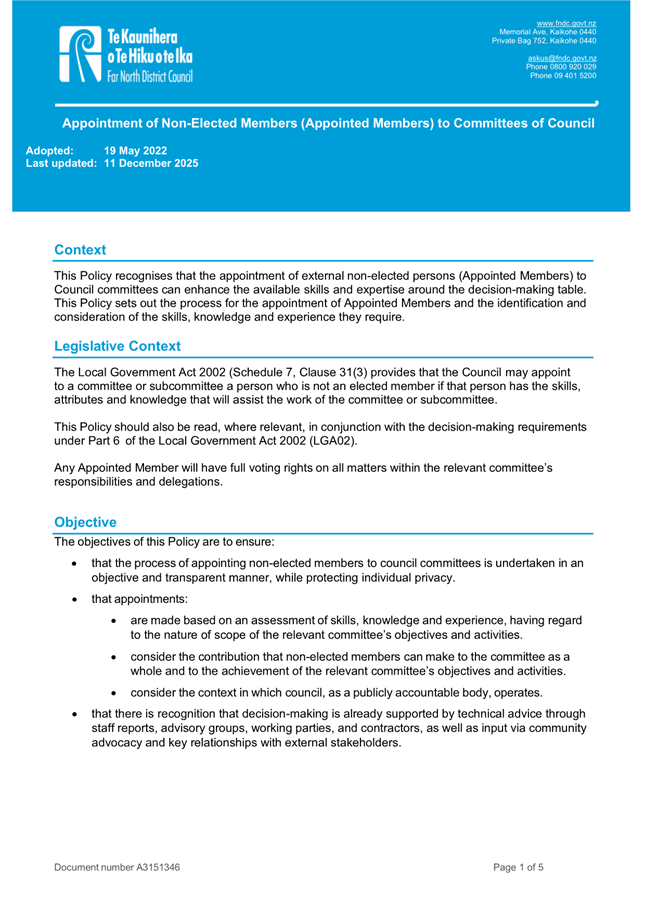
|
Ordinary Council Meeting Agenda
|
1 April 2026
|
|
Ordinary Council Meeting Agenda
|
1 April 2026
|
6.7 Approval of
Tourism Frame For Paihia
File
Number: A5631535
Author: Mark
Inglis, Facilties Lead - Technical Operations
Authoriser: Ivan
Ashby, Manager - Property & Facilities Manager
Take Pūrongo / Purpose of the Report
To seek to approve a Tourism Frame fixture on the Paihia
waterfront.
WhakarĀpopoto matua / Executive Summary
· This report considers the implications of approving a “Tourist
Photo Frame by Rotary” for the Paihia waterfront, on Stockyard Point, at the south end of Paihia Beach.
· The installation was supported by the Bay of
Island-Whangaroa Community Board at its meeting on 12 March 2026, which
recommended that Council approve the proposal.
· The report addresses the issues of compliance with Far North
District Council policy, affected parties, risks and mitigations, implications
for Māori and estimated costs to Council.
· The proposal is consistent with the 2017 Arts and Memorials in
Public Places policy.
· The impact on affected parties is likely to be minimal and the
impact on parties interested in the application is likely to be positive.
· The proposal has the support of the local Hapū and Focus
Paihia.
· Since the purchase and installation of the frame fixture would be
borne by the applicant, and ongoing maintenance costs likely to be minimal, the
financial implications of this proposal are minor.
· The report recommends approval of the application, subject to the
applicant undertaking the installation works to Council’s specification.
|
tŪtohunga
/ Recommendation
That Far North District Council, approve the
installation of a Tourist Photo Frame at Stockyard Point Scenic Reserve in
the position indicated, subject to the applicant undertaking the installation
to Council specifications.
|
1) TĀhuhu kŌrero / Background
Rotary Bay of Islands requests
approval to install a life-size Tourist Photo Frame at Stockyard Point Reserve.
The idea came from one of the club’s members, as this type of
installation is widely seen in many towns across New Zealand and further afield
to promote tourism. The club’s application is included in this agenda
report as Attachment A.
The frame would be a drawcard for
photographs of visitors to Paihia and reminds the viewer of where the
photograph was taken - resulting in a great advertising platform for the
town.
The tourist frame had previously
been installed on the Te Tii foreshore but was removed due to concerns raised
about its location.
The club requests that it be
located on a large open area in Stockyard Point Reserve, at the south end of
Paihia Beach as per the image below. The frame is built and ready to be
installed. The precise location will be determined by District Facilities staff
in consultation with BOI Rotary to ensure a safe and practical siting which
aligns with parks maintenance requirements, as per the red circle in location
photograph below.
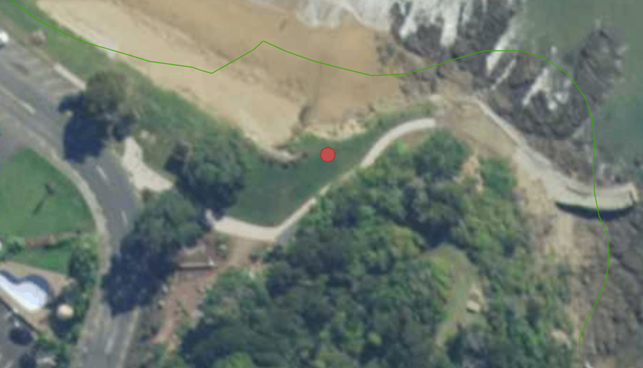
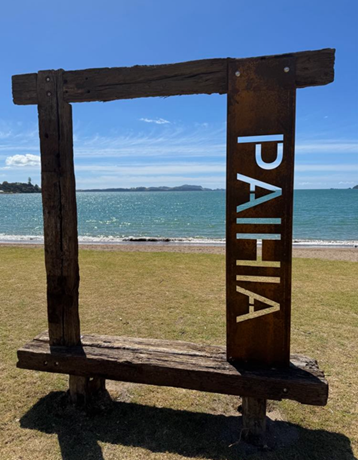
2) matapaki me NgĀ KŌwhiringa /
Discussion and Options
In considering this request, the following issues need to be
addressed
· Far
North District Council Policy – Council has current policy entitled -
“Art and Memorials in Public Places 2017”, which is included in
this agenda report as Attachment B. The relevant elements of the policy are
considered below:
o Contribution to the profile
and identity of the town – the proposed frame bears the name of
Paihia town and the resulting picturesque visitor photography will help to
raise the profile of the town.
o Durable, easy to maintain
and of good quality materials – the frame is made of durable steel
and treated timber. It will be concreted in place at the appropriate depth to
Council specifications. There may be minor costs incurred in graffiti removal.
The Team Leader Technical Operations was consulted and has approved ongoing
maintenance of the fixture.
o Comply with standards
relating to design and colour – the steel and timber design is
compatible with the other parks structures nearby at Stockyard Point Reserve
and is sympathetic to the natural rock and foreshore elements present near the
site.
o Enhance the public space
– the additional seat and style of the unit would enhance the park by
providing improved public amenity.
o Community involvement
– the policy states that there should be community involvement in
decision-making about any proposed memorial. Focus Paihia has been consulted on
the matter and has given its approval of the proposal. Given that the scale of
this proposal is minor, it would be unnecessary to undertake a formal community
consultation on the matter. The local Hapū have been consulted and have
approved the location. Both communications are attached in “Supporting
Documents” - Attachment C.
o Become Council property
– the frame would become a Council asset and require minimal maintenance
due to the durable nature of the materials used, namely distressed steel and
railway sleepers. BOI Rotary will display a small plaque on the frame to
acknowledge its gifting of the frame.
· Affected and
Interested Parties – the frame will not make any negative impact on
users of the park; in fact it will provide additional seating for park users.
With the frame building the profile of the town as a visitor hub it will
enhance tourism and business in Paihia. Heritage NZ was consulted, who had no
issue with the proposal, subject to the use of their Accidental Discovery
Protocol, should any archaeological items be discovered during digging.
· Risks and
Mitigations – there is a risk of damage to the frame through graffiti
or physical force. This would create addition work and cost for the FNDC
District Facilities Team. Any damage would be funded through existing
operational expenditure for Parks and Reserves. The frame is made from durable
materials however and is unlikely to become a drain on council resources.
· Consents –
The building consent team has been consulted and building consent is not
required. An enquiry regarding requirement for resource consent advised that
resource consent is not required.
· Implications
for Māori – a representative of Ngāti Kawa, Ngāti
Rāhiri and Te Matarahurahu, the local Hapū in the area, has been
consulted and supports this new proposed location. The communication is
attached in Support Documents, Attachment C.
TAKE TŪTOHUNGA
/ REASON FOR THE RECOMMENDATION
The Bay of Island-Whangaroa Community Board, at its meeting
on 12 March 2026, recommended that Council approve the proposal, as per the
following resolution:
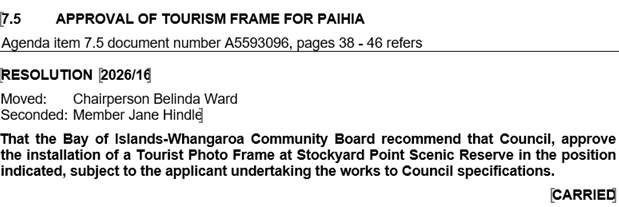
Since the proposal for a Tourist Frame is consistent with
Council policy and that the associated risks are relatively minor, it is
recommended that the proposal be approved by Council. The frame will provide a
focal point for visitors, will improve the amenity value of the park and be
visually consistent with the other public fixtures in the town.
3) PĀnga PŪtea me ngĀ
wĀhanga tahua / Financial Implications and Budgetary Provision
The cost of the frame, and its installation, will be borne
by the applicant, so there is no cost to Council for the asset. Operational
expenditure for repairs and maintenance is estimated at no more than
$200/annum.
Āpitihanga
/ Attachments
1. Application
for Tourist Photoframe from BOI Rotary - A5593781 ⇩
2. Art-and-Memorials-in-Public-Places-2017.
- A5593793 ⇩ 
3. Attachment
C Supporting Documents Tourist Photo Frame - A5631603 ⇩ 
Hōtaka Take Ōkawa / Compliance Schedule:
Full consideration has been given to the provisions of the
Local Government Act 2002 S77 in relation to decision making, in particular:
1. A
Local authority must, in the course of the decision-making process,
a) Seek
to identify all reasonably practicable options for the achievement of the
objective of a decision; and
b) Assess
the options in terms of their advantages and disadvantages; and
c) If
any of the options identified under paragraph (a) involves a significant
decision in relation to land or a body of water, take into account the
relationship of Māori and their culture and traditions with their
ancestral land, water sites, waahi tapu, valued flora and fauna and other
taonga.
2. This
section is subject to Section 79 - Compliance with procedures in relation to
decisions.
|
He Take Ōkawa /
Compliance Requirement
|
Aromatawai Kaimahi /
Staff Assessment
|
|
State the level of significance (high or low) of the
issue or proposal as determined by the Council’s
Significance and Engagement Policy
|
The establishment of a Tourist Photo Frame in Paihia is
meaningful for the community, however since its value is modest, and proposed
location uncontentious, the relative level of significance is low.
|
|
State the relevant Council policies (external or
internal), legislation, and/or community outcomes (as stated in the LTP) that
relate to this decision.
|
This proposal is consistent with the principles and
objectives of the following policy:
https://www.fndc.govt.nz/__data/assets/pdf_file/0022/18094/Art-and-Memorials-in-Public-Places-2017..pdf
|
|
State whether this issue or proposal has a District wide
relevance and, if not, the ways in which the appropriate Community
Board’s views have been sought.
|
Community Boards are delegated to make recommendations
to Council on the installation of works of art and memorials within their
ward or subdivision.
|
|
State the
possible implications for Māori and how Māori have been provided
with an opportunity to contribute to decision making if this decision is
significant and relates to land and/or any body of water.
State the
possible implications and how this report aligns with Te Tiriti o Waitangi /
The Treaty of Waitangi.
|
hapū of the area. A representative of Ngāti
Kawa, Ngāti Rāhiri and Te Matarahurahu has approved the new
proposed location.
|
|
Identify persons likely to be affected by or have an
interest in the matter, and how you have given consideration to their views
or preferences (for example – youth, the aged and those with
disabilities).
|
The proposal is unlikely to cause concern or create
barriers to other affected parties. The chair of Focus Paihia has been
consulted, supports the proposal and commented that the proposed location was
suitable.
|
|
State the financial implications and where budgetary
provisions have been made to support this decision.
|
Since the installation of the frame will be borne by the
applicant and ongoing maintenance costs are likely to be low, the financial
implications of this proposal are minor.
|
|
Chief Financial Officer review.
|
The CFO has reviewed this report.
|
|
Ordinary Council Meeting Agenda
|
1 April 2026
|
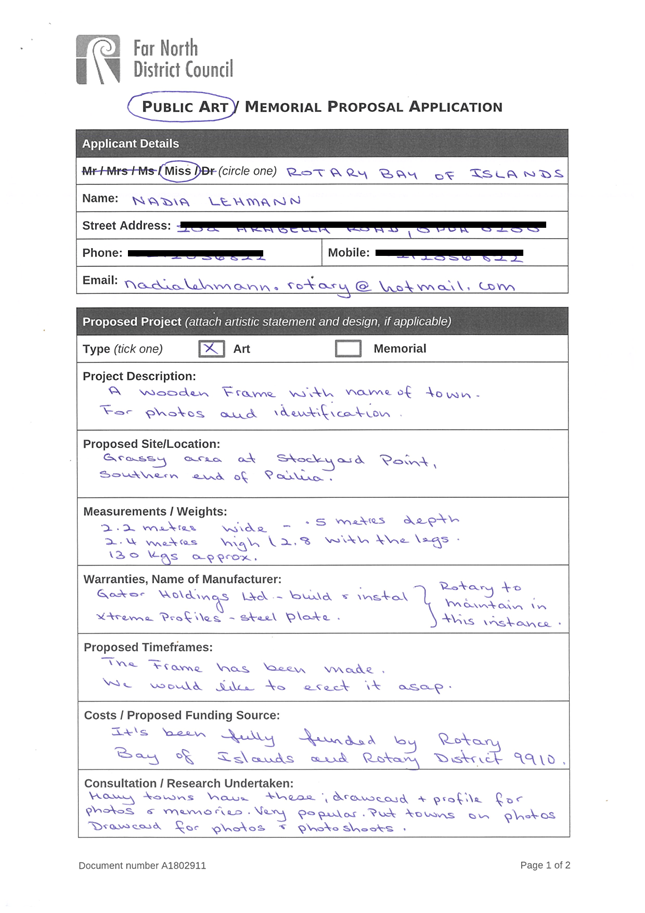
|
Ordinary Council Meeting Agenda
|
1 April 2026
|
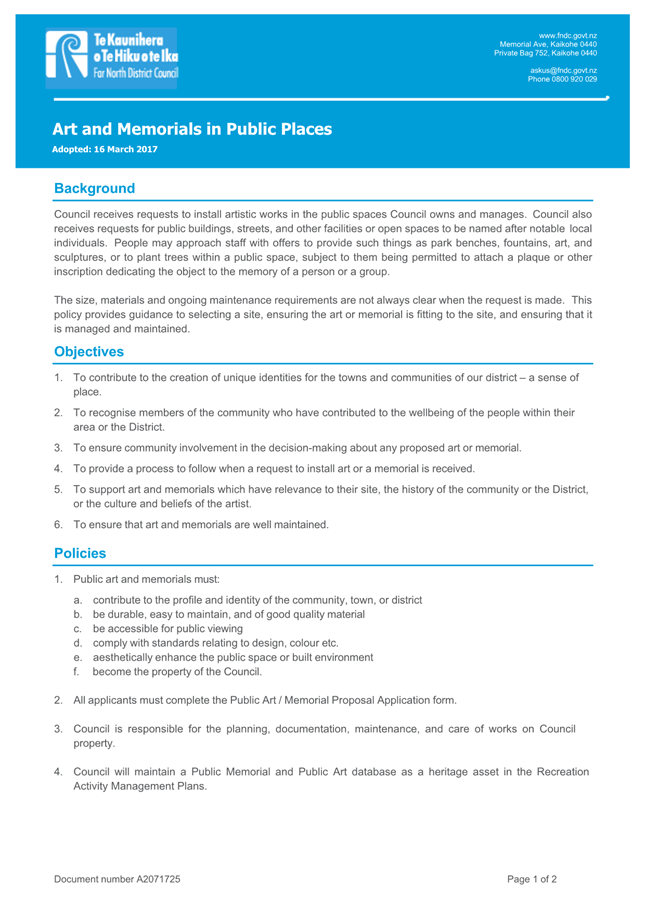
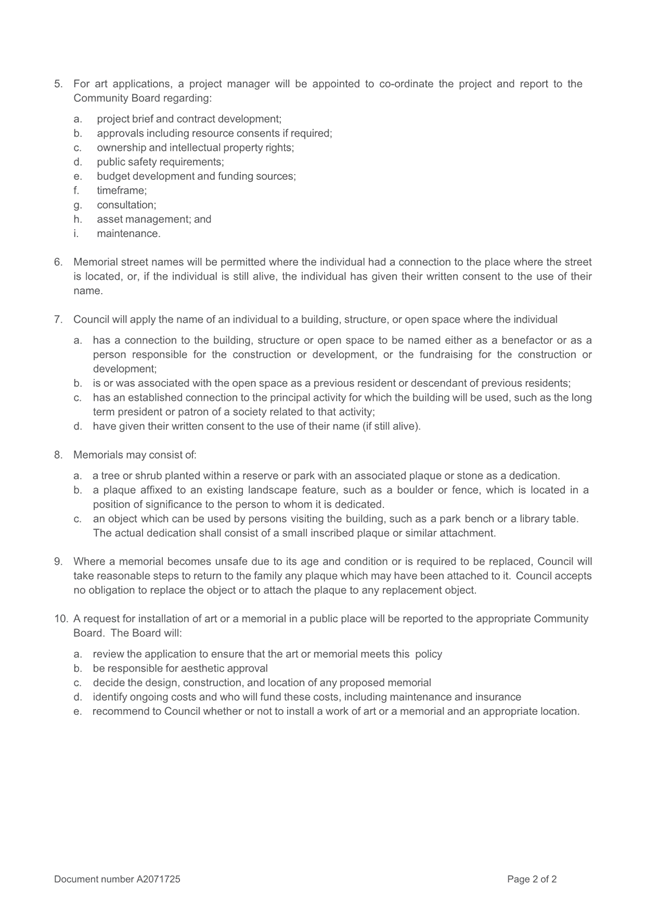
|
Ordinary Council Meeting Agenda
|
1 April 2026
|
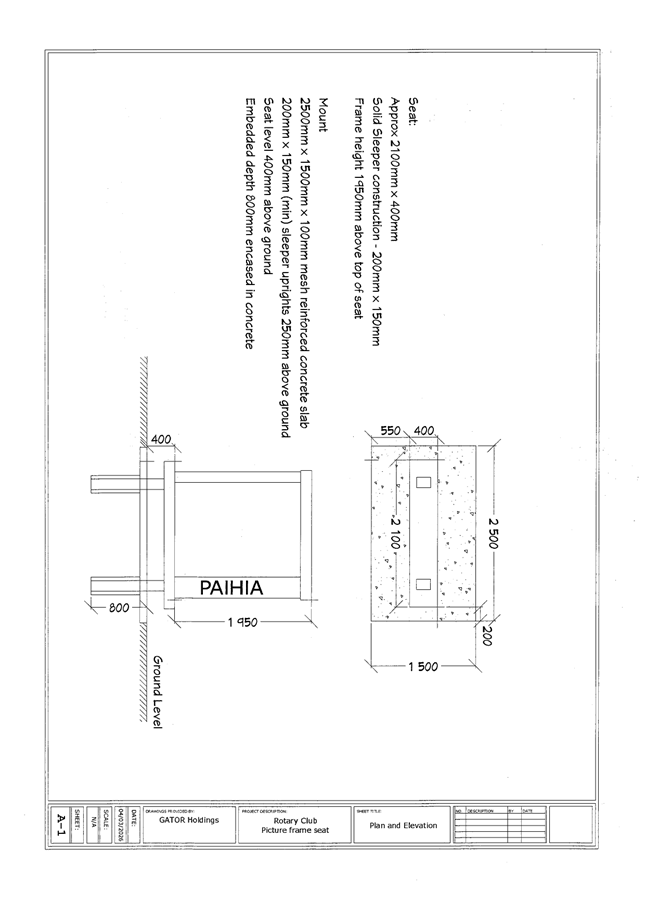
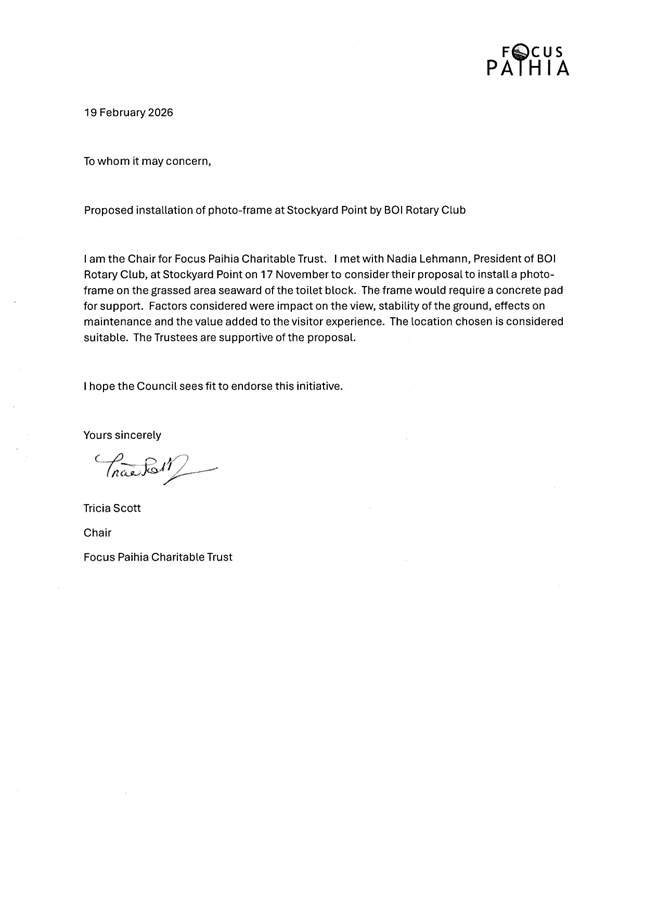
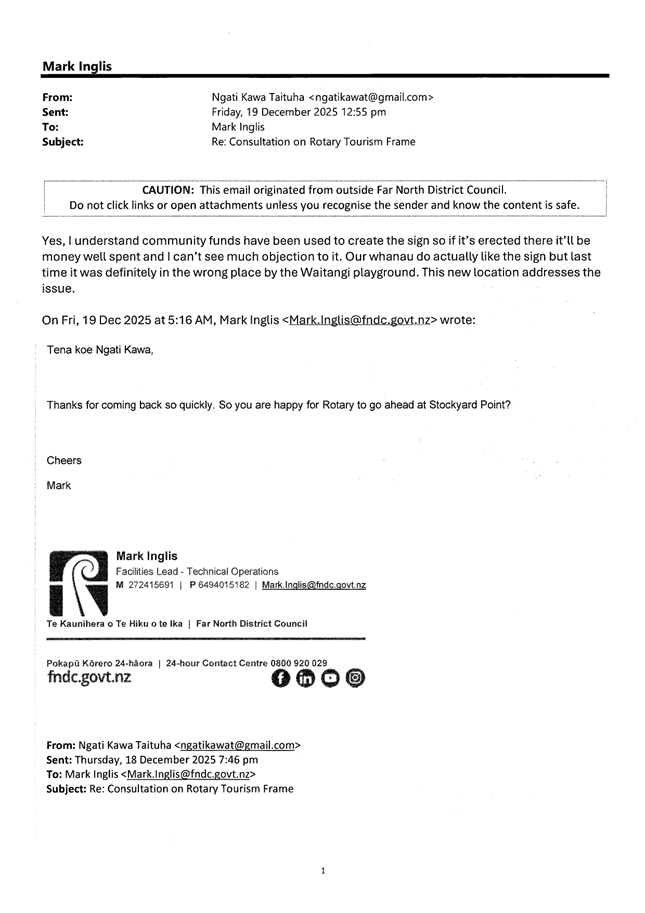
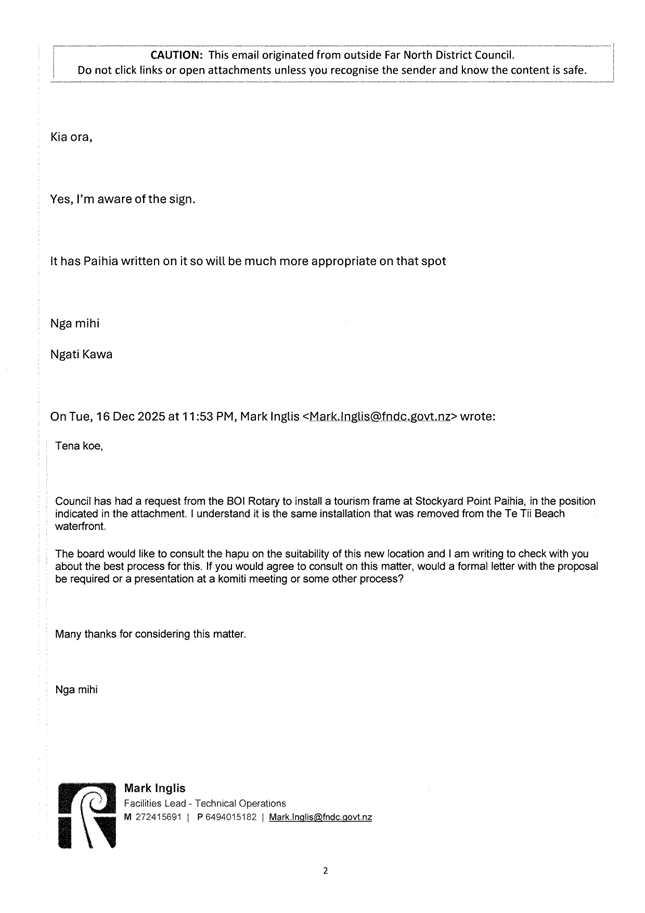
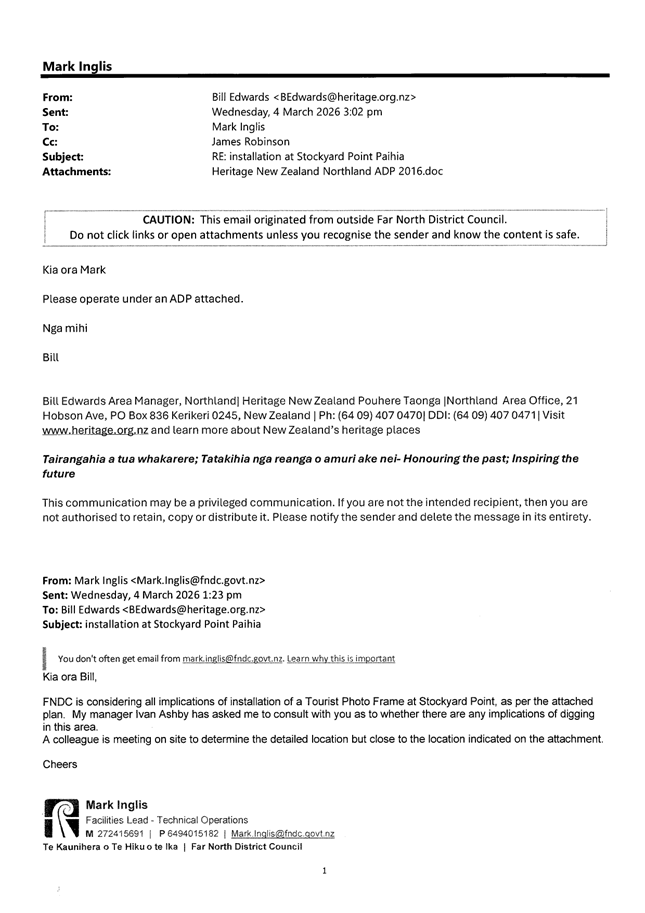
|
Ordinary Council Meeting Agenda
|
1 April 2026
|
7 Ngā
Pūrongo Taipitopito / Information Reports
7.1 Response
to Council - Roaming and Aggressive dogs in Ahipara
File
Number: A5629400
Author: Mike
McMurtrie, Manager - Compliance
Authoriser: Hilary
Sumpter, Group Manager - Delivery and Operations
TAKE PŪRONGO / Purpose of the Report
The purpose of this
report is to provide a report to Council, concerning the roaming and aggressive
dog situation in Ahipara.
WHAKARĀPOPOTO MATUA / Executive SummarY
· This
report proposes to highlight roaming and dangerous dogs in the Ahipara area of
the Far North District with recommendations Around enforcement options,
resources required and measures to improve the community’s safety.
· The
report aims to respond to concerns raised by the Ahipara Community through
their petition presented to Council on the 5th of March 2026 after a recent
dogs on dog attack between roaming dogs.
· The
petition highlights that in Ahipara, many people are carrying sticks or
avoiding walking in certain areas due to fear of roaming and aggressive dogs
that are uncontrolled in the community.
· The
recommended solutions strengthen Animal Management resourcing, expand community
education and involvement, enhance community and staff safety and response
capabilities.
· Expected
outcomes include fewer public safety incidents, improved compliance by dog
owners, and increased community trust.
· While
the report focusses on Ahipara, the problem is not isolated to Ahipara or even
the Far North District and so most causes and solutions can be attributed to
other areas of the Far North.
|
TŪTOHUNGA
/ Recommendation
That the Council receive the report Response to Council
- Roaming and Aggressive dogs in Ahipara.
|
tĀHUHU KŌRERO / Background
Tyrone Biddle presented a petition to Council on the 5th
of March 2026, following a dog attack in Kākāpō Street, Ahipara.
Several roaming dogs attacked another in the street, in
front of his family, prompting him to petition to Council to address concerns
in the Ahipara Community. The petition received several hundred signatures in
support.
Following the receiving of the report, on the 5th
of March 2026, a report was requested to outline options to address roaming and
dangerous dogs in Ahipara, including enforcement tools, resources required, and
measures to improve community’s safety.
MATAPAKI ME NGĀ KŌWHIRINGA /
Discussion and Next Steps
Council staff met with Mr Biddle on Tuesday 10th
March 2026 in Ahipara to discuss concerns and have prepared the attached report
to summarise this meeting, identified several short term and longer term
solutions, in conjunction with operational initiatives that have already been
identified and implemented in previous weeks and months.
PĀNGA PŪTEA ME NGĀ WĀHANGA
TAHUA / Financial Implications and Budgetary Provision
There are financial implications, should any solutions
involving increased FTE be implemented. These are outlined within the
report.
Āpitihanga
/ Attachments
1. Response
to Council - Roaming and Aggressive dogs in Ahipara - A5629441 ⇩ 
|
Ordinary Council Meeting Agenda
|
1 April 2026
|
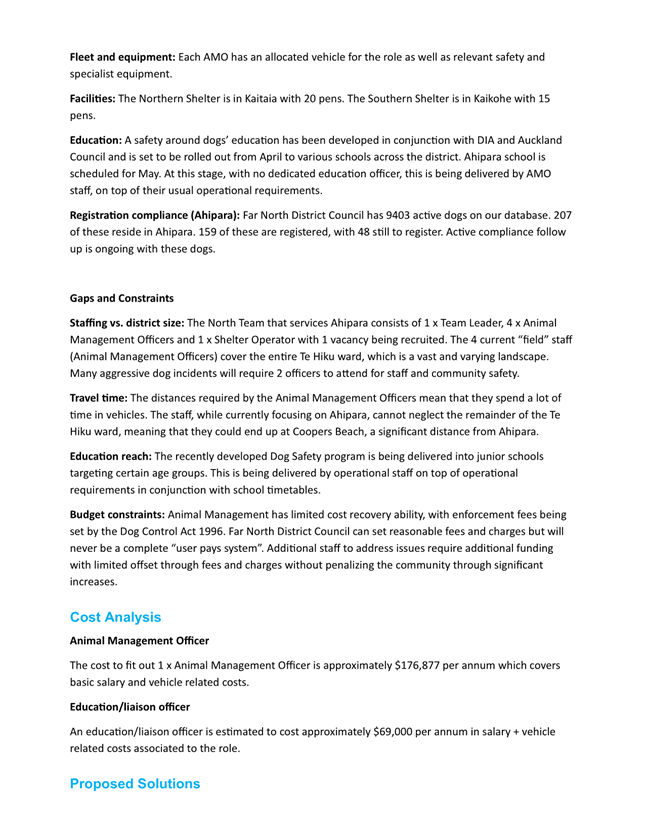
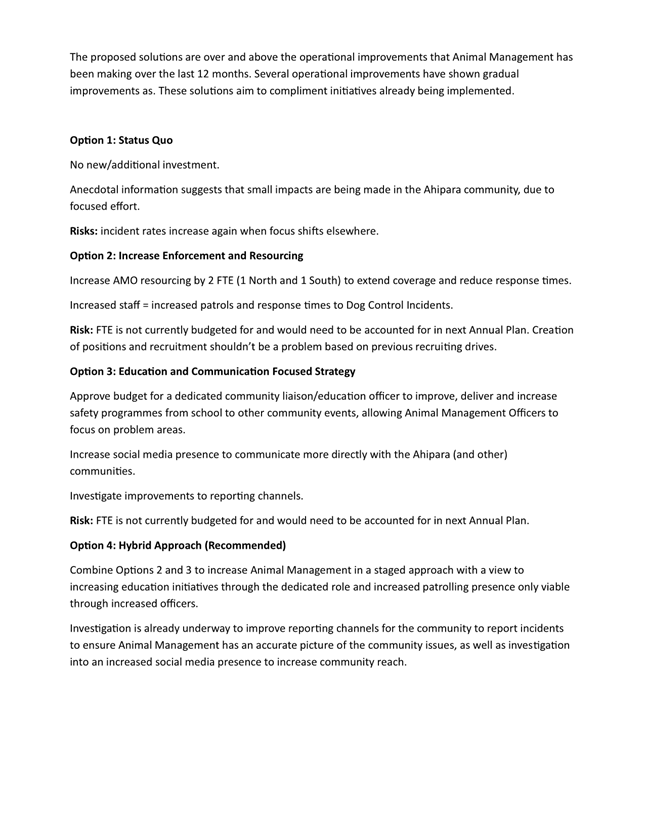
|
Ordinary Council Meeting Agenda
|
1 April 2026
|
7.2 Community
Board Minutes
File
Number: A5642773
Author: Natasha
Rmandic, Democracy Advisor
Authoriser: Aisha
Huriwai, Manager - Democracy Services
Take Pūrongo / Purpose of the Report
To provide an overview of
resolutions made by Community Boards with an opportunity for Chairpersons to
speak with Council about pertinent discussions held at Community Board.
WhakarĀpopoto matua / Executive Summary
Minutes from the Te Hiku, Bay of
Islands-Whangaroa and Kaikohe-Hokianga Community Board meetings are attached
for Council information.
|
tŪtohunga
/ Recommendation
That Council
note the minutes from the following Community Board meetings:
a) Te
Hiku Community Board Meeting held 10 March 2026;
b) Kaikohe-Hokianga
Community Board Meeting held 11 March 2026.
c) Bay
of Islands-Whangaroa Community Board Meeting held 12 March 2026;
|
1) TĀhuhu kŌrero / Background
This report is to provide Council with an overview of
resolutions made at Community Board meetings and for Community Board
Chairpersons to raise any Community Board issues with Council.
2) matapaki me NgĀ KŌwhiringa /
Discussion and Options
From time-to-time Community Boards may make recommendations
to Council. This report is not considered to be the appropriate mechanism for
Council to make a decision from a Community Board recommendation. Council could
however move a motion to formally request a report on a particular matter for
formal consideration at a subsequent meeting. The report would then ensure that
Council have sufficient information to satisfy the decision-making requirements
under the Local Government Act 2002 (sections 77-79).
3) PĀnga PŪtea me ngĀ
wĀhanga tahua / Financial Implications and Budgetary Provision
There are no financial implications or need for budget
provision in considering this report.
Āpitihanga
/ Attachments
1. 2026-03-10
Te Hiku Community Board Minutes - A5620032 ⇩
2. 2026-03-11
Kaikohe-Hokianga Community Board Minutes - A5620358 ⇩
3. 2026-03-12
Bay of Islands-Whangaroa Community Board Minutes - A5620637 ⇩
|
Ordinary Council Meeting Agenda
|
1 April 2026
|
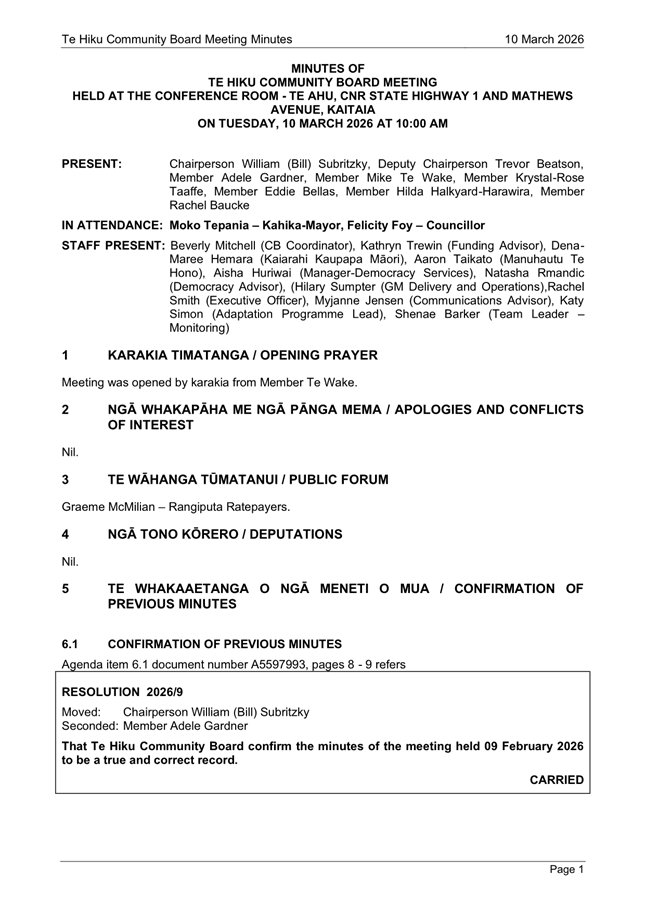
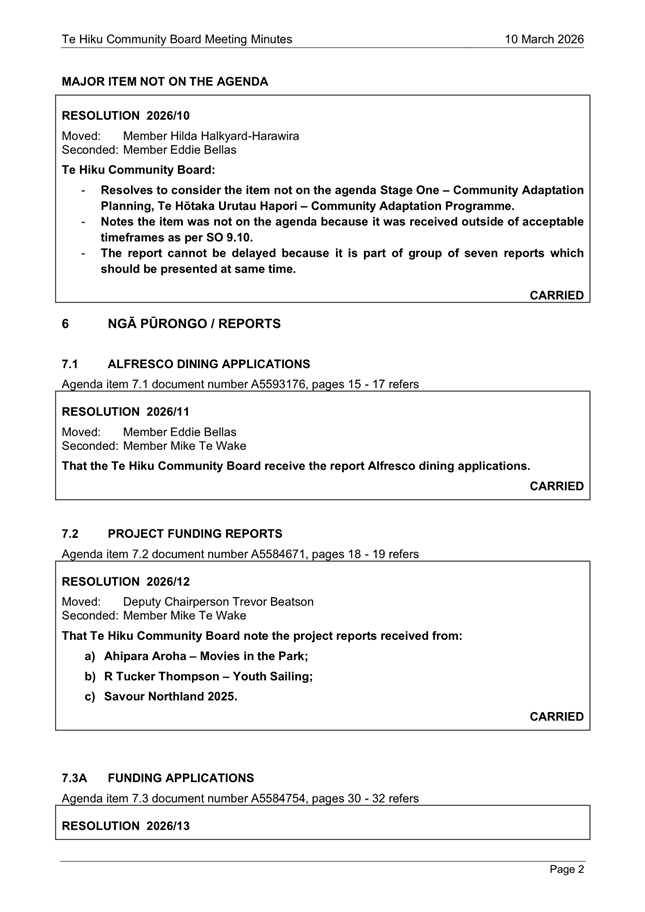
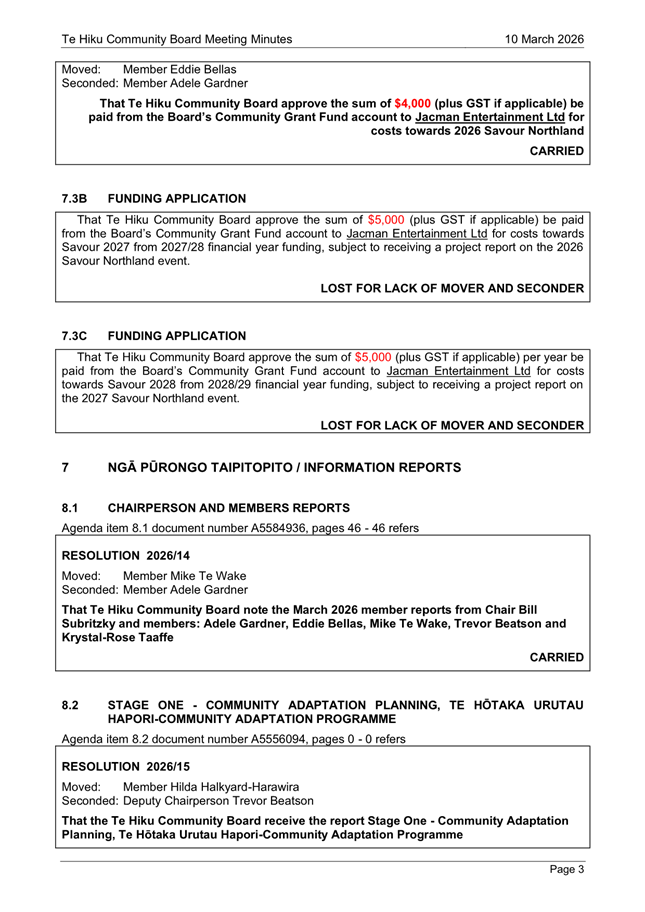
|
Ordinary Council Meeting Agenda
|
1 April 2026
|
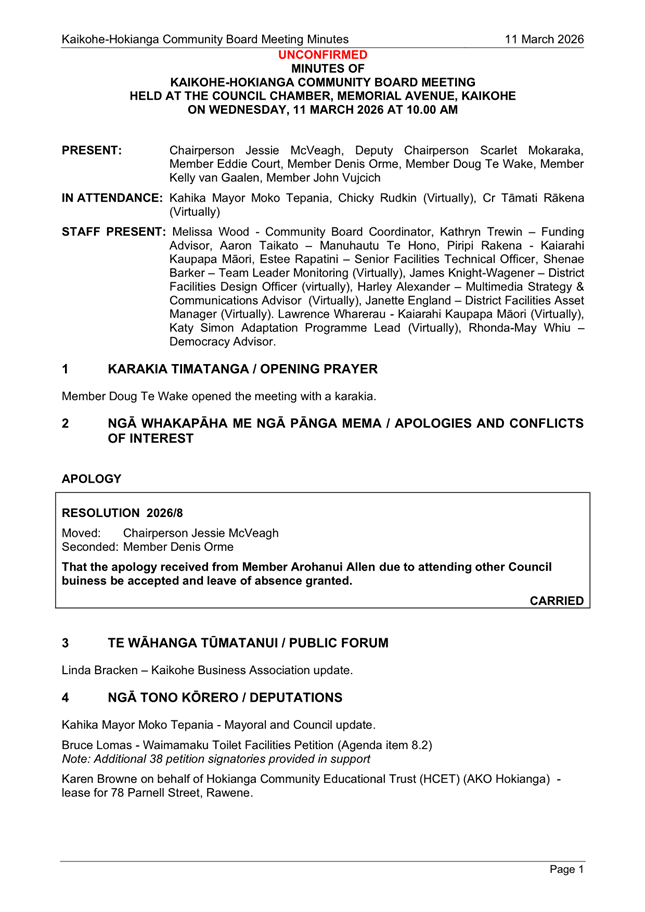
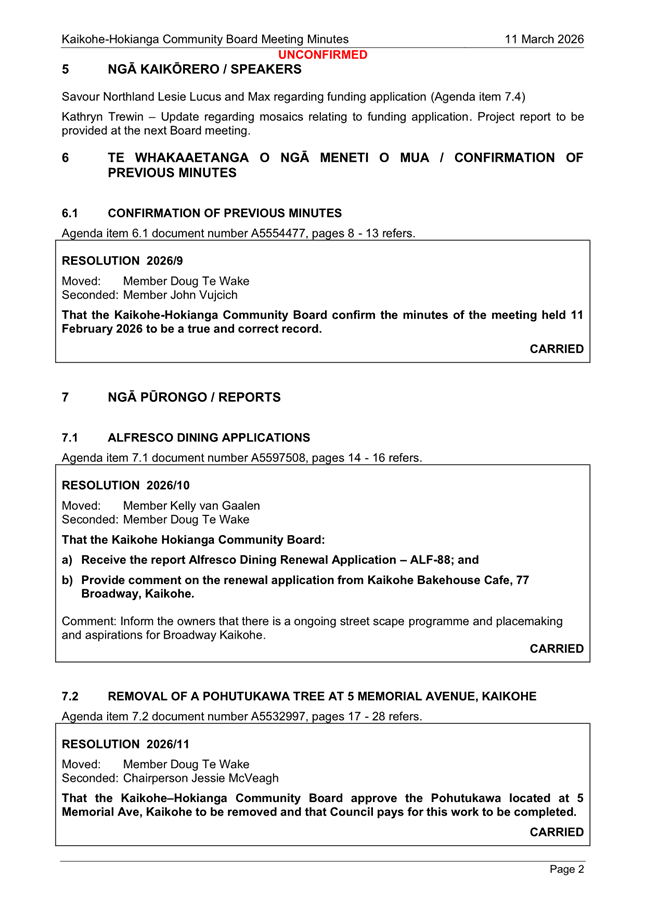
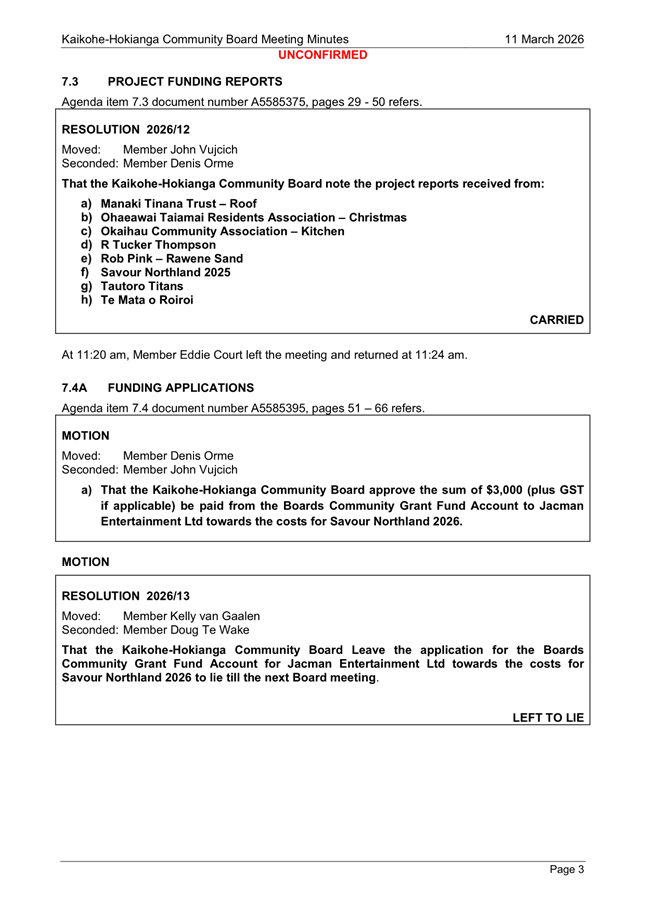
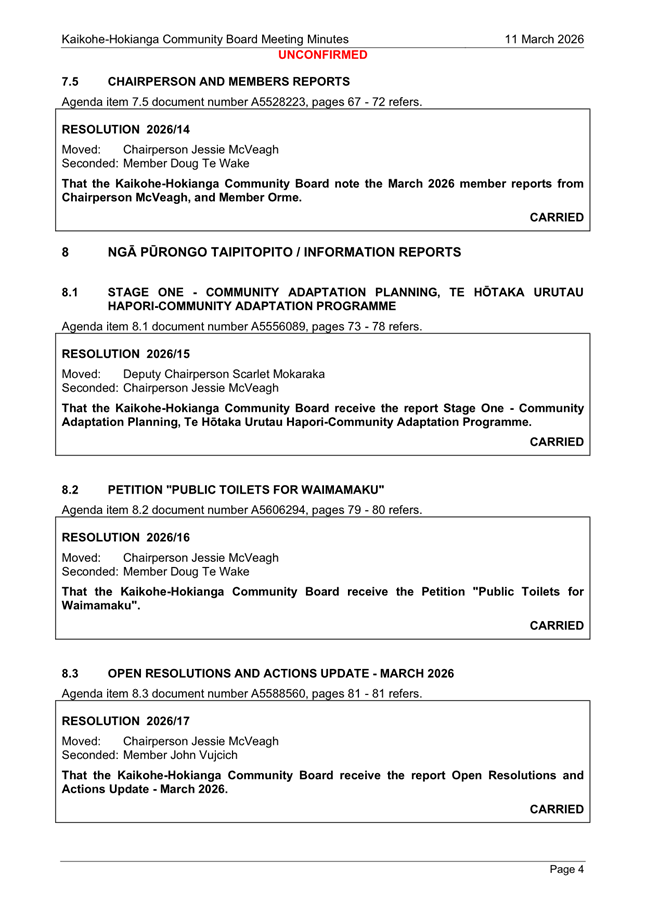
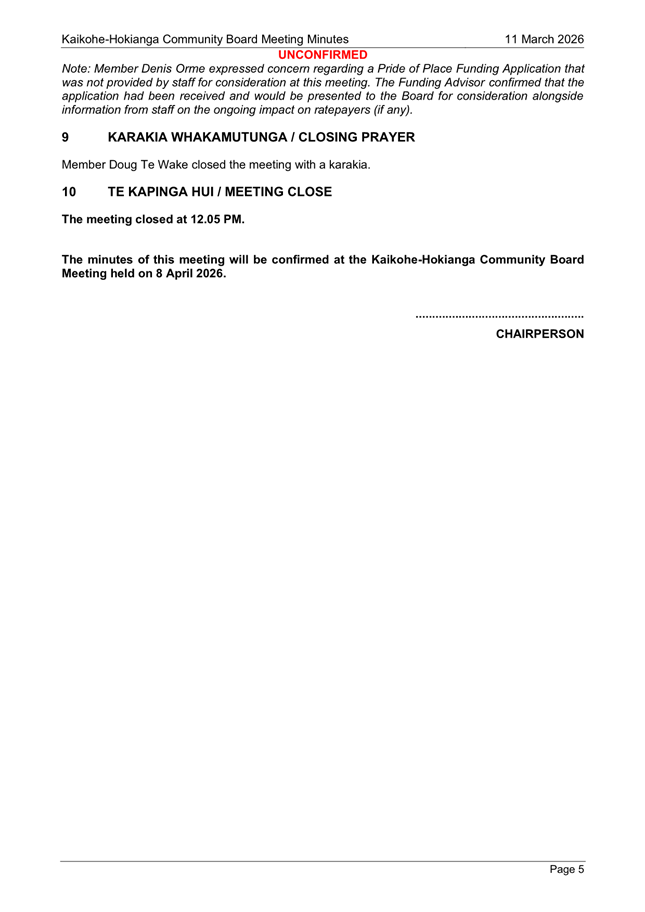
|
Ordinary Council Meeting Agenda
|
1 April 2026
|
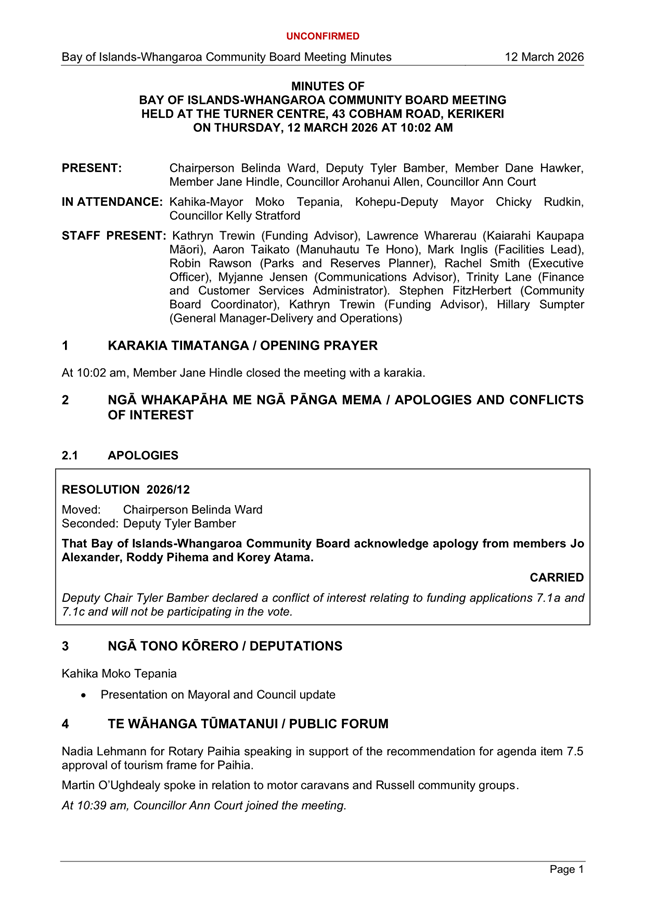
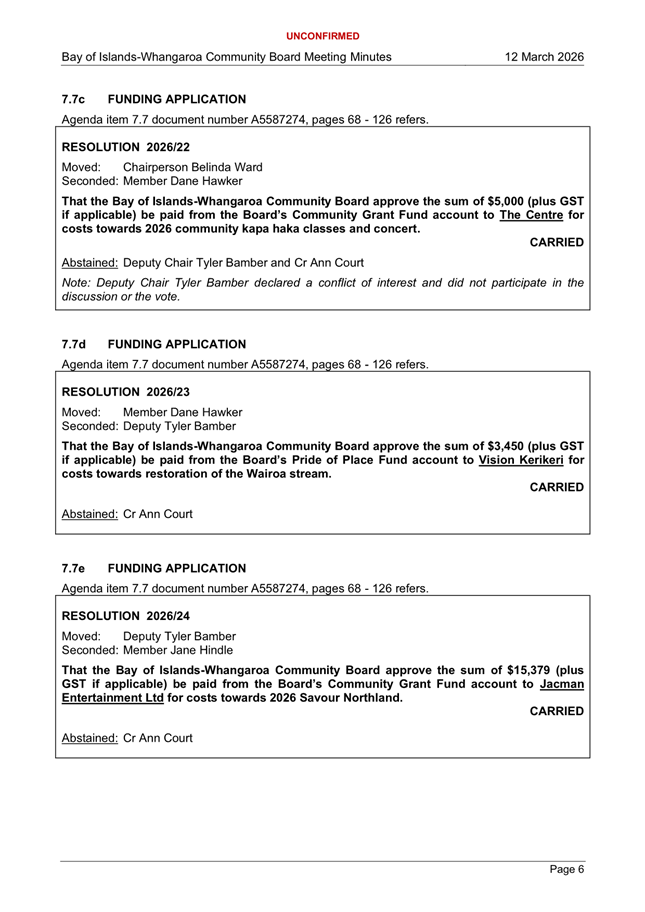
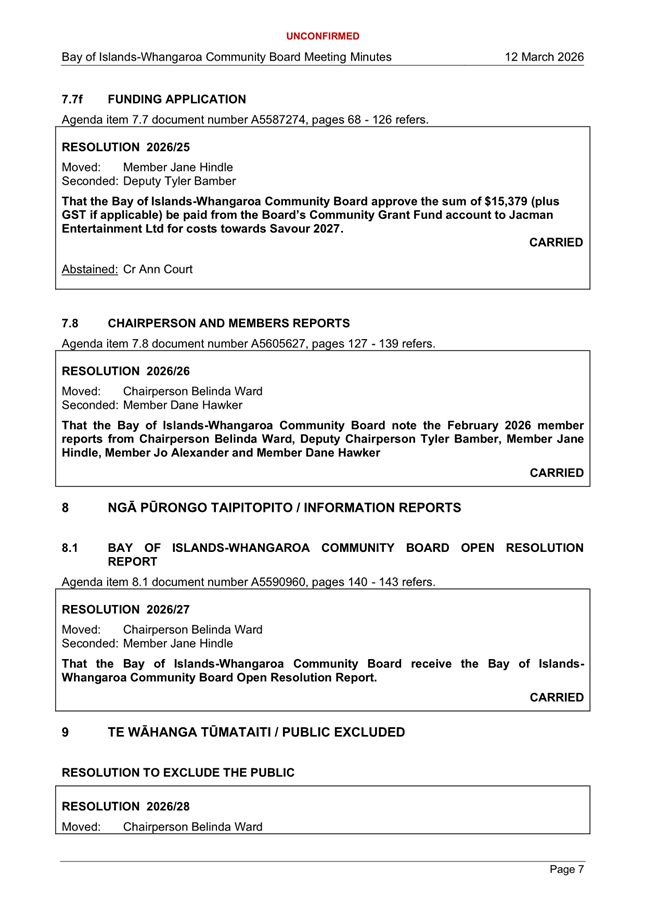
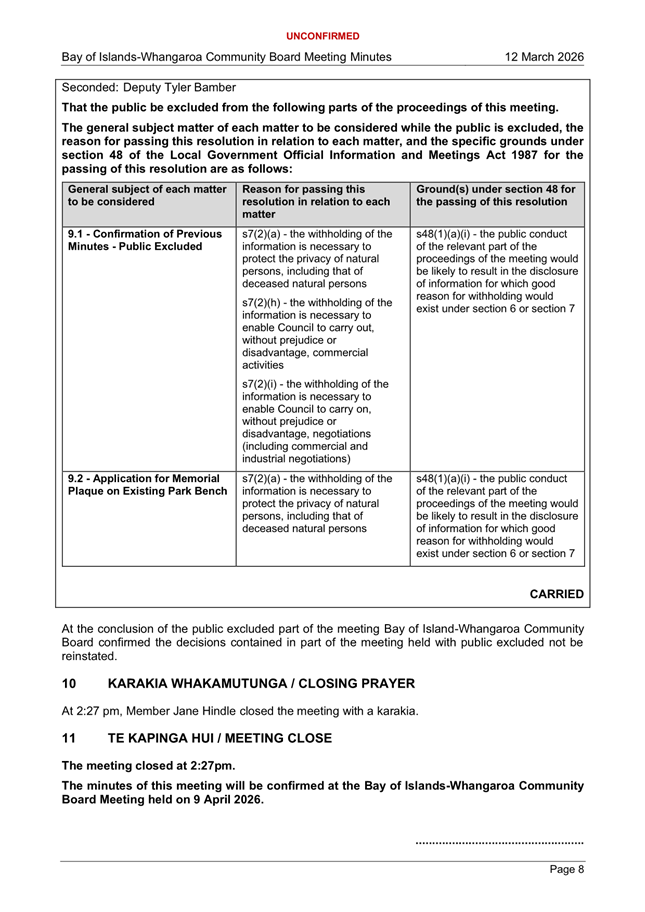

|
Ordinary Council Meeting Agenda
|
1 April 2026
|
7.3 Committee
and Joint Committee Minutes - March 2026
File
Number: A5642783
Author: Natasha
Rmandic, Democracy Advisor
Authoriser: Aisha
Huriwai, Manager - Democracy Services
TAKE PŪRONGO / Purpose of the Report
This report highlights recent Council and Joint Committee
meetings and the availability of minutes for reference.
WHAKARĀPOPOTO MATUA / Executive SummarY
Recent meetings are listed below, with links to minutes
included where available at the time of publication.
Far North District Council Committee Meetings:
Minutes of Te Kūkupa Committee for Strategy, Policy
and Regulation Meeting - Wednesday, 18 March 2026
Note: Any recommendations from Committee meetings will be
presented separately on the Council agenda for consideration.
|
TŪTOHUNGA
/ Recommendation
That the Far
North District Council receive the report: Committee and Joint Committee
Minutes.
|
tĀHUHU KŌRERO / Background
Council
operates several Committees that meet regularly but on different cycles:
· Te
Huia Committee for Chief Executive Performance
· Te
Kuaka Committee for Māori Strategic Relationships
· Te
Koekoeā Committee for Council Controlled Organisations
· Te
Koukou Committee for Transport and Infrastructure
· Te
Kūkupa Committee for Strategy, Policy and Regulation
· Te
Miromiro Committee for Assurance, Risk and Finance
· Te
Pīpīwharauroa Committee for External Appointments.
Agendas and
minutes for these meetings are publicly available at https://infocouncil.fndc.govt.nz/
Council
also has appointed representatives to joint and external committees in
partnership with Northland Regional Council (NRC):
· Te Oneroa-a-Tōhe Beach Board Committee
· Joint Regional Economic Development Committee
· Joint Climate Change Adaptation Committee
· Civil Defence Emergency Management Committee
· Regional Transport Committee
Further
details, including Terms of Reference, can be found on the NRC Website.
Agendas and minutes are updated on the NRC Agendas
and Minutes page.
MATAPAKI ME NGĀ KŌWHIRINGA /
Discussion and Next Steps
This
report highlights where information is available.
Any recommendations will
be presented separately on the Council agenda for consideration.
PĀNGA PŪTEA ME NGĀ WĀHANGA
TAHUA / Financial Implications and Budgetary Provision
This
report has no financial implications.
Āpitihanga
/ Attachments
Nil
|
Ordinary Council Meeting Agenda
|
1 April 2026
|
8 Te
Wāhanga Tūmataiti / Public Excluded
RESOLUTION TO
EXCLUDE THE PUBLIC
|
Recommendation
That the public be excluded from the following parts of
the proceedings of this meeting.
The general subject matter of each matter to be considered
while the public is excluded, the reason for passing this resolution in
relation to each matter, and the specific grounds under section 48 of the
Local Government Official Information and Meetings Act 1987 for the passing
of this resolution are as follows:
|
General subject of each matter to be
considered
|
Reason for passing this resolution in
relation to each matter
|
Ground(s) under section 48 for the
passing of this resolution
|
|
8.1 - Notice of Motion - Far North
Holdings Ltd Statement of Expectation
|
s7(2)(b)(ii) - the withholding of the information
is necessary to protect information where the making available of the
information would be likely unreasonably to prejudice the commercial
position of the person who supplied or who is the subject of the information
|
s48(1)(a)(i) - the public conduct of the relevant
part of the proceedings of the meeting would be likely to result in the
disclosure of information for which good reason for withholding would exist
under section 6 or section 7
|
|
8.2 - Confirmation of Previous Minutes
- Public Excluded
|
s7(2)(a) - the withholding of the information is
necessary to protect the privacy of natural persons, including that of
deceased natural persons
s7(2)(h) - the withholding of the information is
necessary to enable Council to carry out, without prejudice or
disadvantage, commercial activities
s7(2)(i) - the withholding of the information is
necessary to enable Council to carry on, without prejudice or disadvantage,
negotiations (including commercial and industrial negotiations)
|
s48(1)(a)(i) - the public conduct of the relevant
part of the proceedings of the meeting would be likely to result in the
disclosure of information for which good reason for withholding would exist
under section 6 or section 7
|
|
8.3 - Far North Holdings Limited -
Letter of Expectations 2026-29
|
s7(2)(h) - the withholding of the information is
necessary to enable Council to carry out, without prejudice or
disadvantage, commercial activities
s7(2)(i) - the withholding of the information is
necessary to enable Council to carry on, without prejudice or disadvantage,
negotiations (including commercial and industrial negotiations)
|
s48(1)(a)(i) - the public conduct of the relevant
part of the proceedings of the meeting would be likely to result in the
disclosure of information for which good reason for withholding would exist
under section 6 or section 7
|
|
8.4 - Confirmation of March Community
Boards Minutes - Public Excluded
|
s7(2)(a) - the withholding of the information is
necessary to protect the privacy of natural persons, including that of
deceased natural persons
s7(2)(h) - the withholding of the information is
necessary to enable Council to carry out, without prejudice or
disadvantage, commercial activities
s7(2)(i) - the withholding of the information is
necessary to enable Council to carry on, without prejudice or disadvantage,
negotiations (including commercial and industrial negotiations)
|
s48(1)(a)(i) - the public conduct of the relevant
part of the proceedings of the meeting would be likely to result in the
disclosure of information for which good reason for withholding would exist
under section 6 or section 7
|
|
8.5 - Confirmation of Committee and
Joint Committee March 2026 Minutes - Public Excluded
|
s7(2)(a) - the withholding of the information is
necessary to protect the privacy of natural persons, including that of
deceased natural persons
s7(2)(h) - the withholding of the information is
necessary to enable Council to carry out, without prejudice or
disadvantage, commercial activities
s7(2)(i) - the withholding of the information is
necessary to enable Council to carry on, without prejudice or disadvantage,
negotiations (including commercial and industrial negotiations)
|
s48(1)(a)(i) - the public conduct of the relevant
part of the proceedings of the meeting would be likely to result in the
disclosure of information for which good reason for withholding would exist
under section 6 or section 7
|
|
8.6 - Stormwater Unbudgeted
Expenditure and Restricted Reserve Fund Allocation
|
s7(2)(a) - the withholding of the information is
necessary to protect the privacy of natural persons, including that of
deceased natural persons
s7(2)(i) - the withholding of the information is
necessary to enable Council to carry on, without prejudice or disadvantage,
negotiations (including commercial and industrial negotiations)
s7(2)(j) - the withholding of the information is
necessary to prevent the disclosure or use of official information for
improper gain or improper advantage
|
s48(1)(a)(i) - the public conduct of the relevant
part of the proceedings of the meeting would be likely to result in the
disclosure of information for which good reason for withholding would exist
under section 6 or section 7
|
|
9 Karakia
Whakamutunga / Closing Prayer
10 Te
Kapinga Hui / Meeting Close