AGENDA
Thursday, 9 April 2026
|
Time:
|
10:00 am
|
|
Location:
|
Turner Centre
43 Cobham Road
Kerikeri
|
Membership:
Chairperson Belinda Ward -
Chairperson
Deputy Tyler Bamber
Member Jo Alexander
Member Korey Atama
Member Roddy Hapati-Pihema
Member Dane Hawker
Member Jane Hindle
Councillor Arohanui Allen
Councillor Ann Court
|
Bay of Islands-Whangaroa Community Board Meeting Agenda
|
9 April 2026
|
The Local Government Act 2002 states the role of a
Community Board is to:
A.
Represent, and act as an advocate for,
the interests of its community.
B.
Consider and report on all matters
referred to it by the territorial authority, or any matter of interest or
concern to the community board.
C.
Maintain an overview of services
provided by the territorial authority within the community.
D.
Prepare an annual submission to the
territorial authority for expenditure within the community.
E.
Communicate with community
organisations and special interest groups within the community.
F.
Undertake any other responsibilities
that are delegated to it by the territorial authority
Council Delegations to Community Boards - January
2013
The "civic amenities" referred to in these
delegations include the following Council activities:
·
Amenity lighting
·
Cemeteries
·
Drainage (does not include reticulated
stormwater systems)
·
Footpaths/cycle ways and walkways
·
Public toilets
·
Reserves
·
Halls
·
Swimming pools
·
Town litter
·
Town beautification and maintenance
·
Street furniture including public
information signage
·
Street/public Art.
·
Trees on Council land
·
Off road public car parks
·
Lindvart Park – a
Kaikohe-Hokianga Community Board civic amenity
Exclusions: From
time to time Council may consider some activities and assets as having district
wide significance and these will remain the responsibility of Council. These
currently include: The roading network, Hundertwasser toilets, District Library
Network, Baysport, the Kerikeri, Kaikohe & Kaitaia Airports, Hokianga
Vehicle Ferry, i-Site network, Far North Community Centre, Kerikeri Domain,
Kawakawa Heated Swimming Pool, Kaikohe Cemetery, Kerikeri Sports Complex, The
Centre at Kerikeri, the Bay of Islands/Hokianga Cycle Trail.
Set local priorities for minor capital works in accordance
with existing strategies,
1.
Recommend local service levels and
asset development priorities for civic amenities as part of the Annual Plan and
Long Term Plan processes.
2.
Reallocate capital budgets within the
Annual Plan of up to 5% for any specific civic amenity, provided that the
overall activity budgetary targets are met.
3.
Make grants from the allocated
Community Funds in accordance with policy 3209, and the SPARC/Sport Northland
Rural Travel fund in accordance with the criteria set by the respective body,
and, for the Bay of Islands-Whangaroa Community Board, the power to allocate
the Hundertwasser Donations Account.
4.
Provide comment to council staff on
resource consent applications having significance within the Community,
including the provision of land for reserves or other public purposes.
5.
To hold, or participate in hearings, as
the Council considers appropriate, in relation to submissions pertinent to
their community made to plans and strategies including the Long Term Plan and
Annual Plan, and if appropriate recommend decisions to the Council.
6.
To hold hearings of submissions
received as a result of Special Consultative Procedures carried out in respect
of any matter other than an Annual or Long Term Plan and make recommendations
to the Council.
7.
Where recommended by staff to appoint
management committees for local reserves, cemeteries, halls, and community
centres.
8.
To allocate names for previously
unnamed local roads, reserves and other community facilities, and recommend to
Council name changes of previously named roads, reserves, and community
facilities subject to consultation with the community.
9.
To consider the provisions of new and
reviewed reserve management plans for recommendation to the Council in
accordance with the Reserves Act 1977 and hear or participate in the hearing of
submissions thereto, as considered appropriate by the Council.
10.
To provide recommendations to the
Council in respect of applications for the use and/or lease of reserves not
contemplated by an existing reserve management plan.
11.
Prohibit the use of skateboards in
specified locations within their communities, in accordance with
Council’s Skating Bylaw 1998.
12.
Recommend new bylaws or amendments to
existing bylaws.
13.
Prepare and review management plans for
local cemeteries within budget parameters and in a manner consistent with
Council Policy.
14.
Exercise the following powers in
respect of the Council bylaws within their community:
a)
Control of Use of Public Spaces –
Dispensations on signs
b)
Mobile Shops and Hawkers –
Recommend places where mobile shops and/or hawkers should not be permitted.
c)
Parking and Traffic Control –
Recommend parking restrictions, and areas where complying camping vehicles may
park, and consider and grant dispensations in accordance with clause 2007.2
d)
Public Places Liquor Control –
Recommend times and places where the possession or drinking of alcohol should
be prohibited.
e)
Speed Limits – Recommend places
and speed limits which should be imposed.
15.
To appoint Community Board members to
speak on behalf of their community in respect of submissions or petitions.
16.
Specific to the Bay of
Islands-Whangaroa Community Board – consider any recommendations of the
Paihia Heritage Working Group and make appropriate recommendations to Council
on the development of a draft Plan Change and a Section 32 analysis on heritage
provisions for Paihia.
17.
To set schedule of meeting dates, times
and venues, subject to the meetings not conflicting with meetings of the
Council and satisfying the provisions of the Local Government Official
information and Meetings Act 1987.
18.
To review all proposed public art
projects on a project-by project basis to ensure they comply with policy #5105
Art in Public Places, including approval of the aesthetic appearance,
maintenance programme, insurance and appropriate location, and to agree to
their installation.
19.
In respect of applications from food
establishments for permission to establish tables and chairs on a public place,
i.e. Alfresco dining in accordance with Policy 3116, to consider and decide on
any application which does not meet all criteria of the policy, and any
application which staff recommend to be declined.
20.
Subject to a report from the
appropriate managers and the appropriate budgetary provision, to make decisions
in respect of civic amenities including the levels of service, and the
provision or removal of an amenity not provided for elsewhere in these delegations.
Terms of Reference
In fulfilling its role and giving effect to its
delegations, Community Boards are expected to:
1.
Comment on adverse performance to the
Chief Executive in respect of service delivery.
2.
Assist their communities in the
development of structure plans, emergency management community response plans,
and community development plans.
3.
Assist their communities to set
priorities for Pride of Place programmes.
4.
Have special regard for the views of Māori.
5.
Have special regard for the views of
special interest groups, e.g. disabled, youth, aged, etc.
6.
Actively participate in community
consultation and advocacy and keep Council informed on local issues.
7.
Seek and report to Council community
feedback on current issues by:
a)
Holding a Community forum prior to
Board meetings
b)
Varying the venues of Board meetings to
enable access by members of the community
8.
Monitor and make recommendations to
Council to improve effectiveness of policy.
9.
Appoint a member to receive Annual
Plan\Long Term Council Community Plan submissions pertinent to the Board area,
attend hearings within the Board area, and attend Council deliberations prior
to the Plan adoption.
Protocols
In supporting Community Boards to fulfil their role, the
Council will:
1.
Provide appropriate management support
for the Boards.
2.
Organise and host regular workshops
with the Community Boards l to assess the 'State of the Wards & District'
to establish spending priorities.
3.
Prior to decision-making, seek and
include 'Community Board views' in Council reports in relation to:
a)
the disposal and purchase of land
b)
proposals to acquire or dispose of
reserves
c)
representation reviews
d)
development of new maritime facilities
e)
community development plans and
structure plans
f)
removal and protection of trees
g)
local economic development initiatives
h)
changes to the Resource Management Plan
4.
Organise and host quarterly meetings
between Boards, the CEO and senior management staff.
5.
Prepare an induction/familiarisation
process targeting new members in particular early in the term.
6.
Support Board members to arrange
meetings with local agencies and service clubs to place more emphasis on
partnerships and raising profile of the Boards as community leaders.
7.
Permit Board chairperson (or nominated
member) speaking rights at Council meetings.
8.
Help Boards to implement local
community projects.
9.
Arrange for Infrastructure and Asset
Management Staff to meet with the Community Boards in September each year to
agree the capital works for the forthcoming year for input into the Annual or
Long Term Plan.
10.
Provide information.
Far North District Council
Bay of Islands-Whangaroa Community Board Meeting
will be held in the Turner Centre, 43 Cobham Road,
Kerikeri on:
Thursday 9 April 2026 at 10:00
am
Te Paeroa Mahi / Order
of Business
1 Karakia
Timatanga / Opening Prayer 7
2 Ngā
Whakapāha Me Ngā Pānga Mema / Apologies and Conflicts of
Interest 7
3 Te
Wāhanga Tūmatanui / Public Forum.. 7
4 Ngā Tono
Kōrero / Deputation. 7
5 Ngā Kaikōrero / Speakers. 7
6 Te
Whakaaetanga o Ngā Meneti o Mua / Confirmation of Previous Minutes. 8
6.1 Confirmation
of Previous Minutes. 8
7 Ngā
Pūrongo / Reports. 19
7.1 Kerikeri
Urban Design Framework and Design Guide Project 19
7.2 Amenity
Lighting. 44
7.3 Winter
2026 Rural Travel Funding Applications. 53
7.4 Funding
Applications. 57
7.5 Chairperson
and Members Reports. 83
8 Ngā
Pūrongo Taipitopito / Information Reports. 93
8.1 Alfresco
dining applications. 93
8.2 Bay
of Islands-Whangaroa Community Board Open Resolution Report 104
9 Karakia
Whakamutunga / Closing Prayer 113
10 Te Kapinga Hui / Meeting
Close. 113
1 Karakia
Timatanga / Opening Prayer
ki te mahi me te ngākau auaha
me te whakamahi i ngā pūkenga me te mātauranga i roto i ngā
wānanga me ngā whakataunga kia whakatūria ai tētahi Hapori
e matatika ana, e tū kotahi ana ka mutu ka whakapiki anō i te oranga
o tō tātou rohe, ka whakatau anō i ngā take o te rohe i
runga i te tika me te pono.
We ask that through the boards
discussions and decisions the representatives elected may advocate on behalf of
the Bay of Islands-Whangaroa community with aroha, imagination, skill and
wisdom to achieve a fairer and more united community that enhances the
wellbeing of the community and solves the community's problems efficiently and
effectively.
2 Ngā Whakapāha Me Ngā Pānga Mema / Apologies
and Conflicts of Interest
Members need to
stand aside from decision-making when a conflict arises between their role as a
Member of the Community Board and any private or other external interest they
might have. This note is provided as a reminder to Members to review the
matters on the agenda and assess and identify where they may have a pecuniary
or other conflict of interest, or where there may be a perception of a conflict
of interest.
If a Member
feels they do have a conflict of interest, they should publicly declare that at
the start of the meeting or of the relevant item of business and refrain from
participating in the discussion or voting on that item. If a Member thinks they
may have a conflict of interest, they can seek advice from the Chief Executive
Officer or the Manager - Democracy Services (preferably before the meeting).
It is noted
that while members can seek advice the final decision as to whether a conflict
exists rests with the member.
3 Te
Wāhanga Tūmatanui / Public Forum
To be confirmed on the day.
4 Ngā Tono Kōrero / Deputation
No requests for deputations were received at the time of the
Agenda going to print.
5 Ngā
Kaikōrero / Speakers
Ashley Tipping representing
Funding Application for Bay of Island Country Rock Festival
|
Bay of Islands-Whangaroa
Community Board Meeting
Agenda
|
9 April 2026
|
6 Te
Whakaaetanga o Ngā Meneti o Mua / Confirmation of Previous Minutes
6.1 Confirmation
of Previous Minutes
File
Number: A5634917
Author: Imrie
Dunn, Democracy Advisor
Authoriser: Aisha
Huriwai, Manager - Democracy Services
Take
Pūrongo / Purpose of the Report
The minutes are attached to allow
the Bay of Islands-Whangaroa Community Board to confirm that the minutes are a
true and correct record of the previous meeting.
|
tŪtohunga / Recommendation
That the Bay of Islands-Whangaroa Community
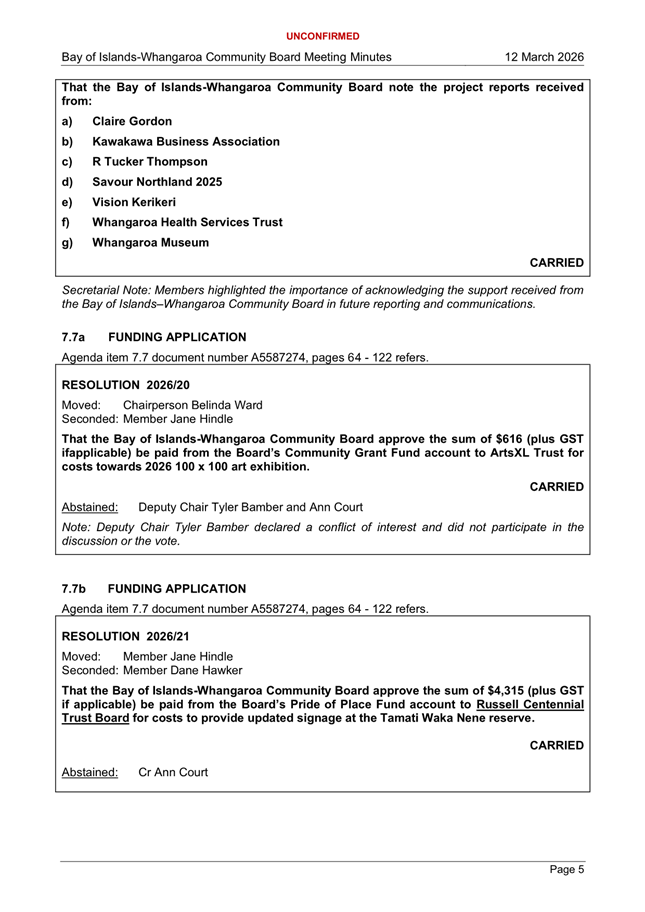
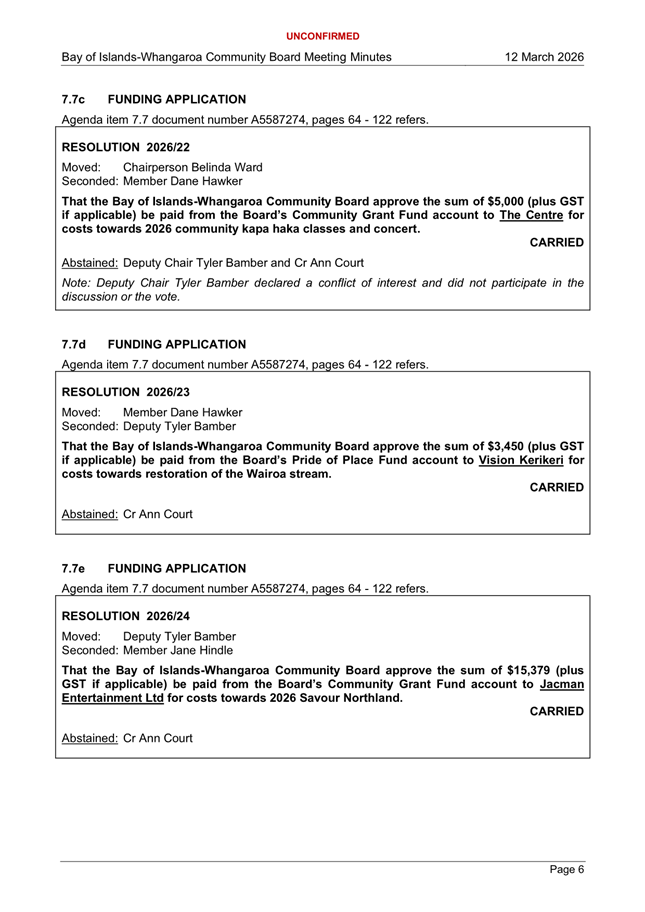
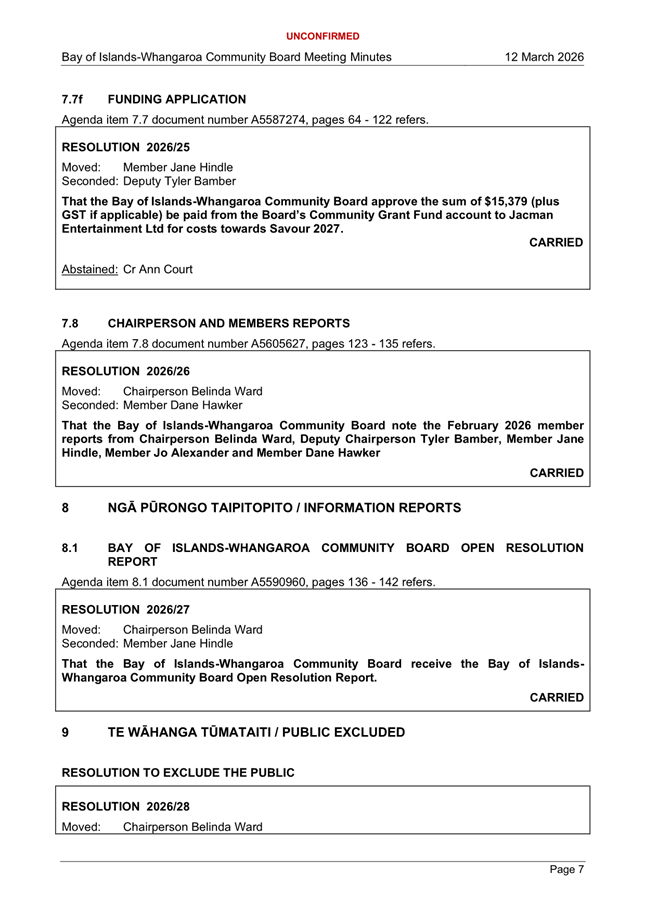
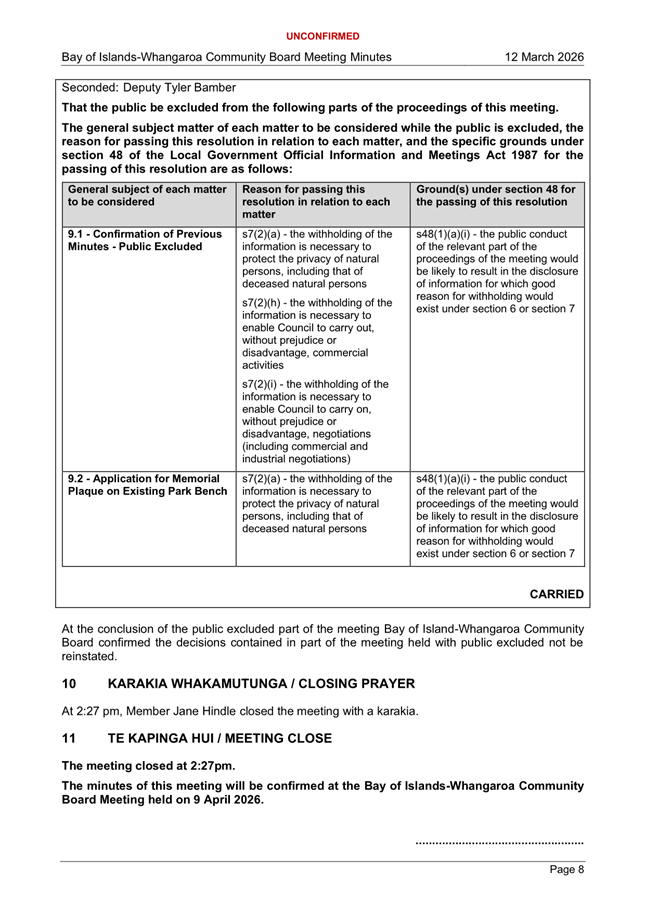
Board confirm the minutes of the meeting held 12 March 2026 as a true
and correct record.
|
1)
TĀhuhu kŌrero / Background
Local Government Act 2002 clause 7
Section 28 states that a local authority must keep minutes of its
proceedings. The minutes of these proceedings duly entered and
authenticated as prescribed by a local authority are prima facie evidence of
those meetings.
2) matapaki me
NgĀ KŌwhiringa / Discussion and Options
The Bay of Islands-Whangaroa
Community Board Standing Orders Section 27.3 states that “no discussion
may arise on the substance of the minutes at any succeeding meeting, except as
to their correctness”.
TAKE TŪTOHUNGA
/ REASON FOR THE RECOMMENDATION
The reason for the recommendation
is to confirm the minutes as a true and correct record of the previous meeting.
3) PĀnga
PŪtea me ngĀ wĀhanga tahua / Financial Implications and
Budgetary Provision
There are no financial implications
or the need for budgetary provision.
Āpitihanga
/ Attachments
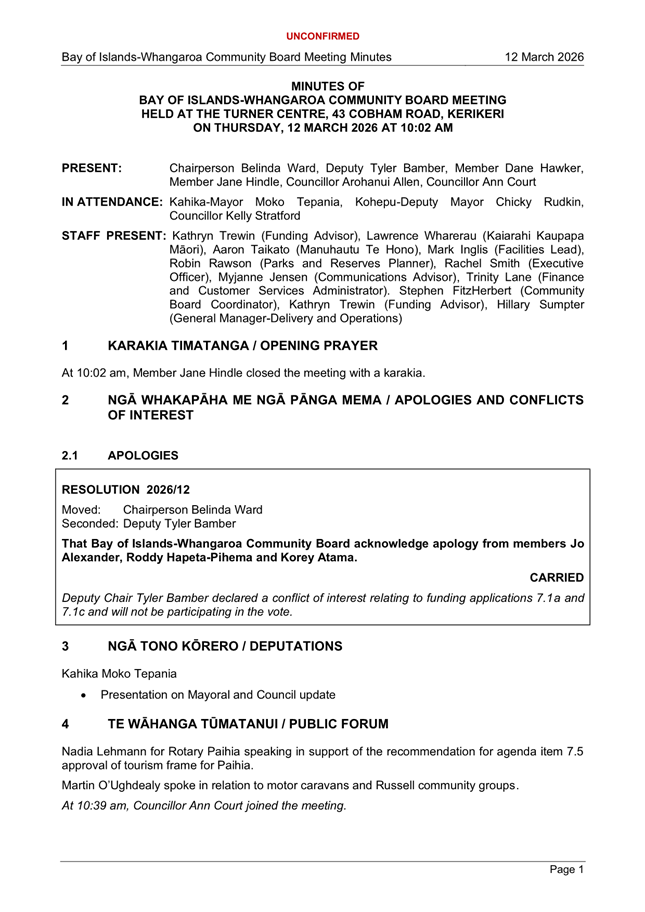
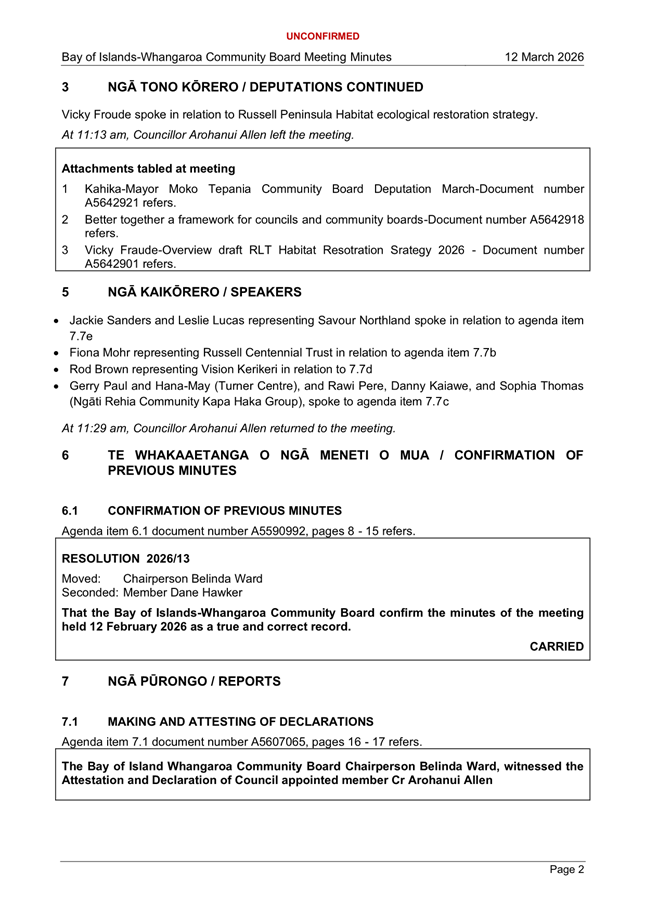
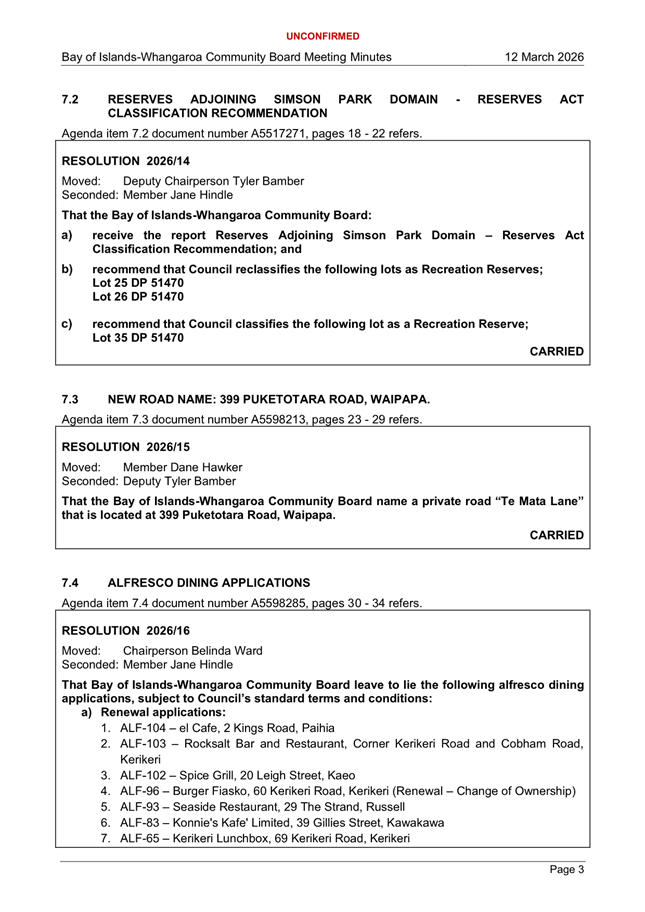
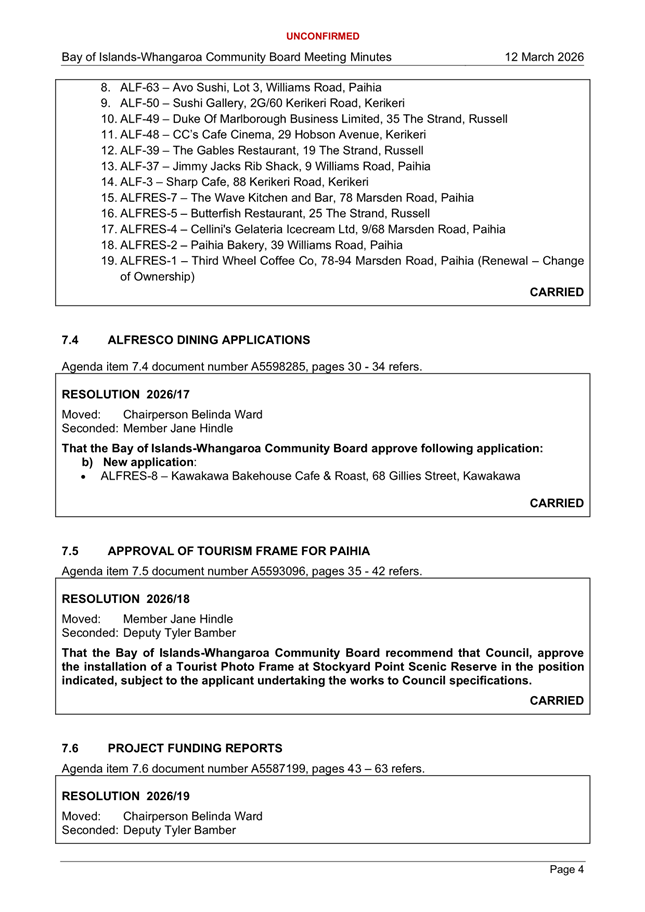
1. 2026-03-12
Bay of Islands-Whangaroa Community Board Minutes - A5620637 ⇩ 
Hōtaka Take Ōkawa / Compliance Schedule:
Full consideration has been given to the provisions of the
Local Government Act 2002 S77 in relation to decision making, in particular:
1. A Local authority must,
in the course of the decision-making process,
a) Seek to identify all
reasonably practicable options for the achievement of the objective of a
decision; and
b) Assess the options in
terms of their advantages and disadvantages; and
c) If any of the
options identified under paragraph (a) involves a significant decision in
relation to land or a body of water, take into account the relationship of
Māori and their culture and traditions with their ancestral land, water
sites, waahi tapu, valued flora and fauna and other taonga.
2. This section is subject
to Section 79 - Compliance with procedures in relation to decisions.
|
He Take Ōkawa / Compliance
Requirement
|
Aromatawai Kaimahi / Staff
Assessment
|
|
State the level of significance (high or low) of the
issue or proposal as determined by the Council’s
Significance and Engagement Policy
|
This is a matter of low significance.
|
|
State the relevant Council policies (external or
internal), legislation, and/or community outcomes (as stated in the LTP) that
relate to this decision.
|
This report complies with the Local Government Act 2002
Schedule 7 Section 28.
|
|
State whether this issue or proposal has a District wide
relevance and, if not, the ways in which the appropriate Community
Board’s views have been sought.
|
It is the responsibility of each meeting to confirm
their minutes therefore the views of another meeting are not relevant.
|
|
State the
possible implications for Māori and how Māori have been provided
with an opportunity to contribute to decision making if this decision is
significant and relates to land and/or any body of water.
State the
possible implications and how this report aligns with Te Tiriti o Waitangi /
The Treaty of Waitangi.
|
There are no implications on Māori in confirming minutes from a
previous meeting. Any implications on Māori arising from matters
included in meeting minutes should be considered as part of the relevant
report.
|
|
Identify persons likely to be affected by or have an
interest in the matter, and how you have given consideration to their views
or preferences (for example – youth, the aged and those with
disabilities).
|
This report is asking for the minutes to be confirmed as
a true and correct record, any interest that affect other people should be
considered as art of the individuals report.
|
|
State the financial implications and where budgetary
provisions have been made to support this decision.
|
There are no financial implications requiring input from
the Chief Financial Officer.
|
|
Chief Financial Officer review.
|
The Chief Financial Officer has not reviewed this
report.
|
|
Bay of Islands-Whangaroa Community Board Meeting Agenda
|
9 April 2026
|

|
Bay of Islands-Whangaroa
Community Board Meeting
Agenda
|
9 April 2026
|
7 Ngā
Pūrongo / Reports
7.1 Kerikeri
Urban Design Framework and Design Guide Project
File
Number: A5606428
Author: Giles
Dodson, Senior Strategic Planner
Authoriser: Tammy
Wooster, Group Manager Planning and Policy
Take
Pūrongo / Purpose of the Report
The purpose of the report is to introduce
the Kerikeri Urban Design Framework and Design Guide project (the project) and
to seek endorsement from the Bay of Islands-Whangaroa Community Board (the
Board) to alter the scope of this project as it is proposed in the Te
Pātukurea Kerikeri-Waipapa Spatial Plan (Te Pātukurea).
Te Pātukurea identifies the need for
an urban design framework for Kerikeri-Waipapa, and includes this project in
its implementation plan. When Te Pātukurea was developed and
approved an urban design project that encompassed both Kerikeri and Waipapa was
contemplated.
The scope change proposed is:
· focusing the urban design project on Kerikeri
· addressing Waipapa urban design matters via the Waipapa Structure
Plan project.
WhakarĀpopoto
matua / Executive Summary
This report:
· describes the the Kerikeri Urban Design Framework project and its
development to date
· provides a rationale for focusing the project only on Kerikeri
· recommends the Board endorse this change of focus.
|
tŪtohunga
/ Recommendation
That the Bay of Islands-Whangaroa Community
Board receives this report, and:
a) endorse
the recommendation to Te Kūkupa Committee for Strategy Policy and
Regulation to narrow the focus of the Kerikeri-Waipapa Urban Design Framework
project to Kerikeri alone.
|
1)
TĀhuhu kŌrero / Background
Council adopted Te Pātukurea in June
2025. Translating Te
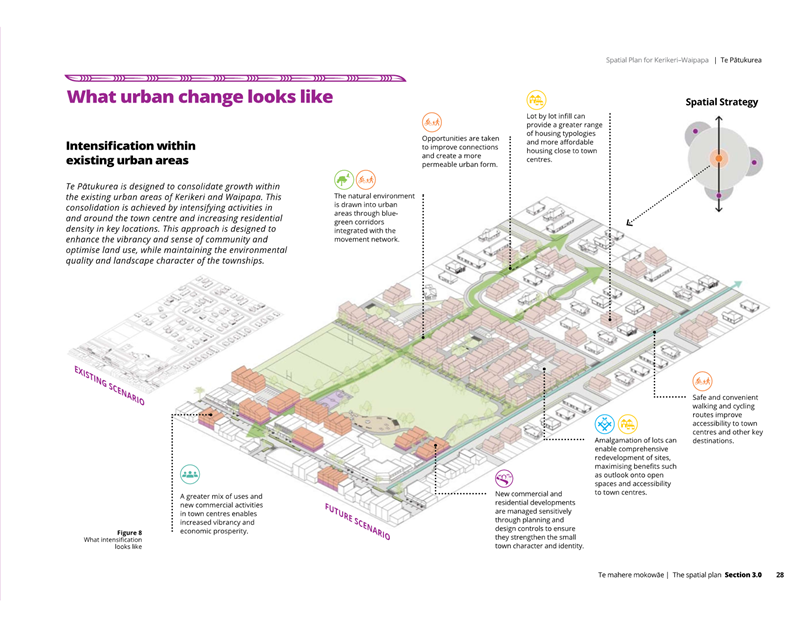
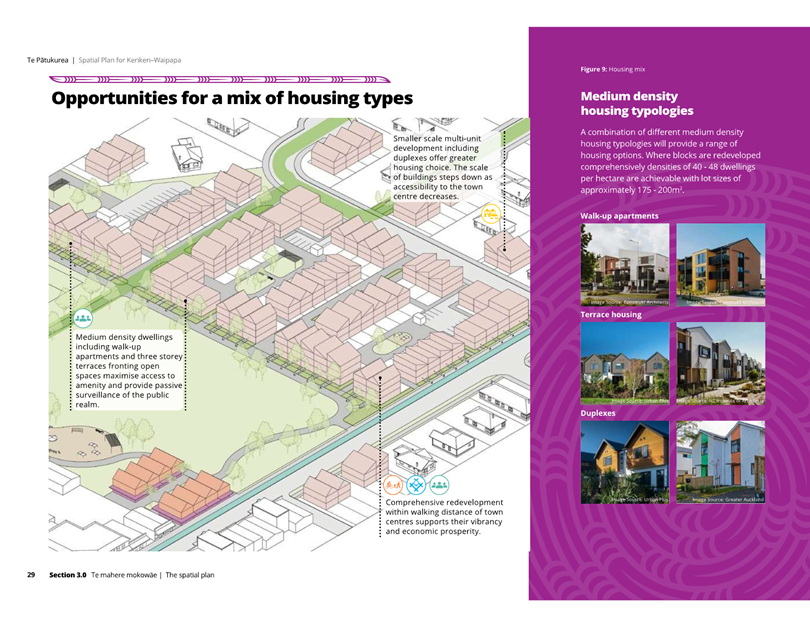
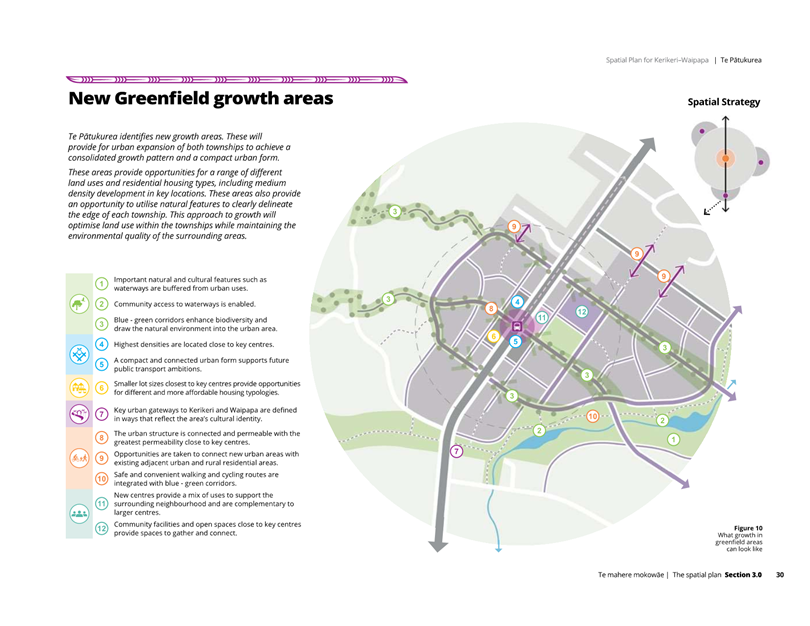
Pātukurea’s urban design principles into an actionable framework is
a short-term project directed by Te Pātukurea’s implementation plan.
As recommended by this report, the purpose
of the project is to:
· give effect to the urban design principles that guide Te
Pātukurea
· address key urban design challenges and opportunities in Kerikeri
· provide a framework in which long-term community urban design
aspirations in Kerikeri can be realised.
The project will produce:
· an integrated urban design framework, elaborating a design vision
and implementation plan for the future Kerikeri urban area
· design guidelines informing future medium density residential and
commercial development in Kerikeri.
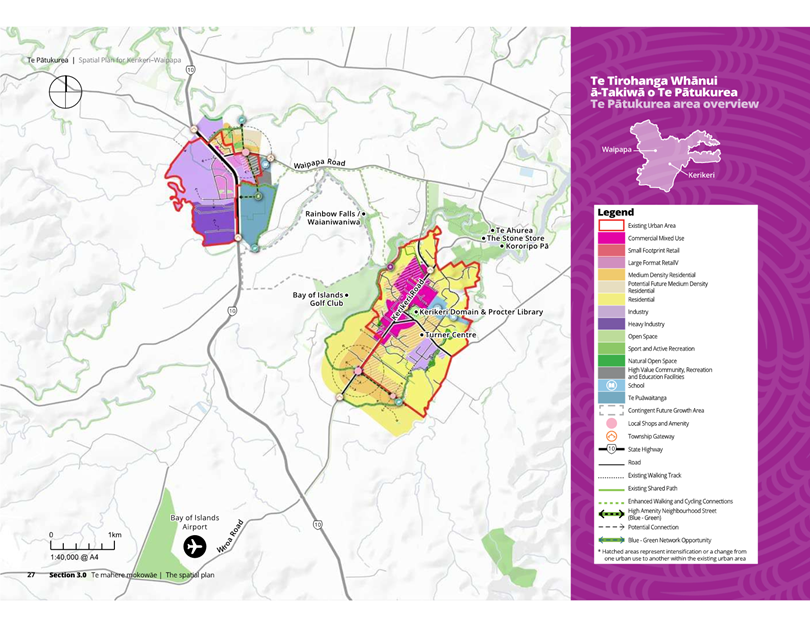
The project scope is the proposed
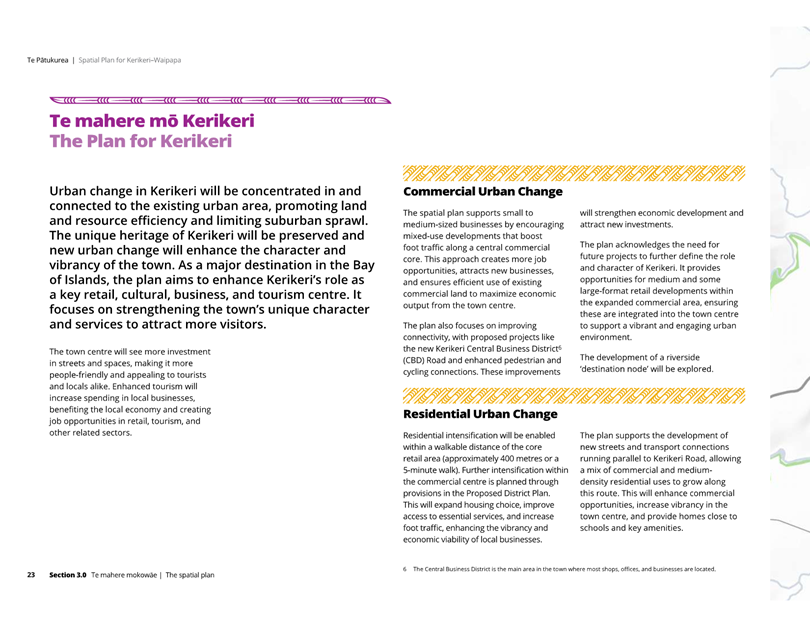
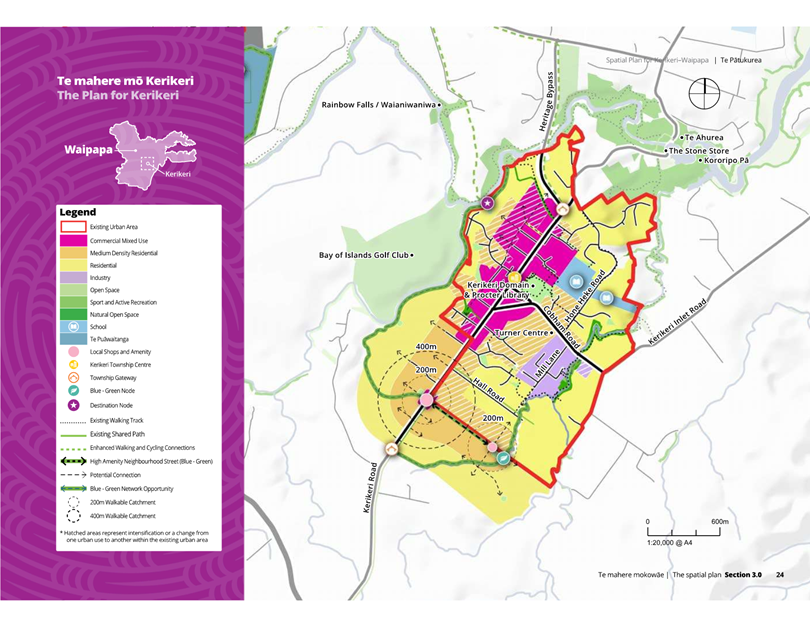
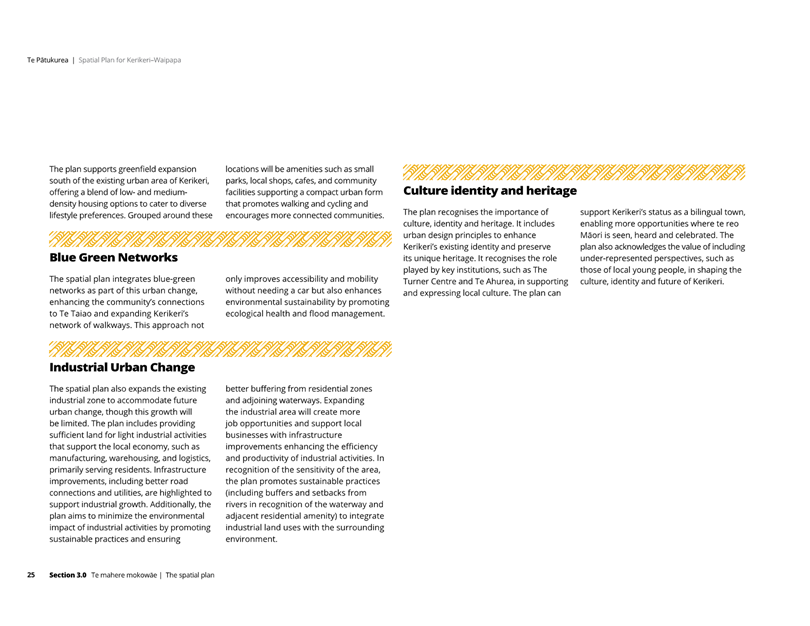
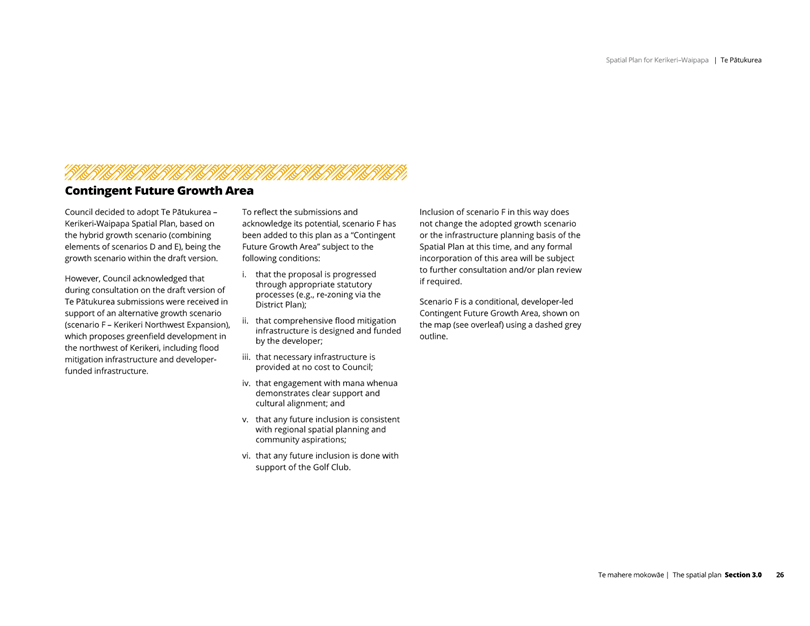
extent of the future Kerikeri urban area, as described in Te Pātukurea
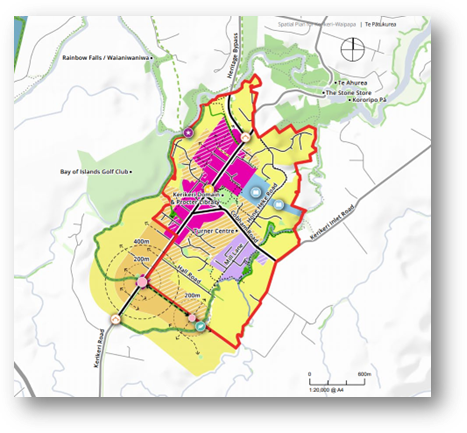
(see below). This area includes the Kerikeri town centre, existing urban area
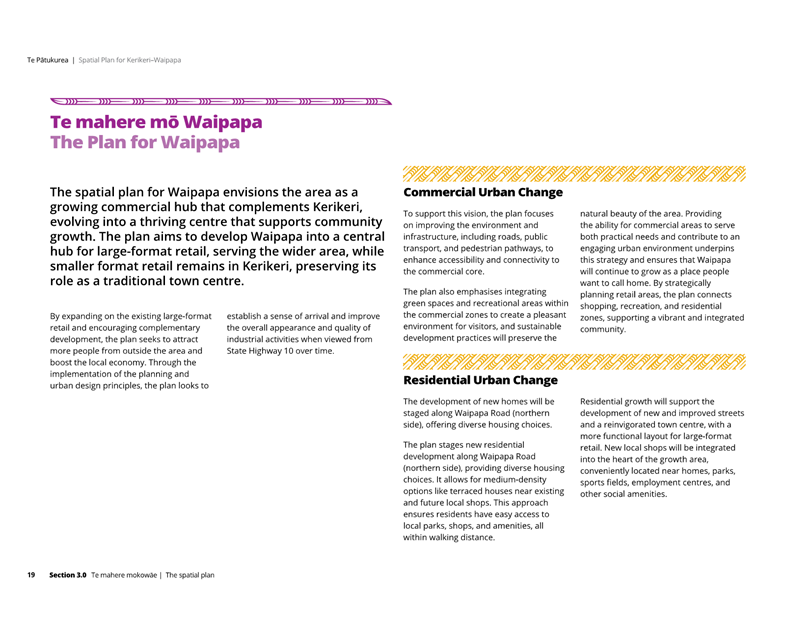
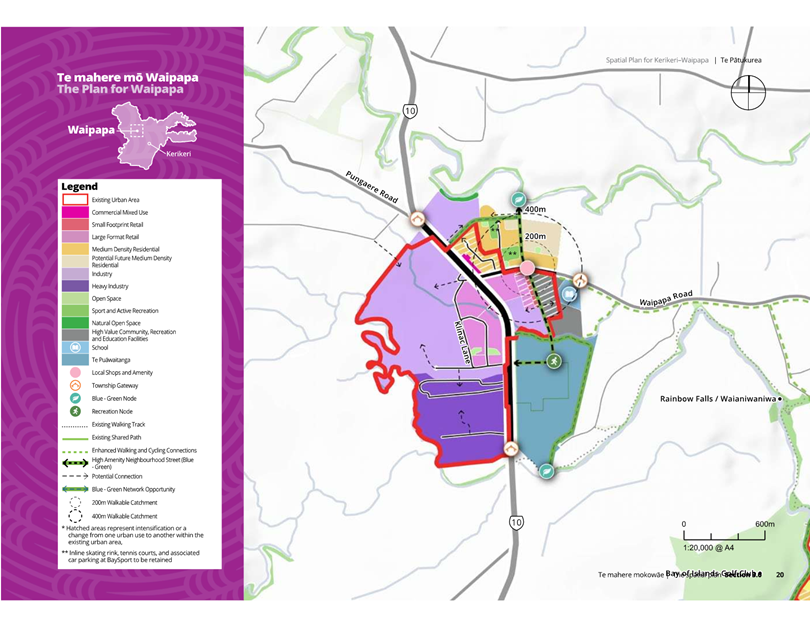
(red line, below) and the areas proposed for intensification (residential zone
and medium-density residential zone) (dark yellow and light yellow outside the
red line).
Fig 1. Kerikeri urban area, from Te
Pātukurea
The project is
consistent with current national policy direction set out in the National
Policy Statement for Urban Development 2020 (NPS-UD), which requires that urban
areas are well-functioning, resilient and responsive to change.
The recently announced planning
sector reforms and how these will specifically affect the implementation of a
local urban design framework and design guidelines is not certain at this time[4]. However,
the changes signalled to land use and development rules, such as reduced
‘visual amenity’ or landscape protections may only affect a narrow
dimension of urban design, which is concerned with the overall design of urban systems. The emerging picture
of reform maintains a focus on ‘well-functioning urban areas’.
The project plan takes account of
this uncertainty through a mid-year ‘hold point’, allowing for
implications of Proposed District Plan decision making and Planning Bill
enactment to be understood.
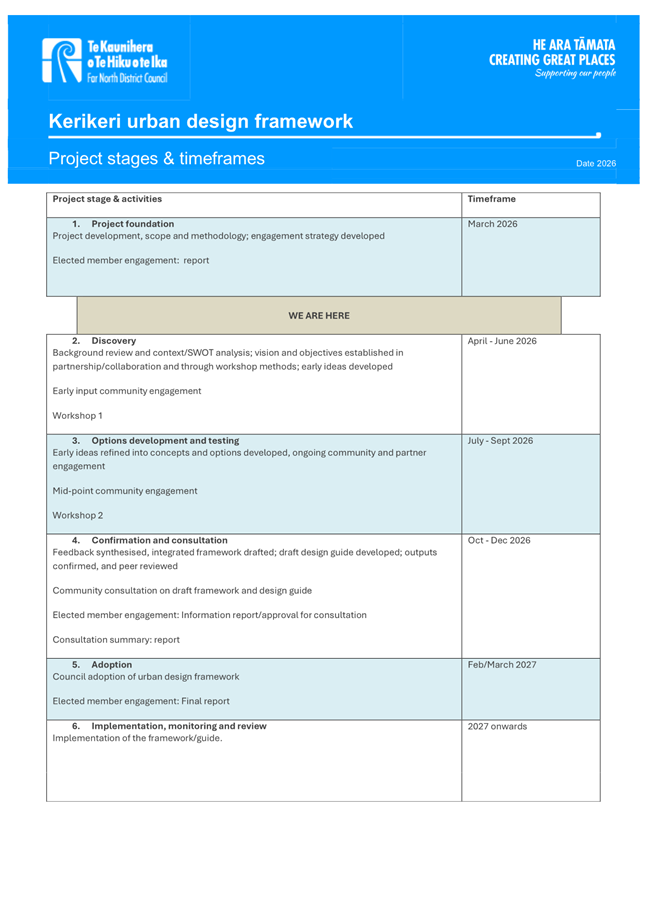
The project will run throughout
2026 and aims to have a completed design framework and design guidelines for
adoption by Council in early 2027. The project will follow established
urban design methodology, progressing through the following stages:
1. Project establishment - (Jan – March 2026)
2. Discovery – early stage research, context analysis and engagement
(April -June 2026)
3. Options development – focused, workshop-based options development (July-Sept
2026)
4. Confirmation and
consultation – testing and confirming options
and community consultation (Oct-Dec 2026)
5. Adoption and
implementation – adoption by Council and
implementation (2027).
Hapū, community and stakeholder
involvement
The project will continue to collaborate
closely with hapū partners and community stakeholders, in line with the
engagement approach indicated in Te Pātukurea’s implementation plan.
The partnership formed with the Hapū
Rōpū during Te Pātukurea has been re-established, and a community
reference group (see below) is in the process of being formed to guide Te
Pātukurea’s implementation. groups will work together to provide
important community voice and input into the project.
In preparing a project plan, a broader
group of stakeholders with specific interest and influence relating to
Kerikeri’s CBD and urban development has been identified and these
participants will be directly engaged in line with project stages 2,3 4, and
5.
Local community engagement and consultation
will also align with these stages.
At present we are preparing for Stage 1 – Discovery,
with early engagement during May. This will include an email newsletter to
Kerikeri residents, an online survey and web-based information, and pop-up
events in Kerikeri. It will also include direct engagement with key
stakeholders. A briefing paper outlining engagement activities will be
published prior to the start of this engagement period.
The establishment
of the community reference group was the subject of previous formal reports.
See: BOI-Whangaroa Community Board (2026, February 12) Minutes
of Bay of Islands-Whangaroa Community Board Meeting - Thursday, 12 February
2026 and to Te Kūkupa Committee for Strategy, Policy and
Regulation (2026, March 18) Agenda
of Te Kūkupa Committee for Strategy, Policy and Regulation Meeting -
Wednesday, 18 March 2026.
2) matapaki me
NgĀ KŌwhiringa / Discussion and Options
Originally, Te Pātukurea proposed an
urban design project that included both Kerikeri and Waipapa. Subsequent
analysis, advice and project development work indicates that a project focused
on both towns is unwieldy. The reasons for this are:
· each town has a distinct identity, character and function
· each town has distinct urban design challenges and opportunties
· significant urban change is occuring in Kerikeri, requiring in-depth
urban analysis and design
· distinct issues, stakeholders and community interests characterise
each town, potentially requiring duplicated consultation on different proposals
· significant community interest in focused attention being paid to
Kerikeri’s urban design and development.
Given these reasons, the most efficient
means to address urban design matters in the two towns is through separate
projects. This approach can be efficiently pursued, because:
· a separate project, the Waipapa Structure Plan Project (WSP), can
appropriately incorporate Waipapa urban design matters efficiently and avoid
unnecessary complexity
· urban design guidelines for medium density residential development
can be adapted to Waipapa as part of the WSP work.
The proposed refinement of urban design
work programme was discussed with and has been endorsed by the Hapū
Rōpū at a meeting held 20 November, 2025.
Lastly, the Te Pātukurea
Implementation Plan contemplates a flexible approach to achieving the long-term
objectives for Kerikeri-Waipapa. Actions within the inplementation plan
are ‘indicative’, and changes recommended in this report are in
line with this intent.
For these reasons it is recommended to
narrow the focus of the Kerikeri-Waipapa Urban Design project to Kerikeri
alone.
The Waipapa
Structure Plan project was the subject of previous formal reports. See:
BOI-Whangaroa Community Board (2026, February 12) Minutes
of Bay of Islands-Whangaroa Community Board Meeting - Thursday, 12 February
2026 and Te Kūkupa Committee for Strategy, Policy and Regulation
(2026, February 18) Minutes
of Te Kūkupa Committee for Strategy, Policy and Regulation Meeting -
Wednesday, 18 February 2026.
Option 1: Recommend narrowing the focus
of the Kerikeri-Waipapa Urban Design Project to Kerikeri alone (recommended
option).
Under this option, the Board recommends
that the project focuses on Kerikeri. Urban design matters in Waipapa will be
addressed via the Waipapa Structure Plan.
Advantages:
· the distinct urban challenges and opportunities in Kerikeri receive
sustained focus
· projects in both Kerikeri and Waipapa can proceed efficiently,
without overly complex overlap, and duplicated engagement and consultation
activities
· clarity of purpose and intent for both projects is maintained.
Disadvantages:
None identified.
Option 2: Do not recommend narrowing the
focus of the Kerikeri-Waipapa Urban Design Project to Kerikeri alone.
Under this option the Board does not
recommend the change in focus, and it is necessary to revise the urban design
project scope to include Waipapa, and also to revise the Waipapa Structure Plan
project to exclude urban design matters.
Advantages:
Te Pātukurea’s implementation
proceeds unchanged.
Disadvantages:
This option is likely to produce
significant complexity, a loss of focus and risks the Waipapa project pursuing
an incoherent planning approach. .
This option carries with it the risk of
overly complex community engagement and consultation (i.e. distinct,
township-specific issues being addressed simultaneously and separate design
frameworks being produced).
It also carries the risk of community
dissatisfaction with a process that does not focus sustained attention on
Kerikeri (or likewise dissatisfaction within the Waipapa community that Waipapa
structure planning overlooks urban design matters), given the scale of the
urban design challenges faced in Kerikeri and the high level of community
interest in these matters.
TAKE TŪTOHUNGA
/ REASON FOR THE RECOMMENDATION
The recommendation enables important Te
Pātukurea implementation projects to proceed without introducing
unnecessary complexity and inefficiency into the work. A clear, sustained focus
on Kerikeri’s challenges and opportunities can occur, reflecting the
scale and pace of urban change currently underway and the high level of
community interest in Kerikeri’s future development.
Narrowing the project scope provides
clarity of purpose and strengthens the ability of the projects to deliver
meaningful, place-specific outcomes. It also allows urban design matters in
Waipapa to be addressed more appropriately and efficiently through the Waipapa
Structure Plan, rather than diluting focus across two distinct townships with
different identities, issues and stakeholders.
Overall, the recommended approach reduces
delivery risk, avoids duplication of effort and engagement, and ensures that
both Kerikeri and Waipapa benefit from tailored, fit-for-purpose planning
processes aligned with Te Pātukurea’s intent.
3) PĀnga
PŪtea me ngĀ wĀhanga tahua / Financial Implications and
Budgetary Provision
The project is funded by the Annual Plan,
via the Growth Planning and Placemaking operational budget. Sufficient budget
has been allocated to the project during financial year 2025/2026. Funds for
this project have been included in the budgeting for the 2026/2027 Annual
Plan.
Āpitihanga / Attachments
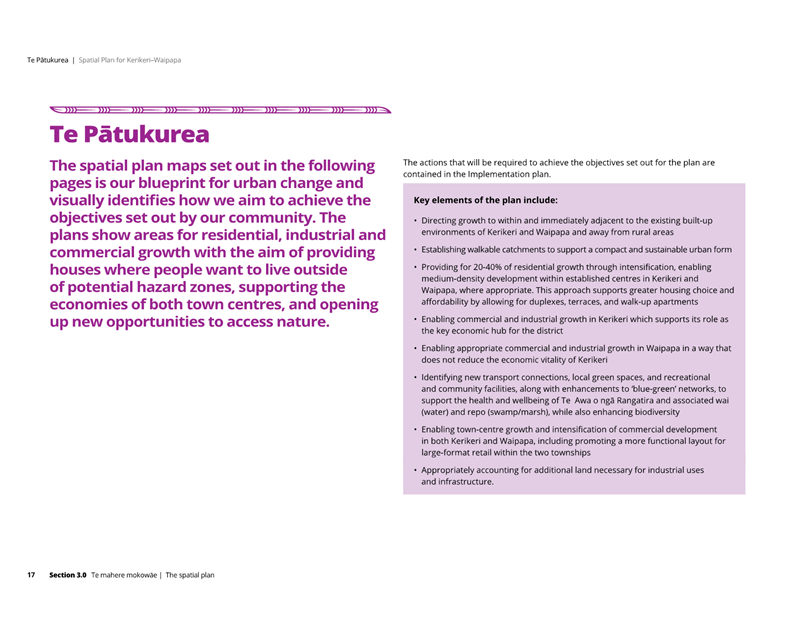
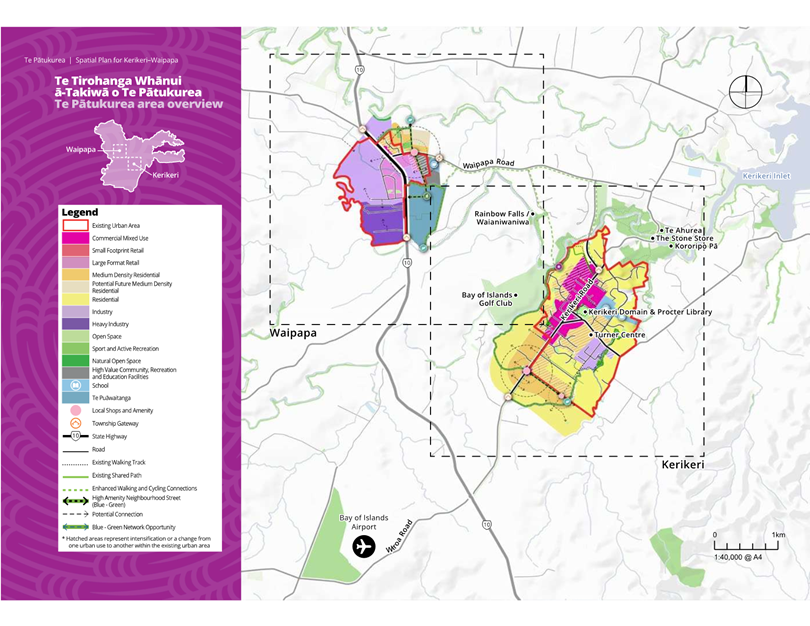
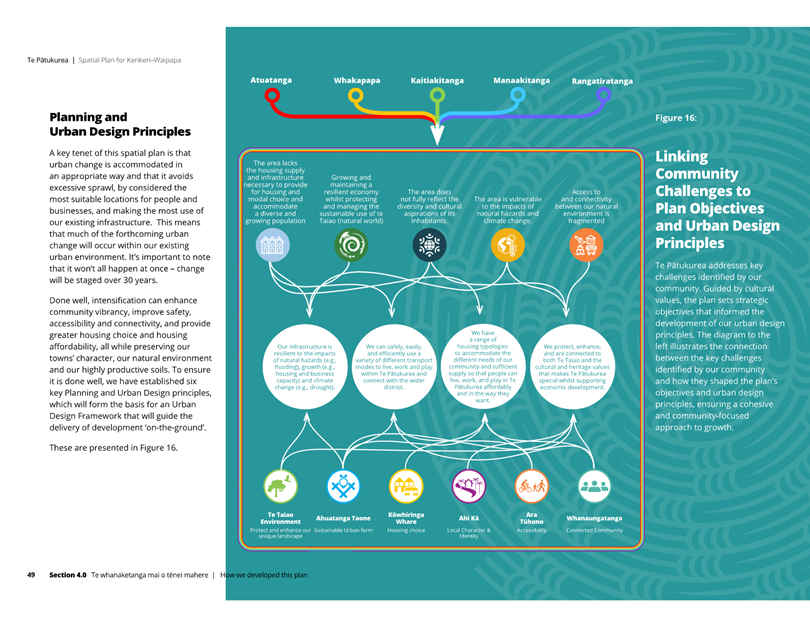
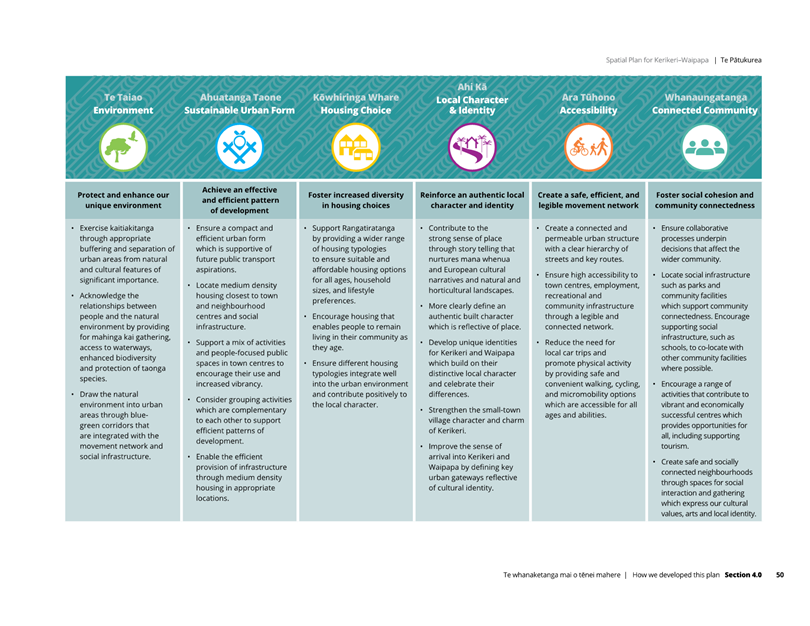
1. Te
Patukurea Kerikeri Waipapa - A5607695 ⇩
2. Te
Patukurea Urban planning and urban design principles - A5607699 ⇩
3. Urban
design framework stages and timeframes - A5608579 ⇩
Hōtaka Take Ōkawa / Compliance Schedule:
Full consideration has been given to the provisions of the
Local Government Act 2002 S77 in relation to decision making, in particular:
1. A Local authority must,
in the course of the decision-making process,
a) Seek to identify all
reasonably practicable options for the achievement of the objective of a
decision; and
b) Assess the options in
terms of their advantages and disadvantages; and
c) If any of the
options identified under paragraph (a) involves a significant decision in
relation to land or a body of water, take into account the relationship of
Māori and their culture and traditions with their ancestral land, water
sites, waahi tapu, valued flora and fauna and other taonga.
2. This section is subject
to Section 79 - Compliance with procedures in relation to decisions.
|
He Take Ōkawa / Compliance
Requirement
|
Aromatawai Kaimahi / Staff
Assessment
|
|
State the level of significance (high or low) of the
issue or proposal as determined by the Council’s
Significance and Engagement Policy
|
The change of focus recommended in the report has a low
level of significance, as determined by the Significance and Engagement
Policy
|
|
State the relevant Council policies (external or
internal), legislation, and/or community outcomes (as stated in the LTP) that
relate to this decision.
|
|
|
State whether this issue or proposal has a District wide
relevance and, if not, the ways in which the appropriate Community
Board’s views have been sought.
|
The project focuses on the urban area of Kerikeri.
Although Kerikeri has district-wide importance as the Far North’s
largest town and economic centre, specific urban design matters relating to
Kerikeri do not have district-wide relevance.
The BOI-Whangaroa Community Board’s views are
being sought via this report, and subsequent programmed reporting.
|
|
State the
possible implications for Māori and how Māori have been provided
with an opportunity to contribute to decision making if this decision is
significant and relates to land and/or any body of water.
State the
possible implications and how this report aligns with Te Tiriti o Waitangi /
The Treaty of Waitangi.
|
The project is engaged in active partnership with the
Hapū Rōpū, the mandated mana whenua body representing eight
hapū:
· Ngāti
Hineira
· Ngāti
Korohue
· Ngāti
Mau
· Ngāti
Rangi
· Ngāti
Rēhia
· Ngāti
Torehina ki Matakā
· Te
Uri Taniwha
· Te Whiu
|
|
Identify persons likely to be affected by or have an
interest in the matter, and how you have given consideration to their views
or preferences (for example – youth, the aged and those with
disabilities).
|
The Hapū Rōpū and a community steering
group will be active collaborators in this project. Broader stakeholder
and local community engagement and consultation is programmed.
|
|
State the financial implications and where budgetary
provisions have been made to support this decision.
|
None.
|
|
Chief Financial Officer review.
|
The CFO has not reviewed this report.
|
|
Bay of Islands-Whangaroa Community Board Meeting Agenda
|
9 April 2026
|


|
Bay of Islands-Whangaroa Community Board Meeting Agenda
|
9 April 2026
|
|
Bay of Islands-Whangaroa Community Board Meeting Agenda
|
9 April 2026
|
|
Bay of Islands-Whangaroa Community Board Meeting Agenda
|
9 April 2026
|
7.2 Amenity
Lighting
File
Number: A5585708
Author: Tayarni
McGee-Rivington, Junior Project Manager
Authoriser: Ken
Macdonald, Chief Financial Officer
Take Pūrongo / Purpose of the Report
The purpose of this report is to confirm the approval of the
amenity lighting at the Kaeo recreational space and recommend two further
locations for investigation.
WhakarĀpopoto matua / Executive Summary
· Amenity lighting plays a key role in improving the safety,
accessibility, and attractiveness of public spaces across the Bay of
Islands–Whangaroa ward.
· Council’s amenity lighting programme aims to address these
issues by delivering small‑scale, energy‑efficient lighting
improvements in high‑use areas such as wharfs, boat ramps, parks, and
walkways.
· The Community Board’s input is essential to ensure that
selected locations reflect community needs, align with ward priorities, and
support accessible, safe, and welcoming public spaces for residents, visitors,
and businesses.
· The Bay of Islands – Whangaroa Community Board has delegation
to approve the locations of amenity lighting.
|
tŪtohunga
/ Recommendation
That the Bay of Islands – Whangaroa
Community Board
a) approve
the installation of amenity lighting at ________ as identified in the Bay of
Islands – Whangaroa Community Board 25/28 strategic plan, and
b) recommend
__________ and ________ for further investigation to become the third amenity
lighting location.
|
1) TĀhuhu kŌrero / Background
Within the 2024/27 Long Term Plan, $10,000.00 is allocated
per year for each of the wards across the Far North District for new amenity
lighting installations.
To enable one contract for the amenity lighting capital
works to be bundled and achieve efficient delivery and value for money, the
Year 1 budget has been combined with the Year 2 and Year 3 budgets and brought
forward into Year 2 (2025/2026). As a result, $26,581.53 is now available in
the 2025/26 financial year.
In 2024/25 a new amenity light was installed at the
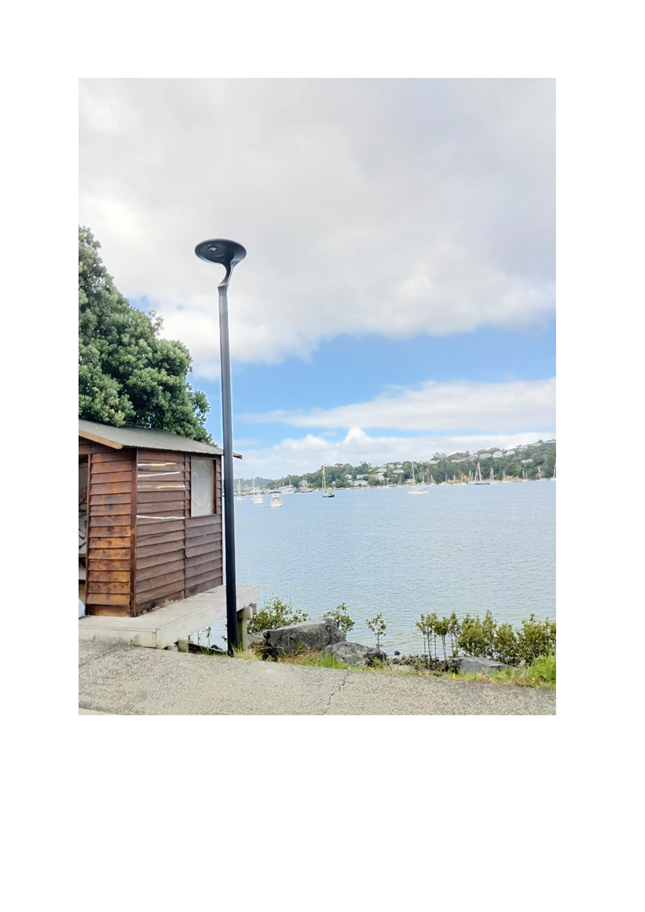
Ōkiato Ferry Ramp. The remaining budget allows for two more amenity lights
to be installed in the Bay of Islands – Whangaroa ward under the 2024/27
LTP.
2) matapaki me NgĀ KŌwhiringa /
Discussion and Options
When considering locations for the third amenity light, it
is important to note that solar-powered lights are recommended, as they can be
installed in locations previously inaccessible to mains power.
The confirmation of two preferred sites will enable Council
to make full use of the brought‑forward LTP funds and deliver visible,
high‑value improvements to the community earlier than planned.
Following the Community
Board’s recommendation of two priority sites, staff will progress the
amenity lighting programme and engage a supplier to install the amenity
lighting prior to 30 June 2026.
TAKE TŪTOHUNGA
/ REASON FOR THE RECOMMENDATION
The installation of an amenity light at the Kāeo
recreation space was confirmed within the Bay of Islands – Whangaroa
Community Board Strategic Plan 2025/28.
crucial, as members have a deep
understanding of local priorities, community concerns, and emerging
opportunities across the ward.3) PĀnga PŪtea me ngĀ wĀhanga
tahua / Financial Implications and Budgetary Provision
$26,581.53 is available for new amenity lighting
installations within the Bay of Islands – Whangaroa Ward.
Typical installation costs range from $9,000 - $12,000
(includes material supply and installation)
Āpitihanga
/ Attachments
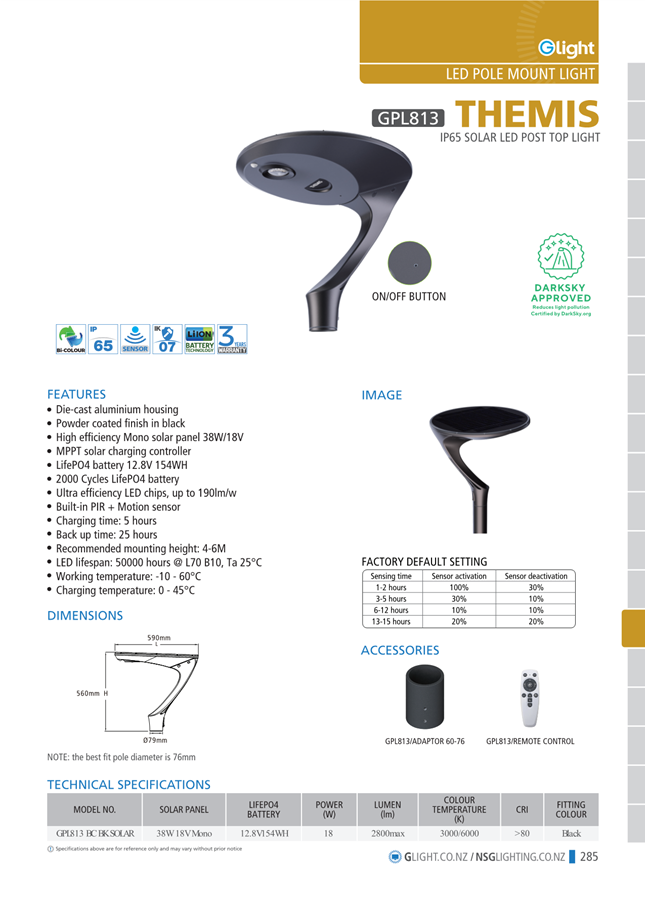
1. Solar
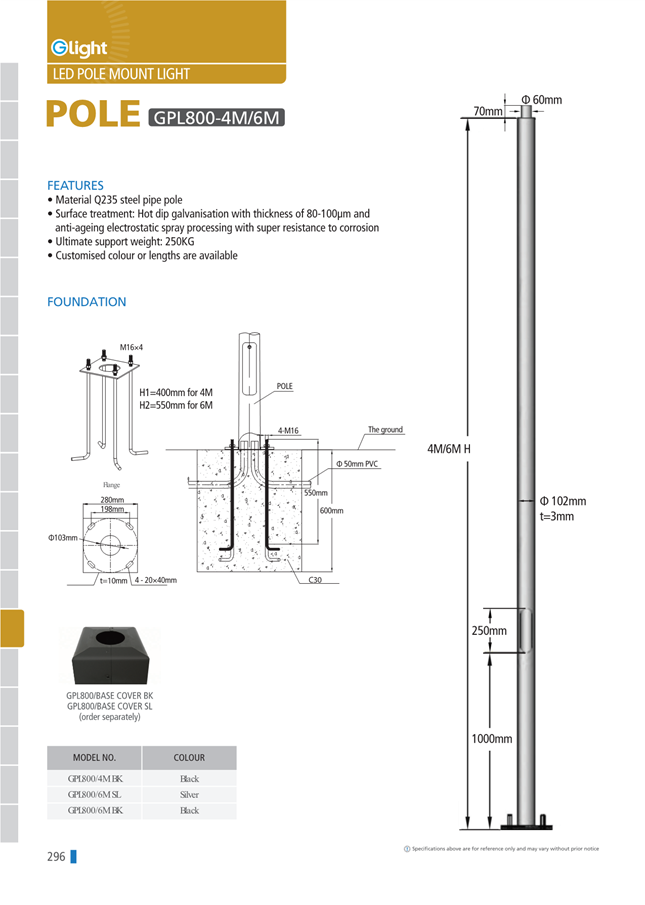
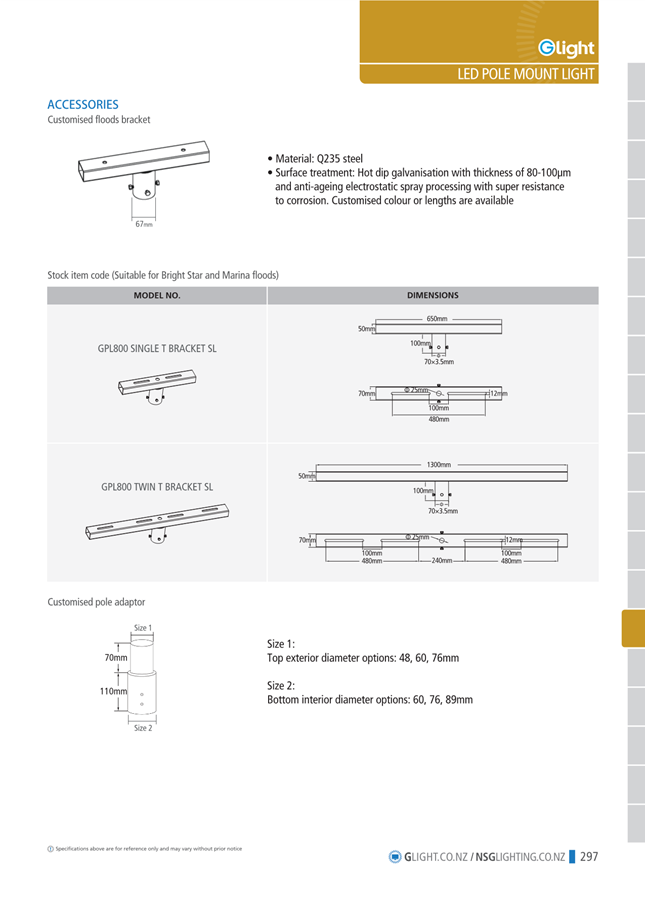
Light Specifications - A5585403 ⇩
2. Solar
Light Pole Specifications - A5585405 ⇩
3. Example
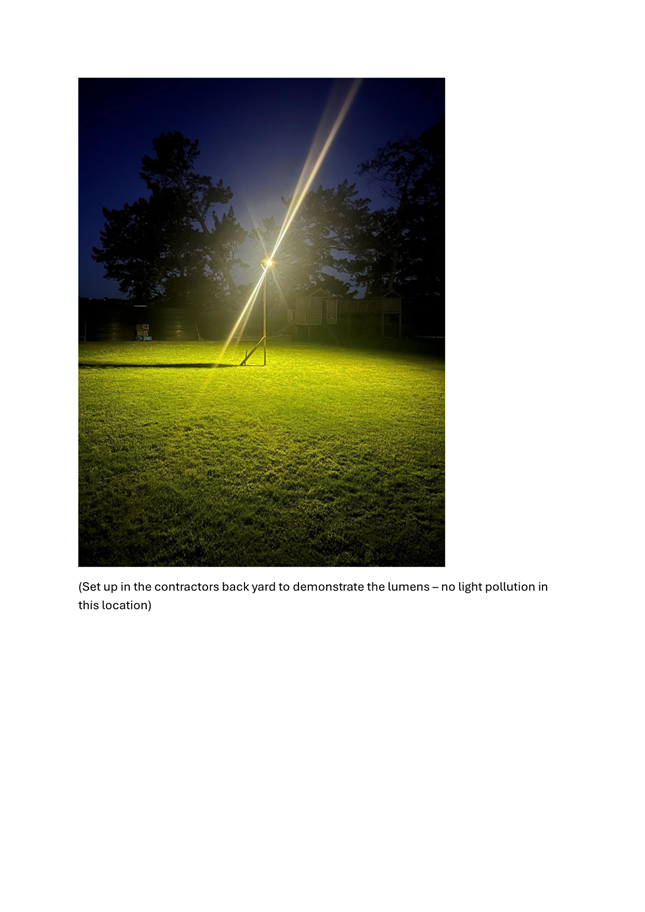
of the solar light at night - A5585401 ⇩
4. Example
of solar light at Okiato Ferry Ramp - A5585400 ⇩
5. BOIW
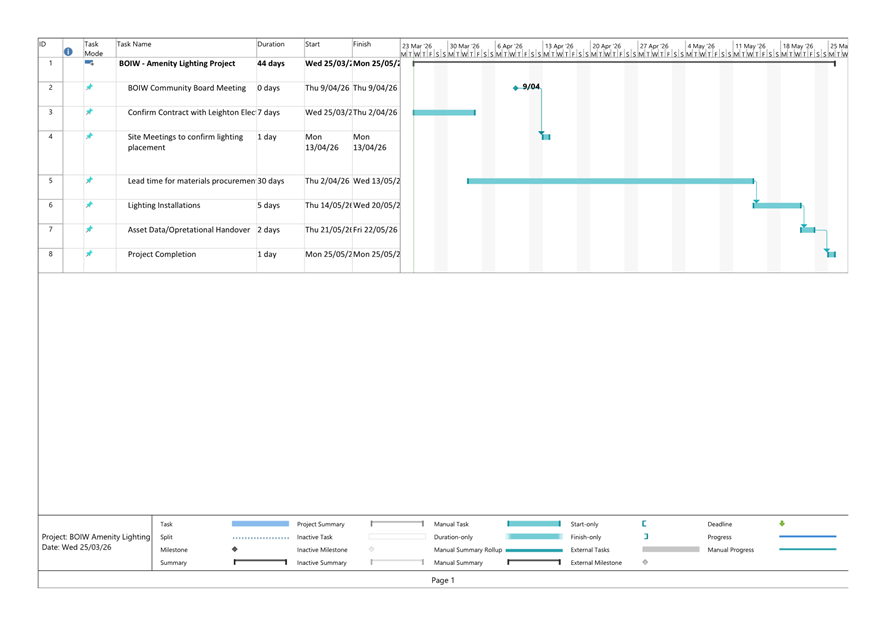
Amenity Lighting Project Schedule - A5652347 ⇩
Hōtaka Take Ōkawa / Compliance Schedule:
Full consideration has been given to the provisions of the
Local Government Act 2002 S77 in relation to decision making, in particular:
1. A
Local authority must, in the course of the decision-making process,
a) Seek
to identify all reasonably practicable options for the achievement of the
objective of a decision; and
b) Assess
the options in terms of their advantages and disadvantages; and
c) If
any of the options identified under paragraph (a) involves a significant
decision in relation to land or a body of water, take into account the
relationship of Māori and their culture and traditions with their
ancestral land, water sites, waahi tapu, valued flora and fauna and other
taonga.
2. This
section is subject to Section 79 - Compliance with procedures in relation to
decisions.
|
He Take Ōkawa /
Compliance Requirement
|
Aromatawai Kaimahi /
Staff Assessment
|
|
State the level of significance (high or low) of the
issue or proposal as determined by the Council’s
Significance and Engagement Policy
|
This report has a low degree of significance; public
consultation is not needed for these decisions to be made.
|
|
State the relevant Council policies (external or
internal), legislation, and/or community outcomes (as stated in the LTP) that
relate to this decision.
|
FNDC Street Lighting Policy (#4110)
NZS1158 – Lighting for Roads and Public Spaces
|
|
State whether this issue or proposal has a District wide
relevance and, if not, the ways in which the appropriate Community
Board’s views have been sought.
|
Deciding where amenity lighting is installed throughout
the district is part of Community Board delegations
|
|
State the
possible implications for Māori and how Māori have been provided
with an opportunity to contribute to decision making if this decision is
significant and relates to land and/or any body of water.
State the
possible implications and how this report aligns with Te Tiriti o Waitangi /
The Treaty of Waitangi.
|
No, iwi and hapu have not yet been consulted, once
locations are recommended by the community board the relevant iwi and hapu
will be contact for input.
Currently no implications to Māori perceived as a
result of this request.
|
|
Identify persons likely to be affected by or have an
interest in the matter, and how you have given consideration to their views
or preferences (for example – youth, the aged and those with
disabilities).
|
The effects of the installation of amenity lighting will
be positive for the communities that use the areas.
|
|
State the financial implications and where budgetary
provisions have been made to support this decision.
|
Provided under financial implications and budgetary
provision.
|
|
Chief Financial Officer review.
|
Chief Financial Officer has reviewed this report.
|
|
Bay of Islands-Whangaroa Community Board Meeting Agenda
|
9 April 2026
|
|
Bay of Islands-Whangaroa Community Board Meeting Agenda
|
9 April 2026
|

|
Bay of Islands-Whangaroa Community Board Meeting Agenda
|
9 April 2026
|
|
Bay of Islands-Whangaroa Community Board Meeting Agenda
|
9 April 2026
|
|
Bay of Islands-Whangaroa Community Board Meeting Agenda
|
9 April 2026
|
|
Bay of Islands-Whangaroa Community Board Meeting Agenda
|
9 April 2026
|
7.3 Winter 2026
Rural Travel Funding Applications
File
Number: A5642757
Author: Kathryn
Trewin, Funding Advisor
Authoriser: Aisha
Huriwai, Manager - Democracy Services
Take Pūrongo / Purpose of the Report
To allocate Rural Travel Funding for the 2026 winter
sporting season.
|
tŪtohunga
/ Recommendation
That Bay of Islands-Whangaroa Community Board allocates
Rural Travel Grant funding in accordance with the recommendations received
from Sport Northland as follows:
a)
Bay of Islands
Gymnastics $126
b)
Kerikeri Football Club $1,639
c)
Kerikeri High School $163
d)
Moerewa Tigers Rugby
League Club $882
e)
Otiria Rugby Football and
Sports Club $170
f)
Russell Football Club $170
g)
The Bubz Netball $189
h) Whangaroa
College $655
TOTAL $3,994
|
1) TĀhuhu kŌrero / Background
The Rural Travel Fund was developed
in response to concerns raised by Councils throughout the country about the
lack of participation in sport by young people living in rural communities. The
Fund was introduced as an interim measure until a rural participation strategy
was fully developed and implemented by central government. The strategy is yet
to be developed.
Council receives funding based on a
per capita basis and gave the three Community Boards delegated authority to
allocate the funding. This funding round is the first of two funding
rounds for the current financial year, for sporting activities taking place in
summer, or until approximately April 2026 when the next round of funding is
allocated.
Council advertises that funding is
available approximately one month before applications close online (including
on Council’s Facebook page), with the closing dates notified on the Rural
Travel Funding page at the start of each calendar year (when the Community
Board meetings dates are set). The Sport Northland representatives also forward
information of the fund to clubs and schools that they work with as a more
targeted approach to advertise the funding is available.
2) matapaki me NgĀ KŌwhiringa /
Discussion and Options
Eight applications were received
for winter sports funding, for 634 children in the Bay of Islands-Whangaroa
Community Board area.
It is each Community Board's role
to determine which applications best meet the criteria and will have the most
positive broad effect in their communities. The following table is a guide to
the funding criteria.
Project reports for any previous grants have been received
from all the current applicants. The funding recommendation summary is
attached.
|
|
Sport
New Zealand (Rural Travel)
|
What are the
Objectives?
|
Subsidise
travel for junior teams participating in local sport competition.
|
|
How much is
available?
|
$29,400
across the Far North District
|
|
Funding is not
available for
|
Activities
taking place during school hours, coaches, referees, club/school sport
administration, travel to training.
|
|
Who can apply?
|
Schools
and clubs.
|
|
What age group is
funding for?
|
Funding
is available for youth/children aged 5 - 19 years of age.
|
|
Eligible Sports
|
Sports
that have regular grass roots competitions such as netball, hockey, rugby,
rugby league, softball, football, touch rugby, basketball.
|
Applicants are advised, when granted funds, that the funds
are to be uplifted within three months and that a project report form is
required if they wish to be eligible to apply for future funding.
TAKE TŪTOHUNGA
/ REASON FOR THE RECOMMENDATION
To fulfil the requirements of the Sport NZ Rural Travel Fund
agreement with Sport New Zealand to increase participation in sport by young
people living in rural communities.
3) PĀnga PŪtea me ngĀ
wĀhanga tahua / Financial Implications and Budgetary Provision
Council now receives one grant
annually from Sport New Zealand. Sport Northland no longer offer
Tū Manawa funding through Councils and undertake granting of this funding
themselves.
The total budget for rural travel
funding for the 2025/26 financial year for the whole of the Far North District
is $29,400 and all applications were considered together.
Āpitihanga
/ Attachments
1. BOIWCB
- Rural Travel Fund Breakdown - A5648313 ⇩
Hōtaka Take Ōkawa / Compliance Schedule:
Full consideration has been given to the provisions of the
Local Government Act 2002 S77 in relation to decision making, in particular:
1. A
Local authority must, in the course of the decision-making process,
a) Seek
to identify all reasonably practicable options for the achievement of the
objective of a decision; and
b) Assess
the options in terms of their advantages and disadvantages; and
c) If
any of the options identified under paragraph (a) involves a significant
decision in relation to land or a body of water, take into account the
relationship of Māori and their culture and traditions with their
ancestral land, water sites, waahi tapu, valued flora and fauna and other
taonga.
2. This
section is subject to Section 79 - Compliance with procedures in relation to
decisions.
|
He
Take Ōkawa / Compliance Requirement
|
Aromatawai
Kaimahi / Staff Assessment
|
|
State the level of significance
(high or low) of the issue or proposal as determined by the Council’s
Significance and Engagement Policy
|
This is a matter of low
significance.
|
|
State the relevant Council
policies (external or internal), legislation, and/or community outcomes (as
stated in the LTP) that relate to this decision.
|
Community Grant Policy, Te
Pae o Uta and the Sport New Zealand Rural Travel Fund Guidelines.
|
|
State whether this issue or
proposal has a District wide relevance and, if not, the ways in which the
appropriate Community Board’s views have been sought.
|
It is the responsibility of each
Community Board to confirm the funding that they allocated has been spent
correctly.
|
|
State the possible implications for Māori
and how Māori have been provided with an opportunity to contribute to
decision making if this decision is significant and relates to land and/or
any body of water.
|
There are no implications on Māori in confirming the project
reports. Any implications on Māori arising from matters included in
project reports should be considered as part of the relevant report.
|
|
Identify persons likely to be
affected by or have an interest in the matter, and how you have given
consideration to their views or preferences (for example – youth, the
aged and those with disabilities).
|
This report is asking for the
project reports to be approved, any interests that affect other people should
be considered as part of the individual reports.
|
|
State the financial implications
and where budgetary provisions have been made to support this decision.
|
There are no financial
implications or the need for budgetary provision.
|
|
Chief Financial Officer review.
|
The Chief Financial Officer has
not reviewed this report.
|
|
Bay of Islands-Whangaroa Community Board Meeting Agenda
|
9 April 2026
|
|
Bay of Islands-Whangaroa Community Board Meeting Agenda
|
9 April 2026
|
7.4 Funding
Applications
File
Number: A5651163
Author: Kathryn
Trewin, Funding Advisor
Authoriser: Aisha
Huriwai, Manager - Democracy Services
Take Pūrongo / Purpose of the Report
The purpose of this report is to allow the Bay of
Islands-Whangaroa Community Board (the Board) to consider the application/s
received for the Community Grant Fund/Placemaking Fund.
WhakarĀpopoto matua / Executive Summary
· There are two new
applications requesting $4,178. One applicant is seeking funding
from the Board for each of the remaining years of the triennium.
· The Board has $36,299
to allocate for the Community Board Fund in the 2025/2026 financial year.
· The Board has $87,149
to allocate for the Placemaking Fund in the 2025/2026 financial year.
|
TŪTOHUNGA / RECOMMENDATION
That the Bay of Islands-Whangaroa Community Board
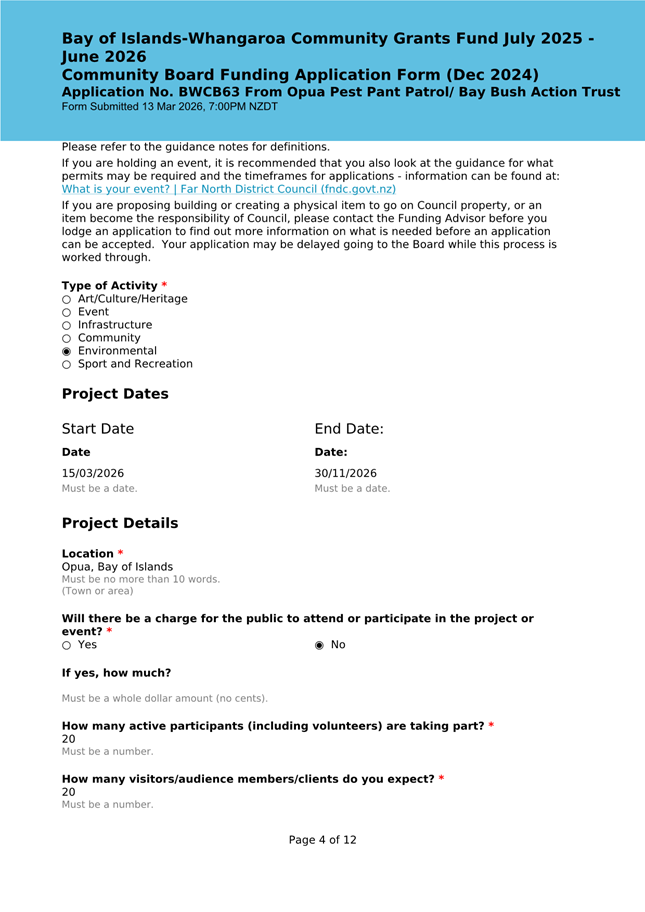
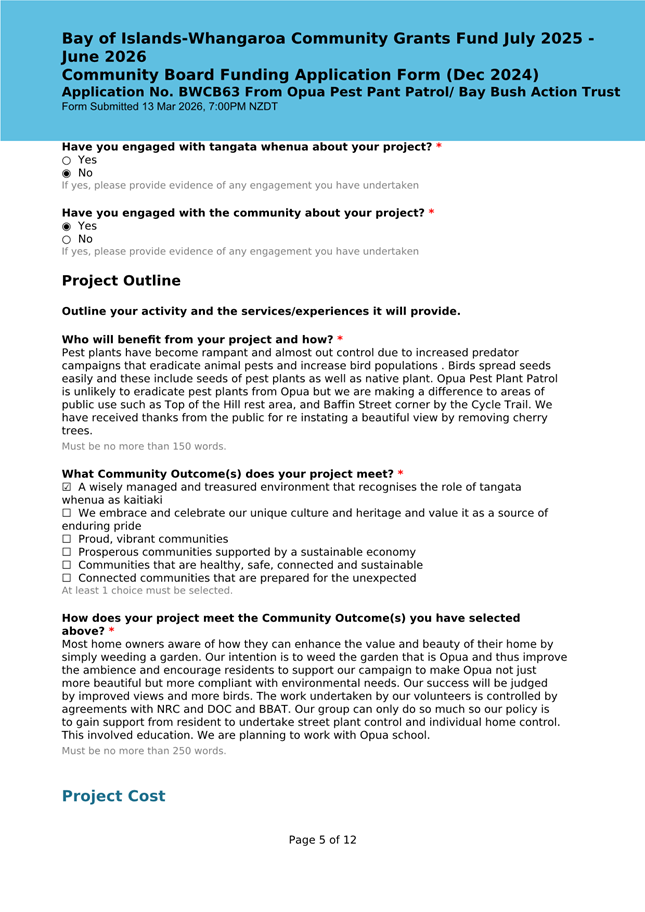
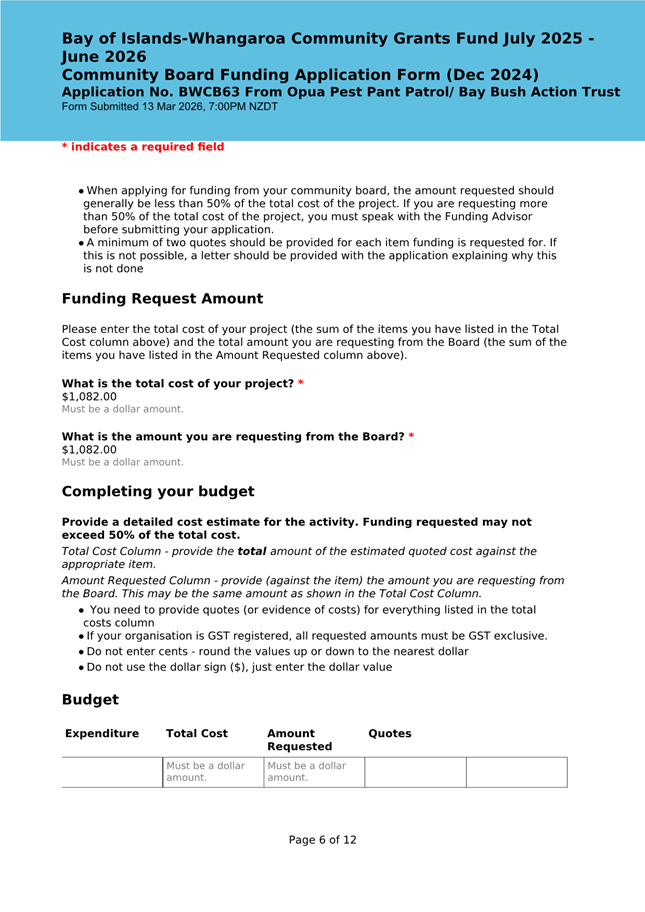
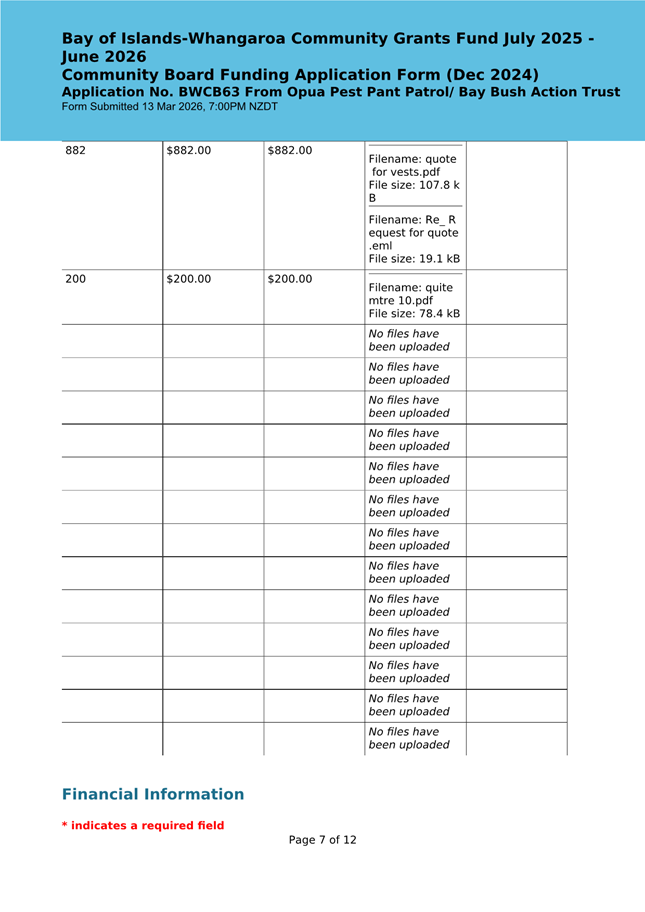
approve the sum of $1,082 (plus GST if
applicable) be paid from the Board’s Community Grant Fund account to Opua
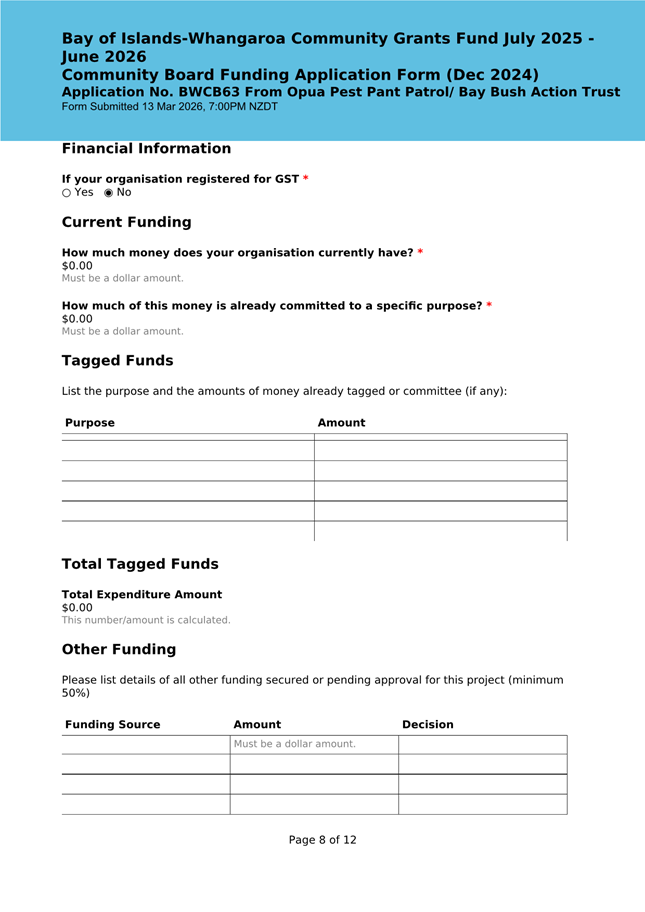
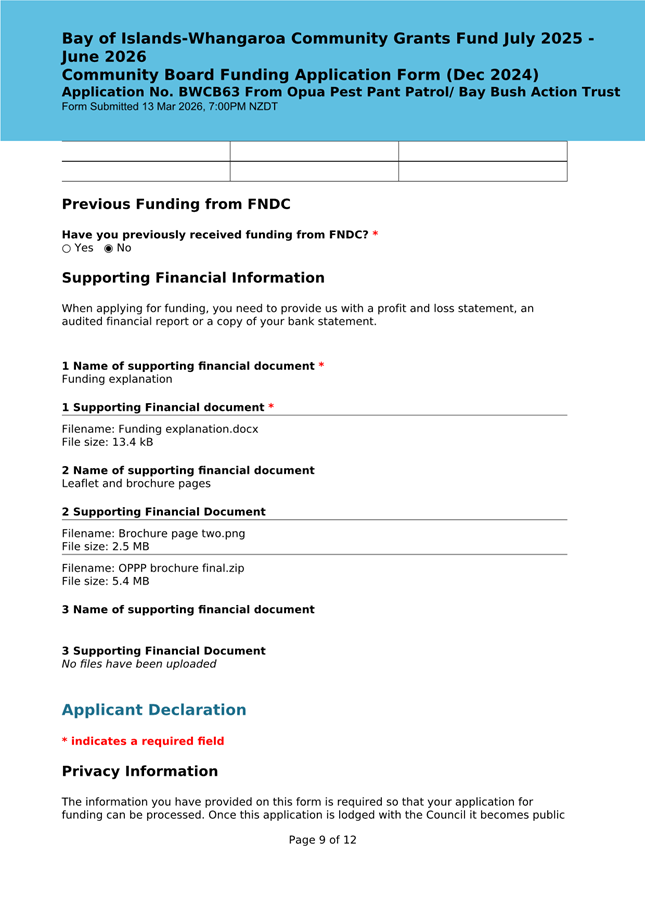
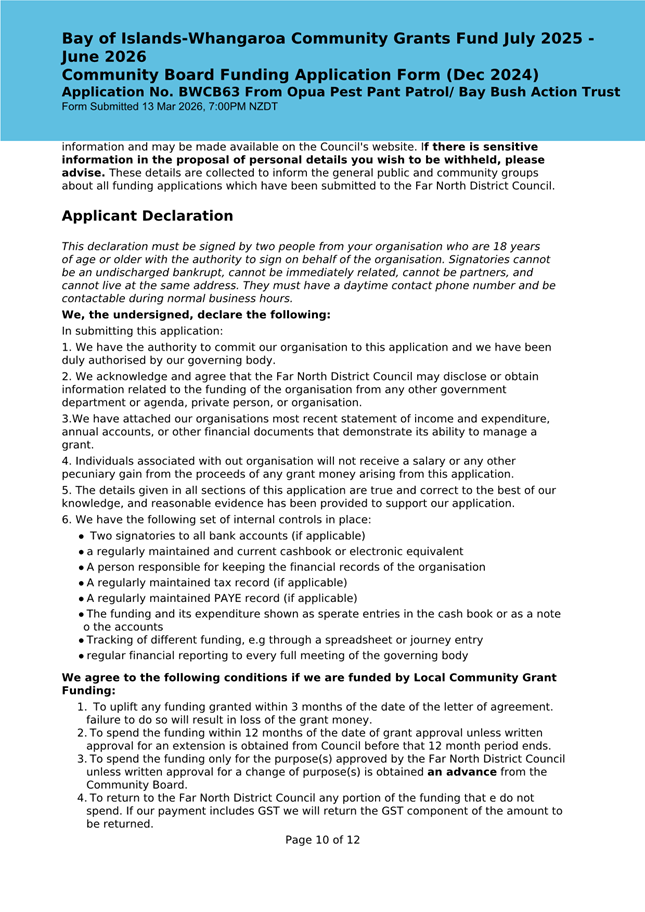
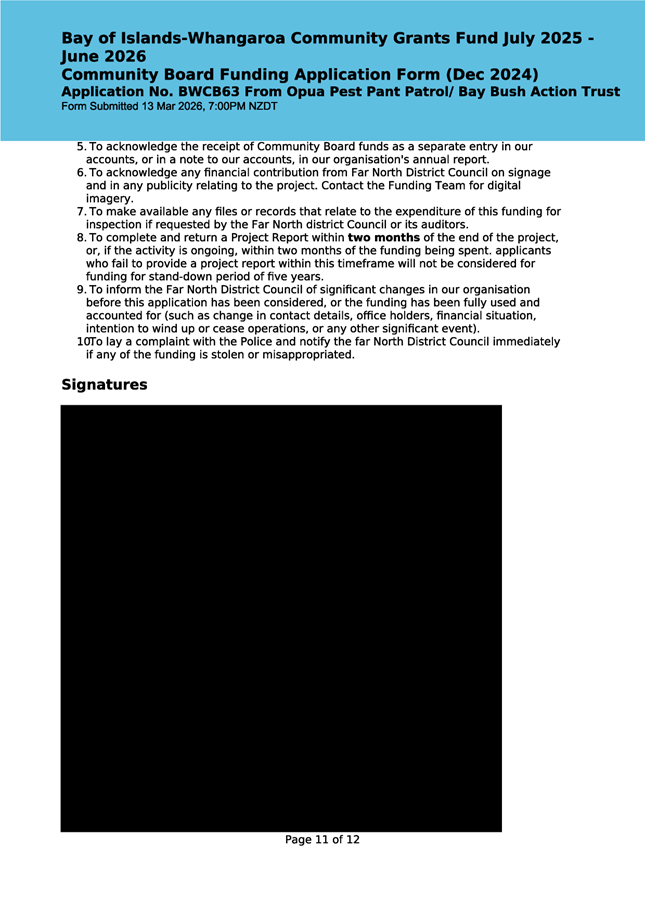
Pest Plant Patrol for costs towards vests and brochure printing.
|
|
TŪTOHUNGA / RECOMMENDATION
That the Bay of Islands-Whangaroa Community Board
approve the sum of $3,096 (plus GST if
applicable) be paid from the Board’s Community Grant fund account Bay
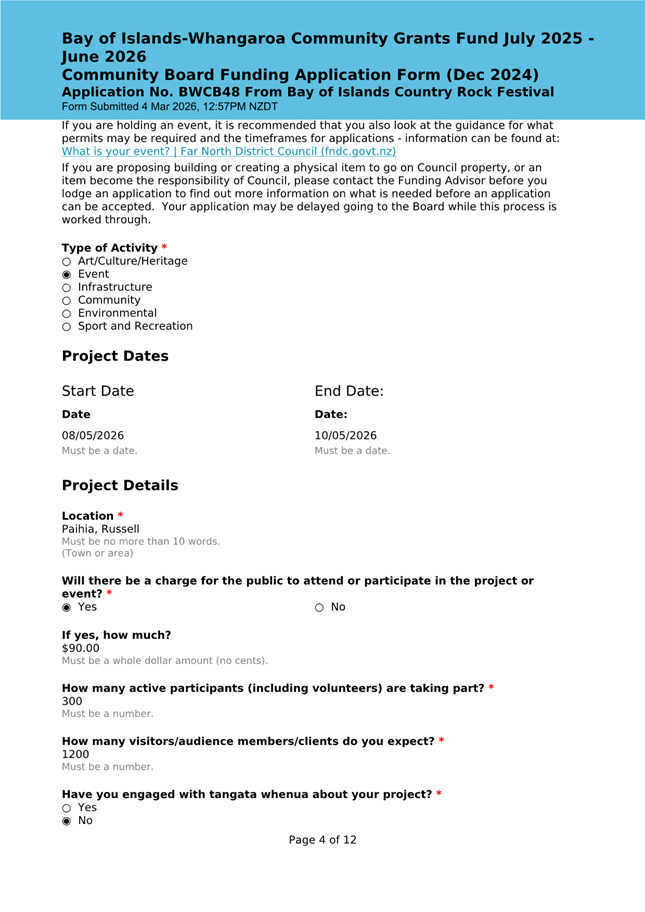
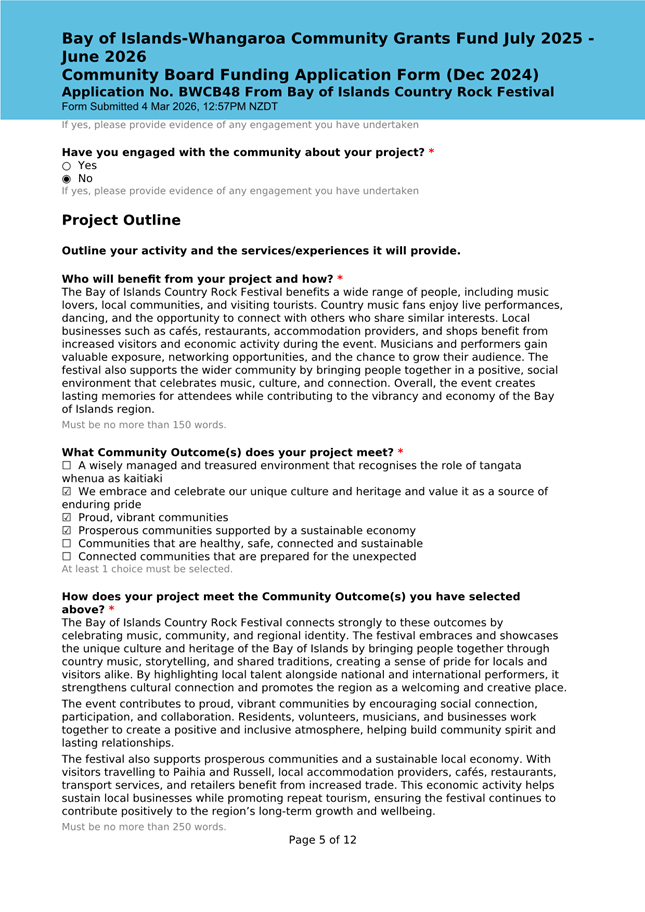
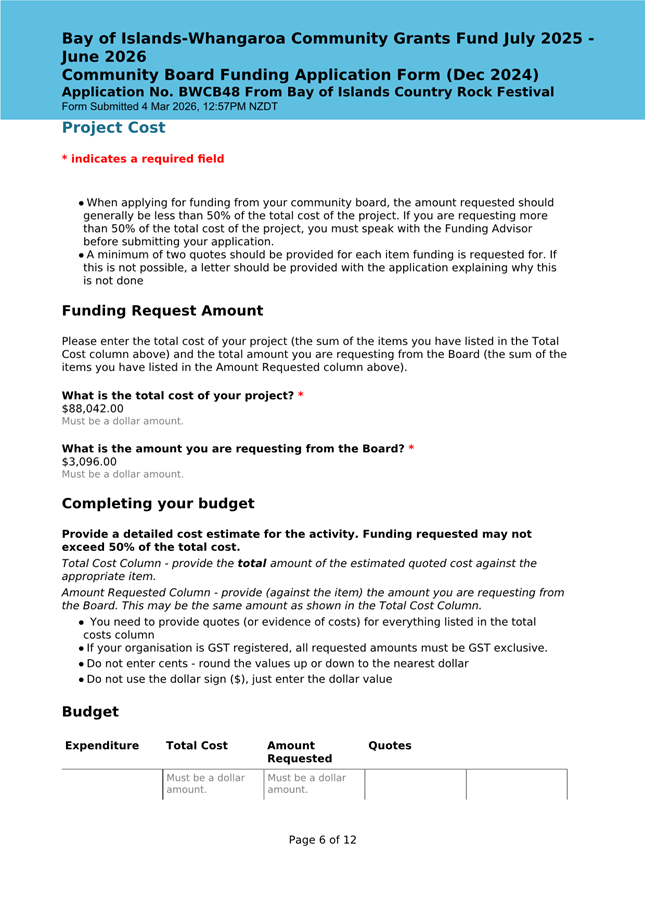
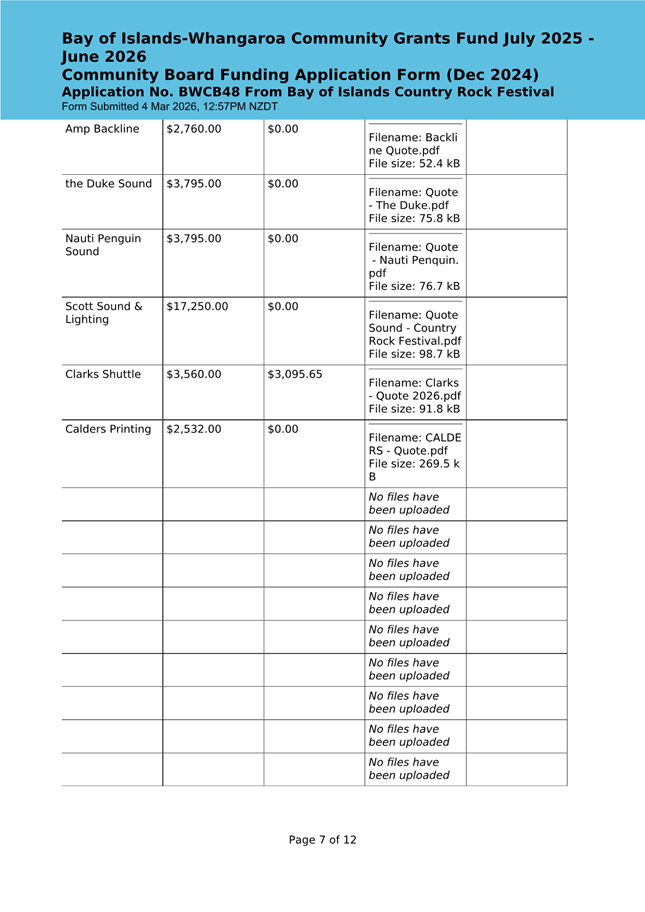
of Islands Country Rock Festival for costs towards 2026 festival.
|
1) TĀhuhu kŌrero / Background
Each application has been checked by staff for completeness
and complies with the conditions of the Community Grant Policy, Community
Outcomes as stated in the Long-Term Plan and all provisions listed on the
application form.
Each application must meet at least one community outcome
from the Council’s Long-Term Plan. The six community outcomes are
as follows:
1. A
wisely managed and treasured environment that recognises the role of tangata
whenua as kaitiaki;
2. We
embrace and celebrate our unique culture and heritage and value it as a source
of enduring pride;
3. Proud,
vibrant communities;
4. Prosperous
Communities supported by a sustainable economy;
5. Communities
that are safe, connected and sustainable;
6. Communities
that are prepared for the unexpected.
2) matapaki me NgĀ KŌwhiringa /
Discussion and Options
|
Applicant
|
Requested
|
Recommend
|
Comments
|
|
Opua Pest Plant Patrol
– Vests and brochure
|
$1,082
|
$1,082
|
The applicant spoke to the Board at their March meeting
and was encouraged to apply by the Board. They are a volunteer group
who have covered costs out of their own pocket up to this time. While
the application seems to be for 100% of the costs, it does not take into
account the volunteer contribution of other costs the organisation is
covering.
This meets community outcomes 1,2,3,5
|
|
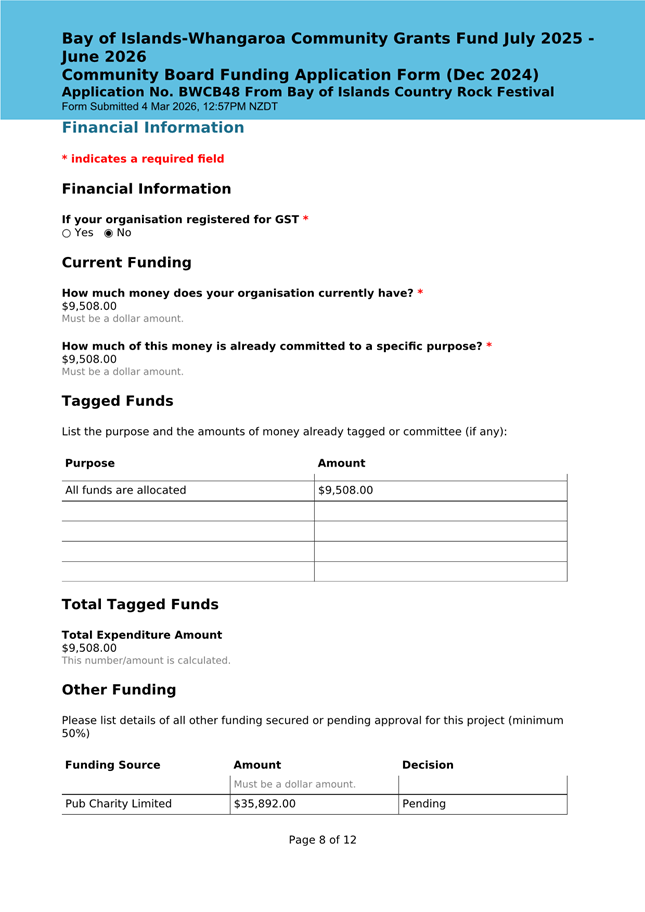
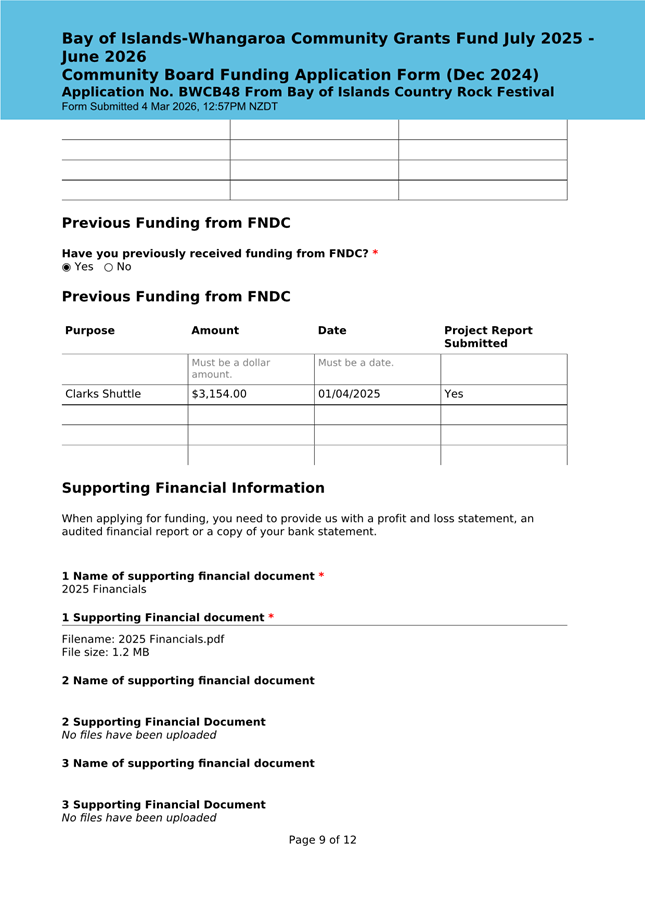
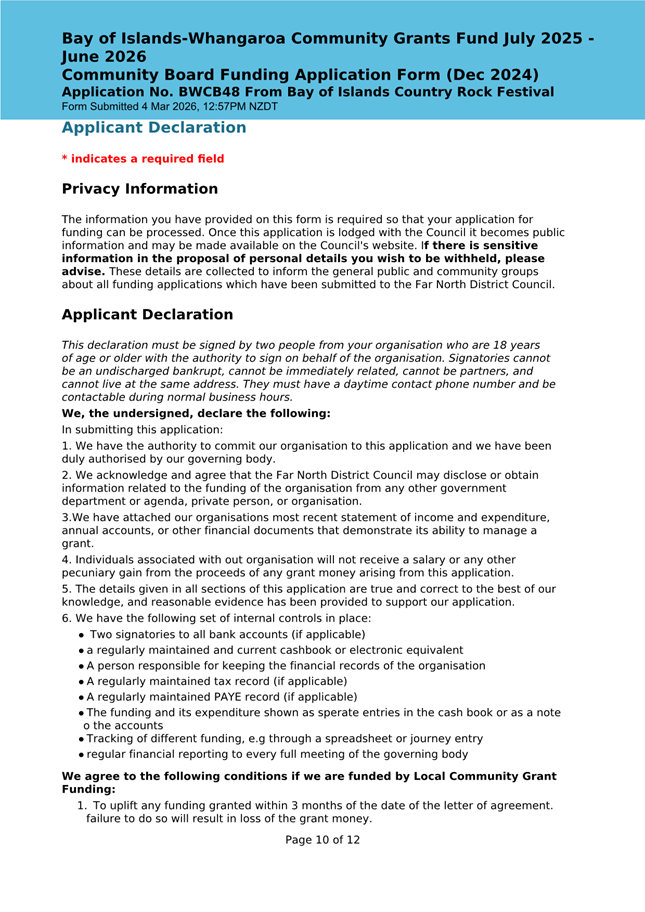
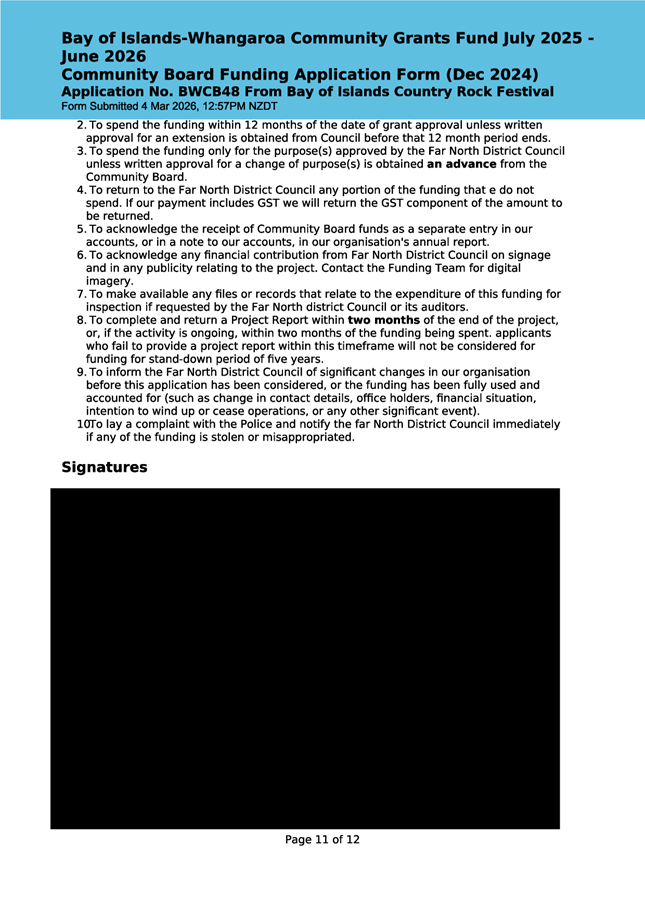
Bay of Islands Country Rock Festival – 2026 Festival
|
$3,096
|
$3,096
|
The applicant is seeking funding towards the costs of the
2026 Country Rock Festival, a regular event in the community calendar.
The Board has granted funding of $2,986 (2021), $5,000 (2022), $5,000 (2023)
and $2,743 (2024).
The event is well attended by guests from outside the
district and supported by the local community.
This meets community outcomes 1,2,3,5
|
Take Tūtohunga / Reason for the
recommendation
The applicants were required to
complete a standard application form and provide supporting information.
For each application, the Board
has three options.
Option One: Authorise
funding for the full amount requested.
Option Two: Authorise
partial funding.
Option Three: Decline
funding the application.
3) PĀnga PŪtea me ngĀ
wĀhanga tahua / Financial Implications and Budgetary Provision
Budgetary provision has been made and the grant is allocated
in accordance with the Community Grant Policy.
Āpitihanga
/ Attachments
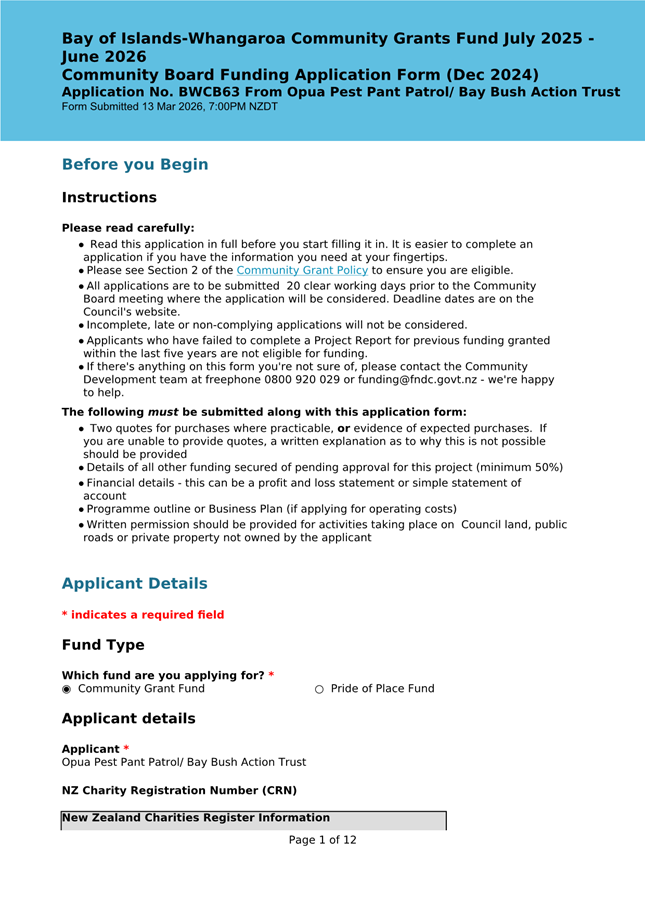
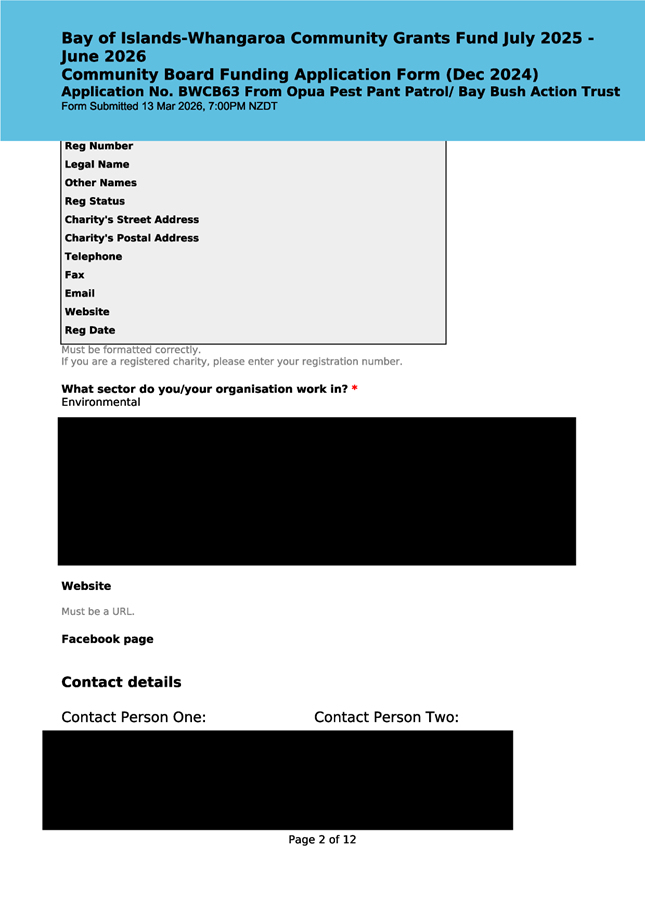
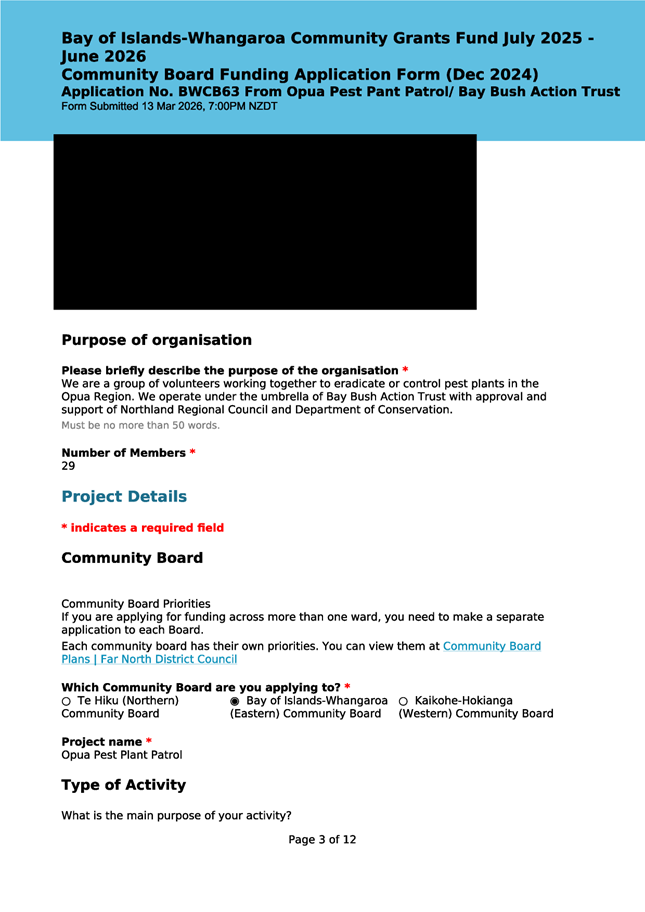
1. Opua
Pest Plant Patrol - A5651160 ⇩
2. Bay
of Islands Country Rock Festival 2026 - A5651161 ⇩
Hōtaka Take Ōkawa / Compliance Schedule:
Full consideration has been given to the provisions of the
Local Government Act 2002 S77 in relation to decision making, in particular:
1. A
Local authority must, in the course of the decision-making process,
a) Seek
to identify all reasonably practicable options for the achievement of the
objective of a decision; and
b) Assess
the options in terms of their advantages and disadvantages; and
c) If
any of the options identified under paragraph (a) involves a significant
decision in relation to land or a body of water, take into account the
relationship of Māori and their culture and traditions with their
ancestral land, water sites, waahi tapu, valued flora and fauna and other
taonga.
2. This
section is subject to Section 79 - Compliance with procedures in relation to
decisions.
|
He Take Ōkawa /
Compliance Requirement
|
Aromatawai Kaimahi /
Staff Assessment
|
|
State the level of significance (high or low) of the
issue or proposal as determined by the Council’s
Significance and Engagement Policy
|
This is a matter of low significance.
|
|
State the relevant Council policies (external or
internal), legislation, and/or community outcomes (as stated in the LTP) that
relate to this decision.
|
Applications received are assessed against the Community
Grants Policy and Te Pae o Uta.
|
|
State whether this issue or proposal has a District wide
relevance and, if not, the ways in which the appropriate Community
Board’s views have been sought.
|
This report does not have district wide relevance.
|
|
State the
possible implications for Māori and how Māori have been provided
with an opportunity to contribute to decision making if this decision is
significant and relates to land and/or any body of water.
State the
possible implications and how this report aligns with Te Tiriti o Waitangi /
The Treaty of Waitangi.
|
There are no implications for Māori in relation to
the applications received in relation to whenua and/or wai.
|
|
Identify persons likely to be affected by or have an
interest in the matter, and how you have given consideration to their views
or preferences (for example – youth, the aged and those with
disabilities).
|
Considered in the application.
|
|
State the financial implications and where budgetary
provisions have been made to support this decision.
|
Budgetary provision has been made, and the grant is
allocated in accordance with the Community Grant Policy.
|
|
Chief Financial Officer review.
|
The Chief Financial Officer has not reviewed this
report.
|
|
Bay of Islands-Whangaroa Community Board Meeting Agenda
|
9 April 2026
|

|
Bay of Islands-Whangaroa Community Board Meeting Agenda
|
9 April 2026
|
|
Bay of Islands-Whangaroa Community Board Meeting Agenda
|
9 April 2026
|
7.5 Chairperson
and Members Reports
File
Number: A5634931
Author: Stephen
FitzHerbert, Community Board Co-Ordinator
Authoriser: Aisha
Huriwai, Manager - Democracy Services
TE TAKE PŪRONGO / Purpose of the Report
The report provides feedback to the community on matters of
interest or concern to the Community Board.
|
NGĀ
TŪTOHUNGA / Recommendation
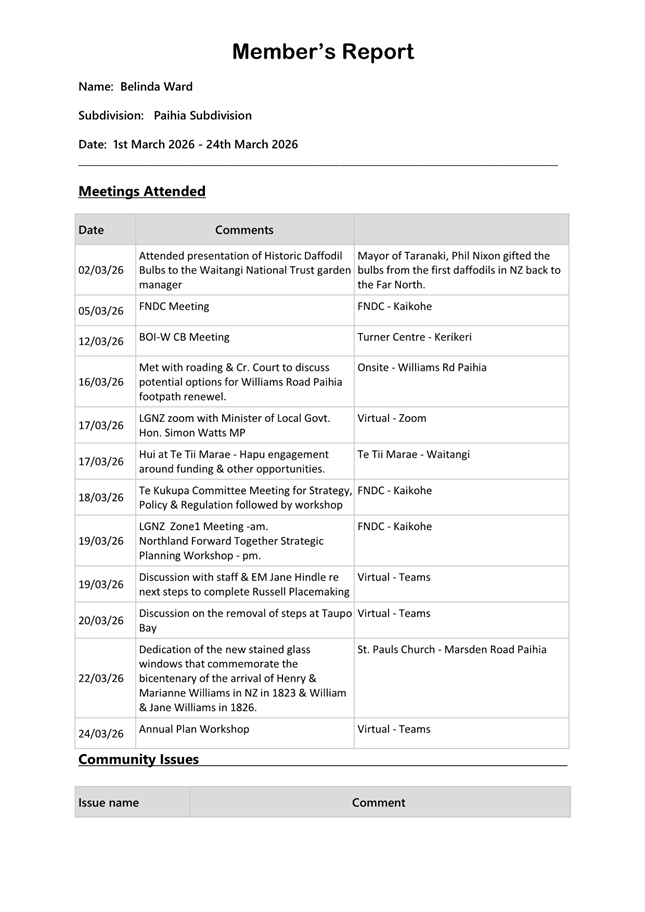
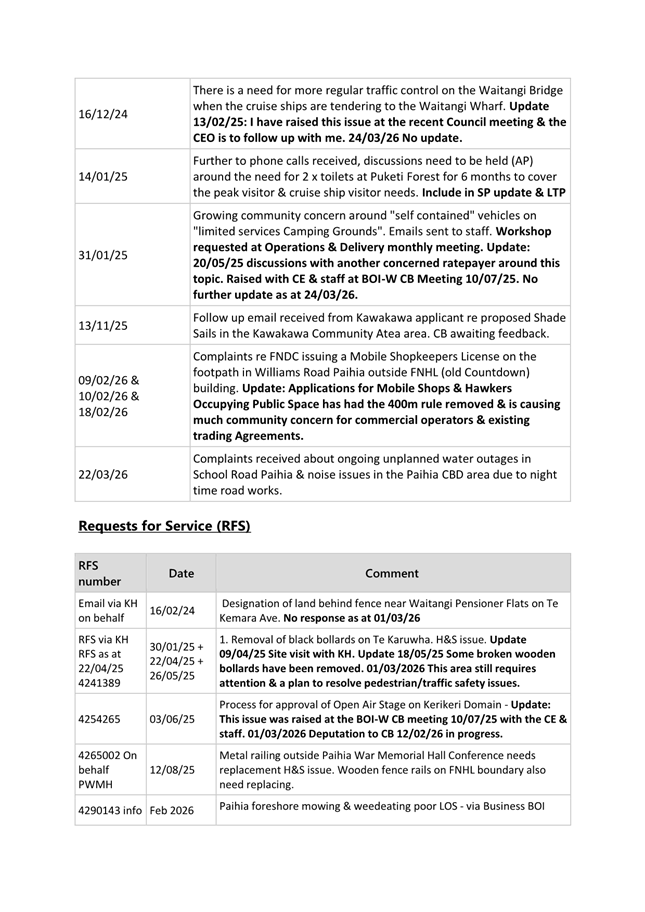
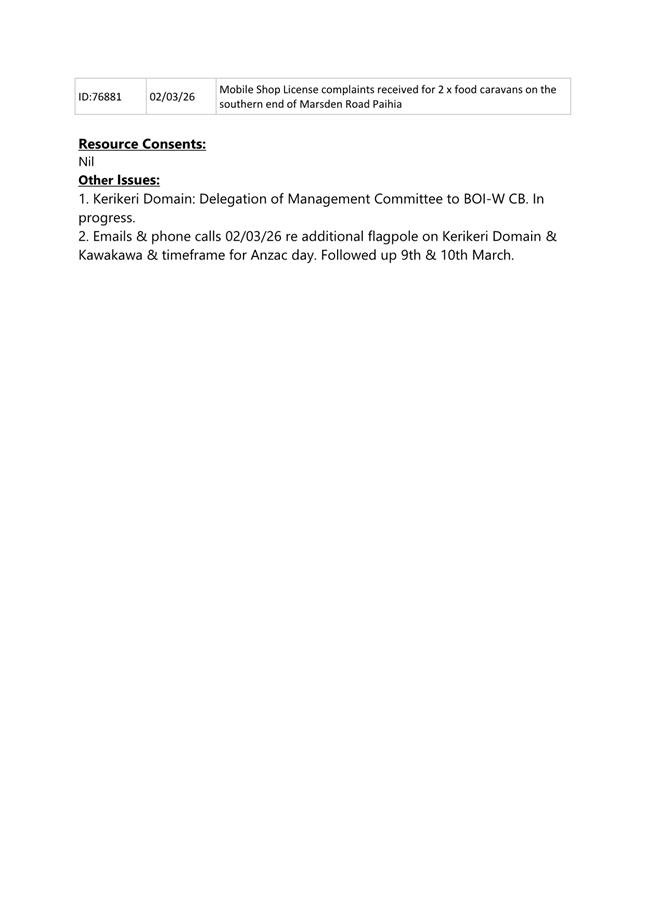
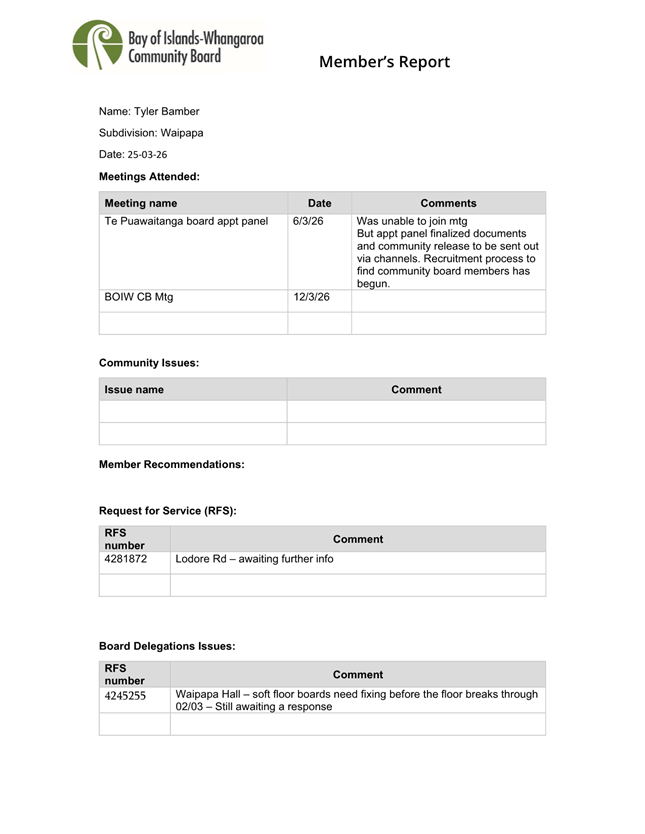
That the Bay of Islands-Whangaroa Community Board note
the March 2026 member reports from Chair Belinda Ward, Deputy Chair Tyler
Bamber, Member Jo Alexander, Member Dane Hawker and Member Jane Hindle.
|
TE tĀHUHU KŌRERO / Background
The Local Government Act 2002 Part
4 Section 52 states that the role of a Community Board is to represent, and act
as an advocate for the interests of its community.
TE MATAPAKI ME NGĀ KŌWHIRINGA /
Discussion and Next Steps
Community Boards are required to
consider and report on any matters of concern or interest to the Community
Board, maintain an overview of services provided to the community and
communicate with community organisations and special interest groups within the
community.
The reports from the Chairperson
and Members provide information to community on these requirements. They
also provide Request for Service (RFS) information on issues of interest or
concern to the Community Board, providing a reference for further enquiry on
the progress of the matters raised. The report from the Chairperson and members
are attached.
Resource Consents have been emailed
to community board members. Members have five days to send feedback in relation
to a resource consent. Members will be expected to include these details in
their member reports going forward.
REASON FOR THE RECOMMENDATION
The reason for the recommendation
is to provide information to the Community on the work that has been undertaken
by the Chairperson and Members on its behalf.
NGĀ PĀNGA PŪTEA ME NGĀ WĀHANGA
TAHUA / Financial Implications and Budgetary Provision
There are no financial implications
or the need for budgetary provision as a result of this report.
ngĀ
Āpitihanga / Attachments
1. Chair
Report Belinda Ward - A5650008 ⇩
2. Member
Report Tyler Bamber - A5659232 ⇩
3. Member
Report Jo Alexander - A5659236 ⇩
4. Member
Report Dane Hawker - A5659235 ⇩
5. Member
Report Jane Hindle - A5659234 ⇩
|
Bay of Islands-Whangaroa Community Board Meeting Agenda
|
9 April 2026
|
|
Bay of Islands-Whangaroa Community Board Meeting Agenda
|
9 April 2026
|

|
Bay of Islands-Whangaroa Community Board Meeting Agenda
|
9 April 2026
|

|
Bay of Islands-Whangaroa Community Board Meeting Agenda
|
9 April 2026
|
|
Bay of Islands-Whangaroa Community Board Meeting Agenda
|
9 April 2026
|
|
Bay of Islands-Whangaroa
Community Board Meeting
Agenda
|
9 April 2026
|
8 Ngā
Pūrongo Taipitopito / Information Reports
8.1 Alfresco
dining applications
File
Number: A5637940
Author: Shenae
Barker, Team Leader - Monitoring
Authoriser: Hilary
Sumpter, Group Manager - Delivery and Operations
Take Pūrongo / Purpose of the Report
To seek approval for twelve (12) alfresco dining
applications on Council-controlled land, comprising twelve (12) renewal
applications (including two renewals with change of ownership).
WhakarĀpopoto matua / Executive Summary
•
Eleven alfresco dining applications have been received.
• Eleven applications are renewals of existing permits, including two
with change of ownership.
• The renewal applications relate to established outdoor dining areas
that have previously been approved and are operating in accordance with permit
conditions.
• All applications meet Council requirements and are recommended for
approval subject to standard conditions.
|
tŪtohunga
/ Recommendation
That the Bay of
Island-Whangaroa Community Board:
a) uplift
the following Alfresco Dining Applications; and
b) approve
the following alfresco dining applications, subject to Council’s
standard terms and conditions:
i) Renewal applications:
1. ALF-103 – Rocksalt Bar
and Restaurant, Corner Kerikeri Road and Cobham Road, Kerikeri
2. ALF-102 – Spice Grill,
20 Leigh Street, Kaeo
3. ALF-96 – Burger Fiasko,
60 Kerikeri Road, Kerikeri (Renewal – Change of Ownership)
4. ALF-93 – Seaside
Restaurant, 29 The Strand, Russell
5. ALF-65 – Kerikeri
Lunchbox, 69 Kerikeri Road, Kerikeri
6. ALF-50 – Sushi Gallery,
2G/60 Kerikeri Road, Kerikeri
7. ALFRES-7 – The Wave
Kitchen and Bar, 78 Marsden Road, Paihia
8. ALFRES-5 – Butterfish
Restaurant, 25 The Strand, Russell
9. ALFRES-4 – Cellini's
Gelateria Icecream Ltd, 9/68 Marsden Road, Paihia
10. ALFRES-2 – Paihia Bakery, 39
Williams Road, Paihia
11. ALFRES-1 – Third Wheel Coffee Co,
78-94 Marsden Road, Paihia (Renewal – Change of Ownership)
|
1) TĀhuhu
kŌrero / Background
Council
regulates alfresco dining activities located on legal road and
Council-controlled land to ensure pedestrian safety, accessibility, and
appropriate use of public space.
Permit
holders are required to renew approvals periodically to ensure continued
compliance with Council standards and regulatory requirements.
This report
addresses Eleven
applications across Paihia, Kerikeri, Russell, Kawakawa, and Kaeo. Total tables
40, 1-6 per site.
Eleven applications are renewals of
existing approved dining areas. Two of these renewals involve a change of
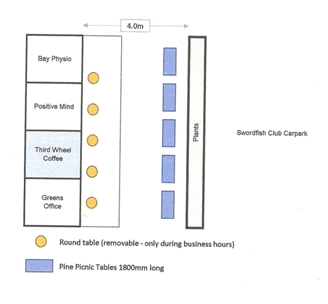
ownership (Burger Fiasko and Third Wheel Coffee Co).
Rocksalt Bar and Restaurant (ALF-103)
· Location: 1 Cobham Road
· Tables: 6
Assessment:
Largest allocation in Kerikeri. Located in a busy commercial area.
Risk Level: Moderate (pedestrian flow)
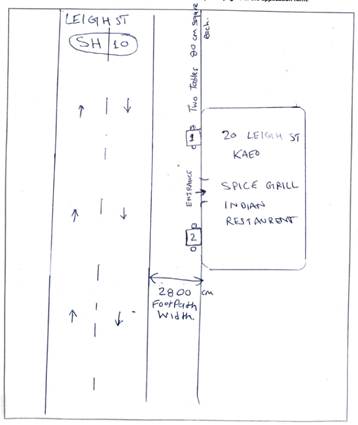
Spice Grill (ALF-102)
· Location: 20 Leigh Street
· Tables: 2
Assessment:
Low-density rural setting.
Risk Level: Very Low
Burger Fiasko (ALF-96)
· Location: 60 Kerikeri Road
· Tables: 1
Assessment:
Minimal footprint.
Risk Level: Very Low
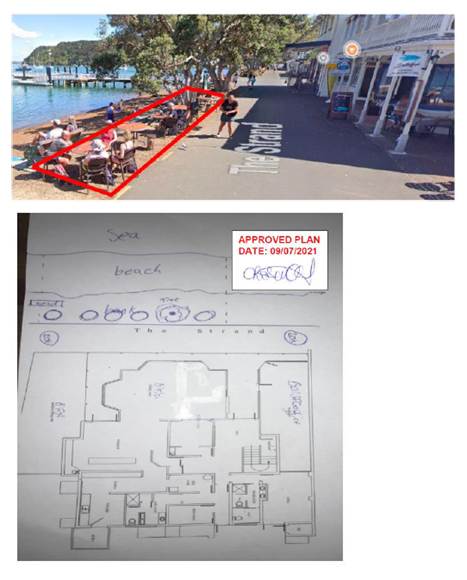
Seaside Restaurant (ALF-93)
· Location: 29 The Strand
· Tables: 5
Assessment:
Waterfront location with high pedestrian and visual sensitivity.
Risk Level: Moderate
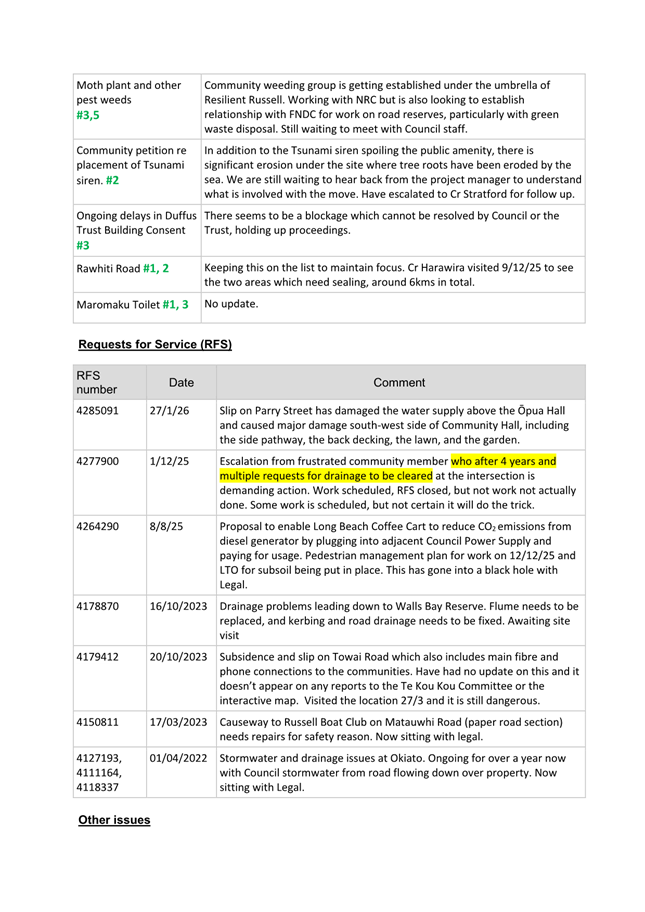
Kerikeri Lunchbox (ALF-65)
· Location: 69 Kerikeri Road
· Tables: 3
Assessment:
Typical café-scale outdoor seating.
Risk Level: Low
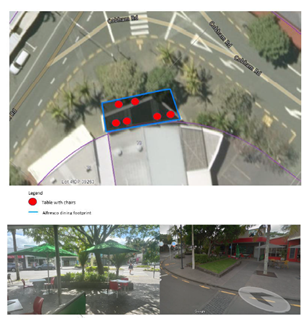
Sushi Gallery (ALF-50)
· Location: 2G/60 Kerikeri Road
· Tables: 4
Assessment:
Moderate scale within retail frontage.
Risk Level: Low–Moderate
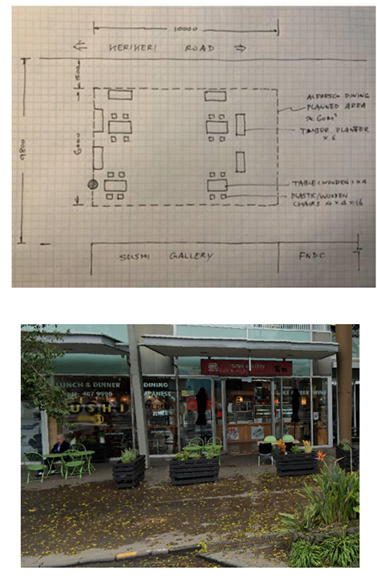
The Wave Kitchen and Bar (ALFRES-7)
· Location: 78 Marsden Road
· Tables: 4
Assessment:
Tourism-focused hospitality site.
Risk Level: Moderate
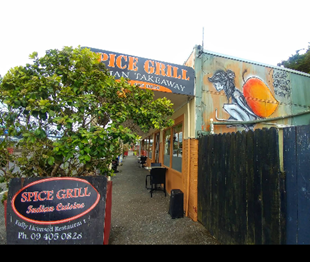
Butterfish Restaurant (ALFRES-5)
· Location: 25 The Strand
· Tables: 5
Assessment:
Similar waterfront context; high amenity value.
Risk Level: Moderate
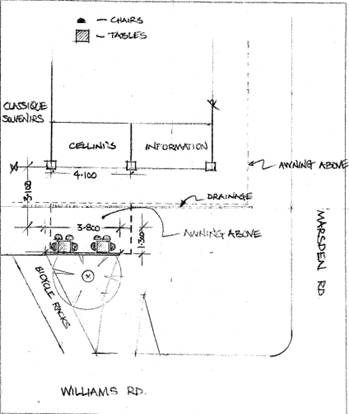
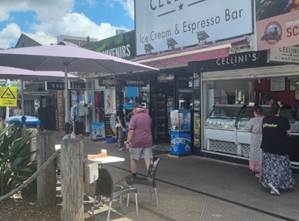
Cellini’s Gelateria (ALFRES-4)
· Location: 9/68 Marsden Road
· Tables: 2
Assessment:
Small-scale, low-impact.
Risk Level: Low
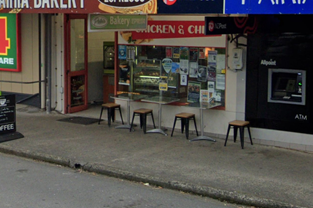
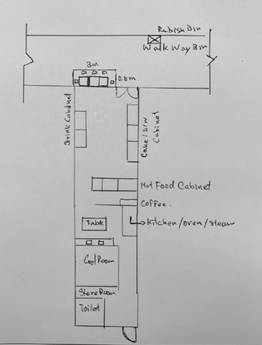
Paihia Bakery Espresso (ALFRES-2)
· Location: 39 Williams Road
· Tables: 3
Assessment:
Daytime café, moderate foot traffic.
Risk Level: Low
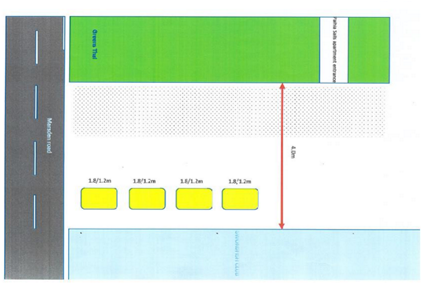
Third Wheel Coffee (ALFRES-1)
· Location: 78–94 Marsden Road
· Tables: 5
Assessment:
Higher seating density in busy tourism area.
Risk Level: Moderate
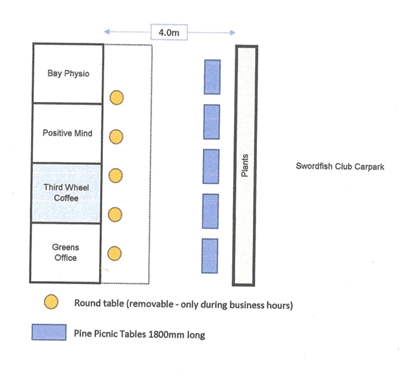
Approval
Conditions
Annual
inspection is required.
The
approval and approved plan must be displayed at all times during trading.
Trading is
limited to the area designated on the approved plan. The Licensee is required
to remove all items used for alfresco dining by 10.00pm each day, unless
otherwise specified in writing.
2) matapaki me NgĀ KŌwhiringa /
Discussion and Options
The renewal applications have been assessed against:
· Compliance
history
· Pedestrian
clearway requirements
· Public
safety and visibility
· Accessibility
standards
· Suitability
of location
All renewal applicants are currently operating in accordance
with their permit conditions. No significant complaints or enforcement issues
have been identified.
Where ownership has changed, the new operators have accepted
responsibility for complying with existing permit conditions.
TAKE TŪTOHUNGA
/ REASON FOR THE RECOMMENDATION
The applications comply with Council’s
regulatory and operational requirements. Renewal applicants have demonstrated
satisfactory compliance history.3) PĀnga PŪtea me ngĀ
wĀhanga tahua / Financial Implications and Budgetary Provision
Application and permit fees are charged in accordance with
Council’s Fees and Charges Schedule.
There are no unbudgeted financial implications. Monitoring
and administration are accommodated within existing operational budgets.
Āpitihanga
/ Attachments
Nil
|
Bay of Islands-Whangaroa Community Board Meeting Agenda
|
9 April 2026
|
8.2 Bay of
Islands-Whangaroa Community Board Open Resolution Report
File
Number: A5634933
Author: Imrie
Dunn, Democracy Advisor
Authoriser: Aisha
Huriwai, Manager - Democracy Services
TAKE
PŪRONGO / Purpose of the Report
To
provide the Bay of Islands-Whangaroa Community Board with an overview of
outstanding open resolutions arising from meetings.
WHAKARĀPOPOTO
MATUA / Executive SummarY
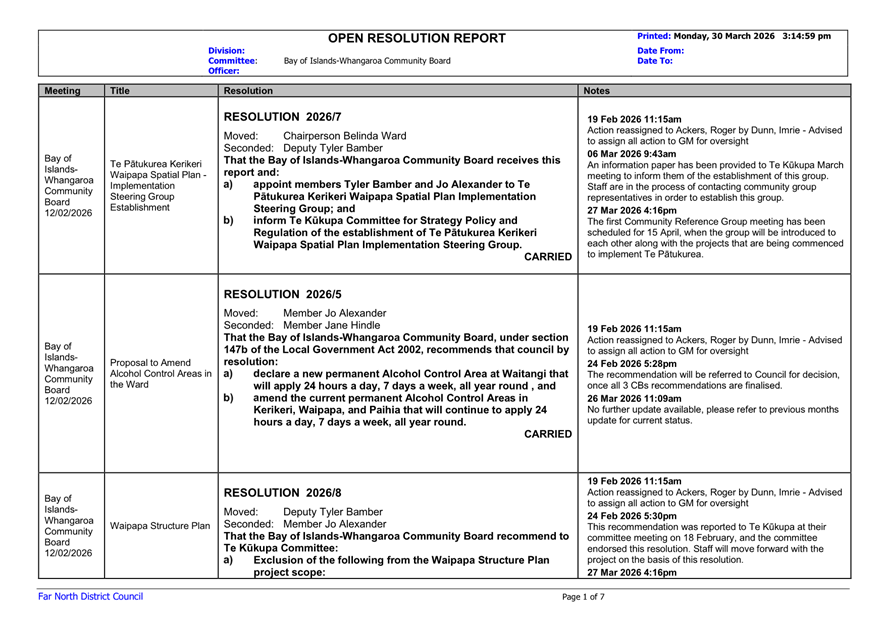
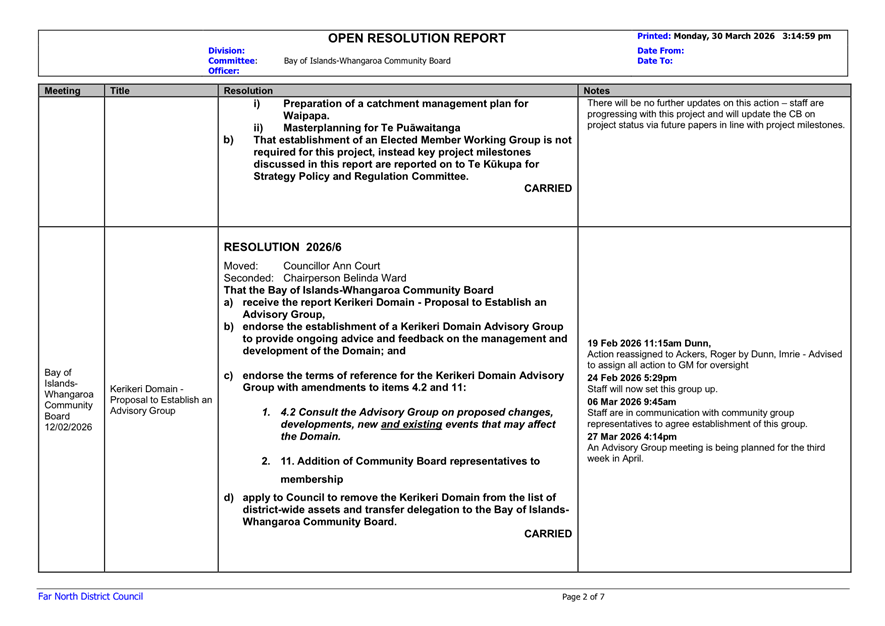
Open resolutions are a mechanism to communicate progress against
decisions/resolutions.
|
TŪTOHUNGA
/ Recommendation
That the Bay of Islands-Whangaroa Community Board
receive the Bay of Islands-Whangaroa Community Board Open Resolution Report.
|
tĀHUHU
KŌRERO / Background
Open resolution reports
provide regular updates on progress against decisions made at meetings.
Open resolution reports
have been designed as a way to close the loop and communicate with elected
members on the decisions made by way of resolution at formal meetings.
MATAPAKI ME NGĀ
KŌWHIRINGA / Discussion and Next Steps
Group Managers will assist in recording and following up
outstanding open resolutions and action points with staff where appropriate,
and occasionally, may be in a position to provide a further verbal update at
meetings following the printing of an agenda. Democracy Services staff will
support the process by generating reports.
The outstanding tasks are often multi-facet projects that
take longer to fully complete.
PĀNGA PŪTEA
ME NGĀ WĀHANGA TAHUA / Financial Implications and Budgetary Provision
There are no financial
implications or need for budgetary provision in receiving this report.
Āpitihanga / Attachments
1. Open
Resolution Report - A5658380 ⇩
|
Bay of Islands-Whangaroa Community Board Meeting Agenda
|
9 April 2026
|