AGENDA
Ordinary Te Kūkupa Committee for Strategy, Policy
and Regulation Meeting
Wednesday, 18 March 2026
|
Time:
|
10:00 am
|
|
Location:
|
Council Chamber
Memorial Ave
Kaikohe
|
Membership:
Cr Kelly Stratford - Chairperson
Cr Ann Court – Deputy
Chairperson
Cr Rachel Baucke
Cr Felicity Foy
Cr Hilda Halkyard-Harawira
Cr Davina Smolders
(Ex-officio Member) Kahika - Mayor
Moko Tepania
|
|
Authorising Body
|
Mayor/Council
|
|
Status
|
Standing Committee
|
|
COUNCIL COMMITTEE
|
Title
|
Te Kūkupa Committee for Strategy, Policy and
Regulation
|
|
Terms of Reference Adoption
|
11 December 2025
|
|
Responsible Officer
|
General Manager Planning and
Policy
|
Kaupapa / Purpose
Te Kūkupa –
Strategy, Policy and Regulation Committee is established to provide governance
oversight, leadership, and direction on the development, review, and monitoring
of the Far North District Council’s strategies, policies, bylaws, and
regulatory frameworks. The Committee ensures that Council’s strategic
objectives are advanced through robust policy development and effective
regulatory practice.
Ngā Huānga / Membership
The Council will determine the
membership of the Committee.
Te Kūkupa Committee for
Strategy, Policy and Regulation will comprise of at least six elected members
(one of which will be the chairperson).
Kahika
/ Mayor Moko Tepania is an ex-officio member of all Committees.
Membership is as follows:
|
Cr Kelly
Stratford - Chairperson
|
|
Cr Ann
Court - Deputy Chairperson
|
|
Cr Felicity
Foy
|
|
Cr Davina
Smolders
|
|
Cr
Hilda Halkyard Harawira
|
|
Cr
Rachel Baucke
|
Kōrama
/ Quorum
The
quorum at a meeting of Te Kūkupa Committee for Strategy, Policy and
Regulation is 4 members.
Ngā Hui / Frequency of
Meetings
The
Committee shall meet 4 weekly.
Ngā Apatono / Power to
Delegate
The responsibilities, duties and
powers of the Committee are subject to the prohibition on delegation of powers
under Clause 32(1), Schedule 7, Local Government Act 2002, and any other
restrictions on delegation under any other relevant legislation.
Te Kūkupa
Committee for Strategy Policy and Regulation
may not delegate any of its responsibilities,
duties or powers however it may establish working
groups to consider issues within the committee’s areas of
responsibilities noting that working groups have no decision-making powers.
Ngā Herenga Paetae /
Responsibilities
The Committee’s responsibilities include, but are not
limited to:
·
Leading the development, review, and recommendation of Council
strategies, policies, and bylaws.
·
Overseeing the preparation and review of the Long Term Plan,
Annual Plan, and associated consultation processes.
·
Monitoring the implementation and effectiveness of adopted
strategies and policies.
·
Provide Governance level insight on Council’s approach to
regulatory matters - having regard to the separation of regulatory and
non-regulatory decision-making functions as between the Chief Executive and
Governance (section 42(3)(a) LGA02).
·
Have input into submissions on central government policy,
legislation, and regulatory proposals relevant to Council’s functions.
·
Considering and recommending to Council on matters relating to:
-
District Plan and Resource Management Act functions,
-
Environmental policy and planning,
-
Economic development strategies,
-
Social and community wellbeing policies,
-
Climate change adaptation and mitigation policy,
-
Regulatory fees and charges,
-
Other strategic or regulatory matters as delegated by Council.
The Committee has delegated authority to:
·
Approve for consultation draft strategies, policies, and bylaws.
·
Hear and consider submissions, including oral submissions on
strategies, policies, and bylaws, and recommend adoption to Council.
·
Have Governance level oversight of regulatory and policy matters
as specifically delegated by Council - subject to
Clause 32(1), Schedule 7, Local Government Act 2002 and section 43(3)(a) of the
LGA02.
·
Request reports and briefings from staff on matters within its
scope.
The Committee does NOT have the authority to:
·
Adopt final strategies, policies, or bylaws (unless specifically
delegated by Council).
·
Make decisions that are the responsibility of the full Council or
another committee.
Ngā
Ture / Rules and Procedures
Council’s Standing Orders and Elected Member Code of
Conduct apply to all meetings.
Reporting
and Review of Committee Terms of Reference
In December of each year, the Responsible Officer alongside
Democracy Services will submit a report to Council. The report will summarise
the activities of the Committee and how it has contributed to the
Council’s governance and strategic objectives. This will look at whether
the Council are meeting the full requirements of the Committee Terms of
Reference and whether any amendments are required to the Committees terms of
reference to increase efficient and effective decision making.
The
terms of reference of the Committee will be reviewed as part of this report but
can be amended by Council at any point throughout the term.
1 Karakia
Tīmatanga / Opening Prayer
2 Ngā Whakapāha Me Ngā Pānga Mema / Apologies
and Declarations of Interest
Members need to
stand aside from decision-making when a conflict arises between their role as a
Member of the Committee and any private or other external interest they might
have. This note is provided as a reminder to Members to review the matters on
the agenda and assess and identify where they may have a pecuniary or other
conflict of interest, or where there may be a perception of a conflict of
interest.
If a Member
feels they do have a conflict of interest, they should publicly declare that at
the start of the meeting or of the relevant item of business and refrain from
participating in the discussion or voting on that item. If a Member thinks they
may have a conflict of interest, they can seek advice from the Chief Executive
Officer or the Manager - Democracy Services (preferably before the meeting).
It is noted
that while members can seek advice the final decision as to whether a conflict
exists rests with the member.
3 Ngā
Tono Kōrero / Deputation
No requests for deputations were received at the time of the
Agenda going to print.
|
Ordinary
Te Kūkupa Committee for Strategy, Policy and Regulation Meeting
Agenda
|
18
March 2026
|
4 Te
Whakaaetanga o Ngā Meneti o Mua / Confirmation of Previous Minutes
4.1 Confirmation
of Previous Minutes
File
Number: A5602822
Author: Imrie
Dunn, Democracy Advisor
Authoriser: Aisha
Huriwai, Manager - Democracy Services
Take Pūrongo / Purpose of the Report
The minutes are attached to allow the Committee to confirm
that the minutes are a true and correct record of previous meetings.
|
tŪtohunga
/ Recommendation
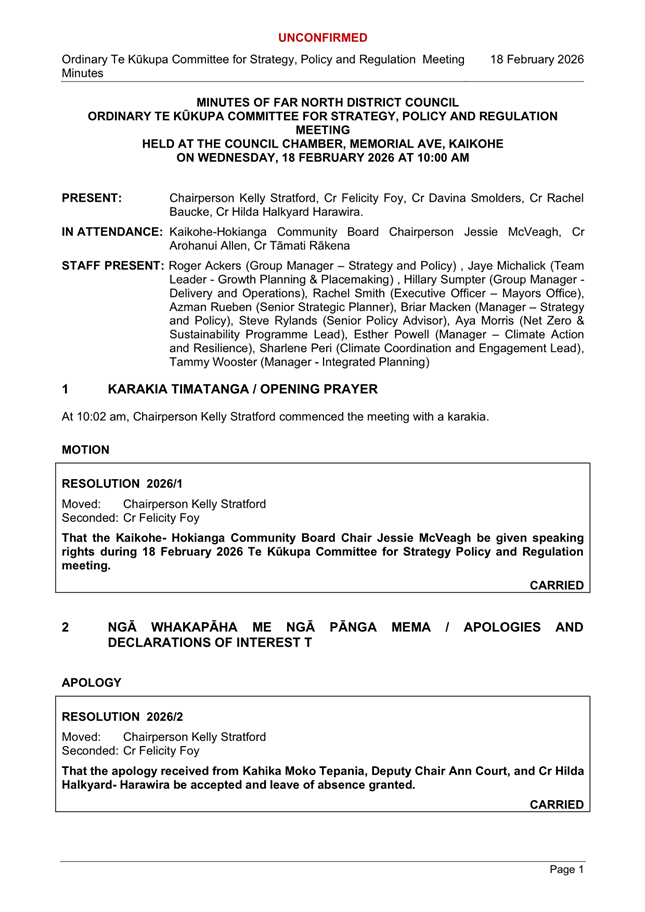
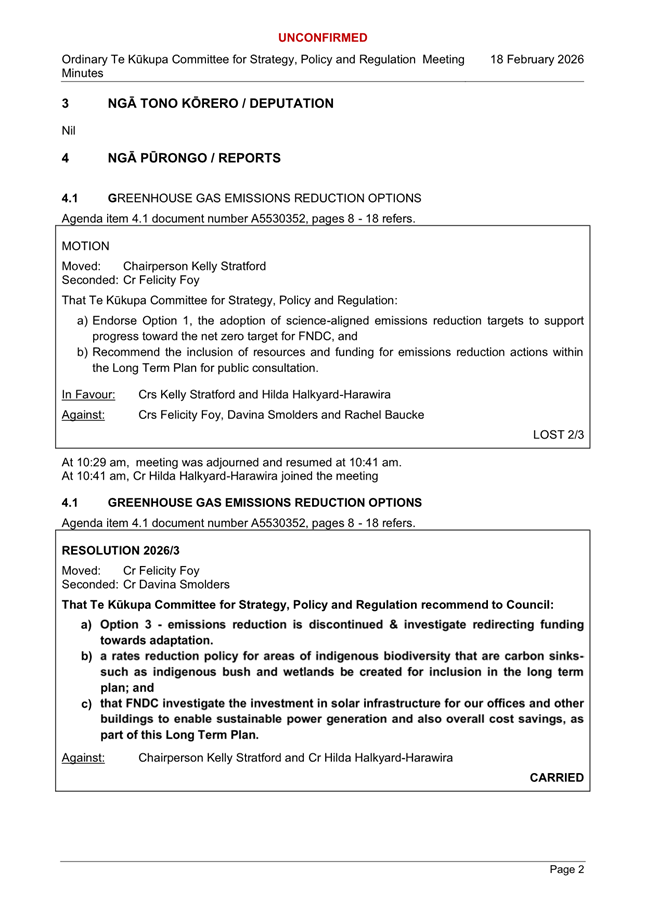
That Te Kūkupa Committee for Strategy, Policy and
Regulation confirm the minutes of the meeting held 18 February 2026 are true
and correct.
|
1) TĀhuhu kŌrero / Background
Local Government Act 2002 Schedule 7 Section 28 states that
a local authority must keep minutes of its proceedings. The minutes of these
proceedings duly entered and authenticated as prescribed by a local authority
are prima facie evidence of those meetings.
2) matapaki me NgĀ KŌwhiringa /
Discussion and Options
The minutes of the meetings are attached.
Far North District Council Standing Orders Section 27.3
states that no discussion shall arise on the substance of the minutes in any
succeeding meeting, except as to their correctness.
TAKE TŪTOHUNGA
/ REASON FOR THE RECOMMENDATION
The reason for the recommendation is to confirm the minutes
are a true and correct record of the previous meetings.
3) PĀnga PŪtea me ngĀ
wĀhanga tahua / Financial Implications and Budgetary Provision
There are no financial implications or the need for
budgetary provision as a result of this report.
Attachments
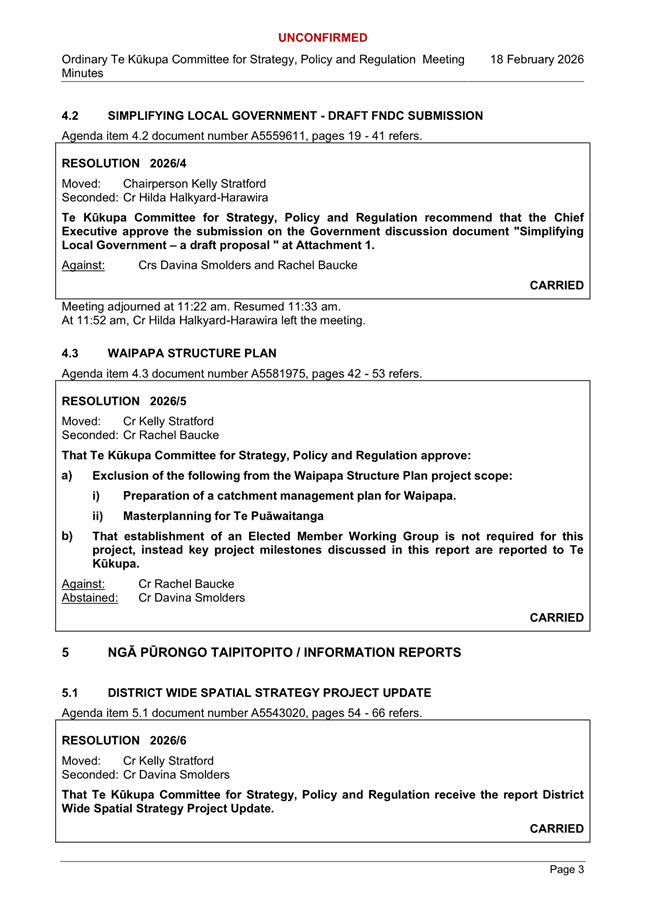
1. 2026-02-18
- Te Kūkupa Committee for Strategy, Policy and Regulation Minutes -
A5583767 ⇩ 
Hōtaka Take Ōkawa / Compliance schedule:
Full consideration has been given to the provisions of the
Local Government Act 2002 S77 in relation to decision making, in particular:
1. A
Local authority must, in the course of the decision-making process,
a) Seek
to identify all reasonably practicable options for the achievement of the
objective of a decision; and
b) Assess
the options in terms of their advantages and disadvantages; and
c) If
any of the options identified under paragraph (a) involves a significant
decision in relation to land or a body of water, take into account the
relationship of Māori and their culture and traditions with their
ancestral land, water sites, waahi tapu, valued flora and fauna and other
taonga.
2. This
section is subject to Section 79 - Compliance with procedures in relation to
decisions.
|
He
Take Ōkawa / Compliance Requirement
|
Aromatawai
Kaimahi / Staff Assessment
|
|
State the level of significance
(high or low) of the issue or proposal as determined by the Council’s
Significance and Engagement Policy
|
This is a matter of low
significance.
|
|
State the relevant Council
policies (external or internal), legislation, and/or community outcomes (as
stated in the LTP) that relate to this decision.
|
This report complies with the
Local Government Act 2002 Schedule 7 Section 28.
|
|
State whether this issue or
proposal has a District wide relevance and, if not, the ways in which the
appropriate Community Board’s views have been sought.
|
It is the responsibility of each
meeting to confirm their minutes therefore the views of another meeting are
not relevant.
|
|
State the possible implications for Māori
and how Māori have been provided with an opportunity to contribute to
decision making if this decision is significant and relates to land and/or
any body of water.
|
There are no implications for Māori in confirming minutes
from a previous meeting. Any implications on Māori arising from matters
included in meeting minutes should be considered as part of the relevant
report.
|
|
Identify persons likely to be
affected by or have an interest in the matter, and how you have given
consideration to their views or preferences (for example,
youth, the aged and those with disabilities).
|
This report is asking for minutes
to be confirmed as true and correct record, any interests that affect other
people should be considered as part of the individual reports.
|
|
State the financial implications
and where budgetary provisions have been made to support this decision.
|
There are no financial
implications or the need for budgetary provision arising from this report.
|
|
Chief Financial Officer review.
|
The Chief Financial Officer has
not reviewed this report.
|
|
Ordinary Te Kūkupa
Committee for Strategy, Policy and Regulation Meeting Agenda
|
18 March 2026
|

|
Ordinary
Te Kūkupa Committee for Strategy, Policy and Regulation Meeting
Agenda
|
18
March 2026
|
5 Ngā
Pūrongo / Reports
5.1 Te
Kūkupa Work Programme 2026
File
Number: A5608621
Author: Roger
Ackers, Group Manager - Planning & Policy
Authoriser: Guy
Holroyd, Chief Executive Officer
Take Pūrongo / Purpose of the Report
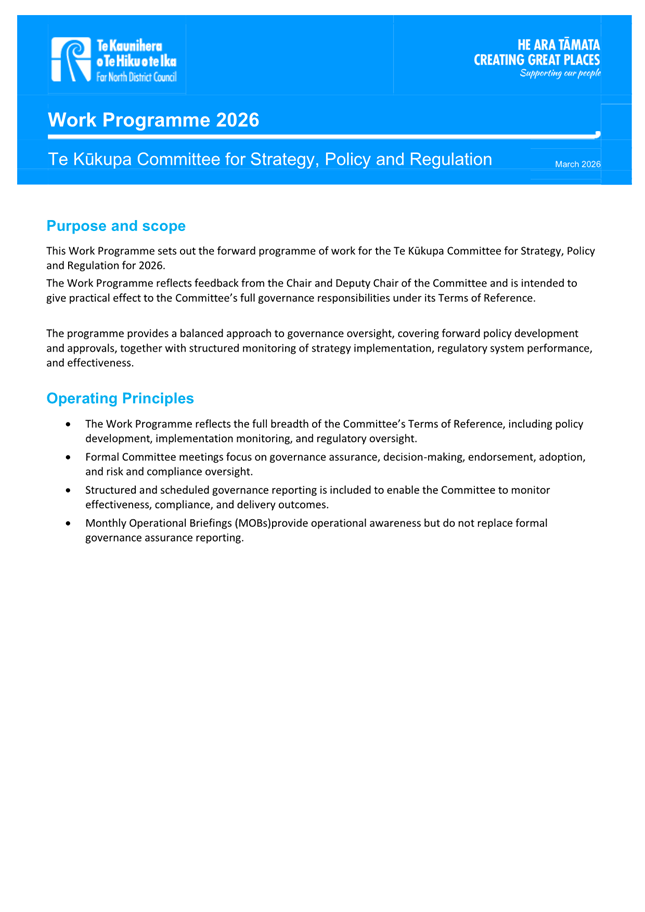
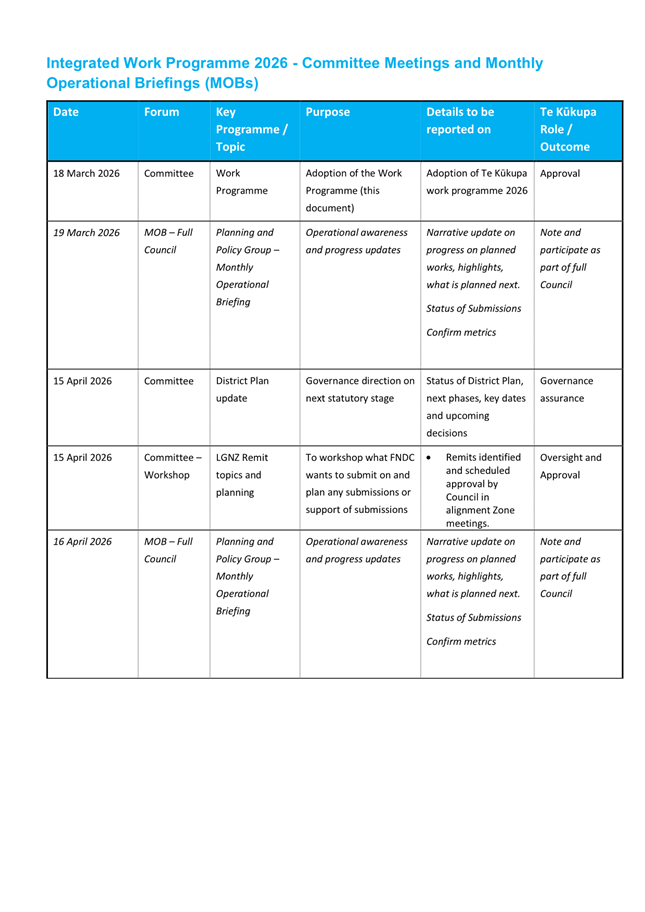
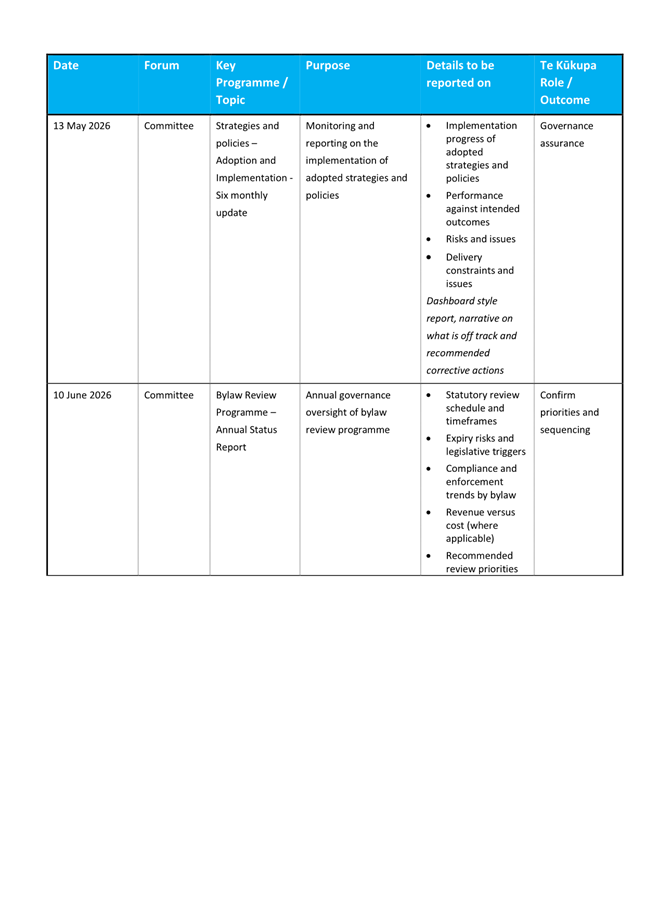
The purpose of this report is to seek Committee approval of
the proposed Te Kūkupa Work Programme for 2026, as attached
WhakarĀpopoto matua / Executive Summary
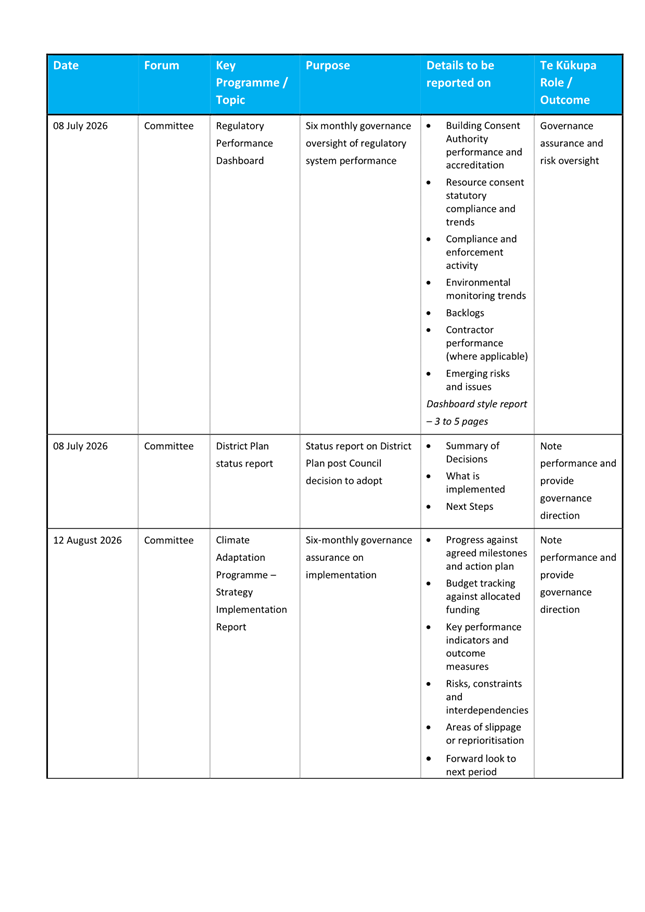
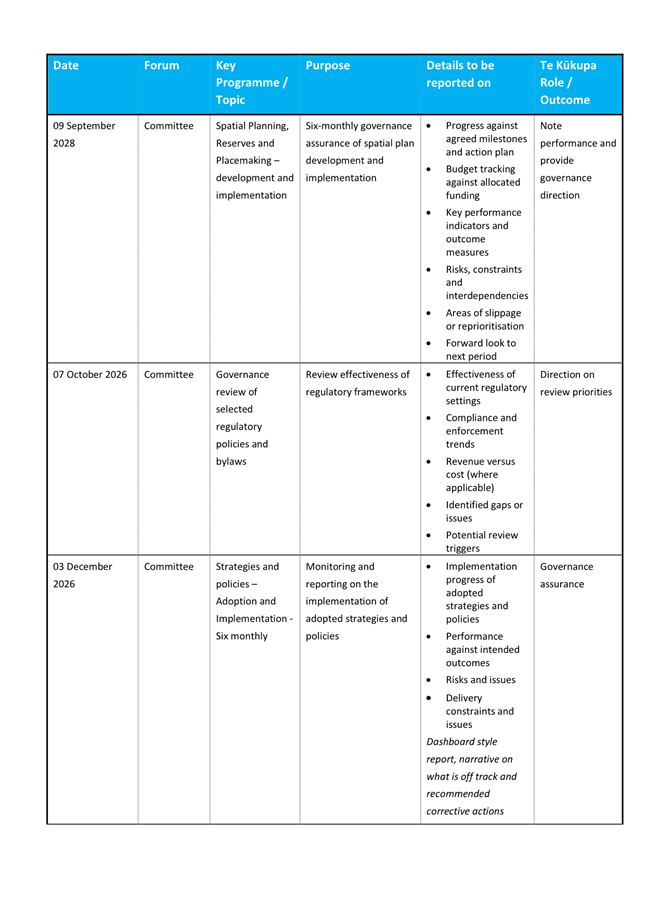
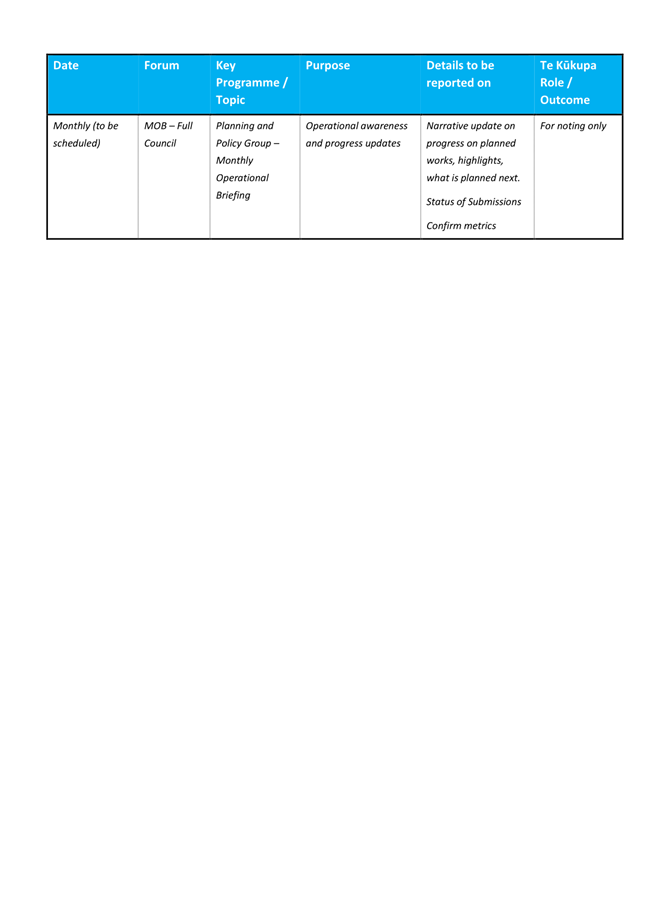
· This report presents the proposed Te Kūkupa Work Programme for
2026 for Committee approval.
· The Work Programme has been developed to give effect to the
Committee’s full Terms of Reference, including responsibility for:
o strategy and policy development and adoption
o monitoring the implementation and effectiveness of adopted
strategies and policies
o governance‑level oversight of regulatory matters
o review of bylaws and regulatory frameworks
o oversight of regulatory system performance, compliance, and risk
· The Work Programme reflects feedback from the Chair and Deputy Chair
combining forward‑looking decision making with structured governance assurance.
· Key features of the proposed Work Programme include:
o scheduled governance reporting on strategy and policy implementation
o six‑monthly and annual reporting on regulatory performance and bylaw
review programmes
o clear distinction between governance assurance reporting and
operational awareness provided through Monthly Operational Briefings
o a disciplined, dashboard‑led reporting approach to
support assurance and early warning without unnecessary reporting burden
|
tŪtohunga
/ Recommendation
That Te Kūkupa Committee for Strategy,
Policy and Regulation:
a) Approves
the Te Kūkupa Work Programme for 2026, as attached; and
b) Notes
that the Work Programme has been designed to reflect the Committee’s
full governance responsibilities under its Terms of Reference, with
operational updates provided through Monthly Operational Briefings.
|
1) TĀhuhu kŌrero / Background
Te Kūkupa Committee for Strategy, Policy and Regulation
is established to provide governance leadership, oversight, and direction
across Council’s strategy, policy, and regulatory functions.
The Committee’s Terms of Reference extend beyond
policy development and adoption to include ongoing governance responsibilities
for monitoring implementation, regulatory system performance, compliance, and
effectiveness.
An annual Work Programme supports the Committee by:
· providing
transparency about upcoming governance decisions and assurance activities
· aligning reporting
with the Committee’s delegated responsibilities
· supporting
effective agenda management and Committee time discipline
The proposed 2026 Work Programme has been refined following
from the Chair and Deputy Chair of the Committee to ensure it appropriately
balances governance assurance with proportionality.
2) matapaki me NgĀ KŌwhiringa /
Discussion and Options
In considering the Te Kūkupa Work Programme for
2026, the Committee has the following options;
Option One: Approve the Te Kūkupa Work
Programme (recommended option)
The Committee approves the attached Te Kūkupa
Work Programme for 2026 as presented.
Advantages
· Confirms a clear,
agreed forward programme aligned to the Committee’s Terms of Reference,
including strategy, policy, and regulatory oversight.
· Provides certainty
for elected members and staff about scheduled governance decisions and
assurance reporting.
· Enables the
Committee to discharge its responsibilities for implementation monitoring,
regulatory performance oversight, and bylaw review in a structured way.
· Supports
disciplined agenda planning and early signalling of governance issues
throughout the year.
Disadvantages
· Limits the
opportunity to further refine scope, frequency, or reporting format at this
meeting.
· Any subsequent
refinements would need to be managed through adjustments to the Work Programme
via future resolutions of the Committee.
Option Two: Approve the Te Kūkupa Work
Programme with amendments
The Committee approves the Te Kūkupa Work
Programme subject to agreed amendments (for example, changes to reporting
frequency, scope, or format).
Advantages
· Allows the
Committee to adopt the Work Programme while refining specific elements to
better reflect governance preferences.
· Enables
adjustments to ensure reporting remains proportionate, assurance‑focused, and aligned
with Committee expectations.
· Maintains momentum
and certainty while responding to feedback from the Chair and Deputy Chair.
Disadvantages
· May require
additional officer time to incorporate amendments and confirm the final
version.
· Risk of ambiguity
if amendments are not clearly specified at the meeting.
Option Three: Defer adoption of the Work Programme to a
later Committee meeting
The Committee defers consideration of the Work Programme to
a future meeting to allow further discussion or refinement.
Advantages
· Provides
additional time for detailed discussion on governance scope and reporting
expectations.
· Allows further
alignment between elected members before committing to a full‑year programme.
Disadvantages
· Delays formal
adoption, reducing clarity and certainty for both the Committee and staff.
· Risks creating
gaps in planned governance assurance and forward planning during the early part
of 2026.
· May result in ad‑hoc agenda setting
rather than a structured programme aligned to the Terms of Reference.
Option Four: Do not approve the Te Kūkupa Work
Programme
The Committee decides not to approve the
Te Kūkupa Work Programme for 2026.
Advantages
· Signals that the
Committee is not satisfied that the proposed Work Programme appropriately
reflects its governance role or priorities.
Disadvantages
· Leaves the
Committee without an agreed forward programme, reducing transparency and
governance discipline.
· Increases the risk
of reactive or fragmented agenda planning.
· Makes it more
difficult for the Committee to systematically meet its Terms of Reference
obligations, particularly for implementation monitoring and regulatory
oversight.
TAKE TŪTOHUNGA
/ REASON FOR THE RECOMMENDATION
Option One is recommended option as it enable the Committee
to adopt a structured Work Programme aligned to its Terms of Reference while
maintaining the ability to refine governance reporting expectations as required
via future resolutions of committee.
3) PĀnga PŪtea me ngĀ
wĀhanga tahua / Financial Implications and Budgetary Provision
There are no direct financial implications arising from
approval of the Te Kūkupa Work Programme.
Any financial implications associated with individual agenda
items will be addressed through those specific reports as they are brought to
the Committee.
Āpitihanga
/ Attachments
1. Te
Kūkupa Work Programme 2026 - A5619272 ⇩ 
Hōtaka Take Ōkawa / Compliance Schedule:
Full consideration has been given to the provisions of the
Local Government Act 2002 S77 in relation to decision making, in particular:
1. A
Local authority must, in the course of the decision-making process,
a) Seek
to identify all reasonably practicable options for the achievement of the
objective of a decision; and
b) Assess
the options in terms of their advantages and disadvantages; and
c) If
any of the options identified under paragraph (a) involves a significant
decision in relation to land or a body of water, take into account the
relationship of Māori and their culture and traditions with their
ancestral land, water sites, waahi tapu, valued flora and fauna and other
taonga.
2. This
section is subject to Section 79 - Compliance with procedures in relation to
decisions.
|
He Take Ōkawa /
Compliance Requirement
|
Aromatawai Kaimahi /
Staff Assessment
|
|
State the level of significance (high or low) of the
issue or proposal as determined by the Council’s
Significance and Engagement Policy
|
Assessment: Low significance
Staff assessment: approval of the Te Kūkupa Work
Programme establishes the Committee’s forward governance agenda and
reporting framework for 2026. It does not in itself commit Council to
specific policy decisions, budget changes, or service level adjustments.
Individual agenda items arising from the Work Programme will be subject to
their own significance assessment at the time they are considered.
|
|
State the relevant Council policies (external or
internal), legislation, and/or community outcomes (as stated in the LTP) that
relate to this decision.
|
Staff assessment:
The decision relates to the following:
· Local
Government Act 2002 – particularly sections relating to governance,
decision‑making,
and committee delegation
· Te
Kūkupa Committee Terms of Reference – Strategy, Policy and
Regulation
· Long
Term Plan (LTP) and Annual Plan – governance oversight of delivery,
implementation, and regulatory performance
· Council’s
Significance and Engagement Policy – applied at the level of individual
decisions arising from the Work Programme
The Work Programme supports Council’s community
outcomes by enabling structured governance oversight of strategy
implementation, regulatory effectiveness, and statutory compliance.
|
|
State whether this issue or proposal has a District wide
relevance and, if not, the ways in which the appropriate Community
Board’s views have been sought.
|
Staff assessment:
The Te Kūkupa Work Programme has district‑wide relevance, as the
Committee’s Terms of Reference cover Council‑wide strategy, policy, and regulatory
matters. Community Board views are considered where required through specific
agenda items and decision‑making
processes arising from the Work Programme.
|
|
State the
possible implications for Māori and how Māori have been provided
with an opportunity to contribute to decision making if this decision is
significant and relates to land and/or any body of water.
State the
possible implications and how this report aligns with Te Tiriti o Waitangi /
The Treaty of Waitangi.
|
Staff assessment:
Approval of the Work Programme does not of itself have
direct implications for land or water, nor does it make substantive policy
decisions. However, the Work Programme explicitly includes governance
oversight of strategies, policies, and regulatory frameworks that engage with
Māori interests and Te Tiriti o Waitangi obligations.
Māori participation and partnership considerations
will be addressed in detail through individual agenda items as they arise, in
accordance with Council’s Te Tiriti commitments and statutory
obligations.
|
|
Identify persons likely to be affected by or have an
interest in the matter, and how you have given consideration to their views
or preferences (for example – youth, the aged and those with
disabilities).
|
Staff assessment:
Approval of the Work Programme primarily affects
internal governance planning and reporting. External stakeholders, including
the wider community, iwi, hapū, and sector groups, will be engaged
through individual policy, strategy, and regulatory processes scheduled
within the Work Programme, where appropriate.
|
|
State the financial implications and where budgetary
provisions have been made to support this decision.
|
Staff assessment:
There are no direct financial implications arising from
approval of the Te Kūkupa Work Programme. Financial implications
associated with individual strategies, policies, or regulatory decisions will
be considered and reported through those specific agenda items.
|
|
Chief Financial Officer review.
|
The CFO has reviewed this report..
|
|
Ordinary Te Kūkupa
Committee for Strategy, Policy and Regulation Meeting Agenda
|
18 March 2026
|
|
Ordinary
Te Kūkupa Committee for Strategy, Policy and Regulation Meeting
Agenda
|
18
March 2026
|
6 Ngā
Pūrongo Taipitopito / Information Reports
6.1 Te
Pātukurea Kerikeri Waipapa Spatial Plan - Implementation Reference Group
Establishment
File
Number: A5604285
Author: Jaye
Michalick, Team Leader – Growth Planning & Placemaking
Authoriser: Roger
Ackers, Group Manager - Planning & Policy
TAKE PŪRONGO / Purpose of the Report
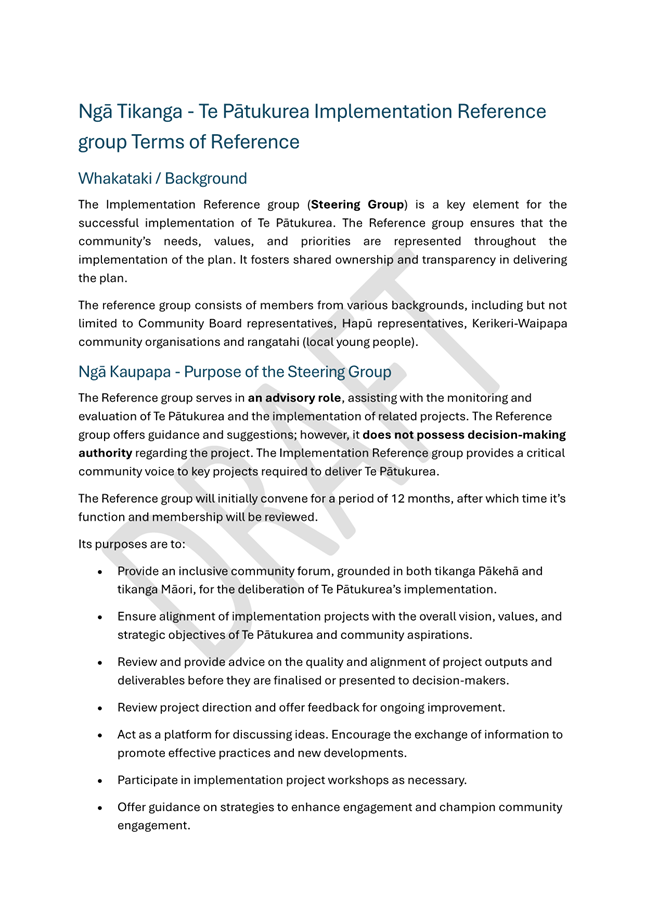
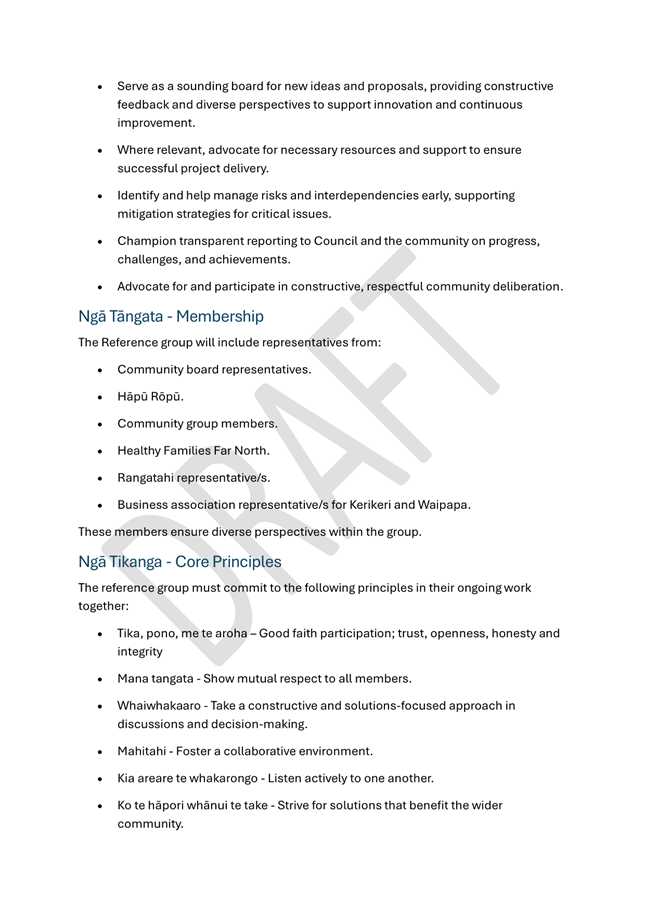
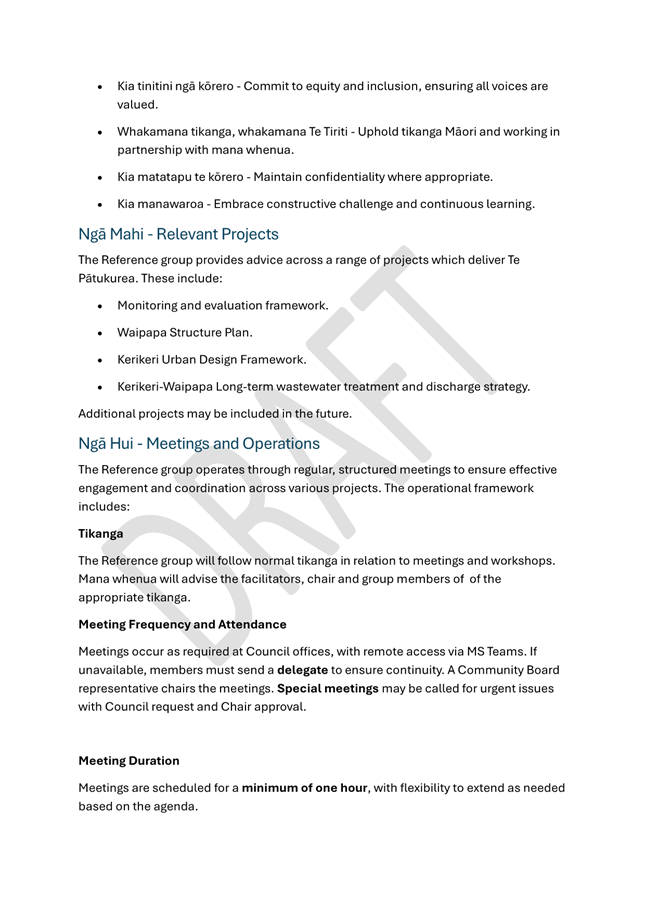
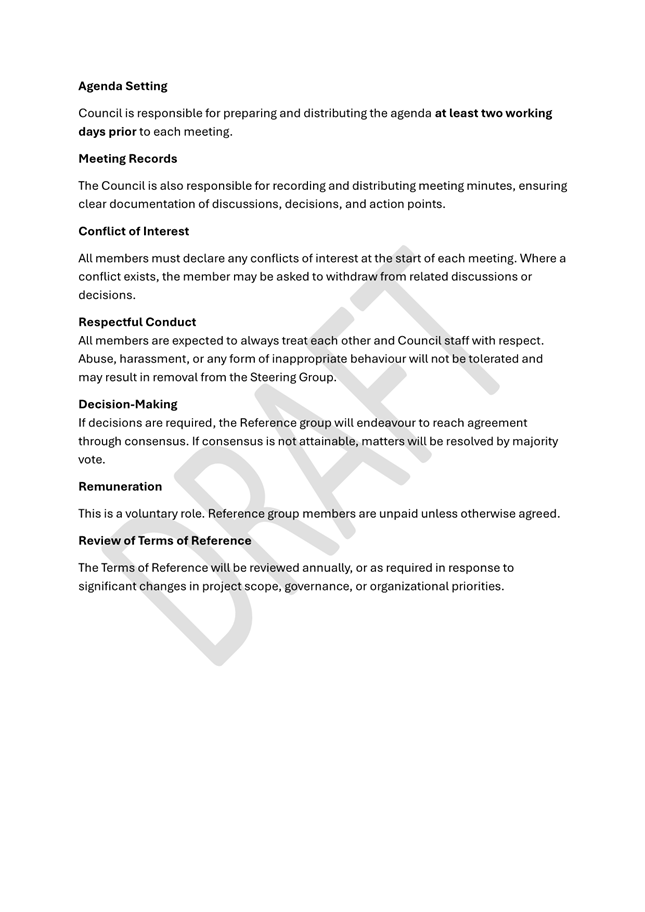
The purpose of the report is to inform Te Kūkupa
Committee for Strategy, Policy and Regulation (Te Kūkupa) of the
establishment of the Te Pātukurea Kerikeri Waipapa Spatial Plan
Implementation Reference Group (Reference Group), including the appointment of
two members of the Bay of Islands-Whangaroa Community Board (Community Board)
as representatives on to the Reference Group. This report also informs Te
Kūkupa of the name change for the Group, based on feedback given at the
Community Board meeting.
WHAKARĀPOPOTO MATUA / Executive SummarY
This report:
· Outlines the initial projects required to be commenced as part of
the implementation plan within Te Pātukurea Kerikeri Waipapa Spatial Plan,
including to establish the Reference Group.
· Reiterates the extent of mana whenua partnership and stakeholder
engagement undertaken to prepare the adopted spatial plan as context for the
need to establish an ongoing Reference Group.
· Discusses the change of name for the Reference Group, from
‘Steering Group’ as described in Te Pātukurea implementation
plan, to ‘Reference Group’ as suggested by our Community Board
representative.
· Outlines the purpose, composition and draft Terms of Reference, of
the Reference Group.
· Informs Te Kūkupa that the Reference Group is currently being
established.
|
TŪTOHUNGA
/ Recommendation
That the Te Kūkupa Committee for Strategy, Policy
and Regulation receive the report Te Pātukurea Kerikeri Waipapa Spatial
Plan - Implementation Reference Group Establishment.
|
tĀHUHU KŌRERO / Background
Te Pātukurea Kerikeri Waipapa Spatial Plan (Te
Pātukurea) is a non-statutory plan that was adopted by Council in June
2025 via Resolution 2025/61 (link to adopted version here: Te
Pātukurea). Te Pātukurea is a plan for the long-term growth (30+
years) of Kerikeri and Waipapa, it is based on good-practice spatial planning
principles and sets out how we can grow and service the subject urban areas.
The spatial plan was developed in partnership with Te Pātukurea Hapū
Rōpū[1]
and with significant iterative stakeholder engagement and public consultations.
Te Pātukurea includes an implementation plan with
actions that need to be carried out over the short-, medium- and long-term to
deliver the plan.
To ensure ongoing mana whenua partnership and stakeholder
engagement throughout the implementation phase of Te Pātukurea, the
implementation plan includes two key actions:
· Establish an implementation steering group (the subject of this
paper); and
· Explore co-governance and collaboration opportunities with hapū
(staff have met with Te Pātukurea Hapū Rōpū, which
confirmed a desire to reform and continue to partner with Council on the
implementation of Te Pātukurea).
The purpose of the implementation reference group (formerly
“Steering’) is defined in the implementation plan as:
to ensure the
community’s needs, values, and priorities are represented throughout the
process. It fosters shared ownership and transparency in delivering the plan. A
diverse membership is key – Community Board representation connects the
plan to local governance, while Hapū Rōpū representation brings
mana whenua perspectives and Kaitiakitanga. Young people’s participation
ensures their unique perspectives are recognised, valued and included.
In accordance with Bay of Islands-Whangaroa Community Board
resolution 2026/7 (12 February 2026), the Community Board appointed Tyler
Bamber and Jo Alexander to the Implementation Steering Group, now
called the Reference Group.
At the February 2026 Community Board meeting, the name of
the steering group was discussed, it was agreed that the word steering infers
decision making responsibilities, rather than providing community advisory
input to projects. As a result, the name of this group has changed from
Steering Group to Reference Group. A representative of Vision Kerikeri spoke at
the February Community Board meeting, providing suggested changes to the draft
terms of reference for the Reference Group. The terms of reference will be on
the first meeting agenda for the Reference Group to finalise. They will be able
to raise their suggested changes directly to the Reference Group members.
Te Pātukurea Hapū Rōpū representatives
have confirmed that, alongside regular meetings with staff on implementation
plan projects, and potentially workshopping with elected members on certain
project milestones in the same way the rōpū did for Te
Pātukurea, they also agree to be members of the Reference Group. This is
both to ensure that there is a full sharing of knowledge and ideas between mana
whenua and other community representatives on implementation plan projects and
at the request of both the rōpū and community group representatives
to have ‘everyone in the room’ at key stages of projects.
Along with setting up
this Reference Group, staff are in the process of commencing two further
Implementation Plan actions: Waipapa Structure Plan project – which was
reported on to Te Kūkupa in February 2026, and starting a Kerikeri Urban
Design Framework project, which will be the subject of a future agenda item
paper.
MATAPAKI ME NGĀ KŌWHIRINGA /
Discussion and Next Steps
The Reference Group will
serve in an advisory role, assisting with the monitoring and evaluation of Te
Pātukurea and the implementation of related projects. The Reference Group
can offer guidance and suggestions; however, it will not possess decision-making
authority regarding projects that it advises on. The Reference Group will
provide critical community voice to key projects required to deliver Te
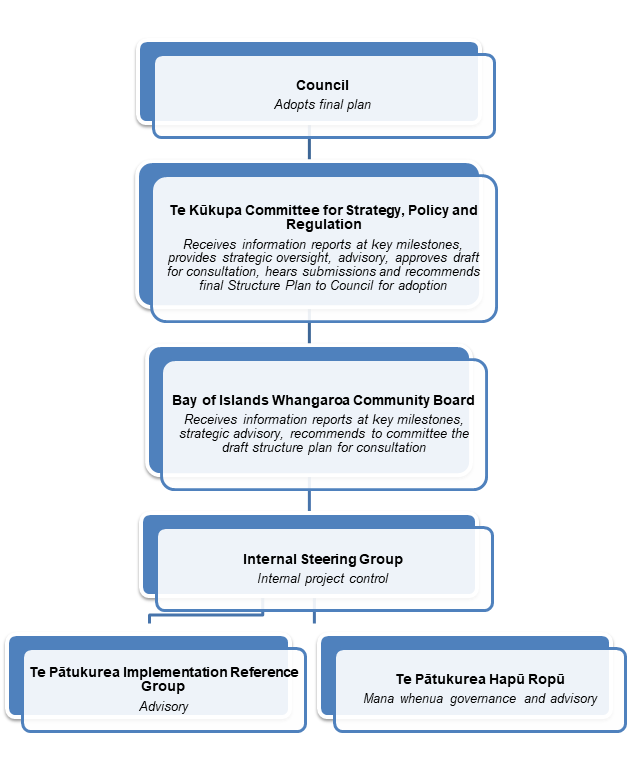
Pātukurea. Refer to the diagram below, being the Project Governance
Structure for the Waipapa Structure Plan, which demonstrates how the Reference
Group is intended to fit within a project governance structure for
implementation plan projects.
It is anticipated that
the Reference Group would meet approximately 2 to 4 times per year, to be kept
up to date with the various Te Pātukurea implementation plan projects that
are underway, and to identify further opportunities for relevant representatives
to participate in individual projects, or collectively as the Reference Group,
if appropriate. Attachment 1 contains a draft Terms of Reference for the
Reference Group, which will be finalised following establishment of the
Reference Group.
In addition to establishing the Reference Group, it is
expected that all projects established to implement Te Pātukurea will be
reported on to Te Kūkupa at key milestones as standard practice.
PĀNGA PŪTEA ME NGĀ WĀHANGA
TAHUA / Financial Implications and Budgetary Provision
The costs of facilitating the Reference Group meetings are
estimated to be between $5,300 (2 meetings p/a) and $10,600 (4 meetings p/a)
per annum, and these costs have been budgeted for in the Growth Planning and
Placemaking Team cost centre for this financial year. Other than rangatahi and
the Hapū Rōpū, membership of the Reference Group is voluntary
and not remunerated.
Āpitihanga
/ Attachments
1. Draft
Terms of Reference Te Pātukurea Implementation Reference Group - A5607444 ⇩
|
Ordinary Te Kūkupa
Committee for Strategy, Policy and Regulation Meeting Agenda
|
18 March 2026
|
|
Ordinary Te Kūkupa
Committee for Strategy, Policy and Regulation Meeting Agenda
|
18 March 2026
|
6.2 Stage One -
Community Adaptation Planning, Te Hōtaka Urutau Hapori-Community
Adaptation Programme
File
Number: A5556106
Author: Katy
Simon, Adaptation Programme Lead Climate Action and Resilience
Authoriser: Roger
Ackers, Group Manager - Planning & Policy
TAKE PŪRONGO / Purpose of the Report
To update Te Kūkupa
Committee for Strategy, Policy and Regulation on the Stage One Community
Adaptation Planning project.
WHAKARĀPOPOTO MATUA / Executive SummarY
The Climate Action and Resilience Department is starting
Stage One of community adaptation planning, as set by Te
Hōtaka Urutau Hapori, Council’s Community Adaptation Programme.
This information report
outlines Te Kūkupa Committee for Strategy, Policy and Regulation’s
(Te Kūkupa Committee) anticipated governance role in Stage One project.
The report introduces the project plan and initial scoping decisions, ahead of
Te Kūkupa Committee’s direction on a draft scoping report.
|
TŪTOHUNGA
/ Recommendation
That Te Kūkupa Committee for Strategy, Policy and
Regulation receive the report Stage One - Community Adaptation Planning, Te
Hōtaka Urutau Hapori-Community Adaptation Programme.
|
tĀHUHU KŌRERO / Background
August
2025, Council approved Stage One Community Adaptation Planning as part of
the decision to approve an accelerated Te Hōtaka Urutau Hapori –
Community Adaptation Programme
Since this decision, the
Climate Action and Resilience Department have procured professional services
and established a project team to deliver Stage One. Early engagement and
relationship-building has also continued with the support of Kaimanaaki Hapori,
contracted community advisors.
The Stage One project is
now formally starting. This community adaptation planning project spans
multiple functions and areas of Council. Staff are briefing all Elected Members
anticipated to have a governance role: Te Hiku Community Board, Kaikohe-Hokianga
Community Board and Te Koukou Transport and Infrastructure Committee.
MATAPAKI ME NGĀ KŌWHIRINGA /
Discussion and Next Steps
Stage One Community Adaptation Planning
By 2027, the project team aims to deliver adopted Community
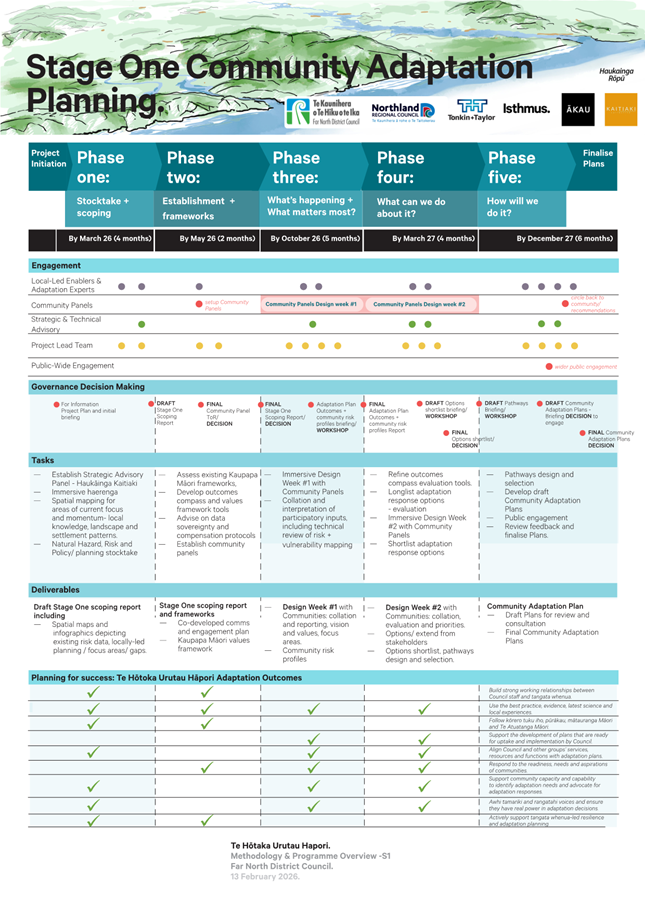
Adaptation Plans for the Stage One area. Attachment A, Stage One
Community Adaptation Planning Project Summary, shows the project’s
phases, key tasks and decisions, and different roles. Staff will be available
to answer questions on the project summary during this March 2026 Committee
meeting.
Tonkin + Taylor, Isthmus and Ākau are jointly
contracted to deliver Stage One. A project team has been established and is
made up of the external specialists, Far North District Council, and Northland
Regional Council staff. Katy Simon, Adaptation Programme Lead and Sarah Peri,
Kaupapa Māori Lead – Climate Action and Resilience, are the key
staff leading this project.
The Stage One area covers Whangapē, Herekino, North
Hokianga, South Hokianga and Waimamaku areas. Figure One below shows a map of
the area (also shown in Attachment A).
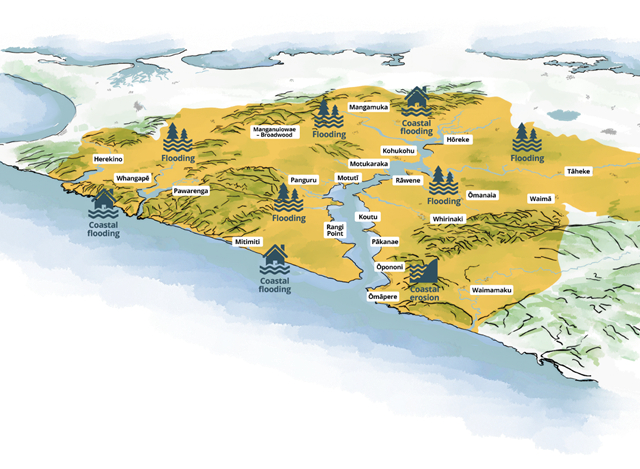
Figure 1 Stage One Project Area
Community Adaptation Plans will set
out how communities and Council will prepare for and respond to increasing
natural hazards. The purpose is to effectively plan for existing assets and
elements of value to community, to manage and/or reduce risk to Council
services and for Far North communities. Community Adaptation Plans will
decide:
- What’s
happening?
o Future risks from natural
hazards to services, places and elements we care about
- What
matters most?
o Community values, outcomes and
risk tolerance levels that set long-term priorities for services and
assets
- What
can we do about it?
o Adaptation response options
available
- How
are we going to do it?
o Preferred short, medium and
long responses and the triggers for changing responses
Council’s Pou 1, Stage One, webpage describes
adaptation planning in more detail: Pou
1 Community Adaptation Planning | Far North District Council.
Christchurch City Council’s Coastal
Hazards Adaptation Plan (2025) provides a good example of a community
adaptation plan.
Stage One project also supports:
- Working
relationships with tangata whenua and communities
- Collaboration
and alignment across FNDC functions
- Collaboration
between councils and regional agencies
- Quality
of natural hazards risk information
Te Kūkupa Committee’s
governance role
Based on the Te Kūkupa Committee’s Terms of
Reference, Staff anticipate that this Committee will provide general governance
oversight and will receive all draft deliverables and proposals across the
Stage One Community Adaptation Planning project.
Staff will either present an information report or a report
seeking endorsement to Te Kūkupa Committee before each Council decision.
Attachment A shows the anticipated governance touchpoints.
Project structure and wider decision-making process
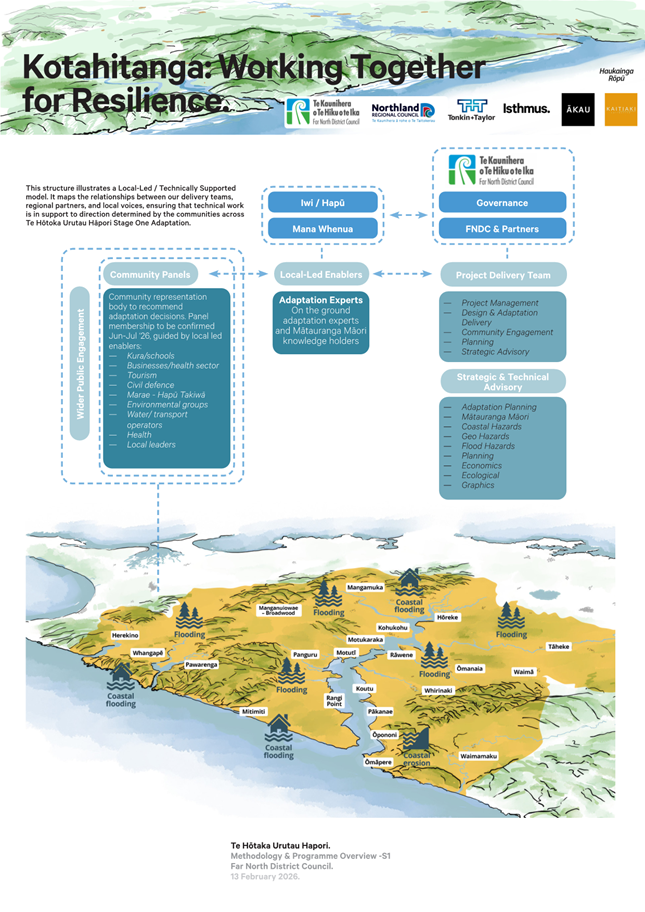
Under Te Hōtaka Urutau Hapori – Community
Adaptation Programme, Council commits to working alongside communities and
tangata whenua on adaptation planning. The project is designed to deliver on
this commitment.
This means:
- a
haukāinga kaitiaki rōpū – local adaptation tangata whenua
expert group will be set up to advise at the project level,
- Community
Panels will be established to make recommendations on adaptation decisions to
Council,
- staff
expect to seek formal hapū or marae representation for the Community
Panels.
- Community
Board Members may also be invited to participate in the relevant Community
Panels; and
- Council
will be the final decision-maker because it is the main entity responsible for
implementing the Community Adaptation Plans.
In some cases, elements of Community Adaptation Plans may
need to go to Northland Regional Council, Regional Waters CCO, or other joint
regional governance bodies for direction or decision. This will depend on their
role and functions in future implementation of adaptation plans.
Next steps – Stage One scoping report
By June 2026, staff will seek Council’s decision on
Stage One scoping report. Ahead of this decision, Staff will present the draft
Stage One scoping report to Te Kūkupa Committee at the April or May 2026
meetings.
A scoping report will decide:
- Sub-areas
where adaptation plans will be created
- What
we’re planning for – elements of value included, hazards addressed
- The
level of detail we’re planning for – specificity of an adaptation
response
- How
long we’re planning for – temporal extent for planning decisions
- Who
we’re working with, how decisions will be made and who will be involved
in implementation
The scoping report will be informed by:
- Existing
natural hazards risk information
- Current
and future, anticipated legislation
- Current
precedent of roles and responsibilities, if not specified in legislation
- Existing,
related strategies, plans and projects
- Engagement
on tangata whenua and community needs, issues and opportunities
PĀNGA PŪTEA ME NGĀ WĀHANGA
TAHUA / Financial Implications and Budgetary Provision
Stage One Community
Adaptation Planning has an estimated total budget of $650,000.00, across the
2025-2026 and 2026-2027 financial years.
Northland Regional
Council provides $100,000.00 in funding (included in the $650,000.00 total).
The Senior Leadership
Team is reviewing a business case for an additional two FTE, as set by Council
in the decision to approve the accelerated Adaptation Programme.
Future budget
requirements will be determined through the 2027-2037 Long Term Plan
process.
Āpitihanga
/ Attachments
1. Attachment
A - Stage One Community Adaptation Planning Project Summary - A5589555 ⇩ 
|
Ordinary Te Kūkupa
Committee for Strategy, Policy and Regulation Meeting Agenda
|
18 March 2026
|
|
Ordinary
Te Kūkupa Committee for Strategy, Policy and Regulation Meeting
Agenda
|
18
March 2026
|
7 Karakia
Whakamutunga / Closing Prayer
8 Te Kapinga Hui / Meeting
Close