AGENDA
Ordinary Te Kuaka Committee for Strategic
Māori Relationships Meeting
Wednesday, 25 March 2026
|
Time:
|
10:00 AM
|
|
Location:
|
Council Chamber
Memorial Ave
Kaikohe
|
Membership:
Heamana
(Chairperson) Tāmati Rākena
Heamana
Tuarua (Co-Chairperson) External Appointed Member
Mema
(Member) Hilda Halkyard-Harawira
Mema
(Member) Arohanui Allen
Mema
(Member) Chicky Rudkin
Mema
(Member) Kelly Stratford
Mema
(Member) Davina Smolders
Ngā
Mema (Members) Hapu with a Signed MOU with Council
Ngā
Mema (Members) Te Kahu o Taonui Representatives
|
|
Authorising
Body
|
Council
|
|
Status
|
Standing
Committee
|
|
COUNCIL
COMMITTEE
|
Title
|
Te
Kuaka Committee for Māori Strategic Relationships Terms of Reference
|
|
Terms
of Reference Adoption
|
11
December 2025 and revised 5 March 2026
|
|
Responsible
Officer
|
Manuhautū
Te Hono - Group Manager Te Hono
|
Kaupapa
/ Purpose
To provide
strategic leadership and guidance that strengthens Te Ao Māori
perspectives within Council decision‑making, ensuring genuine Te Tiriti‑based
partnership and leadership between FNDC and iwi/hapū, and to
provide recommendations to full Council. This includes strengthening Council’s relationship
with Iwi and Hapū by promoting
effective partnership models, improving engagement practices, championing
shared decision‑making, and
adding value to relationships with Māori.
Ngā
Huānga / Membership
The
Committee will comprise of no less than 4 elected members and external
representation.
Kahika / Mayor Moko Tepania is an
ex-officio member of all Committees.
All
committee members will have full speaking and voting rights.
|
Cr Tāmati Rākena
(Chairperson)
|
|
External Appointment (Deputy
Chairperson)
|
|
Kohepu / Deputy Mayor Chicky Rudkin
|
|
Cr Arohanui Allen
|
|
Cr Hilda Halkyard-Harawira
|
|
Cr Kelly Stratford
|
|
Cr Davina
Smolders
|
|
Te Kahu o Taonui Representation
|
|
Hapū with a signed Memorandum of
Understanding (MOU) with Council
|
Kōrama /
Quorum
The
quorum at a meeting of the Committee is 4 members.
Ngā Hui /
Frequency of Meetings
The
Committee shall meet 8 weekly.
Ngā
Apatono / Power to Delegate
The
responsibilities, duties and powers of the Committee are subject to the
prohibition on delegation of powers under Clause 32(1), Schedule 7, Local
Government Act 2002, and any other restrictions on delegation under any other
relevant legislation.
Te
Kuaka Committee for Māori Strategic Relationships may not delegate any of its responsibilities,
duties or powers however it may establish working groups to consider issues
within the committee’s areas of responsibilities noting that working
groups have no decision-making powers.
Ngā Herenga Paetae / Responsibilities
The
Committees responsibilities are described below:
1.
Build
and sustain genuine, high-trust relationships based on He Whakaputanga and Te
Tiriti o Waitangi.
2.
Continue
with the development and implementation of Te Kuaka - Te Pae ki Tawhiti 2040
Strategic Intent.
3.
Support
strategic partnerships that empower communities, Hapū, and Iwi to shape
their own development.
4.
Oversee
Te Pae o Uta Te Ao Māori Framework
5.
Facilitate
collaboration across sectors to invest in quality infrastructure and
initiatives.
6.
Develop
and approve frameworks for partnership, engagement, monitoring and reporting.
7.
Identify
and prioritise strategic relationships with Iwi, Hapū, Government
agencies, and key stakeholders.
8.
Monitor
and evaluate the effectiveness of partnerships.
9.
Provide
direction to the Council on relationship strategies and opportunities.
10.
Ensure
Te Ao Māori perspectives inform Council strategic and operational work.
11.
Recommend
to Council, aspects of importance to Māori for incorporation into the
development of the Strategic documents (e.g. Te Ao Māori Framework, Annual
Plan, Long Term Plan, District Plan)
12.
Recommend
to Council aspects that the Far North District Council could pursue to develop
and or enhance Māori capacity to contribute to Council’s
decision-making processes.
Ngā Ture /
Rules and Procedures
Council’s
Standing Orders and Elected Member Code of Conduct apply to all meetings.
Reporting
and Review of Committee Terms of Reference
In
December of each year, the Responsible Officer alongside Democracy Services
will submit a report to Council. The report will summarise the activities of
the Committee and how it has contributed to the Council’s governance and
strategic objectives. This will look at whether the Council are meeting the
full requirements of the Committee Terms of Reference and whether any
amendments are required to the Committees terms of reference to increase
efficient and effective decision making.
The Terms of
Reference of the Committee will be reviewed as part of this report but can be
amended by Council at any point throughout the term.
Far North District Council
Ordinary Te Kuaka Committee for Strategic Māori
Relationships Meeting
will be held in the Council Chamber, Memorial Ave,
Kaikohe on:
Wednesday 25 March 2026 at 10:00
AM
Te Paeroa Mahi / Order
of Business
1 Karakia
Tīmatanga / Opening Prayer. 7
2 Ngā
Whakapāha Me Ngā Pānga Mema / Apologies and Declarations of
Interest 7
3 Ngā
Tono Kōrero / Deputation. 7
4 Ngā
Pūrongo / Reports. 8
4.1 Kaitiaki
Agreement - Moringaehe Reserve. 8
4.2 District
Wide Spatial Strategy Project 27
5 Ngā
Pūrongo Taipitopito / Information Reports. 44
5.1 Whenua
Māori - Freehold Land Rating Relief Update. 44
5.2 Ngā
Kaupapa Māori / Matters of Importance to Māori 48
5.3 Te
Reo and Tikanga Māori Policy Report 58
5.4 Te
Pae o Uta Te Ao Māori Framework Update. 171
5.5 Local
Water Done Well – Update and FNDC Positioning. 230
5.6 Status
Update on He Ara Ki Tua | Tangata Whenua Climate Adaptation Planning and
Ngā Kete Tautoko | Tools, Resources and Templates. 233
5.7 Update
on Local Government Reforms. 236
6 Karakia
Whakamutunga / Closing Prayer. 257
7 Te
Kapinga Hui / Meeting Close. 257
|
Ordinary
Te Kuaka Committee for Strategic Māori Relationships Meeting
Agenda
|
25
March 2026
|
1 Karakia
Tīmatanga / Opening Prayer
2 Ngā Whakapāha Me Ngā Pānga Mema / Apologies
and Declarations of Interest
Members need to
stand aside from decision-making when a conflict arises between their role as a
Member of the Committee and any private or other external interest they might
have. This note is provided as a reminder to Members to review the matters on
the agenda and assess and identify where they may have a pecuniary or other
conflict of interest, or where there may be a perception of a conflict of
interest.
If a Member
feels they do have a conflict of interest, they should publicly declare that at
the start of the meeting or of the relevant item of business and refrain from
participating in the discussion or voting on that item. If a Member thinks they
may have a conflict of interest, they can seek advice from the Chief Executive
Officer or the Manager - Democracy Services (preferably before the meeting).
It is noted
that while members can seek advice the final decision as to whether a conflict
exists rests with the member.
3 Ngā
Tono Kōrero / Deputation
Rueben Taipari –
representing Ngā Hapū o Ahipara in reference to agenda item 4.1
Kaitiaki Agreement – Moringaehe Reserve.
|
Ordinary
Te Kuaka Committee for Strategic Māori Relationships Meeting
Agenda
|
25
March 2026
|
4 Ngā
Pūrongo / Reports
4.1 Kaitiaki
Agreement - Moringaehe Reserve
File
Number: A5629604
Author: Dena-Maree
Hemara, Kaiārahi Kaupapa Māori
Authoriser: Aaron
Taikato, Manuhautū Te Hono – Group Manager Te Hono
Take Pūrongo / Purpose of the Report
To seek endorsement of the draft Kaitiaki Agreement –
Moringaehe Reserve from Te Kuaka Committee for Strategic Māori
Relationships (Te Kuaka).
WhakarĀpopoto
matua / Executive Summary
This report seeks endorsement of the proposed Kaitiaki
Agreement – Moringaehe Reserve between Ngā Hapū o Ahipara and
the Far North District Council (FNDC).
The Agreement establishes a shared
governance framework that upholds mana whenua authority, strengthens
environmental and cultural kaitiakitanga, and supports collaborative decision‑making for the
protection and sustainable management of Moringaehe Reserve.
|
tŪtohunga / Recommendation
That Te Kuaka Committee for Strategic Māori
Relationships;
a) receive and
endorse the draft Kaitiaki Agreement – Moringaehe Reserve between
Ngā Hapū o Ahipara and the Far North District Council;
b) endorse the
establishment of a Moringaehe Reserve Working Group (the Working Group) to
support implementation of the Agreement;
c) endorse the
draft Terms of Reference for the Moringaehe Reserve Working Group;
and that
d) once established by Council, the Working Group
develop a work programme that reflects mana whenua aspirations, the intent of
the Agreement, and the sustainable management of Moringaehe Reserve;
and recommends that Council:
e) approve the
draft Kaitiaki Agreement – Moringaehe Reserve between Ngā
Hapū o Ahipara and the Far North District Council;
f) approve
the establishment of the Moringaehe Reserve Working Group; and
g) appoint Councillor xxx as a representative
to the Working Group.
|
1) TĀhuhu
kŌrero / Background
At the meeting held on 11
December 2024 the committee resolved that Te Kuaka – Te Ao Māori
Committee:
a) receive the report 1
Wharo Way, Ahipara & Pohutukawa Tree and Te Puna o Kupenuku Updates,
and
b) that the CEO
formalises a written agreement and resourcing for Ngā Hapū o Ahipara
to maintain Moringaehe reserve.
Moringaehe Reserve, located at 1 Wharo Way, Ahipara, holds
significant cultural, historical, environmental and social value to Ngā
Hapū o Ahipara and the wider community. The whenua carries deep ancestral
connections and remains an important site for customary practice, environmental
restoration, education, and community wellbeing.
The proposed Kaitiaki Agreement establishes a formal
partnership framework between Ngā Hapū o Ahipara and the Far North
District Council (FNDC) to provide shared governance, strategic oversight, and
decision-making for the protection, restoration and sustainable use of
Moringaehe Reserve as well as early engagement and identification of issues.
Initial kōrero between Ngā Hapū o Ahipara and
FNDC highlighted long‑standing
concerns regarding land management, protection of wāhi tapu, erosion,
invasive species, and increasing recreational pressures on Moringaehe Reserve.
Mana whenua expressed the need for a more appropriate
governance arrangement, one that recognised cultural values, mātauranga
Māori, and ancestral responsibilities for the whenua.
Development
of a Collaborative Approach
Hui and discussions were held with Ngā Hapū o
Ahipara, where both parties explored potential partnership models that would
better reflect Te Tiriti o Waitangi principles—particularly partnership,
participation, and active protection. Through these engagements, co‑management emerged as
the preferred mechanism, providing a balanced approach to shared governance and
joint decision‑making.
Agreement
in Principle
FNDC and Ngā
Hapū o Ahipara reached agreement in principle to develop a formal
agreement for Moringaehe Reserve.
This included acknowledging the significant cultural,
historical, environmental, and social importance of the reserve and reaffirming
mana whenua responsibilities of kaitiakitanga.
Drafting
the agreement
A draft
agreement was prepared outlining:
· Shared
governance arrangements.
· Decision‑making processes.
· Roles
and responsibilities.
· Integration
of tikanga Māori and council processes.
· Environmental
and cultural restoration priorities.
· This
agreement provided the foundation for establishing a more structured
partnership.
Formation
of a Working Group (Proposed)
This report recommends the
establishment of a working group. The scope of the working group will be to
oversee the:
· Development of a
Terms of Reference
· Development of a
work programme associated to Moringaehe Reserve
· Monitoring and
evaluation of the Kaitiaki Agreement
Current
Stage
The project has now reached a
point where formal endorsement is required from Te Kuaka Committee to:
· Endorse
the Kaitiaki Agreement
· Establish
the Working Group
· Appoint
councillors to participate in the Working Group
· Support
the development of a work programme
This will enable the partnership to move into the
implementation phase and ensure that both mana whenua and Council have a shared
governance structure to guide future management of Moringaehe Reserve.
2) matapaki
me NgĀ KŌwhiringa / Discussion and Options
This paper recommends the
signing of the Kaitiaki Agreement – Moringaehe Reserve and the
establishment of a working group.
TAKE TŪTOHUNGA / REASON FOR THE RECOMMENDATION
Kaitiaki Agreement – Moringaehe Reserve
· To
formalise partnership with Ngā Hapū o Ahipara in recognition of mana
whenua status and Te Tiriti principles.
· To
provide governance clarity by establishing defined roles, responsibilities, and
decision-making processes.
· To
improve environmental and cultural outcomes through shared management and
integration of mātauranga Māori.
· To
strengthen relationships and community confidence through transparent and
collaborative leadership.
· To
ensure political mandate and oversight by appointing councillors to the Working
Group.
· To
reduce risk and enable funding opportunities through a structured and
accountable co-management framework.
3) PĀnga PŪtea me ngĀ
wĀhanga tahua / Financial Implications and Budgetary Provision
Operational budgets have been factored into this agreement
with each Manager providing approvals over their budget areas
Āpitihanga / Attachments
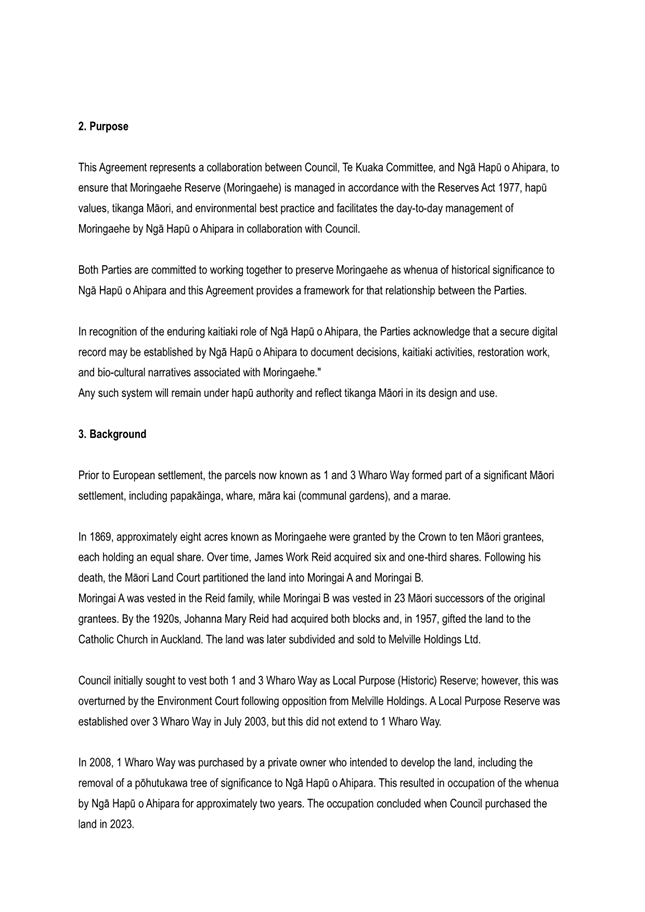
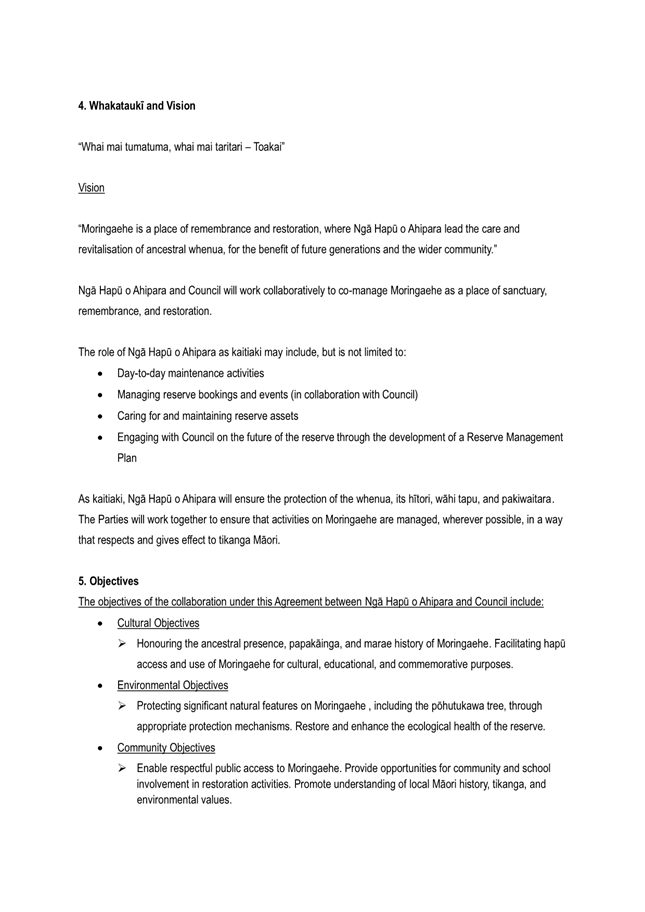
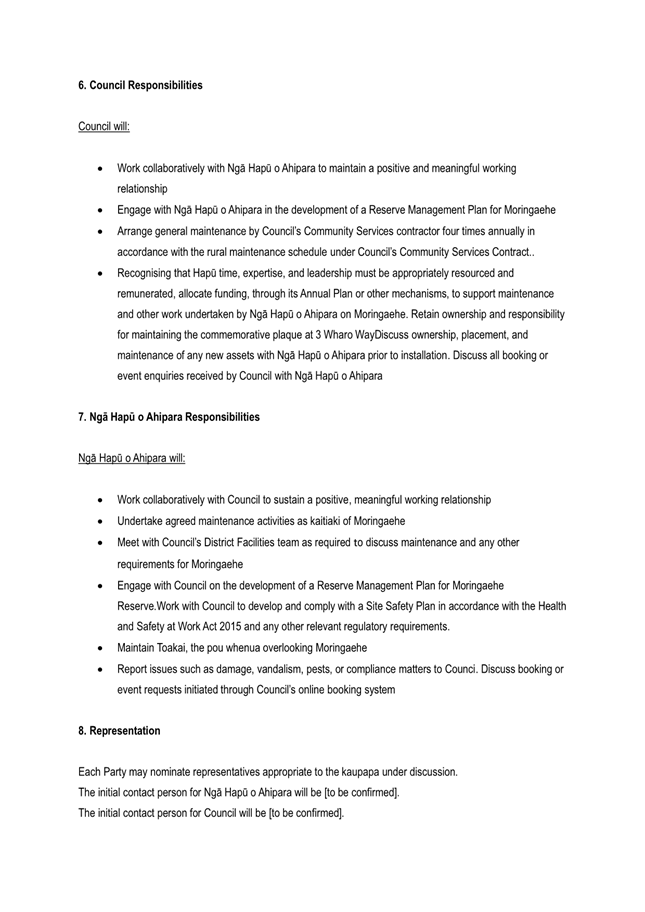
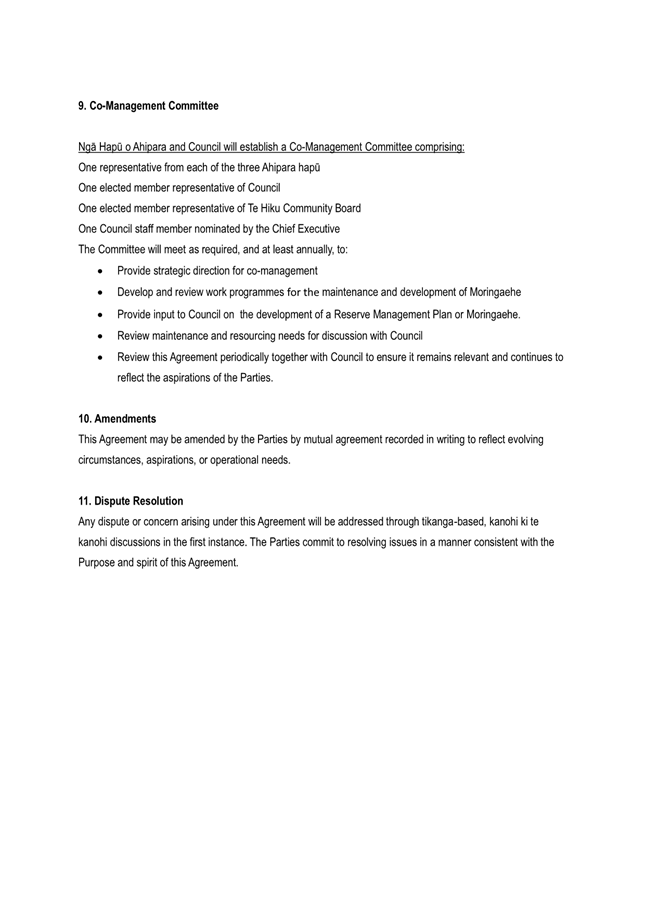
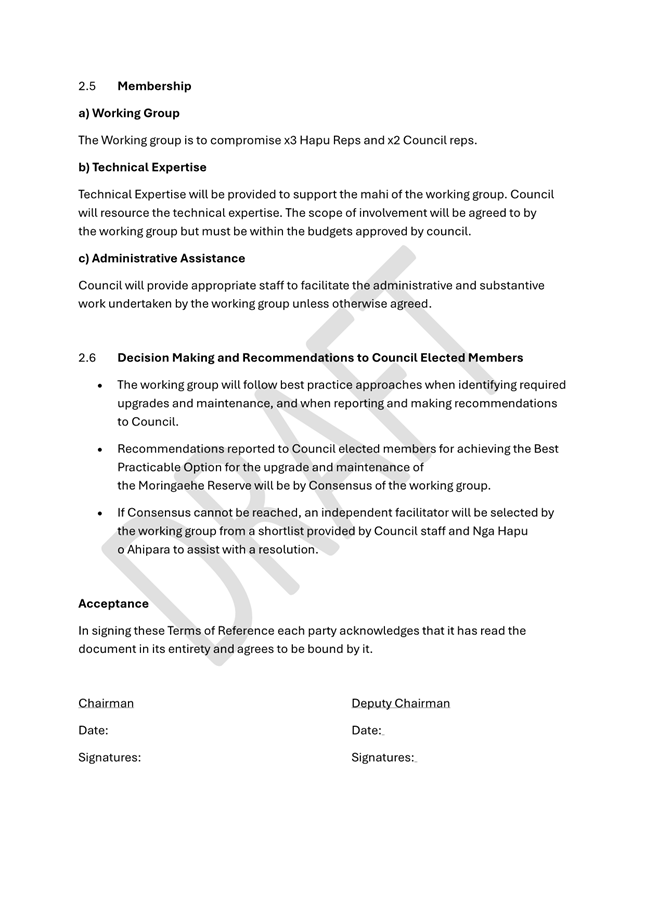
1. DRAFT
Kaitiaki Agreement - Moringaehe Reserve - A5634200 ⇩ 
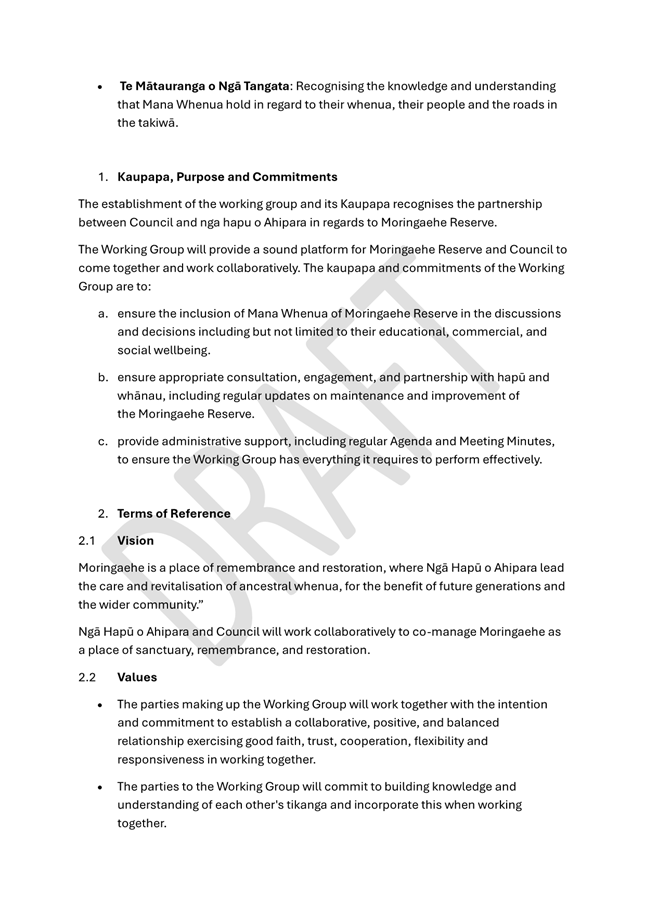
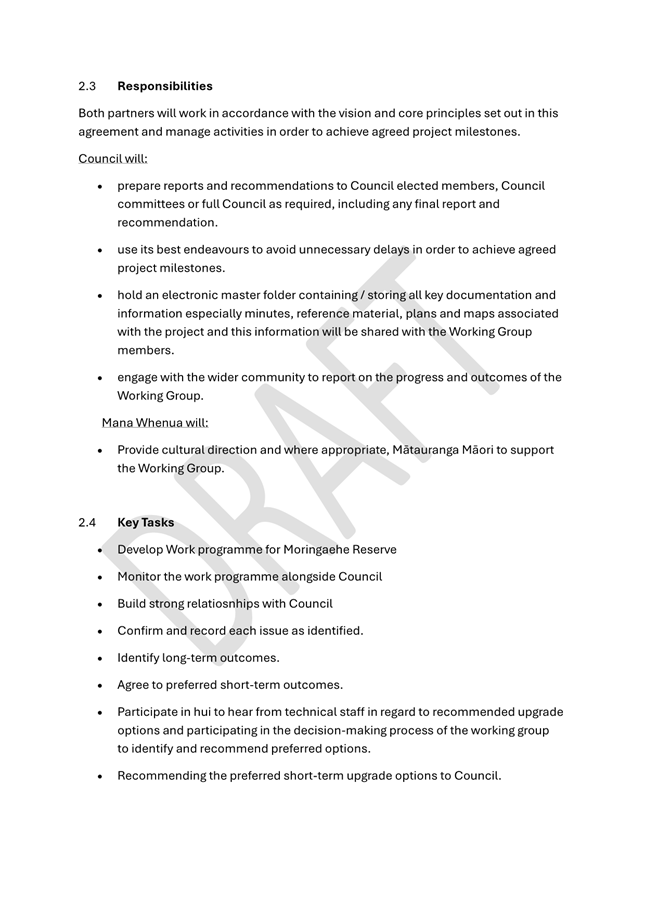
2. DRAFT
Moringaehe Reserve Terms of Reference - A5635306 ⇩
Hōtaka Take Ōkawa / Compliance Schedule:
Full consideration has
been given to the provisions of the Local Government Act 2002 S77 in relation
to decision making, in particular:
1. A Local authority
must, in the course of the decision-making process,
a) Seek to identify all
reasonably practicable options for the achievement of the objective of a
decision; and
b) Assess the options in
terms of their advantages and disadvantages; and
c) If any of the options
identified under paragraph (a) involves a significant decision in relation to
land or a body of water, take into account the relationship of Māori and
their culture and traditions with their ancestral land, water sites, waahi tapu,
valued flora and fauna and other taonga.
2. This section is
subject to Section 79 - Compliance with procedures in relation to decisions.
a) Identified
and assessed reasonably practicable options.
b) Considered the views and interests of
affected parties, including Ngā Hapū o Ahipara.
c) Evaluated the significance of the decision
in accordance with Council policy.
d) Ensured sufficient information is available
to support informed decision-making.
The establishment of a
Co-Management Agreement Working Group and the appointment of councillors are
considered appropriate and proportionate responses, consistent with
Council’s statutory obligations and governance responsibilities
|
He Take Ōkawa /
Compliance Requirement
|
Aromatawai Kaimahi /
Staff Assessment
|
|
State the level of significance (high or low) of the
issue or proposal as determined by the Council’s
Significance and Engagement Policy
|
High
|
|
State the relevant Council policies (external or
internal), legislation, and/or community outcomes (as stated in the LTP) that
relate to this decision.
|
This report has been
prepared in accordance with Section 79 of the Local Government Act 2002.
Officers are satisfied that:
All reasonably practicable
options have been identified and assessed.
The views and interests of
affected parties have been considered.
The decision’s
significance has been evaluated in line with Council policy.
Members have sufficient
information to make an informed decision.
The proposed
recommendations are considered appropriate, proportionate, and consistent
with Council’s statutory decision-making obligations.
|
|
State whether this issue or proposal has a District wide
relevance and, if not, the ways in which the appropriate Community
Board’s views have been sought.
|
This proposal does not have district-wide relevance,
as it specifically relates to the management of Moringaehe Reserve in
Ahipara.
The views of the relevant Community Board have
been sought through briefings and discussions to ensure local priorities,
community interests, and cultural considerations are reflected in the
proposed Co-Management Agreement and Working Group arrangements.
|
|
State the
possible implications for Māori and how Māori have been provided
with an opportunity to contribute to decision making if this decision is
significant and relates to land and/or any body of water.
State the
possible implications and how this report aligns with Te Tiriti o Waitangi /
The Treaty of Waitangi.
|
This decision relates to
land of cultural, historical, and ancestral significance to Ngā
Hapū o Ahipara. As such, it has direct implications for mana whenua,
including:
Recognition and exercise
of kaitiakitanga over Moringaehe Reserve.
Protection of cultural
values, wāhi tapu, and mātauranga Māori.
Participation in
governance and decision-making affecting ancestral whenua.
Long-term environmental,
social, and intergenerational wellbeing outcomes.
Ngā Hapū o
Ahipara have been actively engaged in discussions regarding the proposed
Co-Management Agreement and the establishment of a Working Group. Engagement
has included hui, collaborative planning discussions, and opportunities to
provide input into the proposed governance framework.
The establishment of a
Co-Management Agreement itself provides a formal mechanism for ongoing
Māori participation in decision-making, ensuring representation at the
governance level rather than consultation only.
Alignment with Te
Tiriti o Waitangi / The Treaty of Waitangi
This report aligns with Te
Tiriti o Waitangi principles in the following ways:
Partnership:
Establishes a shared governance model between Council and mana whenua.
Participation:
Provides Ngā Hapū o Ahipara with a structured and ongoing role in
decision-making.
Active Protection:
Supports the protection of cultural values, sites of significance, and
environmental taonga.
Good Faith: Demonstrates Council’s
commitment to working collaboratively and transparently with Māori. The
proposed Co-Management Agreement gives practical effect to these principles
by embedding shared responsibility and joint oversight into the governance
framework for Moringaehe Reserve.
|
|
Identify persons likely to be affected by or have an
interest in the matter, and how you have given consideration to their views
or preferences (for example – youth, the aged and those with
disabilities).
|
Ngā Hapū o Ahipara: Direct interest as
mana whenua; engaged through hui and collaborative discussions.
Local Community: Users of the reserve for
recreation, education, and gatherings; input considered in planning.
Youth (tamariki and rangatahi): Opportunities for
cultural learning and environmental projects.
Kaumātua and Elders: Provide cultural
knowledge and guidance on land use and protection.
People with Disabilities: Accessibility
considerations included in ongoing planning.
Council and Ratepayers: Ensure governance,
compliance, and responsible management.
Engagement to date ensures diverse interests are
considered, with the Working Group providing ongoing input into
decision-making.
|
|
State the financial implications and where budgetary
provisions have been made to support this decision.
|
Operational budgets have been factored into this
agreement with each Manager providing approvals over their budget area
|
|
Chief Financial Officer review.
|
This report has not been reviewed by the CFO
|
|
Ordinary Te Kuaka
Committee for Strategic Māori Relationships Meeting Agenda
|
25 March 2026
|
|
Ordinary Te Kuaka
Committee for Strategic Māori Relationships Meeting Agenda
|
25 March 2026
|
|
Ordinary Te Kuaka
Committee for Strategic Māori Relationships Meeting Agenda
|
25 March 2026
|
4.2 District
Wide Spatial Strategy Project
File
Number: A5629616
Author: Jaye
Michalick, Team Leader – Growth Planning & Placemaking
Authoriser: Roger
Ackers, Group Manager - Planning and Policy
Take Pūrongo / Purpose of the Report
To inform Te Kuaka Committee – Māori
Strategic Relationships (Te Kuaka) about the District Wide Spatial Strategy
(DWSS) project, including an outline of its governance
structure; the project process and timing; planned mana whenua
engagement; and alignment with incoming Resource Management Act
(RMA) legislative reform.
To confirm with Te Kuaka the extent of
involvement by Te Kuaka Committee – Māori Strategic Relationships in
this project.
WhakarĀpopoto matua / Executive Summary
· This
report introduces Te Kuaka to the DWSS project, outlining key aspects of the
project, including:
· setting
out the purpose of a spatial strategy and why it is important to progress this
workstream.
· outlining
the project stages and timeframes, which have been developed to integrate with
the proposed RMA Reform, to take account of reform programme uncertainties and
to inform any future regional spatial plan required.
· discussing
the value of identifying a preferred spatial scenario by early 2027 to inform
the development of regional spatial plan, which is expected to be commenced in
2027, in accordance with anticipated incoming RMA reform legislative
requirements.
· outline
the project governance structure, with a focus on the recommended approach for
engaging with mana whenua via Te Kuaka and through iwi and hapū engagement
across the project duration.
· providing
more detail regarding the first stage of the project (next steps).
|
tŪtohunga
/ Recommendation
That Te Kuaka Committee for Strategic Māori
Relationships:
a) Receive
the report District Wide Spatial Strategy Project;
and,
b) Confirms that Te
Kuaka Committee – Strategic Māori
Relationships will provide strategic direction into this
project via workshops at the following stages of project
development:
1. Strategy
visions, principles and objectives;
2. Spatial
Scenarios Report;
3. Draft
Spatial Strategy Report for Consultation; and
4. Recommendation
to Te Kūkupa Committee for Strategy, Policy and
Regulation and Council on adoption of the Strategy.
|
1) TĀhuhu kŌrero / Background
The Far North district faces distinct challenges and
opportunities. The combination of large, complex geography, a predominantly
rural population, extensive infrastructure networks and vulnerabilities,
significant long-term socio-economic issues and inequalities position the Far
North as unique within New Zealand. A spatial strategy (or spatial plan) is a
mechanism through which long-term growth, servicing requirements, and community
aspirations can be explored and understood, and a planned approach to their
realisation can be developed.
At present the Far North has an adopted spatial plan for
Kerikeri-Waipapa (Te Pātukurea) but it does not have a spatial plan for
the balance of the district. The purpose of the DWSS is to provide the rest of
the district a plan for how it wants to grow and change over the next thirty
years.
The DWSS project will inform Council’s future
Long-Term Plan priorities and support the Far North 2100 Growth Strategy by
providing a clear spatial framework that is locally relevant, grounded in
partnership, and is analytically and technically robust to provide the
foundation for district-wide transformational change. The spatial strategy will
not only focus on growth and infrastructure required to facilitate that (where
relevant), but on long-term structural change, community well-being, Māori
aspirations, and transformative policy. Project planning and some
early mana whenua engagement[1]
commenced from mid-2025, including two hui with the District Wide Kaupapa
Steering Rōpū, however the project has now formally moved into an
active project
2) matapaki me NgĀ KŌwhiringa /
Discussion and Options
This section outlines the project including project stages
and timing, governance structure, engagement approach, alignment with RMA
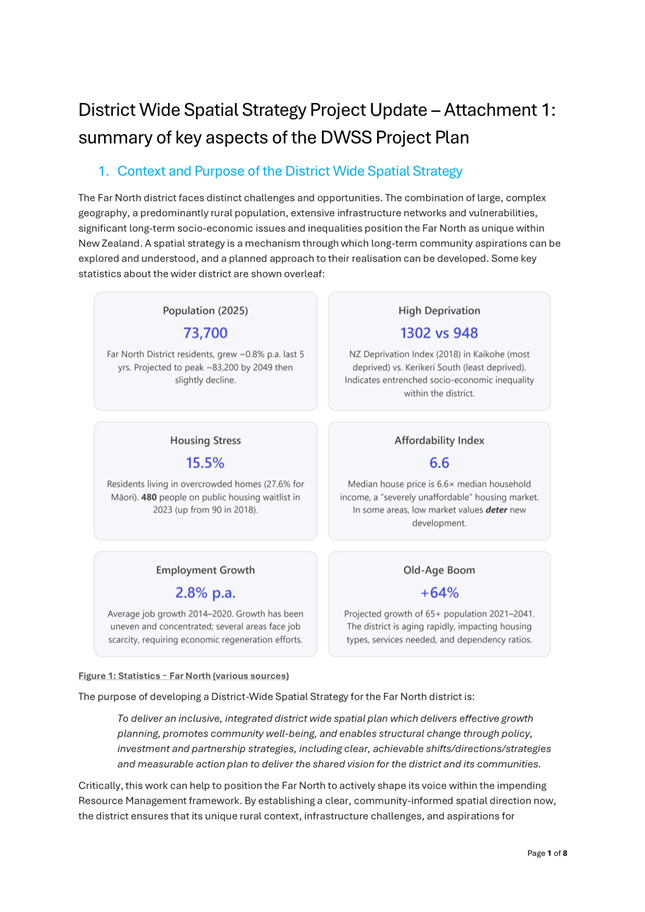
reform, and it discusses next steps. Attachment 1 provides a more detailed
summary of key aspects of the DWSS Project Plan, specifically, context,
purpose, project stages, timing and outputs, and project governance and role
descriptions.
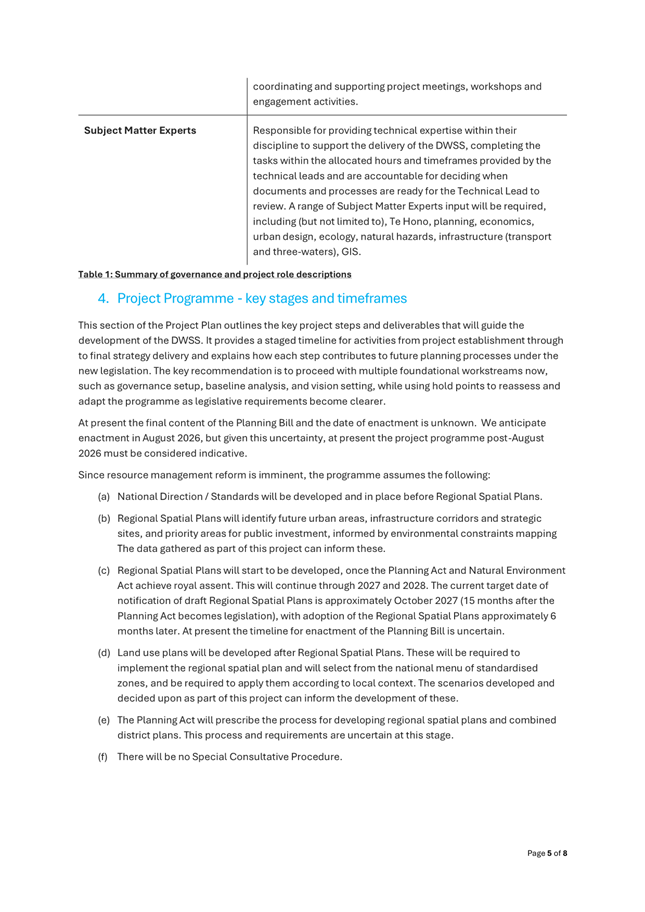
1. PROJECT
STAGES AND TIMING
The DWSS will be developed in stages as summarised in
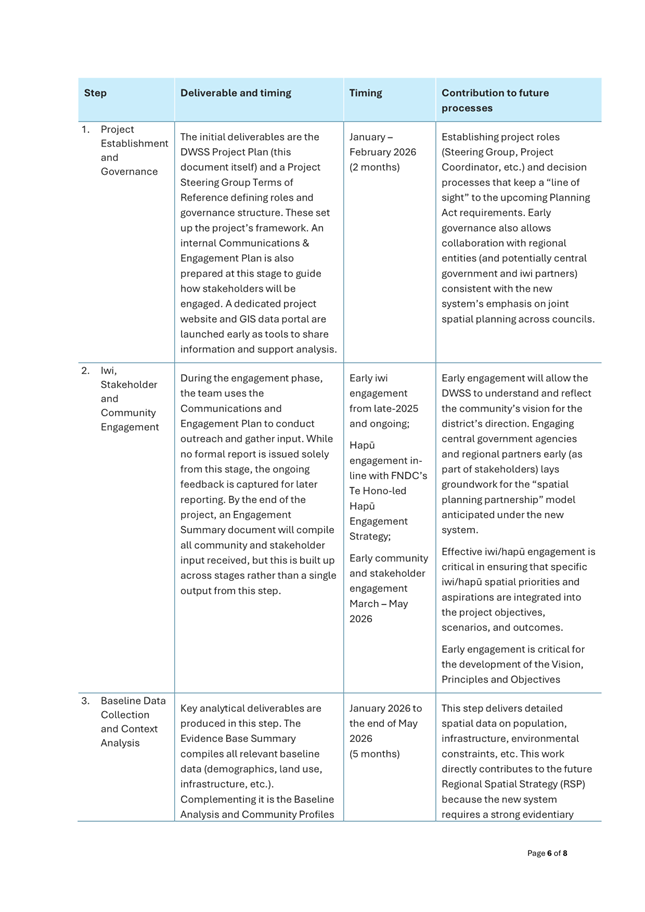
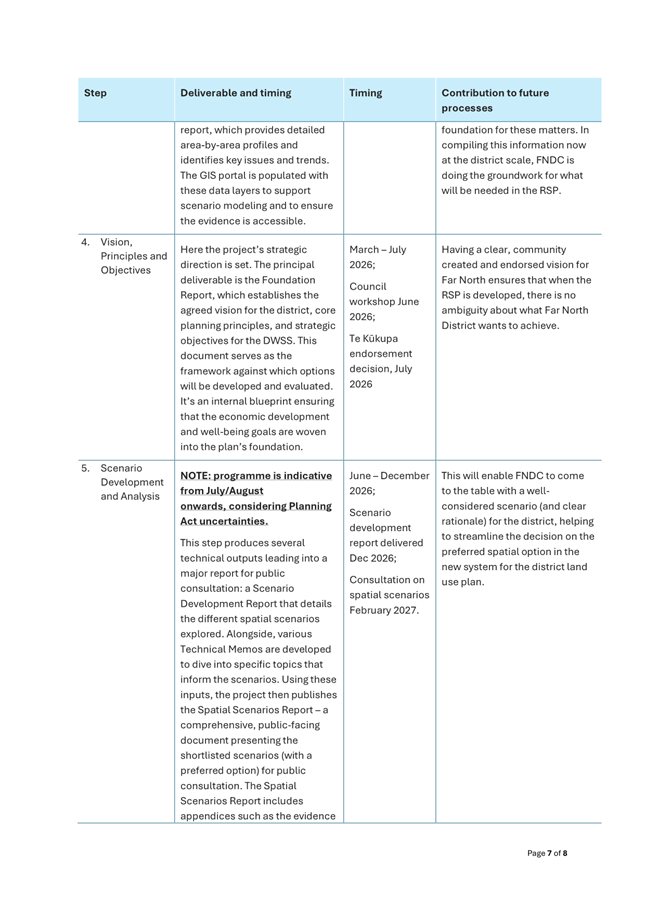
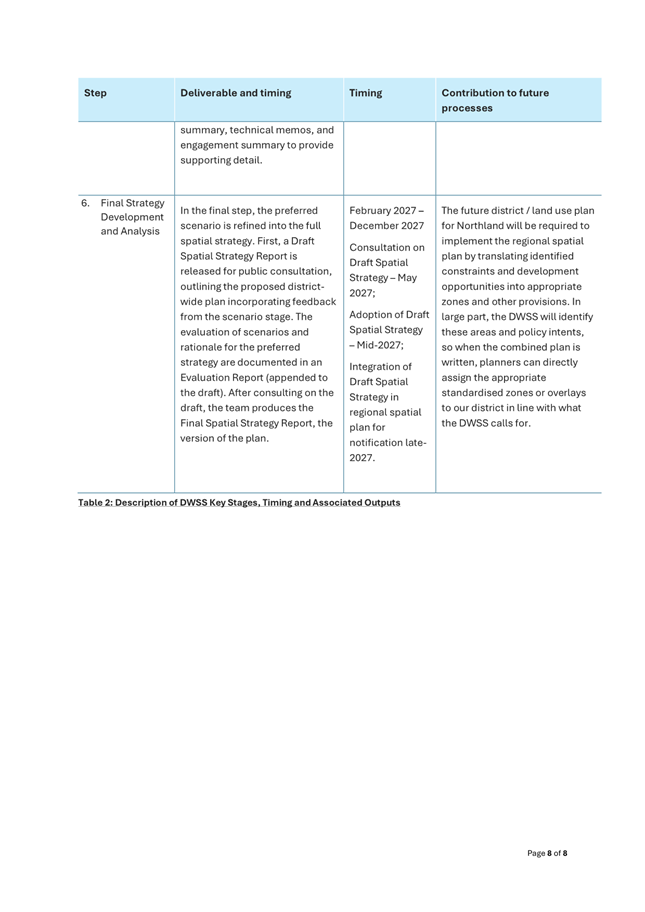
Table 1. Attachment 1 provides a more detailed description of the
project stages and associated outputs.
At present the final content of the Planning Bill and the
date of enactment is unknown. We anticipate enactment in August 2026, but
given this uncertainty, the project programme post-August 2026 must be
considered indicative.
At present this uncertainty does not have budgetary
implications for the project (see Compliance Schedule).
Table 1: Project Stages and Timing
|
Stage
|
Description
|
Timing
|
|
1. Project Establishment and
Governance
|
Establishing project roles and
decision processes. Potential for collaboration with regional
entities consistent with the new system’s emphasis on joint spatial
planning across councils.
Outputs: DWSS Project Plan, Project
Steering Group Terms of Reference, an internal Communications
& Engagement Plan, dedicated project website and GIS
data portal.
|
January – February 2026
(2 months)
|
|
2. Iwi, Stakeholder and Community
Engagement
|
Early
engagement will allow the DWSS to understand and reflect the
community’s vision for the district’s direction. Engaging
central government agencies and regional partners early lays groundwork for
the “spatial planning partnership”
model anticipated under the new system.
Outputs: By
the end of the project, an Engagement Summary.
|
.
Early iwi engagement from late 2025
onwards;
Hapū engagement in line with
FNDC’s Te Hono-led Hapū Engagement Strategy;
Early community and stakeholder
engagement March – May 2026.
|
|
3. Baseline Data Collection and Context
Analysis
|
This step delivers detailed spatial
data on population, infrastructure, environmental constraints, etc. This work
directly contributes to the future Regional Spatial Strategy (RSP) because
the new system requires a strong evidentiary foundation for these
matters.
Outputs: Evidence Base
Summary, Baseline Analysis and Community Profiles report. The
GIS portal is populated with these data layers to support scenario
modelling. Outputs inform the Foundation Report.
|
January 2026 to the end of May
2026
(5 months)
|
|
4. Vision, Principles and
Objectives
|
Here
the project’s strategic direction is set. Having a clear, community created and
endorsed vision for Far North ensures that when the RSP is developed, there
is no ambiguity about what Far North District wants to achieve
Outputs: Foundation Report (includes engagement and evidence
summaries)
|
March – July 2026 (5 months);
Council (incl. Te Kuaka) workshop on
VPO mid-June; Te Kūkupa endorsement decision on VPO July 2026.
Foundation Report delivered late July 2026
|
|
5. Scenario Development and
Analysis
|
NOTE: programme is indicative from
July/August onwards, considering Planning Act uncertainties
This will enable FNDC to come to the
table with a well-considered spatial scenario (and clear rationale)
for the district, helping to streamline the decision on the preferred spatial
option in the new system for the district land use plan.
Engagement with iwi, hapū,
communities and stakeholders continues.
Outputs: Scenario
Development Report, Technical Memos Spatial Scenarios Report (for
public consultation).
|
June 2026 – December 20262026 to
December 2026
(7 months);
Scenario development report
delivered December 2026;
Consultation
on spatial scenarios in February
2027
(1 month)
|
|
6. Final Strategy Development and
Analysis
|
In
the final step, the preferred scenario is refined into the full spatial
strategy.
Outputs: Draft
Spatial Strategy Report (for consultation), Evaluation Report and the Final
Spatial Strategy.
|
February 2027 to December
2027
Consultation on Draft Spatial Strategy
– May 2027;
Adoption of Draft Spatial Strategy
– Mid-2027;
Integration of Draft Spatial Strategy
in regional spatial plan for notification late-2027.
|
2. GOVERNANCE
AND PROJECT STRUCTURE
Te Kūkupa Committee
for Strategy, Policy and Regulation
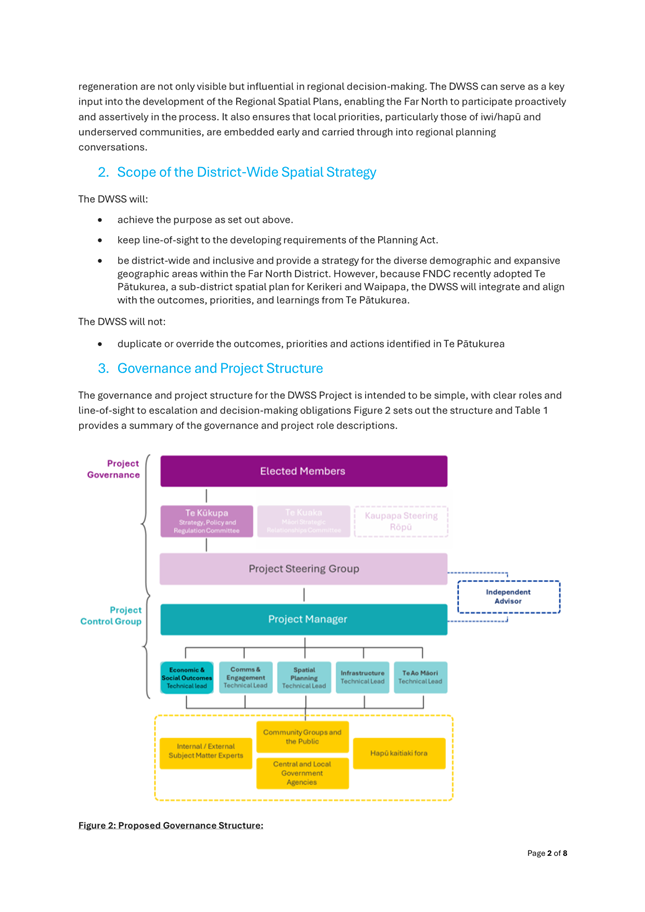
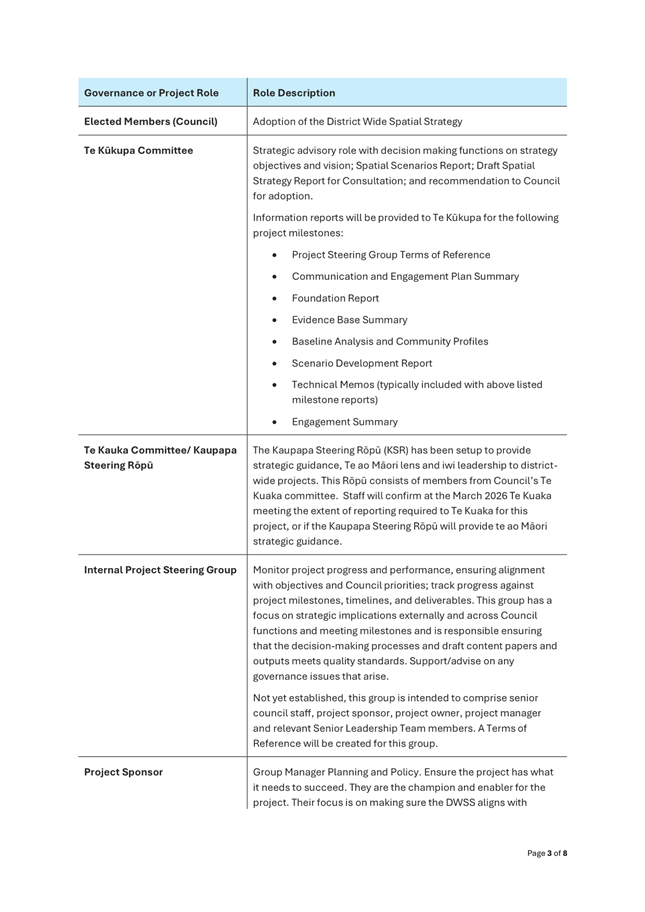
The DWSS governance and project structure (Figure 1)
is intended to be simple, with clear roles and decision-making obligations.
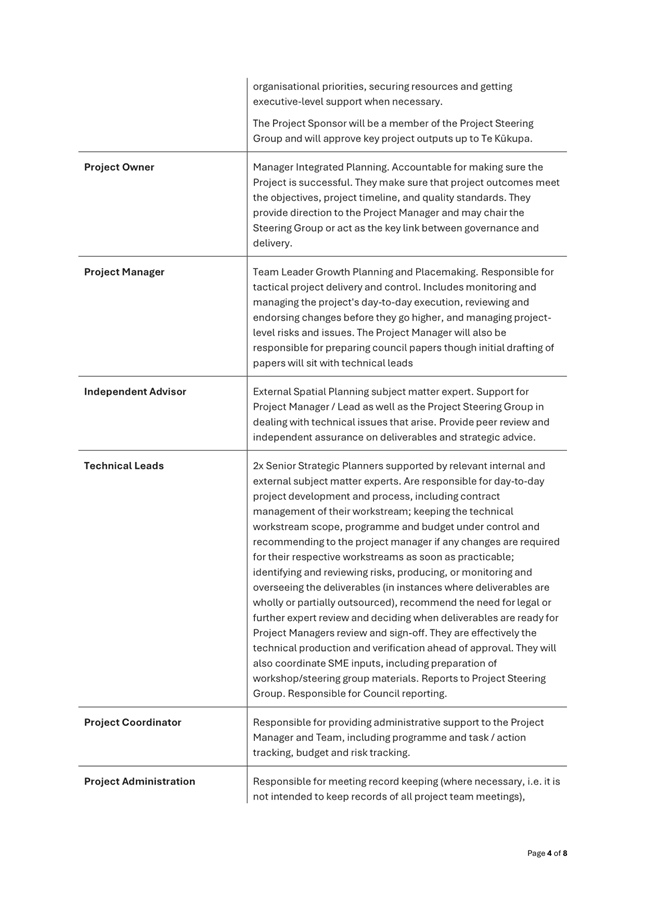
Attachment 1 provides a summary of project role descriptions in relation to
Figure 1.
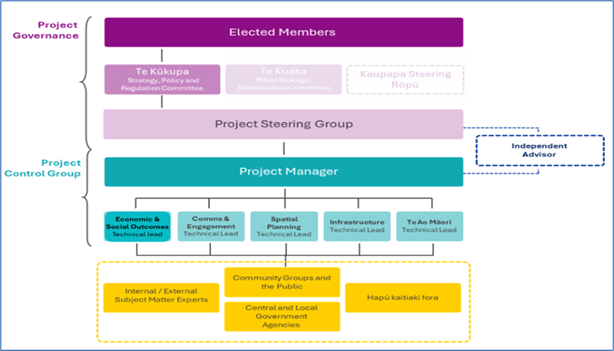
Figure 1: Proposed Governance Structure
In accordance with the
Te Kūkupa Strategy, Policy and Regulation Committee Terms
of
Reference, Te Kūkupa will provide a strategic
advisory role with decision making functions on the following key project
milestones:
· Strategy visions, principles and objectives;
· Spatial
Scenarios Report;
· Draft
Spatial Strategy Report for Consultation; and
· Recommendation
to Council for adoption.
Information reports will also be provided
to Te Kūkupa Committee as the project progresses
through other project milestones.
Mana whenua engagement on this project is intended to
be achieved through several channels as set out below:
Te Kuaka Committee for Māori Strategic
Relationships
The project team propose to
receive strategic direction from Te Kuaka
Committee, to ensure Māori perspectives and objectives
for Te Hiku o te Ika are effectively incorporated into this
project, via workshops on the following for milestones, noting that
some of these workshops may be combined with all of Council and community
board:
· Strategy visions, principles and objectives;
· Spatial
Scenarios Report;
· Draft
Spatial Strategy Report for Consultation; and
· Recommendation
to Council for adoption.
These workshops will be scheduled to
enable workshop outcomes to inform the relevant
project milestone report that is to
be submitted to Te Kūkupa Committee.
The District Wide Kaupapa Steering Rōpū
The District Wide Kaupapa Steering Rōpū (KSR,
endorsed by Te Kuaka Committee resolution 2024/25, is included in the DWSS
project governance structure however at the time of writing, the Kaupapa
Steering Rōpū is yet to re-establish in this triennium and staff
understand that the topic of re-establishing the KSR will be the subject of a
separate paper to a future Te Kuaka meeting.
When, or if, the KSR is re-established, the project
team will seek direction from Te Kuaka on whether to continue to
schedule the above-described project milestone workshops with Te
Kuaka, or whether the KSR will take on that function.
Direct Iwi Engagement
To align outputs of this project
with the commencement of developing a regional spatial plan
in 2027, ongoing iwi engagement with this project is critical; the Manager
of Te Hono has committed to work with the project team to plan and undertake
early iwi engagement on a traditional iwi by iwi approach in early
2026. The purpose of direct iwi engagement is to ensure that specific iwi
spatial planning priorities and aspirations are integrated into the project
objectives, scenarios and outcomes.
Currently the project team is actively engaged with
Te Hiku iwi, via the Te Hiku Iwi Development
Trust (THIDT). Direct engagement with iwi leaders
has occurred via the Te Kauta Housing Strategy Steering
Group and an in-person meeting was recently held with THIDT in
Kaitāia. further engagement is planned involving Te Hiku iwi
representatives in April-May, invited iwi will include:
· Te
Rarawa
· Ngāi Takoto
· Ngāti
Kahu
· Te Aupōuri
· Ngāti Kurī (invited
by THIDT).
Broader iwi engagement is being advised by Te Hono, and to
date early engagement has involved direct communications with recognised iwi
authorities, inviting their participation. This communication has been directed
to Te Kahu o Taonui representatives. At present, in addition to Te Hiku iwi
engagement, the following iwi entities have indicated an interest in
participating in DWSS discussions:
· Te Rūnanga o
Te Rarawa
· Te Rūnanga o
Ngāi Takoto
· Te Rūnanga
ā-Iwi o Ngāti Kahu
· Te Rūnanga o
Whaingaroa
· Te Rūnanga o
Ngāti Hine.
Hapū Engagement
In line with the district-wide kaupapa framework and
FNDC hapū engagement strategy, hapū engagement will be
conducted through quarterly hapū fora, held in each FNDC ward,
at alternating marae. Te Hono is advising the project team in this
engagement. This approach does not anticipate district wide hapū
engagement.
Engagement approach
The following key engagement principles are
factored into the proposed approach for engagement, and it is acknowledged
that the tight timeframes across 2026 will require significant
resourcing from the project team to achieve these. Early iwi engagement at the
start of 2026 is considered critical to ensure sufficient time across 2026 to
achieve effective participation.
· Time
and Continuity: Building trust requires early engagement and ongoing
dialogue.
· Cultural
competency and partnership: Engagement with mana whenua involves shared
governance and tikanga and time to build in a true partnership.
· Multi-Channel
approaches: Combining digital tools with in-person engagement.
· Transparency
and Feedback Loops: Communities need to see how input influences
outcomes.
Engagement and consultation milestones for the
project are:
· Undertake
engagement with iwi and key stakeholders - initial feedback on challenges,
vision/aspirations, objectives and principles + project wide
engagement and relationship building (February – May 2026). As
above, hapū engagement will be held in-line with the
FNDC’s Hapū Engagement Strategy.
· Project
wide engagement on spatial scenario options development (August to December
2026)
· Public
consultation on spatial scenario options (February 2027)
· Public
consultation on draft spatial strategy, if the project continues
beyond 2026 (May 2027)
· Inform
the public on the final spatial strategy (August 2027).
Alignment with Resource Management Reform
The Planning Bill, introduced in late-2025 and
intended to pass into legislation mid-2026, seeks to establish a new
planning hierarchy requiring a regional combined
plan comprising a regional spatial plan, a natural environment plan
and land use plans for each district. While the final form of the Planning Act
is unknown, staff have developed the DWSS project plan to deliver critical
early outputs in line with the current
proposed timeframe to commence development of
Northland’s first regional spatial plan (RSP) (from early 2027). If the
RMA reform programme timeframe is extended, the DWSS project can be
continued across 2027 towards adoption of the strategy.
A spatial plan can typically take 18 to 24 months to
produce, depending on both the complexity of the plan and the necessary extent
of partnership, engagement and consultation. The timeline for the
DWSS project contemplates the plan being adopted by Council in July/August
2027. However, to align with likely requirements of the future Planning Act,
the project has been developed to enable completion of public consultation on
district wide spatial scenario options by early 2027, enabling the Far North to
have a preferred long-term spatial scenario for the district, alongside Te
Pātukurea, to contribute to the development of the regional spatial
plan.
The value in FNDC leading this process is that FNDC
has a closer connection to the communities we are seeking to plan
for. Having a clear, community created and endorsed vision for Far North
ensures that when the regional spatial plan is developed, there is no ambiguity
about what Far North District wants to achieve. The future RSP will require a
strong evidentiary foundation, in compiling baseline data (demographics, land
use, infrastructure) now as part of this project, FNDC is doing the groundwork
for, and determining, what will be needed in the RSP.
Project next steps
Across February to May, the project team will be
focused on:
· establishing
the internal steering group
· engaging with
mana whenua
· commencing
tasks under Step 3 – baseline data collection and context analysis
· undertaking
engagement to inform development of a
vision, principles and objectives for the strategy.
Options
Option 1: Endorse the recommended option that Te Kuaka
provide strategic direction into this project via workshops at
the following stages of project development: Strategy visions,
principles and objectives; Spatial Scenarios Report; Draft Spatial
Strategy Report for Consultation; and Recommendation
to Te Kūkupa Committee, which then recommends
to Council the final Strategy for adoption.
This option provides for workshops with Te Kuaka to inform
key milestones of this project while also best supports the project team to
complete those milestones across 2026-2027, working towards having key outputs
to inform the development of a regional spatial plan, when that is expected to
commence in 2027.
Option 2: Direct
staff to engage with Te Kuaka Committee on this project in a different way, for
example requiring reports to be submitted for endorsement by Te Kuaka to Te
Kūkupa at key project milestones. This approach is expected to result in
pushing out timeframes, the extent of this would depend on the extent of papers
required to go through Te Kuaka. This approach may be considered to provide Te
Kuaka more certainty regarding matters of importance to Te Kuaka being retained
through the process.
Option 3: Delegate engagement by Te Kuaka in this project
to the KSR, if the rōpū is reestablished this year. This approach may
result in pushing out timeframes, as this is no certainty when this would
occur.
TAKE TŪTOHUNGA / REASON FOR THE RECOMMENDATION
Option 1 is recommended as a balanced way of ensuring
project outputs are achieved in the limited timeframe available leading up to
commencing development of a regional spatial plan, while providing dedicated
workshop time to work through and capture into the project outputs, matters of
importance to Te Kuaka on this project. This option also allows for the
committee to review its position if the KSR becomes active again.
3) PĀnga PŪtea me ngĀ
wĀhanga tahua / Financial Implications and Budgetary Provision
The Growth Planning and Placemaking Team professional fees
budget is sufficient to meet the forecasted costs associated with this project,
which are approximately $460,000 for this financial year. Sufficient
funds to continue this project across the next financial year have
been forecast into the upcoming annual plan process.
Āpitihanga
/ Attachments
1. DWSS
Project Plan Key Aspects Summary_revised - A5634768 ⇩ 
Hōtaka Take Ōkawa / Compliance Schedule:
Full consideration has been given to the provisions of the
Local Government Act 2002 S77 in relation to decision making, in particular:
1. A
Local authority must, in the course of the decision-making process,
a) Seek
to identify all reasonably practicable options for the achievement of the
objective of a decision; and
b) Assess
the options in terms of their advantages and disadvantages; and
c) If
any of the options identified under paragraph (a) involves a significant
decision in relation to land or a body of water, take into account the
relationship of Māori and their culture and traditions with their
ancestral land, water sites, waahi tapu, valued flora and fauna and other
taonga.
2. This
section is subject to Section 79 - Compliance with procedures in relation to
decisions.
|
He Take Ōkawa /
Compliance Requirement
|
Aromatawai Kaimahi /
Staff Assessment
|
|
State the level of significance (high or low) of the
issue or proposal as determined by the Council’s
Significance and Engagement Policy
|
In accordance with Council’s Significance and
Engagement Policy, this decision is not assessed a being of high significance
as it does not involve the transfer of ownership or control of a strategic
asset, and it is not inconsistent with Council plans or policies. The public
will be engaged with during development of the draft strategy, and formally
consulted on the draft strategy.
|
|
State the relevant Council policies (external or
internal), legislation, and/or community outcomes (as stated in the LTP) that
relate to this decision.
|
Far North 2100
Te Pātukurea, Kerikeri Waipapa Spatial Plan
The Resource Management Act 1991
National Policy Statement – Urban Development 2020
National Policy Statement – Highly Productive
Soils 2022
Local Government Act 2002
Northland Regional Policy Statement
Far North District Council Proposed District Plan
The Planning Bill currently making its way through
parliament.
|
|
State whether this issue or proposal has a District wide
relevance and, if not, the ways in which the appropriate Community
Board’s views have been sought.
|
This proposal is of district wide significance.
|
|
State the
possible implications for Māori and how Māori have been provided
with an opportunity to contribute to decision making if this decision is
significant and relates to land and/or any body of water.
State the
possible implications and how this report aligns with Te Tiriti o Waitangi /
The Treaty of Waitangi.
|
This project is about planning for long-term growth in
the district for Māori and non-Māori. This report sets out and
seeks guidance from Te Kuaka on how Māori can have strategic input into
this project, alongside the planned individual iwi engagement for this
project.
The mana whenua engagement process proposed facilitates
a collaborative relationship between Te Kaunihera and mana whenua, ensuring
that Māori values, mātauranga and aspirations are embedded in how
land and resources are intended to be managed in the future.
|
|
Identify persons likely to be affected by or have an
interest in the matter, and how you have given consideration to their views
or preferences (for example – youth, the aged and those with
disabilities).
|
A stakeholder identification process has been completed,
drawing on local knowledge and staff engagement expertise, to ensure that,
alongside mana whenua, community groups, rangatahi, government agencies,
industries and other groups likely to be instrumental in informing or
implementing the final spatial strategy, will be engaged with either as key
stakeholders, or as part of wider public engagement planned to ensure views
and preferences of interested parties are obtained.
|
|
State the financial implications and where budgetary
provisions have been made to support this decision.
|
The Growth Planning and Placemaking Team budget for this
financial year 2025-2026 is sufficient to cover the estimated costs for this
2025-2026 financial year, which are $460,000. Sufficient funds to continue to
progress the project next financial year have been put forward for the next
annual plan for 2026 – 2027 financial year
|
|
Chief Financial Officer review.
|
The CFO has reviewed this report.
|
|
Ordinary Te Kuaka
Committee for Strategic Māori Relationships Meeting Agenda
|
25 March 2026
|
|
Ordinary
Te Kuaka Committee for Strategic Māori Relationships Meeting
Agenda
|
25
March 2026
|
5 Ngā
Pūrongo Taipitopito / Information Reports
5.1 Whenua
Māori - Freehold Land Rating Relief Update
File
Number: A5629589
Author: Zena
Tango, Team Leader - Transaction Services
Authoriser: Charlie
Billington, Group Manager - Corporate Services
TAKE PŪRONGO / Purpose of the Report
The purpose of this report is to update Te Kuaka Committee
for Strategic Māori Relationships (Te Kuaka) on the work completed by the
Whenua Māori Working Group (the Working Group) last rating year.
WHAKARĀPOPOTO MATUA / Executive SummarY
· The Working Group was established to ensure Far North District
Council (FNDC) provides ongoing support to Māori Freehold Landowners;
· The Working Group has committed to a holistic approach with
cross Council collaboration and community engagement to achieve key outcomes of
reducing debt levels, clarifying rating information, reducing barriers to land
use and development, stimulating regional growth, and enhancing understanding
of Whenua Māori.
|
TŪTOHUNGA
/ Recommendation
That Te Kuaka Committee for Strategic Māori
Relationships for Strategic Māori Relationships receive the report
Whenua Māori - Freehold Land Rating Relief Update.
|
tĀHUHU KŌRERO / Background
The Working Group was formally established to ensure that Far North
District Council (FNDC) continues to provide meaningful and sustained support
to Māori Freehold Landowners. The group has implemented a holistic, cross‑Council
approach that actively involves community engagement.
Through
this collaborative effort, the Working Group has completed actions aimed at:
· Reducing debt levels for Māori Freehold Landowners
· Clarifying rating information and improving transparency
· Reducing barriers to land use and development
· Supporting and stimulating regional economic growth
· Enhancing understanding and awareness of Whenua Māori across
the organisation and community
The following activities collectively demonstrate the Working
Group’s commitment to enabling better outcomes for Māori Freehold
Land and its owners.
MATAPAKI ME NGĀ KŌWHIRINGA /
Discussion and Next Steps
Rating reviews
A total
arrears balance of $1,035,756.90 for 239 properties, has been written off since
the start of the working group was established, in April 2024. $437,894.44 of
the above is the CE write offs that have been processed.
For the
last rating year we received payments of $2,387,756.78 towards Whenua
Māori rates. $5,437,536.03 was the total amount of rates struck for the
previous rating year.
Remissions applied to
Whenua Māori:
For the
2024/2025 year we received and/or applied remissions to 510 Whenua Māori
properties, this is slightly up from the 482 applications we received/applied
in the prior year.
|
Period
|
Remission Type
|
Number of properties
|
|
2025
|
Common-Use Properties
|
25
|
|
2025
|
Enabling Housing
Development on MFL (Yr 1-3)
|
1
|
|
2025
|
Incentivizing Māori
Economic Development (Year 5)
|
1
|
|
2025
|
ML04/01 Māori
Freehold Land Not Used
|
105
|
|
2025
|
Papakainga on Māori
Freehold Land
|
334
|
|
2025
|
Properties Spanning
Multiple Districts
|
1
|
|
2025
|
Remission of Charges on
Contiguous Properties
|
35
|
|
2025
|
Remission of Rates on
Land (QEII Covenant)
|
4
|
|
2025
|
School Sewerage Charges
|
3
|
|
2025
|
Incentivizing Māori
Economic Development (Year 1)
|
1
|
Request For Service (RFS)
data
Revenue
Recovery, Te Hono and the Rating team received 327 requests for service in the
past year in relation to Whenua Māori queries.
Geospatial Mapping
Due to the
ongoing vendor issues which include corrupted data, base map issues and the
vendors multiple health concerns, the Revenue Recovery team started manually
reviewing the 2501 rateable accounts.
The vendor
had delivered the artificial intelligence feature extract to Far North District
Council. We then supplied the satellite imagery to Innvex for our feature
extractions, once uploaded the file was incorrect and the feature did not line
up with the basemap. The vendor ran a new extraction for FNDC. We
are in the process of analysing the data and verifying the accuracy of the AI
(Artificial Intelligence) outputs. Validation is being conducted using
the LINZ Building Outline dataset and Resource Consent data.
The team
aim to complete this work by the end of August 2025.
Last
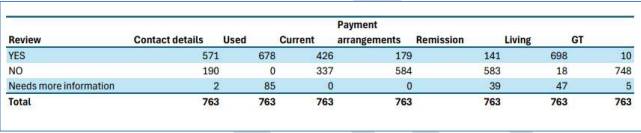
rating year the Revenue Recovery team manually reviewed 763 accounts.
From this data 178 accounts need further investigation. During the review
process we now have 2306 rateable Whenua Māori accounts.
Engagement
The 2024/2025 engagement plan set
for the working group was to focus on providing ongoing support to Whenua
Māori owners as well as a cross council holistic approach to community
engagement, reducing debt levels, clarifying rating information, reducing
barriers to whenua use and development, as well as an enhanced understanding of
Whenua Māori throughout our region and most importantly within FNDC.
The following was proposed to SLT
and to Te Kuaka Committee:
· Workshops: Hosting
workshops to receive feedback and ensure points of view are considered prior to
engaging in Marae visits
· Marae Visits: Engaging
with Māori Freehold Landowners through Marae visits.
· Online Platforms: Developing
culturally relevant online engagement platforms with videos, articles,
interactive maps, and dedicated web pages. Engagement will also include emails,
surveys, and social media content.
· Cultural Festivals and Events: Participating in or sponsoring events that celebrate
Māori culture to foster informal interactions and relationship-building.
Workshop
A Whenua Māori focus group session was held in Kaikohe
to ascertain the real-life hurdles that are preventing development of whenua
Māori, to fact check our information and ensure it is relevant and
understands the intricacies of Māori Freehold Land. We had 17
attendees who provided us with valuable insight and feedback that was utilised
in the remainder of our engagement plan.
Learning
and Development
A Whenua Māori training presentation as well as a
comprehensive Promapp for customer facing roles has been developed and rolled
out throughout FNDC, including a full presentation to all staff on Whenua
Māori.
Marae
visits
We
held five Marae hui throughout the Far North– which were well represented
by staff, with attendance by Te Kooti Whenua Māori. The consensus
received from over 115 attendees was welcomed and provided us with valuable
insights to what we can deliver better and how we incorporate that into
future hui.
The marae hui held were:
|
Date
|
Marae
|
|
23
Nov 2024
|
Waipuna
Marae
|
|
16
Dec 2024
|
Ōtiria
Marae
|
|
14
Mar 2025
|
Haititaimarangai
Marae
|
|
07
Apr 2025
|
Roma
Marae
|
|
07
Jun 2025
|
Te
Tii Waitangi Marae
|
Cultural events
Members of
the working group attended multiple cultural events to promote the Whenua
Māori Marae Hui and provide information brochures on Whenua
Māori.
Online platforms
Social
media posts/reels data analysis of marae hui:
• Waipuna
Marae – 1051 views, reached 511 people and 7 interactions.
• Ōtiria
Marae – 4217 views, reached 881 people and 21 interactions.
• Roma
Marae – 20,926 views, reached 19,643 people and 303 interactions.
• Haititaimarangai
Marae postponed hui – 51,827 views, reached 32,450 people and 379
interactions.
• Te
Tii Waitangi Marae – 54,532 views, 821 likes and interactions and 197
shares.
Updates
The team will provide verbal updates on any changes
that have occurred since the report was submitted, at the committee meeting.
A more comprehensive report will be presented at the next
hui 19 April 2026.
PĀNGA PŪTEA ME NGĀ WĀHANGA
TAHUA / Financial Implications and Budgetary Provision
Provision is made for doubtful debts in relation to the
general arrears and Māori Freehold Land arrears owed to council. This is
reviewed on a yearly basis and updated accordingly in line with council
auditors.
Financial implications are
relevant to the engagement plan as budget is required to fund this activity.
Āpitihanga
/ Attachments
Nil
|
Ordinary Te Kuaka
Committee for Strategic Māori Relationships Meeting Agenda
|
25 March 2026
|
5.2 Ngā
Kaupapa Māori / Matters of Importance to Māori
File
Number: A5629595
Author: Llani
Harding, Pouhautū Te Hono - Manager - Te Hono
Authoriser: Aaron
Taikato, Manuhautū Te Hono – Group Manager Te Hono
TAKE PŪRONGO / Purpose of the Report
To provide Te Kuaka Committee for
Strategic Māori Relationships (Te Kuaka) with a report on Ngā Kaupapa
Māori / Matters of Importance to Māori from the last Te Kuaka hui
September, 2025 to March, 2026.
WHAKARĀPOPOTO MATUA / Executive SummarY
· Te Kuaka is committed to ensuring that the work of the Committee is
carried out in a way that enhances the social, economic, cultural, and
environmental wellbeing of the Far North District and
assist Council as appropriate in conducting and maintaining effective, good
faith working relationships with the Māori community.
· Ngā
Kaupapa Māori / Matters of Importance to Māori are raised at Council meetings and/or by the Kahika/Mayor and
Councillors, Te Kahu o Taonui Iwi Representatives or members of the public.
This report serves as a mechanism to provide Te Kuaka Committee with an update on matters from the last hui in the previous triennium to
the first sitting in the current triennium.
|
TŪTOHUNGA
/ Recommendation
That Te Kuaka Committee for
Strategic Māori Relationships receive the report Ngā Kaupapa
Māori / Matters of Importance to Māori .
|
tĀHUHU KŌRERO / Background
This report, Ngā
Kaupapa Māori / Matters of Importance to Māori,
serves as a mechanism to provide Te Kuaka with updates on the kaupapa / matters
pertaining to Māori that council were involved in through the year.
MATAPAKI ME NGĀ KŌWHIRINGA /
Discussion and Next Steps
Peowhairangi ki
Whangaroa Wāri - Māhuru 2025 ki Poutūterangi 2026 – Bay of
Islands-Whangaroa Ward – September 2025 – March 2026
30/09/25 – Mana Ōrite
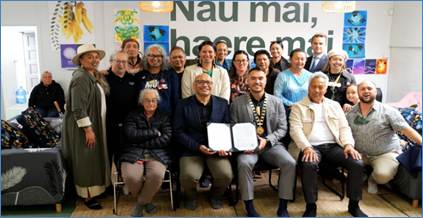
Relationship Agreement formalisation:
Te Mana
Ōrite Relationship Agreement signing at Pokapū Hauora Community Hub
– Kāeo. Following months of negotiations with Te Rūnanga o
Whaingaroa, the agreement was formalised between Council and Iwi.
10/10/25 – Civic Engagement
Support
Te Hono supported the Civic Engagement
& Education team with the Mobile Ballot Box tour at Te Kura Kaupapa
Māori o Taumārere. This kaupapa aimed to support communities within
Taumārere to vote in the Local Elections.
16/10/25 – FNDC Online Content
Creation:
Te Hono
supported the Communications and Engagement team in producing a series of
Interview videos with Francis Goulten from Whangaroa Artists Collective and
Rāniera Kaio explaining the reasons for using Wenua Rangatira as opposed
to Whenua Rangatira in their art installation at the Kāeo roundabout.
This
kaupapa recognises kōrero tuku iho and Mātauranga Māori within
Iwi and further supports Councils objectives in supporting Te Reo and Tikanga
Māori utilisation throughout the district.
This
kōrero was posted on FNDC Youtube channel - https://www.youtube.com/watch?v=tQYd28thpyY
20-22/10/25 – Māori Housing
Conference
Council were premium sponsors to the
Bi-annual Māori Housing Conference hosted by Te Hauora o Ngāpuhi at
Waitangi. Council were invited to support the Māori Housing Conference
with a Council stall at the conference. The FNDC stall focussed heavily on
providing information to visitors on Council services that impact the
eco-system of Housing including Rating advice, Planning advice, Resource
Consents and Building Consents and Funding support.
24/10/25 – Blessing Hine
Pāpara Waka Tauā
Council supported and attended the blessing
of Ngāti Rēhia waka tauā Hine Pāpara, a
14-metre 24-paddler waka carved from a storm-fallen kauri in Ōmahuta
Forest. The waka is stationed at a purpose-built whare-waka in the Kerikeri
Basin located near Te Ahurea Centre (formerly Rewa's Village).
This project aims to revive traditional seafaring culture
and to enhance local pride.
Council support to Ngāti Rēhia is a goal of Te
Rauora-Reorua Strategy in ensuring that Places and spaces are reflective of the
narrative in both Reo signage and also Toi Māori within Ngāti
Rēhia areas of interest.
14/11/25 – Hōkūle’a and Hikianalia
double-hulled waka (canoe) visit – Honouring 40 Years of Connection
Council supported and attended the arrival of
Hōkūle’a and Hikianalia double-hulled oceanic-voyaging vessels
as part of the 40th anniversary of the first visit by
Hōkūle’a.
The first visit of the Hōkūle’a was the
catalyst to revive traditional navigation practices. At the time they were
gifted the name Ngāti Ruawāhia by Tā Himi Hēnare (Sir James
Hēnare), referring to them as “The Sixth Tribe” of Te
Taitokerau; a special and honorary designation. It was bestowed upon
Hawaiʻi in recognition of the historic landfall and the extraordinary
pride and resolve it inspired in the hearts of multiple generations of people
throughout Aotearoa, the Pacific, and around the world.
Council supported this kaupapa by providing Traffic
Management Plan support. Elected Members presence further reflects Councils
commitment to supporting Iwi, Hapū and Marae with Community lead events.
25/11/25 – Hapū Engagement Hui, Ōtiria
Marae.
This initiative was established through the development of a
Hapū Engagement Strategy (Internal) within Te Hono.
The purpose of the strategy is to ensure Hapu engagement is
targeted, beneficial and achieves outcomes for both Hapū and Council by
having planned hui within wards alongside hapū members.
The Pēowhairangi ki Whangaroa Wāri (Bay of
Islands-Whangaroa Ward) Hapū Engagement Hui hosted by Ōtiria Mare was
1 of 3 Hui held within Quarter 2. Hapū from the Eastern Ward were invited
to an information presentation from Te Hono. Attendees included local hapū
representatives from Ngāti Hine, Ngāti Rāhiri, Ngāti
Kōpaki and Ngāti Te Ara, Elected Members and Council staff.
The kōrero centred around services provided by Council
to support hapū aspirations, including information about the request for
services, dust matrix and roading.
A direct outcome from this engagement was raising an RFS to
remedy a trip hazard directly outside the Hundertwasser which was closed within
10 days. It was noted there is a high desire for repeat Whenua Māori
Engagement hui alongside Te Kooti Whenua Māori and Te Puni
Kōkiri.
09-10/01/26 – Ruapekapeka 180th years.
Council staff and Elected Members, including Kahika Moko
Tepania, Kohepu Chicky Rudkin, Kaikaunihera Allen and Rākena, attended the
Te Mere Whakakopa hui at Kawiti Marae, Waiomio supported by Council staff.
Council provided support through the provision of Council
gazebos to shelter manuhiri (visitors) as they gathered before their haka
pōwhiri.
Te Mere Whakakopa is a significant historical
greenstone club gifted by Hone Heke to Te Ruki Kawiti in January 1845,
symbolising a pact to wage war against British colonial authority, which was
seen as defiling Māori sovereignty. It was smeared with human excrement,
representing the contamination of Māori authority. This symbol was the
focus of the 180th anniversary commemorations of the Battle of
Ruapekapeka. Here is a clip shot for FNDC’s Youtube channel with
Kaikaunihera Allen and Ngāti Hine rangatira Pita Tīpene on the
significance of the celebrations. https://www.youtube.com/watch?v=VV1GbIK8VcY
 Other
activities during the series of hui were the unveiling of Pou Ihi, which can be
seen at the intersection of State Highway One and Ruapekapeka Road, and 12 pou
atop Ruapekapeka Pā as follows;
Other
activities during the series of hui were the unveiling of Pou Ihi, which can be
seen at the intersection of State Highway One and Ruapekapeka Road, and 12 pou
atop Ruapekapeka Pā as follows;
Ngā Tūpuna Pou:
1. 'Whiti' Te Kapotai Pou
2. 'Tū Mataara' Ngāti Hau Pou
3. 'Pare' Te Kapotai Pou
4. 'Ko Tū, Ko Rongo' Ngāti Hau/ Hao Pou
5. 'Te Hā o Te Whenua' Northern Pou - Te Rarawa
6. 'Tū Te Taurapa' Eastern Pou - Te Waiariki Ngātiwai
7. 'Whakamaumahara' Western Pou - Ngāti Whātua
8. Rongo Taketake Southern Pou - Ngā Iwi o Te Motu
9. 'Huiarau' Ngāti Manu Pou
10. 'Ruapekapeka' Ngāti Manu Pou
11. 'Tao Whakahoro' Ngāti Hine Pou
12. 'Tao Whakawāhine' Ngāti Hine Pou
01-05/02/26 – Waitangi Week, 186 years.
Waitangi Week 186th commemorative celebrations.
Council again supported the five days of activities prior to
the official day acknowledging the signing of Te Tiriti o Waitangi.
Council provided financial support and services in kind,
including assisting with the Transport Management Plan, installing bollards
(temporary as well as permanent) and securing public reserves, mowing reserves
and rubbish clearing as well as extra public toilets and servicing, Compliance
and Monitoring of Reserves and no camp zones during the week.
Council staff attended many pōwhiri during the week
alongside Elected Members assisting with Taumata responsibilities, further
supporting Councils role in working alongside Iwi and Hapū within the
community.
A highlight of the celebrations this year which also
contributed to a relatively smoother journey into Waitangi was the blessing and
re-opening of the newly sealed Haruru Falls Road attended by Minister Jones and
other parliamentarians. This project was funded by Kanoa Regional Economic
Development Agency and supported by Council and Waitangi National Trust
providing an additional emergency route via Haruru Falls.
20/02/26 - Patukeha Iwi Hapū Management Plan
Workshop
The Iwi Hapū Environmental Management Plan adopted by
Council in September 2025 alongside Patukeha was further acknowledged through
the attendance of staff alongside Te Patukeha Hapū representatives and
practitioners. This workshop provided an opportunity for hapū members to
discuss the aspirations and historic context to them creating their
environmental plan and to also specifically highlight areas of interest for
Council staff practitioners.
Ngā
Kaupapa Māori- Kaikohe ki Hokianga Wāri - Māhuru 2025 ki Poutūterangi 2026
– Kaikohe-Hokianga Ward – September 2025 – March 2026
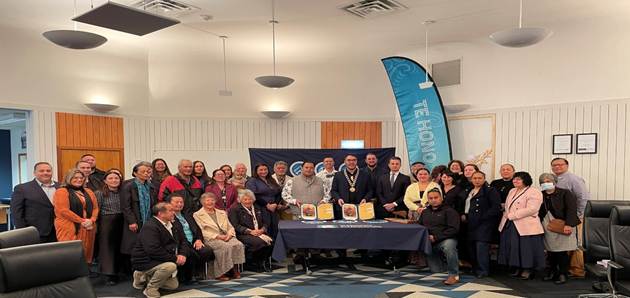
15/08/2025 - Mana Whakahono Ā Rohe
On August 15th, 2025,
the signing of a Mana Whakahono Ā Rohe between Te Rūnanga Ā Iwi
Ō Ngāpuhi and Te Kaunihera o Te Hiku o te Ika (Far North District
Council). The Mana Whakahono ā Rohe
between Ngāpuhi and the Far North District Council is significant because
it creates a formally recognised partnership that strengthens how both sides
work together on environmental planning, resource management, and local
decision‑making. It establishes a framework for early, consistent
engagement with Iwi and Hapū, ensuring Ngāpuhi perspectives, cultural
values, and kaitiaki responsibilities are embedded in council processes. This
agreement also rebalances the relationship by recognising Ngāpuhi the
largest Iwi in Aotearoa and an essential partner in shaping the future of the
Far North. The value it brings includes better collaboration, improved trust,
more culturally grounded decisions, and a shared approach to managing land,
water, and development across the rohe (territory). It also gives both parties
a stable, long‑term mechanism for cooperation, reducing conflict and
creating more effective outcomes for communities.
19/09/2025 - Te Wiki o Te Reo
Māori
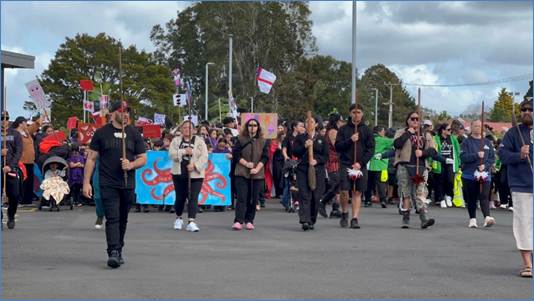
The hīkoi held in Kaikohe on
19 September, 2025, as part of Te Wiki o te Reo Māori (Māori Language
Week) carried deep significance for the community because it brought together
local schools, whānau (family), and kaumātua (elders) to celebrate
the 50th anniversary of Māori Language Week. It was a collective
expression of pride, unity and commitment to strengthening te reo Māori
across the rohe (territory). The march followed a route through the Kaikohe
township and involved around 400 tamariki and kōhanga reo children,
supported by parents and community members, showcasing the mana and Kotahitanga
(unity) of the town as they moved together up through Broadway and surrounding
streets. The event was guided by respected local leaders, including
kaumātua, Rangatira (leader, chief), and Kīngi Rākete‑Tane of Te Kura Kaupapa Māori O Kaikohe, whose
presence reinforced the cultural authority and intergenerational leadership
behind the kaupapa. The hikoi (march) highlighted the ongoing revitalisation of
te reo (language) Māori, the role of kura (school) and kōhanga reo
(preschool) in nurturing language, and the importance of a visible with a
community‑led celebration in keeping the reo strong for future
generations.
Council staff supported the event
with the provision of a Mobile Ballot box tour organised by the Civic
Engagement and Education team as well as a Council stall offering support on
council services. Council staff have committed to working alongside the Working
Group in 2026 and have provided support for funding applications to further
strengthen the Kaupapa of a Reorua town.
19/11/2025 - Kaikohe
Placemaking/ Broadway Spring Clean
A committee made up of Far North
District Council staff, the Kaikohe Business Association, and hapū
representatives oversaw this project, ensuring it reflected both community
aspirations and cultural values. Their collaboration meant the clean‑up wasn’t just cosmetic but part of a broader
placemaking effort to strengthen Kaikohe and its identity and support the long‑term revitalisation of the community. The result was a
noticeably cleaner and a brighter Broadway main road, improved business
confidence, and a renewed sense of community ownership over the town centre.
The project also helped build stronger working relationships between council,
local businesses, and mana whenua, laying groundwork for future improvements
across the rohe.
8/12/2026 – Hapū
Engagement
This initiative was established
through the development of a Hapu Engagement Strategy (Internal) within Te
Hono.
The purpose of the strategy is to
ensure Hapu engagement is targeted, beneficial and achieves outcomes for both
Hapu and Council by having planned hui within wards alongside Hapu members.
The Kaikohe ki Hokianga Ward
Hapū Engagement Hui hosted at Kohewhata Marae was 1 of 3 Hui held within
Quarter 2. Hapū from the Western Ward were invited to an information
presentation from Te Hono. Attendees included local hapū representatives
from Te Uri O Hua, Ngāti Kura, Te Takotokē, Ngāti Tautahi,
Ngāi Tuteauru, Te Matarahurahu, Ngāti Whakaeke, Elected Members and
Council staff.
The kōrero centred around
services provided by Council to support hapū aspirations, including
information about the request for services, dust matrix and roading. Hapū
want to be invited to attend council hui, including Te Kuaka, to understand how
decisions are made and how they can participate more effectively for their
community. Hapū also seek recognition of their rangatiratanga and
individual authority and want pathways such as the Good Decisions course to
strengthen their involvement in council decision‑making.
It was also mentioned that hapū want FNDC to align engagement with Te Pae
o Uta, IHEMP, and the Hapū Engagement Framework, ensuring that council
processes reflect tikanga, kaitiakitanga, and hapū authority
This supports transparency,
capability building, and relationship strengthening.
18/12/2025 - Wairoro Stream
Water Take
The Wairoro Stream water take is
designed to strengthen Kaikohe’s long‑term
drinking‑water security, but it also carries important Māori
and cultural significance because Wairoro is a living taonga (treasure) with
deep whakapapa (genealogy) connections for mana whenua (local hapu authority).
The project aims to draw water in a way that supports the town’s
resilience during droughts while protecting the stream’s mauri (life
force, essence), which ecological assessments show is already under pressure
from low flows and nearby wastewater activity.
For Māori, the positive
effects come from ensuring the water‑take is paired with
restoration work across Kaikohe waterways, a wider programme recognised as
essential for the community’s wellbeing and environmental health. By
involving hapū such as Ngā Hapū o Kaikohe and Te Uri o Hua, the
project embeds kaitiakitanga (guardianship) into decisions, strengthens
cultural guardianship, and helps maintain the spiritual and ecological
integrity of the awa (stream, river). This approach supports both reliable
water for the town and the protection of a culturally significant waterway,
aligning community needs with the values and responsibilities of mana whenua
Council (Far North District
Council) has received funding through an application which is the IAF
(Infrastructure Acceleration Fund) to upgrade Kaikohe water treatment system.
Council has engaged with hapū to provide a CIA (Cultural Impact Assessment)
that would further add more participation and guidance from haukāinga
knowledge.
The Wairoro water‑take is still in the early–mid project phase, sitting
between design development and pre‑consenting, with some
components already funded and committed through the Infrastructure Acceleration
Fund (IAF).
12/02/2026
- Te Rā o Māngūngū
On 12
February 2026, Ngā Uri Whakatupu o Hokianga hosted the 186th
Māngūngū Celebrations at Māngūngū Mission, the
site of the largest signing of Te Tiriti o Waitangi. The event brought together
iwi (tribe), hapū (subtribe), schools, community groups, and manuhiri
(guests) to acknowledge the history of the 1840 signing and the leadership of
the 64 rangatira (leaders/chiefs) who signed their names on the document. The
day reflected strong cultural pride, with kōrero (documented
talk/speaking, Waiata (song), and whakawhanaungatanga (relationship building)
reinforcing the ongoing significance of Māngūngū as a
cornerstone of Hokianga identity. Public information noted that the site
continues to hold deep meaning as the place where the greatest number of
Māori signatures were gathered for Te Tiriti, and the celebrations
highlighted both remembrance and the living connection of descendants to their
tūpuna (ancestor). The gathering was well supported and carried a positive
atmosphere, demonstrating unity across the rohe (district) and a shared
commitment to honouring the legacy of the Treaty and the responsibilities it
carries today. Council assisted with guidance on the roading management plan
with the committee, dust suppression water on the day, putea to cover the
manaakitanga of manuhiri with kai, maintenance of a nearby reserve for kaumatua
and kuia parking.
18/02/2026 -
Waiarohia/Waiotemarama Water Take
The Waiarohia and Waiotemarama
water take engagement is to focus on how open and productive the kōrero
(conversation) was. The hui (meeting) with Ngāti Korokoro Hapū Trust
was to make sure everyone had the full picture about the water take, with clear
information shared for the hapū to ask questions, raise concerns, and
offer practical ideas. The discussion was positive, with good participation and
a shared commitment to protecting the waterways while keeping communication
strong. The outcome where the hapū felt was meaningful engagement included
and informed, and confident that their voice is part of the ongoing process. A
water take is needed so there is a reliable supply for local needs, especially
during dry periods when streams run low. Water takes support essential uses
like farming, and community activities, as long drinking water and as they are
managed carefully to protect the health of the water and community. Hapū
will continue to be engaged to provide kaitiakitanga (guardianship) for the betterment
of all communities and the wai (water).
25/02/2026 - Pōhutukawa
Rākau ki Kaikohe
Growing on the FNDC (Far North
District Council) headquarters office has a Pōhutukawa tree growing and
has been assessed as causing significant neighbouring property’s
wastewater pipes to be continually damaged by its roots structure, and there
are no options available or practical to prevent further damage. The assessment
was to remove the tree and still engage with hapū as of its cultural
significance. Because the tree’s location within the rohe (territory) of
Te Uri O Hua, Te Matarahurahu, FNDC met with the Hapū (subtribe) to ensure
the hapū were fully informed about the situation and able to participate
in the process. In the hui the decision making, opened discussion and provided
clear information for hapū to raise concerns, and space for and offer
guidance of this engagement. A positive outcome that the tree be felled and cut
into sizes so the wood can be retained and utilised for future carvings,
allowing the tree to continue to hold cultural value even after removal. This
reflects a respectful and collaborative approach, with the hapū.
This has
now been approved by the Kaikohe ki Hokianga Community Board supported by
hāpu, as hapu will be given the rākau to utilise for future carving
projects.
Ngā Kaupapa Māori- Te Hiku Wāri - Māhuru 2025 ki Poutūterangi 2026
– Te Hiku Ward – September 2025 – March 2026
Two significant cultural
milestones were recently marked with the return of important taonga to Te Hiku.
Tangonge Taonga
returned to Te Rarawa Marae 24th October 2025
The return of Tangonge, a treasured taonga of Te
Rūnanga o Te Rarawa, represents a significant moment of cultural
restoration for the iwi. Tangonge was returned to the rohe in time to be
acknowledged during the 100-year commemorations of Te Rarawa, allowing
whānau, hapū, and iwi to reconnect with an important part of their
cultural heritage. The return of Tangonge strengthens the connection of Te
Rarawa people to their history, whakapapa, and identity, ensuring the taonga is
preserved within its rightful cultural context for future generations.
Tangonge, a 14th–16th century, 2.3-metre-long carved lintel and one of
New Zealand's oldest wooden carvings.
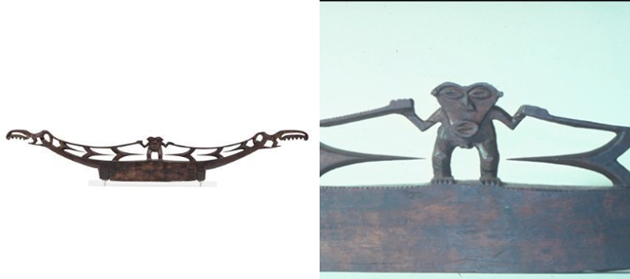
Te Paatu Taonga
Ōruru returned 16th October 2025
A second significant taonga, from Te Paatu, was also
returned and is now held at Te Ahu Centre. The return of Ōruru ensures
that this taonga is cared for within the rohe and accessible to the people of
Te Hiku. The presence of Te Paatu at Te Ahu provides an opportunity for the
community and visitors to learn about the history, significance, and cultural
narratives connected to the taonga.
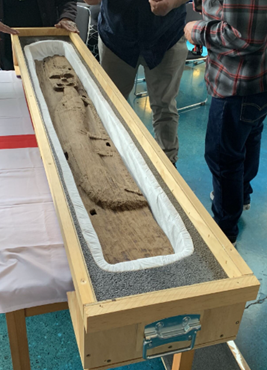
The return of both Tangonge and
Ōruru reflects the continued restoration and protection of important
cultural heritage within Te Hiku. These milestones highlight the importance of
preserving taonga and strengthening the connection of iwi and hapū to
their ancestral history and identity.
First Quarterly
Hapū Engagement Hui – Waimanoni Marae 24th November 2025
The first Quarterly
Hapū Engagement Hui for Te Hiku Ward was held at Waimanoni Marae.
This initiative was established through the development of a
Hapu Engagement Strategy (Internal) within Te Hono.
The purpose of the strategy is to ensure Hapu engagement is
targeted, beneficial and achieves outcomes for both Hapū and Council by
having planned hui within wards alongside hapū members.
The hui provided an opportunity for hapū
representatives, Marae leaders, and council staff to come together to discuss
matters of importance within the ward, share updates on council initiatives,
and identify priorities for collaboration moving forward.
Key themes included strengthening communication between
Council and Hapū, supporting local development aspirations, and ensuring
that hapū voices are heard in council decision-making processes. The hui
also reaffirmed the importance of regular engagement and relationship-building
between mana whenua and council.
These kaupapa reflect the ongoing commitment across Te Hiku
Ward to strengthen Māori development, cultural revitalisation, and
meaningful engagement with Hapū and Iwi. Continued collaboration between
Mana whenua, community, and Council will remain important in progressing shared
aspirations for the region. He Whenua Rangatira, Kia Tū Kōtahi, Kia
Whanake tahi, Kia Kōkiri Tahi.
Te Oneroa a Tohe Beach Board update from 19th
December 2025.
The Board received the Ngā Puāwai o Te
Oneroa-a-Tōhe report (19 September 2025) and agreed to include the
initiative as a priority within its work programme, with the Board endorsing
any future projects and funding related to Te Puawaitanga.
The Technical Advisory Group
membership was confirmed for Te Aupōuri, Ngāti Kuri, and Te Rarawa,
with Ngāi Takoto representation to be confirmed. NRC and FNDC will work
with iwi representatives to ensure the appropriate staff technical expertise
supports the kaupapa.
February 2026
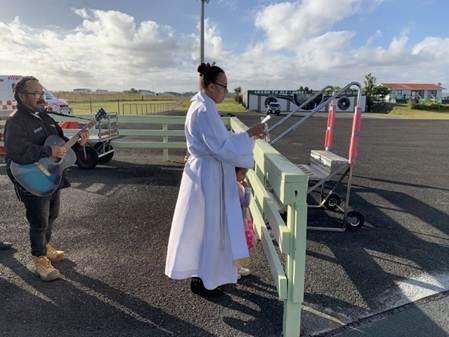
The grounds at Kaitāia Airport were blessed on Tuesday
24 February by Anglican Archdeacon Fran Hokianga, marking a significant
milestone ahead of upcoming upgrade works funded by Te Arawhiti and Far North
District Council. The blessing recognises the site’s importance and
signals the formal start of construction.
The upgrade will be delivered in three phases, with further
details confirmed as contractors are appointed. Far North Holdings Ltd (FNHL)
will continue to operate the aerodrome while managing the project.
To keep the community informed, the council has launched a
monthly newsletter. Issued in the final week of each month, it will provide
updates on construction progress, advisory group discussions, emerging risks,
and any works that may affect travellers or nearby residents.
Ahipara Footpath Replacement – Update
Work to improve pedestrian safety on the Foreshore Road
bridge in Ahipara began on 3 March and is expected to take around four weeks.
The project involves replacing the existing footpath, the only pedestrian
crossing over Wairoa Stream, which was assessed as structurally compromised.
A full bridge closure from 13–17 March was required to
demolish the old footpath, with traffic detoured via Roma Road,
Kaitāia–Awaroa Road, and Ahipara Road. Temporary traffic lights
remain in place at the Foreshore Road and Roma Road intersection, with
pedestrian access maintained during construction.
The upgrade will provide a safer, more secure pedestrian
crossing for the Ahipara community.
PĀNGA PŪTEA ME NGĀ WĀHANGA
TAHUA / Financial Implications and Budgetary Provision
There are no financial implications or need for budgetary
provision arising from this report.
Āpitihanga
/ Attachments
Nil
|
Ordinary Te Kuaka
Committee for Strategic Māori Relationships Meeting Agenda
|
25 March 2026
|
5.3 Te Reo and
Tikanga Māori Policy Report
File
Number: A5630796
Author: Llani
Harding, Pouhautū Te Hono - Manager - Te Hono
Authoriser: Aaron
Taikato, Manuhautū Te Hono – Group Manager Te Hono
TAKE PŪRONGO / Purpose of the Report
To provide Te Kuaka Committee for Strategic Māori
Relationships (Te Kuaka) with an update on our Te Reo and Tikanga Policy, as
well as progress on the Ka Irihia te reo Māori Action Plan
WHAKARĀPOPOTO MATUA / Executive SummarY
This report provides Te Kuaka with an update on the
Council's progress in implementing and advancing the te reo Māori and
tikanga Policy, which was adopted in September 2023.
|
TŪTOHUNGA
/ Recommendation
That Te Kuaka Committee for Strategic Māori
Relationships receive the report Te Reo and Tikanga Māori Policy Report.
|
tĀHUHU KŌRERO / Background
Council’s Te Reo and Tikanga Policy, along with Ka
Irihia, support the revitalisation of te reo Māori. Ka Irihia was
developed to assess Council’s commitment to implementing our Te Reo and
Tikanga Policy.
Council is making progress towards giving effect to its Te
Reo Māori and Tikanga Policy through several key initiatives, including
270 team goals for Te Pae o Uta, Te Pae o Waho, and implementation plans within
Council strategies to give effect to the policies. This includes the Toi Mana,
FN2100 and Ka Irihia policies and the development of strategies that further
enhance and acknowledge korero tuku iho within Te Kiri Waiwai o Papatuanuku.
We are also developing Te Ao Marama, our District-wide
Reorua Strategy.
MATAPAKI ME NGĀ KŌWHIRINGA /
Discussion and Next Steps
Te Reo and Tikanga
Policy:
The purpose and scope of council’s te reo and tikanga
Policy is to enable the Te Kaunihera o Te Hiku o te Ika to support correct
usage of te reo Māori by providing a framework for its use, both
internally and externally.
The vision is that by 2025 Far North District Council has
increased use of te reo and tikanga in the workspaces and public places we
manage as a key element to strengthening our partnership with tangata whenua
and in delivering effective services.
The goals and objectives
are to:
1. Demonstrate leadership in increasing the
use of te reo
2. Achieve te reo and tikanga staff
development outcomes
3. Implement effective te reo communication
systems and processes
4. Increase te reo use in human resource
processes and systems
The respective roles and
responsibilities of the policy include:
1. Senior
leadership team provides authority for the policy, and with managers, will
demonstrate leadership and role modelling in implementing the policy
2. Employees
will be aware and implement the policy by making the policy and implementation
plan available through the intranet and induction training processes.
3. Te Hono will provide advice and support on
any issues associated with the policy
4. Far North District Council’s trainer
in te reo and tikanga will provide clarification in Te Pae o Waho sessions.
The policy is due for
review in September 2026.
Ka Irihia – Te
Reo Māori Action Plan:
The purpose of the Te Reo Māori Action Plan for Te
Kaunihera o Te Hiku o te Ika is to affirm the intrinsic value of te reo
Māori as a cherished taonga and an official language of Aotearoa New
Zealand.
Ka Irihia is designed to elevate the council’s
commitment to tangata whenua, honouring He Whakaputanga o te Rangatiratanga o
Niu Tireni and Te Tiriti o Waitangi. The action plan also gives effect to the
Council-adopted Te Ao Māori framework Te Pae o Uta and Council-adopted
strategies Toi Mana and FN2100. The goal of Ka Irihia is to achieve full Reorua
(bilingual) status for Te Hiku o te Ika by 2040.
The key actions of Ka Irihia, includes Te Kore (Critical
Awareness), Te Pō (Status) and Te Ao Mārama (Use), as well as success
factors, and Action Plan steps, are progressing according to the allocated
timeframe (See attached).
The Te Pae o Uta Key Performance Report outlines the
achievements of Ka Irihia in the 2025-2026 Financial Year.
Ka Irihia is monitored through Senior Leadership team and
further supported by the work of Te Rōpu Tupuwanawana. Te Rōpu have
not yet met in 2026.
The following table
examines the goals for the current financial year and responsible department:
|
Success Factor
|
Action plan steps
|
By June 2026
|
Responsible Group
|
|
Dual welcome signs for
the district
|
Install dual-language
welcome signs across the district
|
In progress
|
Delivery and Operations
|
|
A procurement process
that aligns with our commitment to be a reorua Māori district by 2040.
|
Align procurement
practices with bilingual objectives, favouring activities contributing to
strong te reo Māori community outcomes.
|
In progress
|
Corporate Services
|
|
All Council external
communications reflect the Tikanga and Te Reo Policy with dialect from Te Tai
Tokerau.
|
Ensure that all
external communications adhere to the Tikanga and Te Reo Policy,
incorporating dialect from Te Tai Tokerau to promote language accuracy and
cultural sensitivity.
|
In progress
|
Communications and
Engagement
|
|
Work with Te Taura
Whiri i te reo Māori, Te Mātāwai, and other central government
agencies for a local and regional approach to revitalising te reo Māori.
|
Collaborate with
central agencies for a coordinated approach to te reo Māori initiatives,
ensuring effective use of resources and support for a te reo district by
2040.
|
In progress
|
Te Hono
|
|
Translation and
interpretation services for Council and Committee meetings, including a
tikanga-based process for deputations.
|
Provide translation
services for te reo Māori presentations and interpretations during
Council meetings, ensuring inclusivity and understanding in decision-making
processes
|
Achieved
|
Strategic Relationships
|
|
Playgrounds will
support site storytelling in design, technology, and bilingual signage.
|
Incorporate
storytelling elements and bilingual signage in playground designs to promote
cultural narratives and language use among tamariki and whānau.
|
In progress
|
Delivery and Operations
|
|
Bilingual areas at our
Council Libraries with te reo Māori resources, books, signage to
increase the use of te reo Māori, e.g. at our Council Libraries and
Community Centres.
|
Enhance te reo
Māori resources and signage in Council libraries and community centres
to promote language learning and cultural engagement among visitors.
|
In progress
|
Communications and
Engagement
|
|
We will upgrade our
Council technology to include macronised technology in our systems e.g Info
Council
|
Integrate macronised te
reo Māori technology into Council systems to support accurate language
representation and use across digital platforms
|
In progress
|
Corporate Services
|
|
Council website with
full bilingual function
|
Council website will
have full bilingual function and all te reo Māori headings in English
function
|
In progress
|
Communications and
Engagement
|
|
We will use technology
in central spaces to tell local Māori history and kōrero tuku iho
|
Utilise technology to
showcase local Māori history and narratives, promoting cultural
understanding and appreciation within the community.
|
In progress
|
Corporate
Services/Communications and Engagement
|
PĀNGA PŪTEA ME NGĀ WĀHANGA
TAHUA / Financial Implications and Budgetary Provision
All sections of the Council must ensure they have the
necessary budgetary provisions to support the implementation of the Te Reo and
Tikanga Policy and Ka Irihia through their respective actions
Āpitihanga
/ Attachments
1. Ka
Irihia Te Reo Maori Action Plan FINAL - A5621675 ⇩ 
2. Te
Reo Māori and Tikanga Policy FINAL (1) - A5623375 ⇩
3. Te
Ao Marama Reorua Strategy FINAL 20025 - A5621664 ⇩
4. Te
Pae o Uta Key Performance Report 2024/25 FINAL (1) - A5624383 ⇩
|
Ordinary Te Kuaka
Committee for Strategic Māori Relationships Meeting Agenda
|
25 March 2026
|
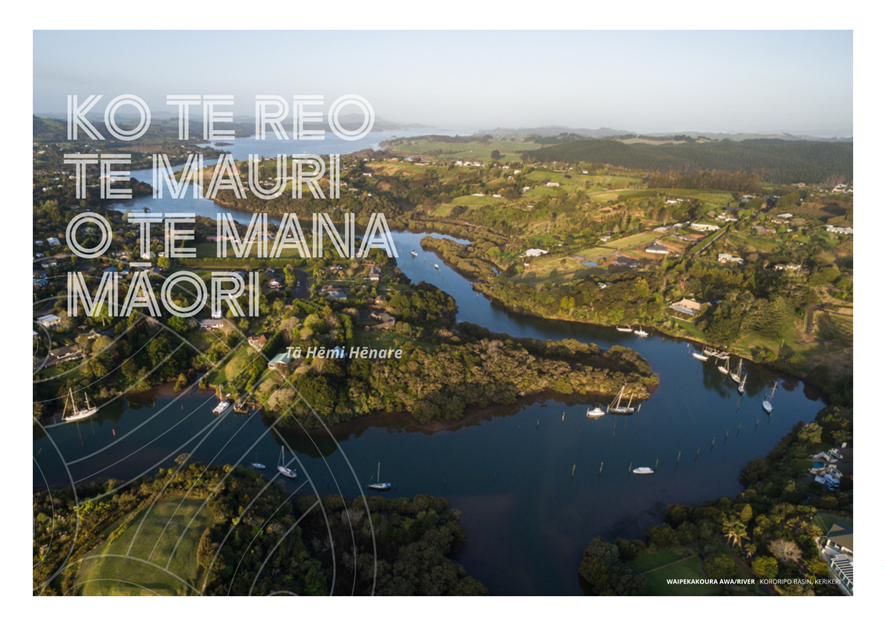
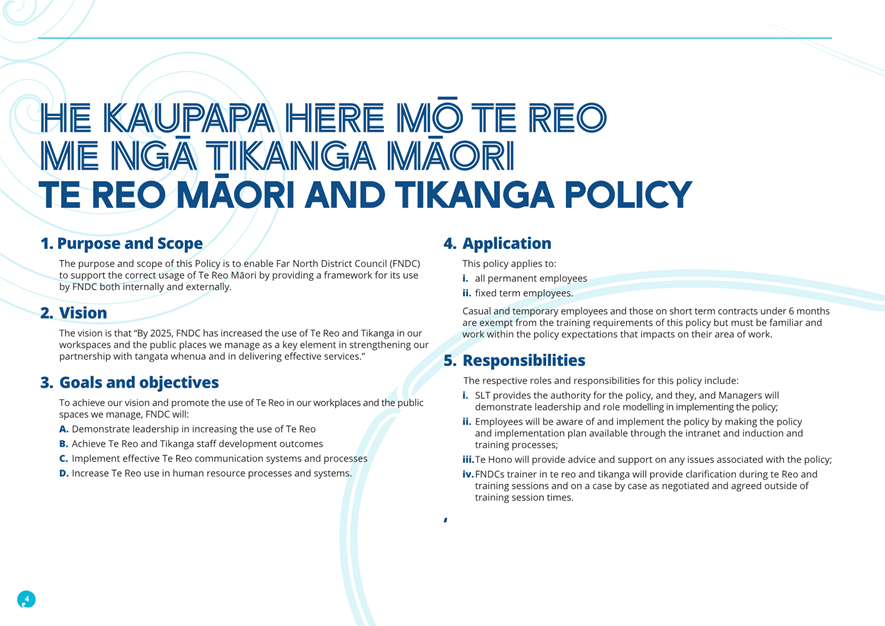
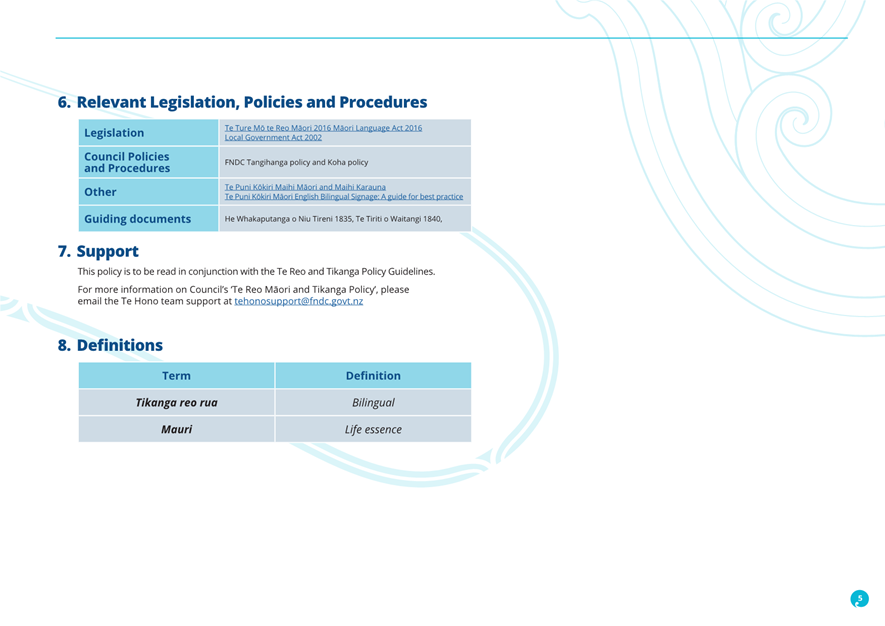
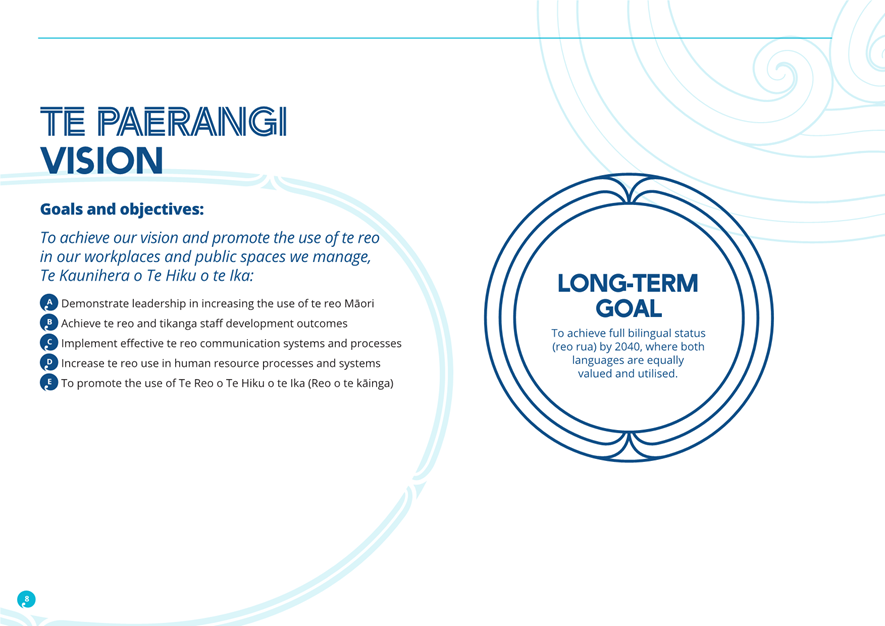
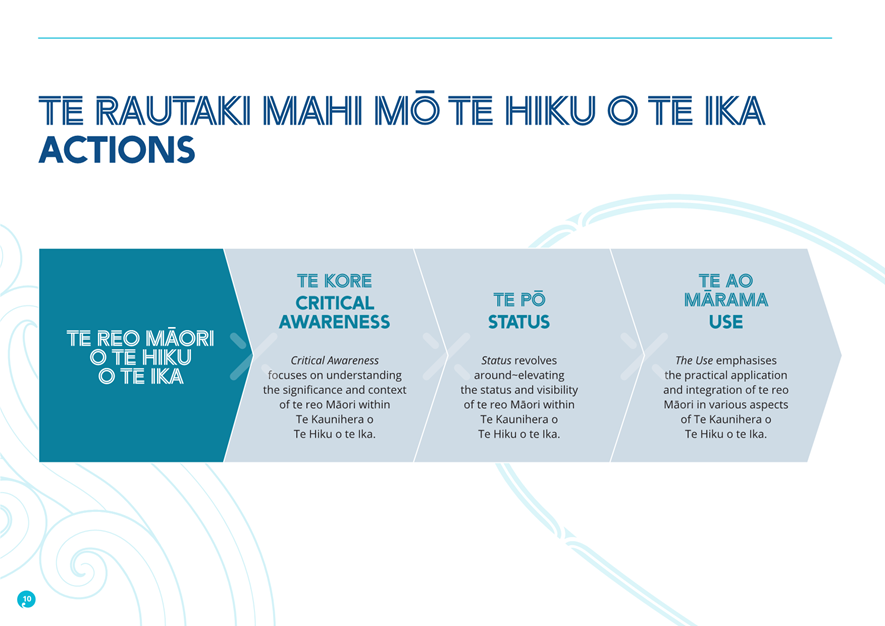
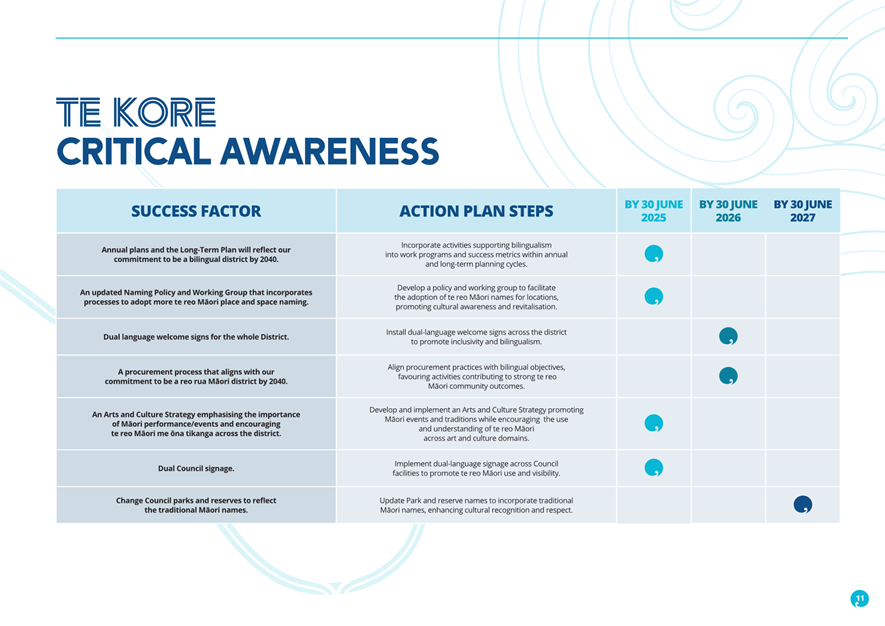
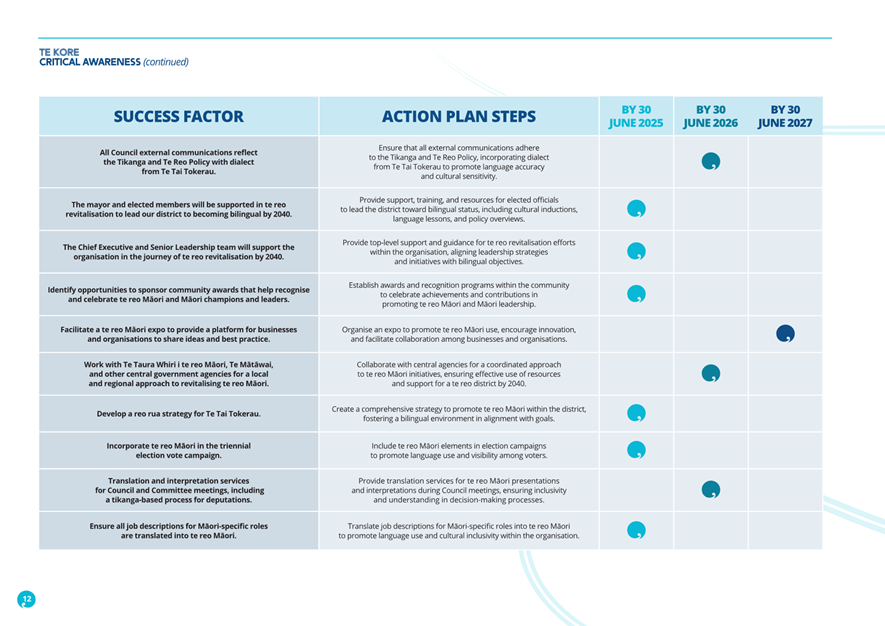
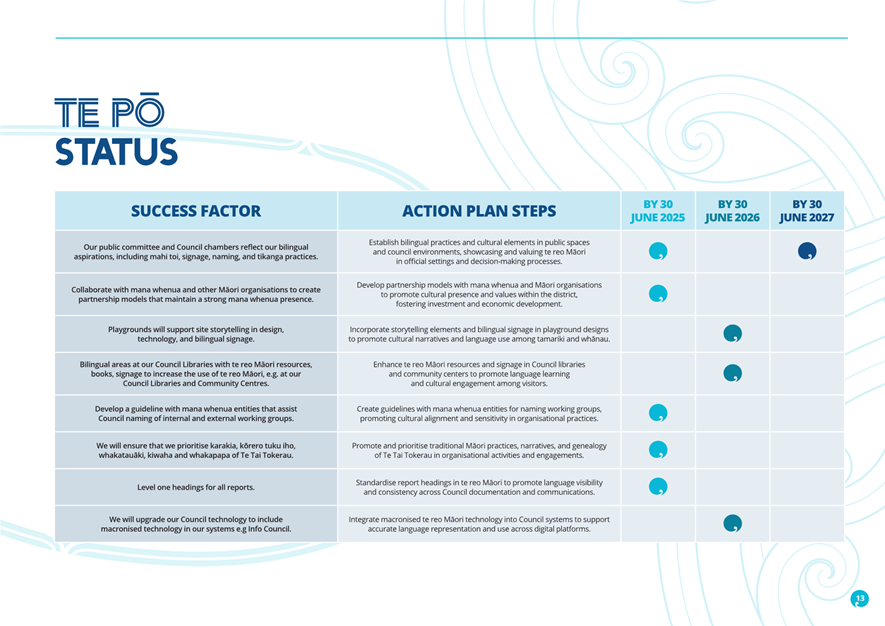
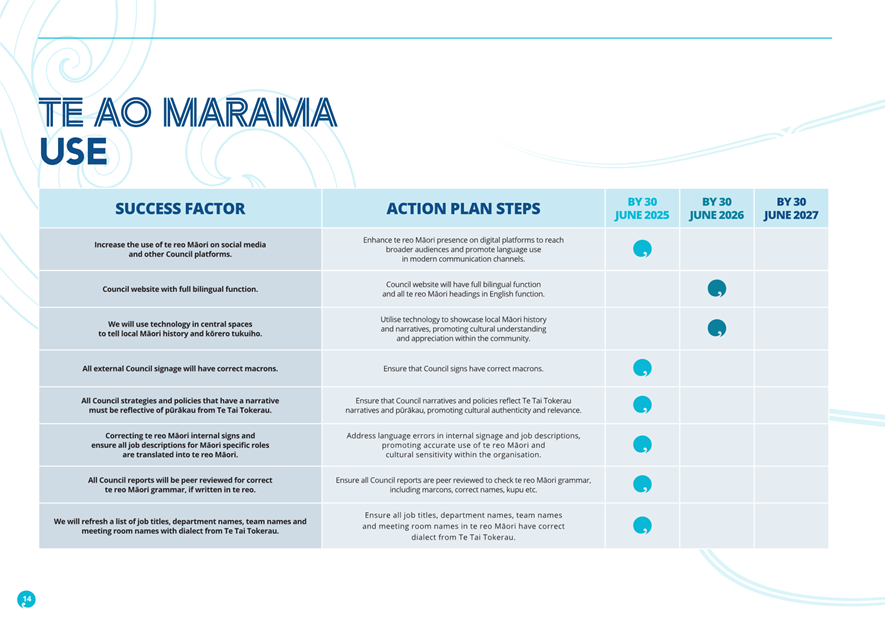

|
Ordinary Te Kuaka
Committee for Strategic Māori Relationships Meeting Agenda
|
25 March 2026
|
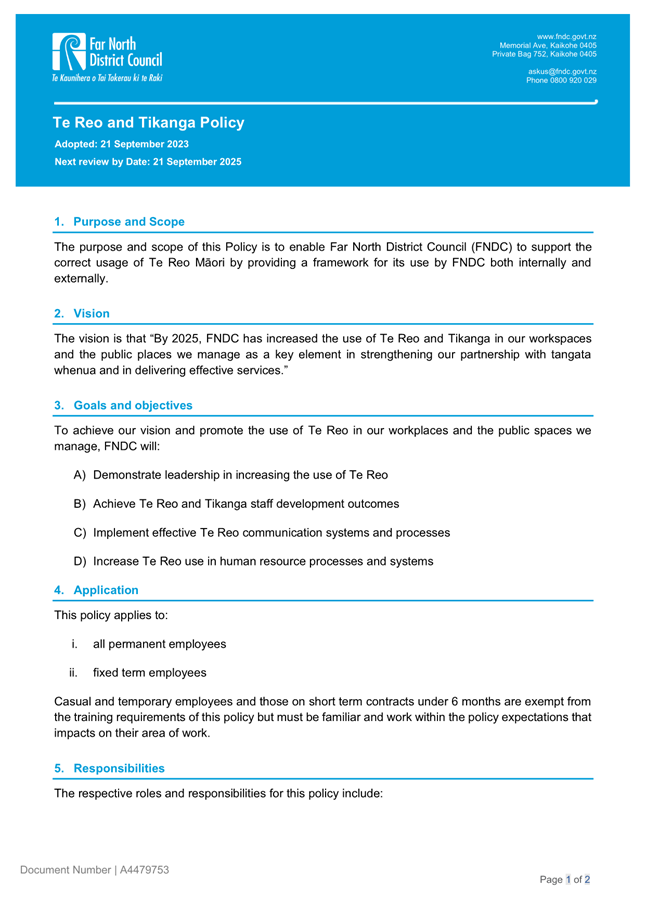
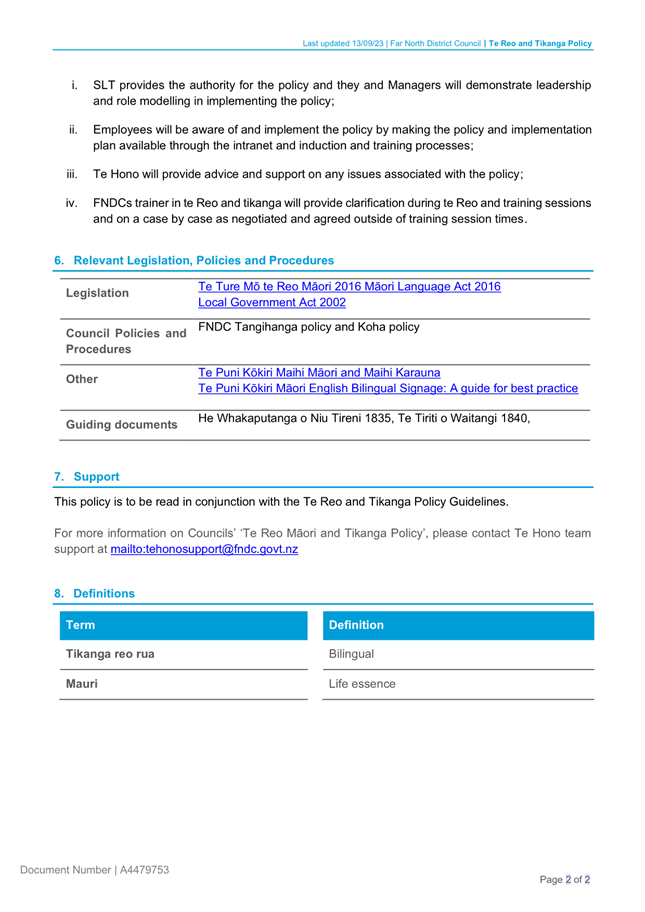
|
Ordinary Te Kuaka
Committee for Strategic Māori Relationships Meeting Agenda
|
25 March 2026
|
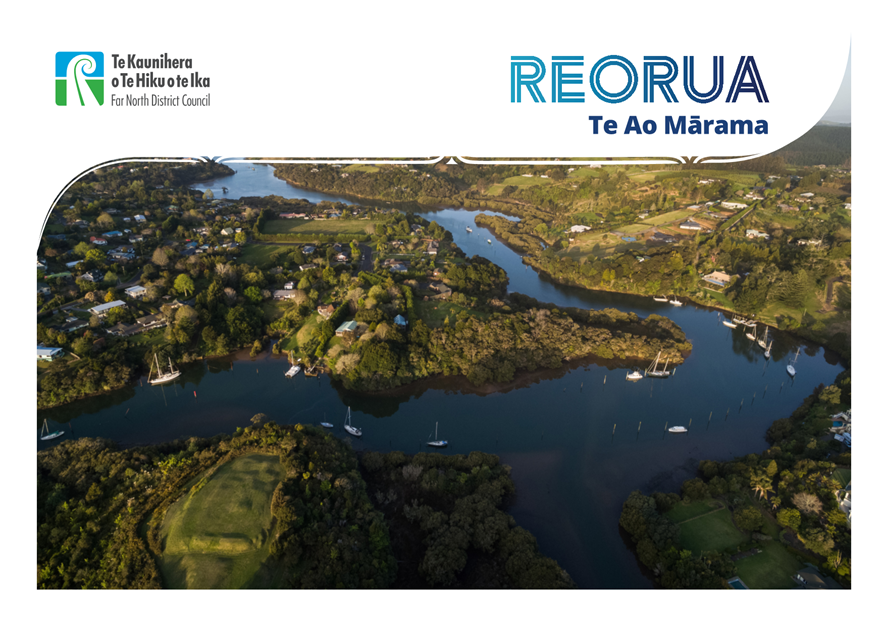
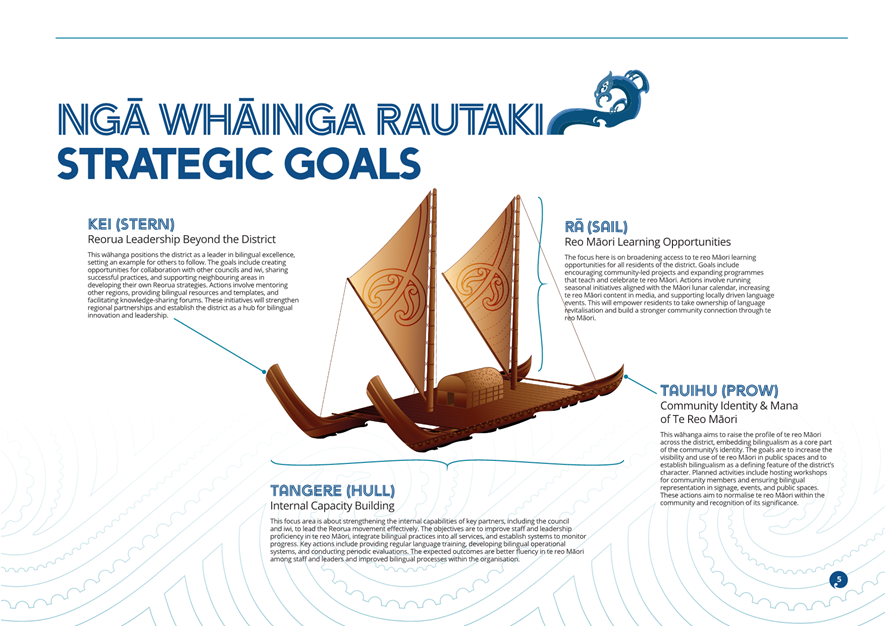
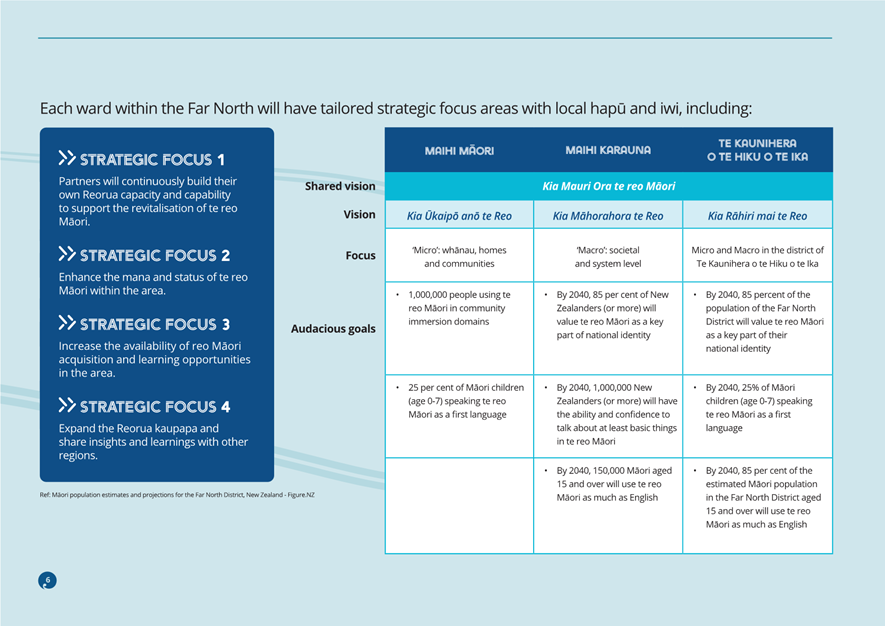
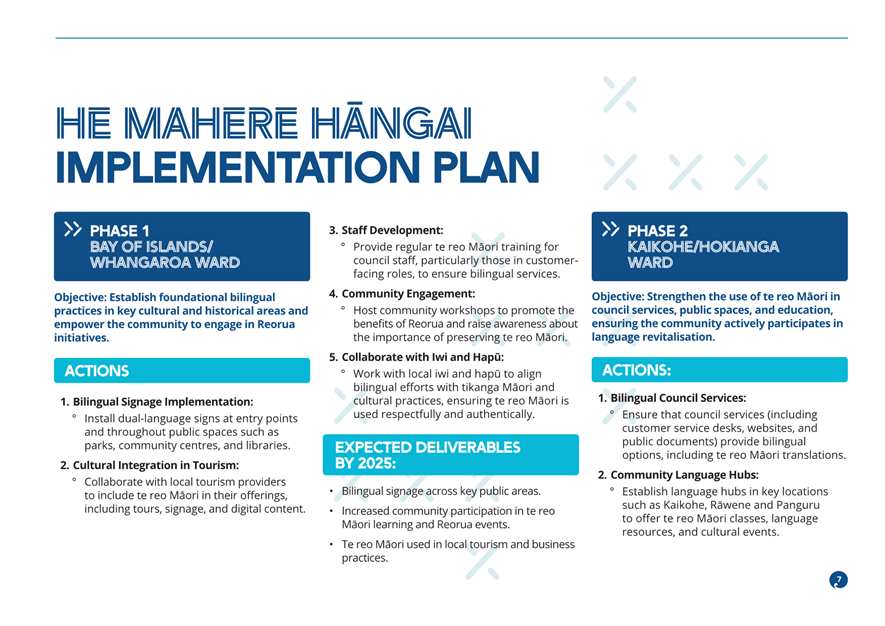
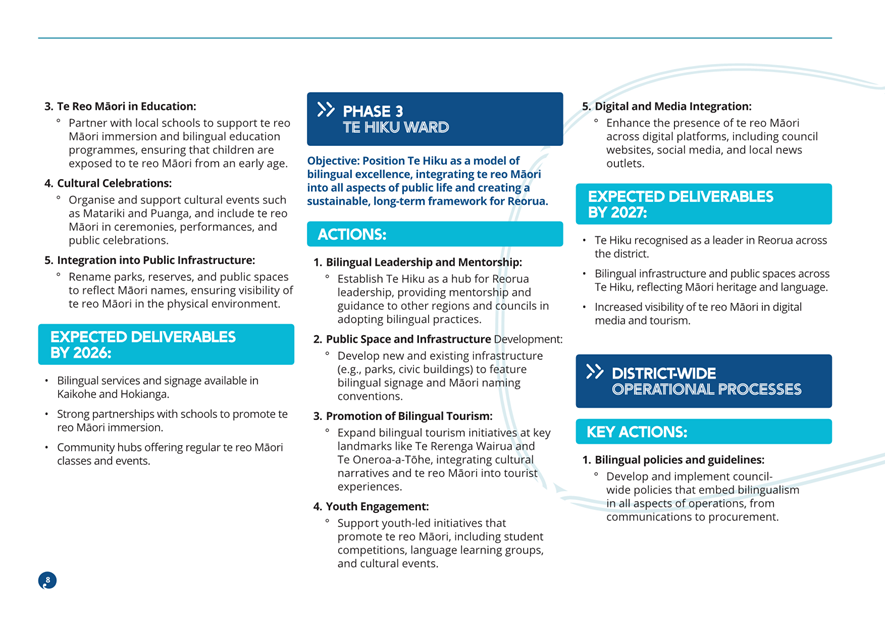
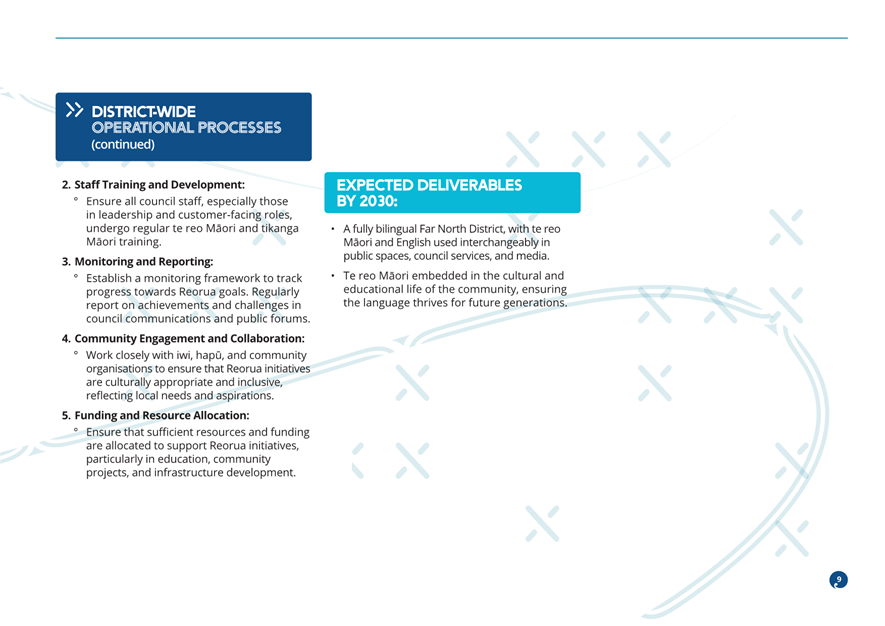
|
Ordinary Te Kuaka
Committee for Strategic Māori Relationships Meeting Agenda
|
25 March 2026
|
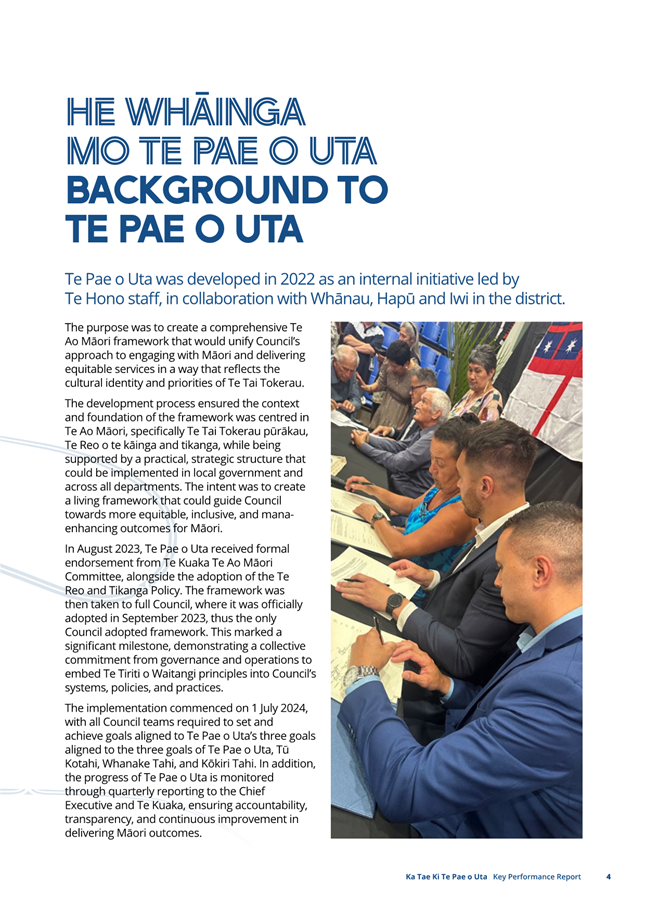
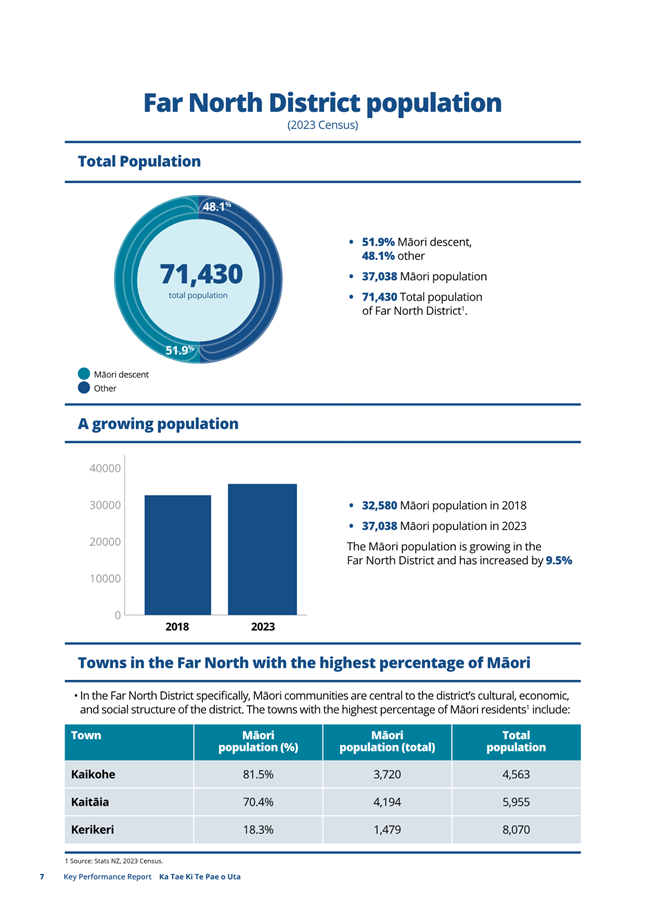
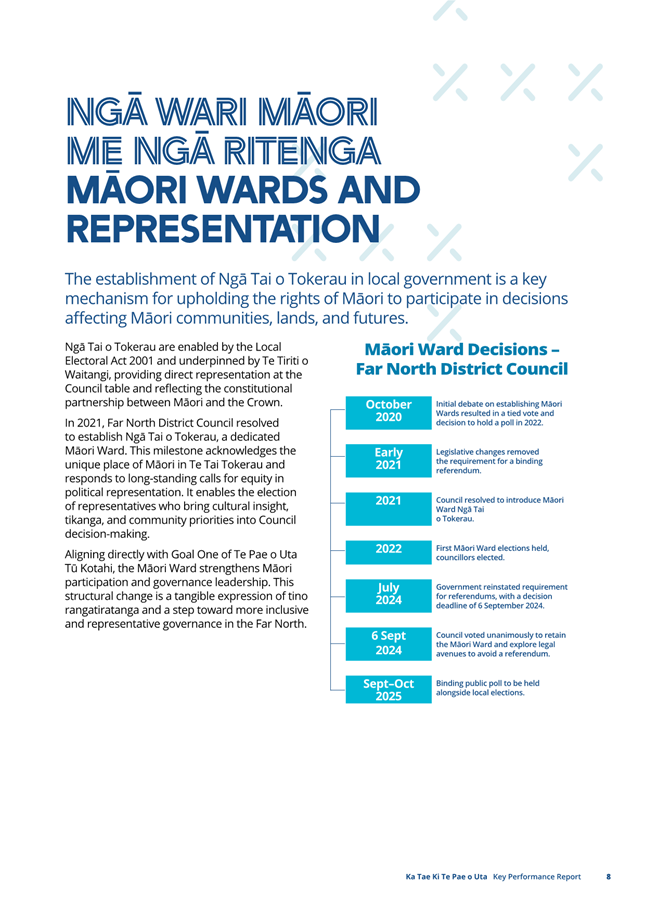
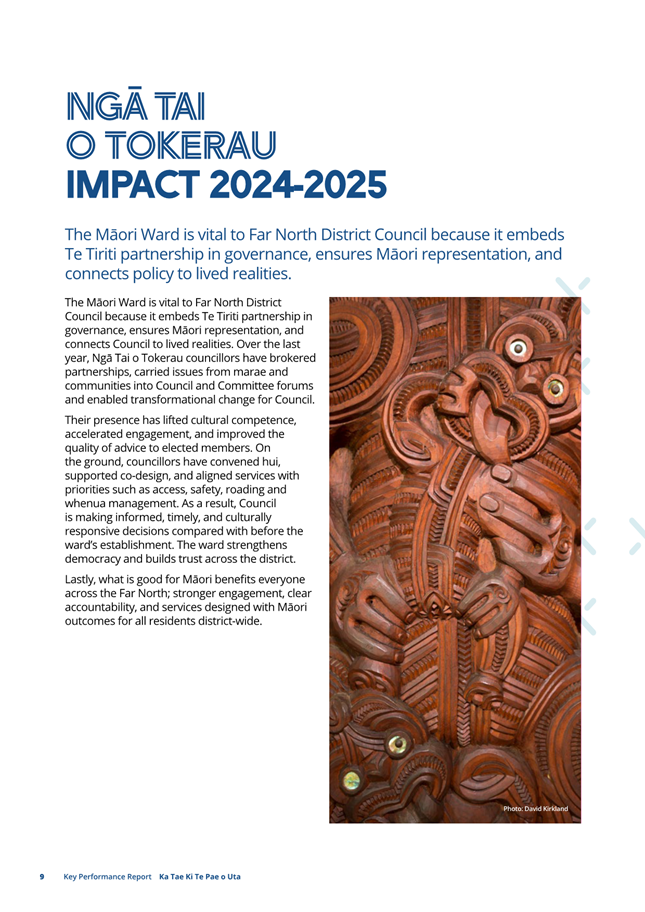
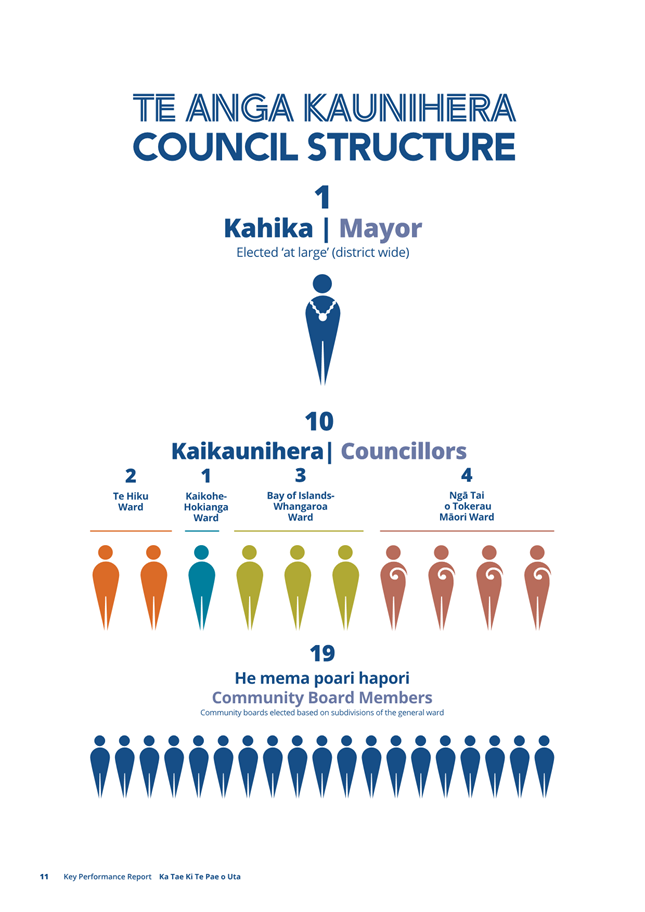
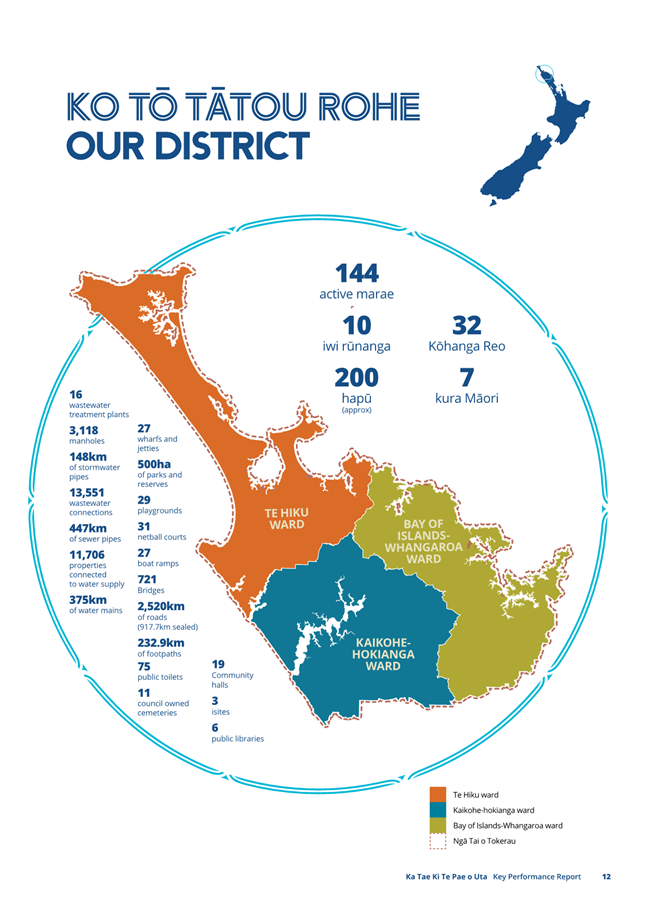
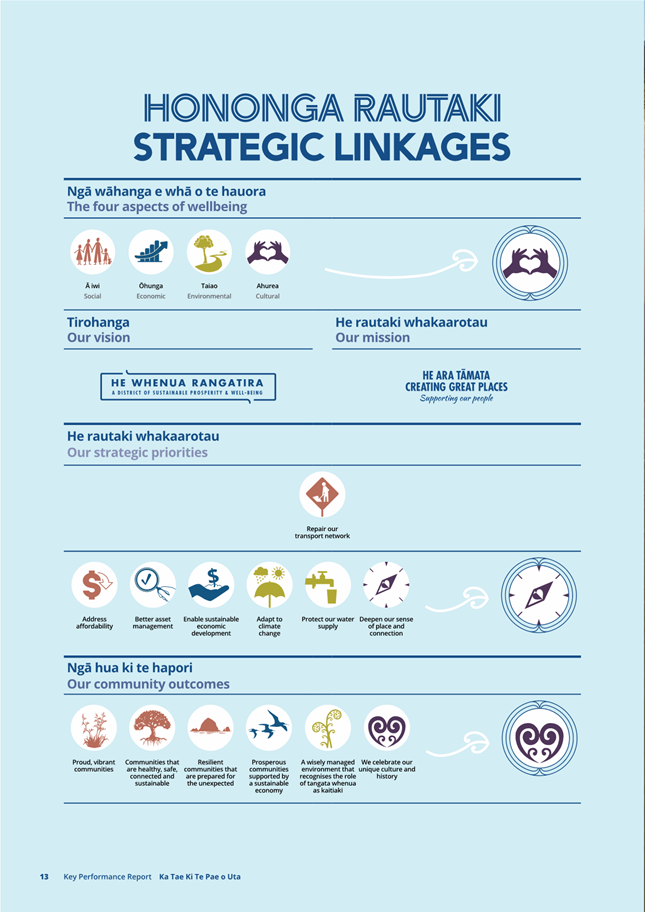
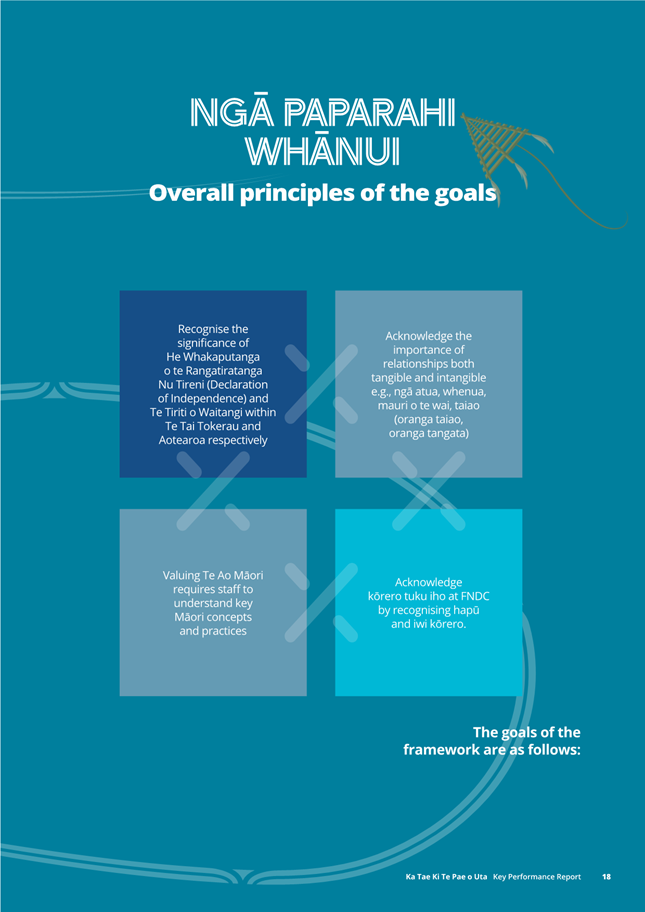
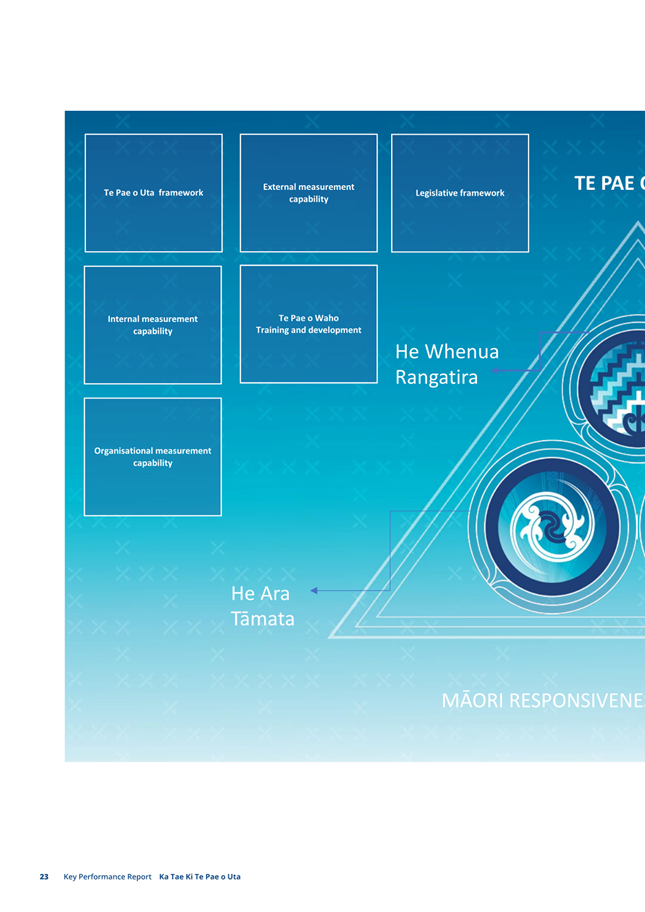
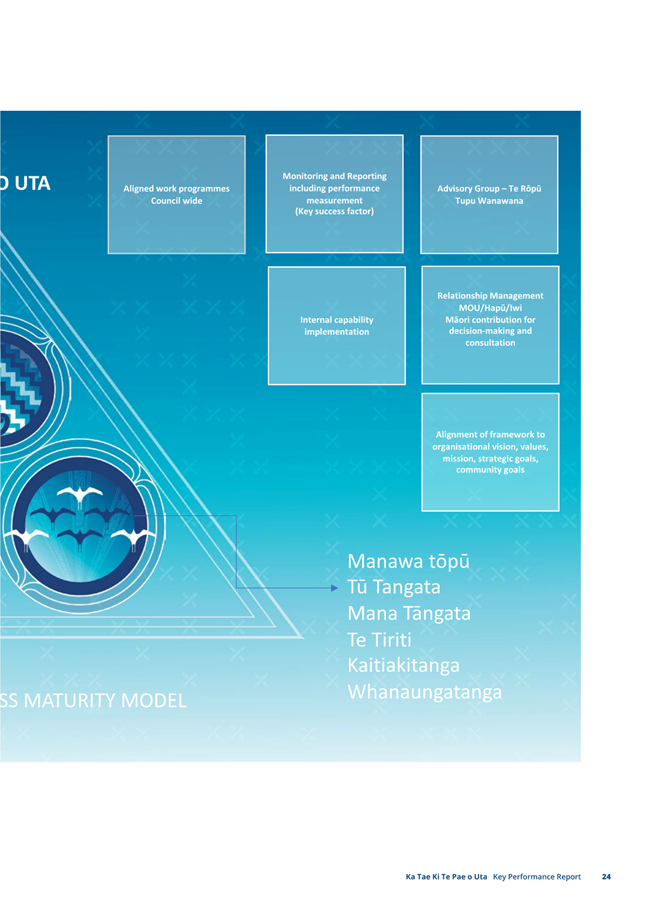
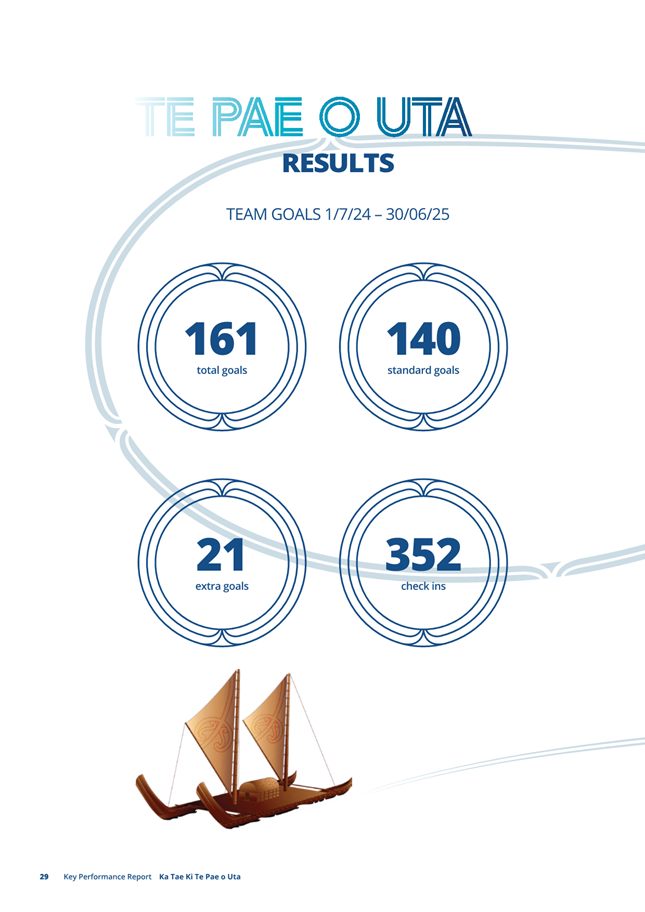
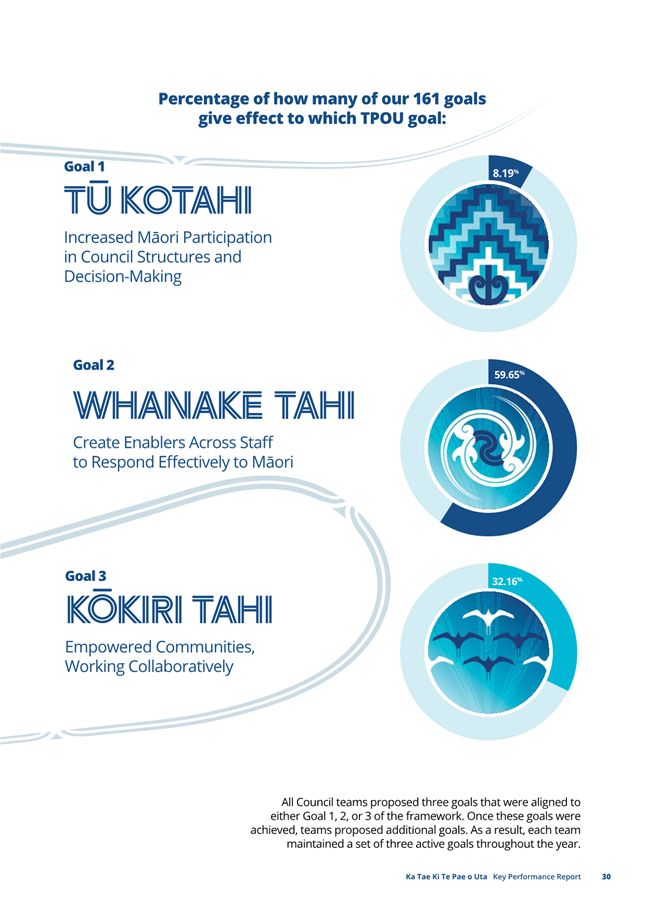
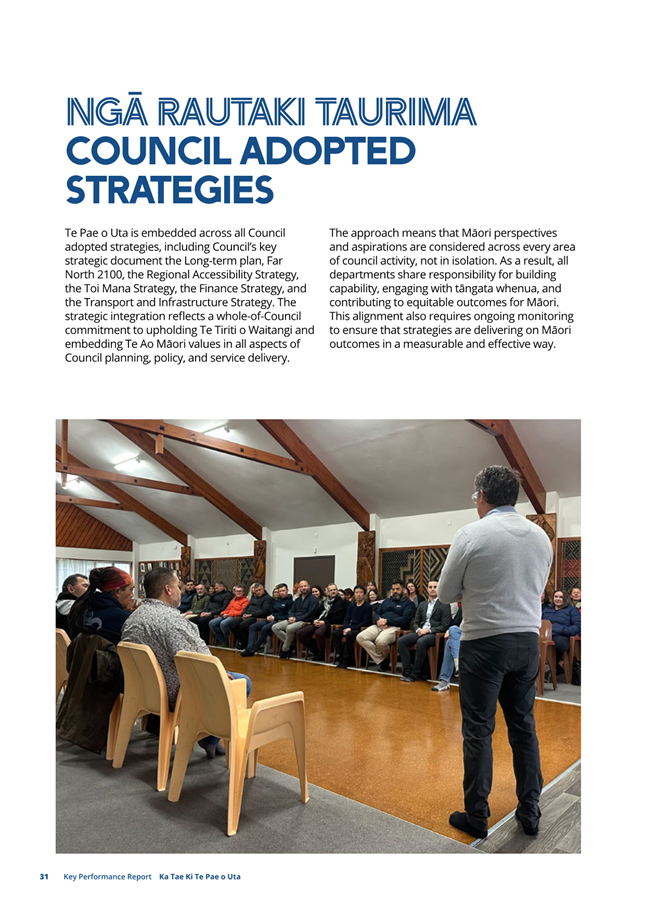
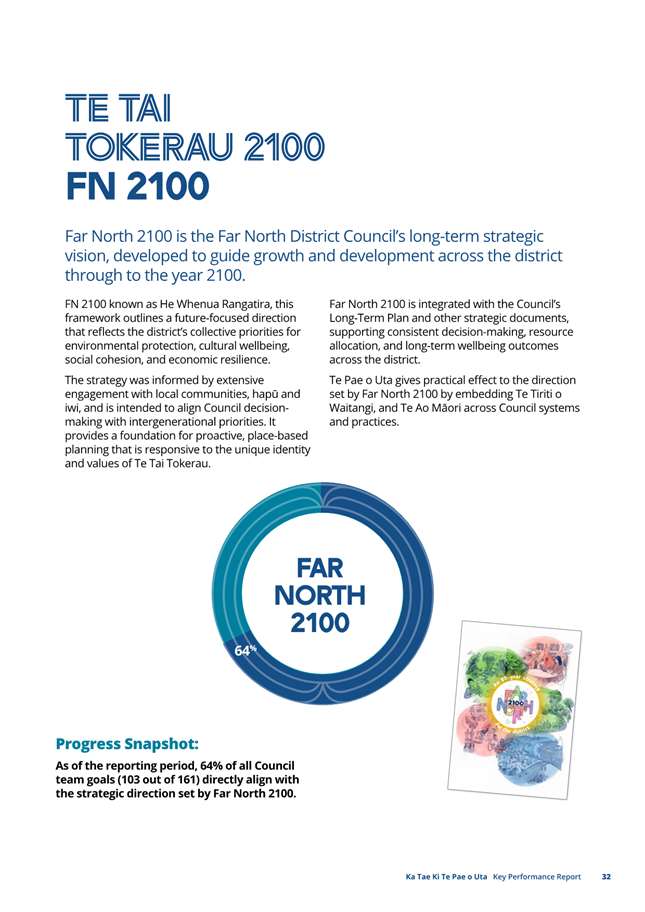
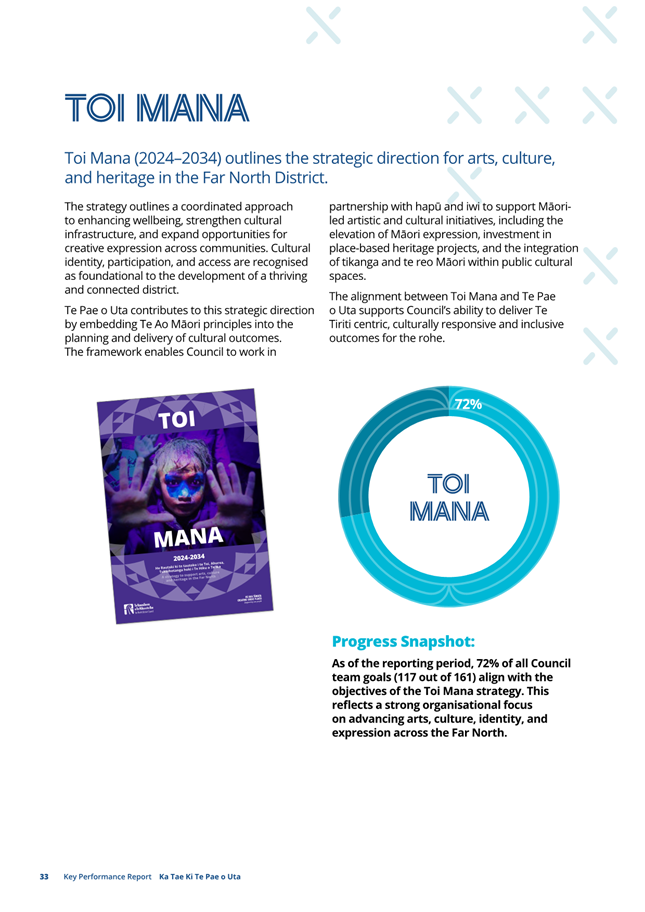
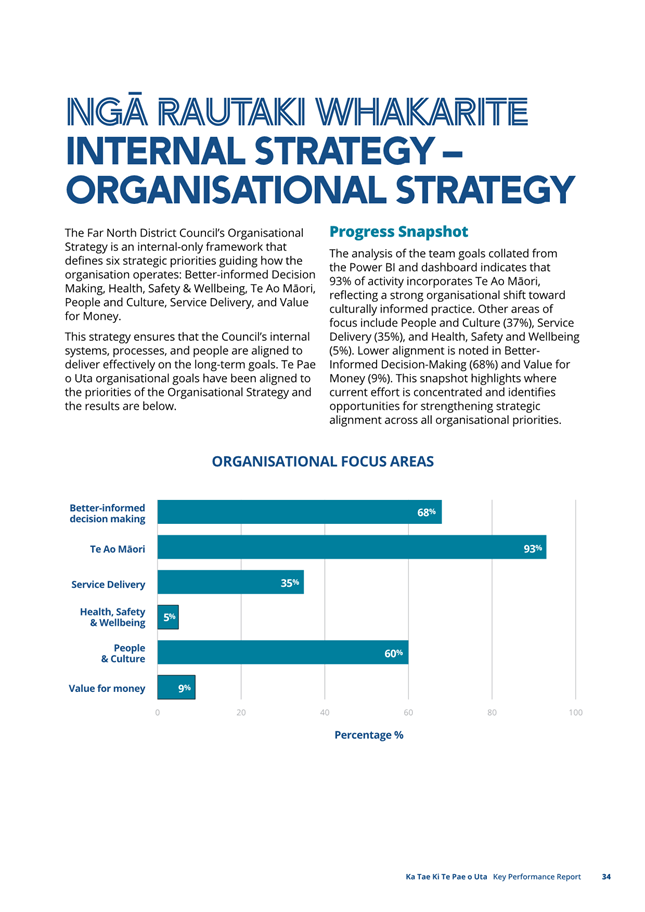
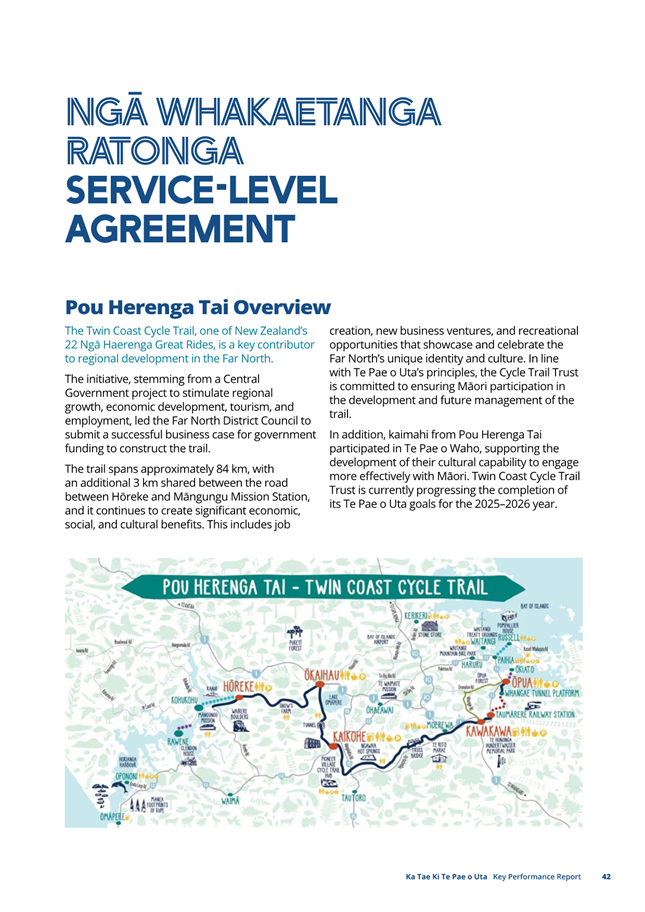
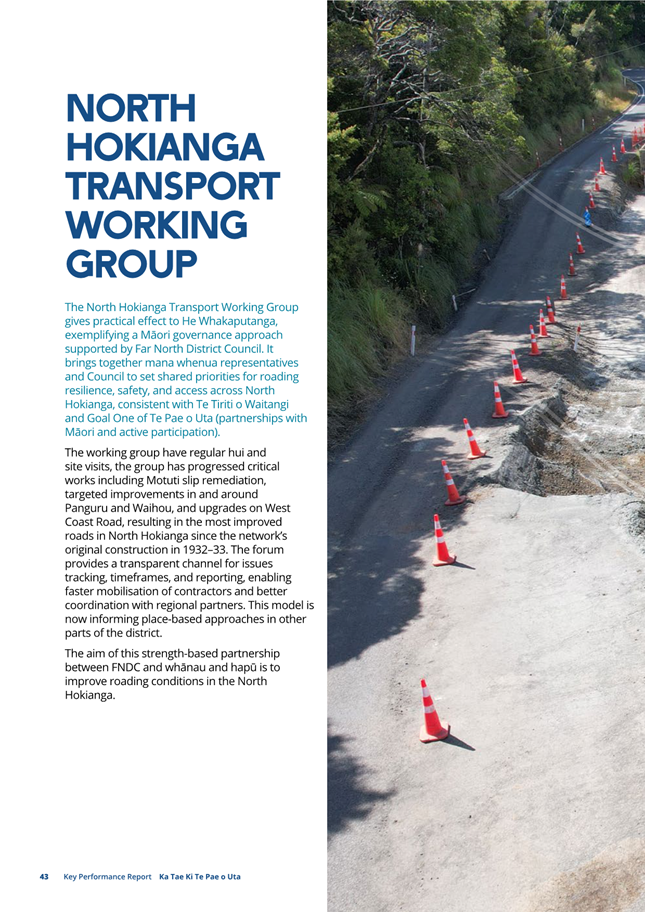
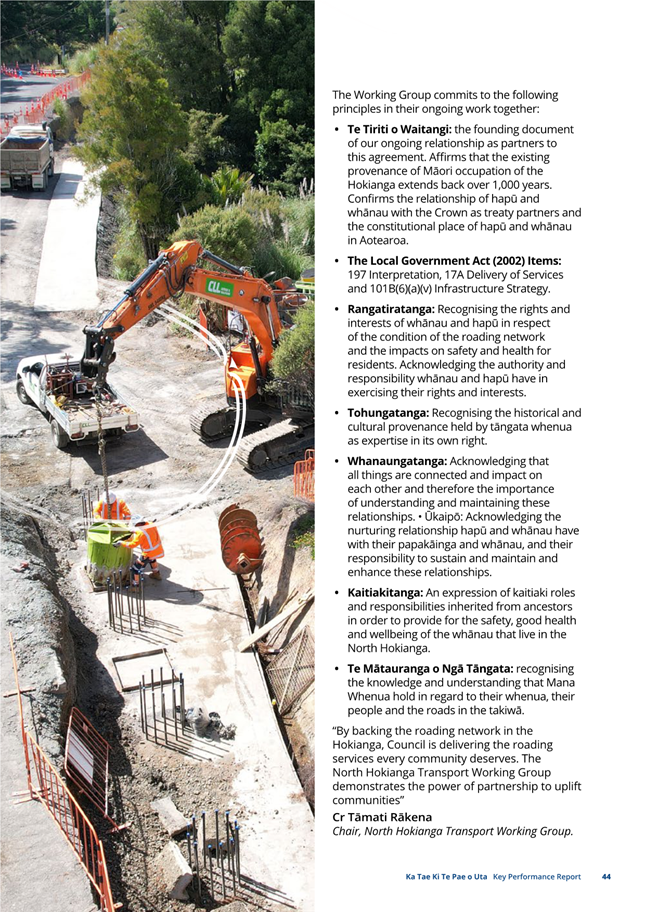
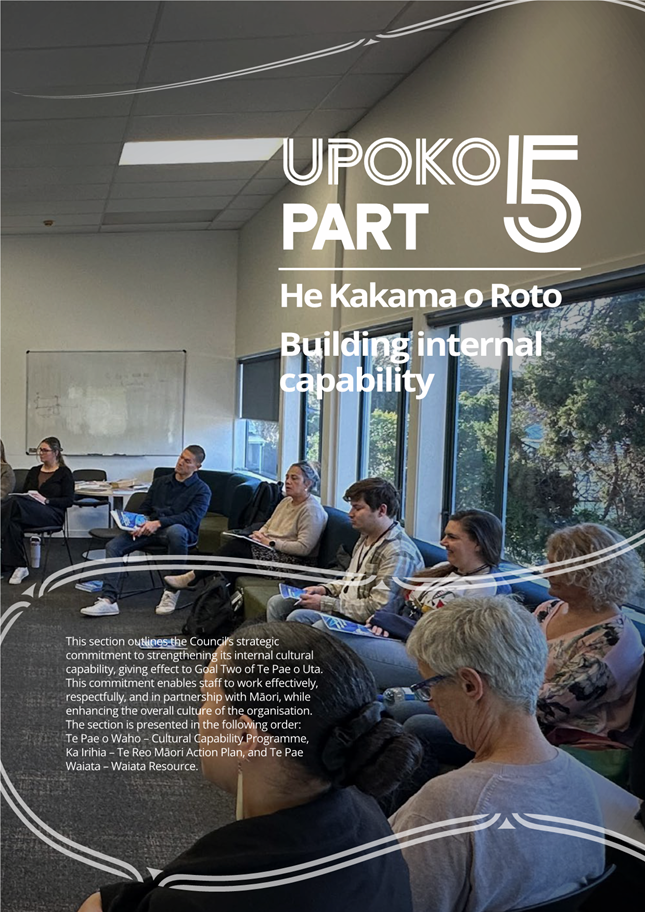
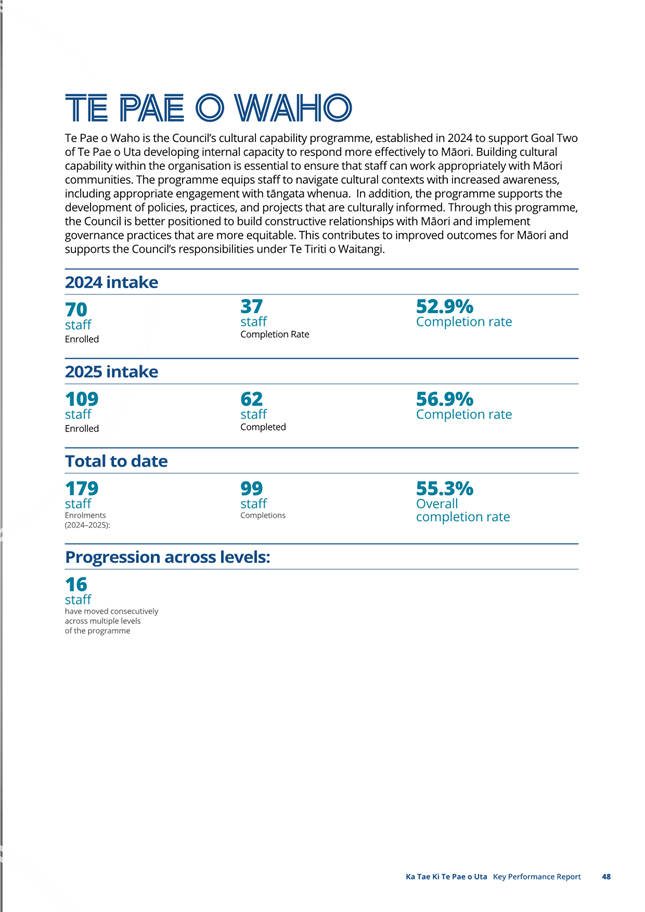
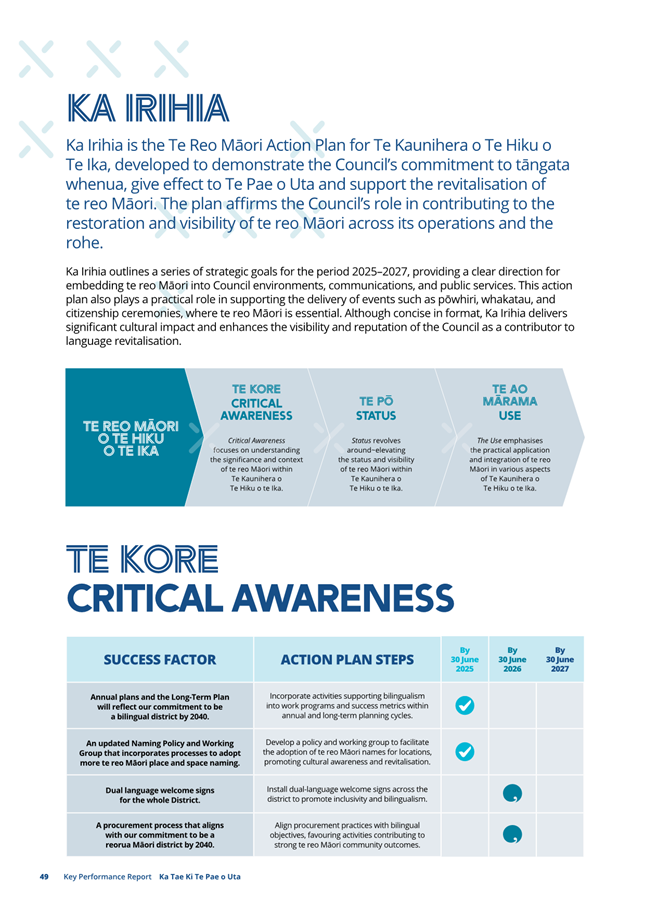
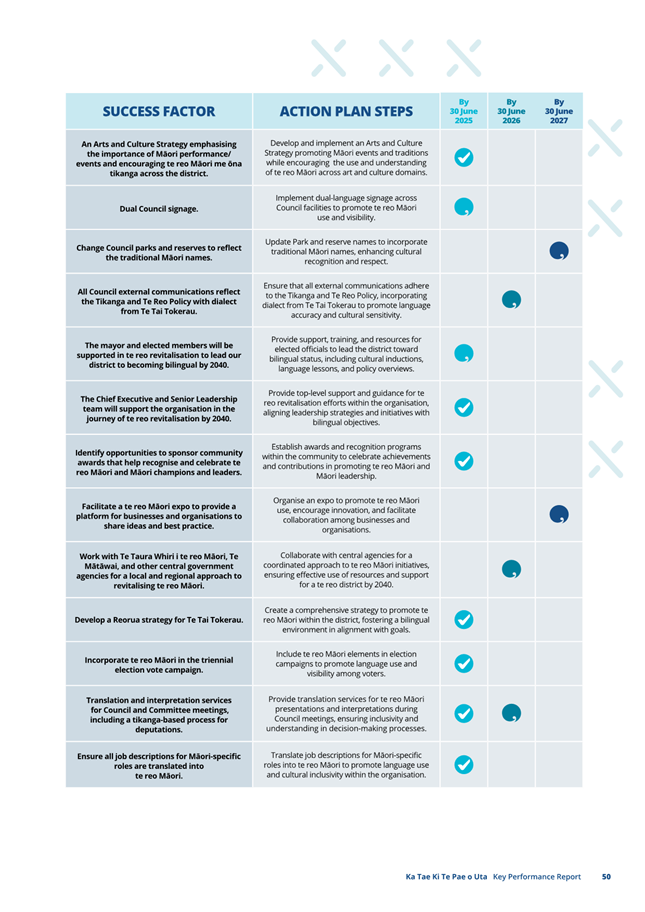
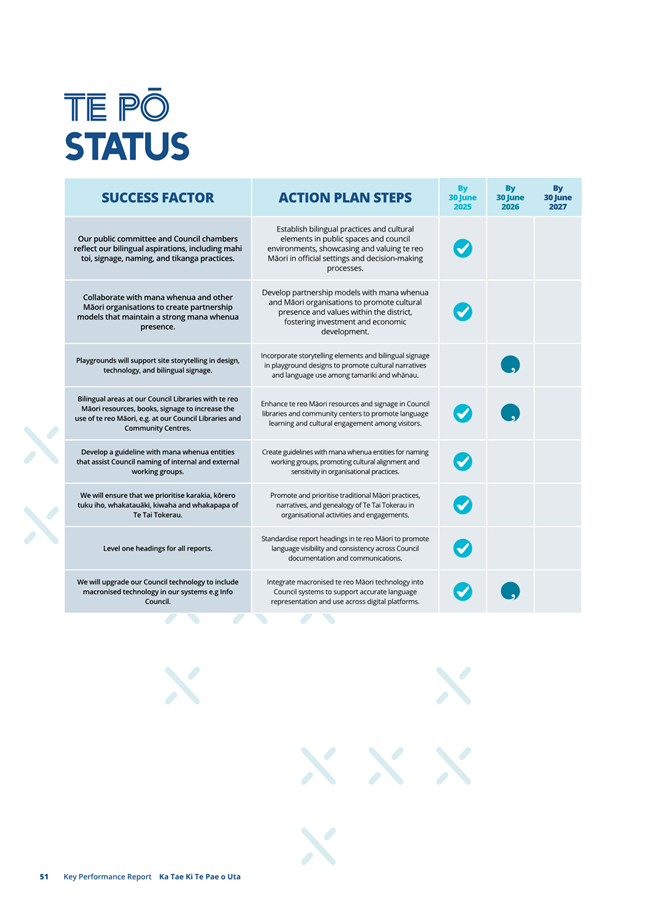
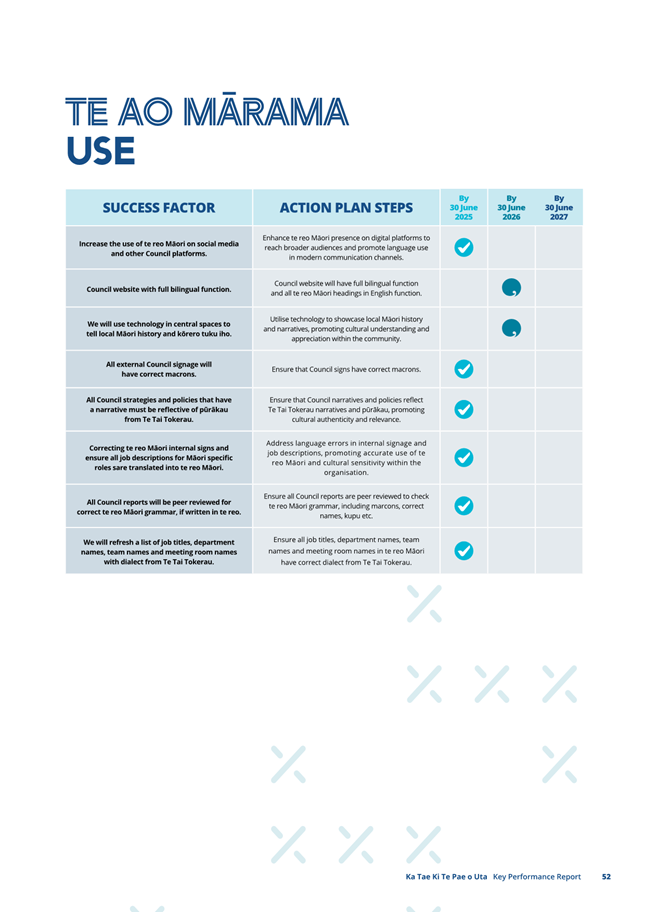
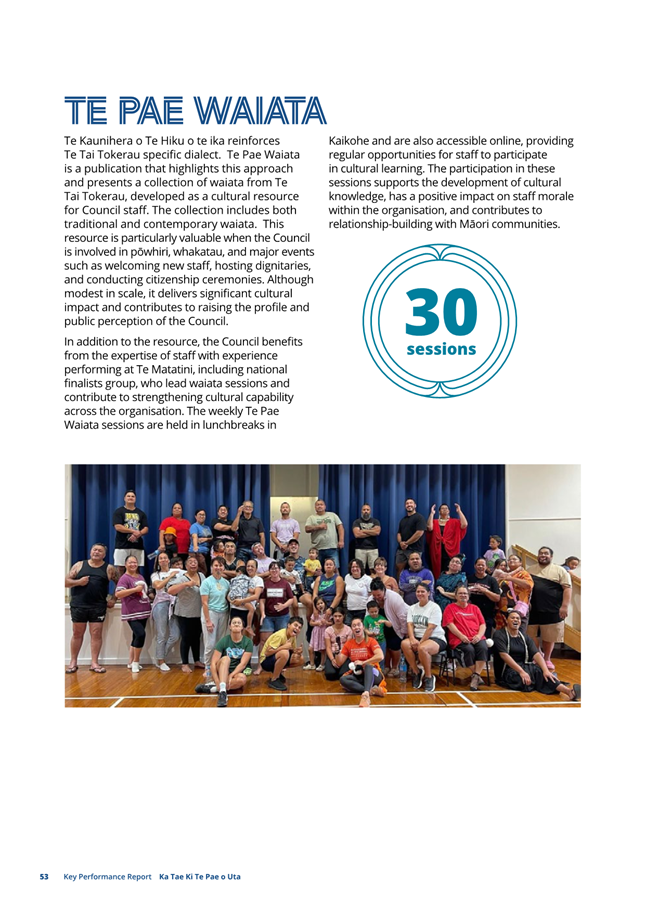
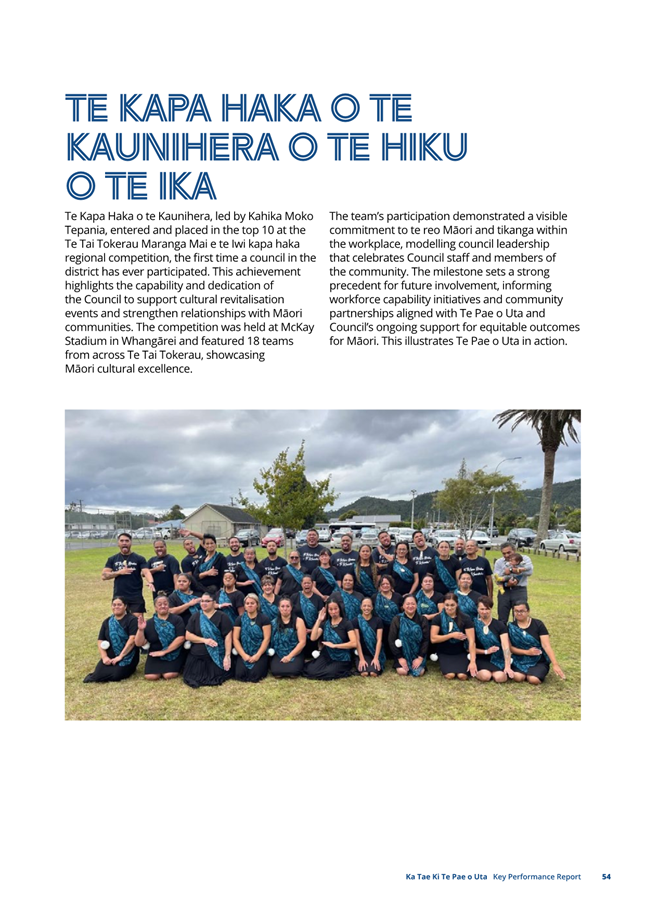
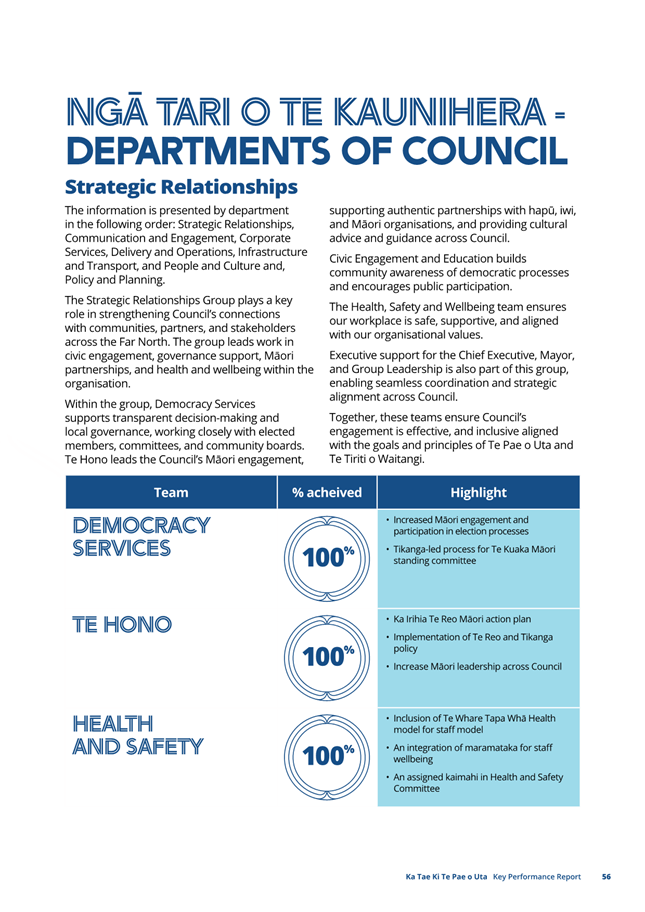
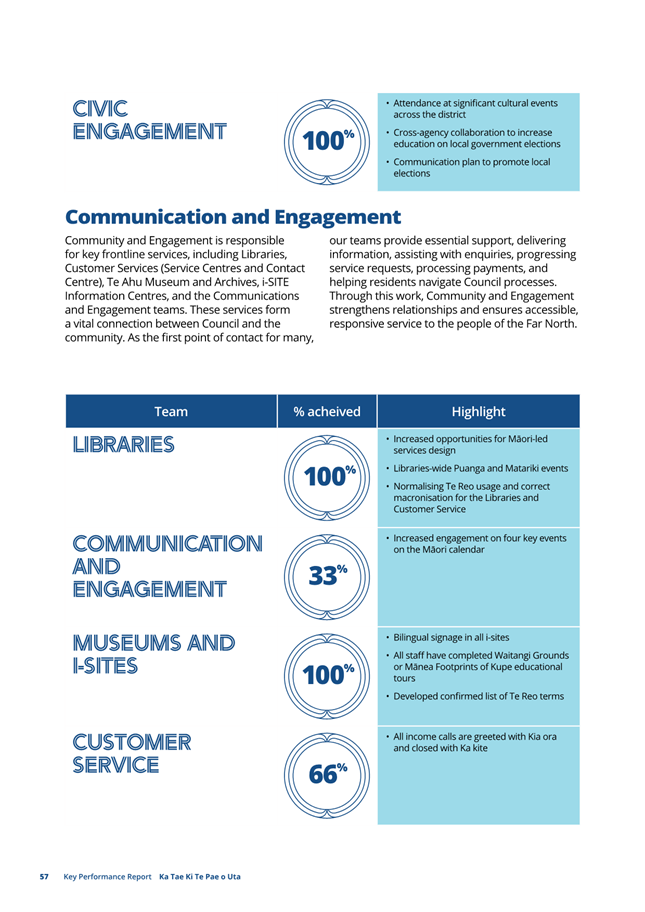
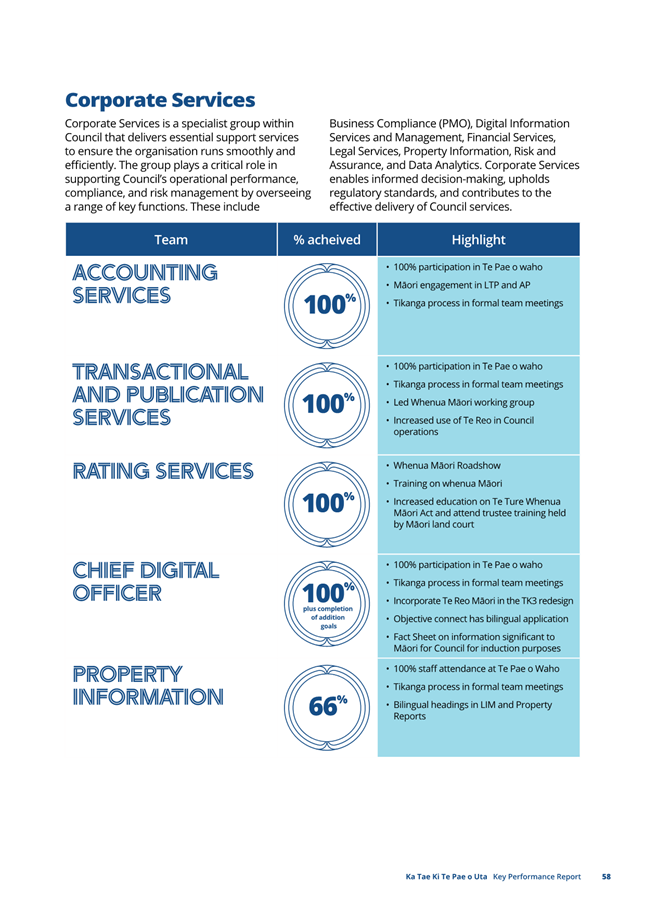
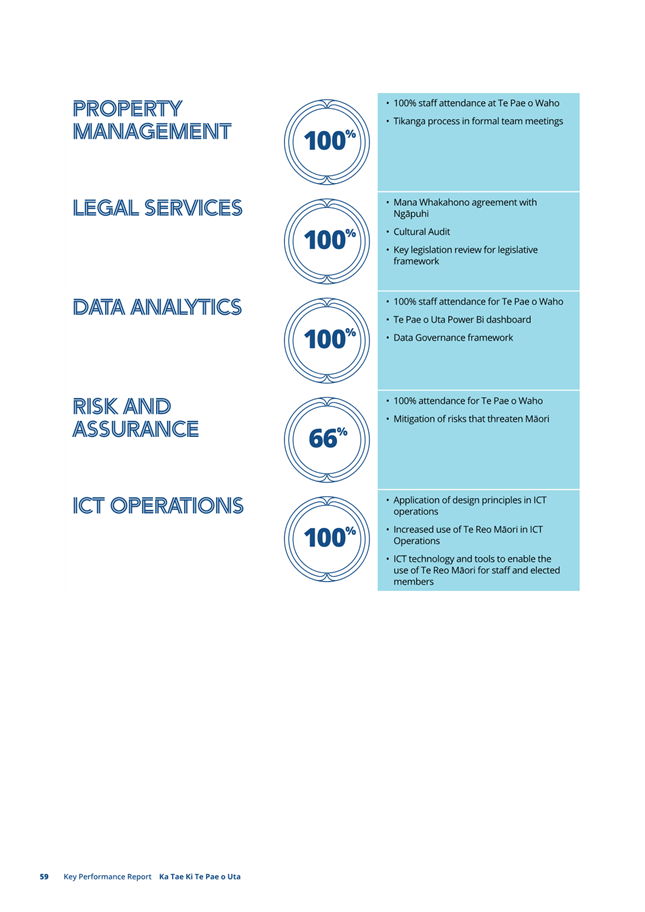
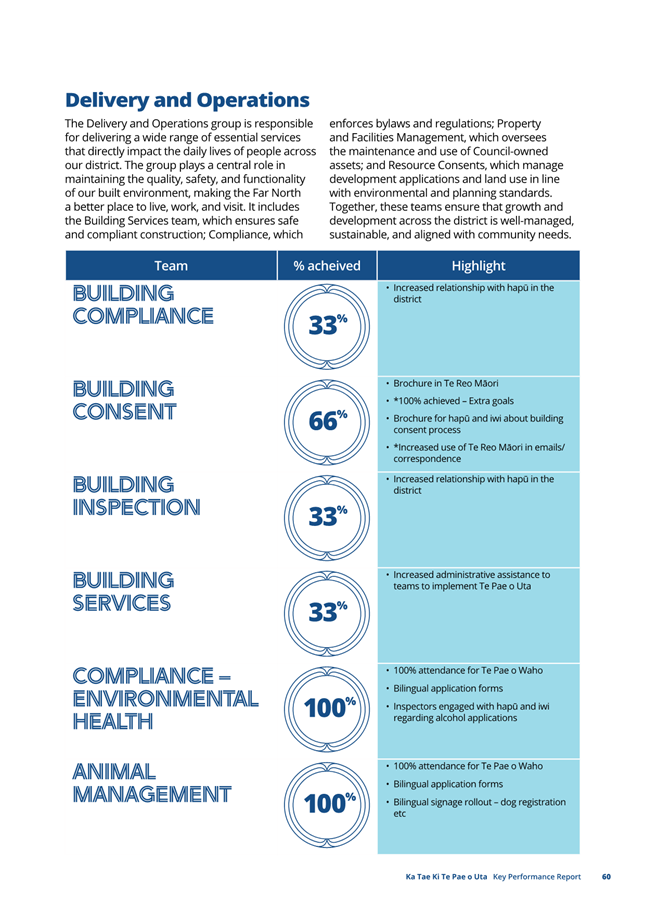
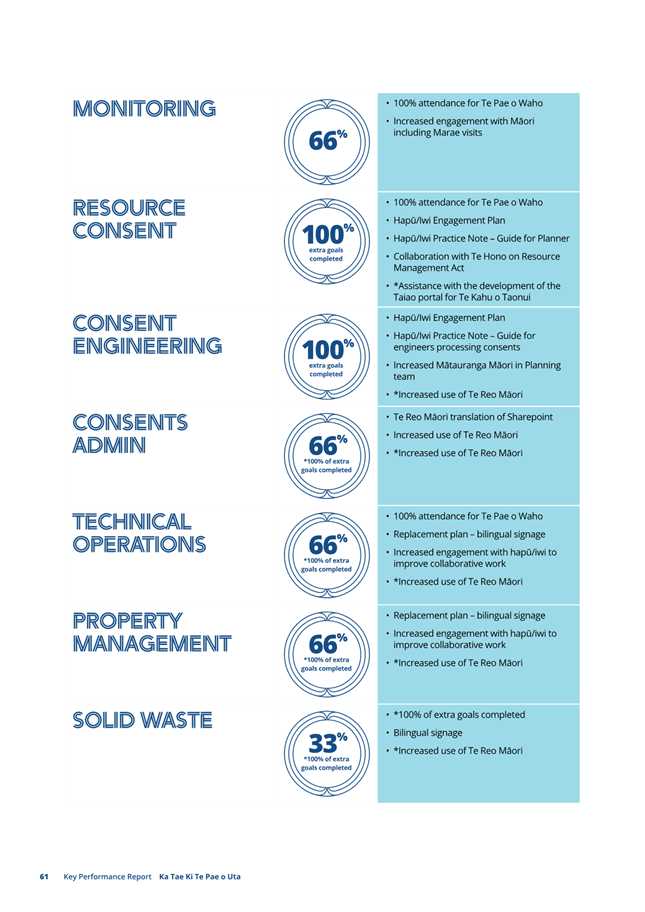
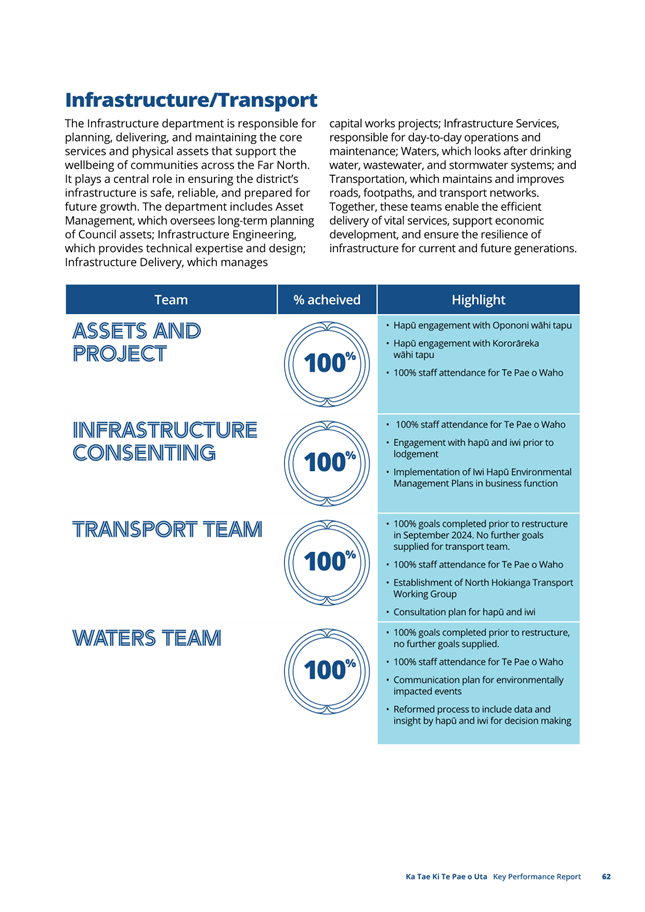
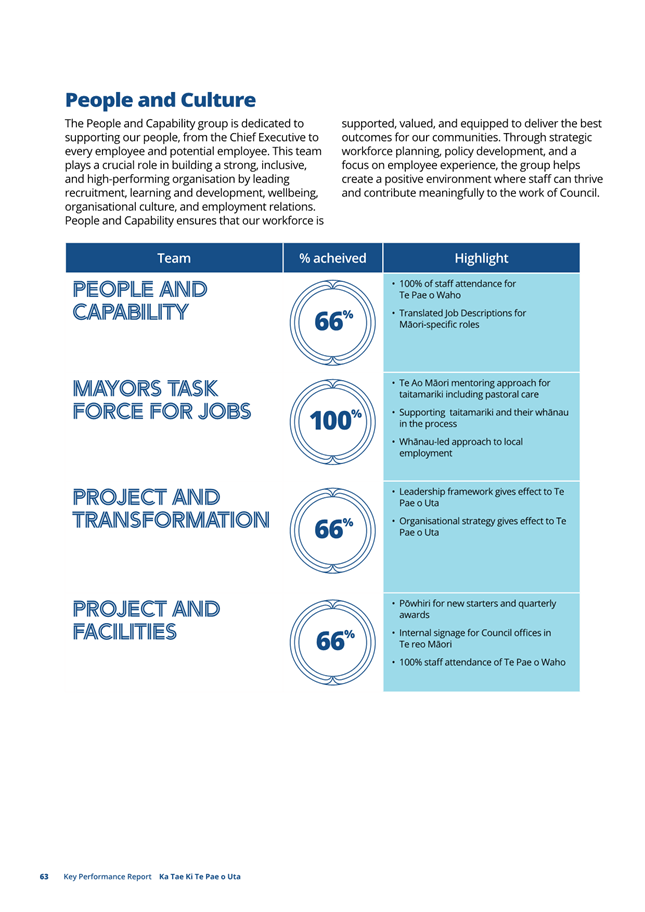
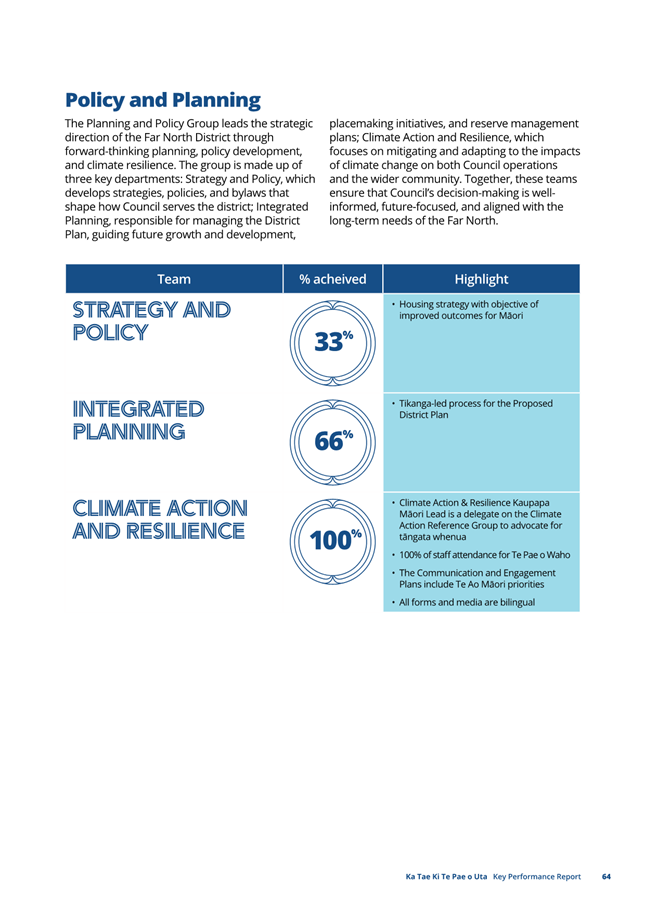
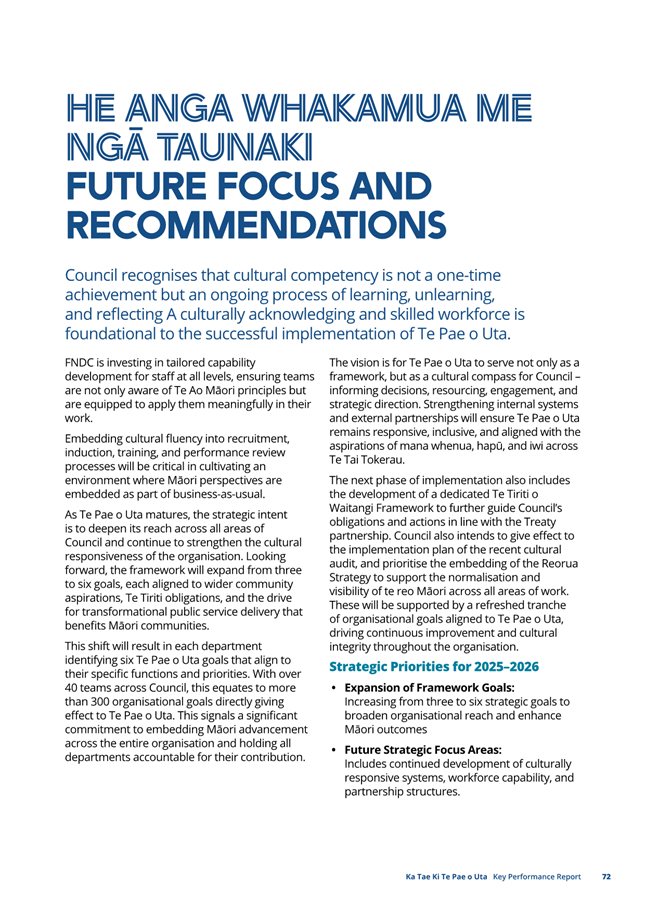

|
Ordinary Te Kuaka
Committee for Strategic Māori Relationships Meeting Agenda
|
25 March 2026
|
5.4 Te Pae o
Uta Te Ao Māori Framework Update
File
Number: A5629557
Author: Jude
Campbell, Principal Advisor
Authoriser: Aaron
Taikato, Manuhautū Te Hono – Group Manager Te Hono
TAKE PŪRONGO / Purpose of the Report
To provide Te Kuaka
Committee for Strategic Māori Relationships (Te Kuaka) with an
update on Te Pae o Uta - Te Ao Māori Framework.
WHAKARĀPOPOTO MATUA / Executive SummarY
The Far North District
Council (FNDC) adopted the Te Pae o Uta Te Ao Māori Framework in the
Council meeting (resolution 2023/8, dated 7 September 2023). The overall
principles for Council in respect of Te Pae o Uta are to
· Recognise
He Whakaputanga o te Rangatiratanga o Nu Tireni (Declaration of Independence)
and Te Tiriti o Waitangi (Treaty of Waitangi) as the founding covenants of Te
Tai Tokerau and Aotearoa respectively;
· Acknowledge
the importance of relationships, both tangible and intangible, e.g., Ngā
Atua, Whenua, Mauri o Te Wai, Taiao, (Oranga Taiao, Oranga Tāngata);
· Focus on the
pursuit on excellence in the Te Ao Māori space;
· Valuing Te Ao
Māori requires staff to understand key concepts and practices;
· Acknowledge
kōrero tuku iho at FNDC by recognising Hapū and Iwi kōrero.
|
TŪTOHUNGA
/ Recommendation
That Te
Kuaka Committee for Strategic Māori Relationships receive the Te Pae o
Uta Te Ao Māori Framework Update Report.
|
tĀHUHU KŌRERO / Background
Please see the timeline
of events for Te Pae o Uta:
|
Date
|
Milestone
|
Detail
|
|
June 2023
|
Te Rauora
Reorua
|
Far North
District Council signs Te Rauora Reorua Strategy with Ngāti Rēhia,
establishing a commitment to strengthening Te Reo Māori revitalisation.
|
|
August 2023
|
Framework
Endorsement
|
Te Pae o Uta -
Te Ao Māori Framework is formally endorsed by Te Kuaka - Māori
Strategic Relationships Committee, establishing the framework as a strategic
direction for Council.
|
|
September 2023
|
Council
Adoption
|
Te Pae o Uta
and Te Reo and Tikanga Policy are formally adopted by Council.
|
|
February 2024
|
Implementation
Work Begins
|
Te Pae o Uta
progress update provided to Te Kuaka, and the framework transitions into an
organisational implementation work programme.
|
|
February 2024
|
Cultural
Capability Initiative
|
Te Pae Waiata
programme designed and delivered by Te Hono begins weekly sessions for staff
and elected members to strengthen cultural capability.
|
|
March 2024
|
Cultural
Programme Expansion
|
Te Pae Waiata
expands to become Te Kaunihera o Te Hiku o te Ika kapa haka rōpū,
representing Council at the Te Tai Tokerau Regional Kapa Haka Competition,
placing within the top 10.
|
|
July 2024
|
Organisational
Work Programme
|
The first
formal Te Pae o Uta organisational work programme is established, consisting
of 161 organisational goals across Council departments. Six-weekly reporting
mechanisms are implemented.
|
|
August 2024
|
Te Reo
Māori Strategy Development
|
Te Reo
Māori Action Plan workshop held with Te Kuaka to develop strategic
actions for strengthening Te Reo Māori capability within Council.
|
|
September 2024
|
Te Reo Action
Plan Endorsed
|
Ka Irihia - Te
Reo Māori Action Plan formally endorsed by Te Kuaka, providing the
strategic pathway for advancing Te Reo Māori within Council operations.
|
|
September 2024
|
Cultural
Competency Programme
|
Te Pae o Waho,
developed by Te Reo Māori expert Kanewa Harrison to support Goal 2 of Te
Pae o Uta and the Chief Executive’s cultural competency key success
factor.
|
|
September 2024
|
Māori
Representation
|
Council votes
unanimously to retain the Māori Ward and pursue legal avenues to avoid a
referendum, reaffirming commitment to Māori representation in local
governance.
|
|
October 2024
|
Staff
Capability Development
|
Te Pae o Waho
classes commence for Council staff to strengthen cultural capability and Te
Ao Māori understanding across the organisation.
|
|
October 2024
|
National
Recognition
|
Te Pae o Uta
is named a finalist in the Human Resources New Zealand Awards under the
category Mana Tāngata – Emerging Leader Award.
|
|
November 2024
|
Governance
Oversight Established
|
Te
Rōpū Tupu Wanawana is established as an advisory rōpū to
oversee implementation of Te Pae o Uta, review progress, and encourage
continuous improvement. The rōpū meets monthly.
|
|
December 2024
|
Strengthening
Iwi Relationships
|
Council signs
Te Aro Manatū Relationship Agreement with Ngāti Rēhia,
strengthening our strategic partnership.
|
|
December 2024
|
Cultural
Resource Development
|
Te Pae Waiata
booklet is developed to support learning and participation in waiata and kapa
haka across the organisation.
|
|
February 2025
|
Council-Controlled
Organisation Engagement
|
Far North
Holdings Limited (FNHL) senior leadership team undertake workshops on
integrating Te Pae o Uta into FNHL operations.
|
|
February 2025
|
Cultural
Training Expansion
|
Second cohort
of Te Pae o Waho begins for Council staff and Pou Herenga Tai Trust,
continuing organisational capability development.
|
|
April 2025
|
Strategic
Integration
|
During
workshops reviewing the FNHL Draft Statement of Intent, elected members
advise that Te Pae o Uta must be considered in the document.
|
|
May 2025
|
Reorua
Strategy Development
|
Te Ao
Mārama - Reorua Strategy workshopped with Te Kuaka to strengthen
bilingual organisational capability.
|
|
May 2025
|
Iwi
Partnership
|
Council
formally signs a Memorandum of Understanding with Te Rūnanga o Te Rarawa
|
|
June 2025
|
Strategy
Endorsement
|
Te Ao
Mārama - Reorua Strategy formally endorsed to give effect to Ka Irihia -
Te Reo Māori Action Plan.
|
|
June 2025
|
Programme
Analysis
|
Detailed
analysis of the 2024–2025 Te Pae o Uta work programme undertaken,
identifying 166 organisational goals across Council departments.
|
|
July 2025
|
Programme
Expansion
|
New 2025-2026
Te Pae o Uta work programme developed, expanding to 266 organisational goals
across the organisation.
|
|
August 2025
|
Iwi
Partnership
|
Council
formally signs a Mana Whakahono ā Rohe agreement with Te
Rūnanga-Ā-Iwi-o Ngāpuhi, strengthening partnership and
engagement on resource management matters.
|
|
September 2025
|
Relationship
Agreement
|
Council
formally signs a Te Mana Ōrite Relationship Agreement with Te
Rūnanga o Whaingaroa.
|
|
September 2025
|
Performance
Reporting
|
Te Pae o Uta
Key Performance Report completed, providing detailed analysis of Māori
outcomes across Council through the framework.
|
|
September 2025
|
Whenua
Māori Strategy
|
Te Kiri Waiwai
o Papatūānuku - Whenua Māori Strategy approved by Te Kuaka and
formally adopted by Council.
|
|
October 2025
|
Governance
Reporting
|
Te Pae o Uta
Key Performance Report presented to Council.
|
|
October 2025
|
Pou Herenga
Tai Trust Alignment
|
Pou Herenga
Tai Trust confirms six organisational goals that give effect to Te Pae o Uta.
These goals are formally presented to Council.
|
|
December 2025
|
FNHL Alignment
|
Far North
Holdings Limited confirms six organisational goals that give effect to Te Pae
o Uta.
|
|
December 2025
|
Hapū
Engagement Programme
|
Hapū
Engagement Strategy internal work programme developed, and first engagement
hui conducted across Te Hiku, Bay of Islands-Whangaroa, and Kaikohe-Hokianga
wards.
|
|
April 2026
(Upcoming)
|
Framework
Review
|
Formal review
of Te Pae o Uta scheduled to commence, assessing implementation progress, and
identifying opportunities for refinement.
|
Te Pae o Uta internal
process:
All Council teams provide 6-weekly status updates to Te Hono
on their Te Pae o Uta goals. In addition, all general managers provide a
Te Pae o Uta update in their quarterly report to the Chief Executive. Te Hono
provide a weekly drop-in service for all Te Pae o Uta or Te Hono related
queries.
Te Pae o Uta
monitoring and reporting system:
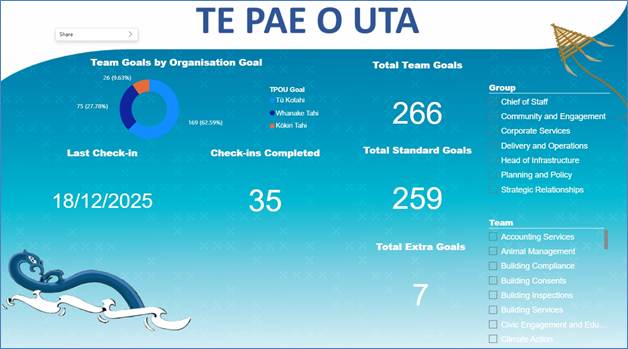
MATAPAKI ME NGĀ KŌWHIRINGA /
Discussion and Next Steps
Te Pae
o Uta review, initially due in September 2026, will now commence in April 2026.
An update will be provided at every Te Kuaka meeting.
PĀNGA PŪTEA ME NGĀ WĀHANGA
TAHUA / Financial Implications and Budgetary Provision
All
Council departments must ensure they have appropriate budget provision to give
effect to Te Pae o Uta.
Āpitihanga
/ Attachments
1. Ka
Irihia Te Reo Maori Action Plan FINAL - A5621675 ⇩ 
2. Te
Ao Marama Reorua Strategy Final 2025 - A5621664 ⇩
3. Te
Pae o Uta publication FINAL - A5621645 ⇩
4. Te
Putea Funding 2025 - A5621647 ⇩ 
|
Ordinary Te Kuaka
Committee for Strategic Māori Relationships Meeting Agenda
|
25 March 2026
|
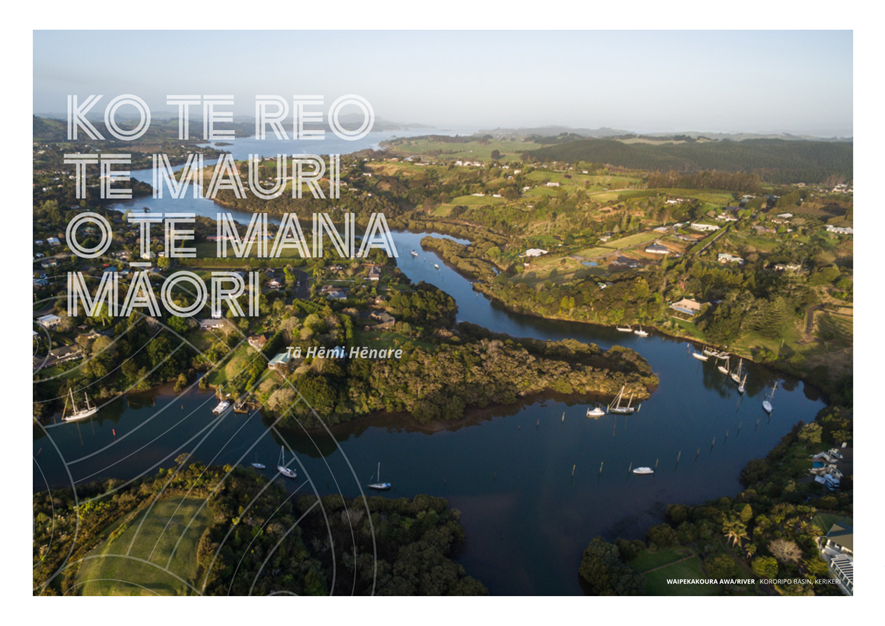
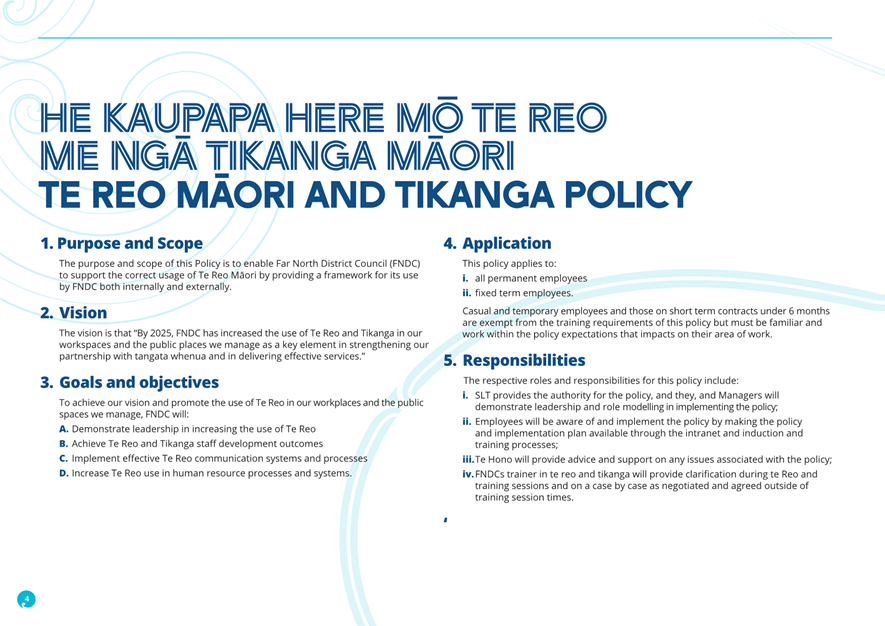
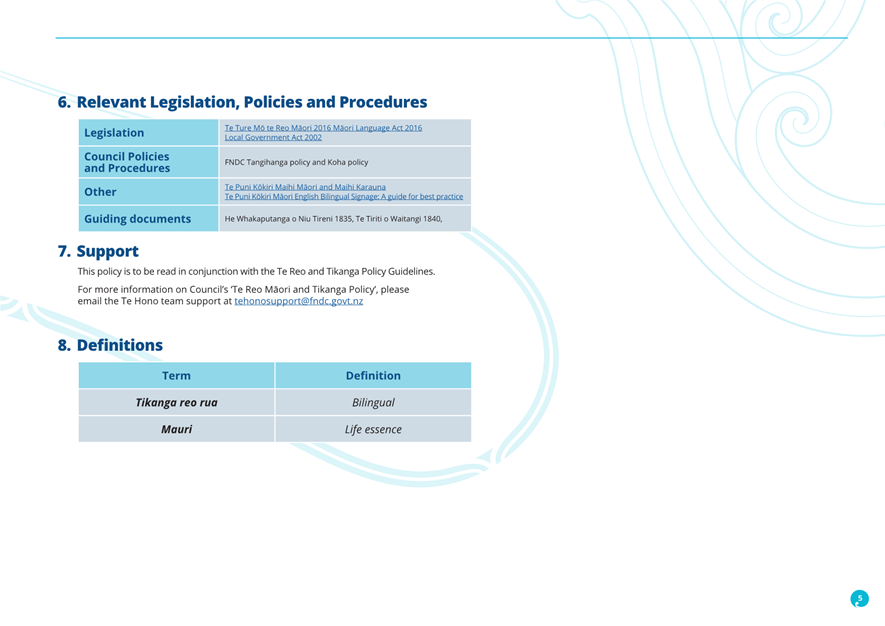
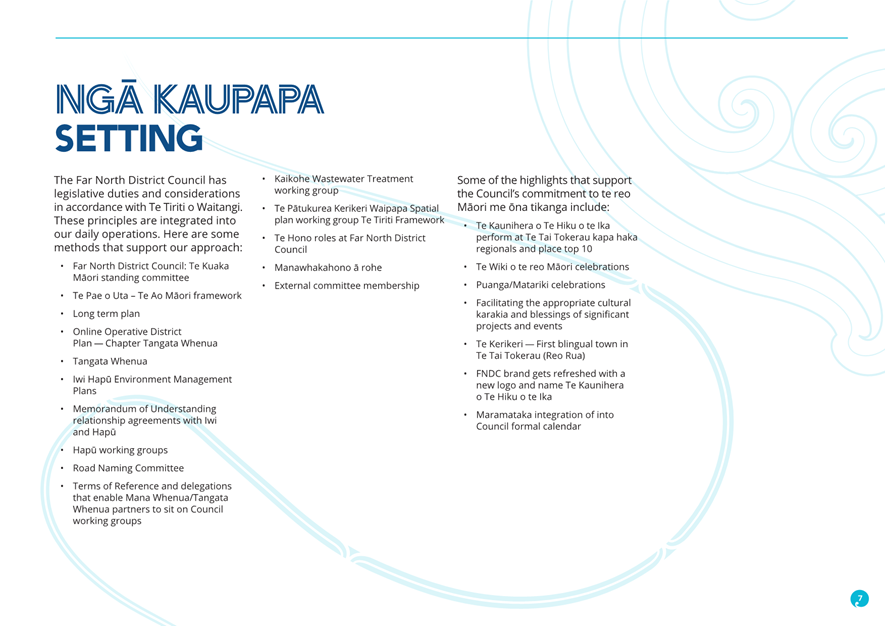
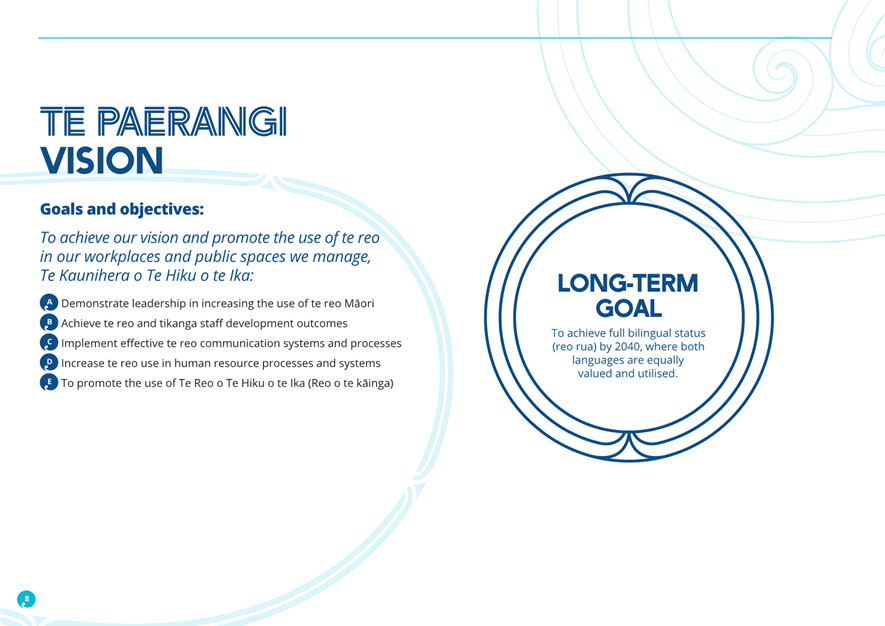
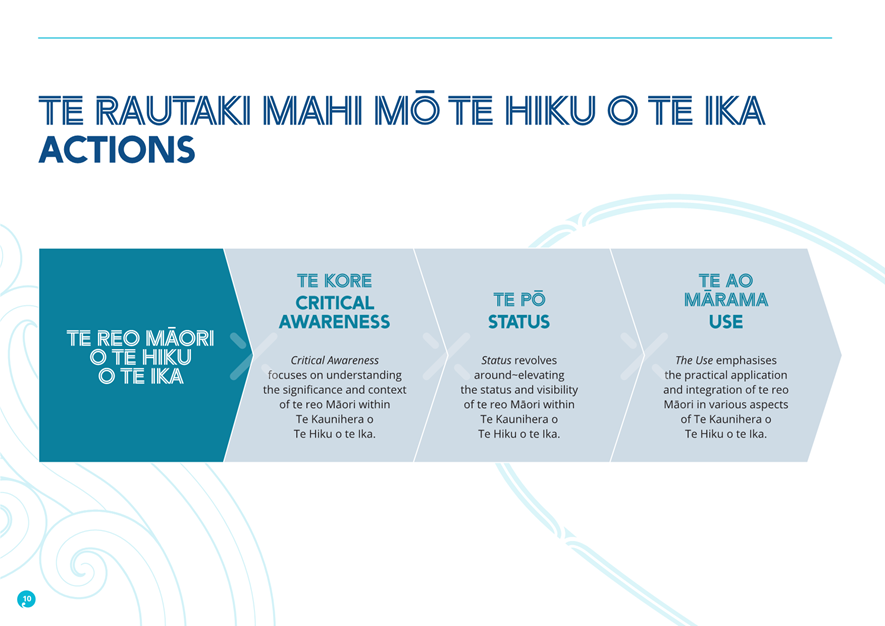
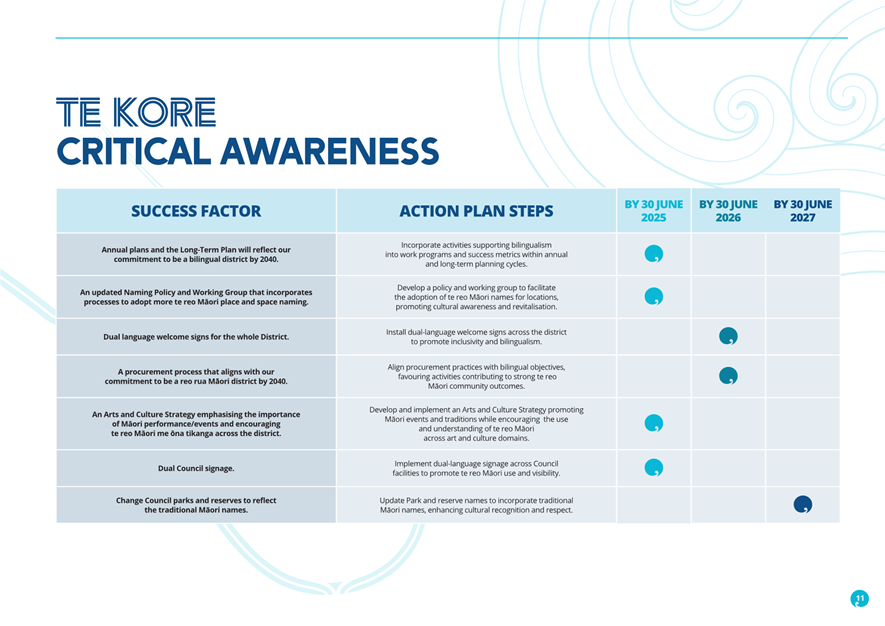
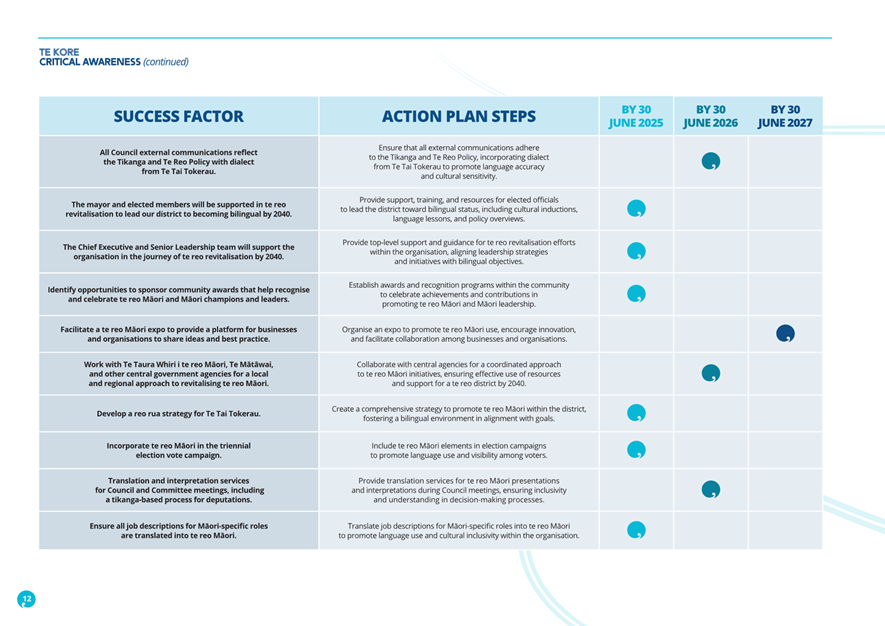
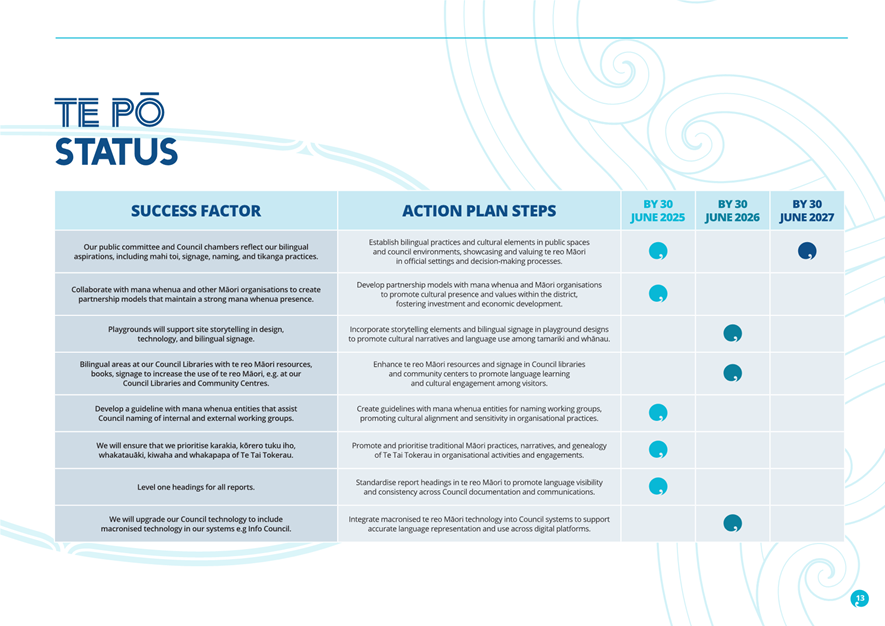
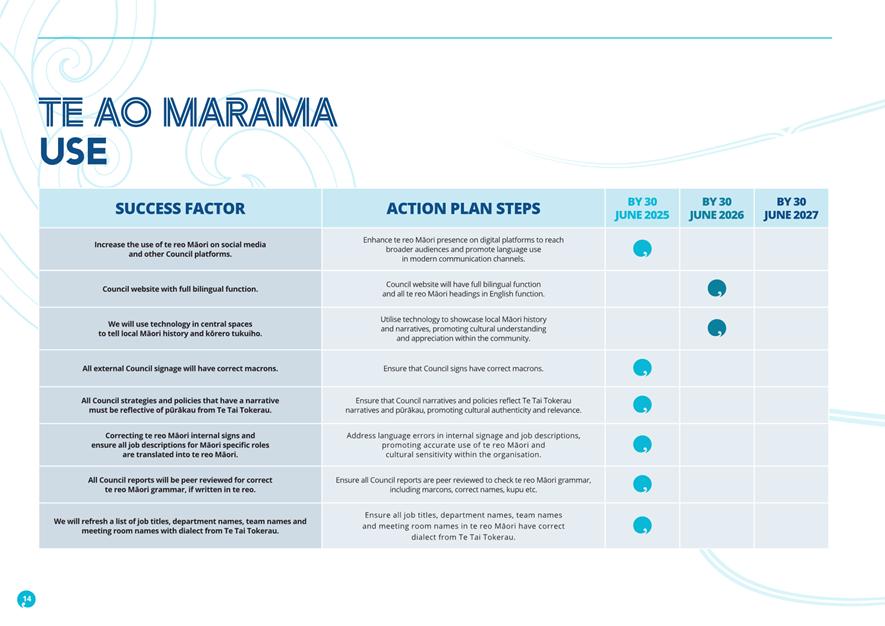

|
Ordinary Te Kuaka
Committee for Strategic Māori Relationships Meeting Agenda
|
25 March 2026
|
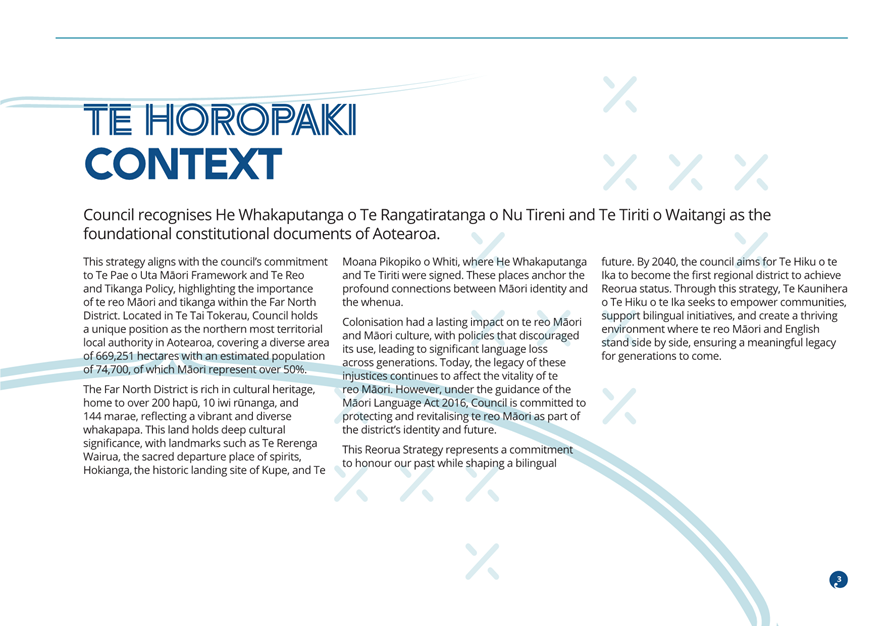
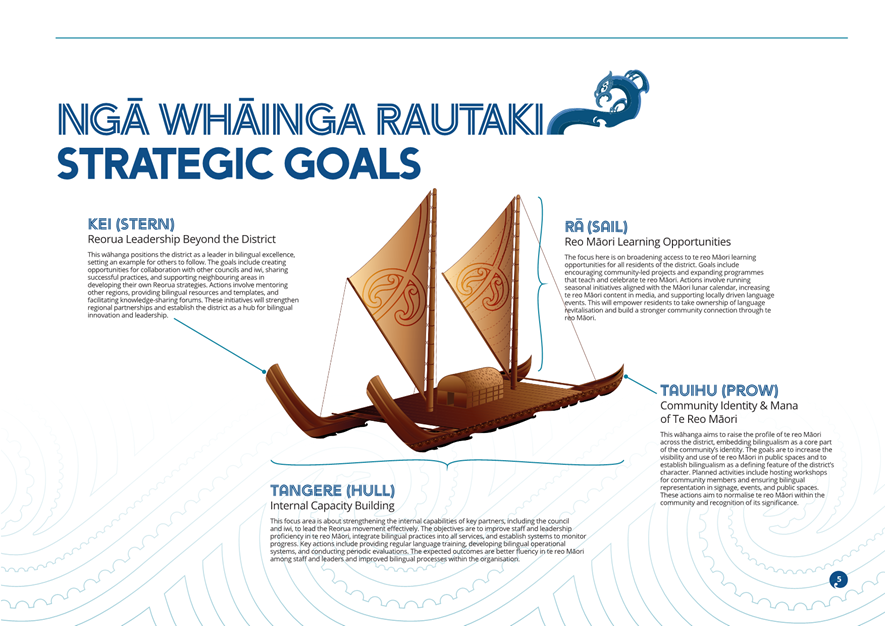
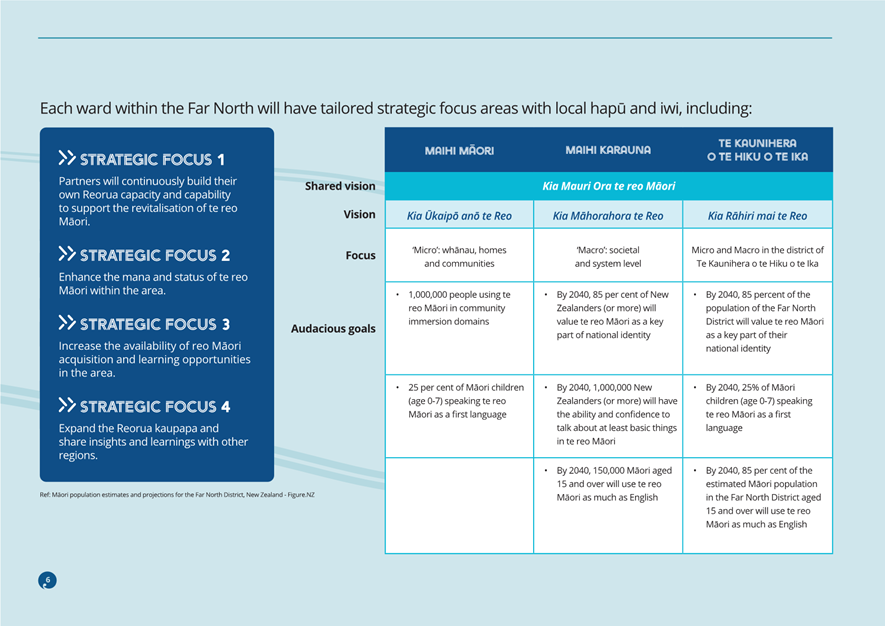
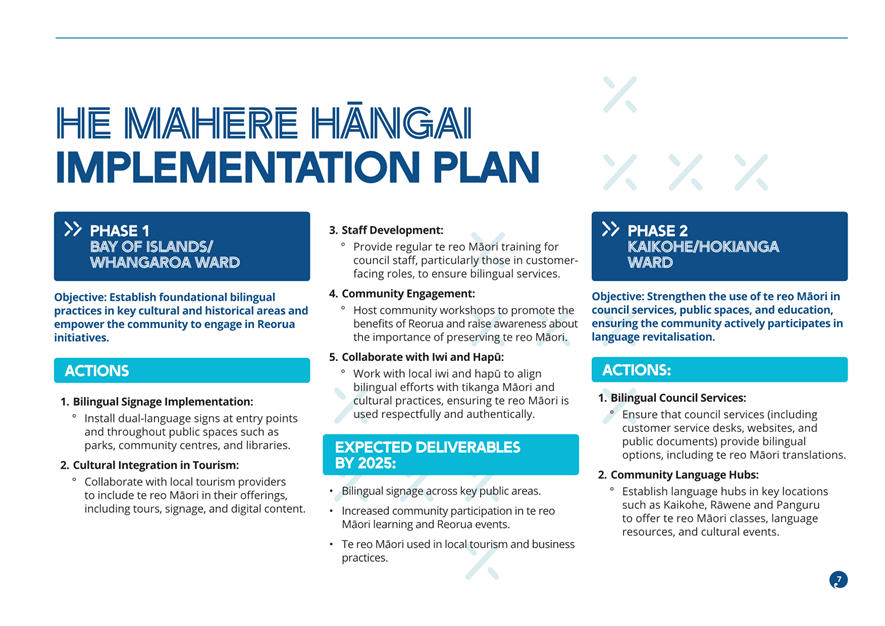
|
Ordinary Te Kuaka
Committee for Strategic Māori Relationships Meeting Agenda
|
25 March 2026
|
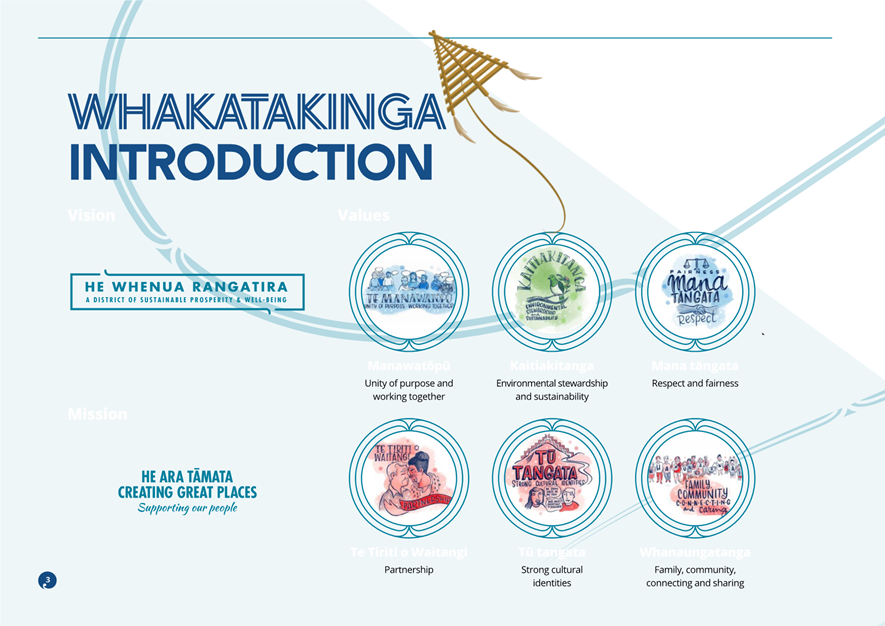
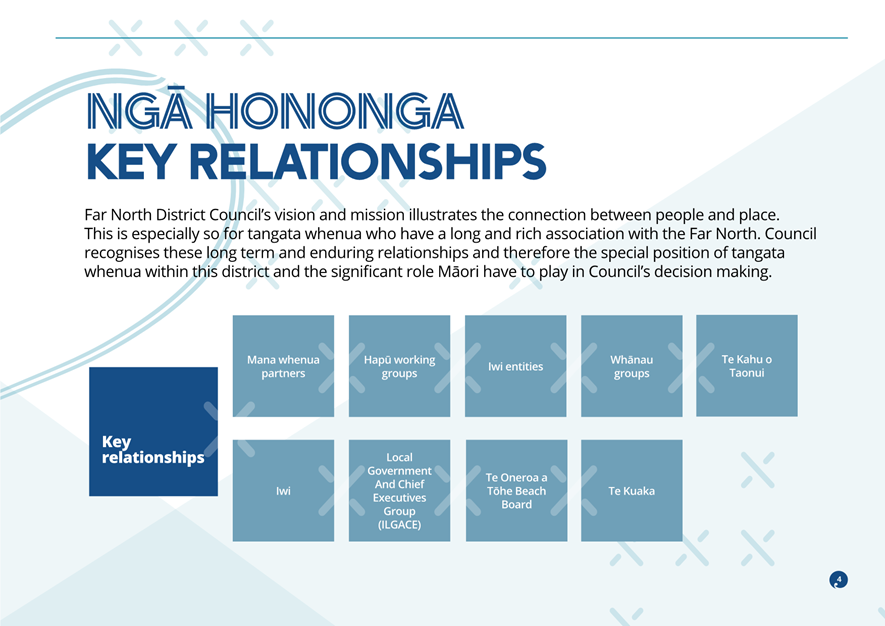
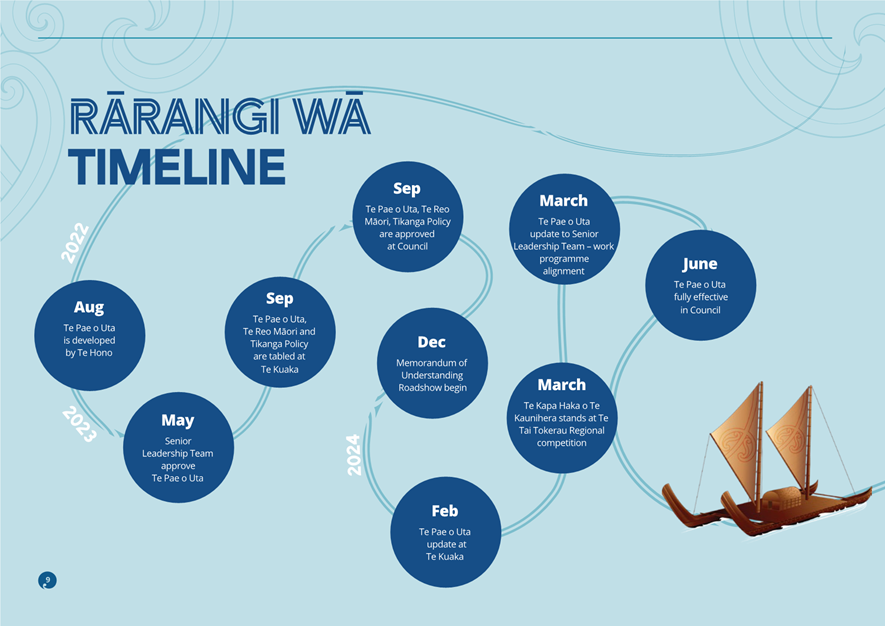
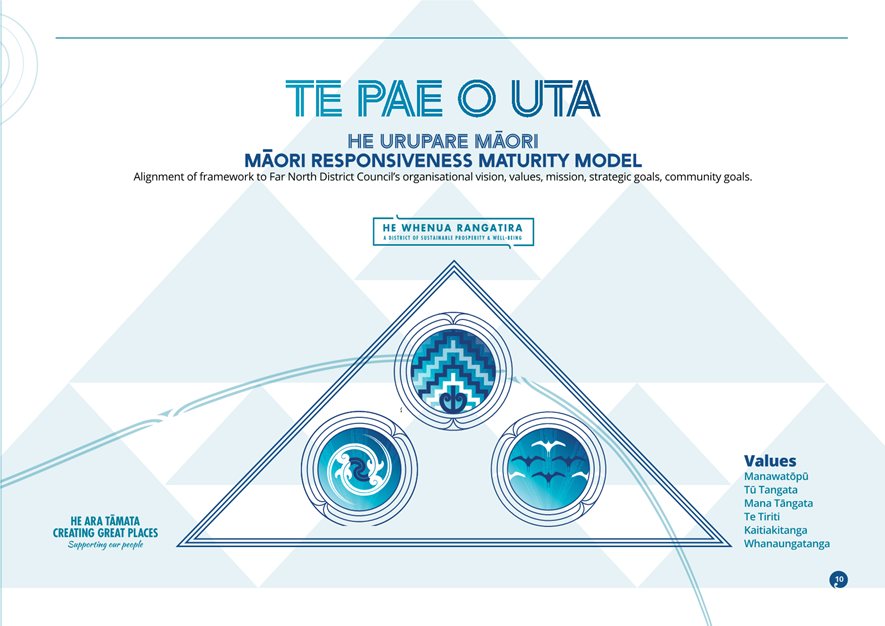
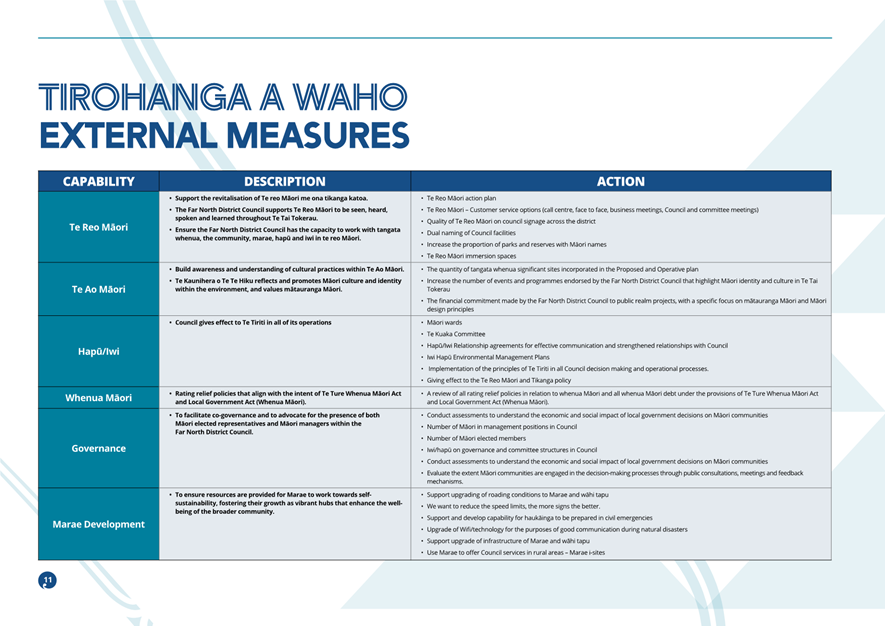
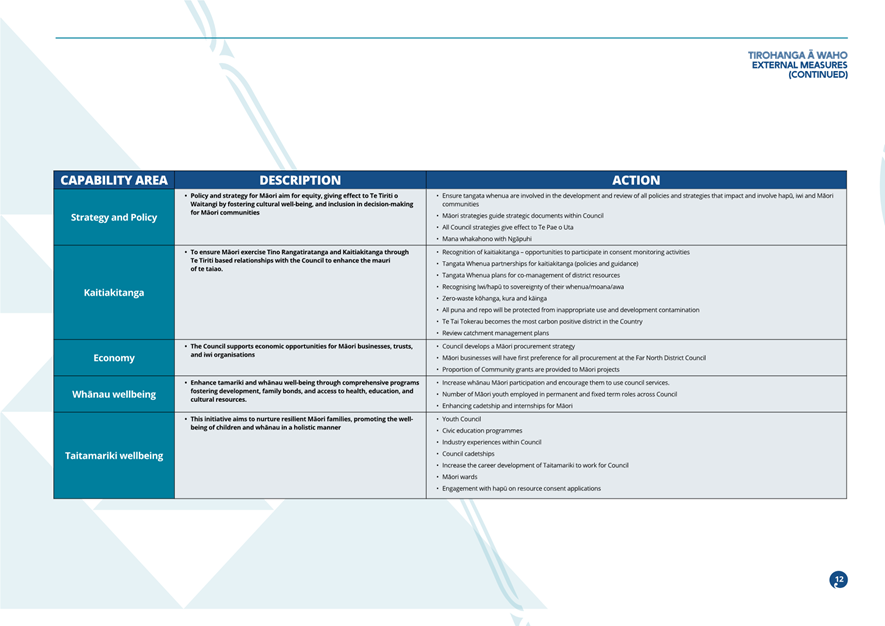
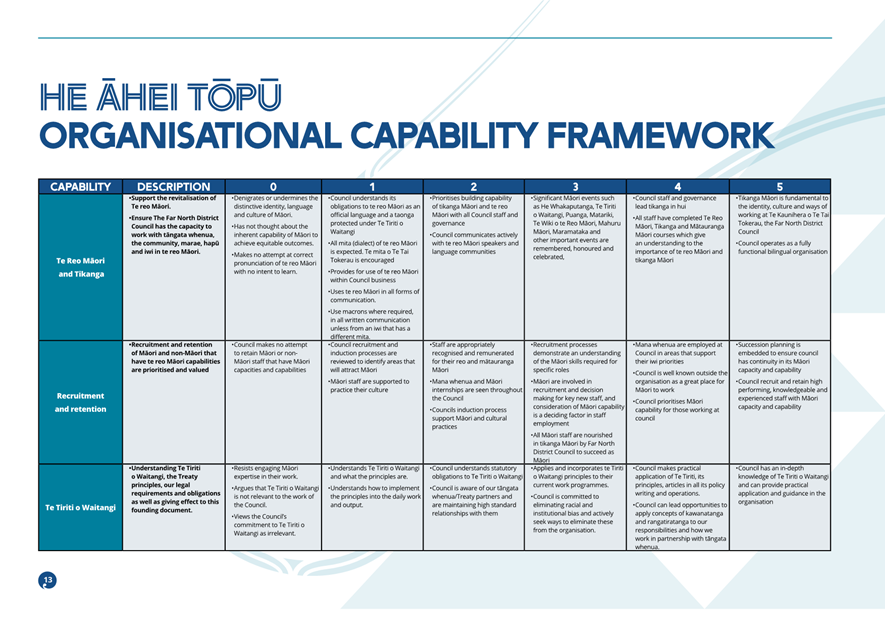
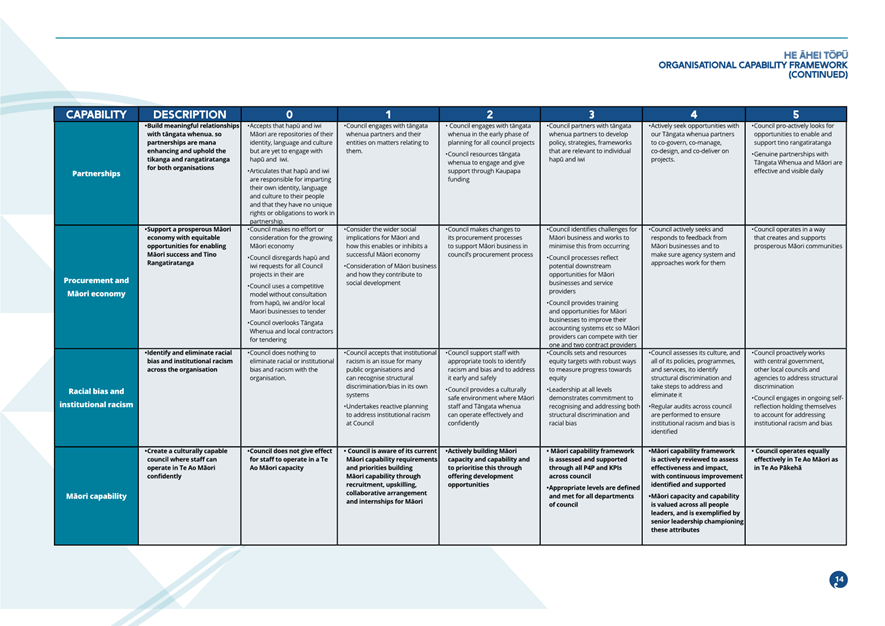
|
Ordinary Te Kuaka
Committee for Strategic Māori Relationships Meeting Agenda
|
25 March 2026
|
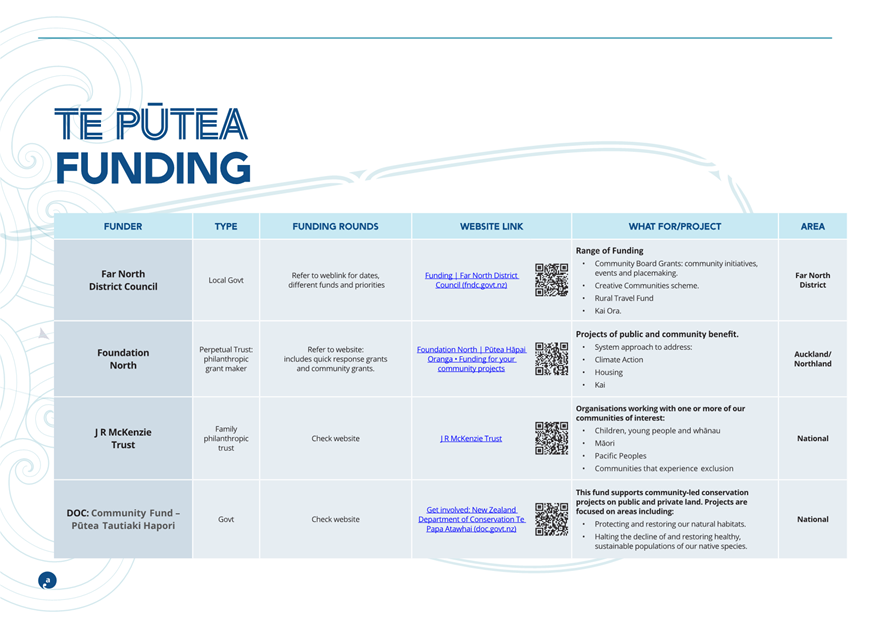
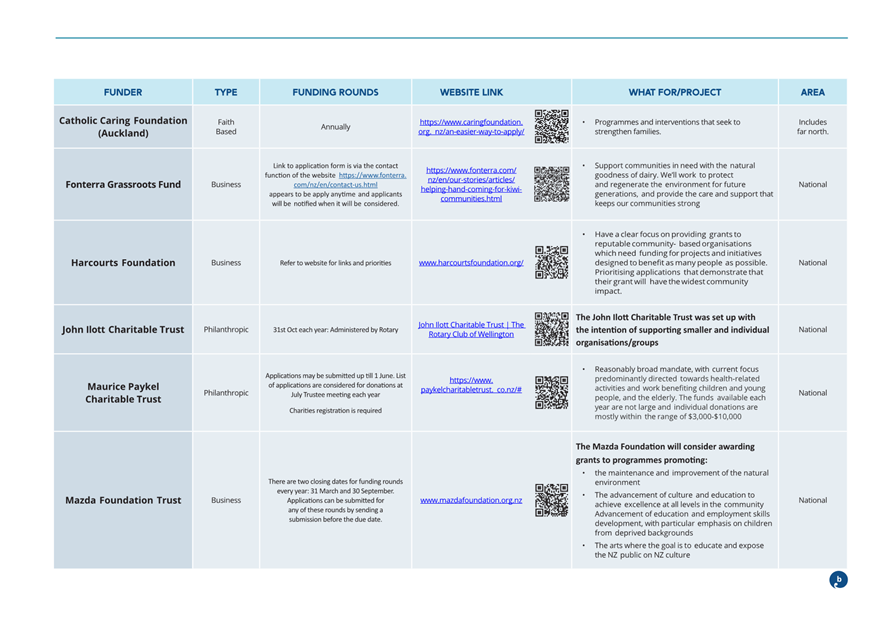
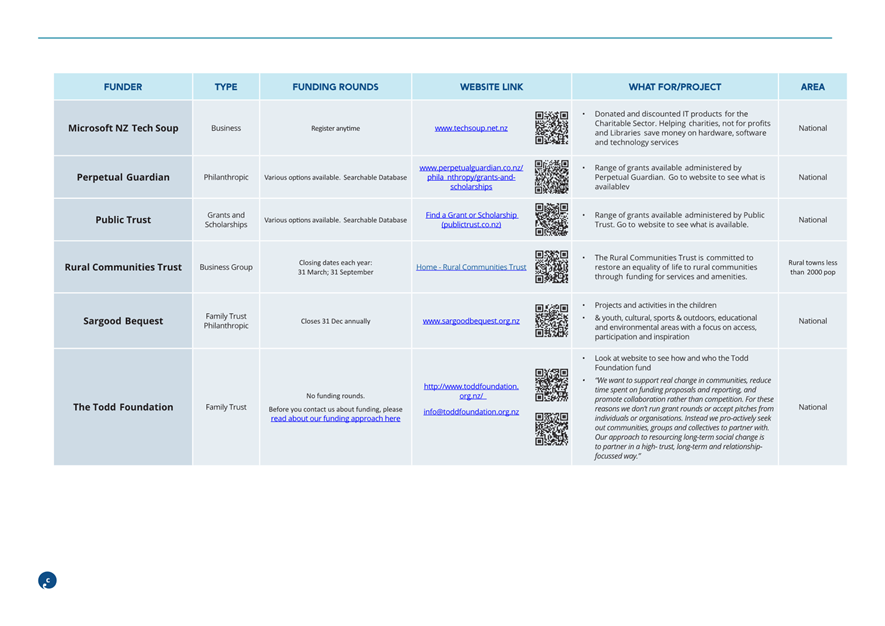
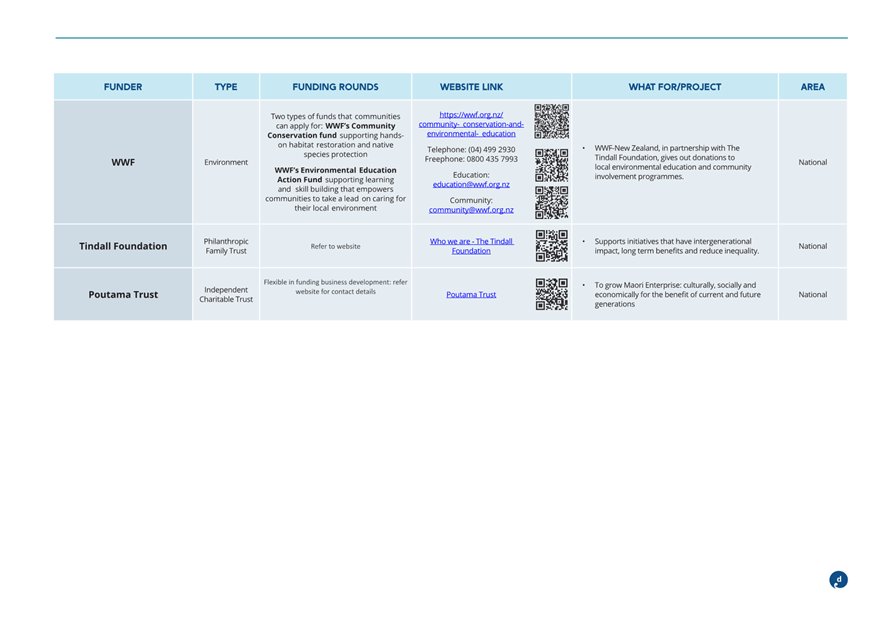
|
Ordinary Te Kuaka
Committee for Strategic Māori Relationships Meeting Agenda
|
25 March 2026
|
5.5 Local Water
Done Well – Update and FNDC Positioning
File
Number: A5629636
Author: Andy
Dowdle, Change Specialist - Organisational Development
Authoriser: Emma
Healy, Chief of Staff
TAKE PŪRONGO / Purpose of the Report
To provide Te Kuaka Committee for
Strategic Māori Relationships (Te Kuaka) with an update on Local Water
Done Well (LWDW) and progress in delivering against the Water Services Delivery
Plan (WSDP) the Far North District Council (FNDC) approved in August 2025.
WHAKARĀPOPOTO MATUA / Executive SummarY
At the time of the last update to
Te Kuaka by the LWDW project team FNDC had just completed the special
consultation required for LWDW. At that time two options for delivery were
discussed Te Pēke (retaining services in-house) and Te Kete (forming a
regional CCO). Te Kete was ultimately accepted as the preferred delivery model
and a WSDP prepared to detail how water services will be delivered under the
new model.
The programme of work to deliver
against the WSDP is still in the planning and preparation phase, although the
legal workstream to establish the CCO as a legal entity is ahead of schedule
and the CCO is now expected to be incorporated in May 2026 (rather than July
2026) allowing more time for the CCO to establish the operational functions
required to deliver drinking water and wastewater services.
|
TŪTOHUNGA
/ Recommendation
That Te Kuaka Committee for
Strategic Māori Relationships receive the report Local Water Done Well
– Update and FNDC Positioning.
|
tĀHUHU KŌRERO / Background
Under the
Governments Local Water Done Well legislation all territorial authorities in
Aotearoa were required to submit a WSDP to Government for approval by 3
September 2025. The WSDP must show how council will deliver drinking water,
wastewater and stormwater in a way that meets strengthened regulatory standards
whilst remaining financially sustainable and supporting growth.
The Far North worked with Kaipara
and Whangarei District Councils to prepare a joint WSDP whereby drinking water
and wastewater services will be delivered by a regional asset-owning CCO and
stormwater will remain the responsibility of each District Council. The plan
was approved in late 2025 since which time a Regional Elected Members Steering
Group (EMSG), supported by staff from each of the councils, has been working to
implement the initial stages of the WSDP implementation plan. FNDC is
represented on the EMSG by Kahika Moko Tepania, Councillor John Vujcich, and
Councillor Ann Court.
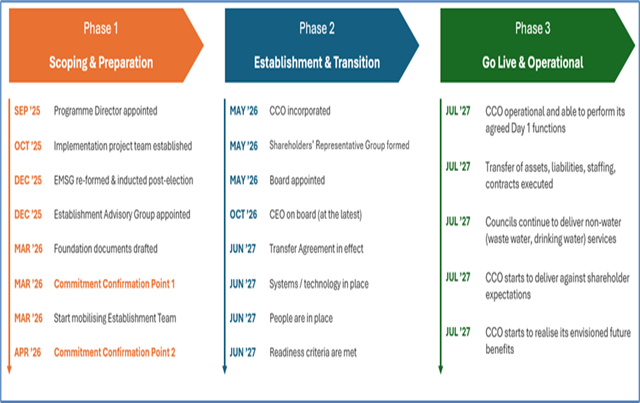
MATAPAKI ME NGĀ KŌWHIRINGA /
Discussion and Next Steps
Governance
The EMSG has been working at pace to complete Phase 1 of the
Implementation Plan which creates the CCO as a legal entity able to appoint a
board of directors, recruit a CEO, raise funds, etc. The initial plan had a
target date of 1 July 2026 for incorporation of the CCO, in recognition of the
amount of effort required for Phase 2 (the establishment of the CCO as an
operational entity delivering water services) the date for incorporation is now
targeting May 2026.
An Establishment Advisory Group (EAG) was formed in January
2026 and is in the process of recruiting the inaugural CEO for the CCO. In
collaboration with the EMSG the EAG is also developing the foundational legal
documents for the CCO:
Shareholders’ Agreement – To establish
the three council’s shareholder rights and interests
Constitution – Setting out the water
organisations’ governance framework
Upon incorporation and when the programme enters the
establishment phase. Further legal documents will be developed
Transfer Agreement – Transferring ownership of
water assets and responsibility for service
Statement of Expectations – Guiding the CCO to
make decisions
Water Services Strategy – Publicly state how
the CCO will delivery services
When the CCO is formed and the programme to establish the
CCO moves into delivery. The EMSG will be disbanded and replaced by a
Shareholder Representative Group.
The Programme Director for the CCO (Andrew Carvell) has met
with Te Kahu o Taihui (Philip Grimshaw) during these early planning stages and
it has been flagged that more interaction is needed as the EAG takes a more
prominent role in decision making.
Programme Delivery
As the programme moves towards completion of Phase 1
(Scoping and Preparation) and into Phase 2 (Establishment) the programme team
will be expanded and structured to ensure it maintains adequate linkages with
staff from each of the three councils.
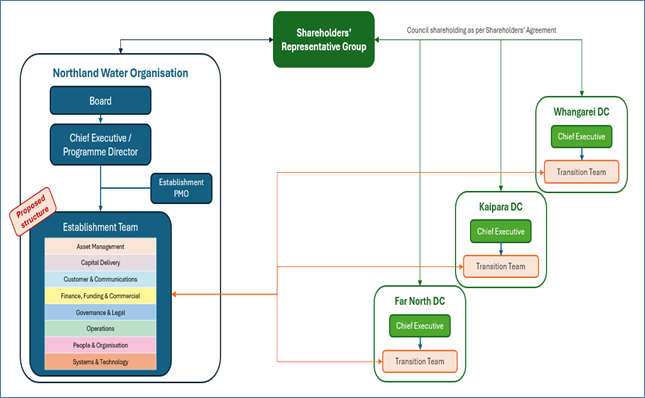
Stormwater
Although there is not the requirement to perform legal
separation from the rest of council for delivery of stormwater services, there
is still a significant work programme to create a standalone Business Unit for
stormwater within FNDC, including ring-fencing of financials, creation of
separate strategic planning documents (replacing the LTP for stormwater) and
new commercial/compliance reporting standards to be met. The stormwater
Business Unit is being delivered by an internal project at FNDC. The project is
still in its planning phase.
PĀNGA PŪTEA ME NGĀ WĀHANGA
TAHUA / Financial Implications and Budgetary Provision
No budgetary
implications.
Āpitihanga
/ Attachments
Nil
|
Ordinary Te Kuaka
Committee for Strategic Māori Relationships Meeting Agenda
|
25 March 2026
|
5.6 Status
Update on He Ara Ki Tua | Tangata Whenua Climate Adaptation Planning and
Ngā Kete Tautoko | Tools, Resources and Templates
File
Number: A5629652
Author: Sarah
Peri, Kaupapa Maori Lead - Climate Action and Resilience
Authoriser: Roger
Ackers, Group Manager - Planning and Policy
TAKE PŪRONGO / Purpose of the Report
To provide Te Kuaka Committee for Strategic Māori
Relationships (Te Kuaka) with an update on He Ara ki Tua | Tangata Whenua
Climate Adaptation Planning and seek endorsement for the continued delivery of
Pou 2: Tuia Ngā Tai o te Ao | Tangata Whenua-led Adaptation.
WHAKARĀPOPOTO MATUA / Executive SummarY
· Te
Hōtaka Urutau Hapori | Community Adaptation Programme is underway.
· Pou
2: Tuia Ngā Tai o te Ao is one of three pou that make up Piki Tū
Rangi, Councils adaptation programme.
· He
Ara ki Tua | Tangata Whenua Climate Adaptation Planning resources are part of
the community adaptation programme, Pou 2: Tuia Ngā Tai o te Ao.
· Ngā
Kete Tautoko | Tools, Resources and Templates were designed by, with and for
tangata whenua are available on our website.
Pou 2 Tangata Whenua-Led Adaptation | Far North District
Council
· Extensive
engagement has resulted in positive uptake of He Ara ki Tua | Tangata Whenua
Climate Change Adaption Planning Resources
· Staff
will continue to support the delivery of He Ara ki Tua across the district.
|
TŪTOHUNGA
/ Recommendation
That Te Kuaka Committee for Strategic Māori
Relationships receive the report Status Update on He Ara Ki Tua | Tangata
Whenua Climate Adaptation Planning and Ngā Kete Tautoko | Tools,
Resources and Templates.
|
tĀHUHU KŌRERO / Background
The Far North District Council (FNDC or Council) has a role
to undertake community adaptation planning in the district. FNDC and Northland
Regional Council (NRC) are required under the Resource Management Act 1991
(RMA) and Local Government Act 2002 (LGA) to consider the impacts of a changing
climate and to integrate these considerations into planning, regulatory, and
decision-making processes.
Council’s Te Hōtaka Urutau Hapori | Community
Adaptation Programme has 3 Pou (core pillars of council’s adaptation
work), known as ‘Piki Tū Rangi’, a phrase taken from
Nukutawhiti’s karakia that highlights the importance of collective action
in achieving our adaptation outcomes. A breakdown of the three Pou are as
follows:
· Pou 1: Community adaptation planning is a
major collaborative planning process where there are significant risks to
community values and public infrastructure. The Stage One project area includes
Herekino, Whangapē, Hokianga and Waimamaku. Council is currently
undertaking the early stages of this mahi.
· Pou 2: Tuia ngā tai o te ao | Tangata
whenua-led adaptation planning supports tangata whenua, across the entire
District in creating their own plans and deciding on their actions to
adapt.
· Pou 3: Community adaptation toolkits are
resources to help communities (outside of Pou 1 and Pou 2) identify their
adaptation needs and to kick start community adaptation planning.
He Ara ki Tua | Tangata Whenua Climate Adaptation Planning
aims to tautoko (support) hapū, marae, and whānau to lead their own
adaptation planning, undertake kaupapa Māori risk assessments, and develop
their own climate adaptation strategies. Ngā Kete Tautoko | Tools,
Resources and Templates have been shared through wānanga, through
Kaimanaaki Hapori | Community Advisor networks, and direct engagement with
marae and hapori Māori. He Kupu Ārahi | Guidance Document and Storymap
have been developed with contributions from tangata whenua across Te Tai
Tokerau.
We acknowledge Matua Rereata Makiha for sharing kōrero
on Te Mana o Te Ao Turoa Framework and a kaupapa Māori planning method
known as Te Ahunga, both feature in ‘Ngā Kete Tautoko’
MATAPAKI ME NGĀ KŌWHIRINGA /
Discussion and Next Steps
Engagement with
Hapū
Discussions with Ngāti Rēhia and Ngāti
Hine’s adaptation planner have been positive. Keen interest in
integrating He Ara ki Tua tools into their upcoming initiatives have been
expressed by the Ngāti Hine Health Trust Climate Risk Assessment
papakōrero and Climate Adaptation Planning Workshops for Ngāti
Rēhia.
Early demonstrations of He Ara ki Tua were held at Waikare,
Ngāi Tūpoto, Mangataipa. Ōhāki, and Waipuna marae (with
representatives from Taiao, Te Rangi, Morehu, Waihou and Ngāti Manawa
marae in attendance). Whānau were introduced to the programme (Te
Hōtaka Urutau Hapori), the 3 Pou (Piki Tū Rangi), and the planning
framework (Te Ahunga). The kaupapa was well received, with whānau noting
the clarity, cultural resonance, and usability of the tools in whānau/marae/hapū/hapori
planning contexts.
Kaimanaaki Hapori report strong engagement and positive
uptake of the tools across Haurunga (South) and Hauraro (North) Hokianga
communities, including whānau, hapū, marae, kura, taiao groups,
taitamariki and kaumātua. The tools are described as clear, practical and
culturally grounded, providing an accessible starting point for climate
adaptation planning while reducing planning burden and overwhelm.
Feedback highlights that the resources support tangata
whenua-led planning by strengthening confidence to act, embedding tikanga and
mātauranga Māori, and supporting mana motuhake and kaitiakitanga. The
kaupapa Māori framework has sparked deeper conversations about local
impacts, cultural risk and intergenerational responsibility, while the
inclusion of funding pathways and action focused templates gives whānau
confidence to move from kōrero to implementation.
The tools are building readiness, momentum and long-term
capability, with uptake accelerated through the trusted relationships and
facilitation of Kaimanaaki Hapori in conjunction with Council support.
Recent Weather Event:
Heightened Urgency and Awareness
Tangata whenua are disproportionately affected by the
impacts of climate change, largely living in rural and remote areas that are
exposed to multiple natural hazards. The recent (February 2026) weather event
in Te Tai Tokerau has reinforced vulnerabilities in infrastructure, impacts on
urupā, marae, water systems, and cultural sites, challenges in evacuation
and isolation, and the need for proactive planning based on local knowledge.
These events have emphasised that tangata whenua require accessible, culturally
aligned tools to prepare for future changes. He Ara ki Tua provides that
foundation, enabling hapū and marae to assess risks and plan according to
their own priorities and tikanga.
Public Engagements
The recent FNDC stalls at Waitangi (February 2026) and the
Hokianga A&P Show successfully drew public attention. These engagements
reflect heightened public awareness of climate impacts, support for
Māori-led adaptation pathways, strong interest in tools that enable local
communities to prepare and recognition of the need for long-term thinking
around whenua and wai. The visibility and engagement further validates the
direction of He Ara ki Tua and Te Hōtaka Urutau Hapori.
He Ara ki Tua is progressing
strongly and has already shown meaningful impact across tangata whenua
communities. Positive receptions at several marae, endorsement from Kaimanaaki
Hapori, collaboration with Māori adaptation planners, and strong public
engagement demonstrate clear momentum. As weather events intensify and
community awareness grows, these tools will play a critical role in supporting
tangata whenua to exercise mana motuhake, plan for their own futures, and
protect their whenua and wai for the generations that follow.
PĀNGA PŪTEA ME NGĀ WĀHANGA
TAHUA / Financial Implications and Budgetary Provision
There are no financial
implications from the continued support of this existing programme.
Āpitihanga
/ Attachments
Nil
|
Ordinary Te Kuaka
Committee for Strategic Māori Relationships Meeting Agenda
|
25 March 2026
|
5.7 Update on
Local Government Reforms
File
Number: A5630756
Author: Roger
Ackers, Group Manager - Planning and Policy
Authoriser: Aaron
Taikato, Manuhautū Te Hono – Group Manager Te Hono
TAKE PŪRONGO / Purpose of the Report
To provide Te Kuaka
Committee for Strategic Māori Relationships with an update on the Far
North District Council’s response to the Governments proposed legislative
changes.
WHAKARĀPOPOTO MATUA / Executive SummarY
On 25
November 2025, the Government released the Simplifying Local Government reform
package, alongside significant Resource Management and sector‑wide reforms,
representing the most substantial change to local government structures since
1989.
The
Simplifying Local Government reforms propose two key changes:
• Replacement
of elected regional councillors with Combined Territorial Boards (CTBs)
comprising mayors from each region’s city and district councils, assuming
all regional council functions.
• Mandatory
preparation of Regional Reorganisation Plans (RRPs) by each CTB within two
years, setting out how councils will work together or reorganise to deliver
services more efficiently and effectively.
Public consultation closed on 20 February 2026. Final
Government decisions are expected by March 2026, with legislation anticipated
in mid‑2026 and
enactment in 2027.
|
TŪTOHUNGA
/ Recommendation
That Te Kuaka Committee for
Strategic Māori Relationships receive the report Update on Local
Government Reforms.
|
tĀHUHU KŌRERO / Background
RRPs are a statutory requirement for all regions and will
determine future local government structures and service delivery arrangements.
Plans must:
• Map all council
functions within the region.
• Recommend the most
effective delivery model for each function.
• Include mandatory
engagement with communities, iwi, hapū, Māori, and stakeholders.
• Be approved by the
Minister of Local Government (approval is not by referendum).
A central government review of regional council functions
will be completed prior to CTB establishment and must be reflected in RRPs,
clarifying which functions remain local and which may be centralised or
discontinued.
In parallel, the Planning Bill and Natural Environment Bill
(introduced December 2025) will replace the RMA, requiring a single integrated
regional plan, significant changes to consenting and compliance, increased
permitted activities, and transition to a digital planning system. The
Government has signalled enactment between July and September 2026.
Local government is also managing many concurrent reforms,
including Local Water Done Well, infrastructure funding reforms, emergency
management changes, climate adaptation requirements, rates capping, building
and liability reforms, Treaty clause review, waste legislation, and transport
funding changes, creating cumulative delivery and capacity pressures.
In response, on 26 February 2026, the Northland Mayoral
Forum endorsed a proposed “By Northland, For Northland” approach to
local government reform, including preparation of a Regional Reorganisation
Plan for consideration by each council in March 2026.
The proposed Northland approach includes:
• A shared
governance and programme structure.
• An Elected
Members Steering Group and Independent Advisory Group.
• Equal
funding contributions from the four councils across 2025/26 and 2026/27.
• Indicative
timelines enabling either implementation ahead of the 2028 local government
elections or alignment with a 2031 transition.
Agreement by all four councils will enable establishment of
governance arrangements, resourcing of the programme, and commencement of
detailed planning.
Separately, on 6 March 2026, the Mayoral Forum endorsed a
regional governance and programme structure for Resource Management Reform,
including a Joint Committee and shared programme team, to reduce duplication,
improve consistency, and coordinate engagement, readiness, and implementation
across Northland.
Simplifying Local Government
On 25 November 2025, the Government
introduced the “Simplifying Local Government” reforms. The proposed
changes consist of two key steps:
1. Abolition of Elected Regional Councillors: Elected
regional councillors would be replaced by Combined Territories Boards (CTBs)
made up of mayors from each region’s city and district councils. CTBs
would assume all regional council responsibilities, including environmental
management, public transport planning, and civil defence.
2. Development of Regional Reorganisation Plans: Each CTB
will be tasked with creating a Regional Reorganisation Plan within two years of
its establishment. These plans will explore how councils in each region can
collaborate more effectively through options such as shared services, mergers,
or forming unitary authorities.
Public consultation on these
proposals closed on 20 February 2026. Final decisions are expected by March
2026, with legislation to be introduced around mid-2026 and anticipated to pass
in 2027.
Regional reorganisation plans
provide a unique opportunity for regions to agree on common outcomes and
reorganise their structures and services accordingly. Every region will be
required to develop a plan outlining how councils can work together to deliver
services more efficiently and effectively. These plans must reflect local
needs, incorporate public feedback, and meet clear national standards. They
will consider a range of options, from shared services to broader structural
reforms, and will form the foundation for future local government decisions.
Specifically,
these plans must:
· Map
all council functions within the region
· Recommend
the most effective delivery model for each function, such as shared services,
joint council-controlled companies, or amalgamations
· Include
mandatory consultation with communities, iwi, hapū, Māori, and
relevant stakeholders
· Be
approved by the Minister of Local Government, contingent on meeting statutory
criteria (approval will not be determined by referendum)
To aid this process, a government
review of regional council roles and functions will clarify which
responsibilities remain at the local level and which may be centralised or
discontinued. This review will be completed prior to the establishment of CTBs and
must be taken into account when developing regional plans.
Resource
Management Act (RM) Reform
On 9 December 2025, the Planning
Bill and the Natural Environment Bill were introduced to Parliament. The
Planning Bill is focused on land use, development, and the provision of
infrastructure to support economic growth, establishing a framework for the use
and enjoyment of land. The Natural Environment Bill is designed to manage the
impacts of natural resource use and protect the environment by setting clear
environmental limits and improving the management of shared resources.
Submissions on the RM Reforms are
currently being considered with the government signalling that the two bills
will become law between July and September of 2026.
Other
Reforms
It
should also be noted that the following reforms are also already impacting on
local government decision making in Northland alongside the two significant
reforms mentioned above.
1. Local Water Done Well (LWDW):
o Legislative
phase complete; new Water Services Act 2025 in force.
o Economic
regulation and phased data requirements for water entities.
2. Local Government (Systems Improvement)
Amendment Bill:
o Progressing
through Parliament.
o Introduces
a new purpose for local government, core services focus, financial management
reforms, and enhanced governance/accountability.
3. Infrastructure Funding and Financing Act
Amendments:
o Aims
to simplify funding mechanisms for infrastructure projects, encouraging greater
uptake.
4. Emergency Management Bill (No 2):
o At
Select Committee.
o Major
changes to emergency management, including regional submissions and new
legislative requirements.
5. Public Works Amendment Bill:
o Currently
before the Transport and Infrastructure Select Committee.
o Enhances
compensation, streamlines processes, and introduces fast-track acquisition for
disaster recovery.
6. Climate Change Response Act Amendments
– Adaptation Framework:
o Bill
expected early to mid-2026.
o Will
require local government adaptation plans in priority areas.
7. Fast-track Approvals Amendment Act:
o Passed
under urgency in December 2025.
o Expands
and streamlines consenting processes for infrastructure and development
8. Land Transport (Revenue) Amendment Bill:
o At
Select Committee; submissions closed 8 January 2026 with the select committee
report due 17 May 2026.
o Expands
tolling options and modernises road user charges.
9. Local Government (Infrastructure Funding)
Amendment Bill:
o An
exposure‑draft Bill
released by the Government as part of the “Going for Housing
Growth” programme. Its central purpose is to replace the current
development contributions (DC) regime with a new development levies system for
funding growth‑related
infrastructure needed to support housing and urban development across New
Zealand.
o The
Bill is expected to proceed to a full Select Committee process in 2026,
following Cabinet decisions on the final design.
10. Te Ture Whenua Māori Amendment Bill:
o Awaiting
introduction.
o Reforms
Māori land law, including central registers and expanded court
jurisdiction.
11. Rates Capping:
o Targeted
consultation underway; legislation expected after 2026 election.
o Proposes
annual rates increase caps based on economic indicators.
12. Building Amendment Bill (Proportionate Liability and
Consumer Protections):
o Bill
expected early 2026.
o Introduces
proportionate liability, mandatory home warranties, and BCA consolidation
options.
13. Building and Construction Sector (Self-Certification
by Plumbers and Drainlayers) Amendment Bill:
o At
Select Committee; submissions closed 8 January 2026.
o Allows
approved practitioners to self-certify certain work.
14. Treaty Clauses Legislation Bill:
o Review
underway; possible Bill mid-2026.
o May
alter references to Treaty principles in key legislation.
15. Waste Management Bill:
o Bill
likely mid-2026.
o Modernizes
waste and resource efficiency laws, expands council use of levy funds.
16. Gene Technology Bill:
o Awaiting
Second Reading.
o Regulates
GMOs; FNDC has submitted concerns regarding local regulatory powers.
MATAPAKI ME NGĀ KŌWHIRINGA /
Discussion and Next Steps
Northland
Response to the Reforms
Local Waters Done Well
Local Waters Done Well is
progressing on its own workstream. Many of the learnings from Local
Waters Done Well governance structures have been taken into a Northland
Response to the wider proposed Local Government Reforms.
Simplifying Local Government
On 26 February 2026 The Mayoral Forum endorsed a proposed
approach to progressing a ‘By Northland, For Northland’ response to
local government reform, including preparation of a Regional Reorganisation
Plan (RRP) to come back to each Council in the month of March for
approval. The proposal includes.
• A governance and
programme structure for a Local Government Reform Programme.
• Draft Terms of
Reference for the proposed Elected Members Steering Group and an Independent
Advisory Group to oversee a Local Government Reform Programme (both captured in
the governance structure).
• The allocation of
budget funded equally four ways from each Council to meet the estimated costs
of a Local Government Reform Programme for the remainder of the 25/26 Financial
Year and the 26/27 Financial Year.
• An indicative timeline
that, subject to detailed planning, could allow for a new governance
structure(s) to be in place ahead of the next local government elections
currently scheduled to run from September to October 2028.
• An alternate timeline
in alignment with the proposal that is signalling local government
reorganisation to come into effect in alignment with the 2031 local government
elections.
Agreement of four councils to the
proposal will enable establishment of the governance structure, resourcing of
the project team and detailed project planning.
RM Reforms
The Planning and Natural
Environment Bills (Resource Management Reform) will require councils
to work in fundamentally new ways.
They introduce a statutory requirement for a single regional
plan that integrates spatial,
natural environment, and land use planning, alongside significant
changes to consenting and
compliance functions, a shift to managing more permitted activities and
a digital planning system.
The Mayoral Forum on 6 March 2026 endorsed a regional
governance and programme structure for the RM Reforms separate to the Local
Government Reforms. The programme structure comprises a Joint Committee of the
councils, supported operationally by the CE Forum, and a programme manager,
project team and cross‑council
working groups—to coordinate readiness, resourcing, digital enablement,
and engagement with iwi, central government, and stakeholders.
The approach would reduce
duplication, improve consistency, and create a forum for Councils to work
through the complex implementation responsibilities, tangata whenua
participation and cost-sharing.
PĀNGA PŪTEA ME NGĀ WĀHANGA
TAHUA / Financial Implications and Budgetary Provision
There are no financial
decisions resulting from this report.
Āpitihanga
/ Attachments
1. FNDC
Submission Simplifying Local Government - A5632895 ⇩ 
|
Ordinary Te Kuaka
Committee for Strategic Māori Relationships Meeting Agenda
|
25 March 2026
|
|
Ordinary
Te Kuaka Committee for Strategic Māori Relationships Meeting
Agenda
|
25
March 2026
|
6 Karakia
Whakamutunga / Closing Prayer
7 Te Kapinga Hui / Meeting
Close