AGENDA
Wednesday, 11 March 2026
|
Time:
|
10.00am
|
|
Location:
|
Council Chamber
Memorial Avenue
Kaikohe
|
Membership:
Member Jessie McVeagh -
Chairperson
Member Scarlet Mokaraka –
Deputy Chairperson
Member Arohanui Allen
Member Eddie Court
Member Denis Orme
Member Doug Te Wake
Member Kelly van Gaalen
Member John Vujcich
|
Kaikohe-Hokianga Community Board Meeting
Agenda
|
11 March 2026
|
The Local Government Act 2002 states the role of a
Community Board is to:-
A.
Represent, and act as an advocate for,
the interests of its community.
B.
Consider and report on all matters
referred to it by the territorial authority, or any matter of interest or
concern to the community board.
C.
Maintain an overview of services
provided by the territorial authority within the community.
D.
Prepare an annual submission to the
territorial authority for expenditure within the community.
E.
Communicate with community
organisations and special interest groups within the community.
F.
Undertake any other responsibilities
that are delegated to it by the territorial authority
Council Delegations to Community Boards - January
2013
The "civic amenities" referred to in these
delegations include the following Council activities:
·
Amenity lighting
·
Cemeteries
·
Drainage (does not include reticulated
storm water systems)
·
Footpaths/cycle ways and walkways.
·
Public toilets
·
Reserves
·
Halls
·
Swimming pools
·
Town litter
·
Town beautification and maintenance
·
Street furniture including public
information signage.
·
Street/public Art.
·
Trees on Council land
·
Off road public car parks.
·
Lindvart Park – a
Kaikohe-Hokianga Community Board civic amenity.
Exclusions: From
time to time Council may consider some activities and assets as having district
wide significance and these will remain the responsibility of Council. These
currently include: The roading network, Hundertwasser toilets, District Library
Network, Baysport, the Kerikeri, Kaikohe & Kaitaia Airports, Hokianga
Vehicle Ferry, i-Site network, Far North Community Centre, Kerikeri Domain,
Kawakawa Heated Swimming Pool, Kaikohe Cemetery, Kerikeri Sports Complex, The
Centre at Kerikeri, the Bay of Islands/Hokianga Cycle Trail.
Set local priorities for minor capital works in accordance
with existing strategies,
1.
Recommend local service levels and
asset development priorities for civic amenities as part of the Annual Plan and
Long Term Plan processes.
2.
Reallocate capital budgets within the
Annual Plan of up to 5% for any specific civic amenity, provided that the
overall activity budgetary targets are met.
3.
Make grants from the allocated
Community Funds in accordance with policy 3209, and the SPARC/Sport Northland
Rural Travel fund in accordance with the criteria set by the respective body,
and, for the Bay of Islands-Whangaroa Community Board, the power to allocate
the Hundertwasser Donations Account.
4.
Provide comment to council staff on
resource consent applications having significance within the Community,
including the provision of land for reserves or other public purposes.
5.
To hold, or participate in hearings, as
the Council considers appropriate, in relation to submissions pertinent to
their community made to plans and strategies including the Long Term Plan and
Annual Plan, and if appropriate recommend decisions to the Council.
6.
To hold hearings of submissions
received as a result of Special Consultative Procedures carried out in respect
of any matter other than an Annual or Long Term Plan, and make recommendations
to the Council.
7.
Where recommended by staff to appoint
management committees for local reserves, cemeteries, halls, and community
centers.
8.
To allocate names for previously
unnamed local roads, reserves and other community facilities, and recommend to
Council name changes of previously named roads, reserves, and community
facilities subject to consultation with the community.
9.
To consider the provisions of new and
reviewed reserve management plans for recommendation to the Council in
accordance with the Reserves Act 1977, and hear or participate in the hearing
of submissions thereto, as considered appropriate by the Council.
10.
To provide recommendations to the
Council in respect of applications for the use and/or lease of reserves not
contemplated by an existing reserve management plan.
11.
Prohibit the use of skateboards in
specified locations within their communities, in accordance with
Council’s Skating Bylaw 1998.
12.
Recommend new bylaws or amendments to
existing bylaws.
13.
Prepare and review management plans for
local cemeteries within budget parameters and in a manner consistent with
Council Policy.
14.
Exercise the following powers in
respect of the Council bylaws within their community:
a)
Control of Use of Public Spaces –
Dispensations on signs
b)
Mobile Shops and Hawkers –
Recommend places where mobile shops and/or hawkers should not be permitted.
c)
Parking and Traffic Control –
Recommend parking restrictions, and areas where complying camping vehicles may
park, and consider and grant dispensations in accordance with clause 2007.2
d)
Public Places Liquor Control –
Recommend times and places where the possession or drinking of alcohol should
be prohibited.
e)
Speed Limits – Recommend places
and speed limits which should be imposed.
15.
To appoint Community Board members to
speak on behalf of their community in respect of submissions or petitions.
16.
Specific to the Bay of
Islands-Whangaroa Community Board – consider any recommendations of the
Paihia Heritage Working Group and make appropriate recommendations to Council
on the development of a draft Plan Change and a Section 32 analysis on heritage
provisions for Paihia.
17.
To set schedule of meeting dates, times
and venues, subject to the meetings not conflicting with meetings of the
Council and satisfying the provisions of the Local Government Official
information and Meetings Act 1987.
18.
To review all proposed public art
projects on a project-by project basis to ensure they comply with policy #5105
Art in Public Places, including approval of the aesthetic appearance,
maintenance programme, insurance and appropriate location, and to agree to
their installation.
19.
In respect of applications from food
establishments for permission to establish tables and chairs on a public place,
i.e. Alfresco dining in accordance with Policy 3116, to consider and decide on
any application which does not meet all criteria of the policy, and any
application which staff recommend to be declined.
20.
Subject to a report from the
appropriate managers and the appropriate budgetary provision, to make decisions
in respect of civic amenities including the levels of service, and the
provision or removal of an amenity not provided for elsewhere in these delegations.
Terms of Reference
In fulfilling its role and giving effect to its
delegations, Community Boards are expected to:
1.
Comment on adverse performance to the
Chief Executive in respect of service delivery.
2.
Assist their communities in the
development of structure plans, emergency management community response plans,
and community development plans.
3.
Assist their communities to set
priorities for Pride of Place programmes.
4.
Have special regard for the views of Māori.
5.
Have special regard for the views of
special interest groups, e.g. disabled, youth, aged, etc.
6.
Actively participate in community
consultation and advocacy and keep Council informed on local issues.
7.
Seek and report to Council community
feedback on current issues by:
a)
Holding a Community forum prior to
Board meetings
b)
Varying the venues of Board meetings to
enable access by members of the community
8.
Monitor and make recommendations to
Council to improve effectiveness of policy.
9.
Appoint a member to receive Annual
Plan\Long Term Council Community Plan submissions pertinent to the Board area,
attend hearings within the Board area, and attend Council deliberations prior
to the Plan adoption.
Protocols
In supporting Community Boards to fulfil their role, the
Council will:
1.
Provide appropriate management support
for the Boards.
2.
Organise and host regular workshops
with the Community Boards l to assess the 'State of the Wards & District'
to establish spending priorities.
3.
Prior to decision-making, seek and
include 'Community Board views' in Council reports in relation to:
a)
the disposal and purchase of land
b)
proposals to acquire or dispose of
reserves
c)
representation reviews
d)
development of new maritime facilities
e)
community development plans and
structure plans
f)
removal and protection of trees
g)
local economic development initiatives
h)
changes to the Resource Management Plan
4.
Organise and host quarterly meetings
between Boards, the CEO and senior management staff.
5.
Prepare an induction/familiarisation
process targeting new members in particular early in the term.
6.
Support Board members to arrange
meetings with local agencies and service clubs to place more emphasis on
partnerships and raising profile of the Boards as community leaders.
7.
Permit Board chairperson (or nominated
member) speaking rights at Council meetings.
8.
Help Boards to implement local
community projects.
9.
Arrange for Infrastructure and Asset
Management Staff to meet with the Community Boards in September each year to
agree the capital works for the forthcoming year for input into the Annual or
Long Term Plan.
10. Provide information.
Far North District Council
Kaikohe-Hokianga Community Board Meeting
will be held in the Council Chamber, Memorial Avenue,
Kaikohe on:
Wednesday 11 March 2026 at 10.00am
Te Paeroa Mahi / Order
of Business
1 Karakia
Tīmatanga / Opening Prayer. 7
2 Ngā
Whakapāha Me Ngā Pānga Mema / Apologies and Conflicts of
Interest 7
3 Te
Wāhanga Tūmatanui / Public Forum.. 7
4 Ngā
Tono Kōrero / Deputation. 7
5 Ngā
Kaikōrero / Speakers. 7
6 Te
Whakaaetanga o Ngā Meneti o Mua / Confirmation of Previous Minutes. 8
6.1 Confirmation
of Previous Minutes. 8
7 Ngā
Pūrongo / Reports. 14
7.1 Alfresco
Dining Applications. 14
7.2 Removal
of a Pohutukawa Tree at 5 Memorial Avenue, Kaikohe. 17
7.3 Project
Funding Reports. 29
7.4 Funding
Applications. 51
7.5 Chairperson
and Members Reports. 67
8 Ngā
Pūrongo Taipitopito / Information Reports. 73
8.1 Stage
One - Community Adaptation Planning, Te Hōtaka Urutau Hapori-Community
Adaptation Programme. 73
8.2 Petition
"Public Toilets for Waimamaku" 79
8.3 Open
Resolutions and Actions Update - March 2026. 81
9 Karakia
Whakamutunga / Closing Prayer. 88
10 Te Kapinga Hui /
Meeting Close. 88
1 Karakia
Tīmatanga / Opening Prayer
2 Ngā Whakapāha Me Ngā Pānga Mema / Apologies
and Conflicts of Interest
Members need to
stand aside from decision-making when a conflict arises between their role as a
Member of the Community Board and any private or other external interest they
might have. This note is provided as a reminder to Members to review the
matters on the agenda and assess and identify where they may have a pecuniary
or other conflict of interest, or where there may be a perception of a conflict
of interest.
If a Member
feels they do have a conflict of interest, they should publicly declare that at
the start of the meeting or of the relevant item of business and refrain from
participating in the discussion or voting on that item. If a Member thinks they
may have a conflict of interest, they can seek advice from the Chief Executive
Officer or the Manager - Democracy Services (preferably before the meeting).
It is noted
that while members can seek advice the final decision as to whether a conflict
exists rests with the member.
Elected
Member - Register of Interests
3 Te
Wāhanga Tūmatanui / Public Forum
To be decided on the day.
4 Ngā Tono Kōrero / Deputation
No requests for deputations were received at the time of the
Agenda going to print.
5 Ngā
Kaikōrero / Speakers
§ Jackie Sanders and
Leslie Lucas – representing Savour Northland.
|
Kaikohe-Hokianga Community Board
Meeting Agenda
|
11 March 2026
|
6 Te
Whakaaetanga o Ngā Meneti o Mua / Confirmation of Previous Minutes
6.1 Confirmation
of Previous Minutes
File
Number: A5554477
Author: Rhonda-May
Whiu, Democracy Advisor
Authoriser: Aisha
Huriwai, Manager - Democracy Services
Take Pūrongo / Purpose of the Report
The minutes are attached to allow the Kaikohe-Hokianga
Community Board to confirm that the minutes are a true and correct record of
the previous meetings.
|
tŪtohunga
/ Recommendation
That the Kaikohe-Hokianga Community Board confirm the
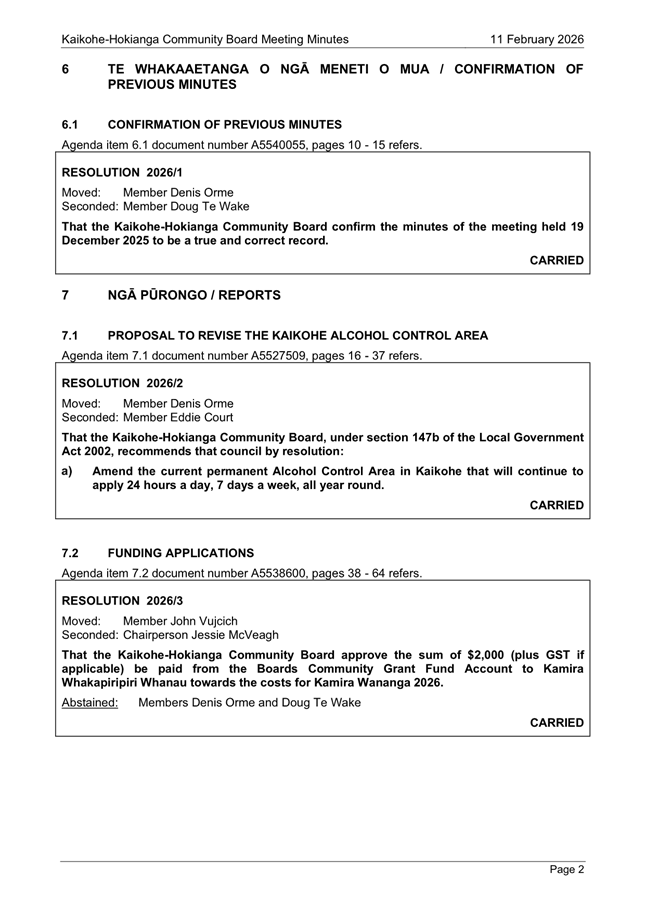
minutes of the meeting held 11 February 2026 to be a true and correct record.
|
1) TĀhuhu kŌrero / Background
Local Government Act 2002 Schedule 7 Section 28 states that
a local authority must keep minutes of its proceedings. The minutes of these
proceedings duly entered and authenticated as prescribed by a local authority
are prima facie evidence of those meetings.
2) matapaki me NgĀ KŌwhiringa /
Discussion and Options
The minutes of the meetings are
attached.
The Kaikohe-Hokianga Board Standing
Orders Section 27.3 states that no discussion may arise on the substance of the
minutes at any succeeding meeting, except as to their correctness.
TAKE TŪTOHUNGA
/ REASON FOR THE RECOMMENDATION
The reason for the recommendation is to confirm the minutes
as a true and correct record of the previous meetings.
3) PĀnga PŪtea me ngĀ
wĀhanga tahua / Financial Implications and Budgetary Provision
There are no financial implications or the need for
budgetary provision.
Āpitihanga / Attachments
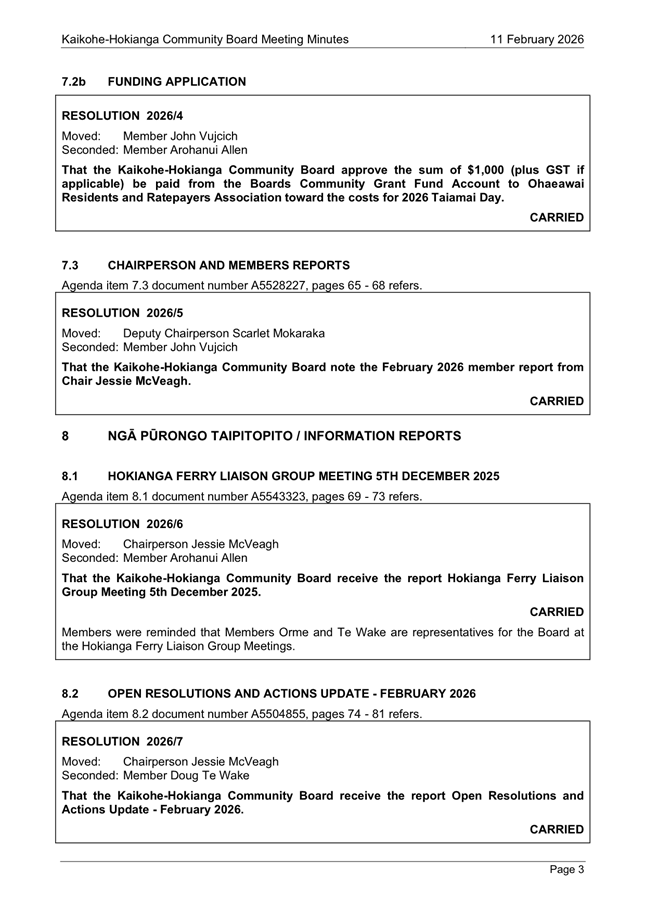
1. 2026-02-11
Kaikohe-Hokianga Community Board Minutes - A5558103 ⇩ 
Hōtaka Take Ōkawa / Compliance Schedule:
Full consideration has been given to the provisions of the
Local Government Act 2002 S77 in relation to decision making, in particular:
1. A
Local authority must, in the course of the decision-making process,
a) Seek
to identify all reasonably practicable options for the achievement of the
objective of a decision; and
b) Assess
the options in terms of their advantages and disadvantages; and
c) If
any of the options identified under paragraph (a) involves a significant
decision in relation to land or a body of water, take into account the
relationship of Māori and their culture and traditions with their
ancestral land, water sites, waahi tapu, valued flora and fauna and other
taonga.
2. This
section is subject to Section 79 - Compliance with procedures in relation to
decisions.
|
He Take Ōkawa /
Compliance Requirement
|
Aromatawai Kaimahi /
Staff Assessment
|
|
State the level of significance (high or low) of the
issue or proposal as determined by the Council’s
Significance and Engagement Policy
|
This is a matter of low significance.
|
|
State the relevant Council policies (external or
internal), legislation, and/or community outcomes (as stated in the LTP) that
relate to this decision.
|
This report complies with the Local Government Act 2002
Schedule 7 Section 28.
|
|
State whether this issue or proposal has a District wide
relevance and, if not, the ways in which the appropriate Community
Board’s views have been sought.
|
It is the responsibility of each meeting to confirm
their minutes therefore the views of another meeting are not relevant.
|
|
State the
possible implications for Māori and how Māori have been provided
with an opportunity to contribute to decision making if this decision is
significant and relates to land and/or any body of water.
State the
possible implications and how this report aligns with Te Tiriti o Waitangi /
The Treaty of Waitangi.
|
There are no implications on Māori in confirming
minutes from a previous meeting. Any implications on Māori arising from
matters included in meeting minutes should be considered as part of the
relevant report.
|
|
Identify persons likely to be affected by or have an
interest in the matter, and how you have given consideration to their views
or preferences (for example – youth, the aged and those with
disabilities).
|
This report is asking for the minutes to be confirmed as
true and correct record, any interests that affect other people should be
considered as part of the individual reports.
|
|
State the financial implications and where budgetary
provisions have been made to support this decision.
|
There are no financial implications or the need for
budgetary provision arising from this report.
|
|
Chief Financial Officer review.
|
The Chief Financial Officer has not reviewed this
report.
|
|
Kaikohe-Hokianga Community Board Meeting
Agenda
|
11 March 2026
|


|
Kaikohe-Hokianga Community Board
Meeting Agenda
|
11 March 2026
|
7 Ngā
Pūrongo / Reports
7.1 Alfresco
Dining Applications
File
Number: A5597508
Author: Shenae
Barker, Team Leader - Monitoring
Authoriser: Hilary
Sumpter, Group Manager - Delivery and Operations
Take Pūrongo / Purpose of the Report
To allow the Kaikohe Hokianga Community Board the
opportunity to provide comment on three alfresco dining renewal applications
within the Kaikohe Hokianga ward.
WhakarĀpopoto matua / Executive Summary
An
application has been received from Kaikohe Bakehouse Cafe, located at 77
Broadway, Kaikohe, for the renewal of its existing alfresco dining
approval (File Number ALF-88).
The purpose
of this report is to present the renewal application to the Kaikohe Hokianga
Community Board for comment. The renewal relates to the continued use of
Council-controlled land (footpath area) for outdoor dining purposes.
The
application has been reviewed by staff and is considered consistent with
previous approvals and relevant Council policies. There are no identified
significant issues associated with the renewal.
|
tŪtohunga
/ Recommendation
That the Kaikohe
Hokianga Community Board:
a) Receive the report Alfresco Dining
Renewal Application – ALF-88; and
b) Provide
comment on the renewal application from Kaikohe Bakehouse Cafe, 77 Broadway,
Kaikohe.
|
1) TĀhuhu kŌrero / Background
Kaikohe
Bakehouse Cafe currently operates an approved alfresco dining area outside its
premises at 77 Broadway, Kaikohe.
The
business has applied for a renewal of its alfresco dining permit to continue
utilising the designated footpath space for customer seating. The renewal
ensures compliance with Council requirements for the use of public space and
provides an opportunity to confirm that safety, accessibility, and operational
standards continue to be met.
The
application has been assessed against relevant Council policies and operational
requirements.
2) matapaki me NgĀ KŌwhiringa /
Discussion and Options
As a renewal application,
the activities are established and have previously operated under approval.
There are no identified compliance concerns at the time of writing this report.
The Kaikohe Hokianga
board may provide comment on the renewal application.
TAKE TŪTOHUNGA
/ REASON FOR THE RECOMMENDATION
The
recommendation enables the Community Board to fulfil its role in providing
local input on the use of public space within its ward.
Supporting
the renewal aligns with Council’s objectives of enabling local economic
activity while ensuring safe and accessible public spaces.
3) PĀnga PŪtea me ngĀ
wĀhanga tahua / Financial Implications and Budgetary Provision
There are
no direct financial implications for Council beyond standard administrative
processing.
Any
applicable alfresco dining fees are charged to the applicant in accordance with
Council’s Fees and Charges Schedule.
Āpitihanga
/ Attachments
Nil
Hōtaka Take Ōkawa / Compliance Schedule:
Full consideration has been given to the provisions of the
Local Government Act 2002 S77 in relation to decision making, in particular:
1. A
Local authority must, in the course of the decision-making process,
a) Seek
to identify all reasonably practicable options for the achievement of the
objective of a decision; and
b) Assess
the options in terms of their advantages and disadvantages; and
c) If
any of the options identified under paragraph (a) involves a significant
decision in relation to land or a body of water, take into account the
relationship of Māori and their culture and traditions with their
ancestral land, water sites, waahi tapu, valued flora and fauna and other
taonga.
2. This
section is subject to Section 79 - Compliance with procedures in relation to
decisions.
|
He Take Ōkawa /
Compliance Requirement
|
Aromatawai Kaimahi /
Staff Assessment
|
|
State the level of significance (high or low) of the
issue or proposal as determined by the Council’s
Significance and Engagement Policy
|
Regulation of alfresco dining is outlined in the Road
Use Bylaw 2022. The rules around approvals for alfresco dining are unchanged
in effect. As these applications are renewals of existing approvals, the
level of significance is considered low.
|
|
State the relevant Council policies (external or
internal), legislation, and/or community outcomes (as stated in the LTP) that
relate to this decision.
|
Road Use Bylaw 2022 – Part 4 clause 13 and Part 7.
|
|
State whether this issue or proposal has a District wide
relevance and, if not, the ways in which the appropriate Community
Board’s views have been sought.
|
This matter relates to alfresco dining approvals within
the Kaikohe Hokianga ward. The Kaikohe Hokianga Community Board has
delegation to comment on alfresco dining applications.
|
|
State the
possible implications for Māori and how Māori have been provided
with an opportunity to contribute to decision making if this decision is
significant and relates to land and/or any body of water.
|
Māori had the opportunity to contribute during the
consultation process on the Road Use Bylaw 2022. These renewal applications
are not considered significant.
|
|
State the
possible implications and how this report aligns with Te Tiriti o Waitangi /
The Treaty of Waitangi.
|
The Road Use Bylaw 2022 was adopted on 19 May 2022
following consultation. This report aligns with the adopted bylaw framework.
|
|
Identify persons likely to be affected by or have an
interest in the matter, and how you have given consideration to their views
or preferences (for example – youth, the aged and those with
disabilities).
|
Regulation of alfresco dining is relevant to hospitality
businesses, their employees, and members of the public, including pedestrians
and mobility users. Pedestrian access requirements are assessed to ensure
continued safe use of the footpath.
|
|
State the financial implications and where budgetary
provisions have been made to support this decision.
|
There are no financial implications.
|
|
Kaikohe-Hokianga Community Board Meeting
Agenda
|
11 March 2026
|
7.2 Removal of
a Pohutukawa Tree at 5 Memorial Avenue, Kaikohe
File
Number: A5532997
Author: Estee
Rapatini, Senior Facilities Technical Officer
Authoriser: Hilary
Sumpter, Group Manager - Delivery and Operations
Take Pūrongo / Purpose of the Report
The purpose
of this report is to seek approval from the Kaikohe - Hokianga Community Board
to remove the healthy Pohutukawa tree standing at 5 Memorial Avenue, Kaikohe
(Far North District Council headquarters site).
WhakarĀpopoto matua / Executive Summary
· Kaikohe Headquarters is located at 5 Memorial Ave, Kaikohe.
The site borders a private residential dwelling, 35 Raihara Street, Kaikohe.The
owner of 35 Raihara Street, Kaikohe has requested the tree be removed due to
tree roots disrupting the private and public sewer line.As per the Tree and
Vegetations Guidelines, Council engaged a qualified arborist to assess the
tree, including the consideration of guard or prevention could be met while
promoting the health and wellbeing of the tree.
· The tree is not listed on the notable tree register or heritage tree
register.
· Trees hold amenity value in our green spaces and contribute to the
biodiversity and climate change.
· The Kaikohe-Hokianga Community Board has delegation to approve the
removal of healthy trees.
|
tŪtohunga
/ Recommendation
That the Kaikohe–Hokianga Community Board
approve the Pohutukawa located at 5 Memorial Ave, Kaikohe to be removed and
that Council pays for this work to be completed.
|
1) TĀhuhu kŌrero / Background
Kaikohe
Headquarters, located at 5 Memorial Ave, Kaikohe, Northland, is fee simple
land:
· Fee Simple, 1/1, Lot 1 Deposited Plan 134473 – a
total of 12,801 square meters
The site
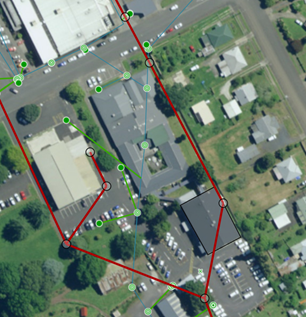
consists of five buildings with six mature native trees. The Pohutukawa
tree causing concern can be seen in the below map.
The below picture shows the
following:
- Pohutukawa tree - marked yellow
circle
- 35 Raihara Street, Kaikohe, to
the right and marked X is the property that has made the request and
experiences disruption to their private sewer line.
- Councils public wastewater line,
(underground services)


In late October 2025, the neighboring
residential property owner approached Te Kaunihera o Te Hiku o Te Ika
requesting the removal of a Pohutukawa bordering their property at 35 Raihara
Street, Kaikohe due to tree roots encroaching onto their property disrupting
the private sewer service line. The property owner has repaired several leaks
that have occurred due to the Pohutukawa tree roots.
Council staff physically inspected the tree
in November 2025, which appeared healthy and did not pose a health and safety
risk upon visual inspection.
A qualified arborist was engaged in
December 2025 to assess the tree and investigate root guard measures verses
removal of tree. The arborist made the following general statement”
“This tree is of excellent health, perhaps in part
due to intermittent supplies of nutrient rich sewage. The foliage density is
good with a 90% crown ratio. There is minimal sign of chlorosis or
predation.”
Summary of the findings from the full
arborist report:
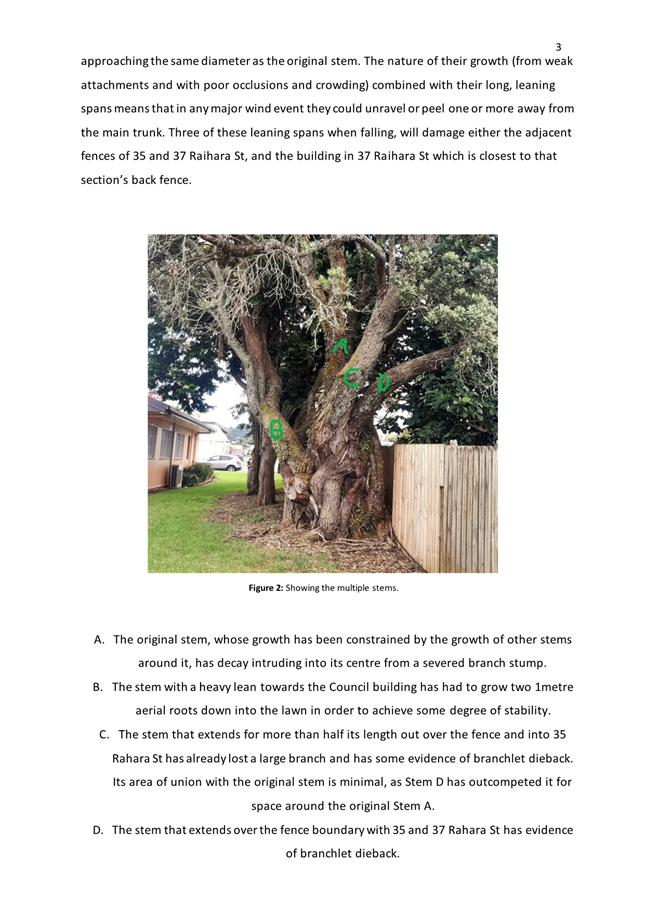
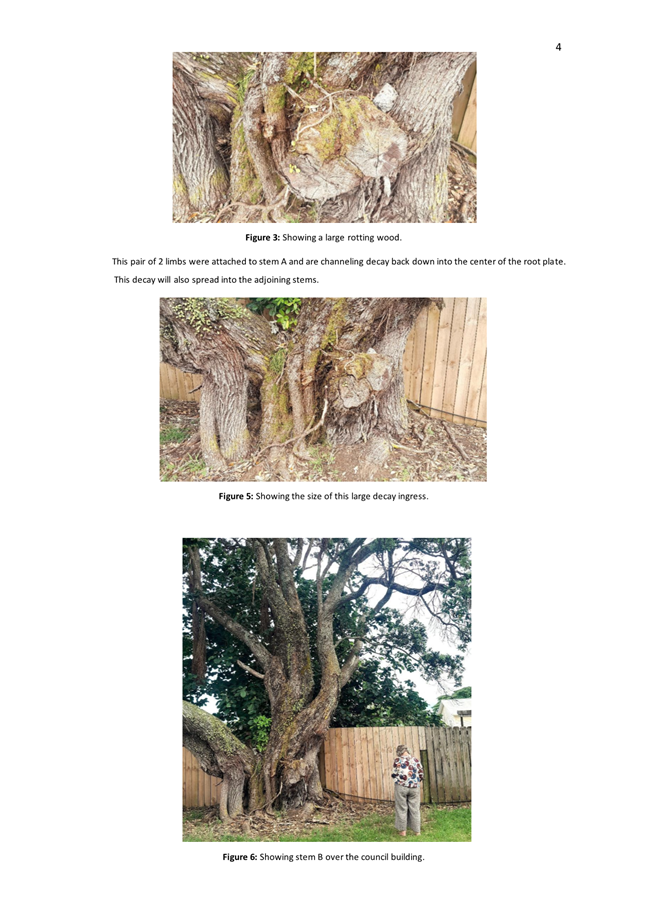
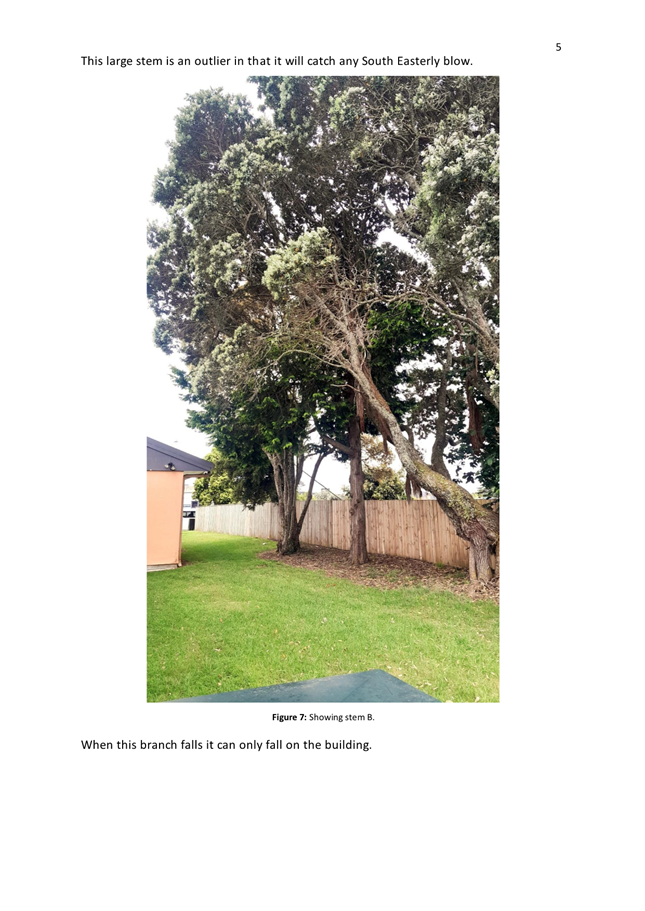
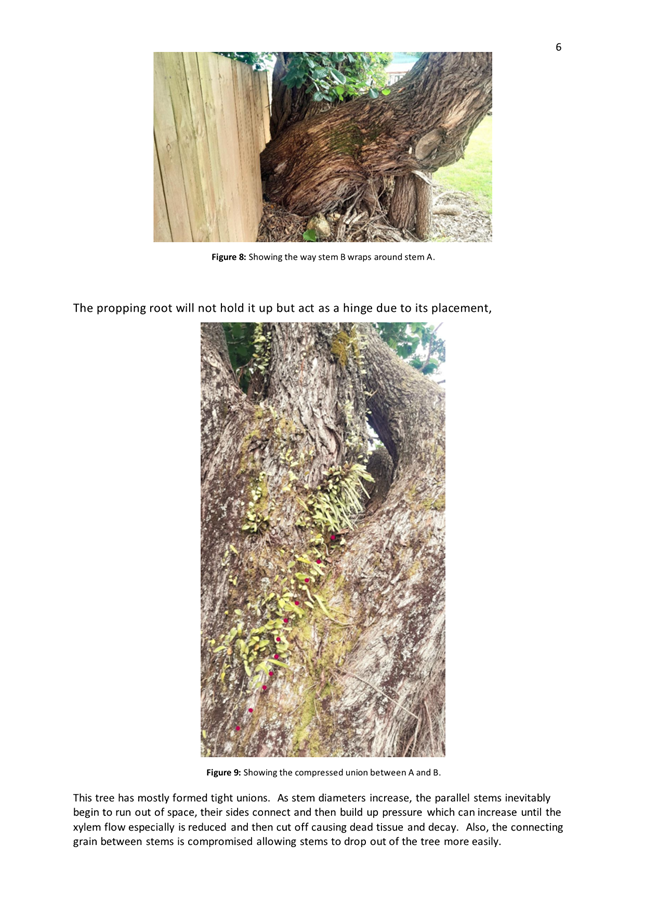
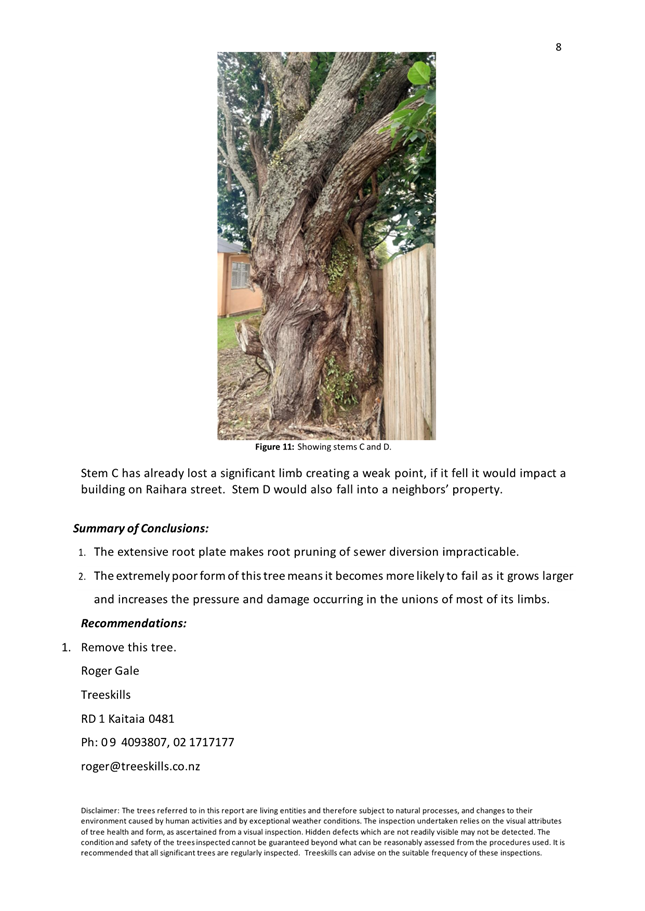
· The extensive root
plate makes root pruning of sewer diversion impracticable.
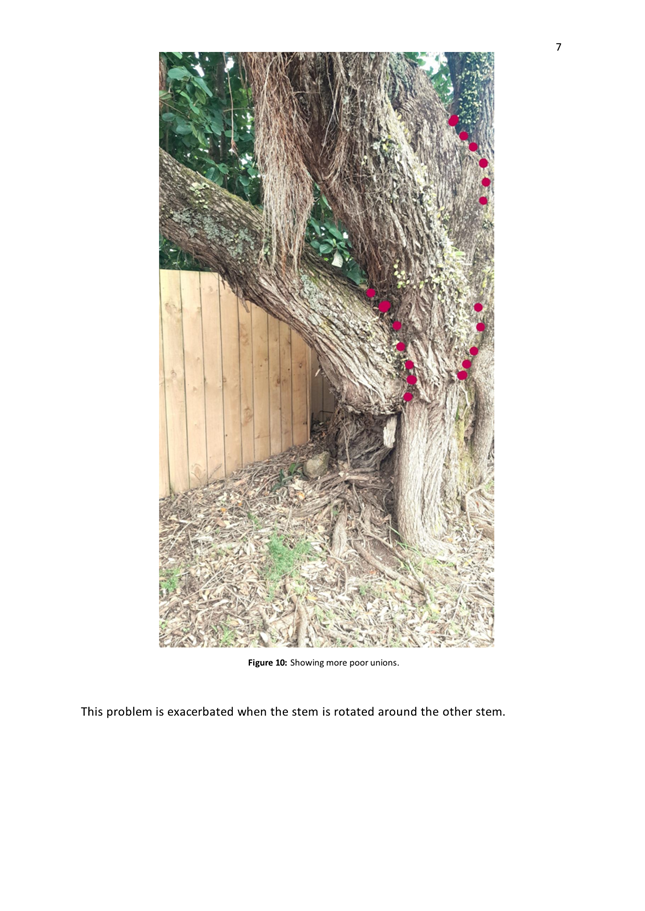
· The
extremely poor form of this tree means it becomes more likely to fail as it
grows larger and increases the pressure and damage occurring in the unions of
most of its limbs.
The full arborist report is attached.
2) matapaki me NgĀ KŌwhiringa /
Discussion and Options
Policy and Strategy Considerations
In accordance with Te
Kaunihera o Te Hiku o Te Ika Tree and Vegetation
guidelines 2008, section 2.4 – Removal of park trees, this
situation does not warrant the removal of healthy trees
“In some extreme situations, trees may cause
problems with services and roads. Remedial action will be considered in these
situations. Removal will be the most extreme option and will only be considered
where all other options have been explored.
Where a significant healthy tree is being considered for
removal, community consultation will be undertaken, and the final decision will
rest with the relevant community board.”
This also aligns with The Reserves Act 1977: Section
42 - Preservation of trees and bush
(2) The trees or bush on any
recreation reserve, or government purpose reserve, or local purpose reserve
shall not be cut or destroyed, except in accordance with a permit granted
under section
48A or unless the administering body of
the reserve is satisfied that the cutting or destruction is necessary for the
proper management or maintenance of the reserve, or for the management or
preservation of other trees or bush, or in the interests of the safety of
persons on or near the reserve or of the safety of property adjoining the
reserve, or that the cutting is necessary to harvest trees planted for revenue
producing purpose
Option one (recommended):
That the Kaikohe–Hokianga Community Board
approve the Pohutukawa to be felled and removed from site at council’s
expense.
Specialist advice has been sought to
identify that the tree is in healthy condition. However, the tree presents an
ongoing risk to the underground services with no way to divert the underground
services.
Option two:
That Kaikohe – Hokianga Community
Board approve the Pohutukawa to be felled and removed from site at the
neighboring property owner’s expense.
Due to the impact affecting the neighboring
property owner sewer line. It is within their best interest to support the
removal of this tree. The cost for the private property owner is estimated
$5,000 - $8,000 for a qualified arborist.
Option three:
That the Kaikohe–Hokianga
Community Board support the tree to remain in place.
If the tree
is to remain in place the neighbouring property owner will continue to
experience disruption to the underground private services. Council may be
liable for costs associated with repairs due to failure to prevent further
disruption.
Replacement of the trees:
Due to the underground services in place,
it is not recommended that a replacement tree be put in place.
Iwi/ Hapu:
Engagement hui with local iwi / hapu will take place 25
February 2026.
TAKE TŪTOHUNGA
/ REASON FOR THE RECOMMENDATION
The tree(s)
present no immediate danger to the public or the neighbouring property.
However, is an ongoing nuisance and possible future disruption to the property
owner affected.
Should the
Kaikohe-Hokianga Community Board support to keep the tree, this will allow them
to continue to mature and positively enhance the eco system and amenity value
of the site.
3) PĀnga PŪtea me ngĀ
wĀhanga tahua / Financial Implications and Budgetary Provision
A one-off cost of approximately $5,000 -
$8,000 will be incurred to fell the tree and remove from site. There will be
zero on-going cost associated with this work. Removal will safeguard the
neighboring property owner and councils underground se4rvices from any further
disruption.
Āpitihanga
/ Attachments
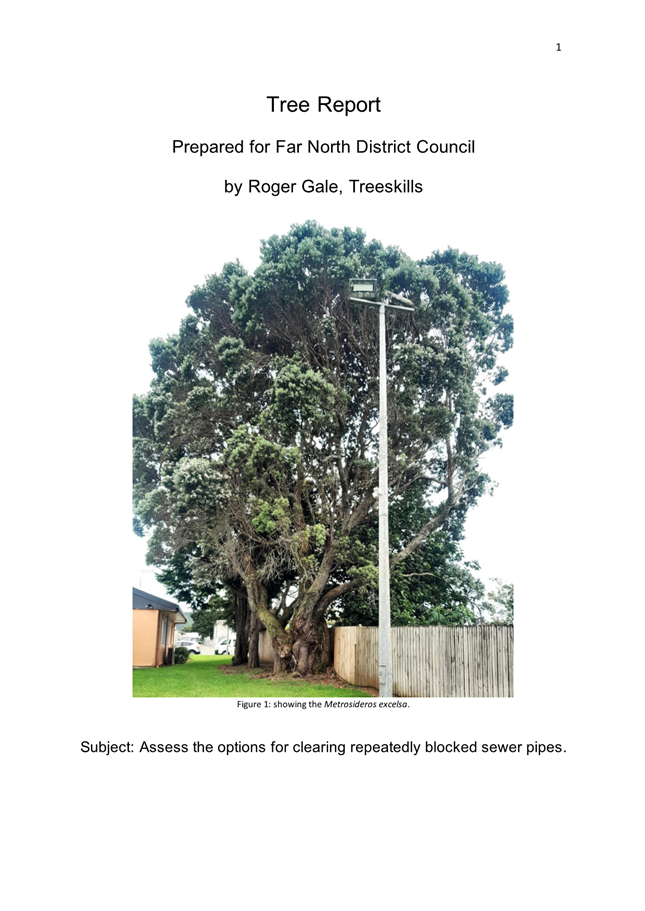
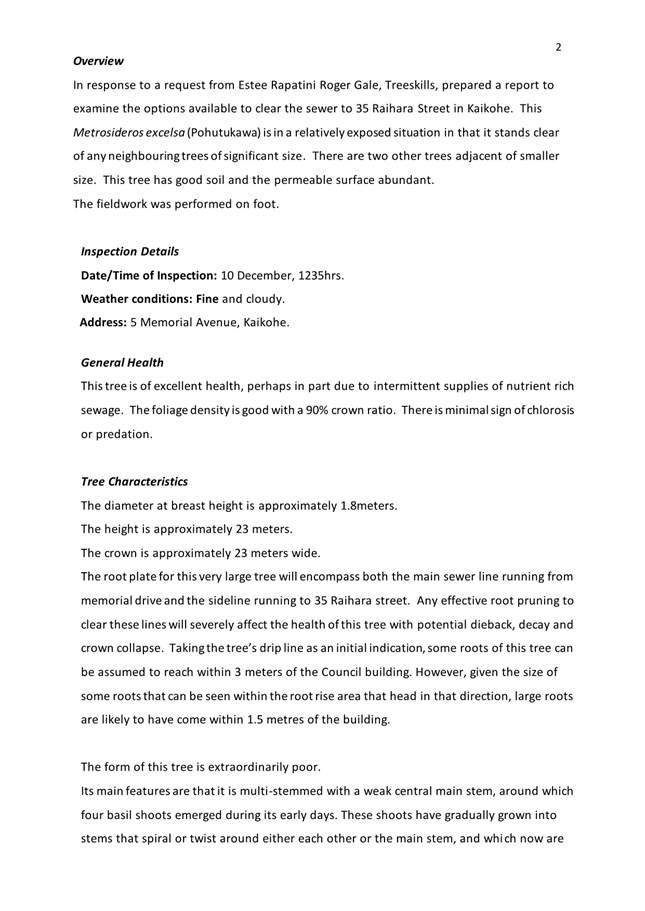
1. Arborist
Report - A5561061 ⇩
Hōtaka Take Ōkawa / Compliance Schedule:
Full consideration has been given to the provisions of the
Local Government Act 2002 S77 in relation to decision making, in particular:
1. A
Local authority must, in the course of the decision-making process,
a) Seek
to identify all reasonably practicable options for the achievement of the
objective of a decision; and
b) Assess
the options in terms of their advantages and disadvantages; and
c) If
any of the options identified under paragraph (a) involves a significant
decision in relation to land or a body of water, take into account the
relationship of Māori and their culture and traditions with their
ancestral land, water sites, waahi tapu, valued flora and fauna and other
taonga.
2. This
section is subject to Section 79 - Compliance with procedures in relation to
decisions.
|
He Take Ōkawa /
Compliance Requirement
|
Aromatawai Kaimahi /
Staff Assessment
|
|
State the level of significance (high or low) of the
issue or proposal as determined by the Council’s
Significance and Engagement Policy
|
Low Significance
|
|
State the relevant Council policies (external or
internal), legislation, and/or community outcomes (as stated in the LTP) that
relate to this decision.
|
Reserves Policy and Tree and Vegetation Guidelines
|
|
State whether this issue or proposal has a District wide
relevance and, if not, the ways in which the appropriate Community
Board’s views have been sought.
|
Community Board Delegations include Trees on Council
Land
|
|
State the
possible implications for Māori and how Māori have been provided
with an opportunity to contribute to decision making if this decision is
significant and relates to land and/or any body of water.
State the
possible implications and how this report aligns with Te Tiriti o Waitangi /
The Treaty of Waitangi.
|
No implications to Maori perceived as a result of this
request.
|
|
Identify persons likely to be affected by or have an
interest in the matter, and how you have given consideration to their views
or preferences (for example – youth, the aged and those with
disabilities).
|
No implications to Maori perceived as a result of this
request.
|
|
State the financial implications and where budgetary
provisions have been made to support this decision.
|
A one-off cost of approximately $5,000 -
$8,000 will be incurred to fell the tree and remove from site. There will be
zero on-going cost associated with this work. Removal will safeguard the
neighboring property owner and councils underground se4rvices from any
further disruption.
|
|
Chief Financial Officer review.
|
The CFO has reviewed this document.
|
|
Kaikohe-Hokianga Community Board Meeting
Agenda
|
11 March 2026
|
7.3 Project
Funding Reports
File
Number: A5585375
Author: Kathryn
Trewin, Funding Advisor
Authoriser: Aisha
Huriwai, Manager - Democracy Services
Take Pūrongo / Purpose of the Report
Recipients of funds from the Community Board’s Local
Grant Fund must complete and submit a project report no later than two months
after the completion of their project.
|
tŪtohunga
/ Recommendation
That the Kaikohe-Hokianga Community Board note
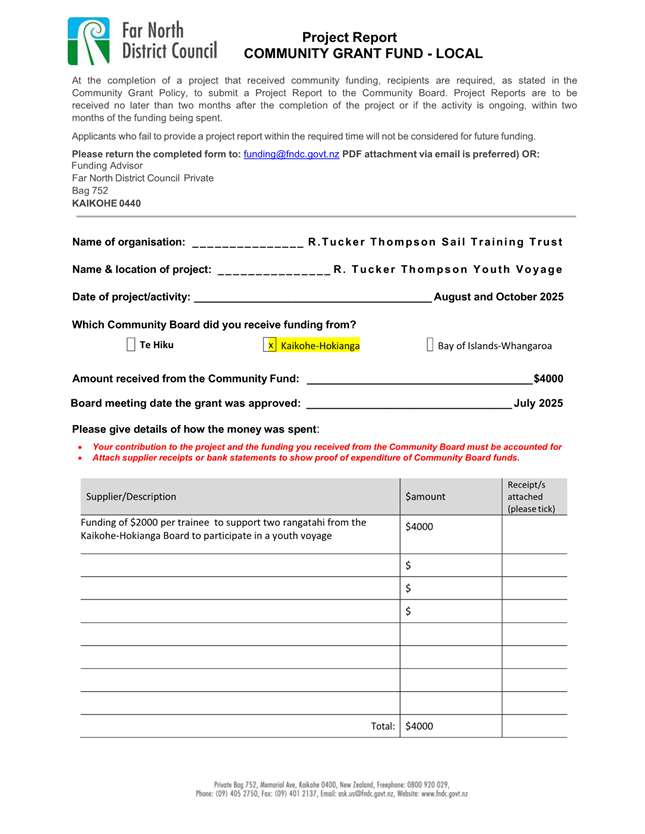
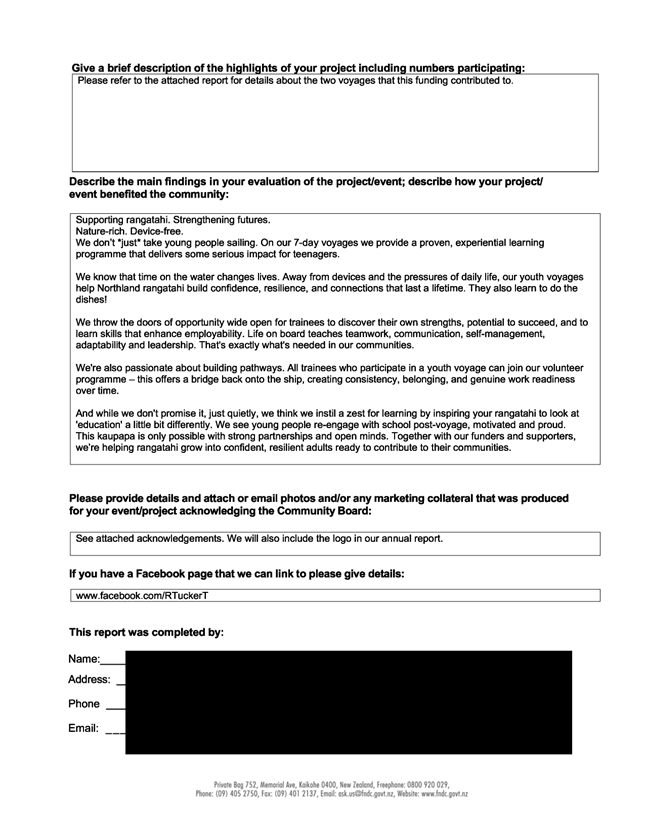
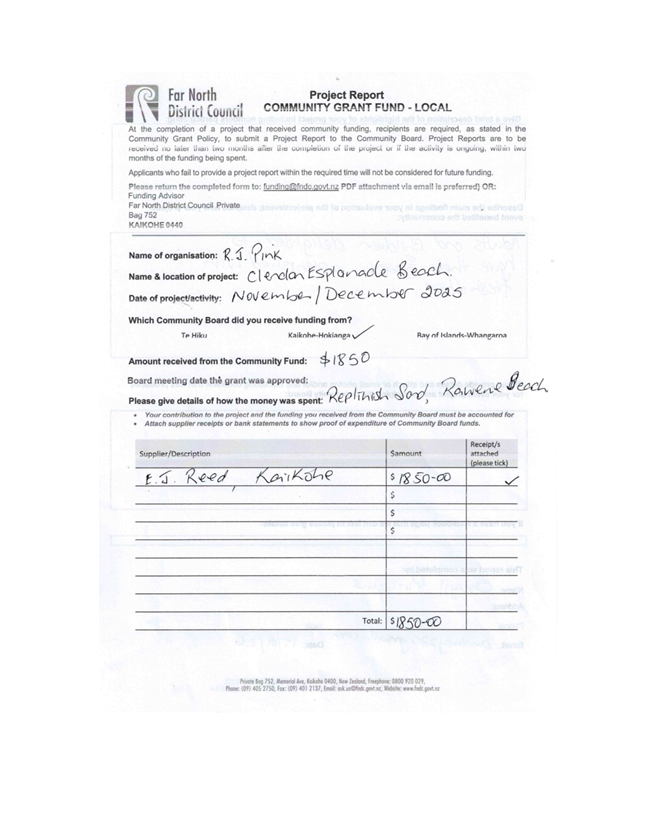
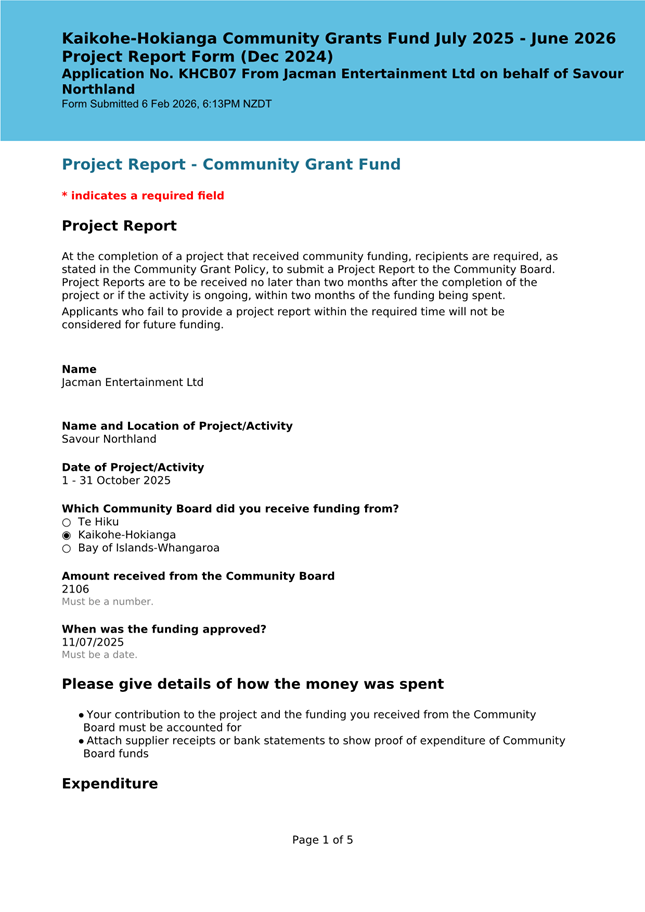
the project reports received from:
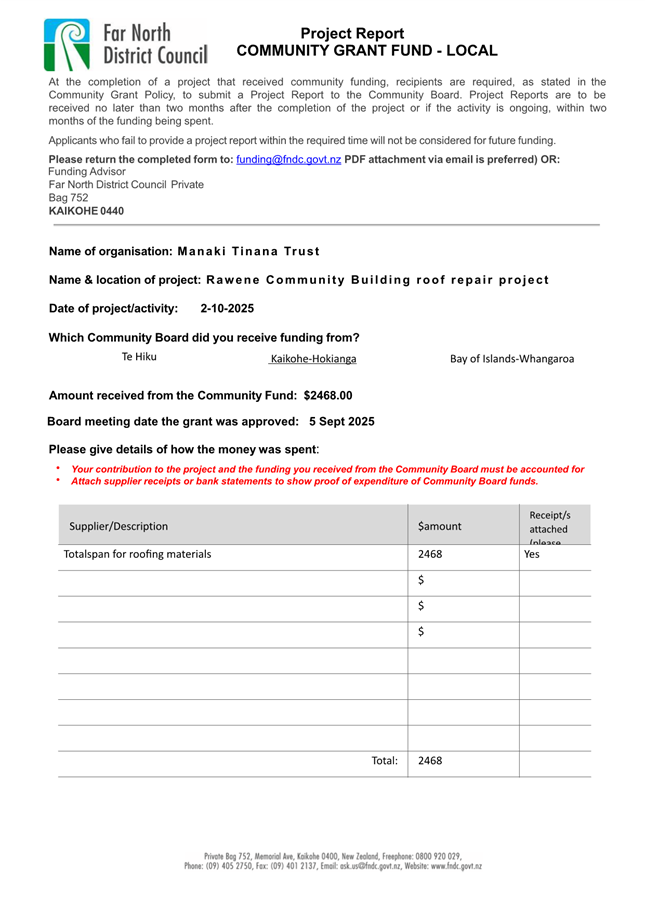
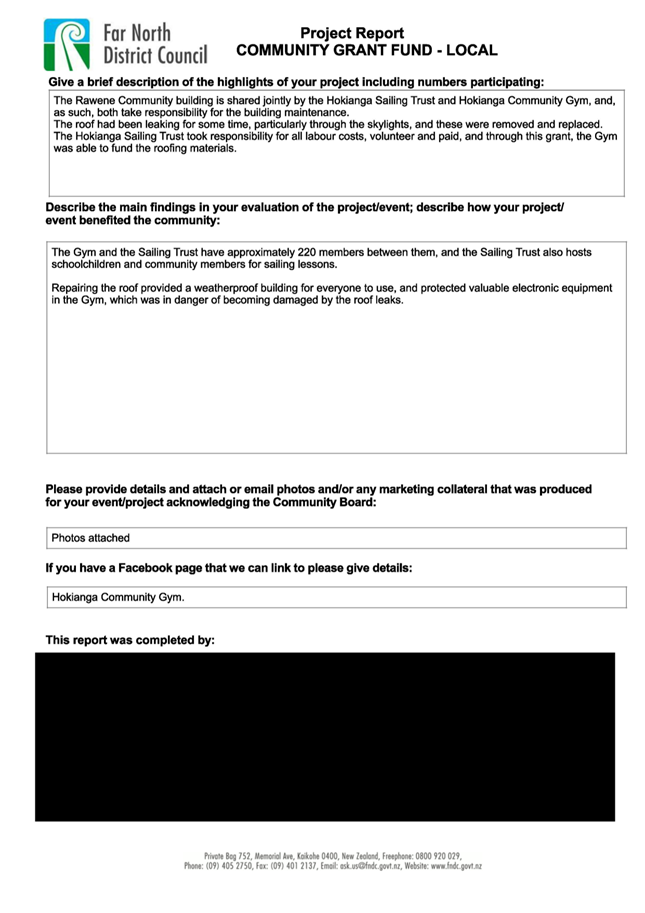
a) Manaki
Tinana Trust – Roof
b) Ohaeawai
Taiamai Residents Association – Christmas
c) Okaihau
Community Association – Kitchen
d) R Tucker
Thompson
e) Rob Pink
– Rawene Sand
f) Savour
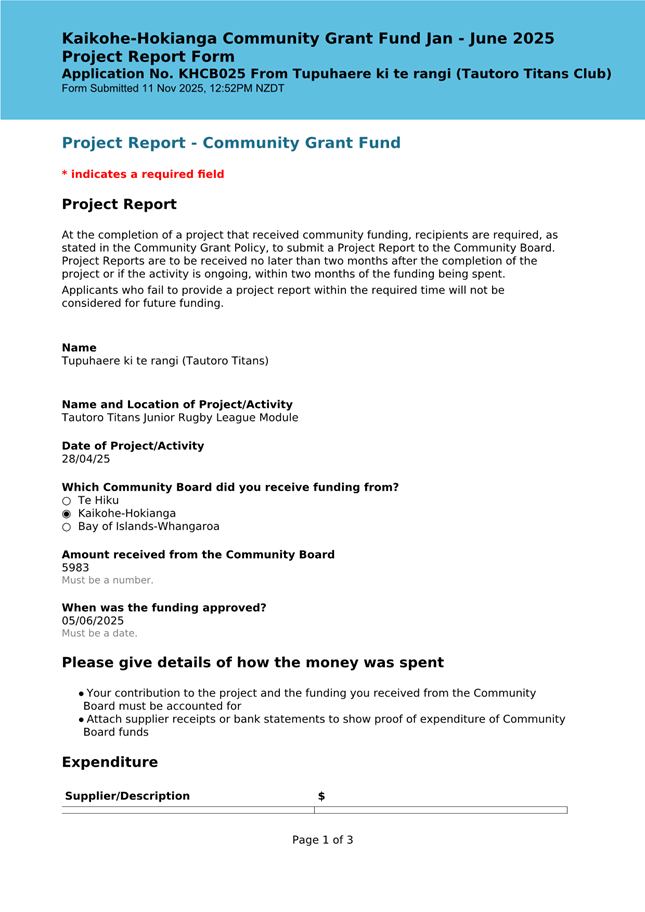
Northland 2025
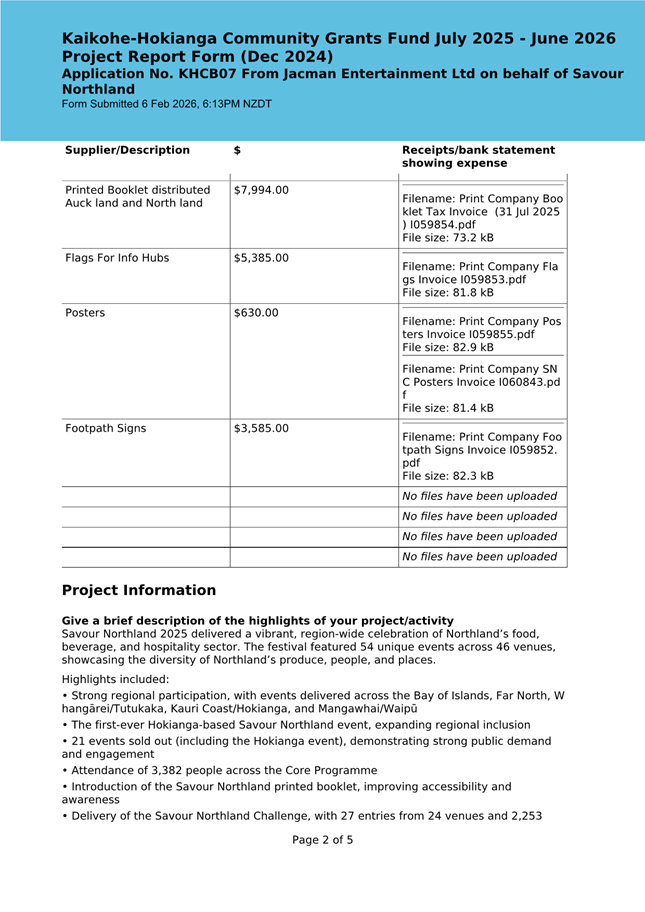
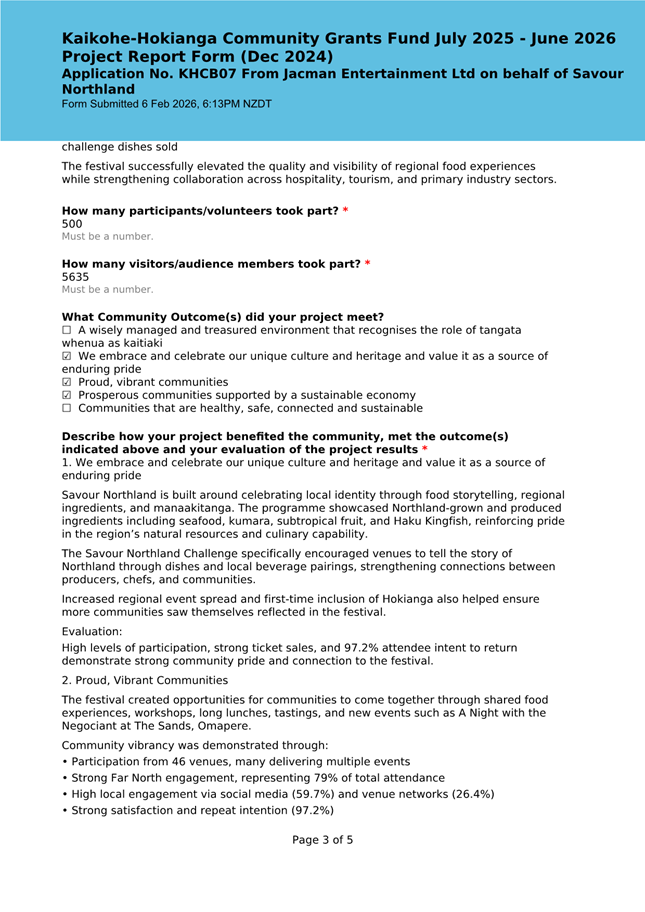
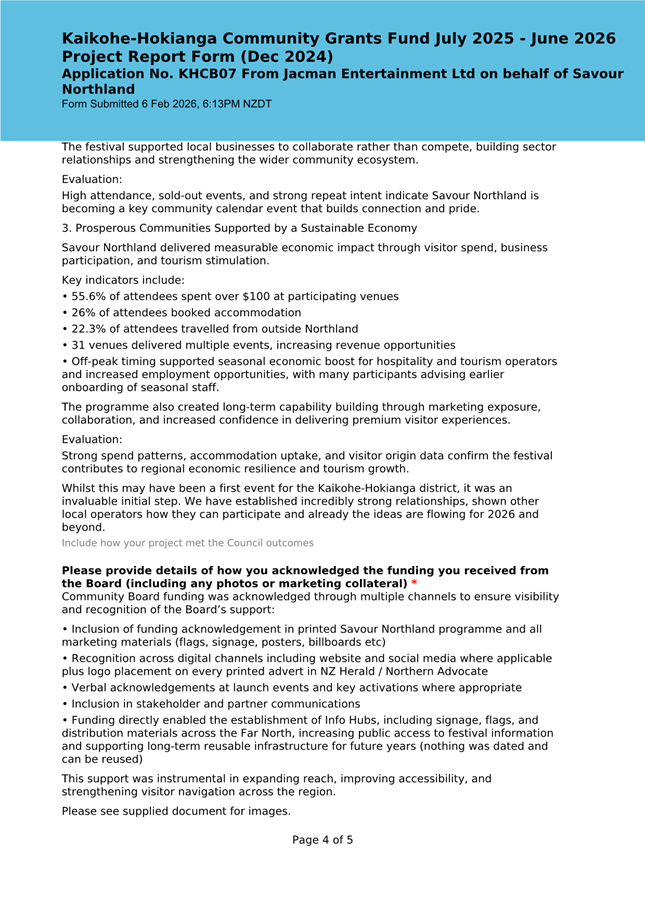
g) Tautoro
Titans
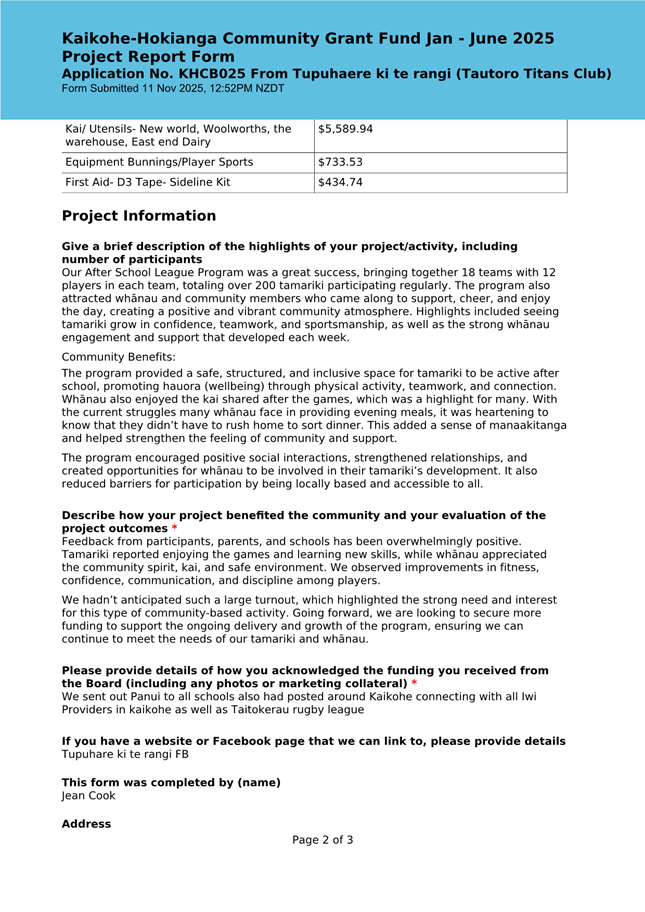
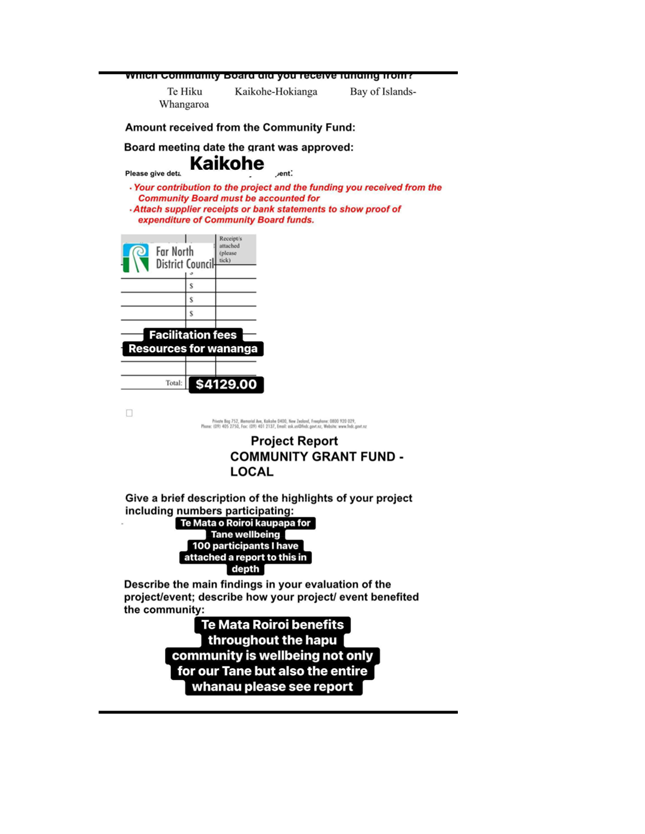
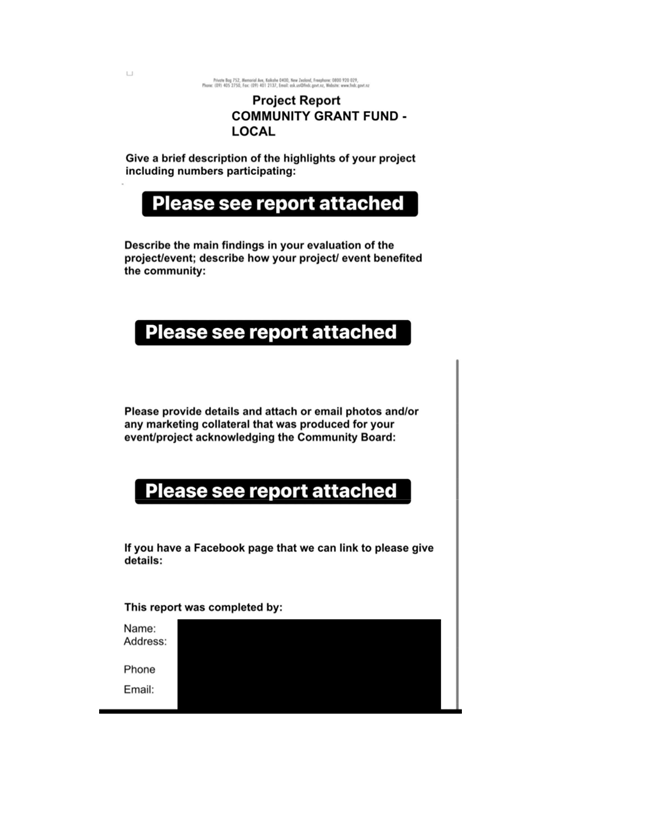
h) Te
Mata o Roiroi
|
1) TĀhuhu kŌrero / Background
Clause 15 of the Community Grant
Policy states that: “At the completion of a project that received
community funding, recipients are required to complete a Project Report. These
reports must be received no later than two months after the completion of the
project, or, if the activity is ongoing, within two months of the funding being
spent. Recipients who do not complete this form are ineligible for Council
funding for a period of five years.”
2) matapaki me NgĀ KŌwhiringa /
Discussion and Options
Copies of the project reports are attached
for the Board’s information. Should Board members have concerns or
issues with these reports, these should be discussed at this part of the
meeting.
TAKE
TŪHOTUNGA / REASON FOR THE RECCOMENDATION
To receive the project reports from funding applicants in
accordance with the Community Grant Policy.
3) PĀnga PŪtea me ngĀ
wĀhanga tahua / Financial Implications and Budgetary Provision
There are no financial
implications or budgetary requirements.
Āpitihanga
/ Attachments
1. Manaki
Tinana Trust - A5585350 ⇩ 
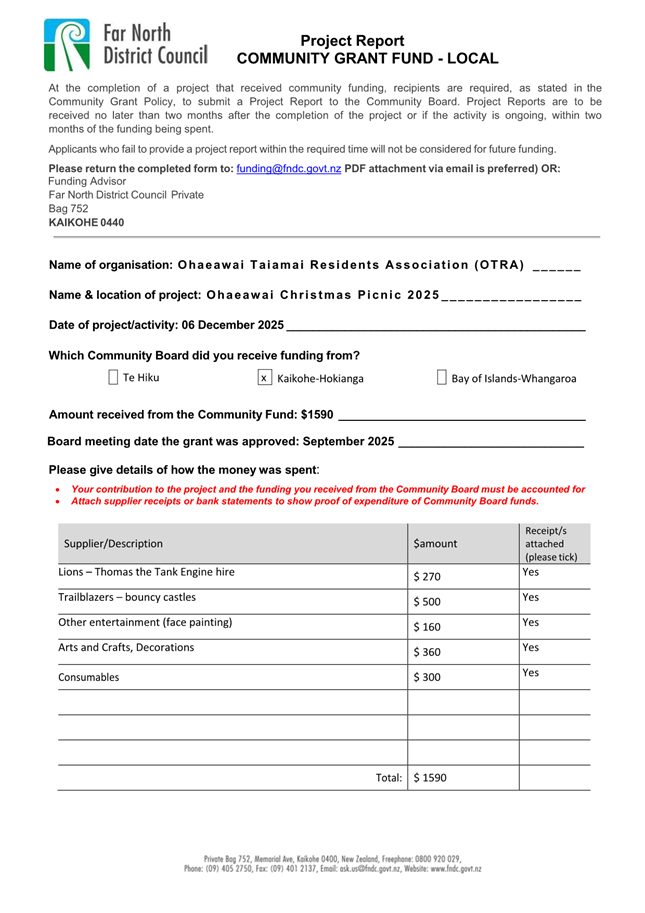
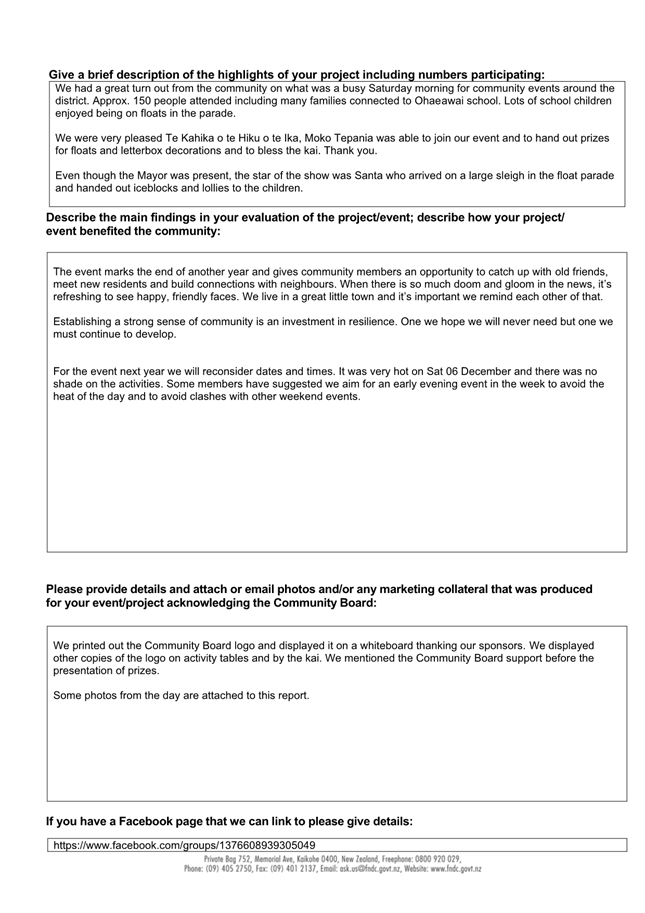
2. Ohaeawai
Taiamai Residents Association - Christmas - A5585353 ⇩
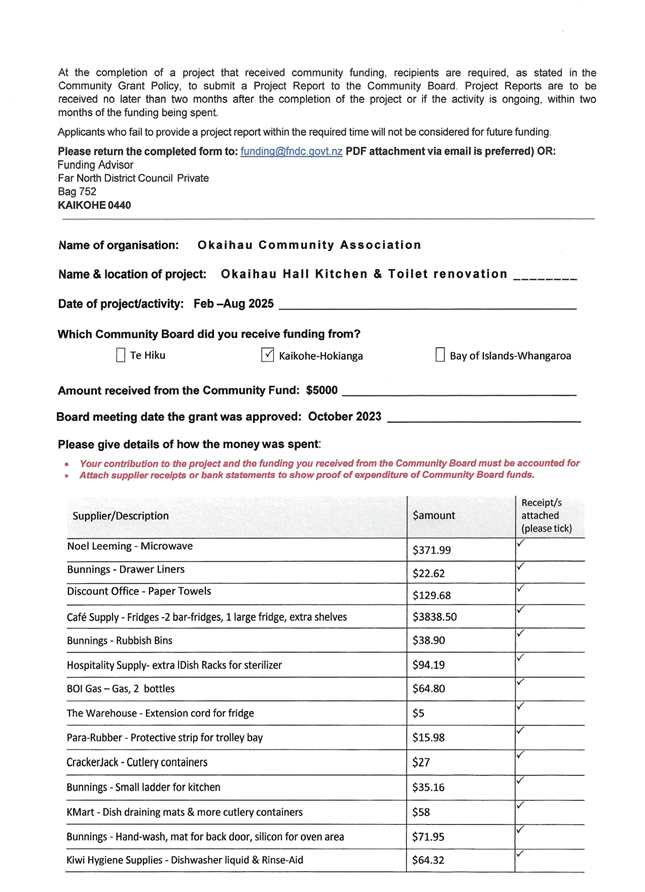
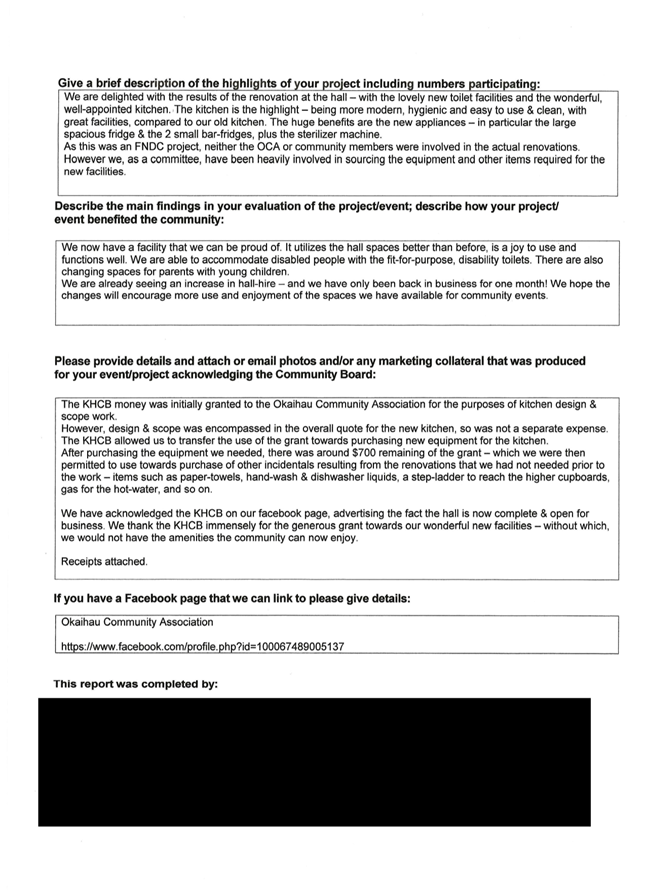
3. Okaihau
Community Association - A5585346 ⇩ 
4. R
Tucker Thompson - A5585348 ⇩
5. Rob
Pink - Rawene Sand - A5585352 ⇩
6. Savour
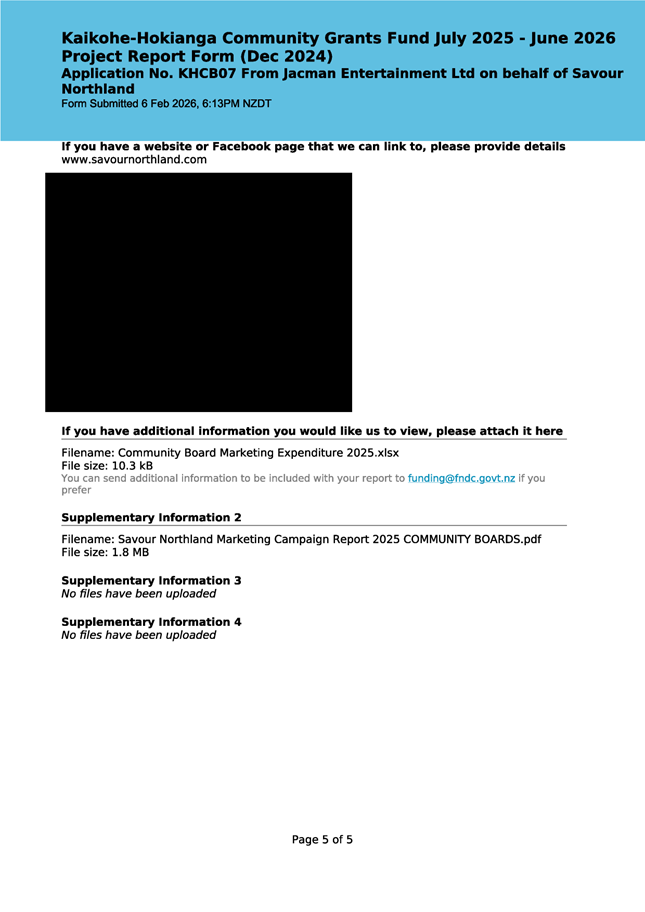
Northland 2025 - A5585349 ⇩
7. Tautoro
Titans - A5585351 ⇩
8. Te
Mata o Roiroi - A5585347 ⇩
HŌTAKA TAKE ŌKAWA / COMPLIANCE SCHEDULE:
Full consideration has been given to the provisions of the
Local Government Act 2002 S77 in relation to decision making, in particular:
1. A
Local authority must, in the course of the decision-making process,
a) Seek
to identify all reasonably practicable options for the achievement of the
objective of a decision; and
b) Assess
the options in terms of their advantages and disadvantages; and
c) If
any of the options identified under paragraph (a) involves a significant
decision in relation to land or a body of water, take into account the
relationship of Māori and their culture and traditions with their
ancestral land, water sites, waahi tapu, valued flora and fauna and other
taonga.
2. This
section is subject to Section 79 - Compliance with procedures in relation to
decisions.
|
He
Take Ōkawa / Compliance Requirement
|
Aromatawai
Kaimahi / Staff Assessment
|
|
State the level of significance
(high or low) of the issue or proposal as determined by the Council’s
Significance and Engagement Policy
|
This is a matter of low
significance.
|
|
State the relevant Council
policies (external or internal), legislation, and/or community outcomes (as
stated in the LTP) that relate to this decision.
|
Community Grant Policy.
|
|
State whether this issue or
proposal has a District wide relevance and, if not, the ways in which the
appropriate Community Board’s views have been sought.
|
It is the responsibility of each
Community Board to confirm the funding that they allocated has been spent
correctly.
|
|
State the possible implications for Māori
and how Māori have been provided with an opportunity to contribute to
decision making if this decision is significant and relates to land and/or
any body of water.
|
There are no implications on Māori in confirming the project
reports. Any implications on Māori arising from matters included in
project reports should be considered as part of the relevant report.
|
|
Identify persons likely to be
affected by or have an interest in the matter, and how you have given
consideration to their views or preferences (for example – youth, the
aged and those with disabilities).
|
This report is asking for the
project reports to be approved, any interests that affect other people should
be considered as part of the individual reports.
|
|
State the financial implications
and where budgetary provisions have been made to support this decision.
|
There are no financial
implications or the need for budgetary provision.
|
|
Chief Financial Officer review.
|
The Chief Financial Officer has
not reviewed this report.
|
|
Kaikohe-Hokianga Community Board Meeting
Agenda
|
11 March 2026
|
|
Kaikohe-Hokianga Community Board Meeting
Agenda
|
11 March 2026
|
|
Kaikohe-Hokianga Community Board Meeting
Agenda
|
11 March 2026
|

|
Kaikohe-Hokianga Community Board Meeting
Agenda
|
11 March 2026
|
|
Kaikohe-Hokianga Community Board Meeting
Agenda
|
11 March 2026
|
|
Kaikohe-Hokianga Community Board Meeting
Agenda
|
11 March 2026
|
|
Kaikohe-Hokianga Community Board Meeting
Agenda
|
11 March 2026
|

|
Kaikohe-Hokianga Community Board Meeting
Agenda
|
11 March 2026
|
|
Kaikohe-Hokianga Community Board Meeting
Agenda
|
11 March 2026
|
7.4 Funding
Applications
File
Number: A5585395
Author: Kathryn
Trewin, Funding Advisor
Authoriser: Aisha
Huriwai, Manager - Democracy Services
Take Pūrongo / Purpose of the Report
1. This report
summarises the applications received for the Local Community Grant funding to
enable the Kaikohe-Hokianga Community Board to
determine which applications will receive funding at the meeting.
WhakarĀpopoto matua /
Executive Summary
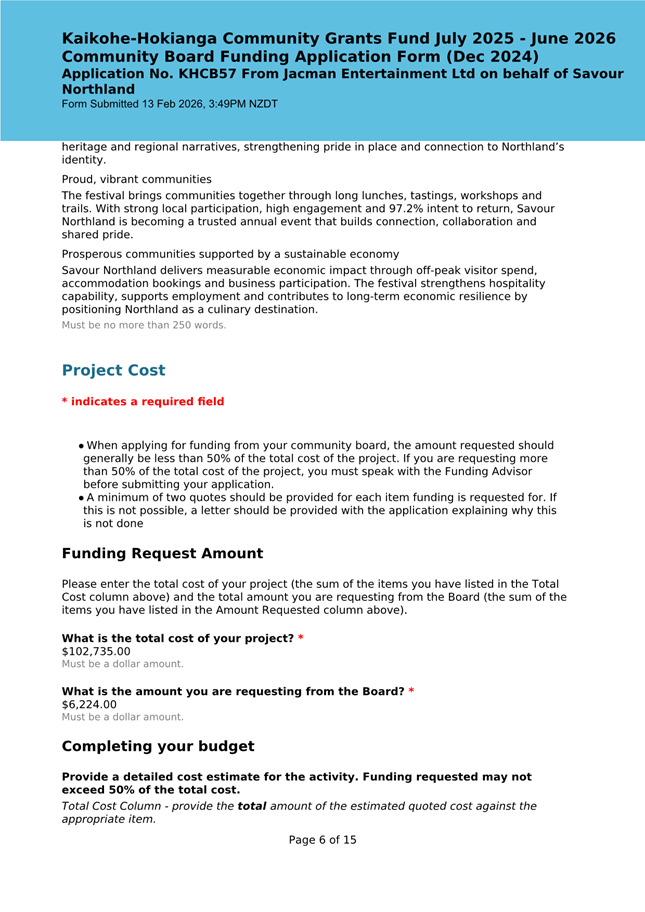
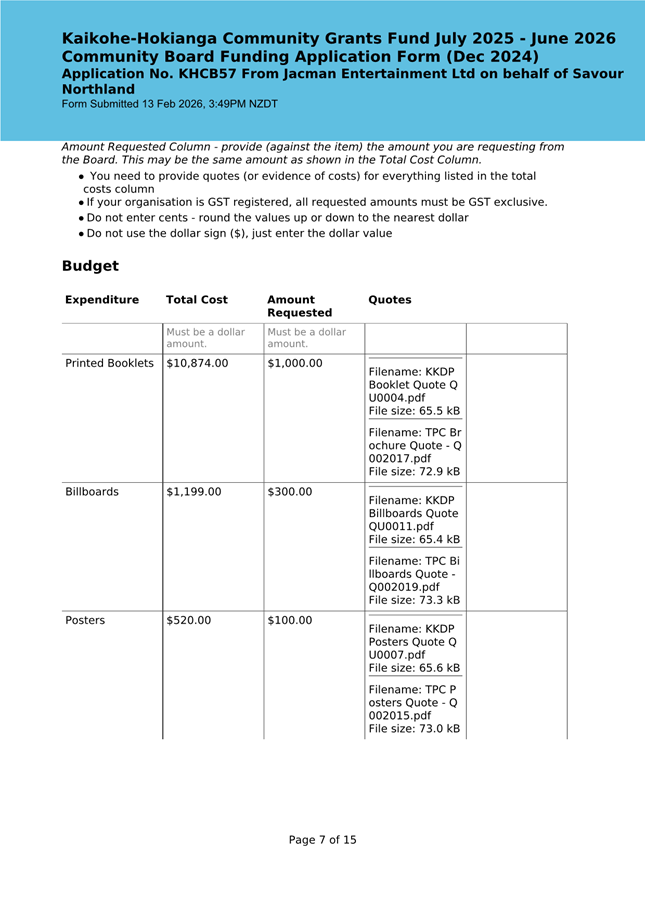
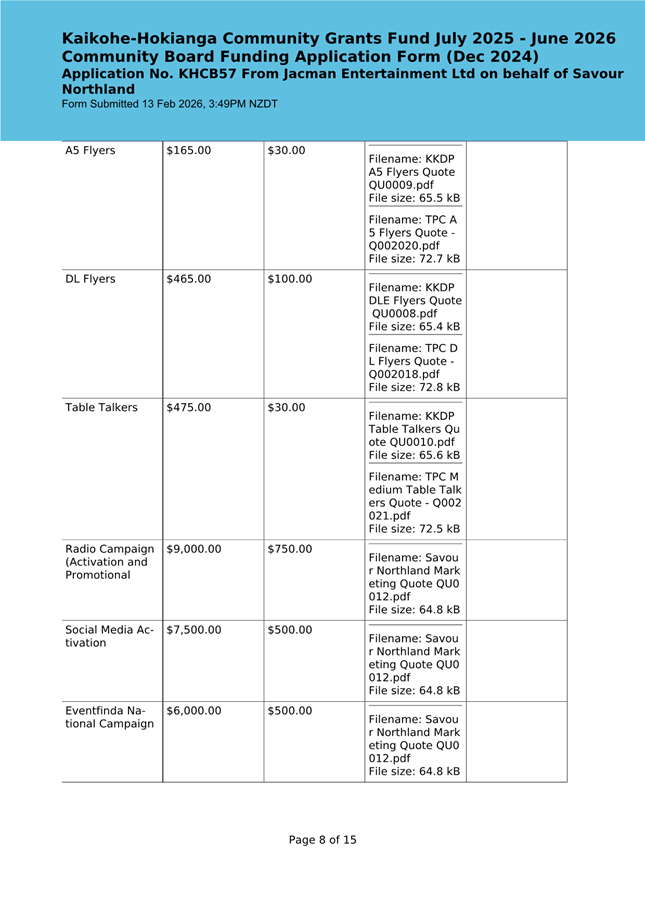
· One application has been received, requesting a total of $6,224.
· The Board has $13,029 to allocate for the Community
Board Fund in the 2025/2026 financial year.
· The Board has $95,273 to allocate for the Pride of
Place Fund in the 2025/2026 financial year.
|
a) tŪtohunga / Recommendation
That the Kaikohe-Hokianga Community Board approve the sum
of $xxx (plus
GST if applicable) be paid from the Boards Community Grant Fund Account to
Jacman Entertainment Ltd towards the costs for Savour Northland 2026.
|
|
b)
tŪtohunga /
Recommendation
That
Kaikohe-Hokianga Community Board approve the sum of $xxx
(plus GST if applicable) be paid from the Board’s Community Grant Fund
account to Jacman Entertainment Ltd for costs towards Savour 2027 from
2027/28 financial year funding.
|
|
c)
tŪtohunga /
Recommendation
That
Kaikohe-Hokianga Community Board approve the sum of $xxx
(plus GST if applicable) per year be paid from the Board’s Community
Grant Fund account to Jacman Entertainment Ltd for costs towards
Savour 2028 from 2028/29 financial year funding.
|
|
d)
tŪtohunga /
Recommendation
That funding
for Savour 2027 and Savour 2028 is only to be released after a project report
has been provided for the event of the previous year that has been accepted
by the Board.
|
1) TĀhuhu kŌrero / Background
Each application has been checked by staff for completeness
and complies with the conditions of the Community Grant Policy, Community
Outcomes as stated in the Long-Term Plan (LTP) and all provisions listed on the
application form.
Each application must meet at least one community outcome
from the Council’s LTP. The six community outcomes are as follows:
1. A wisely managed and
treasured environment that recognises the role of tangata whenua as kaitiaki;
2. We embrace and
celebrate our unique culture and heritage and value it as a source of enduring
pride.
3. Proud, vibrant
communities;
4. Prosperous Communities
supported by a sustainable economy;
5. Communities that are
safe, connected and sustainable;
6. Communities that are
prepared for the unexpected;
matapaki me NgĀ KŌwhiringa /
Discussion and Options
|
Applicant and Project
|
Requested
|
Recommend
|
Comments
|
|
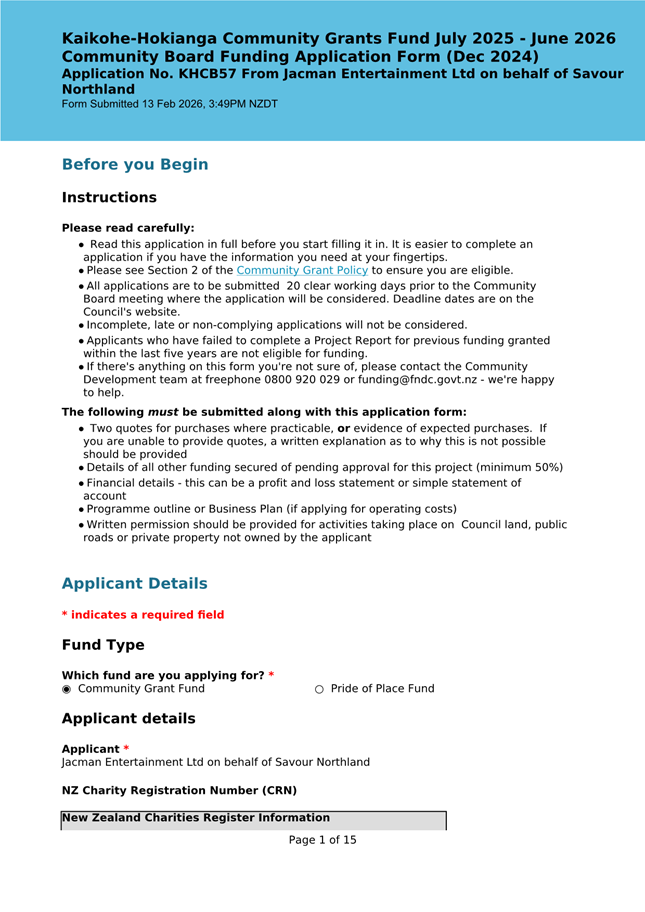
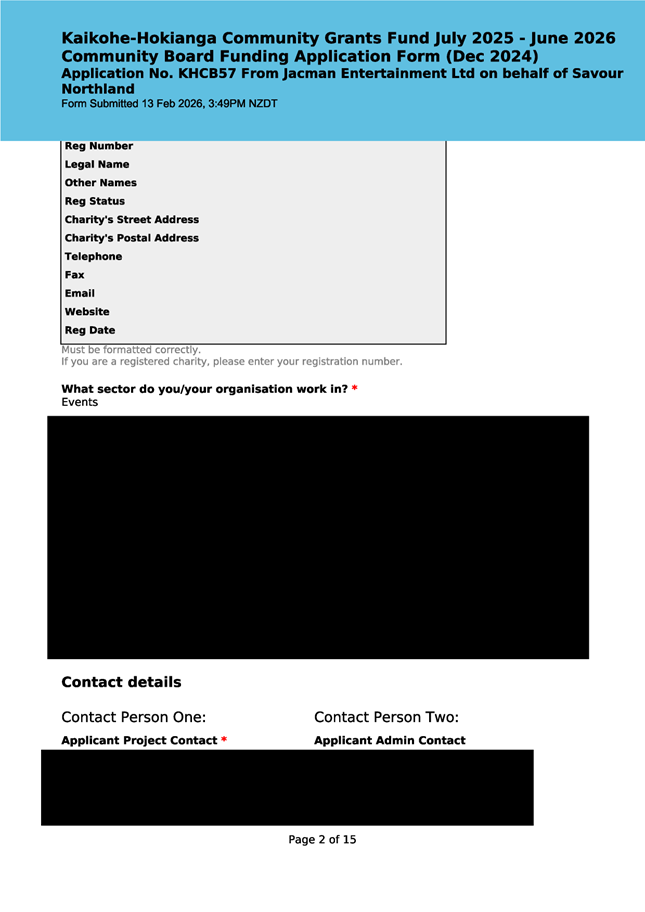
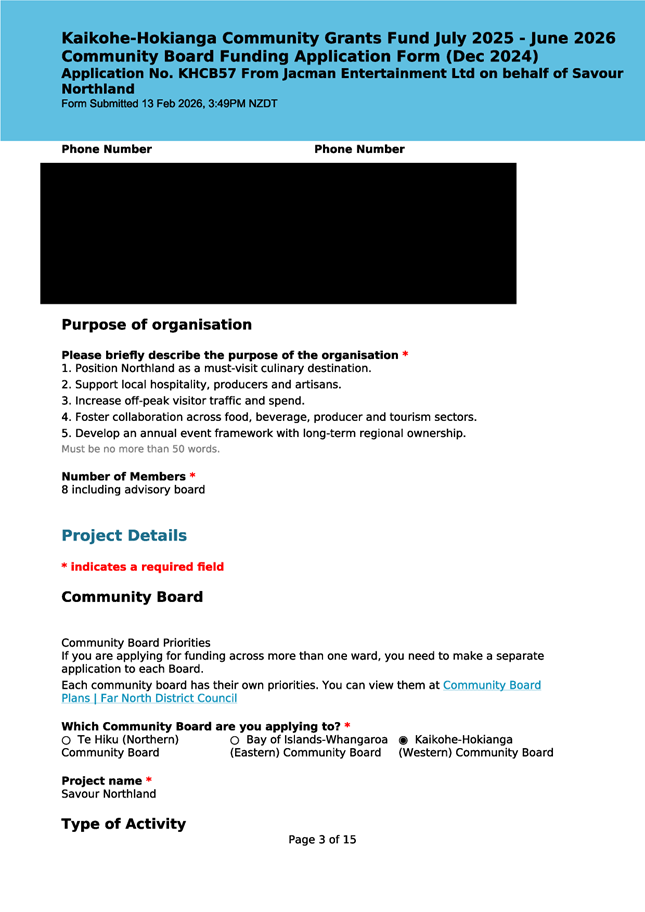
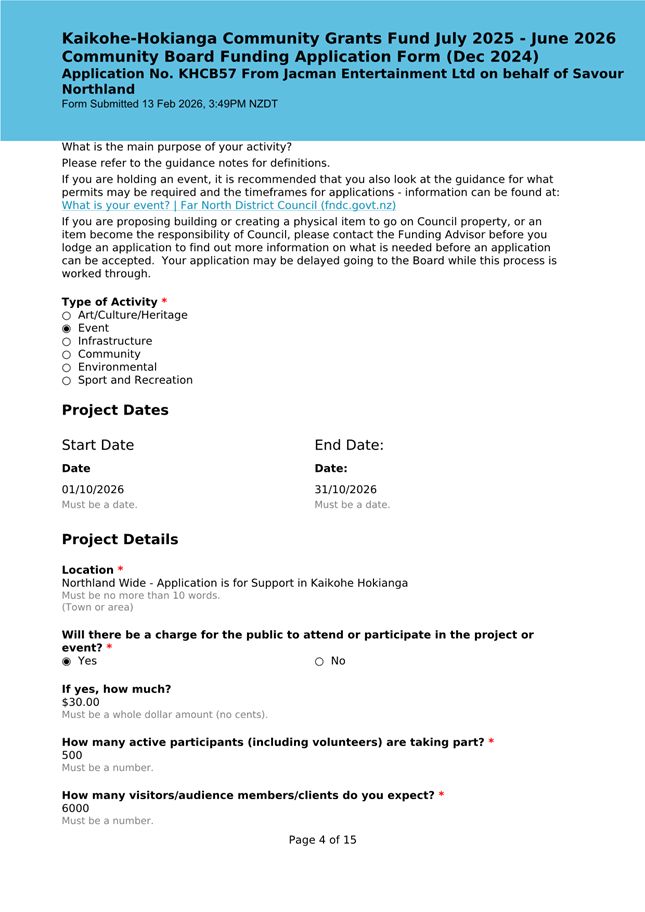
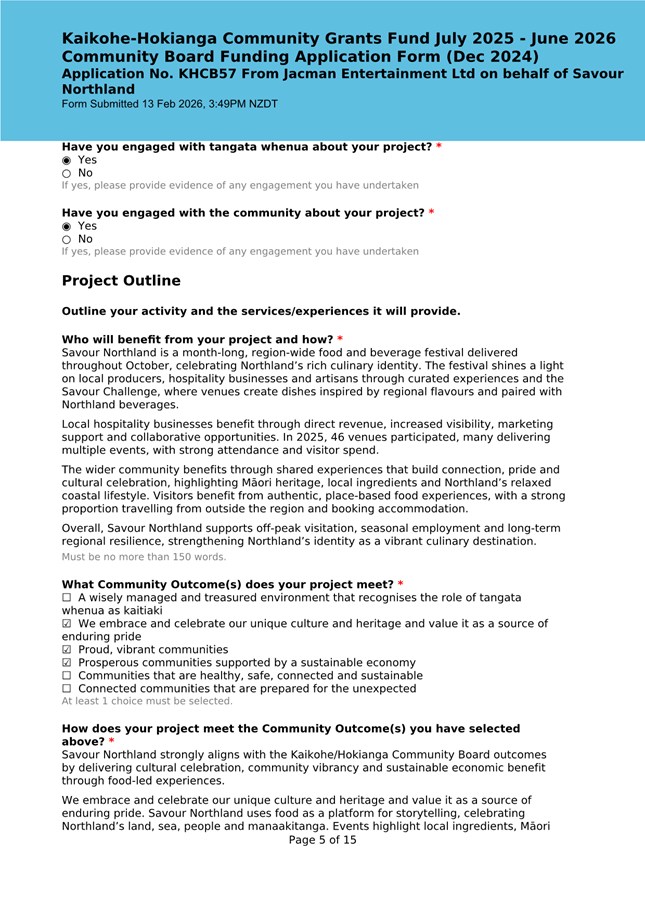
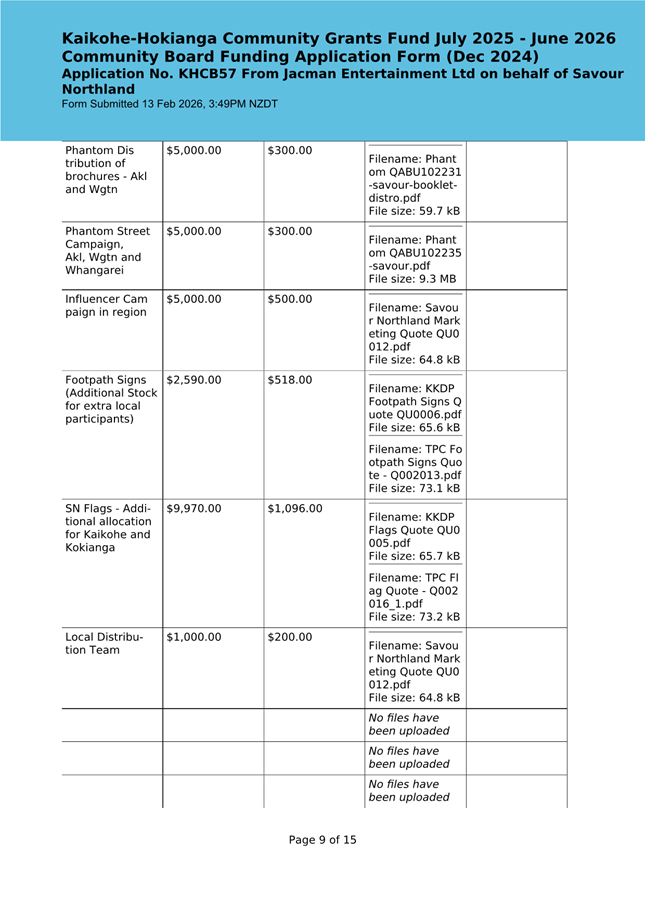
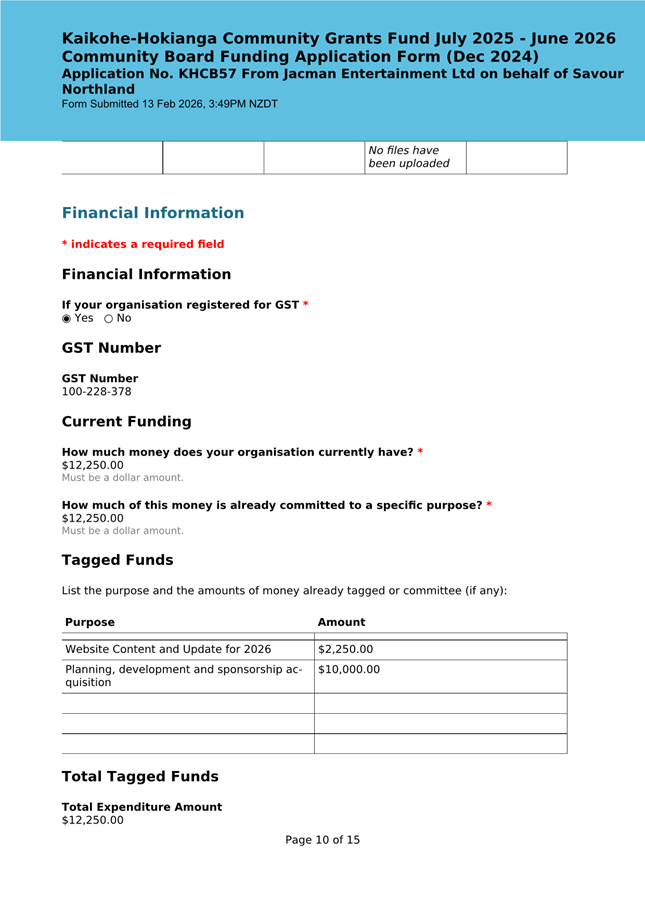
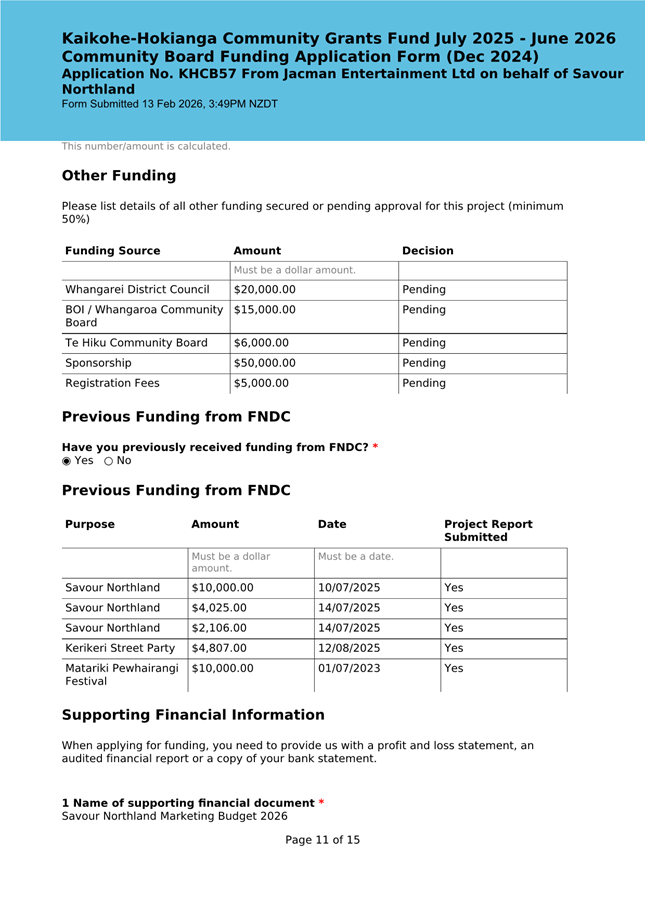
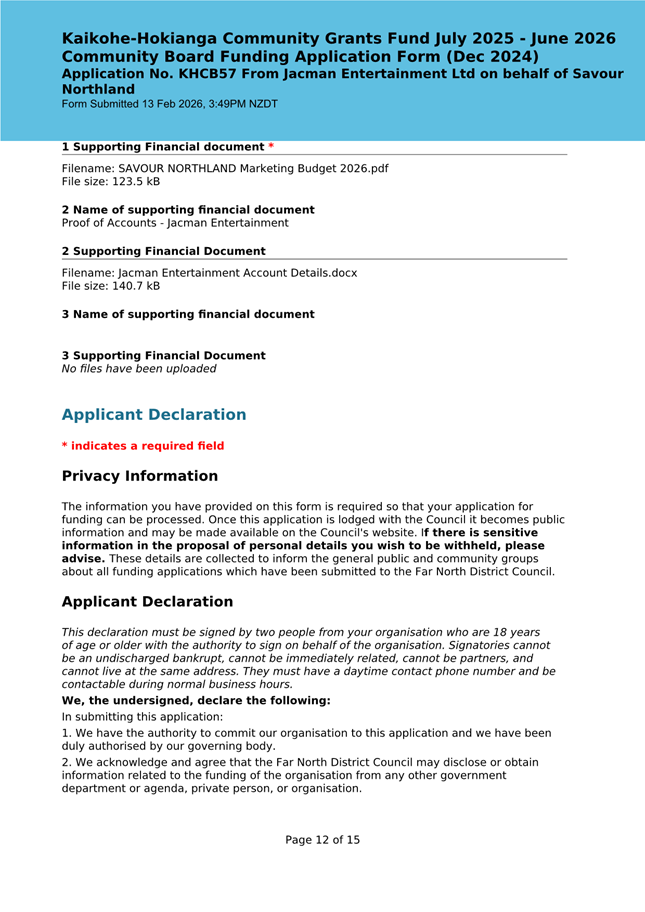
Jacman Entertainment Ltd –
Savour Northland
|
$6,244
|
$2,500 per year
|
The applicant is seeking funding
for the Savour Northland food festival for promotion and events in
Kaikohe-Hokianga Ward. They are requesting funding be granted for the
remaining years of the triennium from the Board (this is permitted under the
Community Board Grant Funding Policy).
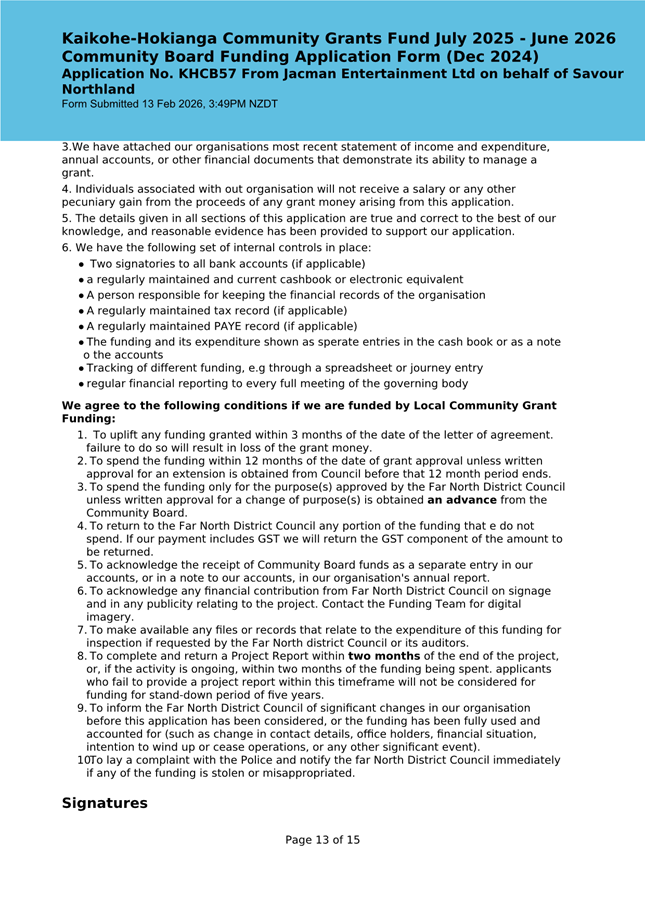
They have provided their report
for the 2025 Savour Northland festival (provided at the same meeting as this
application.)
The Board granted the applicant
$2,106 to the applicant for the 2025 festival.
The Board may grant the
applicant funding for a further two years. This gives the applicant
certainty for their event and allows them to focus on growing alternative
funding sources. They would be required to provide a project report for
each year, prior to any additional funding being released.
The applicant has applied to all
three Boards.
This meets community outcomes 2,3,4,5
|
TAKE TŪTOHUNGA
/ REASON FOR THE RECOMMENDATION
The applicants are required to complete a standard
application form and provide supporting information.
For each application the Board has three options.
Option 1 Authorise funding for the
full amount requested.
Option 2 Authorise partial funding.
Option 3 Decline funding.
Each application has been assessed and meets the criteria of
the Community Grant Policy, Community Outcomes as listed in the LTP and the
conditions listed on the application form.
3) PĀnga PŪtea me ngĀ
wĀhanga tahua / Financial Implications and Budgetary Provision
Budgetary Provisions have been made and the grant is
allocated in accordance with the Community Grant Policy.
Āpitihanga
/ Attachments
1. Savour
Northland - A5585354 ⇩
HŌTAKA TAKE ŌKAWA / COMPLIANCE SCHEDULE:
Full consideration has been given
to the provisions of the Local Government Act 2002 S77 in relation to decision
making, in particular:
1. A
Local authority must, in the course of the decision-making process,
a) Seek
to identify all reasonably practicable options for the achievement of the
objective of a decision; and
b) Assess
the options in terms of their advantages and disadvantages; and
c) If
any of the options identified under paragraph (a) involves a significant
decision in relation to land or a body of water, take into account the
relationship of Māori and their culture and traditions with their
ancestral land, water sites, waahi tapu, valued flora and fauna and other
taonga.
2. This
section is subject to Section 79 - Compliance with procedures in relation to
decisions.
|
He
Take Ōkawa / Compliance Requirement
|
Aromatawai
Kaimahi / Staff Assessment
|
|
State the level of significance
(high or low) of the issue or proposal as determined by the Council’s
Significance and Engagement Policy
|
This is a matter of low
significance.
|
|
State the relevant Council
policies (external or internal), legislation, and/or community outcomes (as
stated in the LTP) that relate to this decision.
|
Community Grant Policy and Te Pae
o Uta.
|
|
State whether this issue or
proposal has a District wide relevance and, if not, the ways in which the
appropriate Community Board’s views have been sought.
|
This report does not have
district-wide relevance. Community Boards hold the delegation to approve
Community Grant Funds.
|
|
State the possible implications for Māori
and how Māori have been provided with an opportunity to contribute to
decision making if this decision is significant and relates to land and/or
any body of water.
State the possible implications and how this
report aligns with Te Tiriti o Waitangi / The Treaty of Waitangi.
|
There are no implications for
Māori in relation to land and/or water.
|
|
Identify persons likely to be
affected by or have an interest in the matter, and how you have given
consideration to their views or preferences (for example – youth, the
aged and those with disabilities).
|
Considered in each of the
individual applications.
|
|
State the financial implications
and where budgetary provisions have been made to support this decision.
|
Budgetary provision has been made
and the grant is allocated in accordance with the Community Grant Policy.
|
|
Chief Financial Officer review.
|
The Chief Financial Officer has
not reviewed this report.
|
|
Kaikohe-Hokianga Community Board Meeting
Agenda
|
11 March 2026
|
|
Kaikohe-Hokianga Community Board Meeting
Agenda
|
11 March 2026
|
7.5 Chairperson
and Members Reports
File
Number: A5528223
Author: Melissa
Wood, Community Board Coordinator
Authoriser: Aisha
Huriwai, Manager - Democracy Services
TE TAKE PŪRONGO / Purpose of the Report
The report provides feedback to the community on matters of
interest or concern to the Community Board.
|
NGĀ
TŪTOHUNGA / Recommendation
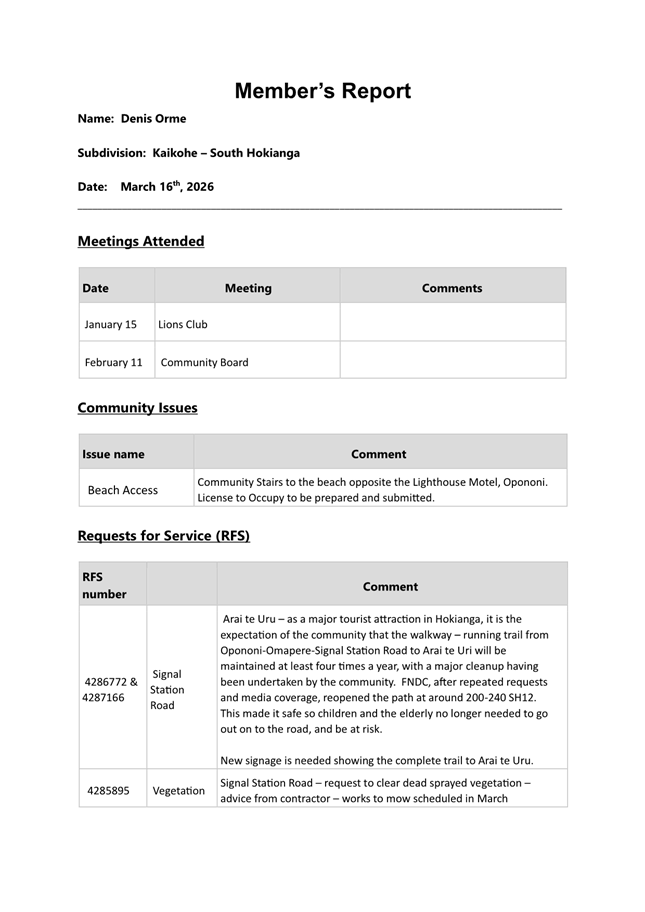
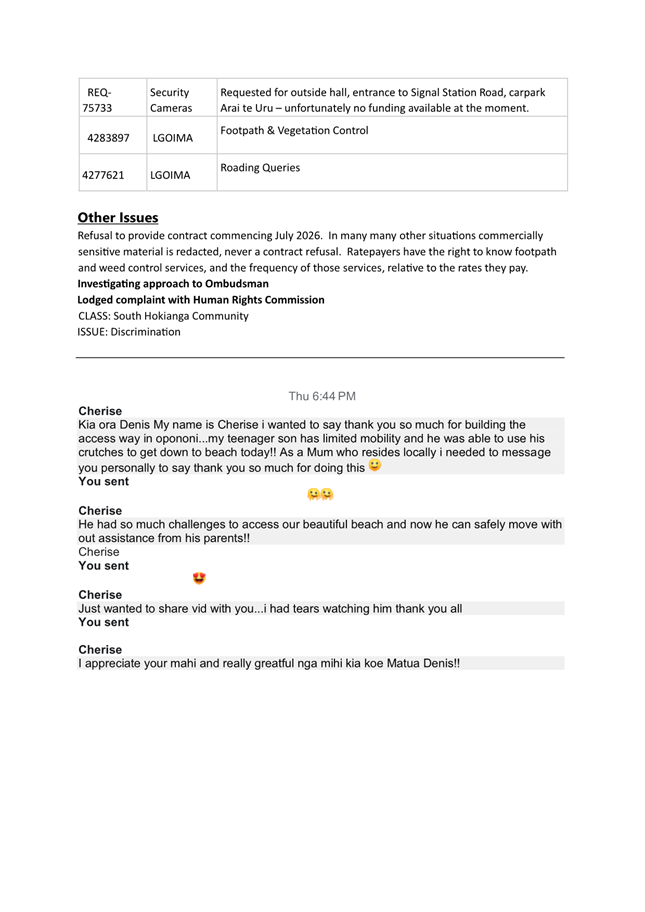
That the Kaikohe-Hokianga Community Board note the
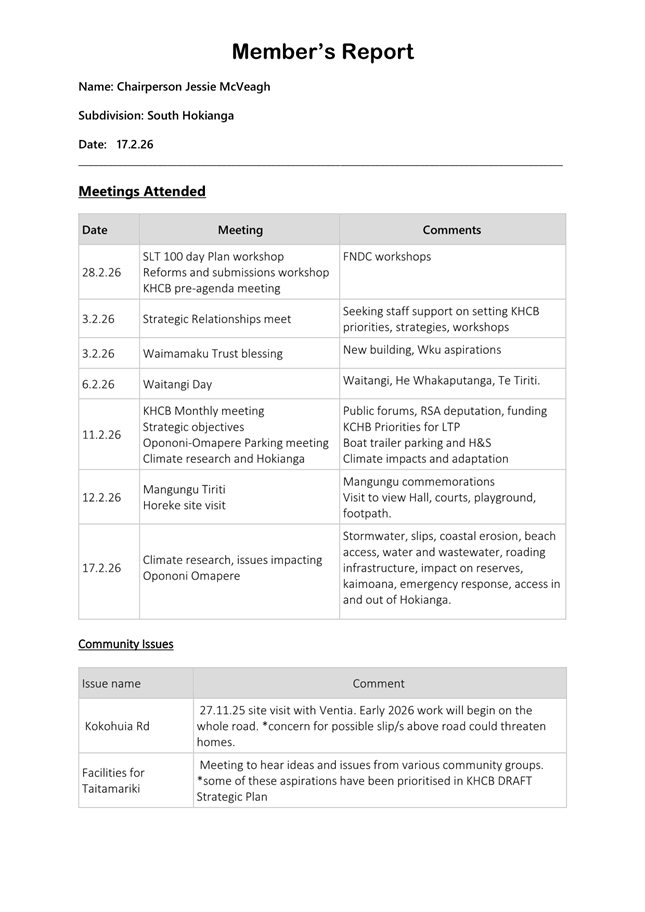
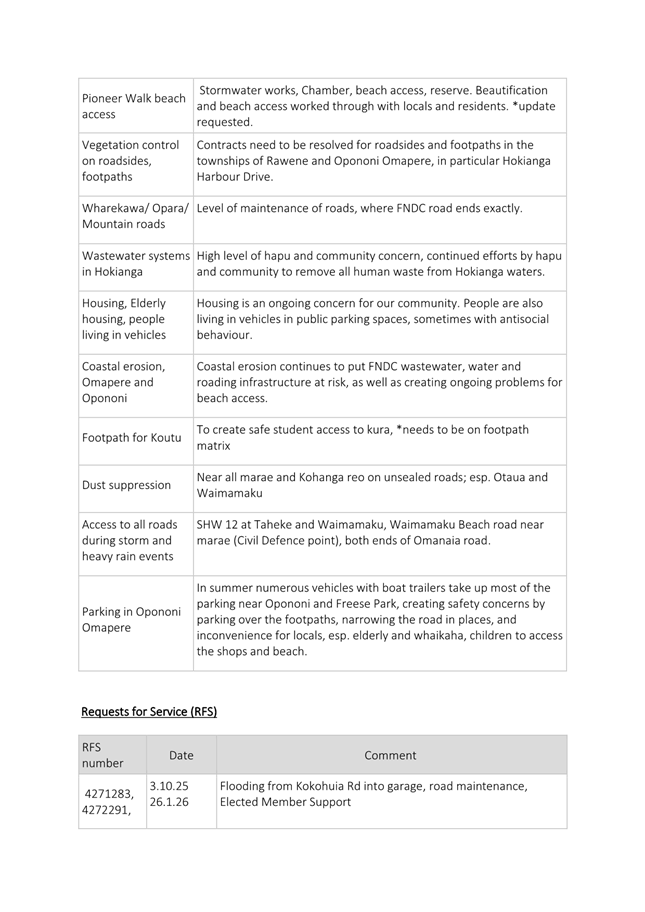
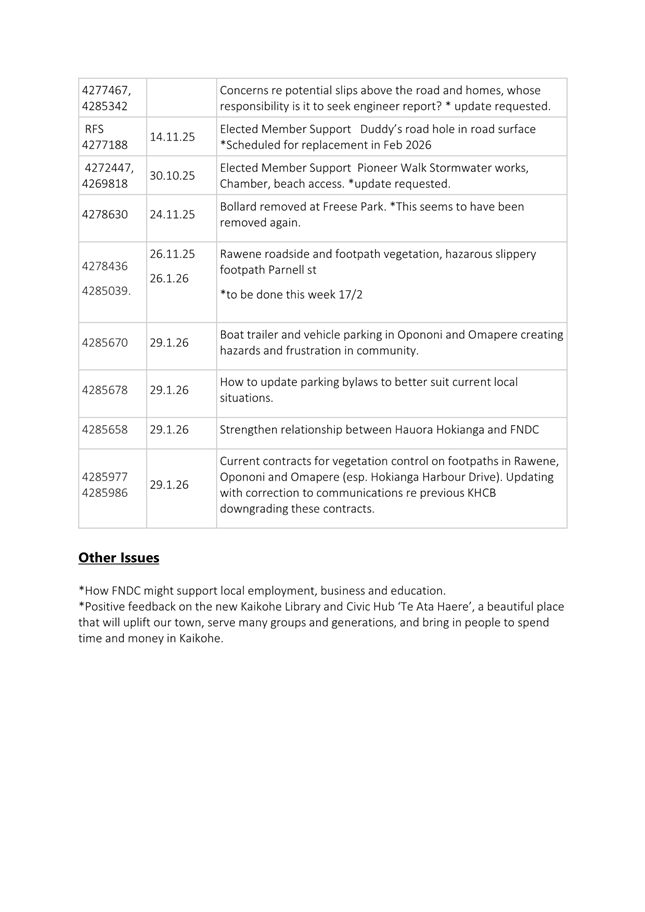
March 2026 member reports from Chairperson McVeagh, and Member Orme.
|
TE tĀHUHU KŌRERO / Background
The Local Government Act 2002 Part
4 Section 52 states that the role of a Community Board is to represent, and act
as an advocate for the interests of its community.
TE MATAPAKI ME NGĀ KŌWHIRINGA /
Discussion and Next Steps
Community Boards are required to
consider and report on any matters of concern or interest to the Community
Board, maintain an overview of services provided to the community and
communicate with community organisations and special interest groups within the
community.
The reports from the Chairperson
and Members provide information to community on these requirements. They
also provide Request for Service (RFS) information on issues of interest or
concern to the Community Board, providing a reference for further enquiry on
the progress of the matters raised. The report from the Chairperson and members
are attached.
Resource Consents have been emailed
to community board members. Members have five days to send feedback in relation
to a resource consent. Members will be expected to include these details in
their member reports going forward.
REASON FOR THE RECOMMENDATION
The reason for the recommendation
is to provide information to the Community on the work that has been undertaken
by the Chairperson and Members on its behalf.
NGĀ PĀNGA PŪTEA ME NGĀ WĀHANGA
TAHUA / Financial Implications and Budgetary Provision
There are no financial implications
or the need for budgetary provision as a result of this report.
ngĀ
Āpitihanga / Attachments
1. KHCB
Chair McVeagh Report March 2026 - A5594268 ⇩ 
2. KHCB
Member Orme report March 2026 - A5594273 ⇩
|
Kaikohe-Hokianga Community Board Meeting
Agenda
|
11 March 2026
|
|
Kaikohe-Hokianga Community Board Meeting
Agenda
|
11 March 2026
|
|
Kaikohe-Hokianga Community Board
Meeting Agenda
|
11 March 2026
|
8 Ngā
Pūrongo Taipitopito / Information Reports
8.1 Stage
One - Community Adaptation Planning, Te Hōtaka Urutau Hapori-Community
Adaptation Programme
File
Number: A5556089
Author: Katy
Simon, Adaptation Programme Lead Climate Action and Resilience
Authoriser: Ken
Macdonald, Chief Financial Officer
TAKE PŪRONGO / Purpose of the Report
To update the
Kaikohe-Hokianga Community Board on the Stage One Community Adaptation Planning
project.
WHAKARĀPOPOTO MATUA / Executive SummarY
The Climate Action and Resilience Department is starting
Stage One of community adaptation planning, as set by Te
Hōtaka Urutau Hapori, Council’s Community Adaptation Programme.
This information report
outlines the Kaikohe-Hokianga Community Board’s (KHCB) anticipated
governance role and introduces the project plan and initial scoping decisions.
|
TŪTOHUNGA
/ Recommendation
That the Kaikohe-Hokianga Community Board receive the
report Stage One - Community Adaptation Planning, Te Hōtaka Urutau
Hapori-Community Adaptation Programme .
|
tĀHUHU KŌRERO / Background
Council approved Stage One
Community Adaptation Planning under Te Hōtaka Urutau Hapori –
Community Adaptation Programme in August
2025. Since this decision, the Climate Action and Resilience Department
have procured professional services and established a project team to deliver
Stage One. Early engagement and relationship-building has also continued with
the support of Kaimanaaki Hapori, contracted community advisors. The Stage One
project is now formally starting.
MATAPAKI ME NGĀ KŌWHIRINGA /
Discussion and Next Steps
Stage One Community Adaptation Planning
By 2027, the project team aims to
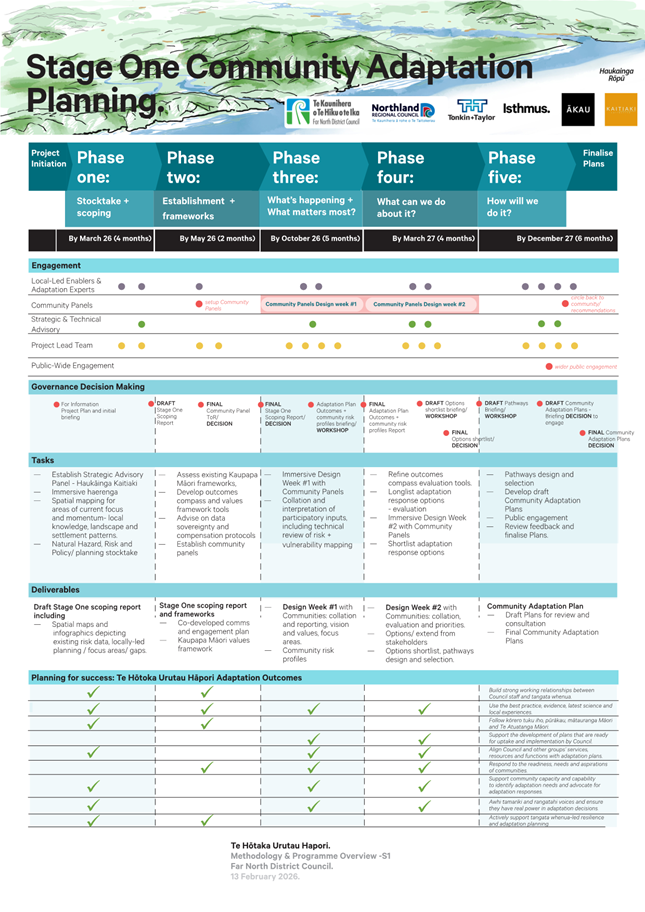
deliver adopted Community Adaptation Plans for the Stage One area. Attachment
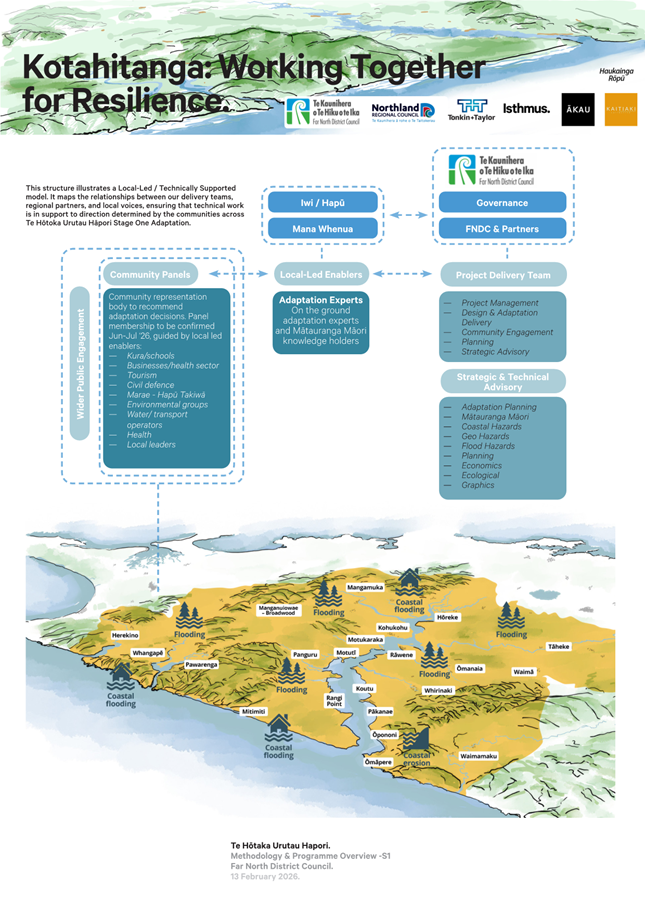
A, Stage One Community Adaptation Planning Project Summary, shows the
project’s phases, key tasks and decisions, and different roles. Staff
will be available to answer questions on the project summary during this March
2026 meeting.
Tonkin + Taylor, Isthmus and
Ākau are jointly contracted to deliver Stage One. A project team has been
established and is made up of the external specialists, Far North District
Council, and Northland Regional Council staff. Katy Simon, Adaptation Programme
Lead and Sarah Peri, Kaupapa Māori Lead – Climate Action and
Resilience, are the key staff leading this project.
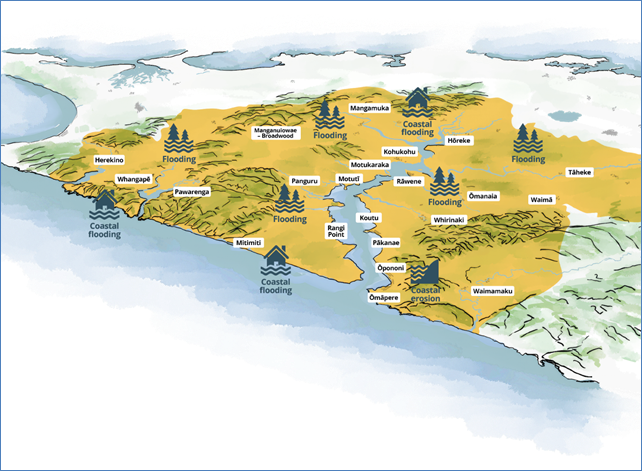
The Stage One area covers
Whangapē, Herekino, North Hokianga, South Hokianga and Waimamaku areas.
Figure One below shows a map of the area (also shown in Attachment A).
·
Figure 1 Stage One
Project Area
Community Adaptation Plans will set
out how communities and Council will prepare for and respond to increasing
natural hazards. Community Adaptation Plans will decide:
- What’s
happening?
o Future risks from natural
hazards to services, places and elements we care about
- What
matters most?
o Community values, outcomes and
risk tolerance levels that set long-term priorities for services and
assets
- What
can we do about it?
o Adaptation response options
available
- How
are we going to do it?
o Preferred short, medium and
long responses and the triggers for changing responses
Council’s Pou 1, Stage One, webpage describes
adaptation planning in more detail: Pou
1 Community Adaptation Planning | Far North District Council.
Christchurch City Council’s Coastal
Hazards Adaptation Plan (2025) provides a good example of a community
adaptation plan.
Stage One project also supports:
- Working
relationships with tangata whenua and communities
- Collaboration
and alignment across FNDC functions
- Collaboration
between councils and regional agencies
- Quality
of natural hazards risk information
Kaikohe Hokianga Community Board governance role
The Kaikohe Hokianga Community Board has a governance role
in Stage One community adaptation planning. This comes from the Board’s
role, to represent, and act as an advocate for, the interests of its community.
Staff will seek direction on community-specific aspects of the project that
fall within the South Hokianga and North Hokianga subdivisions. All decisions
will go to full Council.
Community-specific components may include direction on
establishing community panels and their terms of reference, draft community
outcomes, values and risk tolerances, and community-based criteria for
determining preferred adaptation options. Anticipated governance touchpoints
are shown in Attachment A.
Decision-making process and wider governance structure
Project structure and decision-making process
Under Te Hōtaka Urutau Hapori – Community
Adaptation Programme, Council commits to working alongside communities and
tangata whenua on adaptation planning. The project is designed to deliver on
this commitment.
This means:
- a
haukāinga kaitiaki rōpū – local adaptation tangata whenua
expert group will be set up to advise at the project level,
- Community
Panels will be established to make recommendations on adaptation decisions to
Council,
- staff
expect to seek formal hapū or marae representation for the Community
Panels.
- North
and South Hokianga subdivision Members may also be invited to participate in
the relevant Community Panels; and
- Council
will be the final decision-maker because it is the main entity responsible for
implementing the Community Adaptation Plans.
In some cases, elements of Community Adaptation Plans may
need to go to Northland Regional Council, Regional Waters CCO, or other joint
regional governance bodies for direction or decision. This will depend on their
role and functions in future implementation of adaptation plans.
Attachment A shows the project structure.
Next steps – Stage One scoping report
By June 2026, staff will seek Council’s decision on
Stage One scoping report.
A scoping report will decide:
- Sub-areas
where adaptation plans will be created
- What
we’re planning for – elements of value included, hazards addressed
- The
level of detail we’re planning for
- How
long we’re planning for – temporal extent for planning decisions
- Who
we’re working with, how decisions will be made and who will be involved
in implementation
The scoping report will be informed by:
- Existing
natural hazards risk information
- Current
and future, anticipated legislation
- Current
precedent of roles and responsibilities, if not specified in legislation
- Existing,
related strategies, plans and projects
- Engagement
on tangata whenua and community needs, issues and opportunities
April to May, before a Council decision on the scoping
report, Staff can circulate a draft version to the North and South Hokianga
subdivision Members.
PĀNGA PŪTEA ME NGĀ WĀHANGA
TAHUA / Financial Implications and Budgetary Provision
n/a
Āpitihanga
/ Attachments
1. Attachment
A - Stage One Community Adaptation Planning Project Summary - A5584382 ⇩ 
|
Kaikohe-Hokianga Community Board Meeting
Agenda
|
11 March 2026
|
|
Kaikohe-Hokianga Community Board Meeting
Agenda
|
11 March 2026
|
8.2 Petition
"Public Toilets for Waimamaku"
File
Number: A5606294
Author: Rhonda-May
Whiu, Democracy Advisor
Authoriser: Aisha
Huriwai, Manager - Democracy Services
TAKE PŪRONGO / Purpose of the Report
For the Board to receive the petition requesting Far North
District Council to provide new public toilet facility in Waimamaku Township
and ensure their ongoing servicing and maintenance.
WHAKARĀPOPOTO MATUA / Executive SummarY
· There are 107 hard copy signatures.
· 9 signatures were on behalf of business and organisation.
· 98 signatures were individuals.
· All signatories are in favour of requesting Far North District
Council providing new public toilet facilities in Waimamaku.
· Included as supporting material for consideration in the 27/37 Long
Term Plan process
· The Petition has been redacted due to private information on the
petition. Copies of the petition can be made available to the board members at
their request.
|
TŪTOHUNGA
/ Recommendation
That the Kaikohe-Hokianga Community Board receive the
Petition "Public Toilets for Waimamaku".
|
tĀHUHU KŌRERO / Background
The petition was received from the Waimamaku Business and
Community Organisations and Community Members on 10 February 2026.
This is widely supported by Waimamaku businesses, wider
community and friends.
Waimamaku is a rural community serving residents, workers,
and visitors traveling through the South Hokianga region.
Access to clean, safe public toilets is a basic public
health need that supports dignity, accessibility, well kept natural environment
and community wellbeing. The absence of adequate facilities places pressure on
local households and businesses and negatively impacts residents and visitors.
The petition has been received and recorded as supporting
material for the KHCB capital project priority, “Development of public
toilet services for Waimamaku,” which is included as a proposed project
for consideration in the upcoming 2027–2037 Long Term Plan process (KHCB
19/12/25, Agenda item 7.2). The petition will also be referred to the relevant
operational areas for their information.
Petitions may be presented to the FNDC or any of its
committees or community boards.
Petitions must contain at least 20 signatures, and the
request must consist of fewer than 150 words (not including signatures). The
petition must be received by the Chief Executive at least five working days
before the date of the meeting at which it will be presented.
Petitions must not use offensive language or include
malicious statements They may be written in English or te reo Māori.
To be accepted, a petition must be clearly addressed to the
Far North District Council.
A petition may be delivered by electronic means.
The name of the principal petitioner must appear at the head
of the petition, and that contact information is provided when the petition is
presented. The principal petitioner is usually the person who has initiated or
organised the petition and presents the petition to Council.
MATAPAKI ME NGĀ KŌWHIRINGA /
Discussion and Next Steps
To enable the
Kaikohe-Hokianga Community Board to formally receive the petition and provide a
way for the Board to advocate for its community where appropriate.
The petition is addressed
to the Far North District Council. It has not been attached to this report
because it contains personal information that must be withheld for privacy
reasons. A redacted version would add little value, and as the project is already
a Community Board priority, attaching the petition was not considered
necessary.
The petition includes 107
handwritten signatures: 9 from businesses or organisations and 98 from
individuals.
When receiving a
petition, the Board must consider whether it supports the request and what
action, if any, should follow. As this matter is already being progressed
through other channels, the recommendation is simply to receive the petition.
Staff will update the petition organisers on the steps the Board has already
taken.
PĀNGA PŪTEA ME NGĀ WĀHANGA
TAHUA / Financial Implications and Budgetary Provision
There are no financial
implications or need for budgetary provision in receiving this petition.
Āpitihanga
/ Attachments
Nil
|
Kaikohe-Hokianga Community Board Meeting
Agenda
|
11 March 2026
|
8.3 Open
Resolutions and Actions Update - March 2026
File
Number: A5588560
Author: Rhonda-May
Whiu, Democracy Advisor
Authoriser: Aisha
Huriwai, Manager - Democracy Services
TAKE PŪRONGO / Purpose of the Report
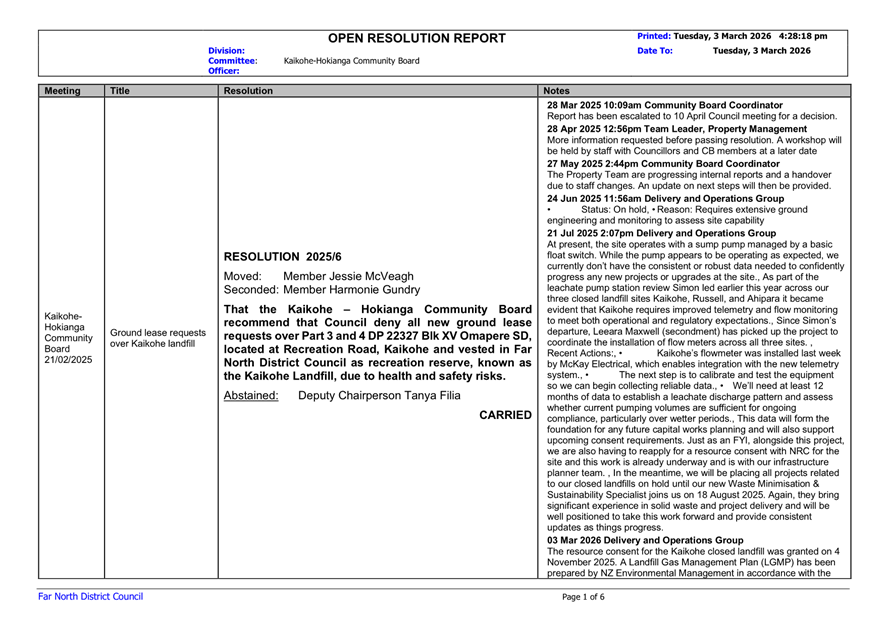
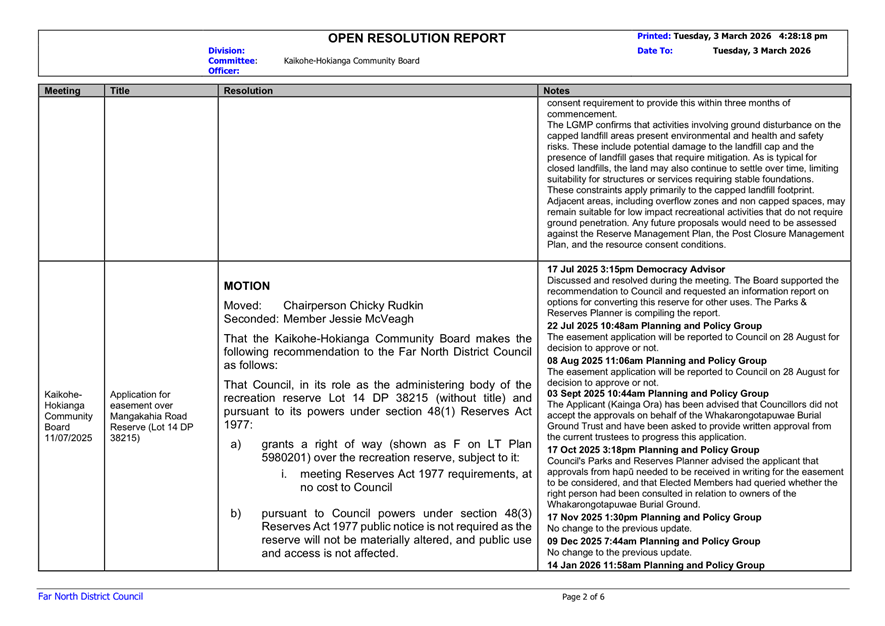
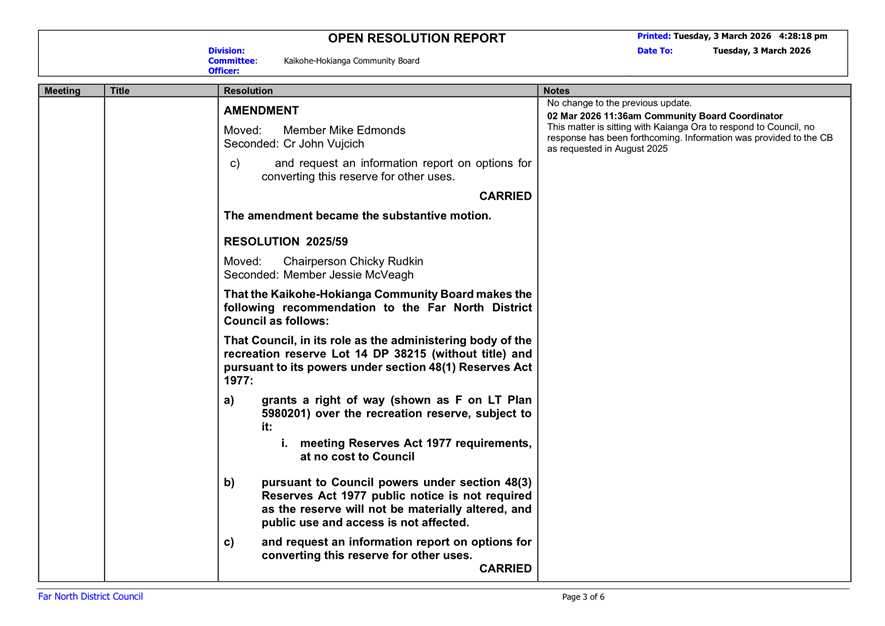
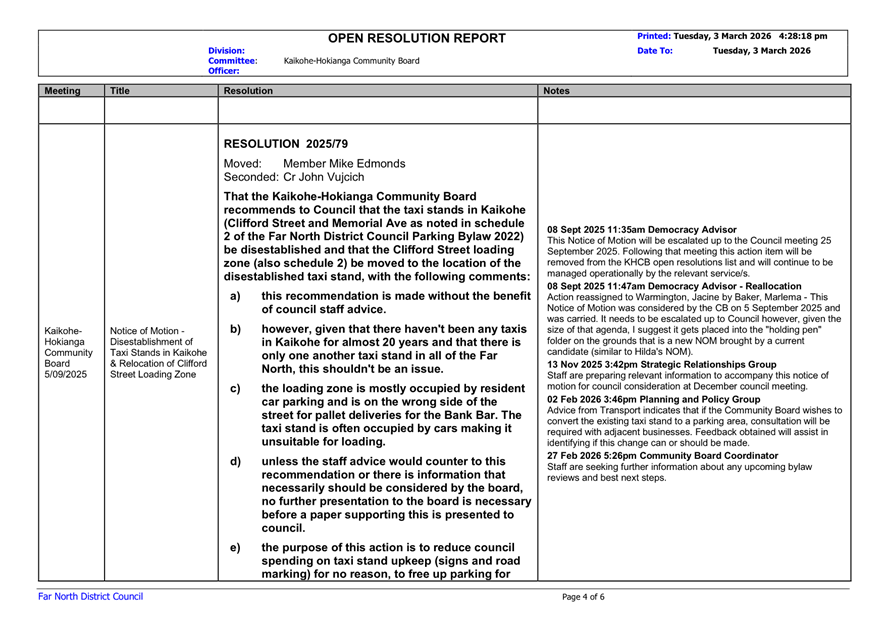
To provide the
Kaikohe-Hokianga Community Board with an overview of outstanding open
resolutions and actions for Kaikohe-Hokianga Community Board.
WHAKARĀPOPOTO MATUA / Executive SummarY
· Open resolutions are a mechanism to communicate progress against
decisions/resolutions.
· Open resolutions are also in place for all formal elected member
meetings.
· This report introduces the inclusion of ‘action points’
in this reporting going forward.
· Action points are a mechanism to capture actions that are not part
of a formal decision/resolution but require follow up or confirmation from
staff.
|
TŪTOHUNGA
/ Recommendation
That the Kaikohe-Hokianga Community Board receive the
report Open Resolutions and Actions Update - March 2026.
|
tĀHUHU KŌRERO / Background
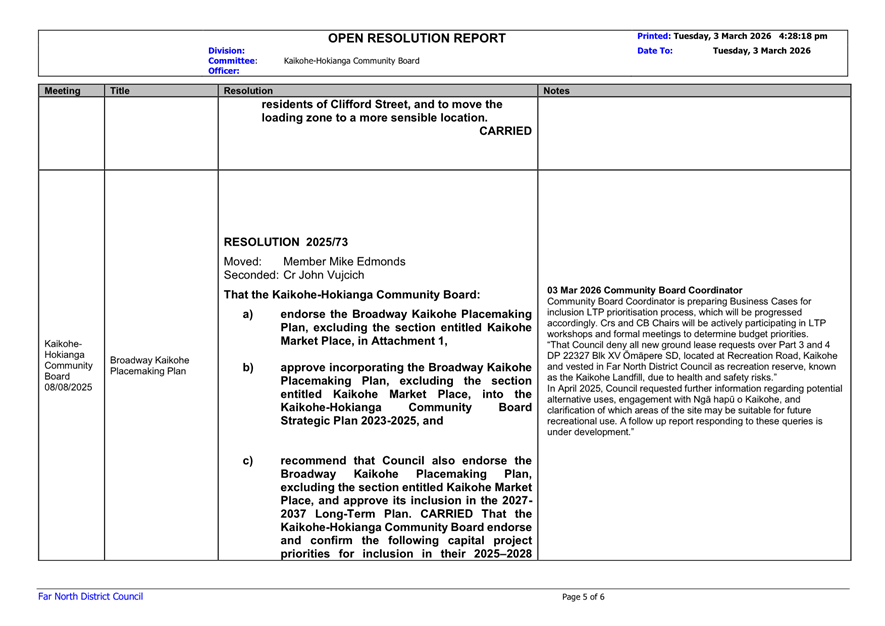
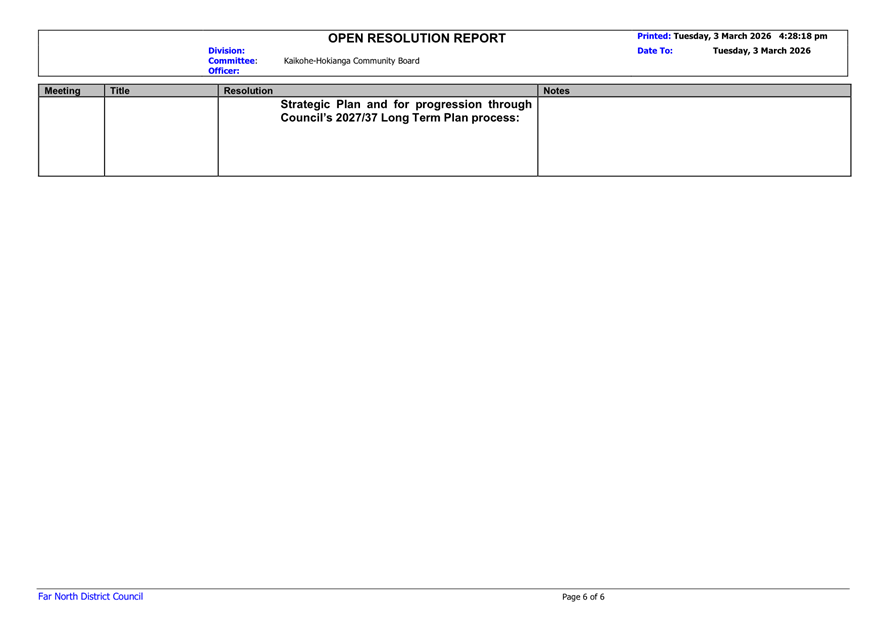
Any resolution or decision from a meeting is compiled on an
open resolution status report, to capture actions trigged by Board decisions.
Staff provide updates on progress against tasks that are not yet completed.
Since some reports received by this Board are informational,
they do not generate open resolution items. However, a need has been identified
to record and track action points arising from information reports or meeting
discussions.
There are currently no action point open items recorded.
Moving forward, these will be captured and reported at Board meetings.
MATAPAKI ME NGĀ KŌWHIRINGA /
Discussion and Next Steps
Managers will assist in recording and following up
outstanding open resolutions or actions points with their staff.
Community Board Coordinators will assist where appropriate,
and occasionally, may be in a position to provide a further verbal update at
meetings, following the printing of an agenda. Democracy Services staff will
support the process by generating reports.
PĀNGA PŪTEA ME NGĀ WĀHANGA
TAHUA / Financial Implications and Budgetary Provision
There are no financial
implications or need for budgetary provision in receiving this report.
Āpitihanga
/ Attachments
1. Kaikohe-Hokianga
Community Board Open Resolutions March Update - A5599959 ⇩ 
|
Kaikohe-Hokianga Community Board Meeting
Agenda
|
11 March 2026
|