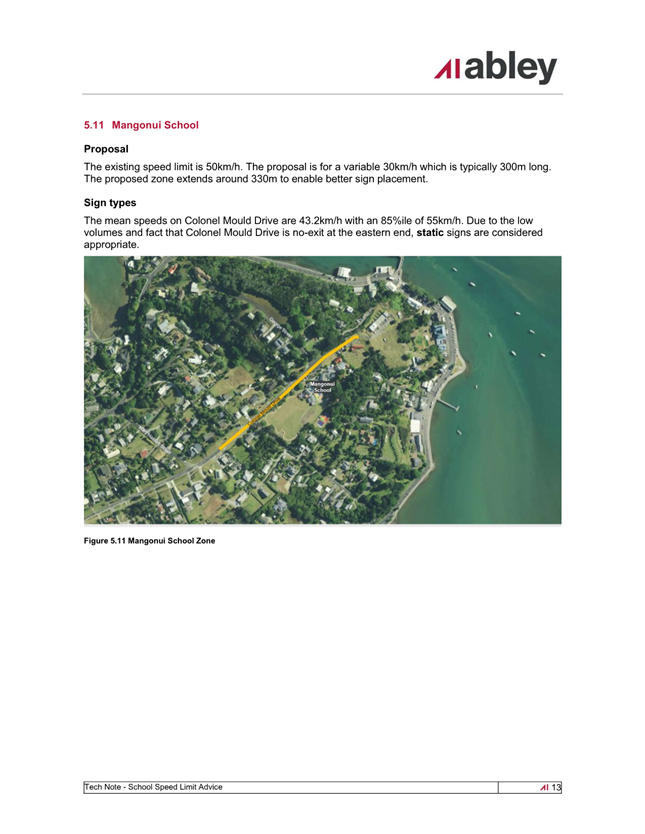
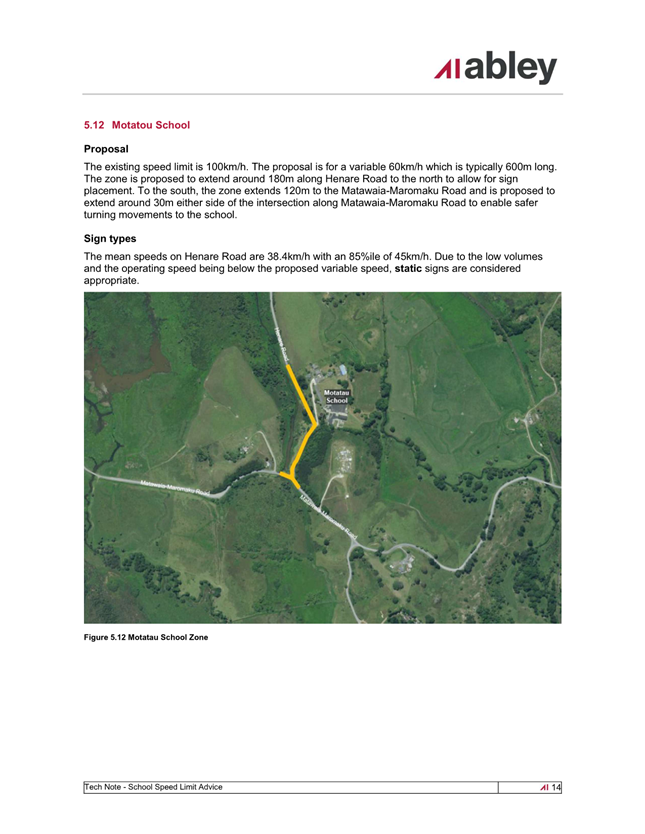
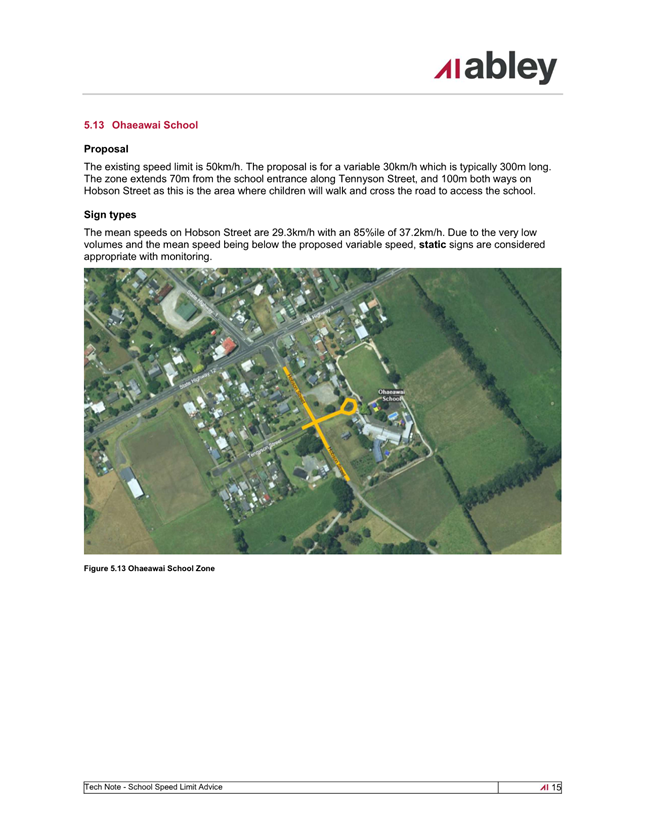
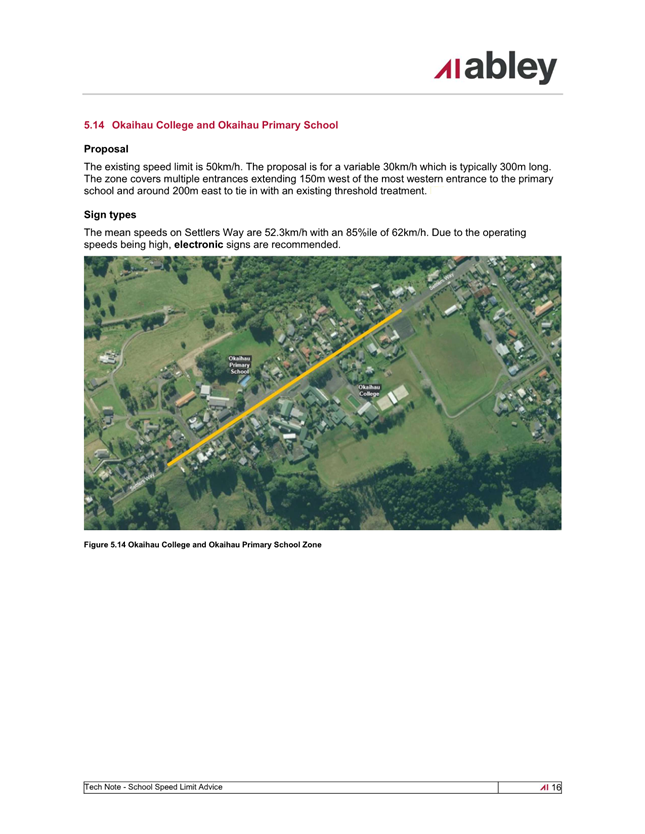
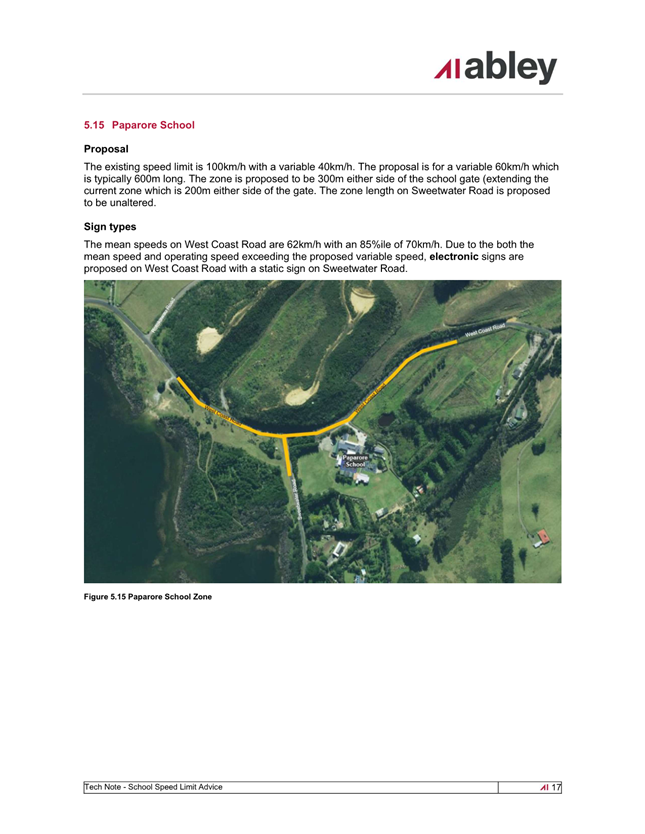
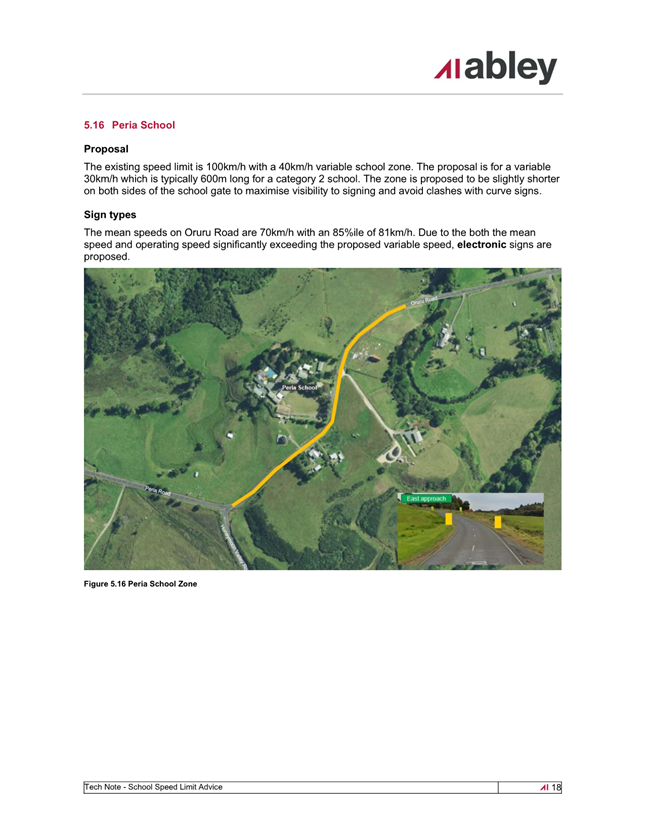
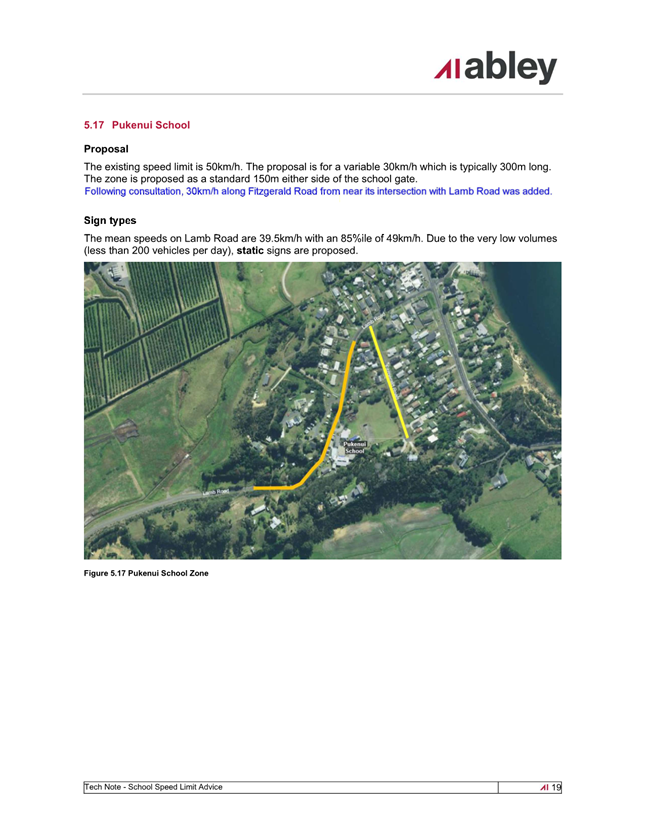
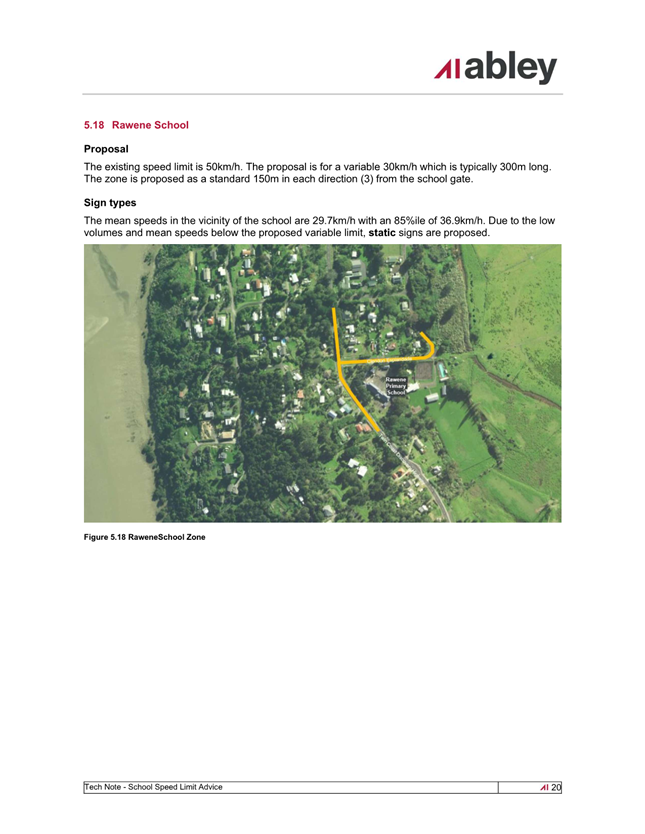
|
Ordinary Council Meeting Agenda
|
5 March 2026
|
7 Ngā
Pūrongo / Reports
7.2 Speed
Limit Changes at Schools - Setting of Speed Limits Rule 2024
File
Number: A5523245
Author: Andy
Brown, Transportation Business Manager - Transportation Services
Authoriser: Charlie
Billington, Group Manager - Corporate Services
Take Pūrongo / Purpose of the Report
To seek Council approval for the proposed speed limit
changes around schools, as required under the 2024 Setting of Speed Limits Rule
(“the Rule”).
WhakarĀpopoto matua / Executive Summary
· The Rule requires Road Controlling Authorities to implement variable
speed limits at all schools by 1 July 2026.
· Council approval is required prior to submission to the Director of
Land Transport (Waka Kotahi NZTA).
· This report presents the proposed speed limit changes for Council
approval.
|
tŪtohunga
/ Recommendation
That Council:
a) Seek approval
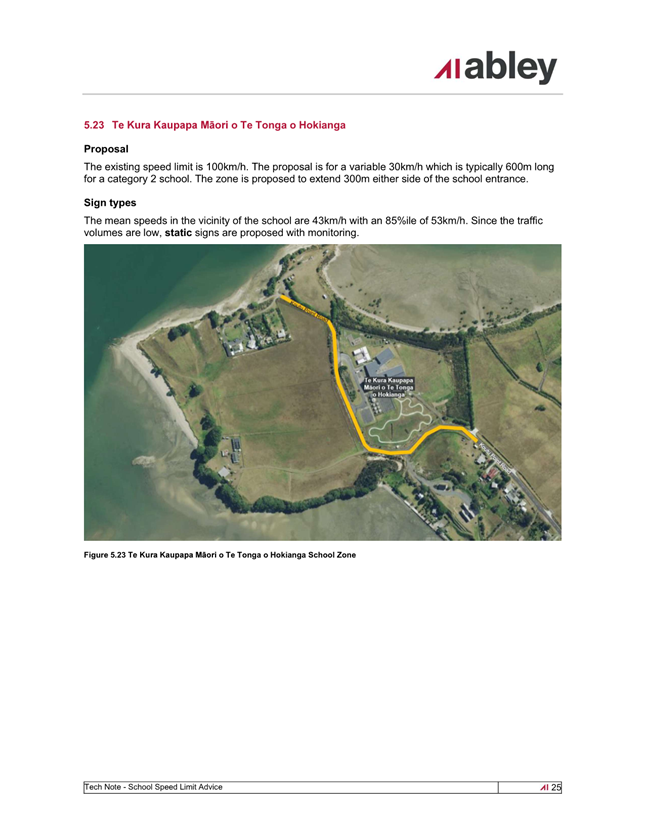
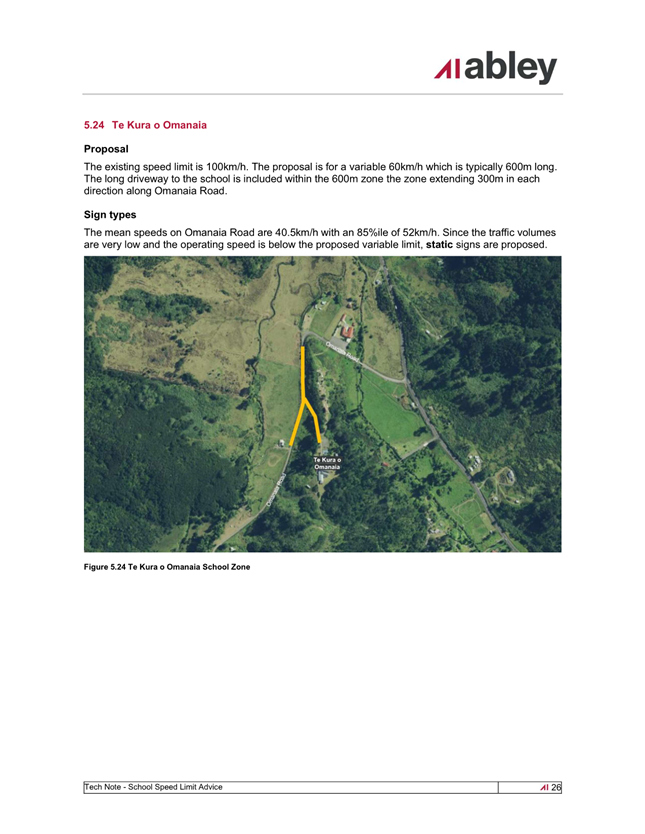
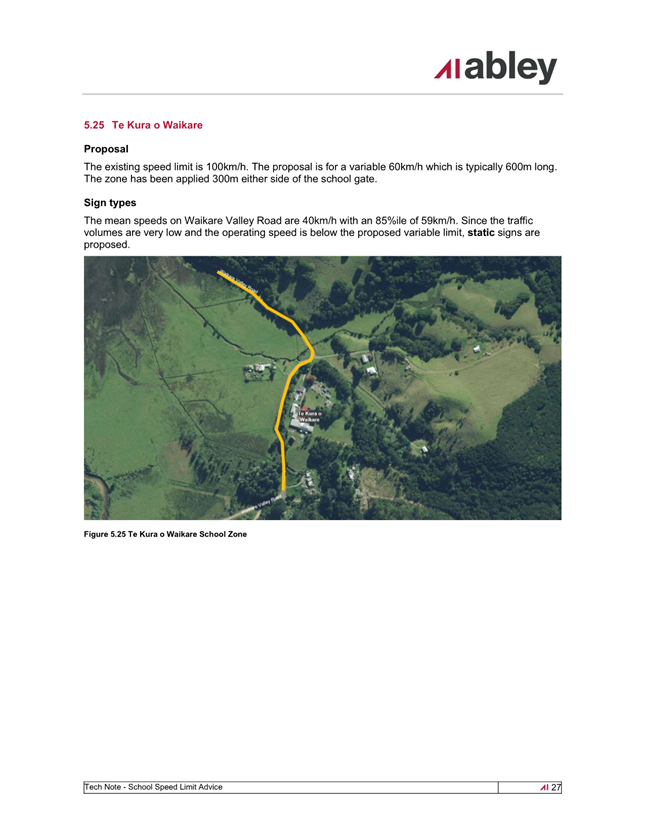
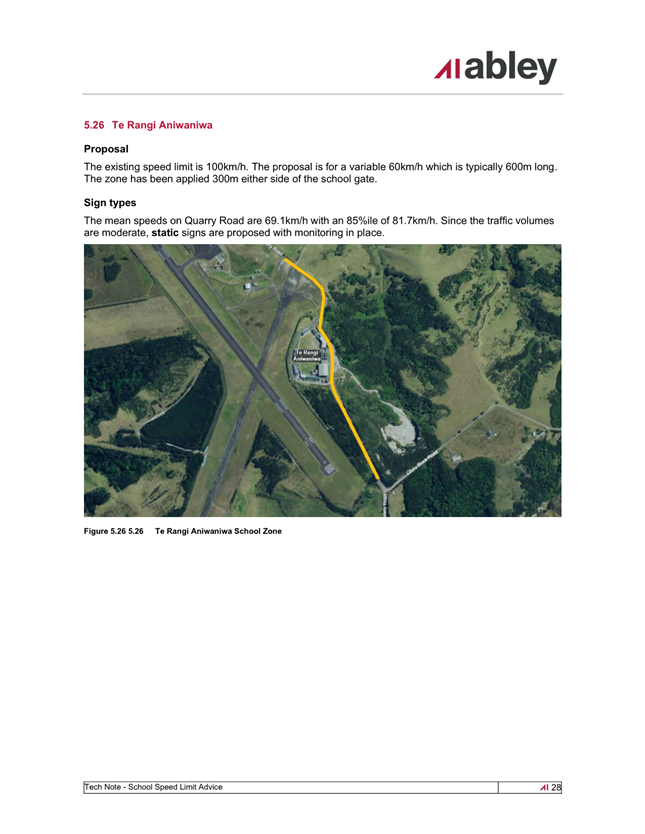
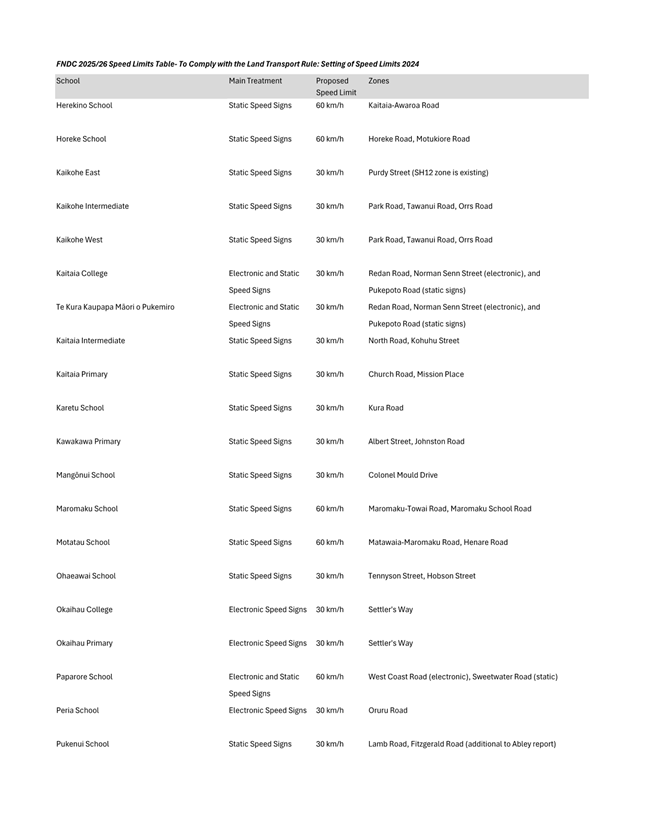
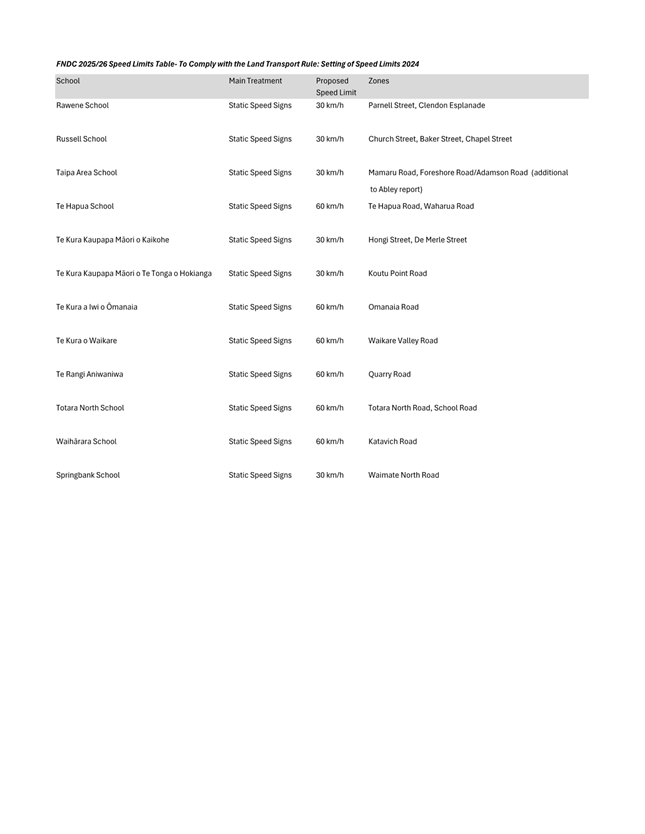
of the Director of Land Transport for speed limit changes at 32 schools
across the district as described in the table ‘FNDC 2025/26 Speed
Limits Table’ attached to this report (A5484687), and
b) delegate
authority to the Chief Executive to accept and incorporate any amendments
required by the Director of Land Transport as part of the approval process,
provided such amendments remain consistent with the intent of the 2024
Setting of Speed Limits Rule.
|
1) TĀhuhu kŌrero / Background
As a Road Controlling Authority, Far North District Council
(FNDC) is required to implement speed limit changes in accordance with the Land
Transport Rule - Setting of Speed Limits 2024.
This report details the required changes for Category 2
schools, including:
· Variable
speed limits around in school zones: A reduced speed limit will apply in the
school zone up to 45 minutes before and after the start and end of the school
day; normal road speed applies at other times.
· Reduced
speed limits in the school zones must be less than 60km/h.
· School
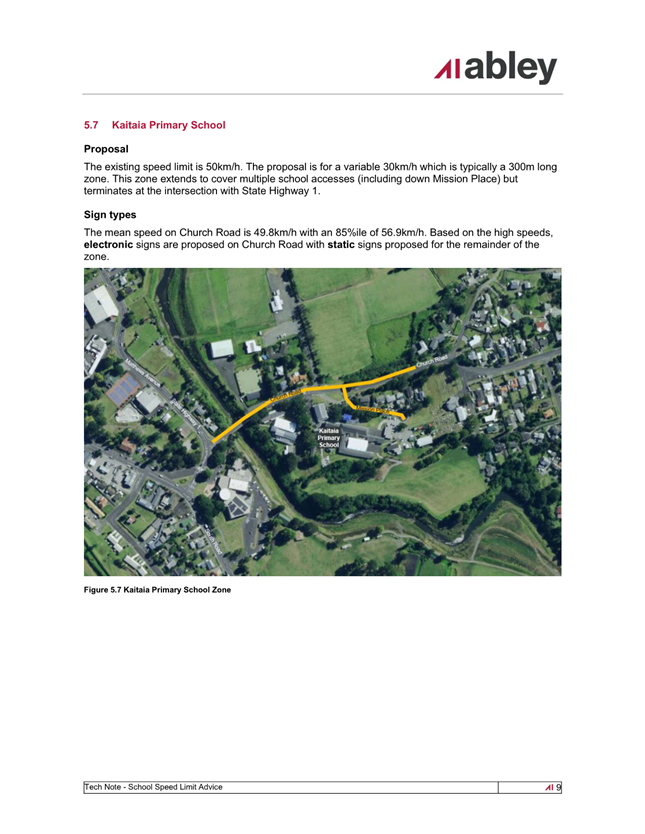
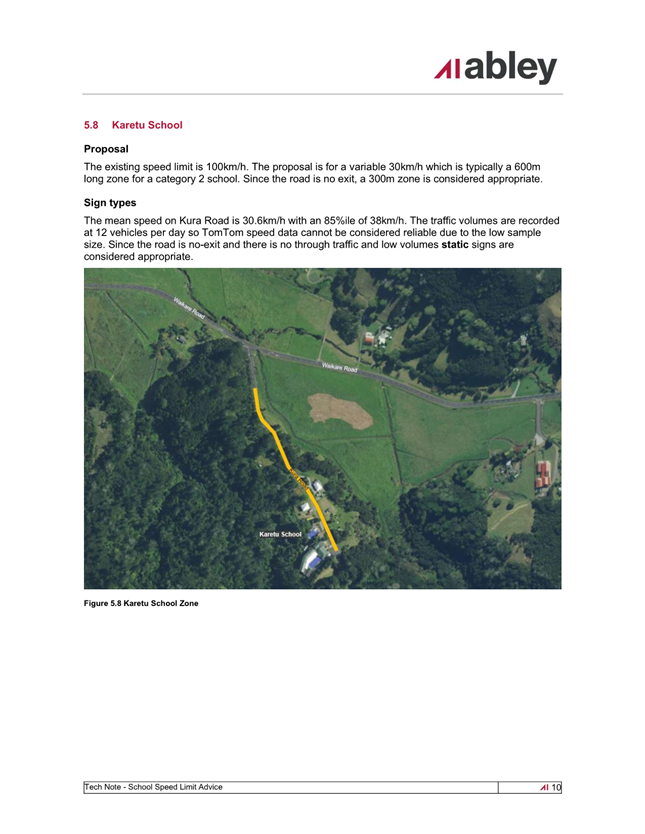
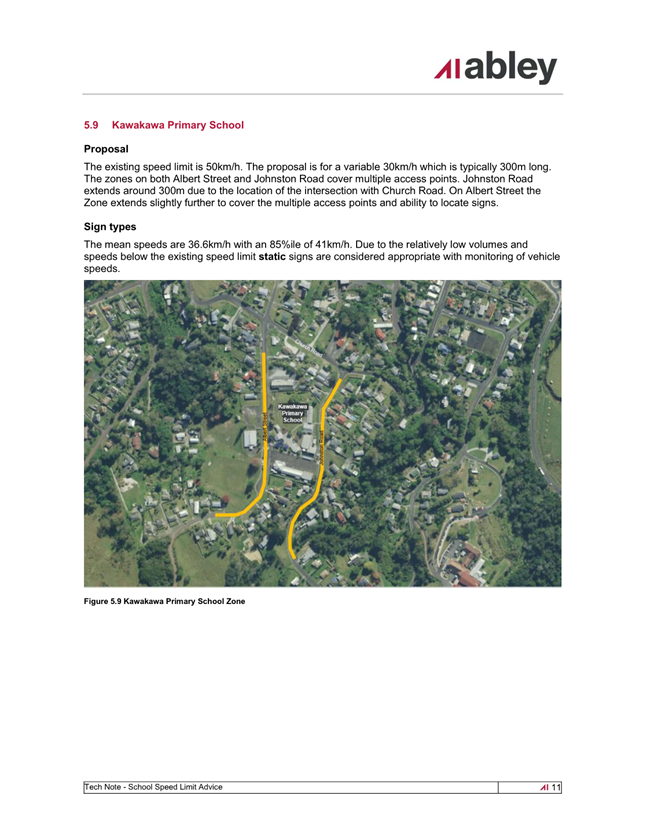
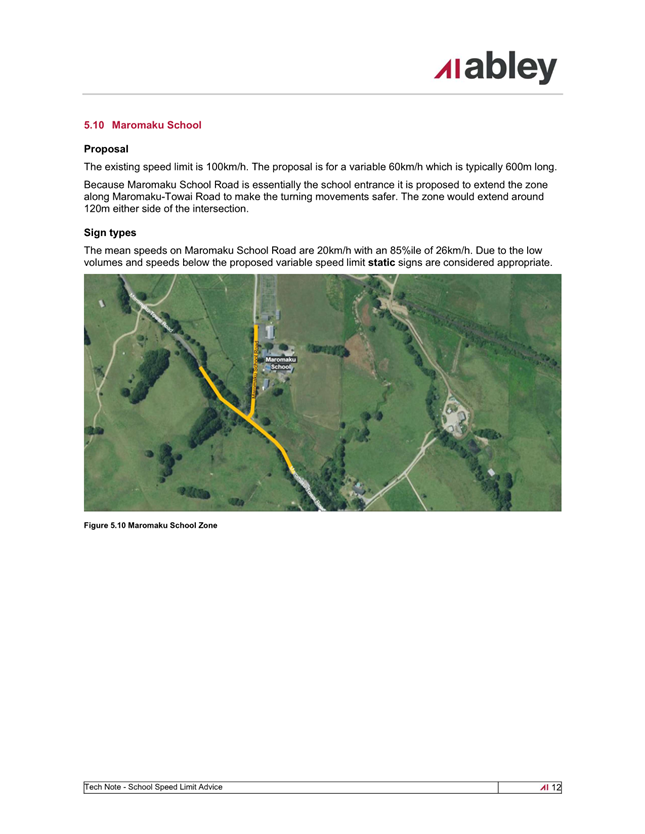
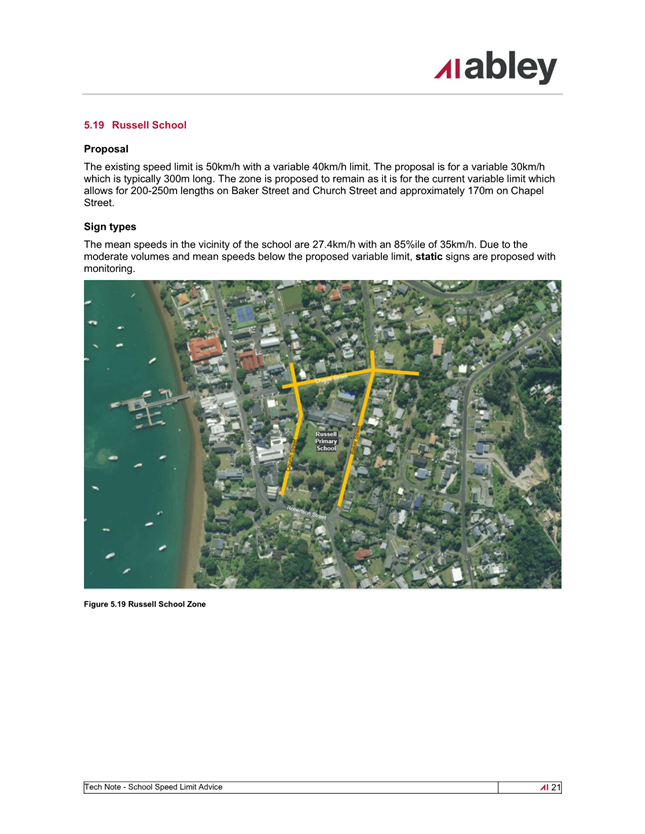
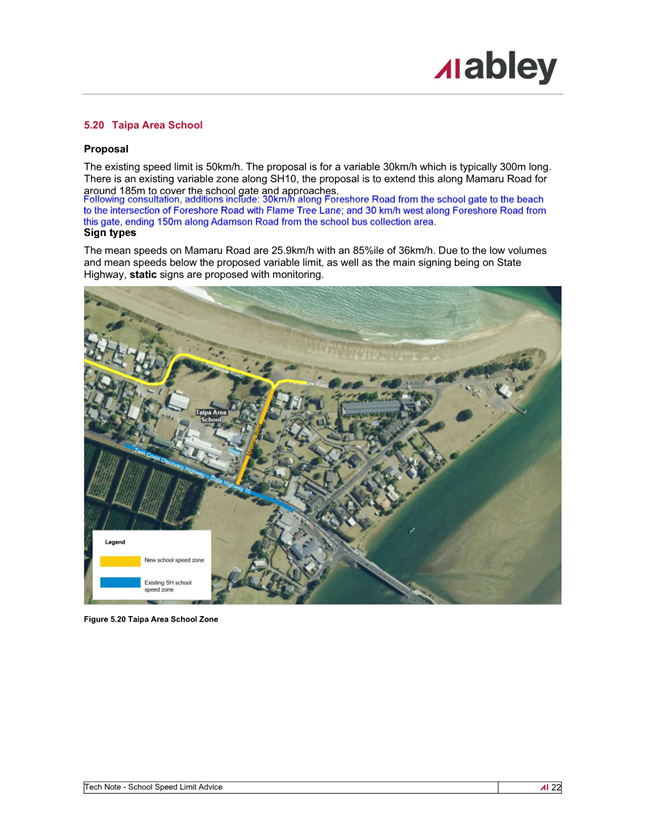
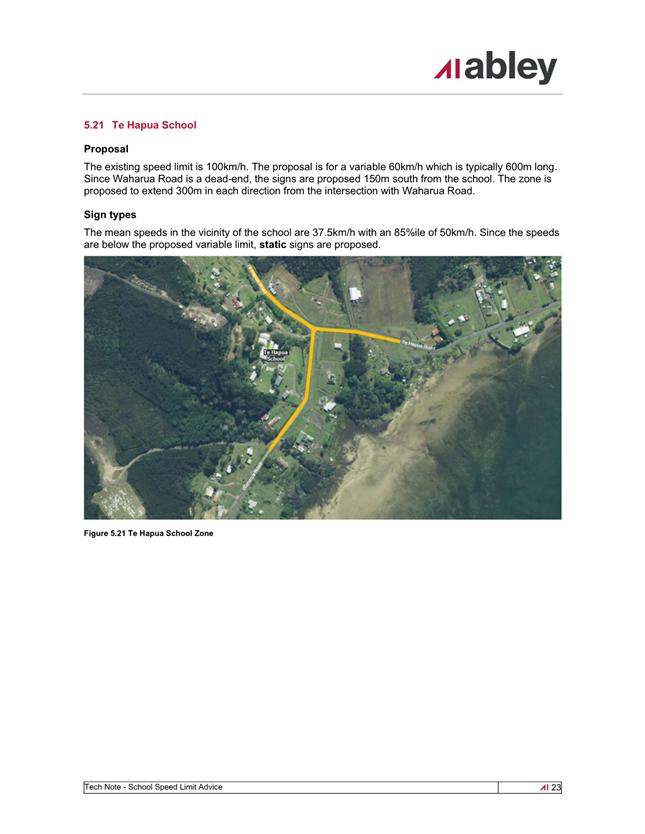
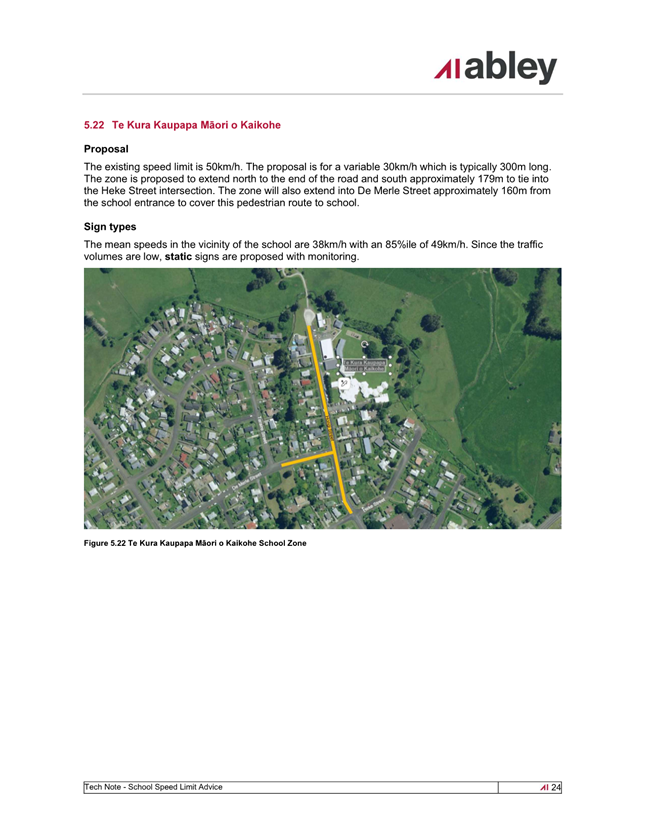
zone extents: up to 150m each side of each gate to an urban school, and up to
300m each side of each gate for a rural school with modifications permitted
only where specifically required (road layout etc).
The Rule requires reasonable efforts to ensure completion of
Category 2 School changes by 1 July 2026.
2) matapaki me NgĀ KŌwhiringa /
Discussion and Options
The implementation process includes:
1. Identification
of proposed speed limits and zones applicable, based on the Rule and aerial
maps (completed).
2. Recommendation
of variable speed limits, required to be at or less than 60kp/h (completed).
3. Consultation
with schools regarding preferred times for reduced limits, within the limits
set by the Rule, and confirmation that all the school gates had been included.
4. Council
resolution to submit the proposed speed limit changes to the Director of Land
Transport for approval.
5. Consideration
and approval of the speed limit change by the Director of Land Transport.
6. Detailed
design of the sign placement and engagement of contractors to supply and
install the signs.
7. Publication
of the speed limit changes.
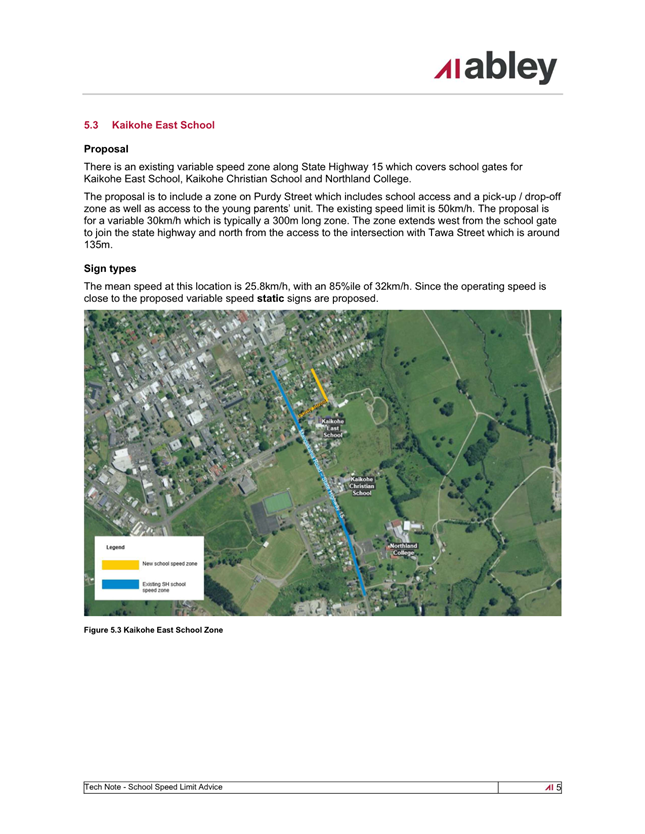
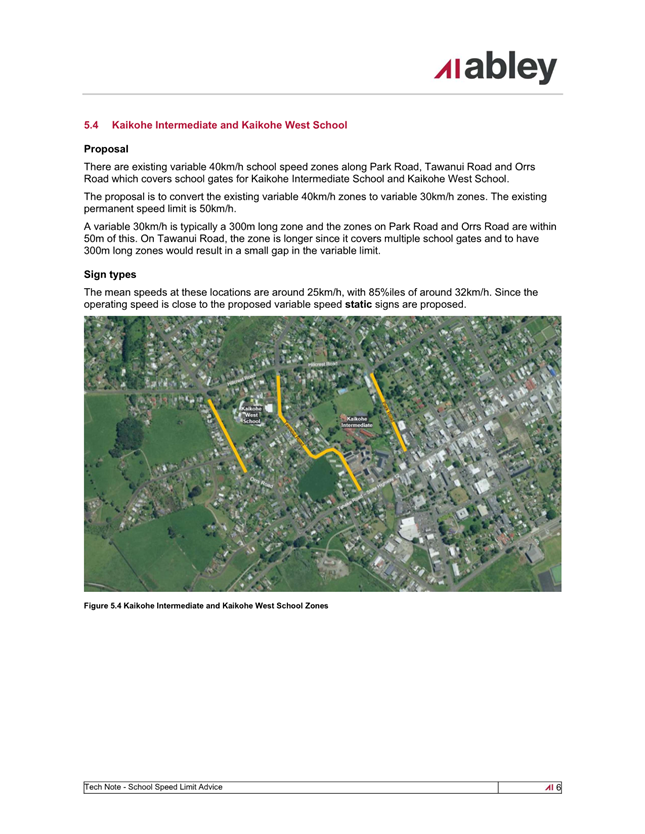
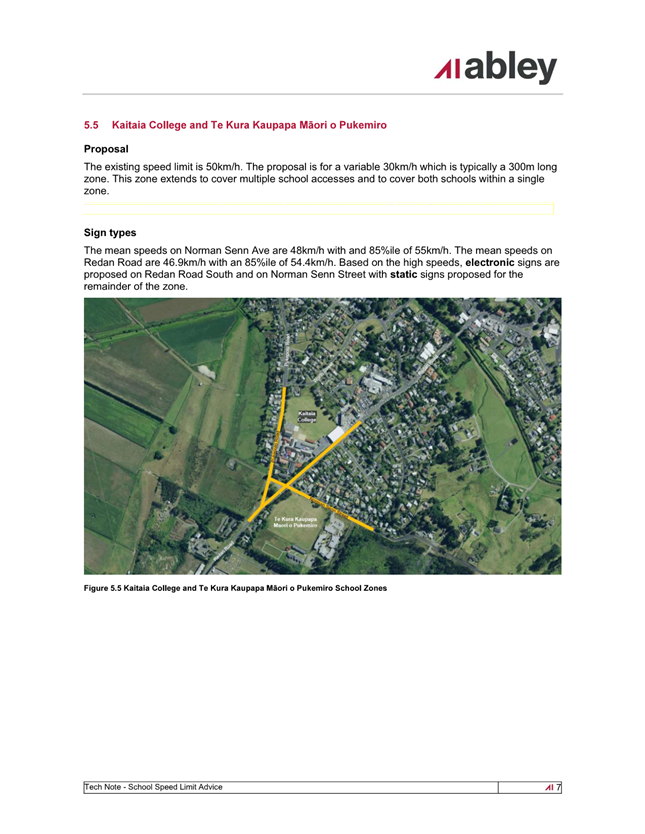
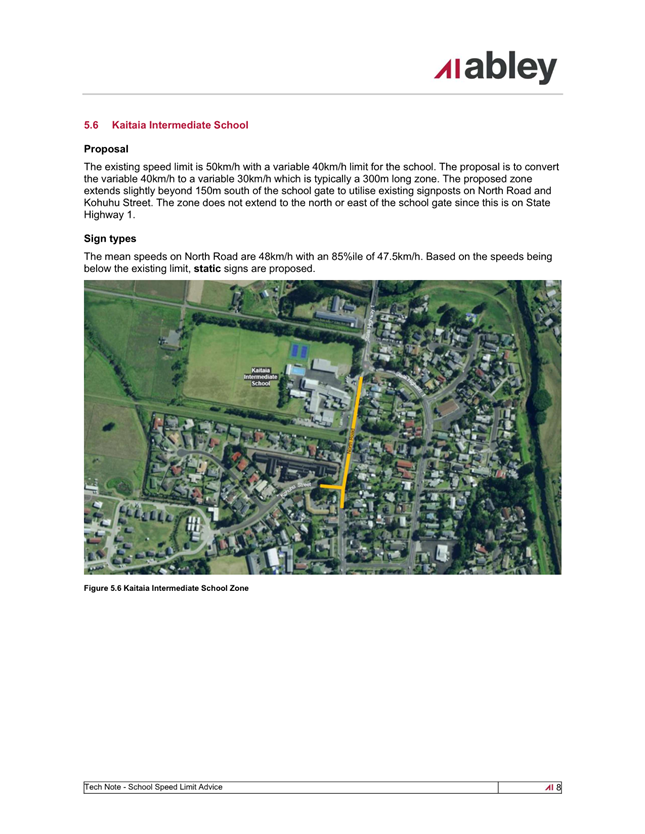
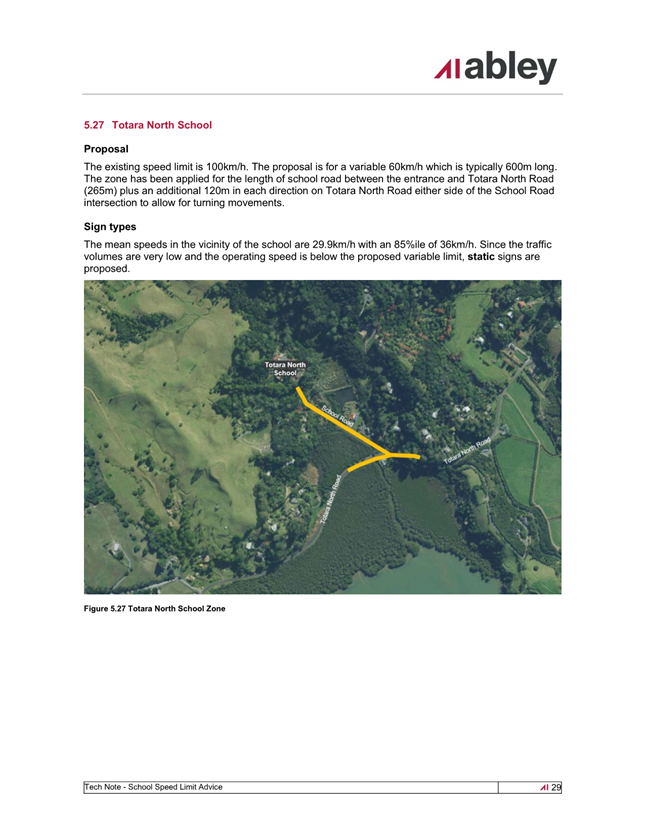
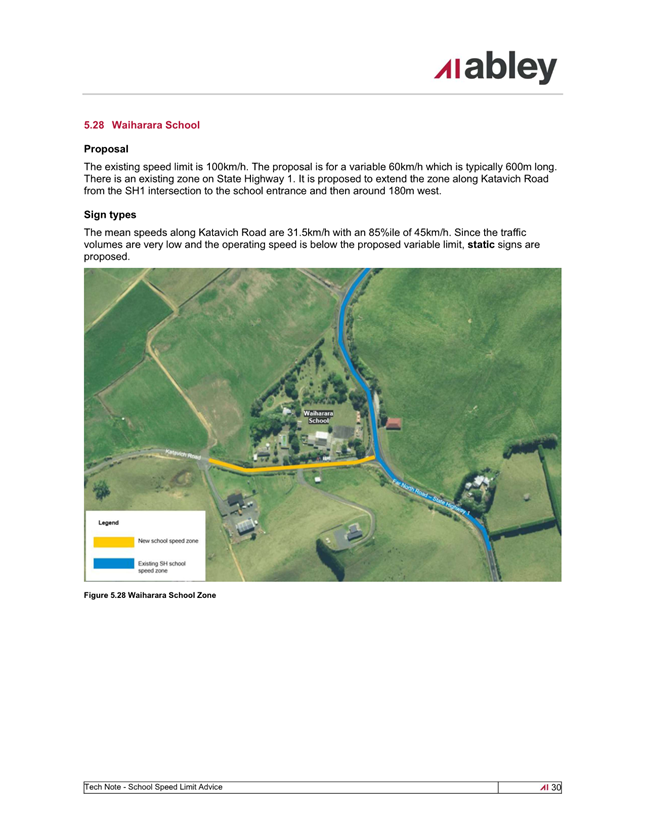
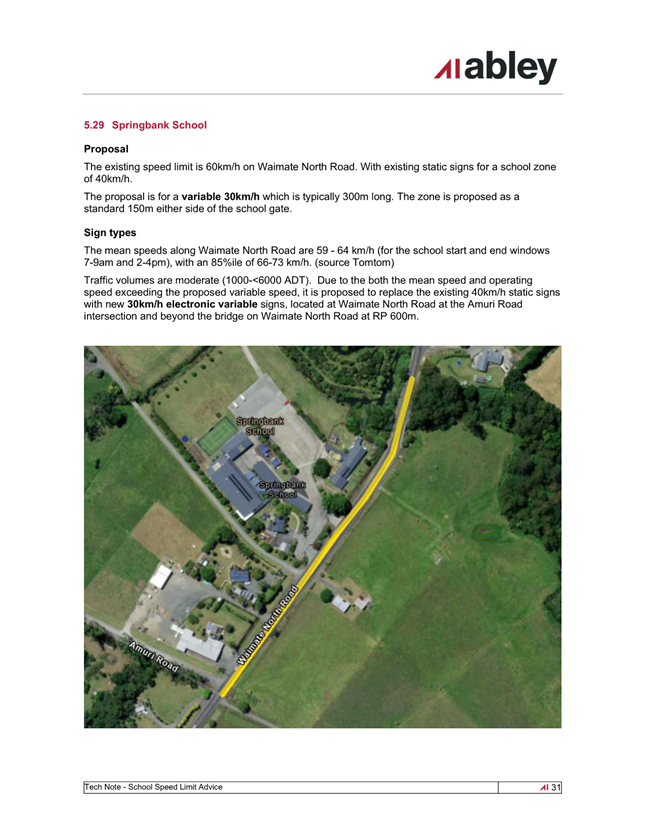
A list of the proposed speed limit changes is included as an
attachment to this report together with our consultant’s report
describing the signage and zones.
Subject to Council approval at this meeting, the project is
on track for completion by 1 July 2026 as required.
TAKE TŪTOHUNGA
/ REASON FOR THE RECOMMENDATION
The recommended speed limit changes are required to ensure
compliance with the Land Transport Rule – Setting of Speed Limits 2024,
which mandates variable speed limits at all schools by 31 July 2026.
The proposal reflects technical assessments, consultation
with affected schools, and alignment with national road safety strategies.
Funding has been secured from NZTA/Waka Kotahi, and the implementation plan is
achievable within the required timeframe. Delegating authority to the Chief
Executive Officer to accept minor amendments from the Director of Land
Transport will ensure the process remains efficient and responsive to
regulatory requirements.
3) PĀnga PŪtea me ngĀ
wĀhanga tahua / Financial Implications and Budgetary Provision
There are no financial implications. Local share funding is
drawn from Low Cost, Low Risk budgets already approved by Council, or otherwise
funded by NZTA Waka Kotahi.
The total budget for the work is $870,961, of which 71% is
funded by NZTA Waka Kotahi. FNDC’s 29% share of the budget ($252,579)
is provided for within Council’s current financial year budgets,
funded through the Roading Differential Rate (10% or $25,258) and the General
Rate (90% or $227,321).
Āpitihanga / Attachments
1. FNDC
2025/26 Speed Limits Table - A5484687 ⇩ 
2. Tech
Note - Far North School Speed Limit Advice 2025 - A5606602 ⇩
Hōtaka Take Ōkawa / Compliance Schedule:
Full consideration has been given to the provisions of the
Local Government Act 2002 S77 in relation to decision making, in particular:
1. A
Local authority must, in the course of the decision-making process,
a) Seek
to identify all reasonably practicable options for the achievement of the
objective of a decision; and
b) Assess
the options in terms of their advantages and disadvantages; and
c) If
any of the options identified under paragraph (a) involves a significant
decision in relation to land or a body of water, take into account the
relationship of Māori and their culture and traditions with their
ancestral land, water sites, waahi tapu, valued flora and fauna and other
taonga.
2. This
section is subject to Section 79 - Compliance with procedures in relation to
decisions.
|
He Take Ōkawa /
Compliance Requirement
|
Aromatawai Kaimahi /
Staff Assessment
|
|
State the level of significance (high or low) of the
issue or proposal as determined by the Council’s
Significance and Engagement Policy
|
The
issue/proposal has been assessed as having a low level of significance in
accordance with the Council’s Significance and Engagement Policy, as it
implements a regulatory requirement, affects specific school zones, and does
not materially impact Council’s strategic direction, assets, or
budgets.
|
|
State the relevant Council policies (external or
internal), legislation, and/or community outcomes (as stated in the LTP) that
relate to this decision.
|
Land
Transport Rule: Setting of Speed Limits 2024
Local
Government Act 2002
National
Land Transport Programme (NLTP)
Regional
Land Transport Plan (RLTP)
|
|
State whether this issue or proposal has a District wide
relevance and, if not, the ways in which the appropriate Community
Board’s views have been sought.
|
This
issue/proposal has district-wide relevance. As the changes are required by
national regulation, decision-making authority rests with Council as Road
Controlling Authority. Community Boards are not required to make decisions on
this matter.
|
|
State the
possible implications for Māori and how Māori have been provided
with an opportunity to contribute to decision making if this decision is
significant and relates to land and/or any body of water.
State the
possible implications and how this report aligns with Te Tiriti o Waitangi /
The Treaty of Waitangi.
|
The
proposed changes do not directly relate to land or any body of water, but
there are implications for Māori, particularly in relation to the safety
and wellbeing of tamariki and whānau in school communities. As this is a
regulatory change, Council has consulted with affected schools, which include
Māori students and staff, to ensure their views and needs are
considered.
|
|
Identify persons likely to be affected by or have an
interest in the matter, and how you have given consideration to their views
or preferences (for example – youth, the aged and those with
disabilities).
|
Students,
parents, caregivers, and whānau, school staff, residents.
|
|
State the financial implications and where budgetary
provisions have been made to support this decision.
|
Funding
for this project of $870,961 has been approved by Waka Kotahi NZTA at
Council’s normal Funding Assistance Rate of 71%.
|
|
Chief Financial Officer review.
|
This
report has not been reviewed by the CFO as funding has already been approved.
|
|
Ordinary Council Meeting Agenda
|
5 March 2026
|
7.3 Greenhouse
Gas Emissions Reduction Options
File
Number: A5595398
Author: Aya
Morris, Net Zero & Sustainability Programme Lead
Authoriser: Ken
Macdonald, Chief Financial Officer
Take Pūrongo / Purpose of the Report
To seek endorsement for the adoption of science-aligned
corporate emissions reduction targets to support progress toward net zero
corporate greenhouse gas (GHG) emissions for Far North District Council (FNDC
or council) and to recommend the allocation of resources toward corporate
emissions reduction actions through the Long-Term Plan (LTP).
WhakarĀpopoto matua / Executive Summary
· Council has made commitments through the Climate Action Policy,
Climate Change Roadmap and Far North 2100 strategy to reduce corporate
greenhouse gas emissions in line with the government’s national emissions
reduction targets, achieving net zero emissions by 2050.
· Adopting science-aligned emissions reduction targets for corporate
emissions will qualify council to apply for Climate Action Loans and emissions
measurement subsidies through the Local Government Funding Agency.
· If emissions reduction work is not adequately resourced,
council’s existing climate action goals cannot be met, and council will
be vulnerable to strategic and operational risks which may lead to
reputational, financial, legal and compliance impacts.
· Council must decide whether to develop an emissions reduction plan
with science-aligned targets and resource emissions reduction actions toward
net zero.
· If work toward net zero emissions by 2050 is to be discontinued, a
review will be required for the Climate Action Policy, Climate Change Roadmap
and Far North 2100 strategy.
· It is recommended that council consult the public on emissions
reduction targets and resourcing through the Long-Term Plan process.
· This report has previously been presented to Te Kūkupa
Committee[i]
and the committee has recommended the discontinuation of corporate emissions
reduction, an option which is inconsistent with council plans and policies and
is not supported by staff advice. Te Kūkupa Committee recommendation is as follows:
That Te Kūkupa Committee for Strategy, Policy
and Regulation recommend to Council:
1. Option 3 - emissions
reduction is discontinued & investigate redirecting funding towards
adaptation.
2. a rates reduction
policy for areas of indigenous biodiversity that are carbon sinks- such as
indigenous bush and wetlands be created for inclusion in the long-term plan;
and
3. that FNDC investigate
the investment in solar infrastructure for our offices and other buildings to
enable sustainable power generation and also overall cost savings, as part of
this long-term plan.
|
tŪtohunga
/ Recommendation
That Council:
a) Endorse
Option 1, the adoption of science-aligned emissions reduction targets to
support progress toward the net zero target for FNDC, and
b) Recommend
the inclusion of resources and funding for emissions reduction actions within
the Long-Term Plan for public consultation.
|
1) TĀhuhu kŌrero / Background
In 2020, Council adopted a Climate Change Roadmap with two
climate change mitigation goals:[1]
1. to
reduce its own greenhouse gas emissions in line with the government’s
national emission reduction targets or better (“walking the talk”),
and
2. to
promote and advise the businesses and communities of the Far North towards
Carbon Zero 2050 (“reducing our carbon emissions together”).
In response to the Paris Agreement, the Climate Change
Response (Zero Carbon) Amendment Act 2019 set GHG emissions reduction targets
for New Zealand: [2]
To reduce emissions of
greenhouse gases (except biogenic methane) to net zero by 2050 and to reduce
emissions of biogenic methane to 14-24 percent below 2017 levels by 2050,
including to 10 per cent below 2017 levels by 2030.
These targets are not mandatory for local government, and
councils are not required to measure emissions. However, under the Resource
Management Act 1991 (RMA) local government is required to consider the effects
of a changing climate on communities. The Local Government Act 2002 (LGA)
requires councils to integrate climate adaptation and mitigation into strategic
planning processes and financial reporting, to ensure the resilience of
infrastructure, and to consider community wellbeing.
Council’s Climate Change Roadmap gives effect to these
requirements. The roadmap was informed by extensive community engagement during
development of the Far North 2100 strategy, adopted by Council in November
2021.[3]
However, neither the 2021-2031 LTP nor the 2024-2027 LTP allocated sufficient
resourcing to support an emissions reduction trajectory toward the achievement
of net zero greenhouse gas emissions by 2050.
The Climate Action Policy, endorsed by Council in 2023,[4] states that council
will measure and reduce emissions, aligning targets with the national Emissions
Reduction Plan (ERP).[5]
Section 8 within the policy sets out actions to progress
toward net zero emissions by 2050, including:
1. development
of an operational emissions reduction plan to reduce corporate emissions,
2. annual
corporate greenhouse gas emissions inventories,
3. sustainable
procurement practices,
4. development
of a regional emissions inventory,
5. preparation
of a district-wide community emissions reduction plan, and
6. monitoring
and reporting on a regional emissions reduction plan.
Historical support for Far North climate action goals
In 2015, Mayors and Chairs of New Zealand declared an urgent
need for responsive leadership and a holistic approach to climate change. [6] FNDC formally
endorsed the Local Government Leaders’ Climate Change Declaration in
2017.[7]
Community advocacy for climate action continued to grow over
subsequent years. In June 2019, a deputation from the Kaitaia College Climate
Action Group, a group which included members of council’s Far North Youth
Council, presented a deputation to call for the declaration of a climate
emergency for the Far North,[8]
which was published on Youtube,[9]
and subsequently reported in the Northland Age.[10] Two Far North Youth
Councillors, including one of the students involved in this deputation, were
later involved in the successful declaration of a climate emergency at the July
2019 Youth Parliament.[11]
Later in 2019, a further deputation was presented by Far North Sea Change to
support the call to declare a climate emergency.[12]
Climate action accelerated across the Northland region as
legislative support for climate action was strengthened, with Whangarei
District Council declaring a climate change emergency in 2019.[13] Far North District joined a
joint climate change adaptation committee and an intercouncil group known as
Climate Adaptation Te Taitokerau,[14]
and adopted a Climate Change Roadmap by a majority vote of nine to one.[15]
Community support for the Climate Change Roadmap was evident
during community engagement carried out during the development of Far North
2100. Community support for climate action was further demonstrated during the
consultation process for the proposed district plan, held during 2022 and 2023,
which attracted over 250 submissions which mentioned climate.[16]
In March 2023, another community deputation in support of
climate action was presented.[17]
In December 2023, FNDC became the first local authority in
Northland to endorse a climate action policy,[18]
resolving to endorse the policy and support its early socialisation with
iwi/hapu/whanau.
More recently, in September 2025, a
collaborative hapū-led deputation to Te Kuaka – Te Ao Māori
Committee presented the Oromahoe Waitangi Kāinga Climate Adaptation Plan,[19]
which included a focus on climate mitigation goals as well as adaptation goals.
February 2026 Te Kūkupa
Committee recommendation
On 18 February 2026 Te Kūkupa
Committee recommended discontinuing corporate emissions reduction work and
investigating the redirection of funding toward climate adaptation. The
recommendation also includes exploring a rates reduction policy for areas of
indigenous biodiversity that act as carbon sinks, such as indigenous vegetation
and wetlands, for potential inclusion in the Long-Term Plan, and investigating
investment in solar infrastructure for council offices and other buildings to
support sustainable power generation and long‑term cost savings. This
community and corporate emissions reduction work is supported by staff.
GHG emissions data –
what have we learned so far?
Council has completed two
corporate GHG emissions inventories, which have provided data to inform
emissions reduction planning and contribute toward climate change mitigation
action. A third inventory is in progress, and a fourth planned to measure emissions
from the current financial year.
Emissions are categorised as Scope
1, direct emissions from fuel, fertilisers, refrigerant gases, waste,
and wastewater, where emissions sources are owned or controlled by council;
Scope 2, indirect emissions from purchased electricity; and Scope 3, indirect
emissions from goods and services.
For FY2022-23, the base year for
emissions reduction measurement, corporate emissions for FNDC were recorded as
26,435 metric tonnes of carbon dioxide equivalent (tCO2e).
For FY2023-24, total corporate
emissions were recorded as 30,787 tCO2e. This represents an increase of 4,352
tCO2e from the base year.
An increase in emissions across
the first two years of measurement was caused by increased spending on
infrastructure, due to repairs for infrastructure damaged by major storm events
in 2023.
These completed emissions
inventories have been verified by Toitū Envirocare – Enviromark
Solutions Ltd (Toitū), a subsidiary of Manaaki Whenua Landcare Research
within the Bioeconomy Science Institute.
As a certified Toitū Carbon
Reduce organisation, council must adopt emissions reduction targets before the
third emissions inventory is audited in April 2026. The existing net zero
emissions target for 2050 is not sufficient to meet Toitū’s carbon
reduction target requirements, and Council must adopt intermediate targets for
the short term and medium term.
2) matapaki me NgĀ KŌwhiringa /
Discussion and Options
Completed corporate emissions
inventories show that the most significant emissions sources for council are
from capital works, particularly for the roading network, and from wastewater
and sewerage services.
As shown in Figures 1 and 2,
below, these three sources combined represent over 50% of the total corporate
emissions for the council, offering the greatest potential for emissions
reduction. To meet the net zero target, emissions from these sources must be
reduced.
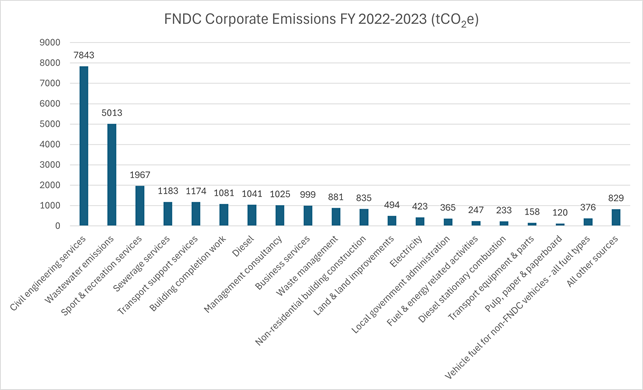
Figure 1. FNDC Corporate
Greenhouse Gas Emissions FY22-23
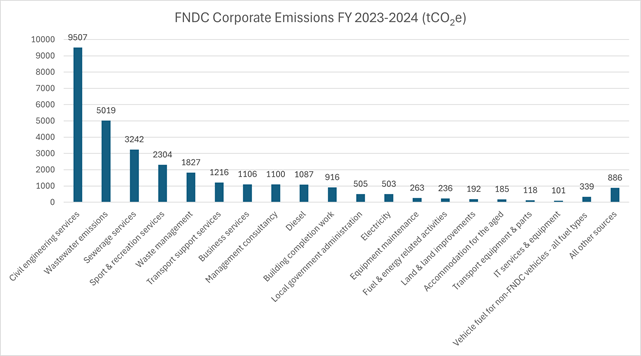
Figure 2. FNDC Corporate
Greenhouse Gas Emissions FY23-24
Wastewater emissions fall within
the biogenic methane category. A 10% methane emissions reduction is required by
2030, if FNDC aligns with the government’s second national emissions
reduction plan (ERP2). The transfer of waters assets to the new
Northland Waters council-controlled organisation (CCO) will not remove the
emissions generated by these assets from council’s emissions footprint.
The emissions will be transferred from scope 1 (direct emissions) to scope 3
(indirect emissions).
The most effective way to reduce
indirect emissions from contractors or CCOs providing goods and services for
FNDC, is through emissions reduction targets for contractors and CCOs.
Sustainable procurement practices could introduce mandatory emissions reduction
targets for contractors. It will be essential for emissions reduction targets
to be implemented for the Northland Waters CCO if the 2030 biogenic methane
target is to be met.
What are
the benefits of measuring and reducing corporate emissions?
Reduction of emissions by council
contributes toward national and international emissions reduction efforts which
aim to mitigate the severity of climate change. The communities of the Far
North have shown support for council’s climate action goals through the
Far North 2100 engagement process and through LTP consultation on climate
action spending.
Council has previously resolved to accelerate the community
adaptation programme, Te Hōtaka Urutau Hapori.[20] Actions
to support emissions reduction can also support climate adaptation. An
emissions reduction plan for FNDC was produced by WSP in 2022.[21] The WSP recommendations focused
on several major emissions sources: waters services, waste management,
buildings, vehicle fleet, and staff commute.
The largest share of emissions reductions in the WSP plan
related to waters infrastructure. Climate adaptation is urgently needed for Far
North waters infrastructure, which is vulnerable to projected increases in
flooding, coastal inundation and sea level rise, and associated groundwater
changes, as well as weather events.
Emissions reduction reduces
council’s exposure to organisational risks. Council has formally
recognised climate resilience as an organisational risk and included it on the
Strategic Risk Register. Given the broad impacts associated with climate change,
it is important for council to actively mitigate this risk. Failure to progress
climate resilience could expose council to increased reputational, financial,
legal and compliance impacts. In addition, council has identified a separate
transition‑to‑net‑zero risk on the Operational Risk Register.
Continued progress toward emissions reduction is essential to managing both
organisational and reputational consequences, reinforcing that climate change
remains a significant and high‑priority issue for council.
Climate Action Loans
Local government organisations
working to reduce their corporate emissions become eligible for Climate Action
Loans through the Local Government Funding Agency (LGFA).[22] These are
low-interest loans that are not tied to specific projects and may be used to
refinance existing debt, reducing interest costs. The new Northland Waters CCO
will also be eligible to apply for Climate Action Loans if LGFA criteria are
met.
To qualify for Climate Action
Loans, councils and CCOs must comprehensively measure emissions, have annual
emissions inventories verified for assurance purposes, and approve emissions
reduction plans with science-aligned emission reduction targets. Once a
science-aligned emissions reduction plan is in place, councils and CCOs become
eligible for LGFA subsidies toward the annual costs of emissions inventory
compilation and verification.
Climate Action Loans are intended
to expedite climate action spending. Earlier climate action is recommended, as
the costs of climate adaptation are projected to increase exponentially with
each year of delay before action is taken. Typically, emissions reduction
delivers ongoing cost savings, as initial investments in energy efficiency and
fuel efficiency deliver lower fuel costs and electricity costs for the
organisation in the longer term. These avoided costs can assist to repay the
loans in future.
Are
science-aligned corporate emissions reduction targets feasible for FNDC?
Science-aligned emissions reduction targets are based on the
international climate change research which informed the Paris Agreement and
seek to reduce emissions sufficiently to limit global warming to
1.5°C-2°C, a more ambitious aspiration than that set out in the
government’s national ERP2. Guidance on science-based targets is provided
by the Science-Based Targets Initiative (SBTi), [23]
and this guidance informs LGFA and Toitū practice. The achievement of
science-aligned emissions reduction targets will require emissions reduction
action to be resourced swiftly by contractors and CCOs as well as by council.
As climate change progresses, council will face growing
costs associated with recovery from increasingly frequent severe weather
events, such as the recent January 2026 storm, the 2022 and 2023 storm events,
and the 2020 and 2021 droughts. Initial emissions inventories have shown that
infrastructure repairs add to council’s emissions footprint. Therefore,
increased frequency of severe weather events may impact progress in emissions
reduction.
Affordability is a key factor in emissions reduction.
Council has not yet resourced implementation for the 2022 WSP recommendations.
Capital works for waters infrastructure, particularly wastewater treatment
infrastructure, formed the most significant share of the projected costs to
implement these recommendations.
Climate Action Loans might offer an opportunity to
prioritise earlier capital expenditure toward emissions reduction through the
next Long-Term Plan. Earlier action could reduce the impact of steeply
increasing costs for infrastructure construction. If all actions recommended by
WSP are resourced by 2030, council will be better placed to progress the
proposed 2030 target.
The single area of council operations with greatest
potential for corporate emissions reduction is waters services. The timeline
for the transfer of council’s waters assets to the new Northland Waters
CCO, and the potential delays in emissions reduction actions relating to these
assets in the interim, may make it unlikely that significant emissions
reductions for wastewater can be delivered by 2030.
Sustainable procurement practices to introduce emissions
reduction requirements for contractors will become possible as new contracts
are agreed. However, some current contracts span up to ten years, which may mean delays of several years before new
requirements can be introduced. These timelines reduce the likelihood that
council can achieve intermediate emissions reduction targets by 2030.
To achieve the longer-term goal of net zero emissions by
2050, council will likely be required to offset emissions. Emissions offsetting
through permanent forestry on council-owned lands may assist toward emissions
reduction, but this pathway alone cannot achieve the net zero emissions target
by 2050 without substantial land acquisition. The purchase of carbon credits
will be required alongside emissions reduction investment if the net zero
emissions target is to be achieved.
Corporate
emissions reduction options
In accord with the council’s current Climate Action
Policy and Climate Change Roadmap, continued work to measure and reduce
corporate emissions is recommended. However, if an emissions reduction plan is
to be adopted, council must allocate sufficient budget to resource the actions
within the plan. Therefore, a decision is required regarding the level of
emissions reductions council will seek to achieve.
Option 1 - Recommended
Option 1, the recommended option, is that the committee
endorses a series of science-aligned corporate emissions reduction targets
which meet minimum LGFA requirements and will qualify council for Climate
Action Loans and emissions accounting subsidies.
Table 1 proposes science-aligned corporate emissions
reduction targets for 2030, 2035 and 2050.
|
FY2022-23
emissions (base year)
|
2030
target
|
2035
target
|
2050
target
|
|
26,435 tCO2e
|
15,333 tCO2e
|
7,137 tCO2e
|
0 tCO2e
|
Table 1. Science-aligned corporate
emissions reduction targets for Far North District Council
These science-aligned targets will require corporate
emissions reductions of approximately 11,000 tCO2e by 2030, a
further 8,000 tCO2e by 2035, and a final reduction of 7,137 tCO2e
to achieve net zero emissions by 2050. The 2030 target must include 10%
reduction in biogenic methane.
There will be significant costs to achieve the 2030 target,
with additional costs to achieve further targets. If Option 1 is endorsed, it
includes an expectation that council, and council’s contractors and CCOs,
will resource timely emissions reduction actions. The inclusion of projected
costs in the next Long Term Plan consultation process will enable the council
to assess the community’s appetite to progress the work programme.
Option 2
Option 2, which is not recommended, is that the committee
endorses a series of moderate corporate emissions reduction targets, which are
not designed to achieve the existing net zero emissions target by 2050, and
will not qualify council to access Climate Action Loans or emissions accounting
subsidies through LGFA. This option requires a review
of council’s Climate Action Policy, Climate Change Roadmap and Far North
2100 strategy, to remove the references to climate change mitigation.
Table 2 proposes moderate corporate emissions reduction
targets for 2030, 2035 and 2050.
|
FY2022-23 emissions (base year)
|
2030 target
|
2035 target
|
2050 target
|
|
26,435
tCO2e
|
22,435
tCO2e
|
18,435
tCO2e
|
12,435
tCO2e
|
Table 2.
Moderate corporate emissions reduction targets for Far North District
Council
These moderate targets will require emissions reductions of
approximately 4,000 tCO2e by 2030, a
further 4,000 tCO2e by 2035, and a further reduction of 6,000 tCO2e
by 2050.
The cost to achieve these more moderate targets will be less
than Option 1, and spending will be allocated across a longer timeline. This
option relies mostly on reductions in scope 1 and 2 corporate emissions
sources, which council has the greatest control over, and which have potential
to reduce costs alongside reducing emissions. If Option 2 is endorsed, council
might adopt a simpler corporate emissions inventory format, measuring and
reducing emissions from only scope 1 and scope 2 sources, while also requiring
major contractors and CCOs to measure and reduce emissions.
Option 3
Option 3, which is not
recommended, is to discontinue work toward corporate emissions reduction. This
option has previously been endorsed by the Te Kūkupa Committee. However,
it will not achieve the council’s net zero emissions target for 2050 and
would require a review of the Climate Action Policy, Climate Change Roadmap,
and Far North 2100 Strategy to remove references to climate change mitigation.
This option does not assist in mitigating climate resilience risk for council.
If Option 3 is adopted, resources currently allocated to emissions measurement
could be redirected to other priorities, such as the previously approved
acceleration of the climate adaptation work programme.
TAKE TŪTOHUNGA
/ REASON FOR THE RECOMMENDATION
The recommended option for corporate emissions reduction is
Option 1, which delivers against the goals in council’s Climate Action
Policy and Climate Change Roadmap, and the Far North 2100 strategy. This option
will also qualify council for Climate Action Loans and emissions accounting
subsidies, which may be used to resource emissions reduction and climate
adaptation work.
If Option 1 is not adopted and resourced, council cannot
deliver on the strategic goals set out in Far North 2100, and a review for this
strategy, as well as the Climate Change Roadmap and Climate Action Policy, will
be required. This option leaves council exposed to strategic and operational
risks, which may lead to reputational, financial, legal and compliance impacts.
If council progresses science-based corporate emissions reduction planning,
costs can be included into the long-term planning process and undergo public
consultation to identify whether resourcing toward the net zero target is
supported.
Option 2 has been proposed so that Council can consider
whether it is feasible for council to resource the level of corporate emissions
reduction necessary to achieve the existing net zero emissions target by 2050,
or whether a transition toward a more
moderate corporate emissions reduction pathway is preferred.
Option 3 has been proposed so that Council can consider
whether council should entirely withdraw from the existing 2050 net zero target
and cease work toward corporate emissions reduction, redirecting resources
toward the acceleration of the climate adaptation programme.
3) PĀnga PŪtea me ngĀ
wĀhanga tahua / Financial Implications and Budgetary Provision
Detailed costings for these alternative corporate emissions
reduction targets have not been prepared, as the purpose of this paper is to
seek the committee’s endorsement for the proposed corporate emissions
reduction targets before a detailed emissions reduction plan is developed.
The previous LTP has not budgeted for the implementation of
the WSP recommendations, which are recommended as actions through both Option 1
and Option 2.
There are significant costs to implement the 2022 WSP
recommendations, which are included in Option 1 to be delivered before 2030. If
this option is to be adopted, the required costings must be prepared for
inclusion in the LTP consultation process. Note that the greatest share of
these costs will be for upgrades to waters infrastructure, which in future will
be managed by the new Northland Waters entity.
Option 2 proposes extending the timeline for the
implementation of the WSP recommendations out until 2035, spreading expenditure
across a longer timeframe. If this option is to be adopted, the required
costings must be prepared for inclusion in the LTP consultation process.
Option 3 offers cost reallocation opportunities as the
budget allocated toward corporate emissions measurement might be repurposed
toward the acceleration of the climate adaptation programme. However, Option 3
does not offer proposed cost savings through energy efficiency.
Āpitihanga
/ Attachments
Nil
Hōtaka Take Ōkawa / Compliance Schedule:
Full consideration has been given to the provisions of the
Local Government Act 2002 S77 in relation to decision making, in particular:
1. A
Local authority must, in the course of the decision-making process,
a) Seek
to identify all reasonably practicable options for the achievement of the
objective of a decision; and
b) Assess
the options in terms of their advantages and disadvantages; and
c) If
any of the options identified under paragraph (a) involves a significant
decision in relation to land or a body of water, take into account the
relationship of Māori and their culture and traditions with their
ancestral land, water sites, waahi tapu, valued flora and fauna and other
taonga.
2. This
section is subject to Section 79 - Compliance with procedures in relation to
decisions.
|
He Take Ōkawa /
Compliance Requirement
|
Aromatawai Kaimahi /
Staff Assessment
|
|
State the level of significance (high or low) of the
issue or proposal as determined by the Council’s
Significance and Engagement Policy
|
The proposal has a high level
of significance, as Option 1, the recommended option, has unbudgeted
financial impacts. Option 2 is inconsistent with Council plans and policies
and has unbudgeted financial impacts. Option 3 is inconsistent with Council
plans and policies but has no unbudgeted financial impacts. It is recommended
to consult communities through the next LTP process.
|
|
State the relevant Council policies (external or
internal), legislation, and/or community outcomes (as stated in the LTP) that
relate to this decision.
|
Climate Action Policy (2023)
Climate Change Roadmap (2020)
Far North 2100 Strategy (2021)
Climate Change Response (Zero
Carbon) Amendment Act (2019)
Local Government Act (2002)
Resource Management Act (1991)
|
|
State whether this issue or proposal has a District wide
relevance and, if not, the ways in which the appropriate Community
Board’s views have been sought.
|
The report has district-wide
relevance.
|
|
State the
possible implications for Māori and how Māori have been provided
with an opportunity to contribute to decision making if this decision is
significant and relates to land and/or any body of water.
State the
possible implications and how this report aligns with Te Tiriti o Waitangi /
The Treaty of Waitangi.
|
Climate change mitigation has
implications for Māori as lands and waterways, as well as indigenous
biodiversity, are vulnerable to climate change impacts.
District-wide Māori
community engagement was carried out around Far North 2100 strategy which
informed the development of the Climate Action Policy and Climate Change
Roadmap.
|
|
Identify persons likely to be affected by or have an
interest in the matter, and how you have given consideration to their views
or preferences (for example – youth, the aged and those with
disabilities).
|
All the groups named are
affected by climate change, alongside the general population.
|
|
State the financial implications and where budgetary
provisions have been made to support this decision.
|
This has been covered in
Section 3.
|
|
Chief Financial Officer review.
|
The CFO has reviewed this report.
|