AGENDA
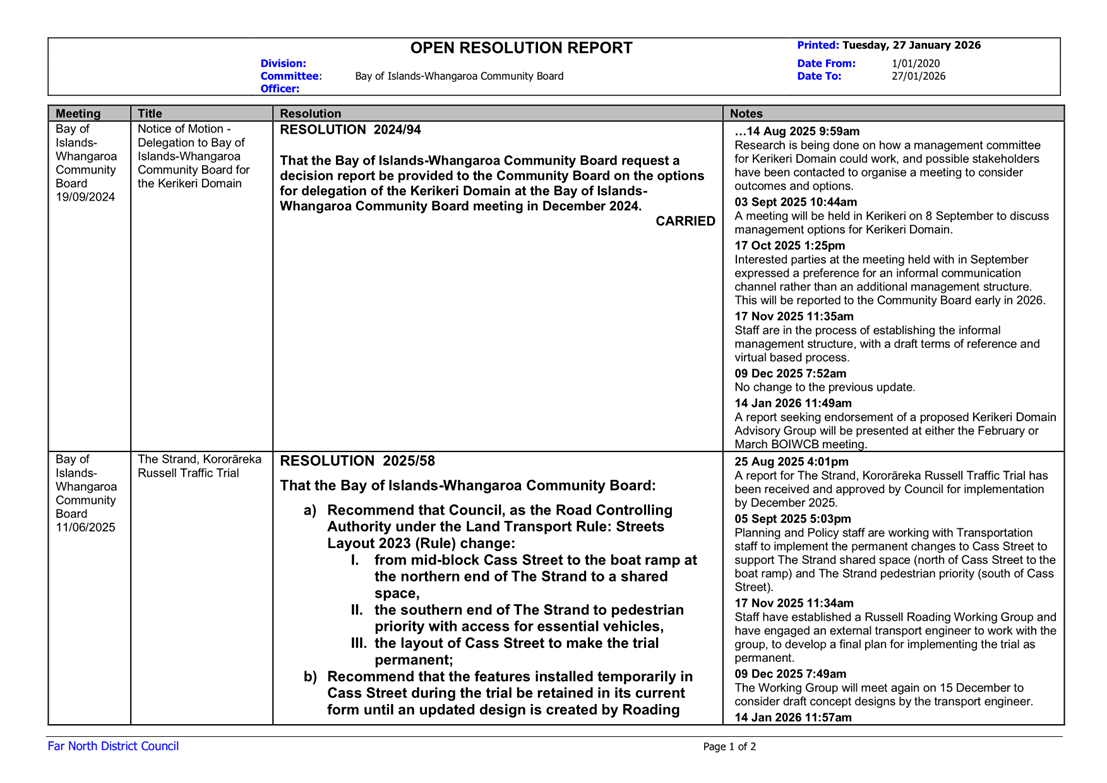
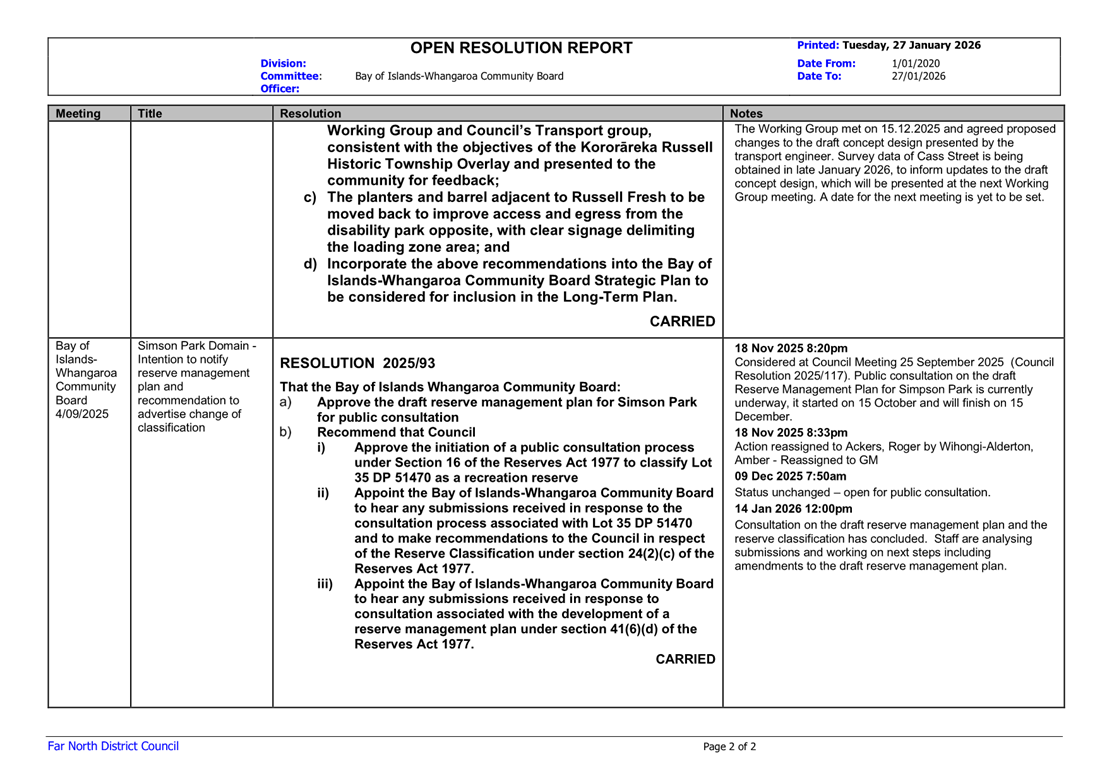
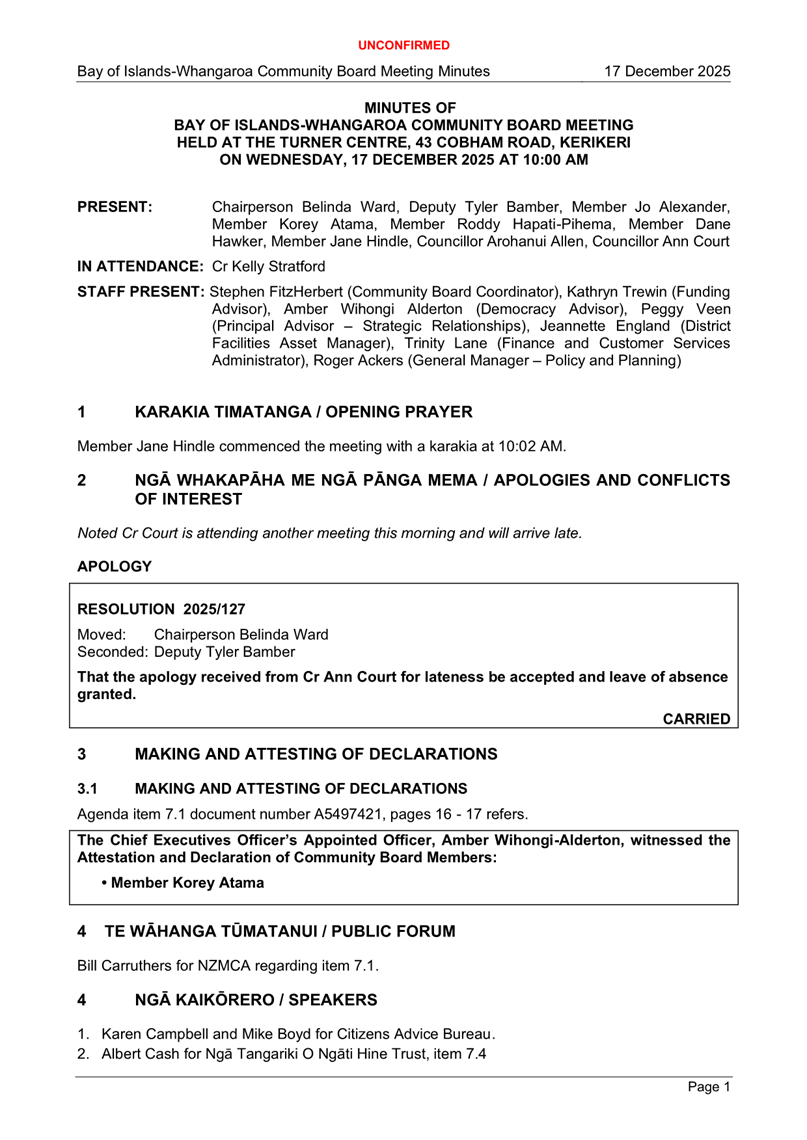
Thursday, 12 February 2026
|
Time:
|
10:00 am
|
|
Location:
|
Turner Centre
43 Cobham Road
Kerikeri
|
Membership:
Chairperson Belinda Ward -
Chairperson
Deputy Tyler Bamber
Member Jo Alexander
Member Korey Atama
Member Roddy Hapati-Pihema
Member Dane Hawker
Member Jane Hindle
Councillor Arohanui Allen
Councillor Ann Court
|
Bay of Islands-Whangaroa Community Board Meeting Agenda
|
12 February 2026
|
The Local Government Act 2002 states the role of a
Community Board is to:
A.
Represent, and act as an advocate for,
the interests of its community.
B.
Consider and report on all matters
referred to it by the territorial authority, or any matter of interest or
concern to the community board.
C.
Maintain an overview of services
provided by the territorial authority within the community.
D.
Prepare an annual submission to the
territorial authority for expenditure within the community.
E.
Communicate with community
organisations and special interest groups within the community.
F.
Undertake any other responsibilities
that are delegated to it by the territorial authority
Council Delegations to Community Boards - January
2013
The "civic amenities" referred to in these
delegations include the following Council activities:
·
Amenity lighting
·
Cemeteries
·
Drainage (does not include reticulated
stormwater systems)
·
Footpaths/cycle ways and walkways
·
Public toilets
·
Reserves
·
Halls
·
Swimming pools
·
Town litter
·
Town beautification and maintenance
·
Street furniture including public
information signage
·
Street/public Art
·
Trees on Council land
·
Off road public car parks
·
Lindvart Park – a
Kaikohe-Hokianga Community Board civic amenity
Exclusions: From
time to time Council may consider some activities and assets as having district
wide significance and these will remain the responsibility of Council. These
currently include: The roading network, Hundertwasser toilets, District Library
Network, Baysport, the Kerikeri, Kaikohe & Kaitaia Airports, Hokianga
Vehicle Ferry, i-Site network, Far North Community Centre, Kerikeri Domain,
Kawakawa Heated Swimming Pool, Kaikohe Cemetery, Kerikeri Sports Complex, The
Centre at Kerikeri, the Bay of Islands/Hokianga Cycle Trail.
Set local priorities for minor capital works in accordance
with existing strategies,
1.
Recommend local service levels and
asset development priorities for civic amenities as part of the Annual Plan and
Long Term Plan processes.
2.
Reallocate capital budgets within the
Annual Plan of up to 5% for any specific civic amenity, provided that the
overall activity budgetary targets are met.
3.
Make grants from the allocated
Community Funds in accordance with policy 3209, and the SPARC/Sport Northland
Rural Travel fund in accordance with the criteria set by the respective body,
and, for the Bay of Islands-Whangaroa Community Board, the power to allocate
the Hundertwasser Donations Account.
4.
Provide comment to council staff on
resource consent applications having significance within the Community,
including the provision of land for reserves or other public purposes.
5.
To hold, or participate in hearings, as
the Council considers appropriate, in relation to submissions pertinent to
their community made to plans and strategies including the Long Term Plan and
Annual Plan, and if appropriate recommend decisions to the Council.
6.
To hold hearings of submissions
received as a result of Special Consultative Procedures carried out in respect
of any matter other than an Annual or Long Term Plan and make recommendations
to the Council.
7.
Where recommended by staff to appoint
management committees for local reserves, cemeteries, halls, and community
centres.
8.
To allocate names for previously
unnamed local roads, reserves and other community facilities, and recommend to
Council name changes of previously named roads, reserves, and community
facilities subject to consultation with the community.
9.
To consider the provisions of new and
reviewed reserve management plans for recommendation to the Council in
accordance with the Reserves Act 1977 and hear or participate in the hearing of
submissions thereto, as considered appropriate by the Council.
10.
To provide recommendations to the
Council in respect of applications for the use and/or lease of reserves not
contemplated by an existing reserve management plan.
11.
Prohibit the use of skateboards in
specified locations within their communities, in accordance with
Council’s Skating Bylaw 1998.
12.
Recommend new bylaws or amendments to
existing bylaws.
13.
Prepare and review management plans for
local cemeteries within budget parameters and in a manner consistent with
Council Policy.
14.
Exercise the following powers in
respect of the Council bylaws within their community:
a)
Control of Use of Public Spaces –
Dispensations on signs
b)
Mobile Shops and Hawkers –
Recommend places where mobile shops and/or hawkers should not be permitted.
c)
Parking and Traffic Control –
Recommend parking restrictions, and areas where complying camping vehicles may
park, and consider and grant dispensations in accordance with clause 2007.2
d)
Public Places Liquor Control –
Recommend times and places where the possession or drinking of alcohol should
be prohibited.
e)
Speed Limits – Recommend places
and speed limits which should be imposed.
15.
To appoint Community Board members to
speak on behalf of their community in respect of submissions or petitions.
16.
Specific to the Bay of
Islands-Whangaroa Community Board – consider any recommendations of the
Paihia Heritage Working Group and make appropriate recommendations to Council
on the development of a draft Plan Change and a Section 32 analysis on heritage
provisions for Paihia.
17.
To set schedule of meeting dates, times
and venues, subject to the meetings not conflicting with meetings of the
Council and satisfying the provisions of the Local Government Official
information and Meetings Act 1987.
18.
To review all proposed public art
projects on a project-by project basis to ensure they comply with policy #5105
Art in Public Places, including approval of the aesthetic appearance,
maintenance programme, insurance and appropriate location, and to agree to
their installation.
19.
In respect of applications from food
establishments for permission to establish tables and chairs on a public place,
i.e. Alfresco dining in accordance with Policy 3116, to consider and decide on
any application which does not meet all criteria of the policy, and any
application which staff recommend to be declined.
20.
Subject to a report from the
appropriate managers and the appropriate budgetary provision, to make decisions
in respect of civic amenities including the levels of service, and the
provision or removal of an amenity not provided for elsewhere in these delegations.
Terms of Reference
In fulfilling its role and giving effect to its
delegations, Community Boards are expected to:
1.
Comment on adverse performance to the
Chief Executive in respect of service delivery.
2.
Assist their communities in the
development of structure plans, emergency management community response plans,
and community development plans.
3.
Assist their communities to set
priorities for Pride of Place programmes.
4.
Have special regard for the views of Māori.
5.
Have special regard for the views of
special interest groups, e.g. disabled, youth, aged, etc.
6.
Actively participate in community
consultation and advocacy and keep Council informed on local issues.
7.
Seek and report to Council community
feedback on current issues by:
a)
Holding a Community forum prior to
Board meetings
b)
Varying the venues of Board meetings to
enable access by members of the community
8.
Monitor and make recommendations to
Council to improve effectiveness of policy.
9.
Appoint a member to receive Annual
Plan\Long Term Council Community Plan submissions pertinent to the Board area,
attend hearings within the Board area, and attend Council deliberations prior
to the Plan adoption.
Protocols
In supporting Community Boards to fulfil their role, the
Council will:
1.
Provide appropriate management support
for the Boards.
2.
Organise and host regular workshops
with the Community Boards l to assess the 'State of the Wards & District'
to establish spending priorities.
3.
Prior to decision-making, seek and
include 'Community Board views' in Council reports in relation to:
a)
the disposal and purchase of land
b)
proposals to acquire or dispose of
reserves
c)
representation reviews
d)
development of new maritime facilities
e)
community development plans and
structure plans
f)
removal and protection of trees
g)
local economic development initiatives
h)
changes to the Resource Management Plan
4.
Organise and host quarterly meetings
between Boards, the CEO and senior management staff.
5.
Prepare an induction/familiarisation
process targeting new members in particular early in the term.
6.
Support Board members to arrange
meetings with local agencies and service clubs to place more emphasis on
partnerships and raising profile of the Boards as community leaders.
7.
Permit Board chairperson (or nominated
member) speaking rights at Council meetings.
8.
Help Boards to implement local
community projects.
9.
Arrange for Infrastructure and Asset
Management Staff to meet with the Community Boards in September each year to
agree the capital works for the forthcoming year for input into the Annual or
Long Term Plan.
10.
Provide information.
Far North District Council
Bay of Islands-Whangaroa Community Board Meeting
will be held in the Turner Centre, 43 Cobham Road,
Kerikeri on:
Thursday 12 February 2026 at 10:00
am
Te Paeroa Mahi / Order
of Business
1 Karakia
Timatanga / Opening Prayer 7
2 Ngā
Whakapāha Me Ngā Pānga Mema / Apologies and Conflicts of
Interest 7
3 Te
Wāhanga Tūmatanui / Public Forum.. 7
4 Ngā Tono
Kōrero / Deputation. 7
5 Ngā Kaikōrero / Speakers. 7
6 Te
Whakaaetanga o Ngā Meneti o Mua / Confirmation of Previous Minutes. 8
6.1 Confirmation
of Previous Minutes. 8...................................................
7 Ngā
Pūrongo / Reports. 17
7.1 Funding
Applications. 17
7.2 New
Road Name - 1349b State Highway 10, Kerikeri 21
7.3 Proposal
to Amend Alcohol Control Areas in the Ward. 26
7.4 Kerikeri
Domain - Proposal to Establish an Advisory Group. 48
7.5 Te
Pātukurea Kerikeri Waipapa Spatial Plan - Implementation Steering Group
Establishment 55
7.6 Waipapa
Structure Plan. 65
7.7 Bay
of Islands-Whangaroa Community Board Capital project priorities for Long Term
Plan (2027/37) alignment. 77
7.8 Chairperson
and Members Reports. 81
8 Ngā
Pūrongo Taipitopito / Information Reports. 98
8.1 Bay
of Islands-Whangaroa Community Board Open Resolution Report 98
9 Karakia
Whakamutunga / Closing Prayer 101
10 Te Kapinga Hui / Meeting
Close. 101
1 Karakia
Timatanga / Opening Prayer
ki te mahi me te ngākau auaha
me te whakamahi i ngā pūkenga me te mātauranga i roto i ngā
wānanga me ngā whakataunga kia whakatūria ai tētahi Hapori
e matatika ana, e tū kotahi ana ka mutu ka whakapiki anō i te oranga
o tō tātou rohe, ka whakatau anō i ngā take o te rohe i
runga i te tika me te pono.
We ask that through the boards
discussions and decisions the representatives elected may advocate on behalf of
the Bay of Islands-Whangaroa community with aroha, imagination, skill and
wisdom to achieve a fairer and more united community that enhances the
wellbeing of the community and solves the community's problems efficiently and
effectively.
2 Ngā Whakapāha Me Ngā Pānga Mema / Apologies
and Conflicts of Interest
Members need to
stand aside from decision-making when a conflict arises between their role as a
Member of the Community Board and any private or other external interest they
might have. This note is provided as a reminder to Members to review the
matters on the agenda and assess and identify where they may have a pecuniary
or other conflict of interest, or where there may be a perception of a conflict
of interest.
If a Member
feels they do have a conflict of interest, they should publicly declare that at
the start of the meeting or of the relevant item of business and refrain from
participating in the discussion or voting on that item. If a Member thinks they
may have a conflict of interest, they can seek advice from the Chief Executive
Officer or the Manager - Democracy Services (preferably before the meeting).
It is noted
that while members can seek advice the final decision as to whether a conflict
exists rests with the member.
3 Te
Wāhanga Tūmatanui / Public Forum
To be confirmed on the day.
4 Ngā Tono Kōrero / Deputation
No requests for deputations were received at the time of the
Agenda going to print.
5 Ngā
Kaikōrero / Speakers
|
Bay of Islands-Whangaroa
Community Board Meeting
Agenda
|
12 February 2026
|
6 Te
Whakaaetanga o Ngā Meneti o Mua / Confirmation of Previous Minutes
6.1 Confirmation
of Previous Minutes
File
Number: A5544225
Author: Amber
Wihongi-Alderton, Democracy Advisor
Authoriser: Aisha
Huriwai, Manager - Democracy Services
Take Pūrongo / Purpose of the Report
The minutes are attached to allow
the Bay of Islands-Whangaroa Community Board to confirm that the minutes are a
true and correct record of the previous meeting.
|
tŪtohunga
/ Recommendation
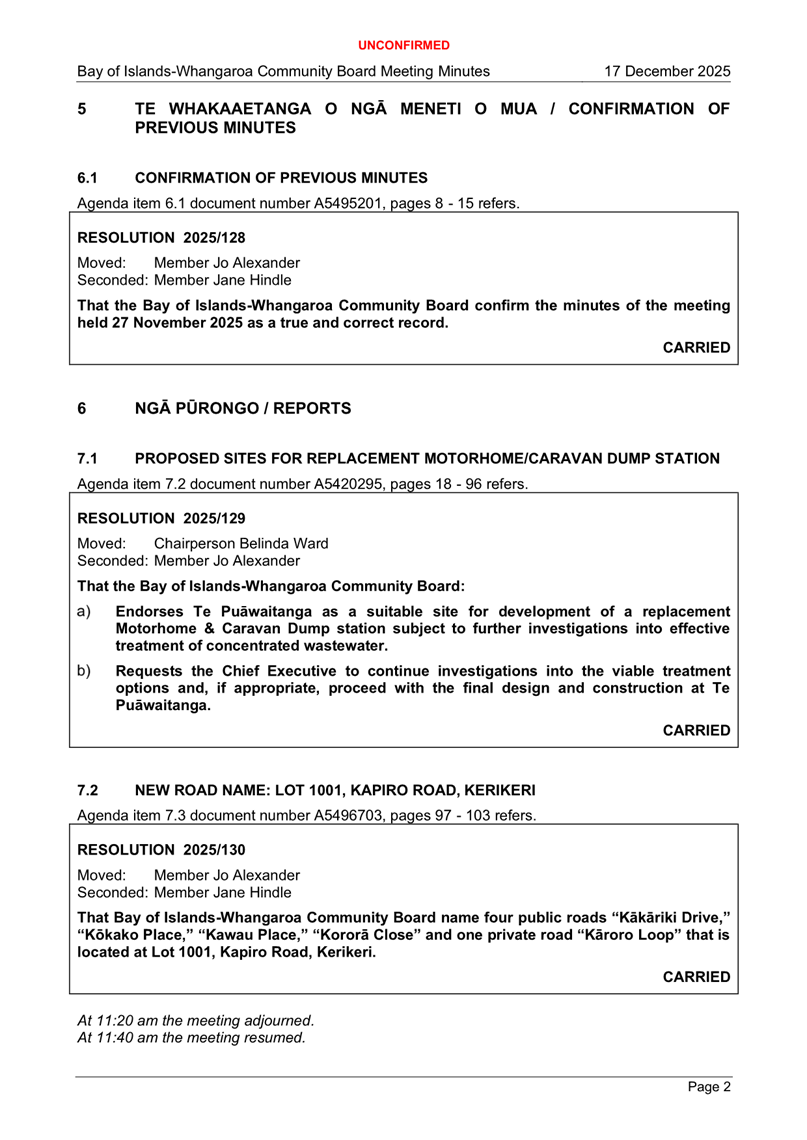
That the Bay of Islands-Whangaroa Community
Board confirm the minutes of the meeting held 17 December 2025 as a
true and correct record.
|
1) TĀhuhu kŌrero / Background
Local Government Act 2002 clause 7
Section 28 states that a local authority must keep minutes of its
proceedings. The minutes of these proceedings duly entered and
authenticated as prescribed by a local authority are prima facie evidence of
those meetings.
2) matapaki me NgĀ KŌwhiringa /
Discussion and Options
The Bay of Islands-Whangaroa
Community Board Standing Orders Section 27.3 states that “no discussion
may arise on the substance of the minutes at any succeeding meeting, except as
to their correctness”.
TAKE TŪTOHUNGA
/ REASON FOR THE RECOMMENDATION
The reason for the recommendation
is to confirm the minutes as a true and correct record of the previous meeting.
3) PĀnga PŪtea me ngĀ
wĀhanga tahua / Financial Implications and Budgetary Provision
There are no financial implications
or the need for budgetary provision.
Āpitihanga / Attachments
1. 2025-12-17
Bay of Islands-Whangaroa Community Board Minutes - A5509830 ⇩ 
Hōtaka Take Ōkawa / Compliance Schedule:
Full consideration has been given to the provisions of the
Local Government Act 2002 S77 in relation to decision making, in particular:
1. A
Local authority must, in the course of the decision-making process,
a) Seek
to identify all reasonably practicable options for the achievement of the
objective of a decision; and
b) Assess
the options in terms of their advantages and disadvantages; and
c) If
any of the options identified under paragraph (a) involves a significant
decision in relation to land or a body of water, take into account the
relationship of Māori and their culture and traditions with their
ancestral land, water sites, waahi tapu, valued flora and fauna and other
taonga.
2. This
section is subject to Section 79 - Compliance with procedures in relation to
decisions.
|
He Take Ōkawa /
Compliance Requirement
|
Aromatawai Kaimahi /
Staff Assessment
|
|
State the level of significance (high or low) of the
issue or proposal as determined by the Council’s
Significance and Engagement Policy
|
This is a matter of low significance.
|
|
State the relevant Council policies (external or
internal), legislation, and/or community outcomes (as stated in the LTP) that
relate to this decision.
|
This report complies with the Local Government Act 2002
Schedule 7 Section 28.
|
|
State whether this issue or proposal has a District wide
relevance and, if not, the ways in which the appropriate Community
Board’s views have been sought.
|
It is the responsibility of each meeting to confirm
their minutes therefore the views of another meeting are not relevant.
|
|
State the
possible implications for Māori and how Māori have been provided
with an opportunity to contribute to decision making if this decision is
significant and relates to land and/or any body of water.
State the
possible implications and how this report aligns with Te Tiriti o Waitangi /
The Treaty of Waitangi.
|
There are no implications on Māori in confirming minutes from a
previous meeting. Any implications on Māori arising from matters
included in meeting minutes should be considered as part of the relevant
report.
|
|
Identify persons likely to be affected by or have an
interest in the matter, and how you have given consideration to their views
or preferences (for example – youth, the aged and those with
disabilities).
|
This report is asking for the minutes to be confirmed as
a true and correct record, any interest that affect other people should be
considered as art of the individuals report.
|
|
State the financial implications and where budgetary
provisions have been made to support this decision.
|
There are no financial implications requiring input from
the Chief Financial Officer.
|
|
Chief Financial Officer review.
|
The Chief Financial Officer has
not reviewed this report.
|
|
Bay of Islands-Whangaroa Community Board Meeting Agenda
|
12 February 2026
|

|
Bay of Islands-Whangaroa
Community Board Meeting
Agenda
|
12 February 2026
|
7 Ngā
Pūrongo / Reports
7.1 Funding
Applications
File
Number: A5542762
Author: Kathryn
Trewin, Funding Advisor
Authoriser: Aisha
Huriwai, Manager - Democracy Services
Take Pūrongo / Purpose of the Report
The purpose of this report is to allow the Bay of
Islands-Whangaroa Community Board (the Board) to consider the application/s
received for the Community Grant Fund/Placemaking Fund.
WhakarĀpopoto matua / Executive Summary
· There are no new
applications, but a request for an extension on time for fund use has been
received.
· The Board has $72,673
to allocate for the Community Board Fund in the 2025/2026 financial year.
· The Board has $94,914
to allocate for the Placemaking Fund in the 2025/2026 financial year.
|
TŪTOHUNGA / RECOMMENDATION
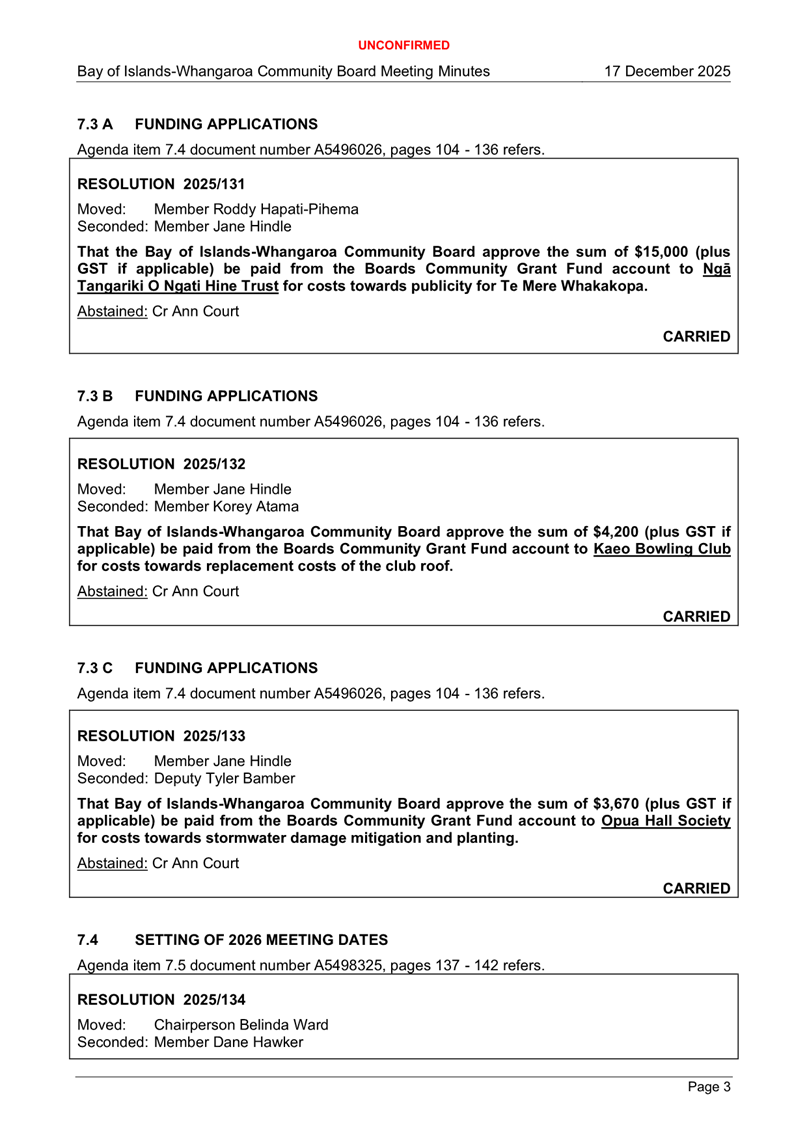
That Bay of Islands-Whangaroa
Community Board approve the sum of $7,500 (plus GST if applicable) be
retained by The Centre, Kerikeri to be used towards costs of an
accessible concert by Troy Kingi to be held no later than 30 June 2026.
|
1) TĀhuhu kŌrero / Background
Each application has been checked by staff for completeness
and complies with the conditions of the Community Grant Policy, Community
Outcomes as stated in the Long-Term Plan and all provisions listed on the
application form.
Each application must meet at least one community outcome
from the Council’s Long-Term Plan. The six community outcomes are
as follows:
1. A
wisely managed and treasured environment that recognises the role of tangata
whenua as kaitiaki;
2. We embrace and celebrate our unique
culture and heritage and value it as a source of enduring pride;
3. Proud,
vibrant communities;
4. Prosperous
Communities supported by a sustainable economy;
5. Communities
that are safe, connected and sustainable;
6. Communities
that are prepared for the unexpected.
2) matapaki me NgĀ KŌwhiringa /
Discussion and Options
|
Applicant
|
Granted
|
Recommend
|
Comments
|
|
The Centre – Te Wiki o Waitangi 2026
|
$7,500
|
Allow the extension
|
The applicant was granted funding towards the costs for
hosting events for Waitangi week 2026. This was their third application
for this financial year, with them previously receiving $6,000 for the show
Tangihanga in August and $5,000 for Diwali in September.
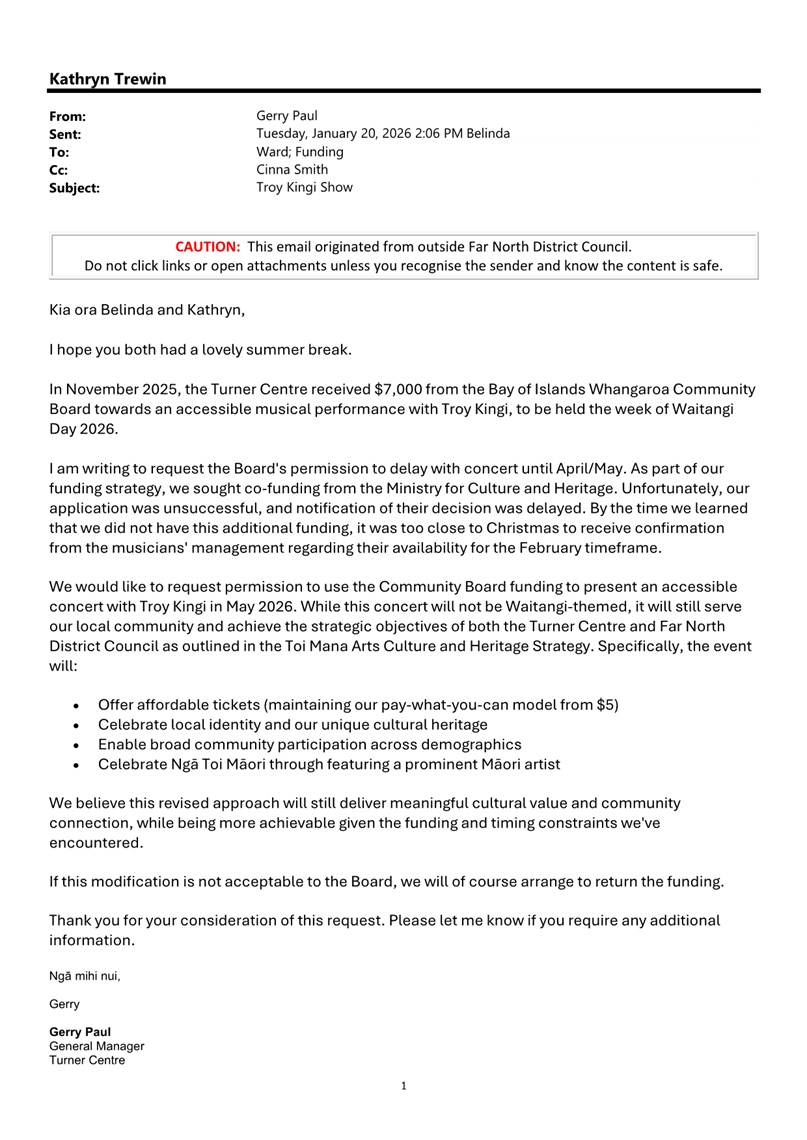
They allocated the funding towards artist fees for Troy
Kingi to perform, but he has had to delay his concert to April or May 2026
(date to be confirmed). They are requesting the Board allow them to
retain the funds and use it towards the concert when rescheduled. The request
is attached for your information.
This meets community outcomes 2, 3 and 5.
|
Take Tūtohunga / Reason for the
recommendation
The applicants were required to
complete a standard application form and provide supporting information.
For each application, the Board
has three options.
Option One: Authorise
funding for the full amount requested.
Option Two: Authorise
partial funding.
Option Three: Decline
funding the application.
3) PĀnga PŪtea me ngĀ
wĀhanga tahua / Financial Implications and Budgetary Provision
Budgetary provision has been made and the grant is allocated
in accordance with the Community Grant Policy.
Āpitihanga
/ Attachments
1. Request
from The Centre - A5542760 ⇩
Hōtaka Take Ōkawa / Compliance Schedule:
Full consideration has been given to the provisions of the
Local Government Act 2002 S77 in relation to decision making, in particular:
1. A
Local authority must, in the course of the decision-making process,
a) Seek
to identify all reasonably practicable options for the achievement of the
objective of a decision; and
b) Assess
the options in terms of their advantages and disadvantages; and
c) If
any of the options identified under paragraph (a) involves a significant
decision in relation to land or a body of water, take into account the
relationship of Māori and their culture and traditions with their
ancestral land, water sites, waahi tapu, valued flora and fauna and other
taonga.
2. This
section is subject to Section 79 - Compliance with procedures in relation to
decisions.
|
He Take Ōkawa /
Compliance Requirement
|
Aromatawai Kaimahi /
Staff Assessment
|
|
State the level of significance (high or low) of the
issue or proposal as determined by the Council’s
Significance and Engagement Policy
|
This is a matter of low significance.
|
|
State the relevant Council policies (external or
internal), legislation, and/or community outcomes (as stated in the LTP) that
relate to this decision.
|
Applications received are assessed against the Community
Grants Policy and Te Pae o Uta.
|
|
State whether this issue or proposal has a District wide
relevance and, if not, the ways in which the appropriate Community
Board’s views have been sought.
|
This report does not have district wide relevance.
|
|
State the
possible implications for Māori and how Māori have been provided
with an opportunity to contribute to decision making if this decision is
significant and relates to land and/or any body of water.
State the
possible implications and how this report aligns with Te Tiriti o Waitangi /
The Treaty of Waitangi.
|
There are no implications for Māori in relation to
the applications received in relation to whenua and/or wai.
|
|
Identify persons likely to be affected by or have an
interest in the matter, and how you have given consideration to their views
or preferences (for example – youth, the aged and those with
disabilities).
|
Considered in the application.
|
|
State the financial implications and where budgetary
provisions have been made to support this decision.
|
Budgetary provision has been made and the grant is
allocated in accordance with the Community Grant Policy.
|
|
Chief Financial Officer review.
|
The Chief Financial Officer has not reviewed this
report.
|
|
Bay of Islands-Whangaroa Community Board Meeting Agenda
|
12 February 2026
|
|
Bay of Islands-Whangaroa Community Board Meeting Agenda
|
12 February 2026
|
7.2 New Road
Name - 1349b State Highway 10, Kerikeri
File
Number: A5540888
Author: Trinity
Lane, Finance and Customer Services Administrator
Authoriser: Andy
Brown, Transportation Business Manager - Transportation Services
Take Pūrongo / Purpose of the
Report
That Bay of
Islands-Whangaroa Community Board name the private road located at 1349b State
Highway 10, Kerikeri.
WhakarĀpopoto matua / Executive Summary
· A
road naming application was received on the 6th of January 2026
· Community
Boards have the delegated authority to allocate names for previously unnamed
private roads, reserves, and other community facilities.
|
tŪtohunga
/ Recommendation
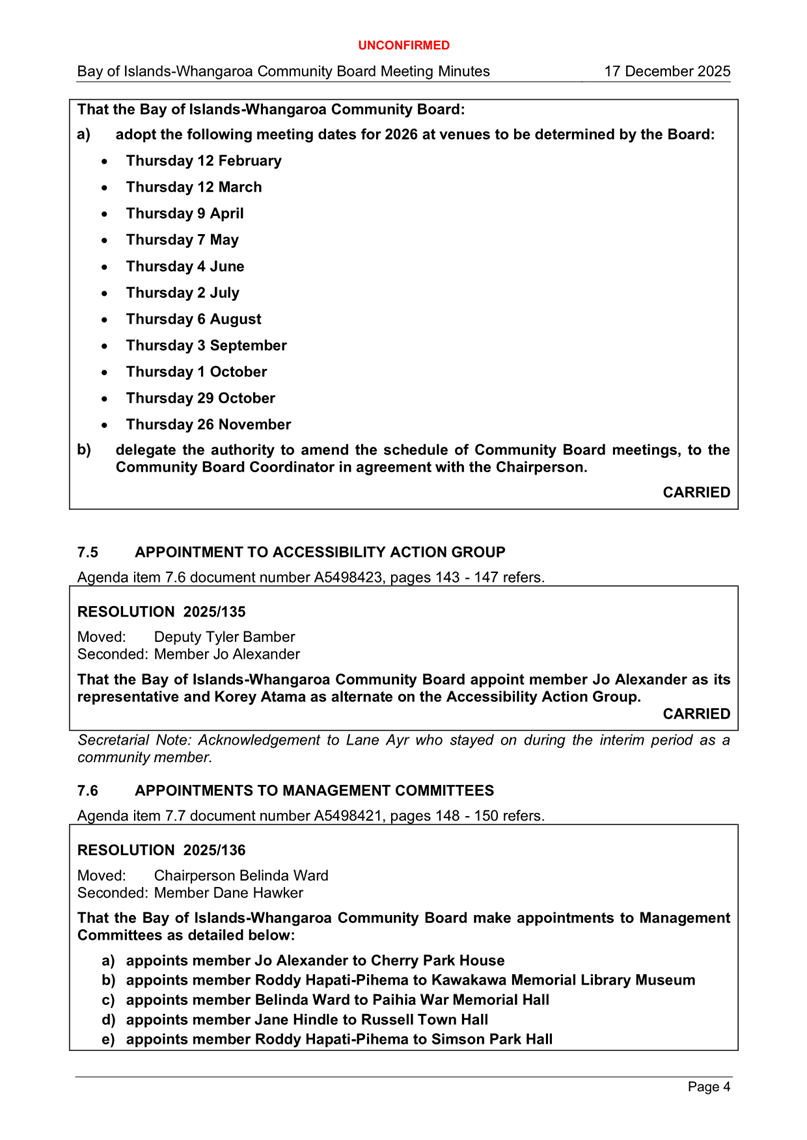
That Bay of
Islands-Whangaroa Community Board name a right of way “Kiwi Creek Lane”
that is located at 1349b State Highway 10, Kerikeri.
|
1)
TĀhuhu kŌrero / Background
Peter Cameron Shaw
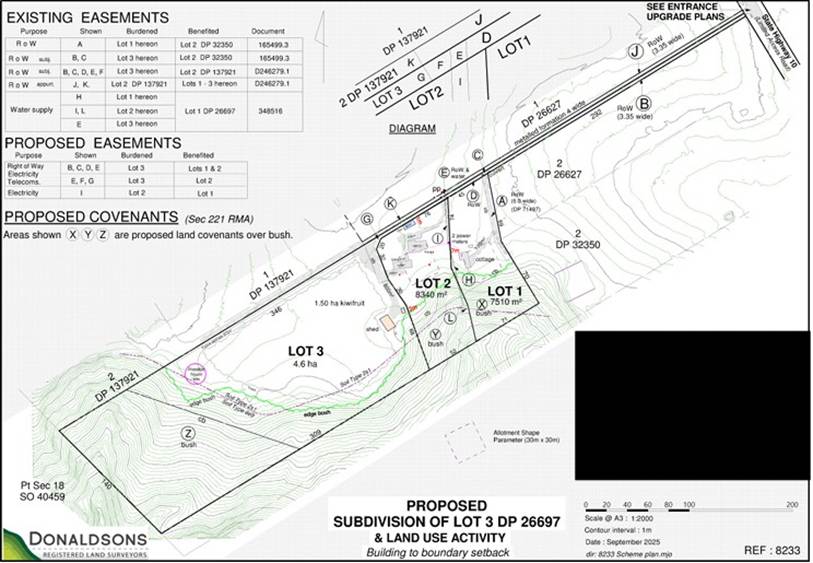
submitted a road naming application on 6th January 2026 for a right
of way located at 1349B State Highway 10, Kerikeri. The proposed development
will subdivide the existing lot to create three additional lots. In accordance
with the Road Naming and Numbering Policy and the conditions of the associated
resource consent, a road name is required.
The applicant proposed
the name Kiwi Creek Lane, reflecting the bush area on the property,
which provides habitat for kiwi that thrive along the spring-fed creek running
through the site.
The proposed road names
were submitted to Land Information New Zealand for assessment. Land Information
New Zealand confirmed that all three proposed names are acceptable for use and
comply with the Addressing Standards 2011.
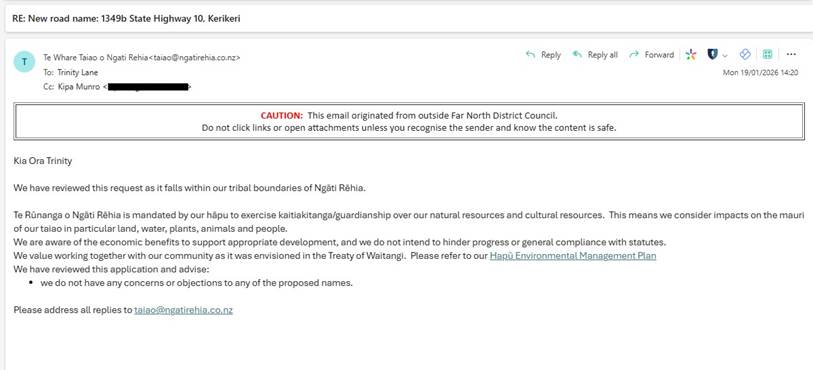
Feedback was also sought
from Ngāti Rēhia hapū. A response was received indicating no
objection to the proposed road names.
2) matapaki me
NgĀ KŌwhiringa / Discussion and Options
The proposed road names are:
- Kiwi
Creek Lane
- Kiwi
Creek Way
- Kiwi
Crossing Lane
TAKE TŪTOHUNGA
/ REASON FOR THE RECOMMENDATION
The road names
recommended in this report are not duplicates of any other road names in the
district, therefore meeting the criteria set down in the Council’s Road
Naming and Property Numbering Policy and the Australian/New Zealand Addressing
Standard - AS/NZS 4819.2011.
3) PĀnga
PŪtea me ngĀ wĀhanga tahua / Financial Implications and
Budgetary Provision
There will be no
financial implications to Council relating to the installation of the road name
signs (blue on white background name blade). The cost of the road signage and
installation will be met by the applicant.
Āpitihanga / Attachments
1. Hapu
Approval - A5540874 ⇩
2. Map
- A5540880 ⇩
Hōtaka Take Ōkawa / Compliance Schedule:
Full consideration has been given to the provisions of the
Local Government Act 2002 S77 in relation to decision making, in particular:
1. A Local authority must,
in the course of the decision-making process,
a) Seek to identify all
reasonably practicable options for the achievement of the objective of a
decision; and
b) Assess the options in
terms of their advantages and disadvantages; and
c) If any of the
options identified under paragraph (a) involves a significant decision in
relation to land or a body of water, take into account the relationship of
Māori and their culture and traditions with their ancestral land, water
sites, waahi tapu, valued flora and fauna and other taonga.
2. This section is subject
to Section 79 - Compliance with procedures in relation to decisions.
|
He Take Ōkawa / Compliance
Requirement
|
Aromatawai Kaimahi / Staff
Assessment
|
|
State the level of
significance (high or low) of the issue or proposal as determined by the Council’s
Significance and Engagement Policy
|
This is the naming of a right
of way and is of low significance.
|
|
State the relevant Council
policies (external or internal), legislation, and/or community outcomes (as
stated in the LTP) that relate to this decision.
|
Road Naming and Property
Numbering Policy #2125 and Australia/New Zealand Urban and Rural Addressing
Standards 4819.2011.
|
|
State whether this issue
or proposal has a District wide relevance and, if not, the ways in which the
appropriate Community Board’s views have been sought.
|
No district wide relevance
and the Community Board have the delegated authority to approve road names.
|
|
State the possible implications for Māori
and how Māori have been provided with an opportunity to contribute to
decision making if this decision is significant and relates to land and/or
any body of water.
State the possible implications and how this
report aligns with Te Tiriti o Waitangi / The Treaty of Waitangi.
|
Feedback was sought
from Ngāti Rēhia hapū. A response was received indicating no
objection to the proposed road names.
|
|
Identify persons likely to
be affected by or have an interest in the matter, and how you have given
consideration to their views or preferences (for example – youth, the
aged and those with disabilities).
|
All affected homeowners
were provided the opportunity to submit their feedback. There were no
objections.
|
|
State the financial
implications and where budgetary provisions have been made to support this
decision.
|
There will be no financial
implications to Council relating to the installation of the road name signs
(blue on white background name blade). The cost of the road signage and
installation will be met by the applicant.
|
|
Chief Financial Officer
review.
|
The
Chief Financial Officer as not reviewed this report.
|
|
Bay of Islands-Whangaroa Community Board Meeting Agenda
|
12 February 2026
|
|
Bay of Islands-Whangaroa Community Board Meeting Agenda
|
12 February 2026
|
|
Bay of Islands-Whangaroa Community Board Meeting Agenda
|
12 February 2026
|
7.3 Proposal to
Amend Alcohol Control Areas in the Ward
File
Number: A5516634
Author: Donald
Sheppard, Policy Advisor
Authoriser: Roger
Ackers, Group Manager - Planning & Policy
Take Pūrongo / Purpose of the Report
To seek a recommendation from the Bay of Islands-Whangaroa
Community Board that the council should declare a new Alcohol Control Area in
Waitangi and amend three current Alcohol Control Areas in Paihia, Waipapa and
Kerikeri.
WhakarĀpopoto matua / Executive Summary
· Alcohol Control Areas (alcohol-free areas) are public places where
it is prohibited to consume, bring in, or possess alcohol.
· These Alcohol Control Areas are amended or declared by resolution of
Council and are listed in the Register of Resolutions in the Alcohol Control
Bylaw 2018 (the Bylaw).
· On 4 September 2025 (resolution 2025/92 refers) the Bay of
Islands-Whangaroa Community Board recommended that the Council should:
o declare two new Alcohol Control Areas - in Waitangi and Ōpua
o amend three current
Alcohol Control Areas - in Paihia, Waipapa and Kerikeri.
· On 25 September 2025 (resolution 2025/116 refers) the Council
accepted this recommendation and authorised public
consultation on the Proposal to Amend Alcohol Ban Areas (the Proposal).
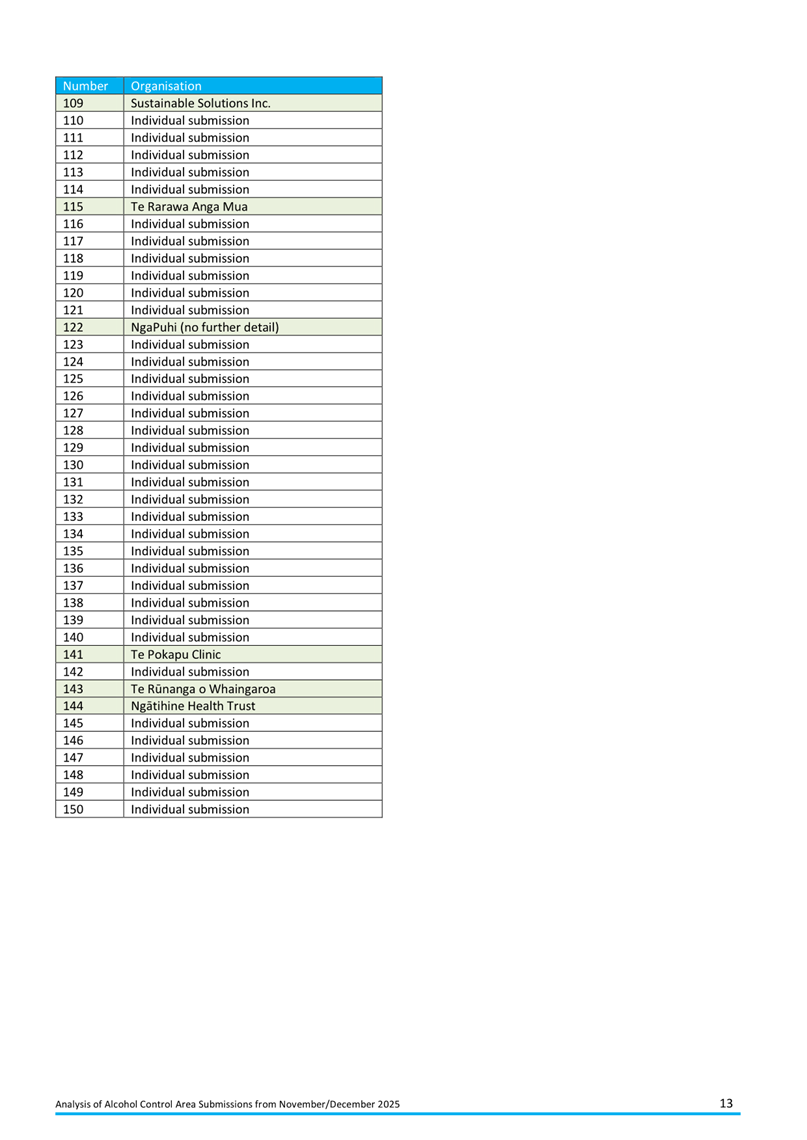
· 150 written submissions were received regarding the Proposal, with
78% of Bay of Islands-Whangaroa Ward residents who made submissions expressing
full support. See Attachment One, Analysis of Alcohol Control Area
Submissions.
· However, a number of Ōpua residents pointed out that alcohol-related disorder and criminal
behaviour is not a serious issue in public places in Ōpua and staff agree that Ōpua should not be declared an Alcohol Control Area.
· Based on this feedback, Council staff recommend proceeding with the
Proposal as it affects the Bay of Islands-Whangaroa Ward except for not
declaring Ōpua
an Alcohol Control Area.
|
tŪtohunga
/ Recommendation
That the Bay of Islands-Whangaroa Community
Board, under section 147b of the Local Government Act 2002, recommends that
council by resolution:
a) Declare
a new permanent Alcohol Control Area at Waitangi that will apply 24 hours a
day, 7 days a week, all year round
b) Amend
the current permanent Alcohol Control Areas in Kerikeri, Waipapa, and Paihia
that will continue to apply 24 hours a day, 7 days a week, all year round.
|
1) TĀhuhu
kŌrero / Background
Alcohol consumption in public
places in the district
Public drinking in the Far North is common and is often
relatively harmless, e.g. people having a quiet drink at a picnic. However,
excessive drinking in public can lead to disorderly and criminal behaviour,
impacting others’ enjoyment of public places, making members of the
public feel unsafe, and/or degrading the amenity and good order of localities, due to alcohol litter, vandalism, and graffiti.
Alcohol Control Areas
(wāhi waipiro kore)
The Bylaw addresses the problems of alcohol-related disorder
and criminal behaviour in public places by prohibiting the consumption,
bringing in, or possession of alcohol in Alcohol Control Areas declared under
section 147 of the Local Government Act 2002 (LGA02).
Section 147(1) of LGA02 gives a broad definition of the
public places where alcohol bans can apply, as places that are open to or being
used by the public. These places may include carparks, sportsgrounds,
conservation land, and certain private properties open to the public (e.g.
supermarket or bottle store carparks).
There are ten current Alcohol Control Areas in the Bay of
Islands-Whangaroa Ward: Kawakawa, Moerewa, Haruru Falls, Lily Pond,
Paihia, Russell, Kerikeri, Waipapa, Kāeo, and Taupō Bay.
Maps of the current Control Areas are included in the
Register of Resolutions to the Bylaw.
The Police enforce the Bylaw
The Police enforce the Bylaw and
in the Alcohol Control Areas they have the power to:
· search
vehicles, bags, and packages for alcohol
· seize
and remove alcohol
· ask
people to leave Alcohol Control Areas
· issue
infringement notices to offenders with a $250 fine
· arrest people who
commit offences or do not comply with police instructions.
Police have discretion under the
Bylaw – they are not required to act unless they observe actual or
potential alcohol-related crime or disorder. Typically, they will ignore
someone having a quiet drink in an alcohol ban area.
Review of the Alcohol Control
Areas
Council staff analysed relevant information to support the
review of Alcohol Control Areas in the Ward. This information was presented to
the Bay of Islands-Whangaroa Community Board meeting on 4 September 2025.
2) matapaki me NgĀ KŌwhiringa /
Discussion and Options
High-level research findings
Where do alcohol-related problems occur in public places in
the district
As evidenced by observations of
alcohol-litter and feedback from residents, public drinking often occurs in
concealed or less visible locations such as parks and reserves sheltered by
trees, service lanes, and places without CCTV coverage. “Side-loading”
outside bars and taverns is common. Drinking in and around vehicles is also
common in carparks and outside licensed premises.
When does problem drinking occur in public
From 2024 Police data for the
district, alcohol-related incidents in public occur year-round, peaking
slightly from January to March. Saturdays account for the highest number of
incidents (25%), but Thursdays and Fridays also show significant activity (both
18%). Most incidents occur between 4pm and midnight (61%), though some happen
during quieter periods. These patterns support the need for consistent, 24x7
year-round alcohol bans to ensure police can respond whenever required.
Framework for declaring or amending
Alcohol Control Areas
Council staff developed a decision-making framework to
identify whether a high level of alcohol-related crime and disorder is
occurring in an area. Using this framework, evidence of at least one of the
following measures indicates that an Alcohol Control Area should be
declared or amended:
|
Evidence required
|
Measures
|
|
1. Evidence of a high
number of alcohol-related crime and disorder incidents in public in the area
from police records.
|
At least 20 incidents reported to the police in the area in the most
recent year where data is available (i.e. 2024)
|
|
2. Evidence of a high
number of serious alcohol-related incidents occurring in the area from
police records including:
· abduction,
harassment and other offences against a person
· acts
intended to cause injury
· dangerous
or negligent acts endangering persons
· prohibited
and regulated weapons and explosives offences
· theft
and related offences
· homicides
and related offences
· sexual
assault and related offences.
|
At least 10 serious
police incidents reported in the area in the most recent year (i.e. 2024)
|
|
3. Compelling evidence of
alcohol-related crime and disorder from public feedback.
|
Either public survey
feedback or reports from members of the public about alcohol-related crime
and disorder in an area.
|
Findings for the Bay of
Islands-Whangaroa Ward
Applying the
decision-making framework identified that two broad areas in the Ward met the
criteria for declaring new Control Areas or amending existing Areas:
|
|
Areas
|
|
Criteria
|
Waitangi/Paihia/Ōpua
|
Kerikeri/Waipapa
|
|
Were at least 20
alcohol-related crime and disorder incidents in public places reported to the
police in 2024?
|
Yes
|
Yes
|
|
No. of police
incidents in 2024
|
47
|
36
|
|
Were
at least 10 police incidents
serious
in nature in 2024?
(e.g.
Acts intended to cause injury)
|
Yes
|
Yes
|
|
No. of police incidents
classified as serious in 2024
|
10
|
12
|
|
Is there compelling
evidence of alcohol-related crime and disorder in the area from observation
and public feedback?
|
Yes
|
Yes
|
More detailed evidence at
the local level initially indicated that the council should:
· declare
new Alcohol Control Areas in Waitangi and Ōpua
· amend the current
Alcohol Control Areas in Paihia, Waipapa and Kerikeri.
This led to the Proposal to Amend Alcohol
Ban Areas – (resolution 2025/116
refers)
Consultation on the Proposal
Consultation took place from 3
November to 1 December 2025 (4 weeks) and 150 written submissions were received
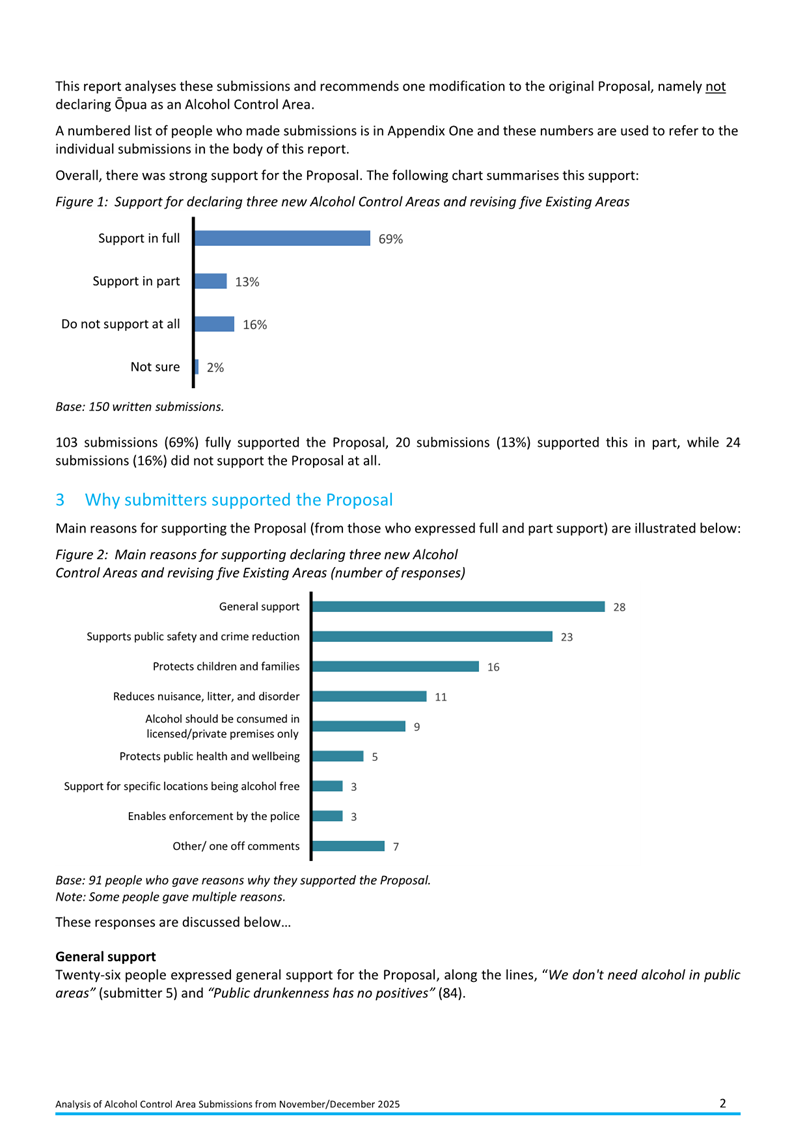
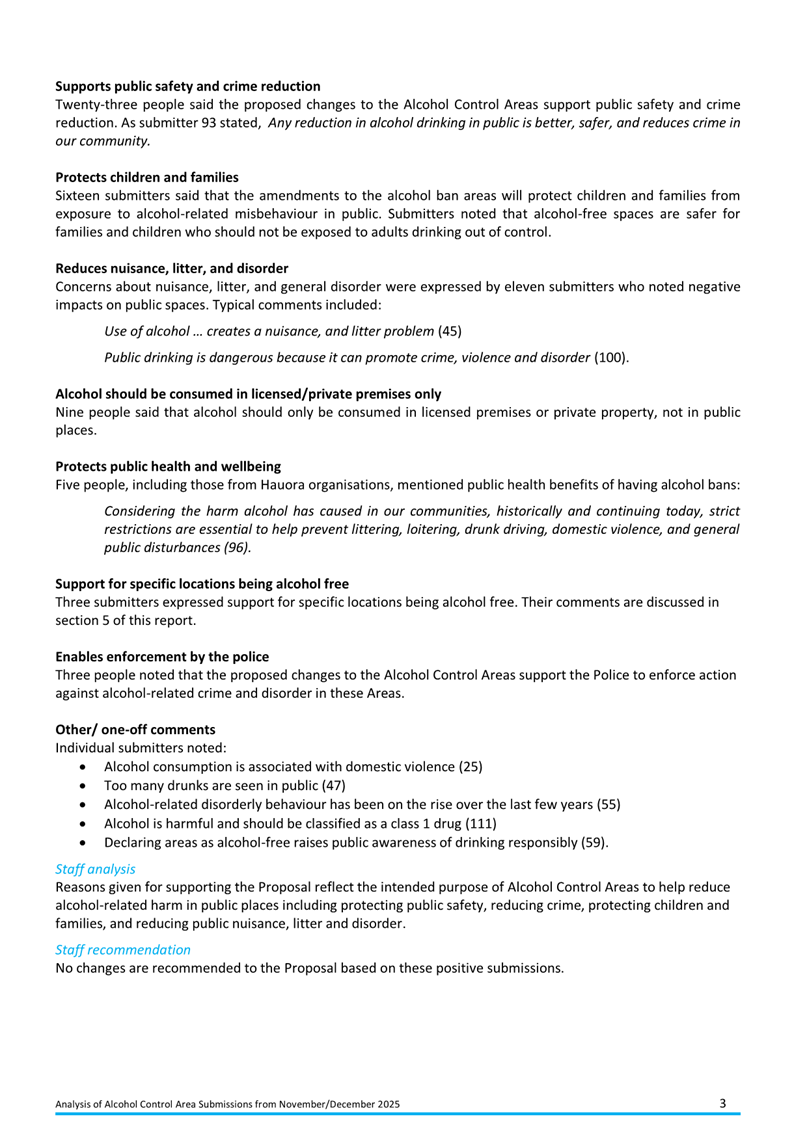
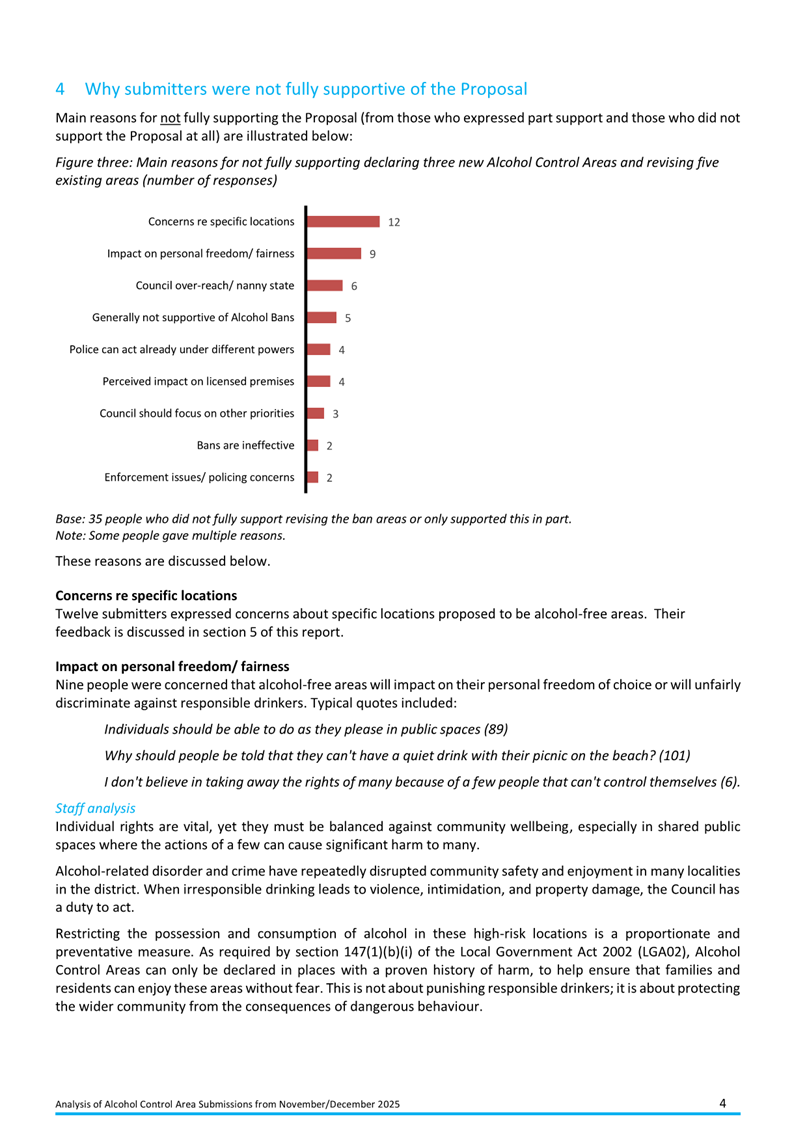
(93 from Bay of Islands-Whangaroa Ward residents). The following table
summarises the results:
|
Support for the Proposal
|
Total response
(district-wide)
|
Response from Bay of Islands-Whangaroa Ward residents
|
|
Support
in full
|
69%
|
78%
|
|
Support
in part
|
13%
|
10%
|
|
Do
not support at all
|
16%
|
11%
|
|
Not
sure
|
2%
|
1%
|
|
Number of submissions
|
150
|
93
|
See Attachment One for full analysis of
public feedback.
Recommendation to no
longer declare Ōpua an Alcohol Control Area
Declaring
an Alcohol Area in Ōpua assumed that alcohol-related disorder is spread
evenly across the Waitangi/Paihia/Ōpua area. However, submissions from
Ōpua residents indicate that alcohol-related public disorder and criminal
behaviour in Ōpua is not an issue, with these incidents concentrated in
Paihia and Waitangi. This finding is backed by Police reports of incidents in
Ōpua. See the Analysis of Alcohol Control Area Submissions (Attachment
One – section 5).
Specific locations to be included in amended and new
Control Areas
Specific locations recommended to
be included in revised and new Alcohol Control Areas in the Ward are listed
below. NB. the locations involved can be viewed at this link: Maps
of Current and Amended Control Areas.
Localities to be included in the Alcohol
Control Area in Waitangi:
1) Hobson Beach
2) Waitangi Reserve
3) Waitangi one way bridge
4) Waitangi boat ramp area
5) Carparks associated with the Copthorne Hotel
complex, Cruising Club and Waitangi Wharf
6) Land and beach area between the Cruising Club and
the sea
7) Waitangi Treaty Grounds carparks
8) Tau Henare Drive to the junction with Bayly Road,
including the Lookout area and all carparks and laybys including the golf club
carpark
9) Bayly Road including the Waitangi Mountain Park
carpark
10) Bayly Road reserve, Wairoa Bay.
Localities to be added to the Alcohol
Control Area in Paihia:
1) Lucy Elizabeth Williams Scenic Reserve – corner Davis Crescent
and Marsden Road
2) Woolworths carpark, Puketona Road
3) Walkway to reserve – next to
11 Kings Road
4) Joyces Road and old RSA Building
carpark
5) Paihia Cemetery
6) All beaches down to the water line
(some beaches are not included in the current Alcohol Control Area).
Localities to be added to the Alcohol
Control Area in Waipapa:
1) Mitre 10/Noel Leeming carpark
2) The Warehouse carpark
3) Parking area at end of Kerikeri
River track opposite 1895 SH10 Waipapa
4) Harmony Lane - associated playing
fields and carparks
5) Walkway running from the soccer
fields to Mawson Ave
6) Walkway running from Mawson Ave to
Waipapa shops
7) Te Puāwaitanga - Bay of
Islands Sports Hub
8) Pioneer Tavern carpark
Localities to be added to the Alcohol
Control Area in Kerikeri:
1) Rainbow Falls carpark and reserve
2) Fairy Pools Lane and Fairy Pools
3) Skudders Beach Road parking bay
4) Stone Store basin carpark, wharf
area and Kororipo Pa area
5) Landing Road including the carpark
for the Kerikeri Basin, the reserve, and picnic area
6) Council carparks between Homestead
Road and Butler Road
7) Carparks between Homestead Road
and Fairway Drive (e.g. old Bunnings carpark area) and connecting lanes to
Kerikeri Road
8) Briscoes, Rebel Sport and Work
& Income carparks
9) The Homestead Sports Bar &
Bistro carpark, 15 Homestead Road
10) The Man Cave carpark and
surrounding area, 19 Homestead Road
11) Masonic Lane
12) All interconnecting service lanes
and carparks between Hobson Avenue and Cobham Road
13) Carparks along Hobson Avenue e.g.
for the Baptist Church, Ministry of Education etc.
14) Liquorland service lane and
carpark, 52 Kerikeri Road
15) Woolworths carpark and service
lanes
16) Shrubbery on north side of
Woolworths Building, on Butler Road
17) McDonald’s carpark
18) Kerikeri Rugby Club, squash and
netball clubs, carparks and associated playing fields – corner of the
Heritage Bypass and Waipapa Road
19) Roundabout area at the
intersection of Kerikeri Road and SH10
When the recommended alcohol bans will
apply
Council staff
recommend 24x7 alcohol bans all year round. This will provide Police with a
regulatory tool to respond to alcohol-related crime and disorder whenever it
occurs, rather than relying on limited timeframes that may not align with
actual incidents.
Options
Option One is
that the Community Board recommends that the Council:
1. declares
a new Alcohol Control Area in Waitangi
2. amends
three current Alcohol Control Areas - in Paihia, Waipapa and Kerikeri
Option Two is a recommendation that Council
maintains the status quo/does nothing.
Advantages and
disadvantages of these Options are as follows:
|
Options
|
Advantages
|
Disadvantages
|
|
Option one - recommend that the council
declares a new Alcohol Control Area in Waitangi and amends three current
Alcohol Control Areas in Paihia, Waipapa and Kerikeri. Any new ban areas will
apply 24x7 all year round.
This is the
recommended option
|
Reducing
alcohol-related disorder and crime to make public places in the district
safer for the public
Evidence‑based targeting of problem areas
New and amended
control areas will include locations where high levels of alcohol-related
crime and disorder is occurring that are not included in current control
areas.
Enabling the police to
enforce the bylaw in these areas under the alcohol control bylaw. this is a
more flexible and less time-consuming approach than charging offenders under
the summary offences act.
Applying the bans 24x7
will enable the police to act whenever they encounter problem drinking in
public in the ban areas.
|
None identified
|
|
Option two – recommend that council
maintains the status quo/ does nothing
|
None identified
|
Alcohol Control Areas will not fully reflect where high
levels of alcohol-related crime and disorder are occurring.
The police will not be
able to act flexibly and proactively to address alcohol-related problems in
the new recommended ban areas.
|
TAKE TŪTOHUNGA
/ REASON FOR THE RECOMMENDATION
The recommended Option means that
the Alcohol Control Areas will better reflect where alcohol-related crime and
disorder is occurring in the Ward. This will make these places safer for the
public and enable the Police to enforce the Bylaw in these areas.
IMPLEMENTATION
If, the council resolves to amend
and declare the Alcohol Control Areas recommended in this report, the following
actions will occur:
· the
Register of Resolutions in the Bylaw will be updated with the date that the
changes will apply to be decided by the council
· Council’s
Communication and Engagement team will communicate the new alcohol ban areas to
the public via a media release
· alcohol-free
signage will be selectively placed in these new areas
· the Police
will communicate to all relevant staff that the Control Areas have changed with
revised GIS maps allowing them to check if specific locations are covered.
3) PĀnga PŪtea me ngĀ
wĀhanga tahua / Financial Implications and Budgetary Provision
Across the district the following costs will be involved:
|
Cost
component
|
Estimated
cost
|
|
Policy research and development
|
<$1,000
|
|
Consultation and communication
|
minimal
|
|
Printing, erecting and placing new signage
|
$5,000
|
The costs will come from within
existing budgets.
Āpitihanga
/ Attachments
1. Analysis
of Alcohol Control Area Submissions - A5524604 ⇩
Hōtaka Take Ōkawa / Compliance Schedule:
Full consideration has been given to the provisions of the
Local Government Act 2002 S77 in relation to decision making, in particular:
1. A
Local authority must, in the course of the decision-making process,
a) Seek
to identify all reasonably practicable options for the achievement of the
objective of a decision; and
b) Assess
the options in terms of their advantages and disadvantages; and
c) If
any of the options identified under paragraph (a) involves a significant
decision in relation to land or a body of water, take into account the
relationship of Māori and their culture and traditions with their
ancestral land, water sites, waahi tapu, valued flora and fauna and other
taonga.
2. This
section is subject to Section 79 - Compliance with procedures in relation to
decisions.
|
He Take Ōkawa /
Compliance Requirement
|
Aromatawai Kaimahi /
Staff Assessment
|
|
State the level of significance (high or low) of the
issue or proposal as determined by the Council’s
Significance and Engagement Policy
|
Under the Significance and Engagement Policy the level
of significance is low as the recommended resolutions a) do not involve the
transfer of the ownership or control of assets; and b) are not inconsistent
with current Council plans or policies.
As required by clause 7.2 of the Bylaw, the council
consulted with the public in accordance with section 82 of the Local
Government Act 2002.
|
|
State the relevant Council policies (external or
internal), legislation, and/or community outcomes (as stated in the LTP) that
relate to this decision.
|
The relevant community outcome from the Long-Term Plan
is ‘Communities that are healthy, safe, connected and
sustainable’.
Under section 147B of LGA02,
section 7 of the Bylaw provides that Council may declare or amend Alcohol
Control Areas by resolution following public consultation under section 82 of
LGA02.
Sections 169 and 170 of LGA02 describe Police powers to
enforce the Bylaw in the Alcohol Control Areas.
|
|
State whether this issue or proposal has a District wide
relevance and, if not, the ways in which the appropriate Community
Board’s views have been sought.
|
As the recommendation to amend and declare permanent
Alcohol Control Areas applies to specific locations within each Ward, it is
important to understand the views of each Community Board and to receive
their recommendation that Council should make the recommended resolutions
applying to their Ward.
A workshop was held with the Bay of Islands-Whangaroa
Community Board early in May 2025 to discuss the review of the Alcohol
Control Areas. Then, on 2 September 2025 the Community Board was asked to
formally recommend the proposed new and revised alcohol ban areas to the
council.
|
|
State the
possible implications for Māori and how Māori have been provided
with an opportunity to contribute to decision making if this decision is
significant and relates to land and/or any body of water.
State the
possible implications and how this report aligns with Te Tiriti o Waitangi /
The Treaty of Waitangi.
|
The recommendation to revise Alcohol Control Areas in
the district does not consider the relationship of Māori to land, water,
sites, wāhi tapu, valued flora and fauna and other taonga as it does not
“significantly affect land or a body of water” as covered by
section 60A of LGA02.
In conducting the research to review the Control Areas,
groups representing Māori
interests were involved, including:
· Te
Hauora o Ngāpuhi
· Hauora
Bay of Islands-Whangaroa
· Whiria
Te Muka
· Te
Roopu A Iwi o Te Rarawa
· Waka
ama coaches and participants re Lake Ngātu.
At the consultation stage, all iwi groups in the
district were given the opportunity to provide their views on the Proposal.
|
|
Identify persons likely to be affected by or have an
interest in the matter, and how you have given consideration to their views
or preferences (for example – youth, the aged and those with
disabilities).
|
Three main groups of persons are likely to be affected
by changes to the Alcohol Control Areas:
1) The general public
The public can be negatively
affected by alcohol-related crime and disorder in public places e.g. feeling
intimidated or threatened by intoxicated individuals, having their property
damaged, and/or not enjoying being in these public places. Updating the Alcohol
Control Areas will provide additional protection for the public.
Engagement with the public occurred at two stages of the
review process: a) a survey of the public conducted in May/June 2025; and b)
the public consultation.
2) Owners of properties whose carparks are proposed
to be alcohol ban areas
Section 147 of LGA02 gives a
broad definition of places that can be declared Alcohol Control Areas as
places that are open to or used by the public. This includes carparks of
licensed premises and supermarkets etc.
These people were sent emails asking them to participate
in the public consultation.
3) Those consuming alcohol in public
If someone is peacefully
enjoying a drink in an alcohol ban area, the Police have the discretion to
ignore these people. However, the Police have a range of powers to address
offenders whose behaviour is intimidating, aggressive or anti-social in the
alcohol ban areas. The Research Report examines how the rights of these
offenders under the Bill of Rights Act 1990 may be affected by Police actions
and concluded that the limitations on their rights in the revised Alcohol
Areas are reasonable.
|
|
State the financial implications and where budgetary
provisions have been made to support this decision.
|
District-wide costs will be incurred for policy research
and development (est. <$1,000), consultation and communication (minimal),
and to print, erect, and place new signage (est. $5,000).
All these costs come from within existing budgets.
|
|
Chief Financial Officer review.
|
This report has not been reviewed by Chief Financial
Officer.
|
|
Bay of Islands-Whangaroa Community Board Meeting Agenda
|
12 February 2026
|
7.4 Kerikeri
Domain - Proposal to Establish an Advisory Group
File
Number: A5529374
Author: Robin
Rawson, Parks & Reserves Planner
Authoriser: Roger
Ackers, Group Manager - Planning & Policy
Take Pūrongo / Purpose of the Report
To update the Community Board on management options for
Kerikeri Domain and to recommend establishment of a Kerikeri Domain Advisory
Group.
WhakarĀpopoto matua / Executive Summary
This report
provides an update to the Bay of Islands-Whangaroa Community Board on
management options for Kerikeri Domain as directed by resolution 2024/94 in
September 2024. A meeting with identified stakeholders was held in
September 2025 to consider governance model options. The outcome of this
meeting indicated community interest in forming an advisory group to enhance
communication, coordination and planning for the Domain, rather than
establishing a management group with formal delegations. This report
recommends the establishment of a Kerikeri Domain Advisory Group, proposes a
terms of reference for this group, and outlines the next steps for
implementation.
|
tŪtohunga
/ Recommendation
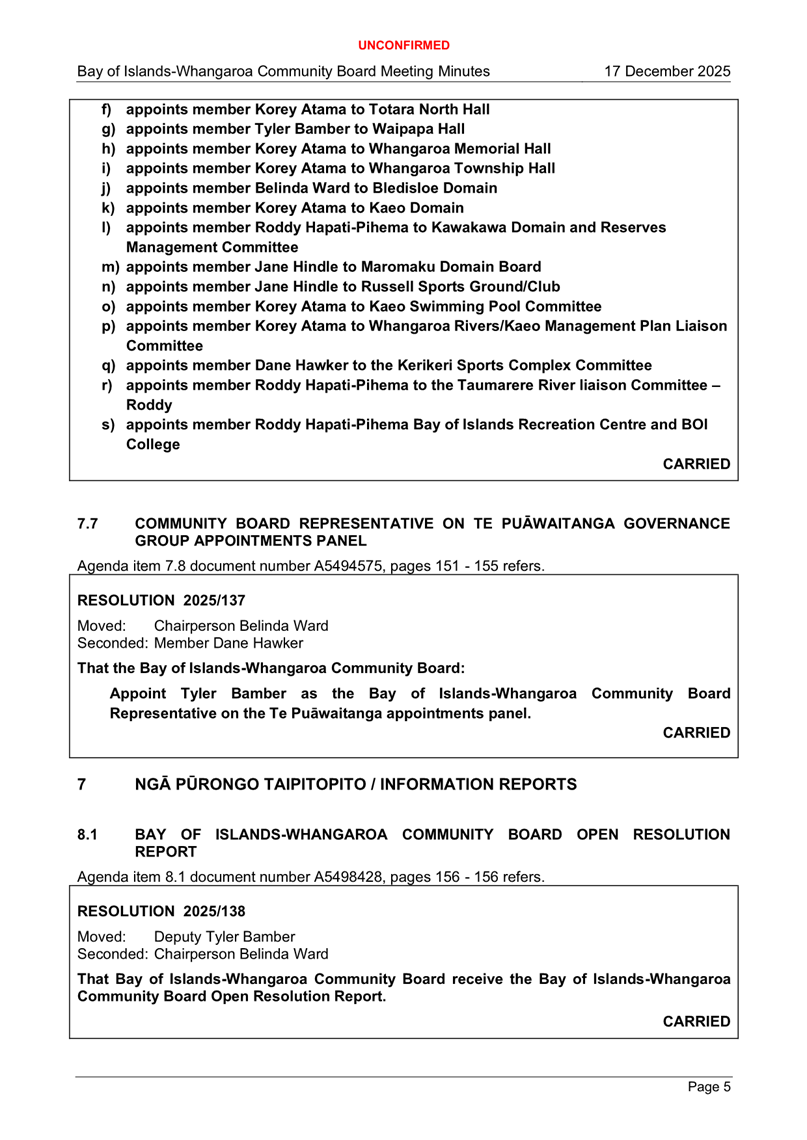
That the Bay of Islands-Whangaroa Community Board:
a)
Receive the report Kerikeri Domain - Proposal to Establish an
Advisory Group.
b)
Endorse the establishment of a Kerikeri Domain Advisory Group
to provide ongoing advice and feedback on the management and development of
the Domain.
c)
Endorse the terms of reference for the Kerikeri Domain Advisory
Group as outlined below.
|
1) TĀhuhu kŌrero / Background
The Bay of Islands-Whangaroa Community Board made the
following resolution (2024/94) on 19 September 2024:
That the Bay of
Islands-Whangaroa Community Board request a decision report be provided to the
Community Board on the options for delegation of the Kerikeri Domain at the Bay
of Islands-Whangaroa Community Board meeting in December 2024.
In the months following the resolution, a report was
presented to Council’s Senior Leadership Team requesting direction on
co-management requests. The Senior Leadership Team supported the trial of
co-management agreements at a reserve or reserves, and this being progressed
for Moringaehe, a Council reserve in the Te Hiku ward, and no direction was
provided for other reserves.
Council staff organised a meeting in Kerikeri on 8 September
2025 to discuss management options for Kerikeri Domain, and attendees included
representatives from the following community and park user groups:
· Vision
Kerikeri
· Our
Kerikeri
· Ngāti
Rēhia
· Kerikeri
High School (also representing Cricket)
· Kerikeri
District Business Association Committee
· Kerikeri
Attendees gave full support to receiving more information
from Council about the Domain and having the opportunity to comment on
development and management options. There was no interest in setting up a
group with delegations for management.
The following email sent to attendees records the outcome of
the meeting:
Thank you for attending the
meeting last night and sharing your knowledge and perspective on Kerikeri
Domain.
To improve communications and
management of the domain including coordination and bookings of activities, as
well as consideration of future development proposals we ended up with 3
actions:
1. Support
to establish a Kerikeri Domain stakeholder / advisory group (or similar name)
– expected to meet on a regular but not frequent basis
(Council
Facilities & Parks Planning to provide support)
2. Consider
removal of Kerikeri Domain from the list of district wide assets so that the
new Community Board have delegation and greater control over management
(New Community Board to
consider application to Council)
3. Consider
review of the reserve management plan at an earlier time, particularly if
public consultation is otherwise required for any development projects
(New Community Board to
consider direction to Parks Planner)
Two of these activities will
be delayed by local body elections. Council will begin work on establishing a
group associated with Kerikeri Domain.
Please get back to me if you
have any queries or further comment.
2) matapaki me NgĀ KŌwhiringa /
Discussion and Options
Participants at the meeting in September 2025 expressed a
clear preference for improved stakeholder engagement and communication
regarding the management of the Kerikeri Domain rather than support for
establishing a group delegated to manage the Kerikeri Domain.
The proposed Kerikeri Domain Advisory Group would serve as a
conduit between Council, park users and other community stakeholders. The aim of the advisory group would be to enhance
decision-making regarding the management, use, and development of Kerikeri
Domain, ensuring user needs and community perspectives are considered.
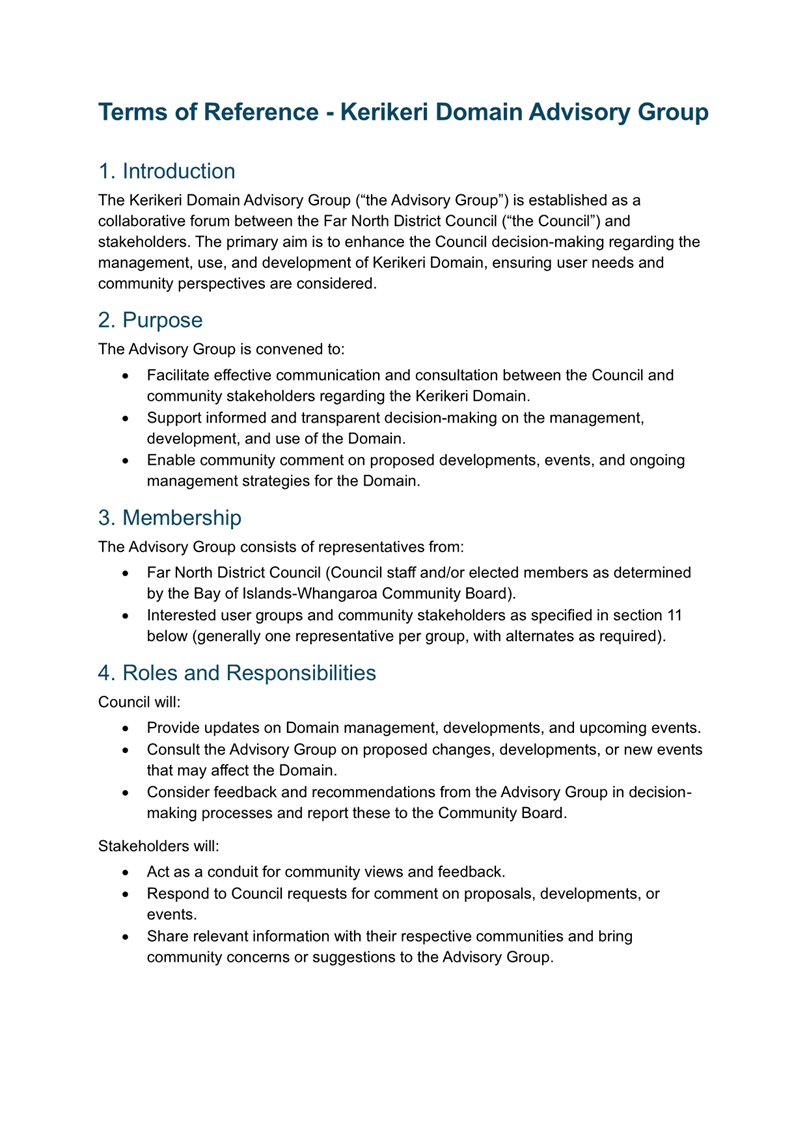
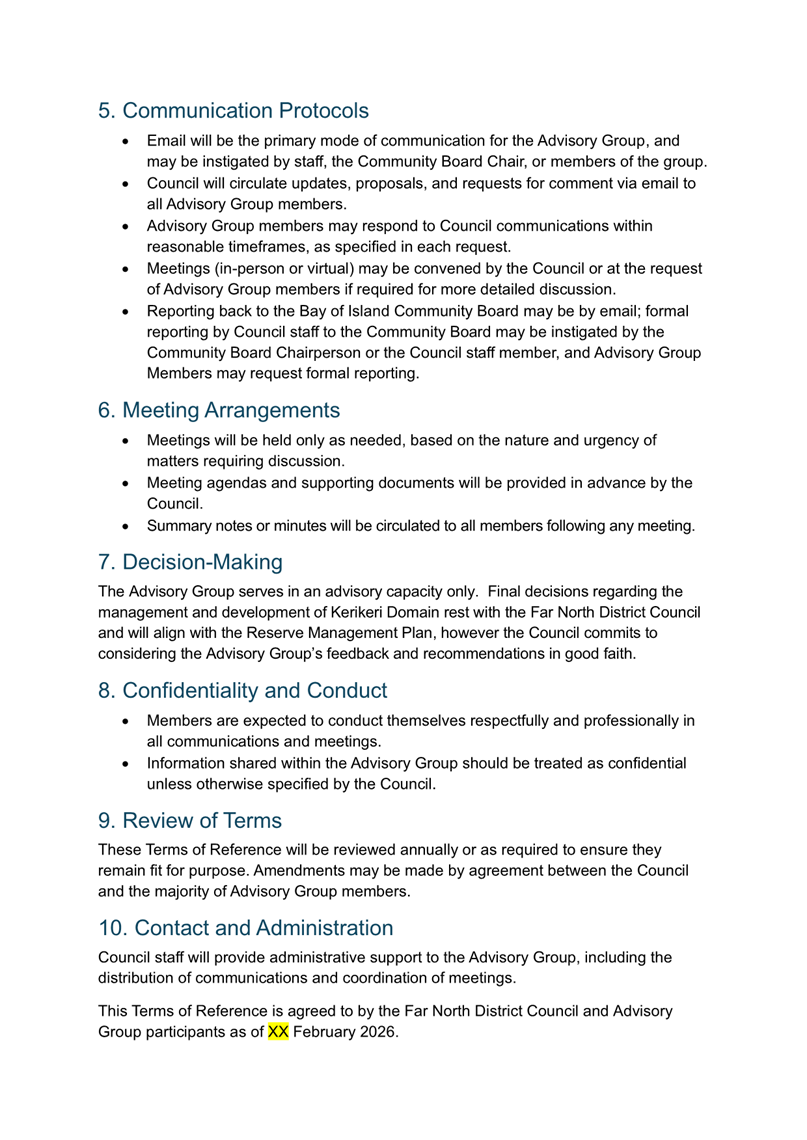
This would be a relatively informal group, however a terms
of reference is recommended to guide expectations of all people involved,
noting that the terms of reference may evolve over time. As outlined in
the attached draft terms of reference, the Kerikeri Domain Advisory Group would
communicate by email, with possible meetings when a higher level of
consideration was required, and this would generally be reported back to the
Community Board by email through the Chairperson. Future reporting to the
Community Board would occur as required, for consideration of management issues
or to consider high impact proposals.
Options that can be considered by the Community Board:
Option 1)
Endorse staff to establish the advisory group (staff
recommendation). Feedback from the advisory group would enhance decision-making
by Council on the management, use and development of Kerikeri Domain. No
significant disadvantages have been identified. Management of the
advisory group would require staff resources. The next steps for this option
are:
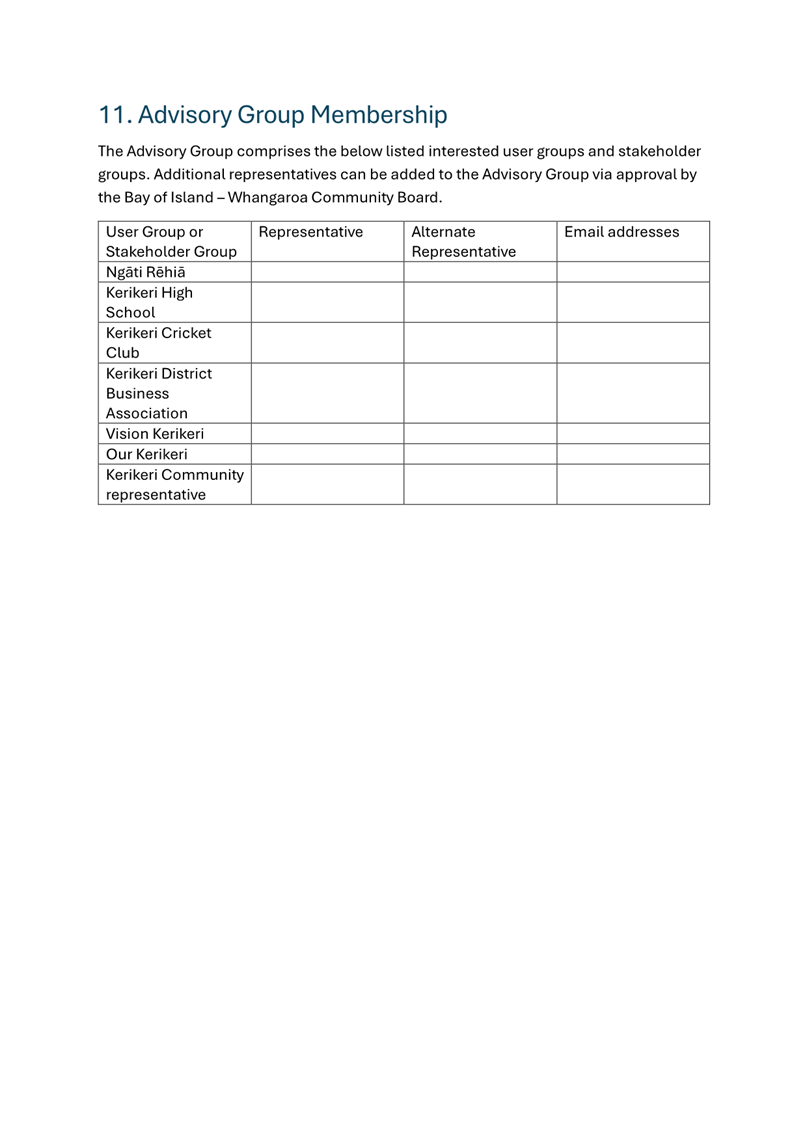
· Confirming
membership, including any additional representatives from key community and
park user organisations.
· Finalise a terms
of reference for the advisory group (refer attachment).
Option 2)
Do not endorse establishment of the advisory group (not
recommended by staff).
There was no interest from meeting attendees in delegations
to allow management of Kerikeri Domain by the community, so this is not
considered to be an option.
TAKE TŪTOHUNGA
/ REASON FOR THE RECOMMENDATION
The proposed Kerikeri Domain Advisory Group would ensure
user needs and community perspectives were considered to enhance
decision-making for the management, use and development of Kerikeri Domain, and
the Kerikeri Domain Advisory Group formation is supported by the stakeholders
engaged on this process.
3) PĀnga PŪtea me ngĀ
wĀhanga tahua / Financial Implications and Budgetary Provision
Budget provision is not
required for the Advisory Group. Any expenditure related to the Advisory
Group would be minor, for example room hire perhaps once or twice per annum.
Āpitihanga
/ Attachments
1. Draft
Kerikeri Domain Advisory Group Terms of Reference - A5527114 ⇩
Hōtaka Take Ōkawa / Compliance Schedule:
Full consideration has been given to the provisions of the
Local Government Act 2002 S77 in relation to decision making, in particular:
1. A
Local authority must, in the course of the decision-making process,
a) Seek
to identify all reasonably practicable options for the achievement of the
objective of a decision; and
b) Assess
the options in terms of their advantages and disadvantages; and
c) If
any of the options identified under paragraph (a) involves a significant
decision in relation to land or a body of water, take into account the
relationship of Māori and their culture and traditions with their
ancestral land, water sites, waahi tapu, valued flora and fauna and other
taonga.
2. This
section is subject to Section 79 - Compliance with procedures in relation to
decisions.
|
He Take Ōkawa /
Compliance Requirement
|
Aromatawai Kaimahi /
Staff Assessment
|
|
State the level of significance (high or low) of the
issue or proposal as determined by the Council’s
Significance and Engagement Policy
|
The creation of a park user group to inform Council
decisions would have a low level of significance.
|
|
State the relevant Council policies (external or
internal), legislation, and/or community outcomes (as stated in the LTP) that
relate to this decision.
|
Kerikeri Domain Reserve Management Plan
Parks and Reserves Policy 2022
|
|
State whether this issue or proposal has a District wide
relevance and, if not, the ways in which the appropriate Community
Board’s views have been sought.
|
While Kerikeri Domain is included as an asset having
district wide significance and remaining the responsibility of the Council,
the Bay of Islands–Whangaroa Community Board has expressed a strong
interest in this reserve. The creation of a Kerikeri Domain Advisory
Group would assist Council in making informed decisions that meet the needs
of the community.
|
|
State the
possible implications for Māori and how Māori have been provided
with an opportunity to contribute to decision making if this decision is
significant and relates to land and/or any body of water.
State the
possible implications and how this report aligns with Te Tiriti o Waitangi /
The Treaty of Waitangi.
|
A representative from Ngāti Rēhia attended the
preliminary meeting and have expressed an interest in on-going involvement in
the advisory group.
|
|
Identify persons likely to be affected by or have an
interest in the matter, and how you have given consideration to their views
or preferences (for example – youth, the aged and those with
disabilities).
|
Groups and individuals that have an interest in Kerikeri
Domain including those involved with sports and events.
|
|
State the financial implications and where budgetary
provisions have been made to support this decision.
|
Budget provision is not
required for the Advisory Group. Any expenditure related to the
Advisory Group would be minor, for example room hire.
|
|
Chief Financial Officer review.
|
The CFO has reviewed this report.
|
|
Bay of Islands-Whangaroa Community Board Meeting Agenda
|
12 February 2026
|
|
Bay of Islands-Whangaroa Community Board Meeting Agenda
|
12 February 2026
|
7.5 Te
Pātukurea Kerikeri Waipapa Spatial Plan - Implementation Steering Group
Establishment
File
Number: A5540696
Author: Jaye
Michalick, Team Leader – Growth Planning & Placemaking
Authoriser: Roger
Ackers, Group Manager - Planning & Policy
Take Pūrongo / Purpose of the Report
The purpose of the report is to describe the requirement to
establish a Te Pātukurea Kerikeri Waipapa Spatial Plan Implementation
Steering Group (Steering Group) and to facilitate the appointment of two Bay of
Islands-Whangaroa Community Board (Board) representatives to the Steering
Group.
WhakarĀpopoto matua / Executive Summary
This report:
· Reiterates the extent of mana whenua partnership and stakeholder
engagement undertaken to prepare the adopted spatial plan as context to the
need to establish an ongoing Steering Group.
· Outlines the initial projects required to be commenced as part of
the implementation plan within Te Pātukurea Kerikeri Waipapa Spatial Plan.
· Outlines the purpose, composition and draft Terms of Reference for
the Steering Group.
· Recommends the Board appoints two Board members to the Steering
Group.
· In accordance with Te Kūkupa Terms of Reference, recommends the
Board informs Te Kūkupa Committee or Strategy Policy and Regulation of the
establishment of the Steering Group.
|
tŪtohunga
/ Recommendation
That the Bay of Islands-Whangaroa Community
Board receive this report and:
a) Appoint
members __________ and ___________ to Te Pātukurea Kerikeri Waipapa
Spatial Plan Implementation Steering Group; and
b) Inform
Te Kūkupa Committee for Strategy Policy and Regulation of the
establishment of Te Pātukurea Kerikeri Waipapa Spatial Plan
Implementation Steering Group.
|
1) TĀhuhu kŌrero / Background
Te Pātukurea Kerikeri Waipapa Spatial Plan (Te
Pātukurea) is a non-statutory plan that was adopted by Council in June
2025 via Resolution 2025/61 (link to adopted version here: Te
Pātukurea). Te Pātukurea is a plan for the long-term growth (30+
years) of Kerikeri and Waipapa, it is based on good-practice spatial planning
principles and sets out how we can grow and service the subject urban areas.
The spatial plan was developed in partnership with Te Pātukurea Hapū
Rōpū[1]
and with significant, iterative stakeholder engagement and public
consultations.
Te Pātukurea includes an Implementation Plan with
actions that need to be carried out over the short-, medium- and long-term in
order to deliver the plan.
To ensure ongoing mana whenua partnership and stakeholder
engagement throughout the implementation phase of Te Pātukurea, the
Implementation Plan includes two key actions:
· Establish an Implementation Steering Group (the subject of this
paper); and
· Explore co-governance and collaboration opportunities with hapū
(staff have met with Te Pātukurea Hapū Rōpū, which
confirmed a desire to reform continue to partner with FNDC on the
implementation of Te Pātukurea).
The purpose of the Implementation Steering Group is defined
in the Implementation Plan as:
to ensure
the community’s needs, values, and priorities are represented throughout
the process. It fosters shared ownership and transparency in delivering the
plan. A diverse membership is key – Community Board representation
connects the plan to local governance, while Hapū Rōpū
representation brings mana whenua perspectives and Kaitiakitanga. Young
people’s participation ensures their unique perspectives are recognised,
valued and included.
Te Pātukurea Hapū Rōpū representatives
have confirmed that, alongside regular meetings with staff on Implementation
Plan projects, they also agree to be members of the Implementation Steering
Group, to ensure that there is a full sharing of knowledge and ideas between
mana whenua and other community representatives on implementation plan
projects.
Along with seeking to set up this Steering Group, staff are
in the process of commencing two further Implementation Plan actions: starting
the Waipapa Structure Plan project – for which a separate paper has been
submitted to the BOIWCB February agenda, and starting a Kerikeri Urban Design
Framework project, which will also be the subject of a future agenda item
paper.
2) matapaki me NgĀ KŌwhiringa /
Discussion and Options
The Steering Group will serve in an advisory role, assisting
with the monitoring and evaluation of Te Pātukurea and the implementation
of related projects. The Steering Group can offer guidance and suggestions;
however, it will not possess decision-making authority regarding projects that
it advises on. The Steering Group will provide critical community voice to key
projects required to deliver Te Pātukurea. Refer to the diagram below,
being the Project Governance Structure for the Waipapa Structure Plan, which
demonstrates how the Steering Group is intended to fit within a project
governance structure for Implementation Plan projects.
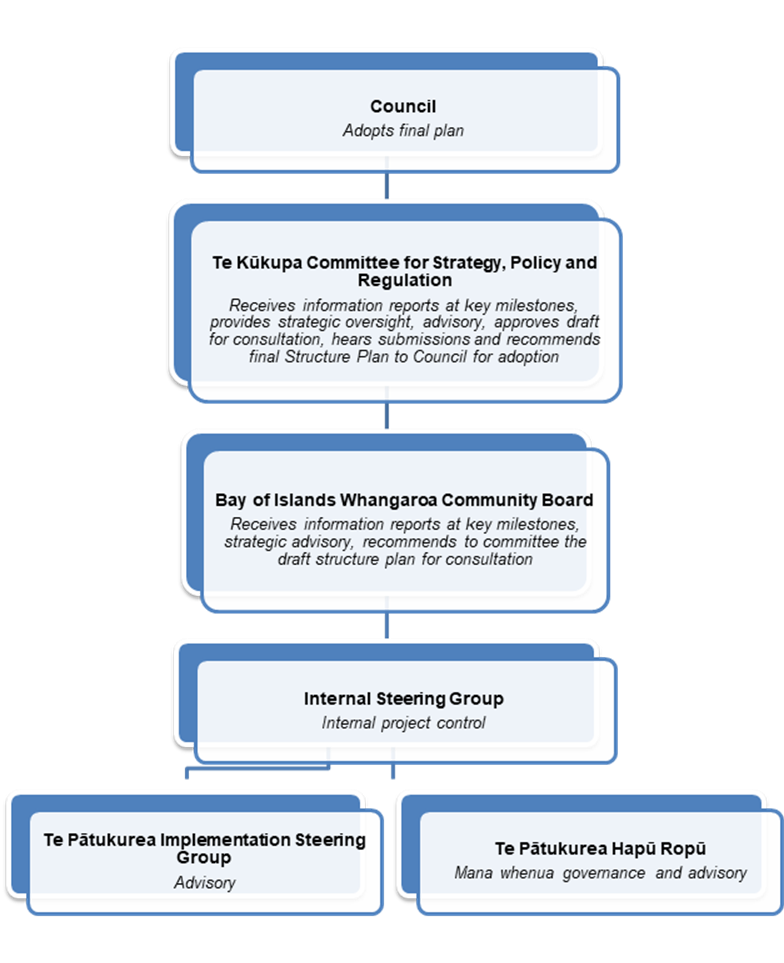
It is anticipated that the Steering Group would meet
approximately 2 to 4 times per year, to be kept up to date with the various Te
Pātukurea implementation plan projects that are underway, and to identify
further opportunities for relevant representatives to participate in individual
projects, or collectively as the steering group, if appropriate. Attachment 1
contains a draft Terms of Reference for the Steering Group, which will be
finalised following establishment of the Steering Group.
Staff recommend that the Board nominates and agrees at this
meeting two Board members to join the Steering Group. We consider it likely
that a member from each of the Kerikeri and Waipapa subdivisions would be
preferrable based on their extent of knowledge on, and linkages into, those
communities. We also recommend that the availability by Board members to attend
the Steering Group meeting is considered in the decision to appoint Board
members.
In addition to establishing the Steering Group, it is
expected that all projects established to implement Te Pātukurea will be
reported on to the Board at key milestones as standard practice.
TAKE TŪTOHUNGA
/ REASON FOR THE RECOMMENDATION
Other options for the composition of elected members on the
Steering Group could be considered, for example, more than two Board members,
or recommending a Councillor on the Steering Group. However, in the interests
of keeping the size of the Steering Group manageable and given the limited
geographic scope of the subject area within the wider district, staff recommend
Board membership is the appropriate level of connection to the subject
communities.
3) PĀnga PŪtea me ngĀ
wĀhanga tahua / Financial Implications and Budgetary Provision
The costs of facilitating the Steering Group meetings are
estimated to be between $5,300 (2 meetings p/a) and $10,600 (4 meetings p/a)
per annum, and these costs have been budgeted for in the Growth Planning and
Placemaking Team cost centre for this financial year. Other than rangatahi and
the Hapū Rōpū, membership of the Steering Group is voluntary and
not remunerated.
Āpitihanga
/ Attachments
1. Draft
Terms of Reference Te Pātukurea Implementation Steering Group - A5540992 ⇩
Hōtaka Take Ōkawa / Compliance Schedule:
Full consideration has been given to the provisions of the
Local Government Act 2002 S77 in relation to decision making, in particular:
1. A
Local authority must, in the course of the decision-making process,
a) Seek
to identify all reasonably practicable options for the achievement of the
objective of a decision; and
b) Assess
the options in terms of their advantages and disadvantages; and
c) If
any of the options identified under paragraph (a) involves a significant
decision in relation to land or a body of water, take into account the
relationship of Māori and their culture and traditions with their
ancestral land, water sites, waahi tapu, valued flora and fauna and other
taonga.
2. This
section is subject to Section 79 - Compliance with procedures in relation to
decisions.
|
He Take Ōkawa /
Compliance Requirement
|
Aromatawai Kaimahi /
Staff Assessment
|
|
State the level of significance (high or low) of the
issue or proposal as determined by the Council’s
Significance and Engagement Policy
|
In accordance with Council’s Significance and
Engagement Policy, this decision is not assessed a being of high significance
as it does not involve the transfer of ownership or control of
a strategic asset, and it is not inconsistent with Council
plans or policies.
|
|
State the relevant Council policies (external or
internal), legislation, and/or community outcomes (as stated in the LTP) that
relate to this decision.
|
Te Pātukurea, Kerikeri Waipapa Spatial
Plan
Local Government Act 2002
|
|
State whether this issue or proposal has a District wide
relevance and, if not, the ways in which the appropriate Community
Board’s views have been sought.
|
This project relates to Kerikeri
and Waipapa and does not have a significant district wide
relevance.
|
|
State the
possible implications for Māori and how Māori have been provided
with an opportunity to contribute to decision making if this decision is
significant and relates to land and/or any body of water.
State the
possible implications and how this report aligns with Te Tiriti o Waitangi /
The Treaty of Waitangi.
|
The Te Pātukurea Hapū Rōpū
Governance Body has been reestablished with mandated representation
for eight local hapū. These hapū are:
· Ngāti Hineira
· Ngāti Korohue
· Ngāti
Mau
· Ngāti
Rangi
· Ngāti
Rēhia
· Ngāti Torehina ki Matakā
· Te
Uri Taniwha
· Te Whiu
|
|
Identify persons likely to be affected by or have an
interest in the matter, and how you have given consideration to their views
or preferences (for example – youth, the aged and those with
disabilities).
|
The Steering Group is being established to ensure key
community stakeholders are involved in projects that implement Te
Pātukurea. The Steering Group does not negate the need to undertake
stakeholder identification and engagement as part of each individual project
to implement Te Pātukurea.
|
|
State the financial implications and where budgetary
provisions have been made to support this decision.
|
There is no requirement for further budgetary
provisions to be made as result of the recommendation in this report.
|
|
Chief Financial Officer review.
|
The CFO has reviewed the report.
|
|
Bay of Islands-Whangaroa Community Board Meeting Agenda
|
12 February 2026
|
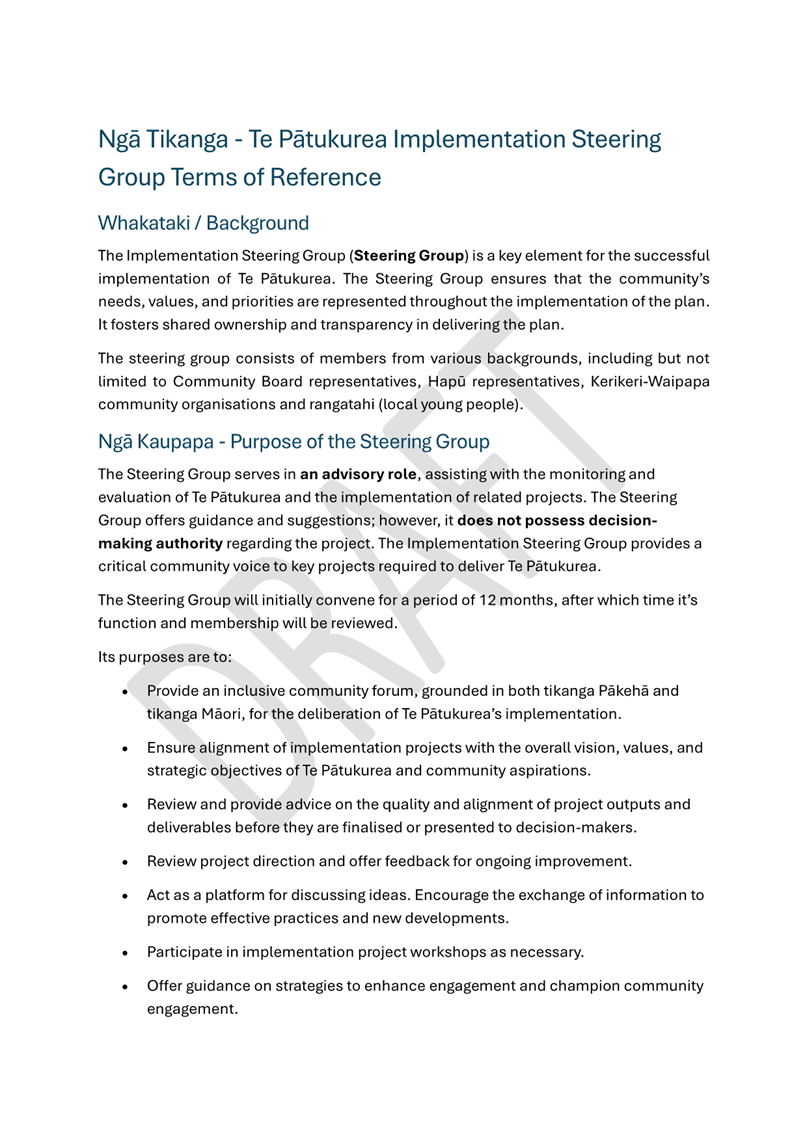
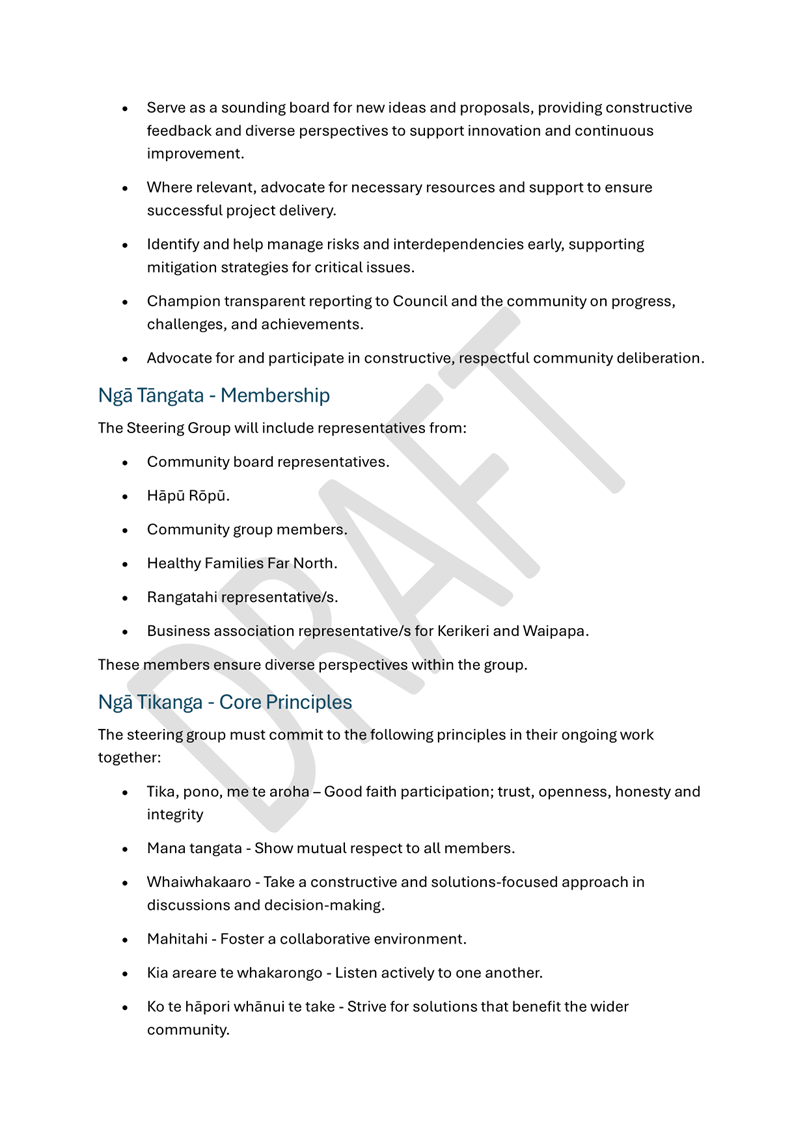
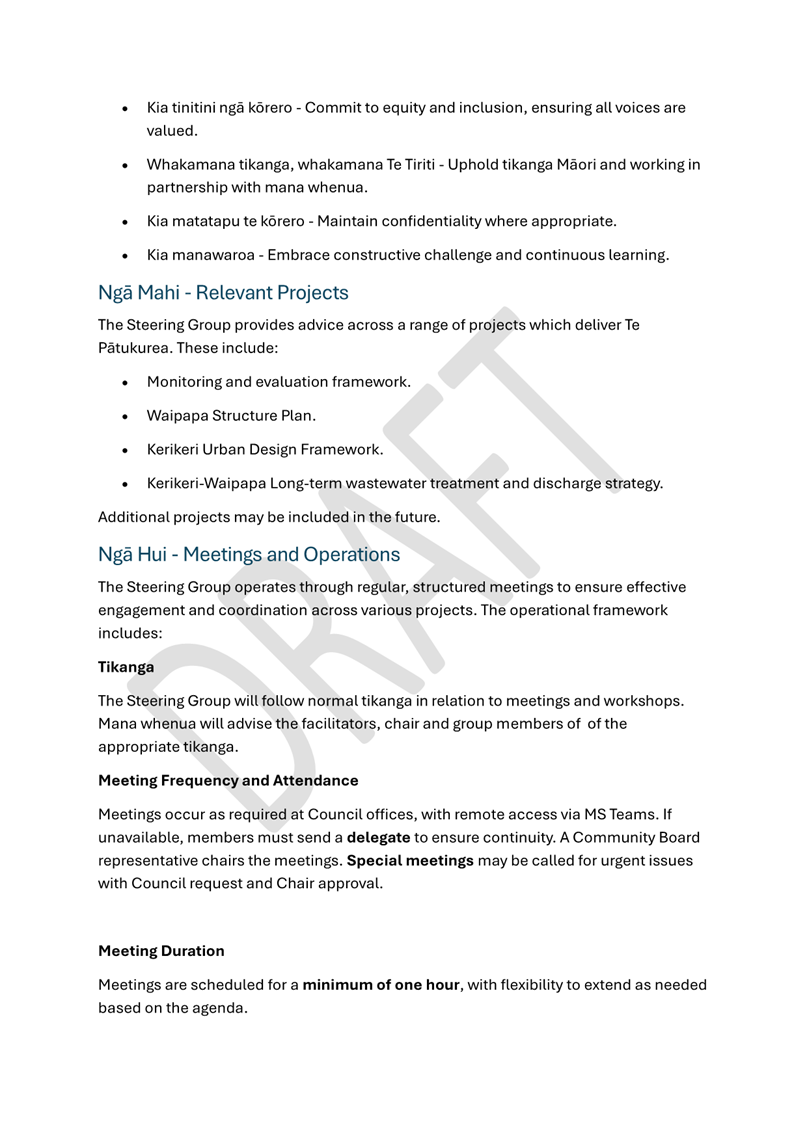
|
Bay of Islands-Whangaroa Community Board Meeting Agenda
|
12 February 2026
|
7.6 Waipapa
Structure Plan
File
Number: A5540967
Author: Azman
Reuben, Senior Strategic Planner - Growth Planning & Placemaking
Authoriser: Roger
Ackers, Group Manager - Planning & Policy
Take Pūrongo / Purpose of the Report
To introduce the Waipapa Structure Plan project and seek
endorsement from the Bay of Islands- Whangaroa Community Board to Te
Kūkupa Committee for Strategy, Policy and Regulation to change the
requirements set down in the Implementation Plan regarding the Waipapa
Structure Plan, specifically the exclusion from the project scope of:
· catchment
management planning; and
· masterplanning of
Te Puāwaitanga
The wording in the implementation plan for the Waipapa
Structure plan states: Develop Structure Plan / Catchment Management Plan
– Waipapa for Urban Intensification and Greenfield areas of Waipapa,
including ‘Te Puāwaitanga Stage 2 Project’, and
consideration of the future of Baysport. The inclusion of catchment
management planning was an error, and we have since identified a more
appropriate method of management planning for Te Puāwaitanga.
The report also recommends that the establishment of an
Elected Member Working Group is not required for this project, and that elected
member involvement in this project is appropriately provided for via the Te
Pātukurea Implementation Steering Group and via regular reporting to the
Bay of Islands-Whangaroa Community Board and Te Kūkupa Committee.
WhakarĀpopoto matua / Executive Summary
· The
Waipapa Structure Plan is a key implementation action
of Te Pātukurea Kerikeri-Waipapa Spatial Plan (link here: Te
Pātukurea), it will be the first structure plan to be delivered as
part of implementing the spatial plan.
· The report outlines the Waipapa Structure Plan project (the
project), which will:
o Translate the strategic
vision of Te Pātukurea into practical steps for land use and
infrastructure planning.
o Inform future district
plan change(s) where necessary.
o Provide certainty for
Council, developers, and the community about how Waipapa will grow.
o Integrate planning for Te
Puāwaitanga (sports hub) and other key facilities.
o Inform investment decisions in the Long-Term Plan and Waters CCO
programme.
· This
report seeks that the Bay of Islands Whangaroa Community Board recommends to Te
Kūkupa Committee the exclusion of a catchment management plan for Waipapa
and a detailed masterplan for Te Puāwaitanga from the scope of the Waipapa
Structure Plan project.
· This
report sets out the project milestones to be reported up to the Bay of
Island-Whangaroa Community Board and Te Kūkupa Committee, in support of
the recommendation to not establish an Elected Member Working Group.
|
tŪtohunga
/ Recommendation
That the Bay of Islands-Whangaroa Community
Board recommends to Te Kūkupa Committee:
a) Exclusion
of the following from the Waipapa Structure Plan project scope:
i) Preparation
of a catchment management plan for Waipapa.
ii) Masterplanning
for Te Puāwaitanga
b) That
establishment of an Elected Member Working Group is not required for this
project, instead key project milestones discussed in this report are reported
on to Te Kūkupa.
|
1) TĀhuhu kŌrero / Background
Council adopted Te Pātukurea and
its implementation plan on 18 June 2025. The Waipapa Structure Plan is a key
short-term action directed by the implementation plan of Te Pātukurea.
The project has been designed to align with current national
and regional planning frameworks, including the National Policy Statement on
Urban Development (NPS-UD), National Policy Statement on Highly Productive
Soils (NPS-HPS), and the Northland Regional Policy Statement. It also supports
Council’s Long-Term Plan priorities and FN2100 growth strategy by
providing a clear framework for infrastructure investment and urban
development. With the reform of resource management legislation and policy direction
currently under way, the project has been designed with ‘check ins’
at critical points. This is to ensure there is alignment with the future
system, particularly the lead pieces of legislation.
The Waipapa Structure Plan will cover the geographic extent
of the urban development areas for Waipapa, as identified in the spatial plan
(refer Figure 1 below). Further detail on the project is provided in Attachment
1.
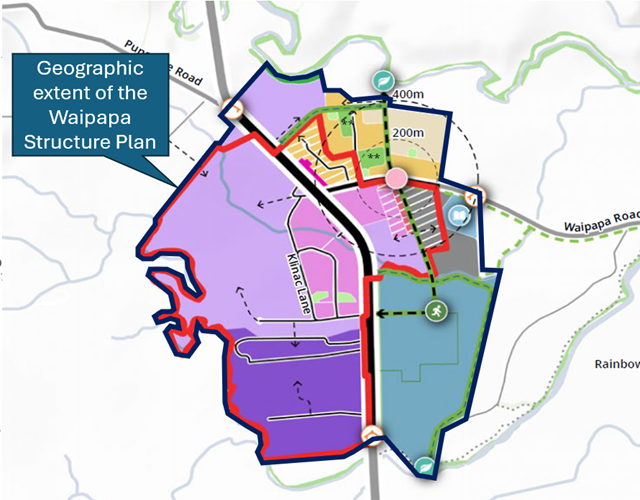
Figure 1: Geographic extent of the Waipapa Structure Plan
study area (black outline around coloured area)
Te Puāwaitanga and Bay Sport
Te Puāwaitanga encompasses 44 hectares, with 12
hectares currently developed in sports fields and parking and another 12
hectares earmarked for Phase 2 sports facilities. However, significant details
for Phase 2 remain undecided and unfunded, and it is yet to be determined
whether all the land will be dedicated to sports or if some land can be set
aside for other uses.
Staff have commissioned an updated needs assessment to
assist in identifying the total land area required to meet future sport and
active recreation needs for the next 30 years. To safeguard the potential
future relocation of most of Baysport activities to Te Puāwaitanga, the
needs assessment will factor in the relocation of all land at Baysport
excluding the land occupied by the tennis courts, skating rink and associated
parking areas, however further negotiations between Baysport and Council are required
to confirm what, when and if relocation from Baysport to Te Puāwaitanga
occurs. Once the needs assessment is completed, a report will go to Council to
confirm the extent of land to be set aside for Te Puāwaitanga. If there is
surplus land on the site, the future uses of this land are expected be
determined through the Waipapa Structure Plan process.
The Waipapa Structure Plan will focus on determining the
overall land use framework, including any surplus land at Te Puāwaitanga
along with any land to be vacated from sport and active recreation uses at
BaySport. The specifics of sports and recreation management on Te
Puāwaitanga will be determined via a future Reserve Management Plan (RMP)
process.
Resource Management Reform &
Proposed District Plan Decisions
The project has built in check points following the passage
of the Planning Bill through parliament, so it can be adapted to fit into the
future planning system.
The project has incorporated
a clear ‘stop/go’ decision point at the early stages of the
programme when district plan decisions are known, specifically at the stage
when council receives recommendations from the hearings panel. Should the proposed
district plan decisions result in urban zone outcomes that are not consistent
with Te Pātukurea, staff will make recommendations to the Bay of
Islands-Whangaroa Community Board and Te Kūkupa on measures to address any
real or perceived inconsistencies between the district plan decisions and the
spatial plan.
2) matapaki me NgĀ KŌwhiringa /
Discussion and Options
Catchment Management Plan and Masterplanning Options
Te Pātukurea Implementation Plan includes actions to
develop a Waipapa Structure Plan that includes development of a catchment
management plan and masterplanning for Te Puāwaitanga and BaySport. This
report recommends excluding these items from the structure plan for the
following reasons:
Catchment Management Plan
· The inclusion of a catchment management plan in this action was an
error as catchment management plans cover a significantly larger land area.
Waipapa is a small portion of the wider water/flood catchment area.
· The
Northland Regional Council is developing a Kerikeri-Waipapa river management
plan which informs flood hazard risk.
· FNDC
Infrastructure Group is responsible for undertaking stormwater catchment
management planning in relation to natural hazards and urban networks under the
Water Services legislation, and as necessary to inform and obtain network
discharge consent from the Northland Regional Council.
· Catchment
management planning and flood modelling is underway, with the Kerikeri-Waipapa
area included in the first stage of works to align with the structure plan
process.
· The
stormwater network and flood modelling work undertaken by FNDC Infrastructure
Group will identify areas critical to management of the stormwater networks.
Future development scenarios will be tested under the structure planning
process, and future network requirements will be identified, including areas
for stormwater management in events up to and including the 1% Annual
Exceedance Probability (AEP) flood event as required by the Council's
Engineering Standards.
Masterplanning for Te Puāwaitanga
· Masterplanning
is best delivered through a Reserve Management Plan, pending classification of
Te Puāwaitanga as a reserve, under the Reserves Act 1977, which provides
the statutory framework for managing reserve land.
· The
Waipapa Structure Plan process is intended to determine the envelope of land
required to meet the long-term needs for sport and active recreation
(considered to be the final extent of Te Puāwaitanga), along with
identifying any potentially surplus land and associated land uses. However,
detailed design and management of the final extent of Te Puāwaitanga needs
to occur through a future Reserve Management Plan process.
· Separating
these processes avoids conflicts of interest and ensures clarity of project
outcomes.
Project staff will collaborate with FNDC Infrastructure
Group on catchment management planning for Waipapa and, in time, will initiate
Te Puāwaitanga Reserve Management Plan project in accordance with
statutory requirements.
Part a) of Recommendation: Decision Regarding Catchment
Management Planning
Option 1: Recommend excluding catchment
management plan for Waipapa and Masterplanning for Te Puāwaitanga (recommended option)
Under this option, the Bay of
Islands-Whangaroa Community Board recommends excluding both
the catchment management plan and masterplanning for Te Puāwaitanga from
the Waipapa Structure Plan.
Advantages:
· Practical steps to give life to the spatial plan.
· FNDC Infrastructure Group continues with existing catchment
management planning work already underway, which enables stormwater discharge
consent to be obtained in preparation for anticipated growth under the
structure plan. Other infrastructure and network planning work for wastewater,
water supply, and transport can be aligned across the structure plan process
and then integrated into long term planning processes.
· Enables
council to comply with statutory requirements under the Water Services
legislation in relation to separation of Urban Stormwater as a stand-alone
business unit.
· Sports and recreation management and uses at Te Puāwaitanga
will be considered via the appropriate mechanism of developing a Reserve
Management Plan (pending classification of Te Puāwaitanga as a reserve).
· A separate catchment management plan project will allow for a more thorough focus on the catchment
and greater process efficiency.
Disadvantages
· Some uncertainty with resource management reform.
Option 2: Do not recommend excluding catchment
management plan for Waipapa and Masterplanning for Te Puāwaitanga
Under this option, the Bay of
Islands-Whangaroa Community Board does not recommend excluding
the catchment management plan and masterplanning for Te Puāwaitanga from
the Waipapa Structure Plan.
Advantages:
· Stays true to original wording from spatial plan.
Disadvantages
· Project
will include scope that is in conflict with the requirements of the Water
Services legislation in relation to stormwater networks, which includes piped
and surface water networks including streams, overland flowpaths, and
floodplains in the 1% AEP storm event).
· Integration issues with having a master plan and catchment
management plan being developed under a process designed to produce a structure
plan for a smaller area than the overall catchment management area.
· Including a catchment management plan duplicates existing catchment
management planning work currently being done by FNDC Infrastructure Group, and
crosses delegation boundaries between council activities.
Part b) of recommendation: Decision Regarding Elected Member Participation
Staff seek to have Te Kūkupa Committee
confirm their preferred level of involvement in this project, either simply
through reporting across the project duration as described below, or with the
formation of an Elected Member Working Group.
Councillor participation in the project is
proposed to be achieved via regular reports to the Bay of Islands-Whangaroa
Community Board and Te Kūkupa as follows:
Te Kūkupa:
· Information reports at key milestones through the project
· Approval of the Draft Structure for public consultation (Approval by
Te Kūkupa)
· Hear and consider submissions on the Draft Structure Plan (Heard by
Te Kūkupa)
· Making recommendations to Council for the adoption of the Structure
Plan
· In
addition, workshops can be undertaken with Te Kūkupa
Committee and the Bay of Islands-Whangaroa Community Board, if requested.
Option 1: Do not establish an Elected
Member Working Group for the project (recommended option)
Under this option, community board
participation in the project will be via regular project reports to the
community board, and participation by two members of the board on the yet to be
formed Implementation Steering Group. Councillor participation in this project
will be via the reporting described above.
Advantages:
· Achieves efficient community board member and councillor
participation in this project without introducing a further level of governance
into the project structure.
Disadvantages
· Compared to Option 2 below, may not provide as much opportunity for
one-on-one discussion about the project with councillors.
Option 2: Establish an Elected Member
Working Group for the project.
Under this option, in addition to the
elected member participation described in Option 1, an Elected Member Working
Group shall be formed and a future report to Te Kūkupa will be provided by
staff to achieve establishment of this group.
Advantages:
· May provide greater opportunity for one-on-one discussion about the
project with councillors, compared to Option 1 above.
Disadvantages
· Will require additional staffing resourcing and time
· Will place additional time burden on specific Councillors.
TAKE TŪTOHUNGA
/ REASON FOR THE RECOMMENDATION
Undertaking
the Waipapa Structure Plan project without a catchment management plan for
Waipapa and Masterplanning for Te Puāwaitanga is recommended as it
delivers on Council’s strategic commitments under Te Pātukurea more
efficiently and avoids conflict with the requirements of the Water Services
legislation.
Progressing
the project without establishing an Elected Member Working Group is recommended
as the establishment of the Implementation Steering Group alongside the
proposed extent of reporting to Te Kūkupa across the project duration is
considered sufficient to inform and gain the views of Councillors on this
project.
3) PĀnga PŪtea me ngĀ
wĀhanga tahua / Financial Implications and Budgetary Provision
The project is budgeted at $297,000 across three financial
years (2025–2028) within the Growth Planning & Placemaking cost
centre. No additional funding is required.
Āpitihanga
/ Attachments
1. Attachment
1 - Additional Project Details - A5543589 ⇩
Hōtaka Take Ōkawa / Compliance Schedule:
Full consideration has been given to the provisions of the
Local Government Act 2002 S77 in relation to decision making, in particular:
1. A
Local authority must, in the course of the decision-making process,
a) Seek
to identify all reasonably practicable options for the achievement of the
objective of a decision; and
b) Assess
the options in terms of their advantages and disadvantages; and
c) If
any of the options identified under paragraph (a) involves a significant
decision in relation to land or a body of water, take into account the
relationship of Māori and their culture and traditions with their
ancestral land, water sites, waahi tapu, valued flora and fauna and other
taonga.
2. This
section is subject to Section 79 - Compliance with procedures in relation to
decisions.
|
He Take Ōkawa /
Compliance Requirement
|
Aromatawai Kaimahi /
Staff Assessment
|
|
State the level of significance (high or low) of the
issue or proposal as determined by the Council’s
Significance and Engagement Policy
|
In accordance with Council’s Significance and
Engagement Policy, this decision is not assessed a being of high significance
as it does not involve the transfer of ownership or control of a strategic
asset, and it is not inconsistent with Council plans or policies.
The public will be consulted at the draft plan stage.
|
|
State the relevant Council policies (external or
internal), legislation, and/or community outcomes (as stated in the LTP) that
relate to this decision.
|
Far North 2100
Te Patukurea, Kerikeri Waipapa Spatial Plan
The Resource Management Act 1991
National Policy Statement – Urban Development 2020
National Policy Statement – Highly Productive
Soils 2022
Local Government Act 2002
Northland Regional Policy Statement
Far North District Council Proposed District Plan
|
|
State whether this issue or proposal has a District wide
relevance and, if not, the ways in which the appropriate Community
Board’s views have been sought.
|
Recommendation sought for the project relates to Waipapa
and does not have a significant district wide relevance.
|
|
State the
possible implications for Māori and how Māori have been provided
with an opportunity to contribute to decision making if this decision is
significant and relates to land and/or any body of water.
State the
possible implications and how this report aligns with Te Tiriti o Waitangi /
The Treaty of Waitangi.
|
The Te Patukurea Hapū Rōpū Governance
Body has been reestablished with mandated representation for eight local
hapū. These hapū are:
· Ngāti
Hineira
· Ngāti
Korohue
· Ngāti
Mau
· Ngāti
Rangi
· Ngāti
Rēhia
· Ngāti
Torehina ki Matakā
· Te
Uri Taniwha
· Te
Whiu
|
|
Identify persons likely to be affected by or have an
interest in the matter, and how you have given consideration to their views
or preferences (for example – youth, the aged and those with
disabilities).
|
Community groups will be engaged via steering group.
There will be multiple opportunities to community and stakeholder input into
the project.
|
|
State the financial implications and where budgetary
provisions have been made to support this decision.
|
There is no requirement for further budgetary provisions
to be made as result of the recommendation in this report.
|
|
Chief Financial Officer review.
|
The Chief Financial Officer has
not reviewed this report.
|
|
Bay of Islands-Whangaroa Community Board Meeting Agenda
|
12 February 2026
|
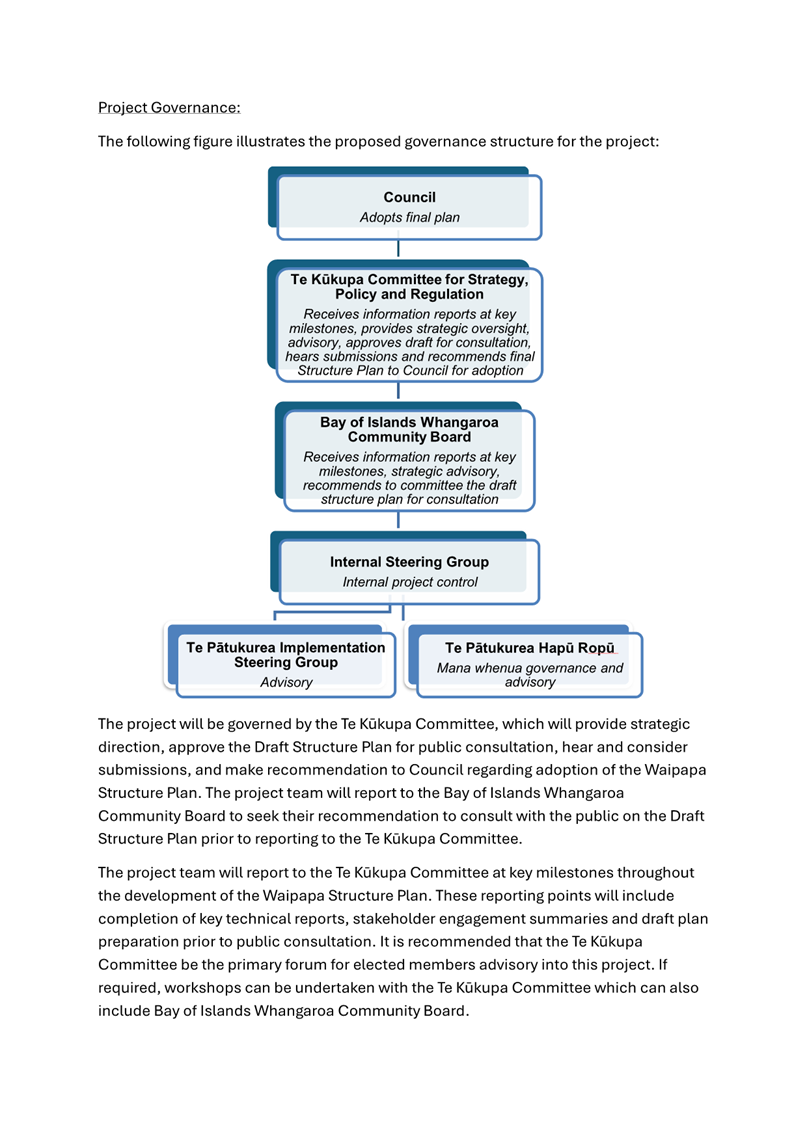
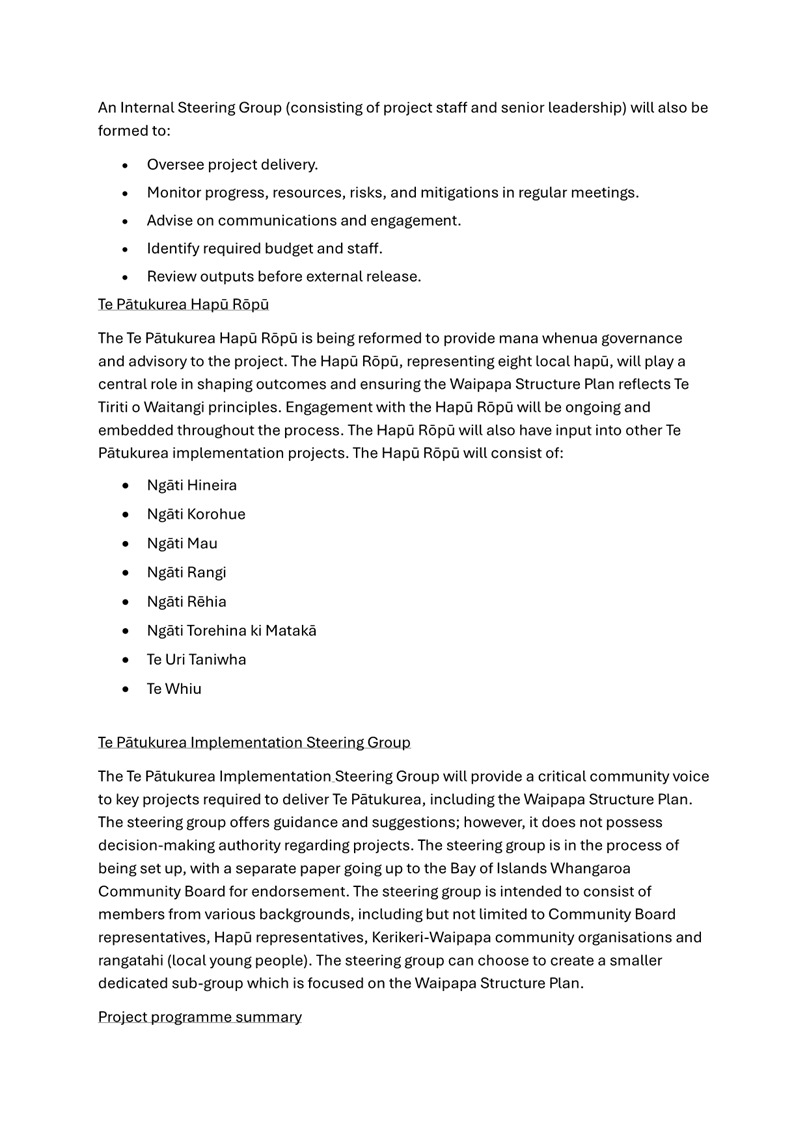
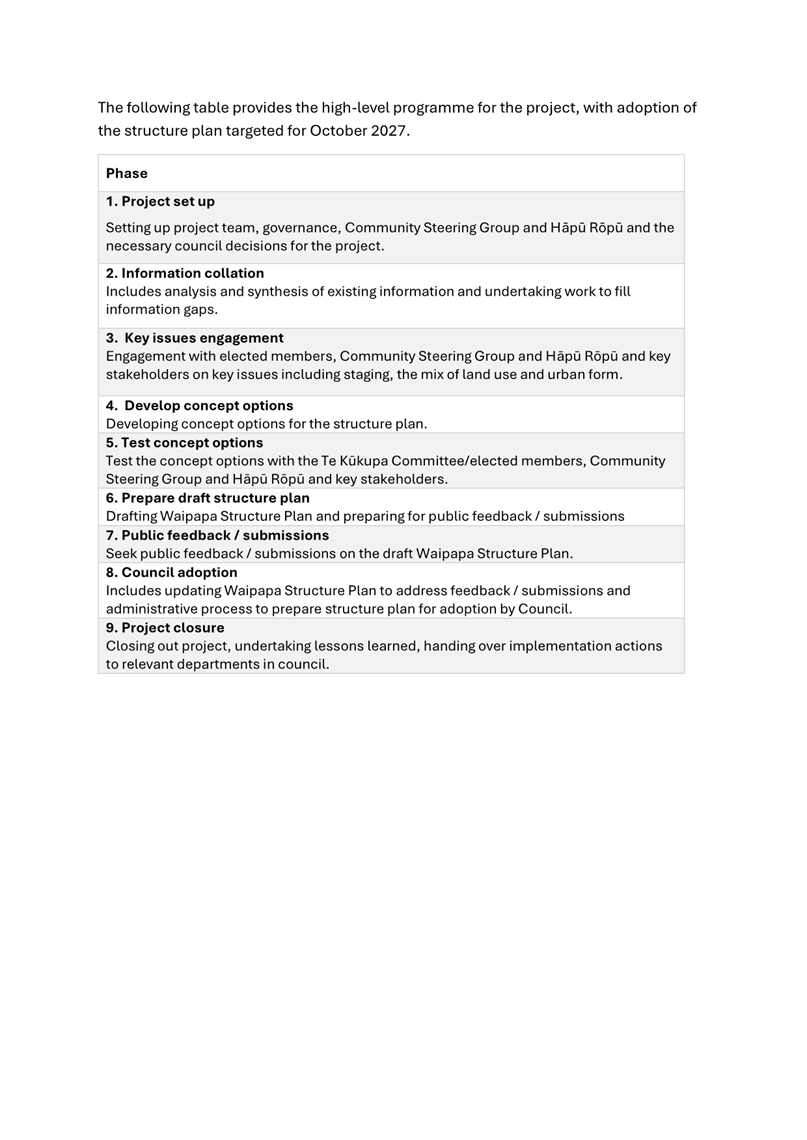
|
Bay of Islands-Whangaroa Community Board Meeting Agenda
|
12 February 2026
|
7.7 Bay of Islands-Whangaroa Community Board Capital project
priorities for Long Term Plan (2027/37) alignment.
File
Number: A5541718
Author: Stephen
FitzHerbert, Community Board Co-Ordinator
Authoriser: Aisha
Huriwai, Manager - Democracy Services
Take
Pūrongo / Purpose of the Report
To confirm the Bay of Islands-Whangaroa Community Board key
strategic priorities for inclusion in the planning process for Council’s
2027-37 Long Term Plan (LTP).
WhakarĀpopoto matua / Executive Summary
· A 2023–2025 Strategic Plan was developed by the Board prior to
the 2025 election.
· The incoming Board formally noted this plan at its meeting on 27
November 2025.
· Work on reviewing and developing the 2025–2028 Strategic Plan
is currently underway.
· The Board has expedited the identification of key capital
expenditure priorities to align with the LTP 2027–2037 planning process.
· Further development and refinement of the Strategic Plan will
continue in early 2026.
|
tŪtohunga
/ Recommendation
That Bay of Islands-Whangaroa Community Board endorse
and confirm the following capital project priorities for inclusion in their
2025–2028 Strategic Plan and for progression through Council’s
2027/37 Long Term Plan process:
1. Onewhero
Bay – Park inspection and installation of tailored Park signage
2. Te
Puāwaitanga – Sealing of gravel carpark, footpath
installation and investigation of safe SH10 crossings
3. Russell
Public Toilets – Replacement of York Street toilets
4. Waipapa
Carpark Public Toilets – Extension of soakage field
5. Whangaroa
Reserve – Sealing of gravel area
6. Maritime
Storm and Sea-level-rise mitigation - Russell
7. Kerikeri
Traffic & Parking – Kerikeri Carpark Plan
8. Parks
& Reserves – Waipapa Landing new recreational resources: footpath,
car and trailer parking, improved walking access to swimming holes
9.
Open spaces – Kaeo
recreational space: installation of removeable bollards, amenity lighting and
CCTV
10. Amenity Lighting
– Priority areas (to be specified)
11. CCTV –
Priority areas (to be specified)
|
1) TĀhuhu kŌrero / Background
Community Board Strategic Planning and Alignment with
Council Processes
Community Board Strategic Plans are dynamic, living
documents that capture local community needs and aspirations. They serve as a
key instrument for identifying priorities for community services and assets,
feeding directly into Council’s Long-Term Planning processes and work
programmes.
Bay of Islands-Whangaroa Community Board Strategic Plan
2023–2025 was developed by the previous Board with support from FNDC
staff. The current Board has acknowledged this plan and is actively reviewing
it while developing the 2025–2028 Strategic Plan.
Priorities outlined in the Strategic Plan reflect Board
members’ engagement with their communities and draw on local community
development plans. These priorities guide the identification of top capital
projects for consideration in Council’s Long-Term Plan (LTP) budgets.
Council has recently introduced a new approach to planning
and prioritising projects for the upcoming 2027–2037 Long-Term Plan
(LTP). This approach leverages the established Project Portfolio Management
(PPM) system to shape and prioritise every project in the LTP. The goal is to
build strong foundations for smarter, proactive, and informed long-term
planning - enabling early identification of the best project ideas and
supporting sound decision-making well ahead of time.
Every proposed project will be supported by clear
justification and assessed against criteria that align with our priorities:
· Delivering
projects that matter most to our communities
· Evaluating
organisational readiness to deliver
· Analysing
financial and rating impacts, including timing of expenditure, to help optimise
cash flow and debt management throughout the project lifecycle
Proposed project lists will be shared with Council from
March.
2) matapaki me NgĀ KŌwhiringa /
Discussion and Options
To ensure the Community
Board’s highest capital priorities are considered for inclusion in the
proposed projects list, the Board has prioritised identifying these ahead of
finalising the Strategic Plan in its entirety.
Development of the full Strategic Plan is underway and a
draft list of priorities has been prepared. The top identified priorities are:
1. Onewhero
Bay – Park inspection and installation of tailored Park signage
2. Te
Puāwaitanga – Sealing of gravel carpark, footpath installation and
investigation of safe SH10 crossings
3. Russell
Public Toilets – Replacement of York Street toilets
4. Waipapa
Carpark Public Toilets – Extension of soakage field
5. Whangaroa
Reserve – Sealing of gravel area
6. Maritime
Storm and Sea-level-rise mitigation - Russell
7. Kerikeri
Traffic & Parking – Kerikeri Carpark Plan
8. Parks
& Reserves – Waipapa Landing new recreational resources: footpath,
car and trailer parking, improved walking access to swimming holes
9. Open spaces – Kaeo recreational space: installation
of removeable bollards, amenity lighting and CCTV
10. Amenity
Lighting – Priority areas (to be specified)
11. CCTV
– Priority areas (to be specified)
Note: This is not an
exhaustive list of all draft priorities.
Formal ratification of these priorities will strengthen the
justification for associated business cases. However, this does not preclude
future review or amendment of priorities if required. Staff will seek
additional information from Board members to support the development of
detailed business cases.
Option 1: Confirm these as the top priorities for inclusion
in the proposed projects list
Option 2: Do not confirm these as the top priorities for
inclusion in the proposed project list
Option 3: Review and confirm the top priorities with any
minor amendments to the list noted
TAKE TŪTOHUNGA
/ REASON FOR THE RECOMMENDATION
To confirm Bay of Islands-Whangaroa Community Board’s
priority projects for consideration through Council’s Long Term Plan
prioritisation process.
3) PĀnga PŪtea me ngĀ
wĀhanga tahua / Financial Implications and Budgetary Provision
There are no immediate financial implications. Projects in
the plan will be costed as part of the business cases and will be seeking
funding via Council’s Long-Term Planning processes, Community Board grant
funding or other mechanisms.
Āpitihanga
/ Attachments
Nil
Hōtaka Take Ōkawa / Compliance Schedule:
Full consideration has been given to the provisions of the
Local Government Act 2002 S77 in relation to decision making, in particular:
1. A
Local authority must, in the course of the decision-making process,
a) Seek
to identify all reasonably practicable options for the achievement of the
objective of a decision; and
b) Assess
the options in terms of their advantages and disadvantages; and
c) If
any of the options identified under paragraph (a) involves a significant
decision in relation to land or a body of water, take into account the
relationship of Māori and their culture and traditions with their
ancestral land, water sites, wāhi tapu, valued flora and fauna and other
taonga.
2. This
section is subject to Section 79 - Compliance with procedures in relation to
decisions.
|
He Take Ōkawa /
Compliance Requirement
|
Aromatawai Kaimahi /
Staff Assessment
|
|
State the level of significance (high or low) of the
issue or proposal as determined by the Council’s
Significance and Engagement Policy
|
Low significance. The proposal relates to confirming
Community Board priorities for inclusion in the Long-Term Plan (LTP) process.
It does not involve changes to Council services at this stage or any
immediate financial commitment.
|
|
State the relevant Council policies (external or
internal), legislation, and/or community outcomes (as stated in the LTP) that
relate to this decision.
|
Long Term Plan (LTP) 2027–2037 framework
Community Outcomes: Vibrant, healthy, and
resilient communities; Improved infrastructure and services; Strong
partnerships with iwi and hapū.
|
|
State whether this issue or proposal has a District wide
relevance and, if not, the ways in which the appropriate Community
Board’s views have been sought.
|
This proposal is not District-wide; it is specific to
Bay of Islands-Whangaroa ward. The priorities have been identified through
engagement by Community Board members with their local communities and
through review of existing community development plans.
|
|
State the
possible implications for Māori and how Māori have been provided
with an opportunity to contribute to decision making if this decision is
significant and relates to land and/or any body of water.
State the
possible implications and how this report aligns with Te Tiriti o Waitangi /
The Treaty of Waitangi.
|
Further work will be undertaken to assess implications
for specific projects as the process progresses.
|
|
Identify persons likely to be affected by or have an
interest in the matter, and how you have given consideration to their views
or preferences (for example – youth, the aged and those with
disabilities).
|
Priorities reflect feedback gathered through community
engagement and Board member consultation.
|
|
State the financial implications and where budgetary
provisions have been made to support this decision.
|
Costing will occur during business case development,
with funding sought through Council’s LTP process, Community Board
grants, or other mechanisms.
|
|
Chief Financial Officer review.
|
Not applicable at this stage; CFO review will occur
during LTP prioritisation and budgeting.
|
|
Bay of Islands-Whangaroa Community Board Meeting Agenda
|
12 February 2026
|
7.8 Chairperson
and Members Reports
File
Number: A5541747
Author: Stephen
FitzHerbert, Community Board Co-Ordinator
Authoriser: Aisha
Huriwai, Manager - Democracy Services
TE TAKE PŪRONGO / Purpose of the Report
The report provides feedback to the community on matters of
interest or concern to the Community Board.
|
NGĀ
TŪTOHUNGA / Recommendation
That the Bay of Islands-Whangaroa Community Board note
the February 2026 member reports from Chair Belinda Ward, Deputy Chair Tyler
Bamber, Member Jane Hindle, Member Jo Alexander and Member Dane Hawker.
|
TE tĀHUHU KŌRERO / Background
The Local Government Act 2002 Part
4 Section 52 states that the role of a Community Board is to represent, and act
as an advocate for the interests of its community.
TE MATAPAKI ME NGĀ KŌWHIRINGA /
Discussion and Next Steps
Community Boards are required to
consider and report on any matters of concern or interest to the Community
Board, maintain an overview of services provided to the community and
communicate with community organisations and special interest groups within the
community.
The reports from the Chairperson
and Members provide information to community on these requirements. They
also provide Request for Service (RFS) information on issues of interest or
concern to the Community Board, providing a reference for further enquiry on
the progress of the matters raised. The report from the Chairperson and members
are attached.
Resource Consents have been emailed
to community board members. Members have five days to send feedback in relation
to a resource consent. Members will be expected to include these details in
their member reports going forward.
REASON FOR THE RECOMMENDATION
The reason for the recommendation
is to provide information to the Community on the work that has been undertaken
by the Chairperson and Members on its behalf.
NGĀ PĀNGA PŪTEA ME NGĀ WĀHANGA
TAHUA / Financial Implications and Budgetary Provision
There are no financial implications
or the need for budgetary provision as a result of this report.
ngĀ
Āpitihanga / Attachments
1. BWCB
Belinda Ward Chair Report - A5558125 ⇩
2. BWCB
Tyler Bamber Member Report - A5558119 ⇩
3. BWCB
Jane-Hindle 260128 Report - A5558121 ⇩
4. BWCB
Jo Alexander Member Report_290126 - A5558123 ⇩
5. BWCB
Dane Hawker Report - A5558117 ⇩
|
Bay of Islands-Whangaroa Community Board Meeting Agenda
|
12 February 2026
|
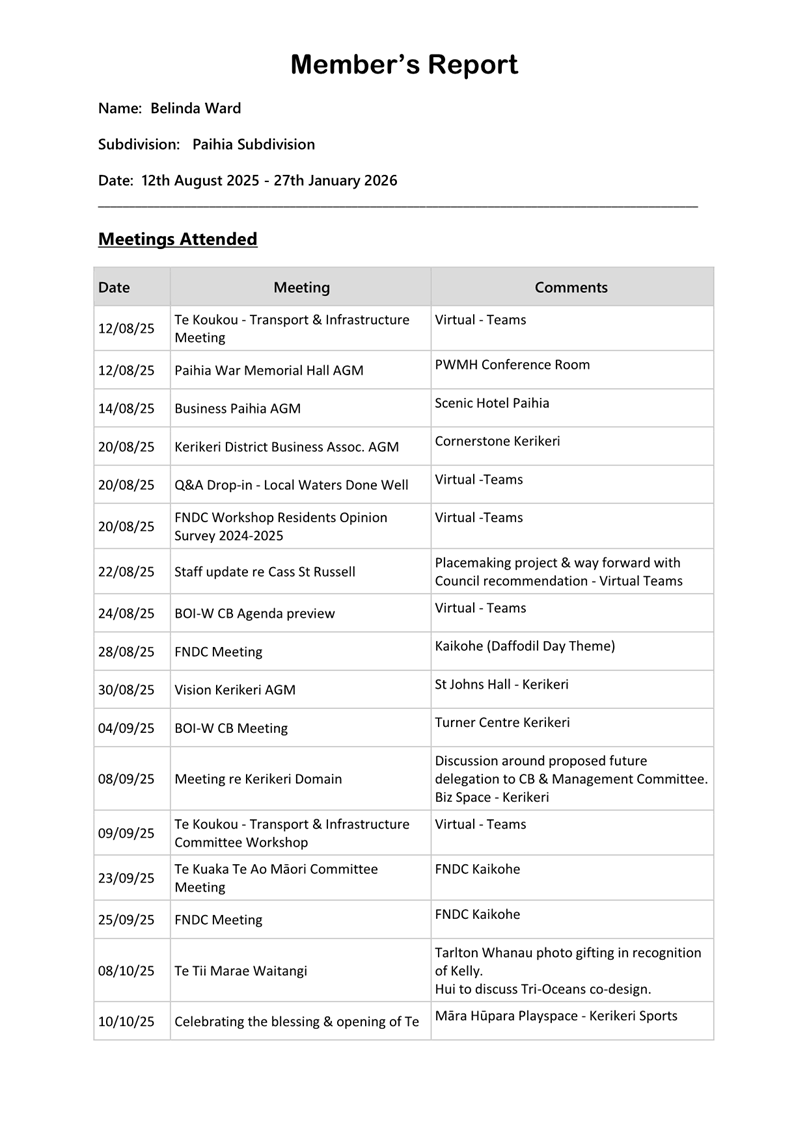
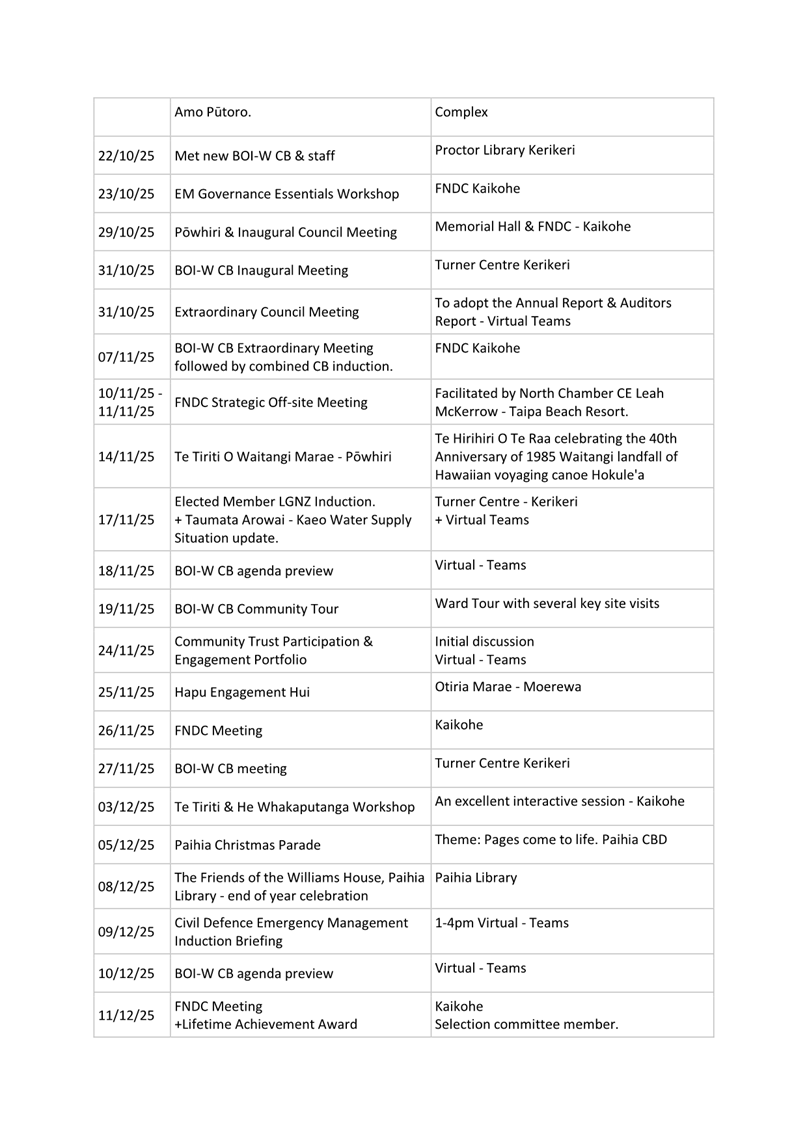
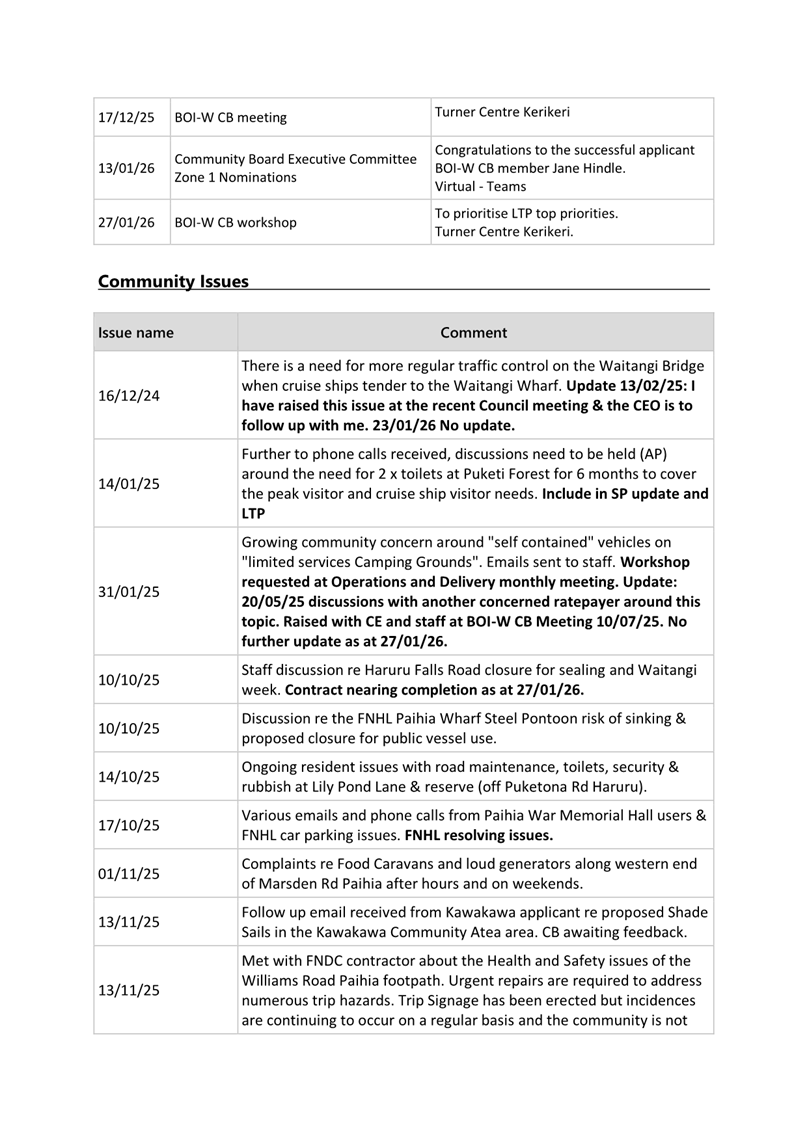
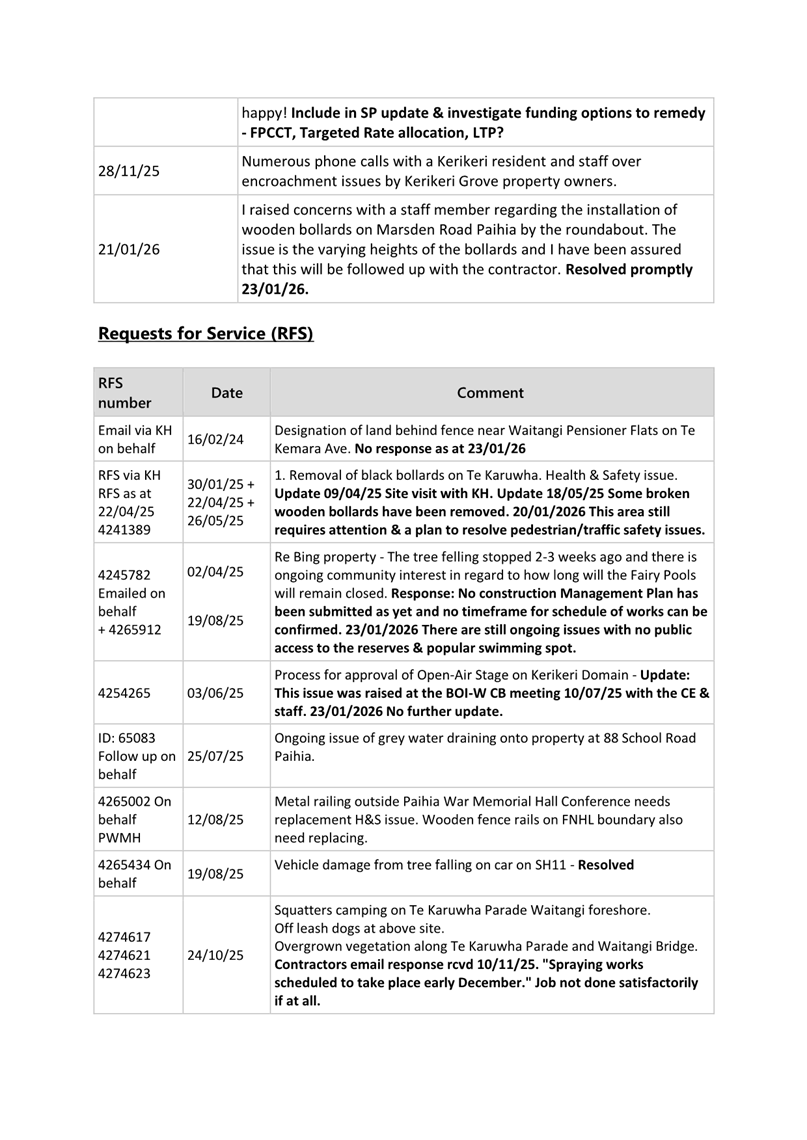
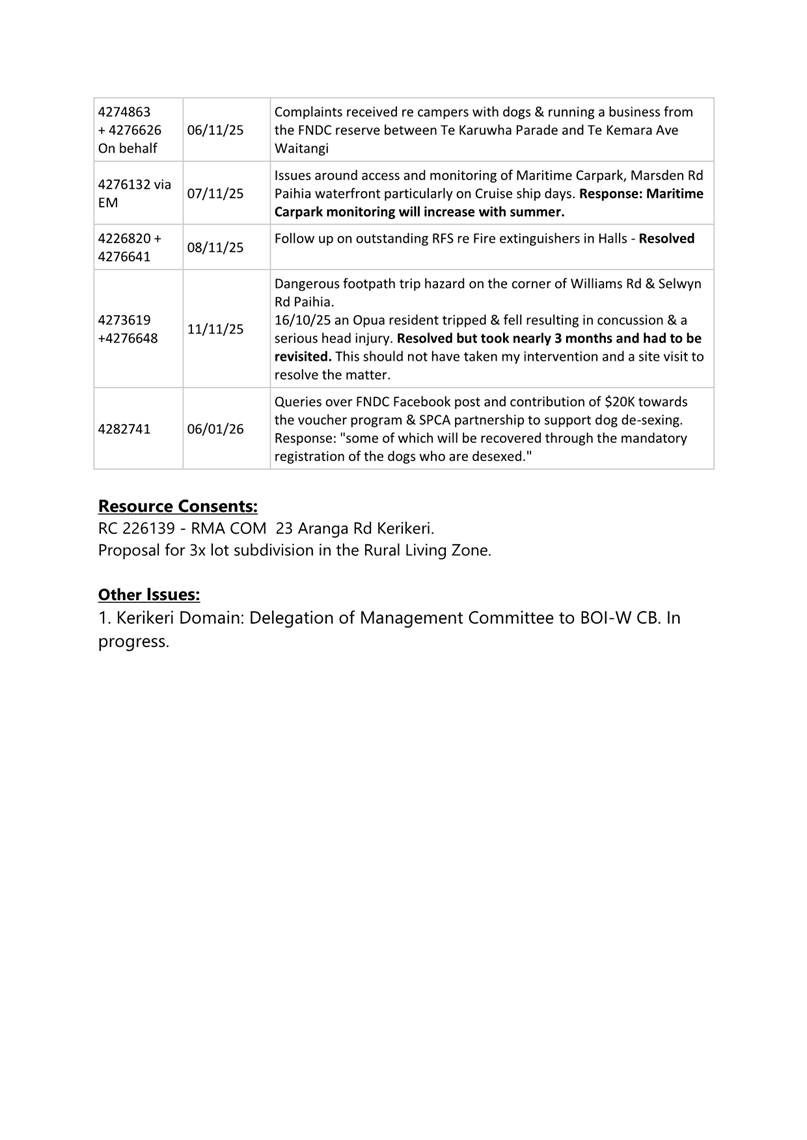
|
Bay of Islands-Whangaroa Community Board Meeting Agenda
|
12 February 2026
|
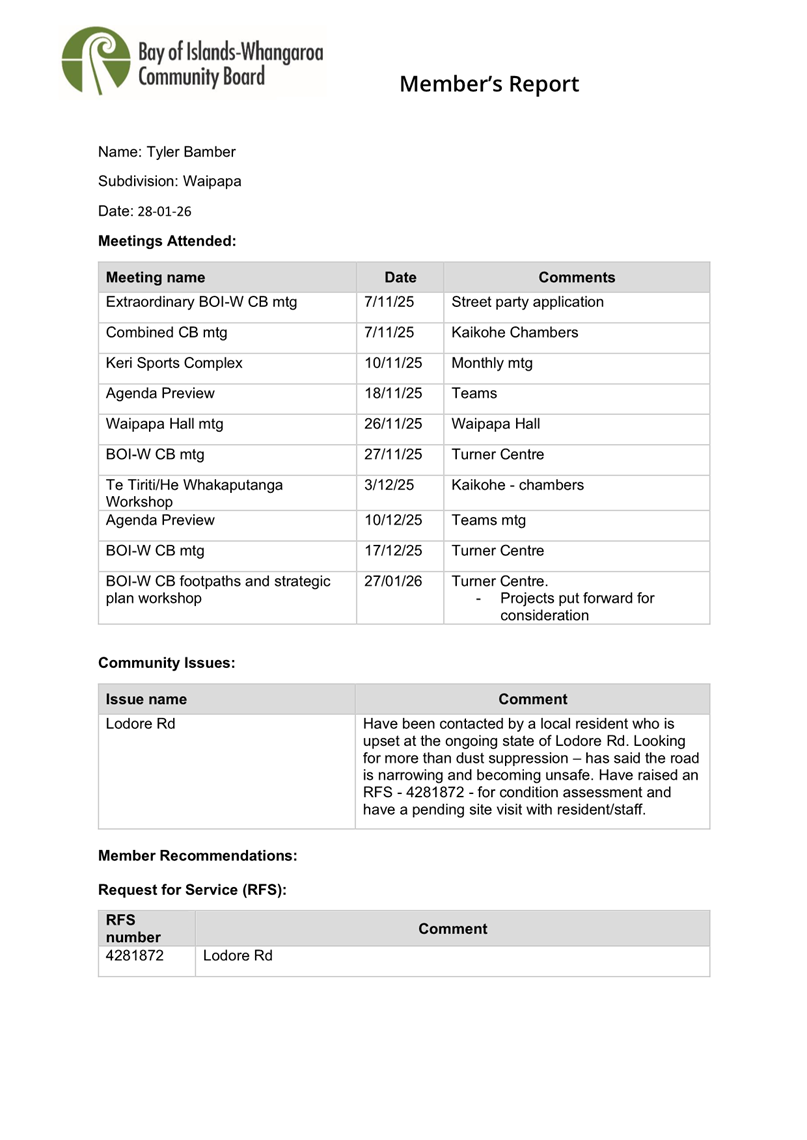
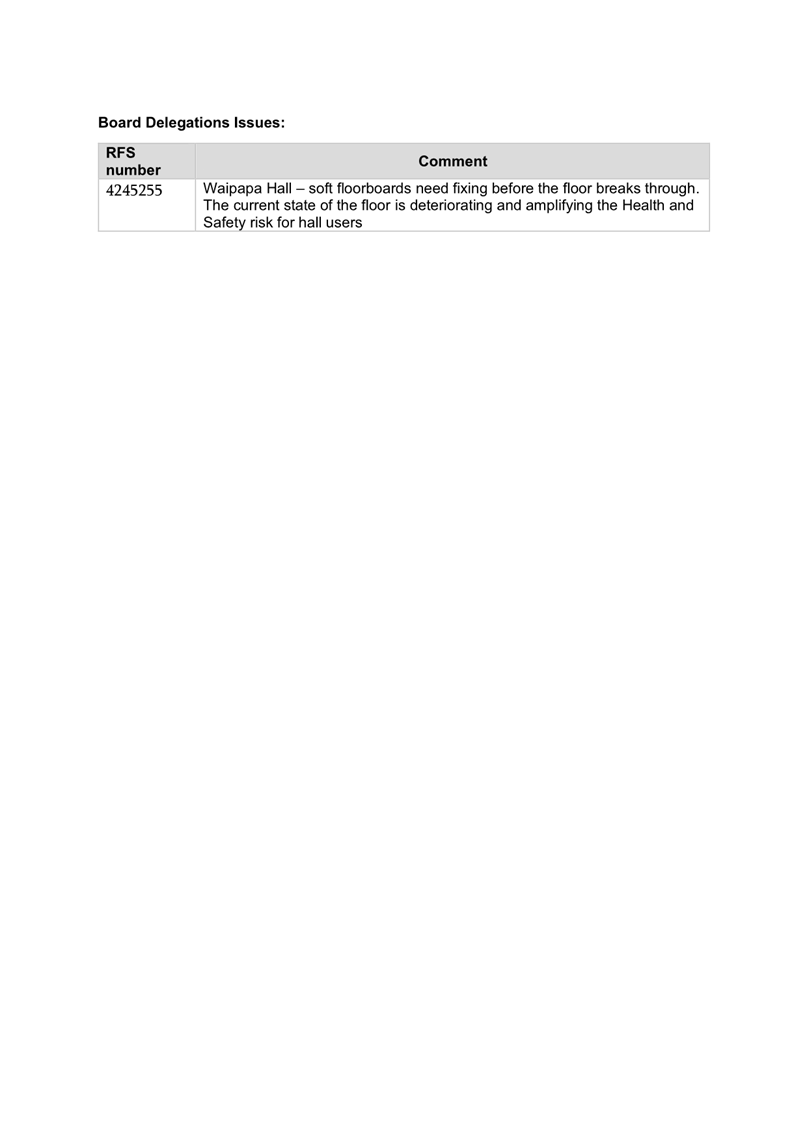
|
Bay of Islands-Whangaroa Community Board Meeting Agenda
|
12 February 2026
|
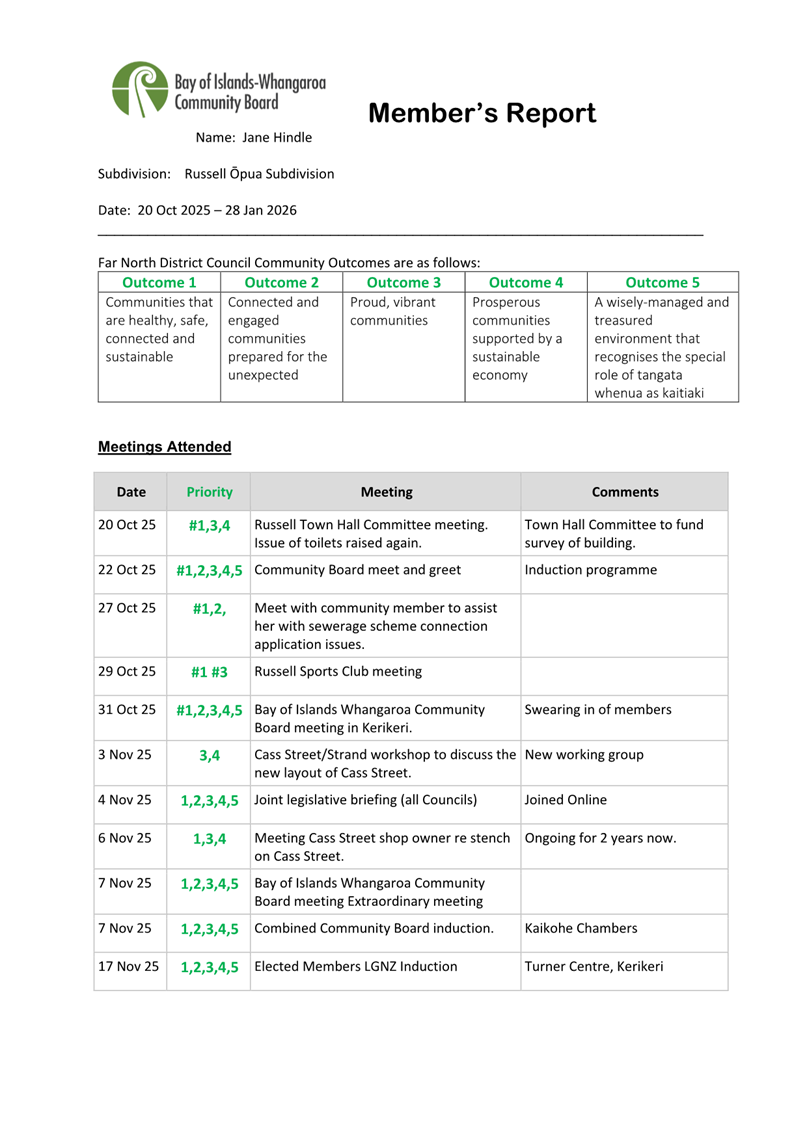
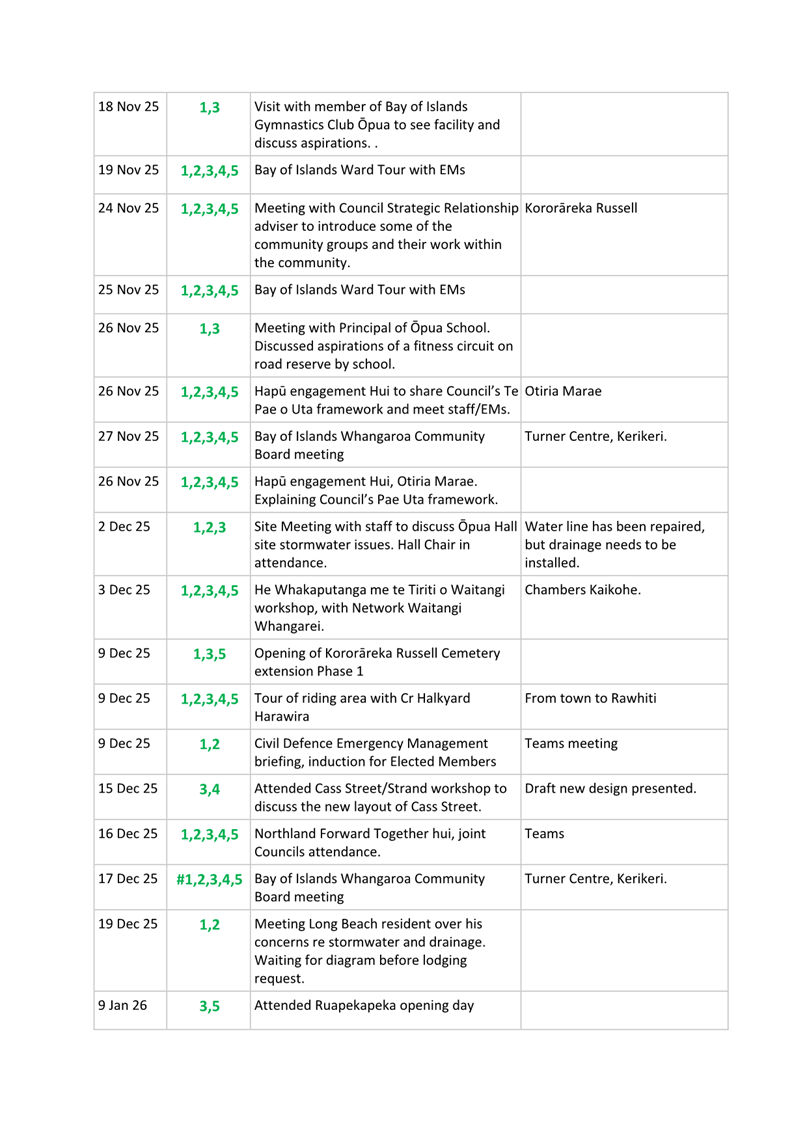
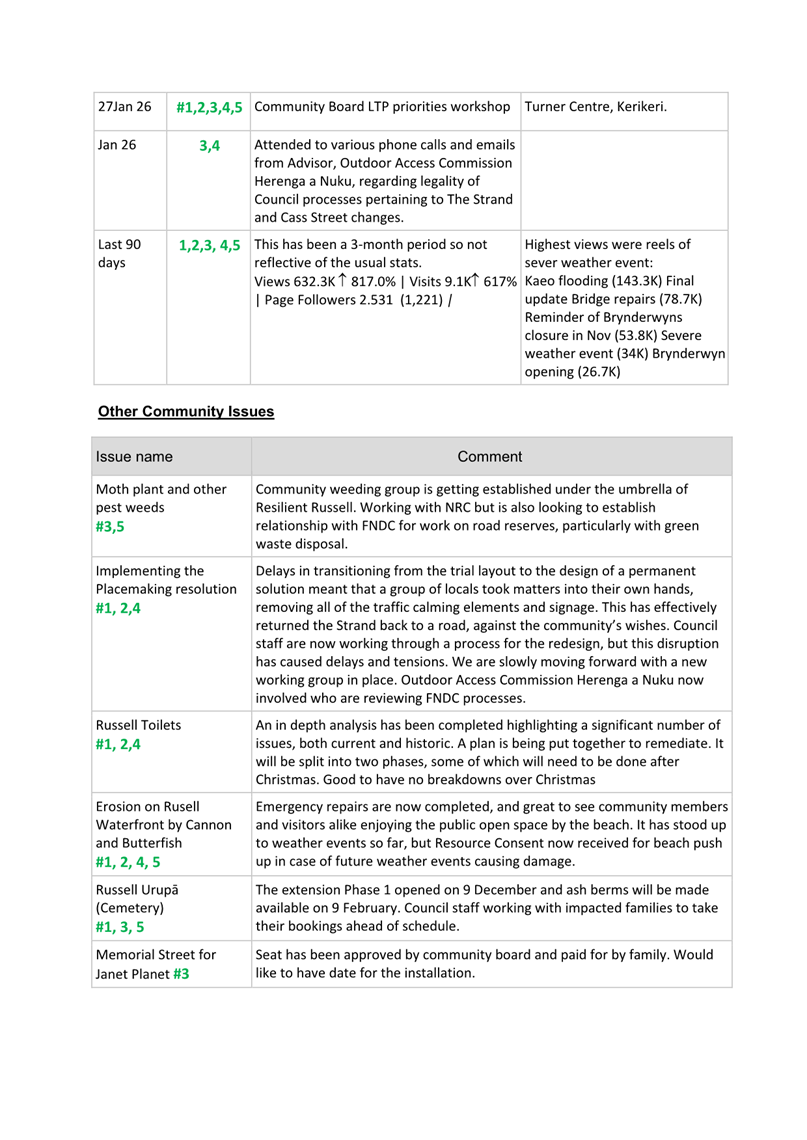
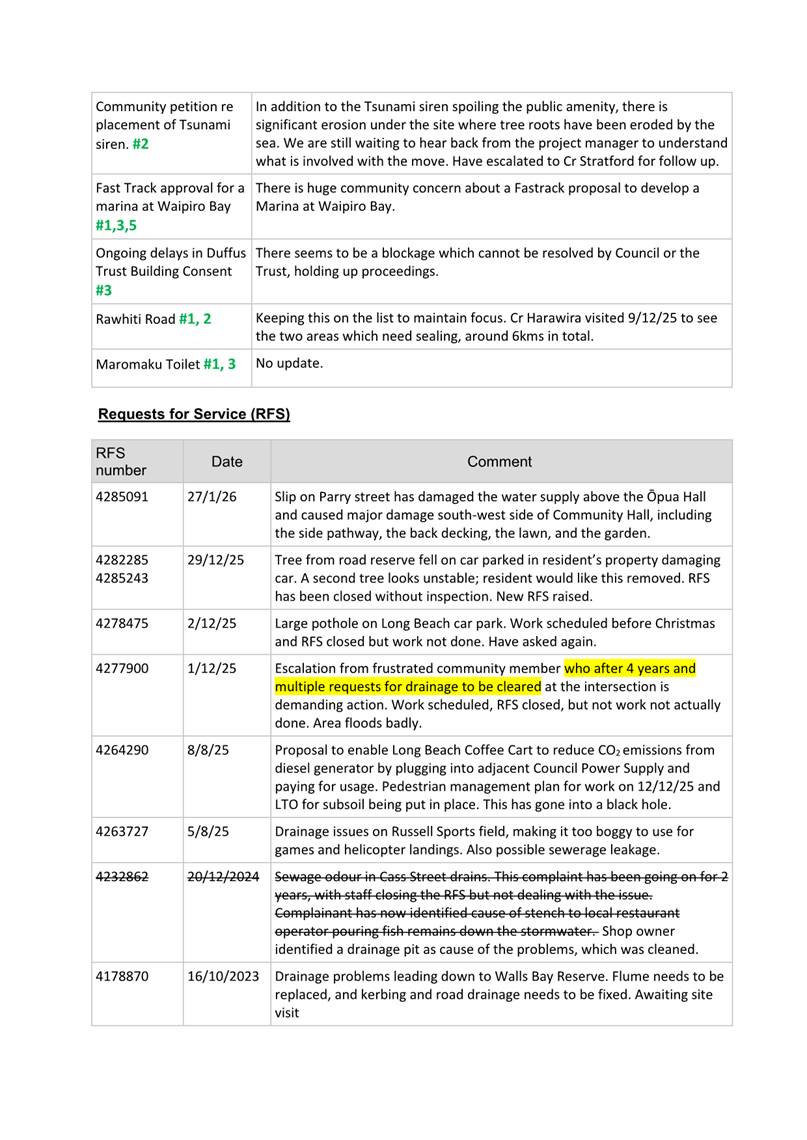
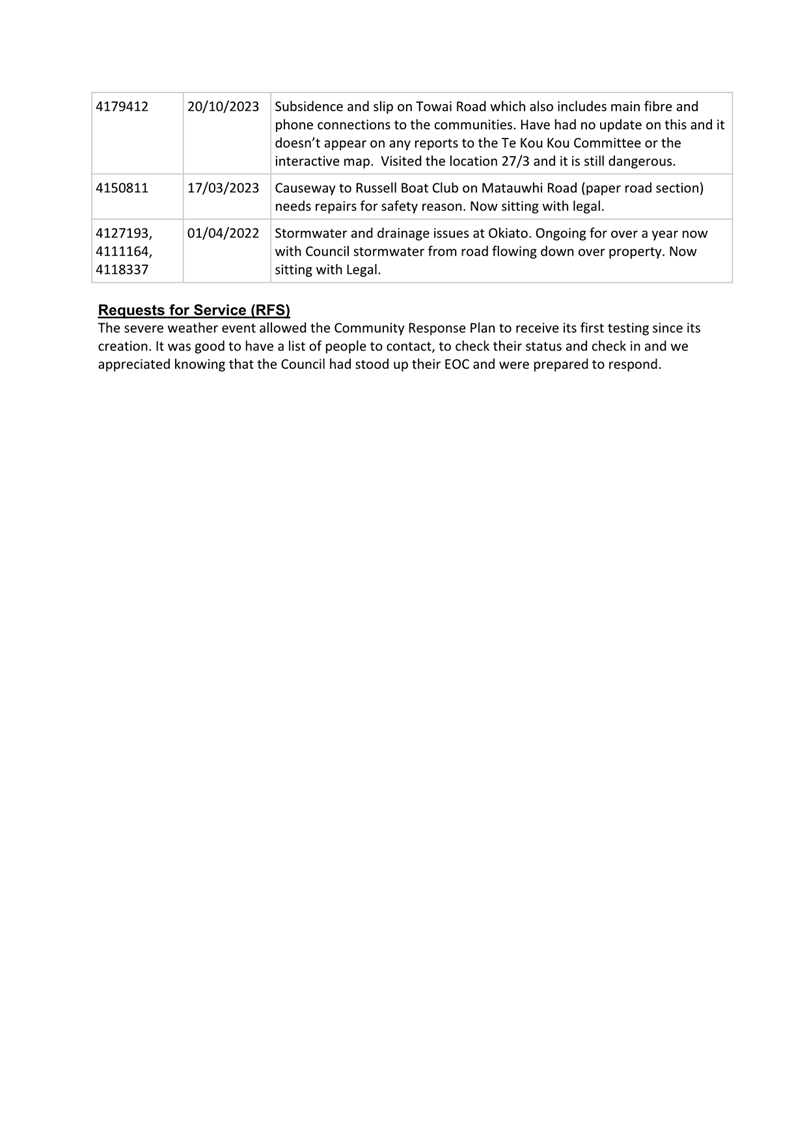
|
Bay of Islands-Whangaroa Community Board Meeting Agenda
|
12 February 2026
|
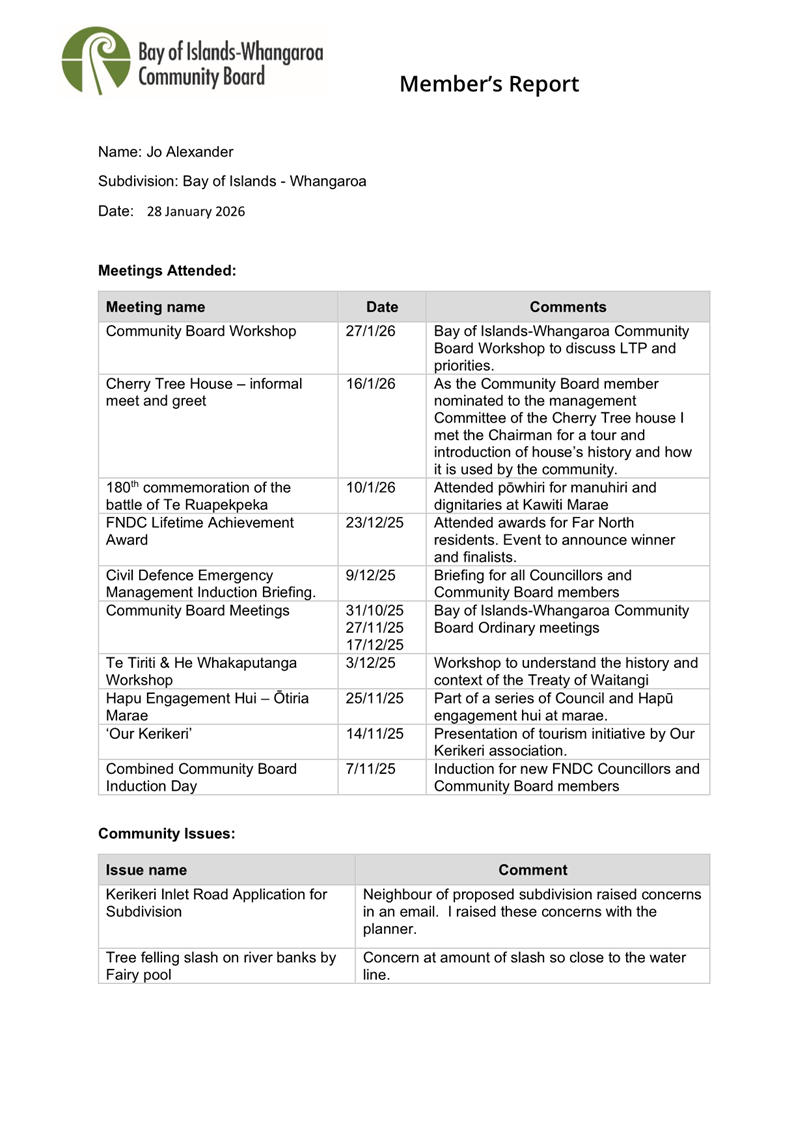
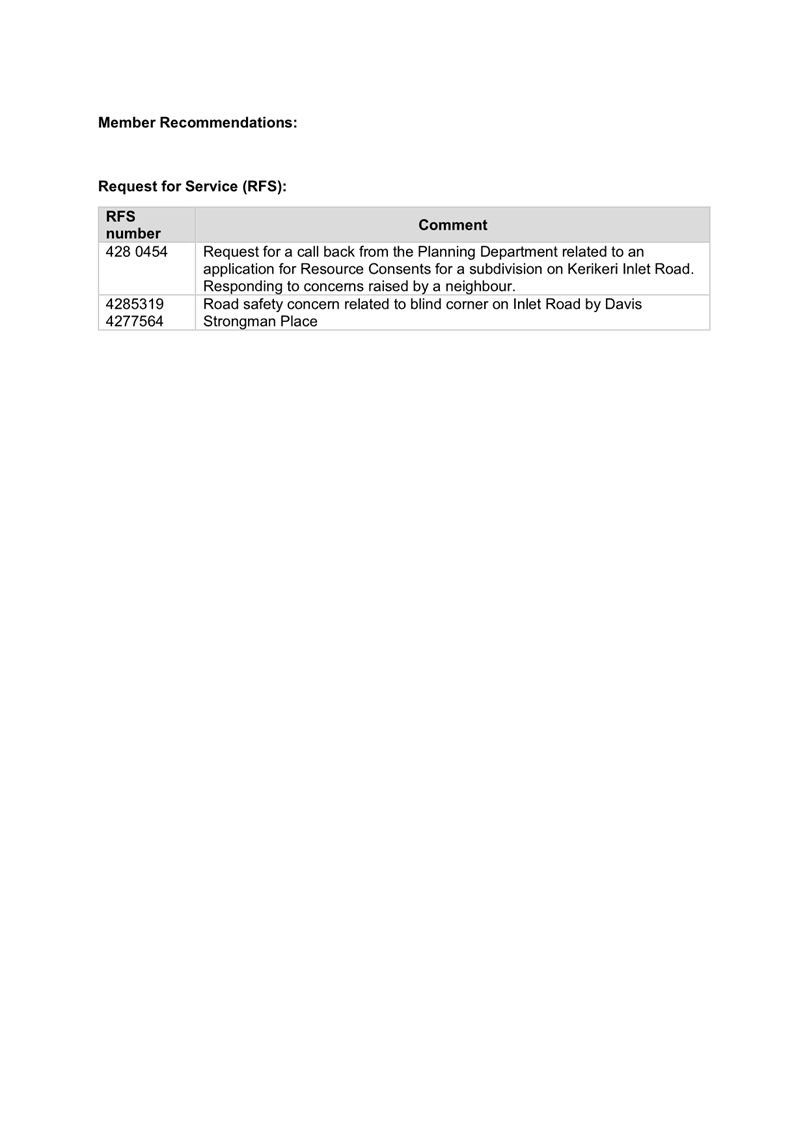
|
Bay of Islands-Whangaroa Community Board Meeting Agenda
|
12 February 2026
|
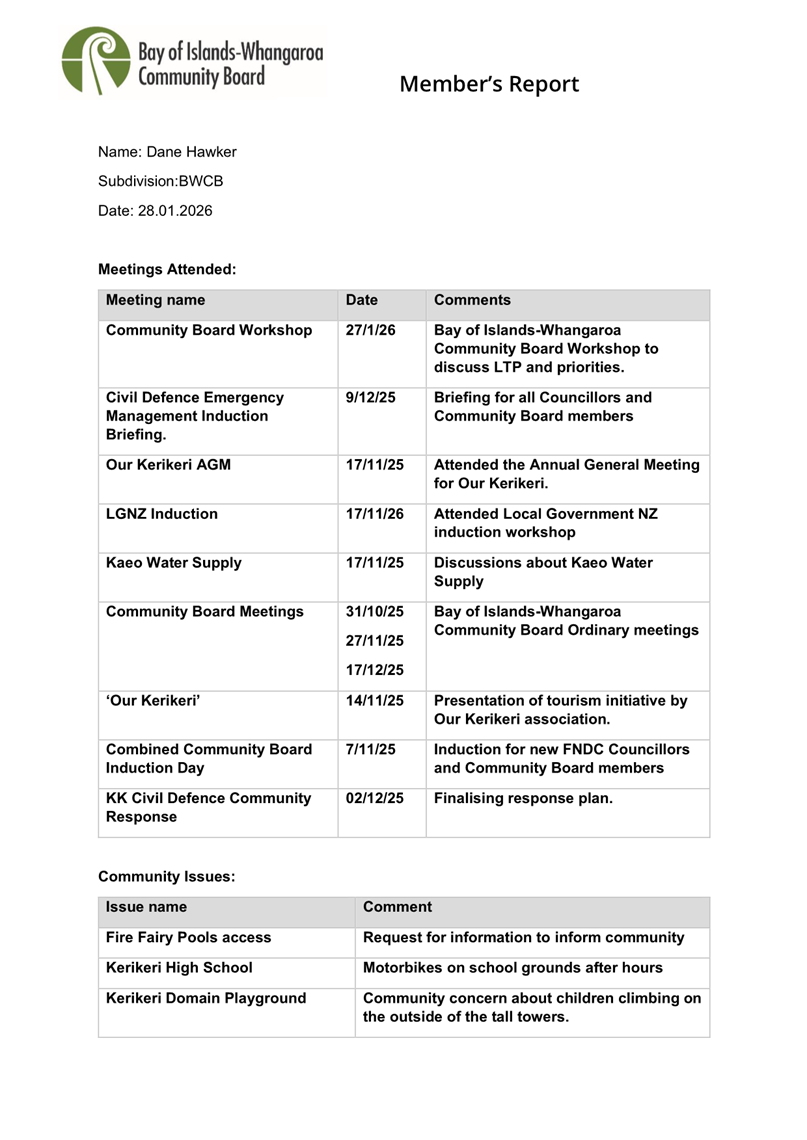
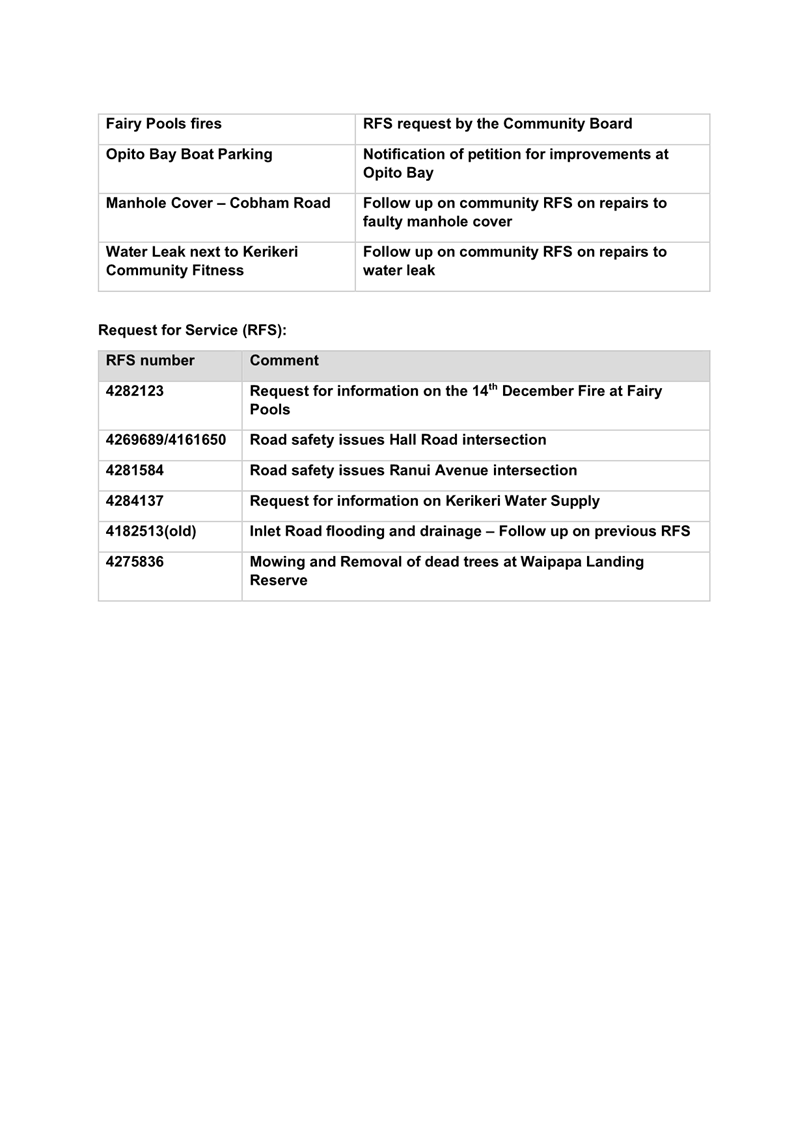
|
Bay of Islands-Whangaroa
Community Board Meeting
Agenda
|
12 February 2026
|
8 Ngā
Pūrongo Taipitopito / Information Reports
8.1 Bay
of Islands-Whangaroa Community Board Open Resolution Report
File
Number: A5544233
Author: Amber
Wihongi-Alderton, Democracy Advisor
Authoriser: Aisha
Huriwai, Manager - Democracy Services
TAKE PŪRONGO / Purpose of the Report
To
provide the Bay of Islands-Whangaroa Community Board with an overview of
outstanding open resolutions arising from meetings.
WHAKARĀPOPOTO MATUA / Executive SummarY
Open resolutions
are a mechanism to communicate progress against decisions/resolutions.
|
TŪTOHUNGA
/ Recommendation
That Bay of Islands-Whangaroa Community Board receive
the Bay of Islands-Whangaroa Community Board Open Resolution Report.
|
tĀHUHU KŌRERO / Background
Open resolution reports
provide regular updates on progress against decisions made at meetings.
Open resolution reports
have been designed as a way to close the loop and communicate with elected
members on the decisions made by way of resolution at formal meetings.
MATAPAKI ME NGĀ KŌWHIRINGA /
Discussion and Next Steps
Group Managers will assist in recording and following up
outstanding open resolutions and action points with staff where appropriate,
and occasionally, may be in a position to provide a further verbal update at
meetings following the printing of an agenda. Democracy Services staff will
support the process by generating reports.
The outstanding tasks are often multi-facet projects that
take longer to fully complete.
PĀNGA PŪTEA ME NGĀ WĀHANGA
TAHUA / Financial Implications and Budgetary Provision
There are no financial
implications or need for budgetary provision in receiving this report.
Āpitihanga
/ Attachments
1. Open
Resolution Report - January 2026 - A5547808 ⇩
|
Bay of Islands-Whangaroa Community Board Meeting Agenda
|
12 February 2026
|