Te Kaunihera o Te Hiku o te Ika
AGENDA
Ordinary Te Kuaka - Te Ao Māori
Committee Meeting
Tuesday, 23 September 2025
|
Time:
|
10:00am
|
|
Location:
|
Council Chambers
Memorial Avenue
Kaikohe
|
Membership:
Co-Chair
- Pita Tipene Te Kahu o Taonui
Co-Chair
- Cr Hilda Halkyard-Harawira
Kahika
- Mayor Moko Tepania
Kōwhai
– Deputy Mayor Kelly Stratford
Cr
Ann Court
Cr
Felicity Foy
Cr
Babe Kapa
Cr
Penetaui Kleskovic
Cr
Steve McNally
Cr
Mate Radich
Cr
Tāmati Rākena
Cr
John Vujcich
Te
Kahu o Taonui Representatives
|
|
Authorising Body
|
Mayor/Council
|
|
Status
|
Standing Committee
|
|
COUNCIL COMMITTEE
|
Title
|
Te Kuaka – Te Ao
Māori Committee
Terms of Reference
|
|
Approval Date
|
29 June 2023
|
|
Amendment Date
|
03 July 2025
|
|
Responsible Officer
|
Chief Executive
|
Kaupapa / Purpose
The purpose of Te Kuaka
Committee is to strengthen a Te Ao Māori perspective within Council
decision-making across policies and strategies.
To perform his or her role
effectively, each member must develop and maintain his or her skills and
knowledge, including an understanding of the Committees’
responsibilities, and of the Council’s business, operations and risks.
Ngā Huānga / Membership
The Committee will comprise of
Mayor and all Councillors as well as 12 iwi representatives nominated through
Te Kahu o Taonui.
|
Kahika/Mayor
Moko Tepania
|
|
Harry
Burkhardt - Chairperson
|
|
Hilda
Halkyard-Harawira – Deputy Chairperson
|
|
Kōwhai/Deputy
Mayor Kelly Stratford
|
|
John
Vujcich
|
|
Ann
Court
|
|
Babe
Kapa
|
|
Felicity
Foy
|
|
Mate
Radich
|
|
Penetaui
Kleskovic
|
|
Steve
McNally
|
|
Tāmati
Rākena
|
Kōrama /
Quorum
The quorum at a
meeting of the Committee is 6 members comprising of 4 FNDC representatives and
2 Te Kahu o Taonui members.
Ngā Hui /
Frequency of Meetings
The Committee shall meet bi-monthly.
Ngā
Apatono / Power to Delegate
The Committee may not
delegate any of its responsibilities, duties or powers.
Ngā
Herenga Paetae / Responsibilities
The
Committees responsibilities are described below:
·
Ensure that the work of Te Kuaka is
carried out in a way that enhances the social, economic, cultural, and
environmental wellbeing of the Far North District
·
Mahi ngātahi mā te huihui,
wānanga Recommend to Council, aspects of importance to Māori
for incorporation into the development of the Strategic documents (e.g. Te Ao
Māori Framework, Annual Plan, Long Term Plan, District Plan)
·
Manaaki To assist Council as appropriate in conducting and
maintaining effective, good faith working relationships with the Māori
community (e.g. Iwi Hapu Environmental Management Plans)
·
Recommend to Council aspects that the
Far North District Council could pursue to develop and or enhance Māori
capacity to contribute to Council’s decision-making processes.
Ngā Ture
/ Rules and Procedures
Council’s
Standing Orders and Code of Conduct apply to all meetings.
Far North District Council
Ordinary Te Kuaka - Te Ao Māori Committee Meeting
will be held in the Council Chambers, Memorial Avenue,
Kaikohe on:
Tuesday 23 September 2025 at 10:00am
Te Paeroa Mahi / Order
of Business
1 Karakia
Tīmatanga / Opening Prayer. 7
2 Ngā
Whakapāha Me Ngā Pānga Mema / Apologies and Declarations of
Interest 7
3 Ngā
Tono Kōrero / Deputation. 7
4 Te
Whakaaetanga o Ngā Meneti o Mua / Confirmation of Previous Minutes. 8
4.1 Confirmation
of Previous Minutes. 8
5 Ngā
Pūrongo / Reports. 16
5.1 Te
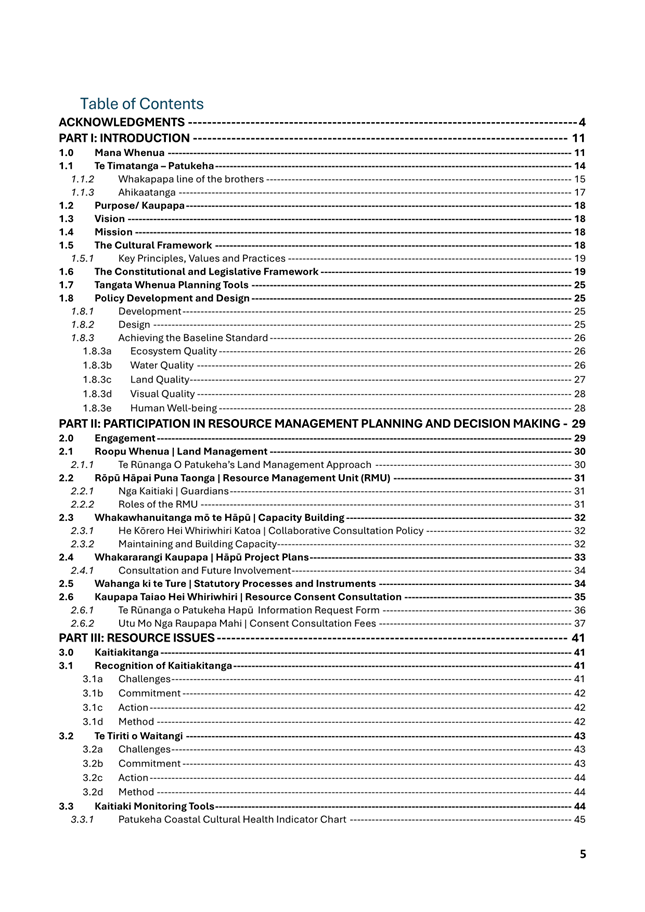
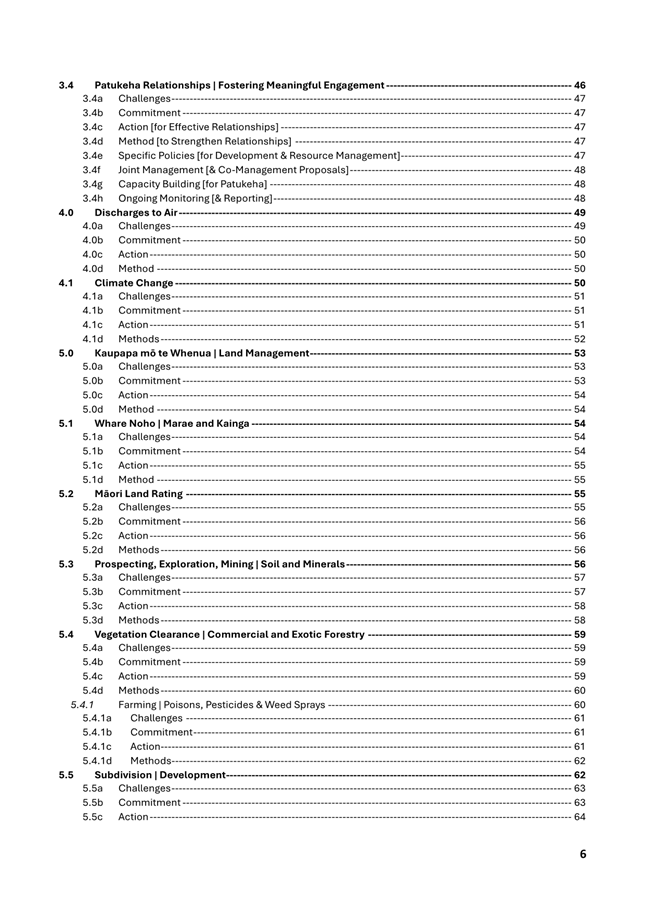
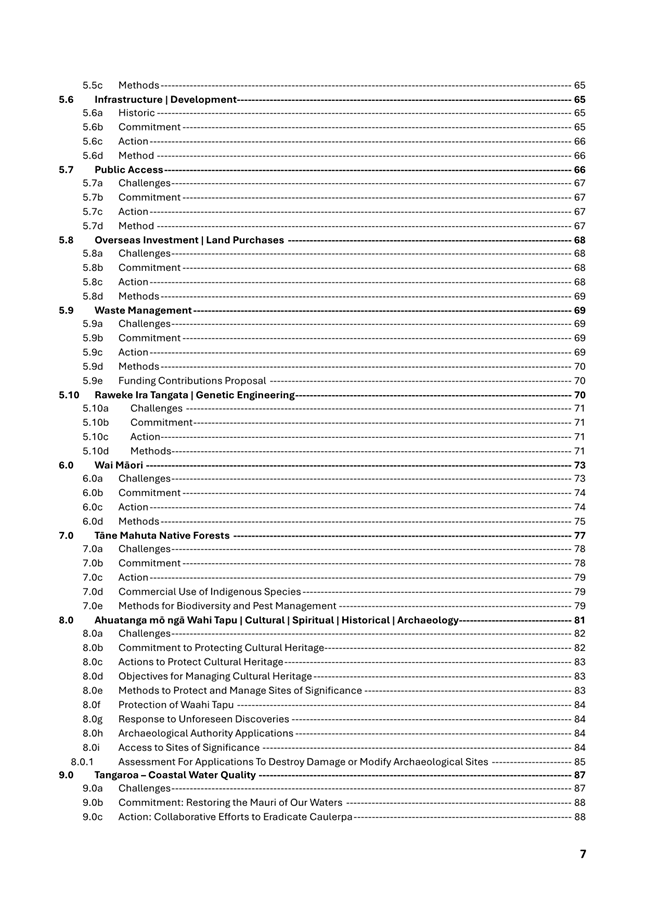
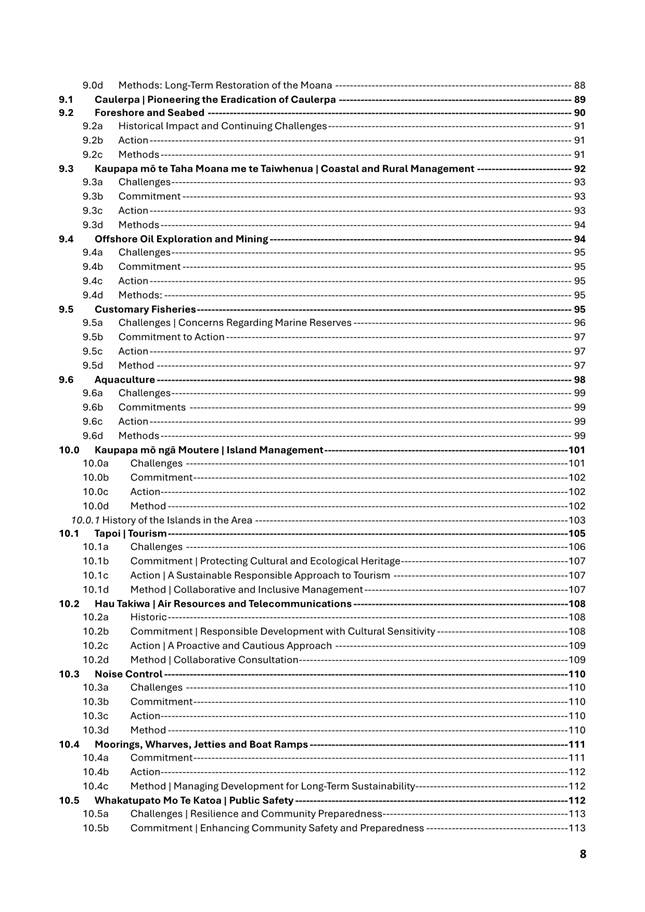
Patukeha Iwi - Hapū Environmental Management Plan. 16
5.2 Te
Kuaka Te Ao Māori Committee Strategic Intent - Te Pae ki Tawhiti 2040. 142
5.3 Te
Reo Māori name for Far North District Libraries. 149
5.4 Far
North Towns and Names. 159
5.5 Far
North District Council Cultural Audit Report 220
5.6 Te Kiri Waiwai o Papatuanuku - Whenua Māori Strategy. 240
6 Ngā
Pūrongo Taipitopito / Information Reports. 279
6.1 Te
Kahu o Taonui Taiao Portal Progress Report 279
6.2 Civic
Engagement and Education Update. 286
6.3 Te
Rauora - Reorua Annual Review.. 291
6.4 Whenua
Māori - Freehold Land Rating Relief 303
6.5 Ngā
Kaupapa Māori / Matters of Importance to Māori 2024-2025 Annual
Report 307
6.6 Open
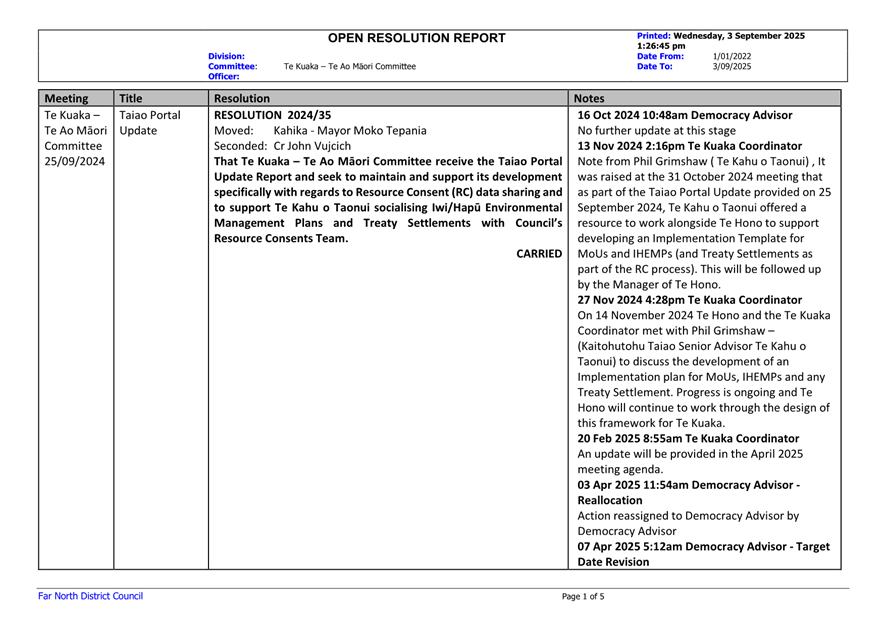
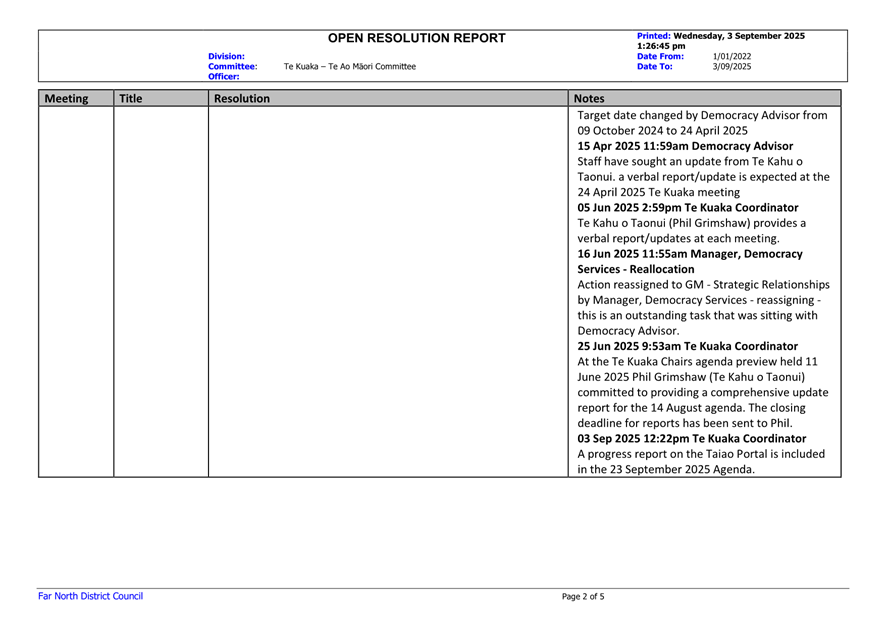
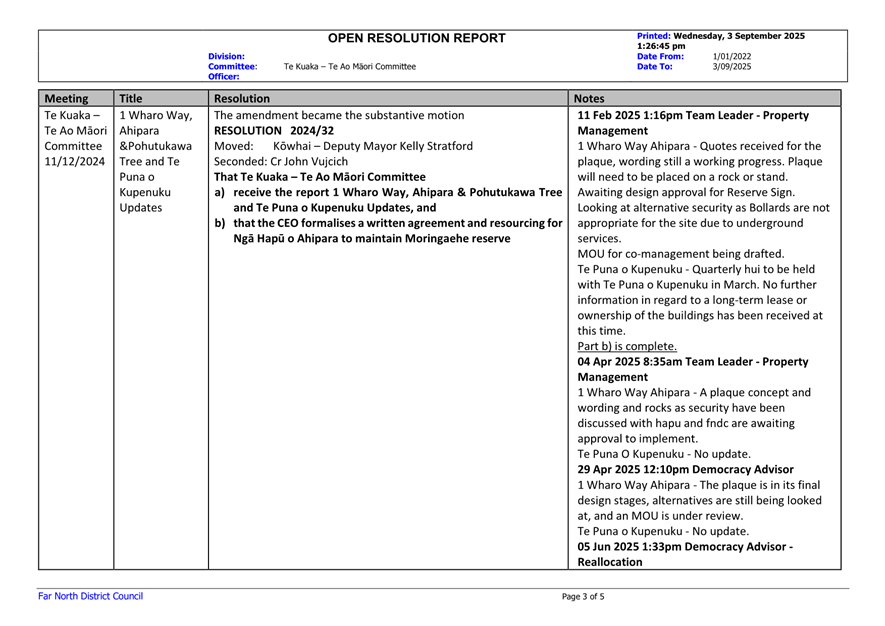
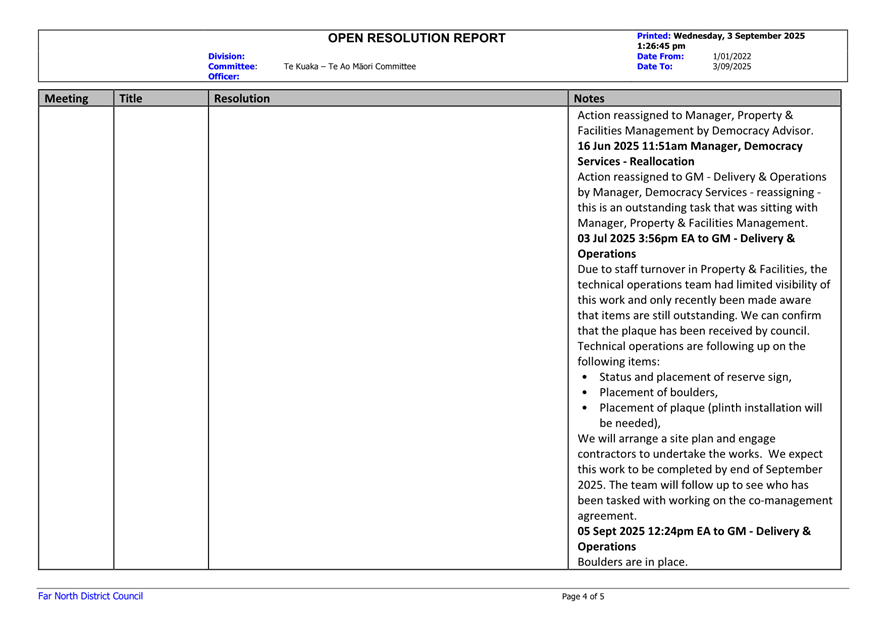
Resolutions and Actions Update - September 2025. 312
Supplementary Reports
(distributed under separate cover)
6.7
Te Kahu o Taonui Update
6,8
Te Pae o Uta Annual Review
7 Karakia
Whakamutunga / Closing Prayer. 319
8 Te
Kapinga Hui / Meeting Close. 319
1 Karakia
Tīmatanga / Opening Prayer
2 Ngā Whakapāha Me Ngā Pānga Mema / Apologies
and Declarations of Interest
Members need to
stand aside from decision-making when a conflict arises between their role as a
Member of the Committee and any private or other external interest they might
have. This note is provided as a reminder to Members to review the matters on
the agenda and assess and identify where they may have a pecuniary or other
conflict of interest, or where there may be a perception of a conflict of
interest.
If a Member
feels they do have a conflict of interest, they should publicly declare that at
the start of the meeting or of the relevant item of business and refrain from
participating in the discussion or voting on that item. If a Member thinks they
may have a conflict of interest, they can seek advice from the Chief Executive
Officer or the Manager - Democracy Services (preferably before the meeting).
It is noted
that while members can seek advice the final decision as to whether a conflict
exists rests with the member.
3 Ngā
Tono Kōrero / Deputation
·
Ngātikawa Taituha - representing Ngāti Kawa, Ngāti
Rāhiri and Te Matarahurahu speaking to the Tauranga Kōtuku Rerenga
Tahi – Oromahoe Waitangi Kāinga Climate Adaptation Plan
NOTE: The Tauranga Kōtuku Rerenga Tahi – Oromahoe
Waitangi Kāinga Climate Adaptation Plan is being presented to Te Kuaka
before the meeting starts.
·
April Sherman & Jacqueline Rewha-Clendon representing Te
Rūnanga o Patukeha speaking to item 5.1 Te Patukeha Iwi – Hapu
Environmental Management Plan
4 Te
Whakaaetanga o Ngā Meneti o Mua / Confirmation of Previous Minutes
4.1 Confirmation
of Previous Minutes
File
Number: A5262658
Author: Marlema
Baker, Democracy Advisor
Authoriser: Aisha
Huriwai, Manager - Democracy Services
Purpose of the Report
The minutes are
attached to allow the Committee to confirm that the minutes are a true and
correct record of the previous meeting.
|
Recommendation
That Te Kuaka – Te Ao Māori Committee confirm
the minutes of the meeting held 27 February 2025 as a true and
correct.
|
1) Background
Local Government Act 2002 clause 7
Section 28 states that a local authority must keep minutes of its
proceedings. The minutes of these proceedings duly entered and
authenticated as prescribed by a local authority are prima facie evidence of
those meetings.
2) Discussion and Options
The minutes of the
meeting are attached.
Far
North District Council Standing Orders Section 27.3 states that “no
discussion shall arise on the substance of the minutes in any succeeding
meeting, except as to their correctness”.
Reason
for the recommendation
The reason for the
recommendation is to confirm the minutes are a true and correct record of the
previous meeting.
3) Financial Implications and Budgetary
Provision
There are no financial implications or the need for
budgetary provision.
Attachments
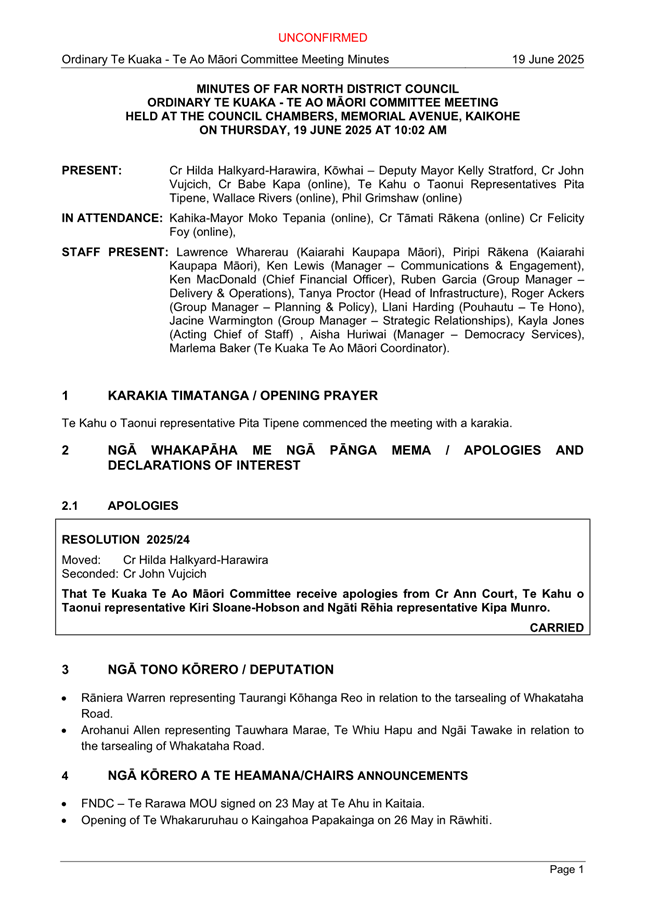
1. Te
Kuaka Te Ao Māori Committee Minutes - 19 June 2025 - A5240117 ⇩ 
Compliance schedule:
Full consideration has been given to the provisions of the
Local Government Act 2002 S77 in relation to decision making, in particular:
1. A
Local authority must, in the course of the decision-making process,
a) Seek
to identify all reasonably practicable options for the achievement of the
objective of a decision; and
b) Assess
the options in terms of their advantages and disadvantages; and
c) If
any of the options identified under paragraph (a) involves a significant
decision in relation to land or a body of water, take into account the
relationship of Māori and their culture and traditions with their
ancestral land, water sites, waahi tapu, valued flora and fauna and other
taonga.
2. This
section is subject to Section 79 - Compliance with procedures in relation to
decisions.
|
Compliance
requirement
|
Staff
assessment
|
|
State the level of significance
(high or low) of the issue or proposal as determined by the Council’s
Significance and Engagement Policy
|
This is a matter of low
significance.
|
|
State the relevant Council
policies (external or internal), legislation, and/or community outcomes (as
stated in the LTP) that relate to this decision.
|
This report complies with the
Local Government Act 2002 Schedule 7 Section 278.
|
|
State whether this issue or
proposal has a District wide relevance and, if not, the ways in which the
appropriate Community Board’s views have been sought.
|
It is the responsibility of each
meeting to confirm their minutes therefore the views of another meeting are
not relevant.
|
|
State the possible implications for Māori
and how Māori have been provided with an opportunity to contribute to
decision making if this decision is significant and relates to land and/or
any body of water.
|
There are no implications on
Māori in confirming minutes from a previous meeting. Any implications on
Māori arising from matters included in meeting minutes should be
considered as part of the relevant report.
|
|
Identify persons likely to be
affected by or have an interest in the matter, and how you have given
consideration to their views or preferences.
|
This report is asking for the
minutes to be confirmed as true and correct record, any interest that affect
other people should be considered as part of the individual reports.
|
|
State the financial implications
and where budgetary provisions have been made to support this decision.
|
There are no financial
implications or the need for budgetary provision arising from this report.
|
|
Chief Financial Officer review.
|
The Chief Financial Officer has
not reviewed this report.
|
|
Ordinary
Te Kuaka - Te Ao Māori Committee Meeting Agenda
|
23
September 2025
|
5 Ngā
Pūrongo / Reports
5.1 Te
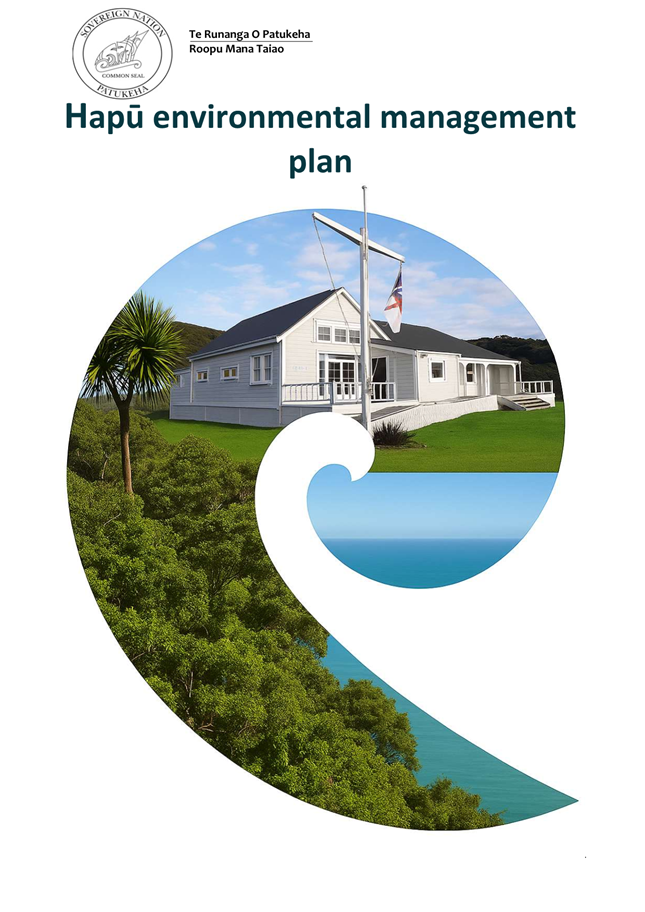
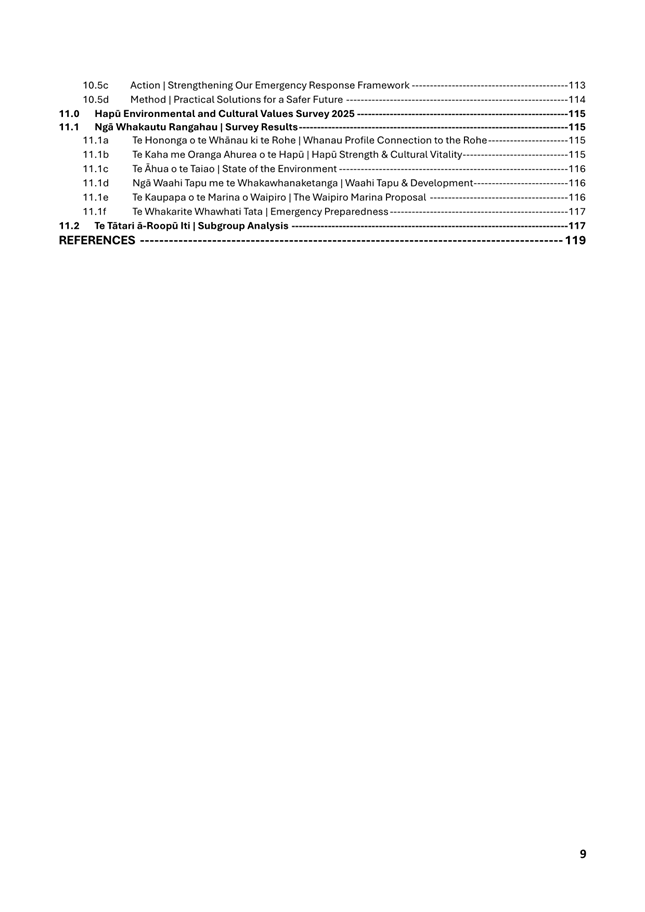
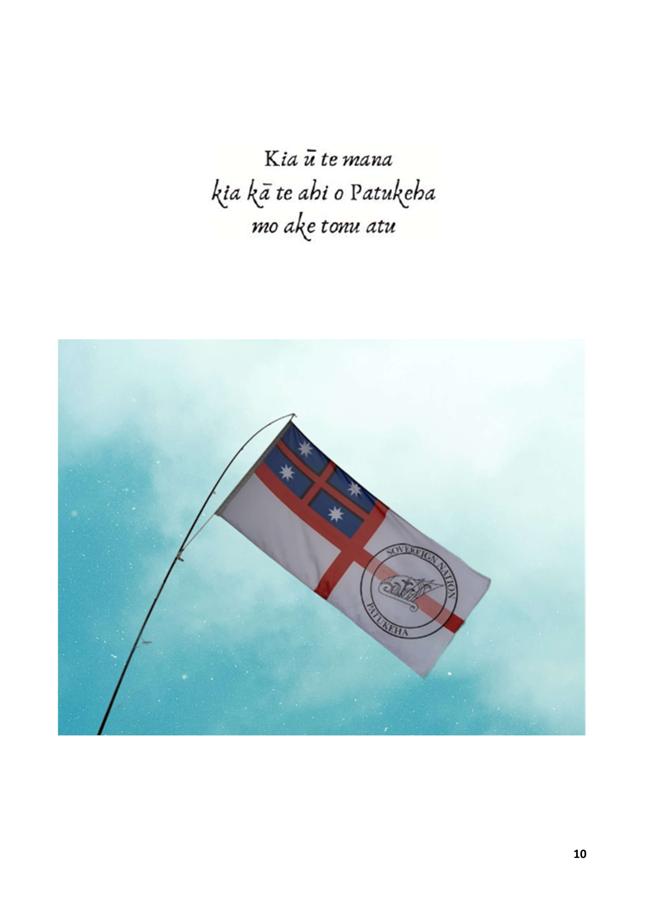
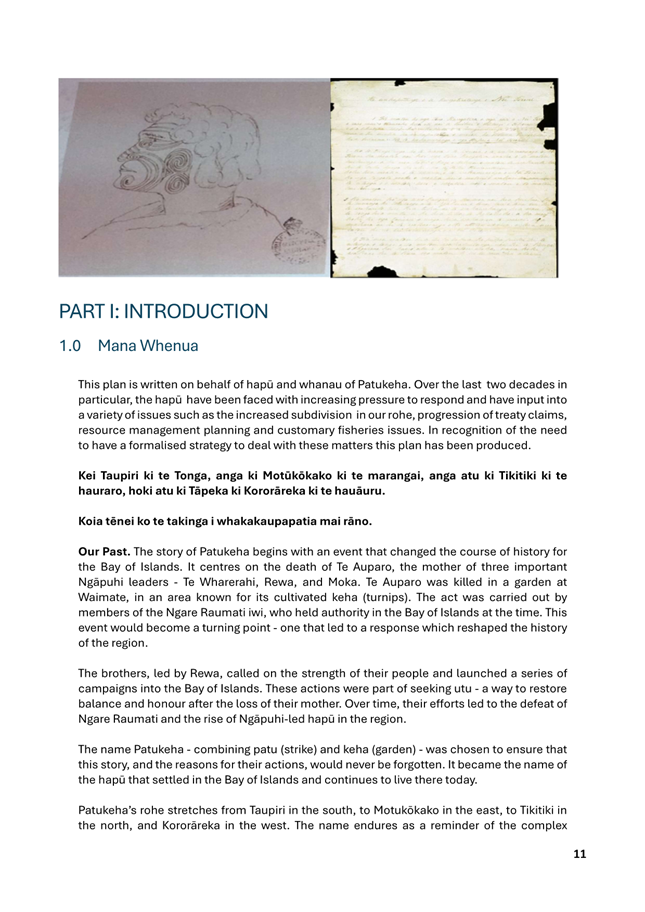
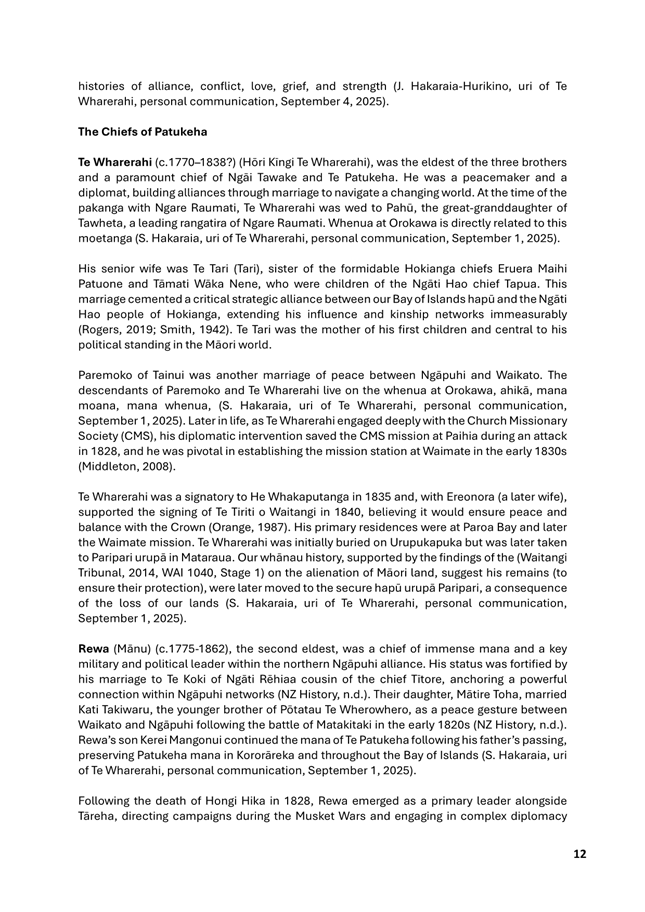
Patukeha Iwi - Hapū Environmental Management Plan
File
Number: A5314356
Author: Llani
Harding, Pouhautū Te Hono - Manager - Te Hono
Authoriser: Jacine
Warmington, Group Manager - Strategic Relationships
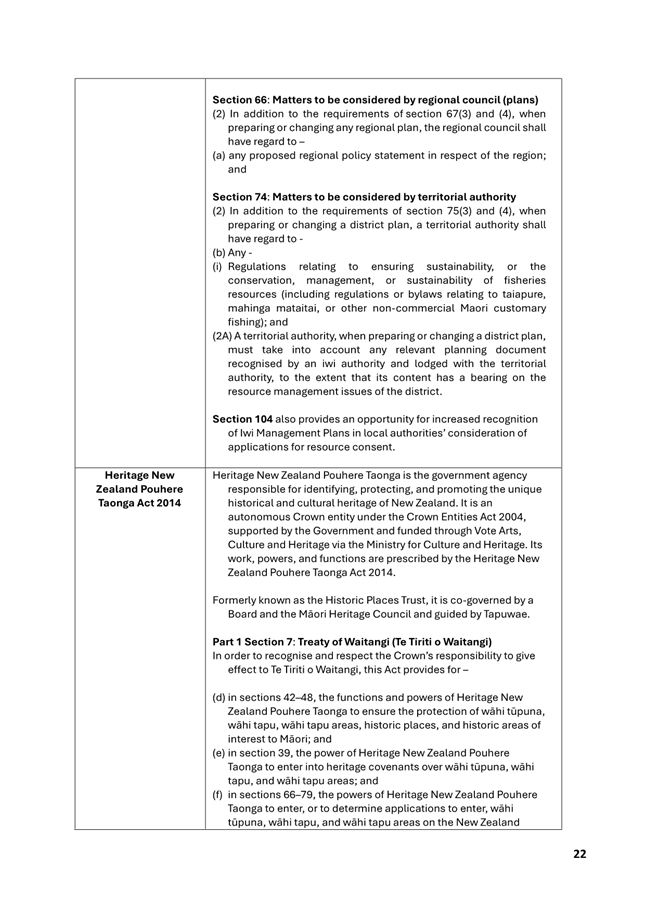
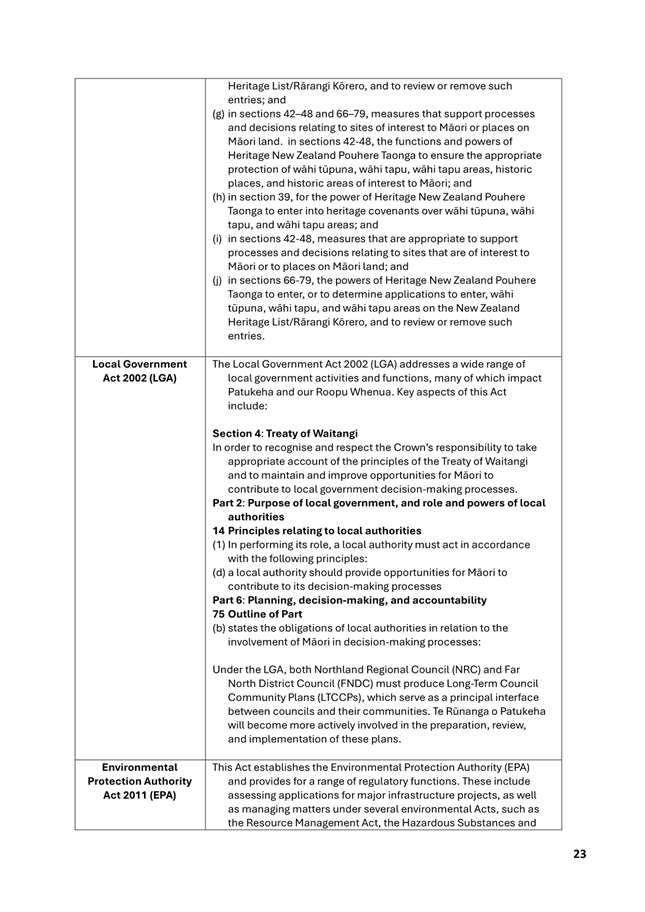
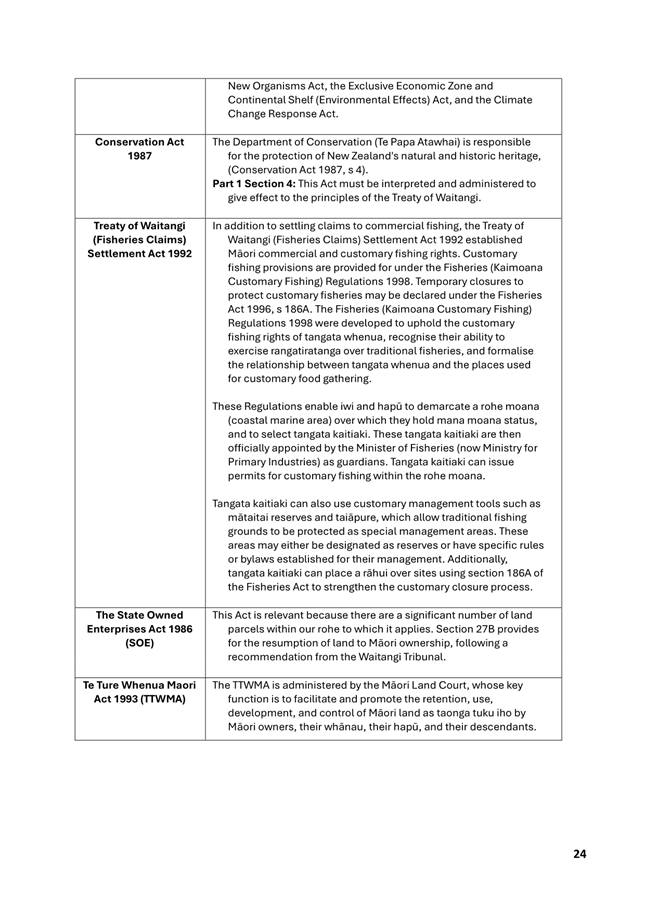
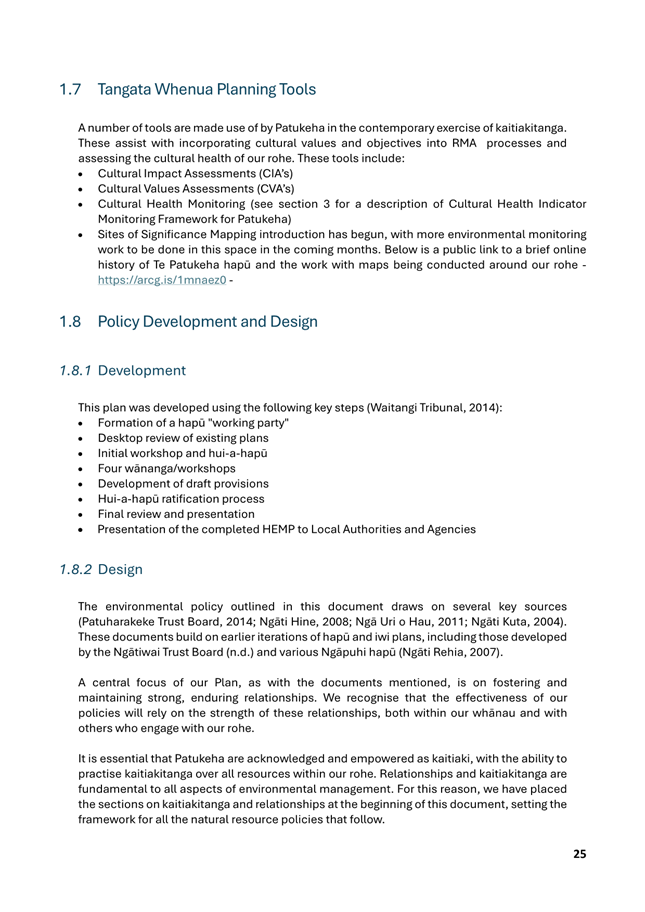
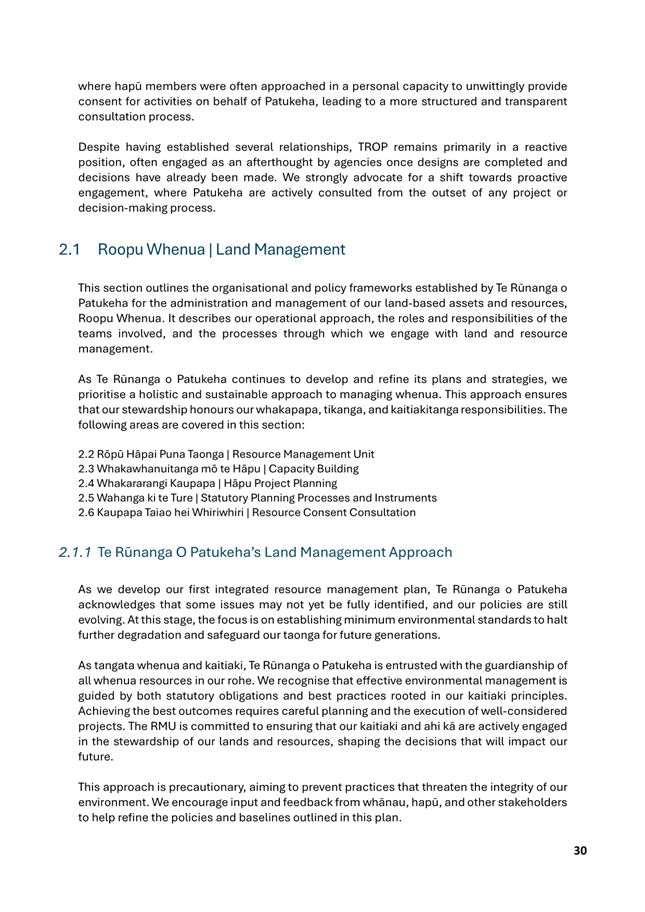
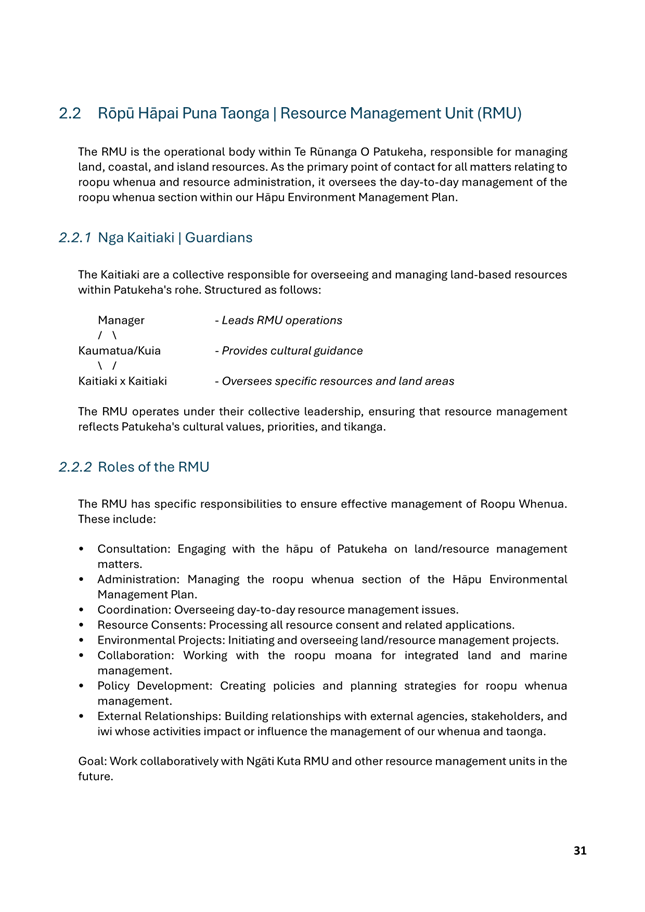
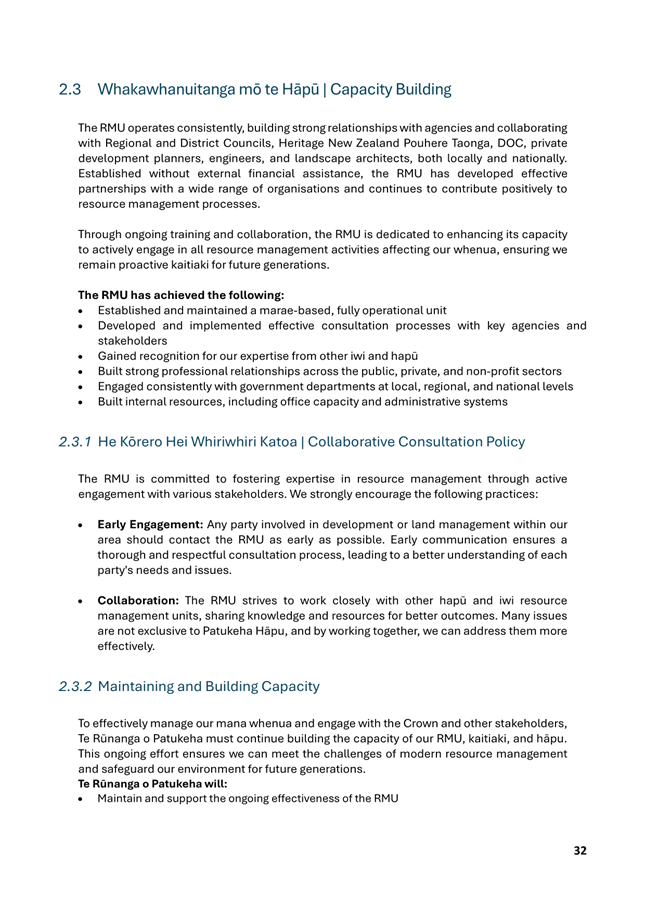
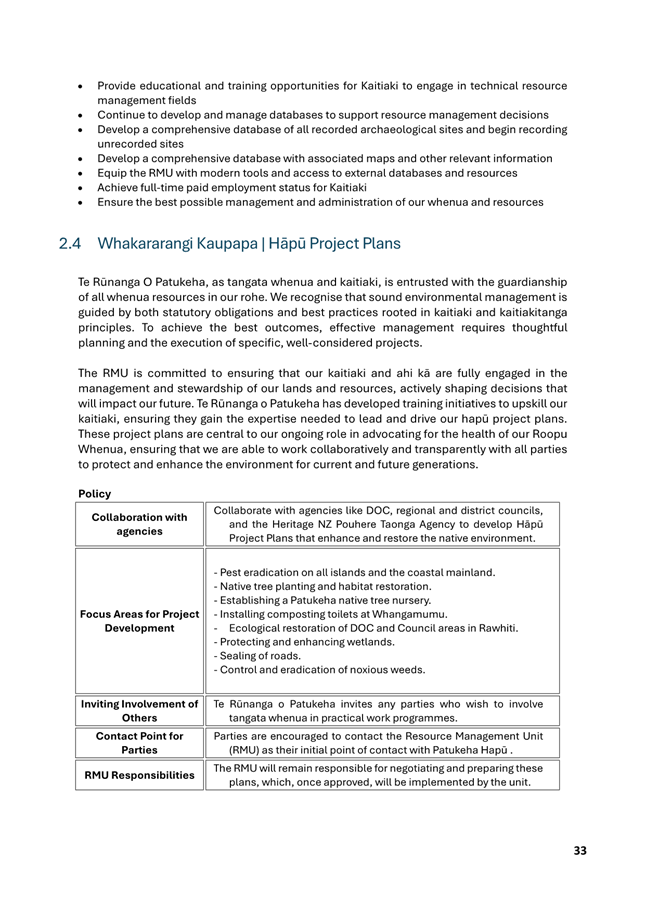
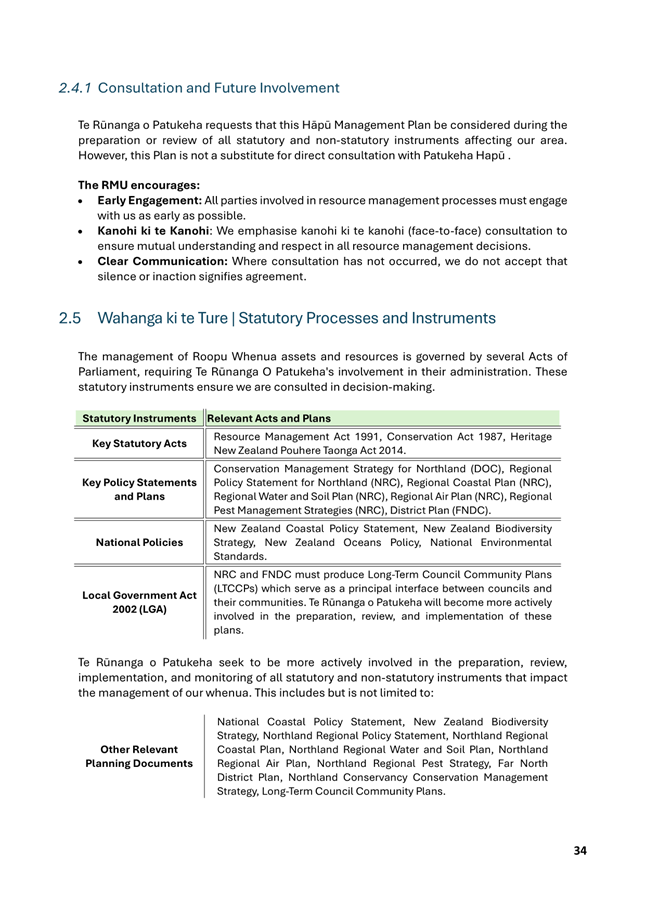
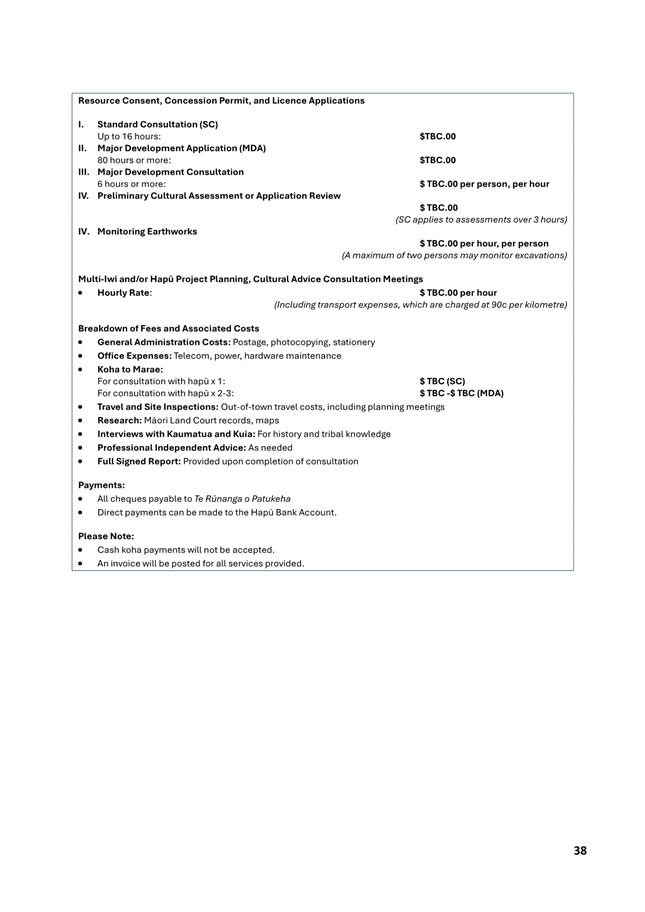
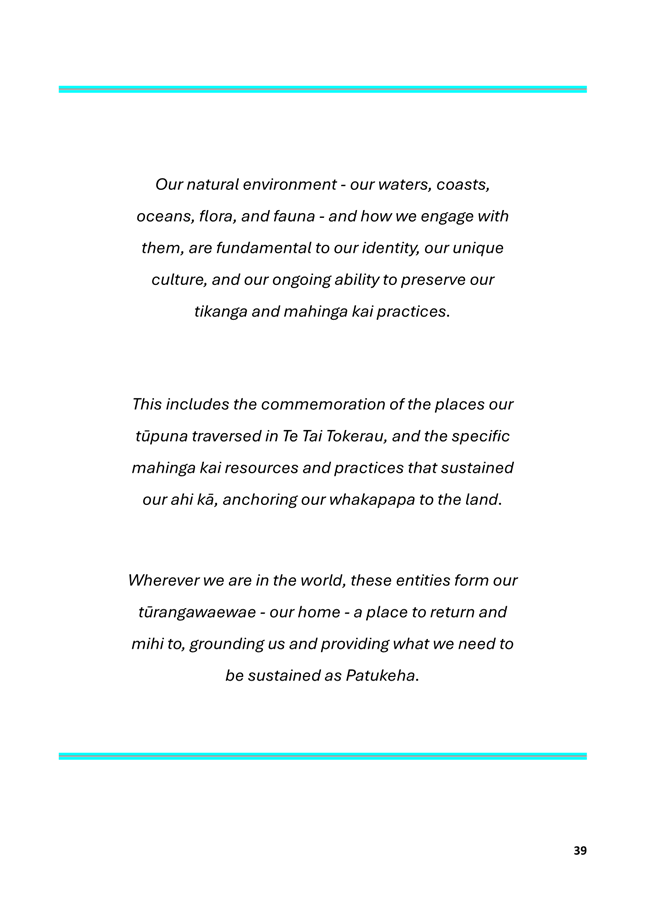
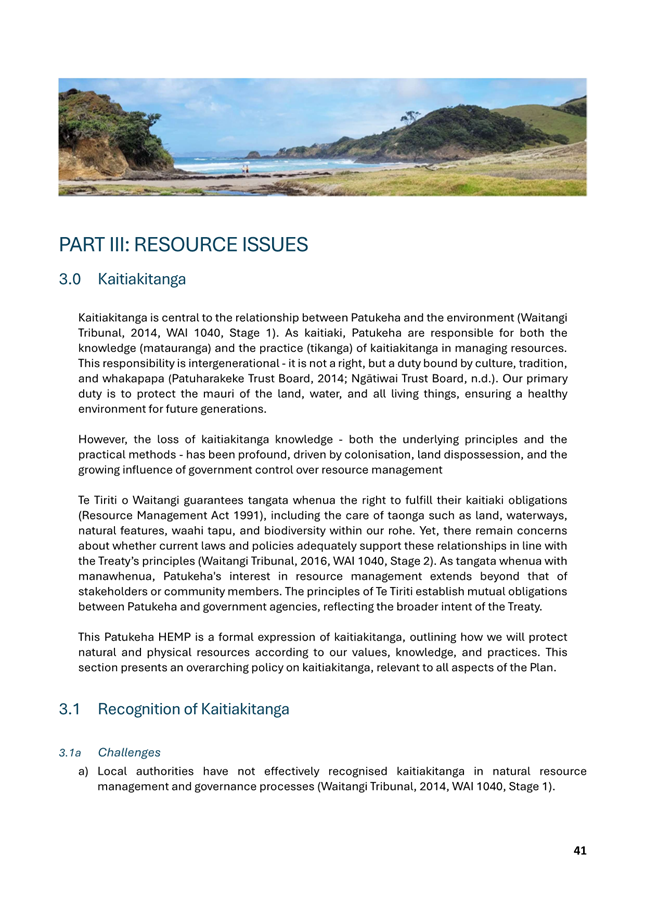
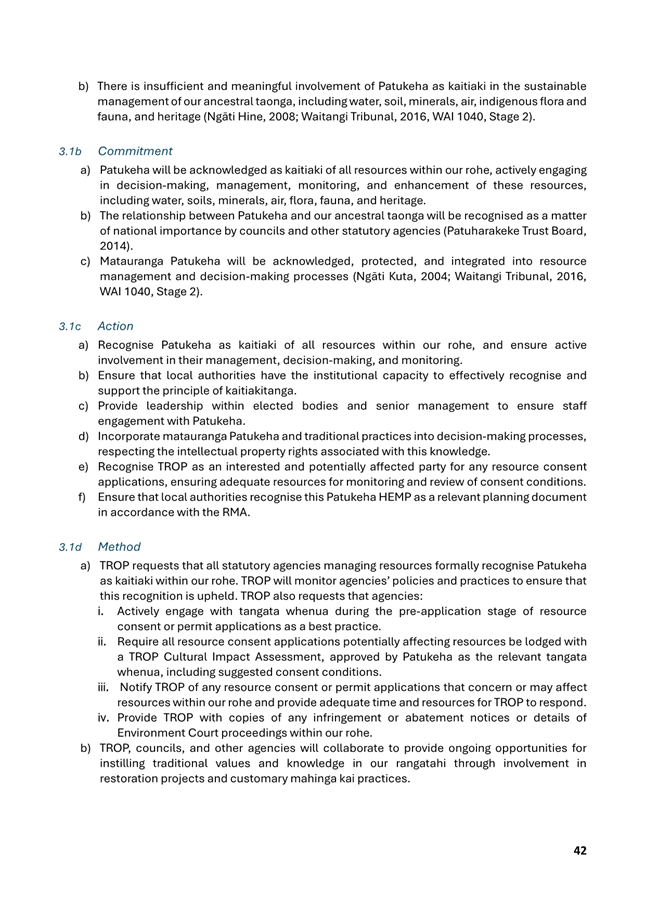
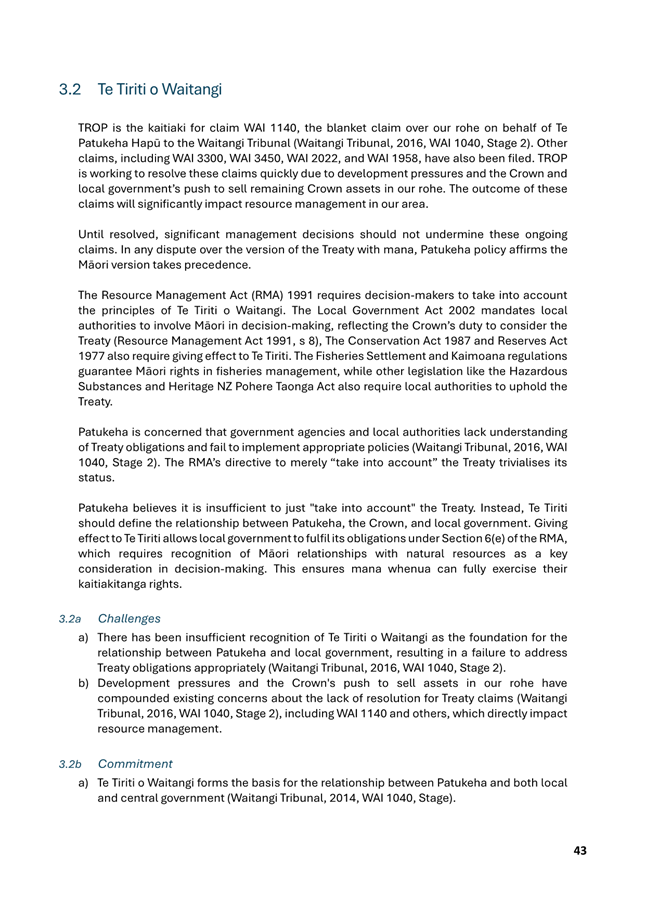
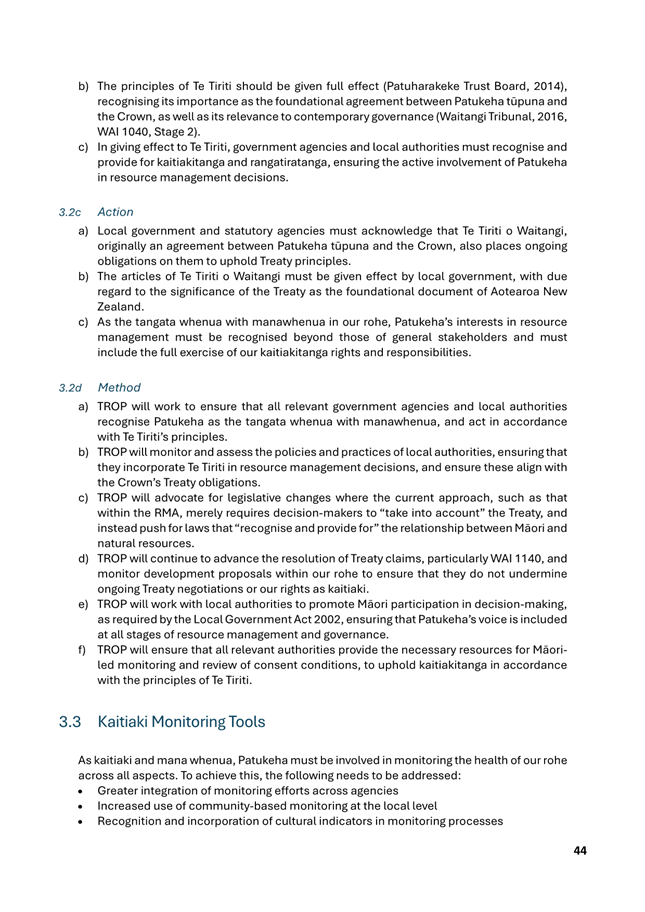
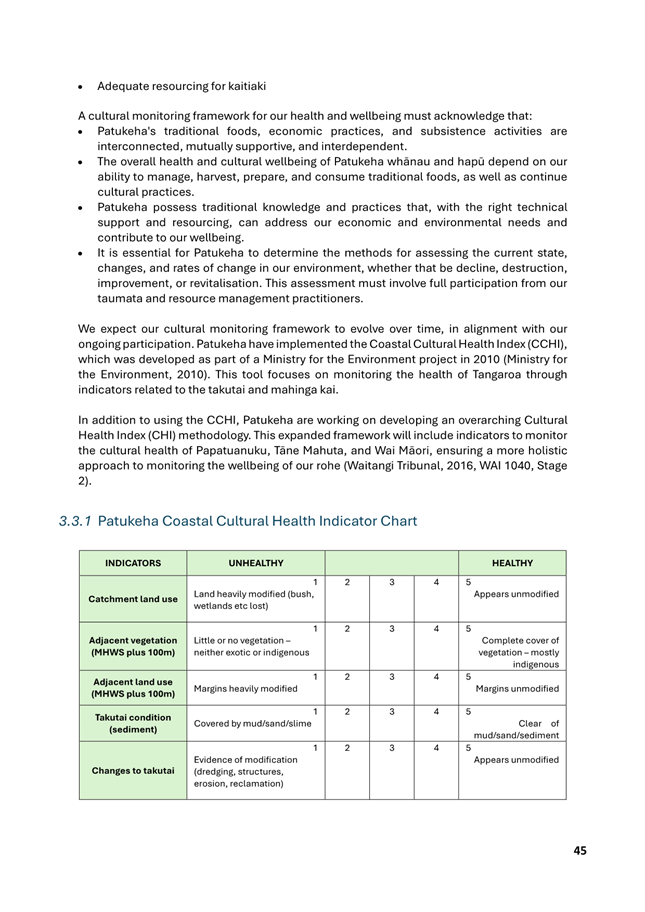
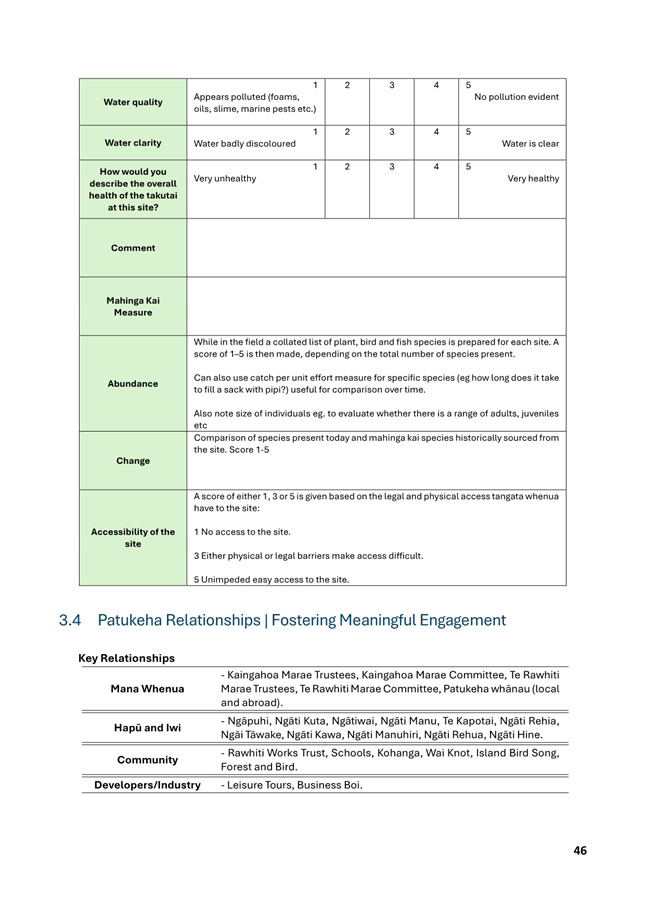
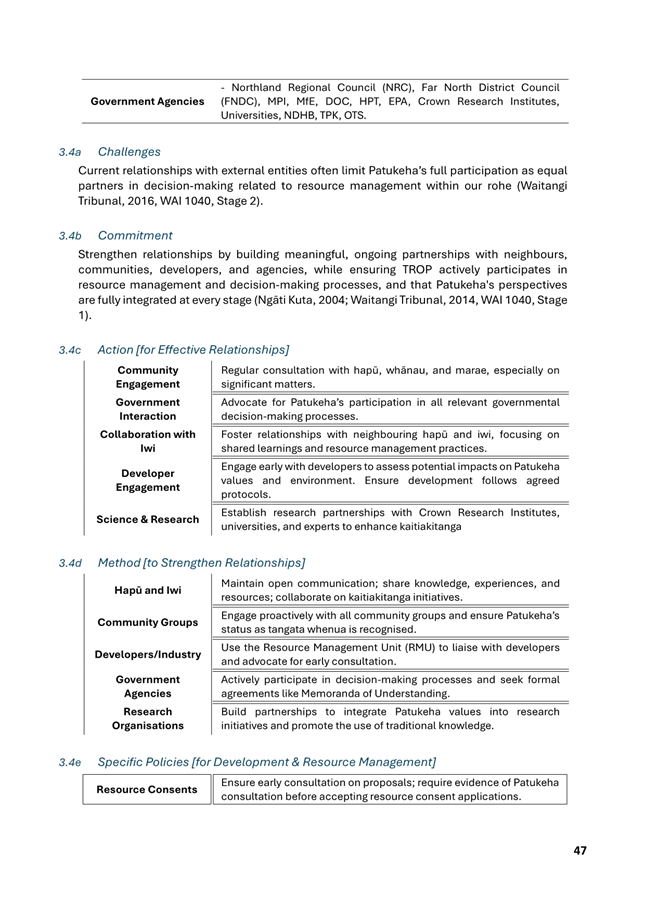
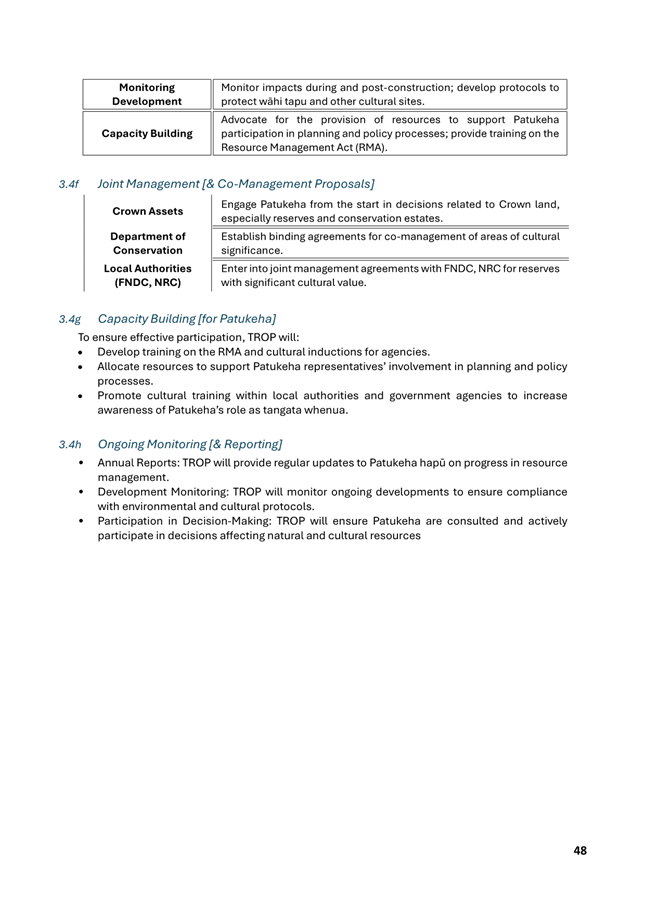
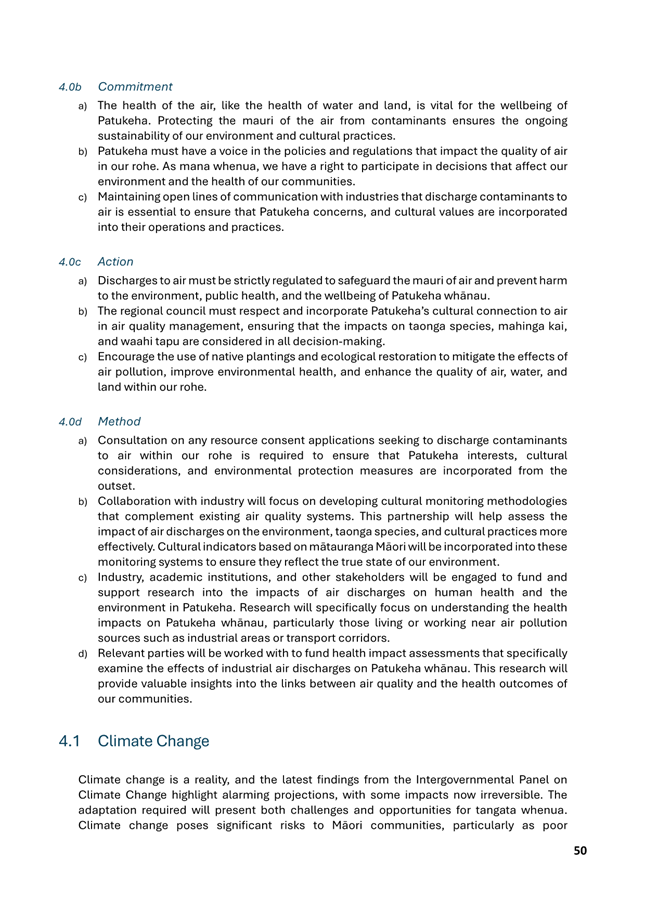
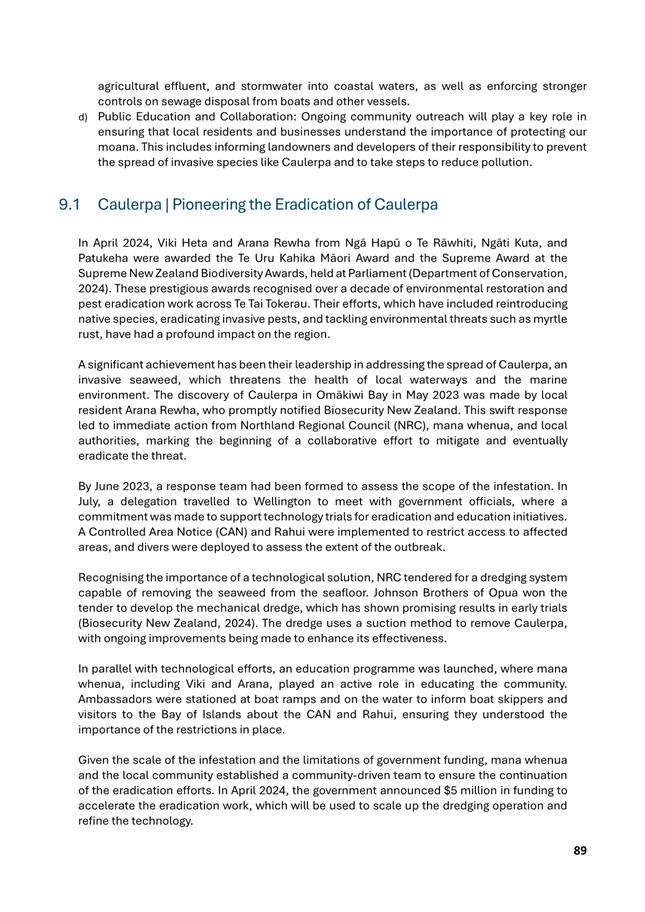
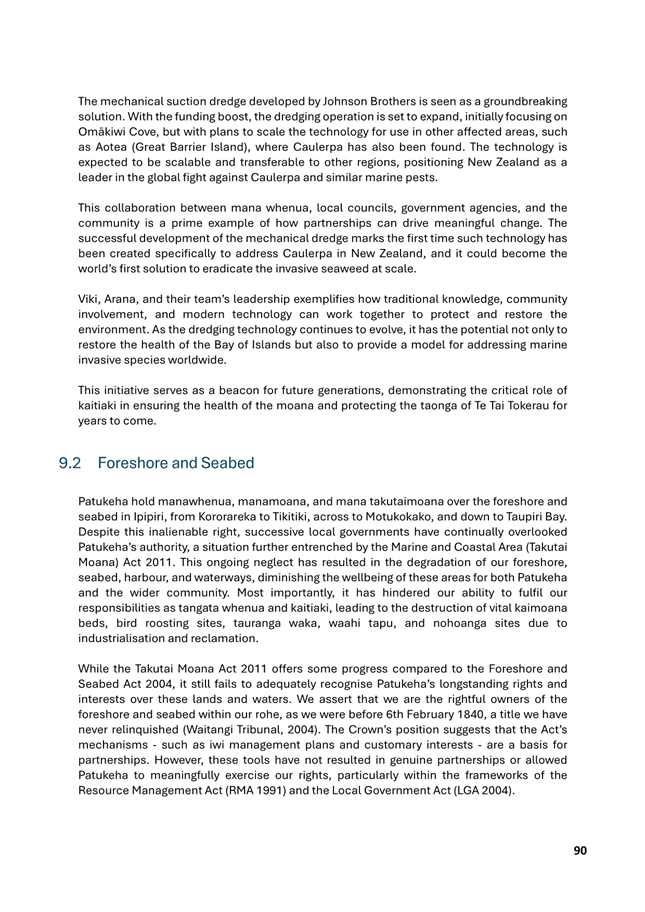
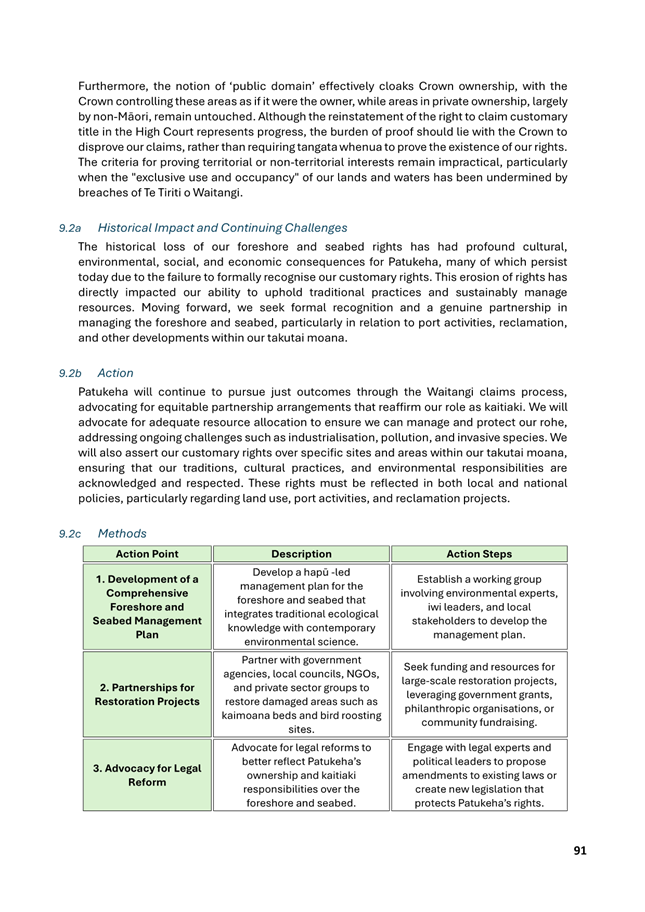
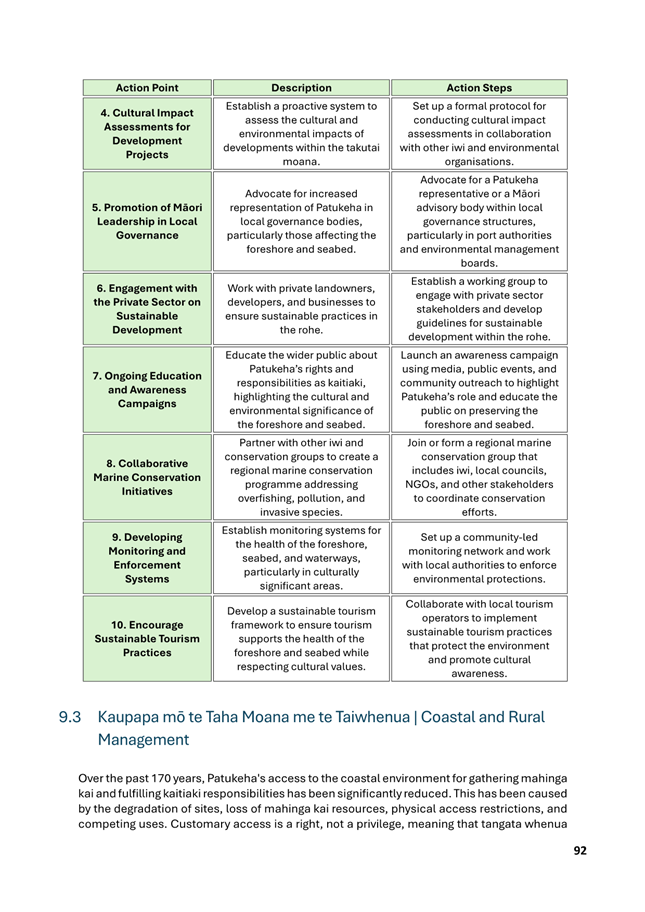
Take Pūrongo / Purpose of the Report
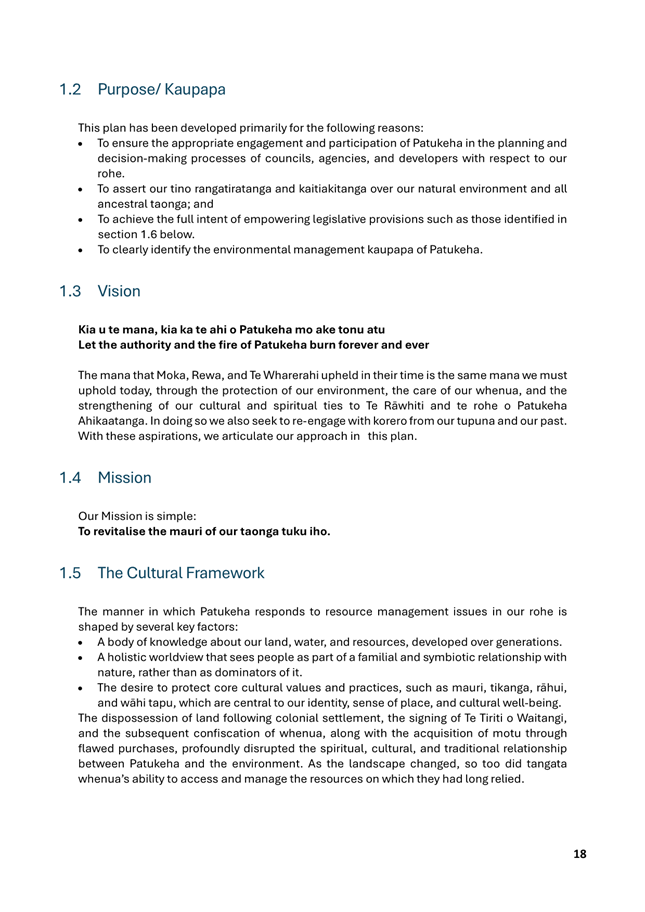
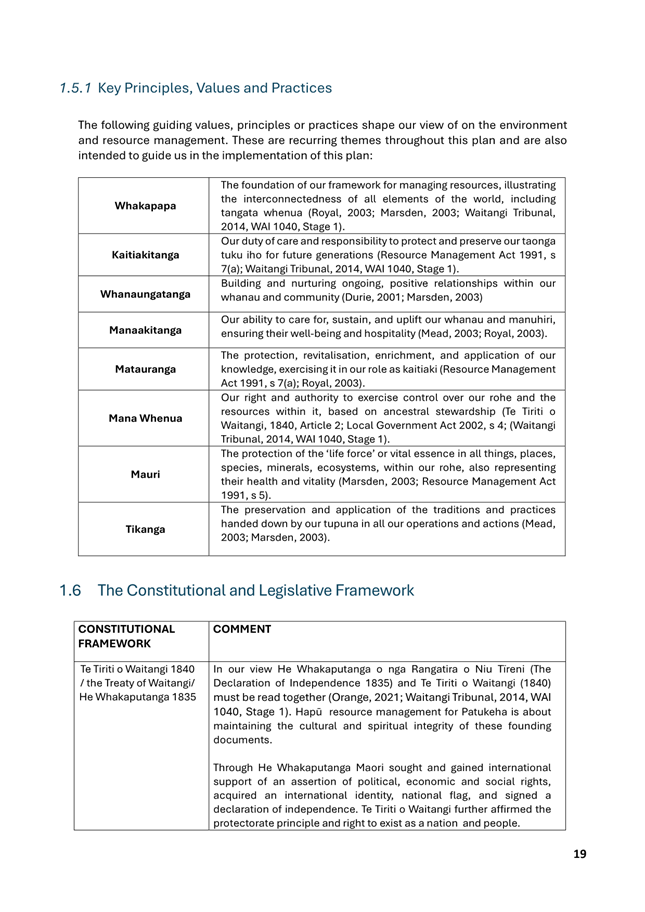
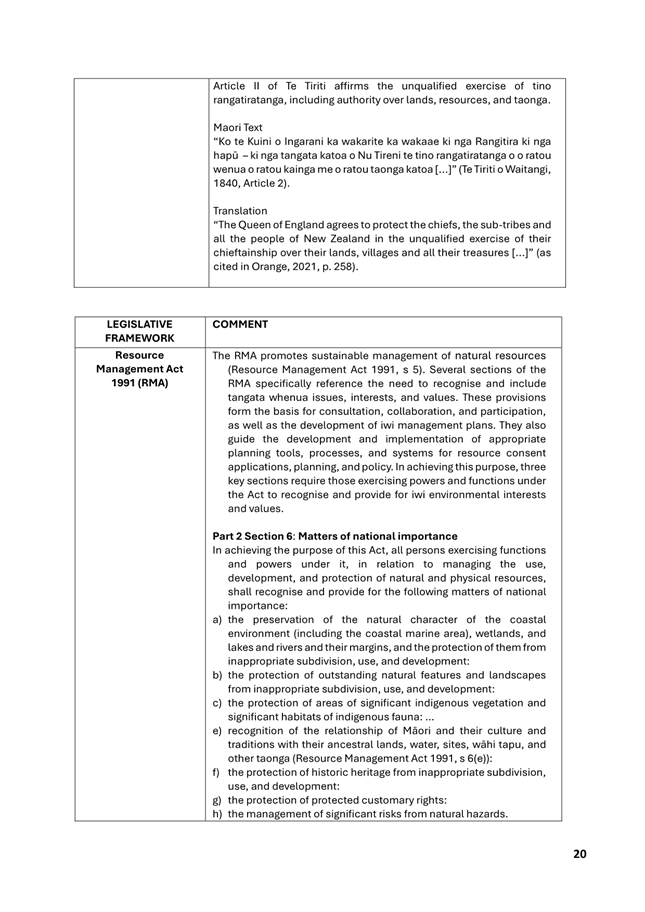
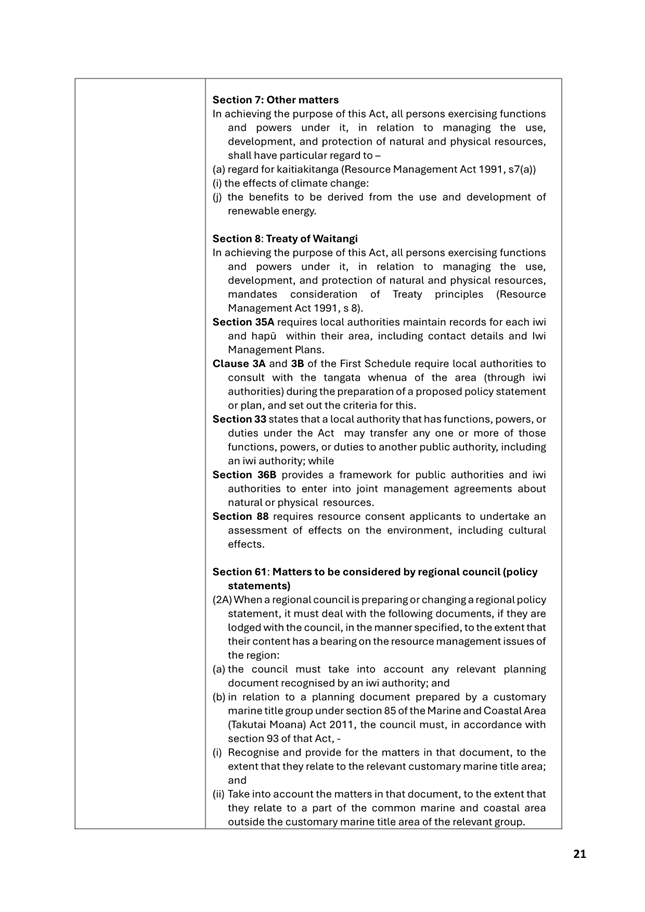
To seek Te Kuaka Te Ao Māori
Committee (Te Kuaka) endorsement of the Te Patukeha Hapu Environmental
Management Plan (IHEMP).
WhakarĀpopoto matua / Executive Summary
· Te Patukeha received council funding in the
2022-2023 financial year to develop an IHEMP alongside hapū, in line with
council policy.
· This will take the number of IHEMPs with
Far North District Council (FNDC) to 15. These agreements are reviewed
every 5 years.
· The Te
Rūnanga o Patukeha Roopu Mana Taiao Hapū Environmental Management
Plan is attached.
|
tŪtohunga
/ Recommendation
That Te Kuaka Te Ao Māori Committee;
a) receive the report Te Patukeha Iwi
Hapū Environmental Management Plan on behalf of Council; and
b) recommend
that Council support Te Patukeha Iwi Hapu Environmental Management Plan.
|
1) TĀhuhu kŌrero / Background
FNDC have the following IHEMP agreements:
1. Te
Patukeha - New
2. Ngāti
Hine Environmental Management Plan – Updated
3. Ahipara
Takiwā Management Plan - Updated
4. Ngāti
Kuri Environmental Management Plan
5. Ngāi
Takoto Environmental Management Plan
6. Te
Aupōuri Iwi Management Plan
7. Haiti-Tai-Marangai
Marae Hapū Management Plan
8. Te
Rūnanga o Whaingaroa Environmental Management Plan
9. Ngāti
Rēhia Environmental Management Plan
10. Kororareka
Marae Society Environmental Management Plan
11. Ngāti
Rangi Environmental Management Plan
12. Te
Iwi o Ngātiwai Iwi Environmental Management Plan
13. Ngāti
Kuta ki te Rāwhiti Environmental Management Plan
14. Te
Kahakura o Ngāti Korokoro, Ngāti Wharara me Pouka Environmental
Management Plan
15. Te
Roroa Iwi Environmental Management Plan
FNDC have funded a further five Iwi
and Hapū to develop plans since 2023. These plans are still in progress
and Te Hono remains in contact with these Iwi and Hapū to provide ongoing
support.
There are currently 12 agreements requiring review.
FNDC have a budget for each agreement holder to assist them in rewriting and
reviewing their outstanding agreements.
2) matapaki me NgĀ KŌwhiringa /
Discussion and Options
On agreement, Iwi and Hapū are
given 18 months to develop their plan. This provides appropriate time for them
to wānanga the contents of their plan within their hapū, source
technical expertise, develop cultural narratives and provide for a robust
review process amongst their Hapū.
At the point where Hapū feel
comfortable that their due diligence is completed, they then present their
confirmed IHEMP to Council to receive. In this case, the receiving of this
IHEMP will be conducted by Te Kuaka Te Ao Māori Committee and this
resolution will be escalated up to Council on 25 September 2025.
Council is then required to enter
as much of the detail in the plan into the systems that we manage for example,
within GIS Mapping highlighting specifically Hapū areas of interest for
consenting purposes, contact details of Hapū technicians are then added to
the Distribution List for all Resource Consent notifications. The Resource
Consents team are provided with the IHEMP to further support the consideration
of their consents.
TAKE TŪTOHUNGA
/ REASON FOR THE RECOMMENDATION
Staff recommend that Te Kuaka
receive Te Patukeha IHEMP and that Council support its implementation across
the services and functions of Council.
3) PĀnga PŪtea me ngĀ
wĀhanga tahua / Financial Implications and Budgetary Provision
Te Hono holds an annual contestable
budget of $20,000 to grant to Iwi and Hapū to develop their IHEMPs.
Hapū can also source other funding through Northland Regional Council, Iwi
entities and external organisations to contribute to their plan development.
There is no budget allocated to
implement the plan within Council.
Council systems and processes are
adapted to include any relevant information from each plan within the systems
that we have.
Āpitihanga
/ Attachments
1. Te
Rūnanga o Patukeha IHEMP - A5353850 ⇩
Hōtaka Take Ōkawa / Compliance Schedule:
Full consideration has been given to the provisions of the
Local Government Act 2002 S77 in relation to decision making, in particular:
1. A
Local authority must, in the course of the decision-making process,
a) Seek
to identify all reasonably practicable options for the achievement of the
objective of a decision; and
b) Assess
the options in terms of their advantages and disadvantages; and
c) If
any of the options identified under paragraph (a) involves a significant
decision in relation to land or a body of water, take into account the
relationship of Māori and their culture and traditions with their
ancestral land, water sites, waahi tapu, valued flora and fauna and other
taonga.
2. This
section is subject to Section 79 - Compliance with procedures in relation to
decisions.
|
He Take Ōkawa /
Compliance Requirement
|
Aromatawai Kaimahi /
Staff Assessment
|
|
State the level of significance (high or low) of the
issue or proposal as determined by the Council’s
Significance and Engagement Policy
|
There is a high degree of significance in endorsing this
paper.
The IHEMP has a major and long-term impact on the
wellbeing of Iwi/Hapū/whanau and their culture and traditions with their
ancestral land, water, sites, wāhi tapu, valued flora and fauna, and
other taonga.
|
|
State the relevant Council policies (external or
internal), legislation, and/or community outcomes (as stated in the LTP) that
relate to this decision.
|
This IHEMP gives effect to Councils Vision, He Whenua
Rangatira. Te Patukeha enable their Mana Motuhake on their ancestral lands
through this IHEMP.
|
|
State whether this issue or proposal has a District wide
relevance and, if not, the ways in which the appropriate Community
Board’s views have been sought.
|
There are no impacts to delegations by Community Boards
in endorsing this IHEMP.
Council staff will continue to work alongside Community
Boards and Te Patukeha on matters of mutual interest
|
|
State the
possible implications for Māori and how Māori have been provided
with an opportunity to contribute to decision making if this decision is
significant and relates to land and/or any body of water.
State the
possible implications and how this report aligns with Te Tiriti o Waitangi /
The Treaty of Waitangi.
|
By endorsing this paper, Council gives effect to the
principles of Te Tiriti o Waitangi by acknowledging the principles of
Participation and Protection.
The outcomes of this IHEMP give effect to our Councils
obligations as Partners under Te Tiriti.
|
|
Identify persons likely to be affected by or have an
interest in the matter, and how you have given consideration to their views
or preferences (for example – youth, the aged and those with
disabilities).
|
Te Patukeha acknowledge the interests of the broader
community when completing their plan.
|
|
State the financial implications and where budgetary
provisions have been made to support this decision.
|
There are no budget implications for this report
|
|
Chief Financial Officer review.
|
|
|
Ordinary
Te Kuaka - Te Ao Māori Committee Meeting Agenda
|
23
September 2025
|






5.2 Te
Kuaka Te Ao Māori Committee Strategic Intent - Te Pae ki Tawhiti 2040
File
Number: A5322151
Author: Marlema
Baker, Democracy Advisor
Authoriser: Roger
Ackers, Group Manager - Planning & Policy
Take Pūrongo / Purpose of the Report
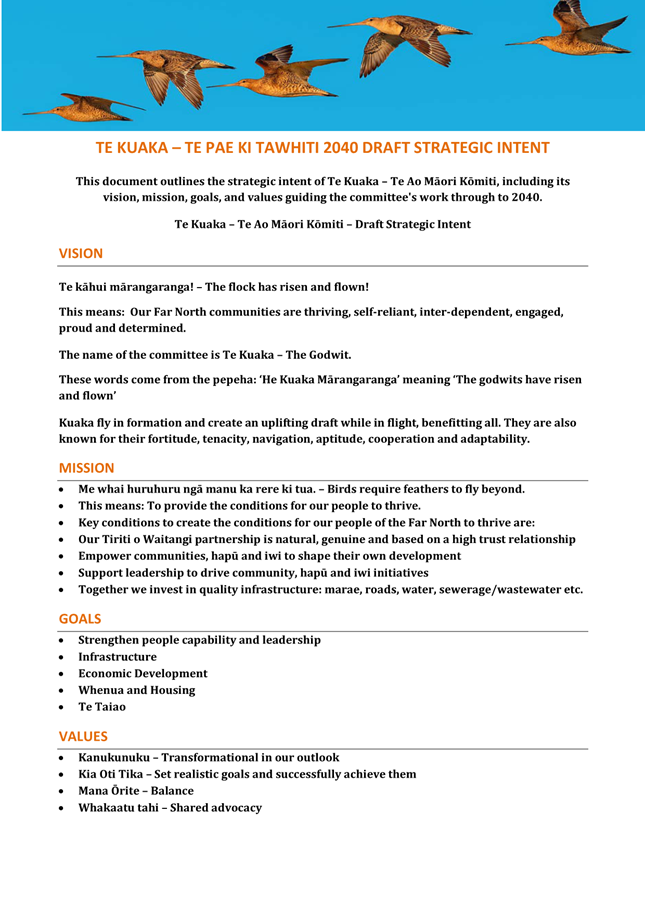
To receive and
endorse the draft Te Kuaka Te Pae Ki Tawhiti 2040 Strategic Intent (Te Pae Ki
Tawhiti 2040).
WhakarĀpopoto matua / Executive Summary
· This report presents the draft Te Kuaka Te
Pae Ki Tawhiti 2040 Strategic Intent (Te Pae Ki Tawhiti 2040) to Te Kuaka Te Ao
Māori Committee, it was developed through a series of hui and workshops
with members of Te Kahu o Taonui, Council leadership and staff.
· It outlines a shared vision, mission,
values, and strategic goals that reflect the aspirations of the Far
North’s communities and mana whenua.
· Should the committee continue in the new
triennium staff intend to recommend Te Kuaka Te Pae Ki Tawhiti 2040 Strategic
Intent to Council for adoption and implementation as a guiding framework for
the Committee’s future agendas, work programmes, and partnership with
Council.
|
tŪtohunga
/ Recommendation
That Te Kuaka Te Ao
Māori Committee receive and endorse the draft Te Kuaka Te Pae Ki Tawhiti
2040 Strategic Intent as the long-term strategic direction for Te Kuaka.
|
1) TĀhuhu kŌrero / Background
Te Kuaka Te Ao Māori Committee
was established to strengthen the partnership between mana whenua and the Far
North District Council, and to ensure that Māori voices are embedded in
Council decision-making. Over the past triennium, the Committee has evolved
into a vital platform for collaboration, advocacy, and strategic alignment.
In July and August 2025, a series
of hui and workshops were held with representatives from Te Kahu o Taonui, Far
North District Council elected members and Council staff, to co-develop a
long-term strategic intent for the Committee. These hui were convened in
response to a recognised need for a unified vision and mission that reflects
the aspirations of Māori across Te Hiku o Te Ika and provides clear
direction for the Committee’s future work.
The report will ultimately seek
formal adoption by Council’s in the new triennium as the strategic
foundation for Te Kuaka Te Ao Māori Committee should the Committee
continue. This endorsement will embed the document as a reference point for future
decision-making, strengthen alignment between Committee and Council priorities,
and ensure enduring commitment to the kaupapa across successive terms.
2) matapaki me NgĀ KŌwhiringa /
Discussion and Options
Strategic Direction and Purpose
Te Pae Ki
Tawhiti 2040 sets out a long-term vision for the Far North as a region
where Māori communities are thriving, self-reliant, and empowered. It
positions Te Kuaka as a strategic platform for both action and advocacy,
enabling the Committee to support Council’s core business while also
championing kaupapa that sit beyond Council’s direct control.
OPTION 1 (RECOMMENDED)
That Te Kuaka Te Ao Māori
Committee receive and endorse the draft Te Kuaka Te
Pae Ki Tawhiti 2040 Strategic Intent as the long-term strategic direction
for Te Kuaka.
PROS
This option
provided strategic clarity and direction
· Te
Pae Ki Tawhiti 2040 provides a clear, long-term vision to guide Te
Kuaka’s planning, decision-making, and delivery; and
· enables
alignment across work programmes, budgets, and partnerships.
This option
honours the engagement process
· Te
Pae Ki Tawhiti 2040 validates the mahi already undertaken; and
· demonstrates
respect for co-design and partnership principles.
This option
supports continuity and momentum
· Te
Pae Ki Tawhiti 2040 allows immediate integration of the strategic intent into
the Committee’s 2025–2028 Work Programme; and
· avoids
delays in operational planning and resource allocation.
This option
strengthens committee mandate
· Te
Pae Ki Tawhiti 2040 positions Te Kuaka as a visionary and proactive committee
of Council; and
· reinforces
the Committee’s leadership role in shaping long-term outcomes for
Māori in the Far North
This option
enables early implementation planning
· Te
Pae Ki Tawhiti 2040 facilitates development of Key Performance Indicators (KPIs),
tracking mechanisms, and delivery frameworks aligned with the 2040 vision; and
· supports
proactive budgeting and risk management.
CONS
Potential
misalignment with incoming governance
· The
incoming Mayor and Council structure may have different priorities or
interpretations.
· Risk
of future review or revision if not fully supported by new leadership.
Limited
opportunity for incoming members to shape strategy
· Endorsing
now may reduce the sense of ownership or input from new Council members
post-election.
· Could
be perceived as pre-empting future governance decisions.
Political
sensitivity during transition
· May
be viewed as a bold move during a politically sensitive period.
· Could
attract scrutiny if not clearly communicated as part of a transitional
strategy.
The purpose of this recommendation
to support the receipt and adoption of Te Kuaka Te Pae Ki Tawhiti 2040
Strategic Intent.
It is staffs’ intention
to escalate this report up to Council in the new triennium once the Mayor and
Councillors begin considering agenda business and pending confirmation that Te
Kuaka Te Ao Māori Committee will continue in the 2025-28 period.
OPTION
2
That Te Kuaka Te Ao Māori
Committee do not support or endorse the draft Te Kuaka Te Pae Ki
Tawhiti 2040 Strategic Intent as the long-term strategic direction for Te
Kuaka.
PROS
This might
provide opportunity for reconsideration
· This
option might allow Te Kuaka to revisit the strategic direction if there are
unresolved concerns or misalignments.
· This
option might prompt deeper internal reflection or alternative approaches to
long-term planning.
Signals
Caution or Strategic Repositioning
· This
option could be seen as a deliberate move to pause and reassess priorities
before committing to a 15-year vision.
· This
option may align with a desire to wait for new leadership or structural clarity
before endorsing major strategic documents.
Avoids
Premature Commitment
· If
there are perceived gaps in the draft or if Te Kuaka feels it’s not yet
ready for endorsement, declining avoids locking in a framework that may need
significant revision.
CONS
This option
undermines previous engagement and co-design
· Risks
invalidating the extensive mahi already undertaken.
· May
be perceived as dismissive of partnership principles and collaborative
governance.
Loss of
strategic momentum
· This
option delays the development of aligned work programmes, KPIs, budgets, and
delivery frameworks; and
· creates
uncertainty for staff, partners, and stakeholders relying on strategic
direction.
Risk of
fragmented planning
· Without
a long-term strategic intent, future planning may lack cohesion or vision.
· This
option makes it harder to align short-term actions with long-term outcomes.
Risks and Mitigations
|
Risk
|
Mitigation
|
|
Lack of continuity across
election cycles
|
Embed Te Pae Ki Tawhiti 2040 in
the Committee’s Terms of Reference
|
|
Misalignment between Council and
iwi priorities
|
Use Te Pae Tawhiti 2040
as a shared reference point for agenda-setting
|
|
Limited
resourcing for implementation
|
Advocate for dedicated funding
and staff support through the LTP and Annual Plan
|
TAKE TŪTOHUNGA
/ REASON FOR THE RECOMMENDATION
The receiving and endorsing
of Te Pae Ki Tawhiti 2040 provides Te Kuaka Te Ao Māori
Committee with a clear, co-developed strategic framework that reflects the
aspirations of Māori across the Far North. It strengthens the Committee’s
ability to effect Council policy, advocate for transformational change, and
ensure continuity of kaupapa across election cycles. Embedding this strategic
intent into the Committee’s Terms of Reference will formalise its role in
guiding Council’s partnership with mana whenua and reinforce its
commitment to Te Tiriti o Waitangi.
3) PĀnga PŪtea me ngĀ
wĀhanga tahua / Financial Implications and Budgetary Provision
There are no direct financial costs
associated with receiving and adopting Te Pae Ki Tawhiti 2040. However,
implementation of the goals and actions outlined in Te Pae Ki Tawhiti 2040
may require future investment, which will be considered through Council’s
standard budgeting processes.
Āpitihanga
/ Attachments
1. FINAL
- Te Kuaka Te Pae Ki Tawhiti 2040 - Strategic Intent - A5358715 ⇩ 
Hōtaka Take Ōkawa / Compliance Schedule:
Full consideration has been given to the provisions of the
Local Government Act 2002 S77 in relation to decision making, in particular:
1. A
Local authority must, in the course of the decision-making process,
a) Seek
to identify all reasonably practicable options for the achievement of the
objective of a decision; and
b) Assess
the options in terms of their advantages and disadvantages; and
c) If
any of the options identified under paragraph (a) involves a significant
decision in relation to land or a body of water, take into account the
relationship of Māori and their culture and traditions with their
ancestral land, water sites, waahi tapu, valued flora and fauna and other
taonga.
2. This
section is subject to Section 79 - Compliance with procedures in relation to
decisions.
|
He Take Ōkawa /
Compliance Requirement
|
Aromatawai Kaimahi /
Staff Assessment
|
|
State the level of significance (high or low) of the
issue or proposal as determined by the Council’s
Significance and Engagement Policy
|
Te Pae Ki
Tawhiti 2040 aligns with:
· Local Government Act 2002,
particularly sections 4, 14, and 77, which require councils to uphold the
principles of Te Tiriti o Waitangi and to consider the well-being of
communities.
· He Whakaputanga o te
Rangatiratanga o Nu Tireni and Te Tiriti o Waitangi, which underpin the
Committee’s commitment to partnership, protection, and participation.
· Far North
District Council’s Significance and Engagement Policy, which recognises
the importance of Māori participation in decisions that affect their
communities, land, and taonga.
|
|
State the relevant Council policies (external or
internal), legislation, and/or community outcomes (as stated in the LTP) that
relate to this decision.
|
Te Pae Ki
Tawhiti 2040 complements and strengthens existing Council strategies,
including:
· Te Pae o Uta
– Te Ao Māori Framework
· FN2100 –
Long-Term Vision
· Te Rerenga
– Economic Development Strategy
· Nothing But Net
– Digital Infrastructure Strategy
· He Ara
Tāmata – Creating Great Places
It could also support the
potential development of new frameworks such as a Marae Infrastructure
Strategy and Whānau-Centred Wellbeing Indicators.
|
|
State whether this issue or proposal has a District wide
relevance and, if not, the ways in which the appropriate Community
Board’s views have been sought.
|
This strategic intent has district-wide implications.
|
|
State the
possible implications for Māori and how Māori have been provided
with an opportunity to contribute to decision making if this decision is
significant and relates to land and/or any body of water.
State the
possible implications and how this report aligns with Te Tiriti o Waitangi /
The Treaty of Waitangi.
|
The adoption
of Te Pae Ki Tawhiti 2040 affirms the role of Māori as Te
Tiriti partners and acknowledges their relationship with whenua, wai, and
taonga. It provides a framework for:
· Embedding mana
motuhake in local governance
· Recognising mātauranga
Māori in planning and environmental management
· Supporting hapū-led
development and iwi-led monitoring and
· Elevating marae as
essential community infrastructures.
|
|
Identify persons likely to be affected by or have an
interest in the matter, and how you have given consideration to their views
or preferences (for example – youth, the aged and those with
disabilities).
|
Mana Whenua, Hapū, and Iwi
Māori Ward Councillors and
Māori Community Leaders
Youth (Rangatahi)
Kaumātua and the Aged
Whānau Living with
Disabilities
Community Organisations and
Service Providers
Council Staff and Governance
Bodies
|
|
State the financial implications and where budgetary
provisions have been made to support this decision.
|
There are no direct financial costs associated with
receiving and adopting Te Pae Ki Tawhiti 2040. However, implementation of the
goals and actions outlined in Te Pae Ki Tawhiti 2040 may require future
investment, which will be considered through Council’s standard
budgeting processes.
|
|
Chief Financial Officer review.
|
This report has not been reviewed by the CFO however
future reports will include CFO review when and where there are financial
implications around investment, resourcing and implementation.
|
|
Ordinary
Te Kuaka - Te Ao Māori Committee Meeting Agenda
|
23
September 2025
|
5.3 Te
Reo Māori name for Far North District Libraries
File
Number: A5210003
Author: Jess
Hallam, Team Leader - Library Services & Programmes
Authoriser: Nicola
Smith, Acting Group Manager – Community and Engagement
Take Pūrongo / Purpose of the Report
To seek approval to adopt a
bilingual name for Far North District Libraries and endorsement of the
recommended name for implementation.
WhakarĀpopoto matua / Executive Summary
· This
report seeks approval for the Far North District Libraries to adopt a new,
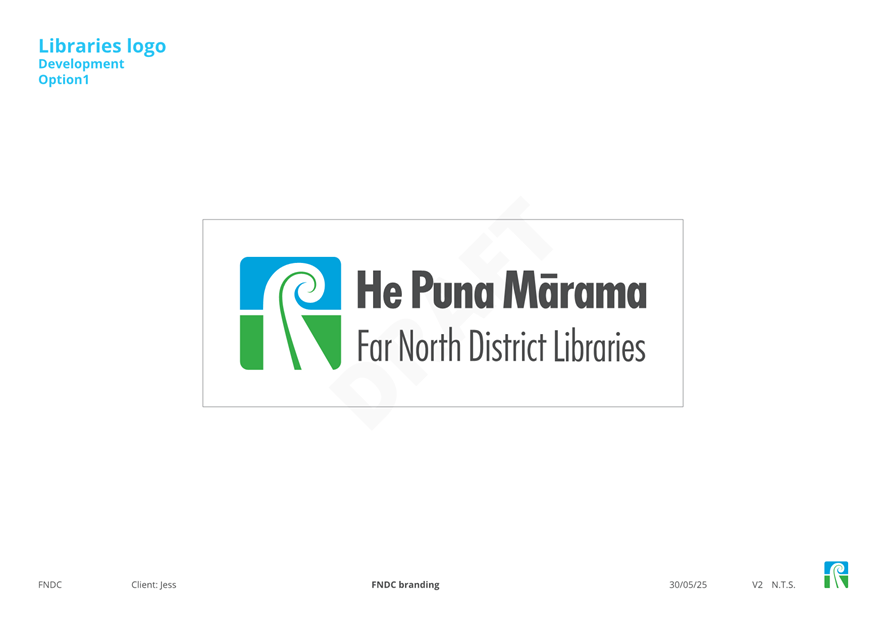
bilingual name: He Puna Mārama, Far North District Libraries. This
initiative aligns the district’s libraries with the Far North District
Council's recent restoration of its indigenous name and logo, reflecting a
deepened commitment to Te Reo Māori and cultural integration.
· Libraries
are evolving beyond traditional "houses of books" to become vital
community hubs for learning, technology, and cultural connection, meaning the
commonly used direct translation ‘Ngā Whare Pukapuka’ does not
effectively capture the full essence of what these services deliver
· The
proposed name, He Puna Mārama, meaning "The Springs of
Enlightenment" (interpreted as "Centres of Information"), is
derived from the significant kōrero of Kupe, reflecting the history and
kaupapa of the Far North.
· The
adoption of this name has no immediate financial implications, as the updates
required to roll the branding out for this name can be made at no additional
cost.
|
tŪtohunga
/ Recommendation
That Te
Kuaka Te Ao Māori Committee;
a) approve
the transition to a bilingual name for Far North District Libraries, and
b) approve
the proposed name ‘He Puna Mārama, Far North District
Libraries’ on behalf of Council.
|
1) TĀhuhu kŌrero / Background
Far North District Council
refreshed its logo and restored its indigenous name in February 2024,
signalling Council's increased commitment to using Te Reo Māori and
aligning with its Te Reo and Tikanga Policy.
Initially, Far North District
Libraries retained their English name and logo. To align with Council's
direction and deepen this commitment, libraries leadership engaged with Te Hono
team to establish a new Te Reo Māori name for the libraries that would
reflect both the purpose and history of the Far North district.
The name He Puna Mārama
emerged from these in-depth discussions with Te Hono staff and is presented to
the committee for consideration.
The intent of this report is not to
change specific names of existing libraries, but to approve a group name for
the Far North District Libraries, including the mobile library. The work on
specific whare names for each site will be progressed as required (noting Te
Hononga and Te Ahu already have whare names that will remain) with local
hapū iwi when the services name is approved.
2) matapaki me NgĀ KŌwhiringa /
Discussion and Options
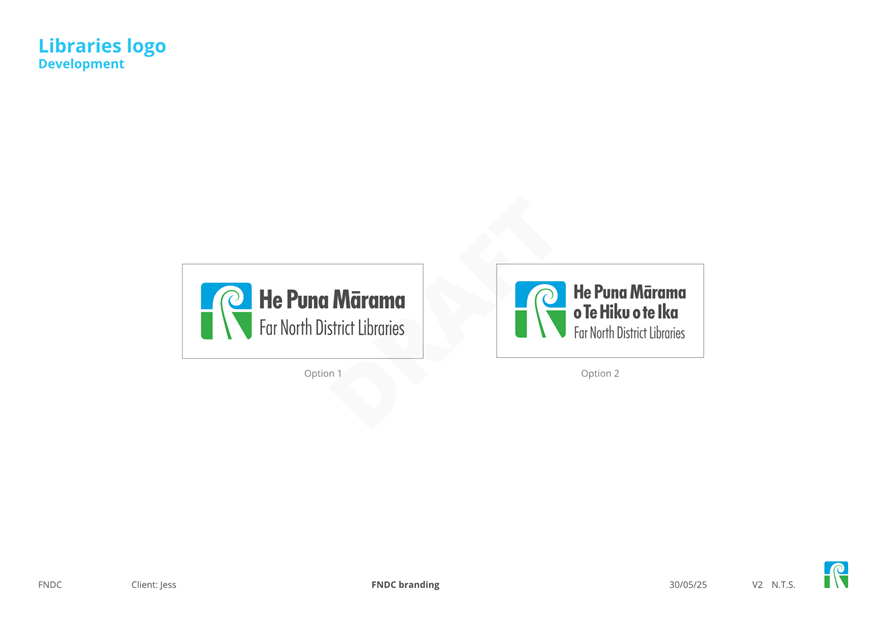
The preferred option is to adopt a
new, bilingual name for Far North District Libraries: He Puna Mārama,
Far North District Libraries.
An alternative option proposed is He
Puna Mārama o Te Hiku o te Ika, Far North District Libraries. This
option is not preferred due to its close similarity to Far North District
Council’s logo and concern this may cause brand confusion across our
communities.
Both logo options are displayed
below for consideration of the committee.
Proposal of these options stem from
a desire to align the libraries' identity with the Far North District Council's
refreshed logo and revitalisation of its Te Reo Māori name, and to visibly
deepen the commitment to te ao Māori within the district.
Libraries are more than
"houses of books"; they are vital, ever-evolving community hubs
offering learning, technology access, cultural enrichment, and inclusive safe
spaces that foster wellbeing, connection, and opportunity. A name that holistically
reflects this broader kaupapa and the rich history of the Far North district is
therefore essential.
The name ‘He Puna
Mārama’ is rooted in the significant narrative kōrero of Kupe,
the great Polynesian wayfinder. As he departed Aotearoa from the Hokianga,
Kupe's farewell as one of his final statements “Hei konei rā e Te
Puna i te Ao Mārama, ka hoki nei ahau, e kore ano ahau e hoki anga nui
mai.” (Farewell The Spring of Enlightenment, for I return home, never to
return to this place) – provides a powerful metaphor that can be taken
and adapted to encompass Far North District Libraries and its purpose in providing
services to our communities.
"He Puna Mārama"
directly translates to ‘The Springs of Enlightenment’ and, as a
literal translation, can be interpreted as ‘centres of
information/knowledge’. This encapsulates the libraries' expanded role as
sources of knowledge, growth, and community engagement.

Relevant legislation and/or policies
This initiative aligns with the
Council's Te Reo Māori and Tikanga Policy, and Te Pae o Uta – Te Ao
Māori Framework which both outline goals and potential actions to increase
the use of Te Reo Māori internally and externally. It also supports the
spirit of the Local Government Act 2002, which encourages local authorities to
provide for the social, economic, environmental, and cultural well-being of
their communities. By adopting a bilingual name, Far North District Libraries
will enhance inclusivity, working to foster stronger engagement and better meet
the diverse needs of Māori.
The adoption of ‘He Puna
Mārama’ holds significant cultural importance. This proposal
demonstrates tangible commitment to Te Tiriti o Waitangi by valuing and
integrating Te Reo Māori, Te Ao Māori, and local Māori narratives
into prominent public-facing services. This name emerged from kōrero
between Libraries leadership and Te Hono through a culturally informed and
collaborative approach. It is anticipated that this name will foster a stronger
sense of belonging and pride in library services for Māori within the Far
North district, while also educating and enriching the wider community.
Policy and strategy considerations
This proposal directly supports the
Far North District Council's strategic direction toward becoming a culturally
skilled, Te Reo Māori proficient organisation. By adopting a bilingual
name derived from a significant local kōrero, the libraries become another
example of this commitment. It reinforces the Council's desire to reflect the
unique identity of the Far North and to ensure its services are culturally
resonant for all residents.
Risk and mitigations
· Risk: Potential
for initial public confusion or resistance to a new name.
o Mitigation: A comprehensive communication
plan will be developed to clearly explain the meaning and significance of
‘He Puna Mārama’, its connection to the Far North's history,
and how it reflects the libraries’ modern role. This plan will include
public education materials, social media campaigns, and staff training. The
name will be revealed as a planned launch during Mahuru Māori, alongside
other bilingual signage updates.
· Risk:
Mispronunciation or misunderstanding of the Te Reo Māori name.
o Mitigation: Provide pronunciation guides
and resources for staff and the public. Promote correct usage through all
communications.
· Risk: Perceived
exclusion of non-Māori residents.
o Mitigation: Emphasise the bilingual nature
of the name and the inclusive "Centres of Information/knowledge"
interpretation, highlighting that the libraries remain welcoming spaces for all
members of the community, regardless of cultural background.
Implications for Māori
The adoption of "He Puna
Mārama" has profound positive implications for Māori. It
directly acknowledges and honours the ancestral history of the Far North
district through the kōrero of Kupe. By integrating Te Reo Māori into
a core public service like the libraries, it contributes to the revitalisation
and normalisation of the language. ‘He Puna Mārama’ resonates
deeply with the Māori worldview, where knowledge is seen as a spring of
enlightenment, connection, and wellbeing.
This name reaffirms the
relationship of Māori with their ancestral lands and waters by embedding
their rich cultural narratives within a contemporary institution, fostering
cultural pride and strengthening identity for current and future generations.
Costs of each option
Option 1: Adopt "He Puna Mārama, Far North
District Libraries" (Recommended)
· Initial Costs: $0.
There are no financial implications in
receiving this report. All necessary initial updates to existing digital
content and logos can be made at no cost, primarily requiring staff time to
update existing collateral.
· Anticipated
near future costs: No unbudgeted expenditure requests required
- Replacement logo vinyl on
the Mobile Library. Costs are minimal at $435 +GST, but confirming all updates
to signage will be completed using existing libraries operational budget.
- Signage above
Kaitāia Library and Service centre at the front count (at Te Ahu) –
this is currently the previous council logo, discussions underway with
Communication and Engagement team and the Te Ahu Trust to enable this change to
be made - updates to signage will be completed using existing libraries
operational budget.
- Signage outside Kāeo
Library and Service Centre holds the previous FNDC logo, discussions are
underway with Communication and Engagement team and staff working on building
renewals for this site to enable this change to be made - updates to signage will
be completed using existing libraries operational budget.
- Existing library card
stock – updates to our Library cards will be undertaken,
however to ensure cost effectiveness to ratepayers, will utilise the
large numbers of existing stock (approx. 7000) before reprinting with the new
logo unless otherwise advised by Te Kuaka.
· Future
Cost: No unbudgeted expenditure requests required.
Any
further updates that may incur costs (e.g., new physical signage, large-scale
printing) will be undertaken when budget allows, integrated into standard
operational cycles.
Option 2: Adopt "He Puna Mārama o Te Hiku o te
Ika, Far North District Libraries" (Not recommended, due to close
similarity with Council logo)
· All costs and updates as
per Option 1.
Option 3: Retain "Far North District Libraries"
(Not Recommended)
· Cost: $0 (no
change, therefore no direct cost).
· Opportunity Cost:
Significant.
This option misses a crucial opportunity
to align with the Council's strategic direction, enhance cultural
responsiveness, and strengthen community identity. To choose to retain status
quo reinforces the current disconnect between the Council's updated identity
and a key community service.
Option 4: Adopt a different bilingual name (Not
Recommended at this stage)
· Initial Cost:
Potentially low, if a suitable alternative name were already identified.
· Future Cost: Per
Option 1 and 2.
· Risk:
Requires further extensive engagement and consultation to find a name with
equivalent depth and community resonance. This could significantly delay
implementation and incur additional staff time and resources in the
consultation process, without guaranteed improvement from the current
well-considered proposal.
TAKE TŪTOHUNGA
/ REASON FOR THE RECOMMENDATION
The recommended option is to
approve the adoption of "He Puna Mārama, Far North District
Libraries" as the new bilingual name for Far North District Libraries.
This option is recommended because
it is the most aligned with Council's strategic direction. ‘He Puna
Mārama’ is not merely a translation, but a deeply meaningful name
rooted in the unique history and kōrero of the Far North, embodying the
libraries’ expanded role as vibrant community hubs and centres of
enlightenment. It strengthens the relationship with Māori, enhances
cultural well-being for all residents, and provides a powerful, aspirational
identity for the libraries.
Crucially, the initial
implementation carries no immediate financial cost, allowing for strategic
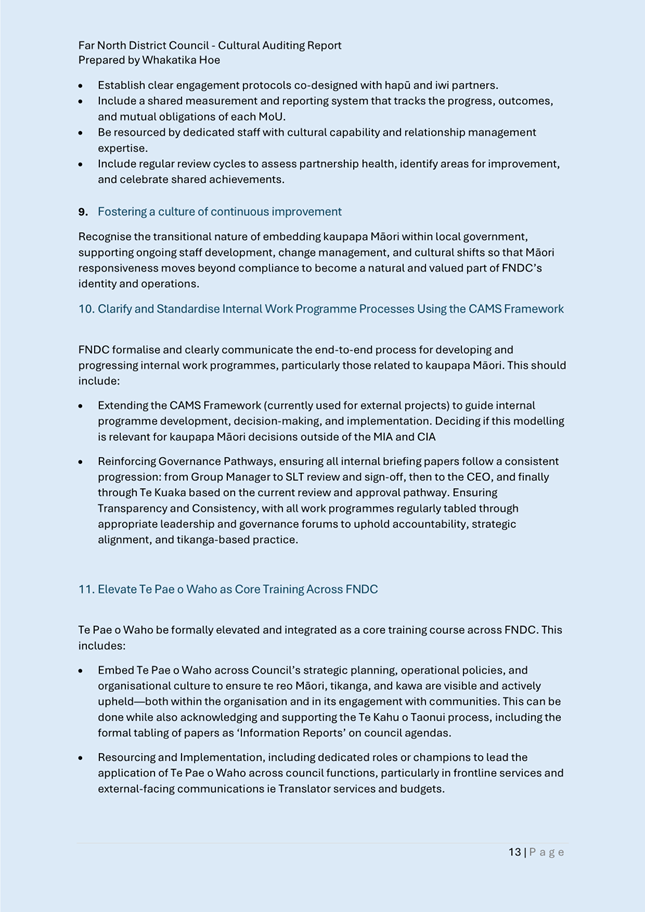
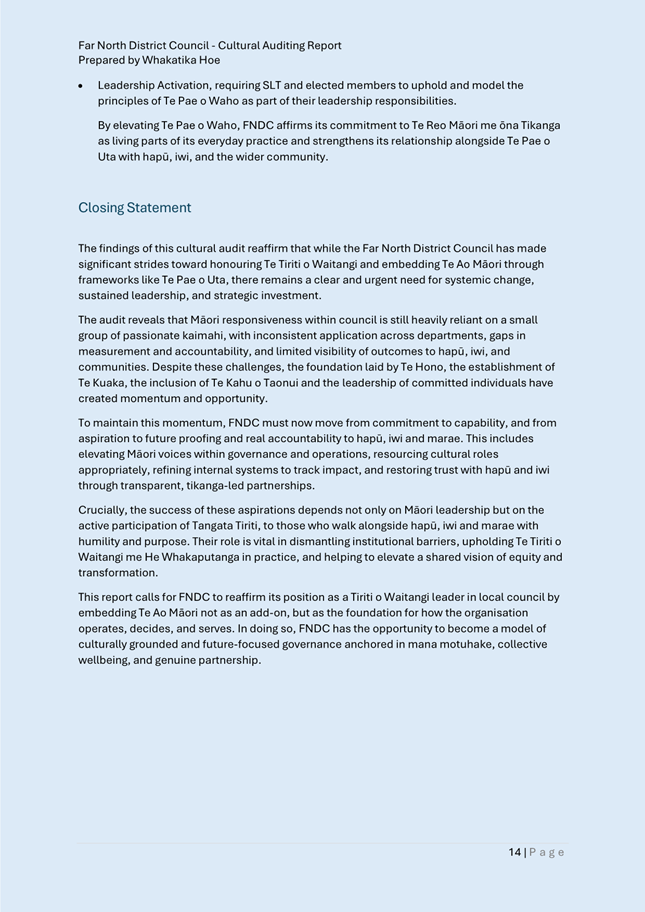
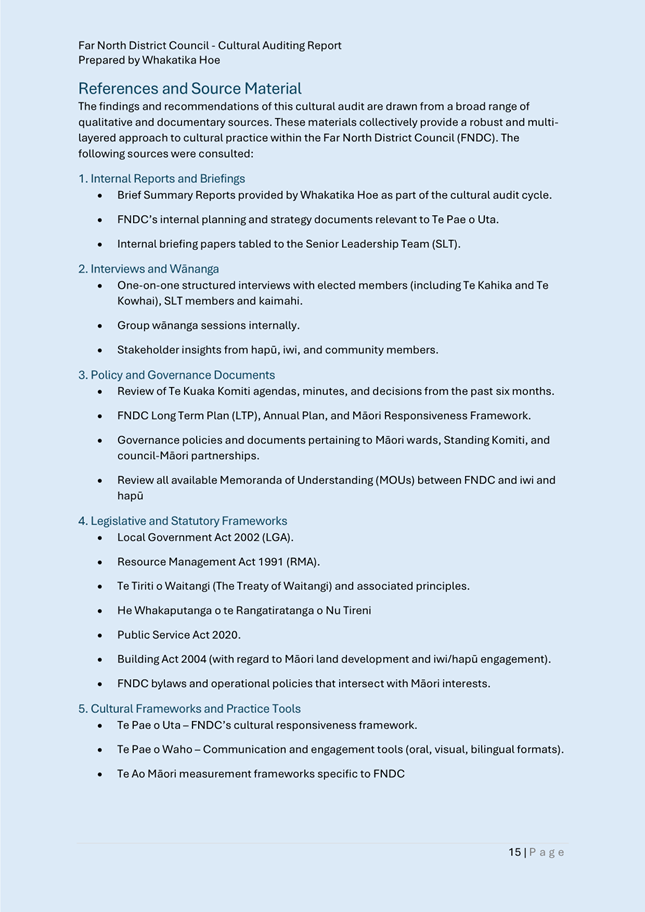
cultural alignment without budget strain, while future updates can be phased as
resources become available.
3) PĀnga PŪtea me ngĀ
wĀhanga tahua / Financial Implications and Budgetary Provision
There are no immediate financial
implications associated with this report or the initial adoption of the new
name. All necessary updates to existing content and logos can be made at no
cost apart from staff time to update existing collateral. Any further updates
that may incur costs will be undertaken within existing budgets.
Anticipated near
future costs will be met withing existing operational budgets. These are likely
to include:
· Replacement logo
vinyl on the Mobile Library. Costs at $435 +GST
· Signage above
Kaitāia Library and Service centre at the front count (at Te Ahu) requires
confirmation with vendor, but previous works indicate this will cost $600 + GST
· Signage outside
Kāeo Library and Service Centre requires confirmation with vendor, but
previous works indicate this will cost $900 + GST
· Existing library
card stock – Libraries bulk order these in lots of 5,000 or
more to lock in the best price per-unit. Generally speaking this costs between
$4,000- $7,000 for an order. As noted earlier in the report, unless otherwise
advised by Te Kuaka the plan is to utilise existing stock and reorder with the
new logos in place as required to ensure cost-effectiveness to ratepayers.
Āpitihanga
/ Attachments
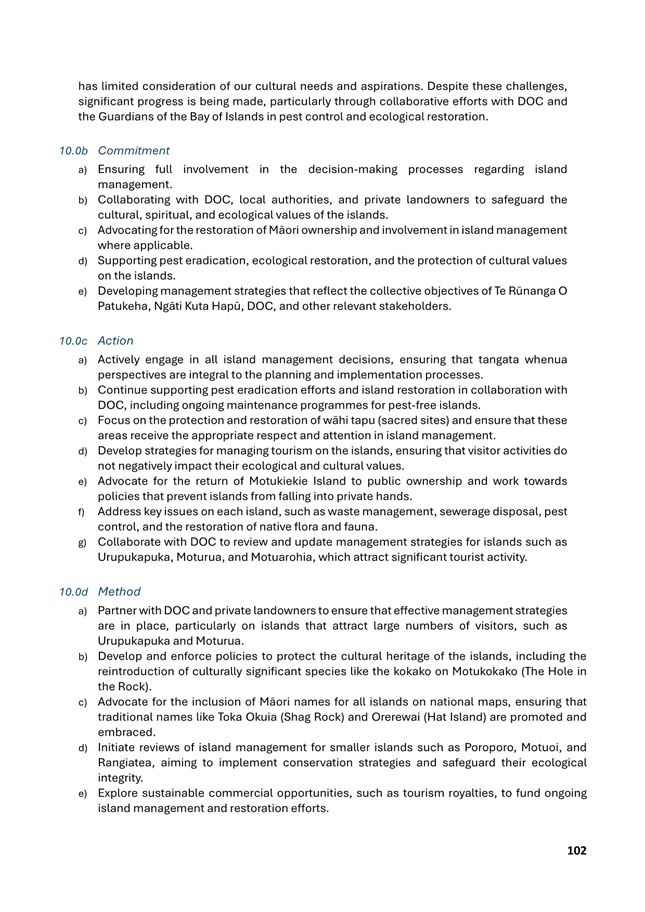
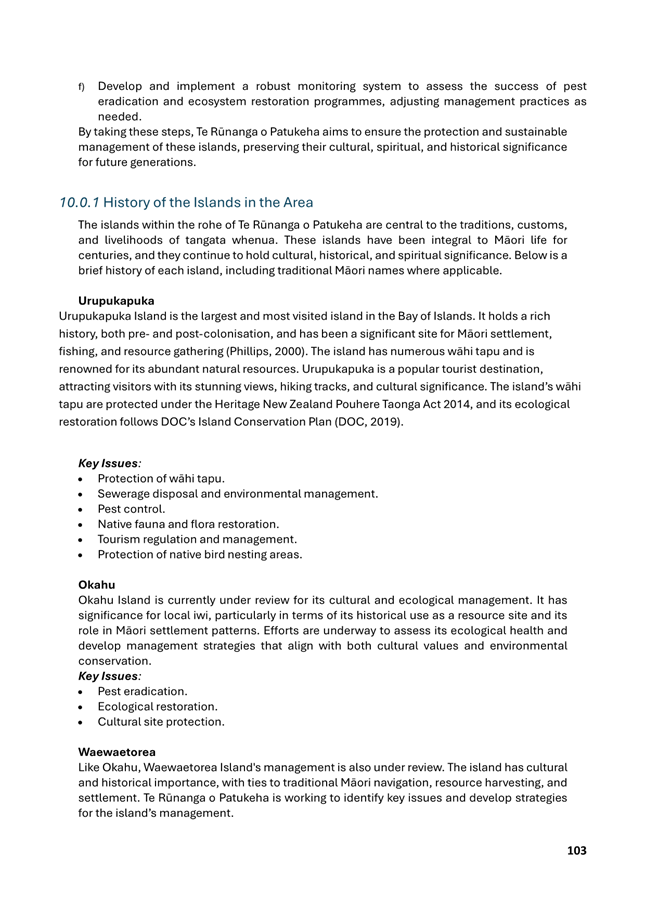
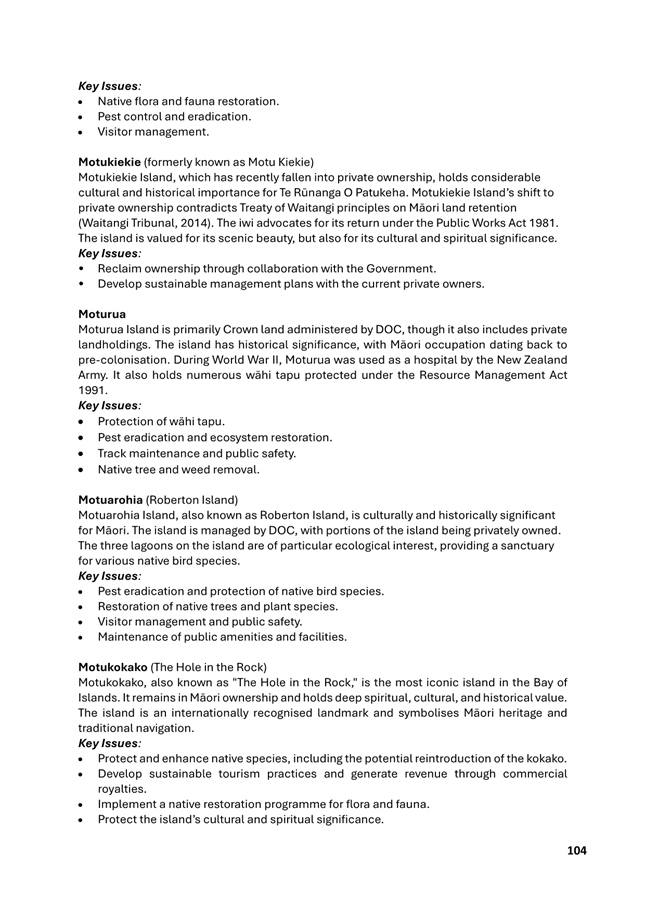
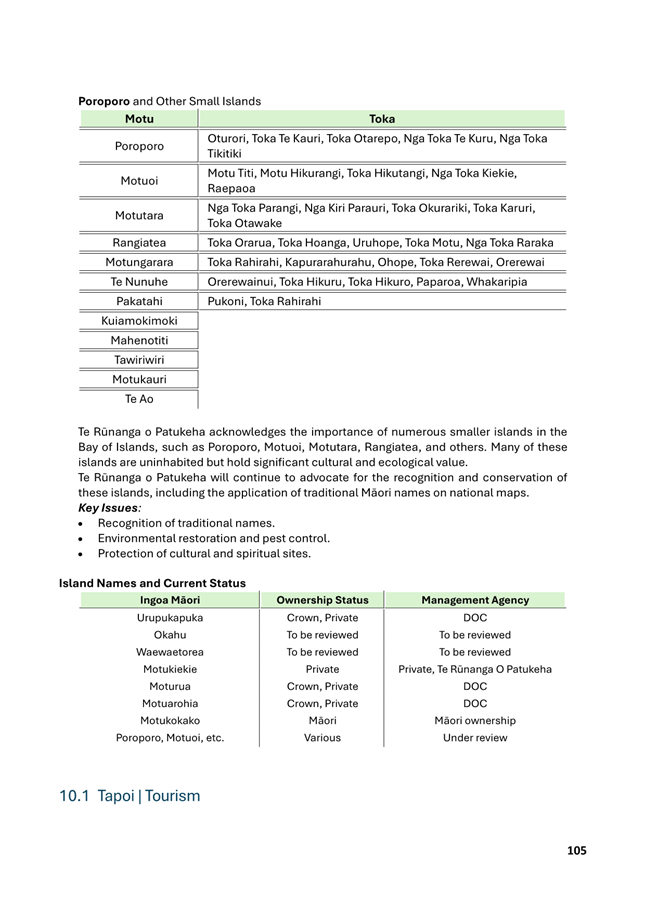
1. 0968_Library-logo_2025_BRAND_Options_Draft2a
- A5356618 ⇩
Hōtaka Take Ōkawa / Compliance Schedule:
Full consideration has been given to the provisions of the
Local Government Act 2002 S77 in relation to decision making, in particular:
1. A
Local authority must, in the course of the decision-making process,
a) Seek
to identify all reasonably practicable options for the achievement of the
objective of a decision; and
b) Assess
the options in terms of their advantages and disadvantages; and
c) If
any of the options identified under paragraph (a) involves a significant
decision in relation to land or a body of water, take into account the
relationship of Māori and their culture and traditions with their
ancestral land, water sites, waahi tapu, valued flora and fauna and other
taonga.
2. This
section is subject to Section 79 - Compliance with procedures in relation to
decisions.
|
He Take Ōkawa /
Compliance Requirement
|
Aromatawai Kaimahi /
Staff Assessment
|
|
State the level of significance (high or low) of the
issue or proposal as determined by the Council’s
Significance and Engagement Policy
|
This report has a high degree of significance. While the
direct financial cost is low, the proposal involves a significant cultural
and identity change for a key community service, aligning with the Council's
strategic direction on Te Reo Māori and biculturalism, impacting how the
community identifies with its libraries.
|
|
State the relevant Council policies (external or
internal), legislation, and/or community outcomes (as stated in the LTP) that
relate to this decision.
|
This decision aligns with the Local Government Act 2002
(encouraging cultural well-being and Māori engagement), the
Council’s Te Reo Māori and Tikanga Policy, and the Te Pae o Uta
– Te Ao Māori Framework. It also supports community outcomes
related to cultural identity and community well-being as outlined in the
Long-Term Plan.
|
|
State whether this issue or proposal has a District wide
relevance and, if not, the ways in which the appropriate Community
Board’s views have been sought.
|
This report has District-wide relevance as it pertains
to the collective identity of all Far North District Libraries, serving the
entire community. While individual library names are not changing, the
overarching group name affects all users across the district.
|
|
State the
possible implications for Māori and how Māori have been provided
with an opportunity to contribute to decision making if this decision is
significant and relates to land and/or any body of water.
State the
possible implications and how this report aligns with Te Tiriti o Waitangi /
The Treaty of Waitangi.
|
The adoption of "He Puna Mārama" has
profound positive implications for Māori. It directly acknowledges and
honours ancestral history and contributes to Te Reo Māori
revitalisation. Māori input was provided through direct kōrero
between Libraries leadership and the Te Hono team, who offered the name for
consideration. This process respects the relationship of Māori with
their culture and traditions.
|
|
Identify persons likely to be affected by or have an
interest in the matter, and how you have given consideration to their views
or preferences (for example – youth, the aged and those with
disabilities).
|
Persons likely to be affected or interested include all
Far North residents who use library services, particularly Māori
communities (who will benefit from increased cultural recognition), and
library staff. The chosen name, "He Puna Mārama," embodies an
inclusive "Centres of Information/knowlege" concept, designed to be
welcoming to all, including youth, the aged, and those with disabilities, by
promoting access to learning, technology, and community connection.
|
|
State the financial implications and where budgetary
provisions have been made to support this decision.
|
There are no immediate financial implications associated
with this report. All necessary initial updates to existing content and logos
can be made at no cost. Any further updates that may incur costs will be
undertaken only when budget allows and using existing operational budgets, no
unbudgeted expenditure requests will be required. This is further detailed in
section 2 and 3.
|
|
Chief Financial Officer review.
|
N/A
|
|
Ordinary
Te Kuaka - Te Ao Māori Committee Meeting Agenda
|
23
September 2025
|

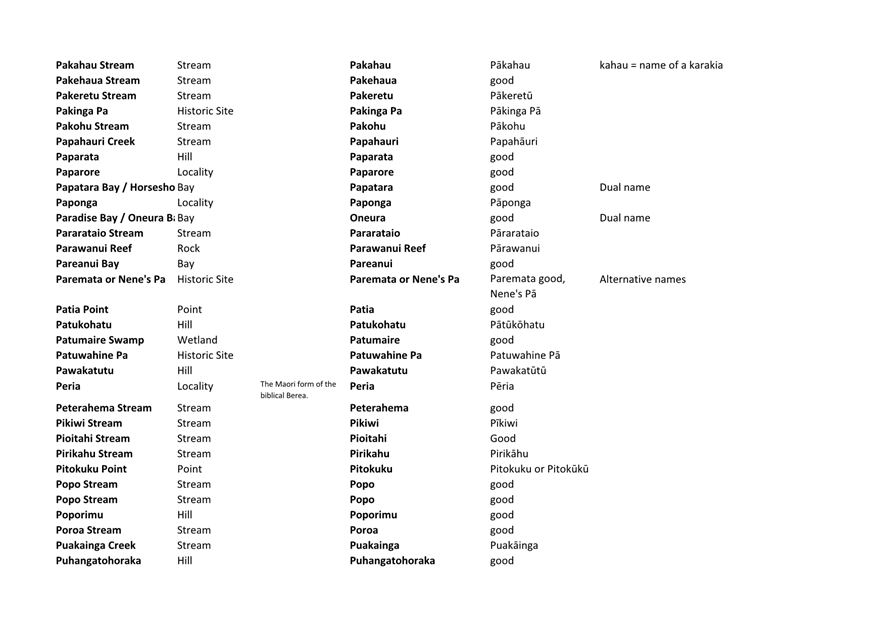
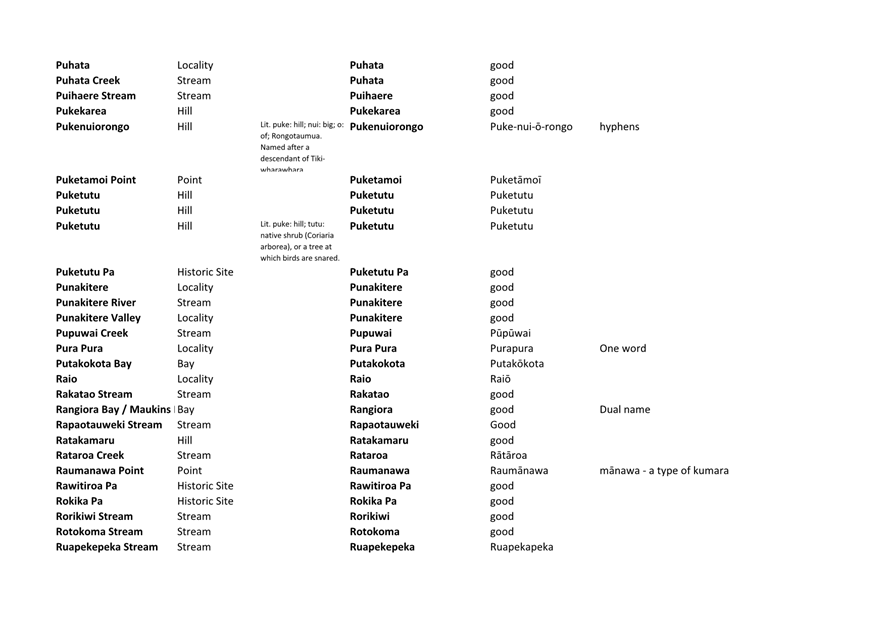
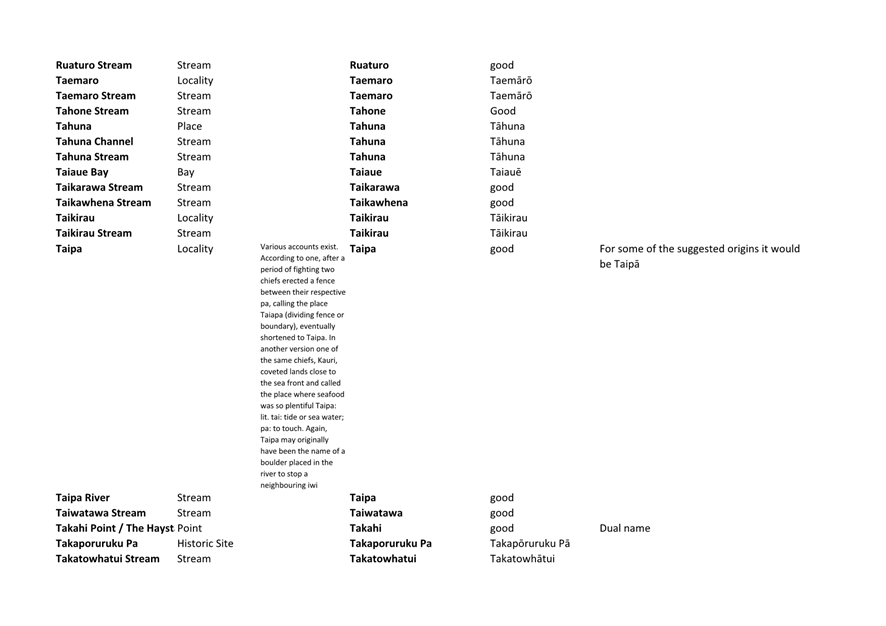
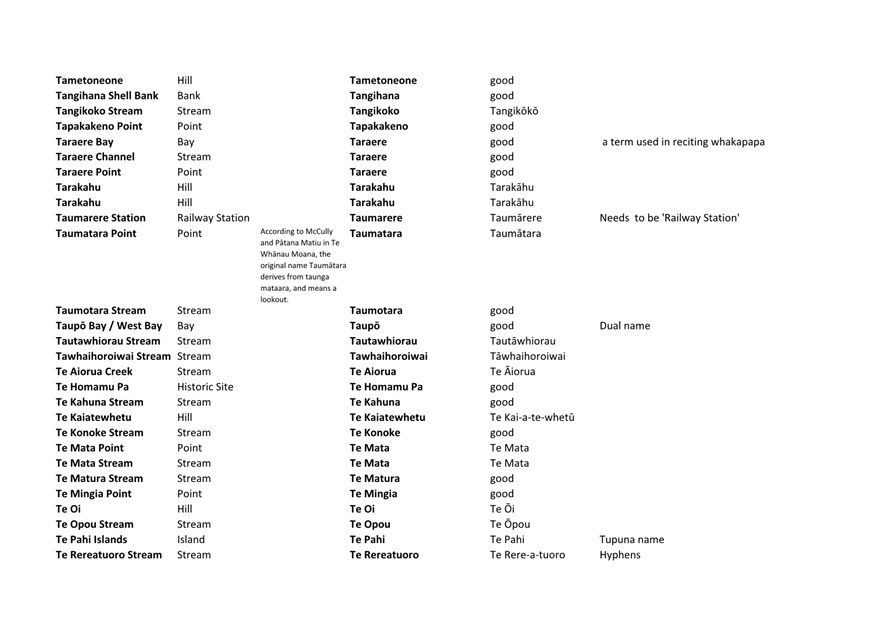
5.4 Far
North Towns and Names
File
Number: A5272278
Author: Llani
Harding, Pouhautū Te Hono - Manager - Te Hono
Authoriser: Jacine
Warmington, Group Manager - Strategic Relationships
Take Pūrongo / Purpose of the Report
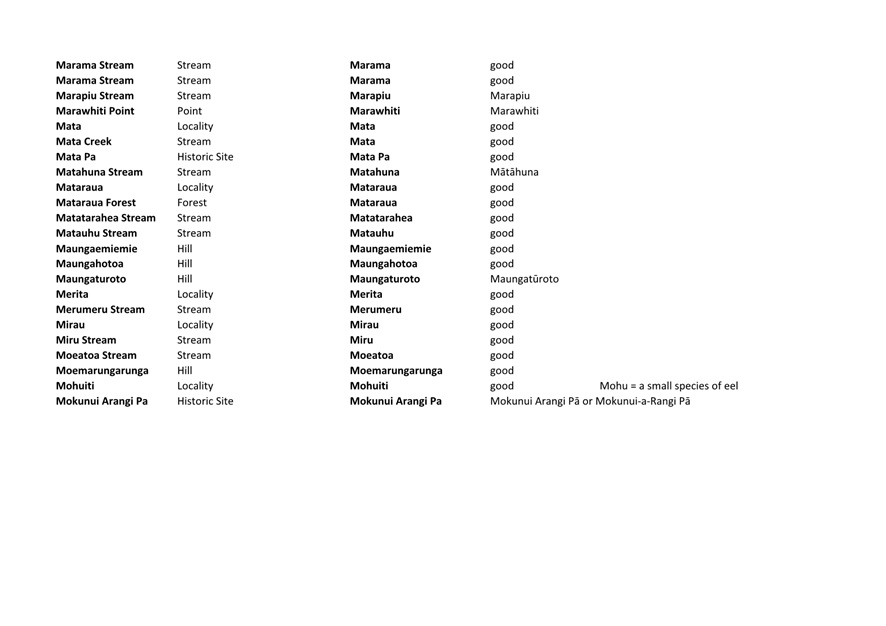
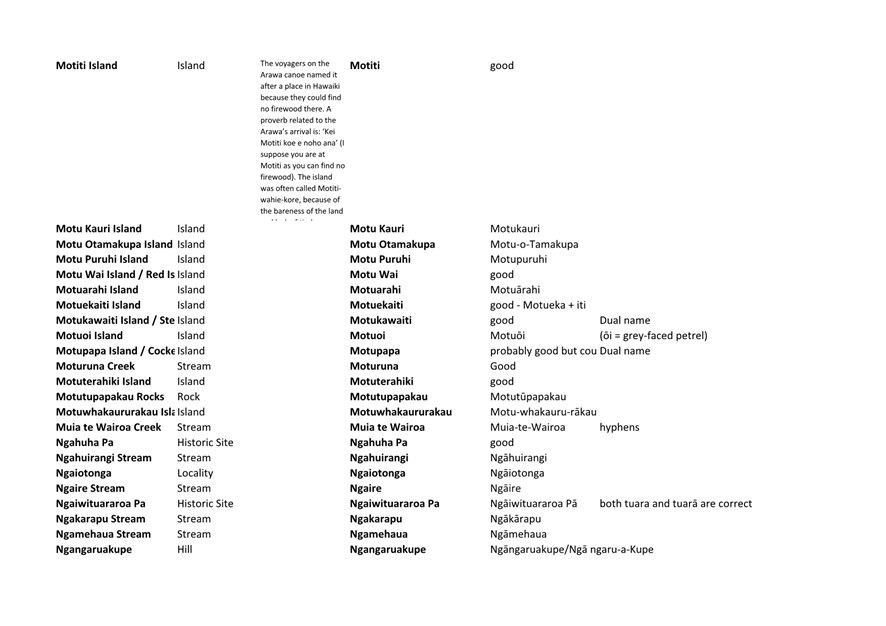
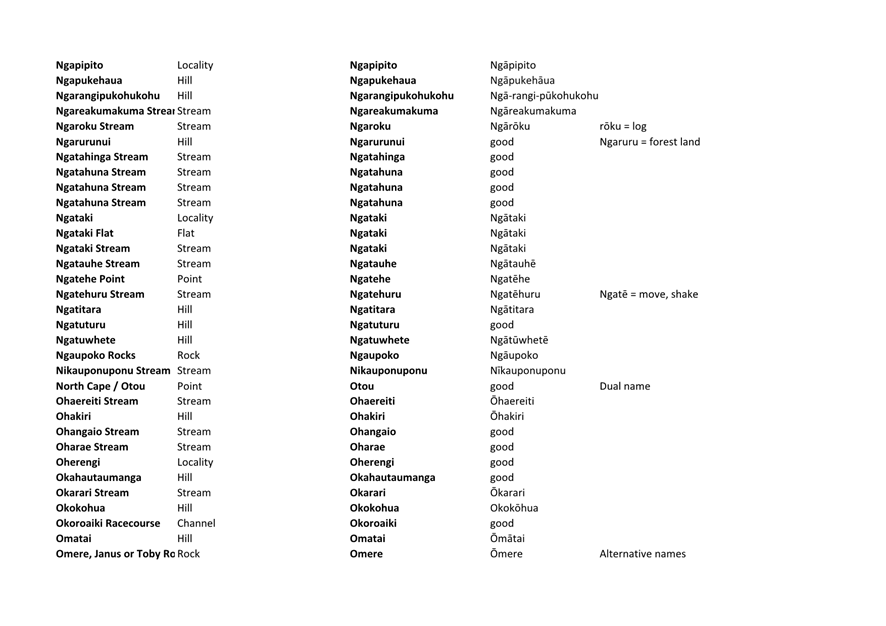
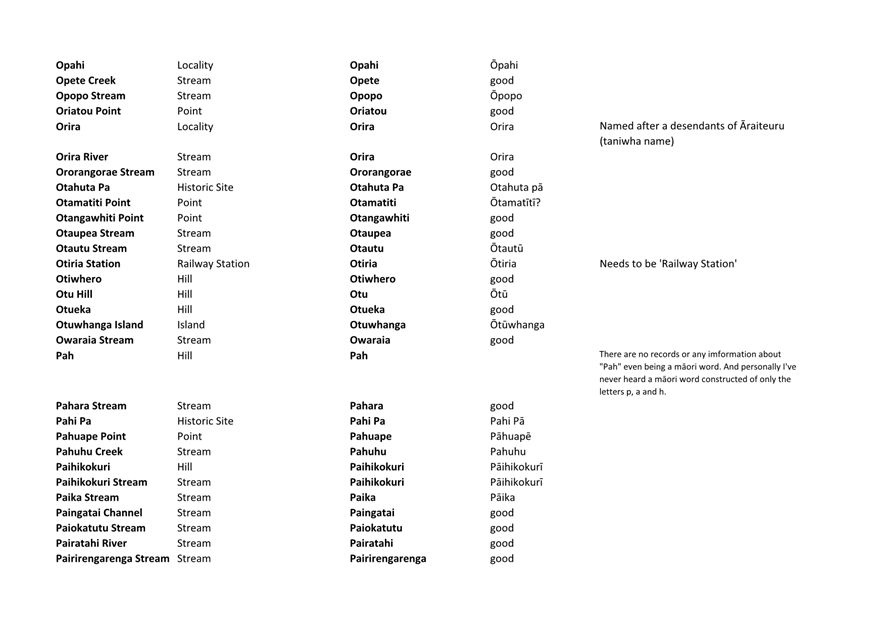
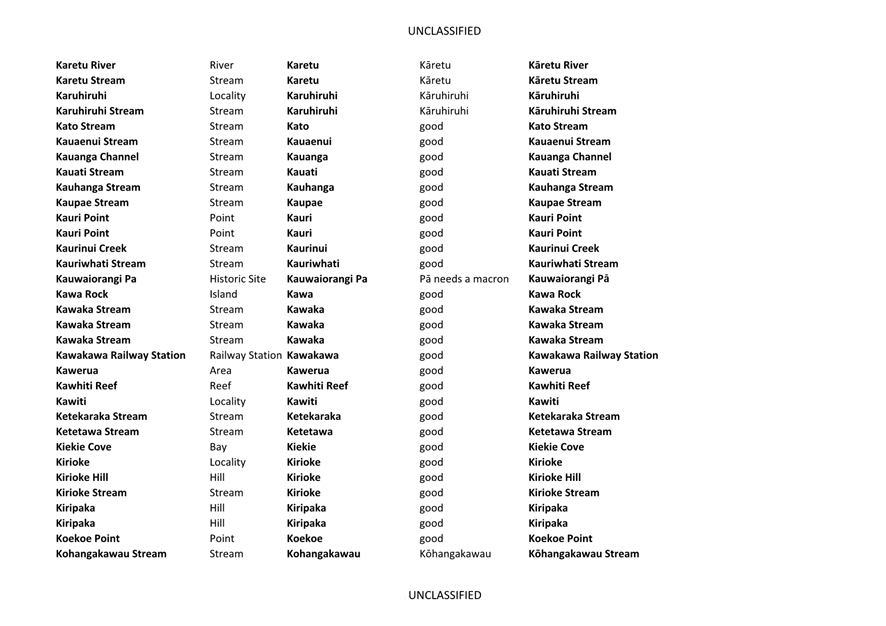
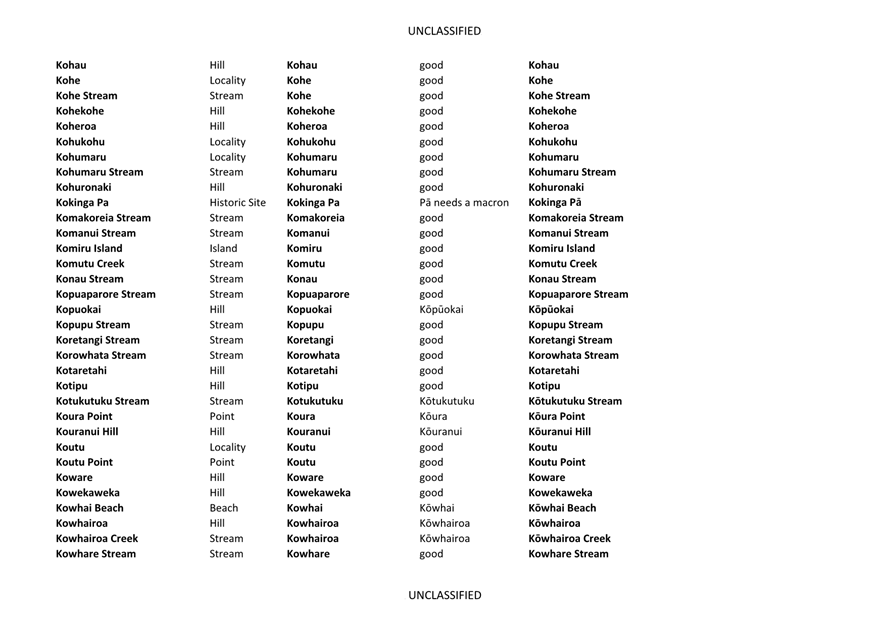
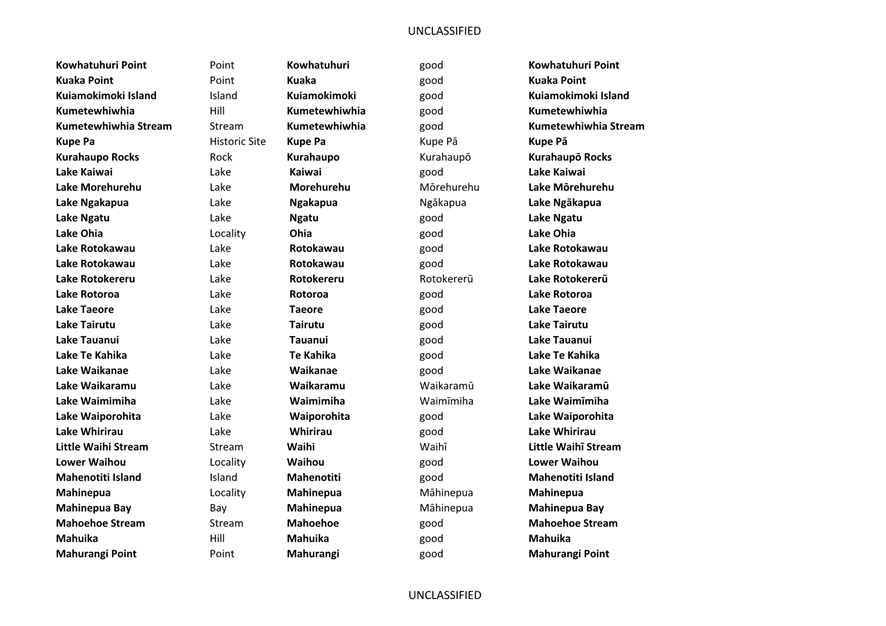
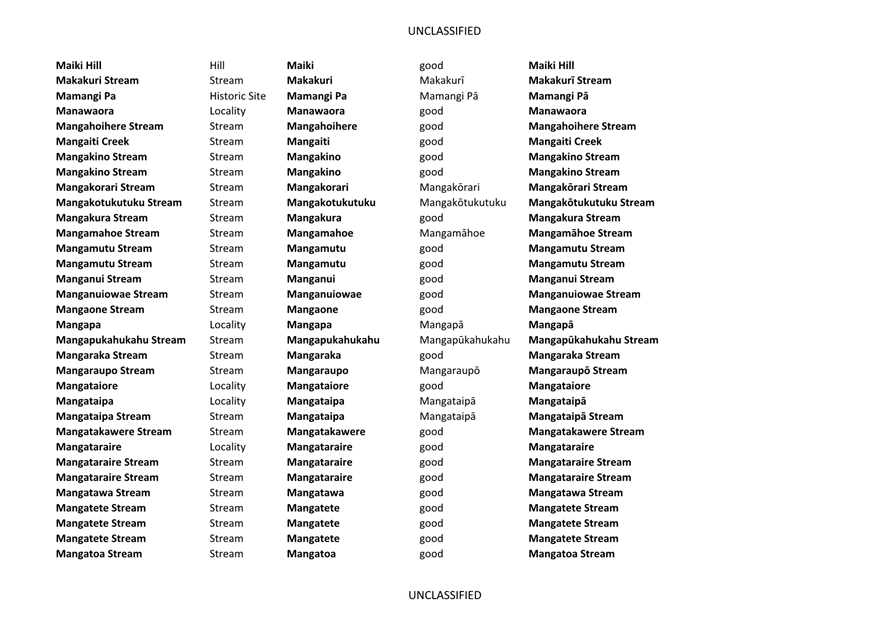
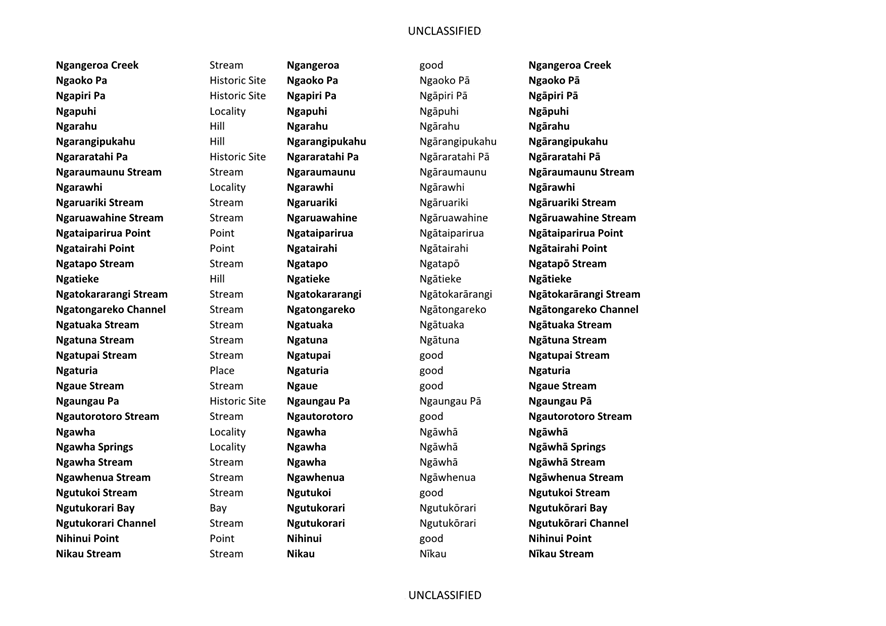
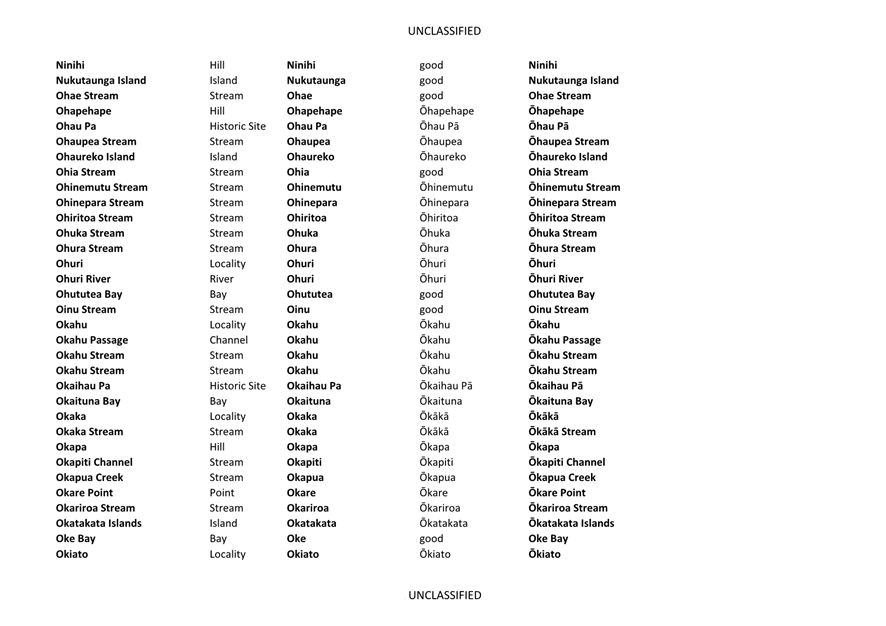
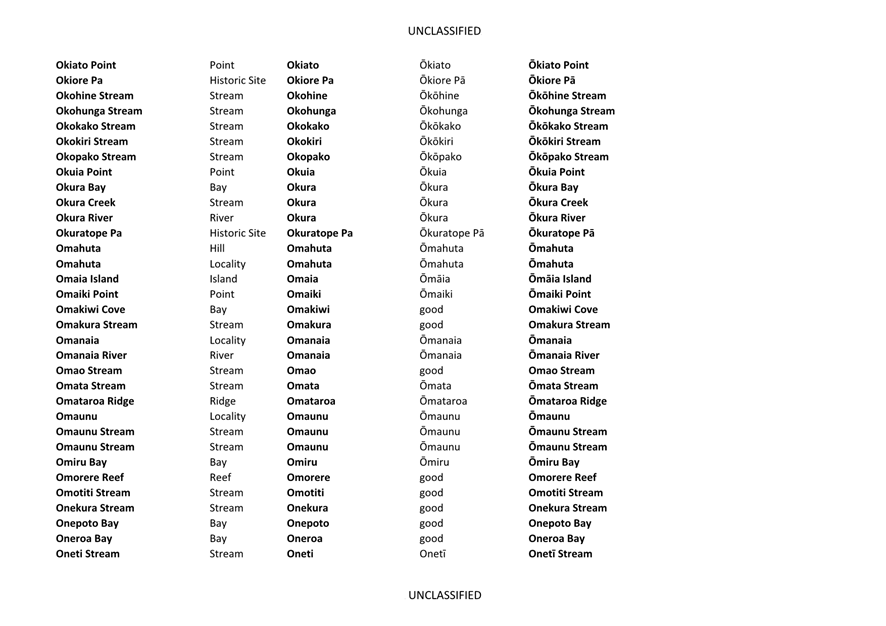
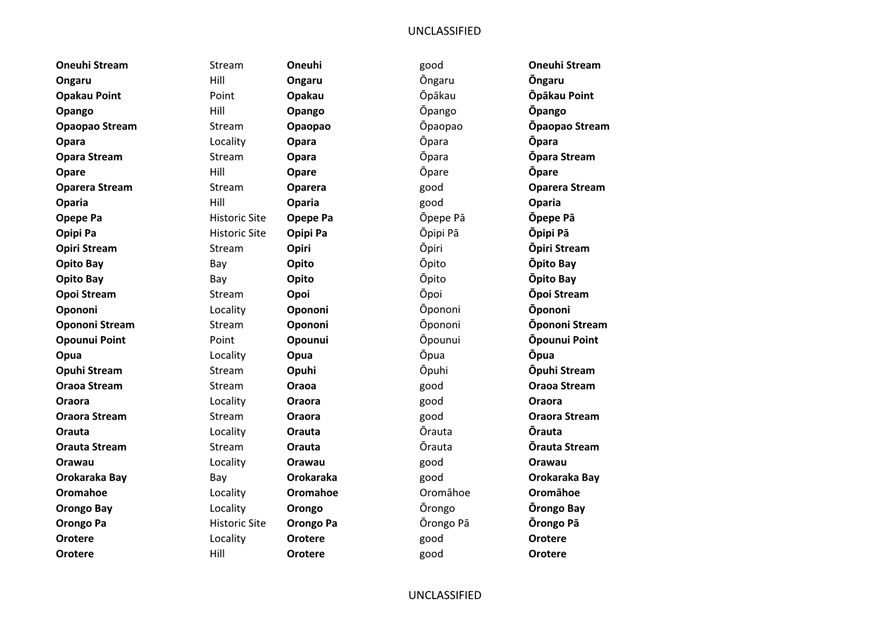
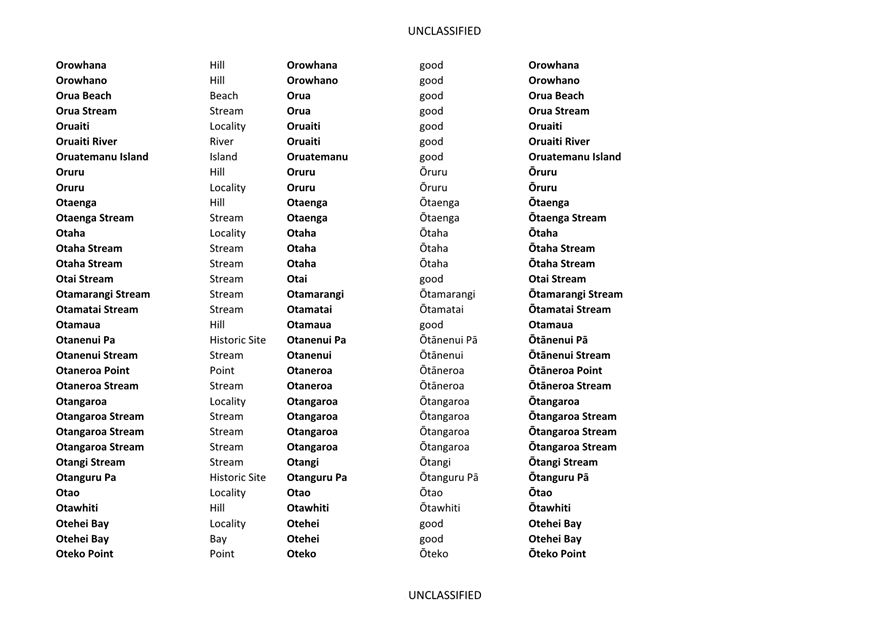
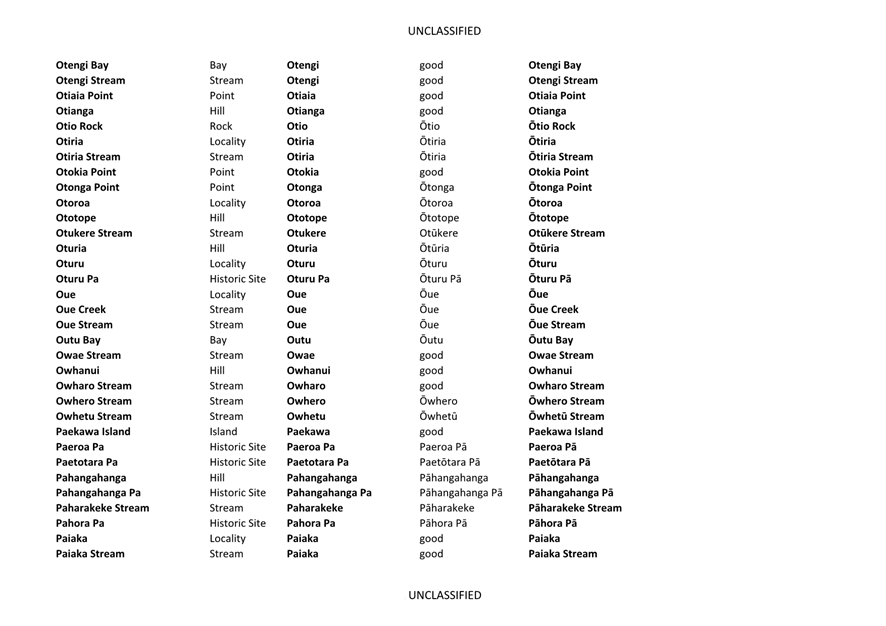
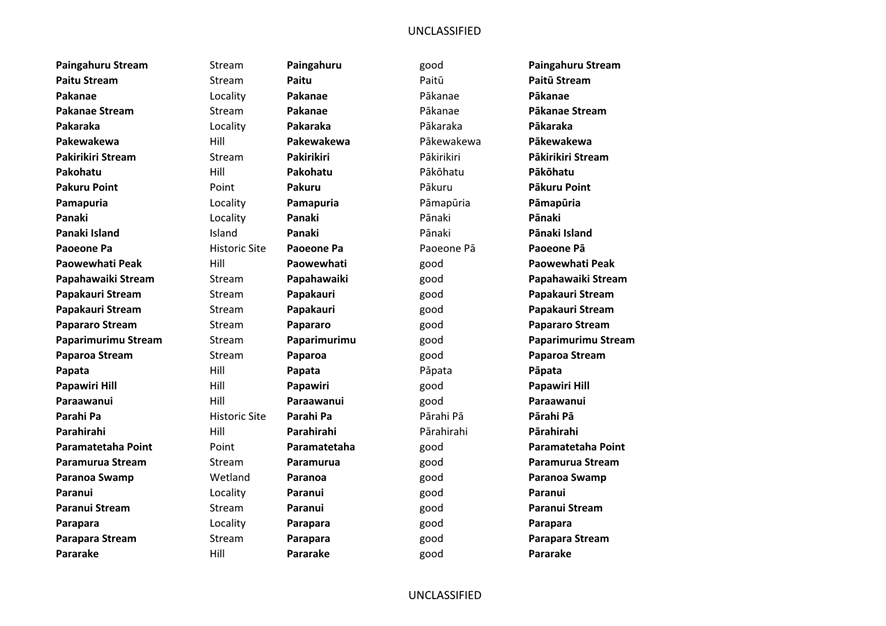
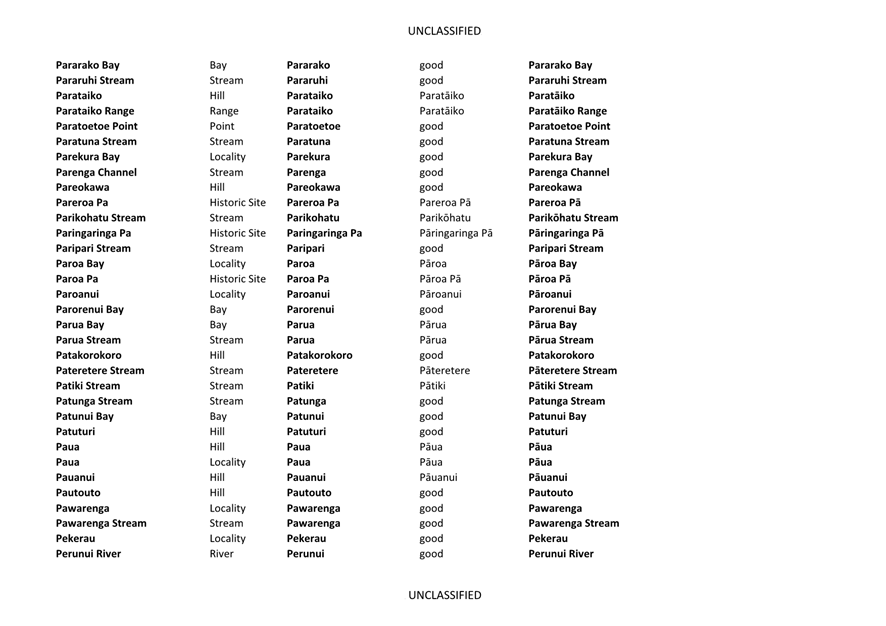
To review the Towns and Community
names submissions to Ngā Pou Taunaha o Aotearoa – New Zealand
Geographic Board.
WhakarĀpopoto matua / Executive Summary
· This report provides an overview of the
official Māori place names that have been developed for the Ngā Pou
Taunaha o Aotearoa New Zealand Geographic Board (the Board).
|
tŪtohunga
/ Recommendation
That Te Kuaka – Te Ao Māori Committee
receive the report Far North Towns and Names and recommend that Council
approve the towns and place names for adoption by the New Zealand Geographic
Board
|
1) TĀhuhu kŌrero / Background
Thousands of place names throughout
New Zealand are not official, even though most have been shown on maps and
charts for many years. Making place names official is important as it means
there is one agreed and correct name for a place. This is especially important
for identifying where you are in an emergency and to recognise New
Zealand’s unique culture and heritage.
In 2023 the Board altered the
programme that began in 2020 because the number of recorded (unofficial) place
names was too high for some iwi to process. The Board decided to focus on
processing recorded (unofficial) Māori place names first, adding macrons
where appropriate and giving mana whenua more time to respond if needed. The
Board will continue to approve recorded Māori names as official, as long
as they meet the criteria.
As part of the programme, the Board
will review the existing official Māori place names to ensure they are
consistent with any newly approved names that have macrons.
If a Māori place name made
official through this process needs to be corrected in respect of macrons, we
can publish an amendment in the New Zealand Gazette or a formal proposal can be
made, which this Board would publicly consult on.
Spelling changes to any place name,
whether recorded or official, will require a proposal that goes through public
consultation. These cannot be processed through this programme.
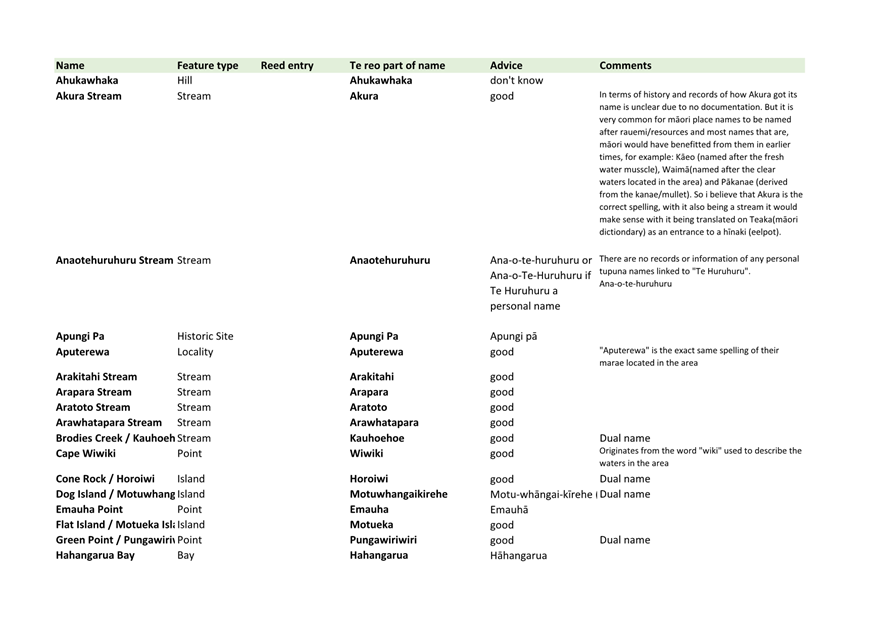
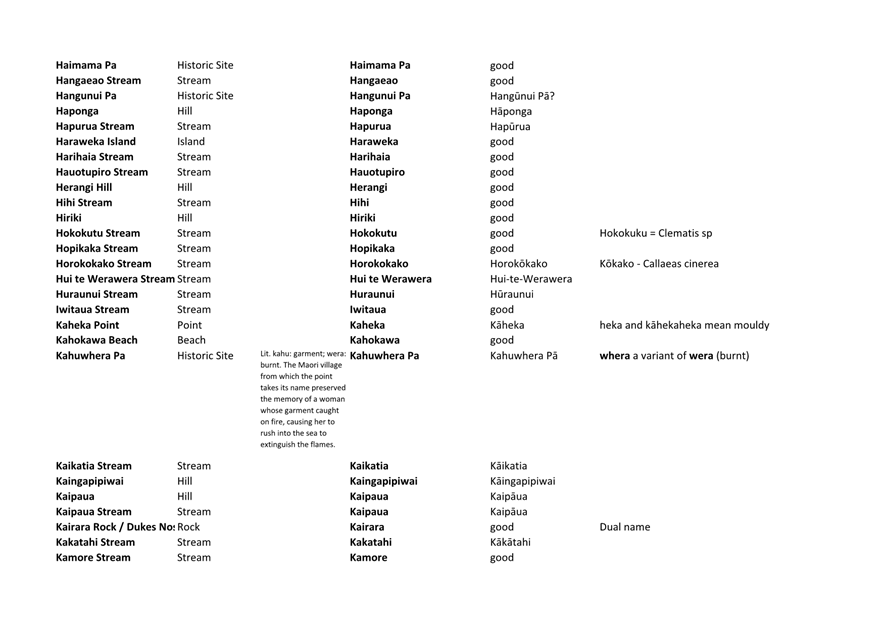
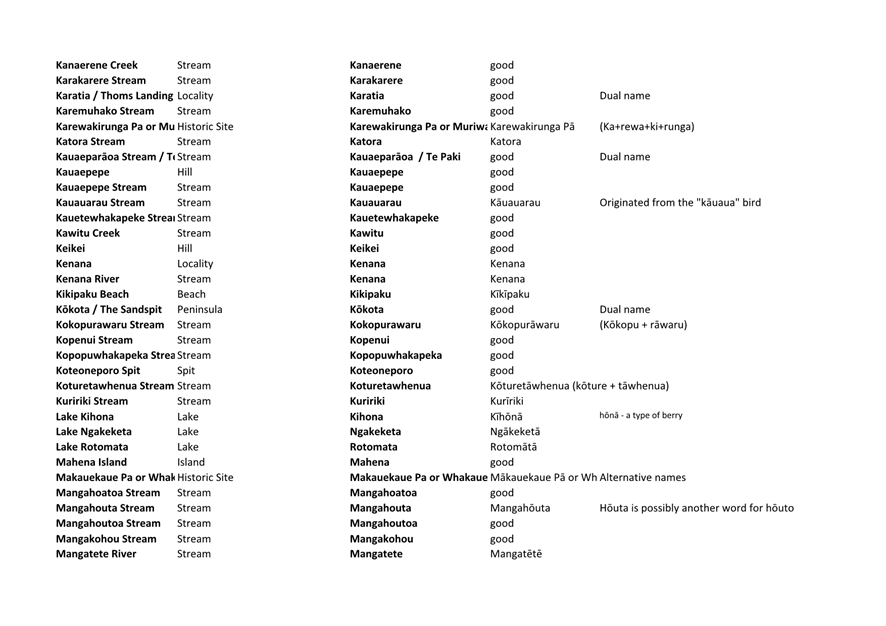
To support this work, the Board
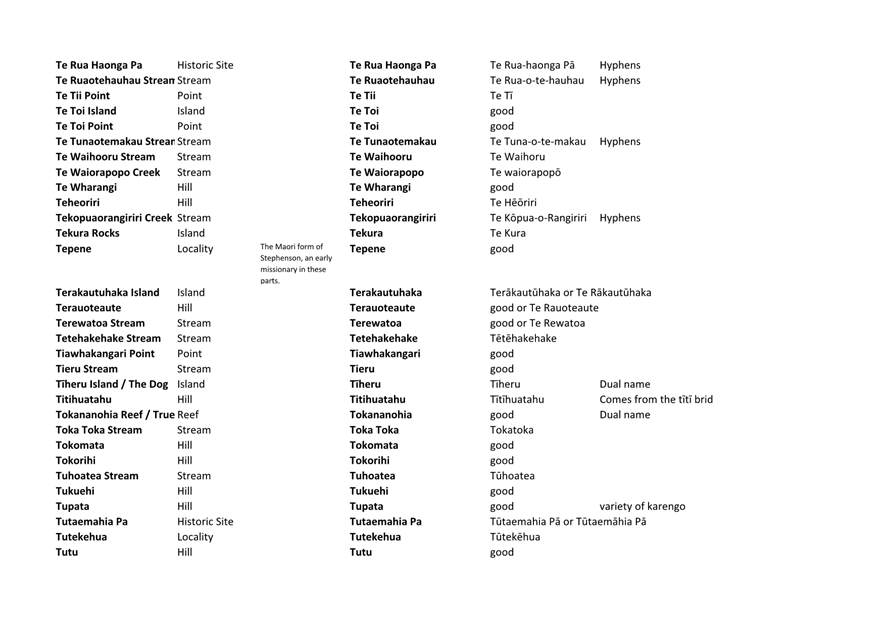
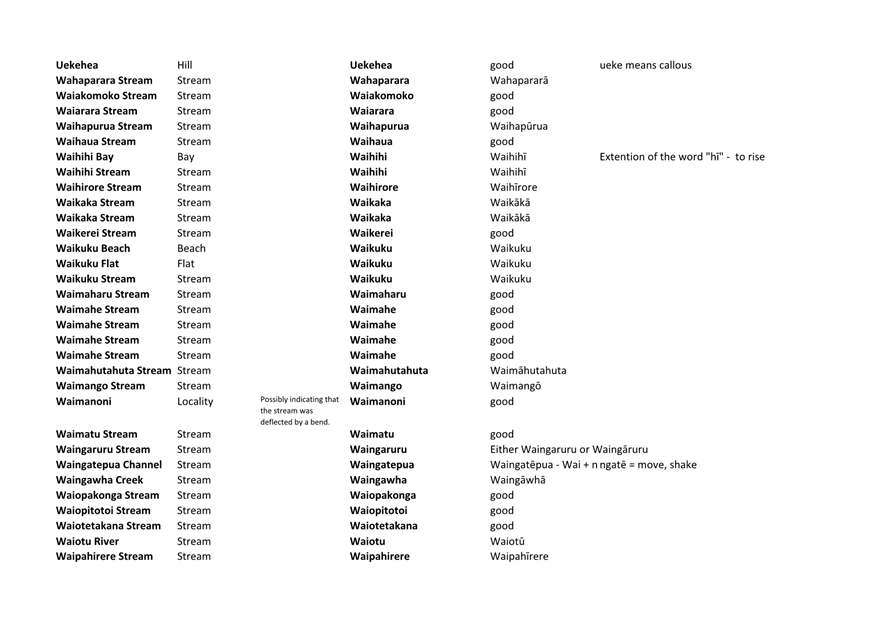
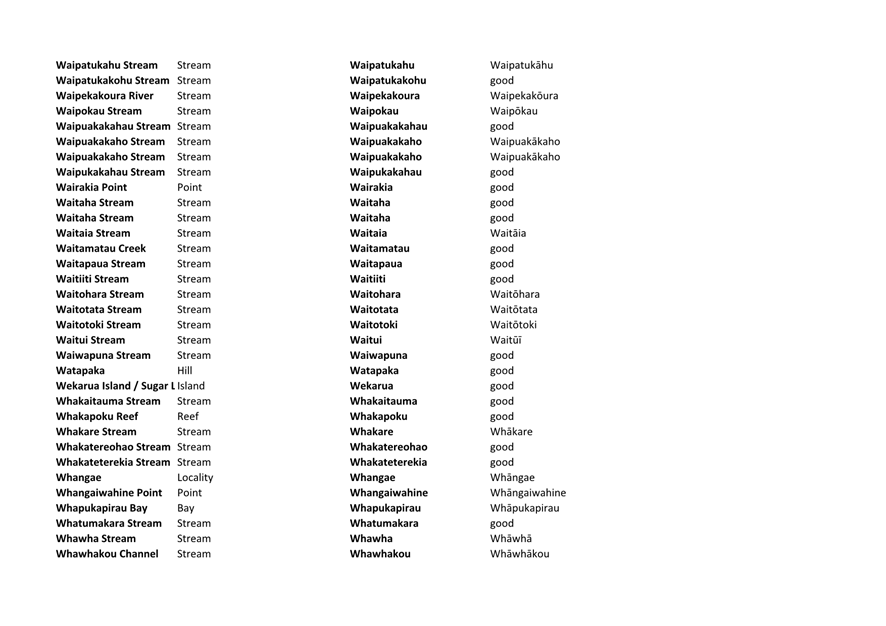
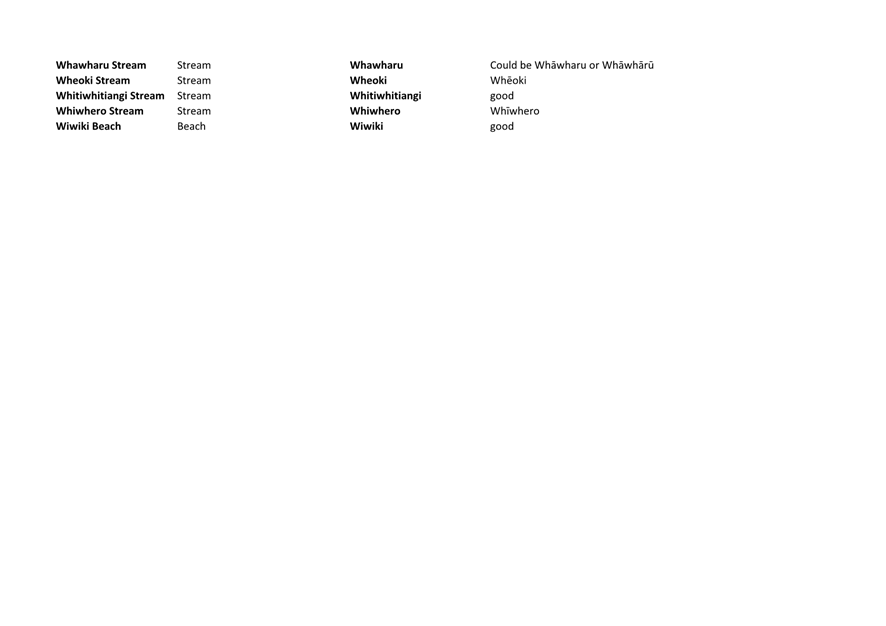
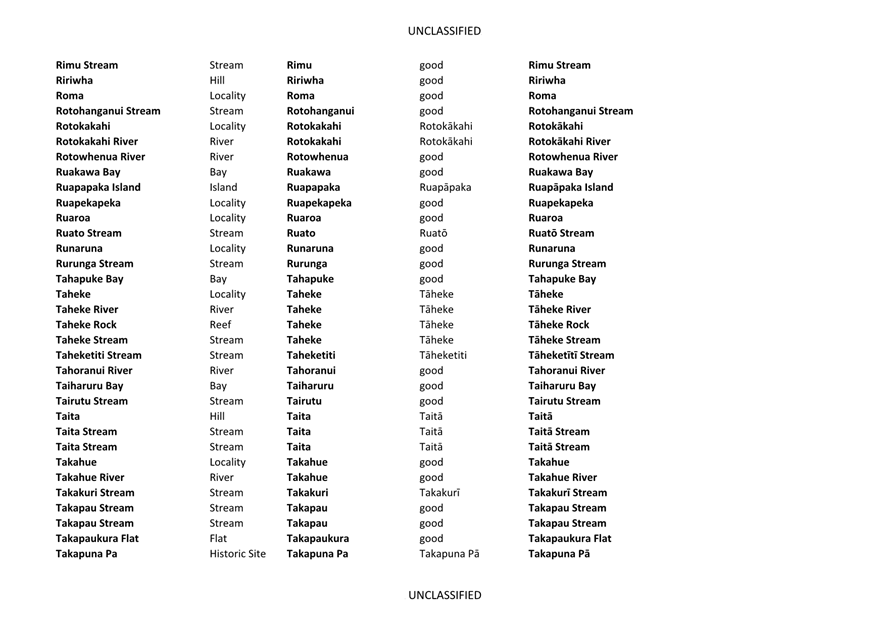
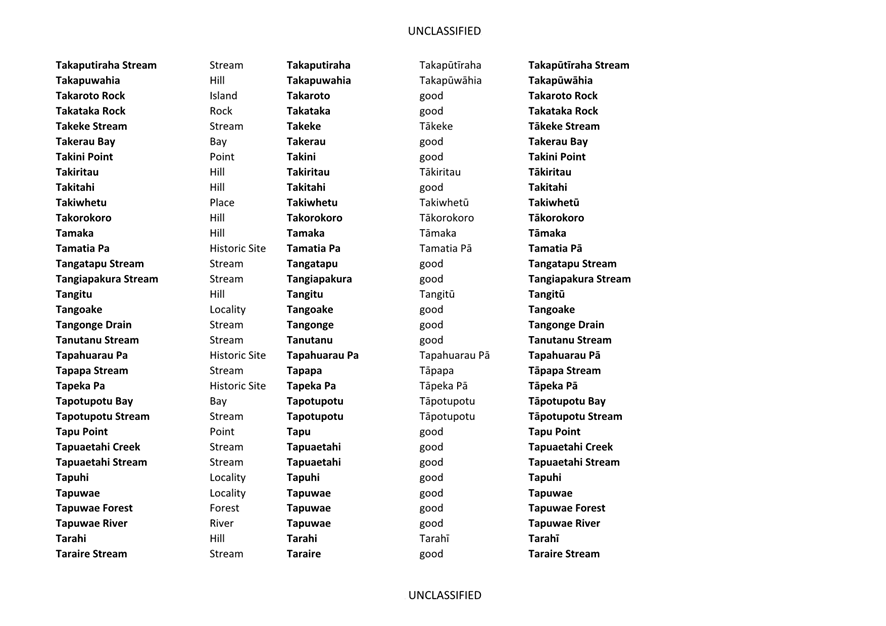
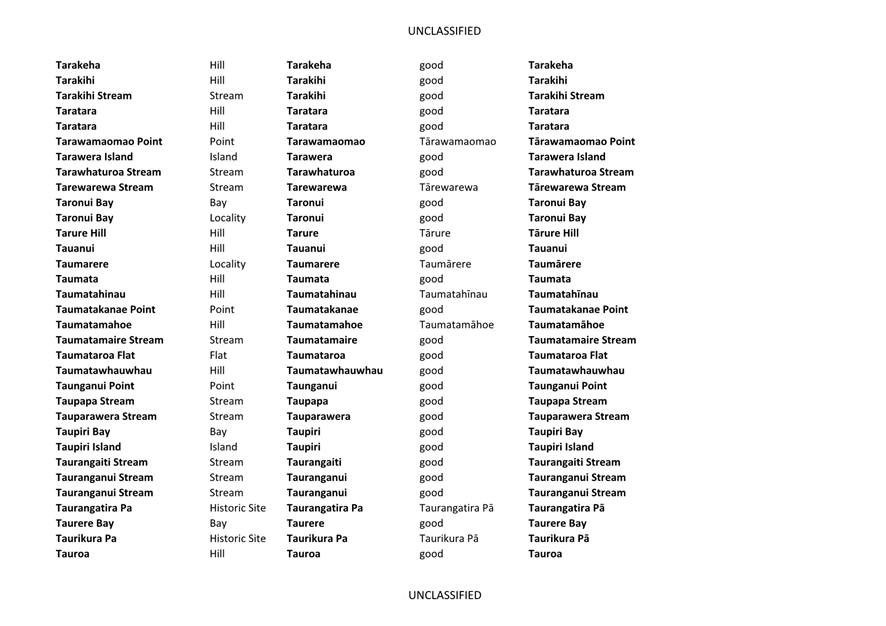
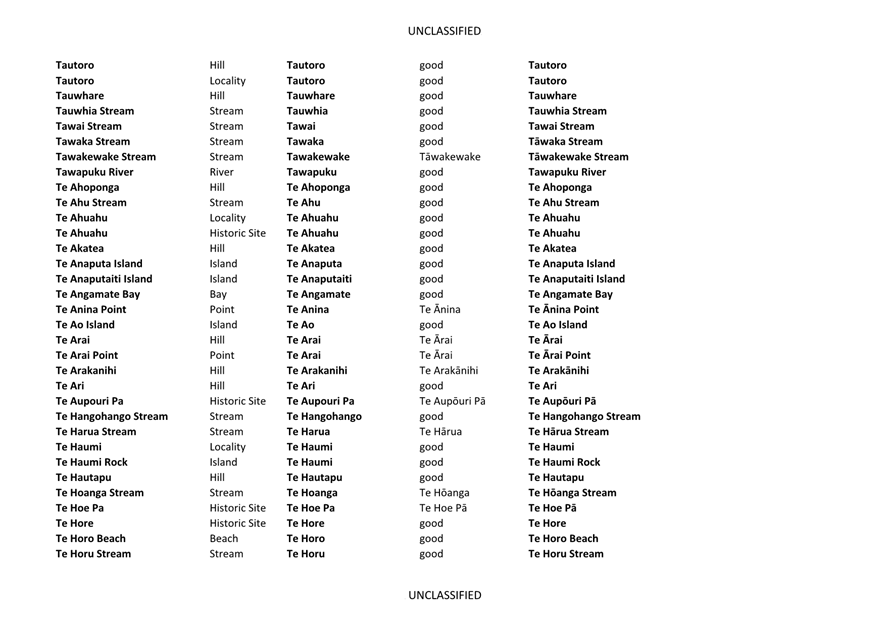
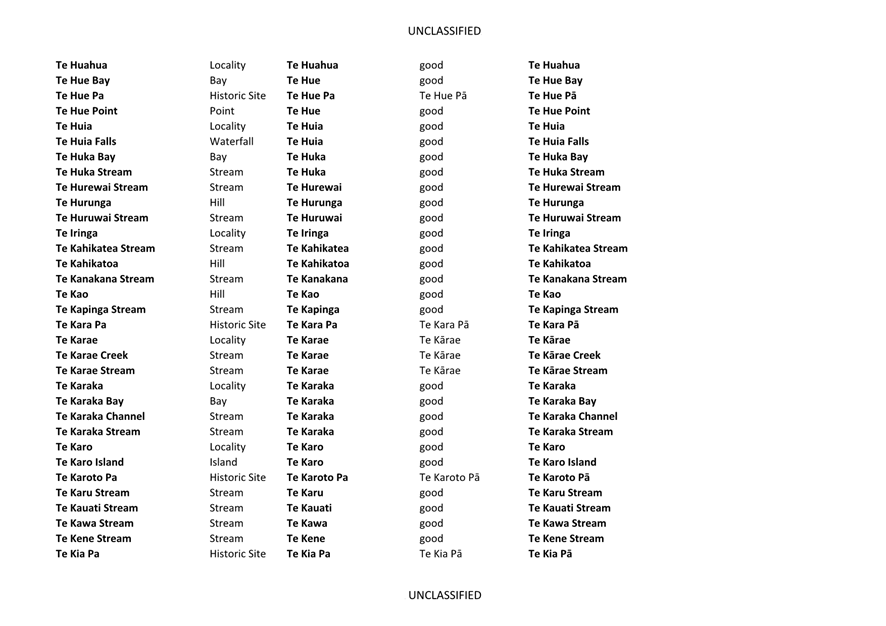
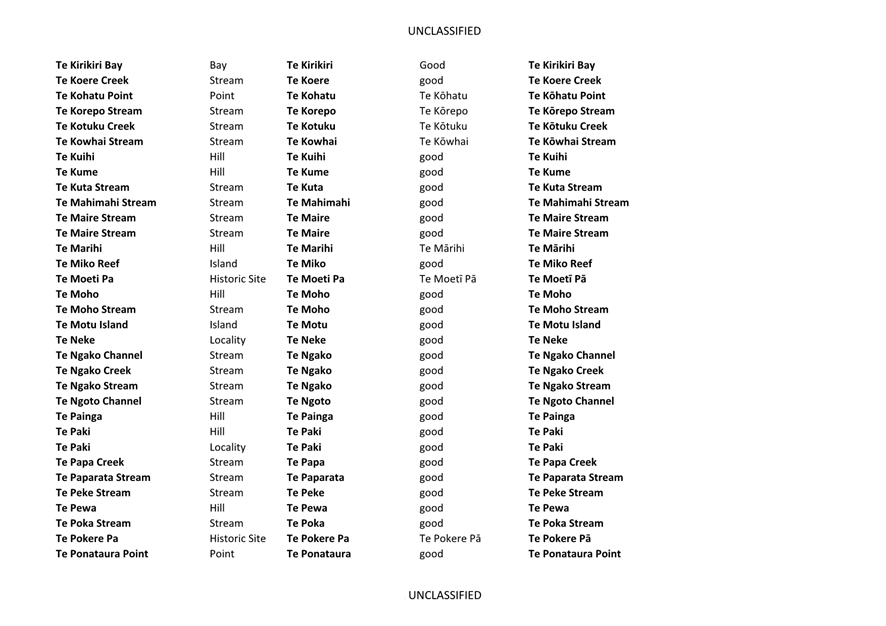
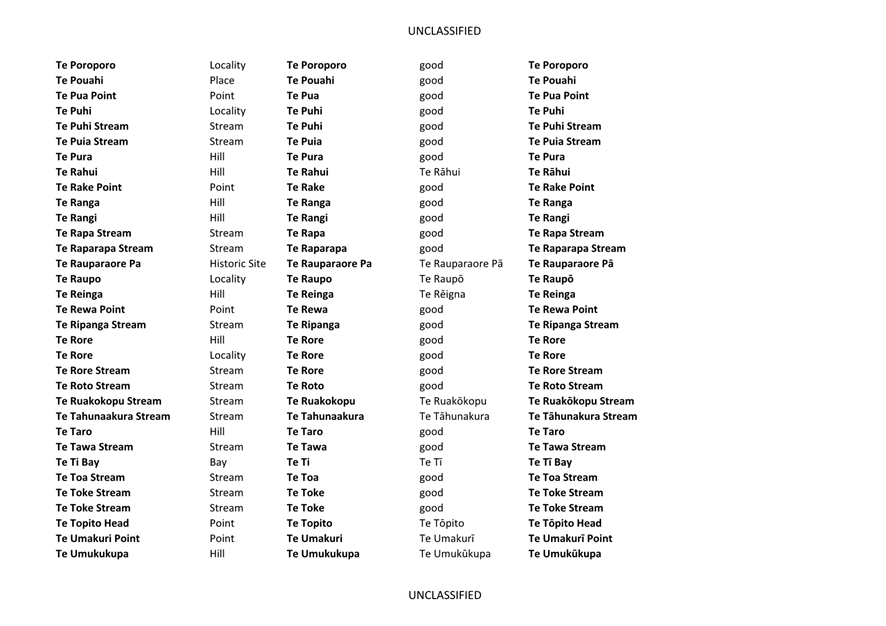
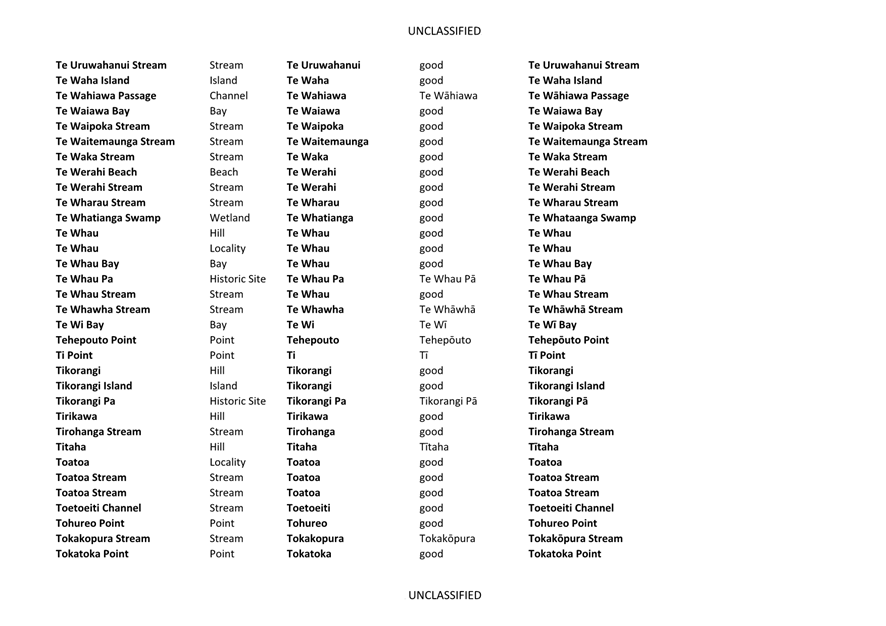
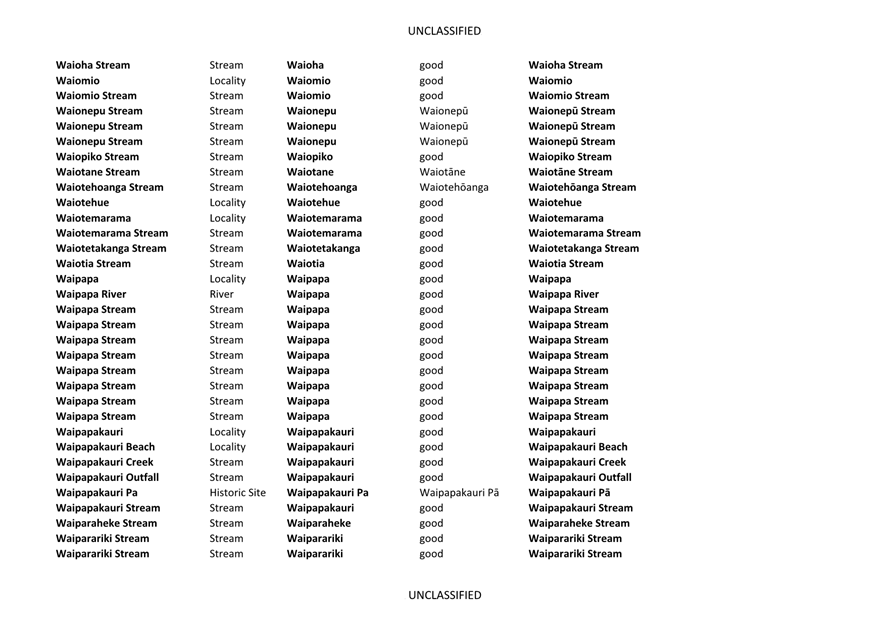
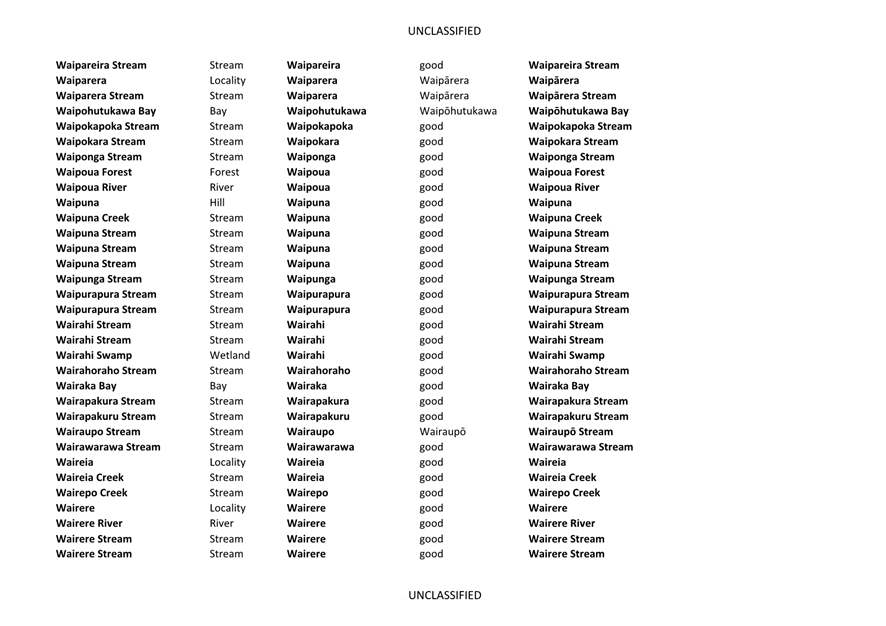
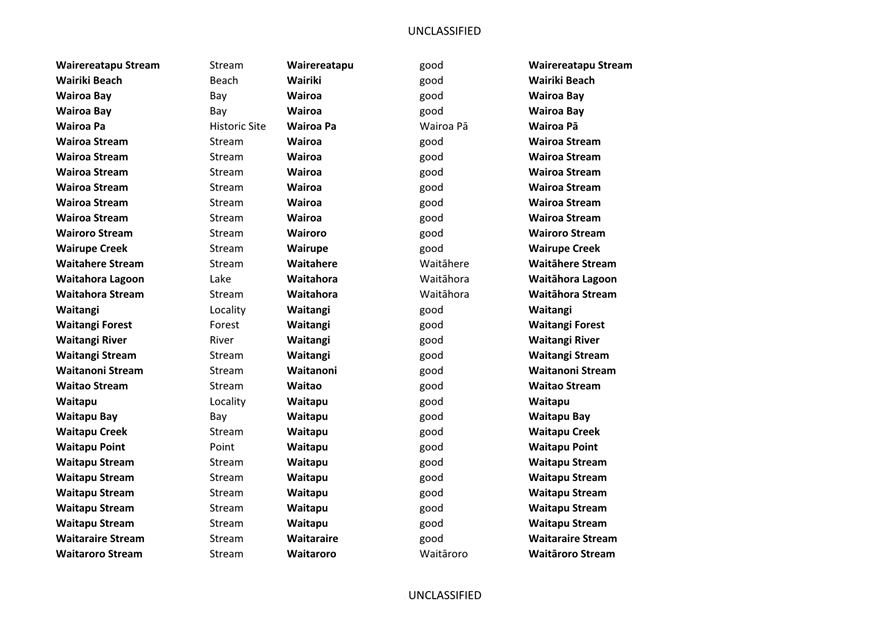
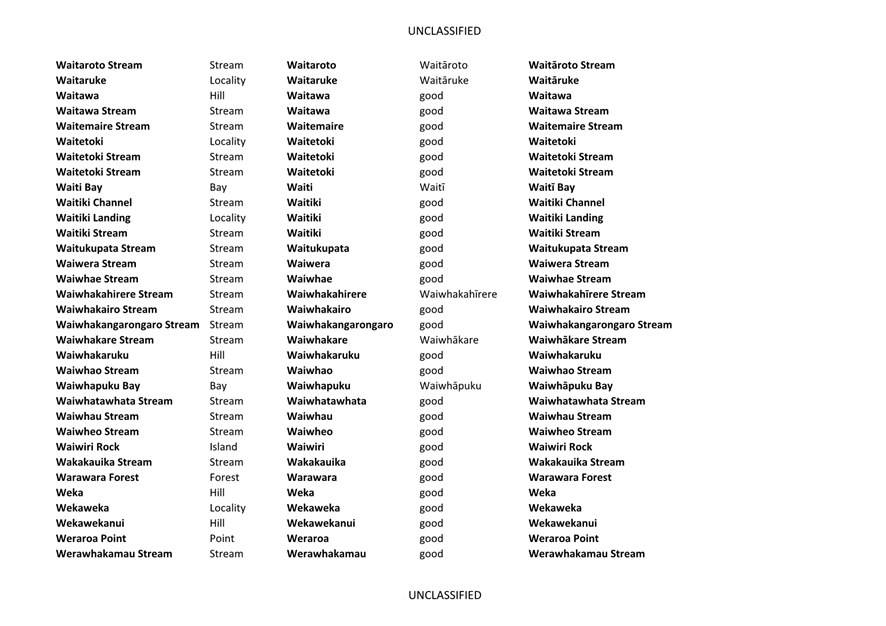
identified 1,783 unofficial Māori place names within the Far North
District Council’s jurisdiction. Of these, the Board’s expert
translator, Te Haumihiata Mason, advised that 1,389 are spelled correctly or
only require macrons and could therefore be made official.
The remaining 394 names could not
be verified and were referred to Kahika-Mayor Moko Tepania for review.
The fast-track process does not
require public consultation, but the Board are seeking feedback/comments from
mana whenua and the council on whether there would be any issues that would
prevent the names that are orthographically correct from being made official.
To this end, Council staff have
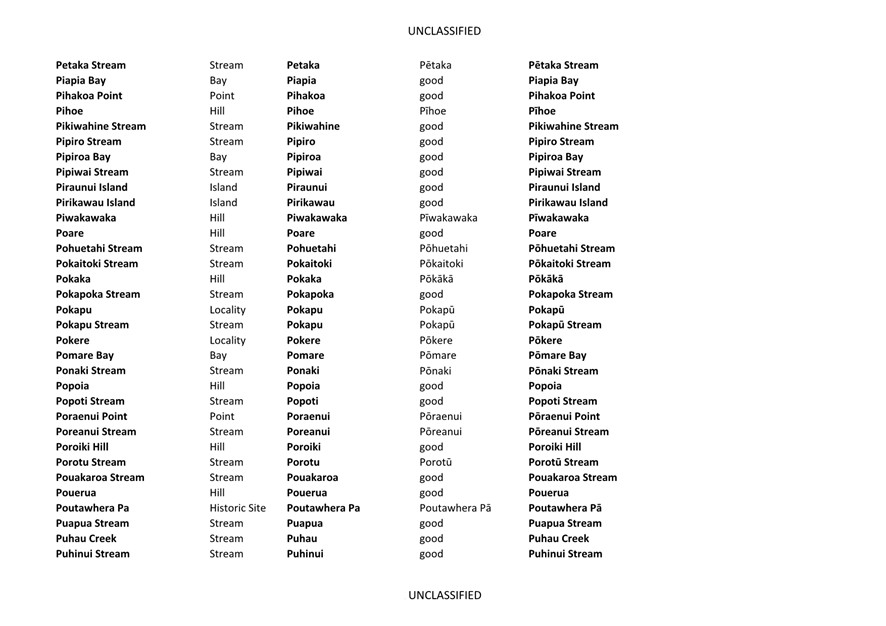
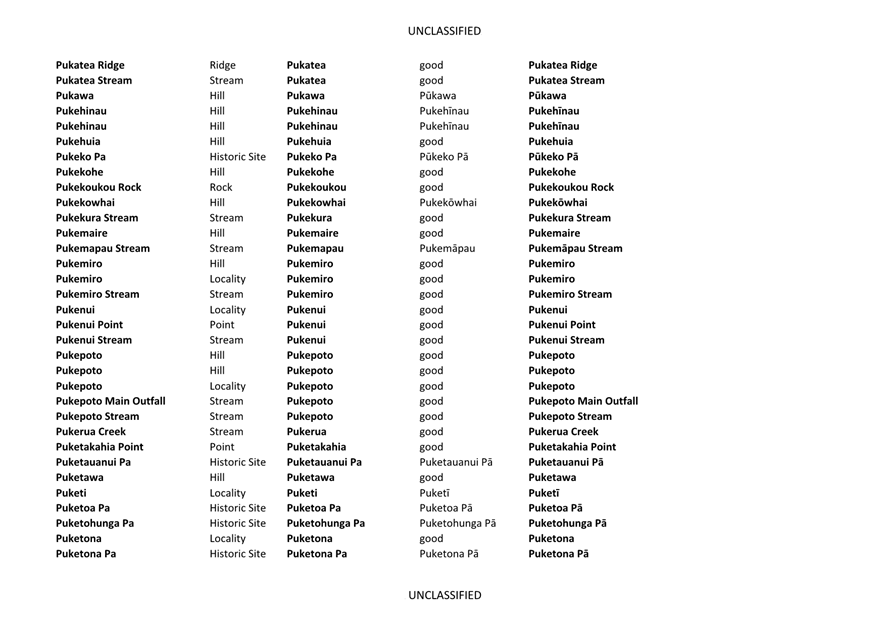
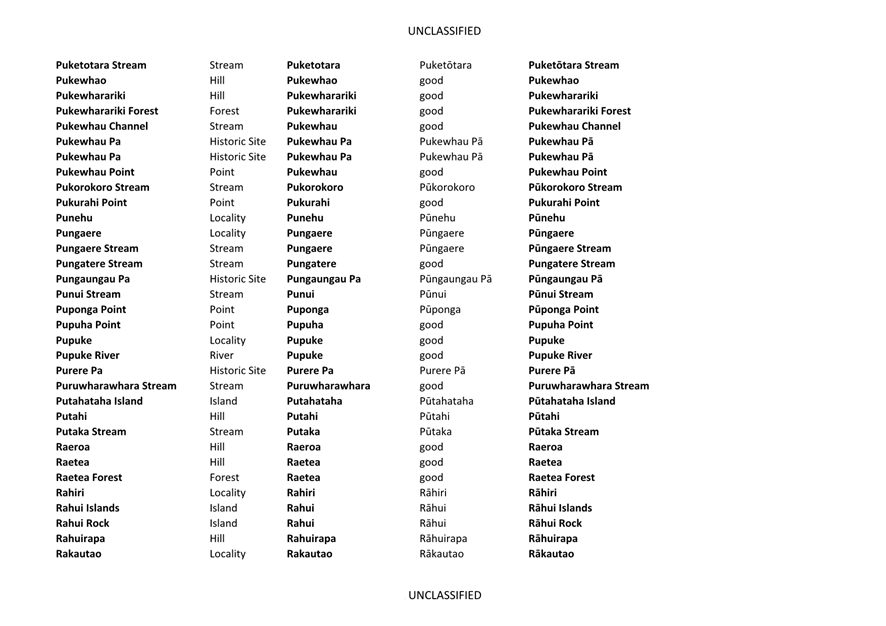
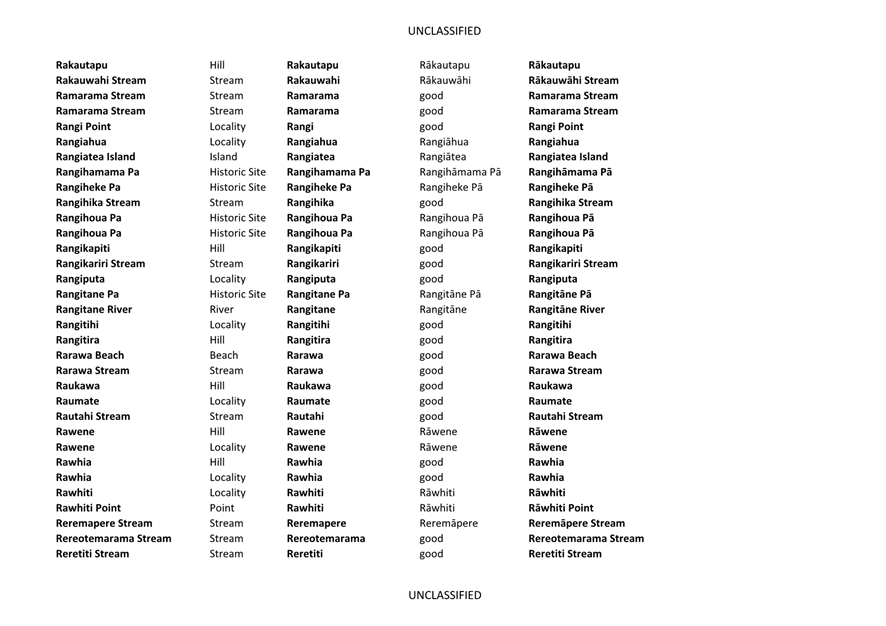
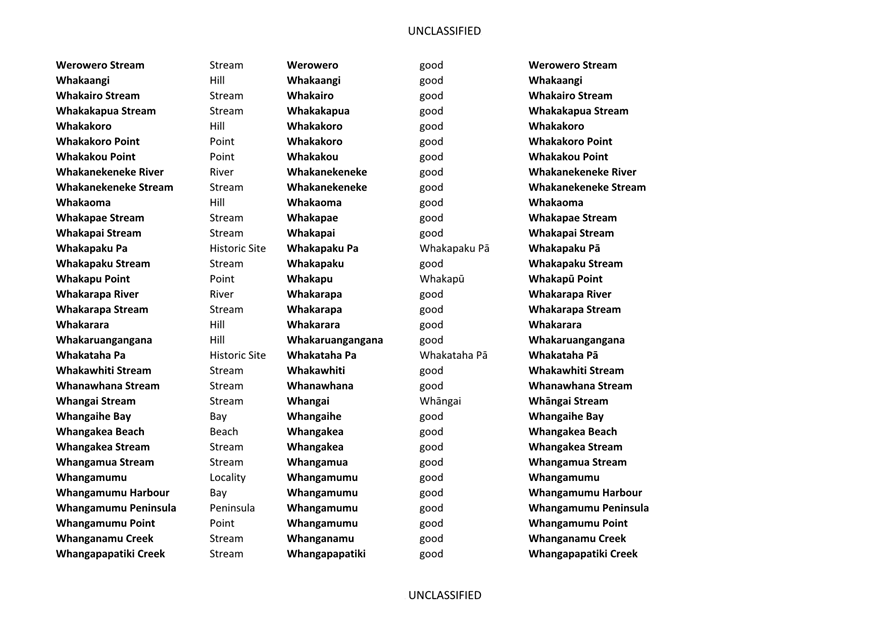
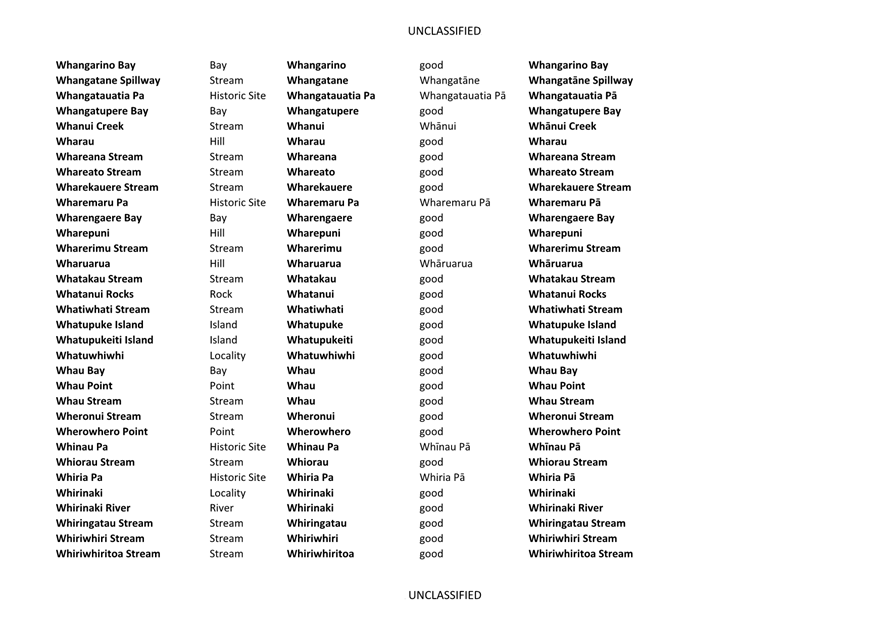
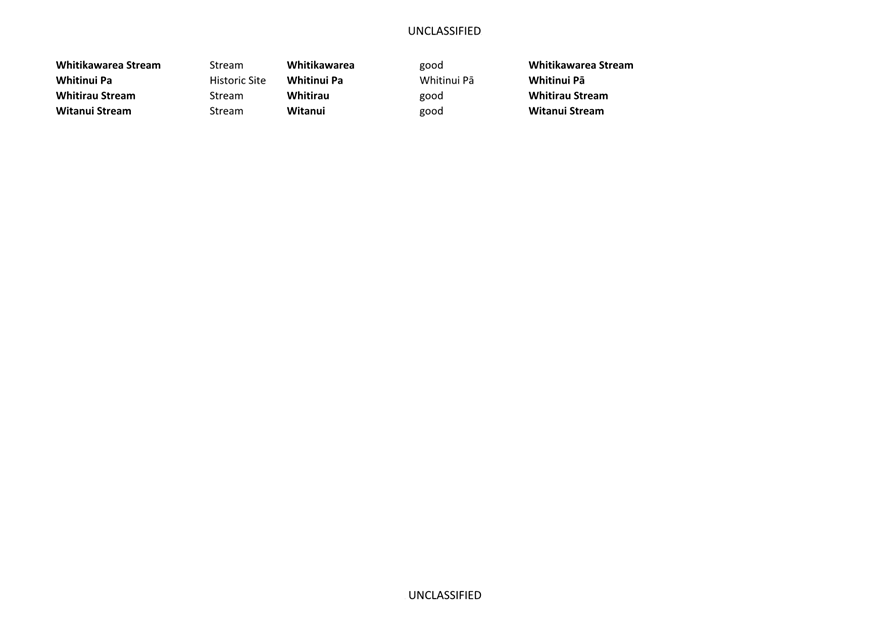
undertaken a thorough analysis of all 2,177 place names and recommend the
following for approval by Te Kuaka.
2) matapaki me NgĀ KŌwhiringa /
Discussion and Options
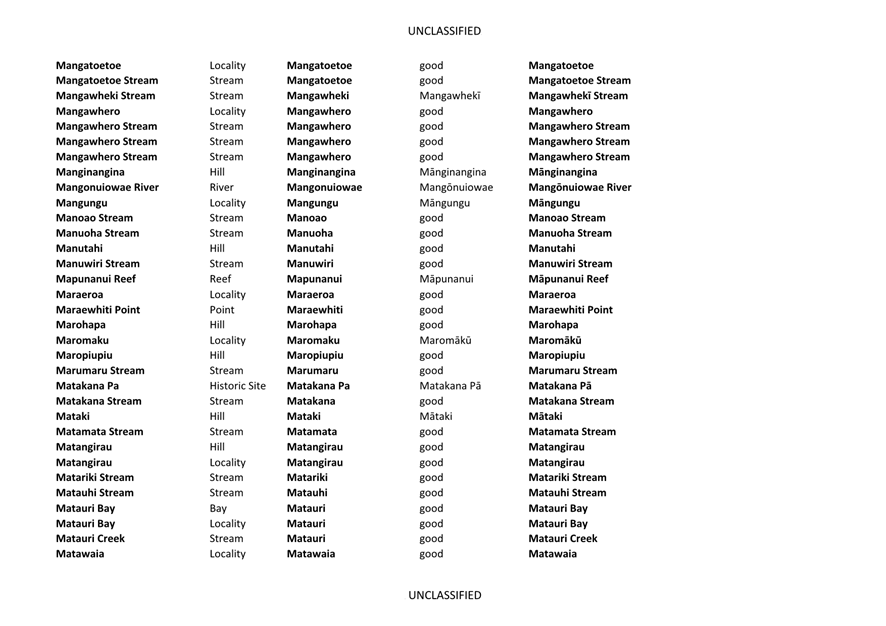
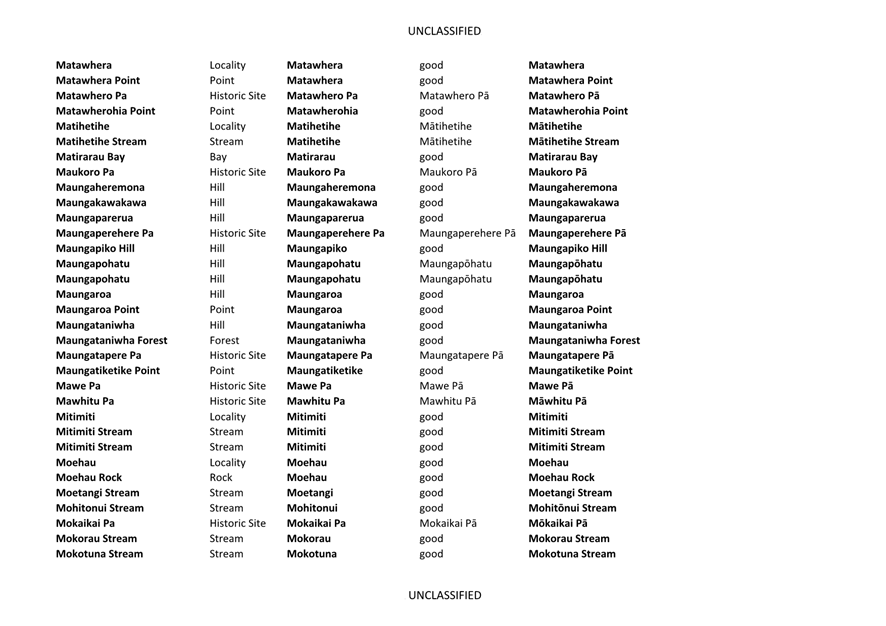
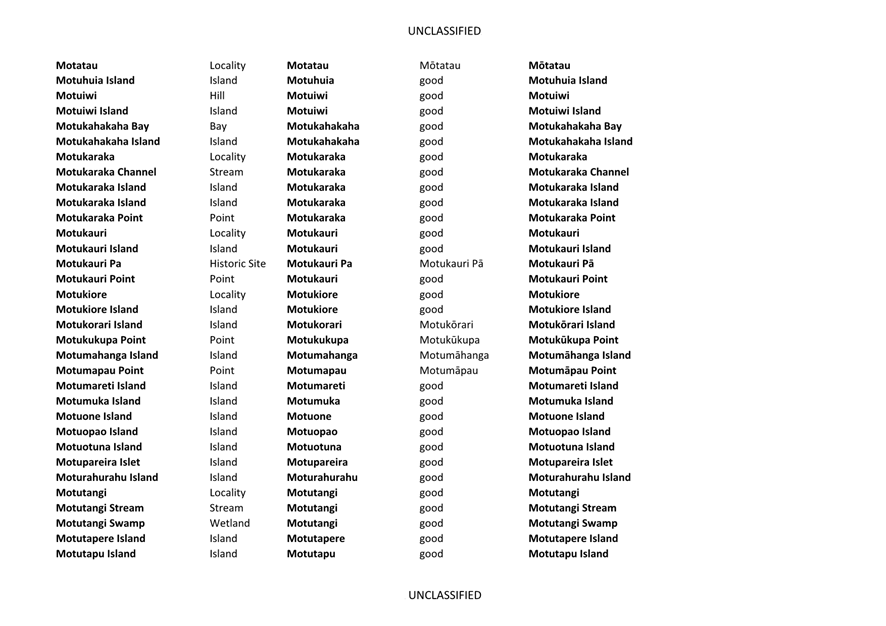
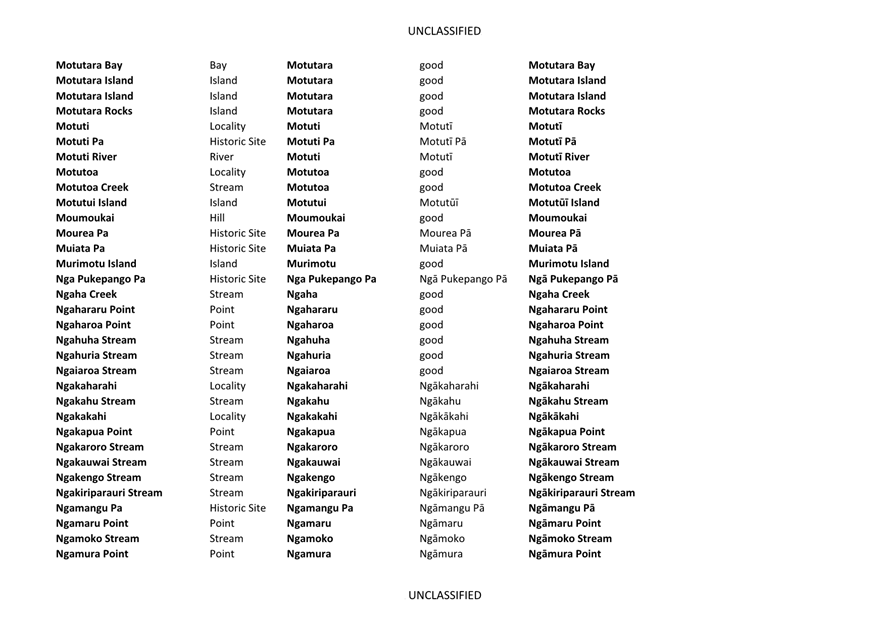
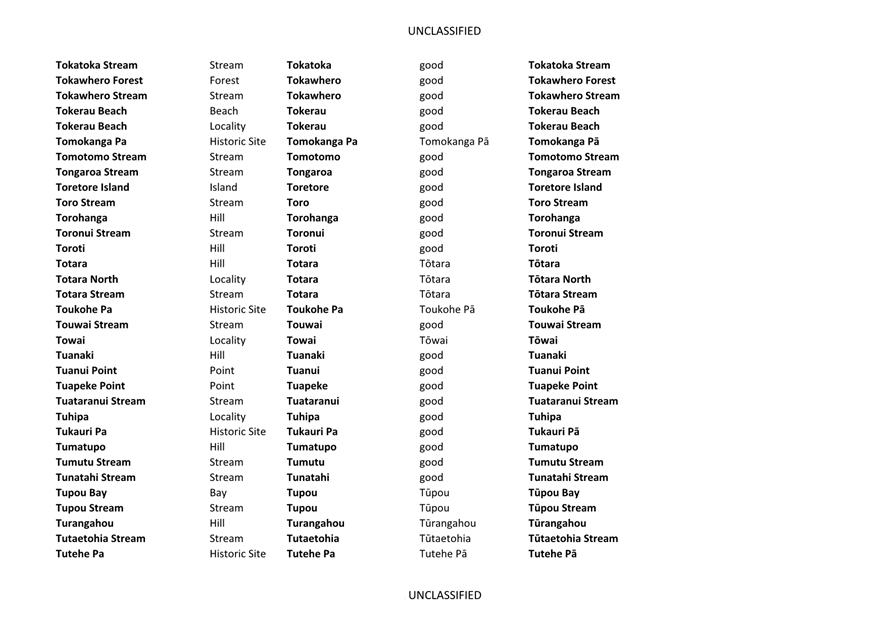
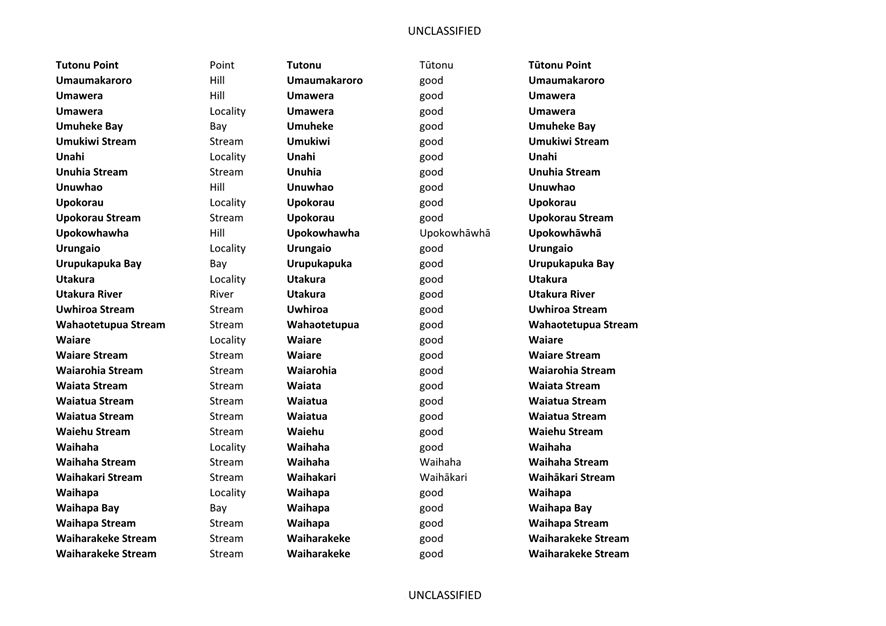
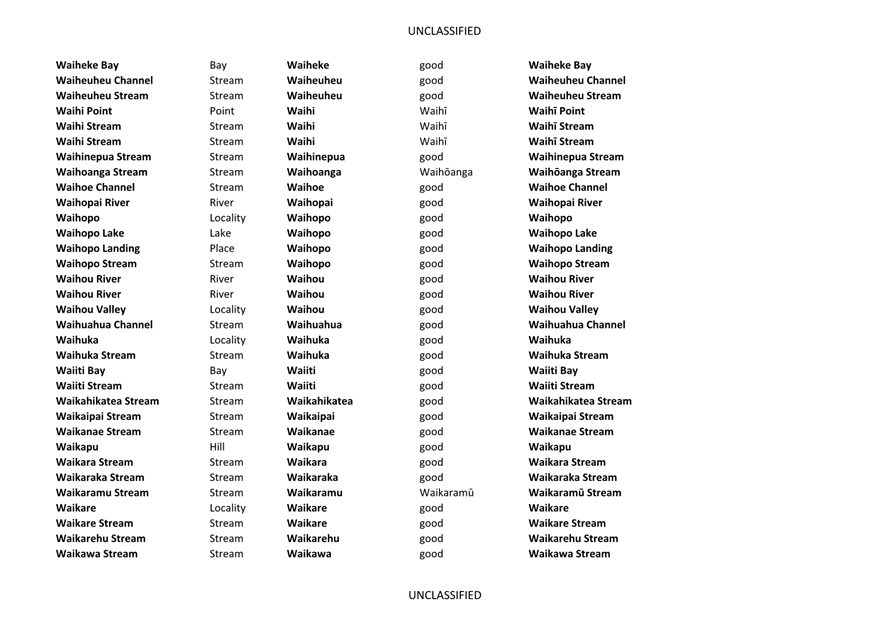
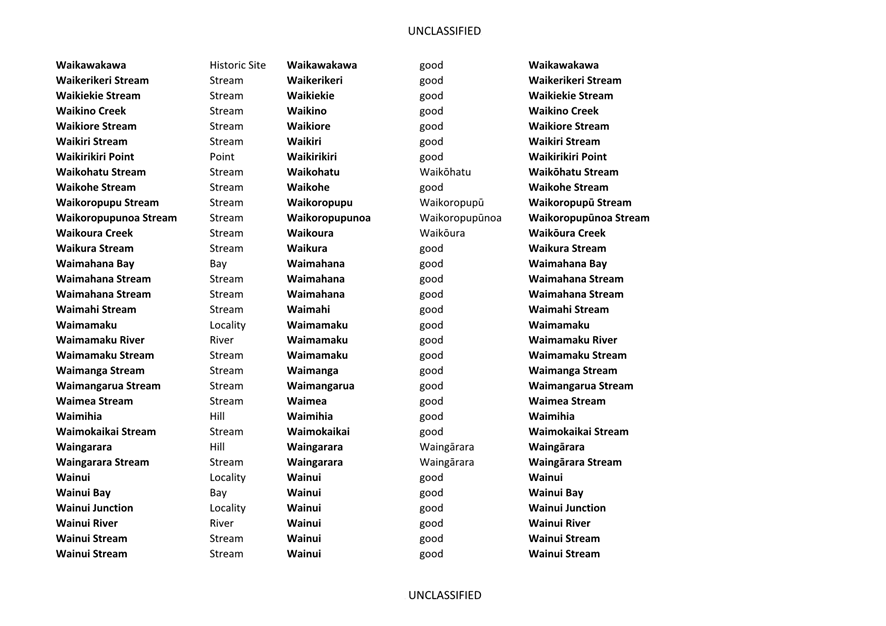
Staff recommend Te Kuaka approve
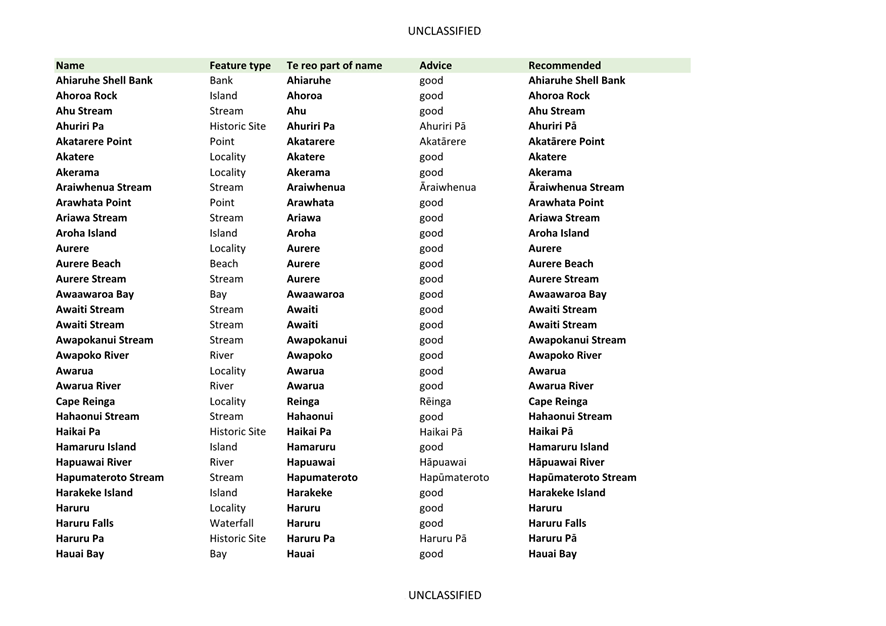
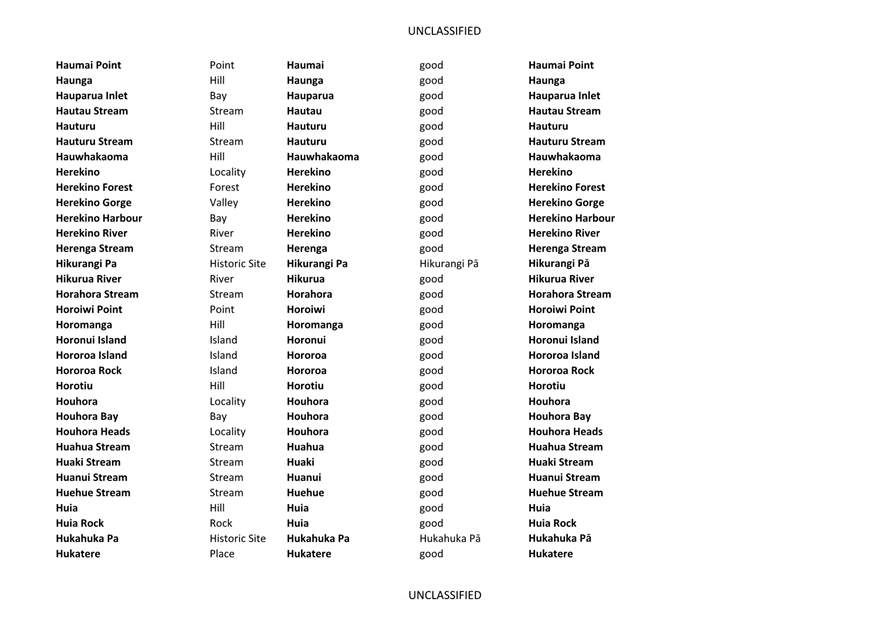
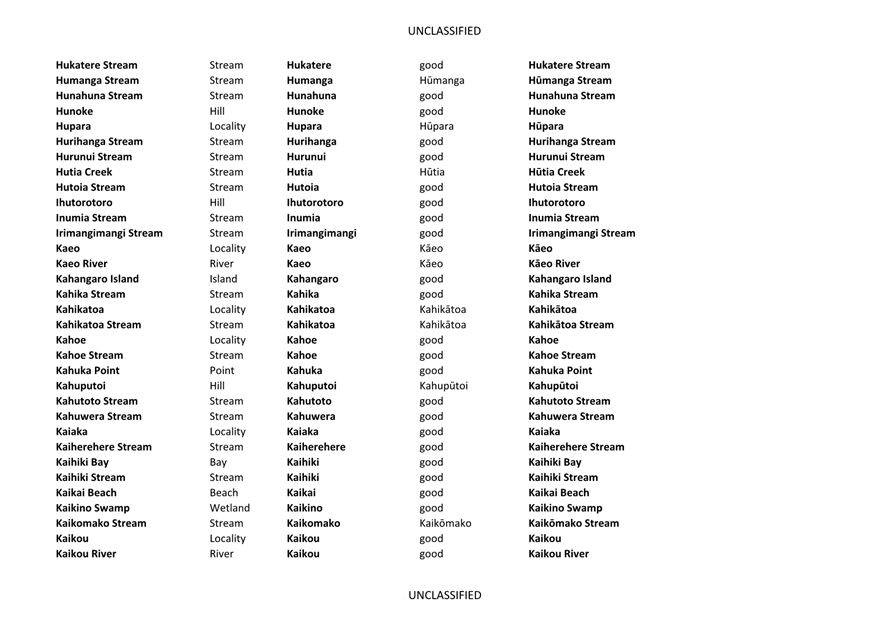
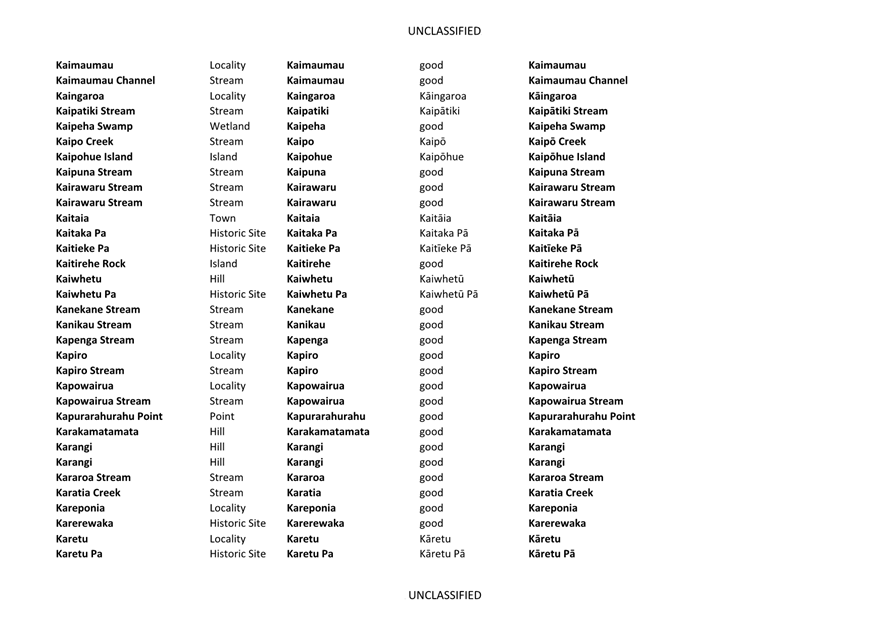
the distribution of the attached names back to Ngā Pou Taunaha o Aotearoa
New Zealand Geographic Board (the Board) for their end of year Board meeting as
per the recommendations
TAKE TŪTOHUNGA
/ REASON FOR THE RECOMMENDATION
The Towns and names have been
developed using expert Tikanga and Te Reo specialists in the Far North and also
reflect our council’s commitment to enabling Ka Irihia – Te Reo
Māori Action plan
3) PĀnga PŪtea me ngĀ
wĀhanga tahua / Financial Implications and Budgetary Provision
There are no costs in recommending
Towns and Names to the New Zealand Geographic Board. Once approved Council will
need to consider the costs of changing signage across teams.
Āpitihanga
/ Attachments
1. Far
North District Council Recommended Towns and Places - A5282336 ⇩
Hōtaka Take Ōkawa / Compliance Schedule:
Full consideration has been given to the provisions of the
Local Government Act 2002 S77 in relation to decision making, in particular:
1. A
Local authority must, in the course of the decision-making process,
a) Seek
to identify all reasonably practicable options for the achievement of the
objective of a decision; and
b) Assess
the options in terms of their advantages and disadvantages; and
c) If
any of the options identified under paragraph (a) involves a significant
decision in relation to land or a body of water, take into account the
relationship of Māori and their culture and traditions with their
ancestral land, water sites, waahi tapu, valued flora and fauna and other
taonga.
2. This
section is subject to Section 79 - Compliance with procedures in relation to
decisions.
|
He Take Ōkawa /
Compliance Requirement
|
Aromatawai Kaimahi /
Staff Assessment
|
|
State the level of significance (high or low) of the
issue or proposal as determined by the Council’s
Significance and Engagement Policy
|
This report has high significance as it relates to Te
Reo Māori and provides recommendations by Council to a national board
for adoption of towns and place names.
|
|
State the relevant Council policies (external or
internal), legislation, and/or community outcomes (as stated in the LTP) that
relate to this decision.
|
Ka Irihia – Te Reo Māori Action plan
Te Pae o Uta – Te Ao Māori Framework
|
|
State whether this issue or proposal has a District wide
relevance and, if not, the ways in which the appropriate Community
Board’s views have been sought.
|
This has district-wide impact if adopted by the New
Zealand Geographic Board
|
|
State the
possible implications for Māori and how Māori have been provided
with an opportunity to contribute to decision making if this decision is
significant and relates to land and/or any body of water.
State the
possible implications and how this report aligns with Te Tiriti o Waitangi /
The Treaty of Waitangi.
|
Te Kuaka have been provided with a Information report on
this topic.
Council staff have sought the expertise of Te Reo
Māori advocates and Te Reo experts to develop the recommended names
alongside Iwi and Hapū.
|
|
Identify persons likely to be affected by or have an
interest in the matter, and how you have given consideration to their views
or preferences (for example – youth, the aged and those with
disabilities).
|
This has an all of district impact as the place and town
names will impact all of the communities that reside or frequent our areas.
|
|
State the financial implications and where budgetary
provisions have been made to support this decision.
|
There is no immediate impact on budgets for approving
this report. Budgetary impacts will need to be considered on approval by the
New Zealand Geographic Board.
|
|
Chief Financial Officer review.
|
Reviewed.
|
|
Ordinary
Te Kuaka - Te Ao Māori Committee Meeting Agenda
|
23
September 2025
|
5.5 Far
North District Council Cultural Audit Report
File
Number: A5209933
Author: Llani
Harding, Pouhautū Te Hono - Manager - Te Hono
Authoriser: Jacine
Warmington, Group Manager - Strategic Relationships
Take Pūrongo / Purpose of the Report
To share with Te Kuaka Te Ao
Māori Committee (Te Kuaka), the findings of Far North District Council
(FNDC) Cultural Audit report and next steps.
WhakarĀpopoto matua / Executive Summary
· This report will outline the Cultural Audit
Report including final recommendations.
· The main issues within this report outline
twelve final recommendations to be implemented by operations.
|
tŪtohunga
/ Recommendation
That Te
Kuaka Te Ao Māori Committee recommend that Council approve the final
recommendations contained in the Far North District Council Cultural Audit
report 2025.
|
1) TĀhuhu kŌrero / Background
In October 2024 external
contractors Whakatika Hoe were commissioned to perform an extensive cultural
audit of council’s obligations to He Whakaputanga o te Rangatiratanga o
Nu Tireni (He Whakaputanga) and Te Tiriti o Waitangi.
The Cultural Audit was undertaken
to assess how effectively the FNDC is honouring its commitments under Te
Tiriti o Waitangi and He Whakaputanga. It examined the integration
of Te Ao Māori values, knowledge systems, and principles of
partnership within the Council’s policies, practices, and decision-making
processes and acknowledges both strengths and areas of improvement.
2) matapaki me NgĀ KŌwhiringa /
Discussion and Options
This marks the first cultural audit
ever conducted at FNDC, a significant milestone in evaluating how the Council
enacts its Treaty obligations while fulfilling its statutory responsibilities
to ratepayers across the district.
The audit focused on four key areas of FNDC’s
operations:
· Operational
functions
· Policy
development
· Internal
systems
· External
engagement
Each area was assessed through a
cultural lens, guided by Te Pae o Uta - FNDC’s internal framework
for embedding tikanga, te reo Māori, mātauranga
Māori, and kawa into Council practice.
A Chief
Executive KPI has been established to ensure the findings of the Cultural Audit
are actioned within the year. The KPI states:
“Implement the findings, reporting, and recommendations from elected
members relating to the Te Tiriti o Waitangi and He Whakaputanga Cultural Audit
during the 2025/26 financial year.”
TAKE TŪTOHUNGA
/ REASON FOR THE RECOMMENDATION
The recommendation to endorse
the findings of the Cultural Audit report will support the formalisation
an implementation plan and initiate a programme of work aligned with the
successful delivery of the KPI and more importantly, reaffirm council’s
position as a Tiriti o Waitangi leader in local government.
3) PĀnga PŪtea me ngĀ
wĀhanga tahua / Financial Implications and Budgetary Provision
Funding for this Cultural Audit was
included in the 2024-2027 Long Term Plan (Te Pae Tata) and approved by Council.
Council staff alongside the CEO
will need to work through how each item, as it pertains to each Council
department, to give effect to the final recommendations and their
implementation.
Āpitihanga
/ Attachments
1. Whakatika
Hoe - Cultural Audit Final Report JUNE 2025 for Far North District Council .pdf
V3 Te Hiwi amendments (002) - A5282342 ⇩
Hōtaka Take Ōkawa / Compliance Schedule:
Full consideration has been given to the provisions of the
Local Government Act 2002 S77 in relation to decision making, in particular:
1. A
Local authority must, in the course of the decision-making process,
a) Seek
to identify all reasonably practicable options for the achievement of the
objective of a decision; and
b) Assess
the options in terms of their advantages and disadvantages; and
c) If
any of the options identified under paragraph (a) involves a significant
decision in relation to land or a body of water, take into account the
relationship of Māori and their culture and traditions with their
ancestral land, water sites, waahi tapu, valued flora and fauna and other
taonga.
2. This
section is subject to Section 79 - Compliance with procedures in relation to
decisions.
|
He Take Ōkawa /
Compliance Requirement
|
Aromatawai Kaimahi /
Staff Assessment
|
|
State the level of significance (high or low) of the
issue or proposal as determined by the Council’s
Significance and Engagement Policy
|
This report has a low degree of significance as it
relates to predominantly internal processes and system changes to give effect
to the Cultural audit.
|
|
State the relevant Council policies (external or
internal), legislation, and/or community outcomes (as stated in the LTP) that
relate to this decision.
|
This Cultural Audit is founded on the basis of providing
a Te Tiriti and He Whakaputanga lens to its analysis and final
recommendations.
This audit will give effect to the goals of Te Pae o
Uta, Te Pae Tata and Toi Māori.
|
|
State whether this issue or proposal has a District wide
relevance and, if not, the ways in which the appropriate Community
Board’s views have been sought.
|
This will improve Iwi and Hapū relationships for
Council including Community Boards but does not have any effect on the
delegations of Community Boards.
|
|
State the
possible implications for Māori and how Māori have been provided
with an opportunity to contribute to decision making if this decision is
significant and relates to land and/or any body of water.
State the
possible implications and how this report aligns with Te Tiriti o Waitangi /
The Treaty of Waitangi.
|
This report looks at the systems and processes of
Council that give effect to Te Tiriti therefore the implications for
Māori will be substantial in terms of the level of service,
decision-making and engagement Māori have with Council moving forward.
|
|
Identify persons likely to be affected by or have an
interest in the matter, and how you have given consideration to their views
or preferences (for example – youth, the aged and those with
disabilities).
|
This report will affect the wider community through the
level of services that will be strengthened and enhanced.
|
|
State the financial implications and where budgetary
provisions have been made to support this decision.
|
There are no financial implications in endorsing this
report
|
|
Chief Financial Officer review.
|
This report has not be reviewed by the CFO
|
|
Ordinary
Te Kuaka - Te Ao Māori Committee Meeting Agenda
|
23
September 2025
|
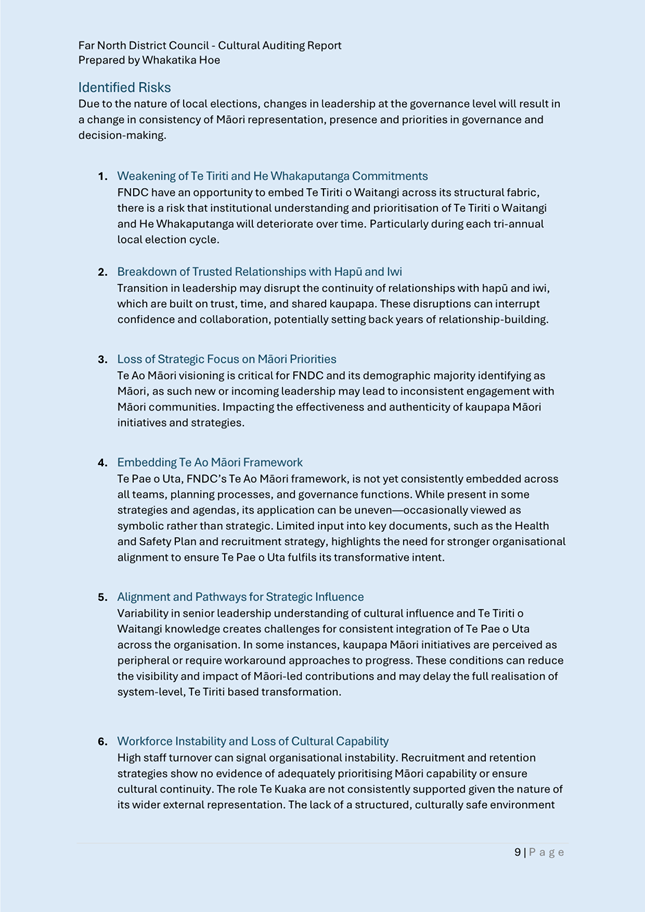
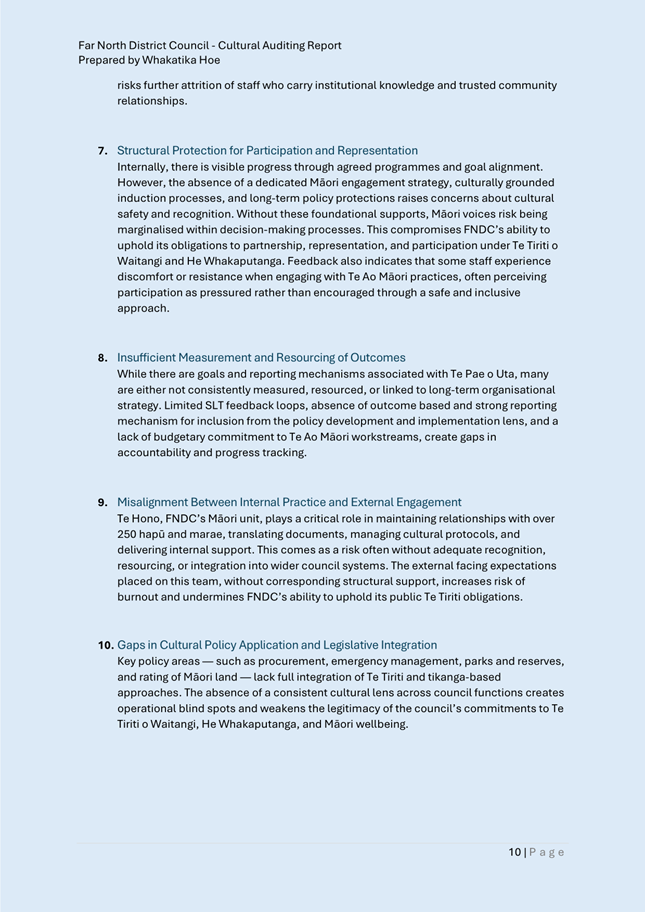
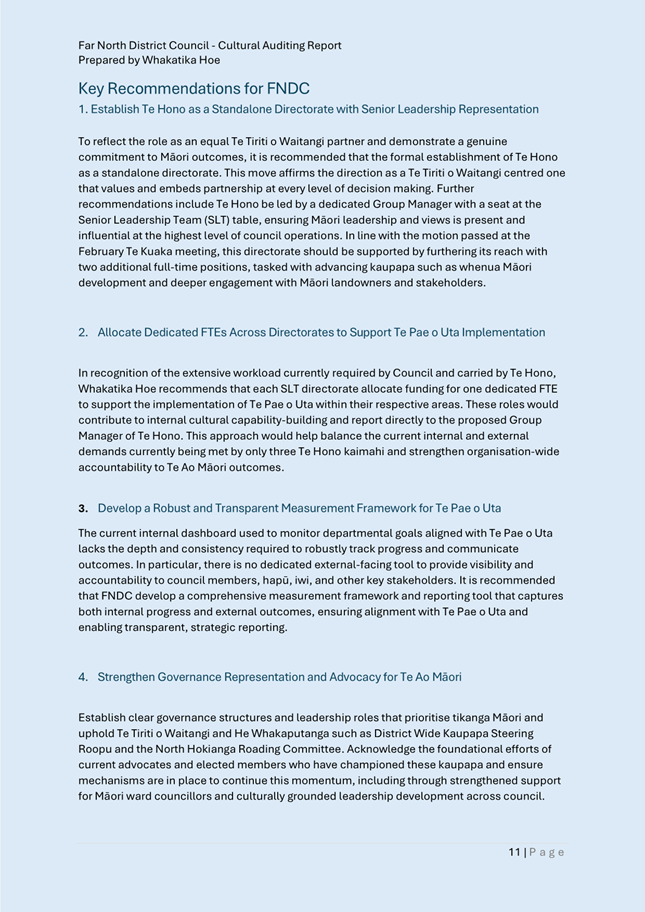
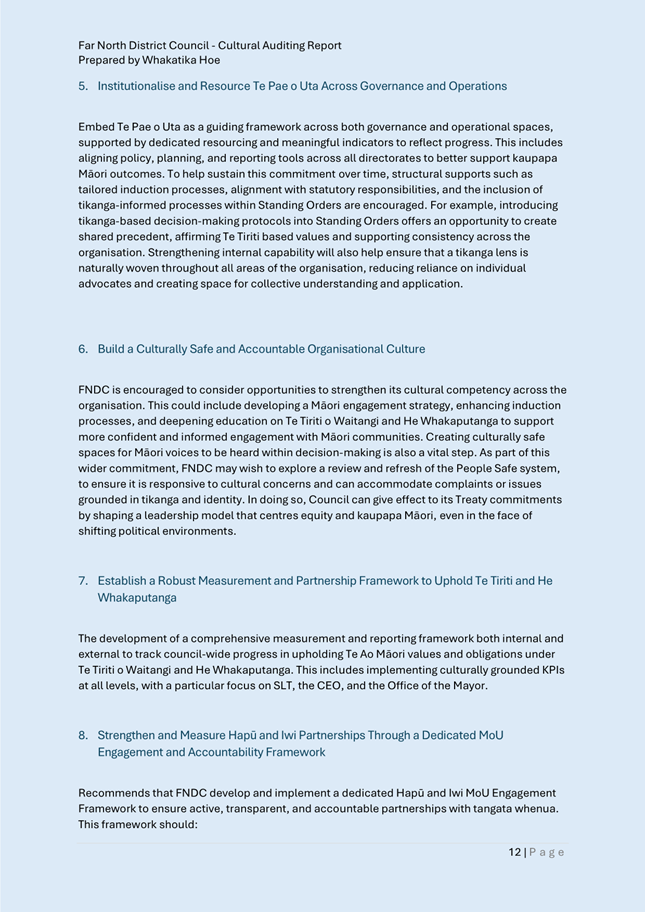
5.6 Te
Kiri Waiwai o Papatuanuku - Whenua Māori Strategy
File Number: A5196515
Author: Llani
Harding, Pouhautū Te Hono - Manager - Te Hono
Authoriser: Jacine Warmington, Group Manager - Strategic Relationships
Take Pūrongo / Purpose of the
Report
To present Te Kiri
Waiwai o Papatuanuku Whenua Māori Strategy to Te Kuaka Te Ao Māori
Committee (Te Kuaka).
WhakarĀpopoto matua /
Executive Summary
· Te Kiri Waiwai o Papatūānuku – Far North Whenua
Māori Strategy is a strategic framework developed by the Far North
District Council (FNDC) in collaboration with Te Kuaka, elected members, and
staff.
· It aims to
support whānau, hapū, and iwi in the occupation, development, and use
of whenua Māori and Treaty Settlement Land across the district.
Recognising whenua Māori as taonga tuku iho – a treasured
inheritance – the strategy responds to longstanding systemic barriers
that have limited Māori landowners’ ability to realise the full
potential of their ancestral lands.
· The strategy
outlines a clear vision of “He Whenua Rangatira – A
District of Sustainable Prosperity and Wellbeing,” underpinned by values
that reflect te ao Māori and a commitment to equity, partnership, and
intergenerational wellbeing. It identifies five focus areas:
Papakāinga, Economic Development, Infrastructure and Servicing,
Decision-Making, and Treaty Settlement Land. These areas are supported by eight
strategic outcomes that guide Council’s governance and
operational functions.
· The accompanying Action Plan sets out a comprehensive programme of
initiatives to be implemented over the next three years. Key actions include:
o Reviewing and enhancing
rating relief and remission policies for whenua Māori and Treaty
Settlement Land.
o Establishing targeted
services to support resource and building consenting processes.
o Developing a premium
consenting pathway tailored to Māori land development.
o Improving infrastructure
access and servicing through GIS analysis and strategic investment.
o Creating a digital tangata
whenua contact database to support engagement.
o Investigating joint
ventures and dedicated funding mechanisms to support papakāinga and
economic development.
o Reviewing Council’s
land disposal processes to consider returning land to original Māori
owners.
o Formalising engagement
frameworks and decision-making delegation opportunities.
· The strategy does not commit Council to funding Whenua Māori
activity beyond the current financial year and work programmes.
|
tŪtohunga / Recommendation
a) That Te Kuaka – Te Ao Māori Committee recommend;
a)
that Council to approve Te Kiri Waiwai
o Papatuanuku - Whenua Māori Strategy.
b)
delegate authority to the CE to make minor editorial
corrections.
|
1) TĀhuhu kŌrero / Background
The Far North
district has a resident population of approximately 74,700 people, with
Māori comprising over 50% of the population (2024). Ngāti Kurī,
Te Aupōuri, Ngāti Kahu, Ngāi Takoto, Te Rarawa, Te Roroa,
Ngāti Kahu ki Whangaroa, Ngāpuhi and Ngāti Wai are iwi of Te
Hiku o Te Ika (Far North), with over 200 hapū, and 144 marae. Te
Hiku o Te Ika is rich in cultural in history, as one of the earliest areas of
settlement for both Māori and Pakeha.
Approximately 17%
or 130,000ha of the district is whenua Māori and is made up of 3,856
Māori land blocks. The majority of whenua Māori is located in
the Kaikohe-Hokinga Ward (approx. 54%), 28% in the Bay of Islands
Pewhairangi/Whangaroa Ward and approximately 18% in the Te Hiku Ward.
Far North District
Council works in a number of areas that focus on Whenua Māori and aims to
achieve the aspirations set out in the preamble to Te Ture Whenua Māori.
Council work in this area ranges from:
· Strategic Relationships Group
o Engagement for example Te Hono and Rating team undertake engagement
with Whenua Māori Landowners in regard to Rating enquiries. Te Hono also
support in providing advice to landowners within pre-concept development
meetings.
o Te Hono provide Strategic direction on Whenua Māori to Council.
· Planning and Policy Group
o Integrated Planning department – District Planning and
Strategic Planning team – develop/write the District Plan.
o Undertake Proposed District Plan work programme – hearings,
reports and submissions.
· Delivery and Operations Group
o Resource Consents Team –
§ Processing of Resource consents
§ Development of He Tikanga Haumaru - Practice and Guidance Note to
support FNDC Planners when assessing Resource Consent applications
o Building Consents –
§ Implementing the Building Act.
§ Issuing Building Consents.
§ working together with Te Hono to ensure Tikanga and Cultural
guidance is undertaken when visiting Whenua Māori sites.
§ Guidance document for Development on Māori Land/building on
Māori land.
· Infrastructure Strategy
o Develop Infrastructure strategy that guides Whenua Māori
development.
o Align Infrastructure Strategy to Te Pae o Uta.
· Corporate Services
o Rating Services – applying Rates Remissions and Rating
enquiries on Whenua Māori.
o Revenue Recovery team – communicating with Ratepayers
regarding payments and relief.
· Communications and Engagement team
o Undertake communications on Whenua Māori initiatives and
activities.
o Promote and advertise Whenua Māori related news.
o Support engagement initiatives with Whenua Māori Landowners in
regard to Rating enquiries.
· Chief of Staff
o Undertake the development of the Organisational Strategy including
Focus area “Te Ao Māori”.
o Align Organisation Strategy to Te Pae o Uta.
Council have
developed a Whenua Māori Strategy that will help provide strategic
over-arching direction to Staff and Elected members when dealing with Whenua
Māori related enquiries from the community. The Whenua Māori Strategy
will also include a Whenua Māori Action Plan.
The strategy is designed to be iterative and responsive, with mechanisms
for monitoring, review, and integration into Council’s Long Term and
Annual Plan processes. It represents a significant step toward enabling
Māori landowners to exercise rangatiratanga over their whenua and
contribute to the district’s sustainable prosperity and wellbeing.
2) matapaki me NgĀ
KŌwhiringa / Discussion and Options
Te Kiri Waiwai o
Papatūānuku presents a strategic opportunity for the FNDC to address
long-standing inequities in the use and development of whenua Māori and
Treaty Settlement Land. The strategy responds to a clear problem definition:
despite the cultural and economic significance of Māori land, systemic
barriers continue to prevent whānau, hapū, and iwi from realising its
full potential.
The strategy is well-aligned with
Council’s broader commitments under Te Pae o Uta, Far North 2100, and the
Infrastructure Strategy 2024. It also complements central government reforms,
including the proposed National Environmental Standard for Papakāinga and
amendments to Te Ture Whenua Māori Act 1993.
Staff and elected
members have been involved in workshops lead by consultants to develop the
focus areas and the actions that will follow.
Option 1: Recommend
the adoption of Te Kiri Waiwai o Papatūānuku in full, including the
Action Plan, to Council
· Advantages:
§ Demonstrates
strong commitment to equity and partnership with Māori.
§ Provides
a clear roadmap for addressing barriers to whenua Māori development.
§ Aligns
with Council’s strategic direction and central government reforms.
§ Enables
immediate implementation of actions already underway or budgeted.
· Disadvantages:
§ Some
actions are unbudgeted and will require future funding decisions.
§ Implementation
will require cross-departmental coordination and resourcing.
Option 2: Recommend
the adoption of the Strategy but deferral of selected unbudgeted actions
pending further funding analysis
· Advantages:
· Allows
Council to progress foundational work while managing financial risk.
· Provides
time to assess feasibility and prioritise actions through the LTP process.
· Disadvantages:
· May
delay outcomes for whānau, hapū, and iwi seeking to develop their
whenua.
· Risks
losing momentum and stakeholder confidence.
Option 3: Recommend
Council do not adopt the Strategy at this time
· Advantages:
· Avoids
immediate financial and operational commitments.
· Disadvantages:
· Missed
opportunity to address systemic barriers and support Māori aspirations.
· Inconsistent
with Council’s commitments under Te Pae o Uta and other strategic
frameworks.
· Potential
reputational risk and loss of trust with Māori communities.
Recommended Option
Option 1 is recommended.
Adoption of Te Kiri Waiwai o Papatūānuku in full will enable Council
to take a proactive and strategic approach to supporting Māori landowners.
It reflects a commitment to partnership, equity, and sustainable development,
and positions FNDC as a leader in whenua Māori responsiveness.
TAKE TŪTOHUNGA / REASON FOR THE RECOMMENDATION
Council requires a
strategic direction on how we respond to Whenua Māori enquiries. Te Kiri
Waiwai o Papatuanuku will provide a consistent approach to advising Whenua
Māori landowners and beneficiaries of their opportunities that can be
undertaken alongside Council to enable prosperous development.
3) PĀnga PŪtea me
ngĀ wĀhanga tahua / Financial Implications and Budgetary Provision
There is no budget
allocated to implement this strategy. The implementation plan outlines staged
phasing in implementing actions.
Some actions are
already accounted for in current budgets and future budgets and will continue
irrespective of the strategy being approved
Āpitihanga
/ Attachments
1. Te Kiri Waiwai o Papatuanuku
Action Plan - A5296046 ⇩

2. Te Kiri Waiwai o Papatuanuku
Whenua Mãori Strategy - A5296048 ⇩
Hōtaka Take Ōkawa / Compliance
Schedule:
Full consideration has been given to the
provisions of the Local Government Act 2002 S77 in relation to decision making,
in particular:
1. A Local authority must, in
the course of the decision-making process,
a) Seek to identify all reasonably
practicable options for the achievement of the objective of a decision; and
b) Assess the options in terms of
their advantages and disadvantages; and
c) If any of the options identified
under paragraph (a) involves a significant decision in relation to land or a
body of water, take into account the relationship of Māori and their
culture and traditions with their ancestral land, water sites, waahi tapu,
valued flora and fauna and other taonga.
2. This section is subject to
Section 79 - Compliance with procedures in relation to decisions.
|
He
Take Ōkawa / Compliance Requirement
|
Aromatawai
Kaimahi / Staff Assessment
|
|
State the level of significance (high
or low) of the issue or proposal as determined by the Council’s Significance and Engagement Policy
|
This paper has medium significance and
has specific interest to Māori. The proposal has a major and long-term
impact on the wellbeing of iwi/hapū/whanau and their culture and
traditions with their ancestral land, water, sites, wāhi tapu, valued
flora and fauna, and other taonga
|
|
State the relevant Council policies
(external or internal), legislation, and/or community outcomes (as stated in
the LTP) that relate to this decision.
|
Te Pae o Uta has been integrated though
this strategy.
This strategy also gives effect to
cross council commitments under the Housing Action Plan, Toi Mana, the Tai
Tokerau Regional Accessibility Strategy, Te Rerenga and FN 2100 Actions.
These strategies have been incorporated
into the Action Plan and where appropriate, avoidance has been given creating
duplicate actions across all strategies.
|
|
State whether this issue or proposal
has a District wide relevance and, if not, the ways in which the appropriate
Community Board’s views have been sought.
|
This strategy has District Wide
implications as Whenua Māori is located across the district. The
outcomes of the strategy will support Community Boards to make better
informed decisions as it pertains to Whenua Māori within their ward and
delegations
|
|
State the
possible implications for Māori and how Māori have been provided
with an opportunity to contribute to decision making if this decision is
significant and relates to land and/or any body of water.
State the
possible implications and how this report aligns with Te Tiriti o Waitangi /
The Treaty of Waitangi.
|
This strategy was approved for
development by Te Kuaka and has included Māori Ward Councillors on the
working group.
Wider consultation with Iwi and
Hapū has not been undertaken directly as this strategy is targeted first
at Council staff integration into work streams.
|
|
Identify persons likely to be affected
by or have an interest in the matter, and how you have given consideration to
their views or preferences (for example – youth, the aged and those
with disabilities).
|
This strategy has an impact on all
communities within the Far North. Better processes and development of Policy
will benefit all communities.
|
|
State the financial implications and
where budgetary provisions have been made to support this decision.
|
There are budgetary implications noted
within the Action plan that have been worked through with the Staff working
group and Subject Matter Experts.
|
|
Chief Financial Officer review.
|
This report has not been reviewed by
the CFO
|
|
Ordinary
Te Kuaka - Te Ao Māori Committee Meeting Agenda
|
23
September 2025
|
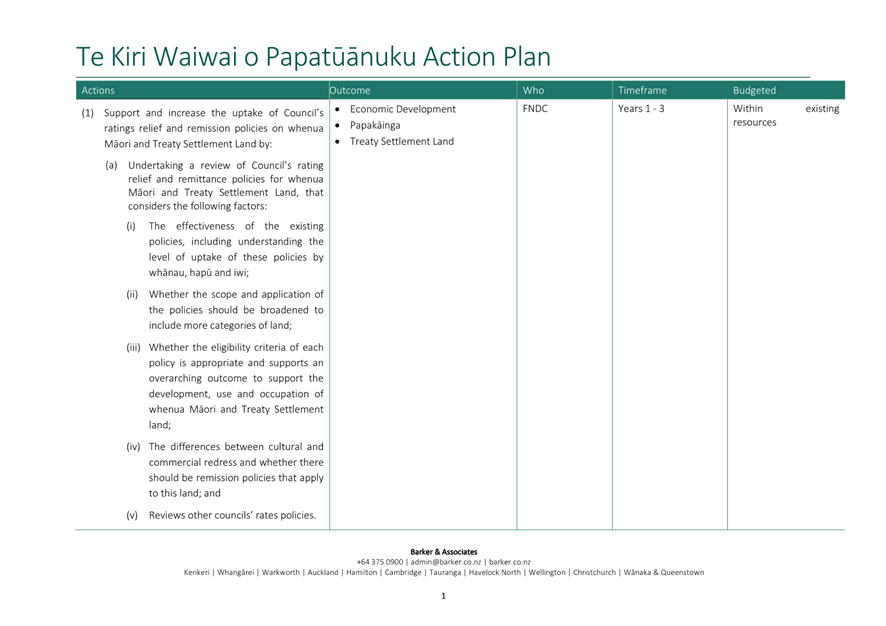
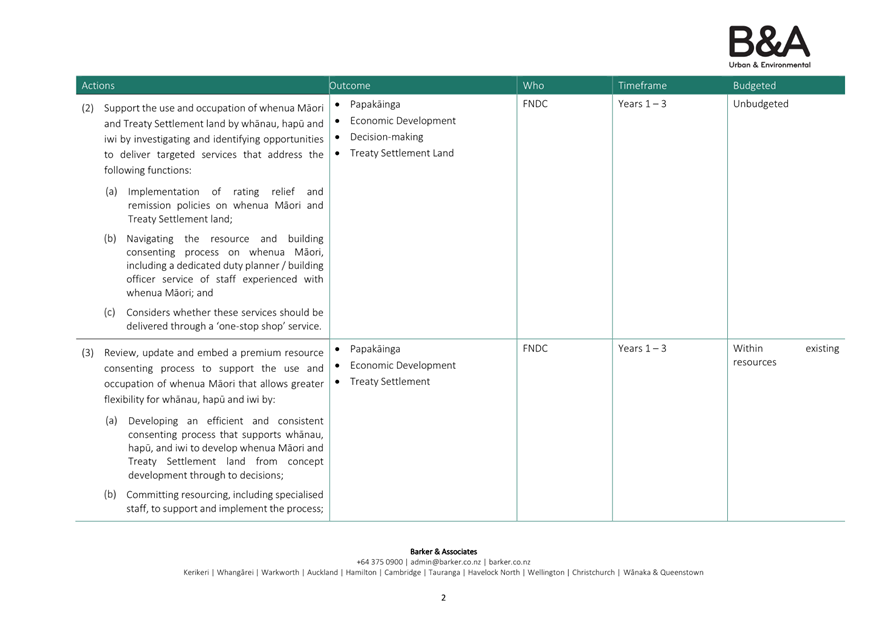
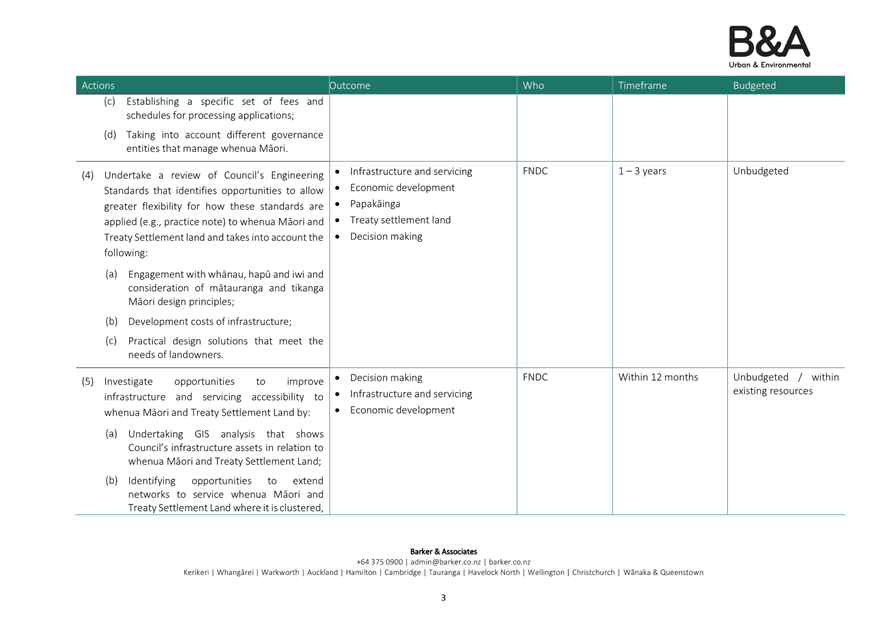
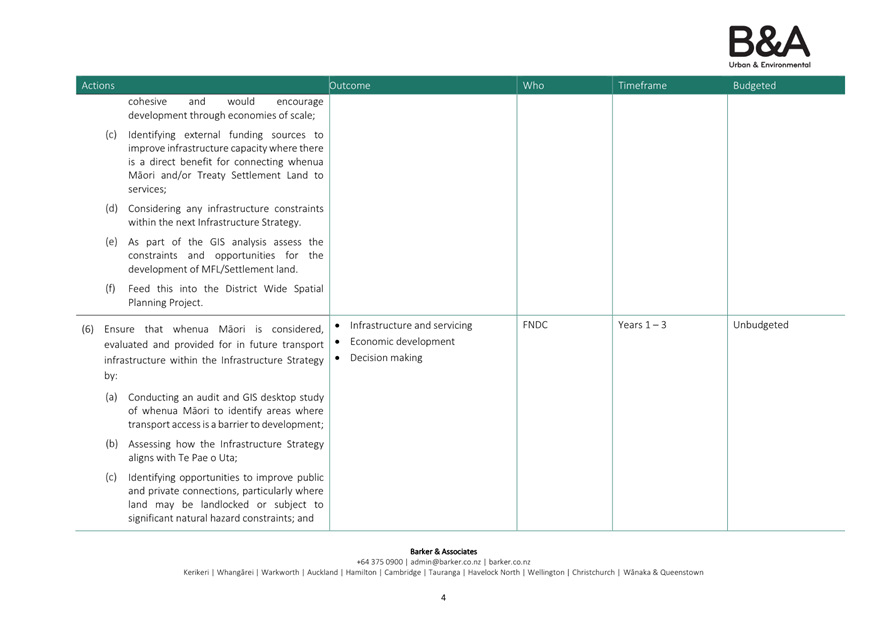
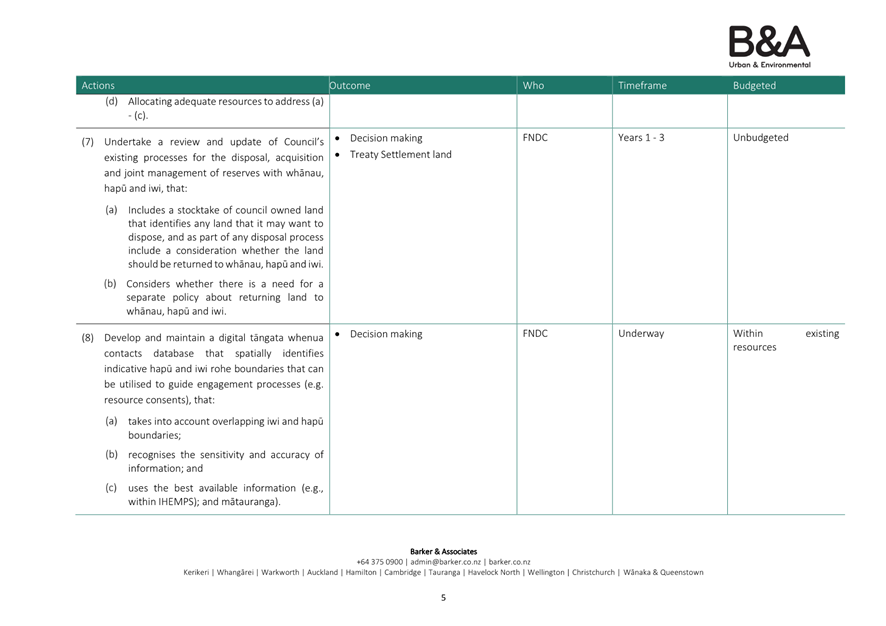
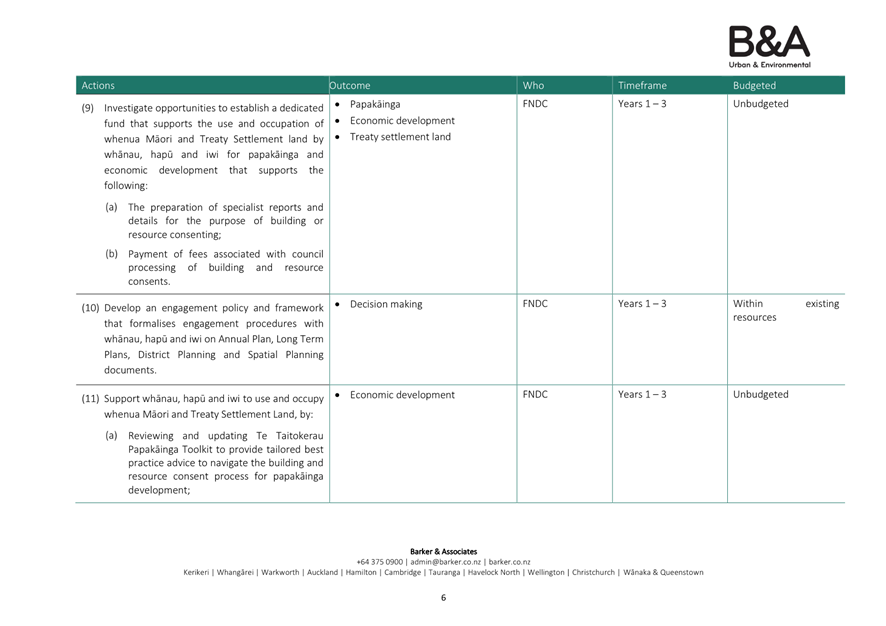
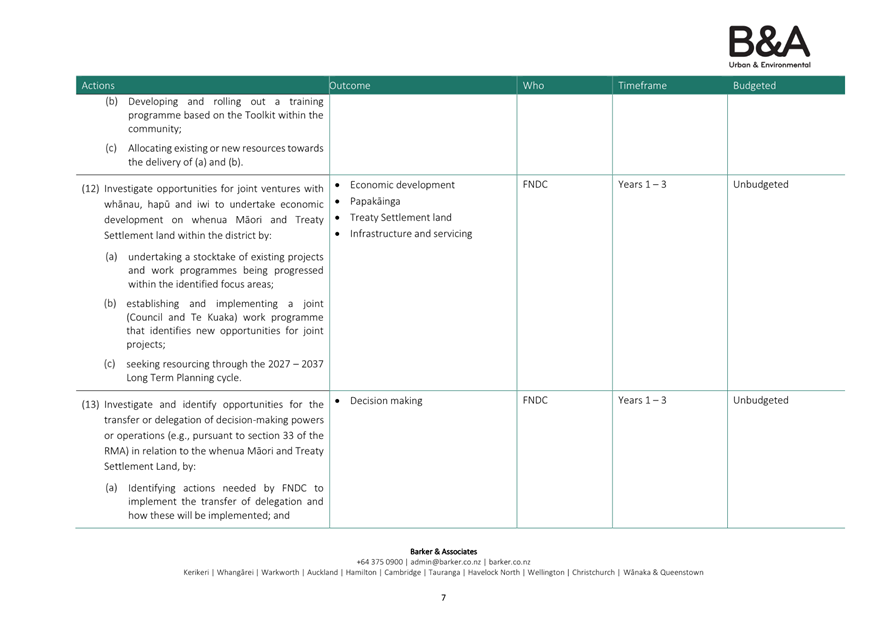
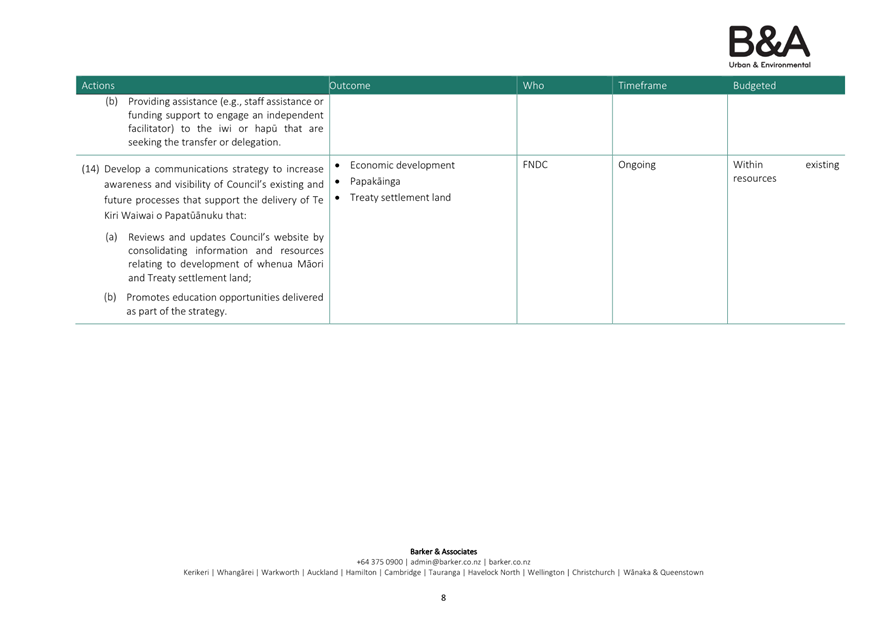
|
Ordinary Te Kuaka - Te Ao
Māori Committee Meeting Agenda
|
23
September 2025
|
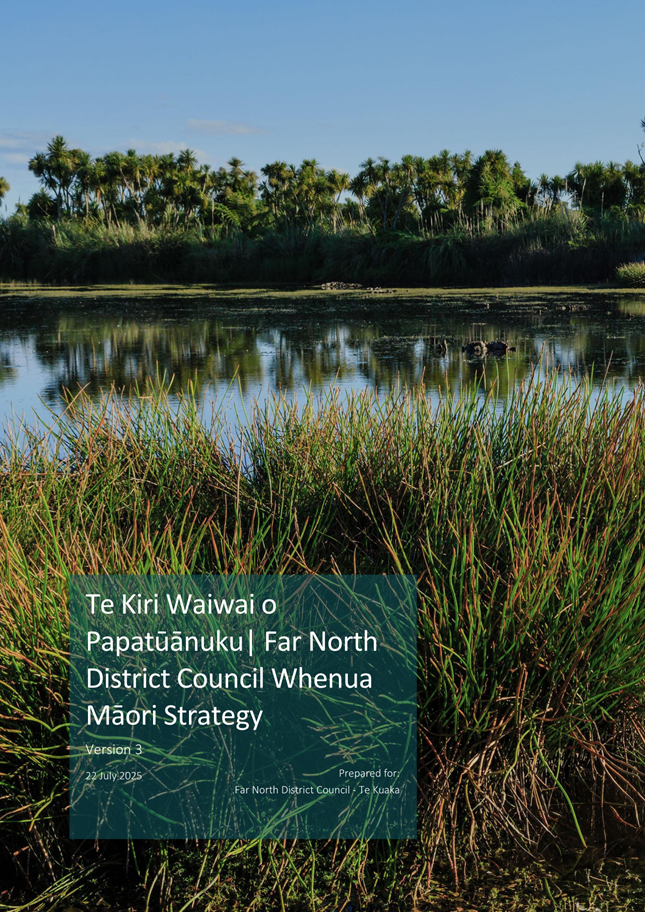
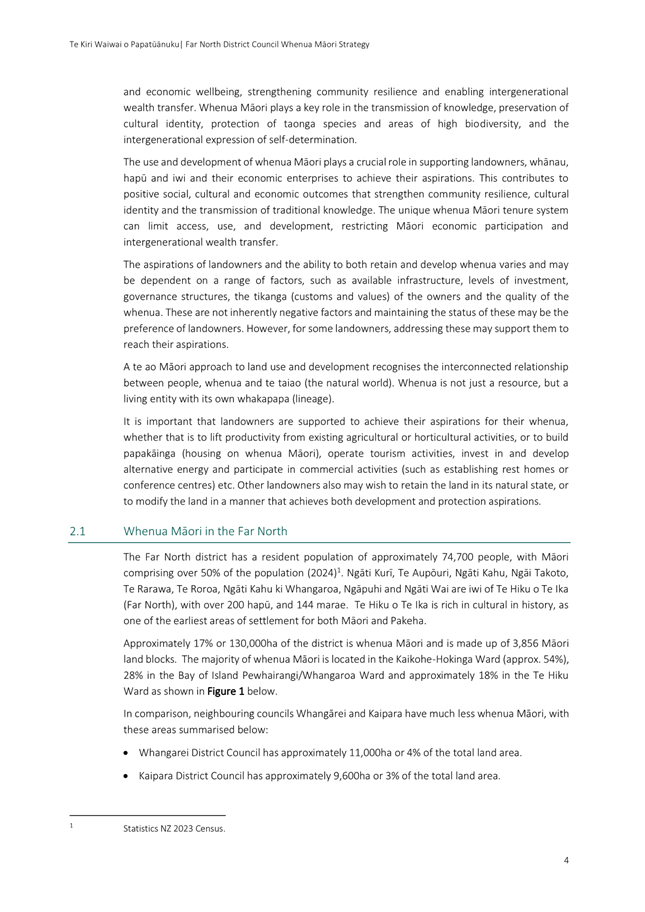
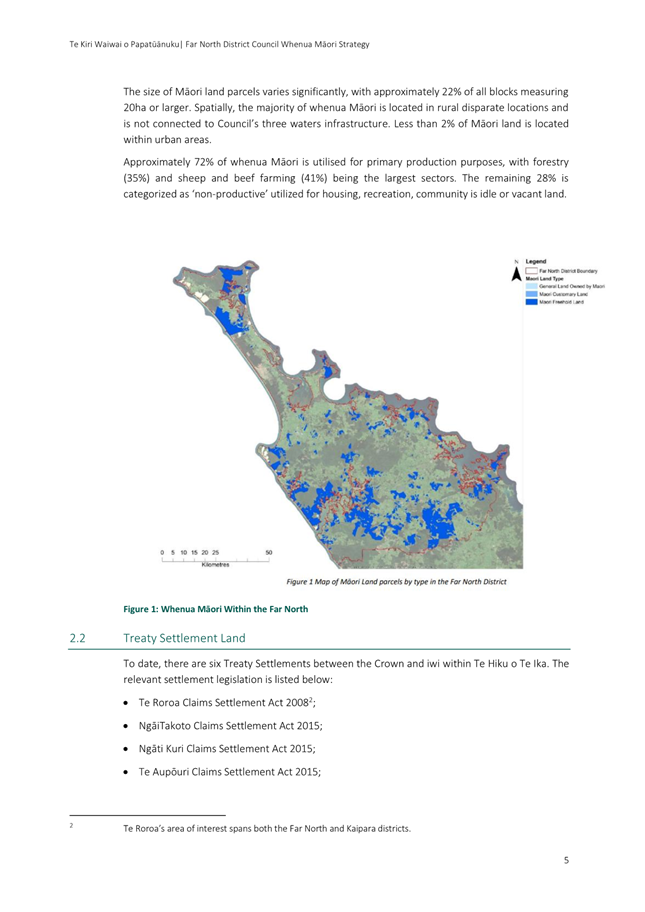
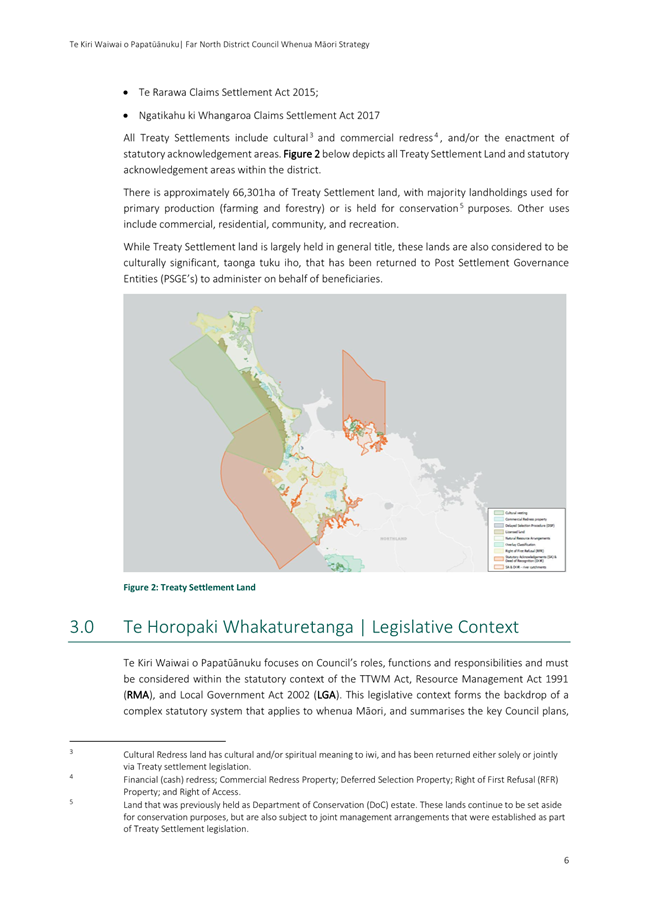
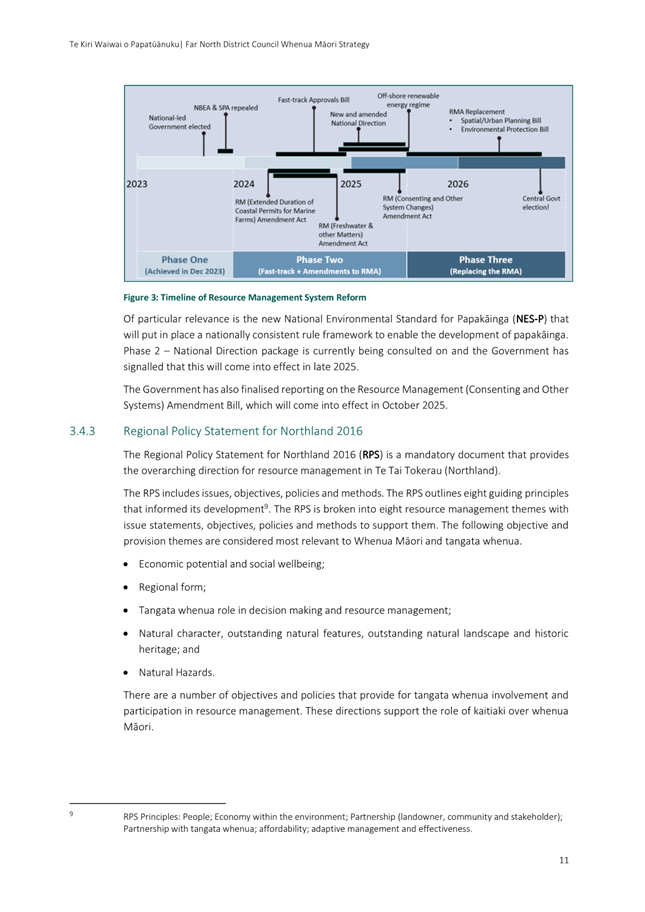
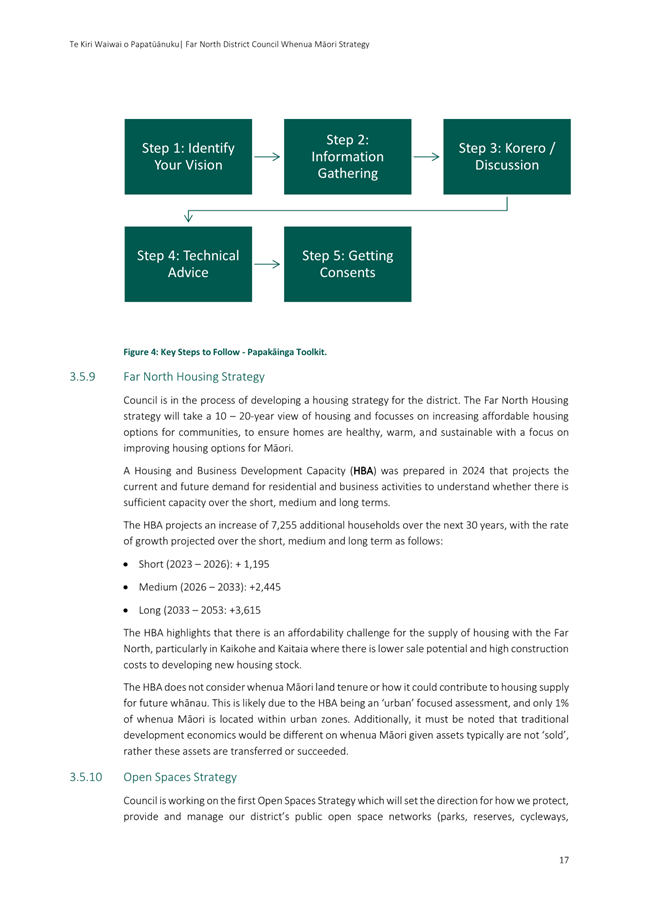
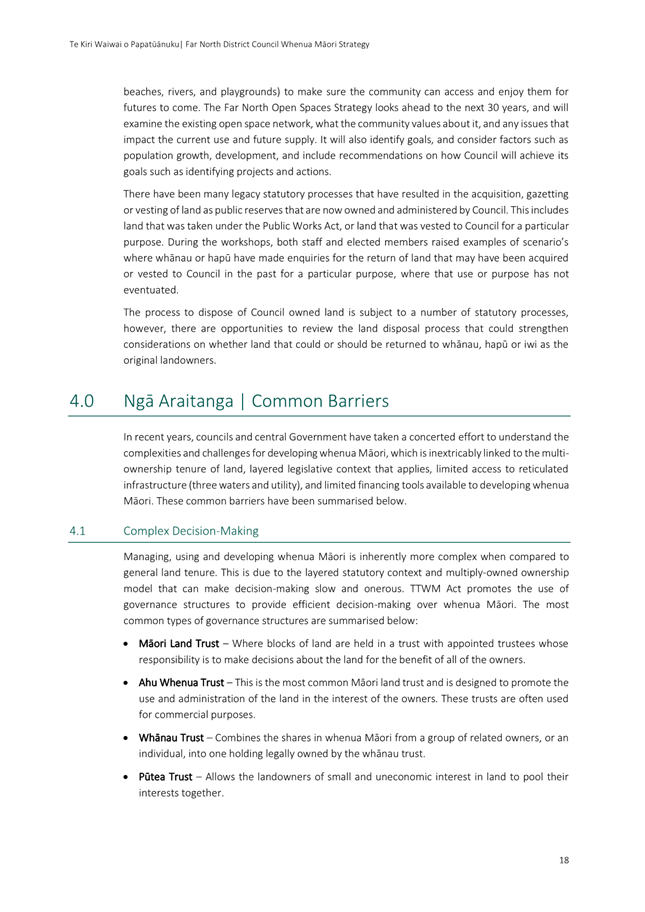
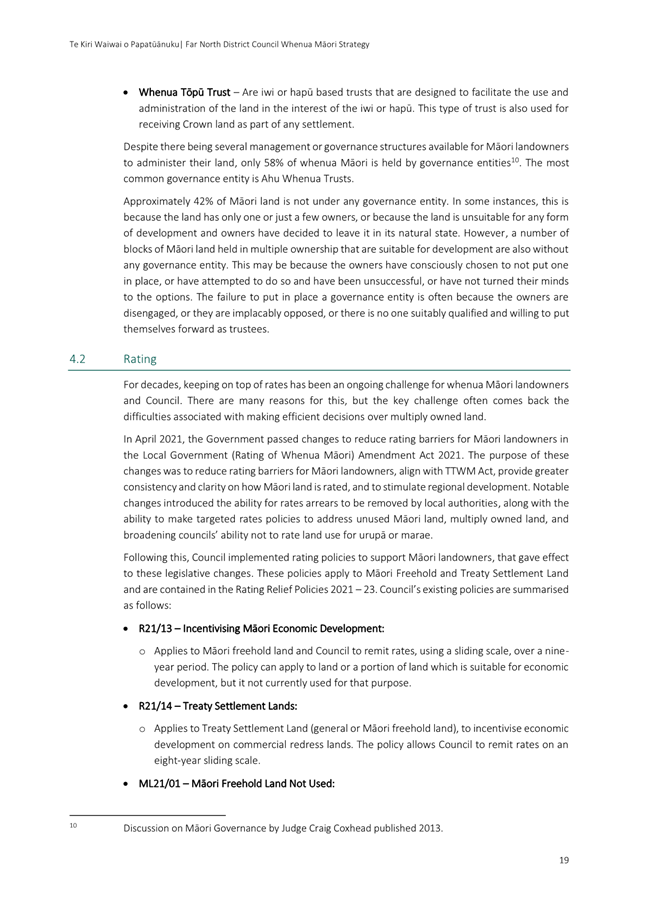
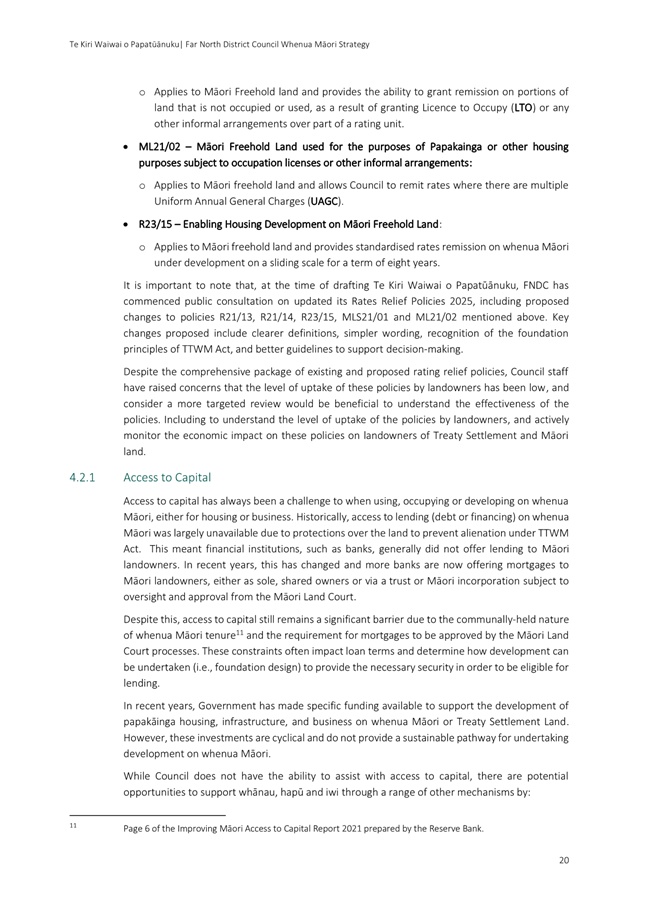
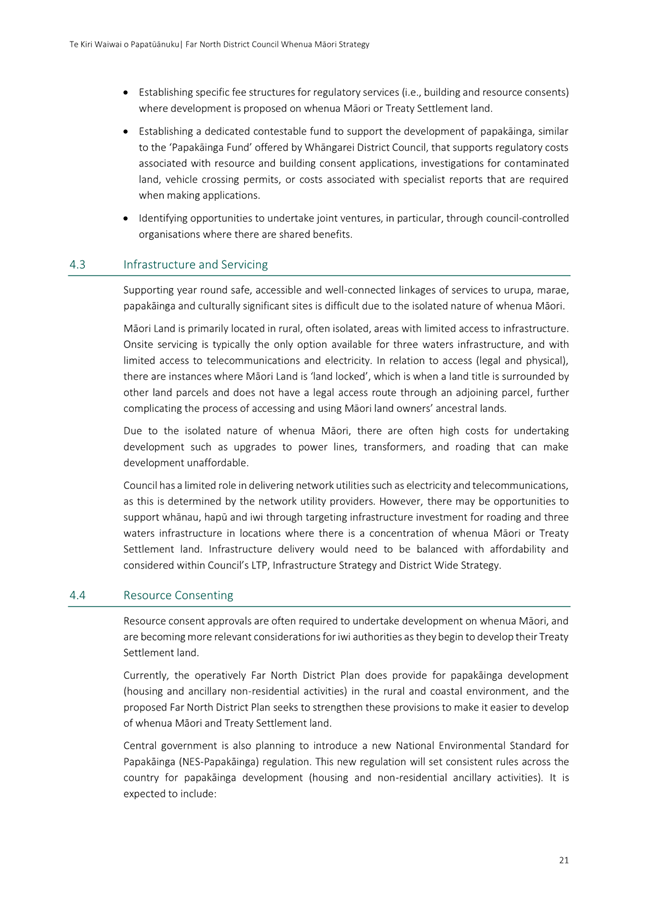
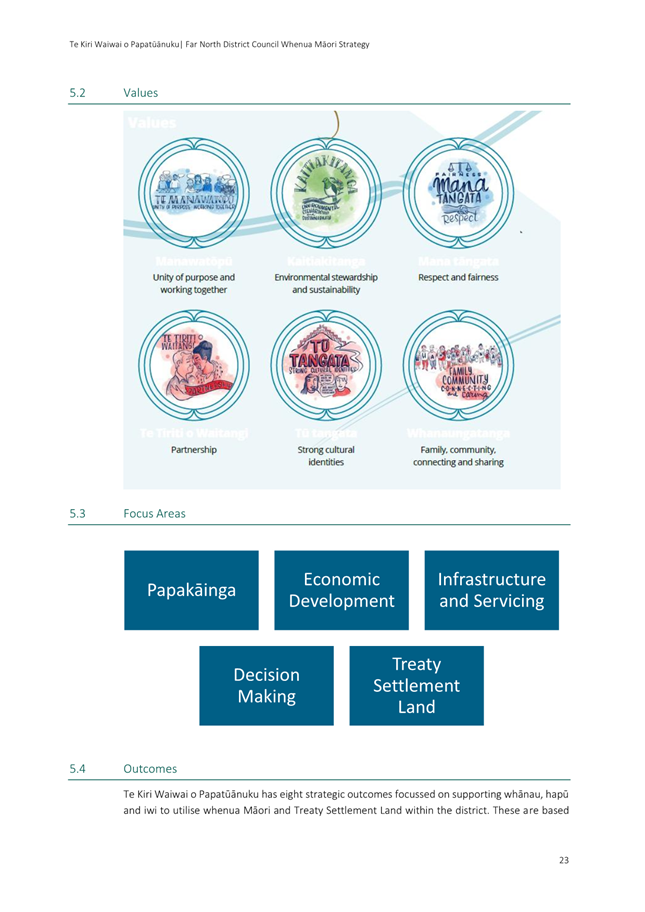
6 Ngā
Pūrongo Taipitopito / Information Reports
6.1 Te
Kahu o Taonui Taiao Portal Progress Report
File
Number: A5345378
Author: Marlema
Baker, Democracy Advisor
Authoriser: Roger
Ackers, Group Manager - Planning & Policy
TAKE PŪRONGO / Purpose of the Report
To present Te Kuaka Te Ao Māori Committee (Te Kuaka)
with a progress report on Te Kahu o Taonui (TKoT) Taiao Portal.
WHAKARĀPOPOTO MATUA / Executive SummarY
· The
Taiao Portal is a web-based portal that presents tāngata whenua with an
opportunity to improve working relationships with Council and enhance their
participation in resource management and decision-making processes.
· A
copy of the June 2025 Taiao Portal Progress Report is attached.
|
TŪTOHUNGA
/ Recommendation
That Te Kuaka – Te Ao
Māori Committee receive the report Te Kahu o Taonui Taiao Portal
Progress Report.
|
tĀHUHU KŌRERO / Background
As part of the Better off Funding
Package, Te Kahu o Taonui, in collaboration with the Far North District
Council, developed a web-based Taiao Portal to enable iwi/hapū/whānau
to have better access to environmental data and to facilitate engagement on
other environmental matters.
The last Taiao Portal update was received 25 September 2024.
MATAPAKI ME NGĀ KŌWHIRINGA /
Discussion and Next Steps
The Taiao Portal is a website that
aims to support taiao practitioners via a range of specific resources to enable
their input and participation in Resource Management (RM) matters regarding,
but not limited to, Te Mana o te Wai and Te Oranga o Te Taiao.
In supporting taiao practitioners
the underlying kaupapa is twofold:
1. Providing
access to a range of tools and templates; and
2. Building
capacity and capability.
The portals construction is ongoing
and will evolve as more tools and templates are developed
Te Kahu o Taonui will continue to
provide updated developments to Te Kuaka Te Ao Māori Committee and
maintain collaboration with Te Hono.
PĀNGA PŪTEA ME NGĀ WĀHANGA
TAHUA / Financial Implications and Budgetary Provision
Funding for this project
was achieved through central governments Better Off Funding initiative for
community wellbeing projects. There are no financial implications in the
receiving of this report.
Āpitihanga
/ Attachments
1. Te
Kahu o Taonui Taiao Portal Progress Update - A5345370 ⇩
|
Ordinary
Te Kuaka - Te Ao Māori Committee Meeting Agenda
|
23
September 2025
|
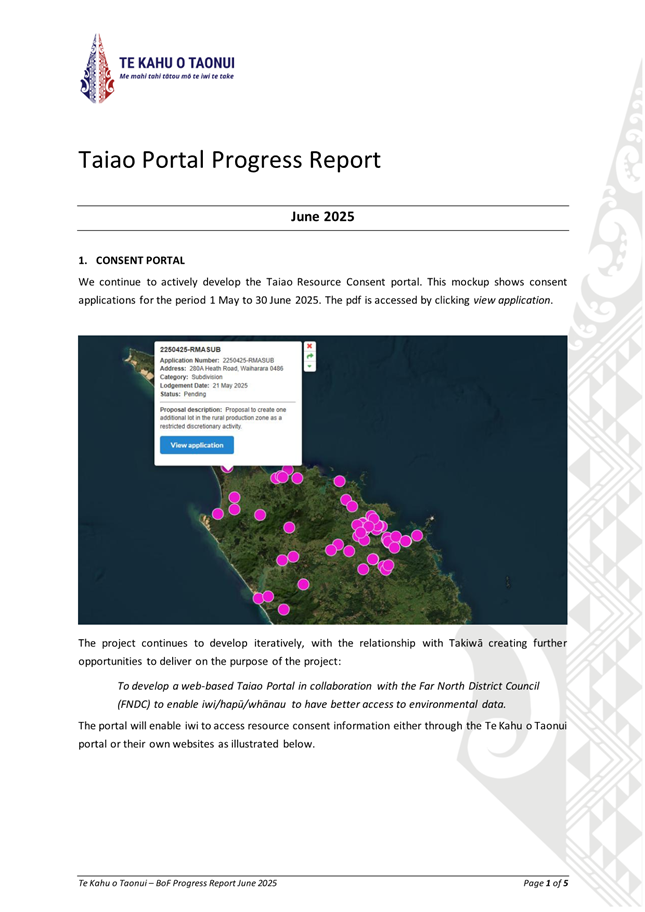
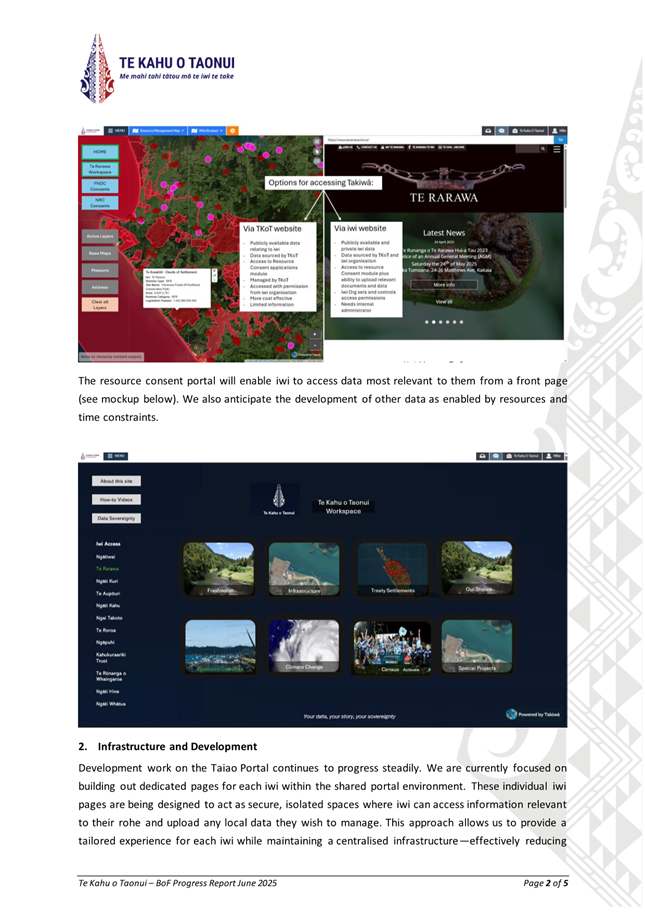
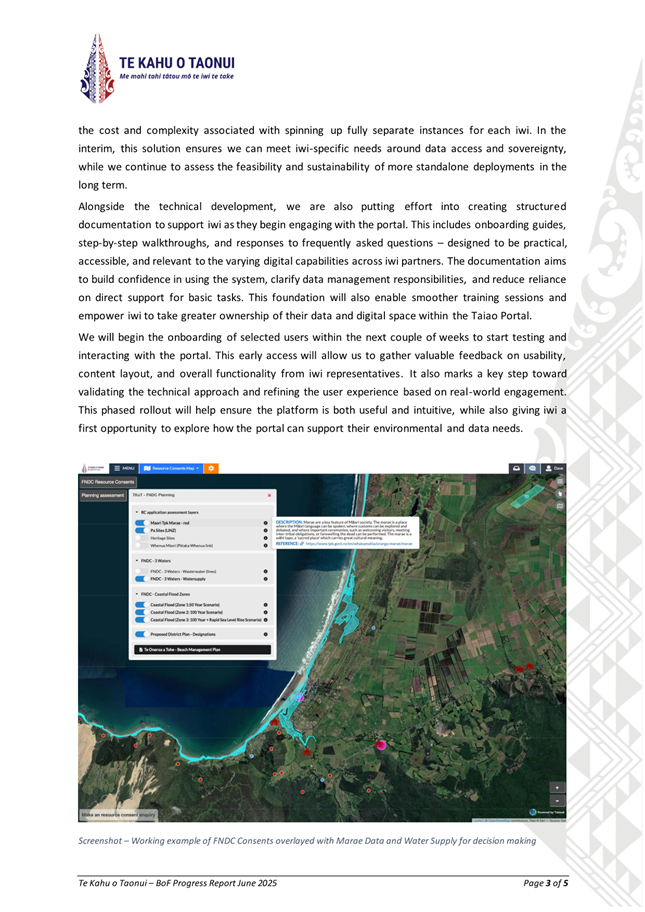
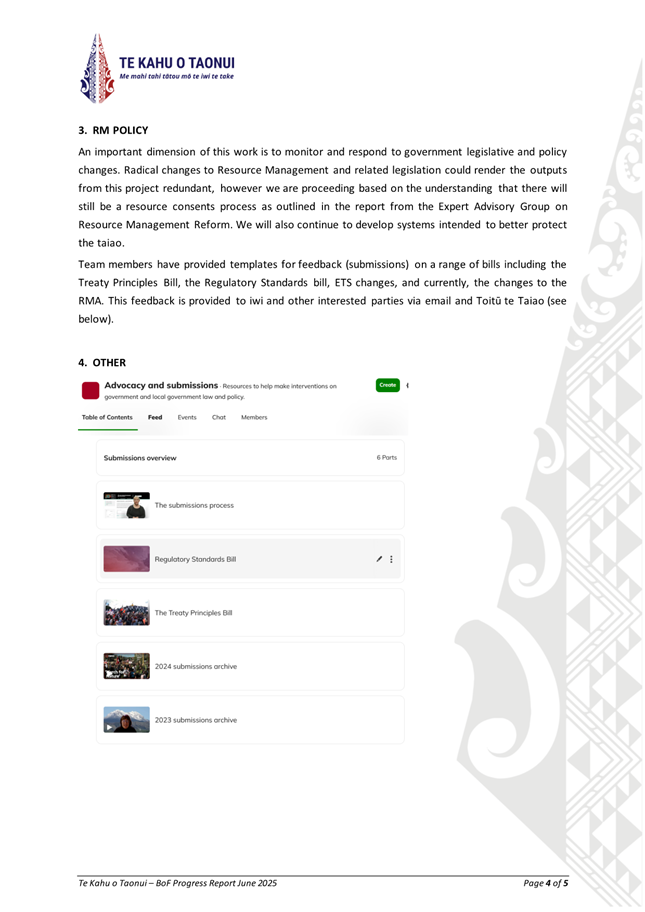
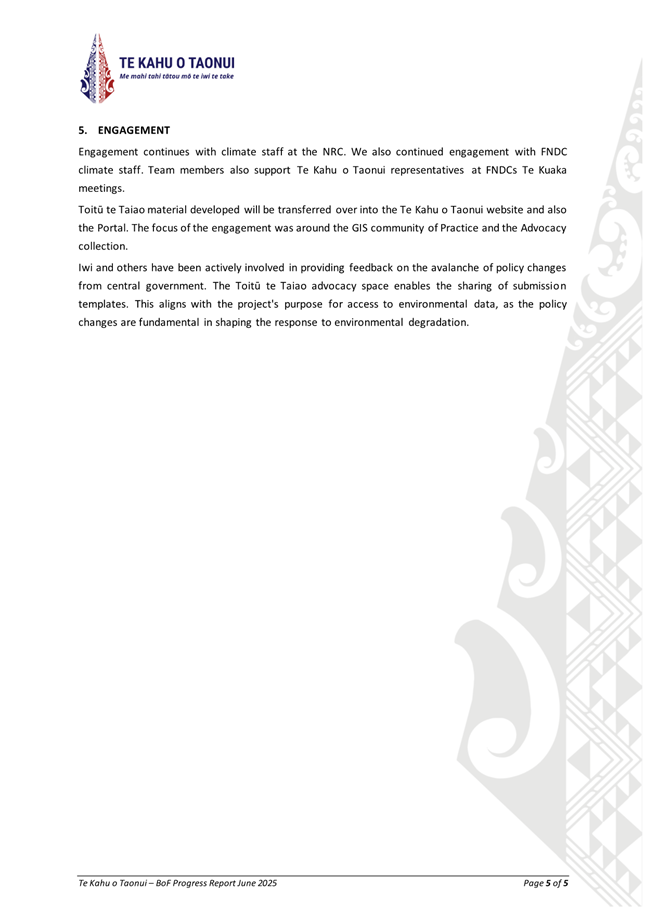
6.2 Civic
Engagement and Education Update
File
Number: A5345970
Author: Casey
Gannon, Manager - Civic Engagement and Education
Authoriser: Jacine
Warmington, Group Manager - Strategic Relationships
TAKE PŪRONGO / Purpose of the Report
To provide Te
Kuaka – Te Ao Māori Committee with an update on Far North District
Council (FNDC) Civic Engagement and Education (CEE) work programme.
WHAKARĀPOPOTO MATUA / Executive SummarY
o The Civic
Education and Engagement Programme 2024–2025 is a strategic
initiative led by FNDC to strengthen democratic participation, political
literacy, and community engagement across the district. The programme is
designed to make local government more relevant and accessible, particularly
for communities that have historically been underrepresented or disengaged.
|
TŪTOHUNGA
/ Recommendation
That Te Kuaka – Te Ao
Māori Committee receive the report Civic Engagement and Education
Update.
|
tĀHUHU KŌRERO / Background
The
organisation has identified a need to strengthen civic participation and
political literacy across the district, particularly among communities that
have historically been underrepresented in local government processes. In
response, the Civic Education and Engagement Programme
2024–2025 has been developed to make local government more relevant,
visible, and accessible to all communities.
The programme is grounded in the
principles of rangatiratanga (leadership), kaitiakitanga (guardianship), and
mana motuhake (self-determination), and seeks to empower whānau,
hapū, and iwi to engage meaningfully with Council processes and decision-making.
It also supports FNDC’s strategic goals under Te Pae o Uta and
complements broader initiatives such as the Whenua Māori Strategy and the
upcoming 2025 local government elections.
The programme includes a range of
innovative and culturally responsive activities, including:
· Civic
education tools such as web-series, storytelling, and workshops to build
understanding of local government functions.
· Community
engagement events to connect with aspirations and promote active
citizenship.
· Pre-election
education including youth competitions and a candidate information
evening.
· Voting
period activations such as VOTE/POTI whānau days to encourage voter
turnout and civic pride.
Additionally, the programme
features a “Day in the Life” video series showcasing FNDC
staff roles, and a “Local Legend” series highlighting
successful community-led projects and partnerships with Council.
This initiative reflects
FNDC’s commitment to removing barriers to participation, lifting civic
capability, and building trust between Council and the communities it serves.
Te Kuaka – Te Ao Māori
Committee received an update at their 19 June 2025 meeting which provided a
high-level overview of the CEE work programme.
MATAPAKI ME NGĀ KŌWHIRINGA /
Discussion and Next Steps
Local Government New Zealand (LGNZ) carried out a nationwide
survey post the 2022 local government election and provided data at the
Electoral Officer training in Wellington November 2024 that both our
independent electoral officer and deputy electoral officer attended.
Voters across the country have indicated that they want to
know more about the candidates running for election. Committed to a data driven
work programme, we have taken this data and the recommendations for increasing
voter turnout into account when developing the CEE work programme.
The demographics of the Far North district, and the
relationships required to engage in a meaningful way are consistently
considered to build, strengthen and/or maintain ongoing collaborative
approaches to equitable civic education and engagement related to democratic
processes. Our message is to vote and continue to engage throughout the
triennium as to inform the members that are elected when they are making
important decisions that affect your whanau (family), hapori (community),
tamariki (children), and mokopuna (grandchildren).
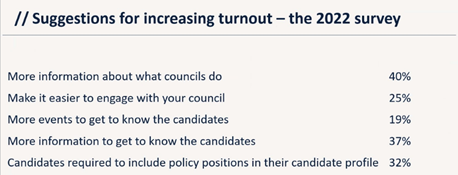
Source: Local
Government New Zealand Electoral Officer training held in Wellington Nov 2024
The number one reason people are not voting is because they
do not know who they are voting for. We have increased accessibility to the
candidate profiles by filming candidate videos within the allocated CEE work
programme budget. The filming of the videos came to no additional unbudgeted
cost to ratepayers. For candidates that did not film a video the profile
statement and photo provided with their nomination form (which will be provided
in the candidate handbook delivered with voting documents from 9 Sept 2025) was
included on our webpage: Candidate
Profiles | Far North District Council made available from 1 September 2025.
70%+ of nominated positions filmed a candidate video. Graphic 1 and 2
below provide data on viewership as at 4-9-2025.
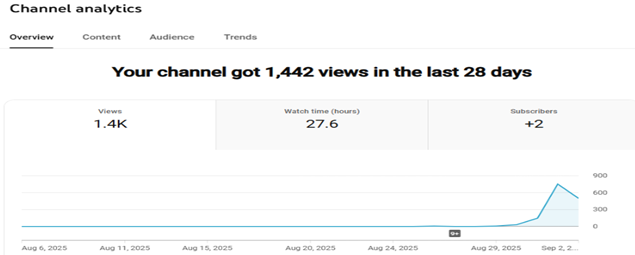
Graphic 1: Analytics showing channel views commencing
August 2025.
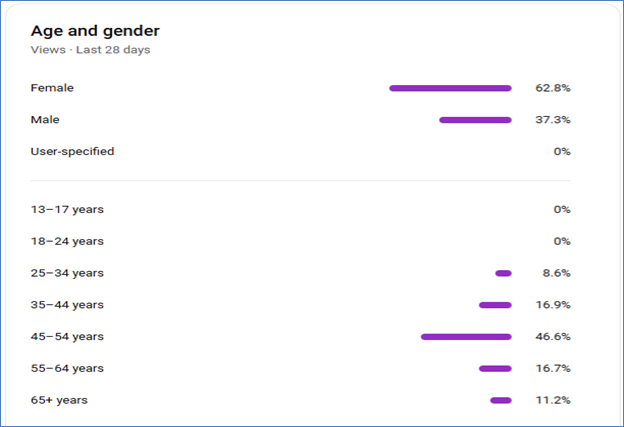
Graphic 2: Breakdown of viewer age and gender
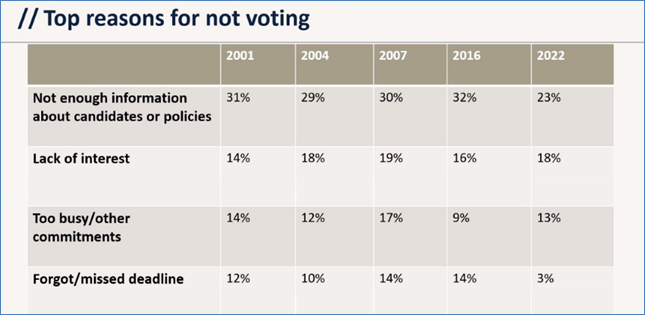
Source: Local
Government New Zealand Electoral Officer training held in Wellington Nov 2024
2025 Local Government Elections key dates:
Local
Elections 2025 | Far North District Council
o Update/change/choose
enrolment details before
11 July 2025
o Candidate nominations open 4
July 2025
o Candidate nominations close 1
August 2025
o Candidates announced 8
August 2025
o Voting opens 9
September 2025
o Voting closes 11
October 2025 (midday)
o Final results announced 14
October 2025
Upcoming Events
o Meet the candidates events | Far North District
Council
o Community
led initiatives that we are advised of are added to our webpage:
Next steps
o Activating
voter participation throughout voting period (9 Sept – 11 Oct)
o Mobile Ballot Box Tour | Far North District Council
§ Drop
completed voting documents
§ Enrol/update
details on electoral roll
§ Special
voting
§ 6
units running 7 days a week
§ 93
stops across the 3 wards aligned with mobile nursing units, community led
events, business associations, sport codes, retirement villages, schools, Kura
Kaupapa Māori, industrial areas, cafes, rural communities, marae, urban
town centres, markets, fishing clubs, halls etc.
o Fact sheet | Far North District Council
§ 8
service centres (9 Sept through 10 Oct)
· Kaikohe
Service Centre, 5 Memorial Avenue, Kaikohe;
· Kaitāia
Service Centre (Te Ahu), Corner SH1 & Matthews Ave, Kaitāia;
· Kerikeri
Service Centre (Procter Library),6 Cobham Road, Kerikeri;
· Kawakawa
Service Centre, MacKereth Lane, Kawakawa;
· Kaeo
Service Centre, Leigh Street, Kaeo;
· Hokianga
Service Centre (Ōpononi isite), 29 Hokianga Harbour Drive, Ōpononi;
· Paihia
Library, 6 Williams Road, Paihia;
· Rāwene
Service Centre, 11 Parnell Street, Rāwene (Thursdays only)
§ Drop
completed voting documents
§ Enrol/update
details on electoral roll
§ Special
voting
· Anyone
that updates or enrols after the 1st August must do a special vote
· Non-Resident
Ratepayer Electors completing form after 1 August must do a special vote
· Enrol
and vote on the same day up until 10 October
§ 3
service centres (11 October until midday)
· Kaitaia
– Te Ahu
· Kaikohe
– Headquarters
· Kerikeri
– Procter Library
o Onboarding/induction/pōwhiri/inaugural
meetings planning is underway.
PĀNGA PŪTEA ME NGĀ WĀHANGA
TAHUA / Financial Implications and Budgetary Provision
No budgetary
implications.
Āpitihanga
/ Attachments
Nil
6.3 Te
Rauora - Reorua Annual Review
File
Number: A5262643
Author: Lawrence
Wharerau, Kaiārahi Kaupapa Māori
Authoriser: Llani
Harding, Pouhautū Te Hono - Manager - Te Hono
TAKE PŪRONGO / Purpose of the Report
To
furnish Te Kuaka Te Ao Māori Komiti with a final report of Te Rauora
Kerikeri Reorua Strategy (Te Rauora).
WHAKARĀPOPOTO MATUA / Executive SummarY
· This
report is a summary and update of Te Rauora between Te Rūnanga o
Ngāti Rēhia (TRONR) and Te Kaunihera o Te Hiku o te Ika (FNDC). The
agreement has now reached its final stages.
· This
pūrongo is an extension of the progress report tabled at the 24 April
sitting of Te Kuaka Komiti, the same hui which endorsed Te Rauora as the name
for this strategy.
|
TŪTOHUNGA
/ Recommendation
That Te Kuaka – Te Ao Māori Committee
receive the report Te Rauora - Reorua Annual Review.
|
tĀHUHU KŌRERO / Background
On June 1, 2023, TRONR and FNDC,
launched Rautaki Reorua/Bilingual Plan for Te Kerikeri (attached). The Rautaki
Reorua for Te Kerikeri, referred to as Te Rauora, is an agreement sponsored by
Te Tari Taiwhenua – The Department of Internal Affairs (DIA) to create Te
Kerikeri as a bilingual township and centre of reo excellence.
While the fixed term of the
agreement sponsored by DIA concluded at the end of June 2025 and this report is
titled a final review, the work programme will continue and endure under the
commitments expressed in Te Aro Manatu Relationship agreement between TRONR and
FNDC.
Te Rauora was prepared within the
context of the Māori Language Act 2016 and Te Whare o te Reo Mauriora and
its two maihi: Te Maihi Karauna - The Crown Māori Language Strategy and Te
Maihi Māori - the Māori Language Strategy for Aotearoa.
Te Rauora includes TRONR led
strategic focus areas, FNDC led priority actions and joint outcomes targeted in
the strategy. These are expressed in the Pou Tuarongo, Pou Tokomanawa, Pou
Tāhū and Pou Mataaho sections of Te Rauora. This report does not
speak for TRONR led goals and outcomes.
MATAPAKI ME NGĀ KŌWHIRINGA /
Discussion and Next Steps.
Te Rautaki Aro Tahi
– Strategic Focus 1 – FNDC and joint led outcomes – Te Pou
Tuarongo (Te Rauora informs).
The FNDC Te Reo and Tikanga Policy
- Te Kaupapa Here mō Te Reo me ngā Tikanga Māori (attached) was
formally adopted on September 21, 2023 and is due for review September 21,
2025. Te Pae o Waho - Te Reo and Tikanga learning programmes continue to roll
out across council at our three main centres as well as online serving all
areas of council and is lining up to provide access and opportunities for our
CCO partners. Classes are offered at levels one, two and three while courses
are being prepared to cater for level four, five and six.
Since the last report on Te Rauora
24, April 2025, a further 49 staff have signed up to reap the benefits Te Pae o
Waho provides and lifts the number of participants 222 since classes began.
There has been a significant and noticed increase in the use of Te Reo in
official and casual communications across council including conversations
around “the coffee machines” amongst staff. From what is observed,
confidence and capability is growing internally. TRONR will always be
acknowledged by FNDC as tuakana holding ahi kā and kaitiakitanga in
Kerikeri.
FNDC have held two significant hui
at Whitiora Marae, Te Tii Mangonui, specifically the mātauranga
wānanga for elected members and SLT on May 29, 2025, and the SLT
People’s Leaders hui on June 10, 2025. The joint outcomes of this focus
area continue to evolve and strengthen giving longevity and succession to Te
Rauora.
Te Rautaki Aro Rua
– Strategic Focus 2 – FNDC and joint led outcomes – Te Pou
Tokomanawa (Te Rauora informs).
There is an increased use and
normalisation of te reo Māori in FNDC spaces as evidenced in Te Rautaki
Aro Tahi above. Opening and closing karakia has become the norm in FNDC hui
at all levels. The look and feel of Te Kerikeri as a reorua centre enhancing
its Māori identity is seen and heard particularly with rise of Ngāti
Rēhia Community Kapa Haka group, an eclectic rōpū made up of
mixed ethnicities including Sri Lankan, Irish and German members of the
Kerikeri hapori with a love for kapa haka and a desire to learn more about Te
Ao Māori. In eight short weeks of learning and rehearsals, they took the
stage at Turners Event Centre during Matariki celebrations. It is standard
practice across the board for relevant hapū to be consulted when road naming
requests come to the three Community Boards.
Te Rautaki Aro Toru
– Strategic Focus 3 – FNDC and joint led outcomes – Te Pou
Tāhū (Te Rauora informs).
There is a noticeable increase in
te reo Māori and Reorua events and kaupapa in both FNDC and community led
opportunities. FNDC acknowledge and support TRONR in their Reorua led kaupapa
in Te Kerikeri with an increase in these activations, the community kapa haka
is evidence of this. Supporting other kaupapa across our district include
Waitangi Week events and activities, Mangungu Te Tiriti kaupapa, Te Tai Tokerau
Secondary Schools Kapa Haka Festival, Manu Kōrero competitions, and the
recent Te Tai Tokerau Kapa Haka Kura Tuarua Regionals hosted at Papa Hawaiki
facility August 2nd, 2025. Maramataka has been an influence at FNDC
dating back to before this agreement was entered into with TRONR, for instance
the timing of formal hui in our calendar which avoids the lower energy days
where and whenever possible. Te reo Māori signage has increased in the
Kerikeri catchment with a good example being Bunnings, Waipapa, which
introduced dual signage from the opening day.
Te Rautaki Aro
Whā – Strategic Focus 4 – FNDC and joint led outcomes –
Te Pou Mataaho (Te Rauora informs).
Promoting Te Hiku o te Ika as a
premier reorua destination is further manifested by the groundbreaking choice
at the last sitting of Te Kuaka approving the Districtwide Reorua – Te Ao
Mārama Strategy. There is an increased use of te reo Māori in
planning documents like Te Pātukurea Spatial Plan for Waipapa and Te
Kerikeri, annual plans and other strategic documents throughout council has
increased. FNDC champions and encourages the use of dual signage in public
spaces with correction being made as signage is renewed and/or swapped out.
Recently FNDC fed into a spreadsheet from The Geographic Board correcting
macrons and other te reo Māori standards to reflect northern mita in
placenames. Communication and Engagement are compiling a lexicon of terms, phrases
and kupu Māori for all staff to access through the “Compiled FNDC
Report Translations and Macronised Place Names” spreadsheet on their TK3
page.
PĀNGA PŪTEA ME NGĀ WĀHANGA
TAHUA / Financial Implications and Budgetary Provision
There are no financial implications in receiving this
report.
Āpitihanga
/ Attachments
1. Te
Reo Maori and Tikanga Policy FINAL - A4479753 ⇩
2. 2023_Kerikeri_Rautaki
Reorua Final - A5158307 ⇩ 
|
Ordinary
Te Kuaka - Te Ao Māori Committee Meeting Agenda
|
23
September 2025
|
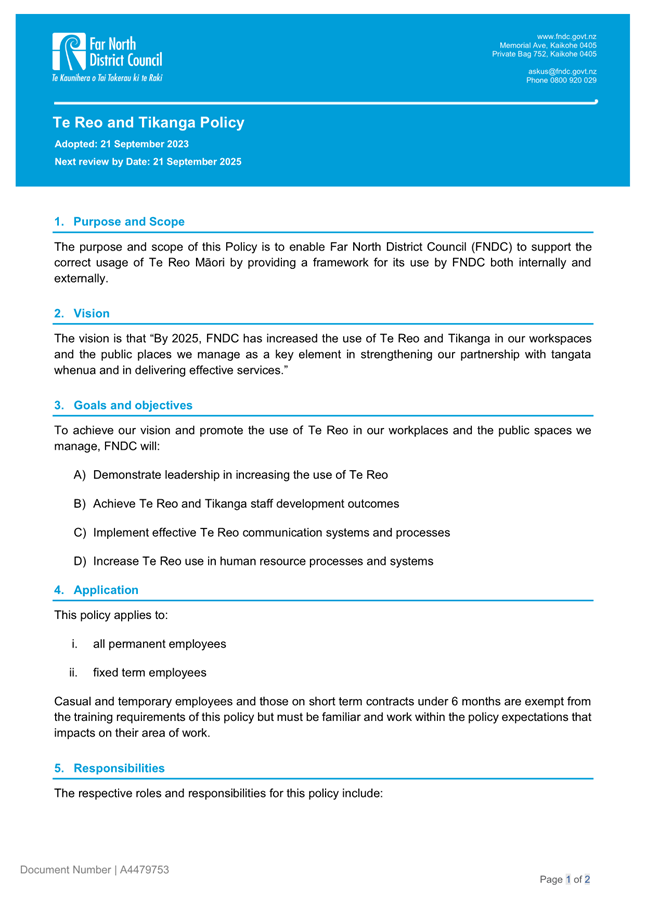
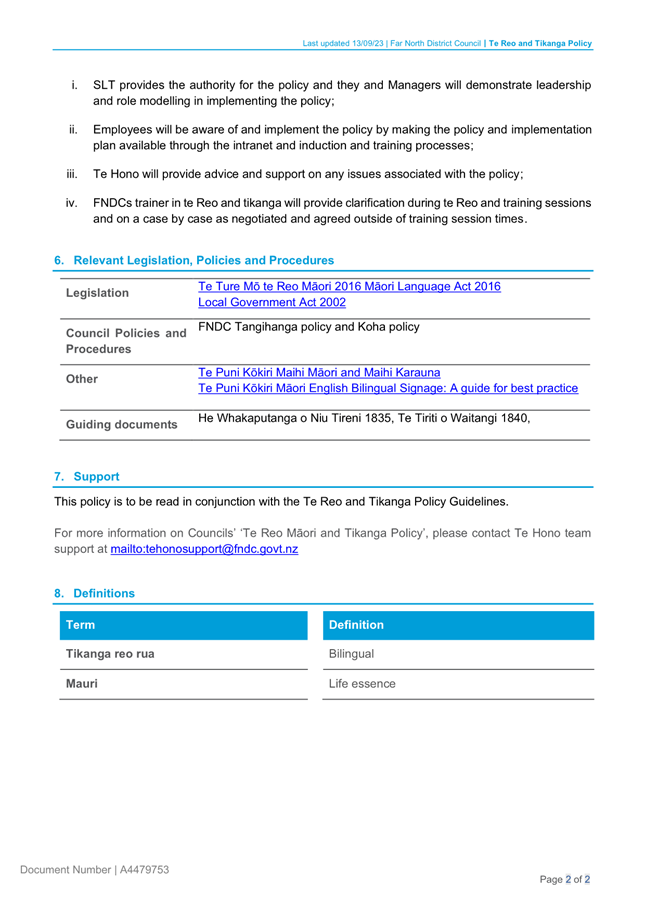
|
Ordinary Te Kuaka - Te Ao
Māori Committee Meeting Agenda
|
23
September 2025
|
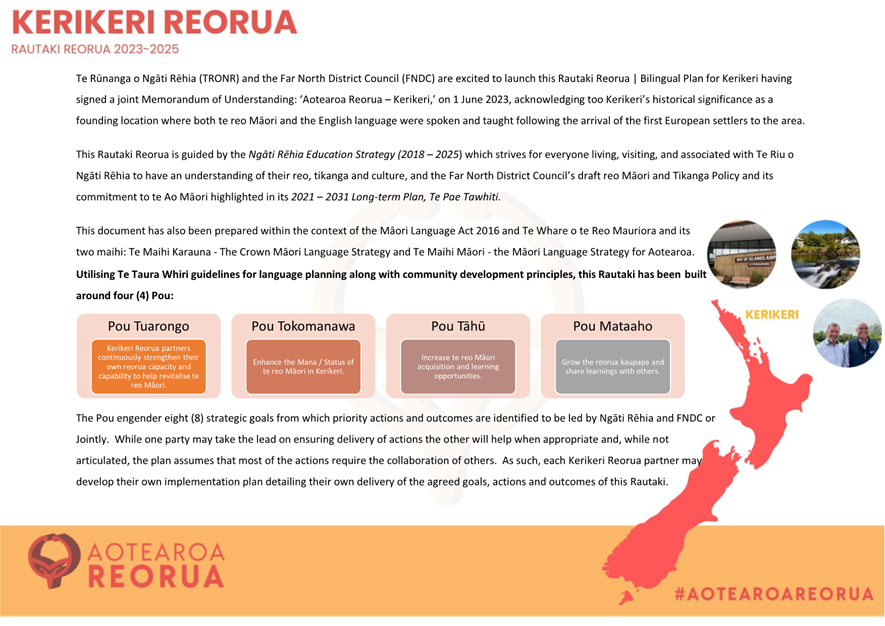
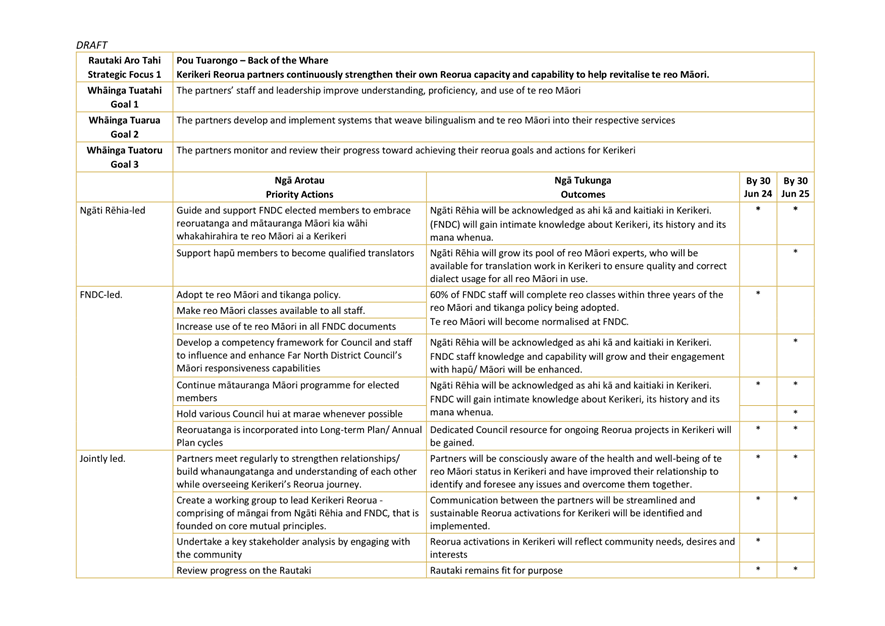
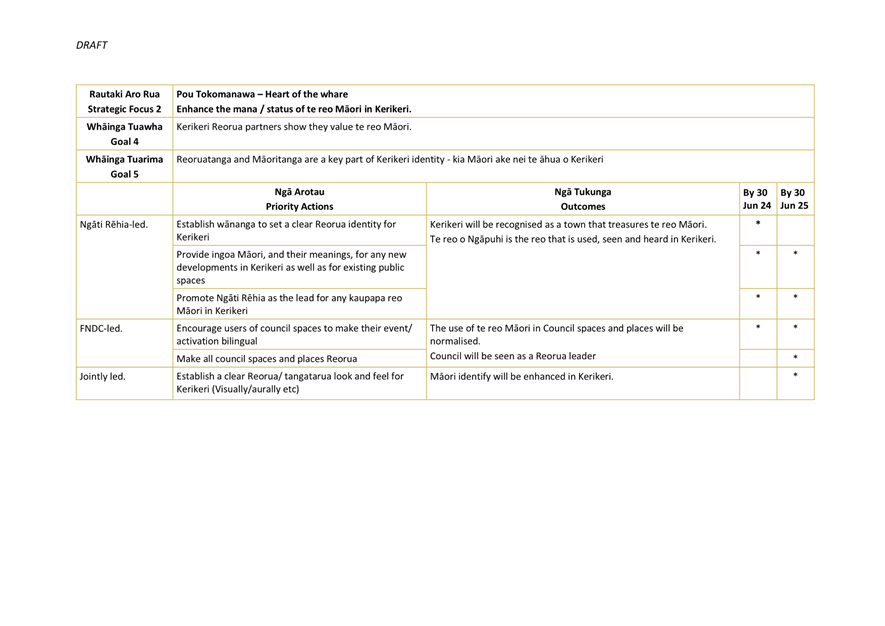
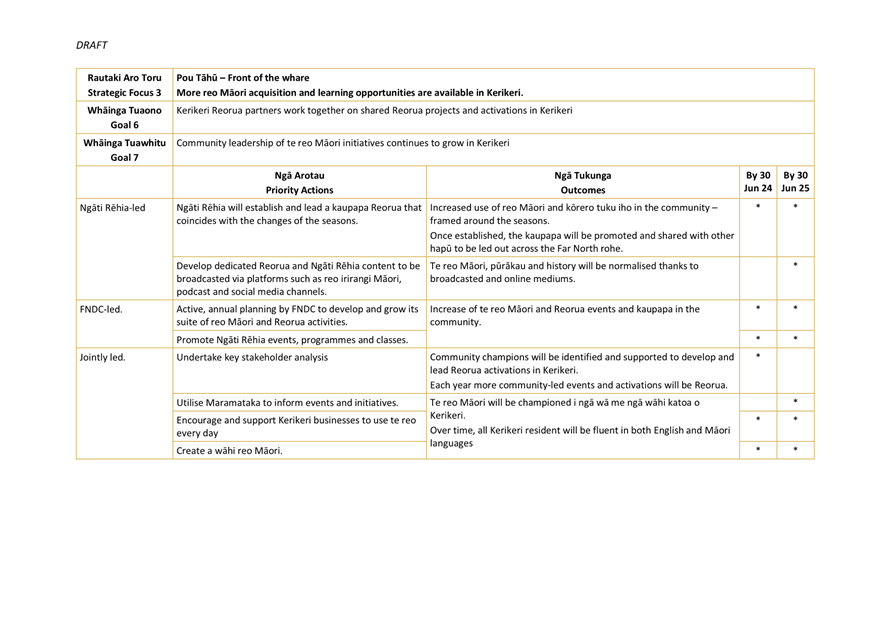
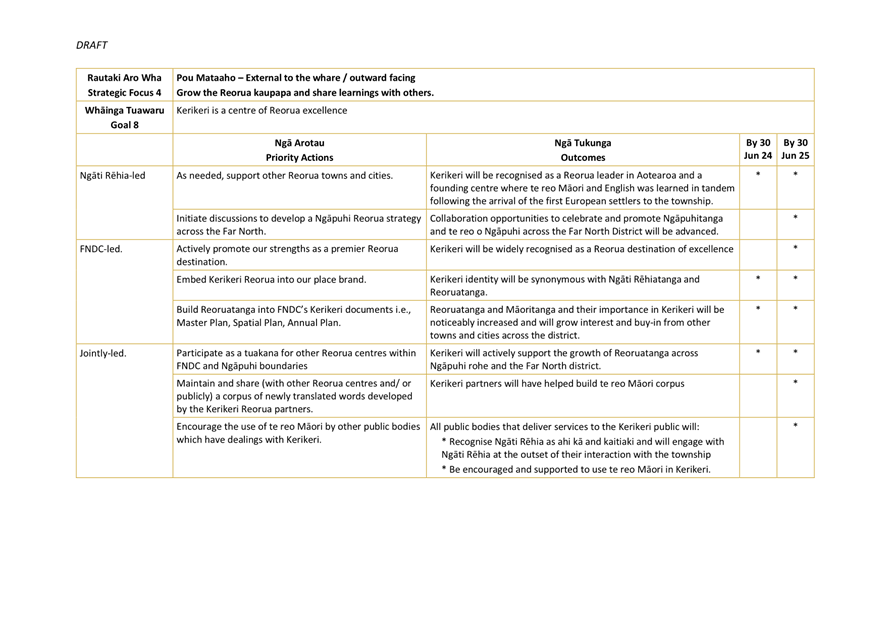
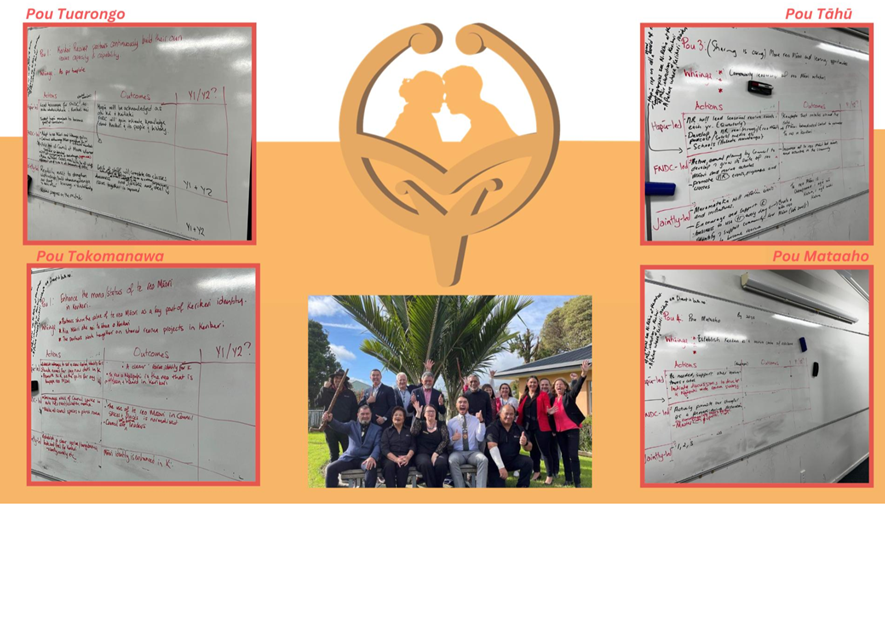
6.4 Whenua
Māori - Freehold Land Rating Relief
File
Number: A5295524
Author: Zena
Tango, Team Leader - Transaction Services
Authoriser: Charlie
Billington, Group Manager - Corporate Services
TAKE PŪRONGO / Purpose of the Report
The purpose of this report is to
update Te Kuaka – Te Ao Māori Committee (Te Kuaka) on the progress
made to date by the Whenua Māori Working Group (the Working Group).
WHAKARĀPOPOTO MATUA / Executive SummarY
· The Working Group was established to ensure Far North District
Council (FNDC) provides ongoing support to Māori Freehold Landowners
· The
Working Group has committed to a holistic approach with cross Council
collaboration and community engagement to achieve key outcomes of reducing debt
levels, clarifying rating information, reducing barriers to land use and
development, stimulating regional growth, and enhancing understanding of Whenua
Māori.
|
TŪTOHUNGA
/ Recommendation
That the Te
Kuaka – Te Ao Māori Committee receive the report Whenua Māori
- Freehold Land Rating Relief.
|
tĀHUHU KŌRERO / Background
The
following is an outline of actions that have been completed since the start of
May 2024.
|
Actions
completed
|
Start date
|
End date
|
|
|
Learning and development training
plan Whenua Māori for working group & others involved in engagement
plan
|
01/05/24
|
01/11/24
|
|
Geospatial mapping: Basemap loaded
and operational (received by 30/12/24 due to vendors health issues this has
added additional delays)
|
01/05/24
|
30/12/24
|
|
|
Commenced engagement.
|
30/09/24
|
30/06/25
|
|
|
|
|
|
|
|
In
progress
|
Start date
|
End date
|
|
Review of existing rating relief
policies
|
01/05/24
|
WIP
|
|
Data analysis utilising geospatial
mapping to review the balance of 2,501 accounts (We had data corruption
previously, they have been resolved but vendors health issues have added
additional delays, now expected to commence 01/11//24. Revenue Recovery are
currently reviewing these accounts manually).
|
27/09/24
|
WIP
|
|
Build layers to utilise geospatial
mapping for data analysis (We had data corruption previously; they have been resolved but
vendors health issues have added additional delays.
|
13/09/24
|
30/08/25
|
|
|
|
|
|
|
Next Steps
|
Start
date
|
End
date
|
|
Formalise the work plan for
2025/2026 rating year for the Whenua Māori Rating Relief Working
group.
|
01/07/25
|
30/10/25
|
MATAPAKI ME NGĀ KŌWHIRINGA /
Discussion and Next Steps
Property Reviews - A total arrears balance of
$1,035,756.90 for 239 properties, has been written off since the start of the
working group was established. $437,894.44 of the above is the CE write offs
that have been processed.
As of 30
June 2025 we have received payments of $2,387,756.78 towards Whenua Māori.
Remissions
applied to Whenua Māori:
For the 2025 year we received and or applied remissions to 509 Whenua
Māori properties, this is up from the 482 applications we received/applied
in the prior year.
|
Period
|
Remission Type
|
Number of properties
|
|
2025
|
Common-Use Properties
|
25
|
|
2025
|
Enabling Housing
Development on MFL (Yr 1-3)
|
1
|
|
2025
|
Incentivizing Māori
Economic Development (Year 5)
|
1
|
|
2025
|
ML04/01 Māori
Freehold Land Not Used
|
105
|
|
2025
|
Papakainga on Māori
Freehold Land
|
334
|
|
2025
|
Properties Spanning
Multiple Districts
|
1
|
|
2025
|
Remission of Charges on
Contiguous Properties
|
35
|
|
2025
|
Remission of Rates on
Land (QEII Covenant)
|
4
|
|
2025
|
School Sewerage Charges
|
3
|
Request
For Service (RFS) data
Revenue recovery, Te Hono and the Rating team received 327 requests
for service in the past year in relation to Whenua Māori queries –
from these there is 6 that are still being resolved.
Geospatial
mapping
Due to the ongoing vendor issues which include corrupted data, base
map issues and the vendors multiple health concerns, the Revenue Recovery team
started manually reviewing the 2501 rateable accounts.
The vendor had delivered the artificial intelligence feature extract
to Far North District Council. We then supplied the satellite imagery to
Innvex for our feature extractions, once uploaded the file was incorrect and
the feature did not line up with the basemap. The vendor did a new
extraction for FNDC. We are in the process of analysing the data and
verifying the accuracy of the AI outputs. Validation is being conducted
using the LINZ building outline dataset and resource consent data. The
team aim to complete this work by the end of August 2025.
As of 30 June 2025, the team have reviewed 763 accounts. From
this data 178 accounts need further investigation. During the review
process we now have 2306 rateable Whenua Māori accounts.
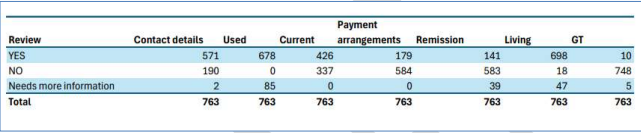
Engagement
The
2024/2025 engagement plan set for the working group was to focus on providing
ongoing support to Whenua Māori owners as well as a cross council holistic
approach to community engagement, reducing debt levels, clarifying rating
information, reducing barriers to whenua use and development as well as an
enhanced understanding of Whenua Māori throughout our region and most
importantly within FNDC.
The following was what was
proposed to SLT and to Te Kuaka:
· Workshops: Hosting workshops to receive feedback and ensure
points of view are considered prior to engaging in Marae visits
· Marae Visits: Engaging with Māori Freehold Landowners
through Marae visits.
· Online Platforms: Developing culturally relevant online
engagement platforms with videos, articles, interactive maps, and dedicated web
pages. Engagement will also include emails, surveys, and social media content.
· Cultural Festivals and Events: Participating in or
sponsoring events that celebrate Māori culture to foster informal
interactions and relationship-building.
Workshop
6 November 2024 we held a Whenua Māori
focus group session in Kaikohe to ascertain the real-life hurdles that are
preventing development of whenua, fact check our information is relevant and
given more understanding of the intricacies of Māori Freehold Land.
We had 17 attendees who provided us with valuable insight and feedback that was
utilised in the remainder of our engagement plan.
Learning and Development:
A Whenua Māori training presentation
as well as a comprehensive Promapp for customer facing roles has been developed
and rolled out throughout FNDC. Which included a full presentation to all
staff on Whenua Māori.
Marae visits
We held five Marae hui throughout the Far
North– which were well represented by staff, with attendance by Te Kooti
Whenua Māori. The consensus received from over 115 attendees have
been welcoming and provided us with valuable insight for what we can do better
and incorporate into future hui.
The
marae hui held were:
|
Date
|
Marae
|
|
23
Nov 2024
|
Waipuna
Marae
|
|
16
Dec 2024
|
Otiria
Marae
|
|
14
Mar 2025
|
Haititaimarangai
Marae
|
|
07
Apr 2025
|
Roma
Marae
|
|
07
Jun 2025
|
Te
Tii Waitangi Marae
|
Communications had been distributed to
internal/external stakeholders and partners via email, and the information had
been added to our website and social media channels.
Cultural
events
Members of the working group attended multiple cultural events to
promote the Whenua Māori Marae Hui and provide information brochures on
Whenua Māori.
Online
platforms
Social
media posts/reels data analysis of marae hui:
• Waipuna
Marae – 1051 views, reached 511 people and 7 interactions.
• Otiria
Marae – 4217 views, reached 881 people and 21 interactions.
• Roma
Marae – 20,926 views, reached 19,643 people and 303 interactions.
• Haititaimarangai
Marae postponed hui – 51,827 views, reached 32,450 people and 379
interactions
The FNDC Multimedia Strategy & Communications Advisor attended Te
Tii Waitangi Marae and made a short film of the day.
Updates
Verbal updates of any
changes since the date the report was submitted, will be provided by the team
during the committee meeting.
PĀNGA PŪTEA ME NGĀ WĀHANGA
TAHUA / Financial Implications and Budgetary Provision
Provision is made for doubtful debts in relation to the
arrears owed to council.
Impact on financial performance is expected to be
limited as aged balances are provided for under the doubtful debt provision,
which offsets the amount written off within the rating year.
Financial implications are
relevant to the engagement plan as budget is required to fund this activity.
Āpitihanga
/ Attachments
Nil
6.5 Ngā
Kaupapa Māori / Matters of Importance to Māori 2024-2025 Annual
Report
File
Number: A5262612
Author: Llani
Harding, Pouhautū Te Hono - Manager - Te Hono
Authoriser: Jacine
Warmington, Group Manager - Strategic Relationships
TAKE PŪRONGO / Purpose of the Report
To provide the Te
Kuaka Te Ao Māori Committee (Te Kuaka) with an annual report on Ngā
Kaupapa Māori / Matters of Importance to Māori for the financial year
2024-2025.
WHAKARĀPOPOTO MATUA / Executive SummarY
· Te Kuaka is committed to ensuring that the
work of the Committee is carried out in a way that enhances the social,
economic, cultural, and environmental wellbeing of the Far North District and assist Council as appropriate in
conducting and maintaining effective, good faith working relationships with the
Māori community.
· Ngā Kaupapa Māori / Matters of
Importance to Māori are
raised at Council meetings and/or by the Kahika/Mayor and Councillors, Te Kahu
o Taonui Iwi Representatives or members of the public. This report serves as a
mechanism to provide Te Kuaka Committee with quarterly updates on those matters.
|
TŪTOHUNGĀ
/ Recommendation
That the Te Kuaka – Te
Ao Māori Committee receive the report Ngā Kaupapa Māori /
Matters of Importance to Māori 2024-2025 Annual Report.
|
tĀHUHU KŌRERO / Background
The purpose of Te Kuaka is to
strengthen a Te Ao Māori perspective within Council decision making across
policies and strategies. The committee responsibilities include:
· Ensure that the work of Te Kuaka is carried out in a way that
enhances the social, economic, cultural, and environmental wellbeing of the Far
North District
· Mahi ngātahi mā te huihui, wānanga –
recommend to Council, aspects of importance to Māori for incorporation
into the development of the Strategic documents (e.g., Te Ao Māori
Framework, Annual Plan, Long Term Plan, District Plan)
· Manaaki – to assist Council as appropriate in
conducting and maintaining effective, good faith working relationships with the
Māori community (e.g., Iwi Hapū Environmental Management Plans)
· Recommend to Council aspects that the Far North District Council
could pursue to develop and or enhance Māori capacity to contribute to
Council’s decision-making processes.
This report, Ngā
Kaupapa Māori / Matters of Importance to Māori,
serves as a mechanism to provide Te Kuaka with updates on the kaupapa / matters
pertaining to Māori that were council were involved in through the
year.
MATAPAKI ME NGĀ KŌWHIRINGĀ /
Discussion and Next Steps
Te Hiku Ward:
· Te
Rūnanga o te Rarawa MOU signing. This 12-month period marks a
significant milestone in the partnership journey, highlighted by Te Rarawa
becoming the first iwi rūnanga to formally sign a Memorandum of
Understanding (MOU) with Council. This MOU is more than a formal
agreement—it represents a relationship grounded in trust, mutual respect,
and a shared vision for transformative, community-led outcomes. Chairperson
Katie Murray described the signing as an "auspicious occasion",
acknowledging the importance of entering into active partnership under this
kaupapa. The MOU establishes a framework for continued collaboration,
co-design, and delivery of initiatives that are deeply rooted in cultural
values and local aspirations.
· Strengthening
Relationships with Marae and Hapū. In alignment with the MOU and wider
engagement strategy, council have initiated and deepened partnerships across
the rohe including:
· Ōturu
Marae: A service agreement has been established to support water monitoring
initiatives, reinforcing our shared commitment to environmental kaitiakitanga
and marae-based leadership.
· Roma
Marae: Engagement with Roma Marae has continued to grow, with collaborative
efforts focused on environmental resilience, infrastructure development, and
shared planning priorities. This relationship reflects council’s
commitment to working alongside marae to elevate community-led solutions.
· Haititai
Marangai Roadshow: As part of ongoing outreach, the Haititai Marangai
Roadshow was launched to engage with whānau, hapū, and iwi across the
region. These interactive sessions have strengthened understanding of local
priorities and helped shape future project planning.
· Infrastructure
and Environmental Stewardship. Council have initiated bridge infrastructure
works in collaboration with new hapū connections within the Te Hiku Ward.
These projects are being delivered with a strong emphasis on community
consultation and ensuring mana whenua voices are central to design and
implementation processes. Our environmental partnerships are expanding through
ongoing water and land monitoring efforts, designed to uphold the principles of
kaitiakitanga and local stewardship.
· Te
Oneroa-a-Tōhe Beach Board Engagement. The Board continues to make
progress on a number of strategic initiatives:
o Resource
Consents: The Board is exploring the re-formation of the Technical Advisory
Group to assist with consent applications and reviews. NRC will provide a
detailed update at the September 2025 meeting. The Technical Steering Group
will also develop a process to improve consent assessments.
o Commissioners
Process: NRC is finalising Resource Consent Guidelines, with an emphasis on
collaboration between NRC and FNDC for a unified and culturally responsive
approach. Ngāti Kuri will submit a commissioners list by July 2025.
o Aero
Club Beach Use: Further information is required to assess a proposed use of
the beach. Ongoing discussions will be held during the next Board workshop.
o Spat
Collecting: The Board has expressed concerns regarding voluntary
compliance, regulatory gaps, and environmental impact. Iwi are advocating to
become formal kaitiaki of spat harvesting. An Official Information Act (OIA)
request has been submitted to Te Ohu Kaimoana, with further engagement planned
with Aquaculture New Zealand.
· Strategic
Infrastructure – Kaitāia Airport Project – Council
continues to strengthen its relationship with Iwi and Hapū landowners in
delivering on its Resilience upgrades of Kaitāia Airport. A number of hui
with Iwi and Hapū have been held to formalise this relationship followed
by a community hui alongside key stakeholders of the airport. A recent hui at
Ngāi Takoto headquarters helped advance discussions on the financial
responsibilities related to the Kaitāia Airport development. This meeting
ensured alignment among stakeholders and helped pave the way for the next
implementation phase in accordance with central government funding agreements.
Bay of Islands – Whangaroa Ward:
· Formalisation
of Te Aro Manatu Relationship Agreement (TAMRA) between Te Rūnanga o
Ngāti Rēhia (TRONR) and Council took place. This was followed up with
two significant hui hosted by Ngāti Rēhia at Whitiora Marae, Te Tii
Mangonui as agreed to in TAMRA. The first was a mātauranga exchange
designed for elected members and the Strategic Leadership Team (SLT) and was
well received and attended by governance and management. The second catered for
all council’s people leaders. During the second hui, Ngāti
Rēhia determined that SLT members who attended the earlier mātauranga
exchange were tangata whenua and invited to sit on the taumata to receive their
colleagues, while the rest were left to represent themselves with karanga and
mihimihi. The Group Manager – Planning and Policy spoke on behalf of the
whare Te Tino Rangatiratanga welcoming the others and Te Tumu Whakarae picked
up the challenge and spoke on behalf of the team entering Tino Rangatiratanga.
· Supporting
Waitangi Week activities FNDC had a high visual presence during the
Waitangi Week of events, from supporting the taumata as Kaikōrero,
Kaikaranga and waiata tautoko, providing shuttle services for the aged or
infirm. Elected members addressed several workshops and information tents.
Council staff were present throughout the week providing information on
elections, local government and council services in stalls on the Te Tii
Waitangi Marae and Waitangi Treaty Grounds (sports grounds).
· Whenua
Māori Roadshows centred on rates relief, advice on changing from
general titled land to Māori freehold and the benefits of doing so, with
the actions required for this to happen. One hosted by Ngāti Hine,
Ngāti Kōpaki and Ngāti Te Ara in Tūmatauenga Wharenui at
Ōtiria Marae, Moerewa, with members from Te Kooti Whenua Māori and Te
Puni Kōkiri supporting and 60+ hapū/iwi attendees as well as elected
member representation. The second was hosted by Ngāti Kawa and Ngāti
Rāhiri in Te Tiriti o Waitangi Wharehui, Te Tii Waitangi Marae including
45 attendees.
· Kaiārahi
Kaupapa Māori supporting the Community and Engagement business group
supported council message in several kaupapa Māori projects. Te Mana o te
Wai short video series with tohunga/kaumatua Rereata Makiha discussing the
importance and significance of water through a Ngāpuhi lens in te reo
Māori and English. Participating in promotional material for the Mangungu
Te Tirit o Waitangi commemorations. More recently advising and providing
voiceover content created to encourage people to participate in the upcoming
local elections process.
Kaikohe-Hokianga Ward:
· Waimamaku
Kaumātua and Age Care Hui - Hui in Waimamaku held by Billy Te Kahika
at his residence to present a proposed Age Care facility for kaumātua.
Present were members of the community, an investor and Te Roroa iwi staff. The
vision is to provide Age Care for kaumātua in the area.
· Rawene
Domain - engagement with Ngāti Kaharau, Ngāti Hau, Te
Māhurehure hapū, Lease holders of the gym, the sailing club and Horse
Trekking for kids over the Sailing Club’s proposal to build a new
building on the land to house all activities and more room to share, bringing
sports back into Rawene community.
· Ōmāpere
Forest- proposed work to mill the Pine Trees as the lease will expire.
Concerns from whānau around the environmental impacts and in what
condition the land will be left after the milling. Contractors and whānau
are working together to agree a suitable plan.
· Kohukohu
WWTP Working Group- Te Ihu Tai hapū members, Council’s
infrastructure staff, Kohukohu Community representative working together to
find solutions to minimise wastewater outflow to the Hokianga harbour.
· Opononi WWTP- Community
members of Opononi/Ōmāpere and Ngāti Korokoro hapū, the
start of the future for the WWTP (Wastewater Treatment Plant). Staff are
engaging in korero with hapū and community on what is proposed and how it
best works for the Opononi/Ōmāpere area.
· Māngungu
Commemorations- Te Ngahengahe, Ngāti Toro, Te Pōpoto, Ngāti
Hao hapū including the Māngungu Committee with Council committed to
tautoko the kaupapa. It was a successful event with many hapū from all
over the north and communities, from Māori and non-māori. An internal
working group has been put together to start planning for 2026 Māngungu
and Waitangi commemorations.
· Te
Tai Tokerau Festival- FNDC held a stall at the festival to engage with
whānau, hapū, iwi and communities from all over the district. Working
with NRC (Northland Regional Council), also alongside business owners and
organisations.
· Youth Week & Empowering our Tamariki Whānau- Youth Week 2025 held at the Kaikohe Memorial Park joined
by businesses, service providers and community organisations hosted by the
Solomon Group to celebrate a special end to the week. Council staff
engaging with rangatahi to raise the awareness about the importance of a local
government and to enrol for this year’s 2025 local elections. In support
of this kaupapa it had the backing of the Kaikohe ki Hokianga Community Board,
this is event shows the importance of our rangatahi and the power of
communities.
· Mangamuka Road Repair-
A joint discussion from Te Rūnanga o Te Rarawa, Ngāpuhi, Horizon
Archaeology, LDE Engineering to make plans on how to approach the road slip
repair to Mangamuka Road (between Mangataipā and Tūtekehua).
Information was provided by the engineers to give understanding on what will be
required. Engagement with hapū will be a priority as there is concern that
the area is located on or there abouts of an wāhi tapu (ancient burial
site), local hapū will be able to add cultural guidance and further
information on the site.
· Reorua –
With a focus on a programme of work around a bilingual district next steps will
be to continue discussions with hapū around reorua, predominantly Te Uri o
Hua. Future hui will be planned with Kohanga Reo, Non-Governmental
Organisations (NGO) and businesses as continued contact to ensure council is
able to present at a future date.
· Iwi Environmental Management Plan- Worked with hapū to provide applications and
understanding around IHEMP’s (Iwi Environmental Management Plan), with
two Hokianga hapū being successful in the application process. Those
hapū are Ngāti Korokoro, Ngāti Pakau/ Ngāti Rauwawe. They
will now begin journey to put together their IHEMP with hopes that council will
be able to sit down in future to finalise with hapū.
· Mana Whakahono A Rohe- Finalised the agreement with TRAION (Te Rūnanga Ā Iwi Ō
Ngāpuhi) ready for adoption by council in July.
· MOU- Memorandum of
Understanding between council and Te Roroa iwi will be revisited in the
following months. Worked with Taoho Tane, Sharron Murray and Delilah
Parore-Southon who have taken all collective
kōrero from hui and present to the board of Te Roroa. An email was sent
out to follow up on the discussion’s outcomes from the hui, awaiting a
response from the board and or the CEO.
· Kaikohe Placemaking- the
Placemaking group consists of working with hapū Te Uri o Hua, Ngāti
Whakaeke and Ngāti Tautahi on the visual look of Kaikohe main street. The
group is still working through options as pūtea has been set and allocated
to this project $50k for the wash and paint and $57k for the beautification.
Beautifying and painting of the main street is the preferred option supported
by hapū. This will go to the next Community Board on the 8th August
with a recommendation for options on the wash and paint in main street and
planter boxes.
PĀNGĀ PŪTEA ME NGĀ WĀHANGĀ
TAHUA / Financial Implications and Budgetary Provision
There are no financial implications or need for budgetary
provision as a result of this report.
Āpitihanga
/ Attachments
Nil
6.6 Open
Resolutions and Actions Update - September 2025.
File
Number: A5345481
Author: Marlema
Baker, Democracy Advisor
Authoriser: Aisha
Huriwai, Manager - Democracy Services
Take Pūrongo / Purpose of the Report
To
provide Te Kuaka Te Ao Māori Committee with an overview of outstanding
open resolutions and action points arising from Committee meetings.
WhakarĀpopoto matua / Executive Summary
· Action points are a new addition to this standard report item.
· Action points will capture actions that are
not part of a formal decision/resolution but require follow up or confirmation
from staff.
· Open resolutions are a mechanism to communicate progress against
decisions/resolutions.
· Open resolutions are also in place for all formal elected member
meetings.
|
tŪtohunga
/ Recommendation
That Te
Kuaka – Te Māori Committee receive the Open Resolutions and
Actions Update – September 2025 report.
|
1) TĀhuhu kŌrero / Background
This report introduces action updates into the Open
Resolutions Update report.
Resolutions from standard reports (also known as decisionmaking
reports) are compiled in an open resolution report and included in
each agenda. Staff track the status of each resolution or action through to
completion or until such time as the committee is satisfied with
progress and directs staff to remove the item from the report. Staff remain
responsible for ensuring progress continues.
Many reports received by this
committee are information-only (to receive or to note), as such they are not automatically
captured as open resolution items. However, a need has been identified to
record and track action points arising from information reports and meeting
discussions.
Moving forward, these will be captured and reported at
committee meetings.
2) matapaki me NgĀ KŌwhiringa /
Discussion and Options
Managers, with staff where
appropriate, will assist in recording and following up outstanding open
resolutions and/or actions points and may occasionally provide verbal updates
at meetings where updates are received after the printing of an agenda. Democracy
Services staff will support the process by generating reports.
TAKE TŪTOHUNGA
/ REASON FOR THE RECOMMENDATION.
To
provide Te Kuaka – Te Ao Māori Committee with an overview of
outstanding decisions from 29 June 2023.
3) PĀnga PŪtea me ngĀ
wĀhanga tahua / Financial Implications and Budgetary Provision
There are no financial
implications or need for budgetary provision in receiving this report.
Āpitihanga
/ Attachments
1. Te
Kuaka Open Resolutions and Actions - September 2025 - A5347422 ⇩ 
|
Ordinary
Te Kuaka - Te Ao Māori Committee Meeting Agenda
|
23
September 2025
|