|
Extraordinary Council Meeting Agenda
|
11 June 2026
|
5 Ngā
Pūrongo / Reports
5.1 Far
North District Councils participation in the Local Government Reform Head Start
Pathway Process
File
Number: A5808859
Author: Roger
Ackers, Head of Strategic Reform Initiatives
Authoriser: Emma
Healy, Chief Executive (Acting)
Take Pūrongo / Purpose of the Report
The purpose of this report is to seek Council direction on
Far North District Council’s continued participation in the Local
Government Reform Head Start Pathway and the next phase of work required to
meet the Government’s outline proposal deadline.
WhakarĀpopoto matua / Executive Summary
· The Government’s Head Start pathway provides a voluntary,
time-limited opportunity for Territorial Local Authorities to develop and
submit a locally led proposal for future governance arrangements by 9 August
2026.
· This report outlines the current position of the Northland Local
Government Reform programme following discussion at the Elected Member Steering
Group (EMSG) meeting held on 29 May 2026.
· At the EMSG meeting, high-level governance options were considered.
FNDC elected members present abstained from voting, reflecting that Council has
not yet determined a position and that further information is required.
· To continue through the Head Start pathway beyond 9 August, FNDC
must be part of a proposal with at least one other Northland territorial
authority. FNDC cannot progress independently.
· Participation remains exploratory. No decisions have been made on
any preferred structure. The focus is on testing options, building an evidence
base, and maintaining FNDC’s ability to influence any proposal that may
proceed.
· This report seeks Council endorsement to:
o Continue participation in
the Head Start pathway
o Progress further analysis
of options, including one and two unitary authority models
o Maintain a cautious,
conditional and evidence-based position
|
tŪtohunga
/ Recommendation
That Council:
a) Approve
the Council’s continued participation, alongside Northland Regional
Council, Whangārei District Council and Kaipara District Council, in the
Government’s Head Start pathway for local government reform;
b) Agree
that further analysis is progressed on structural options, including:
i) a
single unitary authority; and
ii) two
sub-regional unitary authorities;
|
1) Tāhuhu Kōrero / Background
The Government introduced the Head Start pathway in May 2026
as part of the Simplifying Local Government reforms.
The pathway enables councils to jointly develop and submit
outline proposals for reorganisation of local government, including the
establishment of one or more unitary authorities, prior to the 2028 local
elections. Councils that do not participate, or whose proposals do not proceed,
will enter a compulsory backstop process after the 2028 elections.
Elected members of Far North District Council were first
briefed on the Head Start pathway at a Council workshop held on 12 May 2026.
This workshop enabled early discussion on the risks, opportunities, and
implications of participation, and confirmed the need for further information
before any formal decision is made.
To inform its position, FNDC also undertook a district-wide
survey in May 2026. The results show that while community views on reform are
mixed, there is strong agreement on the conditions that must be met if change
proceeds. These include protecting local voice, maintaining affordability,
ensuring accessible services, and supporting rural communities.
FNDC has been participating in a regional reform programme
with Whangārei District Council and Northland Regional Council, supported
by the Elected Member Steering Group. Kaipara District Council has
subsequently joined the reform programme including representation on the
Elected Member Steering Group.
At the EMSG meeting on 29 May 2026, an initial high-level
assessment of governance options based on Unitary Authorities as per the Head
Start Process Requirements was presented to members for discussion and early
direction for staff to undertake analysis.
2) matapaki me NgĀ KŌwhiringa /
Discussion and Options
The Head Start pathway requires councils to decide whether
to participate in the development of an outline proposal for local government
reform, and if so, which governance options should be progressed for further
analysis.
Participation at this stage is exploratory. It does not
commit Council to any structural outcome. The purpose of the current phase is
to test options, build an evidence base, and ensure Council retains influence
over any potential regional proposal.
Head Start requirements and implications for FNDC
To submit a proposal through the Head Start pathway,
councils must meet eligibility requirements.
A proposal must:
· be submitted by
two or more territorial authorities; and
· represent a
majority of either the territorial authorities or the population affected.
This means:
· FNDC cannot submit
a proposal on its own
· FNDC must be part
of a proposal with at least one other territorial authority to continue beyond
9 August
The policy examples above confirm that proposals can proceed
where a majority of councils or population is represented, even if not all
councils agree.
In practical terms, FNDC cannot control whether reform
proceeds. Other councils may still progress a proposal that meets the
eligibility threshold and includes FNDC.
This means FNDC’s decision is not simply whether to
participate, but how to remain actively engaged in order to influence a
proposal that may proceed with or without its formal support.
EMSG discussion and direction
At the Elected Member Steering Group meeting on 29 May 2026,
the Department of Internal Affairs (DIA) provided updated guidance and
expectations for proposals.
Key points included:
· Strong emphasis on
defining communities of interest, particularly for subregional proposals
· The need to
balance rating base, geographic scale, and population distribution
· Recognition of
Northland’s complexity and diversity, including differences in
representation
· Confirmation that
Cabinet will make final decisions on proposals
· A compressed
timeframe to develop and submit proposals
At the same meeting, governance options were discussed:
· A single unitary
authority
· Two sub-regional
unitary authorities
Whangārei District Council and Northland Regional
Council indicated an early preference for a single unitary authority. However,
the Steering Group agreed to continue assessing both options.
FNDC elected members abstained from voting, reflecting that
Council has not yet provided direction and that further information is required
before determining a position.
FNDC position and community input
FNDC has taken a consistent approach to:
· Remain engaged in
the process
· Not pre-commit to
any preferred model
· Proceed on a
cautious, evidence-based basis
This reflects:
· Workshop feedback
emphasising protection of local voice and representation
· Community feedback
that reform must protect affordability, access to services, and local
decision-making
· The need to
reflect the voice of Far North communities through the process
While the reform process itself is not statutory,
Council’s decision-making obligations under the Local Government Act 2002
and the Significance and Engagement Policy continue to apply.
The timeframe for developing a proposal is compressed, with
limited opportunity to resolve all issues prior to submission.
Timeline of milestones and activities to inform a Head Start
Proposal
|
Date
|
Milestone / Activity
|
Purpose / Outcome
|
|
Late May 2026
|
FNDC survey completed (550+
responses)
|
Provides initial community
input to inform FNDC position and regional proposals
|
|
29 May 2026
|
EMSG meeting
|
Initial assessment of
options (one vs two unitary authorities); FNDC abstained pending Council
direction
|
|
29 May 2026
|
DIA guidance received and
assessment underway
|
Regional staff reviewing
guidance to strengthen potential Northland proposal
|
|
Early June 2026
|
Post Settlement Governance
Entities (PSGEs) and stakeholder engagement initiated
|
Begin engagement with iwi,
hapū and stakeholders to inform proposal development
|
|
8–29 June 2026
|
Development of outline
options and comparative analysis
|
Prepare evidence base to
support decision-making
|
|
10 June 2026
|
FNDC workshop (Kaikohe /
online)
|
Test options, share survey
results, and identify key issues and priorities
|
|
11 June 2026
|
FNDC Extraordinary Council
Meeting
|
Confirm continued
participation and provide initial direction following 29 May EMSG Meeting and
10 June workshop
|
|
Mid-June 2026
|
Ongoing community engagement
based on outcome of 10 June workshop
|
Ensure Māori and
community views inform option development
|
|
17–29 June 2026
|
Integration of survey and
stakeholder feedback from ongoing community engagement
|
Refine options and ensure
alignment with community expectations for feeding into analysis
|
|
Late June 2026
|
Draft materials prepared for
EMSG and councils
|
Prepare reporting to support
regional alignment
|
|
25 June 2026
|
FNDC Council meeting
(target)
|
Council provides steer on
preferred direction (if any), and success measures
|
|
End of June 2026
|
Programme materials
finalised for July decision phase
|
Enable formal Council
decisions in early/mid-July
|
|
6 July 2026*
|
EMSG meeting
|
Decision on direction to
inform Northland Head Start Proposal
|
|
13 July 2026
|
All Councils (FNDC, KDC,
NRC, WDC) extraordinary Council meetings
|
Approval of the direction
from the EMSG so that a Northland Head Start Proposal can be finalised
|
|
20 – 24 July 2026
(exact date to be confirmed)
|
EMSG meeting
|
Endorsement of Head Start
Proposal for submission to Cabinet
|
|
3 – 6 August 2026
|
All Councils (FNDC, KDC,
NRC, WDC) extraordinary Council meetings
|
All Councils approval Head
Start Proposal for submission to Cabinet
|
|
7 August
|
Submission of Head Start
Proposal
|
Submission made on Friday 7
August 2026 to meet the 11:59pm Sunday 9 August deadline for a Head Start
Proposal
|
*in the process of being
finalised
Options for Council
consideration
In accordance with Section 77 of the Local Government Act
2002, Council has considered reasonably practicable options for how FNDC
responds to the Head Start pathway.
Option 1 – Continue participation and progress both
options for further analysis (recommended)
Under this option, Council:
· Confirms continued
participation in the Head Start pathway;
· Supports further
analysis of both a single unitary authority and two sub-regional unitary
authorities; and
· Defers any
decision on a preferred model until further information is available.
Advantages:
· Maintains
FNDC’s influence in a process that requires alignment with other councils
to proceed.
· Retains
flexibility, allowing Council to consider both options before committing to a
preferred structure.
· Supports informed
decision making, by enabling further financial, service delivery, and
governance analysis.
· Aligns with
community feedback, which supports continued engagement but emphasises the need
to proceed cautiously.
· Consistent with
legal obligations, as it demonstrates consideration of multiple options and
avoids premature decisions where information is incomplete.
Disadvantages
· Does not provide
immediate clarity on FNDC’s preferred structure, which may limit early
regional alignment.
· Requires continued
resourcing and effort to progress analysis within a compressed timeframe.
· Delays decision
making, which may create uncertainty for elected members and stakeholders.
Option 2 – Continue participation and signal a
preferred option at this stage
Under this option, Council:
· Confirms
participation in the Head Start pathway; and
· Signals an early
preference for either a single unitary authority or two sub-regional unitary
authorities.
Advantages
· Provides clearer
regional direction, which may assist alignment with other Northland councils.
· Supports earlier
engagement with Government, by indicating a likely proposal direction.
· May accelerate
development of a proposal, by focusing analysis on one option.
Disadvantages
· Limits
Council’s flexibility before sufficient information is available.
· Risks
pre-determining an outcome, which is not supported by current evidence or
community feedback.
· Potentially
inconsistent with LGA decision-making principles, as the advantages and
disadvantages of options have not yet been fully assessed.
Option 3 – Do not progress participation in the
Head Start pathway
Under this option, Council would:
· Withdraw from
active participation in the Head Start process and not be part of developing a
proposal.
Advantages
· Avoids immediate
resource commitments associated with developing a proposal.
· Defers
decision-making, allowing further clarity from Government in the future.
Disadvantages
· Loss of influence
over any proposal that may still proceed with other councils.
· Risk of inclusion
in a proposal developed by others, where FNDC has had limited input.
· Limited ability to
shape outcomes, particularly in relation to governance, service delivery, and
representation.
· Default to the
Government-led backstop process after 2028, which provides less opportunity for
locally led solutions.
· Inconsistent with
earlier Council direction to remain engaged and gather information before
making decisions.
TAKE
TŪTOHUNGA / REASON FOR THE RECOMMENDATION
All options present trade-offs. The key consideration for
Council is how to balance:
· Maintaining
influence in a process that requires regional alignment;
· Ensuring decisions
are informed by evidence; and
· Responding to
community expectations to proceed cautiously.
Option 1 is recommended as it:
· Keeps FNDC
actively engaged in a process it cannot progress independently;
· Enables a full
assessment of advantages and disadvantages before decisions are made; and
· Supports a
cautious, evidence-based approach consistent with both the Local Government Act
and community feedback.
3) PĀnga PŪtea me ngĀ
wĀhanga tahua / Financial Implications and Budgetary Provision
There are no direct financial decisions arising from this
report.
Costs associated with participation in the Head Start
pathway, including staff resourcing, analysis, and coordination of regional
activities, are currently being met within existing operational budgets.
The development of an outline proposal is expected to
require continued staff resourcing within a compressed timeframe. This may
place pressure on existing capacity but does not require additional budget
allocation at this stage.
Further financial implications will arise if:
· a preferred
governance model is identified; or
· a proposal
progresses beyond the outline stage into detailed design and implementation
These future implications are expected to include:
· analysis of
financial sustainability, including rating impacts and affordability;
· consideration of
asset ownership, liabilities (including debt), and funding arrangements; and
· potential
transition and implementation costs associated with any reorganisation
These matters will be reported to Council as part of future
decision-making.
Āpitihanga / Attachments
Nil
Hōtaka Take Ōkawa / Compliance Schedule:
Full consideration has been given to the provisions of the
Local Government Act 2002 S77 in relation to decision making, in particular:
1. A
Local authority must, in the course of the decision-making process,
a) Seek
to identify all reasonably practicable options for the achievement of the
objective of a decision; and
b) Assess
the options in terms of their advantages and disadvantages; and
c) If
any of the options identified under paragraph (a) involves a significant
decision in relation to land or a body of water, take into account the
relationship of Māori and their culture and traditions with their
ancestral land, water sites, waahi tapu, valued flora and fauna and other
taonga.
2. This
section is subject to Section 79 - Compliance with procedures in relation to
decisions.
|
He Take Ōkawa /
Compliance Requirement
|
Aromatawai Kaimahi /
Staff Assessment
|
|
State the level of significance (high or low) of the
issue or proposal as determined by the Council’s
Significance and Engagement Policy
|
Assessment: Low
This report seeks direction on participation and next
steps in an exploratory process. It does not constitute a binding decision on
governance reform or commit Council to a structural outcome.
|
|
State the relevant Council policies (external or
internal), legislation, and/or community outcomes (as stated in the LTP) that
relate to this decision.
|
Assessment:
· Local
Government Act 2002 (particularly sections 76–82 relating to
decision-making)
· FNDC
Significance and Engagement Policy
· Government
Head Start Pathway policy (Simplifying Local Government reforms)
This report aligns with Council’s obligations to
consider reasonably practicable options, assess advantages and disadvantages,
and make decisions in a manner that is transparent and evidence based.
|
|
State whether this issue or proposal has a District wide
relevance and, if not, the ways in which the appropriate Community
Board’s views have been sought.
|
Assessment:
This matter has District-wide relevance.
Local government reform has potential implications for
all communities, ratepayers, and stakeholders across the Far North District.
|
|
State the
possible implications for Māori and how Māori have been provided
with an opportunity to contribute to decision making if this decision is
significant and relates to land and/or any body of water.
State the
possible implications and how this report aligns with Te Tiriti o Waitangi /
The Treaty of Waitangi.
|
Assessment:
Local government reform has the potential to affect:
· Māori
representation and participation in governance
· existing
relationships with iwi, hapū, and Post-Settlement Governance Entities
(PSGEs)
· Treaty
settlement arrangements currently in place
At this stage:
· No
decisions have been made on governance structures or representation
arrangements
· Engagement
with PSGEs and iwi authorities is underway as part of the programme
· Future
proposals will be required to demonstrate how Treaty obligations and
settlement arrangements will be maintained or transferred
|
|
Identify persons likely to be affected by or have an
interest in the matter, and how you have given consideration to their views
or preferences (for example – youth, the aged and those with
disabilities).
|
This matter is of interest to:
· FNDC
ratepayers and residents
· iwi,
hapū, and PSGEs
· community
boards and local stakeholders
· neighbouring
councils and regional partners
· central
government
Council has begun considering community views through:
· the
12 May 2026 elected member workshop; and
· a
district-wide survey with over 550 responses
Further engagement will be explored as options are
developed and prior to any formal decisions.
|
|
State the financial implications and where budgetary
provisions have been made to support this decision.
|
There are no direct financial implications arising from
this report.
Participation costs are being managed within existing
budgets. Future financial implications, including any impacts on rates,
funding, or assets, will be assessed and reported as part of subsequent
decision-making.
|
|
Chief Financial Officer review.
|
The Chief Financial Officer has reviewed this report.
|
|
Extraordinary Council Meeting Agenda
|
11 June 2026
|
5.2 Decisions
on Submissions on Far North Proposed District Plan
File
Number: A5809164
Author: James
Witham, Team Leader-District Planning
Authoriser: Kate
Ivicheva, Group Manager - Planning & Policy
Take Pūrongo / Purpose of the Report
This report seeks Council decisions on submissions to the
Far North Proposed District Plan (PDP) in accordance with clauses 9 and 10 of
Schedule 1 of the Resource Management Act 1991 (RMA).
To help Elected Members with decisions on submissions, the
report outlines:
· plan-making
process to date
· explains the
statutory decision-making requirements and decision-making practice under the
RMA
· presents the
Hearings Panel recommendations to Council
· outlines the next
steps following Council decisions, and
· advises optional
frameworks to manage appeals
· PDP is a living
document, still going through the Schedule 1 plan-making process and will
continue to change post Council decisions through appeals and potential future
plan changes.
WhakarĀpopoto matua / Executive Summary
This report presents the Hearings Panel’s
recommendations on submissions to the PDP and seeks Council decisions in
accordance with the statutory requirements of the RMA.
It should be noted that Council’s decision-making is
subject to a high level of scrutiny which highlights the importance of a
robust, transparent and procedurally sound decision-making process. Following
that framework will reduce legal, financial and reputational risks.
The PDP has been under development since 2016 and has been
developed through a comprehensive and robust plan-making process. It is
intended to replace a district plan that is over 20 years old and no longer fit
for purpose. Plan-making process to date:
· two phases of
pre-engagement with the community in 2016 and 2018
· engagement and
feedback on draft Proposed Far North District Plan in 2021
· targeted
engagement on Significant Natural Areas and Heritage Areas in 2021
· notification of
the PDP in 2022
· formal submissions
and further submissions in 2022 and 2023, resulting in more than 605
submissions, comprising over 8,725 individual submission points, along with 589
further submissions totalling more than 26,000 points
· significant
hearings process occurring over 18 months, conducted by a hearings panel made
up of independent and elected member commissioners
· hearings process
that was open to the public and undertaken in a quasi-judicial forum where
submitters could talk directly to, and be questioned by, the panel and present
evidence (including expert evidence) to support their submission
· approximately 40
hearing days and around 320 hours of hearing time, and
· 17 hearing topics
were considered, with over 800 briefs of evidence presented, supported by 55
section 42A reports and 26 Right of Reply reports prepared by Council officers.
Extensions of time were sought and approved by the Minister
for the Environment to issue decisions on the PDP under clause 10A of Schedule
1 of the RMA, firstly until 27 May 2026, and then again until 30 June 2026.
Next steps if Council accepts the recommendations of this
report are:
· releasing a public
notice of the Council decisions on 30 June 2026
· completing a PDP
Decisions Version e-plan
· updating
Council’s website and the PDP web page with all relevant information
· supporting
internal users in anticipation of the two District Plans having legal status
· preparing material
to support internal and external users post Council decisions
· informing
submitters and the wider public of Council decisions and the appeal process
available to them
· reporting back to
Council in October on the scope and scale of appeals received and writing an
agenda paper recommending the framework to manage appeals.
Appeals are the
next statutory step following Council decisions and notification (30 June
2026). They provide an established mechanism for submitters to challenge
decisions, with most matters resolved through direct discussions with
appellants and through mediation.
The report sets
out the decisions required of Council, outlines the statutory decision-making
framework, and presents the Hearings Panel recommendations. It also identifies
the next steps following Council decisions and includes a structured programme
outlining the sequencing of Council decisions, notifications, appeals, and
progression to operative status. This provides clarity on implementation,
supports coordination across the organisation, and assists in managing
procedural risk and maintaining public confidence in Council’s
decision-making.
|
tŪtohunga
/ Recommendation
That Council:
a) receive
the report “Decisions on Submissions to the Far North Proposed District
Plan”;
b) receive
the Hearings Panel recommendation reports and associated documents;
c) accept
the recommendations of the Hearings Panel and makes decisions on submissions
in accordance with clause 10 of Schedule 1 of the Resource Management Act
1991 and for the reasons set out in the recommendation reports, including in
relation to Proposed Plan Variation;
d) accept
and make the recommendations of the PDP Hearings Panel on notices of
requirement to requiring authorities in accordance with clause 9(1) of
Schedule 1 of the Resource Management Act 1991;
e) accept
the recommendations of the hearings panel and makes the decisions relating to
designations for Far North District Council as requiring authority in
accordance with clause 9(2) of Schedule 1 of the Resource Management Act
1991;
f) approve
public notification of Council’s decisions on submissions and Far North
District Council designations, and its recommendations on designations from
other requiring authorities no later than 30 June 2026;
g) recognise
formally the significant time and input that submitters within the process
have put into the submissions, further submissions and hearings process; and
h) recognise
formally the significant time and input that the staff and the Hearings Panel
appointed to make recommendations with the process have put into the
submissions, further submissions and hearings process.
|
1) Tāhuhu Kōrero / Background
Scope of this report
The scope of this report is to outline the process to date
for the PDP, including hearings, describe the statutory decisions required on
submissions under the RMA, outline the required decision-making practice for
RMA decisions, and present the Hearings Panel recommendations to Council for
decision-making. The report also outlines the next steps following Council
decisions.
District plan review process
Council is required under the RMA to have a district plan
and to review it at least every 10 years. Much of the Operative Far North
District Plan (ODP) has not been updated in over 20 years. During that period,
there have been significant changes in the district, including growth
pressures, infrastructure demand, and environmental management.
The ODP no longer reflects current planning practice and has
led to fragmented and ad hoc development in some areas. It does not adequately
support Māori development aspirations or integrate Māori values.
There has also been substantial change in higher order policy direction that
the plan is required to give effect to, including National Policy Statements,
the National Planning Standards, the New Zealand Coastal Policy Statement, and
the Northland Regional Policy Statement.
A consolidated review of the ODP began in 2016 and included
the preparation of a draft plan released for public comment in 2021. Additional
targeted engagement was undertaken on heritage area provisions and Significant
Natural Areas (SNA), along with “closing the loop” communication to
respond to feedback received during the draft stage. Feedback on the draft plan
informed amendments, particularly in relation to indigenous biodiversity and
heritage areas. A key change was the approach to SNA, in which mapped overlays
were not included, and regulatory limits were instead applied to indigenous
vegetation clearance.
The PDP was publicly notified in July 2022 and received more
than 605 submissions, comprising over 8,725 individual submission points, along
with 589 further submissions totalling more than 26,000 points. This reflects a
high level of engagement from the community and stakeholders.
During the notification period of the PDP, Council also
provided an independent ‘friend of submitter’ service to assist the
public in making a submission. This was done to break down barriers to
people engaging in the plan-making process.
Following notification of the PDP, it was determined that a
variation was required to address minor corrections and specific matters that
could not be resolved through submissions received. Proposed Variation 1
was notified in October 2024 to address proposed changes related to coastal
flood hazard mapping, heritage matters, airport protection surfaces, and zoning
adjustments. The variation now forms part of the PDP and was timed to integrate
with the overall hearing process; therefore, it does not require separate
decisions. Due to needing to integrate with the existing hearing
timetable and not to delay the plan-making process, it does not address issues
or errors identified after the variation was notified in October 2024
Due to this, post-Council, staff will recommend to Council
that a plan change be initiated to the decisions version of the PDP to address
any other minor errors and corrections. Any plan change and associated changes
will need to be approved by Council, and may also require an exemption from the
Minister responsible for the RMA Reform under the “Plan Stop”
process. Staff will wait for users of the plan to utilise it for a period of
time to allow sufficient time to identify any issues staff are not currently
aware of.
The PDP process has involved a high level of community
engagement and input, a significant number of submissions, and extensive
technical input from both Council and submitters. Submitters have participated
in the hearing process in good faith and have invested time and resources.
Council’s decision-making is subject to a high degree of scrutiny. This
reinforces the importance of a robust, transparent and procedurally sound
decision-making process.
2) matapaki me NgĀ KŌwhiringa /
Discussion and Options
Hearings Panel and process
The Hearings Panel was appointed under section 34A(1) of the
RMA and comprised five experienced independent commissioners (Robert Scott
(Chair), Bill Smith (Deputy Chair), Alan Watson, Peter Kensington and Siani
Walker), and four Councillor-appointed commissioners (Councillor Felicity Foy,
Councillor Hilda Halkyard-Harawira, Councillor Kelly Stratford and Councillor
Steve McNally, who was subsequently appointed independently following the 2025
local government elections).
To hear matters under the RMA, decision-makers are required
to be accredited under the Ministry for the Environment’s “Making
Good Decisions” programme. This nationally recognised qualification was
introduced to reflect the increasing complexity of evidence and decision-making
under the RMA, to ensure that hearing processes are fair and consistent with
the principles of natural justice, and to improve the quality and consistency
of RMA decision-making. All members of the Hearings Panel held the appropriate accreditation,
including the Chair, who holds “Chairing” endorsement under his
certification.
The hearings process was extensive and conducted over an
18-month period. The first hearings commenced on 27 May 2024, and the hearing
process included approximately 40 hearing days and around 320 hours of hearing
time. Across this period, 17 hearing topics were considered, with over 800
briefs of evidence presented, supported by 55 section 42A reports and 26 Right
of Reply reports prepared by Council officers. The last hearing day concluded
on 6 November 2025, with the hearings officially closing on 12 December 2025,
when the last right of reply was submitted to the panel.
The hearings provided a public, quasi-judicial forum in
which submitters had the opportunity to present evidence and be heard. The
Panel was able to test evidence through questioning of submitters, reporting
officers and expert witnesses, ensuring that the process was robust,
transparent, and consistent with the principles of natural justice. All the
hearing documents and recordings can be found on the PDP webpage of
Council’s website under Hearings
information | Far North District Council.
The Panel’s recommendations were received by staff on
31 March 2026. Staff undertook quality assurance, such as checking grammar and
spelling, numbering and ensuring there were no missing sections. Staff then
incorporated the recommendations into the PDP recommended decisions version of
the ePlan, including seeking and recording clarifications on technical matters
from the Panel Chair where required. The ePlan recommended decisions version
can be accessed via the following link https://farnorth.isoplan.co.nz/eplan. Staff
have maintained a record of any corrections/changes made during that process to
ensure that the integrity of the hearings panel reports has been maintained
through the quality assurance process, which occurs for any plan change. The
hearings panel recommendation reports were released publicly on 22 May 2026,
and all submitters were advised of this and given an update on next steps.
Three public-excluded workshops were held with Elected
Members with decision-making responsibilities to explain the decision-making
process and provide an overview of the recommendations relevant to each topic
heard. Legal counsel was at the workshops to provide advice where required. The
workshops were structured to inform only. Staff and legal counsel did not offer
any opinion or advice as to the merits of decisions recommended or provide any
further information in relation to those topics. The workshops were undertaken
in a manner to ensure fairness to submitters, and to support a fair plan-making
process which has been a key priority when developing the PDP.
Statutory requirements and decision-making framework
Council’s role in this process is to make decisions on
the provisions and the submissions in accordance with Schedule 1 of the RMA.
Under clause 10, Council must make decisions on the provisions and matters
raised in submissions, provide reasons for accepting or rejecting submissions,
undertake further evaluation where required under section 32AA, and have
particular regard to that evaluation. In doing so, Council may draw on the
analysis and evidence presented to the Hearings Panel, including the section 32AA
evaluations contained within the Panel’s recommendations and the
supporting section 42A and Right of Reply evidence, and can adopt the
Panel’s reasons where it agrees with those recommendations.
Council also has tasks under clause 9 of Schedule 1 in
relation to “requirements” (designations), including making
recommendations on designations of other requiring authorities and making
decisions on Council designations. Council is not required to make
recommendations or decisions for existing designations included without
modification where no submissions were received. The full text in clause l9 and
clause 10 for decision-making can be referred to via Resource
Management Act 1991 | New Zealand Legislation.
Fair process and decision-maker responsibilities
Decision-making under the RMA is a quasi-judicial process
and must be undertaken in a manner consistent with the principles of natural
justice, fairness, and procedural integrity. This requires that Council ensure
a robust evaluation process, apply the correct statutory tests, and make
decisions in a lawful and disciplined manner. Failure to follow a fair process
carries a risk of legal challenge, regardless of the merits of the decisions,
and may result in reputational and cost consequences for Council.
These tasks of hearing submissions and making
recommendations were delegated to the Hearings Panel. The Hearings Panel set out its hearings procedures (to ensure a robust, lawful
and fair process giving effect to natural justice) in Minute 1 – Procedures for Hearing of
Submissions. This information
is available on the PDP webpage of Council website under hearings information
– Minutes and Procedural matters:
https://www.fndc.govt.nz/Council/District-plan/proposed-district-plan/Hearing-1/procedural-matters
Given it is a quasi‑judicial process, submitters had
the opportunity to present their submissions and evidence directly to the
Hearings Panel, and the Panel had the opportunity to ask the submitters,
reporting officers and expert witnesses questions. The process ensured that all parties who wanted to be heard had an
opportunity, and that submissions and evidence were
considered robustly and fairly, in accordance with natural justice principles.
Staff consider that the Hearings Panel has appropriately
discharged its functions and that the hearings process has been robust, lawful,
and consistent with natural justice principles. Similarly, the Hearing
Panel’s recommendations have been made after a full Schedule 1 and
hearings process, prepared in accordance with the statutory requirements, and
are evidence-based in accordance with the making good decisions programme.
Decision-maker requirements
The Council is the decision-maker on the PDP. To maintain a
fair and lawful process, Council must ensure that decision-making is consistent
with the principles of natural justice and the requirements of the RMA.
This requires that decision-makers are free from actual or
perceived bias, approach decisions with an open mind and without
pre-determination, and appropriately manage any actual or perceived conflicts
of interest. Decision-makers must also ensure that their decisions are based
only on information before the Hearings Panel and must not take into account
new information or irrelevant or extraneous matters.
The RMA also sets out detailed statutory requirements that
decisions on proposed plans must meet, including that all decisions must be
within the scope of the submission received.
Failure to meet these requirements materially increases the
risk of legal challenge, regardless of the merits of any decision.
Summary
Staff do not recommend departing from the Hearings Panel
recommendations, as doing so may undermine procedural fairness and may result
in legal errors or a failure to comply with the RMA’s requirements for
decision-making.
This will increase the risk that decisions are appealed or
judicially reviewed and found by the Courts to be unlawful. Departures are
likely to result in additional decision-making steps, increased legal and
expert costs, and delays to the PDP becoming operative.
Appeals are the next statutory step in the Schedule 1
process following Council decisions and notification. They are a normal and
expected part of the plan-making process and provide an established mechanism
for submitters to seek further consideration of matters. Appeals must be lodged
within 30 working days of notification.
Following the lodgement of appeals, other parties may become
involved by registering with the Environment Court under section 274 of the RMA
within a further 15 working-day period. This allows those who made submissions,
as well as others who have an interest greater than the general public, to
participate in relevant appeals. Participation is typically limited to specific
topics or provisions, meaning parties are involved only in matters that
directly affect them.
In practice, the Environment Court process is designed to be
accessible and user-focused. It places a strong emphasis on mediation, where
parties work collaboratively to resolve issues, rather than relying on formal
hearings. Most matters are resolved through discussion and agreement between
parties, with outcomes confirmed by the Court through consent orders.
While a large number of parties may be involved across the
overall appeals process, appeals are generally organised by topic, and
participation focuses on relevant issues. This helps to keep the process
structured and manageable.
Formal hearings are increasingly uncommon, as most appeals
are resolved through mediation. This approach supports a practical,
cost-effective process and enables refinement of the PDP in a legally robust
manner.
In addition, there are other pathways available to Council
to amend the PDP following decisions, including future plan changes to the PDP,
or through wider resource management reform processes (such as future regional
planning). These mechanisms allow provisions to be refined in a structured and
legally robust manner without undermining the integrity of the hearings
process.
For these reasons, staff recommend that the recommendations,
reasons, and section 32AA evaluations contained within the Hearings Panel
reports are accepted in their entirety.
NGĀ TŪRARU / RISKS AND MITIGATIONS
There are significant legal, procedural, financial and
reputational risks associated with Council making decisions on the PDP.
A key risk arises where Council departs from the Hearings
Panel recommendations. Such departures are not typical and materially increase
the likelihood of appeals to the Environment Court and the potential judicial
review. There is an increased risk of legal errors being made. Departures also
raise issues of procedural fairness, as Council has not directly heard
submitter evidence or had the opportunity to ask questions of submitters or
their witnesses. There are also reputational risks associated with departing
from the Panel’s recommendations after submitters have participated in
the Panel’s hearing process in good faith. For these reasons, staff do
not recommend departing from the Panel’s recommendations. Staff have
reviewed the process undertaken by other Councils and found that Councils
typically endorse the hearing panel's recommendations and adopt the decisions
as a bundle rather than breaking them down into chapters or topics.
Additional risks relate to communication and implementation,
including the potential for public confusion about the status of the PDP and a
high volume of enquiries following notification. These will be managed through
a coordinated internal and external communications approach. This approach will
also communicate that decisions are not the end of the PDP plan-making process,
and the next key stage is appeals.
WHAT HAPPENS NEXT / NEXT STEPS
Following Council decisions, staff will finalise the PDP
“Decisions Version” and undertake final quality assurance prior to
public notification. The sequencing and timing of these steps are illustrated
in the project flowchart accompanying this report.
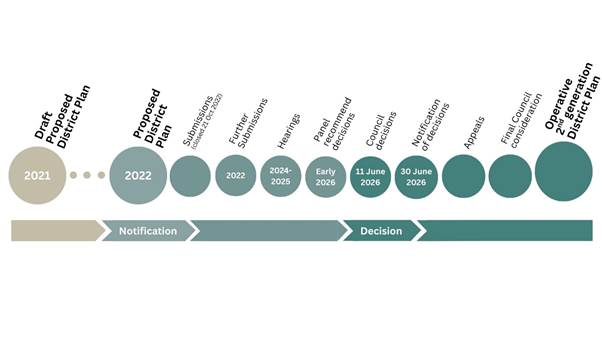
The flowchart provides a view of the overall programme
moving forward, including Council decision-making, notification, the appeals
period, and progression to operative status. It supports effective planning,
coordination across teams, and provides clarity around process, helping to
manage procedural risk and set clear expectations for Council, stakeholders,
and the community. Exact dates, outside of the appeal period, will not be known
until details of the number, scope and complexity of appeals are understood.
Between decisions and notification
Significant administrative work is required prior to
notifying Council's decision. This includes amendments to the ePlan. Changes
required to align with National Environmental Standards will be incorporated
into the Decisions Version under delegated authority to ensure compliance with
that national direction. The RMA directs that these changes be made outside of
the Schedule 1 process (no plan change is required). How the two-district
plans apply does not change during this time. The ODP will continue to apply,
while consideration is given to the PDP objectives and policies already
relevant under S104 (1)(b)(vi) and any immediate legal effect rules under the
PDP Decisions version are notified.
Notification of decisions and appeal period
Council’s decisions will be publicly notified on
Council's website under the PDP webpage and submitters directly notified on 30
June 2026. The appeal period of 30 working days will commence on 1 July and
close on 13 August 2026. Notices are required to be placed in local newspapers.
Decision information, including information about how to lodge an appeal, will
also be displayed at all Council libraries and drop-in facilities. Upon
notification, the PDP becomes the Proposed Far North District Plan –
Decisions version (PDP-Decisions Version).
Information on the Environment Court process and how to
lodge an appeal can be found at Overview of the
Environment Court’s processes | Environment Court of New Zealand
Rollout of decisions
Internal and external engagement programmes will begin after
decisions are made to support the implementation of the new Plan. This will
include media communications, fact sheets, and stakeholder engagement across
Council teams and with iwi, hapū and submitters. Staff are also looking to
leverage other Council consultation and engagement activities such as
practitioners' meetings.
During this period, all provisions in the PDP - Decisions
Version will have ‘legal effect’. This means that both the ODP and
PDP will need to be considered when applying for and processing resource
consents. Officers will ‘weight’ rules during this period when
making their assessments.
Appeals period closes
Following the close of the appeal period (August 13), staff
will start a review of the appeals received. Any provisions that aren't under
appeal become “operative” and resource consents no longer need to
consider the ODP for those provisions. The plan is then annotated, and where
there are appeals, it becomes the PDP “Appeals Version”.
After the close of the appeal period, there is a
15-working-day period during which interested parties can join an appeal under
section 274 of the RMA. The criteria for joining an appeal are that the person
must be a submitter on the PD or a person who has an interest in the
proceedings that is greater than the interest that the general public has.
These parties are known as “section 274 parties”.
Managing appeals
An agenda item will be brought back to Council following the
close of the appeal period and upon completion of a review of the appeals. The
report will outline the scope and scale of appeals received and recommend a
framework for managing them. The report will consider a range of options for
managing appeals, from delegation to staff through to a governance or
committee-based model.
This will include options such as:
· delegation to the
Group Manager – Planning and Policy for day-to-day management of appeals
· staff delegation
with governance oversight, including regular reporting to elected members on
progress, risks, costs, and strategic matters
· a committee-based
approach for governance decision-making on appeals.
These options recognise that the appeals process is largely
operational and iterative, with a focus on mediation and issue resolution. The
role of elected members is typically more strategic, such as considering key
decisions on settlement positions or whether to proceed to a hearing, rather
than direct involvement in individual appeals.
Bringing this report back following the close of appeals
ensures that Council can make an informed decision based on the number,
complexity, and nature of appeals received.
Appeals process
The Environment Court (the Court) appeal resolution process
focuses heavily on alternative dispute resolution in the first instance. In
particular, direct discussions with appellants and section 274 parties, or
mediation facilitated by the Court, are the first steps in resolving appeals. A
timeline is not available at this stage, but direct discussions can begin
immediately after appeals are lodged, and Court-assisted mediation may begin
before the end of 2026, depending on the availability of the parties and
mediators.
Agreements between parties are sent to the presiding judge
for approval. This approval is not automatic, and must be based on robust
reasoning and the statutory requirements for decisions. Where the Court agrees,
it will issue a ‘consent order’ with directions to amend the PDP,
or may provide other directions. Where the consent order is to amend the PDP,
the “Appeals Version” is amended and any relevant ODP provision is
disapplied.
Because of the focus on alternative dispute resolution,
hearings of the Court are becoming increasingly rare. Given the requirement to
exchange evidence prior to the hearing, the first hearings on the PDP would not
take place until 2027. There is a right to appeal Environment Court decisions
on questions of law to the High Court. Once all appeals are finally resolved,
the PDP will be declared ‘Operative’, and the ODP completely
replaced.
MATAPAKI ME NGĀ KŌWHIRINGA / OPTIONS
Council has three broad options when making decisions on
submissions to the PDP.
|
Option
|
Option
1: Accept Panel recommendations in full
|
Option
2: Depart from one or more recommendations
|
Option
3: Defer decisions
|
|
What
this means
|
Council
accepts the recommendations, including reasons and section 32AA evaluations
|
Makes one
or more different decisions, within scope of submissions, supported by
separate reasons and section 32AA evaluation
|
Delays
making decisions on submissions to a later date
|
|
Key
benefits
|
Maintains
the integrity of the hearings process.
Relies on
the Panel’s evidence- based process, with submissions and evidence
tested through the quasi-judicial hearing process
Supports
a lawful and consistent decision-making approach
Provides
the most efficient pathway to notification and progression toward operative
status
Enables
timely notification of decisions and progression to the appeals and
implementation phases
Reduces
cost, delay, and resourcing pressure
|
Allows
Council to respond to specific concerns, provided they are within scope and
can be supported by reasons and a section 32AA evaluation
Enables
targeted changes where Council is satisfied there is a sound basis to depart
from the Hearing Panel recommendation
|
Provides
additional time for Council to consider decision
|
|
Key
trade-offs/limitations
|
Limits
Council’s ability to address residual concerns outside the Hearings
Panel recommendations at this decision-making stage
May not
fully address all Elected Members and submitters' concerns
Remaining
contested matters may need to be addressed through the appeals process, where
appeal rights are available, and submitters elect to lodge an appeal
|
Council
cannot make changes outside the scope of submissions
Council
must rely on the information available through the hearings process and
should not introduce new information at this stage
Council
has not directly heard or tested the evidence in the same way as the Hearings
Panel
Each
departure requires clear reasons and its own section 32AA evaluation
(although the Council could adopt a section 32AA evaluation that was
presented (eg by a submitter) during the hearing process).
|
Does not
resolve the substantive decisions before Council
Extends
uncertainty for submitters, plan users, Council, and the wider community
Delays
progression to the appeals and implementation phases
|
|
Key
risks/implications
|
Lowest
relative legal and procedural risk
Appeals
may still occur, but Council’s position is supported by the
Panel’s reasons, evidence base, and section 32AA evaluations
|
Materially
increases legal and procedural risk
Higher
likelihood of Environment Court appeals and potential judicial review
If
departures are not clearly supported by scope, reasons, evidence, and section
32AA evaluation. May result in more complex or prolonged appeals
Likely to
increase legal, expert, and staff costs, and delay the PDP's progression
toward operative status
Reputational
risks
|
Moderate
to high risk
Would
require Council to seek a further statutory timeframe extension from the
Minister for the Environment, beyond the current extension to 30 June 2026
There is
no certainty that a further extension would be granted
Delays
notification of decisions, prolongs resourcing pressures, and delays
transition to appeals and implementation
|
|
Overall
assessment
|
Recommended
This
option provides the most efficient and procedurally robust pathway for
progressing the PDP
|
Not
recommended unless
there are clear, scoped and well-supported reasons for specific departures
This
option carries the highest overall risk profile
|
Not
recommended unless
there is a clear statutory, procedural or governance reason for deferral
This
option carries moderate to high risk because it delays rather than resolves
the decision pathway
|
TAKE
TŪTOHUNGA / REASON FOR THE RECOMMENDATION
Staff recommend Option 1, being to accept the
Hearings Panel recommendations in full.
This approach ensures that Council’s decisions are
grounded in a robust, lawful and evidence-based process that has been tested
through a comprehensive hearings framework. It maintains the integrity of the
PDP process and supports a fair and consistent decision-making approach.
Appeals are the next statutory step following Council
decisions and notification and provide the appropriate mechanism for submitters
to challenge provisions and for issues to be further tested and resolved
through mediation and, where necessary, the Environment Court.
In addition, there are established pathways available to
amend the PDP following decisions, including through the appeals process,
future plan changes, or as part of wider resource management reform processes
(such as future regional planning). These mechanisms enable provisions to be
refined in a structured and legally robust manner, without undermining the
integrity of the hearings process.
Departing from the Panel’s recommendations materially
increases legal and procedural risk, including the likelihood of appeals and
potential challenge on process grounds. It also has direct cost and time
implications, requiring additional evaluation, resourcing, and potentially
extending the timeframe before the PDP becomes fully operative.
Accepting the Panel’s recommendations provides the
most appropriate and defensible pathway to efficiently progress the PDP through
notification, appeals, and eventual operative status.
3) PĀnga PŪtea me ngĀ
wĀhanga tahua / Financial Implications and Budgetary Provision
The remaining steps in the PDP process will largely relate
to appeals management, and costs will depend on the scale and scope of appeals,
and the process that is adopted to manage them. Budget for the next financial
period has not yet been confirmed as the Annual Plan is not yet adopted. There
will also be costs relating to education and support for users of the two
district plans.
Departing from Panel recommendations risks increased costs
through appeals and judicial review proceedings, additional officer time and
legal expenditure, and delays to plan implementation. These costs and delays
would be significantly further exacerbated if re-hearings by the panel are
required (if directed by the High Court after a successful judicial review
claim).
Āpitihanga
/ Attachments
Nil
Hōtaka Take Ōkawa / Compliance Schedule:
Full consideration has been given to the provisions of the
Local Government Act 2002 S77 in relation to decision making, in particular:
1. A
Local authority must, in the course of the decision-making process,
a) Seek
to identify all reasonably practicable options for the achievement of the
objective of a decision; and
b) Assess
the options in terms of their advantages and disadvantages; and
c) If
any of the options identified under paragraph (a) involves a significant
decision in relation to land or a body of water, take into account the
relationship of Māori and their culture and traditions with their
ancestral land, water sites, waahi tapu, valued flora and fauna and other
taonga.
2. This
section is subject to Section 79 - Compliance with procedures in relation to
decisions.
|
He Take Ōkawa /
Compliance Requirement
|
Aromatawai Kaimahi /
Staff Assessment
|
|
State the level of significance (high or low) of the
issue or proposal as determined by the Council’s
Significance and Engagement Policy
|
The PDP meets the test of high significance but is
governed by the RMA. It has been a full public process, with
pre-engagement steps, and formal consultation governed by the Schedule 1
process of the RMA.
|
|
State the relevant Council policies (external or
internal), legislation, and/or community outcomes (as stated in the LTP) that
relate to this decision.
|
Through the development of the PDP, regard is given to
all relevant council policies and legislation. This is tested at the
section 32 stage and again through the hearing process.
|
|
State whether this issue or proposal has a District wide
relevance and, if not, the ways in which the appropriate Community
Board’s views have been sought.
|
This has district-wide relevance. It is Council document
that has gone through a robust plan-making process that has provided for the
public, including the community boards to engage in the process and be a
submitter.
|
|
State the
possible implications for Māori and how Māori have been provided
with an opportunity to contribute to decision making if this decision is
significant and relates to land and/or any body of water.
State the
possible implications and how this report aligns with Te Tiriti o Waitangi /
The Treaty of Waitangi.
|
A district plan has significant implication for
Māori. The RMA specifies how plan development and the plan itself
must align with Te Tiriti o Waitangi / The Treaty of Waitangi and specifies our legislative obligations in
engaging with Iwi authorities when developing the plan.
The PDP provides a more enabling framework for
development on Māori land and Treaty Settlement land, and also protects
cultural heritage and the wider environment.
The Hearings Panel was formed based on ensuring there
was tikanga Māori expertise. At the hearings, submitters were
supported in presenting their evidence and submission in te reo, with an
interpreter being available.
|
|
Identify persons likely to be affected by or have an
interest in the matter, and how you have given consideration to their views
or preferences (for example – youth, the aged and those with
disabilities).
|
All members of the public are potentially affected or
have an interest. This has been a full public process with multiple
opportunities for people to have their say. The next step in the
appeals process provides for that to continue.
|
|
State the financial implications and where budgetary
provisions have been made to support this decision.
|
There are significant implications if decisions are made
that expose Council to legal risk such as judicial review and appeals. This
will result in greater legal costs and staff resourcing. To manage this risk,
staff have recommended option 1: accepting the hearing panel's
recommendations in full.
|
|
Chief Financial Officer review.
|
The Chief Financial Officer has reviewed the report.
|