
AGENDA
Ordinary Te Koukou Committee for Transport
and Infrastructure Meeting
Wednesday, 20 May 2026
|
Time:
|
10:00 am
|
|
Location:
|
Council Chamber
Memorial Ave
Kaikohe
|
Membership:
Cr
Felicity Foy – Chairperson
External Appointment Deputy Chairperson
(Ex-officio
Member) Kahika - Mayor Moko Tepania
Kohepū
- Deputy Mayor Chicky Rudkin
Cr
Rachel Baucke
Cr Kelly
Stratford
Cr Ann
Court
Cr Hilda
Halkyard-Harawira
Cr
Tāmati Rākena
Cr
Arohanui Allen
|
|
Authorising Body
|
Council
|
|
Status
|
Standing Committee
|
|
COUNCIL COMMITTEE
|
Title
|
Te
Koukou Committee for Transport and Infrastructure
|
|
Terms of
Reference Adoption
|
11 December
2025
|
|
Responsible Officer
|
Head of Infrastructure
|
Kaupapa /
Purpose
The purpose of the
Te Koukou Committee for Transport and Infrastructure (the Committee) is to ensure
cost effective, quality
and sustainable infrastructure decisions are made to meet the current
and future needs of Far North communities and that Councils infrastructure
assets are effectively maintained and operated.
The Committee will review
the effectiveness of the following aspects:
·
Affordable core infrastructure to support
healthy and sustainable living;
·
Operational performance including monitoring and reporting on significant infrastructure projects
·
Delivery of quality infrastructure and district facilities
·
Financial spend
and reprogramming of capital works
·
Property and other assets
Ngā Huānga / Membership
The Council will determine the membership of the Committee.
Te Koukou
– Transport and Infrastructure Committee will comprise
of at least six elected members (one of which will be the
chairperson). Kahika
/ Mayor Moko Tepania is an ex-officio member of all Committees.
Cr Felicity Foy (Chairperson)
External Appointment Deputy Chairperson
Kohepū - Deputy Mayor Chicky
Rudkin
Cr Arohanui Allen
Cr Rachel Baucke
Cr Ann Court
Cr Halkyard Harawira
Cr Tāmati Rākena
Kōrama /
Quorum
The quorum at a meeting of Te
Koukou Committee for Transport and Infrastructure is 4 members.
Ngā Hui /
Frequency of Meetings
The Committee shall meet 4 weekly.
Ngā Apatono
/ Power to Delegate
The
responsibilities, duties and powers of the Committee are subject to the
prohibition on delegation of powers under Clause 32(1), Schedule 7, Local
Government Act 2002, and any other restrictions on delegation under any other
relevant legislation.
Te Koukou Committee for
Transport and Infrastructure may not
delegate any of its responsibilities, duties or powers
however it may establish working
groups to consider issues within the committee’s areas of
responsibilities noting that working groups have no decision-making powers.
Ngā
Herenga Paetae / Responsibilities
The Committees responsibilities are described below:
Quality infrastructure and Facilities
·
Assess and provide advice to Council on strategic issues relating
to the provision of
Council’s infrastructural activities and district facilities
·
Review, and recommend to Council, policy and strategies for the delivery of
infrastructural asset services
·
Monitor achievement of outcomes included
in the Infrastructure Strategy
and other transport and infrastructure strategies
e.g District Transport Strategy
·
Ensure that Council protects
its investment in its
infrastructural assets in accordance with accepted professional standards
·
Monitor the risks, financial
and operational performance of the Council's infrastructural activities and facilities
·
Monitor major contract performance measures/key result areas (KRAs)
Significant Projects
– spend, monitoring and reporting
·
Monitor significant projects
·
Approve budget
overspend (above tolerance
levels in the CE delegations) and any reprogramming
of capex for a project or programme provided that:
o
The overall
budget is met from savings
o The overall budget for capex is not
exceeded. Where this is not the case, the Committee must either:
§ Recommend to Council that additional funding
is approved (outside
the Annual Plan or Long Term Plan process), or
§ Recommend
as part of the next round of Long Term Plan or Annual Plan process that the funding is
considered for inclusion.
·
Approve contracts provided they are:
o in accordance with the current year’s plan, whether that be Annual Plan or Long
Term Plan, and
o deemed
low by the Significance and Engagement Policy
Compliance
·
Ensure that operational functions comply with legislative requirements and Council
policy
·
Ensure that consents associated with Council's infrastructure are being met and renewals are planned for
Service levels (non-regulatory)
·
Recommend service
level changes and new initiatives to the Long Term and
Annual Plan processes.
Property
·
Recommend to Council the acquisition or disposal of assets.
·
Approve new leases and lease renewals
(of non-reserve land), in accordance with the current
years’ plan, whether that be Annual Plan or Long Term Plan.
Transport
·
Approval of roading contracts
beyond CE delegation.
·
Monitor
roading contracts
·
Receive
and consider any consultation document and/or any proposed
amended or new legislative instrument that may have a transport
related outcomes and where
appropriate make submissions and enable political advocacy at a Mayoral Forum
Level if required
·
Receive and adopt the Asset Management Plan for Transport
·
Receive and adopt Far North District
Council's walking and cycling strategies
·
Receive and consider any placemaking projects
that have a transport related component so the committee can ensure the projects are captured (where appropriate) in our funding and planning
instruments
·
Receive invitations to apply for external funding
opportunities in a timely manner
so that the committee may
advocate for community-initiated infrastructure projects. (Examples PGF, TIF)
·
Receive
updates on changes to national and regional policies and Transport Plans that
impact on Council provision of infrastructure and where appropriate make submissions or recommendation to Council.
Ngā Ture
/ Rules and Procedures
Council’s
Standing Orders and Elected Member Code of Conduct apply to all meetings.
Reporting and
Review of Committee Terms of Reference
In December of each year, the Responsible Officer alongside
Democracy Services will submit a report to Council. The report will summarise
the activities of the Committee and how it has contributed to the
Council’s governance and strategic objectives. This will look at whether
the Council are meeting the full requirements of the Committee Terms of
Reference and whether any amendments are required to the Committees terms of
reference to increase efficient and effective decision making.
The terms of
reference of the Committee will be reviewed as part of this report but can be
amended by Council at any point throughout the term.
Far North District Council
Ordinary Te Koukou Committee for Transport and
Infrastructure Meeting
will be held in the Council Chamber, Memorial Ave,
Kaikohe on:
Wednesday 20 May 2026 at 10:00
am
Te Paeroa Mahi / Order
of Business
1 Karakia
Tīmatanga / Opening Prayer. 7
2 Ngā
Whakapāha Me Ngā Pānga Mema / Apologies and Declarations of
Interest 7
3 Ngā
Tono Kōrero / Deputation. 7
4 Te
Whakaaetanga o Ngā Meneti o Mua / Confirmation of Previous Minutes. 8
4.1 Confirmation
of Previous Minutes. 8
5 Ngā
Pūrongo / Reports. 17
5.1 Waitangi-Paihia-Opua
Water Treatment Plant - Land Easement Assessment 17
6 Ngā
Pūrongo Taipitopito / Information Reports. 29
6.1 Delivery
and Operations and Planning and Policy Verbal Updates. 29
6.2 Infrastructure
- Capital Works Update. 30
6.3 Kaikohe
Infrastructure Acceleration Fund update. 37
6.4 Infrastructure
Compliance. 41
6.5 Transportation
- Operational Update. 47
6.6 Transportation
- Road Safety Update. 110
7 Te Wāhanga
Tūmataiti / Public Excluded. 118
7.1 Confirmation
of Previous Minutes - Public Excluded. 118
7.2 SCADA
Upgrade - Telemetry Upgrade stage 1 delegation. 118
8 Karakia
Whakamutunga / Closing Prayer. 119
9 Te
Kapinga Hui / Meeting Close. 119
1 Karakia
Tīmatanga / Opening Prayer
2 Ngā Whakapāha Me Ngā Pānga Mema / Apologies
and Declarations of Interest
Members need to
stand aside from decision-making when a conflict arises between their role as a
Member of the Committee and any private or other external interest they might
have. This note is provided as a reminder to Members to review the matters on
the agenda and assess and identify where they may have a pecuniary or other
conflict of interest, or where there may be a perception of a conflict of
interest.
If a Member
feels they do have a conflict of interest, they should publicly declare that at
the start of the meeting or of the relevant item of business and refrain from
participating in the discussion or voting on that item. If a Member thinks they
may have a conflict of interest, they can seek advice from the Chief Executive
Officer or the Manager - Democracy Services (preferably before the meeting).
It is noted
that while members can seek advice the final decision as to whether a conflict
exists rests with the member.
3 Ngā
Tono Kōrero / Deputation
Michele Denholm - Otaha Rd
Mr & Mrs Vinac - Taipa View Rd
Roddy Pihema - Taumatamakuku
4 Te
Whakaaetanga o Ngā Meneti o Mua / Confirmation of Previous Minutes
4.1 Confirmation
of Previous Minutes
File
Number: A5762145
Author: Natasha
Rmandic, Democracy Advisor
Authoriser: Aisha
Huriwai, Manager - Democracy Services
Take Pūrongo / Purpose of the Report
The minutes are attached to allow the Committee to confirm
that the minutes are a true and correct record of previous meetings.
|
tŪtohunga
/ Recommendation
That Te Koukou Committee for Transport and
Infrastructure confirm the minutes of the meeting held 22 April 2026 are true
and correct.
|
1) TĀhuhu kŌrero / Background
Local Government Act 2002 Schedule 7 Section 28 states that
a local authority must keep minutes of its proceedings. The minutes of these
proceedings duly entered and authenticated as prescribed by a local authority
are prima facie evidence of those meetings.
2) matapaki me NgĀ KŌwhiringa /
Discussion and Options
The minutes of the meetings are attached.
Far North District Council Standing Orders Section 27.3
states that no discussion shall arise on the substance of the minutes in any
succeeding meeting, except as to their correctness.
TAKE TŪTOHUNGA
/ REASON FOR THE RECOMMENDATION
The reason for the recommendation is to confirm the minutes
are a true and correct record of the previous meetings.
3) PĀnga PŪtea me ngĀ
wĀhanga tahua / Financial Implications and Budgetary Provision
There are no financial implications or the need for
budgetary provision as a result of this report.
Attachments
1. 2026-04-22
Te Koukou Committee for Transport and Infrastructure Minutes - A5733024 ⇩ 
Hōtaka Take Ōkawa / Compliance schedule:
Full consideration has been given to the provisions of the
Local Government Act 2002 S77 in relation to decision making, in particular:
1. A
Local authority must, in the course of the decision-making process,
a) Seek
to identify all reasonably practicable options for the achievement of the
objective of a decision; and
b) Assess
the options in terms of their advantages and disadvantages; and
c) If
any of the options identified under paragraph (a) involves a significant
decision in relation to land or a body of water, take into account the
relationship of Māori and their culture and traditions with their
ancestral land, water sites, waahi tapu, valued flora and fauna and other
taonga.
2. This
section is subject to Section 79 - Compliance with procedures in relation to
decisions.
|
He
Take Ōkawa / Compliance Requirement
|
Aromatawai
Kaimahi / Staff Assessment
|
|
State the level of significance
(high or low) of the issue or proposal as determined by the Council’s
Significance and Engagement Policy
|
This is a matter of low
significance.
|
|
State the relevant Council
policies (external or internal), legislation, and/or community outcomes (as
stated in the LTP) that relate to this decision.
|
This report complies with the
Local Government Act 2002 Schedule 7 Section 28.
|
|
State whether this issue or
proposal has a District wide relevance and, if not, the ways in which the
appropriate Community Board’s views have been sought.
|
It is the responsibility of each
meeting to confirm their minutes therefore the views of another meeting are
not relevant.
|
|
State the possible implications for Māori
and how Māori have been provided with an opportunity to contribute to
decision making if this decision is significant and relates to land and/or
any body of water.
|
There are no implications for Māori in confirming minutes
from a previous meeting. Any implications on Māori arising from matters
included in meeting minutes should be considered as part of the relevant
report.
|
|
Identify persons likely to be
affected by or have an interest in the matter, and how you have given
consideration to their views or preferences (for example,
youth, the aged and those with disabilities).
|
This report is asking for minutes
to be confirmed as true and correct record, any interests that affect other
people should be considered as part of the individual reports.
|
|
State the financial implications
and where budgetary provisions have been made to support this decision.
|
There are no financial
implications or the need for budgetary provision arising from this report.
|
|
Chief Financial Officer review.
|
The Chief Financial Officer has
not reviewed this report.
|
5 Ngā
Pūrongo / Reports
5.1 Waitangi-Paihia-Opua
Water Treatment Plant - Land Easement Assessment
File
Number: A5673694
Author: Scott
Eunson, Senior Project Manager
Authoriser: Tanya
Proctor, Head of Infrastructure
Take Pūrongo / Purpose of the Report
The purpose of this report is to seek Te
Koukou Committee direction on the preferred permanent site for the
Waitangi-Paihia-Opua Water Treatment Plant, to enable delivery of a safe,
reliable, and compliant long‑term drinking water supply for the
Waitangi-Paihia–Opua catchment.
The report also outlines the recommended
planning and designation pathway, financial implications within the
2024–2027 Long Term Plan, and the next steps required to progress land
agreements and design‑and‑build procurement, consistent with
Council’s commitments to mana whenua partnership, environmental
protection, and positive community outcomes.
WhakarĀpopoto matua / Executive Summary
· Seeks Te Koukou Committee direction on the preferred permanent site
for the Waitangi-Paihia-Opua Water Treatment Plant
· Supports
delivery of a safe, reliable, and compliant long‑term drinking water
supply for the Waitangi-Paihia–Opua catchment.
· Responds
to the deteriorating condition and capacity limitations of the existing Haruru
Falls water infrastructure.
· Assesses
two site options: Waitangi National Trust land and the previously considered
River Edge development site.
· Compares
options against technical feasibility, flood and geotechnical risk,
infrastructure connectivity, costs, delivery risk, and regulatory compliance.
· Considers
alignment with Māori cultural values and Council’s commitments to
partnership with mana whenua.
· Addresses
compliance with Taumata Arowai requirements and alignment with Local Water Done
Well reforms.
· Considers
long‑term growth and demand over the next 30 years.
· Outlines
the recommended planning and designation pathway for the preferred site.
· Summarises
financial implications within the 2024–2027 Long Term Plan and future
water services transition.
· Identifies
next steps to progress land agreements and design‑and‑build
procurement.
· Te Koukou Committee for Transport and Infrastructure has delegated
authority to:
Approve new leases and lease renewals (of
non-reserve land), in accordance with the current years’ plan, whether
that be Annual Plan or Long Term Plan.
|
tŪtohunga
/ Recommendation
That Te Koukou Committee:
a) Adopt
the Waitangi national Trust (WNT) land, being Lot 3, Haruru Falls Road,
Haruru, as the preferred permanent site for the Waitangi-Paihia-Opua Water
Treatment Plant, having regard to its flood resilience, proximity to existing
infrastructure, and alignment with key stakeholder and partner outcomes; and
b) Authorise
the Chief Executive (or delegate) to:
i) Commence
formal negotiations with the Waitangi National Trust Board to secure the
appropriate lease and/or easement arrangements over Lot 3, Haruru Falls Road
for water supply purposes; and
ii) Initiate
the statutory designation process by preparing and lodging a Notice of
Requirement under the Resource Management Act 1991 to designate the site for
water supply infrastructure, thereby securing long-term land use certainty as
a public works within the District Plan.
|
1) TĀhuhu kŌrero / Background
The
Waitangi-Paihia–Opua Water Supply Project was initiated in response to
increasing concerns that the existing Haruru Falls Water Treatment Plant is no
longer fit for purpose. The current facility is ageing and constrained by
limited treatment redundancy, insufficient raw water storage, and challenges
maintaining regulatory compliance during periods of poor raw water quality.
These limitations increase the risk of supply interruptions and non‑compliance
with contemporary drinking water standards.
Water
demand across Paihia, Waitangi, Opua and Haruru is highly seasonal and driven
by tourism activity. While the permanent population is approximately 4,200
residents, demand increases significantly during peak periods, including cruise
ship visits. Although cruise activity has not fully returned to pre‑COVID‑19
levels, peak demand pressures remain high. Long‑term projections indicate
that peak day demand could reach approximately 4,200 cubic metres per day by
2053, requiring new infrastructure capable of meeting this level of service.
The report
compares the Waitangi National Trust land and the previously considered River
Edge development site, assessing technical feasibility, flood and geotechnical
risk, infrastructure integration, costs, delivery risk, regulatory compliance,
and alignment with Māori cultural values. It responds to the deteriorating
condition and capacity constraints of the existing Haruru Falls infrastructure,
with a focus on meeting Taumata Arowai requirements, supporting projected
growth over the next 30 years, and aligning with Local Water Done Well reforms.
The
following table details the design flows that the new Water Treatment Plant
needs to accommodate to ensure supply security through to 2053:
|
Flow
Parameter
|
Units
|
2023
|
2033
|
2043
|
2053
|
|
Resident
Population
|
People
|
4,234
|
4,903
|
5,255
|
5,518
|
|
Off-Peak
Average Demand
|
m3/day
|
1,746
|
2,289
|
2,454
|
2,577
|
|
Visitor
Demand
|
m3/day
|
553
|
579
|
607
|
636
|
|
Peak Period
Average Demand
|
m3/day
|
2,299
|
2,869
|
3,061
|
3,213
|
|
Peak Day
Demand (Capacity)
|
m3/day
|
3,323
|
3,747
|
3,998
|
4,197
|
The Waitangi River will remain the primary water source;
however, its highly variable water quality presents ongoing treatment
challenges, particularly during storm events. To address these issues and meet
Taumata Arowai requirements, a new water treatment plant incorporating a modern
multi‑barrier treatment process is required.
Early project planning identified the River Edge site
upstream of Haruru Falls; however, subsequent geotechnical and flood risk
investigations identified significant constraints. As a result, alternative
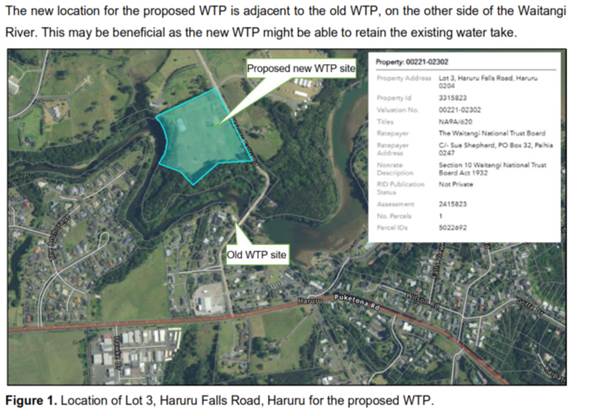
locations were assessed. Land within the Waitangi National Trust Estate (Lot 3,
Haruru Falls Road) has emerged as a viable option due to its elevation, reduced
flood risk, proximity to existing infrastructure, and potential alignment with
mana whenua and stakeholder outcomes, subject to appropriate safeguards for
cultural and heritage values.
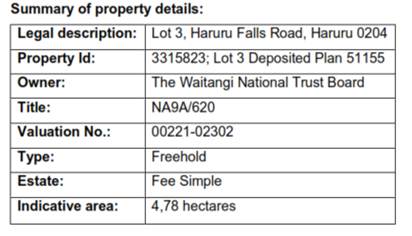
Summary of Property Details:
2) matapaki me NgĀ KŌwhiringa /
Discussion and Options
This section discusses the assessment of site options for
the proposed Waitangi-Paihia–Opua Water Treatment Plant and identifies a
preferred approach for Committee consideration.
Following further investigation, the Waitangi National Trust
(WNT) land at Lot 3, Haruru Falls Road has been identified as the preferred
site. This assessment is based on a comparison with the previously preferred
River Edge site and considers flood resilience, geotechnical suitability,
constructability, infrastructure efficiency, cost, delivery risk, and long‑term
operational resilience.
The Waitangi National Trust (WNT) site is located on
elevated land well above the 1‑in‑100‑year flood level,
significantly reducing flood risk to critical water supply infrastructure and
aligning with Council’s climate resilience and infrastructure investment
objectives. In contrast, the River Edge site includes areas within the floodplain,
increasing long‑term exposure to flood events and associated operational
and regulatory risk.
Geotechnical investigations indicate that the Waitangi
National Trust (WNT) site is suitable for development using standard foundation
solutions. While slope stability considerations exist in adjacent areas, these
can be managed through appropriate site layout and setback distances.
Investigations at the River Edge site identified weak soils and shallow basalt
bedrock, which remove the feasibility of the originally proposed infiltration
intake and materially increase construction complexity, cost, and risk.
The Waitangi National Trust (WNT) site provides
infrastructure efficiencies due to its proximity to the existing water intake
and supply network, reducing the extent of new pipelines required and
associated construction impacts. The site’s location adjacent to an
existing wastewater rising main allows treatment plant waste streams to be
managed without additional loading on the local sewer network. Access from
State Highway 11 further reduces traffic and safety risks during construction
and operation.
By comparison, development of the River Edge site would
require longer pipeline connections, more extensive State Highway access works,
and would be located close to planned residential development, increasing the
potential for traffic, noise, visual, and construction impacts.
Engagement
to date with the Waitangi National Trust Board and relevant hapū has been
constructive, with a collaborative approach supported, subject to the
protection of cultural, historical, and environmental values associated with
the Waitangi Estate.
Overall,
progression of the Waitangi National Trust (WNT) site represents a proactive,
long‑term investment that improves resilience, operational security, and
value for money, and addresses the limitations of the existing Haruru Falls
facility.
Options:
Option 1 – Confirm The Waitangi National Trust
(WNT) (Lot 3, Haruru Falls Road) as the preferred site (Recommended)
Proceed with the development of the Waitangi-Paihia-Opua
Water Treatment Plant on the Waitangi National Trust (WNT) land at Lot 3,
Haruru Falls Road, subject to ongoing engagement and agreement with the
Waitangi National Trust (WNT) Board and relevant hapu.
Rationale and Key Benefits:
· Located
well above the 1 in 100 year flood level, significantly reducing exposure to
flood risk and future climate change impacts.
· Geotechnical
investigations confirm suitability for development using standard foundation
solutions, with manageable slope stability considerations through appropriate
layout and setbacks.
· Strong
infrastructure efficiencies due to proximity to the existing water intake and
supply network, reducing pipeline length, construction impacts, and whole‑of‑life
costs.
· Adjacent
wastewater rising main enables efficient management of treatment process waste
without added pressure on the local sewer network.
· Direct
access from State Highway 11 improves construction logistics and long‑term
operational safety.
· Constructive
engagement to date with the Waitangi National Trust (WNT) and hapū
indicates a collaborative pathway forward, subject to cultural and
environmental protections.
Implications:
· Requires
upfront due diligence and site-related expenditure
· Requires
ongoing cultural engagement and statutory processes
Option
2 – Continue with the River Edge Site with Mitigation Measures
Retain
the River Edge site as the preferred location and redesign the treatment plant
and intake solution to address site constraints identified through
investigations.
Rationale
and Key Benefits:
· Avoids the need to
progress land agreements with the Waitangi National Trust (WNT).
· Geotechnical
investigations identified weak soils and shallow basalt bedrock, rendering the
originally proposed infiltration intake unviable and requiring more complex
engineering solutions.
· Longer pipeline
routes, additional State Highway access works, and proximity to planned
residential development increase construction impacts, cost, and community
risk.
Implications:
·
Higher capital and operational costs and increased delivery risk.
·
Greater exposure to flood‑related disruption and compliance
challenges over the life of the asset
·
Lower overall resilience and value for money compared to the
Waitangi National Trust (WNT) site.
Option 3 – Defer Decision and Investigate
Alternative Sites
Pause
progression of both the Waitangi National Trust (WNT) and River Edge sites to
identify and assess additional alternative locations for the water treatment
plant.
Rationale
and Key Benefits:
· Provides
an opportunity to test whether another site could further reduce risk or cost.
Implications:
· Deferral
would delay replacement of the existing Haruru Falls facility, which has known
resilience and capacity limitations.
· Programme
delays with potential impacts on water supply security and regulatory
compliance.
· Additional
investigation and consultation costs with uncertain outcomes.
· Does
not address known risks with the existing facility in the near term.
Comparative Assessment Summary:
|
Category
|
WNT Site
(Lot 3)
|
River
Edge Site
|
|
Elevation
|
31m RL
(Superior flood resilience)
|
12-25m RL
(Moderate risk)
|
|
Mains
Length
|
~600m
(Cost-effective)
|
~2,300m
(Higher cost/complexity)
|
|
Wastewater
|
Direct tie-in
to rising main
|
2.8km pump to
terminus
|
|
Traffic
|
Off-state
highway (Safe access)
|
SH11 access
(High hazard)
|
|
Māori
Alignment
|
Collaborative
lease model
|
Standard land
purchase
|
|
Geotechnical
|
Stable ridge,
expansive soils
|
Floodplain
risks, shallow rock
|
Recommended Option:
Option 1, confirmation of the Waitangi National Trust (WNT)
site, presents the most robust and future-focused solution, offering superior
flood resilience, constructability, infrastructure efficiency, and long term
operational security while addressing the limitations of the existing Haruru
Fall facility.
TAKE TŪTOHUNGA
/ REASON FOR THE RECOMMENDATION
The Waitangi National Trust (WNT) site at Lot 3, Haruru
Falls Road is recommended as the preferred location for the
Waitangi-Paihia–Opua Water Treatment Plant as it provides the most
resilient, efficient, and low‑risk long‑term solution. The site is
located well above the 1 in 100 year flood level, significantly reducing
exposure to flooding and climate‑related risk to critical water supply
infrastructure. Geotechnical investigations confirm the land is suitable for
development using standard construction methods, avoiding the complexity, cost,
and risk identified at the River Edge site. The Waitangi National Trust (WNT)
site also offers strong infrastructure efficiencies due to its proximity to
existing intake and supply assets, access to an adjacent wastewater rising
main, and direct State Highway access, reducing construction impacts and
operational costs. Constructive engagement with the Waitangi National Trust and
relevant hapū further supports progression of this option. Overall, the
Waitangi National Trust (WNT) site best aligns with Council’s resilience
objectives, delivers value for money, and addresses the limitations of the
existing Haruru Falls facility while minimising long‑term delivery and
operational risk.
3) PĀnga PŪtea me ngĀ
wĀhanga tahua / Financial Implications and Budgetary Provision
The total capital cost for development of the new Water
Treatment Plant on WNT land is estimated at $16 million and reflects the
investment required to replace an existing strategic asset that no longer meets
resilience and performance requirements.
Capital Expenditure (CAPEX) Estimate:
|
Item
|
Estimated
Costs (NZD)
|
Range
(Millions)
|
Rationale
|
|
Site
Development
|
$1,910,000
|
1.34 - 2.48
|
Includes bulk
earthworks and level building platforms.
|
|
Raw Water
Intake & Mains
|
$1,150,000
|
0.81 - 1.50
|
Upgrade of
falls intake and 600m pipeline.
|
|
Clarification
& Filtration
|
$2,670,000
|
1.42 - 1.92
|
Tube
settlers, sand filters, and catalytic media.
|
|
Final
Water Tanks & Pumps
|
$2,660,000
|
2.26 - 3.06
|
Twin 3,000
$m^3$ reservoirs and high-lift pumps.
|
|
Dewatering
& Backwash
|
$1,180,000
|
1.00 - 1.36
|
Decanter
centrifuge, thickener, and balance tank.
|
|
Chemical
Plant & Dosing
|
$840,000
|
0.67 - 1.01
|
PAC,
Chlorine, Caustic, and CO2 plants.
|
|
Electrical,
I&C, Generators
|
$1,200,000
|
0.84 - 1.56
|
Full SCADA
integration and backup power.
|
|
Works
Costs Subtotal
|
$14,800,000
|
11.8 -
17.8M
|
Physical
construction elements.
|
|
Design
& Commissioning
|
$1,200,000
|
0.80 - 1.60
|
Engineering
fees and process verification.
|
|
TOTAL
PROJECT COST
|
$16,000,000
|
12.6 -
19.4
|
Total
financial commitment.
|
Although development of the Waitangi National Trust (WNT)
site involves higher earthworks costs (approximately $1.9 million compared to
$0.83 million at the River Edge site), this is largely mitigated by savings of
approximately $400,000 in pipeline infrastructure and lower ongoing pumping
costs associated with the site’s more efficient hydraulic profile.
Operational and Maintenance (OPEX) Estimate:
Operating costs are estimated at $715,993 per annum and have
been incorporated into the long‑term affordability analysis.
|
OPEX
Category
|
Annual
Cost
|
Description
|
|
Maintenance
& Renewals
|
$285,000
|
5% of
mechanical plant cost per year.
|
|
Sludge
Disposal & Cartage
|
$124,100
|
Disposal of
0.2 dry tonnes/day at $1,500/tonne.
|
|
Electricity
Consumption
|
$107,800
|
Based on
490,000 kWh/yr at 22c/kWh.
|
|
Chemical
Costs
|
$107,336
|
Coagulant
($31k), PAC ($28k), Chlorine ($15k), etc..
|
|
Operations
Labor
|
$79,257
|
48 hours/week
combined operator and supervisor.
|
|
Consumables
|
$12,500
|
UV lamps and
filter media replacements.
|
|
TOTAL
ANNUAL OPEX
|
$715,993
|
Ongoing
financial commitment.
|
Āpitihanga
/ Attachments
Nil
Hōtaka Take Ōkawa / Compliance Schedule:
Full consideration has been given to the provisions of the
Local Government Act 2002 S77 in relation to decision making, in particular:
1. A
Local authority must, in the course of the decision-making process,
a) Seek
to identify all reasonably practicable options for the achievement of the
objective of a decision; and
b) Assess
the options in terms of their advantages and disadvantages; and
c) If
any of the options identified under paragraph (a) involves a significant
decision in relation to land or a body of water, take into account the
relationship of Māori and their culture and traditions with their
ancestral land, water sites, waahi tapu, valued flora and fauna and other
taonga.
2. This
section is subject to Section 79 - Compliance with procedures in relation to
decisions.
|
He Take Ōkawa /
Compliance Requirement
|
Aromatawai Kaimahi /
Staff Assessment
|
|
State the level of significance (high or low) of the
issue or proposal as determined by the Council’s
Significance and Engagement Policy
|
This project is classified as a matter of High
Significance under the Far North District Council’s Significance and
Engagement Policy.
|
|
State the relevant Council policies (external or
internal), legislation, and/or community outcomes (as stated in the LTP) that
relate to this decision.
|
· LGA
2002 – Complies with Section 101B regarding infrastructure
strategy and Section 101(3) regarding fair funding of activities.
· RMA
1991 - The designation pathway satisfies the RMA requirements for
identifying and mitigating environmental effects through an Assessment of
Environmental Effects (AEE).
· Water
Services Repeal Act 2024 - Aligns with the new mandate for councils
to retain ownership of water services while seeking regional sustainability
through a Water Services Delivery Plan.
· National
Environmental Standards (NES)
NES for Source of Human Drinking Water (NESDW): Requires
protection of the raw water abstraction point from upstream contamination.
NES for Freshwater (NESF): Governs the structures
within the Waitangi River bed (e.g., the intake screens).
· LTP
Community Outcomes:
o Healthy
and Sustainable Communities: Providing drinking water that meets
bacterial and protozoal safety rules.
o Resilient
Communities: Building infrastructure capable of withstanding the extreme
rainfall events predicted for the 2050 climate horizon.
o Wisely
Managed Environment: Adopting zero-discharge dewatering technology to
protect the river estuary.
|
|
State whether this issue or proposal has a District wide
relevance and, if not, the ways in which the appropriate Community
Board’s views have been sought.
|
While the proposed Water Treatment Plant primarily
serves the Waitangi, Paihia, Opua, and Haruru communities, it is of district‑wide
significance as a cornerstone of Council’s resilience strategy and
transition toward a regional Northland water model. Engagement with the Bay
of Islands–Whangaroa Community Board has highlighted community safety
and local growth pressures, which are addressed through selection of the
Waitangi National Trust (WNT) site. The project is located within the rohe of
Ngā Puhi on land of high cultural significance and has been progressed
through a partnership‑based approach with the Waitangi National Trust
Board and relevant hapū. This approach aligns with the principles of Te
Tiriti o Waitangi through partnership, participation, and protection,
including design decisions that prioritise river health and cultural values.
|
|
State the
possible implications for Māori and how Māori have been provided
with an opportunity to contribute to decision making if this decision is
significant and relates to land and/or any body of water.
State the
possible implications and how this report aligns with Te Tiriti o Waitangi /
The Treaty of Waitangi.
|
This report and the recommendation of the Waitangi
National Trust (WNT) site align with the principles of Te Tiriti o Waitangi
through partnership, participation, and protection. Partnership is
demonstrated through a joint decision‑making approach between FNDC and
the Waitangi National Trust Board, which includes iwi representation and
enables collaborative governance beyond consultation. Participation is
supported through formal engagement structures, recognition of hapū time,
and the inclusion of mana whenua in shaping the project’s Mission
Statement, ensuring meaningful influence over project outcomes. Protection is
reflected in design decisions that prioritise river health, including
mechanical dewatering to avoid contamination, and in‑lieu
infrastructure roading upgrades that support the cultural, economic, and long‑term
sustainability of the Waitangi Estate.
|
|
Identify persons likely to be affected by or have an
interest in the matter, and how you have given consideration to their views
or preferences (for example – youth, the aged and those with
disabilities).
|
The project has engaged a range of affected persons and
interest groups. The Waitangi National Trust and relevant hapū are key
stakeholders as landowners and kaitiaki, with their interests incorporated
through a structured hui process and refinement of the in‑lieu
infrastructure lease model. The Paihia Pony Club’s existing use of the
equestrian court has been accommodated by retaining access along the northern
edge of the site in the concept design. Haruru residents may experience
construction‑related effects, which will be mitigated through site
layout, separation from residential areas, and off‑highway access
routes. Youth, older people, and persons with disabilities are indirect
beneficiaries through improved drinking water quality, with accessibility
considerations to be integrated into the plant’s final design.
Operational staff have also contributed input to ensure long‑term
operability
|
|
State the financial implications and where budgetary
provisions have been made to support this decision.
|
Section 3 of Report
|
|
Chief Financial Officer review.
|
The Chief Financial Officer has reviewed this report
|
6 Ngā
Pūrongo Taipitopito / Information Reports
6.1 Delivery
and Operations and Planning and Policy Verbal Updates
File
Number: A5779885
Author: Natasha
Rmandic, Democracy Advisor
Authoriser: Aisha
Huriwai, Manager - Democracy Services
Te Take Pūrongo / Purpose of the Report
To provide a mechanism for verbal updates from General
Managers of Delivery and Operations on CityCare Contract and Planning and
Policy on Kerikeri CBD Transport. The verbal reports provide update to Te
Koukou Committee for Transport and Infrastructure on matters of interest or
concern to the Committee.
|
ngĀ
tŪtohunga / Recommendation
That Te Koukou Committee for Transport and
Infrastructure:
· note the
verbal May 2026 update on CityCare contract; and
· note the
verbal May 2026 update on work plan for the Kerikeri CBD transport.
|
1) te TĀhuhu kŌrero / Background
Te Koukou
Committee for Transport and Infrastructure Chairperson, Cr Foy requested a
regular, monthly updates on these matters.
In absence
of formal written reports this report provides mechanism for verbal updated to
be provided at the meeting.
2) Te matapaki me NgĀ KŌwhiringa /
Discussion and Options
These updates will be provided
verbally during the meeting of 20 May 2026.
·
REASON FOR THE RECOMMENDATION
To keep members of Te Koukou
Committee for Transport and Infrastructure fully informed on matters of
interest.
3) NgĀ PĀnga PŪtea me ngĀ
wĀhanga tahua / Financial Implications and Budgetary Provision
There are no financial implications or the need for
budgetary provision as a result of this report.
ngĀ
Āpitihanga / Attachments
Nil
6.2 Infrastructure
- Capital Works Update
File
Number: A5748152
Author: Matt
Richardson, Manager - Infrastructure Delivery
Authoriser: Tanya
Proctor, Head of Infrastructure
TAKE PŪRONGO / Purpose of the Report
To provide an update on
the status of the 2024-2027 Infrastructure Capital Works Programme to Te Koukou
Committee as at 31 March 2026, excluding Transportation.
WHAKARĀPOPOTO MATUA / Executive SummarY
· This
report provides an update on the delivery of the 2024-2027 Infrastructure
Capital Works Programme, excluding Roading projects.
· As
at the current reporting period, $67.89 million of the total $158.18 million
programme has been spent or committed.
· Additional
planning considerations apply to water and wastewater projects as Council
prepares for the transition to Northland Waters Done Well on 1 July 2027.
· The
report highlights the importance of active programme management to maintain
delivery momentum.
· Key
areas of focus include prioritising construction ready projects and making
timely decisions on rephasing or deferral where appropriate.
· These
actions are critical to improving delivery certainty and supporting development
of a realistic and affordable 2027-2037 Long Term Plan.
· Te
Koukou has delegations to review the effectiveness of – financial spend
and reprogramming of capital works, operational performance including
monitoring and reporting of significant projects and the delivery of quality
infrastructure and district facilities.
|
TŪTOHUNGA
/ Recommendation
That Te Koukou Committee for Transport and
Infrastructure receive the report Infrastructure - Capital Works Update.
|
tĀHUHU KŌRERO / Background
The 2024-2027
Infrastructure Capital Works Programme was adopted through the Long Term Plan
to deliver Council’s planned investment for the next three years across
the portfolios of three waters, maritime assets, district facilities and
associated infrastructure, with a focus on Roading, Compliance and Storm
Recovery.
Delivery of the programme
continues to be influenced by range of factors, including consenting
complexity, detailed design and investigations, contractor and resource
availability, cost escalation, and seasonal and weather-related impacts.
As a result, while a number of projects are progressing as planned or under
construction, others have experienced changes to timing as design and delivery
risks are better understood and managed.
As the current Long Term
Plan period progresses towards Year 3 (2026/2027), a review of the
Infrastructure Capital Works Programme has identified specific projects where
delivery prior to 30 June 2027 is at an increased risk. In these cases,
proposed timing adjustments are intended to improve programme realism, reduce
financial risk, and ensure projects are sufficiently advanced before
construction funding is committed.
This update provides the
Te Koukou Committee with current context on the Infrastructure Capital Works
Programme and highlights where timing changes are proposed to align budgets
with project readiness and delivery capability, while retaining the overall intent
and priorities of the adopted Long Term Plan.
The following table
presents a financial summary of 2024-2027 LTP Budget vs Actual Expenditure
across Infrastructure Asset Portfolios at 31 March 2026:
|
Asset
Type
|
2024-2027
Budget
|
2024-2027
Actual + Commitments
|
%
Committed
|
%
Available Budget
|
|
Water
|
$50,066,530
|
$30,964,147
|
61.85
|
38.15
|
|
Wastewater
|
$83,952,068
|
$29,700,438
|
35.38
|
64.62
|
|
Stormwater
|
$10,114,615
|
$3,072,135
|
30.37
|
69.63
|
|
District
Facilities
|
$12,694,903
|
$4,075,966
|
32.11
|
67.89
|
|
Solid
Waste
|
$1,352,412
|
$74,481
|
5.51
|
94.49
|
|
Total
|
$158,180,528
|
$67,887,167
|
42.92
|
57.08
|
MATAPAKI ME NGĀ KŌWHIRINGA /
Discussion and Next Steps
As at the current
reporting period, 31 March 2026, the 2024-2027 Infrastructure Capital Works
Programme has an approved budget of $158.18 million, of which $67.89 million
(42.9 %) has been spent or contractually committed. This leaves 57.1% of
the programme uncommitted as the Long-Term Plan period moves into its latter
stages.
Delivery performance
varies by asset class. Water projects are the most advanced, with 61.85%
committed, reflecting stronger project readiness and established delivery
pathways. In contrast, Wastewater (35.38%), Stormwater (30.37%), District
Facilities (32.11%) and Solid Waste (5.51%) are not as advanced, but it should
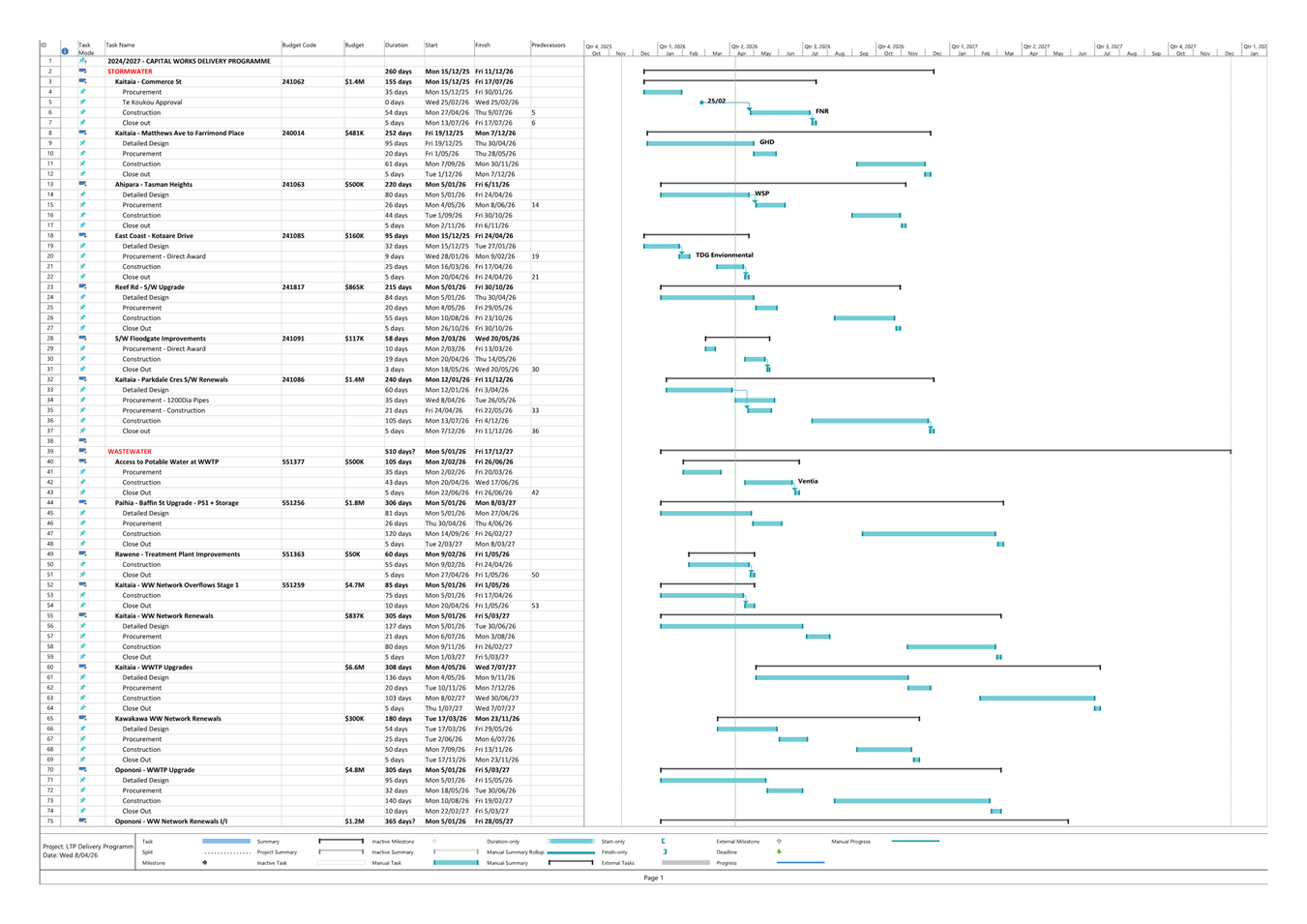
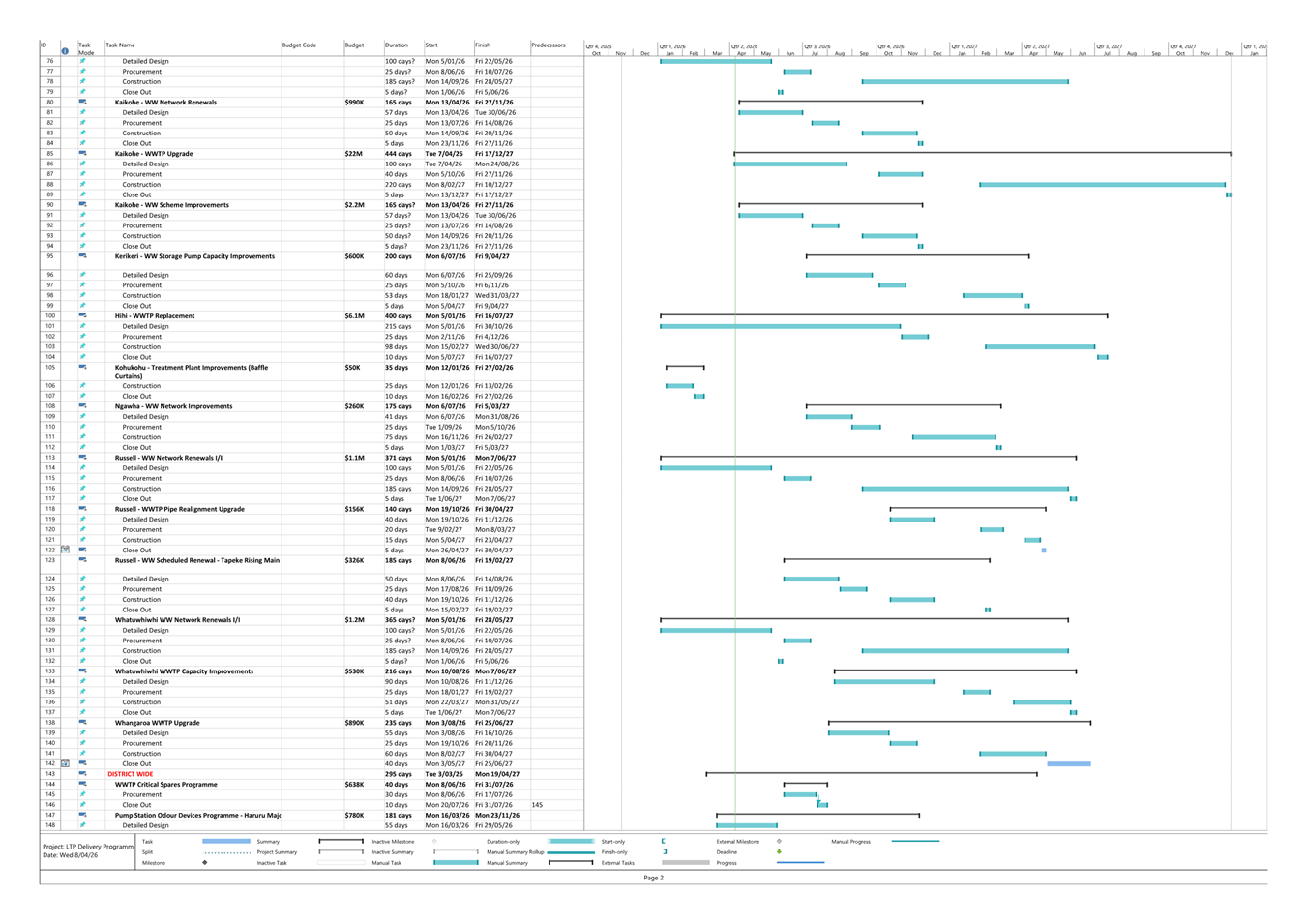
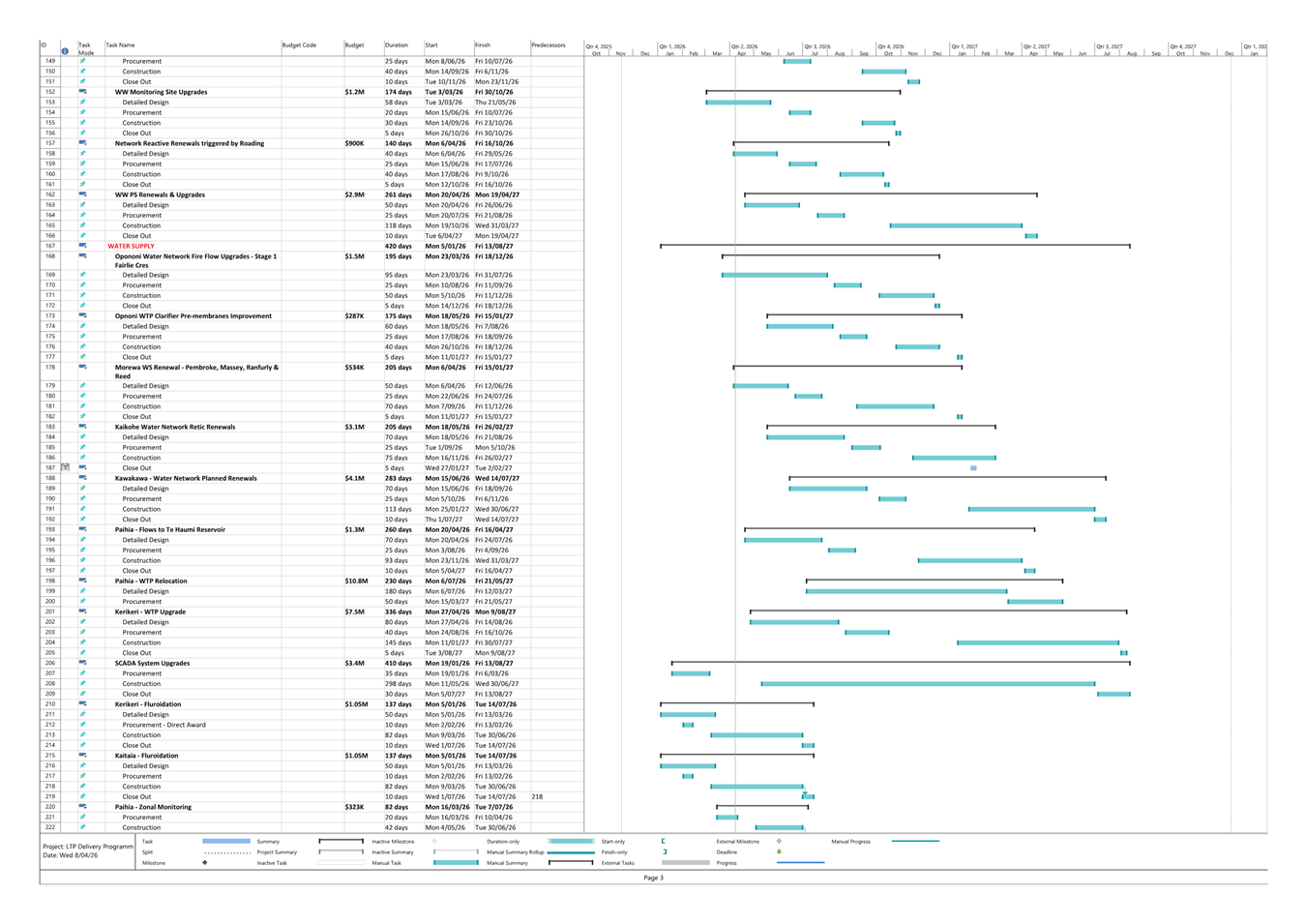
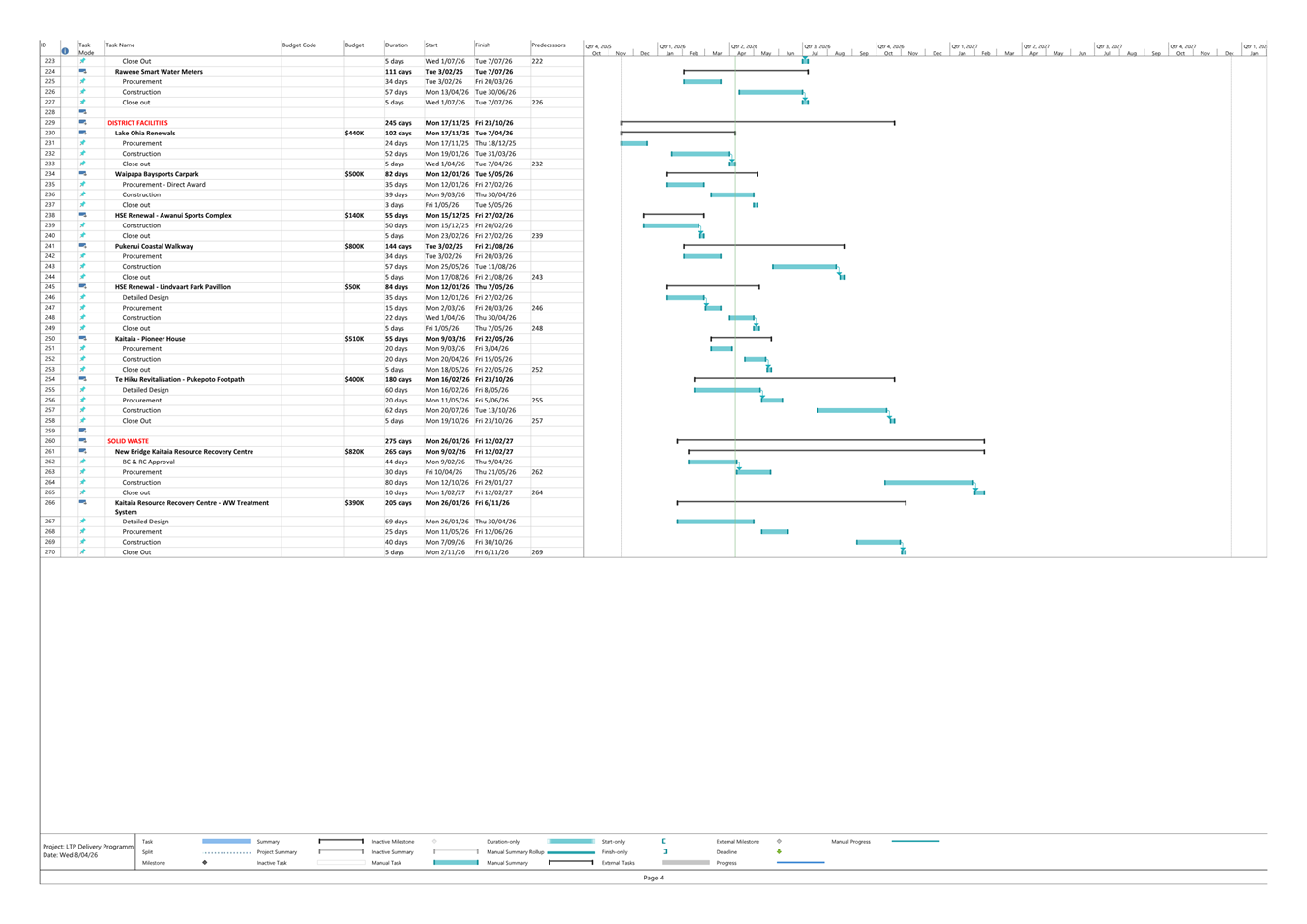
be noted as illustrated in the MS Project Gantt Chart in Appendix 1, that a
number of projects are approaching completion of detailed design and will be
progressed through procurement to contract award within the next 3-4
months. Options are being considered to bundling projects together to
expedite procurement and delivery.
PĀNGA PŪTEA ME NGĀ WĀHANGA
TAHUA / Financial Implications and Budgetary Provision
The 2024-2027
Infrastructure Capital Works Programme has a total approved budget of $158.18
million, of which at the end of March 2026, $67.89 million (42.9%) has been
spent or contractually committed to date. The balance of $90.29 (57.1%)
remains available across the remainder of the current Long Term Plan.
The financial
implications of this report are programme-related rather than project
specific. No additional funding is sought, and there is no change to the
total approved budgets at this stage. The focus is on monitoring delivery
confidence, identifying projects where funding can be effectively utilised with
the current LTP timeframe and recognising where timing adjustments may be
required to avoid underspend and repeated reforecasting.
For water and wastewater
activities, financial planning is also influenced by the planned transfer of
assets and responsibilities to Ngā Wai
o Te Tai Tokerau from 1 July 2027. This requires careful
management of remaining capital commitments to ensure projects delivered prior
to transition are appropriately funded, while projects not achievable within
the current timeframe are identified early and aligned with the next Long Term
Plan and the transition framework.
Any proposed rephasing,
deferral, or transfer of budget arising from programme reviews will be subject
to further reporting and approval through Te Koukou and Council and will be
reflected in future programme forecasts and the development of the 2027–2037
Long Term Plan. There is no immediate impact on rates, debt limits, or funding
sources as a result of this update.
For water and wastewater,
there is an additional transition risk associated with the planned transfer of
assets and responsibilities to Ngā Wai
o Te Tai Tokerau on 1 July 2027. Projects that are not clearly
deliverable prior to this date may require deferral or realignment, and failure
to clearly identify these projects early increases the risk of funding
uncertainty, scope duplication, or misalignment between FNDC and Northland
Waters responsibilities. Active programme management and early decision‑making
are required to mitigate both underspend and transition‑related risks.
Āpitihanga
/ Attachments
1. 2024-2027
Infrastructure Capital Works Programme - 31 March 2026 - A5770144 ⇩ 
1. 2024-2027
Infrastructure Capital Works Programme – 31 March 2026 MS Project Gantt
Chart
6.3 Kaikohe
Infrastructure Acceleration Fund update
File
Number: A5759568
Author: Dave
Collins, DC Civil Services
Authoriser: Tanya
Proctor, Head of Infrastructure
TAKE PŪRONGO / Purpose of the Report
This is an update on
progress to 30 April 2026 of the Kaikohe Infrastructure Acceleration Fund
Programme.
WHAKARĀPOPOTO MATUA / Executive SummarY
· The
Far North District Council has secured $48.6 million through the Infrastructure
Acceleration Fund, with $23 million allocated to Kaikohe for essential water
and wastewater upgrades supporting 365 new homes.
· Key
developments include completed designs for water and wastewater reticulation
and the Taraire Hills Water Treatment Plant. Construction began in late July
2025, with contracts awarded to Bellcon Limited and United Civil Construction
Limited.
· Stakeholder
engagement is ongoing, including a site meeting with NIFF, communications with
local residents and schools, and the launch of a project webpage with ongoing
updates.
· Land
access agreements are now complete ahead of construction, and professional
services have been procured to oversee construction and manage client risk
throughout the project.
· Next
steps involve completing the construction stage on the projects, submitting
funding claims monthly and actioning issues that arise through construction.
|
TŪTOHUNGA
/ Recommendation
That the Te Koukou Committee for Transport and
Infrastructure receive the report Kaikohe Infrastructure Acceleration Fund
update.
|
tĀHUHU KŌRERO / Background
The Infrastructure
Acceleration Fund was established by Central Government to support local
authorities in accelerating core infrastructure investment to enable housing
development. The Far North District Council successfully secured $48.6 million,
with $23 million allocated to Kaikohe for critical water and wastewater
infrastructure upgrades supporting housing developments: the Ex-RSA site,
Wihongi Street and Bisset Road.
The upgrades will
support 365 new homes and will include:
· Water
reticulation
· Water
treatment (Taraire Hills WTP)
· Wastewater
reticulation
· Wastewater
treatment (on hold)
· Stormwater
management (to commence FY26/27)
Design Progress:
· Taraire
Hills water treatment plant: Complete
· Water
reticulation upgrade: Complete
· Wastewater
reticulation upgrade: Complete
· Wastewater
treatment (on hold)
· Stormwater
management (on hold, linked to Wihongi St development)
Construction
Progress:
Contractors
are actively progressing the construction phase across three key infrastructure
contracts, as outlined below:
· Taraire Hills
water treatment plant
Upgrade works at the
plant are progressing across multiple work fronts. The new bolted
stainless-steel treated water reservoir is approximately 75% complete. The roof
structure has been installed and will be jacked into position to allow
fabrication and installation of the final ring of wall panels.
Major process components
for the new treatment plant have been delivered to site, positioned, and onsite
fabrication of interconnecting pipework is underway.
The Taraire Hills Dam
remains drained, with the final stage of the outlet upgrade currently being
completed. This work experienced delays due to adverse weather events in early
April. The water treatment plant continues to operate directly from the Wairoro
Stream, supported by temporary pre-treatment arrangements while the dam is out
of service. The dam is expected to be refilled during the week commencing 11
May, bringing this phase of work to completion.
Upgrade works to the
Wairoro Stream intake were paused during the early April weather events due to
risks to the existing plant’s ability to maintain water supply to Kaikohe
while the dam was offline. As a result, the stream intake works are now on the
project’s critical path and pose a potential risk to the overall
completion date. A resource consent application for a winter works extension is
currently being progressed, and the project funder has being updated. Options
to defer the stream work until the Spring season are being investigate also to
mitigate the risk of poor adverse weather not allowing work in the stream to
progress.
· Water
reticulation upgrade
All upgraded pipes have
been installed; commissioning of these pipes and reinstatement is currently in
progress. Contractual practical completion of the final upgraded pipeline has
been delayed while a Pressure Reducing Valve design was completed. This is now
with the Contractor and the contract works will be completed during May 2026.
· Wastewater
reticulation upgrade
Works continue across
five active work fronts; however, several cost and programme pressures have
emerged that are impacting the overall project financial position. Delays to
critical path activities have arisen due to conflicts with existing power services,
unforeseen underground services, and additional scope required to provide
capacity for planned housing developments. These factors have resulted in
increased construction costs and extended delivery timeframes.
Programme delays and the
associated risk of not achieving funding milestones have been reported to
National Infrastructure Funding and Finance (NIFF). Despite these risks, no
concerns have been raised by the funder to date. Ongoing engagement is being maintained
to ensure continued alignment with funding requirements.
At the Wihongi Street
Pump Station, enabling works have been completed, with ground improvement
piling scheduled to commence on 7 May 2026. Costs associated with this scope
are currently tracking in line with revised forecasts.
The wastewater
reticulation contract was tendered prior to completion of detailed design in
order to meet funding milestone requirements. Since tender award, detailed
design for the remaining components has been finalised and the contractor has
priced the majority of these items. This has resulted in an increase in the
forecast total project cost beyond the currently approved budget.
Options to address the
budget shortfall are under investigation, including the potential reallocation
of funding from the Kaikohe Wastewater Scheme Improvement Renewal budget to
accommodate the additional scope and cost increase. Further cost review and refinement
is underway to understand the full extent of the financial impact and identify
mitigation opportunities.
MATAPAKI ME NGĀ KŌWHIRINGA /
Discussion and Next Steps
· Housing
Development Update
Earthworks
on the Bisset Road development commenced in February 2026 and the contractor is
making good visual progress. Offsite prefabrication of 30 dwellings is under
construction; a further 61 dwellings will be constructed onsite. When completed
the development will be 91 dwellings, this is in line with the housing outcome
agreement. Critical infrastructure upgrades currently in construction will be
complete to enable this development.
An
additional end‑of‑life wastewater pipeline
has been identified for renewal to support the Bisset Road development
connection. The renewal has been designed, and construction will be procured
through the existing wastewater contract to ensure the works are completed
ahead of the housing development connecting to the network.
· Key
Risks
Wastewater
Reticulation – Programme has been delayed due to additional scope
and will affect completion prior to milestone. Funder updates continue to be
submitted in the monthly reporting portal and a Delivery Plan update is
expected from the funder.
The
project is forecasting costs above the approved budget, primarily due to
additional scope required to deliver capacity upgrades supporting housing
growth and higher construction pricing following completion of detailed design
after contract award. Options to address the budget shortfall, including
potential reallocation within Council Kaikohe Wastewater Scheme Improvement
budget, are currently being assessed.
Taraire
Hills Dam – The Taraire Hills dam is still currently drained for
upgrade works that have been delayed with the recent rain events. An increased
risk to operational supply of treated water exists while the plant runs
directly on-stream feed. Additional pretreatment has been implemented to
mitigate quality of water risk however delivery of water risks still exist as
there is no redundancy. This risk is current until approximately 11th
May.
The
Wairoro stream intake upgrade work was paused to mitigate the risk of water
shortage for Kaikohe while the Dam is out of service. As a result, the stream
intake works are now on the project’s critical path and pose a potential
risk to the overall completion date. A resource consent application for a
winter works extension is currently being progressed, and the project funder
has being updated. Options to defer the stream work until the Spring season are
being investigate also to mitigate the risk of poor adverse weather not
allowing work in the stream to progress
· Next
Steps
With
all design phase items now been completed the project focus is currently on
managing the construction phase. Ensuring health & safety, quality,
financial and programme contract commitments are achieved.
Relationship
management with all stakeholders to ensure a smooth project completion is
critical. Ongoing updates to the Far North District Council media releases,
Funder reporting and public relations with effected parties will be
actioned.
The project is
forecasting costs above the approved budget, primarily due to additional scope
required to deliver capacity upgrades supporting housing growth and higher
construction pricing following completion of detailed design after contract
award. Funding risks and programme impacts have been communicated to National
Infrastructure Funding and Finance through monthly reporting. Options to
address the budget shortfall, including potential reallocation within Council
Kaikohe Wastewater Scheme Improvement budget, are currently being assessed.
PĀNGA PŪTEA ME NGĀ WĀHANGA
TAHUA / Financial Implications and Budgetary Provision
Long-Term Plan 2024–2027:
Budget provisions are in place. Stage 1 and 2 milestones have been met and
claims submitted to the funder. Stage 3 (Implementation), monthly construction
claims are being submitted through this stage to the funder.
The project is forecasting costs
above the approved budget, primarily due to additional scope required to
deliver capacity upgrades supporting housing growth and higher construction
pricing following completion of detailed design after contract award. Options
to address the budget shortfall, including potential reallocation within
Council Kaikohe Wastewater Scheme Improvement budget, are currently being
assessed.
Rating Implications: Capital rate
increases expected from FY26/27. Financial planning, internal communications
and community communications will be managed by the Steering Group.
Āpitihanga
/ Attachments
Nil
6.4 Infrastructure
Compliance
File
Number: A5760949
Author: Doug
Astill, Compliance Officer - Infrastructure Services
Authoriser: Tanya
Proctor, Head of Infrastructure
TAKE PŪRONGO / Purpose of the Report
Provide a compliance
status update to Te Koukou Committee of all infrastructure resource consents,
other than Roading, that aligns with the Committee’s Terms of Reference.
WHAKARĀPOPOTO MATUA / Executive SummarY
· Council has many resource
consents, and follows the Resource Management Act 1991, for the operation of water, wastewater,
stormwater and district facility assets.
· Compliance is measured across
all consent conditions, including reporting. Failure
to submit a report on time can
therefore result in a non-compliant status.
· Compliance
results for April were not available at the time of drafting this report.
· A
total of 16 abatement notices
were outstanding on 30
April 2026.
|
TŪTOHUNGA
/ Recommendation
That Te Koukou Committee for Transport and
Infrastructure receive the report Infrastructure Compliance.
|
tĀHUHU KŌRERO / Background
Te Koukou Committee for
Transport and Infrastructure has the following delegated responsibilities for
infrastructure compliance:
· Ensure that
operational functions comply with legislative requirements and Council policy
· Ensure that
consents associated with Council’s infrastructure are being met and
renewals are planned for.
A compliance status
update report for the reporting period ending 31 March 2026 was presented to
the 22 April 2026 Committee meeting. A link to this report is provided for
convenience: Agenda of Te Koukou Committee for Transport and
Infrastructure Meeting - Wednesday, 22 April 2026.
Council is the consent
holder of some 265 resource consents issued by the Regulator, Northland
Regional Council under the Resource Management Act 1991 (RMA), for the
operation of water, wastewater, stormwater, maritime, airports, solid waste
(landfills), sports facilities, campgrounds, and onsite wastewater facilities
for public toilets. These consents contain over 3,600 consent conditions which
set out operational limits/parameters and reporting requirements.
Council must also meet
the legislative requirements of The Water Services Act 2021 for which the
Regulator is Taumata Arowai. Largely these are reporting requirements,
principally annual updates of the Drinking Water Safety Plans including
progress on the delivery of improvements identified.
Failure to comply with
consent conditions or legislative requirements generally results in enforcement
action by the relevant Regulator. For example, Northland Regional Council
issues (RMA) abatement notices notifying the consent holder of the specific breach
with the requirement to stop the breach. Typical breaches for which abatement
notices are issued include exceeding a consent limit/parameter, not keeping
and/or supplying records, not verifying equipment calibration, and not meeting
reporting deadlines.
The Regulator also has
the authority to issue further enforcement action such as fines and
prosecution.
The update provided in
this report takes us to 30 April 2026.
MATAPAKI ME NGĀ KŌWHIRINGA /
Discussion and Next Steps
Operational
Compliance
In the last report:
· Water
treatment - all 8 plants were fully compliant for treatment with 1 plant having
a minor non-compliance for data reporting which will be rectified in April.
· Wastewater
treatment – 4 of 15 plants were fully compliant with 1 plant having a
minor non-compliance for monitoring which has been rectified for April.
· 1
abatement notice from 2024 was resolved and a 2016 notice was superseded by the
issuing of a new abatement notice.
· Significant
progress has been towards achieving compliance for abatement notices issued in
2016 and 2024 with the ongoing delivery of desludging and treatment improvement
works as detailed in Attachment 1 - Abatement Notice Update March 2026.
· 7
abatement notices were received during this reporting period. 1 being a
replacement for a 2016 notice. Of these 7, 1 replaced a 2016 notice, 3 breaches
were rectified immediately and just 1 relates to treatment. Most of the notices
relate to non-compliant reporting or data recording.
· 10
abatement notices were outstanding – water (1), wastewater (7), solid
waste (1), sports complex (1).
What has changed:
· Compliance
results for April 2026 have not been collated at the time of drafting this
report.
· 1
abatement notice from 2024 was resolved, two notices (2016 and 2024) were
superseded by the issuing of new abatement notices.
· 5
abatement notices were received in April. Of these, 1 breach was rectified
immediately, 1 was for non-renewal of a consent issued for a one-year period to
allow for the collection of data, 1 was for unconsented discharges from a
Facilities’ asset, 1 related to incorrect monitoring points, and 1
superseded an existing notice. No new treatment related breaches.
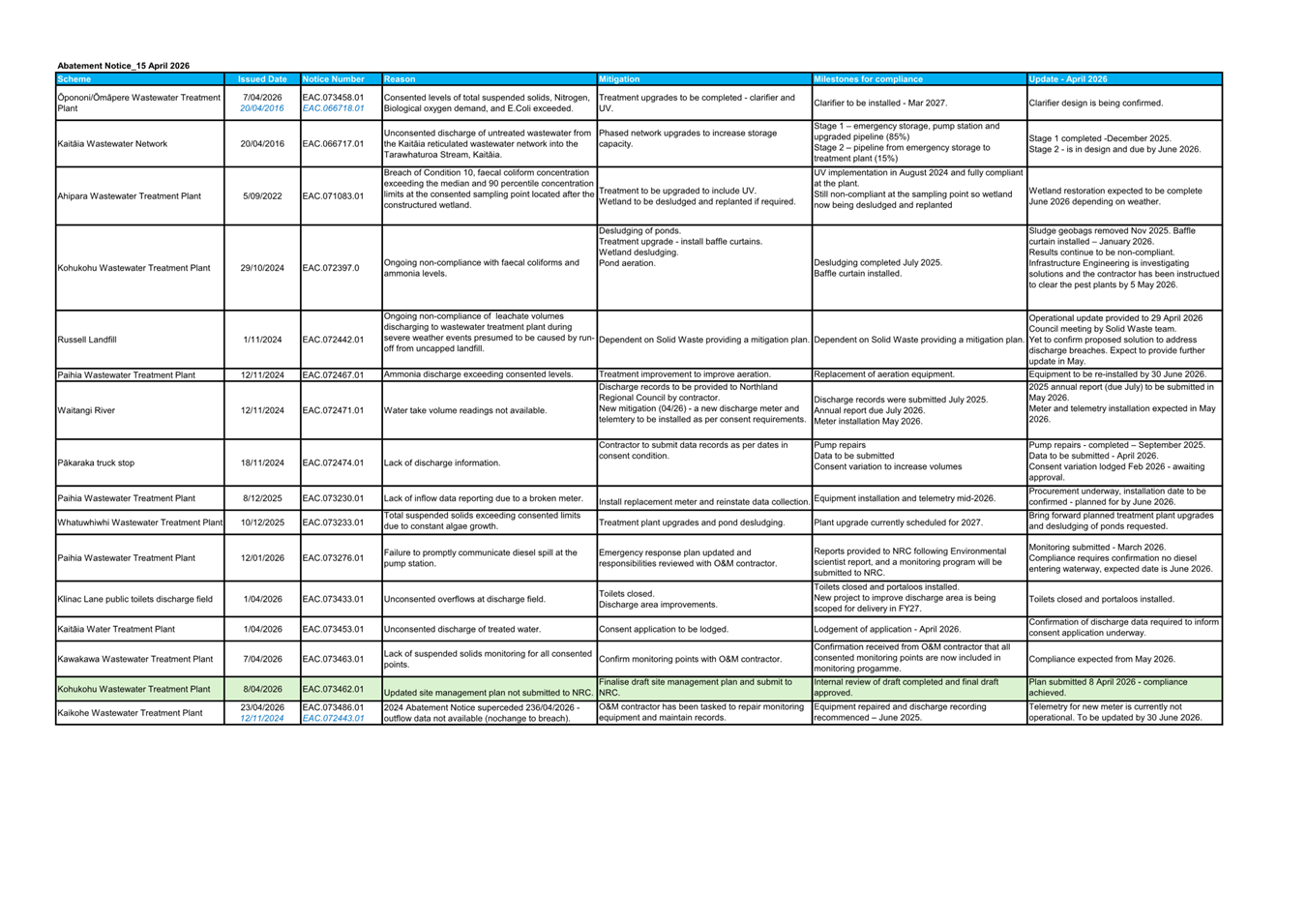
· 16
abatement notices were outstanding – water (2), wastewater (12), solid
waste (1), public toilets (1) – for details refer to Attachment 1 -
Abatement Notice Update April 2026.
Compliance Status
Water and wastewater
treatment compliance results for April 2026 were not available at the time of
drafting this report. Significant weather events continue to affect water and
wastewater treatment which impact compliance. These are managed operationally
and reported to the Regulator as they arise.
Abatement Notice
Update April 2026
Details of all abatement
notices received to 30 April 2026 are included in Attachment 1. Those items
shaded green have been actioned and compliance achieved.
PĀNGA PŪTEA ME NGĀ WĀHANGA
TAHUA / Financial Implications and Budgetary Provision
This is an information report
providing an update
on infrastructure resource
consent compliance.
Minor non-compliances are met from existing operational budgets.
There are existing capital budgets to meet the
cost of planned upgrade works.
No additional financial implications or budgetary provision arises from this report.
Āpitihanga
/ Attachments
1. Abatement
Notice Update_April 2026 - A5760954 ⇩
6.5 Transportation
- Operational Update
File
Number: A5737229
Author: Margriet
Veenstra, Manager - Property Information & Business Compliance
Authoriser: Charlie
Billington, Group Manager - Corporate Services
TAKE PŪRONGO / Purpose of the Report
To present an overview of
Transportation related Maintenance, Operations, and Renewals activities
undertaken during the reporting period and enable committee review, discussion,
and questions.
WHAKARĀPOPOTO MATUA / Executive SummarY
· There
were no serious health and safety incidents to report from any of
Council’s contractors during this reporting period.
· This
report provides an overview of activities undertaken in the following areas
during April 2026:
a) Road
Maintenance and Renewals
b) Hokianga
Ferry Maintenance and Renewals
c) Streetlight
and Amenity Lighting Maintenance and Renewals
· The reports are intended to provide insight
into operational activity completed within the month.
|
TŪTOHUNGA
/ Recommendation
That Te Koukou Committee for Transport and
Infrastructure receive the Transportation - Operational Update.
|
tĀHUHU KŌRERO / Background
General
Key activities during the month included completion of the
2025/26 sealed road rehabilitation and reseal programmes, significant storm
recovery works following severe weather events, ongoing drainage and unsealed
road maintenance, continued operation of the Hokianga Ferry service, and
routine streetlighting maintenance and inspections.
Severe weather events during late March and April resulted
in widespread impacts across both the northern and southern transport networks,
requiring prioritisation of emergency response and recovery works. Further
recovery activity is ongoing and will continue into the next reporting period.
a) Maintenance
Council’s two primary road maintenance contractors,
Fulton Hogan and Ventia, provide monthly reports outlining maintenance,
operations, and renewals activities across the transport network.
Severe and prolonged wet weather during the reporting period
impacted both the northern and southern road networks, requiring contractors to
prioritise emergency response and storm recovery works, which in turn
constrained delivery of some programmed maintenance activities.
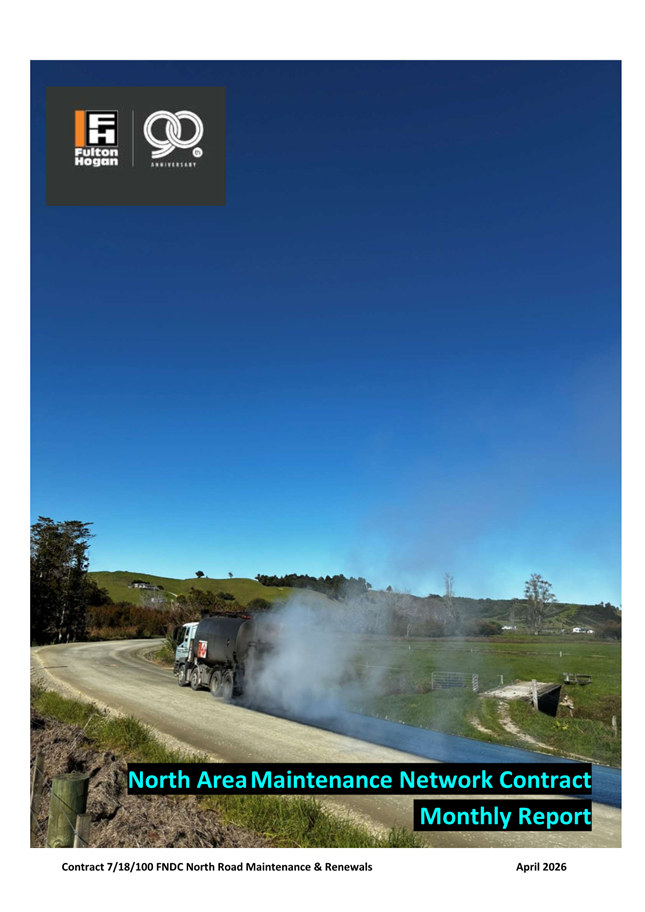
North Area Maintenance Network Contract - Fulton Hogan
Key activities completed during the month included:
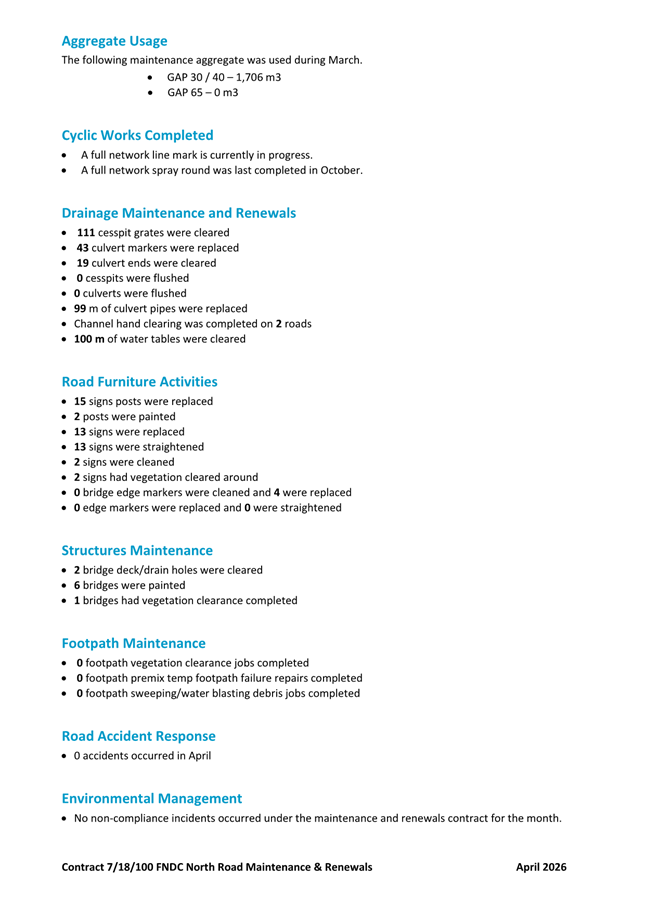
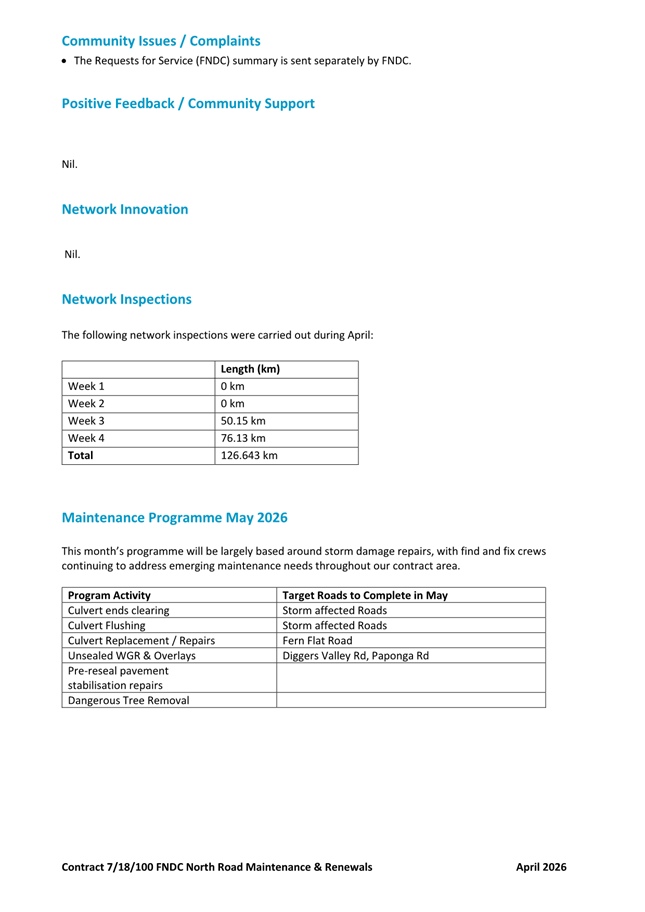
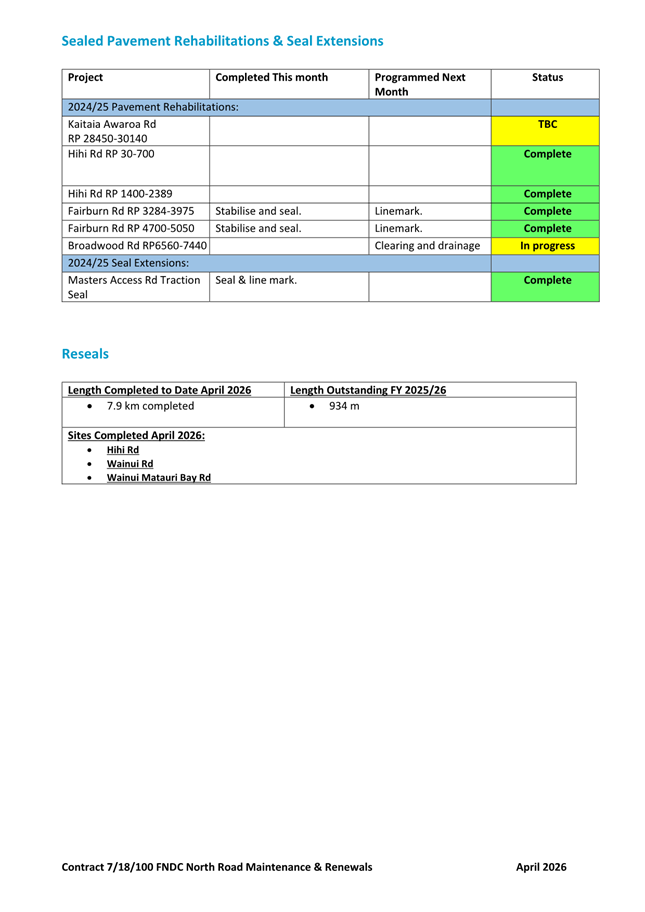
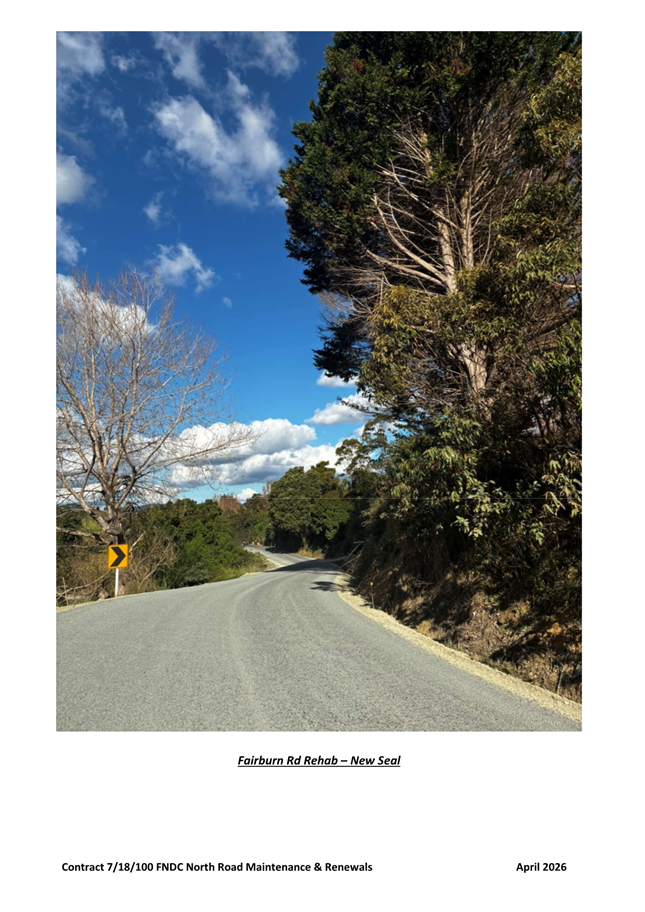
· Completion of the
2025/26 renewals programme, with 3.8 km of pavement rehabilitation and 39 km of
reseals completed.
· Continued storm
damage repairs across North Hokianga, including slip clearing and erosion
repairs.
· Routine
maintenance works including grading, potholing, drainage maintenance, roadside
mowing, and environmental maintenance.
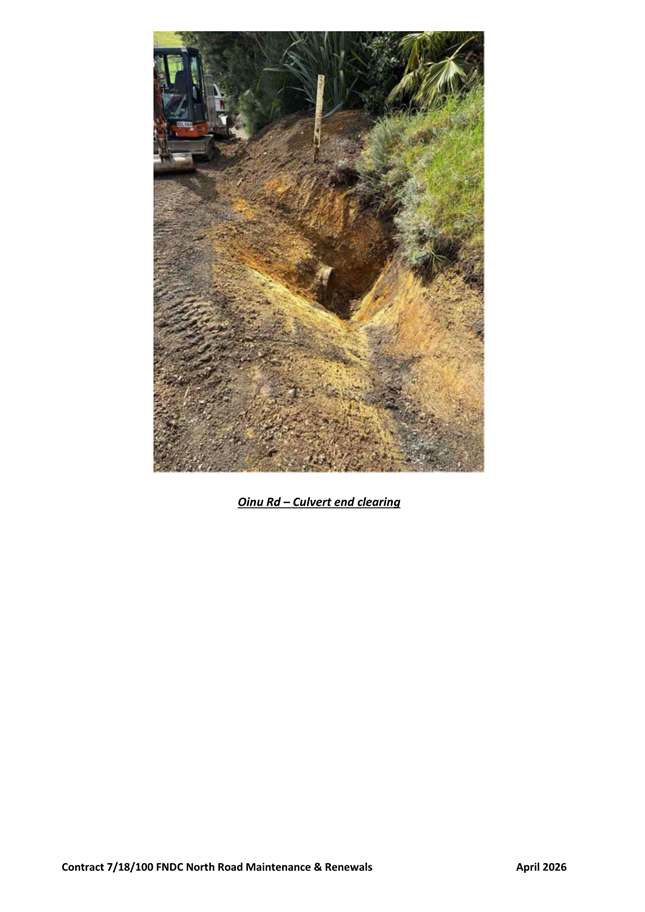
· Drainage works
included cesspit clearing, culvert end clearing, culvert replacements, and
water table maintenance.
Further recovery work planned, subject to funding approval.
South Area Maintenance Network Contract – Ventia
Key activities during the month included:
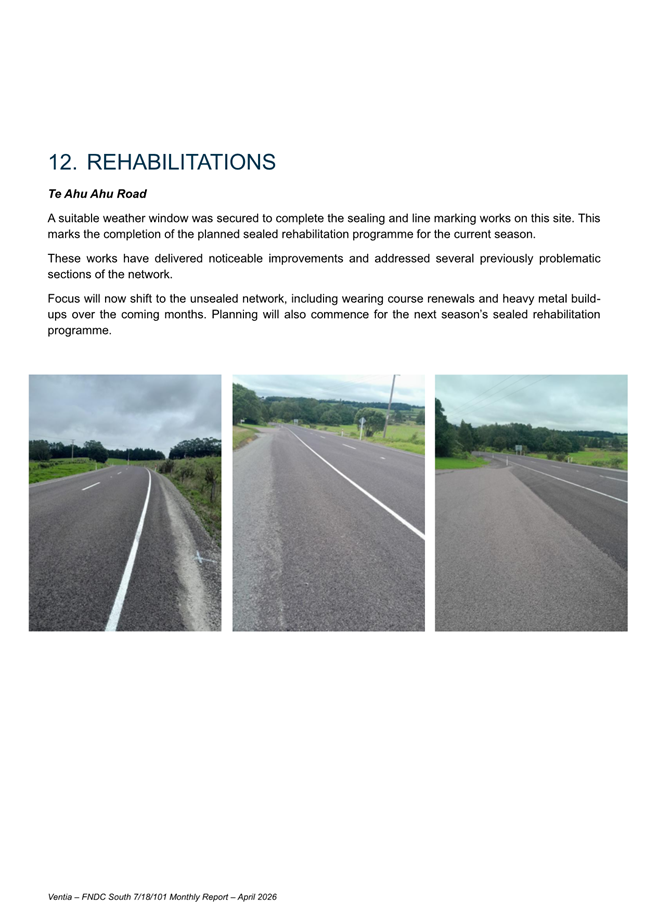
· Completion of the
sealed rehabilitation and reseal programmes for the season, including Te Ahu
Ahu Road and multiple urban and rural sites.
· Significant
emergency works in western areas, particularly Wekaweka Road and Waiotemarama
Gorge Road, with recovery works continuing into May.
· Transition to the
unsealed road programme, including wearing course applications and heavy
metalling.
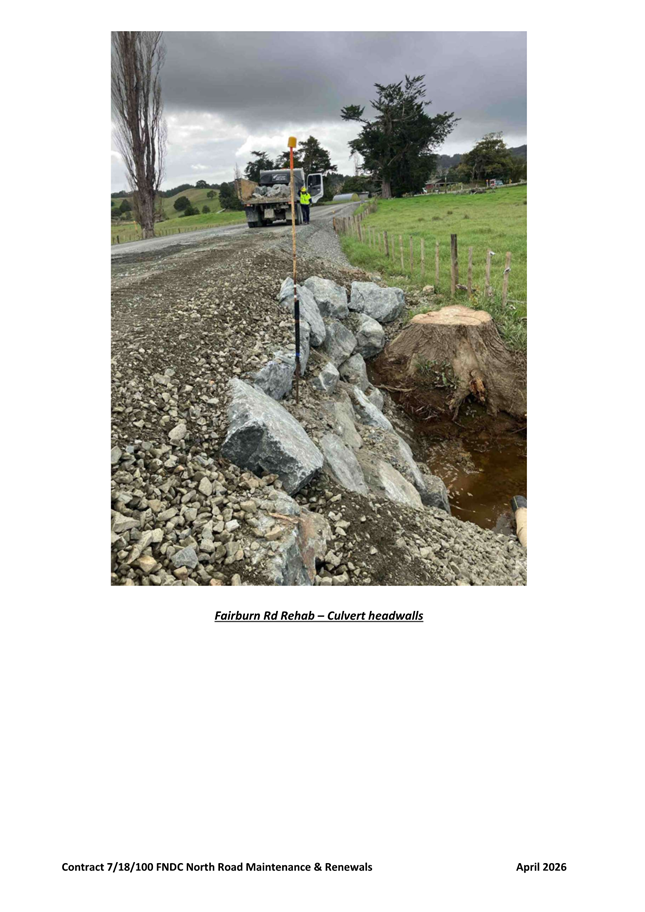
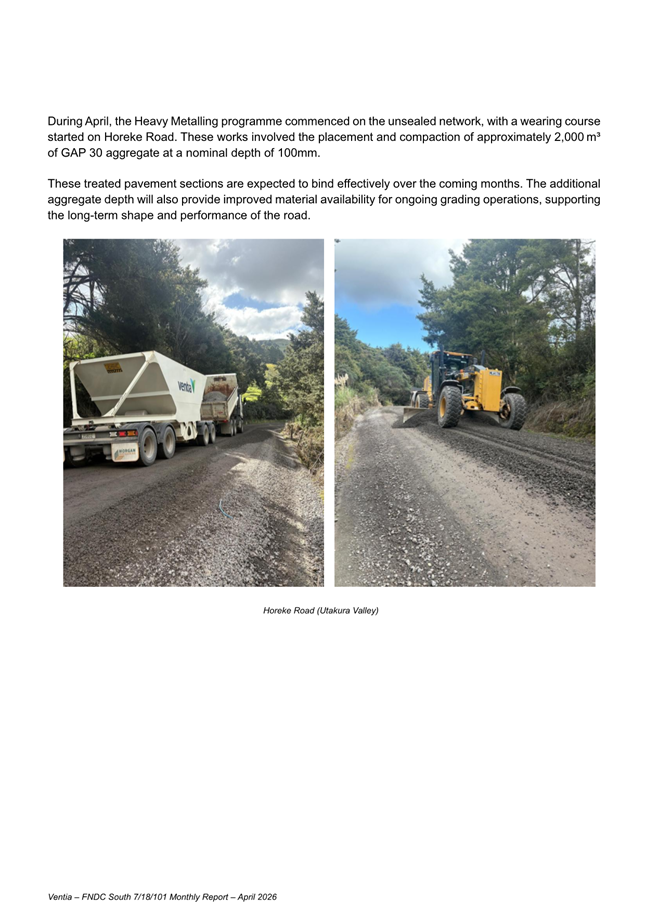
· Drainage
improvements, including water tabling, culvert replacements, culvert flushing,
and construction of headwalls to support network resilience.
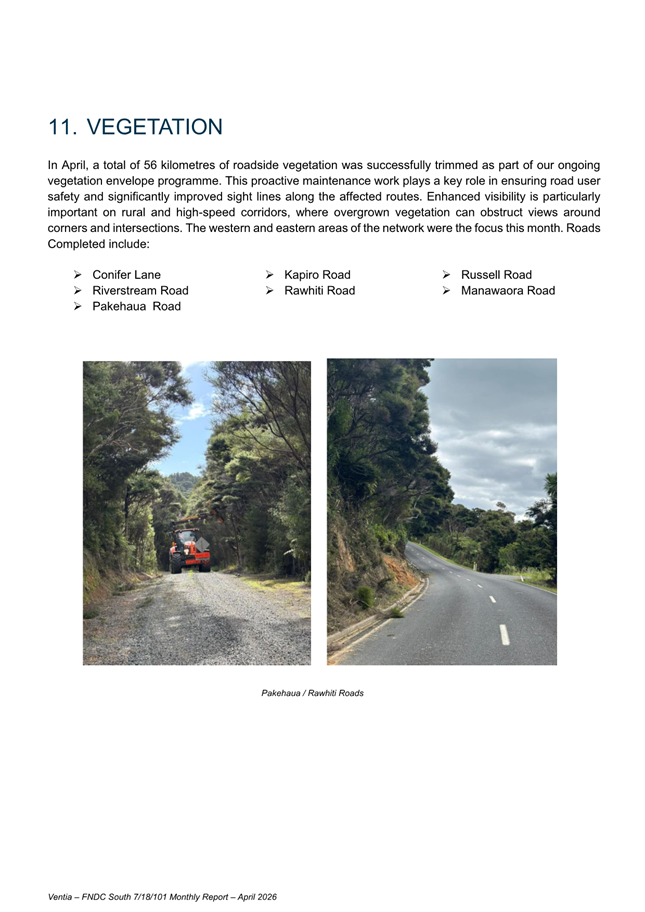
· Routine
maintenance activities including pothole repairs, grading, vegetation control,
signage maintenance, and drainage inspections.
The network has generally
performed well given the volume of rainfall experienced, with further focus
shifting toward winter maintenance activities.
b) Hokianga
Ferry
Northland Ferries Limited
provided the monthly operational update for the Hokianga Ferry service for
April 2026. The ferry service operated reliably throughout the month, with no
health and safety incidents reported. Wind conditions on 12 April resulted in
three scheduled departures being deliberately delayed for operational safety
reasons, an approach endorsed by Council.
Key points for the month
included:
· Ticket
revenue of $35,879 (excluding GST), approximately 21% lower than April 2025,
continuing a monthly downward trend.
· A
higher than usual number of after-hours service requests, considered a one-off
rather than indicative of a trend.
· No
mechanical failures or service disruptions affecting scheduled operations.
· Completion
of planned and preventive maintenance activities in accordance with the
maintenance programme.
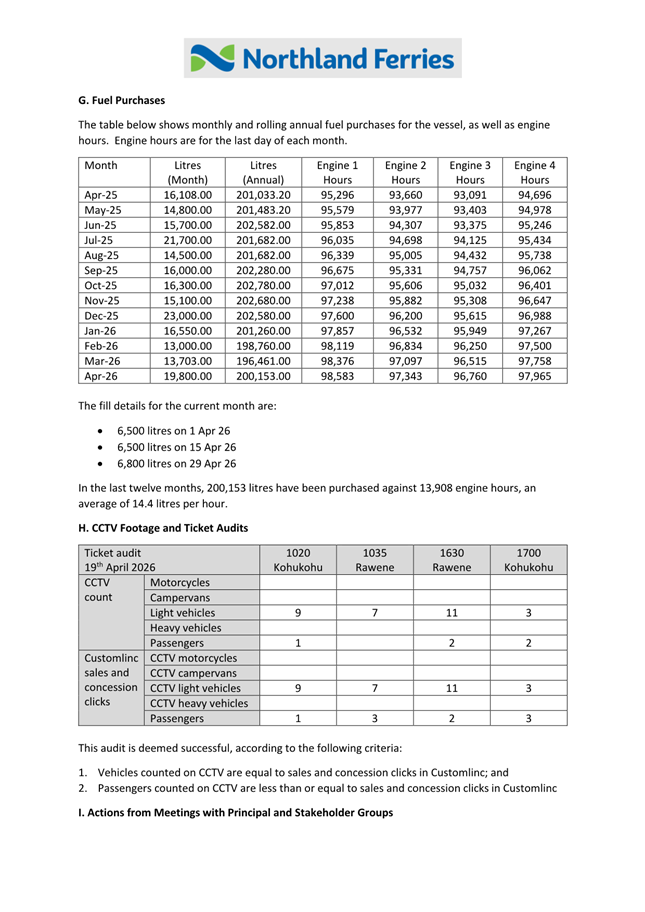
· Successful
CCTV and ticket audits, confirming alignment between ticket sales and observed
vehicle counts.
Discussions regarding pricing
and procurement of specialist mechanical components are ongoing and will be
progressed at the next scheduled contract meeting.
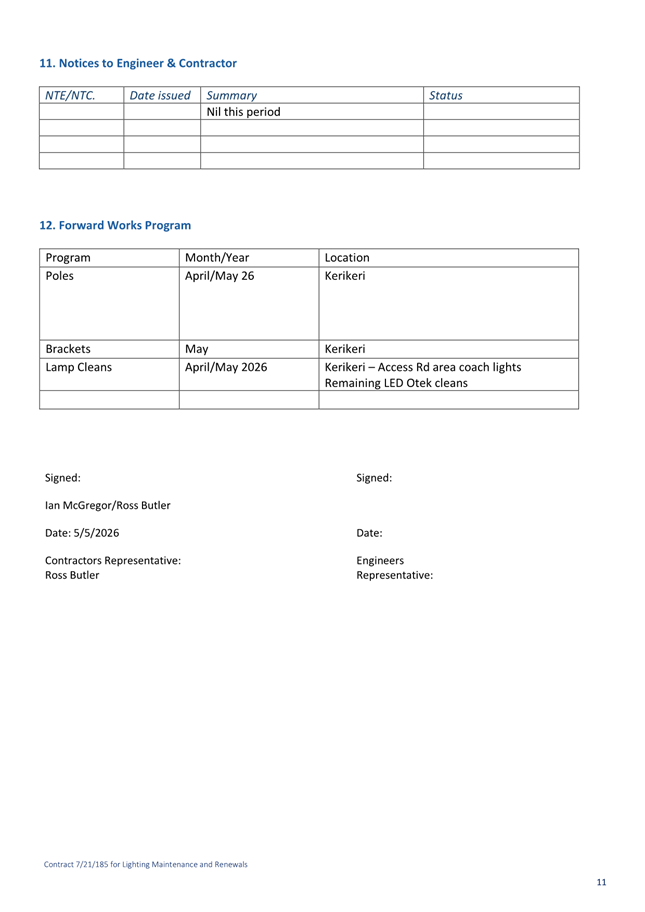
An extension to the Hokianga Ferry
services contract was approved to provide continuity of service.
c) Streetlight
and Amenity Lighting Contract
Council’s streetlighting
contractor completed routine maintenance, inspections, and renewals during
April 2026.
· Completion
of 55 individual work items during the claim period.
· Completion
of cyclic night inspections and routine fault response, with no emergency
callouts required.
· Processing
and resolution of Requests for Service received during the month.
· Ongoing
asset data and system issues within RAMM affecting the closure of some
inspection-related dispatches.
· No
health and safety incidents or near misses reported for the period.
Work continues to address
outstanding inspections and data issues, alongside planned renewals and
maintenance activities.
MATAPAKI ME NGĀ
KŌWHIRINGA / DISCUSSION AND NEXT STEPS
Storm recovery and
network resilience remain a key focus, with further recovery works planned
across both the northern and southern networks. Transition to winter
maintenance programmes is underway, including unsealed road rehabilitations and
drainage works.
Regular
meetings with Portfolio holders will take place to provide updates on the new
maintenance and professional services contracts, clarify reporting, and support
ongoing engagement on transport delivery matters.
PĀNGA PŪTEA ME NGĀ WĀHANGA
TAHUA / Financial Implications and Budgetary Provision
There are no specific financial implications arising from
this report.
Āpitihanga
/ Attachments
1. Road
maintenance contract Monthly report North - A5770016 ⇩ 
2. Road
maintenance contract Monthly report South - A5770018 ⇩
3. Hokianga
Ferry Services Monthly Report-April 2026 (002) - A5770014 ⇩
4. April
2026 Lighting Maintenance and Renewals Monthly Report - A5770013 ⇩
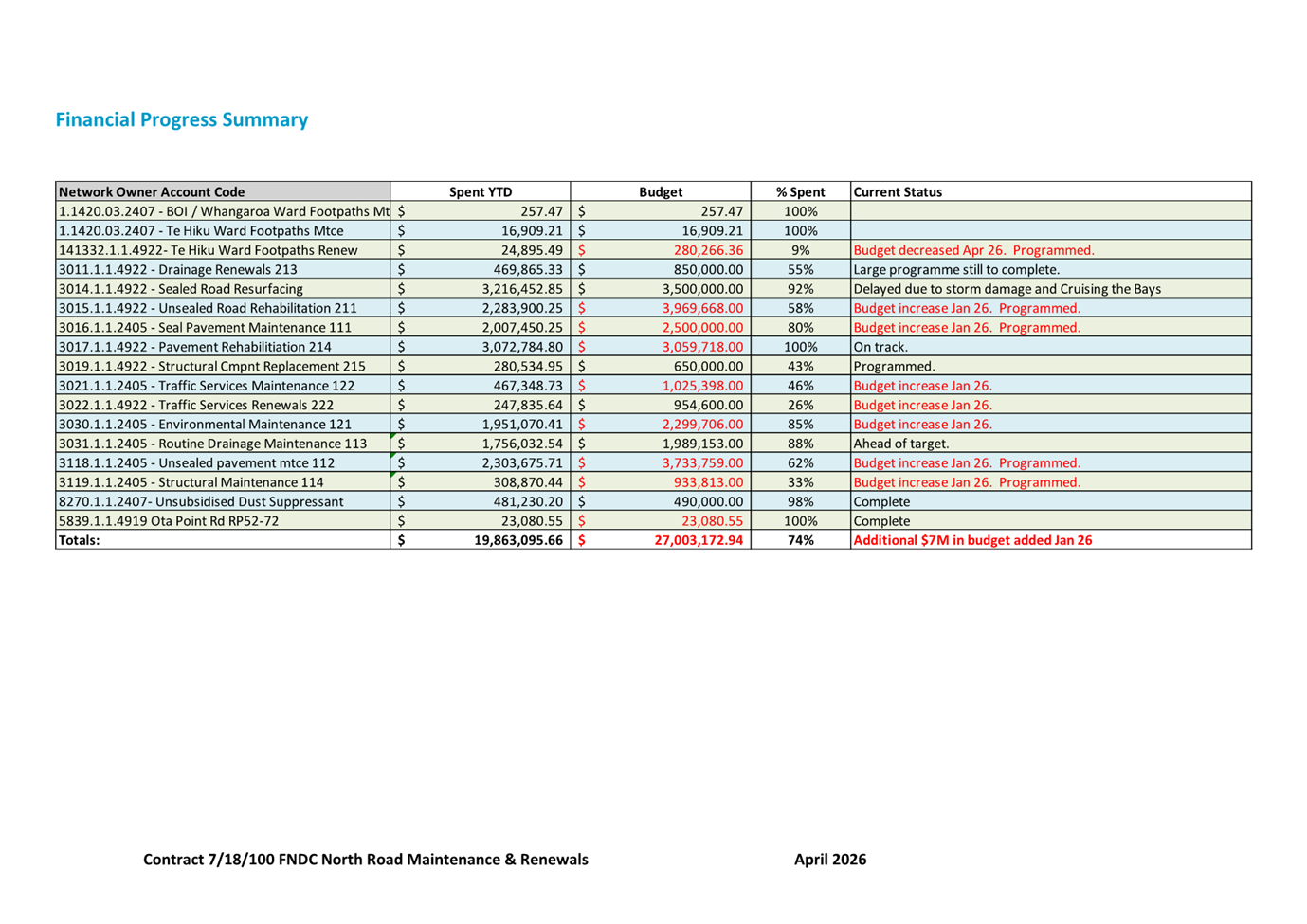
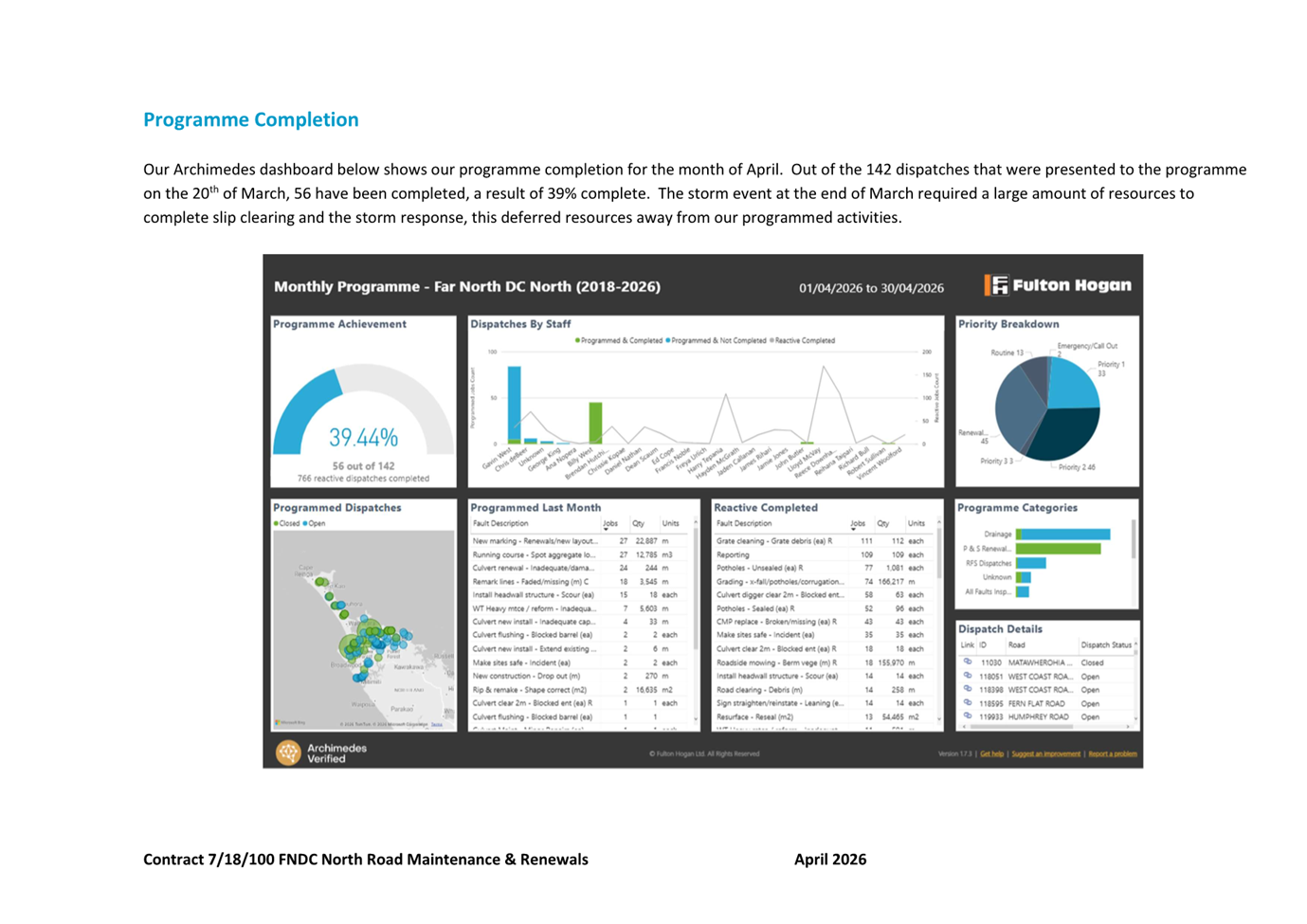
6.6 Transportation
- Road Safety Update
File
Number: A5737244
Author: Margriet
Veenstra, Manager - Property Information & Business Compliance
Authoriser: Charlie
Billington, Group Manager - Corporate Services
TAKE PŪRONGO / Purpose of the Report
The purpose
of this report is to provide an update on the Road Safety Education and
Promotion activities undertaken by Far North REAP in April 2026.
WHAKARĀPOPOTO MATUA / Executive SummarY
Key highlights from the
road safety education and promotion activities are summarised below:
· 4,493
people engaged across the Far North District
· 100%
learners’ licence’s pass rate (35 out of 35 participants)
· 100%
restricted/full licence pass rate (75 of 75 participants)
· Delivery
of education and support across high‑risk
road safety themes including impaired driving, safer speeds, restraints,
distraction and fatigue
· Strong
community engagement through licensed drivers’ courses, workshops,
Heartlands outreach, school initiatives, and community ventures
|
TŪTOHUNGA
/ Recommendation
That Te Koukou Committee for Transport and
Infrastructure receive the report Transportation - Road Safety Update.
|
tĀHUHU KŌRERO / Background
Northland REAP is the organisation
responsible for road safety education and promotion. Their objective is to
enhance road safety outcomes within the Far North District by implementing
proactive educational initiatives and promoting activities that foster a
community-wide commitment to safer use of the transportation system.
MATAPAKI ME NGĀ KŌWHIRINGA /
Discussion and Next Steps
A total of 4,493 community members were engaged through Road
Safety Education and Promotion activities during April 2026.
Programming during the month included learner and
restricted/full licence training, child restraint education, impairment and
fatigue awareness, and safer speed initiatives. Delivery was undertaken through
a mix of community workshops, one‑on‑one licence support,
Heartlands outreach events, school-based initiatives and collaborative ventures
with local providers.
Far North REAP continues to deliver the programme in
accordance with Council’s contracted road safety education outcomes, with
strong participation and consistently high licence pass rates.
PĀNGA PŪTEA ME NGĀ WĀHANGA
TAHUA / Financial Implications and Budgetary Provision
There are no financial
implications associated with this report.
Āpitihanga
/ Attachments
1. RSP
Report - April 2026 - A5771171 ⇩ 
7 Te Wāhanga Tūmataiti
/ Public Excluded
RESOLUTION TO
EXCLUDE THE PUBLIC
|
Recommendation
That the public be excluded from the following parts of
the proceedings of this meeting.
The general subject matter of each matter to be considered
while the public is excluded, the reason for passing this resolution in
relation to each matter, and the specific grounds under section 48 of the
Local Government Official Information and Meetings Act 1987 for the passing
of this resolution are as follows:
|
General subject of each matter to be
considered
|
Reason for passing this resolution in
relation to each matter
|
Ground(s) under section 48 for the
passing of this resolution
|
|
7.1 - Confirmation of Previous Minutes
- Public Excluded
|
s7(2)(h) - the withholding of the information is
necessary to enable Council to carry out, without prejudice or
disadvantage, commercial activities
s7(2)(i) - the withholding of the information is
necessary to enable Council to carry on, without prejudice or disadvantage,
negotiations (including commercial and industrial negotiations)
|
s48(1)(a)(i) - the public conduct of the relevant
part of the proceedings of the meeting would be likely to result in the
disclosure of information for which good reason for withholding would exist
under section 6 or section 7
|
|
7.2 - SCADA Upgrade - Telemetry
Upgrade stage 1 delegation
|
s7(2)(b)(ii) - the withholding of the information
is necessary to protect information where the making available of the
information would be likely unreasonably to prejudice the commercial
position of the person who supplied or who is the subject of the information
s7(2)(h) - the withholding of the information is
necessary to enable Council to carry out, without prejudice or
disadvantage, commercial activities
|
s48(1)(a)(i) - the public conduct of the relevant
part of the proceedings of the meeting would be likely to result in the
disclosure of information for which good reason for withholding would exist
under section 6 or section 7
|
|